Shpogy Secondary School


     RESEARCH WORK IN ENGLISH

 Authors: Laura Lāčauniece,
         Aija Klusa

Adviser: English Language Teacher
            Eva Vovka


              2012
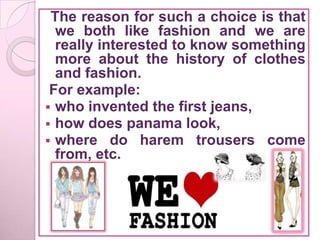
The reason for such a choice is that
  we both like fashion and we are
  really interested to know something
  more about the history of clothes
  and fashion.
 For example:
 who invented the first jeans,
 how does panama look,
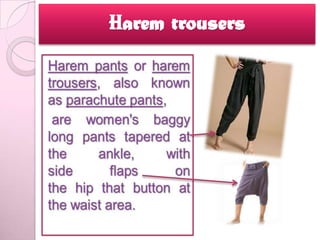
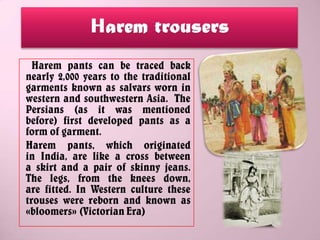
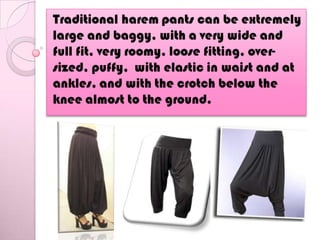
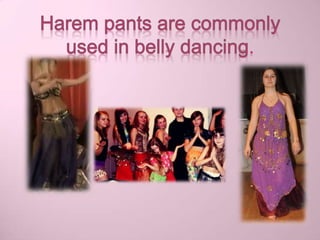
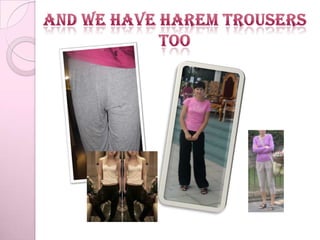
 where do harem trousers come
  from, etc.
GARMENTS
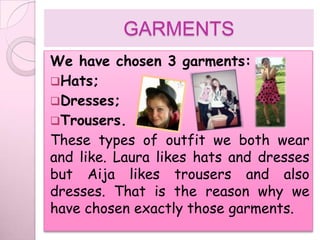
We have chosen 3 garments:
Hats;
Dresses;
Trousers.
These types of outfit we both wear
and like. Laura likes hats and dresses
but Aija likes trousers and also
dresses. That is the reason why we
have chosen exactly those garments.
THE AIM
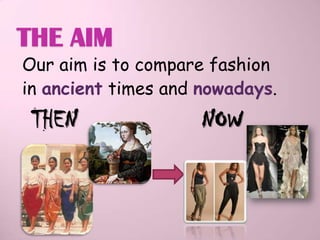
Our aim is to compare fashion
in ancient times and nowadays.
 THEN                NOW
THE TASKS
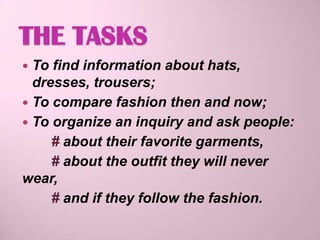
 To find information about hats,
  dresses, trousers;
 To compare fashion then and now;
 To organize an inquiry and ask people:
     # about their favorite garments,
     # about the outfit they will never
wear,
     # and if they follow the fashion.
HATS
                       History
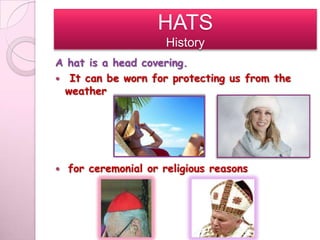
A hat is a head covering.
 It can be worn for protecting us from the
  weather


   for ceremonial or religious reasons
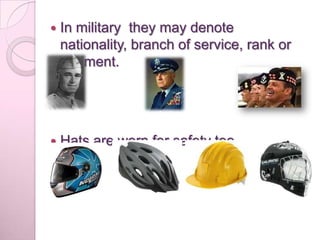
   In military they may denote
    nationality, branch of service, rank or
    regiment.


   Hats are worn for safety too.
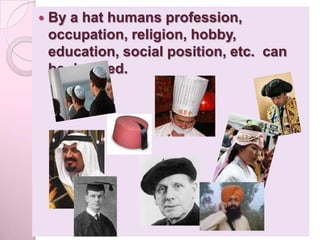
   By a hat humans profession,
    occupation, religion, hobby,
    education, social position, etc. can
    be denoted.
TYPES OF HATS
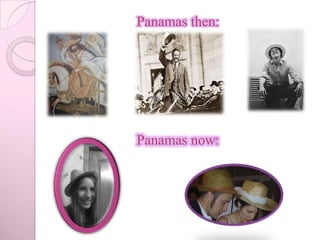
        Panama
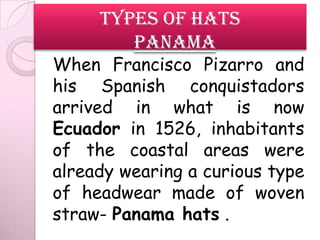
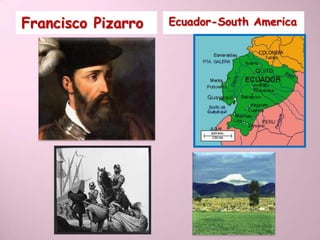
When Francisco Pizarro and
his Spanish conquistadors
arrived in what is now
Ecuador in 1526, inhabitants
of the coastal areas were
already wearing a curious type
of headwear made of woven
straw- Panama hats .
Francisco Pizarro   Ecuador-South America
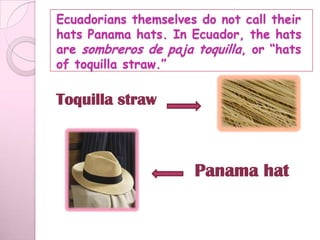
Ecuadorians themselves do not call their
hats Panama hats. In Ecuador, the hats
are sombreros de paja toquilla, or “hats
of toquilla straw.”

Toquilla straw


                      Panama hat
Panamas then:


Panamas now:
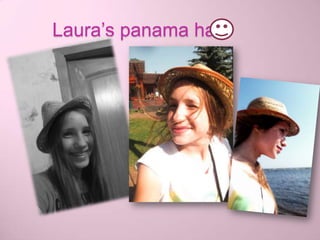
Laura’s panama hat:
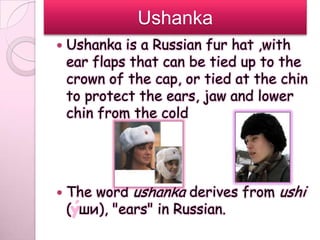
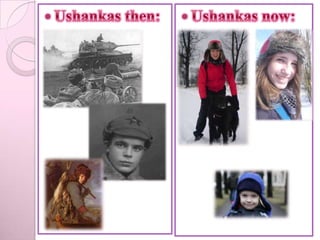
Ushanka
   Ushanka is a Russian fur hat ,with
    ear flaps that can be tied up to the
    crown of the cap, or tied at the chin
    to protect the ears, jaw and lower
    chin from the cold


   The word ushanka derives from ushi
    ( ши), "ears" in Russian.
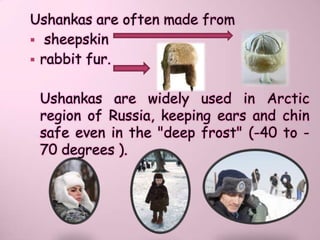
Ushankas are often made from
 sheepskin
 rabbit fur.


 Ushankas are widely used in Arctic
 region of Russia, keeping ears and chin
 safe even in the "deep frost" (-40 to -
 70 degrees ).
Trousers
               history

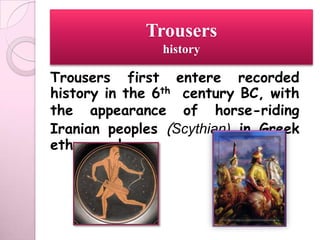
Trousers first entere recorded
history in the 6th century BC, with
the appearance of horse-riding
Iranian peoples (Scythian) in Greek
ethnography.
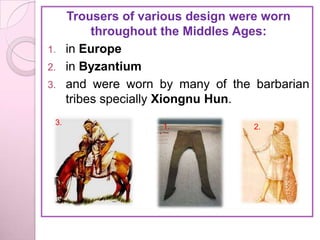
Trousers of various design were worn
        throughout the Middles Ages:
1. in Europe
2. in Byzantium
3. and were worn by many of the barbarian
   tribes specially Xiongnu Hun.
 3.               1.            2.
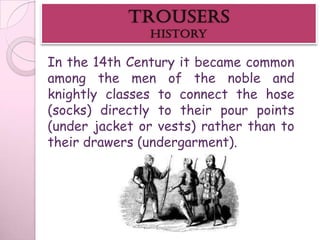
In the 14th Century it became common
among the men of the noble and
knightly classes to connect the hose
(socks) directly to their pour points
(under jacket or vests) rather than to
their drawers (undergarment).
Trousers
                         history
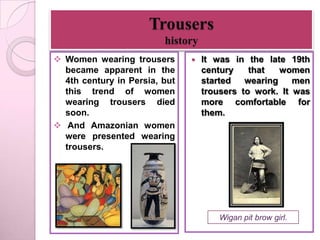
 Women wearing trousers          It was in the late 19th
  became apparent in the           century    that   women
  4th century in Persia, but       started   wearing    men
  this trend of women              trousers to work. It was
  wearing trousers died            more comfortable for
  soon.                            them.
 And Amazonian women
  were presented wearing
  trousers.


                                      Wigan pit brow girl.
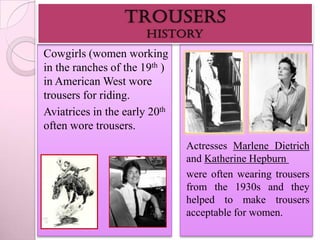
Cowgirls (women working
in the ranches of the 19th )
in American West wore
trousers for riding.
Aviatrices in the early 20th
often wore trousers.
                               Actresses Marlene Dietrich
                               and Katherine Hepburn
                               were often wearing trousers
                               from the 1930s and they
                               helped to make trousers
                               acceptable for women.
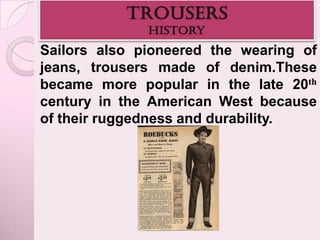
Sailors also pioneered the wearing of
jeans, trousers made of denim.These
became more popular in the late 20th
century in the American West because
of their ruggedness and durability.
TYPES OF TROUSERS
        JEANS
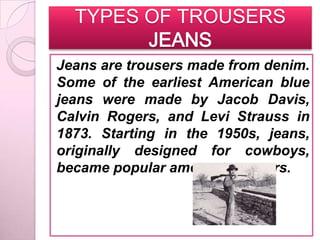
Jeans are trousers made from denim.
Some of the earliest American blue
jeans were made by Jacob Davis,
Calvin Rogers, and Levi Strauss in
1873. Starting in the 1950s, jeans,
originally designed for cowboys,
became popular among teenagers.
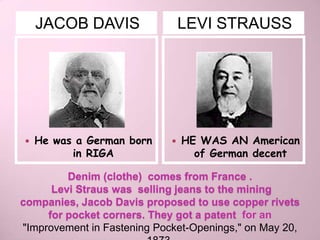
JACOB DAVIS                  LEVI STRAUSS


   He was a German born        HE WAS AN American
          in RIGA                  of German decent

         Denim (clothe) comes from France .
      Levi Straus was selling jeans to the mining
companies, Jacob Davis proposed to use copper rivets
     for pocket corners. They got a patent for an
"Improvement in Fastening Pocket-Openings," on May 20,
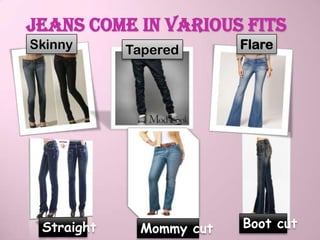
Jeans come in various fits
Skinny      Tapered      Flare


 Straight    Mommy cut   Boot cut
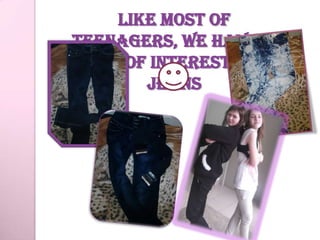
Like most of
teenagers, we have a
  lot of interesting
        jeans
Harem trousers
.
VICTORIAN ERA
  1837-1901
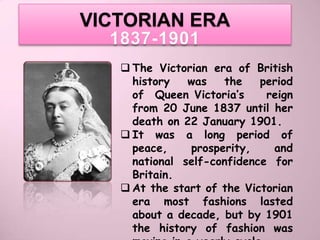
    The Victorian era of British
     history   was   the    period
     of Queen Victoria’s     reign
     from 20 June 1837 until her
     death on 22 January 1901.
    It was a long period of
     peace,    prosperity,    and
     national self-confidence for
     Britain.
    At the start of the Victorian
     era most fashions lasted
     about a decade, but by 1901
     the history of fashion was
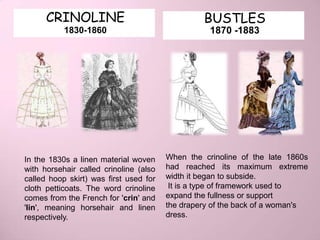
CRINOLINE                                  BUSTLES
           1830-1860                               1870 -1883


In the 1830s a linen material woven     When the crinoline of the late 1860s
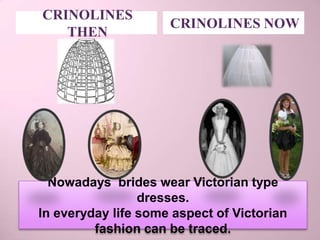
with horsehair called crinoline (also   had reached its maximum extreme
called hoop skirt) was first used for   width it began to subside.
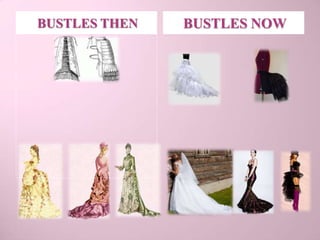
cloth petticoats. The word crinoline     It is a type of framework used to
comes from the French for 'crin' and    expand the fullness or support
'lin', meaning horsehair and linen      the drapery of the back of a woman's
respectively.                           dress.
CRINOLINES
                     CRINOLINES NOW
   THEN


  Nowadays brides wear Victorian type
                 dresses.
In everyday life some aspect of Victorian
         fashion can be traced.
BUSTLES THEN   BUSTLES NOW
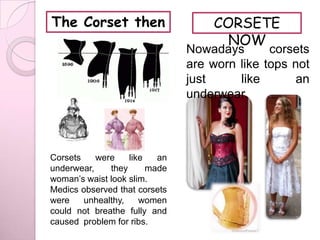
The Corset then                    CORSETE
                                     NOW
                               Nowadays       corsets
                               are worn like tops not
                               just     like       an
                               underwear.


Corsets    were    like   an
underwear,    they      made
woman’s waist look slim.
Medics observed that corsets
were    unhealthy,    women
could not breathe fully and
caused problem for ribs.
DRESSES
        VICTORIAN COSTUMES

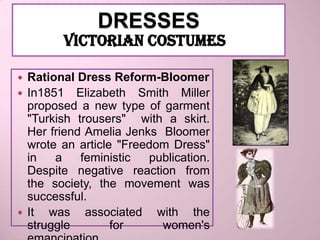
 Rational Dress Reform-Bloomer
 In1851 Elizabeth Smith Miller
  proposed a new type of garment
  "Turkish trousers" with a skirt.
  Her friend Amelia Jenks Bloomer
  wrote an article "Freedom Dress"
  in   a    feministic  publication.
  Despite negative reaction from
  the society, the movement was
  successful.
 It  was associated with the
  struggle        for     women's
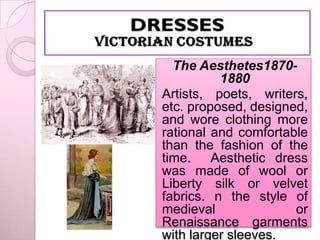
The Aesthetes1870-
          1880
Artists, poets, writers,
etc. proposed, designed,
and wore clothing more
rational and comfortable
than the fashion of the
time. Aesthetic dress
was made of wool or
Liberty silk or velvet
fabrics. n the style of
medieval              or
Renaissance garments
with larger sleeves.
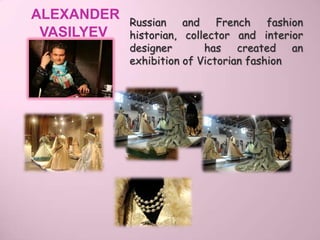
ALEXANDER   Russian    and    French    fashion
 VASILYEV   historian, collector and interior
            designer       has created       an
            exhibition of Victorian fashion

Fashion than and_now

  • 1.
    Shpogy Secondary School RESEARCH WORK IN ENGLISH Authors: Laura Lāčauniece, Aija Klusa Adviser: English Language Teacher Eva Vovka 2012
  • 2.
    The reason forsuch a choice is that we both like fashion and we are really interested to know something more about the history of clothes and fashion. For example:  who invented the first jeans,  how does panama look,  where do harem trousers come from, etc.
  • 3.
    GARMENTS We have chosen3 garments: Hats; Dresses; Trousers. These types of outfit we both wear and like. Laura likes hats and dresses but Aija likes trousers and also dresses. That is the reason why we have chosen exactly those garments.
  • 4.
    THE AIM Our aimis to compare fashion in ancient times and nowadays. THEN NOW
  • 5.
    THE TASKS  Tofind information about hats, dresses, trousers;  To compare fashion then and now;  To organize an inquiry and ask people: # about their favorite garments, # about the outfit they will never wear, # and if they follow the fashion.
  • 6.
    HATS History A hat is a head covering.  It can be worn for protecting us from the weather  for ceremonial or religious reasons
  • 7.
    In military they may denote nationality, branch of service, rank or regiment.  Hats are worn for safety too.
  • 8.
    By a hat humans profession, occupation, religion, hobby, education, social position, etc. can be denoted.
  • 9.
    TYPES OF HATS Panama When Francisco Pizarro and his Spanish conquistadors arrived in what is now Ecuador in 1526, inhabitants of the coastal areas were already wearing a curious type of headwear made of woven straw- Panama hats .
  • 10.
    Francisco Pizarro Ecuador-South America
  • 11.
    Ecuadorians themselves donot call their hats Panama hats. In Ecuador, the hats are sombreros de paja toquilla, or “hats of toquilla straw.” Toquilla straw Panama hat
  • 12.
  • 13.
  • 14.
    Ushanka  Ushanka is a Russian fur hat ,with ear flaps that can be tied up to the crown of the cap, or tied at the chin to protect the ears, jaw and lower chin from the cold  The word ushanka derives from ushi ( ши), "ears" in Russian.
  • 15.
    Ushankas are oftenmade from  sheepskin  rabbit fur. Ushankas are widely used in Arctic region of Russia, keeping ears and chin safe even in the "deep frost" (-40 to - 70 degrees ).
  • 17.
    Trousers history Trousers first entere recorded history in the 6th century BC, with the appearance of horse-riding Iranian peoples (Scythian) in Greek ethnography.
  • 18.
    Trousers of variousdesign were worn throughout the Middles Ages: 1. in Europe 2. in Byzantium 3. and were worn by many of the barbarian tribes specially Xiongnu Hun. 3. 1. 2.
  • 19.
    In the 14thCentury it became common among the men of the noble and knightly classes to connect the hose (socks) directly to their pour points (under jacket or vests) rather than to their drawers (undergarment).
  • 20.
    Trousers history  Women wearing trousers  It was in the late 19th became apparent in the century that women 4th century in Persia, but started wearing men this trend of women trousers to work. It was wearing trousers died more comfortable for soon. them.  And Amazonian women were presented wearing trousers. Wigan pit brow girl.
  • 21.
    Cowgirls (women working inthe ranches of the 19th ) in American West wore trousers for riding. Aviatrices in the early 20th often wore trousers. Actresses Marlene Dietrich and Katherine Hepburn were often wearing trousers from the 1930s and they helped to make trousers acceptable for women.
  • 23.
    Sailors also pioneeredthe wearing of jeans, trousers made of denim.These became more popular in the late 20th century in the American West because of their ruggedness and durability.
  • 24.
    TYPES OF TROUSERS JEANS Jeans are trousers made from denim. Some of the earliest American blue jeans were made by Jacob Davis, Calvin Rogers, and Levi Strauss in 1873. Starting in the 1950s, jeans, originally designed for cowboys, became popular among teenagers.
  • 25.
    JACOB DAVIS LEVI STRAUSS  He was a German born  HE WAS AN American in RIGA of German decent Denim (clothe) comes from France . Levi Straus was selling jeans to the mining companies, Jacob Davis proposed to use copper rivets for pocket corners. They got a patent for an "Improvement in Fastening Pocket-Openings," on May 20,
  • 26.
    Jeans come invarious fits Skinny Tapered Flare Straight Mommy cut Boot cut
  • 27.
    Like most of teenagers,we have a lot of interesting jeans
  • 28.
  • 31.
  • 33.
    VICTORIAN ERA 1837-1901  The Victorian era of British history was the period of Queen Victoria’s reign from 20 June 1837 until her death on 22 January 1901.  It was a long period of peace, prosperity, and national self-confidence for Britain.  At the start of the Victorian era most fashions lasted about a decade, but by 1901 the history of fashion was
  • 34.
    CRINOLINE BUSTLES 1830-1860 1870 -1883 In the 1830s a linen material woven When the crinoline of the late 1860s with horsehair called crinoline (also had reached its maximum extreme called hoop skirt) was first used for width it began to subside. cloth petticoats. The word crinoline It is a type of framework used to comes from the French for 'crin' and expand the fullness or support 'lin', meaning horsehair and linen the drapery of the back of a woman's respectively. dress.
  • 35.
    CRINOLINES CRINOLINES NOW THEN Nowadays brides wear Victorian type dresses. In everyday life some aspect of Victorian fashion can be traced.
  • 36.
    BUSTLES THEN BUSTLES NOW
  • 37.
    The Corset then CORSETE NOW Nowadays corsets are worn like tops not just like an underwear. Corsets were like an underwear, they made woman’s waist look slim. Medics observed that corsets were unhealthy, women could not breathe fully and caused problem for ribs.
  • 38.
    DRESSES VICTORIAN COSTUMES  Rational Dress Reform-Bloomer  In1851 Elizabeth Smith Miller proposed a new type of garment "Turkish trousers" with a skirt. Her friend Amelia Jenks Bloomer wrote an article "Freedom Dress" in a feministic publication. Despite negative reaction from the society, the movement was successful.  It was associated with the struggle for women's
  • 39.
    The Aesthetes1870- 1880 Artists, poets, writers, etc. proposed, designed, and wore clothing more rational and comfortable than the fashion of the time. Aesthetic dress was made of wool or Liberty silk or velvet fabrics. n the style of medieval or Renaissance garments with larger sleeves.
  • 40.
    ALEXANDER Russian and French fashion VASILYEV historian, collector and interior designer has created an exhibition of Victorian fashion