
Family Forms


              Jour nal
 “The happiest moments of my life have
been the few which I have passed at home
       in the bosom of my family.”
             Thomas Jefferson

What have been the happiest memories with
              your family?
Standards and Objectives
• ARFL 8.00          Students will describe effective
  financial management strategies in support of effective
  ways to develop meaningful relations in home and
  family life.
• Identify the family life cycles strengths and weaknesses of
  various family forms.
• Discuss the financial considerations relevant to each stage
  of the life cycle.

• ARR 6.00 Students will identify ways to develop
  meaningful relationships in the family unit.
• List the positive characteristics that affect family
  relationships.
• Identify the family life cycles strengths and weaknesses of
  various family forms.
Millions of Kids
     Family Type                            Number of Children
• Children living in blended families,         • 8 million
  including either a step-parent or step-
  sibling.
• Children living with both natural            • 3.6 million
  parents and full brothers or sisters.
• Children living in extended families         • 7 million
  including other people such as
  uncles, cousins, aunts or
  grandparents.                                • 17 million
• Children living in one-parent (MOM
  only) families.
                                               • 42 million
• Children living in one-parent (DAD
  only) families.                                       2006 statistics
Flexibility,
   adaptability and
tolerance for change
 are helpful skills for
  making family life
        terrific!
Relationship
• What?
  • An interaction between two or more people.
• Who?
  • Parents, siblings, peers, spouse,
    grandparents
• They are constantly changing.
• An individual is going through various
  stages of his life cycle while the family is
  going through its cycle.
Childbearing Family
                                     0-2 1/2 years old

  Leaving                               Family with
  Home                                  Preschoolers 2 ½ - 6 yrs                      y
                 e


                                                                             g
              nc                                                                   pt


                                                                                               t
                                                                        er in


                                                                                           en
                                   g


                          e
                        ag


                                                                      nt ch
             e                                                                   Em est
                                in


           d


                                                                                          m
                     rri
                                 t


        en


                                                                   C e un
                              en


                                        Family with School


                                                                                           e
                    a                                                             N
     ep


                                                                                        tir
                                                                      La
                            r


                   m
                         Pa


   d                                    Children 6 -13 yrs old


                                                                                      Re
In

                                     Parenting adolescents
                                     14-20 yr old


                     Family Life Cycle
Family Life Cycle
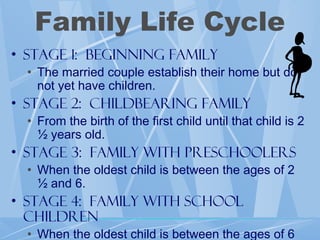
• Stage 1: Beginning Family
  • The married couple establish their home but do
    not yet have children.
• Stage 2: Childbearing Family
  • From the birth of the first child until that child is 2
    ½ years old.
• Stage 3: Family with Preschoolers
  • When the oldest child is between the ages of 2
    ½ and 6.
• Stage 4: Family with School
  Children
  • When the oldest child is between the ages of 6
Family Life Cycle Continued...
• Stage 5: Family with Teenagers
   • When the oldest child is between the
     ages of 13 and 20.
• Stage 6: Launching Center
   • From the time the oldest child leaves
     the family for independent adult life till
     the time the last child leaves.
• Stage 7: Empty Nest
   • From the time the children are gone till
     the marital couple retires from
     employment.
• Stage 8: Aging Family
Activity
• Financial Consideration relevant to
  each stage of the life cycle
Write down your definition
of the stereotypical family.
      • Working dad
      • Stay-at-home
        mom
      • 2 or 3 children


Only 10% of all households
  are in this family form.
American Family Forms
• Living Alone
  • 1 of 24 adults remain single throughout their life.
  • 66% of single people are women.
• POSSLQs
  • Persons of the opposite sex sharing living
    quarters.
  • Couples who live together before marriage,
    divorce just as often as those who marry first.
• Marrying Later in Life
  • Average age to marry: men - 25.9, women -
    23.6
American Family Forms
• Couples Having Children Later in Life
  • More couples are waiting to become parents
    until their careers are established.
  • Estimated cost to raise child is $200,000
• Couples With Fewer Children
  • The average number of children has dropped
    from 3.6 in 1957 to 1.8.
• Couples With No Children
  • Due to career commitments, fertility problems or
    just because they enjoy their childless lifestyles,
    many couples are remaining “Double Income, No
    Kids” couples.
American Family Forms
• Divorced Adults
   • Approximately 60% of all divorces involve
     couples with children in the home.
• Single-Parent Families
   • About 1 in 4 children live with only one parent.
   • The number of single-parent homes has more
     than doubled in the past 20 years
   • Divorced women’s standard of living drops 73%,
     while divorced men jumps 42%.
   • About 50% of the children in divorced families
     report having not seen their father in the last
     year and only 1 of 6 see him once a week.
American Family Forms
• Grown Children Moving In With Their Parents
  • Families with two children and young parents
    living at home with their parents has doubled in
    25 years.
• Grandparents Living With Families
  • With greater longevity, there are more elderly
    people.
• Blended Families
  • Divorced parents, especially fathers are likely to
    remarry.
  • 13% of today’s children are stepchildren
American Family Forms
• Working Mothers
  • The fastest growing segment of the work force is
    women with children under the age of three.
  • More than half of American mothers with infants
    less than a year old are working outside the home.
  • Day care for these children can cost up to ¼ the
    family budget.
  • Working mothers have 15 fewer hours of leisure a
    week than fathers.
Scenarios
• Your marriage is headed for divorce.
  • How would you settle property, child custody,
    divorce costs?
• You are a single mother.
  • How will you cope emotionally and financially?
• Elderly parents need to move in with you.
  • What conflicts and adjustments will arise?
• You just remarried.
  • How will family discipline be handled? How will
    household chores be divided? What name do
    you expect the children to call you? Where
    should you live? How should you divide
Family Forms Quiz
How Strong IS Your FamIlY?
        tradItIonS


Have this completed for
   next class period.

Family forms

  • 1.
    Family Forms Jour nal “The happiest moments of my life have been the few which I have passed at home in the bosom of my family.” Thomas Jefferson What have been the happiest memories with your family?
  • 2.
    Standards and Objectives •ARFL 8.00 Students will describe effective financial management strategies in support of effective ways to develop meaningful relations in home and family life. • Identify the family life cycles strengths and weaknesses of various family forms. • Discuss the financial considerations relevant to each stage of the life cycle. • ARR 6.00 Students will identify ways to develop meaningful relationships in the family unit. • List the positive characteristics that affect family relationships. • Identify the family life cycles strengths and weaknesses of various family forms.
  • 3.
    Millions of Kids Family Type Number of Children • Children living in blended families, • 8 million including either a step-parent or step- sibling. • Children living with both natural • 3.6 million parents and full brothers or sisters. • Children living in extended families • 7 million including other people such as uncles, cousins, aunts or grandparents. • 17 million • Children living in one-parent (MOM only) families. • 42 million • Children living in one-parent (DAD only) families. 2006 statistics
  • 4.
    Flexibility, adaptability and tolerance for change are helpful skills for making family life terrific!
  • 5.
    Relationship • What? • An interaction between two or more people. • Who? • Parents, siblings, peers, spouse, grandparents • They are constantly changing. • An individual is going through various stages of his life cycle while the family is going through its cycle.
  • 6.
    Childbearing Family 0-2 1/2 years old Leaving Family with Home Preschoolers 2 ½ - 6 yrs y e g nc pt t er in en g e ag nt ch e Em est in d m rri t en C e un en Family with School e a N ep tir La r m Pa d Children 6 -13 yrs old Re In Parenting adolescents 14-20 yr old Family Life Cycle
  • 7.
    Family Life Cycle •Stage 1: Beginning Family • The married couple establish their home but do not yet have children. • Stage 2: Childbearing Family • From the birth of the first child until that child is 2 ½ years old. • Stage 3: Family with Preschoolers • When the oldest child is between the ages of 2 ½ and 6. • Stage 4: Family with School Children • When the oldest child is between the ages of 6
  • 8.
    Family Life CycleContinued... • Stage 5: Family with Teenagers • When the oldest child is between the ages of 13 and 20. • Stage 6: Launching Center • From the time the oldest child leaves the family for independent adult life till the time the last child leaves. • Stage 7: Empty Nest • From the time the children are gone till the marital couple retires from employment. • Stage 8: Aging Family
  • 9.
    Activity • Financial Considerationrelevant to each stage of the life cycle
  • 10.
    Write down yourdefinition of the stereotypical family. • Working dad • Stay-at-home mom • 2 or 3 children Only 10% of all households are in this family form.
  • 11.
    American Family Forms •Living Alone • 1 of 24 adults remain single throughout their life. • 66% of single people are women. • POSSLQs • Persons of the opposite sex sharing living quarters. • Couples who live together before marriage, divorce just as often as those who marry first. • Marrying Later in Life • Average age to marry: men - 25.9, women - 23.6
  • 12.
    American Family Forms •Couples Having Children Later in Life • More couples are waiting to become parents until their careers are established. • Estimated cost to raise child is $200,000 • Couples With Fewer Children • The average number of children has dropped from 3.6 in 1957 to 1.8. • Couples With No Children • Due to career commitments, fertility problems or just because they enjoy their childless lifestyles, many couples are remaining “Double Income, No Kids” couples.
  • 13.
    American Family Forms •Divorced Adults • Approximately 60% of all divorces involve couples with children in the home. • Single-Parent Families • About 1 in 4 children live with only one parent. • The number of single-parent homes has more than doubled in the past 20 years • Divorced women’s standard of living drops 73%, while divorced men jumps 42%. • About 50% of the children in divorced families report having not seen their father in the last year and only 1 of 6 see him once a week.
  • 14.
    American Family Forms •Grown Children Moving In With Their Parents • Families with two children and young parents living at home with their parents has doubled in 25 years. • Grandparents Living With Families • With greater longevity, there are more elderly people. • Blended Families • Divorced parents, especially fathers are likely to remarry. • 13% of today’s children are stepchildren
  • 15.
    American Family Forms •Working Mothers • The fastest growing segment of the work force is women with children under the age of three. • More than half of American mothers with infants less than a year old are working outside the home. • Day care for these children can cost up to ¼ the family budget. • Working mothers have 15 fewer hours of leisure a week than fathers.
  • 16.
    Scenarios • Your marriageis headed for divorce. • How would you settle property, child custody, divorce costs? • You are a single mother. • How will you cope emotionally and financially? • Elderly parents need to move in with you. • What conflicts and adjustments will arise? • You just remarried. • How will family discipline be handled? How will household chores be divided? What name do you expect the children to call you? Where should you live? How should you divide
  • 17.
  • 18.
    How Strong ISYour FamIlY? tradItIonS Have this completed for next class period.

Editor's Notes

  • #10 Life Cycle of Financial Planning from FEFE http://fefe.arizona.edu/curriculum.php?categoryID=13#38