PPT 10-hr. GeneralIndustry – Fall Protection v.03.01.17
1
Created by OTIEC Outreach Resources Workgroup
Fall Protection
OSHA 10-hour Outreach Training
2.
PPT 10-hr. GeneralIndustry – Fall Protection v.03.01.17
2
Created by OTIEC Outreach Resources Workgroup
Introduction
Fatal Fall
Eighteen-Year-Old Sporting Goods
Retail Store Worker Dies in a Fall
From a Shelving Unit - Pennsylvania
NIOSH In-house FACE Report 2001-06
3.
PPT 10-hr. GeneralIndustry – Fall Protection v.03.01.17
3
Created by OTIEC Outreach Resources Workgroup
Introduction
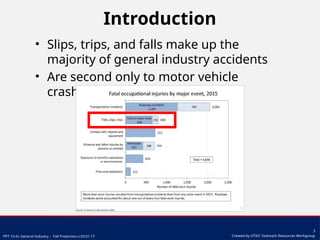
• Slips, trips, and falls make up the
majority of general industry accidents
• Are second only to motor vehicle
crashes
4.
PPT 10-hr. GeneralIndustry – Fall Protection v.03.01.17
4
Created by OTIEC Outreach Resources Workgroup
Introduction
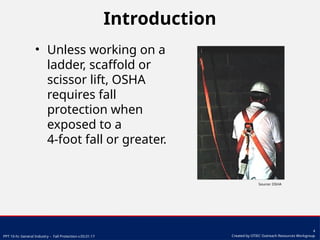
• Unless working on a
ladder, scaffold or
scissor lift, OSHA
requires fall
protection when
exposed to a
4-foot fall or greater.
Source: OSHA
5.
PPT 10-hr. GeneralIndustry – Fall Protection v.03.01.17
5
Created by OTIEC Outreach Resources Workgroup
Introduction
Lesson Objectives
1. Identify types of fall hazards associated
with workplace environments.
2. Identify methods to eliminate or
protect against fall hazards.
6.
PPT 10-hr. GeneralIndustry – Fall Protection v.03.01.17
6
Created by OTIEC Outreach Resources Workgroup
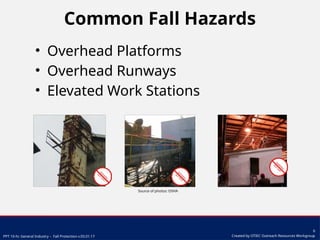
Common Fall Hazards
• Overhead Platforms
• Overhead Runways
• Elevated Work Stations
Source of photos: OSHA
7.
PPT 10-hr. GeneralIndustry – Fall Protection v.03.01.17
7
Created by OTIEC Outreach Resources Workgroup
Common Fall Hazards
• Floor Openings/Pits
• Wall Openings
• Shelving Units
Source of photos: OSHA
8.
PPT 10-hr. GeneralIndustry – Fall Protection v.03.01.17
8
Created by OTIEC Outreach Resources Workgroup
Common Fall Hazards
• Stationary Storage Tanks
• Tanker Trucks
• Industrial Production Units
Source: WVU Source: OSHA Source: OSHA
9.
PPT 10-hr. GeneralIndustry – Fall Protection v.03.01.17
9
Created by OTIEC Outreach Resources Workgroup
Fall Hazard Controls
Hierarchy of Fall Hazard Control:
• First line of defense
– Eliminate the fall hazard
• Second line of defense
– Prevent the fall
• Third and last resort
– Control the fall
10.
PPT 10-hr. GeneralIndustry – Fall Protection v.03.01.17
10
Created by OTIEC Outreach Resources Workgroup
Fall Hazard Controls
Eliminate fall hazards
– work from the
ground
• Gauge at top of tank
moved to ground level
• Use drone, equipped
with camera, for
inspections at heights
Source: WVU
11.
PPT 10-hr. GeneralIndustry – Fall Protection v.03.01.17
11
Created by OTIEC Outreach Resources Workgroup
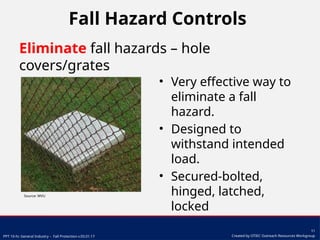
• Very effective way to
eliminate a fall
hazard.
• Designed to
withstand intended
load.
• Secured-bolted,
hinged, latched,
locked
Source: WVU
Fall Hazard Controls
Eliminate fall hazards – hole
covers/grates
12.
PPT 10-hr. GeneralIndustry – Fall Protection v.03.01.17
12
Created by OTIEC Outreach Resources Workgroup
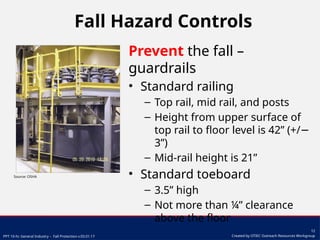
Fall Hazard Controls
Prevent the fall –
guardrails
• Standard railing
– Top rail, mid rail, and posts
– Height from upper surface of
top rail to floor level is 42” (+/−
3”)
– Mid-rail height is 21”
• Standard toeboard
– 3.5” high
– Not more than ¼” clearance
above the floor
Source: OSHA
13.
PPT 10-hr. GeneralIndustry – Fall Protection v.03.01.17
13
Created by OTIEC Outreach Resources Workgroup
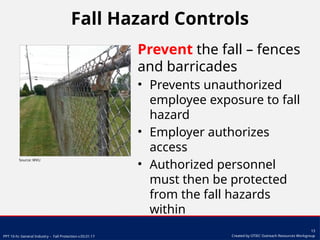
Prevent the fall – fences
and barricades
• Prevents unauthorized
employee exposure to fall
hazard
• Employer authorizes
access
• Authorized personnel
must then be protected
from the fall hazards
within
Source: WVU
Fall Hazard Controls
14.
PPT 10-hr. GeneralIndustry – Fall Protection v.03.01.17
14
Created by OTIEC Outreach Resources Workgroup
Fall Hazard Controls
Source: OSHA
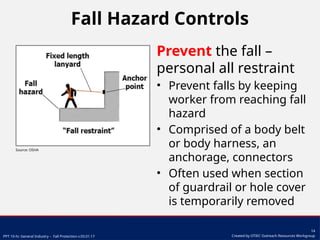
Prevent the fall –
personal all restraint
• Prevent falls by keeping
worker from reaching fall
hazard
• Comprised of a body belt
or body harness, an
anchorage, connectors
• Often used when section
of guardrail or hole cover
is temporarily removed
15.
PPT 10-hr. GeneralIndustry – Fall Protection v.03.01.17
15
Created by OTIEC Outreach Resources Workgroup
Fall Hazard Controls
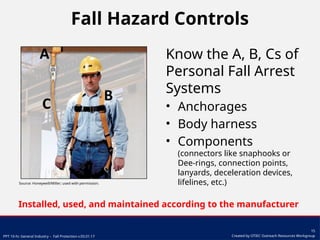
Know the A, B, Cs of
Personal Fall Arrest
Systems
• Anchorages
• Body harness
• Components
(connectors like snaphooks or
Dee-rings, connection points,
lanyards, deceleration devices,
lifelines, etc.)
Installed, used, and maintained according to the manufacturer
Source: Honeywell/Miller; used with permission.
16.
PPT 10-hr. GeneralIndustry – Fall Protection v.03.01.17
16
Created by OTIEC Outreach Resources Workgroup
Fall Hazard Controls
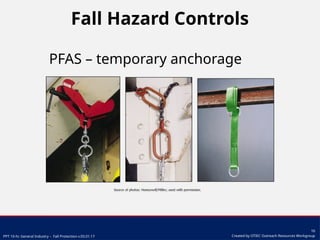
PFAS – temporary anchorage
17.
PPT 10-hr. GeneralIndustry – Fall Protection v.03.01.17
17
Created by OTIEC Outreach Resources Workgroup
Fall Hazard Controls
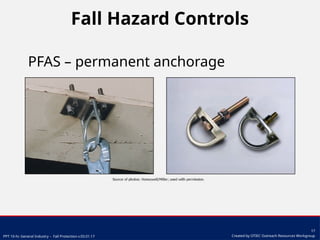
PFAS – permanent anchorage
18.
PPT 10-hr. GeneralIndustry – Fall Protection v.03.01.17
18
Created by OTIEC Outreach Resources Workgroup
Fall Hazard Controls
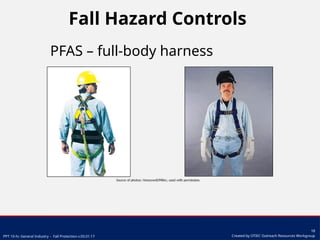
PFAS – full-body harness
19.
PPT 10-hr. GeneralIndustry – Fall Protection v.03.01.17
19
Created by OTIEC Outreach Resources Workgroup
Fall Hazard Controls
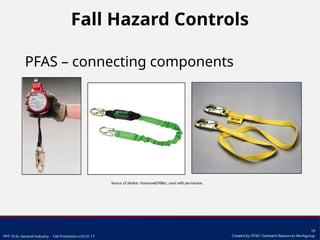
PFAS – connecting components
20.
PPT 10-hr. GeneralIndustry – Fall Protection v.03.01.17
20
Created by OTIEC Outreach Resources Workgroup
Control the fall –
positioning devices
• Consists of a body
belt and connecting
device
• Keeps workers from
falling, while allowing
their hands to be free
to perform work
Source: OSHA
Fall Hazard Controls
21.
PPT 10-hr. GeneralIndustry – Fall Protection v.03.01.17
21
Created by OTIEC Outreach Resources Workgroup
Source: OSHA
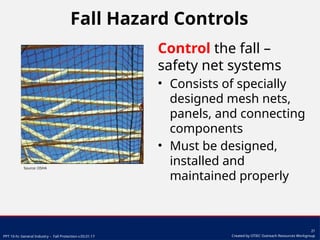
Control the fall –
safety net systems
• Consists of specially
designed mesh nets,
panels, and connecting
components
• Must be designed,
installed and
maintained properly
Fall Hazard Controls
22.
PPT 10-hr. GeneralIndustry – Fall Protection v.03.01.17
22
Created by OTIEC Outreach Resources Workgroup
Employer Requirements
Training – your employer must train
you on the following:
• Fall hazards associated with your facility
and your work
• Methods used to protect you from those
hazards
• Proper and safe use of any personal fall
arrest, positioning, or fall restraint
systems
• Applicable OSHA standards
23.
PPT 10-hr. GeneralIndustry – Fall Protection v.03.01.17
23
Created by OTIEC Outreach Resources Workgroup
Employer Requirements
Inspection
• Your employer must inspect the:
– workplace for existing and potential fall
hazards
– fall hazard controls used; such as guardrails,
covers, grates, and anchorage points
• You must inspect your PFAS, Positioning
and Fall Restraint hardware before each
use.
24.
PPT 10-hr. GeneralIndustry – Fall Protection v.03.01.17
24
Created by OTIEC Outreach Resources Workgroup
Employer Requirements
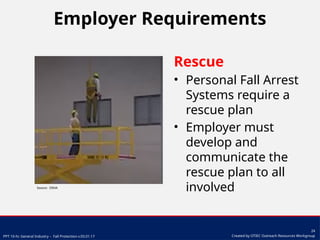
Rescue
• Personal Fall Arrest
Systems require a
rescue plan
• Employer must
develop and
communicate the
rescue plan to all
involved
Source: OSHA
25.
PPT 10-hr. GeneralIndustry – Fall Protection v.03.01.17
25
Created by OTIEC Outreach Resources Workgroup
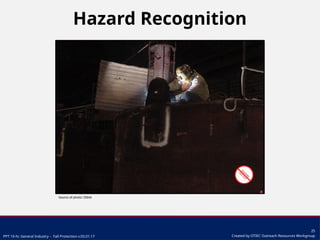
Hazard Recognition
Source of photo: OSHA
26.
PPT 10-hr. GeneralIndustry – Fall Protection v.03.01.17
26
Created by OTIEC Outreach Resources Workgroup
Hazard Recognition
Source of photo: OSHA
27.
PPT 10-hr. GeneralIndustry – Fall Protection v.03.01.17
27
Created by OTIEC Outreach Resources Workgroup
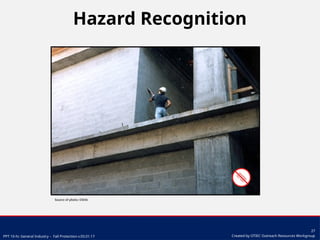
Hazard Recognition
Source of photo: OSHA
28.
PPT 10-hr. GeneralIndustry – Fall Protection v.03.01.17
28
Created by OTIEC Outreach Resources Workgroup
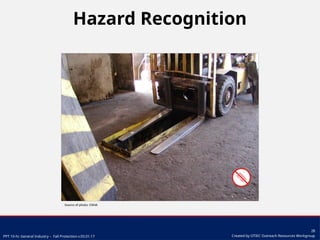
Hazard Recognition
Source of photo: OSHA
29.
PPT 10-hr. GeneralIndustry – Fall Protection v.03.01.17
29
Created by OTIEC Outreach Resources Workgroup
Knowledge Check
1. What is the first line of defense when
it comes to falls in the workplace?
a. Control the fall itself once it occurs
b. Eliminate the fall hazard completely
c. With the fall hazard present, prevent
the fall.
d. Use personal protective equipment
Answer: b. Eliminate the fall
hazard completely
30.
PPT 10-hr. GeneralIndustry – Fall Protection v.03.01.17
30
Created by OTIEC Outreach Resources Workgroup
Knowledge Check
2. A worker is required to remove a
section of guardrail in order to receive
materials from a fork truck; which of
the following provides the best
protections to prevent a fall?
a. Avoid the edge
b. Use a personal fall arrest system
c. Use a fall restraint system
d. Use grab handles
Answer: c. Use a fall restraint system
31.
PPT 10-hr. GeneralIndustry – Fall Protection v.03.01.17
31
Created by OTIEC Outreach Resources Workgroup
Knowledge Check
3. A personal fall arrest system (PFAS)
anchorage point must be capable
of handling ___ pounds.
a. 2,000
b. 3,000
c. 4,000
d. 5,000
Answer: d. 5,000
Editor's Notes
#2 NIOSH In-house FACE Report 2001-06; http://www.cdc.gov/niosh/face/In-house/full200106.html
“An 18-year-old male sporting-goods retail-store worker (the victim) died from a head injury after falling approximately 12 feet from the top of a shelving unit. When the incident happened, the victim was in the process of retrieving a large, heavy box from the top shelf of an H-frame shelving unit. A witness reported that as the victim leaned over and grasped the box by its nylon shipping bands, one of the bands broke and the victim fell backwards off the H-frame to the concrete floor. A registered nurse (RN) who was shopping in the store witnessed the incident, and rendered cardiopulmonary resuscitation (CPR) to the victim. The store's manager called 911 and emergency rescue personnel and police arrived within minutes. The victim was life-flighted to a nearby trauma center where he died later that day from his injuries.”
#3 Falls are among the most common causes of serious work-related injuries and deaths. Employers must take measures in their workplaces to prevent employees from falling off overhead platforms, elevated work stations or into holes in the floor and walls.
#4 Ladders, scaffolds, and scissor lifts have their own fall prevention requirements.
Regardless of height, if a worker can fall into or onto dangerous machines or equipment, employers must provide guardrails and toeboards.
#5 Terminal Objective:
Given current OSHA and industry information regarding general industry worksite illnesses, injuries, and/or fatalities, the student will be able to recognize how to protect themselves from fall hazards.
Enabling Objectives:
1. Identify types of fall hazards associated with workplace environments.
2. Identify methods to eliminate or protect against fall hazards.
#6 Photo 1. This is a photo of two platforms on either side of a bucket conveyor. Access to the platforms is provided by the one ladder between them that stops at the level of the platform. Employees have to climb to either platform from the ladder. Once there they can step across the opening to the other platform when they have to access the conveyor for routine greasing or climb back down on the ladder and then climb back up to the other platform.
Phot 2. Employees exposed to a 25 foot fall from conveyor platform with defective guardrail.
Photo 3. Employees were exposed to falling 14 feet from the roof top of manufactured homes. Employees were working on the roof of manufactured home installing roof decking, roof sheating and electrical wiring without controls to prevent falls.
#7 Photo 1. This photo is of a service pit used for oil changes and other vehicle maintenance. The pit is 50 inches deep.
Photo 2. Sheet metal not attached to vertical steel beams. Sheet metal pushed away from floor allowing employee to fall.
Photo 3. Shelving unit used for storage. Workers would climb then stand on top.
#8 Photo 1. Industrial tanks that often require worker access on top.
Photo 2. Man climbing off/onto tanker ladder and walking the top of the tanker.
Photo 3. Employee working above 4-feet on machine platform without fall protection.
#10 If workers must access the top of a tank to read a gauge. Moving the tank gauge to ground level would eliminate the need for fall hazard exposure.
As a worker, you could suggest such.
Using a drone equipped with a camera to inspect at heights would be another example.
#11 Covering floor openings is a very effective way to eliminate a fall hazard, especially if access to the hole is rarely necessary.
When routine travel over the opening is necessary, often a cover is used, such as a trap-door. Covers must be designed to withstand the potential load that may be placed upon them. For example a 36”x 36” floor-hole cover that will only experience foot traffic would be much different than one experiencing fork truck traffic.
They must also be secured (bolted, hinged, latched, locked) to prevent accidental displacement as well.
It should be noted that the employer should communicate who is authorized to open and/or remove the cover and that when the cover is opened or removed another means of protection is necessary. When the floor opening cover is opened, either a temporary guardrail must be in place or the opening must be constantly attended by someone until closed.
#12 Guardrails – guardrail systems are vertical barriers consisting of top rails, mid-rails, and intermediate vertical members. Guardrail systems can also be combined with toe-boards, which are barriers that prevent materials and equipment from dropping to lower levels.
Standard railing.
Consists of top rail, mid rail, and posts.
Height from the upper surface of top rail to floor level is 42 inches (+/− 3”).
Mid-rail height is 21 inches.
Standard toeboard.
3.5 inches high, with not more than ¼-inch clearance above the floor.
#13 Fences, barricades, and locked doors, whether inside the facility or outside, can be used to prevent unauthorized access to areas where a fall hazard exists. Only authorized and trained employees would have access. Once inside, a method of fall protection must be implemented for the authorized worker.
#14 Fall restraint systems prevent falls by keeping the worker from reaching a fall hazard. While fall restraint systems are not mentioned in OSHA’s fall protection rules, OSHA will accept a properly used fall restraint system in place of a personal fall arrest system when the restraint system is rigged so that the worker cannot get to the fall hazard. In effect, (if properly used) the system tethers a worker in a manner that will not allow a fall of any distance. A fall restraint system is comprised of a body belt or body harness, an anchorage, connectors, and other necessary equipment. Other components typically include a lanyard, and may also include a lifeline and other devices. Note: A self-retracting lanyard is not appropriate for a fall restraint system unless the worker cannot reach the fall hazard when the lanyard is fully extended.
Always follow the manufacturer’s instructions or consult a qualified person to ensure proper installation of anchor points. OSHA recommends that fall restraint systems have the capacity to withstand 3,000 pounds of force or twice the maximum expected force that is needed to restrain the worker from exposure to the fall hazard. As a result, fall restraint may be a viable way to provide fall protection in situations in which the employer has concerns about the adequacy of available anchorage points for fall arrest equipment
#15 A personal fall arrest system is a system used to safely stop (arrest) a worker who is falling from a working level. It consists of an anchorage, connectors, and a body harness. It also may include a lanyard, deceleration device, lifeline, or suitable combinations of these.
It must be set-up to ensure that the worker will not free-fall more than 6 feet before the system begins to arrest the fall, hit the ground or an object below.
The higher the anchorage the better!
#16 Anchorage Connectors are designed as the intermediary for securing a connecting device to an anchorage. The anchorage should be easily accessible, located at a safe distance and support 5,000 lbs. per worker
#17 For areas with predictable and repetitive use, permanent anchors may be installed.
#18 The are many types of full-body harnesses. Regardless of make or model, they must be the properly sized for the wearer, inspected, used and maintained according to the manufacturer.
#19 Photo one: A retractable lanyard. Designed to greatly decrease the free fall distance by locking-up quickly, similar to the shoulder belt in a car.
Photo two: A 6 foot shock absorbing lanyard. The shock absorber decreases the forces of the fall arrest on the body to safe levels when properly used.
Photo three: A 6 foot non-shock absorbing lanyard. Often used for fall restraint.
#20 Position-device system enables the worker to work with both hands free on a surface such as a wall or other vertical structure. They are typically used as protection for concrete form work and placing rebar. The difference between a positioning-device system and a personal fall-arrest system is that the positioning device system supports the worker on an elevated surface and limits a fall to two feet.
#21 Safety net systems consist of mesh nets, panels, and connecting components. They are typically used as protection for those who work 25 feet or more above lower levels.
#25 Photo: Welder on top of tank without fall protection
#26 Photo: Elevated work platform, worker without fall protection.
#27 Photo: This photo shows a worker exposed to a fall hazard while cleaning a wall.
#28 Photo: This photo shows a pit used to service fork trucks.