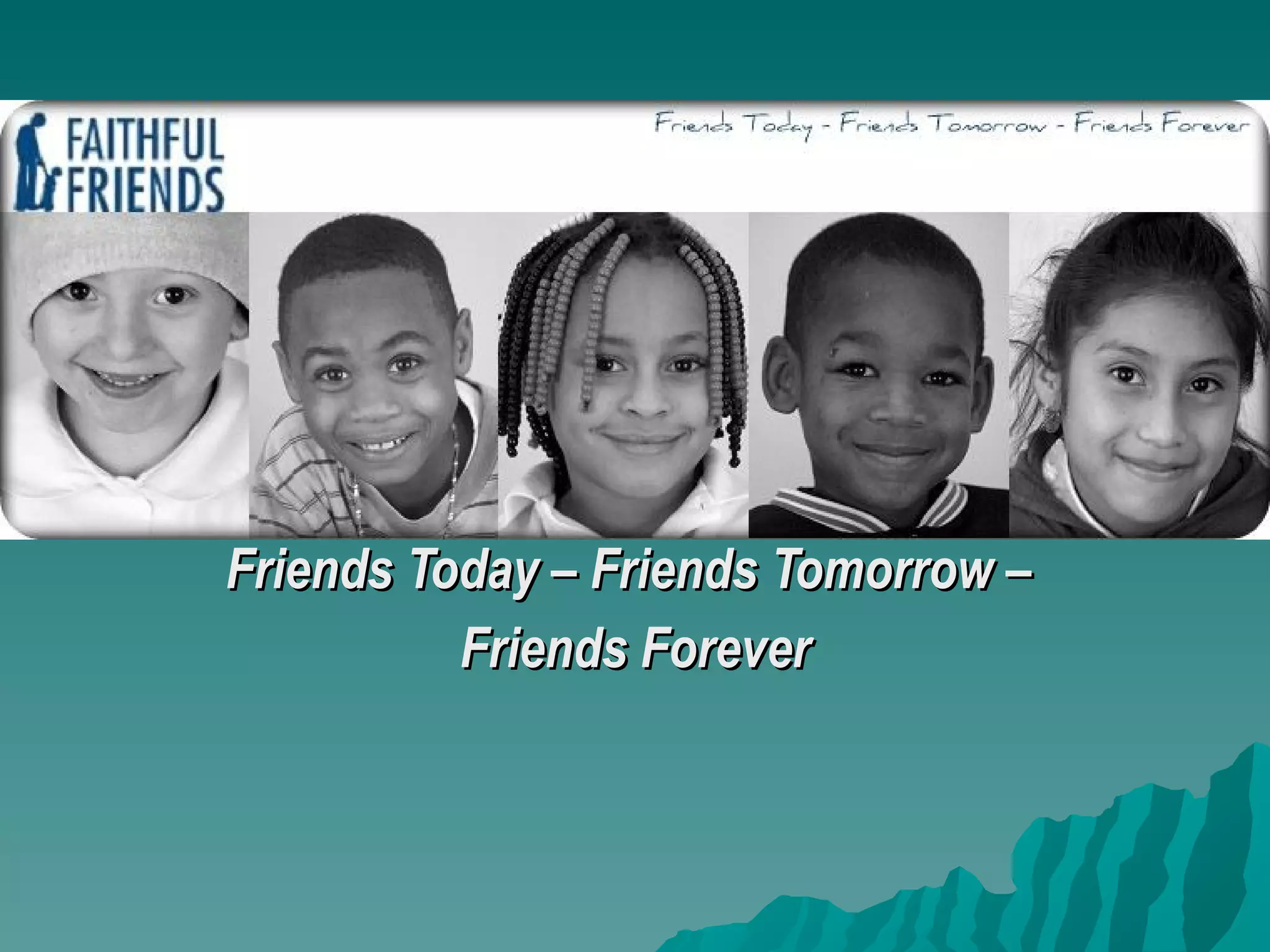
Friends Today – Friends Tomorrow –
          Friends Forever
What is Faithful Friends?
   Faithful Friends– St. Louis is a non-profit
    organization that provides St. Louis’ most
    at-risk children with intensive and long-
    term mentors.

   We take a preventive, early intervention
    approach that breaks the cycle of poverty
    and abuse by helping children in need
    overcome the many obstacles in their
    lives.
Our Mission:
   Faithful Friends provides our community’s most
    vulnerable and challenged children a loving,
    caring, nurturing, and sustained relationship with
    a full-time, paid, professionally trained mentor
    (called a Friend) who teaches positive values and
    has attainable expectations in order that each
    child becomes a healthy, productive member of
    our community.

   We begin working with children in Kindergarten
    and continue to support them through high
    school graduation. Friends will spend at least 4
    hours a week with each child.
Our History:
   Entrepreneur Duncan Campbell’s own troubled youth
    provided the impetus for founding Friends of the Children in
    1993.

   It began with three mentors (called Friends) serving 24
    children in three northeast Portland, Oregon
    neighborhoods.

   Today, more than 80 Friends are guiding, supporting and
    mentoring over 600 children in eight communities across
    the country.

   Faithful Friends is a faith-based model of Friends of the
    Children, which began in 2006. Its only chapter is located
    in St. Louis, Missouri.
We Are Unique:
   There are three key elements that make Faithful
    Friends so unique:

   We mentor the children in our community who
    need us the most.
   Our mentors (called Friends) are full-time, paid
    and professionally trained.
   We make a twelve and a half year (12 ½)
    commitment to each child, selecting them in
    kindergarten and guiding them through high
    school graduation. (There is nothing a child can
    do to be kicked out of our program.)
A Little Bit About Our Kids:
   Most of our children fall far below grade level in almost
    every subject area, so much of the one-on-one time is
    spent reading, working on homework, teaching study skills,
    etc.

   Many of our children live in dangerous neighborhoods and
    some are not allowed to go out and play because it is not
    safe to be outside. Our mentors take the children to fun
    places like the Science Center, ice skating etc. Many of the
    children in our program went swimming in a pool for the
    first time during Summer Camp last summer.

   Many of our children live in poverty and are the children of
    parents who are or have been incarcerated, teen parents or
    high school dropouts.
A Little Bit About Our Kids:
   The majority of our children do not have a parent at home
    after school and live with a single parent, a guardian,
    grandparent, aunt or uncle or foster parent.

   Many of our children have faced neglect and abuse.

   Many of our children have seen crime firsthand, including
    violent crime.

   Many of our children have anger issues they do not know
    how to deal with and often act out in school.

   Our Friends (mentors) help our children understand the
    complex and difficult world around them and work with
    them to develop safe and productive ways to confront the
    issues they face in their day to day lives.
Three Goals Guide The Way:
 We desire each of our children to
 have a bright future, and we believe
 they can. Our work is guided by
 three long-term goals that we set for
 each child in our program:
Goal 1
 Successin school with a
 minimum of H.S. diploma
 (preferred) or GED

Our Success Rate:
 92% attend school regularly;
 82% of our program graduates have
  earned a H.S. diploma or GED
 more than 40% of our youth have a
  parent that did not complete high
  school
Goal 2
 Avoid involvement in the juvenile
 justice system

Our Success Rate:
 92% have avoided the juvenile
  justice system
 despite at least 60% having one
  or more parents who have been
  incarcerated
Goal 3
 Avoid   early parenting

Our Success
 98% of adolescents avoid early
  parenting
 despite at least 60% having been
  born to a teen parent
Cost On the Economy
 The cost for a child to be
  incarcerated for one year is 87,000
 The yearly cost of a teen parent is
  16,000
 Theyearly cost for Faithful Friends is
  9,200
Your Support:
   We know that the program model works . . . one-
    on-one relationships developed at an early age
    with a long-term commitment made to each
    child. A secure, caring and sustained relationship
    is the master key which opens minds, creates
    opportunities and rekindles hope for the future.

   Our desire is to change children's lives for the
    better . . . one child at a time, however we need
    help from people like you.
Your Support:
I invite you to support us by doing one or
   more of the following:

    Join us for one of our events
    Volunteer
   Financially contribute
   Tell someone else about what Faithful Friends is
    doing.
Thank You!


  Thank you for
 helping us serve
and save one child
   at a time!

Faithful Friends - St. Louis

  • 1.
    Friends Today –Friends Tomorrow – Friends Forever
  • 2.
    What is FaithfulFriends?  Faithful Friends– St. Louis is a non-profit organization that provides St. Louis’ most at-risk children with intensive and long- term mentors.  We take a preventive, early intervention approach that breaks the cycle of poverty and abuse by helping children in need overcome the many obstacles in their lives.
  • 3.
    Our Mission:  Faithful Friends provides our community’s most vulnerable and challenged children a loving, caring, nurturing, and sustained relationship with a full-time, paid, professionally trained mentor (called a Friend) who teaches positive values and has attainable expectations in order that each child becomes a healthy, productive member of our community.  We begin working with children in Kindergarten and continue to support them through high school graduation. Friends will spend at least 4 hours a week with each child.
  • 4.
    Our History:  Entrepreneur Duncan Campbell’s own troubled youth provided the impetus for founding Friends of the Children in 1993.  It began with three mentors (called Friends) serving 24 children in three northeast Portland, Oregon neighborhoods.  Today, more than 80 Friends are guiding, supporting and mentoring over 600 children in eight communities across the country.  Faithful Friends is a faith-based model of Friends of the Children, which began in 2006. Its only chapter is located in St. Louis, Missouri.
  • 5.
    We Are Unique:  There are three key elements that make Faithful Friends so unique:  We mentor the children in our community who need us the most.  Our mentors (called Friends) are full-time, paid and professionally trained.  We make a twelve and a half year (12 ½) commitment to each child, selecting them in kindergarten and guiding them through high school graduation. (There is nothing a child can do to be kicked out of our program.)
  • 6.
    A Little BitAbout Our Kids:  Most of our children fall far below grade level in almost every subject area, so much of the one-on-one time is spent reading, working on homework, teaching study skills, etc.  Many of our children live in dangerous neighborhoods and some are not allowed to go out and play because it is not safe to be outside. Our mentors take the children to fun places like the Science Center, ice skating etc. Many of the children in our program went swimming in a pool for the first time during Summer Camp last summer.  Many of our children live in poverty and are the children of parents who are or have been incarcerated, teen parents or high school dropouts.
  • 7.
    A Little BitAbout Our Kids:  The majority of our children do not have a parent at home after school and live with a single parent, a guardian, grandparent, aunt or uncle or foster parent.  Many of our children have faced neglect and abuse.  Many of our children have seen crime firsthand, including violent crime.  Many of our children have anger issues they do not know how to deal with and often act out in school.  Our Friends (mentors) help our children understand the complex and difficult world around them and work with them to develop safe and productive ways to confront the issues they face in their day to day lives.
  • 11.
    Three Goals GuideThe Way:  We desire each of our children to have a bright future, and we believe they can. Our work is guided by three long-term goals that we set for each child in our program:
  • 12.
    Goal 1  Successinschool with a minimum of H.S. diploma (preferred) or GED Our Success Rate:  92% attend school regularly;  82% of our program graduates have earned a H.S. diploma or GED  more than 40% of our youth have a parent that did not complete high school
  • 13.
    Goal 2  Avoidinvolvement in the juvenile justice system Our Success Rate:  92% have avoided the juvenile justice system  despite at least 60% having one or more parents who have been incarcerated
  • 14.
    Goal 3  Avoid early parenting Our Success  98% of adolescents avoid early parenting  despite at least 60% having been born to a teen parent
  • 15.
    Cost On theEconomy  The cost for a child to be incarcerated for one year is 87,000  The yearly cost of a teen parent is 16,000  Theyearly cost for Faithful Friends is 9,200
  • 16.
    Your Support:  We know that the program model works . . . one- on-one relationships developed at an early age with a long-term commitment made to each child. A secure, caring and sustained relationship is the master key which opens minds, creates opportunities and rekindles hope for the future.  Our desire is to change children's lives for the better . . . one child at a time, however we need help from people like you.
  • 17.
    Your Support: I inviteyou to support us by doing one or more of the following:  Join us for one of our events  Volunteer  Financially contribute  Tell someone else about what Faithful Friends is doing.
  • 18.
    Thank You! Thank you for helping us serve and save one child at a time!