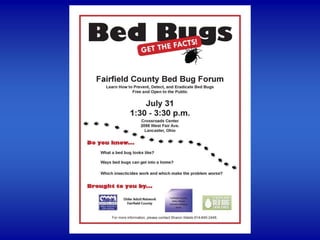
Fairfield Bed Bug Forum
Bed Bugs 101
• Bethany Dohnal
  – Biology and Behavior

• Terri O‟Connor
  – Bed Bug Bites
  – Integrated Pest Management
  – What NOT to do

• Wes Baxter
  – Client interaction
  – Businesses/waiting areas
Bed Bugs 101
(Biology & Behavior)
and Research Update


   Dr. Susan C. Jones
   Associate Professor
   Dept. of Entomology
Bed bugs have plagued
   humans for thousands
         of years!

  Bed bugs are an
   emerging pest
throughout the U.S.!
©Graphicmaps.com
BED BUG HABITS
• Cannot fly
• Can walk very fast
• Typically hide during the day in dark,
  protected sites (esp. cracks & crevices)
• Prefer fabric, wood, and paper surfaces
• Can cling tightly to surfaces
Bed bugs are very
    good hitchhikers!
Bed bugs can be moved from one
place to another by hiding in:
     • luggage
     • furniture
     • bedding
     • backpacks, purses, briefcases
     • clothing
     • …
Bed Bugs Hiding in Luggage
In multi-family housing, bed bugs readily
          spread to units that are
 adjacent, below, and above the infested
                   unit.
Some Reasons For the
  Resurgence of Bed Bugs

• International travel and commerce
• Housing with high tenant turnover
• Pesticide use has changed
  – Pesticide bans
  – Baits to control ants & cockroaches
• Insecticide resistance
Bed Bugs
 (Cimex lectularius)

  •   Insects (true bugs)
  •   Temporary external parasites
  •   Feed only on blood
  •   Often closely associated with
      hosts’ sleeping or resting sites
      (hide in many places)
  Not caused by bad housekeeping!!
BED BUGS CAN HAPPEN TO ANYONE!
Bed Bug Feeding Habits

• Typically feed at night
• Prefer to feed on humans
• May feed on other animals
  • rodents, bats, birds
  • pets (cats, dogs, etc.)
• Locate their host using cues
  such as carbon dioxide and heat
How to recognize if
  it‟s a bed bug
  • Beak-like mouthparts
  • Oval shaped body
  • Adults: ~1/4 to 3/8 inch long
  • Body flattened (unfed)
  • Body swollen (recently fed)
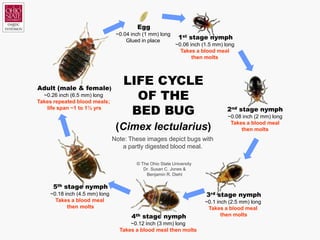
Egg
                                ~0.04 inch (1 mm) long
                                    Glued in place
                                                            1st stage nymph
                                                           ~0.06 inch (1.5 mm) long
                                                             Takes a blood meal
                                                                  then molts


Adult (male & female)
                                   LIFE CYCLE
  ~0.26 inch (6.5 mm) long
Takes repeated blood meals;
                                     OF THE
   life span ~1 to 1½ yrs
                                    BED BUG                                     2nd stage nymph
                                                                                ~0.08 inch (2 mm) long
                                                                                 Takes a blood meal
                                (Cimex lectularius)                                  then molts
                               Note: These images depict bugs with
                                  a partly digested blood meal.

                                        © The Ohio State University
                                           Dr. Susan C. Jones &
                                            Benjamin R. Diehl

     5th stage nymph
    ~0.18 inch (4.5 mm) long                                           3rd stage nymph
      Takes a blood meal                                               ~0.1 inch (2.5 mm) long
           then molts                                                   Takes a blood meal
                                      4th stage nymph                         then molts
                                     ~0.12 inch (3 mm) long
                                 Takes a blood meal then molts
IDENTIFICATION SERVICES
The Ohio Department of Health (ODH)
   –   A free service to Ohioans
   –   ID insects, spiders or other arthropods of medical or public
       health significance (e.g., bed bugs, wasps, flies, maggots, ...)
   –   Submit the sample via your local health dept.


The Ohio State University
   –   Fee for identification services ($20 for insect sample)
   –   ID wide variety of insects and arthropods and plant diseases
   –   OSU submission form available online:
       http://ppdc.osu.edu
Life History Characteristics Show
That Bed Bug Numbers Can Quickly
Skyrocket … (Early Detection and Treatment
                        are Very Important)
       Eggs
           Glued in place
           1 – 12 eggs / day / female
           A single female can produce ~150 eggs
           Hatch in 6 – 17 days

         Nymphs (immature bugs)
              Five nymphal stages
              Require a blood meal in order to grow

                Adults (males & females)
                   Require repeated blood meals
                   Can live 12 – 18 months
                   Can survive months of starvation
Where do bed bugs hide?
    • Mattresses, box springs
    • Bed frames
    • Furniture
    • Carpets and rugs
    • Cracks and crevices
      • Baseboards
      • Window frames and door frames
      • Electric outlets and switch plates
      • Drapery pleats
      • Peeling wallpaper
      • Carpet tack strip
    • Suitcases
    •…
Bed Bugs Hiding in
Mattresses and Box Springs
Bed Bugs Hiding in Furniture


                bed frame
Bed Bugs Hiding Behind A
    Hanging Picture
Terri O’Connor – LISW-S
Central Ohio Area Agency on Aging

- Identifying Bed Bug Bites

- Integrated Pest Management

- What NOT to do!
If you wake up with itchy, red welts that
     weren’t there when you went to
       bed, perhaps its bed bugs.
       BED BUGS BITES:
    • Initial bite is painless
    • Resemble bites from other
      insects & kin
    • Some clues that it may be
      bed bug bites:
       • Typically are on exposed
          skin
       • Often in groups or rows
           Confirmation based on
         finding bed bug evidence
Survey (spring/summer 2009):
       • 474 individuals with verified bed bug infestation in dwellings
       • Apts (66%), single-family homes (15%), condos/townhomes
         (9%), shelters (7%), dorms (2%), long-term care (<1%)
       • Chicago, N.Y., Cincinnati, Louisville, Atlanta, L.A., & Miami


• ~70% of people had an allergic reaction to bed bug’s
  injected saliva; ~30% had no reaction
      - Swelling
      - Welts
      - Severe itching (hrs to days)
• Difference in reactivity due to age
      - Elderly (>65 years old--42% with no reactions)
      - Children (1-10 years old--41% with no reactions
        [note: very small sample size])
• No significant difference in reactivity for:
      - Males vs. females
      - Ethnic groups
Injury From Bed Bugs

• Allergic reaction in ~70% of humans
      • Welts
      • Severe itching
• Anemia
• Asthma
• Scratching of bites increases
  inflammation, can lead to secondary
  bacterial infections
• No conclusive evidence of disease
  transmission (reviewed by Goddard & deShazo.
  2009. JAMA 301(13): 1358-1366)
INJURY FROM BED BUGS
   • Sleeplessness
   • Agitation
   • Anxiety
   • Economic hardship
   •…
INTEGRATED PEST MANAGEMENT
     (IPM) FOR BED BUGS

 • Correctly identify the pest
 • Use Sanitation measures
 • Use non-chemical measures
 • Apply insecticides to targeted sites
Contact a professional pest control
         company to treat for bed bugs


• Make sure properly
  licensed to apply
  pesticides

• ODA web site lists
  licensed pest mgt.
  companies and
  applicators
Contact a professional pest control
   company to treat for bed bugs

Once you’ve made sure they are properly
licensed to apply pesticides:

• It’s advisable to obtain at least 3
  estimates
• Check for satisfied customer references
  that relate to bed bug control
• Recognize that bed bug control typically
  takes several insecticide treatments
Preparing a
home/apartment for
treatment
prep
X
What if can‟t pay for treatment?

• Follow steps for prep (clean,
  vacuum)
• Contact exterminators to see if
  payment plan is option
• Try to limit exposure to invested
  areas to limit spread
DO NOT use “bug bombs”
   against bed bugs!
  - ”Bug Bombs” (“foggers”) don’t work
  - Few bugs will be killed!
  - “Bug Bombs” may cause bed bugs to
    scatter!!!

   “Bug Bombs” will worsen the
        bed bug problem!!
Wes Baxter, LSW
Central Ohio Area Agency on Aging

- Client Interaction
- Workplace/Common Areas
COAAA has stayed on the forefront of the
bed bug problem in central Ohio.
•   Three staff on COBBTF
•   Clinical practices group meetings
•   Written policy
•   Safety committee tracking locations
•   Trainings (new staff)
•   Chairs and dryer
Things to consider when entering an
infested area:
     • What are you wearing?
       – Light colored clothing
       – Booties
       – Tyvek suits
Things to consider when entering an
infested area:
   • Are you going to need to sit?
     – „bed bug‟ chairs
Things to consider when entering an
infested area:

• How is the client going to feel?
  – Stigma attached
  – Provide education
  – Company policy
  – Ensure therapeutic relationship
Things to consider when entering an
infested area:

     • Where do you go after visiting an
       infested area?
       – Carry extra clothes
       – Carry trash bags
WHAT NOT TO DO
   Don't spray yourself with mosquito repellent
    (DEET). It is useless against bed bugs!

   Don't use rubbing alcohol indiscriminately!
    Alcohol is VERY flammable, and it should NEVER
    be sprayed indoors.

   DON‟T use Diatomaceous Earth indiscriminately

   Don't EVER spray yourself, your clothing, or
    your shoes with ANY insecticide! Many
    insecticides can be absorbed through your skin.
After treatment

• Mattress covers
• Monitor environment
• Provide support for PTSD
Support for Professionals

• Address ongoing feelings
• Use PPE as needed to prevent exposure
• Discuss need for dryer
Bed Bugs in the Workplace
Survey the Premises
• Train your staff to know what bed bugs look like and how
  to identify them.

•   Carefully inspect the area where the suspected bed bug
    was found as soon as you can.

•    Because bed bugs like to hide, it is
    important to know where to look for
    them:
      • check the folds and seams in
        upholstery, lockers, baseboards,
         cubicle walls, furniture joints
        and corners, electrical
        outlets, switches, piles of
        papers and other nooks and
        crannies.
Bed Bugs in the Workplace

Respond To Your Findings: If you find more bed bugs...

• Don’t kill them or crush them! It is impossible to make a
  positive identification from smashed bug parts!

• Put the live bug(s) in a pill bottle or a tightly sealed
  plastic bag so that your pest management professional
  (PMP) can make a positive identification.

• Try to isolate the area where the bug(s) were found.
Bed Bugs in the Workplace

Act Quickly:

• Contact your PMP immediately.

• Verify bug, request treatment plan and follow-up.

• Treatment should not occur while people are in the
  area.
Bed Bugs in the Workplace
Debunk the Misconceptions

• When one or two bed bugs, are
  found, most people assume that there
  are many more in the building, which
  isn’t always the case.

• Bed bugs are a pest, but they
  shouldn’t be a cause for panic. There
  is no need to suspend your
  operations, especially if the bed bugs
  were only found in a few isolated
  places.
Thank you!
www.centralohiobedbugs.org

Fairfield 073112

  • 1.
  • 2.
    Bed Bugs 101 •Bethany Dohnal – Biology and Behavior • Terri O‟Connor – Bed Bug Bites – Integrated Pest Management – What NOT to do • Wes Baxter – Client interaction – Businesses/waiting areas
  • 3.
    Bed Bugs 101 (Biology& Behavior) and Research Update Dr. Susan C. Jones Associate Professor Dept. of Entomology
  • 4.
    Bed bugs haveplagued humans for thousands of years! Bed bugs are an emerging pest throughout the U.S.!
  • 6.
  • 7.
    BED BUG HABITS •Cannot fly • Can walk very fast • Typically hide during the day in dark, protected sites (esp. cracks & crevices) • Prefer fabric, wood, and paper surfaces • Can cling tightly to surfaces
  • 8.
    Bed bugs arevery good hitchhikers! Bed bugs can be moved from one place to another by hiding in: • luggage • furniture • bedding • backpacks, purses, briefcases • clothing • …
  • 9.
    Bed Bugs Hidingin Luggage
  • 10.
    In multi-family housing,bed bugs readily spread to units that are adjacent, below, and above the infested unit.
  • 11.
    Some Reasons Forthe Resurgence of Bed Bugs • International travel and commerce • Housing with high tenant turnover • Pesticide use has changed – Pesticide bans – Baits to control ants & cockroaches • Insecticide resistance
  • 12.
    Bed Bugs (Cimexlectularius) • Insects (true bugs) • Temporary external parasites • Feed only on blood • Often closely associated with hosts’ sleeping or resting sites (hide in many places) Not caused by bad housekeeping!! BED BUGS CAN HAPPEN TO ANYONE!
  • 13.
    Bed Bug FeedingHabits • Typically feed at night • Prefer to feed on humans • May feed on other animals • rodents, bats, birds • pets (cats, dogs, etc.) • Locate their host using cues such as carbon dioxide and heat
  • 14.
    How to recognizeif it‟s a bed bug • Beak-like mouthparts • Oval shaped body • Adults: ~1/4 to 3/8 inch long • Body flattened (unfed) • Body swollen (recently fed)
  • 15.
    Egg ~0.04 inch (1 mm) long Glued in place 1st stage nymph ~0.06 inch (1.5 mm) long Takes a blood meal then molts Adult (male & female) LIFE CYCLE ~0.26 inch (6.5 mm) long Takes repeated blood meals; OF THE life span ~1 to 1½ yrs BED BUG 2nd stage nymph ~0.08 inch (2 mm) long Takes a blood meal (Cimex lectularius) then molts Note: These images depict bugs with a partly digested blood meal. © The Ohio State University Dr. Susan C. Jones & Benjamin R. Diehl 5th stage nymph ~0.18 inch (4.5 mm) long 3rd stage nymph Takes a blood meal ~0.1 inch (2.5 mm) long then molts Takes a blood meal 4th stage nymph then molts ~0.12 inch (3 mm) long Takes a blood meal then molts
  • 16.
    IDENTIFICATION SERVICES The OhioDepartment of Health (ODH) – A free service to Ohioans – ID insects, spiders or other arthropods of medical or public health significance (e.g., bed bugs, wasps, flies, maggots, ...) – Submit the sample via your local health dept. The Ohio State University – Fee for identification services ($20 for insect sample) – ID wide variety of insects and arthropods and plant diseases – OSU submission form available online: http://ppdc.osu.edu
  • 17.
    Life History CharacteristicsShow That Bed Bug Numbers Can Quickly Skyrocket … (Early Detection and Treatment are Very Important)  Eggs  Glued in place  1 – 12 eggs / day / female  A single female can produce ~150 eggs  Hatch in 6 – 17 days  Nymphs (immature bugs)  Five nymphal stages  Require a blood meal in order to grow  Adults (males & females)  Require repeated blood meals  Can live 12 – 18 months  Can survive months of starvation
  • 18.
    Where do bedbugs hide? • Mattresses, box springs • Bed frames • Furniture • Carpets and rugs • Cracks and crevices • Baseboards • Window frames and door frames • Electric outlets and switch plates • Drapery pleats • Peeling wallpaper • Carpet tack strip • Suitcases •…
  • 19.
    Bed Bugs Hidingin Mattresses and Box Springs
  • 20.
    Bed Bugs Hidingin Furniture bed frame
  • 21.
    Bed Bugs HidingBehind A Hanging Picture
  • 25.
    Terri O’Connor –LISW-S Central Ohio Area Agency on Aging - Identifying Bed Bug Bites - Integrated Pest Management - What NOT to do!
  • 26.
    If you wakeup with itchy, red welts that weren’t there when you went to bed, perhaps its bed bugs. BED BUGS BITES: • Initial bite is painless • Resemble bites from other insects & kin • Some clues that it may be bed bug bites: • Typically are on exposed skin • Often in groups or rows Confirmation based on finding bed bug evidence
  • 27.
    Survey (spring/summer 2009): • 474 individuals with verified bed bug infestation in dwellings • Apts (66%), single-family homes (15%), condos/townhomes (9%), shelters (7%), dorms (2%), long-term care (<1%) • Chicago, N.Y., Cincinnati, Louisville, Atlanta, L.A., & Miami • ~70% of people had an allergic reaction to bed bug’s injected saliva; ~30% had no reaction - Swelling - Welts - Severe itching (hrs to days) • Difference in reactivity due to age - Elderly (>65 years old--42% with no reactions) - Children (1-10 years old--41% with no reactions [note: very small sample size]) • No significant difference in reactivity for: - Males vs. females - Ethnic groups
  • 28.
    Injury From BedBugs • Allergic reaction in ~70% of humans • Welts • Severe itching • Anemia • Asthma • Scratching of bites increases inflammation, can lead to secondary bacterial infections • No conclusive evidence of disease transmission (reviewed by Goddard & deShazo. 2009. JAMA 301(13): 1358-1366)
  • 29.
    INJURY FROM BEDBUGS • Sleeplessness • Agitation • Anxiety • Economic hardship •…
  • 30.
    INTEGRATED PEST MANAGEMENT (IPM) FOR BED BUGS • Correctly identify the pest • Use Sanitation measures • Use non-chemical measures • Apply insecticides to targeted sites
  • 31.
    Contact a professionalpest control company to treat for bed bugs • Make sure properly licensed to apply pesticides • ODA web site lists licensed pest mgt. companies and applicators
  • 32.
    Contact a professionalpest control company to treat for bed bugs Once you’ve made sure they are properly licensed to apply pesticides: • It’s advisable to obtain at least 3 estimates • Check for satisfied customer references that relate to bed bug control • Recognize that bed bug control typically takes several insecticide treatments
  • 33.
  • 35.
  • 36.
  • 39.
    What if can‟tpay for treatment? • Follow steps for prep (clean, vacuum) • Contact exterminators to see if payment plan is option • Try to limit exposure to invested areas to limit spread
  • 44.
    DO NOT use“bug bombs” against bed bugs! - ”Bug Bombs” (“foggers”) don’t work - Few bugs will be killed! - “Bug Bombs” may cause bed bugs to scatter!!! “Bug Bombs” will worsen the bed bug problem!!
  • 45.
    Wes Baxter, LSW CentralOhio Area Agency on Aging - Client Interaction - Workplace/Common Areas
  • 46.
    COAAA has stayedon the forefront of the bed bug problem in central Ohio. • Three staff on COBBTF • Clinical practices group meetings • Written policy • Safety committee tracking locations • Trainings (new staff) • Chairs and dryer
  • 47.
    Things to considerwhen entering an infested area: • What are you wearing? – Light colored clothing – Booties – Tyvek suits
  • 48.
    Things to considerwhen entering an infested area: • Are you going to need to sit? – „bed bug‟ chairs
  • 49.
    Things to considerwhen entering an infested area: • How is the client going to feel? – Stigma attached – Provide education – Company policy – Ensure therapeutic relationship
  • 50.
    Things to considerwhen entering an infested area: • Where do you go after visiting an infested area? – Carry extra clothes – Carry trash bags
  • 51.
    WHAT NOT TODO  Don't spray yourself with mosquito repellent (DEET). It is useless against bed bugs!  Don't use rubbing alcohol indiscriminately! Alcohol is VERY flammable, and it should NEVER be sprayed indoors.  DON‟T use Diatomaceous Earth indiscriminately  Don't EVER spray yourself, your clothing, or your shoes with ANY insecticide! Many insecticides can be absorbed through your skin.
  • 52.
    After treatment • Mattresscovers • Monitor environment • Provide support for PTSD
  • 54.
    Support for Professionals •Address ongoing feelings • Use PPE as needed to prevent exposure • Discuss need for dryer
  • 55.
    Bed Bugs inthe Workplace Survey the Premises • Train your staff to know what bed bugs look like and how to identify them. • Carefully inspect the area where the suspected bed bug was found as soon as you can. • Because bed bugs like to hide, it is important to know where to look for them: • check the folds and seams in upholstery, lockers, baseboards, cubicle walls, furniture joints and corners, electrical outlets, switches, piles of papers and other nooks and crannies.
  • 56.
    Bed Bugs inthe Workplace Respond To Your Findings: If you find more bed bugs... • Don’t kill them or crush them! It is impossible to make a positive identification from smashed bug parts! • Put the live bug(s) in a pill bottle or a tightly sealed plastic bag so that your pest management professional (PMP) can make a positive identification. • Try to isolate the area where the bug(s) were found.
  • 57.
    Bed Bugs inthe Workplace Act Quickly: • Contact your PMP immediately. • Verify bug, request treatment plan and follow-up. • Treatment should not occur while people are in the area.
  • 58.
    Bed Bugs inthe Workplace Debunk the Misconceptions • When one or two bed bugs, are found, most people assume that there are many more in the building, which isn’t always the case. • Bed bugs are a pest, but they shouldn’t be a cause for panic. There is no need to suspend your operations, especially if the bed bugs were only found in a few isolated places.
  • 59.