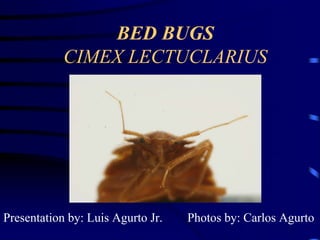
BED BUGS
            CIMEX LECTUCLARIUS


                           PESTEC


Presentation by: Luis Agurto Jr.    Photos by: Carlos Agurto
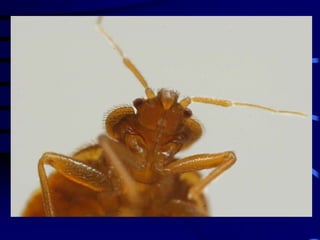
Photo taken by Department of Public Heath
Bed Bug Bites
•   Painless
•   Allergic response to anti-coagulant saliva
•   Have not been shown to transmit diseases
•   Increased sensitization can occur over time
Egg                Nymph             Adult

Color          White              Clear white       Brown to
                                  color             mahogany
Distinctive    Oval shaped        Wingless with     Wingless with
attributes     eggs               flat body         flat body

Length         1 mm.              1-3 mm.           3-4 mm.
Reproduction   Hatch between      Molt 5 times,     Lay 1-5 eggs per
& Growth       4-21 days. 10      requiring blood   day; 200-500 per
               days on average.   meal each molt    life.
Food                              Blood             Prefer human
                                                    blood


Habitats       Found in cracks,   Same places as    In any stage bed
               crevices, box      adults            bugs are found in
               springs, bed                         bedrooms, carpets,
                                                    closets, inside
               frames, etc.
                                                    walls, cracks and
                                                    c r e v i c e s .
Bed Bug Hiding Places
• Tend to congregate in cracks and crevices
• Prefer old hiding places that have fecal
  stains
• Pioneering bed bugs
Bedbug Dispersal
1. Active Stowaway

2. Passive Stowaway

3. Migration
Return of the Bug
• Target Specific Baits vs. Broad Spectrum
  Insecticides
• Increased International Travel
Insecticide Resistance
• DDT – resistance “was first reported in the late-
  1940s and was so widespread a decade later that
  other products were already being recommended
  as alternatives.” (Pest Control 9/06)
• Pyrethroids – “are not providing more than 50%
  mortality as residuals and as direct contact
  insecticides.” (PCT Magazine 12/06)
• Components of IPM for bed bug
  eradication.
        1. Education/Communication
        2. Inspection/ Assessment
        3. Develop a site specific (unit/tenant)
           plan
        4. Monitor and keep records of pest
           findings, bites, actions taken and results
        5. Evaluate effectiveness and continue
           monitoring
Create a Team
Primary
• Tenant
• Pest Management Professional
• Building Owner/Manager
• Building Maintenance
Intermediary
• Department of Public Health
• Social Services
• Physicians
A Case Study
Inspection
Non-Chemical Treatment Options

•   Heating – 120F for 2 hours
•   Freezing – 0F for 4-7 days or with Dry Ice
•   Steam – 220F dry steam
•   Encasement
•   Disposal of infested items
•   Physical removal via vacuum
•   Barriers and traps
Vacuuming removes visible
bed bugs from the equation
• 220F Dry Steam kills instantly
Criticsms of Steam
• Blow Out - Dead
• Short Range – Use for
cracks and crevices only, use
soapy water attachment .
Applying Insecticidal Dust
Seal ‘em out


Keep ‘em in
Chemical
  Application
• Insect Growth
  Regulator &
  Residual
  Pyrethroid
• Repeated 2-3X @
  Two Week
  Intervals
Monitors
Clutter and poor sanitation
allow infestations to remain
hidden and make bed bugs
more difficult to eradicate.
New Tools
• ThermaPure Heat Treatment
  –   Can test multiple locations with probes
  –   Synergism of heat and boric acid/dessicants
  –   Some items cannot be heated
  –   Fire Safety concerns
• Bed bug sniffing dogs
  – Can quickly alert bed bug activity
  – Cannot differentiate between old and new activity
  – Not enough research available testing efficacy of field
    work
In Conclusion
• Bed bugs reproduce rapidly
  – Resistance
• Continual monitoring and quick action is
  needed
• Prevention and physical destruction bed
  bugs must be emphasized
• Bed bug detecting dogs are a good
  inspection tool
• Good Feng Shui = ease of treatment
Power point presentation developed by the
              Pestec Team

Bedbugs By Pestec

  • 1.
    BED BUGS CIMEX LECTUCLARIUS PESTEC Presentation by: Luis Agurto Jr. Photos by: Carlos Agurto
  • 2.
    Photo taken byDepartment of Public Heath
  • 3.
    Bed Bug Bites • Painless • Allergic response to anti-coagulant saliva • Have not been shown to transmit diseases • Increased sensitization can occur over time
  • 5.
    Egg Nymph Adult Color White Clear white Brown to color mahogany Distinctive Oval shaped Wingless with Wingless with attributes eggs flat body flat body Length 1 mm. 1-3 mm. 3-4 mm. Reproduction Hatch between Molt 5 times, Lay 1-5 eggs per & Growth 4-21 days. 10 requiring blood day; 200-500 per days on average. meal each molt life. Food Blood Prefer human blood Habitats Found in cracks, Same places as In any stage bed crevices, box adults bugs are found in springs, bed bedrooms, carpets, closets, inside frames, etc. walls, cracks and c r e v i c e s .
  • 7.
    Bed Bug HidingPlaces • Tend to congregate in cracks and crevices • Prefer old hiding places that have fecal stains • Pioneering bed bugs
  • 9.
    Bedbug Dispersal 1. ActiveStowaway 2. Passive Stowaway 3. Migration
  • 10.
    Return of theBug • Target Specific Baits vs. Broad Spectrum Insecticides • Increased International Travel
  • 11.
    Insecticide Resistance • DDT– resistance “was first reported in the late- 1940s and was so widespread a decade later that other products were already being recommended as alternatives.” (Pest Control 9/06) • Pyrethroids – “are not providing more than 50% mortality as residuals and as direct contact insecticides.” (PCT Magazine 12/06)
  • 12.
    • Components ofIPM for bed bug eradication. 1. Education/Communication 2. Inspection/ Assessment 3. Develop a site specific (unit/tenant) plan 4. Monitor and keep records of pest findings, bites, actions taken and results 5. Evaluate effectiveness and continue monitoring
  • 13.
    Create a Team Primary •Tenant • Pest Management Professional • Building Owner/Manager • Building Maintenance Intermediary • Department of Public Health • Social Services • Physicians
  • 14.
  • 16.
  • 18.
    Non-Chemical Treatment Options • Heating – 120F for 2 hours • Freezing – 0F for 4-7 days or with Dry Ice • Steam – 220F dry steam • Encasement • Disposal of infested items • Physical removal via vacuum • Barriers and traps
  • 19.
    Vacuuming removes visible bedbugs from the equation
  • 20.
    • 220F DrySteam kills instantly
  • 21.
    Criticsms of Steam •Blow Out - Dead • Short Range – Use for cracks and crevices only, use soapy water attachment .
  • 22.
  • 25.
  • 26.
    Chemical Application •Insect Growth Regulator & Residual Pyrethroid • Repeated 2-3X @ Two Week Intervals
  • 28.
  • 29.
    Clutter and poorsanitation allow infestations to remain hidden and make bed bugs more difficult to eradicate.
  • 30.
    New Tools • ThermaPureHeat Treatment – Can test multiple locations with probes – Synergism of heat and boric acid/dessicants – Some items cannot be heated – Fire Safety concerns • Bed bug sniffing dogs – Can quickly alert bed bug activity – Cannot differentiate between old and new activity – Not enough research available testing efficacy of field work
  • 31.
    In Conclusion • Bedbugs reproduce rapidly – Resistance • Continual monitoring and quick action is needed • Prevention and physical destruction bed bugs must be emphasized • Bed bug detecting dogs are a good inspection tool • Good Feng Shui = ease of treatment
  • 32.
    Power point presentationdeveloped by the Pestec Team