Elgethun Capital Management 1 | P a g e
122 S. Phillips Ave Suite 201 Tel: (605) 367-3336 / 1-888-828-3339
Sioux Falls, SD 57104 Fax: (605) 367-1118
Fairfax Financial (NYSE:FRFHF)
By Adam D. Schwab, CFA, CPA
Investment Thesis
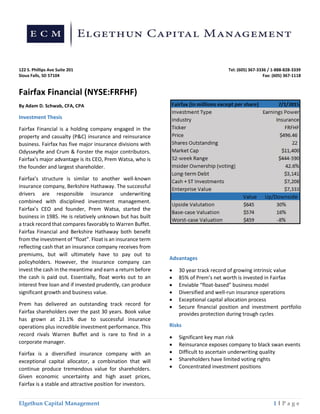
Fairfax Financial is a holding company engaged in the
property and casualty (P&C) insurance and reinsurance
business. Fairfax has five major insurance divisions with
OdysseyRe and Crum & Forster the major contributors.
Fairfax’s major advantage is its CEO, Prem Watsa, who is
the founder and largest shareholder.
Fairfax’s structure is similar to another well-known
insurance company, Berkshire Hathaway. The successful
drivers are responsible insurance underwriting
combined with disciplined investment management.
Fairfax’s CEO and founder, Prem Watsa, started the
business in 1985. He is relatively unknown but has built
a track record that compares favorably to Warren Buffet.
Fairfax Financial and Berkshire Hathaway both benefit
from the investment of “float”. Float is an insurance term
reflecting cash that an insurance company receives from
premiums, but will ultimately have to pay out to
policyholders. However, the insurance company can
invest the cash in the meantime and earn a return before
the cash is paid out. Essentially, float works out to an
interest free loan and if invested prudently, can produce
significant growth and business value.
Prem has delivered an outstanding track record for
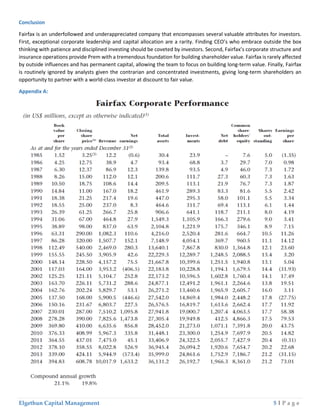
Fairfax shareholders over the past 30 years. Book value
has grown at 21.1% due to successful insurance
operations plus incredible investment performance. This
record rivals Warren Buffet and is rare to find in a
corporate manager.
Fairfax is a diversified insurance company with an
exceptional capital allocator, a combination that will
continue produce tremendous value for shareholders.
Given economic uncertainty and high asset prices,
Fairfax is a stable and attractive position for investors.
Advantages
 30 year track record of growing intrinsic value
 85% of Prem’s net worth is invested in Fairfax
 Enviable “float-based” business model
 Diversified and well-run insurance operations
 Exceptional capital allocation process
 Secure financial position and investment portfolio
provides protection during trough cycles
Risks
 Significant key man risk
 Reinsurance exposes company to black swan events
 Difficult to ascertain underwriting quality
 Shareholders have limited voting rights
 Concentrated investment positions
Elgethun Capital Management 2 | P a g e
Segments and Operations
In the insurance industry, the focus is on underwriting discipline across the cycle. Many companies get lured into
aggressive bidding for business to keep the topline growing, even though they expose the company to significant losses in
the future. Fairfax has done a commendable job putting the right managers in place, building a long-term culture, and
demanding adherence to strict pricing discipline.
As Prem noted in his 2013 annual letter, “Reinsurance businesses are leveraged to a few good men and women at the
top.” We think this concepts applies to all insurance companies. The leadership and culture that drives adequate pricing
and thoughtful risk management is dictated by those in charge. Without them, insurance investors are susceptible to
catastrophic risks. In the 2009 annual letter Prem noted, “It took AIG 89 years to accumulate $100 billion in shareholder’s
capital and ONE year to lose it all!” No matter how impressive the historical track record, insurance companies are a
delicate balance in risk management.
When pricing has been soft (unfavorable for Fairfax), management has been prudent in writing less insurance business
until pricing improves. The following list highlights the major subsidiaries of Fairfax. We have comfort in the leaders of
these divisions, even though annual results will always be volatile. We have modest assumptions and expectations for the
insurance business. As long as Fairfax breaks even on insurance, the investment portfolio can drive a majority of the
earnings growth.
Insurance profitability is judged using the combined ratio: CR = (Incurred Losses + Expenses) / Earned Premium. A CR below
100% means the company is underwriting at a profit; over 100% means underwriting at a loss. The CR excludes investment
income, a major value driver for Fairfax and discussed in the investment section.
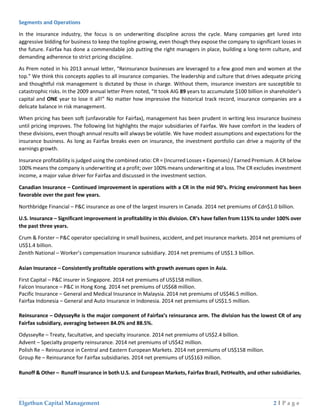
Canadian Insurance – Continued improvement in operations with a CR in the mid 90’s. Pricing environment has been
favorable over the past few years.
Northbridge Financial – P&C insurance as one of the largest insurers in Canada. 2014 net premiums of Cdn$1.0 billion.
U.S. Insurance – Significant improvement in profitability in this division. CR’s have fallen from 115% to under 100% over
the past three years.
Crum & Forster – P&C operator specializing in small business, accident, and pet insurance markets. 2014 net premiums of
US$1.4 billion.
Zenith National – Worker’s compensation insurance subsidiary. 2014 net premiums of US$1.3 billion.
Asian Insurance – Consistently profitable operations with growth avenues open in Asia.
First Capital – P&C insurer in Singapore. 2014 net premiums of US$158 million.
Falcon Insurance – P&C in Hong Kong. 2014 net premiums of US$68 million.
Pacific Insurance – General and Medical Insurance in Malaysia. 2014 net premiums of US$46.5 million.
Fairfax Indonesia – General and Auto Insurance in Indonesia. 2014 net premiums of US$1.5 million.
Reinsurance – OdysseyRe is the major component of Fairfax’s reinsurance arm. The division has the lowest CR of any
Fairfax subsidiary, averaging between 84.0% and 88.5%.
OdysseyRe – Treaty, facultative, and specialty insurance. 2014 net premiums of US$2.4 billion.
Advent – Specialty property reinsurance. 2014 net premiums of US$42 million.
Polish Re – Reinsurance in Central and Eastern European Markets. 2014 net premiums of US$158 million.
Group Re – Reinsurance for Fairfax subsidiaries. 2014 net premiums of US$163 million.
Runoff & Other – Runoff insurance in both U.S. and European Markets, Fairfax Brazil, PetHealth, and other subsidiaries.
Elgethun Capital Management 3 | P a g e
Management
Fairfax is led by Prem Watsa, who founded the business in 1985 and has built one of the best investment track records.
He is an independent and contrarian investor who is not afraid to go against conventional wisdom. Although some of his
investments seem “risky”, he is often the last remaining bidder for cheap but valuable assets. His ability to execute a
contrarian, long-term investment strategy independent of the typical investment mindset is exceedingly rare in today’s
short-term focused world.
After graduation, Prem started his investing career at Confederation Life. He credits reading Security Analysis by Ben
Graham as his introduction to value investing. He has translated those lessons into a contrarian investment strategy with
a prominent focus on margin of safety. He has a willingness to hold cash when prices are high, an attribute that ECM highly
values given that most investors are afraid to lag behind an upward market. Fairfax investors trust him to make
concentrated, contrarian bets. This strategy has delivered incredible value to shareholders and his majority voting control
ensures the culture and discipline of Fairfax will remain intact.
Prem embodies what ECM desires in a CEO and investor: independent and humble mindset, who enjoys betting against
the crowd and rejecting conventional wisdom. Those attributes, combined with his impressive track record and inside
ownership, enable investors to partner with an exceptional owner-operator.
Investment Portfolio
Fairfax has a sophisticated and concentrated investment strategy, leading to volatile yet above average returns over the
past 30 years. Although Prem is the face of Fairfax, the investment portfolio is actually managed by Hamblin Watsa
Investment Counsel, a subsidiary of Fairfax. He has assembled a tremendous investment team that manages the assets of
Fairfax. In addition to typical equity and fixed income investments, Fairfax has made significant investments in non-
traditional assets. The following is a synopsis of the most successful investments made by Fairfax the past 15 years.
1998: Starting in 1996, Fairfax became concerned with excessive U.S. equity valuations and bought put options on the S&P
500. Like most successful long-term investors, they were early and suffered temporary losses. Nonetheless, as the tech
bubble imploded, Fairfax made a sizable profit on the position.
2004: Fairfax sold puts on the S&P 500 (with a collar to limit downside) as equity valuations rose. Prem and the team
expressed concerns regarding problems in the U.S. economy that had not been resolved in the previous downturn.
Hedging and shorting are used as insurance policies. He seeks to protect the portfolio from the 1 in 50 or 1 in 100
catastrophic events.
Prem should also be recognized for what he did not invest in: asset-backed securities, CDO’s, etc. He aptly warned that
financial derivatives were a looming risk to the U.S. and world economies. He correctly pointed out the moral hazard and
perverse incentives in the mortgage origination market. Remember, these statements were made pre-crisis, not post-
crises with the benefit of hindsight! While speculators were getting rich, Prem patiently resisted any temptation to invest.
Contrarian patience is an attribute seldom found in corporate managers – our recommendation is if you find managers
like Prem, stick with them! Investors often focus on the successful investments; often it’s the avoided “bad” investments
which are the most illuminating.
2006: As the housing bubble reached peak levels, Prem began actively betting against the housing market. He bought
credit default swap contracts against the industry, correctly predicting that this episode would end in disaster.
2008: After the U.S markets dropped 50%, Prem removed the equity hedges and realized huge gains on the position. One
flaw that we see in many investors is that even when they make a winning investment, they let hubris and ego takeover
and continue to double down or hold onto their bet. Eventually all markets will turn and these bets go right back to zero.
Prem was disciplined to remove the hedges after his thesis played out, without becoming arrogant with the position.
2010 – Fairfax again placed equity hedges against the U.S. markets. Also, Prem made a deflation bet by buying CPI-linked
derivative contracts. As of 2015, these investments have not paid off and have big unrealized losses. It’s notable to look
Elgethun Capital Management 4 | P a g e
back at his prior bets and realize he has often been early by a couple of years. There is no guarantee these positions work
out, but it critical to remember that these are in context of investment holdings that total over $25 billion.
Fairfax holds nearly $5 billion in common stocks, $11.5 billion in bonds, and $5.5 billion in cash. The company has several
investments in associates, including Thomas Cook India, Quess Human Resources, Sterling Resorts, Sporting Life, and Keg
Restaurants. These investments are spread geographically and reflect a range of industries.
Fairfax’s 15 year equity track record has outperformed the S&P 500 by 7.4% annually (beat the S&P 500 by compounded
+333% over the period), and its bond performance has outperformed the Merrill Lynch corporate index by 5.4% annually.
Although results will be volatile, Prem continues to place margin of safety far ahead of quick profits. In the 2002 annual
report, Prem mentions a valuable quote by Ben Graham from a 1946 lecture:
“In one important aspect, we have made practically no progress at all and that is in human nature…people still
want to make money very fast.”
Valuation Summary
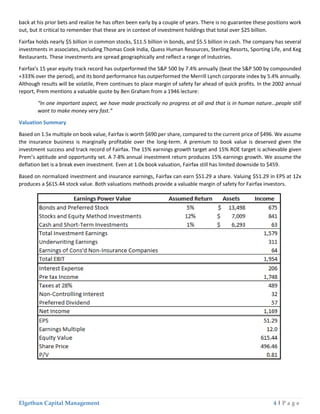
Based on 1.5x multiple on book value, Fairfax is worth $690 per share, compared to the current price of $496. We assume
the insurance business is marginally profitable over the long-term. A premium to book value is deserved given the
investment success and track record of Fairfax. The 15% earnings growth target and 15% ROE target is achievable given
Prem’s aptitude and opportunity set. A 7-8% annual investment return produces 15% earnings growth. We assume the
deflation bet is a break even investment. Even at 1.0x book valuation, Fairfax still has limited downside to $459.
Based on normalized investment and insurance earnings, Fairfax can earn $51.29 a share. Valuing $51.29 in EPS at 12x
produces a $615.44 stock value. Both valuations methods provide a valuable margin of safety for Fairfax investors.
Elgethun Capital Management 5 | P a g e
Conclusion
Fairfax is an underfollowed and underappreciated company that encompasses several valuable attributes for investors.
First, exceptional corporate leadership and capital allocation are a rarity. Finding CEO’s who embrace outside the box
thinking with patience and disciplined investing should be coveted by investors. Second, Fairfax’s corporate structure and
insurance operations provide Prem with a tremendous foundation for building shareholder value. Fairfax is rarely affected
by outside influences and has permanent capital, allowing the team to focus on building long-term value. Finally, Fairfax
is routinely ignored by analysts given the contrarian and concentrated investments, giving long-term shareholders an
opportunity to partner with a world-class investor at discount to fair value.
Appendix A:
Elgethun Capital Management 6 | P a g e
About Elgethun Capital Management, Inc.
Elgethun Capital Management is a fee-based, fiduciary Registered Investment Advisory (RIA) firm established in 2003. We are
registered with the Securities & Exchange Commission (SEC) and subject to their audit reviews. We are independently owned and
operated. As of March 31, 2015, we had approximately $280 million dollars under management. Our clients are high-net-worth
individual investors and institutional investors. Our investments include: individual stocks, bonds, and stock and bond mutual funds.
Disclaimer
The discussion of portfolio investments represents the views of the investment manager. These views are current as of the date of this
commentary but are subject to change without notice. As of the date of this publication, Elgethun Capital Management has a position
in the security mentioned herein and may purchase or sell shares at any time without notice. All information provided is for
informational purposes only and should not be considered investment advice or a recommendation to purchase or sell any specific
security. Security examples featured are samples for presentation purposes and are intended to illustrate our investment philosophy
and its application. While the information presented herein is believed to be reliable, no representations or warranty is made concerning
the accuracy of any data presented. Portfolio composition will change due to ongoing management of the portfolios. References to
individual securities are for informational purposes only and should not be construed as recommendations by Elgethun Capital
Management or its members.

Fairfax Financial

  • 1.
    Elgethun Capital Management1 | P a g e 122 S. Phillips Ave Suite 201 Tel: (605) 367-3336 / 1-888-828-3339 Sioux Falls, SD 57104 Fax: (605) 367-1118 Fairfax Financial (NYSE:FRFHF) By Adam D. Schwab, CFA, CPA Investment Thesis Fairfax Financial is a holding company engaged in the property and casualty (P&C) insurance and reinsurance business. Fairfax has five major insurance divisions with OdysseyRe and Crum & Forster the major contributors. Fairfax’s major advantage is its CEO, Prem Watsa, who is the founder and largest shareholder. Fairfax’s structure is similar to another well-known insurance company, Berkshire Hathaway. The successful drivers are responsible insurance underwriting combined with disciplined investment management. Fairfax’s CEO and founder, Prem Watsa, started the business in 1985. He is relatively unknown but has built a track record that compares favorably to Warren Buffet. Fairfax Financial and Berkshire Hathaway both benefit from the investment of “float”. Float is an insurance term reflecting cash that an insurance company receives from premiums, but will ultimately have to pay out to policyholders. However, the insurance company can invest the cash in the meantime and earn a return before the cash is paid out. Essentially, float works out to an interest free loan and if invested prudently, can produce significant growth and business value. Prem has delivered an outstanding track record for Fairfax shareholders over the past 30 years. Book value has grown at 21.1% due to successful insurance operations plus incredible investment performance. This record rivals Warren Buffet and is rare to find in a corporate manager. Fairfax is a diversified insurance company with an exceptional capital allocator, a combination that will continue produce tremendous value for shareholders. Given economic uncertainty and high asset prices, Fairfax is a stable and attractive position for investors. Advantages  30 year track record of growing intrinsic value  85% of Prem’s net worth is invested in Fairfax  Enviable “float-based” business model  Diversified and well-run insurance operations  Exceptional capital allocation process  Secure financial position and investment portfolio provides protection during trough cycles Risks  Significant key man risk  Reinsurance exposes company to black swan events  Difficult to ascertain underwriting quality  Shareholders have limited voting rights  Concentrated investment positions
  • 2.
    Elgethun Capital Management2 | P a g e Segments and Operations In the insurance industry, the focus is on underwriting discipline across the cycle. Many companies get lured into aggressive bidding for business to keep the topline growing, even though they expose the company to significant losses in the future. Fairfax has done a commendable job putting the right managers in place, building a long-term culture, and demanding adherence to strict pricing discipline. As Prem noted in his 2013 annual letter, “Reinsurance businesses are leveraged to a few good men and women at the top.” We think this concepts applies to all insurance companies. The leadership and culture that drives adequate pricing and thoughtful risk management is dictated by those in charge. Without them, insurance investors are susceptible to catastrophic risks. In the 2009 annual letter Prem noted, “It took AIG 89 years to accumulate $100 billion in shareholder’s capital and ONE year to lose it all!” No matter how impressive the historical track record, insurance companies are a delicate balance in risk management. When pricing has been soft (unfavorable for Fairfax), management has been prudent in writing less insurance business until pricing improves. The following list highlights the major subsidiaries of Fairfax. We have comfort in the leaders of these divisions, even though annual results will always be volatile. We have modest assumptions and expectations for the insurance business. As long as Fairfax breaks even on insurance, the investment portfolio can drive a majority of the earnings growth. Insurance profitability is judged using the combined ratio: CR = (Incurred Losses + Expenses) / Earned Premium. A CR below 100% means the company is underwriting at a profit; over 100% means underwriting at a loss. The CR excludes investment income, a major value driver for Fairfax and discussed in the investment section. Canadian Insurance – Continued improvement in operations with a CR in the mid 90’s. Pricing environment has been favorable over the past few years. Northbridge Financial – P&C insurance as one of the largest insurers in Canada. 2014 net premiums of Cdn$1.0 billion. U.S. Insurance – Significant improvement in profitability in this division. CR’s have fallen from 115% to under 100% over the past three years. Crum & Forster – P&C operator specializing in small business, accident, and pet insurance markets. 2014 net premiums of US$1.4 billion. Zenith National – Worker’s compensation insurance subsidiary. 2014 net premiums of US$1.3 billion. Asian Insurance – Consistently profitable operations with growth avenues open in Asia. First Capital – P&C insurer in Singapore. 2014 net premiums of US$158 million. Falcon Insurance – P&C in Hong Kong. 2014 net premiums of US$68 million. Pacific Insurance – General and Medical Insurance in Malaysia. 2014 net premiums of US$46.5 million. Fairfax Indonesia – General and Auto Insurance in Indonesia. 2014 net premiums of US$1.5 million. Reinsurance – OdysseyRe is the major component of Fairfax’s reinsurance arm. The division has the lowest CR of any Fairfax subsidiary, averaging between 84.0% and 88.5%. OdysseyRe – Treaty, facultative, and specialty insurance. 2014 net premiums of US$2.4 billion. Advent – Specialty property reinsurance. 2014 net premiums of US$42 million. Polish Re – Reinsurance in Central and Eastern European Markets. 2014 net premiums of US$158 million. Group Re – Reinsurance for Fairfax subsidiaries. 2014 net premiums of US$163 million. Runoff & Other – Runoff insurance in both U.S. and European Markets, Fairfax Brazil, PetHealth, and other subsidiaries.
  • 3.
    Elgethun Capital Management3 | P a g e Management Fairfax is led by Prem Watsa, who founded the business in 1985 and has built one of the best investment track records. He is an independent and contrarian investor who is not afraid to go against conventional wisdom. Although some of his investments seem “risky”, he is often the last remaining bidder for cheap but valuable assets. His ability to execute a contrarian, long-term investment strategy independent of the typical investment mindset is exceedingly rare in today’s short-term focused world. After graduation, Prem started his investing career at Confederation Life. He credits reading Security Analysis by Ben Graham as his introduction to value investing. He has translated those lessons into a contrarian investment strategy with a prominent focus on margin of safety. He has a willingness to hold cash when prices are high, an attribute that ECM highly values given that most investors are afraid to lag behind an upward market. Fairfax investors trust him to make concentrated, contrarian bets. This strategy has delivered incredible value to shareholders and his majority voting control ensures the culture and discipline of Fairfax will remain intact. Prem embodies what ECM desires in a CEO and investor: independent and humble mindset, who enjoys betting against the crowd and rejecting conventional wisdom. Those attributes, combined with his impressive track record and inside ownership, enable investors to partner with an exceptional owner-operator. Investment Portfolio Fairfax has a sophisticated and concentrated investment strategy, leading to volatile yet above average returns over the past 30 years. Although Prem is the face of Fairfax, the investment portfolio is actually managed by Hamblin Watsa Investment Counsel, a subsidiary of Fairfax. He has assembled a tremendous investment team that manages the assets of Fairfax. In addition to typical equity and fixed income investments, Fairfax has made significant investments in non- traditional assets. The following is a synopsis of the most successful investments made by Fairfax the past 15 years. 1998: Starting in 1996, Fairfax became concerned with excessive U.S. equity valuations and bought put options on the S&P 500. Like most successful long-term investors, they were early and suffered temporary losses. Nonetheless, as the tech bubble imploded, Fairfax made a sizable profit on the position. 2004: Fairfax sold puts on the S&P 500 (with a collar to limit downside) as equity valuations rose. Prem and the team expressed concerns regarding problems in the U.S. economy that had not been resolved in the previous downturn. Hedging and shorting are used as insurance policies. He seeks to protect the portfolio from the 1 in 50 or 1 in 100 catastrophic events. Prem should also be recognized for what he did not invest in: asset-backed securities, CDO’s, etc. He aptly warned that financial derivatives were a looming risk to the U.S. and world economies. He correctly pointed out the moral hazard and perverse incentives in the mortgage origination market. Remember, these statements were made pre-crisis, not post- crises with the benefit of hindsight! While speculators were getting rich, Prem patiently resisted any temptation to invest. Contrarian patience is an attribute seldom found in corporate managers – our recommendation is if you find managers like Prem, stick with them! Investors often focus on the successful investments; often it’s the avoided “bad” investments which are the most illuminating. 2006: As the housing bubble reached peak levels, Prem began actively betting against the housing market. He bought credit default swap contracts against the industry, correctly predicting that this episode would end in disaster. 2008: After the U.S markets dropped 50%, Prem removed the equity hedges and realized huge gains on the position. One flaw that we see in many investors is that even when they make a winning investment, they let hubris and ego takeover and continue to double down or hold onto their bet. Eventually all markets will turn and these bets go right back to zero. Prem was disciplined to remove the hedges after his thesis played out, without becoming arrogant with the position. 2010 – Fairfax again placed equity hedges against the U.S. markets. Also, Prem made a deflation bet by buying CPI-linked derivative contracts. As of 2015, these investments have not paid off and have big unrealized losses. It’s notable to look
  • 4.
    Elgethun Capital Management4 | P a g e back at his prior bets and realize he has often been early by a couple of years. There is no guarantee these positions work out, but it critical to remember that these are in context of investment holdings that total over $25 billion. Fairfax holds nearly $5 billion in common stocks, $11.5 billion in bonds, and $5.5 billion in cash. The company has several investments in associates, including Thomas Cook India, Quess Human Resources, Sterling Resorts, Sporting Life, and Keg Restaurants. These investments are spread geographically and reflect a range of industries. Fairfax’s 15 year equity track record has outperformed the S&P 500 by 7.4% annually (beat the S&P 500 by compounded +333% over the period), and its bond performance has outperformed the Merrill Lynch corporate index by 5.4% annually. Although results will be volatile, Prem continues to place margin of safety far ahead of quick profits. In the 2002 annual report, Prem mentions a valuable quote by Ben Graham from a 1946 lecture: “In one important aspect, we have made practically no progress at all and that is in human nature…people still want to make money very fast.” Valuation Summary Based on 1.5x multiple on book value, Fairfax is worth $690 per share, compared to the current price of $496. We assume the insurance business is marginally profitable over the long-term. A premium to book value is deserved given the investment success and track record of Fairfax. The 15% earnings growth target and 15% ROE target is achievable given Prem’s aptitude and opportunity set. A 7-8% annual investment return produces 15% earnings growth. We assume the deflation bet is a break even investment. Even at 1.0x book valuation, Fairfax still has limited downside to $459. Based on normalized investment and insurance earnings, Fairfax can earn $51.29 a share. Valuing $51.29 in EPS at 12x produces a $615.44 stock value. Both valuations methods provide a valuable margin of safety for Fairfax investors.
  • 5.
    Elgethun Capital Management5 | P a g e Conclusion Fairfax is an underfollowed and underappreciated company that encompasses several valuable attributes for investors. First, exceptional corporate leadership and capital allocation are a rarity. Finding CEO’s who embrace outside the box thinking with patience and disciplined investing should be coveted by investors. Second, Fairfax’s corporate structure and insurance operations provide Prem with a tremendous foundation for building shareholder value. Fairfax is rarely affected by outside influences and has permanent capital, allowing the team to focus on building long-term value. Finally, Fairfax is routinely ignored by analysts given the contrarian and concentrated investments, giving long-term shareholders an opportunity to partner with a world-class investor at discount to fair value. Appendix A:
  • 6.
    Elgethun Capital Management6 | P a g e About Elgethun Capital Management, Inc. Elgethun Capital Management is a fee-based, fiduciary Registered Investment Advisory (RIA) firm established in 2003. We are registered with the Securities & Exchange Commission (SEC) and subject to their audit reviews. We are independently owned and operated. As of March 31, 2015, we had approximately $280 million dollars under management. Our clients are high-net-worth individual investors and institutional investors. Our investments include: individual stocks, bonds, and stock and bond mutual funds. Disclaimer The discussion of portfolio investments represents the views of the investment manager. These views are current as of the date of this commentary but are subject to change without notice. As of the date of this publication, Elgethun Capital Management has a position in the security mentioned herein and may purchase or sell shares at any time without notice. All information provided is for informational purposes only and should not be considered investment advice or a recommendation to purchase or sell any specific security. Security examples featured are samples for presentation purposes and are intended to illustrate our investment philosophy and its application. While the information presented herein is believed to be reliable, no representations or warranty is made concerning the accuracy of any data presented. Portfolio composition will change due to ongoing management of the portfolios. References to individual securities are for informational purposes only and should not be construed as recommendations by Elgethun Capital Management or its members.