A STUDY ON FACTORS AFFECTING ONLINE STREAMING SERVICE
CHOICE AMONG MILLENNIALS
Submitted by:
Akhil Garg, Student, Mittal School of Business, Lovely Professional University, Punjab
Ishika Pathak, Student, Mittal School of Business, Lovely Professional University, Punjab
Vaibhav Vij, Student, Mittal School of Business, Lovely Professional University, Punjab
Hemanth Kumar, Student, Mittal School of Business, Lovely Professional University, Punjab
Abstract
In this day & age, the entertainment consumption habits of people are rapidly changing. The
introduction & quick adoption of streaming services/OTT platforms has completely changed the
way we consume our entertainment. Millennials, who are the target demographic of this study, are
the most sought-after customers for these OTT platforms as they are well versed with internet
usage and have disposable income which can be spent on these entertainment platforms. This study
focuses on the factors which affect the OTT choice of millennials which will in turn help the OTT
platforms in acquiring customers if they chose to work on the most important factors. The COVID-
19 pandemic has accelerated the adoption of these OTT services as people have had more free time
at their homes due to lockdowns. Pre & post COVID-19 behaviors of customers regarding usage
of OTT platforms has also changed dramatically, with most customers reporting increased usage.
The study talks about several important factors which affect the streaming service choice of
millennials & also talks about the impact of COVID-19 on these OTT platforms.
Introduction
Online streaming services or OTT platforms are the services which offer streaming of
entertainment content such as movies & tv shows over the internet. They have become a part of
daily life for many people, especially the millennials, who prefer these services over traditional
cable tv or DTH services due to factors such as video on demand, mature content & for being the
part of the zeitgeist among other things. Over the past few years, there has been an accelerated
transition from watching content on TV to watching content on streaming services or OTT (over
the top) platforms. Cord cutting is a common term being thrown around these days which refers to
people moving away from regular TV channel subscriptions & choosing OTT platforms over them
as they provide the content that they want to watch, whenever they want it. The recent accelerated
growth in adoption of streaming services due to the ongoing pandemic (Covid-19) will further
increase the market share for OTT platforms over regular cable TV. The people born between 1981
to 1996 are generally referred to as Millennials. They are also known as generation Y & are the
first generation that has really gotten into technology & adopted it at a rapid pace. Tech has
infiltrated each & every aspect of their life, including the way they consume content. Apart from
Journal of Interdisciplinary Cycle Research
Volume XIII, Issue II, February/2021
ISSN NO: 0022-1945
Page No:1165
them, we have 4 more active generations – Silent Generation- born before 1945, Baby Boomers-
born between 1946-1964, Generation X- who precede the millennials & are born between 1965-
1976 & Generation Z- who follow the millennials as they are born after 1996. Popular streaming
services include Disney+ Hotstar, Netflix, Amazon Prime Video, Sony Liv, Zee5, Alt Balaji, MX
player, Eros Now & Apple TV+. Pre-COVID & Post COVID landscape for OTT services -
COVID-19 refers to the Coronavirus infectious disease 2019. It has impacted each & every
business in the world. In relation to the streaming platforms, it has accelerated their growth with
regards to the subscriber base & the number of hours being watched on these services. Before
COVID the users were relatively less compared to the post COVID pandemic period. The people
have increased the number of subscription services that they own to fulfill their entertainment
needs in this period where we all are stuck at home. (this has been found out by the disclosures by
the companies during investor meetings & from reports by independent publications) Each
platform has seen increase in number of subscribers & engagement. The main reasons for post-
COVID growth are → consumer exploration of new entertainment options, lack of live sports
which has stimulated the competition, increased video usage due to adoption of broadband &
cheaper data plans. Factors that affect the customer choice regarding OTT services include
quality & exclusivity of content, pricing of these services, peer influence, branding of these
services, collaboration with different people/brands, zeitgeist, different VOD models
Literature Review
(Aggarwal & Tiwari, 2020) concluded that the next decade will be more about digital presence
rather than the linear broadcast model which is still viable currently. The research also found out
that AVOD is still a major revenue generator for the media-based companies & the SVOD model
has still not become that popular in relative terms. In another study, (Dasgupta et al., 2020)
analyzed targeted advertising in an over-the-top ecosystem. The study found that in the space of
cloud computing and artificial intelligence, it is possible to learn the viewing habits of the
consumer and understand what, when, where & how viewers are watching content. While (Fautier
T, 2020) stated that OTT services have serious limitation, compared to broadcast services, which
they need to fix for further development of the platform. These limitations included delay on OTT
platforms compared to broadcast services, especially in sports broadcast, and low quality of OTT
on TV sets due to bitrates. In their study, (Shaikh & Aggarwal, 2020) concluded that there has
been a surge in viewership across the country due the nation-wide lockdown which led to people
spending more time at home. News, movies & web series had seen major increase in viewership.
Keeping this into consideration, (Madnani et al., 2020) concluded that the average hours spent on
OTT services and average spending of users on these services increased significantly. They also
found that there was a relationship between satisfaction levels of customers & the quality of
content on these platforms. In another study, (Chatterjee & Pal, 2020) focused on the cinema
viewing in the time of OTT. They tried to probe into the changing behavioral pattern of the
consumers for entertainment content, especially in relation to cinemas and the reasons behind the
change in the way they consume the content in this age of OTT. They found that OTT services
have developed indigenous cultural constructs through localized content and gradually the content
Journal of Interdisciplinary Cycle Research
Volume XIII, Issue II, February/2021
ISSN NO: 0022-1945
Page No:1166
and form are being micro-localized. While (Dasgupta & Grover, 2019) found that there is a huge
need to streamline the entire process of the OTT market in India. Content makers and technology
providers need to specifically focus on creating a platform which can cut through the clutter and
make all the content available in an integrated fashion. In their study, (Lu & Rajavi, 2020) focused
on the effect of over-the-top media services on piracy search in their study. They found an overall
substitution between OTT services and piracy. Given the estimate of 160 million visits to piracy
sites in 2017, the findings suggest that Netflix’s global market expansion is responsible for a
decrease of millions of visits to illegal sites. In her study, (Zisha Rizvi, 2020) examined the
regulatory framework around digital media content streaming, challenges in regulating
broadcasting rights considering the judicial interpretations and existing legal framework. In this
study, she found that technological developments cannot exist in a vacuum for too long, for
commercial interests themselves breed disputes. In another study, (Purdy, 2018) concluded that
the OTT market is a complex space dominated by three players namely Netflix, Amazon, and
Disney+Hotstar. This is one of the critical challenges for the small players in the OTT market. The
huge scale of these 3 platforms makes it difficult for the smaller players to succeed in the market.
In his study, (Mavale & Singh, 2020) studied that many ventures are producing video content
solely for these OTT services. These new ventures are changing the way of Indian Television and
Cinemas. The OTT services analyze the video content watched by the users and keep providing
them the content of similar genres to keep the user on their platform. Keeping this into
consideration, (Sharma, 2020) studied that the ongoing COVID-19 pandemic has caused many of
the multiplexes to shut down. As a result, the Indian film industry who wanted to launch the movies
in theatres like local theatres, multiplexes & single screen cinemas, has shifted their launch strategy
to OTT platforms. It is a win-win situation for OTT players who need fresh content and the
filmmakers who had their product ready but were unable to release it. In another study, (E & N,
2020) focused on Emergence and future of Over-the-top (OTT) video services in India. This
research found that the Indian youth will drive digital media consumption. VOD services will go
through many changes and advancements until they get the right business model that will lead to
their success over cable satellite and cable television. While (Goel et al.,2020) focused on the
correlation between smoking scenes shown in OTT content and potential impact on its viewers.
They tried to explain the impact of the content streaming across these platforms will have an impact
on the habits and eventually the lives of its viewers. With the ever-fastening world, roughly 80%
of millennials are subscribed to at least one OTT service. So, it becomes important to see the
effects of smoking over the viewers because of the large overlap. In his study, (Karim, 2019)
focused on the scope and impact of cinema advertising in the era of VOD and online streaming.
On comparing convenience and experience for the consumers when it comes to entertainment, the
study found that the cinema industry is not dying and there is ample scope of cinema advertising.
Online streaming does not have much impact on the cinema audience. The reasons being numerous
include uninterrupted and undivided attention, larger than the life screens, among other things. In
their study, (Chang & Chang, March 2020) focused on exploring the factors influencing
continuous usage of OTT services: the interactivity, consumption value and satisfaction
perspectives. They found that the OTT platforms have evolved to integrate digital technology and
social community from a technological standpoint. Businesses on the platform strive to provide
more opportunities for media consumption, conversation, and content interaction. However, the
Journal of Interdisciplinary Cycle Research
Volume XIII, Issue II, February/2021
ISSN NO: 0022-1945
Page No:1167
existing theoretical and business frameworks cannot keep pace and explain the changes of
emerging technologies. In his study, (Bhattacharyya, 2020) explained about the growth of OTT
platforms in India in Covid-19. The pandemic has forced consumers, in large numbers, to revise
their preferences almost overnight. With movie theatres closed, over-the-top platforms gained
popularity and witnessed a surge in number of viewers and also subscribers. The segment was
forecasted for strong growth in the short term. Keeping this into consideration, (Patel & Khadia,
2020) focused on the OTT viewership in lockdown. As the cinema halls are shutting down and
film releases has been suspended amid nationwide lockdown, this technological shift by internet
has created a new kind of viewing experience. There was a 46% hike in online content viewing. It
is going to have a huge impact on our traditional medium like television and Cinema Hall. The
strong attachment of OTT to the audience in the lockdown period has further confirmed this fact.
There may be decrease in the future footfalls of cinema hall after this lockdown period, dependent
on the viewer preference.
Research Methodology
Need of the Study
This research topic has been selected to study the ongoing trends in the entertainment space & to
observe the changing habits of millennials when it comes to the consumption of entertainment.
There is an increase in the demand & importance of OTT platforms and the choice of millennials
is shaping the entertainment industry based on different factors. The pandemic has caused
accelerated change in the entertainment industry where more & more people are opting for OTT
services over traditional sources of entertainment.
Scope of the Study
The scope of studying factors which affect the streaming service choice of millennials is incredibly
important as OTT platforms are dominating the entertainment landscape in this day & age. The
scope of this study is massive as it is covering a large section of the society → millennials & their
preference towards streaming services which will shape the future of entertainment in the
digitalized world.
Variables
Different variable associated with our study include → Various pricing options, user satisfaction,
personalization, broad content selection, bundle option with telecom providers (with Airtel, JIO),
availability of streaming apps, simultaneous viewing options, peer influence, premium content,
extent of censorship, collaborations, subscription models (AVOD, SVOD, etc.)
Journal of Interdisciplinary Cycle Research
Volume XIII, Issue II, February/2021
ISSN NO: 0022-1945
Page No:1168
Objectives
• The objective of this study is to analyze the factors affecting the online streaming service
choice among millennials.
• To analyze the effect of Covid-19 (pre & post) on OTT platforms.
Sample Size
For this study, the total sample size decided was 250-300 out of which of 263 responses were
effective and 37 were infective. The study focused on the choice of millennials regarding OTT
platforms and out of the 263 responses received, 245 or 93.1% were millennials.
Sampling Technique
In this research project, simple random sampling has been used as it is meant to be an unbiased
representation of the total population. It helped us in choosing individuals completely by the
chance factor wherein each person gets an equal opportunity to be the part of the sample
population. Our questionnaire was open to the whole target population and thus there were less
chances of biasness.
Scaling technique
Scaling technique refers to assigning a scale based on certain values that gradually ascend from a
certain lower value to certain upper value, example: 1 to 5. In this research paper, Likert scale has
been used where respondents were asked about their level of satisfaction regarding different
aspects. They chose from one of the five given options: Very Low, Low, Neutral, High & Very
High.
Analysis Tool
The collected data was analyzed by SPSS using descriptive analysis [mean, median, mode,
frequencies]. Different factors & aspects in the questionnaire were analyzed separately and
inferences were formed with the help of tables from SPSS. Charts were analyzed directly from
google forms & inferences were drawn from them regarding preferences of the respondents.
Journal of Interdisciplinary Cycle Research
Volume XIII, Issue II, February/2021
ISSN NO: 0022-1945
Page No:1169
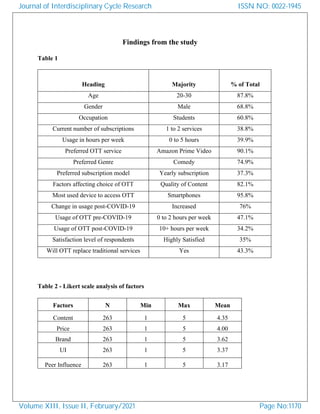
Findings from the study
Table 1
Heading Majority % of Total
Age 20-30 87.8%
Gender Male 68.8%
Occupation Students 60.8%
Current number of subscriptions 1 to 2 services 38.8%
Usage in hours per week 0 to 5 hours 39.9%
Preferred OTT service Amazon Prime Video 90.1%
Preferred Genre Comedy 74.9%
Preferred subscription model Yearly subscription 37.3%
Factors affecting choice of OTT Quality of Content 82.1%
Most used device to access OTT Smartphones 95.8%
Change in usage post-COVID-19 Increased 76%
Usage of OTT pre-COVID-19 0 to 2 hours per week 47.1%
Usage of OTT post-COVID-19 10+ hours per week 34.2%
Satisfaction level of respondents Highly Satisfied 35%
Will OTT replace traditional services Yes 43.3%
Table 2 - Likert scale analysis of factors
Factors N Min Max Mean
Content 263 1 5 4.35
Price 263 1 5 4.00
Brand 263 1 5 3.62
UI 263 1 5 3.37
Peer Influence 263 1 5 3.17
Journal of Interdisciplinary Cycle Research
Volume XIII, Issue II, February/2021
ISSN NO: 0022-1945
Page No:1170
Analysis & Interpretation
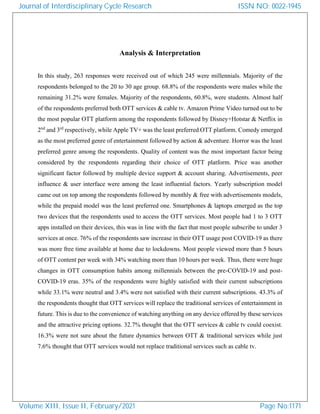
In this study, 263 responses were received out of which 245 were millennials. Majority of the
respondents belonged to the 20 to 30 age group. 68.8% of the respondents were males while the
remaining 31.2% were females. Majority of the respondents, 60.8%, were students. Almost half
of the respondents preferred both OTT services & cable tv. Amazon Prime Video turned out to be
the most popular OTT platform among the respondents followed by Disney+Hotstar & Netflix in
2nd
and 3rd
respectively, while Apple TV+ was the least preferred OTT platform. Comedy emerged
as the most preferred genre of entertainment followed by action & adventure. Horror was the least
preferred genre among the respondents. Quality of content was the most important factor being
considered by the respondents regarding their choice of OTT platform. Price was another
significant factor followed by multiple device support & account sharing. Advertisements, peer
influence & user interface were among the least influential factors. Yearly subscription model
came out on top among the respondents followed by monthly & free with advertisements models,
while the prepaid model was the least preferred one. Smartphones & laptops emerged as the top
two devices that the respondents used to access the OTT services. Most people had 1 to 3 OTT
apps installed on their devices, this was in line with the fact that most people subscribe to under 3
services at once. 76% of the respondents saw increase in their OTT usage post COVID-19 as there
was more free time available at home due to lockdowns. Most people viewed more than 5 hours
of OTT content per week with 34% watching more than 10 hours per week. Thus, there were huge
changes in OTT consumption habits among millennials between the pre-COVID-19 and post-
COVID-19 eras. 35% of the respondents were highly satisfied with their current subscriptions
while 33.1% were neutral and 3.4% were not satisfied with their current subscriptions. 43.3% of
the respondents thought that OTT services will replace the traditional services of entertainment in
future. This is due to the convenience of watching anything on any device offered by these services
and the attractive pricing options. 32.7% thought that the OTT services & cable tv could coexist.
16.3% were not sure about the future dynamics between OTT & traditional services while just
7.6% thought that OTT services would not replace traditional services such as cable tv.
Journal of Interdisciplinary Cycle Research
Volume XIII, Issue II, February/2021
ISSN NO: 0022-1945
Page No:1171
Conclusion
Analyzing the factors affecting the online streaming service choice of millennials, the study found
that quality of content emerged as the top factor that affects the choice of millennials followed by
price, multiple device support, account sharing, download option availability & live sports content.
Among the OTT services, Amazon Prime Video came out on top as the most used service among
the respondents. The reason for this was the incredible value for money that amazon provides
alongside its prime subscription benefits (prime video, fast delivery, prime music, among other
things). Disney+Hotstar & Netflix followed closely while MX player & Sony Liv also saw
significant usage. Analyzing the effect of Covid-19 (pre & post) on OTT platforms, the study
found that usage of OTT service among the respondents significantly increased post-Covid-19.
Weekly usage in hours per week saw huge gains among all the responses. Availability of more
free time due to lockdowns contributed to this change in usage. The pandemic has accelerated the
adoption & usage of OTT platforms among millennials. Due to this, the future of the entertainment
industry depends more on the digital platforms as the audience, especially the younger generations
such as millennials are shifting to OTT services. The service providers need to focus on quality of
content, pricing of their services among other things if they want to attract customers to their
platforms. Authors such as Shaikh & Aggarwal, Mavale & Singh and Madnani et al. supported
these findings with similar conclusions in their studies.
Implications
For people that use OTT services - Huge choice in content. Convenient viewing. Access on any
device that they own. Better deals due to competition in the OTT space. For companies - The
service providers need to focus on quality of content, pricing of their services & other unique
factors if they want to attract customers to their platforms. For smaller OTT services - They need
to focus on creating incredible exclusive content that can only be viewed on their platform which
will drive customers to use their platform. They should also study the practices which were
followed by the current OTT leaders when they were operating at a smaller scale. For traditional
services [Cable Tv] - These services need to adapt to the current times by offering choice to
customers. The star network has shown adaptability by offering its services across cable & Hotstar,
now part of Disney+Hotstar. These traditional services need to adapt or they will cease to exist.
Journal of Interdisciplinary Cycle Research
Volume XIII, Issue II, February/2021
ISSN NO: 0022-1945
Page No:1172
References
Aggarwal, R. D., & Rahul-Tiwari, S. (2020). Macro-economic landscape of Media & Entertainment
Industry in India: Emerging Business Models. Available at SSRN 3523192.
Bhattacharyya, Mausumi. (2020). 21A.-Article-Mausumi-Bhattacharyya-Growth-of-OTT-in-India-The-
Covid-Factor.
Bouquillion, P. (2020). Industrial and Financial Structures of Over-the-Tops (OTTs) in India. In Platform
Capitalism in India (pp. 129-149). Palgrave Macmillan, Cham.
Chang, P. C., & Chang, H. Y. (2020). Exploring the Factors Influencing Continuance Usage of Over-the-
Top Services: The Interactivity, Consumption Value, and Satisfaction Perspectives. International Journal
of Technology and Human Interaction (IJTHI), 16(4), 118-138.
Chatterjee, M., & Pal, S. (2020). Globalization propelled technology often ends up in its microlocalization:
Cinema viewing in the time of OTT. Global Media Journal: Indian Edition, 12(1).
Dasgupta, D., & Grover, D. (2019). Understanding Adoption Factors of Over-the-Top Video Services
Among Millennial Consumers. International Journal of Computer Engineering and Technology, 10(1).
Dasgupta, P., Bhadada, K., Goyal, S., Sarkar, T., & Tripathi, R. (2020). U.S. Patent Application No.
16/728,634.
Fautier, T. (2020). How OTT Services Can Match the Quality of Broadcast. SMPTE Motion Imaging
Journal, 129(3), 16-25.
Gaoshinde, M. (2020). Impact of embedded marketing on OTT Platforms.
Goel, M., Goel, P., Singh Bhati, R., Arora, R., Chawla, S., & Agarwal, U. (2020). Correlation Between
Smoking Scenes Shown in Ott Content and Potential Impact on Its Viewers. Available at SSRN 3687274.
Ham, M., & Lee, S. W. (2020). Factors Affecting the popularity of video content on live-streaming
services: Focusing on V Live, the South Korean live-streaming service. Sustainability, 12(5), 1784.
Isa, A. M., Mahmud, W. A. W., Sulaiman, W. I. W., Pitchan, M. A., & Mamat, S. (2020). OTT Media and
Content Regulation: A Systematic Review and Meta-Analysis.
Karim, S. (2020). Scope and Impact of Cinema Advertising in the era of VoD _ampersandsign Online
Streaming. Allana Inst of Management Sciences, Pune, 9, 1-5.
Kim, H. S., & Kim, M. (2020). Viewing sports online together? Psychological consequences on social live
streaming service usage. Sport Management Review.
Li, Y., Wang, S., Zhang, X., Zhou, C., & Ma, S. (2020, October). High Efficiency Live Video Streaming
With Frame Dropping. In 2020 IEEE International Conference on Image Processing (ICIP) (pp. 1226-
1230). IEEE.
Lu, S., Rajavi, K., & Dinner, I. M. (2020). The Effect of Over-the-Top Media Services on Piracy Search:
Evidence from a Natural Experiment. Marketing Science, Forthcoming.
Madnani, D., Fernandes, S., & Madnani, N. (2020). Analysing the impact of COVID-19 on over-the-top
media platforms in India. International Journal of Pervasive Computing and Communications.
Mavale, S., & Singh, R. (2020). Study of Perception of College Going Young Adults towards Online
Streaming Services. International Journal of Engineering and Management Research.
Journal of Interdisciplinary Cycle Research
Volume XIII, Issue II, February/2021
ISSN NO: 0022-1945
Page No:1173
McEachern, J. A., Taylor, R., Leeder, M., & Gray-Preston, C. L. (2020). U.S. Patent No. 10,581,786.
Washington, DC: U.S. Patent and Trademark Office.
Naik, N. V. (2020, May). An Introduction to Over-The-Top Entertainment. India—A Perfect Playground for
This Digital Industry. In Meeting of Research in Music, Arts and Design (pp. 229-242). Springer, Cham.
Nasir, A. J. (2015). A Case Study on Personalisation of Advertising in India Via Mobile.
Oide, M., Takahashi, A., Abe, T., & Suganuma, T. (2020). User-oriented video streaming service based
on passive aggressive learning. In Cognitive Analytics: Concepts, Methodologies, Tools, and
Applications (pp. 491-511). IGI Global.
Onimus, E. K. (2020). Ideal Streaming Service for College-Aged Students.
Pandit, M., & Parmar, K. (2020). Evolution of Mediated Youth Culture: OTT as ‘New Television’in India.
In Off and Online Journalism and Corruption-International Comparative Analysis. IntechOpen.
Parikh, N. (2020). The emergence of OTT platforms during the pandemic and its future scope.
Patel, U., Tanwar, S., & Nair, A. (2020). Performance Analysis of Video On-demand and Live Video
Streaming using Cloud based Services. Scalable Computing: Practice and Experience, 21(3), 479-496.
Rizvi, Z. (2020). Online Streaming: A Case of Broadcasting?. Available at SSRN 3554184.
Sakthivel, M. (2020). Indian Copyright Act and Live Streaming: a Critical Analysis. In Broadcasters’ Rights
in the Digital Era (pp. 181-213). Brill Nijhoff.
Shaikh, S., & Aggarwal, A. (2020). Lockdown a blessing in disguise?.
Sujata, J., Sohag, S., Tanu, D., Chintan, D., Shubham, P., & Sumit, G. (2015). Impact of over the top (OTT)
services on telecom service providers. Indian Journal of Science and Technology, 8(S4), 145-160.
Sundaravel, E., & Elangovan, N. Emergence and future of Over-the-top (OTT) video services in India: an
analytical research.
Parikh, N. (2020). The emergence of OTT platforms during the pandemic and its future scope.
Journal of Interdisciplinary Cycle Research
Volume XIII, Issue II, February/2021
ISSN NO: 0022-1945
Page No:1174

Factors affecting online streaming service Research

  • 1.
    A STUDY ONFACTORS AFFECTING ONLINE STREAMING SERVICE CHOICE AMONG MILLENNIALS Submitted by: Akhil Garg, Student, Mittal School of Business, Lovely Professional University, Punjab Ishika Pathak, Student, Mittal School of Business, Lovely Professional University, Punjab Vaibhav Vij, Student, Mittal School of Business, Lovely Professional University, Punjab Hemanth Kumar, Student, Mittal School of Business, Lovely Professional University, Punjab Abstract In this day & age, the entertainment consumption habits of people are rapidly changing. The introduction & quick adoption of streaming services/OTT platforms has completely changed the way we consume our entertainment. Millennials, who are the target demographic of this study, are the most sought-after customers for these OTT platforms as they are well versed with internet usage and have disposable income which can be spent on these entertainment platforms. This study focuses on the factors which affect the OTT choice of millennials which will in turn help the OTT platforms in acquiring customers if they chose to work on the most important factors. The COVID- 19 pandemic has accelerated the adoption of these OTT services as people have had more free time at their homes due to lockdowns. Pre & post COVID-19 behaviors of customers regarding usage of OTT platforms has also changed dramatically, with most customers reporting increased usage. The study talks about several important factors which affect the streaming service choice of millennials & also talks about the impact of COVID-19 on these OTT platforms. Introduction Online streaming services or OTT platforms are the services which offer streaming of entertainment content such as movies & tv shows over the internet. They have become a part of daily life for many people, especially the millennials, who prefer these services over traditional cable tv or DTH services due to factors such as video on demand, mature content & for being the part of the zeitgeist among other things. Over the past few years, there has been an accelerated transition from watching content on TV to watching content on streaming services or OTT (over the top) platforms. Cord cutting is a common term being thrown around these days which refers to people moving away from regular TV channel subscriptions & choosing OTT platforms over them as they provide the content that they want to watch, whenever they want it. The recent accelerated growth in adoption of streaming services due to the ongoing pandemic (Covid-19) will further increase the market share for OTT platforms over regular cable TV. The people born between 1981 to 1996 are generally referred to as Millennials. They are also known as generation Y & are the first generation that has really gotten into technology & adopted it at a rapid pace. Tech has infiltrated each & every aspect of their life, including the way they consume content. Apart from Journal of Interdisciplinary Cycle Research Volume XIII, Issue II, February/2021 ISSN NO: 0022-1945 Page No:1165
  • 2.
    them, we have4 more active generations – Silent Generation- born before 1945, Baby Boomers- born between 1946-1964, Generation X- who precede the millennials & are born between 1965- 1976 & Generation Z- who follow the millennials as they are born after 1996. Popular streaming services include Disney+ Hotstar, Netflix, Amazon Prime Video, Sony Liv, Zee5, Alt Balaji, MX player, Eros Now & Apple TV+. Pre-COVID & Post COVID landscape for OTT services - COVID-19 refers to the Coronavirus infectious disease 2019. It has impacted each & every business in the world. In relation to the streaming platforms, it has accelerated their growth with regards to the subscriber base & the number of hours being watched on these services. Before COVID the users were relatively less compared to the post COVID pandemic period. The people have increased the number of subscription services that they own to fulfill their entertainment needs in this period where we all are stuck at home. (this has been found out by the disclosures by the companies during investor meetings & from reports by independent publications) Each platform has seen increase in number of subscribers & engagement. The main reasons for post- COVID growth are → consumer exploration of new entertainment options, lack of live sports which has stimulated the competition, increased video usage due to adoption of broadband & cheaper data plans. Factors that affect the customer choice regarding OTT services include quality & exclusivity of content, pricing of these services, peer influence, branding of these services, collaboration with different people/brands, zeitgeist, different VOD models Literature Review (Aggarwal & Tiwari, 2020) concluded that the next decade will be more about digital presence rather than the linear broadcast model which is still viable currently. The research also found out that AVOD is still a major revenue generator for the media-based companies & the SVOD model has still not become that popular in relative terms. In another study, (Dasgupta et al., 2020) analyzed targeted advertising in an over-the-top ecosystem. The study found that in the space of cloud computing and artificial intelligence, it is possible to learn the viewing habits of the consumer and understand what, when, where & how viewers are watching content. While (Fautier T, 2020) stated that OTT services have serious limitation, compared to broadcast services, which they need to fix for further development of the platform. These limitations included delay on OTT platforms compared to broadcast services, especially in sports broadcast, and low quality of OTT on TV sets due to bitrates. In their study, (Shaikh & Aggarwal, 2020) concluded that there has been a surge in viewership across the country due the nation-wide lockdown which led to people spending more time at home. News, movies & web series had seen major increase in viewership. Keeping this into consideration, (Madnani et al., 2020) concluded that the average hours spent on OTT services and average spending of users on these services increased significantly. They also found that there was a relationship between satisfaction levels of customers & the quality of content on these platforms. In another study, (Chatterjee & Pal, 2020) focused on the cinema viewing in the time of OTT. They tried to probe into the changing behavioral pattern of the consumers for entertainment content, especially in relation to cinemas and the reasons behind the change in the way they consume the content in this age of OTT. They found that OTT services have developed indigenous cultural constructs through localized content and gradually the content Journal of Interdisciplinary Cycle Research Volume XIII, Issue II, February/2021 ISSN NO: 0022-1945 Page No:1166
  • 3.
    and form arebeing micro-localized. While (Dasgupta & Grover, 2019) found that there is a huge need to streamline the entire process of the OTT market in India. Content makers and technology providers need to specifically focus on creating a platform which can cut through the clutter and make all the content available in an integrated fashion. In their study, (Lu & Rajavi, 2020) focused on the effect of over-the-top media services on piracy search in their study. They found an overall substitution between OTT services and piracy. Given the estimate of 160 million visits to piracy sites in 2017, the findings suggest that Netflix’s global market expansion is responsible for a decrease of millions of visits to illegal sites. In her study, (Zisha Rizvi, 2020) examined the regulatory framework around digital media content streaming, challenges in regulating broadcasting rights considering the judicial interpretations and existing legal framework. In this study, she found that technological developments cannot exist in a vacuum for too long, for commercial interests themselves breed disputes. In another study, (Purdy, 2018) concluded that the OTT market is a complex space dominated by three players namely Netflix, Amazon, and Disney+Hotstar. This is one of the critical challenges for the small players in the OTT market. The huge scale of these 3 platforms makes it difficult for the smaller players to succeed in the market. In his study, (Mavale & Singh, 2020) studied that many ventures are producing video content solely for these OTT services. These new ventures are changing the way of Indian Television and Cinemas. The OTT services analyze the video content watched by the users and keep providing them the content of similar genres to keep the user on their platform. Keeping this into consideration, (Sharma, 2020) studied that the ongoing COVID-19 pandemic has caused many of the multiplexes to shut down. As a result, the Indian film industry who wanted to launch the movies in theatres like local theatres, multiplexes & single screen cinemas, has shifted their launch strategy to OTT platforms. It is a win-win situation for OTT players who need fresh content and the filmmakers who had their product ready but were unable to release it. In another study, (E & N, 2020) focused on Emergence and future of Over-the-top (OTT) video services in India. This research found that the Indian youth will drive digital media consumption. VOD services will go through many changes and advancements until they get the right business model that will lead to their success over cable satellite and cable television. While (Goel et al.,2020) focused on the correlation between smoking scenes shown in OTT content and potential impact on its viewers. They tried to explain the impact of the content streaming across these platforms will have an impact on the habits and eventually the lives of its viewers. With the ever-fastening world, roughly 80% of millennials are subscribed to at least one OTT service. So, it becomes important to see the effects of smoking over the viewers because of the large overlap. In his study, (Karim, 2019) focused on the scope and impact of cinema advertising in the era of VOD and online streaming. On comparing convenience and experience for the consumers when it comes to entertainment, the study found that the cinema industry is not dying and there is ample scope of cinema advertising. Online streaming does not have much impact on the cinema audience. The reasons being numerous include uninterrupted and undivided attention, larger than the life screens, among other things. In their study, (Chang & Chang, March 2020) focused on exploring the factors influencing continuous usage of OTT services: the interactivity, consumption value and satisfaction perspectives. They found that the OTT platforms have evolved to integrate digital technology and social community from a technological standpoint. Businesses on the platform strive to provide more opportunities for media consumption, conversation, and content interaction. However, the Journal of Interdisciplinary Cycle Research Volume XIII, Issue II, February/2021 ISSN NO: 0022-1945 Page No:1167
  • 4.
    existing theoretical andbusiness frameworks cannot keep pace and explain the changes of emerging technologies. In his study, (Bhattacharyya, 2020) explained about the growth of OTT platforms in India in Covid-19. The pandemic has forced consumers, in large numbers, to revise their preferences almost overnight. With movie theatres closed, over-the-top platforms gained popularity and witnessed a surge in number of viewers and also subscribers. The segment was forecasted for strong growth in the short term. Keeping this into consideration, (Patel & Khadia, 2020) focused on the OTT viewership in lockdown. As the cinema halls are shutting down and film releases has been suspended amid nationwide lockdown, this technological shift by internet has created a new kind of viewing experience. There was a 46% hike in online content viewing. It is going to have a huge impact on our traditional medium like television and Cinema Hall. The strong attachment of OTT to the audience in the lockdown period has further confirmed this fact. There may be decrease in the future footfalls of cinema hall after this lockdown period, dependent on the viewer preference. Research Methodology Need of the Study This research topic has been selected to study the ongoing trends in the entertainment space & to observe the changing habits of millennials when it comes to the consumption of entertainment. There is an increase in the demand & importance of OTT platforms and the choice of millennials is shaping the entertainment industry based on different factors. The pandemic has caused accelerated change in the entertainment industry where more & more people are opting for OTT services over traditional sources of entertainment. Scope of the Study The scope of studying factors which affect the streaming service choice of millennials is incredibly important as OTT platforms are dominating the entertainment landscape in this day & age. The scope of this study is massive as it is covering a large section of the society → millennials & their preference towards streaming services which will shape the future of entertainment in the digitalized world. Variables Different variable associated with our study include → Various pricing options, user satisfaction, personalization, broad content selection, bundle option with telecom providers (with Airtel, JIO), availability of streaming apps, simultaneous viewing options, peer influence, premium content, extent of censorship, collaborations, subscription models (AVOD, SVOD, etc.) Journal of Interdisciplinary Cycle Research Volume XIII, Issue II, February/2021 ISSN NO: 0022-1945 Page No:1168
  • 5.
    Objectives • The objectiveof this study is to analyze the factors affecting the online streaming service choice among millennials. • To analyze the effect of Covid-19 (pre & post) on OTT platforms. Sample Size For this study, the total sample size decided was 250-300 out of which of 263 responses were effective and 37 were infective. The study focused on the choice of millennials regarding OTT platforms and out of the 263 responses received, 245 or 93.1% were millennials. Sampling Technique In this research project, simple random sampling has been used as it is meant to be an unbiased representation of the total population. It helped us in choosing individuals completely by the chance factor wherein each person gets an equal opportunity to be the part of the sample population. Our questionnaire was open to the whole target population and thus there were less chances of biasness. Scaling technique Scaling technique refers to assigning a scale based on certain values that gradually ascend from a certain lower value to certain upper value, example: 1 to 5. In this research paper, Likert scale has been used where respondents were asked about their level of satisfaction regarding different aspects. They chose from one of the five given options: Very Low, Low, Neutral, High & Very High. Analysis Tool The collected data was analyzed by SPSS using descriptive analysis [mean, median, mode, frequencies]. Different factors & aspects in the questionnaire were analyzed separately and inferences were formed with the help of tables from SPSS. Charts were analyzed directly from google forms & inferences were drawn from them regarding preferences of the respondents. Journal of Interdisciplinary Cycle Research Volume XIII, Issue II, February/2021 ISSN NO: 0022-1945 Page No:1169
  • 6.
    Findings from thestudy Table 1 Heading Majority % of Total Age 20-30 87.8% Gender Male 68.8% Occupation Students 60.8% Current number of subscriptions 1 to 2 services 38.8% Usage in hours per week 0 to 5 hours 39.9% Preferred OTT service Amazon Prime Video 90.1% Preferred Genre Comedy 74.9% Preferred subscription model Yearly subscription 37.3% Factors affecting choice of OTT Quality of Content 82.1% Most used device to access OTT Smartphones 95.8% Change in usage post-COVID-19 Increased 76% Usage of OTT pre-COVID-19 0 to 2 hours per week 47.1% Usage of OTT post-COVID-19 10+ hours per week 34.2% Satisfaction level of respondents Highly Satisfied 35% Will OTT replace traditional services Yes 43.3% Table 2 - Likert scale analysis of factors Factors N Min Max Mean Content 263 1 5 4.35 Price 263 1 5 4.00 Brand 263 1 5 3.62 UI 263 1 5 3.37 Peer Influence 263 1 5 3.17 Journal of Interdisciplinary Cycle Research Volume XIII, Issue II, February/2021 ISSN NO: 0022-1945 Page No:1170
  • 7.
    Analysis & Interpretation Inthis study, 263 responses were received out of which 245 were millennials. Majority of the respondents belonged to the 20 to 30 age group. 68.8% of the respondents were males while the remaining 31.2% were females. Majority of the respondents, 60.8%, were students. Almost half of the respondents preferred both OTT services & cable tv. Amazon Prime Video turned out to be the most popular OTT platform among the respondents followed by Disney+Hotstar & Netflix in 2nd and 3rd respectively, while Apple TV+ was the least preferred OTT platform. Comedy emerged as the most preferred genre of entertainment followed by action & adventure. Horror was the least preferred genre among the respondents. Quality of content was the most important factor being considered by the respondents regarding their choice of OTT platform. Price was another significant factor followed by multiple device support & account sharing. Advertisements, peer influence & user interface were among the least influential factors. Yearly subscription model came out on top among the respondents followed by monthly & free with advertisements models, while the prepaid model was the least preferred one. Smartphones & laptops emerged as the top two devices that the respondents used to access the OTT services. Most people had 1 to 3 OTT apps installed on their devices, this was in line with the fact that most people subscribe to under 3 services at once. 76% of the respondents saw increase in their OTT usage post COVID-19 as there was more free time available at home due to lockdowns. Most people viewed more than 5 hours of OTT content per week with 34% watching more than 10 hours per week. Thus, there were huge changes in OTT consumption habits among millennials between the pre-COVID-19 and post- COVID-19 eras. 35% of the respondents were highly satisfied with their current subscriptions while 33.1% were neutral and 3.4% were not satisfied with their current subscriptions. 43.3% of the respondents thought that OTT services will replace the traditional services of entertainment in future. This is due to the convenience of watching anything on any device offered by these services and the attractive pricing options. 32.7% thought that the OTT services & cable tv could coexist. 16.3% were not sure about the future dynamics between OTT & traditional services while just 7.6% thought that OTT services would not replace traditional services such as cable tv. Journal of Interdisciplinary Cycle Research Volume XIII, Issue II, February/2021 ISSN NO: 0022-1945 Page No:1171
  • 8.
    Conclusion Analyzing the factorsaffecting the online streaming service choice of millennials, the study found that quality of content emerged as the top factor that affects the choice of millennials followed by price, multiple device support, account sharing, download option availability & live sports content. Among the OTT services, Amazon Prime Video came out on top as the most used service among the respondents. The reason for this was the incredible value for money that amazon provides alongside its prime subscription benefits (prime video, fast delivery, prime music, among other things). Disney+Hotstar & Netflix followed closely while MX player & Sony Liv also saw significant usage. Analyzing the effect of Covid-19 (pre & post) on OTT platforms, the study found that usage of OTT service among the respondents significantly increased post-Covid-19. Weekly usage in hours per week saw huge gains among all the responses. Availability of more free time due to lockdowns contributed to this change in usage. The pandemic has accelerated the adoption & usage of OTT platforms among millennials. Due to this, the future of the entertainment industry depends more on the digital platforms as the audience, especially the younger generations such as millennials are shifting to OTT services. The service providers need to focus on quality of content, pricing of their services among other things if they want to attract customers to their platforms. Authors such as Shaikh & Aggarwal, Mavale & Singh and Madnani et al. supported these findings with similar conclusions in their studies. Implications For people that use OTT services - Huge choice in content. Convenient viewing. Access on any device that they own. Better deals due to competition in the OTT space. For companies - The service providers need to focus on quality of content, pricing of their services & other unique factors if they want to attract customers to their platforms. For smaller OTT services - They need to focus on creating incredible exclusive content that can only be viewed on their platform which will drive customers to use their platform. They should also study the practices which were followed by the current OTT leaders when they were operating at a smaller scale. For traditional services [Cable Tv] - These services need to adapt to the current times by offering choice to customers. The star network has shown adaptability by offering its services across cable & Hotstar, now part of Disney+Hotstar. These traditional services need to adapt or they will cease to exist. Journal of Interdisciplinary Cycle Research Volume XIII, Issue II, February/2021 ISSN NO: 0022-1945 Page No:1172
  • 9.
    References Aggarwal, R. D.,& Rahul-Tiwari, S. (2020). Macro-economic landscape of Media & Entertainment Industry in India: Emerging Business Models. Available at SSRN 3523192. Bhattacharyya, Mausumi. (2020). 21A.-Article-Mausumi-Bhattacharyya-Growth-of-OTT-in-India-The- Covid-Factor. Bouquillion, P. (2020). Industrial and Financial Structures of Over-the-Tops (OTTs) in India. In Platform Capitalism in India (pp. 129-149). Palgrave Macmillan, Cham. Chang, P. C., & Chang, H. Y. (2020). Exploring the Factors Influencing Continuance Usage of Over-the- Top Services: The Interactivity, Consumption Value, and Satisfaction Perspectives. International Journal of Technology and Human Interaction (IJTHI), 16(4), 118-138. Chatterjee, M., & Pal, S. (2020). Globalization propelled technology often ends up in its microlocalization: Cinema viewing in the time of OTT. Global Media Journal: Indian Edition, 12(1). Dasgupta, D., & Grover, D. (2019). Understanding Adoption Factors of Over-the-Top Video Services Among Millennial Consumers. International Journal of Computer Engineering and Technology, 10(1). Dasgupta, P., Bhadada, K., Goyal, S., Sarkar, T., & Tripathi, R. (2020). U.S. Patent Application No. 16/728,634. Fautier, T. (2020). How OTT Services Can Match the Quality of Broadcast. SMPTE Motion Imaging Journal, 129(3), 16-25. Gaoshinde, M. (2020). Impact of embedded marketing on OTT Platforms. Goel, M., Goel, P., Singh Bhati, R., Arora, R., Chawla, S., & Agarwal, U. (2020). Correlation Between Smoking Scenes Shown in Ott Content and Potential Impact on Its Viewers. Available at SSRN 3687274. Ham, M., & Lee, S. W. (2020). Factors Affecting the popularity of video content on live-streaming services: Focusing on V Live, the South Korean live-streaming service. Sustainability, 12(5), 1784. Isa, A. M., Mahmud, W. A. W., Sulaiman, W. I. W., Pitchan, M. A., & Mamat, S. (2020). OTT Media and Content Regulation: A Systematic Review and Meta-Analysis. Karim, S. (2020). Scope and Impact of Cinema Advertising in the era of VoD _ampersandsign Online Streaming. Allana Inst of Management Sciences, Pune, 9, 1-5. Kim, H. S., & Kim, M. (2020). Viewing sports online together? Psychological consequences on social live streaming service usage. Sport Management Review. Li, Y., Wang, S., Zhang, X., Zhou, C., & Ma, S. (2020, October). High Efficiency Live Video Streaming With Frame Dropping. In 2020 IEEE International Conference on Image Processing (ICIP) (pp. 1226- 1230). IEEE. Lu, S., Rajavi, K., & Dinner, I. M. (2020). The Effect of Over-the-Top Media Services on Piracy Search: Evidence from a Natural Experiment. Marketing Science, Forthcoming. Madnani, D., Fernandes, S., & Madnani, N. (2020). Analysing the impact of COVID-19 on over-the-top media platforms in India. International Journal of Pervasive Computing and Communications. Mavale, S., & Singh, R. (2020). Study of Perception of College Going Young Adults towards Online Streaming Services. International Journal of Engineering and Management Research. Journal of Interdisciplinary Cycle Research Volume XIII, Issue II, February/2021 ISSN NO: 0022-1945 Page No:1173
  • 10.
    McEachern, J. A.,Taylor, R., Leeder, M., & Gray-Preston, C. L. (2020). U.S. Patent No. 10,581,786. Washington, DC: U.S. Patent and Trademark Office. Naik, N. V. (2020, May). An Introduction to Over-The-Top Entertainment. India—A Perfect Playground for This Digital Industry. In Meeting of Research in Music, Arts and Design (pp. 229-242). Springer, Cham. Nasir, A. J. (2015). A Case Study on Personalisation of Advertising in India Via Mobile. Oide, M., Takahashi, A., Abe, T., & Suganuma, T. (2020). User-oriented video streaming service based on passive aggressive learning. In Cognitive Analytics: Concepts, Methodologies, Tools, and Applications (pp. 491-511). IGI Global. Onimus, E. K. (2020). Ideal Streaming Service for College-Aged Students. Pandit, M., & Parmar, K. (2020). Evolution of Mediated Youth Culture: OTT as ‘New Television’in India. In Off and Online Journalism and Corruption-International Comparative Analysis. IntechOpen. Parikh, N. (2020). The emergence of OTT platforms during the pandemic and its future scope. Patel, U., Tanwar, S., & Nair, A. (2020). Performance Analysis of Video On-demand and Live Video Streaming using Cloud based Services. Scalable Computing: Practice and Experience, 21(3), 479-496. Rizvi, Z. (2020). Online Streaming: A Case of Broadcasting?. Available at SSRN 3554184. Sakthivel, M. (2020). Indian Copyright Act and Live Streaming: a Critical Analysis. In Broadcasters’ Rights in the Digital Era (pp. 181-213). Brill Nijhoff. Shaikh, S., & Aggarwal, A. (2020). Lockdown a blessing in disguise?. Sujata, J., Sohag, S., Tanu, D., Chintan, D., Shubham, P., & Sumit, G. (2015). Impact of over the top (OTT) services on telecom service providers. Indian Journal of Science and Technology, 8(S4), 145-160. Sundaravel, E., & Elangovan, N. Emergence and future of Over-the-top (OTT) video services in India: an analytical research. Parikh, N. (2020). The emergence of OTT platforms during the pandemic and its future scope. Journal of Interdisciplinary Cycle Research Volume XIII, Issue II, February/2021 ISSN NO: 0022-1945 Page No:1174