Focus Area 10
Food Safety
Progress Review
May 11, 2004
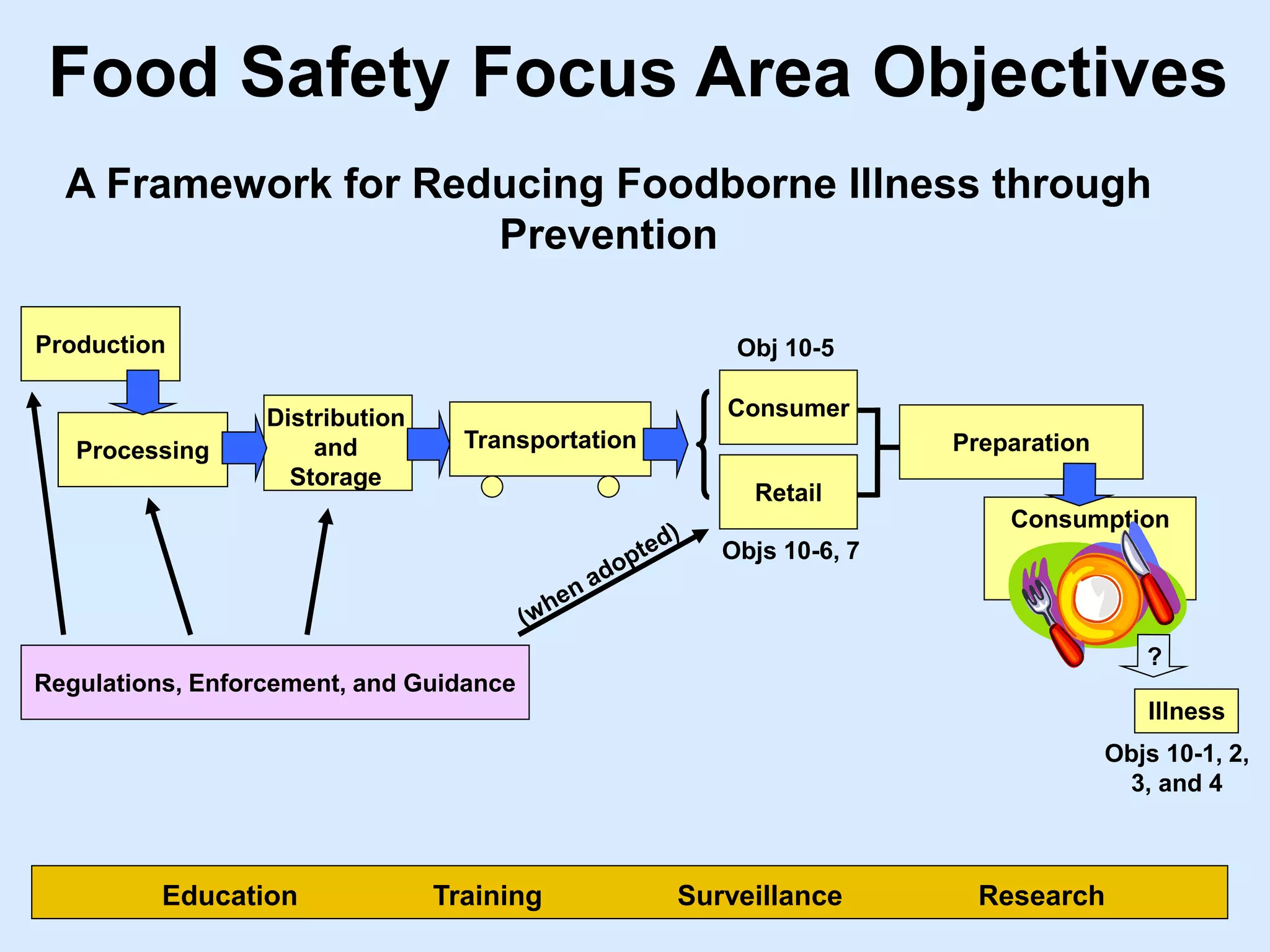
Production
Preparation
Transportation
Retail
Consumer
Processing
A Framework for Reducing Foodborne Illness through
Prevention
Regulations, Enforcement, and Guidance
Consumption
Distribution
and
Storage
Illness
?
Obj 10-5
Objs 10-6, 7
Objs 10-1, 2,
3, and 4
Education Training Surveillance Research
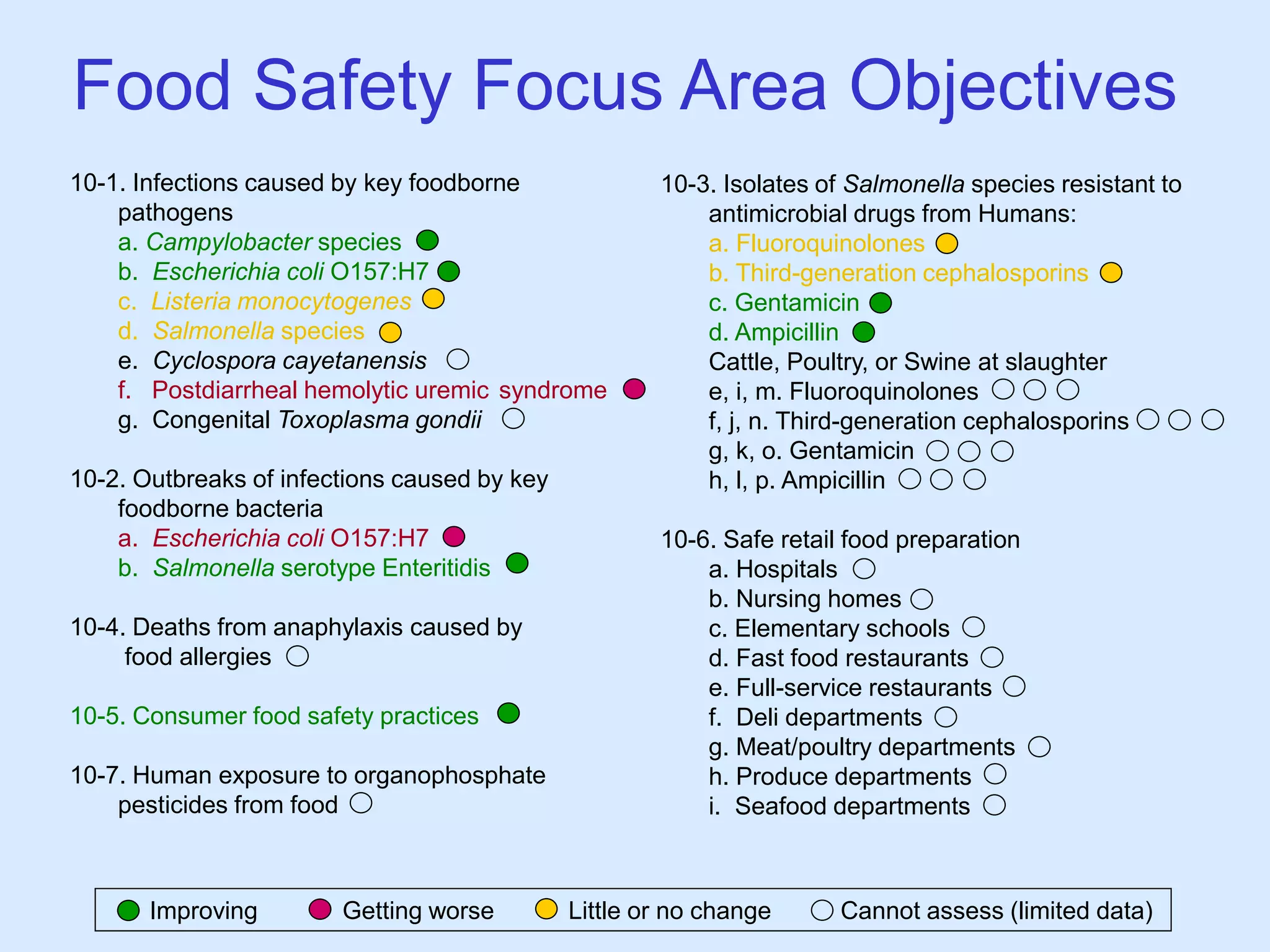
Food Safety Focus Area Objectives
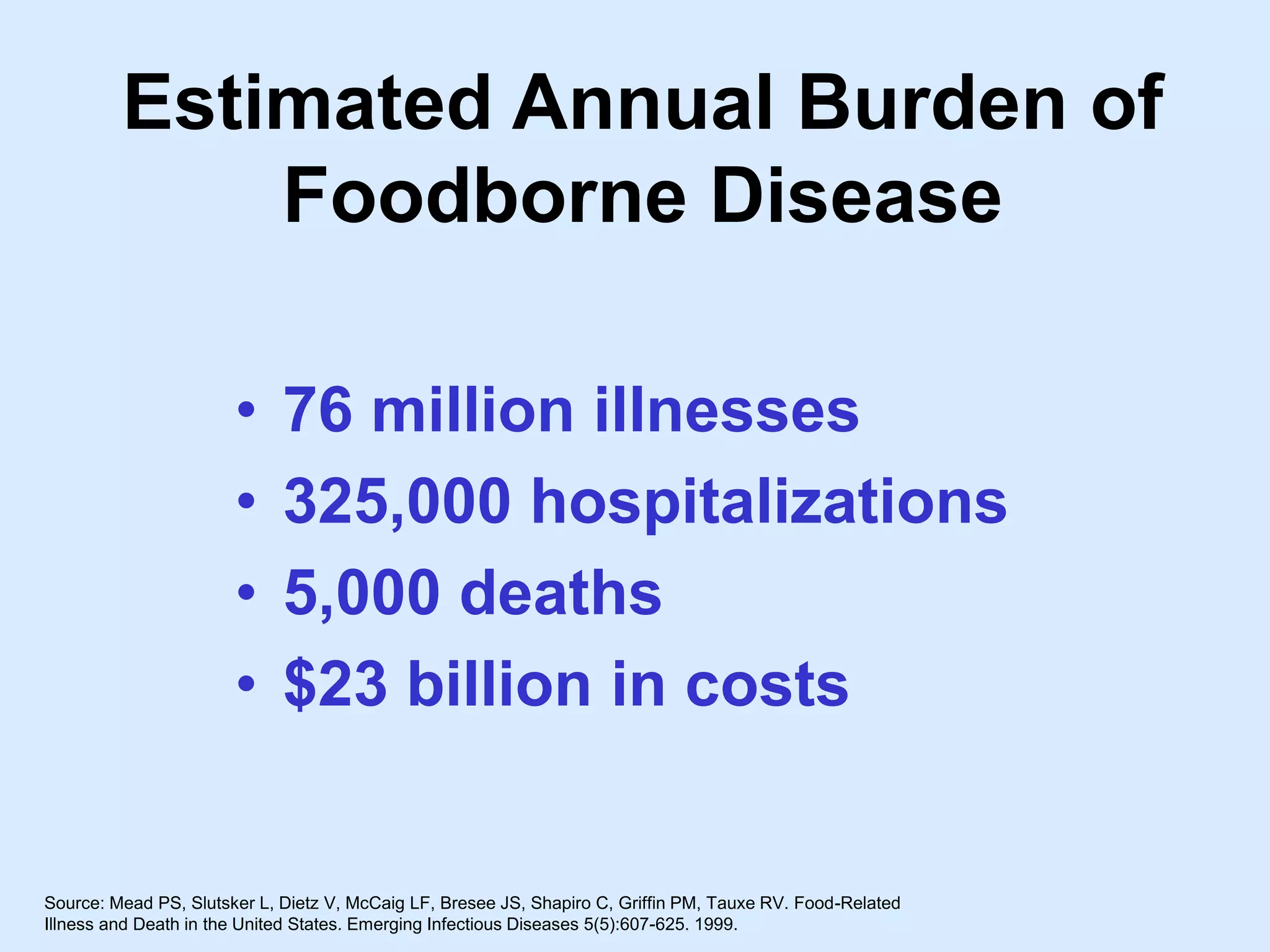
Estimated Annual Burden of
Foodborne Disease
• 76 million illnesses
• 325,000 hospitalizations
• 5,000 deaths
• $23 billion in costs
Source: Mead PS, Slutsker L, Dietz V, McCaig LF, Bresee JS, Shapiro C, Griffin PM, Tauxe RV. Food-Related
Illness and Death in the United States. Emerging Infectious Diseases 5(5):607-625. 1999.
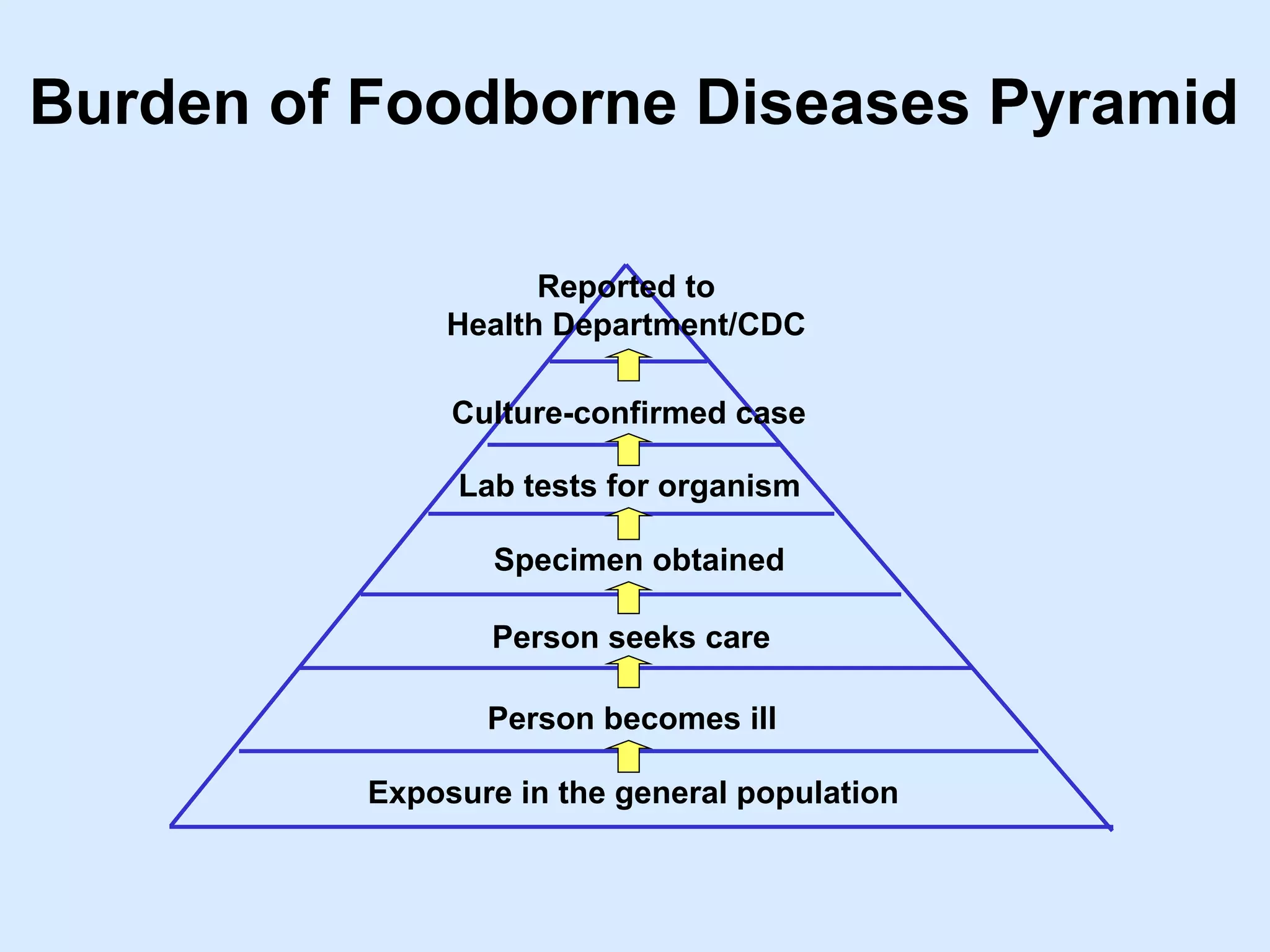
Burden of Foodborne Diseases Pyramid
Exposure in the general population
Person becomes ill
Person seeks care
Specimen obtained
Culture-confirmed case
Reported to
Health Department/CDC
Lab tests for organism
10-1. Infections caused by key foodborne
pathogens
a. Campylobacter species
b. Escherichia coli O157:H7
c. Listeria monocytogenes
d. Salmonella species
e. Cyclospora cayetanensis
f. Postdiarrheal hemolytic uremic syndrome
g. Congenital Toxoplasma gondii
10-2. Outbreaks of infections caused by key
foodborne bacteria
a. Escherichia coli O157:H7
b. Salmonella serotype Enteritidis
10-4. Deaths from anaphylaxis caused by
food allergies
10-5. Consumer food safety practices
10-7. Human exposure to organophosphate
pesticides from food
Food Safety Focus Area Objectives
Improving Getting worse Little or no change Cannot assess (limited data)
10-3. Isolates of Salmonella species resistant to
antimicrobial drugs from Humans:
a. Fluoroquinolones
b. Third-generation cephalosporins
c. Gentamicin
d. Ampicillin
Cattle, Poultry, or Swine at slaughter
e, i, m. Fluoroquinolones
f, j, n. Third-generation cephalosporins
g, k, o. Gentamicin
h, l, p. Ampicillin
10-6. Safe retail food preparation
a. Hospitals
b. Nursing homes
c. Elementary schools
d. Fast food restaurants
e. Full-service restaurants
f. Deli departments
g. Meat/poultry departments
h. Produce departments
i. Seafood departments
0
5
10
15
20
25
1997 1998 1999 2000 2001 2002 2003
0
5
10
15
20
25
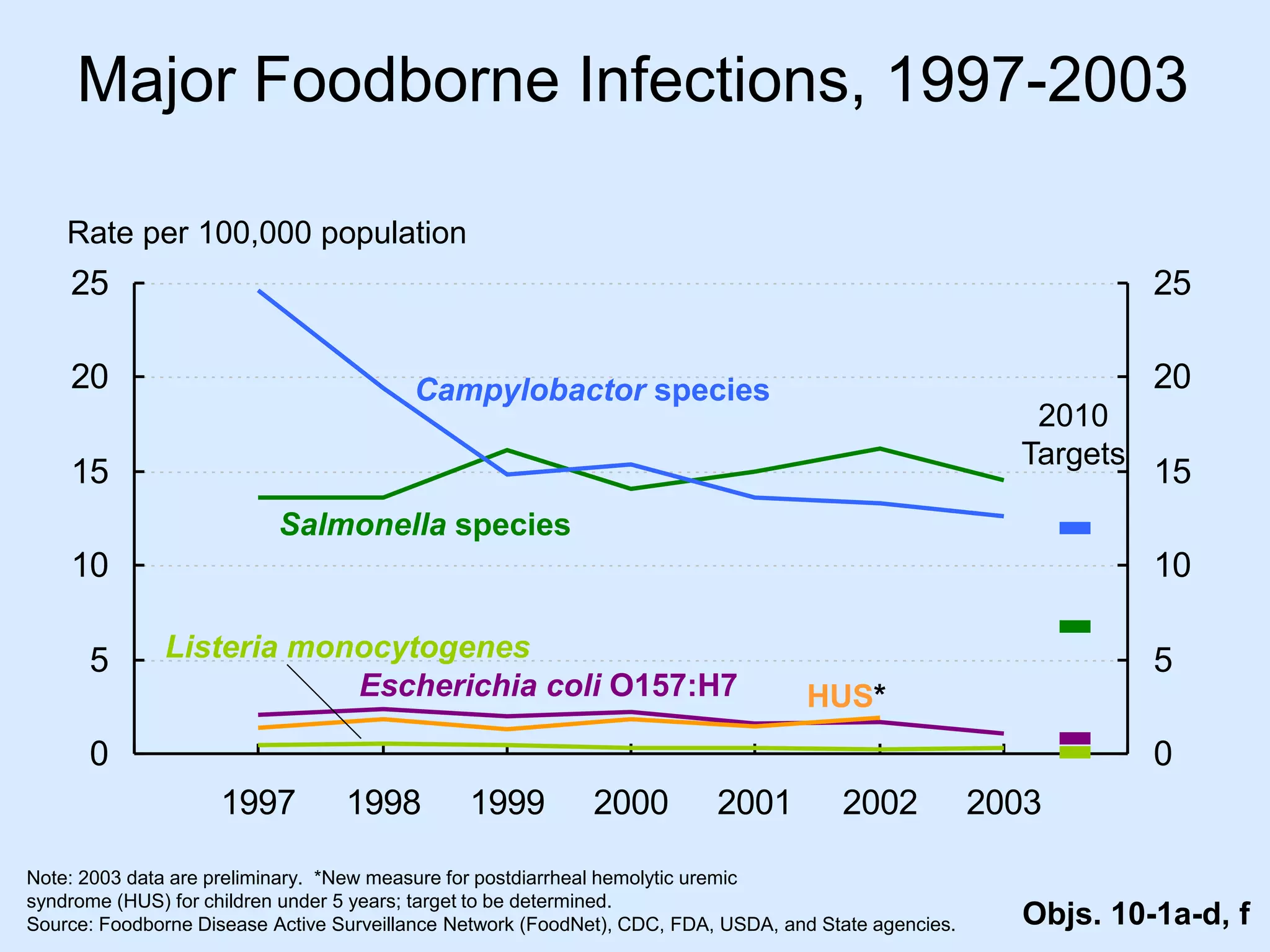
Rate per 100,000 population
Campylobactor species
Salmonella species
Escherichia coli O157:H7
Listeria monocytogenes
2010
Targets
HUS*
Objs. 10-1a-d, f
Major Foodborne Infections, 1997-2003
Note: 2003 data are preliminary. *New measure for postdiarrheal hemolytic uremic
syndrome (HUS) for children under 5 years; target to be determined.
Source: Foodborne Disease Active Surveillance Network (FoodNet), CDC, FDA, USDA, and State agencies.
0
20
40
60
80
1997 1998 1999 2000 2001 2002
0
20
40
60
80
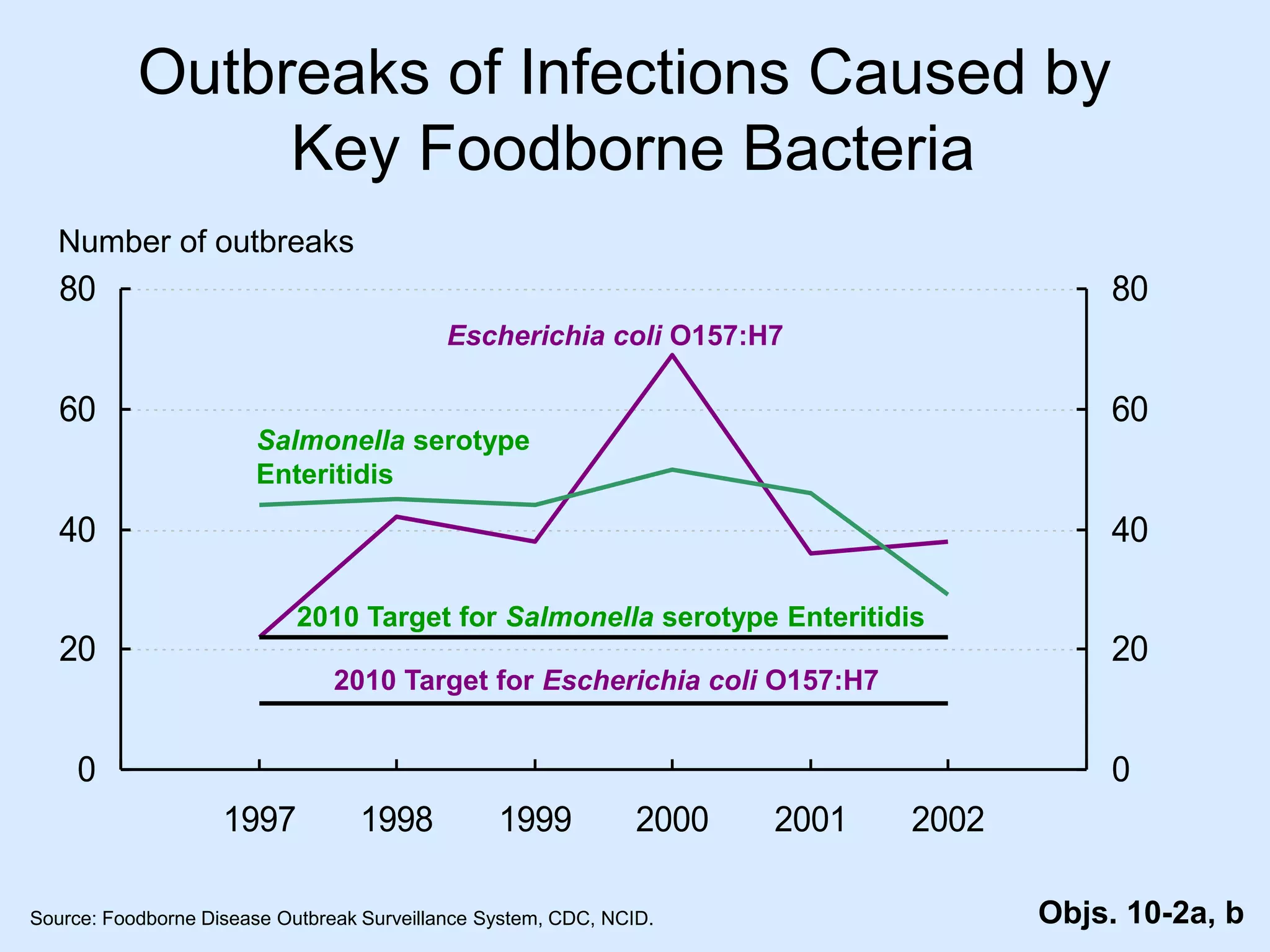
Escherichia coli O157:H7
Number of outbreaks
Salmonella serotype
Enteritidis
2010 Target for Salmonella serotype Enteritidis
2010 Target for Escherichia coli O157:H7
Objs. 10-2a, b
Source: Foodborne Disease Outbreak Surveillance System, CDC, NCID.
Outbreaks of Infections Caused by
Key Foodborne Bacteria
0
5
10
15
20
1997 1998 1999 2000 2001 2002
0
5
10
15
20
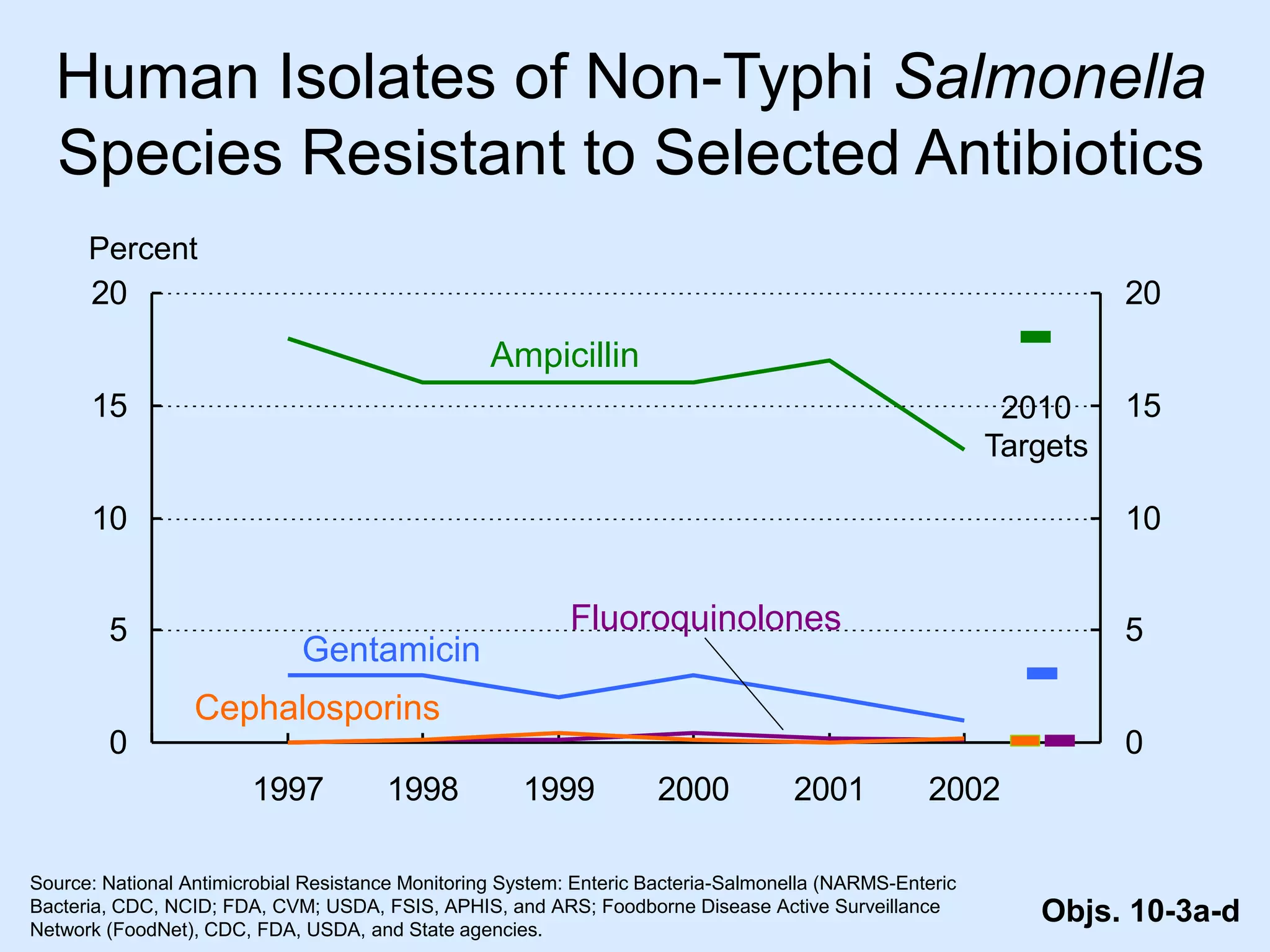
Percent
Ampicillin
2010
Targets
Human Isolates of Non-Typhi Salmonella
Species Resistant to Selected Antibiotics
Fluoroquinolones
Cephalosporins
Gentamicin
Objs. 10-3a-d
Source: National Antimicrobial Resistance Monitoring System: Enteric Bacteria-Salmonella (NARMS-Enteric
Bacteria, CDC, NCID; FDA, CVM; USDA, FSIS, APHIS, and ARS; Foodborne Disease Active Surveillance
Network (FoodNet), CDC, FDA, USDA, and State agencies.
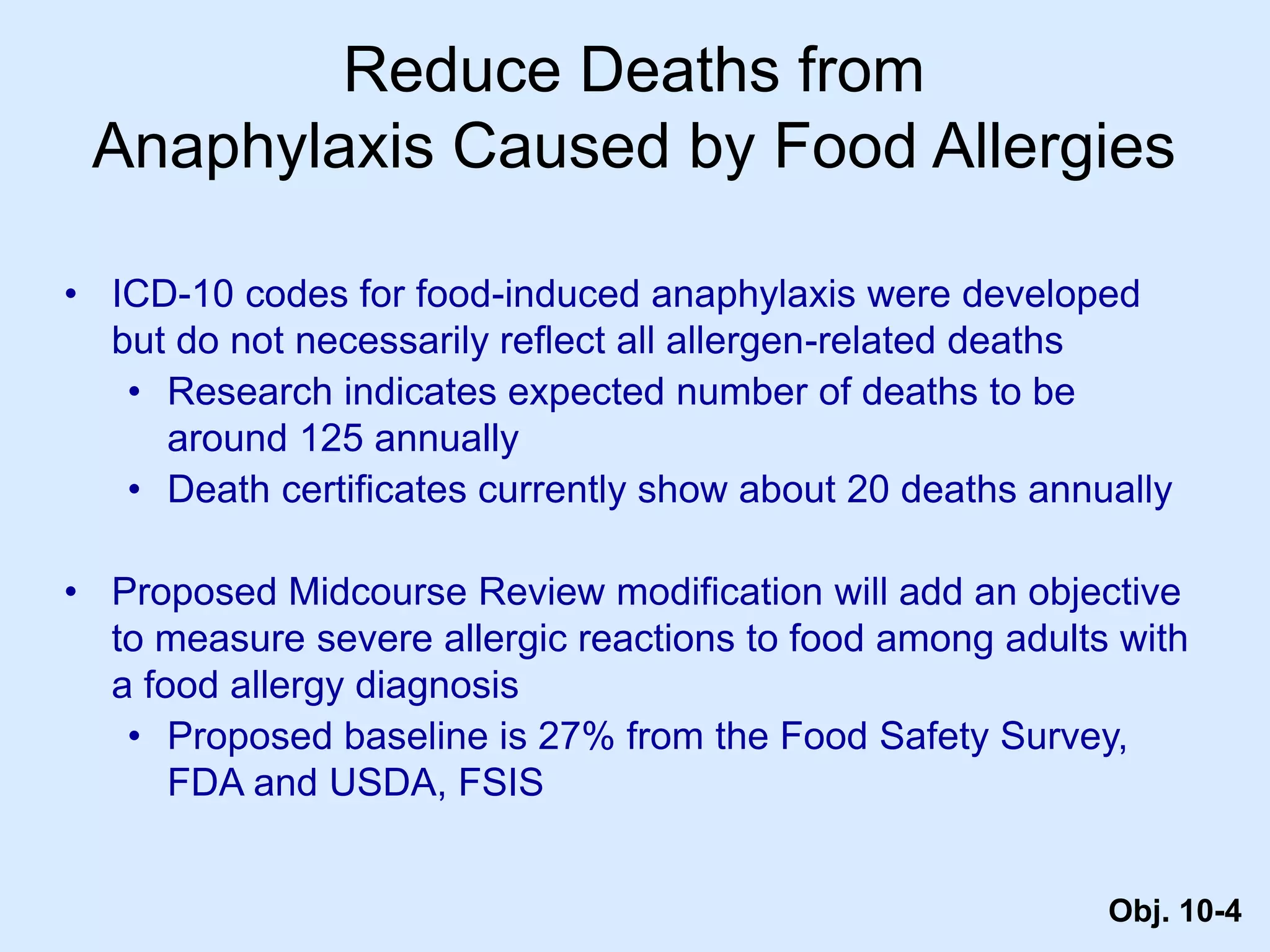
• ICD-10 codes for food-induced anaphylaxis were developed
but do not necessarily reflect all allergen-related deaths
• Research indicates expected number of deaths to be
around 125 annually
• Death certificates currently show about 20 deaths annually
• Proposed Midcourse Review modification will add an objective
to measure severe allergic reactions to food among adults with
a food allergy diagnosis
• Proposed baseline is 27% from the Food Safety Survey,
FDA and USDA, FSIS
Reduce Deaths from
Anaphylaxis Caused by Food Allergies
Obj. 10-4
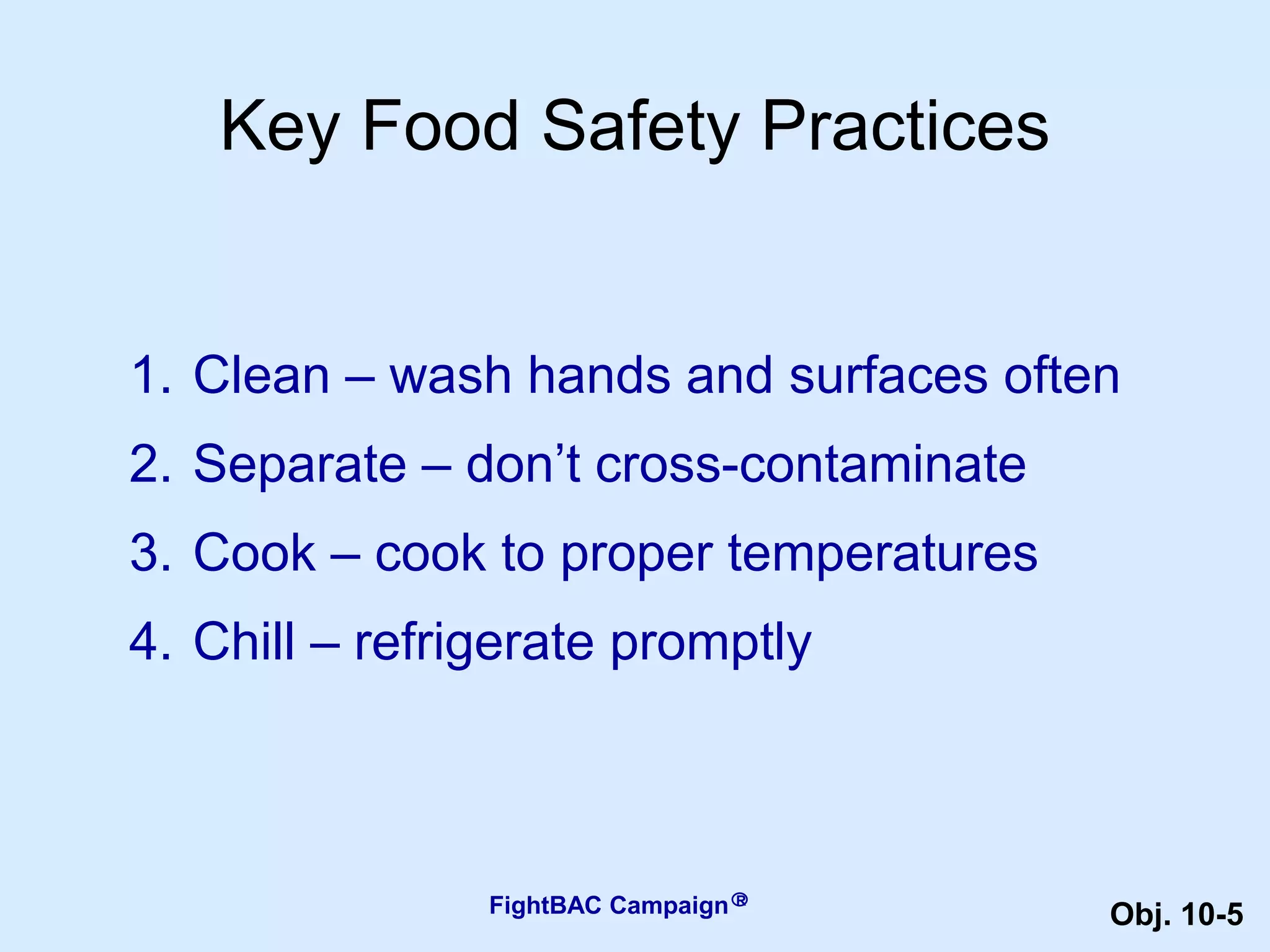
1. Clean – wash hands and surfaces often
2. Separate – don’t cross-contaminate
3. Cook – cook to proper temperatures
4. Chill – refrigerate promptly
FightBAC Campaign
Key Food Safety Practices
R
Obj. 10-5
0
25
50
75
100
Percent
73 76
73
76
70
74 75
2010 Target
Total Black White Female Male Less than High At least
high school some
school graduate college
75 73
75 78
72 75
73
76
71
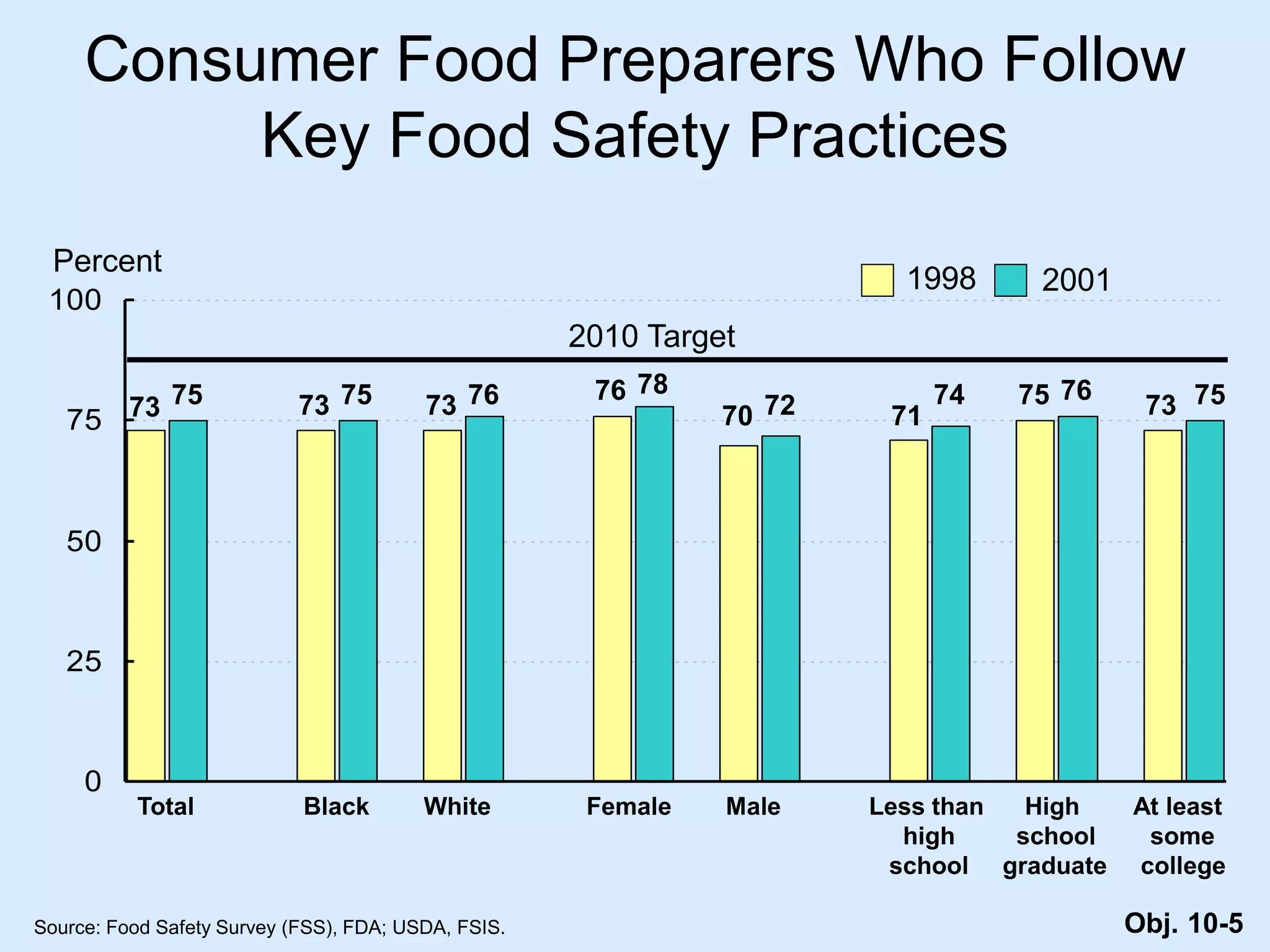
Consumer Food Preparers Who Follow
Key Food Safety Practices
1998 2001
Source: Food Safety Survey (FSS), FDA; USDA, FSIS. Obj. 10-5
0 20 40 60 80 100
Seafood departments
Produce departments
Meat/Poultry departments
Deli departments
Full-service restaurants
Fast food restaurants
Elementary schools
Nursing homes
Hospitals
Percent
80
82
80
80
60
74
81
76
83
2010
Targets
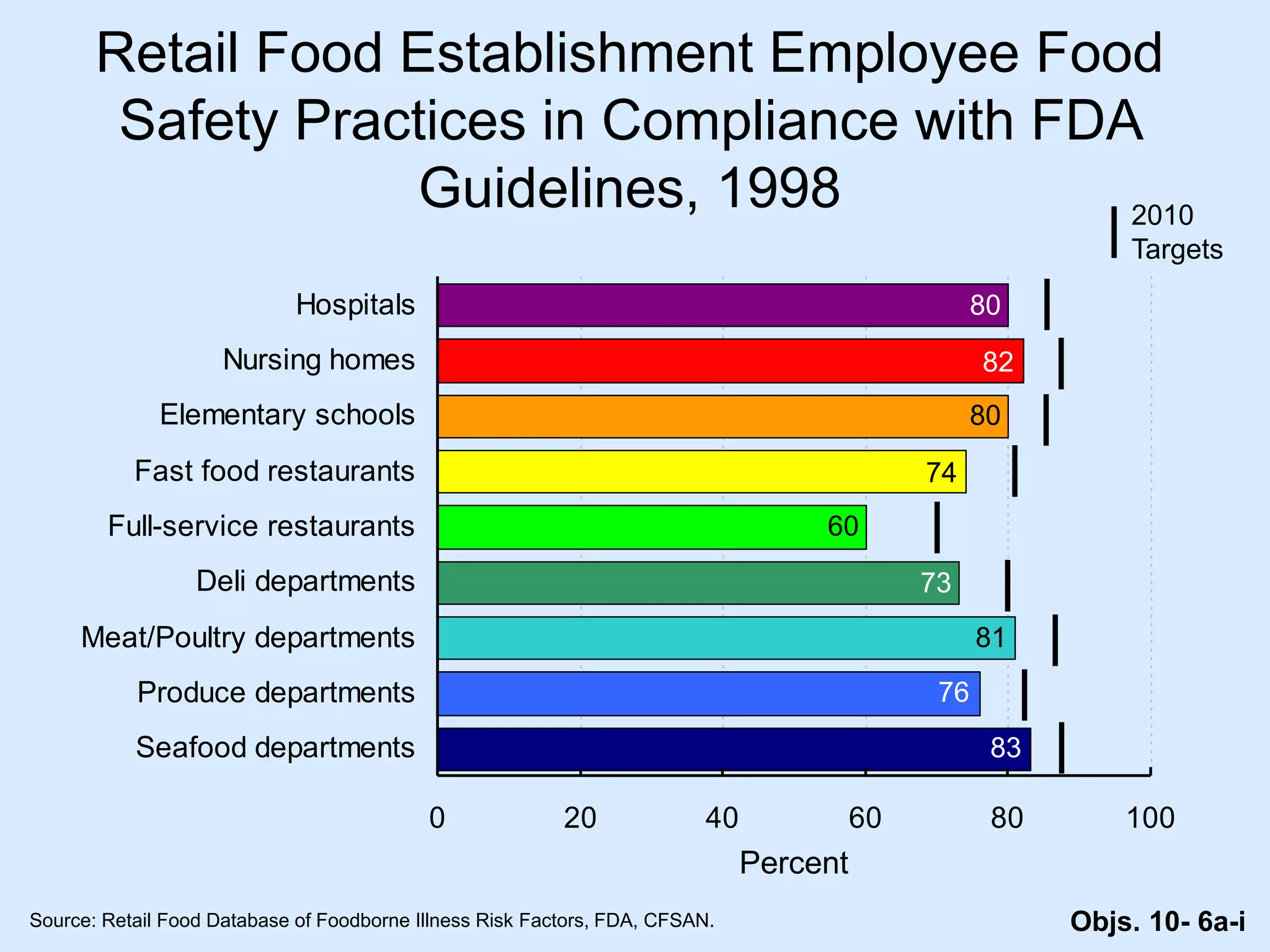
Retail Food Establishment Employee Food
Safety Practices in Compliance with FDA
Guidelines, 1998
83
73
Source: Retail Food Database of Foodborne Illness Risk Factors, FDA, CFSAN. Objs. 10- 6a-i
Progress review data and
slides can be found on the
web at:
http://www.cdc.gov/nchs/hphome.htm

Factors affecting bacterial pathogenicity

  • 1.
    Focus Area 10 FoodSafety Progress Review May 11, 2004
  • 2.
    Production Preparation Transportation Retail Consumer Processing A Framework forReducing Foodborne Illness through Prevention Regulations, Enforcement, and Guidance Consumption Distribution and Storage Illness ? Obj 10-5 Objs 10-6, 7 Objs 10-1, 2, 3, and 4 Education Training Surveillance Research Food Safety Focus Area Objectives
  • 3.
    Estimated Annual Burdenof Foodborne Disease • 76 million illnesses • 325,000 hospitalizations • 5,000 deaths • $23 billion in costs Source: Mead PS, Slutsker L, Dietz V, McCaig LF, Bresee JS, Shapiro C, Griffin PM, Tauxe RV. Food-Related Illness and Death in the United States. Emerging Infectious Diseases 5(5):607-625. 1999.
  • 4.
    Burden of FoodborneDiseases Pyramid Exposure in the general population Person becomes ill Person seeks care Specimen obtained Culture-confirmed case Reported to Health Department/CDC Lab tests for organism
  • 5.
    10-1. Infections causedby key foodborne pathogens a. Campylobacter species b. Escherichia coli O157:H7 c. Listeria monocytogenes d. Salmonella species e. Cyclospora cayetanensis f. Postdiarrheal hemolytic uremic syndrome g. Congenital Toxoplasma gondii 10-2. Outbreaks of infections caused by key foodborne bacteria a. Escherichia coli O157:H7 b. Salmonella serotype Enteritidis 10-4. Deaths from anaphylaxis caused by food allergies 10-5. Consumer food safety practices 10-7. Human exposure to organophosphate pesticides from food Food Safety Focus Area Objectives Improving Getting worse Little or no change Cannot assess (limited data) 10-3. Isolates of Salmonella species resistant to antimicrobial drugs from Humans: a. Fluoroquinolones b. Third-generation cephalosporins c. Gentamicin d. Ampicillin Cattle, Poultry, or Swine at slaughter e, i, m. Fluoroquinolones f, j, n. Third-generation cephalosporins g, k, o. Gentamicin h, l, p. Ampicillin 10-6. Safe retail food preparation a. Hospitals b. Nursing homes c. Elementary schools d. Fast food restaurants e. Full-service restaurants f. Deli departments g. Meat/poultry departments h. Produce departments i. Seafood departments
  • 6.
    0 5 10 15 20 25 1997 1998 19992000 2001 2002 2003 0 5 10 15 20 25 Rate per 100,000 population Campylobactor species Salmonella species Escherichia coli O157:H7 Listeria monocytogenes 2010 Targets HUS* Objs. 10-1a-d, f Major Foodborne Infections, 1997-2003 Note: 2003 data are preliminary. *New measure for postdiarrheal hemolytic uremic syndrome (HUS) for children under 5 years; target to be determined. Source: Foodborne Disease Active Surveillance Network (FoodNet), CDC, FDA, USDA, and State agencies.
  • 7.
    0 20 40 60 80 1997 1998 19992000 2001 2002 0 20 40 60 80 Escherichia coli O157:H7 Number of outbreaks Salmonella serotype Enteritidis 2010 Target for Salmonella serotype Enteritidis 2010 Target for Escherichia coli O157:H7 Objs. 10-2a, b Source: Foodborne Disease Outbreak Surveillance System, CDC, NCID. Outbreaks of Infections Caused by Key Foodborne Bacteria
  • 8.
    0 5 10 15 20 1997 1998 19992000 2001 2002 0 5 10 15 20 Percent Ampicillin 2010 Targets Human Isolates of Non-Typhi Salmonella Species Resistant to Selected Antibiotics Fluoroquinolones Cephalosporins Gentamicin Objs. 10-3a-d Source: National Antimicrobial Resistance Monitoring System: Enteric Bacteria-Salmonella (NARMS-Enteric Bacteria, CDC, NCID; FDA, CVM; USDA, FSIS, APHIS, and ARS; Foodborne Disease Active Surveillance Network (FoodNet), CDC, FDA, USDA, and State agencies.
  • 9.
    • ICD-10 codesfor food-induced anaphylaxis were developed but do not necessarily reflect all allergen-related deaths • Research indicates expected number of deaths to be around 125 annually • Death certificates currently show about 20 deaths annually • Proposed Midcourse Review modification will add an objective to measure severe allergic reactions to food among adults with a food allergy diagnosis • Proposed baseline is 27% from the Food Safety Survey, FDA and USDA, FSIS Reduce Deaths from Anaphylaxis Caused by Food Allergies Obj. 10-4
  • 10.
    1. Clean –wash hands and surfaces often 2. Separate – don’t cross-contaminate 3. Cook – cook to proper temperatures 4. Chill – refrigerate promptly FightBAC Campaign Key Food Safety Practices R Obj. 10-5
  • 11.
    0 25 50 75 100 Percent 73 76 73 76 70 74 75 2010Target Total Black White Female Male Less than High At least high school some school graduate college 75 73 75 78 72 75 73 76 71 Consumer Food Preparers Who Follow Key Food Safety Practices 1998 2001 Source: Food Safety Survey (FSS), FDA; USDA, FSIS. Obj. 10-5
  • 12.
    0 20 4060 80 100 Seafood departments Produce departments Meat/Poultry departments Deli departments Full-service restaurants Fast food restaurants Elementary schools Nursing homes Hospitals Percent 80 82 80 80 60 74 81 76 83 2010 Targets Retail Food Establishment Employee Food Safety Practices in Compliance with FDA Guidelines, 1998 83 73 Source: Retail Food Database of Foodborne Illness Risk Factors, FDA, CFSAN. Objs. 10- 6a-i
  • 13.
    Progress review dataand slides can be found on the web at: http://www.cdc.gov/nchs/hphome.htm