Recommended
PPT
Ecuacion de segundo grado factorizacion
PDF
PDF
Ejercicios de Factorización
PDF
Guia de ejercicios inecuaciones
PDF
Examen productos notables
PDF
Guia de practicas productos notables
PPT
DOC
Ejercicios de-sistemas-de-ecuaciones-lineales (1)
DOCX
Ejercicios resueltos de radicales
DOCX
Ejercicios resueltos de fracciones algebraicas, logaritmos y polinomios
DOC
Algebra 4to...Ecuaciones e inecuaciones de 2º Grado
DOCX
PDF
08. regla de ruffini_ejercicios
DOC
Ejercicios ecuaciones primer grado
PDF
PPTX
Problemas de aplicación de polinomios
PDF
ejercicios resueltos de sumatorais
PDF
Caso 1º de racionalización
DOCX
Relación entre Productos notables y Factorización
PDF
Geometria angulos entre paralelas - grupos i y ii-convertido
PDF
Ejercicios de multiplicacion de expresiones algebraicas
PDF
Ejercicios y soluciones de funciones lineales
PDF
Ejercicios de ecuaciones Cuadráticas resueltos.
PDF
DOCX
Ejercicios de potenciacion de números enteros
DOC
Ejercicios numeros-racionales-y-reales-4c2baa
PDF
26 ejercicios congruencia de triángulos
PDF
Ejercicios logaritmos 1º bachillerato-css
PPTX
PPTX
More Related Content
PPT
Ecuacion de segundo grado factorizacion
PDF
PDF
Ejercicios de Factorización
PDF
Guia de ejercicios inecuaciones
PDF
Examen productos notables
PDF
Guia de practicas productos notables
PPT
DOC
Ejercicios de-sistemas-de-ecuaciones-lineales (1)
What's hot
DOCX
Ejercicios resueltos de radicales
DOCX
Ejercicios resueltos de fracciones algebraicas, logaritmos y polinomios
DOC
Algebra 4to...Ecuaciones e inecuaciones de 2º Grado
DOCX
PDF
08. regla de ruffini_ejercicios
DOC
Ejercicios ecuaciones primer grado
PDF
PPTX
Problemas de aplicación de polinomios
PDF
ejercicios resueltos de sumatorais
PDF
Caso 1º de racionalización
DOCX
Relación entre Productos notables y Factorización
PDF
Geometria angulos entre paralelas - grupos i y ii-convertido
PDF
Ejercicios de multiplicacion de expresiones algebraicas
PDF
Ejercicios y soluciones de funciones lineales
PDF
Ejercicios de ecuaciones Cuadráticas resueltos.
PDF
DOCX
Ejercicios de potenciacion de números enteros
DOC
Ejercicios numeros-racionales-y-reales-4c2baa
PDF
26 ejercicios congruencia de triángulos
PDF
Ejercicios logaritmos 1º bachillerato-css
Similar to Factorizacion ejercicios
PPTX
PPTX
PDF
Problemas resueltos de Matemática Básica MBI ccesa007
PPTX
PDF
EJERCICIOS_DE_FRACCIONES_ALGEBRAICAS.pdf
PDF
PPTX
fracciones_parciales_3 casos_explicación.pptx
DOCX
PDF
Ejercicios resueltos polinomios
PDF
Polinomios+fracciones algebraicas
PPTX
SUEC 高中 Adv Maths (Linear Equation in 3 Variables).pptx
PPTX
Ejercicios de inecuaciones
PDF
Persamaan dan Pertidaksamaan Nilai Mutlak
DOC
Taller de factorizacion grado clei 4º 1
PDF
PDF
Ejemplos de factorizacion
PDF
PRODUCTOS NOTABLES PRE.pdf
PDF
Repaso general. Algebra. (1).pdf
PDF
Problemas resueltos de venero, Introducción al análisis matemático 2020
PDF
More from Edgar Sanchez
DOCX
Balotario funcion reguladora y superv. del estado (1)
DOC
PDF
PDF
DOCX
Proyecto educativo de educación física dos
DOCX
DOCX
Casos de estrategias uno (1)
PPTX
Capacitacion para cetpro (1)
PPTX
Capacitación 15 10-2016. eba(1)
DOCX
Examen escrito de ciencia
PDF
DOCX
Interes compuesto manolito1
DOCX
Las seis llaves maestras de las matemáticas financieras
DOCX
Examen escrito de razonamiento matematico series
DOC
DOCX
Evolución histórica del dólar
DOCX
DOCX
DOCX
DOCX
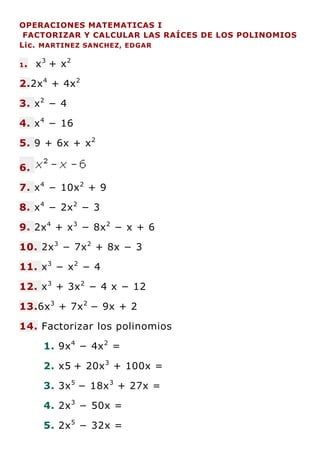
Factorizacion ejercicios 1. OPERACIONES MATEMATICAS I
FACTORIZAR Y CALCULAR LAS RAÍCES DE LOS POLINOMIOS
Lic. MARTINEZ SANCHEZ, EDGAR
1. x3
+ x2
2.2x4
+ 4x2
3. x2
− 4
4. x4
− 16
5. 9 + 6x + x2
6.
7. x4
− 10x2
+ 9
8. x4
− 2x2
− 3
9. 2x4
+ x3
− 8x2
− x + 6
10. 2x3
− 7x2
+ 8x − 3
11. x3
− x2
− 4
12. x3
+ 3x2
− 4 x − 12
13.6x3
+ 7x2
− 9x + 2
14. Factorizar los polinomios
1. 9x4
− 4x2
=
2. x5 + 20x3
+ 100x =
3. 3x5
− 18x3
+ 27x =
4. 2x3
− 50x =
5. 2x5
− 32x =
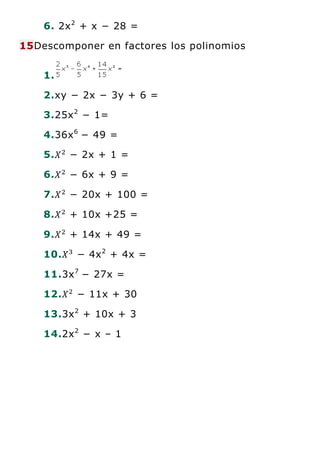
2. 6. 2x2
+ x − 28 =
15Descomponer en factores los polinomios
1.
2.xy − 2x − 3y + 6 =
3.25x2
− 1=
4.36x6
− 49 =
5. − 2x + 1 =
6. − 6x + 9 =
7. − 20x + 100 =
8. + 10x +25 =
9. + 14x + 49 =
10. − 4x2
+ 4x =
11.3x7
− 27x =
12. − 11x + 30
13.3x2
+ 10x + 3
14.2x2
− x – 1
3. 1
x3
+ x2
x3
+ x2
= x2
(x + 1)
La raíces son: x = 0 y x = − 1
2
2x4
+ 4x2
= 2x2
(x2
+ 2)
2x4
+ 4x2
= 2x2
(x2
+ 2)
Sólo tiene una raíz X = 0 ; ya que el polinomio, x2
+ 2, no tiene ningún valor que lo
anule; debido a que al estar la x al cuadrado siempre dará un número positivo, por tanto es
irreducible.
3
x2
− 4
x2
− 4 = (X + 2) · (X − 2)
Las raíces son X = − 2 y X = 2
4
x4
− 16
x4
− 16 = (x2
+ 4) · (x2
− 4) = (X + 2) · (X − 2) · (x2
+ 4)
Las raíces son X = −2 y X = 2
5
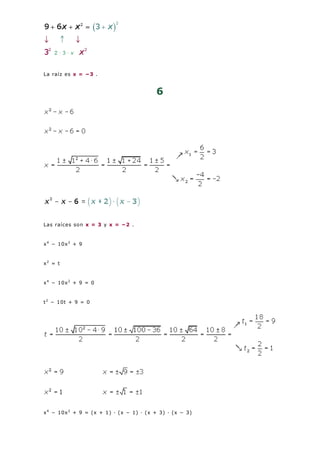
9 + 6x + x2
4. La raíz es x = −3 .
6
Las raíces son x = 3 y x = −2 .
x4
− 10x2
+ 9
x2
= t
x4
− 10x2
+ 9 = 0
t2
− 10t + 9 = 0
x4
− 10x2
+ 9 = (x + 1) · (x − 1) · (x + 3) · (x − 3)
5. 8
x4
− 2x2
− 3
x2
= t
t2
− 2t − 3 = 0
x4
− 2x2
+ 3 = (x2
+ 1) · (x + ) · (x − )
9
2x4
+ x3
− 8x2
− x + 6
1Tomamos los divisores del término independiente: ±1, ±2, ±3.
2Aplicando el teorema del resto sabremos para que valores la división es exacta.
P(1) = 2 · 14
+ 13
− 8 · 12
− 1 + 6 = 2 + 1− 8 − 1 + 6 = 0
3Dividimos por Ruffini.
6. 4Por ser la división exacta, D = d · c
(x −1) · (2x3
+ 3x2
− 5x − 6 )
Una raíz es x = 1.
Continuamos realizando las mismas operaciones al segundo factor.
Volvemos a probar por 1 porque el primer factor podría estar elevado al cuadrado.
P(1) = 2 · 13
+ 3 · 12
− 5 · 1 − 6≠ 0
P(−1) = 2 · (− 1)3
+ 3 ·(− 1)2
− 5 · (− 1) − 6= −2 + 3 + 5 − 6 = 0
(x −1) · (x +1) · (2x2
+x −6)
Otra raíz es x = -1.
El tercer factor lo podemos encontrar aplicando la ecuación de 2º grado o tal como
venimos haciéndolo, aunque tiene el inconveniente de que sólo podemos encontrar raíces
enteras.
El 1 lo descartamos y seguimos probando por − 1.
P(−1) = 2 · (−1)2
+ (−1) − 6 ≠ 0
P(2) = 2 · 22
+ 2 − 6 ≠ 0
P(−2) = 2 · (−2)2
+ (−2) − 6 = 2 · 4 − 2 − 6 = 0
(x −1) · (x +1) · (x +2) · (2x −3 )
Sacamos factor común 2 en último binomio.
7. 2x −3 = 2 (x − 3/2)
La factorización del polinomio queda:
2x4
+ x3
− 8x2
− x + 6 = 2 (x −1) · (x +1) · (x +2) · (x − 3/2)
Las raíces son : x = 1, x = − 1, x = −2 y x = 3/2
10
2x3
− 7x2
+ 8x − 3
P(1) = 2 · 13
− 7 · 12
+ 8 · 1 − 3 = 0
(x −1) · (2x2
− 5x + 3)
P(1) = 2 · 1 2
−5 · 1 + 3 = 0
(x −1)2
· (2x −3) = 2 (x − 3/2) · (x −1)2
Las raíces son: x = 3/2 y x = 1
11
x3
− x2
− 4
{±1, ±2, ±4 }
P(1) = 1 3
− 1 2
− 4 ≠ 0
P(−1) = (−1) 3
− (−1) 2
− 4 ≠ 0
P(2) = 2 3
− 2 2
− 4 = 8 − 4 − 4 = 0
8. (x − 2) · (x2
+ x + 2 )
x2
+ x + 2 = 0
(x − 2) · (x2
+ x + 2 )
Raíz: x = 2.
12
x3
+ 3x2
− 4x − 12
{±1, ±2, ±3, ±4, ±6, ±12 }
P(1) = 13
+ 3 · 12
− 4 · 1 − 12 ≠ 0
P(−1) = (−1)3
+ 3 · (−1)2
− 4 · (−1) − 12 ≠ 0
P(2) = 23
+ 3 · 22
− 4 · 2 − 12 = 8 + 12 − 8 − 12 = 0
(x − 2) · (x2
+ 5x + 6)
x2
+ 5x + 6 = 0
(x − 2) · (x + 2) · (x +3)
9. Las raíces son : x = 2, x = − 2, x = − 3.
13
6x3
+ 7x2
− 9x + 2
{±1, ±2}
P(1) = 6 · 13
+ 7 · 12
− 9 · 1 + 2 ≠ 0
P(−1) = 6 · (−1)3
+ 7 · (−1)2
− 9 · (−1) + 2 ≠ 0
P(2) = 6 · 2 3
+ 7 · 2 2
− 9 · 2 + 2 ≠ 0
P(−2) = 6 · (−2)3
+ 7 · (−2)2
− 9 · (−2) + 2 = − 48 + 28 + 18 + 2 = 0
(x+2) · (6x2
− 5x + 1)
6x2
− 5x + 1 = 0
6 · (x + 2) · (x − 1/2) · (x − 1/3)
Raíces: x = − 2, x = 1/2 y x= 1/3
14
19x4
− 4x2
=
10. x2
· (9x2
− 4) =
x2
· (3x + 2) · (3x − 2)
2x5
+ 20x3
+ 100x =
x · (x4
+ 20x2
+ 100) =
x · (x2
+ 10)2
33x5
− 18x3
+ 27x =
3x · (x4
− 6x2
+ 9) =
= 3x · (x2
− 3)2
42x3
− 50x =
=2x · (x2
− 25) =
2x · (x + 5) · (x - 5)
52x5
− 32x =
= 2x · (x4
− 16 ) =
2x · (x2
+ 4) · (x2
− 4) =
= 2x · (x2
+ 4) ·(x +2) · (x − 2)
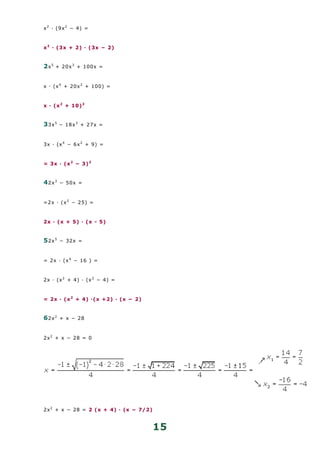
62x2
+ x − 28
2x2
+ x − 28 = 0
2x2
+ x − 28 = 2 (x + 4) · (x − 7/2)
15
11. 1
2xy − 2x − 3y + 6 =
= x · (y − 2) − 3 · (y − 2) =
= (x − 3) · (y − 2)
325x2
− 1=
= (5x +1) ·(5x − 1)
436x6
− 49 =
= (6x3
+ 7) · (6x3
− 7)
5x2
− 2x + 1 =
= (x − 1)2
6x2
− 6x + 9 =
= (x − 3)2
7x2
− 20x + 100 =
= (x − 10)2
8x2
+ 10x + 25 =
= (x + 5)2
9x2
+ 14x + 49 =
= (x + 7)2
10x3
− 4x2
+ 4x =
12. = x · (x2
− 4x +4) =
= x · (x − 2)2
113x7
− 27x =
= 3x · (x6
− 9) =
= 3x · (x3
+ 3) · (x3
− 3)
12x2
− 11x + 30
x2
− 11x + 30 = 0
x2
− 11x + 30 = (x −6) · (x −5)
133x2
+ 10x + 3
3x2
+ 10x + 3 = 0
3x2
+ 10x + 3 = 3 (x − 3) · (x − 1/3)
142x2
− x − 1
2x2
− x −1 = 0
13.