Health & Safety
1Facilities Manager
F
or anyone responsible for maintaining health and
safety in critical care facilities, the shockwaves
sent out after the death of three babies in a Belfast
neonatal unit 18 months ago are still reverberating. To make
matters worse, another neonatal death from the same cause,
infection with the Pseudomonas aeruginosa bacterium, was
reported last October by the North Bristol NHS Trust. All
these infections were traced back to contaminated taps.
If any positive outcome to these tragedies can be considered
at all, it has been to turn the spotlight onto the previously
under-acknowledged link between tap water and
P.aeruginosa infections in the low immunity
individuals that make up a major
proportion of the critical care
population. In the wake of these
tragedies the pressure from
the public and the media to
work out what went wrong
and what lessons need to
be learnt has led to major
new guidance from the
Department of Health (DH).
Published in March as
an addendum to Health
Technical Memorandum
04-01 on the control of
Legionella in water systems1,2
,
the new recommendations
on controlling and minimising
the risks of P. aeruginosa associated
with water outlets build on provisional
advice first sent out following the Belfast incident.
According to Dr Jimmy Walker of Public Health England’s
(PHE)* Biosafety Group at Porton Down, a member of the DH
coordinated P.aeruginosa working group, the previous interim
recommendations on sampling for P.aeruginosa had already begun
to yield results. “The initial indication from intensive care units
(ICU) shows rates of P.aeruginosa have already begun to reduce,”
he says, “and the new document, which incorporates lessons
learnt from the Northern Irish incidents continues this process.”
However, P.aeruginosa infections associated with water are
not really a new problem. Dr Mike Weinbren, Director of Infection
Prevention and Control at University Hospital, Coventry and
Warwickshire (UHCW), an advisor on the addendum, notes that
outbreaks have been reported from before 2000. In reality, he
says, there may be a “missed epidemic”; because the literature is
dominated by infections caused by antibiotic resistant strains,
many other instances of treatable waterborne P.aeruginosa
infections may go unrecognised. This view is backed up by
Professor Martin Exner, Director of the Institute of Hygiene and
Public Health at the University of Bonn, who
considers that up to 40% of P.aeruginosa
infections in ICUs may be acquired
from water systems.3
Yet traditionally, Weinbren
says, P.aeruginosa has
been “accepted ...as part
and parcel of what can
happen in ICUs because
it is accepted that
patients bring the
bug onto the unit...We
don’t have a baseline
of what an ‘acceptable’
rate of infection might be.
We might not necessarily
consider infections as out
of the ordinary and if we did, in
the past we wouldn’t necessarily
consider investigating the water system.
“However, on a neonatal unit,
P.aeruginosa infection will always indicate a
problem, because the infection never occurs naturally
in babies. And that problem might be in the water.”
P.aeruginosa is one of a number of waterborne pathogenic
microorganisms of which the Legionella bacterium is perhaps
the most well known. Like Legionella, P. aeruginosa bacteria
also inhabit moist environments due to their ability to form
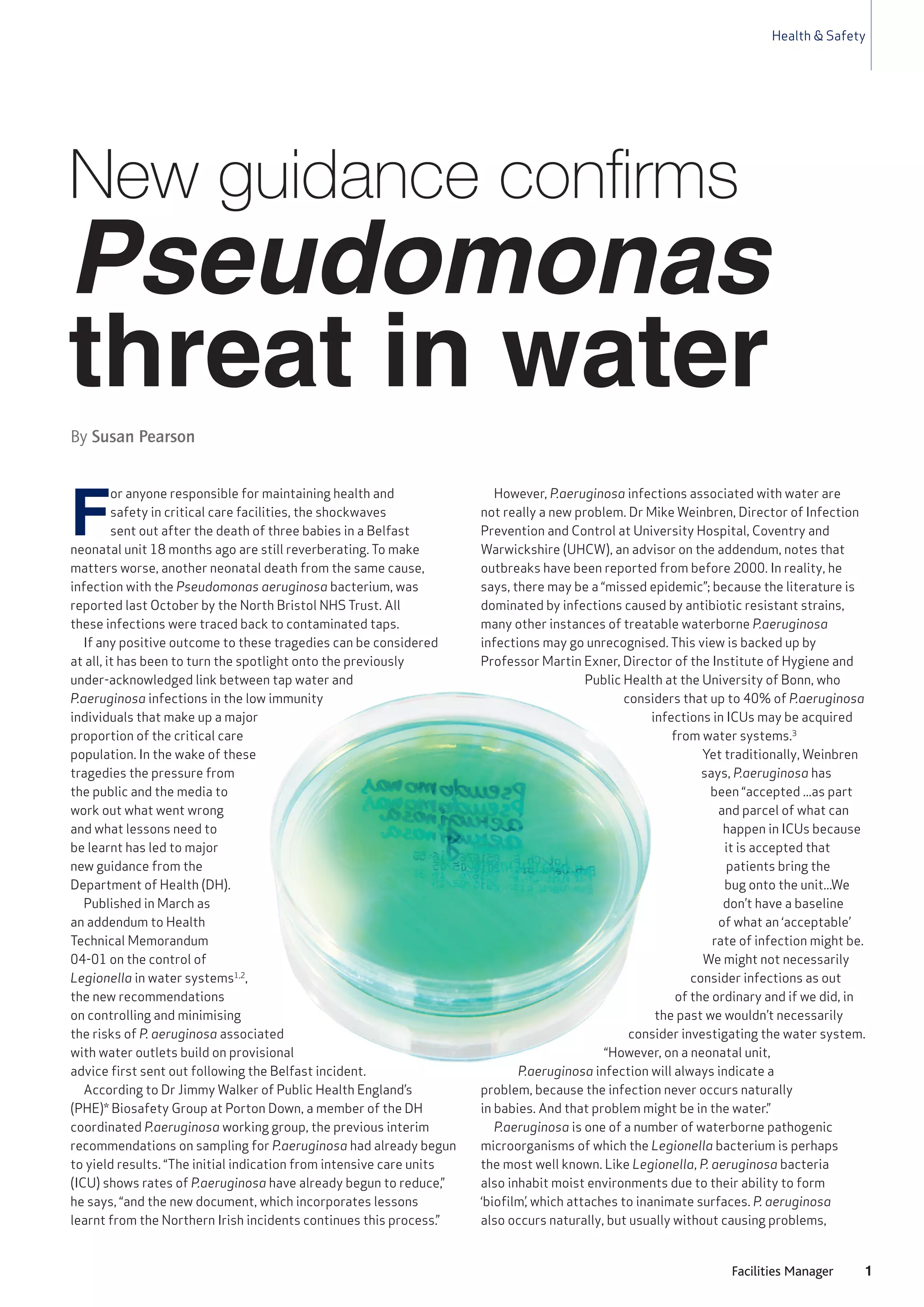
‘biofilm’, which attaches to inanimate surfaces. P. aeruginosa
also occurs naturally, but usually without causing problems,
Pseudomonas
threat in water
New guidance confirms
By Susan Pearson
Health & Safety
2 Facilities Manager
in the intestines of around 50% of healthy individuals. Again,
like Legionella, P.aeruginosa is only really problematic for
those with weak immune systems, such as patients undergoing
immuno-suppressive treatments, neonates, the elderly
or individuals with pre-disposing factors such as wounds.
However, the danger to these groups is constantly increasing as
P.aeruginosa has become highly resistant to many antibiotics.
So how does the organism get into water systems? Like
Legionella, P.aeruginosa may enter in miniscule undetectable
numbers in mains waters and then form biofilm in conducive
conditions such as stagnant warm water in system dead legs.
Certain types of non-metallic materials used in a system’s
construction, such as EPDM used in flexible hoses, also
encourage growth. Retrograde contamination has also been well
documented. This can occur when the organism is transmitted
back to a tap from an infected individual, or when sinks are
used for inappropriate disposal of patient secretions and poor
cleaning, which transfers P.aeruginosa back to the outlet.
P.aeruginosa is also found in lime scale deposits and trapped
debris, particularly frequently in tap fixtures such as flow
straighteners and aerators. P.aeruginosa and Legionella have
also been found inside the complex mechanisms of infra-
red operated taps and in thermostatic mixer valves (TMVs).
The TMVs’ often under-used or stagnant cold feeds are still
connected to hot and cold lever type taps, and act as dead legs.
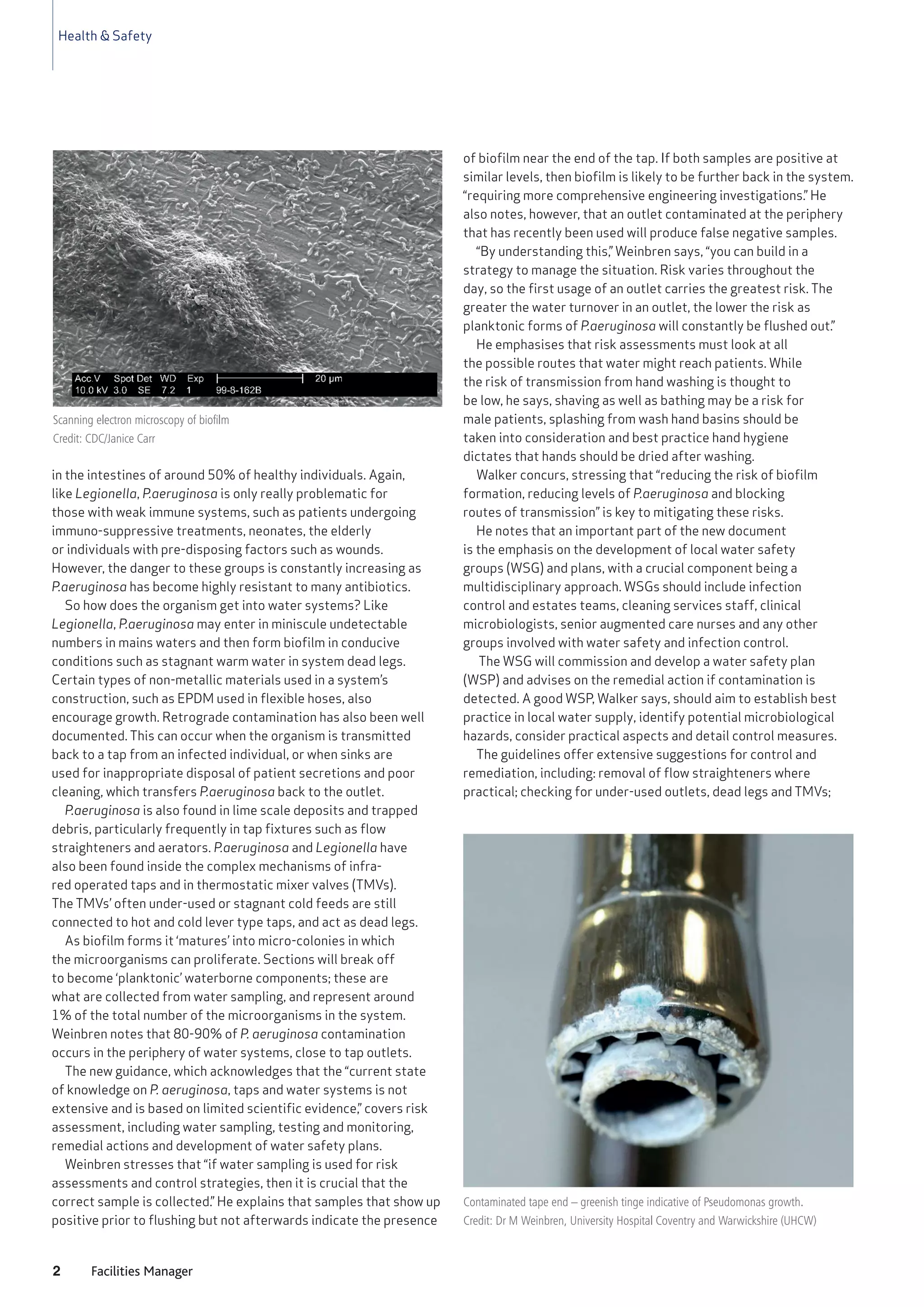
As biofilm forms it ‘matures’ into micro-colonies in which
the microorganisms can proliferate. Sections will break off
to become ‘planktonic’ waterborne components; these are
what are collected from water sampling, and represent around
1% of the total number of the microorganisms in the system.
Weinbren notes that 80-90% of P. aeruginosa contamination
occurs in the periphery of water systems, close to tap outlets.
The new guidance, which acknowledges that the “current state
of knowledge on P. aeruginosa, taps and water systems is not
extensive and is based on limited scientific evidence,” covers risk
assessment, including water sampling, testing and monitoring,
remedial actions and development of water safety plans.
Weinbren stresses that “if water sampling is used for risk
assessments and control strategies, then it is crucial that the
correct sample is collected.” He explains that samples that show up
positive prior to flushing but not afterwards indicate the presence
of biofilm near the end of the tap. If both samples are positive at
similar levels, then biofilm is likely to be further back in the system.
“requiring more comprehensive engineering investigations.” He
also notes, however, that an outlet contaminated at the periphery
that has recently been used will produce false negative samples.
“By understanding this,” Weinbren says, “you can build in a
strategy to manage the situation. Risk varies throughout the
day, so the first usage of an outlet carries the greatest risk. The
greater the water turnover in an outlet, the lower the risk as
planktonic forms of P.aeruginosa will constantly be flushed out.”
He emphasises that risk assessments must look at all
the possible routes that water might reach patients. While
the risk of transmission from hand washing is thought to
be low, he says, shaving as well as bathing may be a risk for
male patients, splashing from wash hand basins should be
taken into consideration and best practice hand hygiene
dictates that hands should be dried after washing.
Walker concurs, stressing that “reducing the risk of biofilm
formation, reducing levels of P.aeruginosa and blocking
routes of transmission” is key to mitigating these risks.
He notes that an important part of the new document
is the emphasis on the development of local water safety
groups (WSG) and plans, with a crucial component being a
multidisciplinary approach. WSGs should include infection
control and estates teams, cleaning services staff, clinical
microbiologists, senior augmented care nurses and any other
groups involved with water safety and infection control.
The WSG will commission and develop a water safety plan
(WSP) and advises on the remedial action if contamination is
detected. A good WSP, Walker says, should aim to establish best
practice in local water supply, identify potential microbiological
hazards, consider practical aspects and detail control measures.
The guidelines offer extensive suggestions for control and
remediation, including: removal of flow straighteners where
practical; checking for under-used outlets, dead legs and TMVs;
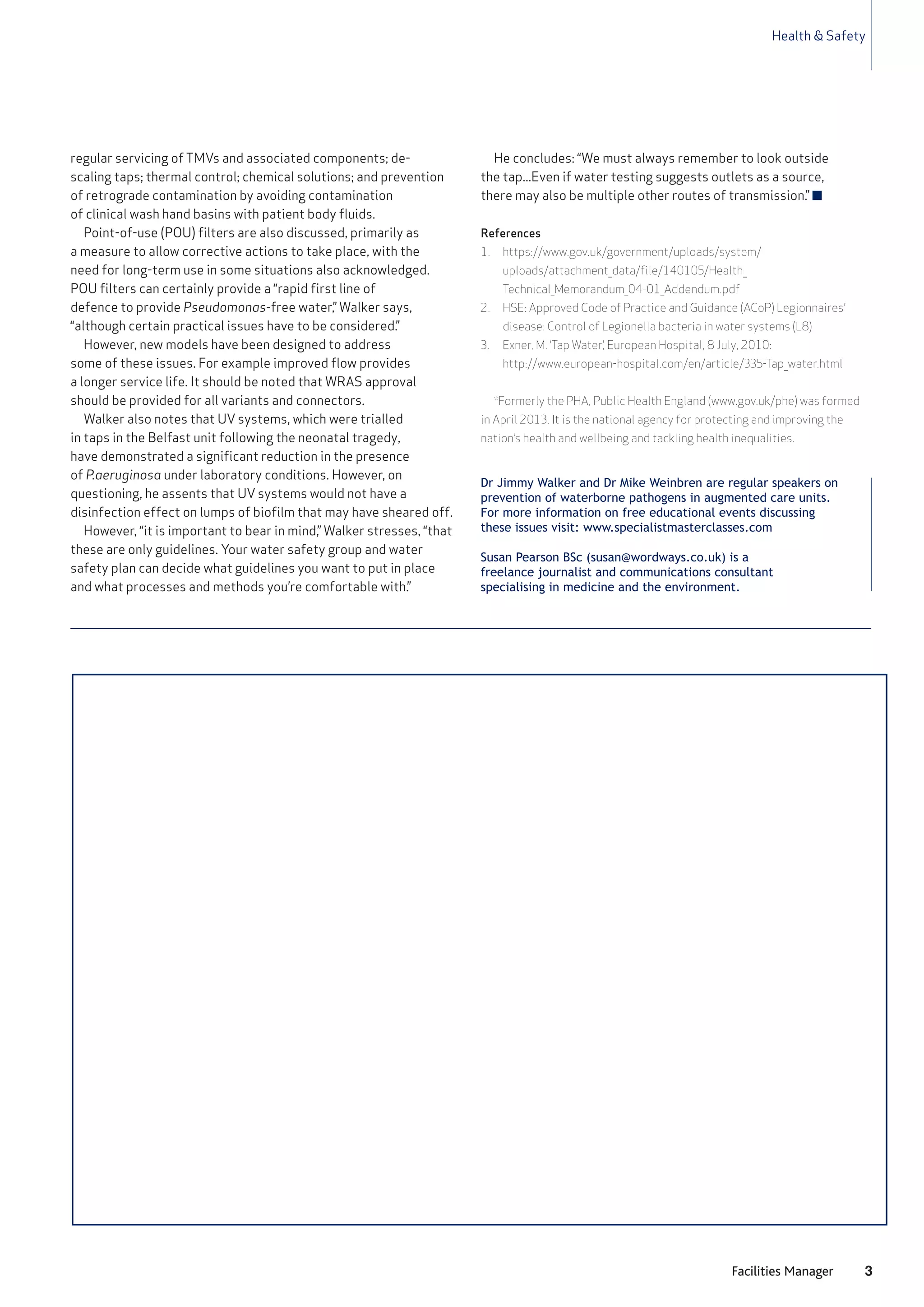
Contaminated tape end – greenish tinge indicative of Pseudomonas growth.
Credit: Dr M Weinbren, University Hospital Coventry and Warwickshire (UHCW)
Scanning electron microscopy of biofilm
Credit: CDC/Janice Carr
Health & Safety
3Facilities Manager
Dr Jimmy Walker and Dr Mike Weinbren are regular speakers on
prevention of waterborne pathogens in augmented care units.
For more information on free educational events discussing
these issues visit: www.specialistmasterclasses.com
Susan Pearson BSc (susan@wordways.co.uk) is a
freelance journalist and communications consultant
specialising in medicine and the environment.
regular servicing of TMVs and associated components; de-
scaling taps; thermal control; chemical solutions; and prevention
of retrograde contamination by avoiding contamination
of clinical wash hand basins with patient body fluids.
Point-of-use (POU) filters are also discussed, primarily as
a measure to allow corrective actions to take place, with the
need for long-term use in some situations also acknowledged.
POU filters can certainly provide a “rapid first line of
defence to provide Pseudomonas-free water,” Walker says,
“although certain practical issues have to be considered.”
However, new models have been designed to address
some of these issues. For example improved flow provides
a longer service life. It should be noted that WRAS approval
should be provided for all variants and connectors.
Walker also notes that UV systems, which were trialled
in taps in the Belfast unit following the neonatal tragedy,
have demonstrated a significant reduction in the presence
of P.aeruginosa under laboratory conditions. However, on
questioning, he assents that UV systems would not have a
disinfection effect on lumps of biofilm that may have sheared off.
However, “it is important to bear in mind,” Walker stresses, “that
these are only guidelines. Your water safety group and water
safety plan can decide what guidelines you want to put in place
and what processes and methods you’re comfortable with.”
He concludes: “We must always remember to look outside
the tap...Even if water testing suggests outlets as a source,
there may also be multiple other routes of transmission.” n
References
1.	 https://www.gov.uk/government/uploads/system/
uploads/attachment_data/file/140105/Health_
Technical_Memorandum_04-01_Addendum.pdf
2.	 HSE: Approved Code of Practice and Guidance (ACoP) Legionnaires’
disease: Control of Legionella bacteria in water systems (L8)
3.	 Exner, M. ‘Tap Water’, European Hospital, 8 July, 2010: 	
http://www.european-hospital.com/en/article/335-Tap_water.html
*Formerly the PHA, Public Health England (www.gov.uk/phe) was formed
in April 2013. It is the national agency for protecting and improving the
nation’s health and wellbeing and tackling health inequalities.

Facilities_Manager_2013-2014

  • 1.
    Health & Safety 1FacilitiesManager F or anyone responsible for maintaining health and safety in critical care facilities, the shockwaves sent out after the death of three babies in a Belfast neonatal unit 18 months ago are still reverberating. To make matters worse, another neonatal death from the same cause, infection with the Pseudomonas aeruginosa bacterium, was reported last October by the North Bristol NHS Trust. All these infections were traced back to contaminated taps. If any positive outcome to these tragedies can be considered at all, it has been to turn the spotlight onto the previously under-acknowledged link between tap water and P.aeruginosa infections in the low immunity individuals that make up a major proportion of the critical care population. In the wake of these tragedies the pressure from the public and the media to work out what went wrong and what lessons need to be learnt has led to major new guidance from the Department of Health (DH). Published in March as an addendum to Health Technical Memorandum 04-01 on the control of Legionella in water systems1,2 , the new recommendations on controlling and minimising the risks of P. aeruginosa associated with water outlets build on provisional advice first sent out following the Belfast incident. According to Dr Jimmy Walker of Public Health England’s (PHE)* Biosafety Group at Porton Down, a member of the DH coordinated P.aeruginosa working group, the previous interim recommendations on sampling for P.aeruginosa had already begun to yield results. “The initial indication from intensive care units (ICU) shows rates of P.aeruginosa have already begun to reduce,” he says, “and the new document, which incorporates lessons learnt from the Northern Irish incidents continues this process.” However, P.aeruginosa infections associated with water are not really a new problem. Dr Mike Weinbren, Director of Infection Prevention and Control at University Hospital, Coventry and Warwickshire (UHCW), an advisor on the addendum, notes that outbreaks have been reported from before 2000. In reality, he says, there may be a “missed epidemic”; because the literature is dominated by infections caused by antibiotic resistant strains, many other instances of treatable waterborne P.aeruginosa infections may go unrecognised. This view is backed up by Professor Martin Exner, Director of the Institute of Hygiene and Public Health at the University of Bonn, who considers that up to 40% of P.aeruginosa infections in ICUs may be acquired from water systems.3 Yet traditionally, Weinbren says, P.aeruginosa has been “accepted ...as part and parcel of what can happen in ICUs because it is accepted that patients bring the bug onto the unit...We don’t have a baseline of what an ‘acceptable’ rate of infection might be. We might not necessarily consider infections as out of the ordinary and if we did, in the past we wouldn’t necessarily consider investigating the water system. “However, on a neonatal unit, P.aeruginosa infection will always indicate a problem, because the infection never occurs naturally in babies. And that problem might be in the water.” P.aeruginosa is one of a number of waterborne pathogenic microorganisms of which the Legionella bacterium is perhaps the most well known. Like Legionella, P. aeruginosa bacteria also inhabit moist environments due to their ability to form ‘biofilm’, which attaches to inanimate surfaces. P. aeruginosa also occurs naturally, but usually without causing problems, Pseudomonas threat in water New guidance confirms By Susan Pearson
  • 2.
    Health & Safety 2Facilities Manager in the intestines of around 50% of healthy individuals. Again, like Legionella, P.aeruginosa is only really problematic for those with weak immune systems, such as patients undergoing immuno-suppressive treatments, neonates, the elderly or individuals with pre-disposing factors such as wounds. However, the danger to these groups is constantly increasing as P.aeruginosa has become highly resistant to many antibiotics. So how does the organism get into water systems? Like Legionella, P.aeruginosa may enter in miniscule undetectable numbers in mains waters and then form biofilm in conducive conditions such as stagnant warm water in system dead legs. Certain types of non-metallic materials used in a system’s construction, such as EPDM used in flexible hoses, also encourage growth. Retrograde contamination has also been well documented. This can occur when the organism is transmitted back to a tap from an infected individual, or when sinks are used for inappropriate disposal of patient secretions and poor cleaning, which transfers P.aeruginosa back to the outlet. P.aeruginosa is also found in lime scale deposits and trapped debris, particularly frequently in tap fixtures such as flow straighteners and aerators. P.aeruginosa and Legionella have also been found inside the complex mechanisms of infra- red operated taps and in thermostatic mixer valves (TMVs). The TMVs’ often under-used or stagnant cold feeds are still connected to hot and cold lever type taps, and act as dead legs. As biofilm forms it ‘matures’ into micro-colonies in which the microorganisms can proliferate. Sections will break off to become ‘planktonic’ waterborne components; these are what are collected from water sampling, and represent around 1% of the total number of the microorganisms in the system. Weinbren notes that 80-90% of P. aeruginosa contamination occurs in the periphery of water systems, close to tap outlets. The new guidance, which acknowledges that the “current state of knowledge on P. aeruginosa, taps and water systems is not extensive and is based on limited scientific evidence,” covers risk assessment, including water sampling, testing and monitoring, remedial actions and development of water safety plans. Weinbren stresses that “if water sampling is used for risk assessments and control strategies, then it is crucial that the correct sample is collected.” He explains that samples that show up positive prior to flushing but not afterwards indicate the presence of biofilm near the end of the tap. If both samples are positive at similar levels, then biofilm is likely to be further back in the system. “requiring more comprehensive engineering investigations.” He also notes, however, that an outlet contaminated at the periphery that has recently been used will produce false negative samples. “By understanding this,” Weinbren says, “you can build in a strategy to manage the situation. Risk varies throughout the day, so the first usage of an outlet carries the greatest risk. The greater the water turnover in an outlet, the lower the risk as planktonic forms of P.aeruginosa will constantly be flushed out.” He emphasises that risk assessments must look at all the possible routes that water might reach patients. While the risk of transmission from hand washing is thought to be low, he says, shaving as well as bathing may be a risk for male patients, splashing from wash hand basins should be taken into consideration and best practice hand hygiene dictates that hands should be dried after washing. Walker concurs, stressing that “reducing the risk of biofilm formation, reducing levels of P.aeruginosa and blocking routes of transmission” is key to mitigating these risks. He notes that an important part of the new document is the emphasis on the development of local water safety groups (WSG) and plans, with a crucial component being a multidisciplinary approach. WSGs should include infection control and estates teams, cleaning services staff, clinical microbiologists, senior augmented care nurses and any other groups involved with water safety and infection control. The WSG will commission and develop a water safety plan (WSP) and advises on the remedial action if contamination is detected. A good WSP, Walker says, should aim to establish best practice in local water supply, identify potential microbiological hazards, consider practical aspects and detail control measures. The guidelines offer extensive suggestions for control and remediation, including: removal of flow straighteners where practical; checking for under-used outlets, dead legs and TMVs; Contaminated tape end – greenish tinge indicative of Pseudomonas growth. Credit: Dr M Weinbren, University Hospital Coventry and Warwickshire (UHCW) Scanning electron microscopy of biofilm Credit: CDC/Janice Carr
  • 3.
    Health & Safety 3FacilitiesManager Dr Jimmy Walker and Dr Mike Weinbren are regular speakers on prevention of waterborne pathogens in augmented care units. For more information on free educational events discussing these issues visit: www.specialistmasterclasses.com Susan Pearson BSc (susan@wordways.co.uk) is a freelance journalist and communications consultant specialising in medicine and the environment. regular servicing of TMVs and associated components; de- scaling taps; thermal control; chemical solutions; and prevention of retrograde contamination by avoiding contamination of clinical wash hand basins with patient body fluids. Point-of-use (POU) filters are also discussed, primarily as a measure to allow corrective actions to take place, with the need for long-term use in some situations also acknowledged. POU filters can certainly provide a “rapid first line of defence to provide Pseudomonas-free water,” Walker says, “although certain practical issues have to be considered.” However, new models have been designed to address some of these issues. For example improved flow provides a longer service life. It should be noted that WRAS approval should be provided for all variants and connectors. Walker also notes that UV systems, which were trialled in taps in the Belfast unit following the neonatal tragedy, have demonstrated a significant reduction in the presence of P.aeruginosa under laboratory conditions. However, on questioning, he assents that UV systems would not have a disinfection effect on lumps of biofilm that may have sheared off. However, “it is important to bear in mind,” Walker stresses, “that these are only guidelines. Your water safety group and water safety plan can decide what guidelines you want to put in place and what processes and methods you’re comfortable with.” He concludes: “We must always remember to look outside the tap...Even if water testing suggests outlets as a source, there may also be multiple other routes of transmission.” n References 1. https://www.gov.uk/government/uploads/system/ uploads/attachment_data/file/140105/Health_ Technical_Memorandum_04-01_Addendum.pdf 2. HSE: Approved Code of Practice and Guidance (ACoP) Legionnaires’ disease: Control of Legionella bacteria in water systems (L8) 3. Exner, M. ‘Tap Water’, European Hospital, 8 July, 2010: http://www.european-hospital.com/en/article/335-Tap_water.html *Formerly the PHA, Public Health England (www.gov.uk/phe) was formed in April 2013. It is the national agency for protecting and improving the nation’s health and wellbeing and tackling health inequalities.