International Research Journal of Engineering and Technology (IRJET) e-ISSN: 2395-0056
Volume: 09 Issue: 05 | May 2022 www.irjet.net p-ISSN: 2395-0072
© 2022, IRJET | Impact Factor value: 7.529 | ISO 9001:2008 Certified Journal | Page 1981
Face-Mask Alert System Using Transfer Learning
Anchal Jain1, Vidushi Jain2, Shivam Sharma3, Rajesh Kumar Singh4
1,2,3 Student, Dept. of Computer Science and Engineering, Meerut Institute of Engineering and Technology, India
4 Professor, Dept. of Computer Science and Engineering, Meerut Institute of Engineering and Technology, India
----------------------------------------------------------------------***--------------------------------------------------------------------
Abstract - In the year 2020, global spread of COVID-19 had put the lives of all the humans at risk. Medicines present were not
helping enough. As a result there was a global shut down. The World Health Organization provided few guidelines to help
control the spread of this disease. One of the guidelines included wearing masks at all public places. However, not everyone
was following this. COVID-19 has made us realize the importance of face-masks. But even today, people are not taking this
guideline seriously. Appointing people at all places to check if the guidelines are being followed is not a feasible solution to this
issue. Hence, there is a need of some software that can do this work for us. Here we are using Transfer Learning to achieve this
task. We have used MobileNet model as our base. The implementation is done in python, taking the help of tensorflow and
keras. Each time the model detects a person not wearing a face-mask, it will make a beep sound to indicate the person to wear
a mask. As soon as he/she puts on the mask, the beep will stop.
Keywords— Face-mask, MobileNet, Keras, COVID19, python
1. INTRODUCTION
In the past few years, there had been life-threatening problems and many viruses all around the world like covid-19 and
which has immense side effects and problems such as acute breathing syndrome(SARS CoV2) and it killed an immense
amount of people to overcome this, one should maintain social distancing and the use of face masks is the key as masking
the nose and mouth can limit the viruses through 95% so that masking is important for prevention and to check if
someone is wearing a face mask or not is known as Face detection. In between these survival fights, we realized how much
technology is important and it can be our lifesaver with all-day internet facilities and the use of face masks is very
important in public like in schools, colleges, markets, shops, etc and a large amount of data is required for deep learning
models to detect face mask, but to enforce the face mask on the public is difficult but with the help of Machine Learning,
Artificial Intelligence, Open CV, Python, CNN to recognize if a person is protected or not. We use 2 phases here Training
phase and the Application phase wherein first phase we train our model and in the second phase, we detect the images of a
person if he is wearing a mask or not. This can help in shopping malls, Schools, and Colleges to check if the student is
wearing a mask or not and the alarm got raised if the student is following Covid-19 rules.
2. LITERATURE REVIEW
The Authors used the Principal Component Analysis method to identify faces with masks, which is a requirement in the
field of security. This work is one of those works which was really important in this field of security. The accuracy in
human face detection decreases by 70 % when a face mask is present. Now, The authors have developed a method to
identify how a person is wearing the face mask. They now knew 3 categories of it, namely correct facemask-wearing,
incorrect facemask-wearing, and no facemask-wearing. This method achieved over 98 % accuracy in detection. Here, we
used Deep Learning as the method to check if a person is wearing a mask or not and in this project, we utilized the already
existing solution as Transfer Learning. Transfer Learning is the method where we didn’t reinvent the wheel but used past
methods to reinvent the solution out of it, We used multiple layers in it, a weight matrix to classify the Cat/Dog or
Car/Truck which are similar but have different features. Also, if the problem is really similar freeze some of the layers and
classify the rest of them. We have a dataset of 224*224 we can down-sample it so that the input size should be the same.
We used CNN for image recognition and classification to detect objects, recognize faces, etc. In CNN we used Image
Processing to enhance the image and extract some information from them. The basic understanding is Input->Image
Output->Features associated with that image. There must be a Computer Vision so that we can see the image and view it
the way humans are recognising it. Deep Learning takes input, assigns weights to objects, and that it is able to differentiate
each other. We are using Softmax here to generate features out of it.
International Research Journal of Engineering and Technology (IRJET) e-ISSN: 2395-0056
Volume: 09 Issue: 05 | May 2022 www.irjet.net p-ISSN: 2395-0072
© 2022, IRJET | Impact Factor value: 7.529 | ISO 9001:2008 Certified Journal | Page 1982
3. DATASET
In this dataset, we have old images of people without masked and now the same images with masked ones. We are using
Deep Learning, Computer Vision, and Image processing at various stages. Covid -19 is at its peak so the people who
weren’t mask before have to wear them now so we took a dataset of images who were not wearing a mask before but were
wearing them now due to covid. the data is collected to train our model for determining of face masks are present or not.
The dataset of face images Flickr-faces-HQ for enhancing the dataset. Also, the sources of data are accessible like in Kaggle,
etc. We have thousands of high-quality images of human faces in a resolution of 1024*1024. We used Deep learning
models that binarize an image. We used a 224*224 type image so that can down-sample and so that the input size should
be the same.
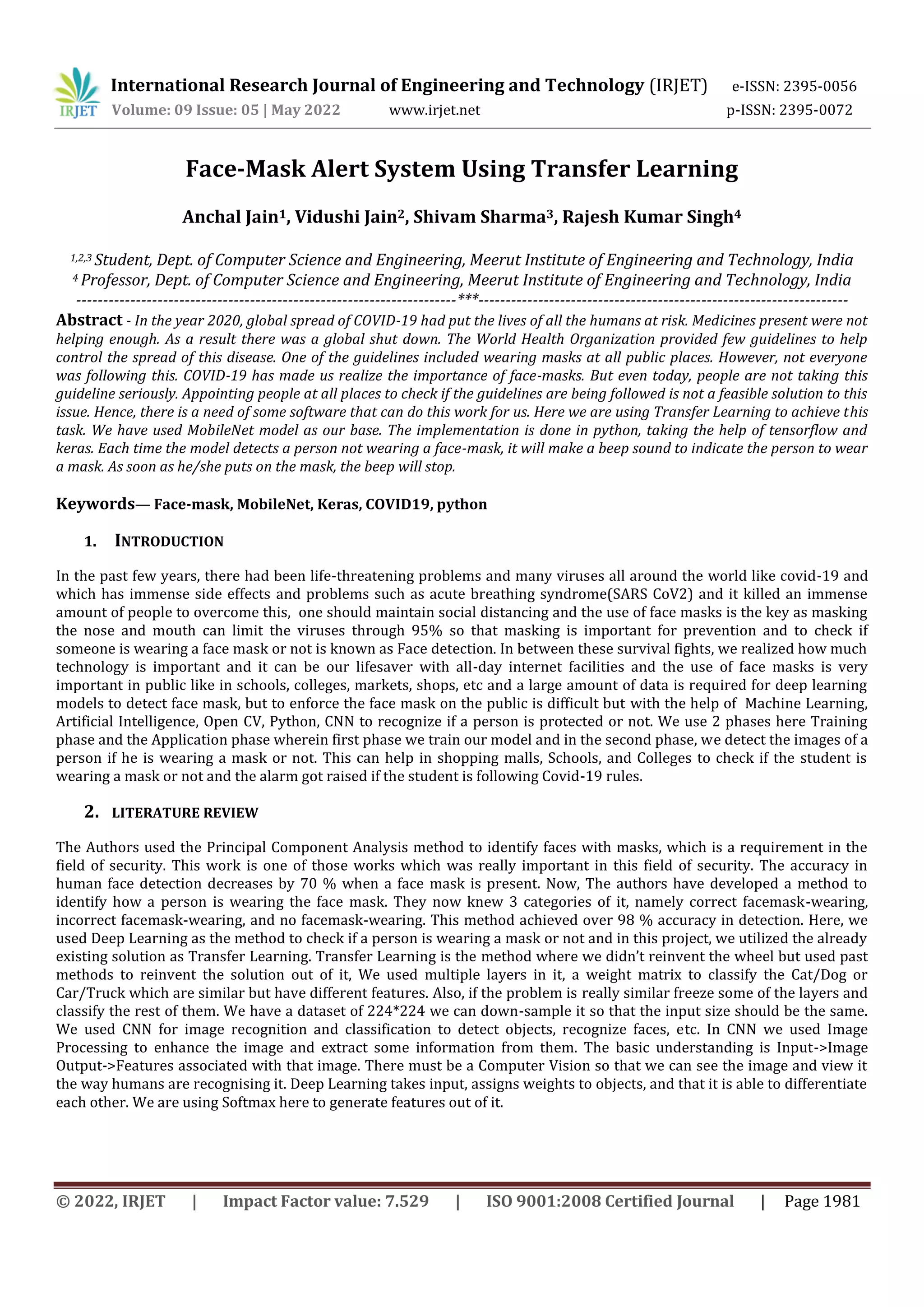
Fig. 1 Correctly Masked Faces
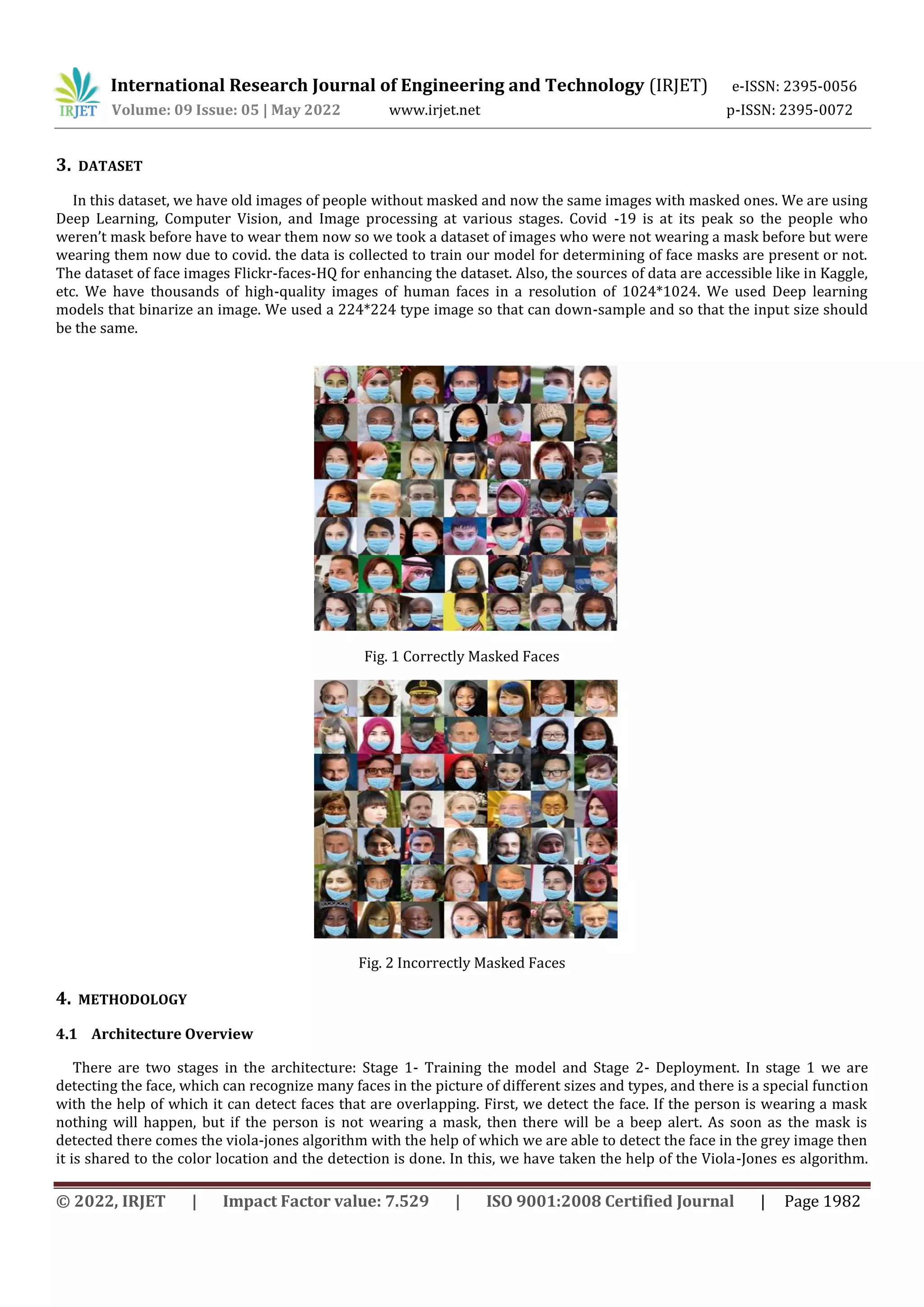
Fig. 2 Incorrectly Masked Faces
4. METHODOLOGY
4.1 Architecture Overview
There are two stages in the architecture: Stage 1- Training the model and Stage 2- Deployment. In stage 1 we are
detecting the face, which can recognize many faces in the picture of different sizes and types, and there is a special function
with the help of which it can detect faces that are overlapping. First, we detect the face. If the person is wearing a mask
nothing will happen, but if the person is not wearing a mask, then there will be a beep alert. As soon as the mask is
detected there comes the viola-jones algorithm with the help of which we are able to detect the face in the grey image then
it is shared to the color location and the detection is done. In this, we have taken the help of the Viola-Jones es algorithm.
International Research Journal of Engineering and Technology (IRJET) e-ISSN: 2395-0056
Volume: 09 Issue: 05 | May 2022 www.irjet.net p-ISSN: 2395-0072
© 2022, IRJET | Impact Factor value: 7.529 | ISO 9001:2008 Certified Journal | Page 1983
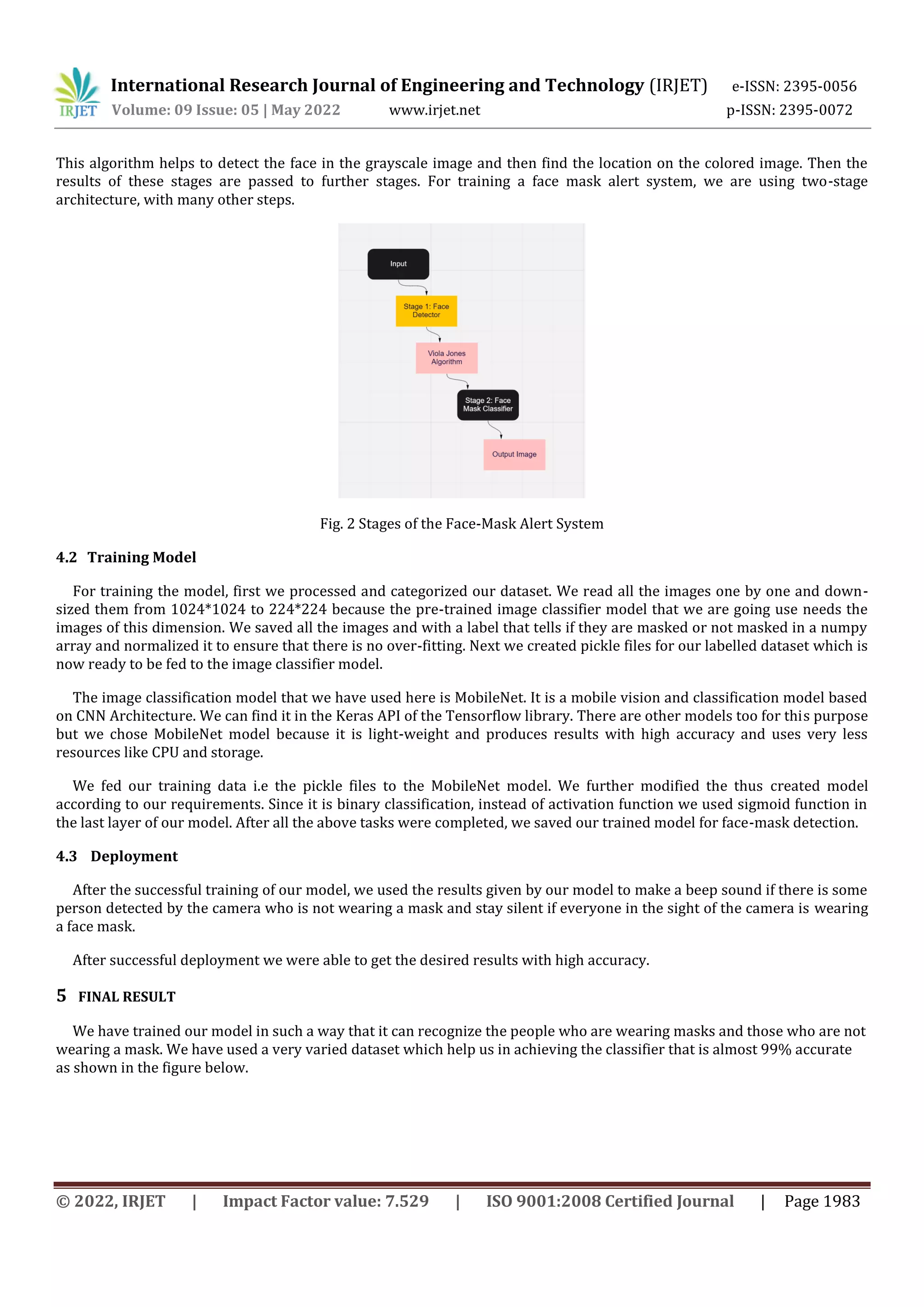
This algorithm helps to detect the face in the grayscale image and then find the location on the colored image. Then the
results of these stages are passed to further stages. For training a face mask alert system, we are using two-stage
architecture, with many other steps.
Fig. 2 Stages of the Face-Mask Alert System
4.2 Training Model
For training the model, first we processed and categorized our dataset. We read all the images one by one and down-
sized them from 1024*1024 to 224*224 because the pre-trained image classifier model that we are going use needs the
images of this dimension. We saved all the images and with a label that tells if they are masked or not masked in a numpy
array and normalized it to ensure that there is no over-fitting. Next we created pickle files for our labelled dataset which is
now ready to be fed to the image classifier model.
The image classification model that we have used here is MobileNet. It is a mobile vision and classification model based
on CNN Architecture. We can find it in the Keras API of the Tensorflow library. There are other models too for this purpose
but we chose MobileNet model because it is light-weight and produces results with high accuracy and uses very less
resources like CPU and storage.
We fed our training data i.e the pickle files to the MobileNet model. We further modified the thus created model
according to our requirements. Since it is binary classification, instead of activation function we used sigmoid function in
the last layer of our model. After all the above tasks were completed, we saved our trained model for face-mask detection.
4.3 Deployment
After the successful training of our model, we used the results given by our model to make a beep sound if there is some
person detected by the camera who is not wearing a mask and stay silent if everyone in the sight of the camera is wearing
a face mask.
After successful deployment we were able to get the desired results with high accuracy.
5 FINAL RESULT
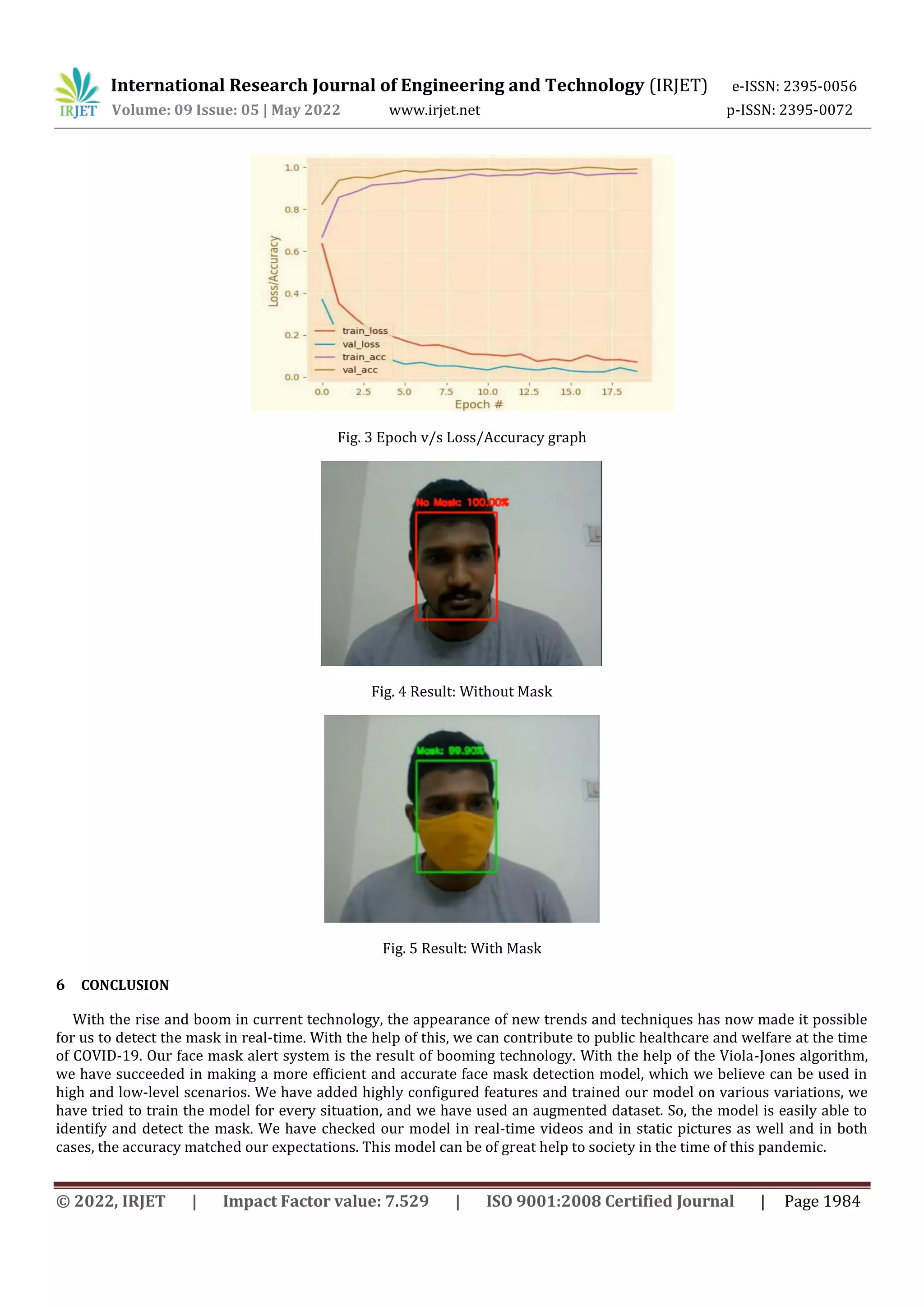
We have trained our model in such a way that it can recognize the people who are wearing masks and those who are not
wearing a mask. We have used a very varied dataset which help us in achieving the classifier that is almost 99% accurate
as shown in the figure below.
International Research Journal of Engineering and Technology (IRJET) e-ISSN: 2395-0056
Volume: 09 Issue: 05 | May 2022 www.irjet.net p-ISSN: 2395-0072
© 2022, IRJET | Impact Factor value: 7.529 | ISO 9001:2008 Certified Journal | Page 1984
Fig. 3 Epoch v/s Loss/Accuracy graph
Fig. 4 Result: Without Mask
Fig. 5 Result: With Mask
6 CONCLUSION
With the rise and boom in current technology, the appearance of new trends and techniques has now made it possible
for us to detect the mask in real-time. With the help of this, we can contribute to public healthcare and welfare at the time
of COVID-19. Our face mask alert system is the result of booming technology. With the help of the Viola-Jones algorithm,
we have succeeded in making a more efficient and accurate face mask detection model, which we believe can be used in
high and low-level scenarios. We have added highly configured features and trained our model on various variations, we
have tried to train the model for every situation, and we have used an augmented dataset. So, the model is easily able to
identify and detect the mask. We have checked our model in real-time videos and in static pictures as well and in both
cases, the accuracy matched our expectations. This model can be of great help to society in the time of this pandemic.
International Research Journal of Engineering and Technology (IRJET) e-ISSN: 2395-0056
Volume: 09 Issue: 05 | May 2022 www.irjet.net p-ISSN: 2395-0072
© 2022, IRJET | Impact Factor value: 7.529 | ISO 9001:2008 Certified Journal | Page 1985
REFERENCES
[1] Karras, T., Laine, S., and Aila, T., “A Style Based Generator Architecture for Generative Adversarial Networks,”
IEEE/CVF Conference on Computer Vision and Pattern Recognition (CVPR), Long Beach, CA, USA, 2019, pp. 4396-
4405, doi: 10.1109/CVPR.2019.00453.
[2] Larxel, 2020 May, “Face Mask Detection”, Kaggle - Version 1.
[3] P. Khandelwal, A. Khandelwal, S. Agarwal, “Using computer vision to enhance safety of workforce in manufacturing in a
post covid world,” arXiv preprint arXiv:2005.05287 (2020)
[4] Y. Liu, A. A. Gayle, A. Wilder-Smith, and J. Rocklöv, “The reproductive number of covid-19 is arehigher compared to
sars coronavirus,” Journal of travel medicine, 2020.
[5] Y. Fang, Y. Nie, and M. Penny, “Transmission dynamics of the covid- 19 outbreak and effectiveness of government
interventions: A data- driven analysis,” Journal of medical virology, vol. 92, no. 6, pp. 645–659, 2020.
[6] N. H. Leung, D. K. Chu, E. Y. Shiu, K.-H. Chan, J. J. McDevitt, B. J. Hau, H.-L. Yen, Y. Li, D. KM, J. Ip et al., “Respiratory
virus sheddingin exhaled breath and efficacy of face masks,” Nature Medicine, 26 pages676–680(2020).
[7] W. Liu, Z. Wang, X. Liu, N. Zeng, Y. Liu, F.E. Alsaadi, “A survey of deep neural network architectures and their
applications,” Neurocomputing 234, 11 (2017).
[8] H. Li, Z. Lin, X. Shen, J. Brandt, G. Hua, in “Proceedings of the IEEE conference on computer vision and pattern
recognition (2015),” pp. 5325–5334.
[9] Sandler, M., Howard, A., Zhu, M., Zhmoginov, A., and Chen, L., “MobileNetV2: Inverted Residuals and Linear
Bottlenecks,” 2018 IEEE/CVF Conference on Computer Vision and Pattern Recognition, Salt Lake City, UT, 2018, pp.
4510- 4520, doi: 10.1109/CVPR.2018.00474.
[10] S. Li, X. Ning, L. Yu, L. Zhang, X. Dong, Y. Shi, W. He, “Multi-angle Head Pose Classification when Wearing the Mask
for Face Recognition under the COVID-19 Coronavirus Epidemic” in 2020 International Conference on High
Performance Big Data and Intelligent Systems (HPBD&IS) (IEEE, 2020), pp. 1–5.
[11] Z. Wang, G. Wang, B. Huang, Z. Xiong, Q. Hong, H. Wu, P. Yi, K. Jiang, N. Wang, Y. Pei, et al., “Masked face recognition
dataset and application,” arXiv preprint arXiv:2003.09093 (2020).
[12] D. Matthias, M. Chidozie, Face mask detection application and dataset.
[13] FFHQ Dataset, Karras et al., 2019.
[14] A. Kamilaris and F. X. Prenafeta-Boldú, “Deep learning in agriculture: A survey,” Computers and Electronics in
Agriculture., vol. 147, no. July 2017, pp. 70– 90, 201

Face-Mask Alert System Using Transfer Learning

  • 1.
    International Research Journalof Engineering and Technology (IRJET) e-ISSN: 2395-0056 Volume: 09 Issue: 05 | May 2022 www.irjet.net p-ISSN: 2395-0072 © 2022, IRJET | Impact Factor value: 7.529 | ISO 9001:2008 Certified Journal | Page 1981 Face-Mask Alert System Using Transfer Learning Anchal Jain1, Vidushi Jain2, Shivam Sharma3, Rajesh Kumar Singh4 1,2,3 Student, Dept. of Computer Science and Engineering, Meerut Institute of Engineering and Technology, India 4 Professor, Dept. of Computer Science and Engineering, Meerut Institute of Engineering and Technology, India ----------------------------------------------------------------------***-------------------------------------------------------------------- Abstract - In the year 2020, global spread of COVID-19 had put the lives of all the humans at risk. Medicines present were not helping enough. As a result there was a global shut down. The World Health Organization provided few guidelines to help control the spread of this disease. One of the guidelines included wearing masks at all public places. However, not everyone was following this. COVID-19 has made us realize the importance of face-masks. But even today, people are not taking this guideline seriously. Appointing people at all places to check if the guidelines are being followed is not a feasible solution to this issue. Hence, there is a need of some software that can do this work for us. Here we are using Transfer Learning to achieve this task. We have used MobileNet model as our base. The implementation is done in python, taking the help of tensorflow and keras. Each time the model detects a person not wearing a face-mask, it will make a beep sound to indicate the person to wear a mask. As soon as he/she puts on the mask, the beep will stop. Keywords— Face-mask, MobileNet, Keras, COVID19, python 1. INTRODUCTION In the past few years, there had been life-threatening problems and many viruses all around the world like covid-19 and which has immense side effects and problems such as acute breathing syndrome(SARS CoV2) and it killed an immense amount of people to overcome this, one should maintain social distancing and the use of face masks is the key as masking the nose and mouth can limit the viruses through 95% so that masking is important for prevention and to check if someone is wearing a face mask or not is known as Face detection. In between these survival fights, we realized how much technology is important and it can be our lifesaver with all-day internet facilities and the use of face masks is very important in public like in schools, colleges, markets, shops, etc and a large amount of data is required for deep learning models to detect face mask, but to enforce the face mask on the public is difficult but with the help of Machine Learning, Artificial Intelligence, Open CV, Python, CNN to recognize if a person is protected or not. We use 2 phases here Training phase and the Application phase wherein first phase we train our model and in the second phase, we detect the images of a person if he is wearing a mask or not. This can help in shopping malls, Schools, and Colleges to check if the student is wearing a mask or not and the alarm got raised if the student is following Covid-19 rules. 2. LITERATURE REVIEW The Authors used the Principal Component Analysis method to identify faces with masks, which is a requirement in the field of security. This work is one of those works which was really important in this field of security. The accuracy in human face detection decreases by 70 % when a face mask is present. Now, The authors have developed a method to identify how a person is wearing the face mask. They now knew 3 categories of it, namely correct facemask-wearing, incorrect facemask-wearing, and no facemask-wearing. This method achieved over 98 % accuracy in detection. Here, we used Deep Learning as the method to check if a person is wearing a mask or not and in this project, we utilized the already existing solution as Transfer Learning. Transfer Learning is the method where we didn’t reinvent the wheel but used past methods to reinvent the solution out of it, We used multiple layers in it, a weight matrix to classify the Cat/Dog or Car/Truck which are similar but have different features. Also, if the problem is really similar freeze some of the layers and classify the rest of them. We have a dataset of 224*224 we can down-sample it so that the input size should be the same. We used CNN for image recognition and classification to detect objects, recognize faces, etc. In CNN we used Image Processing to enhance the image and extract some information from them. The basic understanding is Input->Image Output->Features associated with that image. There must be a Computer Vision so that we can see the image and view it the way humans are recognising it. Deep Learning takes input, assigns weights to objects, and that it is able to differentiate each other. We are using Softmax here to generate features out of it.
  • 2.
    International Research Journalof Engineering and Technology (IRJET) e-ISSN: 2395-0056 Volume: 09 Issue: 05 | May 2022 www.irjet.net p-ISSN: 2395-0072 © 2022, IRJET | Impact Factor value: 7.529 | ISO 9001:2008 Certified Journal | Page 1982 3. DATASET In this dataset, we have old images of people without masked and now the same images with masked ones. We are using Deep Learning, Computer Vision, and Image processing at various stages. Covid -19 is at its peak so the people who weren’t mask before have to wear them now so we took a dataset of images who were not wearing a mask before but were wearing them now due to covid. the data is collected to train our model for determining of face masks are present or not. The dataset of face images Flickr-faces-HQ for enhancing the dataset. Also, the sources of data are accessible like in Kaggle, etc. We have thousands of high-quality images of human faces in a resolution of 1024*1024. We used Deep learning models that binarize an image. We used a 224*224 type image so that can down-sample and so that the input size should be the same. Fig. 1 Correctly Masked Faces Fig. 2 Incorrectly Masked Faces 4. METHODOLOGY 4.1 Architecture Overview There are two stages in the architecture: Stage 1- Training the model and Stage 2- Deployment. In stage 1 we are detecting the face, which can recognize many faces in the picture of different sizes and types, and there is a special function with the help of which it can detect faces that are overlapping. First, we detect the face. If the person is wearing a mask nothing will happen, but if the person is not wearing a mask, then there will be a beep alert. As soon as the mask is detected there comes the viola-jones algorithm with the help of which we are able to detect the face in the grey image then it is shared to the color location and the detection is done. In this, we have taken the help of the Viola-Jones es algorithm.
  • 3.
    International Research Journalof Engineering and Technology (IRJET) e-ISSN: 2395-0056 Volume: 09 Issue: 05 | May 2022 www.irjet.net p-ISSN: 2395-0072 © 2022, IRJET | Impact Factor value: 7.529 | ISO 9001:2008 Certified Journal | Page 1983 This algorithm helps to detect the face in the grayscale image and then find the location on the colored image. Then the results of these stages are passed to further stages. For training a face mask alert system, we are using two-stage architecture, with many other steps. Fig. 2 Stages of the Face-Mask Alert System 4.2 Training Model For training the model, first we processed and categorized our dataset. We read all the images one by one and down- sized them from 1024*1024 to 224*224 because the pre-trained image classifier model that we are going use needs the images of this dimension. We saved all the images and with a label that tells if they are masked or not masked in a numpy array and normalized it to ensure that there is no over-fitting. Next we created pickle files for our labelled dataset which is now ready to be fed to the image classifier model. The image classification model that we have used here is MobileNet. It is a mobile vision and classification model based on CNN Architecture. We can find it in the Keras API of the Tensorflow library. There are other models too for this purpose but we chose MobileNet model because it is light-weight and produces results with high accuracy and uses very less resources like CPU and storage. We fed our training data i.e the pickle files to the MobileNet model. We further modified the thus created model according to our requirements. Since it is binary classification, instead of activation function we used sigmoid function in the last layer of our model. After all the above tasks were completed, we saved our trained model for face-mask detection. 4.3 Deployment After the successful training of our model, we used the results given by our model to make a beep sound if there is some person detected by the camera who is not wearing a mask and stay silent if everyone in the sight of the camera is wearing a face mask. After successful deployment we were able to get the desired results with high accuracy. 5 FINAL RESULT We have trained our model in such a way that it can recognize the people who are wearing masks and those who are not wearing a mask. We have used a very varied dataset which help us in achieving the classifier that is almost 99% accurate as shown in the figure below.
  • 4.
    International Research Journalof Engineering and Technology (IRJET) e-ISSN: 2395-0056 Volume: 09 Issue: 05 | May 2022 www.irjet.net p-ISSN: 2395-0072 © 2022, IRJET | Impact Factor value: 7.529 | ISO 9001:2008 Certified Journal | Page 1984 Fig. 3 Epoch v/s Loss/Accuracy graph Fig. 4 Result: Without Mask Fig. 5 Result: With Mask 6 CONCLUSION With the rise and boom in current technology, the appearance of new trends and techniques has now made it possible for us to detect the mask in real-time. With the help of this, we can contribute to public healthcare and welfare at the time of COVID-19. Our face mask alert system is the result of booming technology. With the help of the Viola-Jones algorithm, we have succeeded in making a more efficient and accurate face mask detection model, which we believe can be used in high and low-level scenarios. We have added highly configured features and trained our model on various variations, we have tried to train the model for every situation, and we have used an augmented dataset. So, the model is easily able to identify and detect the mask. We have checked our model in real-time videos and in static pictures as well and in both cases, the accuracy matched our expectations. This model can be of great help to society in the time of this pandemic.
  • 5.
    International Research Journalof Engineering and Technology (IRJET) e-ISSN: 2395-0056 Volume: 09 Issue: 05 | May 2022 www.irjet.net p-ISSN: 2395-0072 © 2022, IRJET | Impact Factor value: 7.529 | ISO 9001:2008 Certified Journal | Page 1985 REFERENCES [1] Karras, T., Laine, S., and Aila, T., “A Style Based Generator Architecture for Generative Adversarial Networks,” IEEE/CVF Conference on Computer Vision and Pattern Recognition (CVPR), Long Beach, CA, USA, 2019, pp. 4396- 4405, doi: 10.1109/CVPR.2019.00453. [2] Larxel, 2020 May, “Face Mask Detection”, Kaggle - Version 1. [3] P. Khandelwal, A. Khandelwal, S. Agarwal, “Using computer vision to enhance safety of workforce in manufacturing in a post covid world,” arXiv preprint arXiv:2005.05287 (2020) [4] Y. Liu, A. A. Gayle, A. Wilder-Smith, and J. Rocklöv, “The reproductive number of covid-19 is arehigher compared to sars coronavirus,” Journal of travel medicine, 2020. [5] Y. Fang, Y. Nie, and M. Penny, “Transmission dynamics of the covid- 19 outbreak and effectiveness of government interventions: A data- driven analysis,” Journal of medical virology, vol. 92, no. 6, pp. 645–659, 2020. [6] N. H. Leung, D. K. Chu, E. Y. Shiu, K.-H. Chan, J. J. McDevitt, B. J. Hau, H.-L. Yen, Y. Li, D. KM, J. Ip et al., “Respiratory virus sheddingin exhaled breath and efficacy of face masks,” Nature Medicine, 26 pages676–680(2020). [7] W. Liu, Z. Wang, X. Liu, N. Zeng, Y. Liu, F.E. Alsaadi, “A survey of deep neural network architectures and their applications,” Neurocomputing 234, 11 (2017). [8] H. Li, Z. Lin, X. Shen, J. Brandt, G. Hua, in “Proceedings of the IEEE conference on computer vision and pattern recognition (2015),” pp. 5325–5334. [9] Sandler, M., Howard, A., Zhu, M., Zhmoginov, A., and Chen, L., “MobileNetV2: Inverted Residuals and Linear Bottlenecks,” 2018 IEEE/CVF Conference on Computer Vision and Pattern Recognition, Salt Lake City, UT, 2018, pp. 4510- 4520, doi: 10.1109/CVPR.2018.00474. [10] S. Li, X. Ning, L. Yu, L. Zhang, X. Dong, Y. Shi, W. He, “Multi-angle Head Pose Classification when Wearing the Mask for Face Recognition under the COVID-19 Coronavirus Epidemic” in 2020 International Conference on High Performance Big Data and Intelligent Systems (HPBD&IS) (IEEE, 2020), pp. 1–5. [11] Z. Wang, G. Wang, B. Huang, Z. Xiong, Q. Hong, H. Wu, P. Yi, K. Jiang, N. Wang, Y. Pei, et al., “Masked face recognition dataset and application,” arXiv preprint arXiv:2003.09093 (2020). [12] D. Matthias, M. Chidozie, Face mask detection application and dataset. [13] FFHQ Dataset, Karras et al., 2019. [14] A. Kamilaris and F. X. Prenafeta-Boldú, “Deep learning in agriculture: A survey,” Computers and Electronics in Agriculture., vol. 147, no. July 2017, pp. 70– 90, 201