We have just done a role play. What is case analysis in your own words?

 CASE ANALYSIS: Why & What


EDUC W200 Week
Case Analysis: Why & What

• You are going to be a teacher.
• Classroom situations are always messy, and
  problems are everywhere!
• This means you need to be ready for whatever that
  may happen in class, whether you planned or not.
• However, teacher education program cannot tell
  you exactly what to do, when, and how.
• There are too many variables, and they are
  unpredictable!

 EDUC W200 Week
Case Analysis: Why & What

• To be a competent teacher, you need to be a quick
  problem-solver and a wise decision-maker.
• “Case analysis” is designed to help you be a flexible
  thinker, so that you can perform even in the most
  problematic and messy real-world situations.
• Of course, in W200 the ‘case’ means a real or a
  close-to-real classroom case. It is a learning tool for
  you, pre-service teachers. Through this project, you
  will learn to think like a teacher, a problem-solver.

 EDUC W200 Week
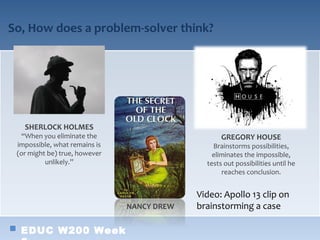
So, How does a problem-solver think?


   SHERLOCK HOLMES
  “When you eliminate the                          GREGORY HOUSE
 impossible, what remains is                    Brainstorms possibilities,
 (or might be) true, however                    eliminates the impossible,
          unlikely.”                          tests out possibilities until he
                                                   reaches conclusion.


                                            Video: Apollo 13 clip on
                               NANCY DREW   brainstorming a case

  EDUC W200 Week
DISCUSS: What are possible steps you would take to
solve a problem?


 EDUC W200 Week
Common Thinking Steps for a Problem-Solver
(Especially, the steps we will use in W200)

  o Identifying the problem and needs
     • E.g., Learner characteristics, teacher concerns,
       curricular requirements (i.e., standards), and
       environmental availability
  o Looking for the many, many appropriate options you
    could use to solve the problem or meet the requirements
  o Making decisions among various options (e.g.,
    technology offerings based on the 3Es that best meet the
    needs and characteristics you discovered)
  o Justifying your decisions


 EDUC W200 Week
Rules and expectations specific to W200 Case Analysis projects

 INTRO TO CASE ANALYSIS PROJECT #1


EDUC W200 Week
FOR W200 CASE ANALYSIS PROJECTS

• You will analyze two hypothetical classroom cases.
• Each case will be a text description of a content and
  grade specific classroom situations, including
  teacher concerns, curricular requirements (e.g.,
  academic standards), learner needs, and
  environmental availability and constraints, etc.
• Analyzing the case description will be key to
  identifying the core problems and needs to be
  addressed in the case analysis process.


 EDUC W200 Week
FOR W200 CASE ANALYSIS PROJECTS

• The goal is to improve the classroom situation in
  the case. And for the purpose of W200, we will
  assume that all of the solutions/options comes from
  (high-)tech resources and tools only.
• Sound difficult? Don’t worry!
  Through Week 6 to Week 10 of W200, you will learn
  various types of options.
  Also, you are expected to follow a thinking process
  framed in the case analysis template.


 EDUC W200 Week
CASE ANALYSIS
THE CASE ANALYSIS PROCESS


 EDUC W200 Week
CASE ANALYSIS PROCESS
STEP 1: IDENTIFY STANDARD & NEEDS

•   IDENTIFY STANDARD(S)
     What standard(s) do you need to address?
     What is the learning goal(s)? For K-12 students. Narrow
      down from the academic standard to be manageable in 1
      class period
•   NEEDS OF THE CASE
     Who are your learners? Their physical ability…
     What is the teaching/learning environment?
     The teacher beliefs or knowledge?
     What is the problem(s)?


    EDUC W200 Week
CASE ANALYSIS PROCESS
STEP 2: BRAINSTORM & SEARCH OPTIONS
•   OPTIONS
     Look for as many options as possible
     Look for options (tools, technologies, approaches) that could be
      useful in your case
           – For instance, for concept maps tools available are
              Inspiration, Gliffy, Text2Mind Map, Mind Meister, Bubbl.us,
              MS Word, MS Excel
           – Options should be relevant and unique (not repeats)
     Remember…
           – One tool does not meet all the needs of your classroom
           – But a set of tools will address all the needs of your
              classroom
           – Just because you find one you like does not mean that you
              stop looking – look for as many possible options


    EDUC W200 Week
CASE ANALYSIS PROCESS
STEP 3: WHAT TECHNOLOGY

•   WHAT HAVE YOU CHOSEN?
     Step 1: List what options you have chosen, and be explicit
      about how it will be used. Just because you list it does
      not mean the reader will understand how you intend for
      the option to be used in the classroom.
     Step 2: Review whether you have options for each need
      expressed in your case. You will have to defend it!


    EDUC W200 Week
CASE ANALYSIS PROCESS
STEP 4: WHY AND REFLECTION

 • WHY
    Why are your choices appropriate?
    Why are you choices better than the alternatives? Than
     all of the other options?
    How do your choices solve the problem?
    How do your choices help meet the standards being
     taught?
    Use the 3Es to support your reasoning


   Example: Why would you choose Inspiration over Visio, MS
   Word and MS Excel? And discuss why?

  EDUC W200 Week
CASE ANALYSIS PROCESS
STEP 4: WHY AND REFLECTION

•   REFLECTION
     Are you addressing the needs of your case? Prove it.
     Do you decisions meet the needs of your case? Really?
          – If not, revisit your options and recommendation(s)
          – If they do, make the connections for the reader. Show it
            (more of a proof, less of a justification)


•   So, how am I going to apply case analysis process in this
    class?
    o Case Analysis Project #1


    EDUC W200 Week
CASE ANALYSIS: TIPS & RESOURCES

              •   Know the details of your case
              •   Approach the problem from many
                  different angles
              •   Analyze, do not describe it - that
                  requires a bit more effort
              •   Do not assume anything – or at least be
                  explicit about your assumptions
              •   W200 Cases
              •   Case analysis template (copy and paste the link:
                  https://drive.google.com/previewtemplate?
                  id=1LMyacDOwef2B1D8ejAVsnTrXhQ_UEWmz31sH6cyFWyE&mode=p
                  ublic


 EDUC W200 Week
CASE ANALYSIS EXAMPLE

                         •   Going over an
                             Example:
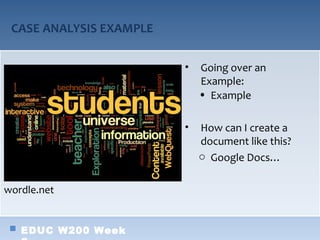
                             • Example

                         •   How can I create a
                             document like this?
                             o Google Docs…


wordle.net


   EDUC W200 Week

Fa12 w200-w5-part3

  • 1.
    We have justdone a role play. What is case analysis in your own words? CASE ANALYSIS: Why & What EDUC W200 Week
  • 2.
    Case Analysis: Why& What • You are going to be a teacher. • Classroom situations are always messy, and problems are everywhere! • This means you need to be ready for whatever that may happen in class, whether you planned or not. • However, teacher education program cannot tell you exactly what to do, when, and how. • There are too many variables, and they are unpredictable! EDUC W200 Week
  • 3.
    Case Analysis: Why& What • To be a competent teacher, you need to be a quick problem-solver and a wise decision-maker. • “Case analysis” is designed to help you be a flexible thinker, so that you can perform even in the most problematic and messy real-world situations. • Of course, in W200 the ‘case’ means a real or a close-to-real classroom case. It is a learning tool for you, pre-service teachers. Through this project, you will learn to think like a teacher, a problem-solver. EDUC W200 Week
  • 4.
    So, How doesa problem-solver think? SHERLOCK HOLMES “When you eliminate the GREGORY HOUSE impossible, what remains is Brainstorms possibilities, (or might be) true, however eliminates the impossible, unlikely.” tests out possibilities until he reaches conclusion. Video: Apollo 13 clip on NANCY DREW brainstorming a case EDUC W200 Week
  • 5.
    DISCUSS: What arepossible steps you would take to solve a problem? EDUC W200 Week
  • 6.
    Common Thinking Stepsfor a Problem-Solver (Especially, the steps we will use in W200) o Identifying the problem and needs • E.g., Learner characteristics, teacher concerns, curricular requirements (i.e., standards), and environmental availability o Looking for the many, many appropriate options you could use to solve the problem or meet the requirements o Making decisions among various options (e.g., technology offerings based on the 3Es that best meet the needs and characteristics you discovered) o Justifying your decisions EDUC W200 Week
  • 7.
    Rules and expectationsspecific to W200 Case Analysis projects INTRO TO CASE ANALYSIS PROJECT #1 EDUC W200 Week
  • 8.
    FOR W200 CASEANALYSIS PROJECTS • You will analyze two hypothetical classroom cases. • Each case will be a text description of a content and grade specific classroom situations, including teacher concerns, curricular requirements (e.g., academic standards), learner needs, and environmental availability and constraints, etc. • Analyzing the case description will be key to identifying the core problems and needs to be addressed in the case analysis process. EDUC W200 Week
  • 9.
    FOR W200 CASEANALYSIS PROJECTS • The goal is to improve the classroom situation in the case. And for the purpose of W200, we will assume that all of the solutions/options comes from (high-)tech resources and tools only. • Sound difficult? Don’t worry! Through Week 6 to Week 10 of W200, you will learn various types of options. Also, you are expected to follow a thinking process framed in the case analysis template. EDUC W200 Week
  • 10.
    CASE ANALYSIS THE CASEANALYSIS PROCESS EDUC W200 Week
  • 11.
    CASE ANALYSIS PROCESS STEP1: IDENTIFY STANDARD & NEEDS • IDENTIFY STANDARD(S)  What standard(s) do you need to address?  What is the learning goal(s)? For K-12 students. Narrow down from the academic standard to be manageable in 1 class period • NEEDS OF THE CASE  Who are your learners? Their physical ability…  What is the teaching/learning environment?  The teacher beliefs or knowledge?  What is the problem(s)? EDUC W200 Week
  • 12.
    CASE ANALYSIS PROCESS STEP2: BRAINSTORM & SEARCH OPTIONS • OPTIONS  Look for as many options as possible  Look for options (tools, technologies, approaches) that could be useful in your case – For instance, for concept maps tools available are Inspiration, Gliffy, Text2Mind Map, Mind Meister, Bubbl.us, MS Word, MS Excel – Options should be relevant and unique (not repeats)  Remember… – One tool does not meet all the needs of your classroom – But a set of tools will address all the needs of your classroom – Just because you find one you like does not mean that you stop looking – look for as many possible options EDUC W200 Week
  • 13.
    CASE ANALYSIS PROCESS STEP3: WHAT TECHNOLOGY • WHAT HAVE YOU CHOSEN?  Step 1: List what options you have chosen, and be explicit about how it will be used. Just because you list it does not mean the reader will understand how you intend for the option to be used in the classroom.  Step 2: Review whether you have options for each need expressed in your case. You will have to defend it! EDUC W200 Week
  • 14.
    CASE ANALYSIS PROCESS STEP4: WHY AND REFLECTION • WHY  Why are your choices appropriate?  Why are you choices better than the alternatives? Than all of the other options?  How do your choices solve the problem?  How do your choices help meet the standards being taught?  Use the 3Es to support your reasoning Example: Why would you choose Inspiration over Visio, MS Word and MS Excel? And discuss why? EDUC W200 Week
  • 15.
    CASE ANALYSIS PROCESS STEP4: WHY AND REFLECTION • REFLECTION  Are you addressing the needs of your case? Prove it.  Do you decisions meet the needs of your case? Really? – If not, revisit your options and recommendation(s) – If they do, make the connections for the reader. Show it (more of a proof, less of a justification) • So, how am I going to apply case analysis process in this class? o Case Analysis Project #1 EDUC W200 Week
  • 16.
    CASE ANALYSIS: TIPS& RESOURCES • Know the details of your case • Approach the problem from many different angles • Analyze, do not describe it - that requires a bit more effort • Do not assume anything – or at least be explicit about your assumptions • W200 Cases • Case analysis template (copy and paste the link: https://drive.google.com/previewtemplate? id=1LMyacDOwef2B1D8ejAVsnTrXhQ_UEWmz31sH6cyFWyE&mode=p ublic EDUC W200 Week
  • 17.
    CASE ANALYSIS EXAMPLE • Going over an Example: • Example • How can I create a document like this? o Google Docs… wordle.net EDUC W200 Week

Editor's Notes

  • #5 With some famous problem-solvers, let students think about how they identify and solve problems…
  • #9 Please discuss with class about the 2 case analysis they need to work as a group and the points assigned to each case (75 points) You will complete two case analysis write-ups. You will work as a content-area group on a case that we will provide you Schedule: See the W200 Website for more info: Case Analysis #1: Due Week 8 Case Artifacts #1: Due Week 11 Case Analysis #2: Due Week 13 Case Artifacts #2: Due Week 15
  • #10 Please discuss with class about the 2 case analysis they need to work as a group and the points assigned to each case (75 points) You will complete two case analysis write-ups. You will work as a content-area group on a case that we will provide you Schedule: See the W200 Website for more info: Case Analysis #1: Due Week 8 Case Artifacts #1: Due Week 11 Case Analysis #2: Due Week 13 Case Artifacts #2: Due Week 15
  • #11 Characteristics – let ’s highlight the actual items in Microsoft Word. MUST NOT DECIDE BEFORE STEP 3. Keep an open-mind.
  • #17 Note: You need to be logged onto the Google services to access and view the template.