Eriawan Kusumawardhono
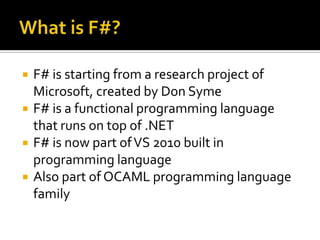
   F# is starting from a research project of
    Microsoft, created by Don Syme
   F# is a functional programming language
    that runs on top of .NET
   F# is now part of VS 2010 built in
    programming language
   Also part of OCAML programming language
    family
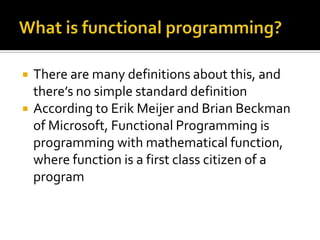
   There are many definitions about this, and
    there’s no simple standard definition
   According to Erik Meijer and Brian Beckman
    of Microsoft, Functional Programming is
    programming with mathematical function,
    where function is a first class citizen of a
    program
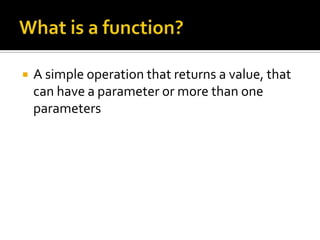
   A simple operation that returns a value, that
    can have a parameter or more than one
    parameters
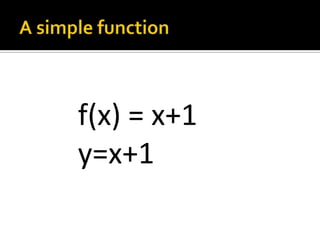
f(x) = x+1
y=x+1
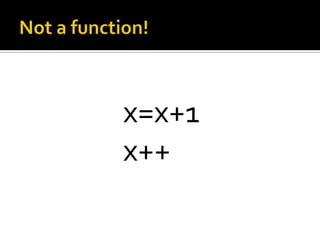
x=x+1
x++
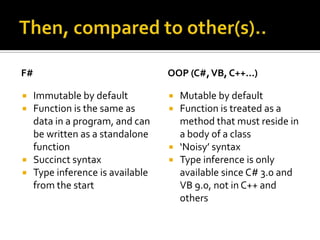
F#                                 OOP (C#, VB, C++…)

    Immutable by default             Mutable by default
    Function is the same as          Function is treated as a
     data in a program, and can        method that must reside in
     be written as a standalone        a body of a class
     function                         ‘Noisy’ syntax
    Succinct syntax                  Type inference is only
    Type inference is available       available since C# 3.0 and
     from the start                    VB 9.0, not in C++ and
                                       others
Comparison of F# to others such as C#, VB, C++
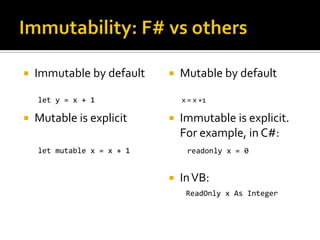
   Immutable by default       Mutable by default

    let y = x + 1               x = x +1

   Mutable is explicit        Immutable is explicit.
                                For example, in C#:
    let mutable x = x + 1        readonly x = 0


                               In VB:
                                 ReadOnly x As Integer
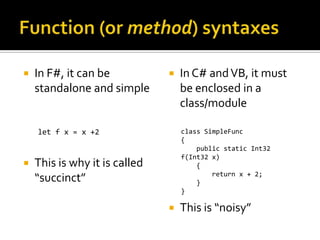
   In F#, it can be              In C# and VB, it must
    standalone and simple          be enclosed in a
                                   class/module

    let f x = x +2                 class SimpleFunc
                                   {
                                       public static Int32
                                   f(Int32 x)
   This is why it is called           {
                                           return x + 2;
    “succinct”                         }
                                   }

                                  This is “noisy”
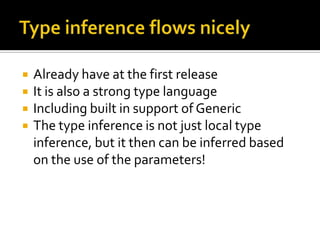
   Already have at the first release
   It is also a strong type language
   Including built in support of Generic
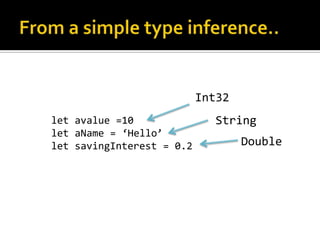
   The type inference is not just local type
    inference, but it then can be inferred based
    on the use of the parameters!
Int32
let avalue =10               String
let aName = ‘Hello’
let savingInterest = 0.2           Double
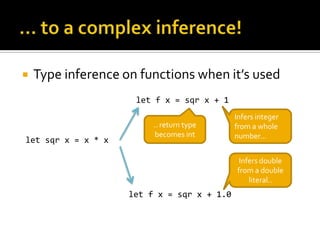
   Type inference on functions when it’s used
                     let f x = sqr x + 1
                                            Infers integer
                         .. return type     from a whole
                          becomes int       number…
let sqr x = x * x

                                             Infers double
                                            from a double
                                                literal..
                    let f x = sqr x + 1.0
Less noise syntax but it’s still strongly typed
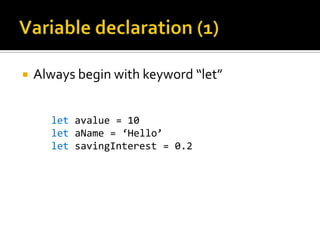
   Always begin with keyword “let”


      let avalue = 10
      let aName = ‘Hello’
      let savingInterest = 0.2
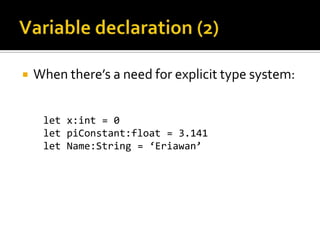
   When there’s a need for explicit type system:


     let x:int = 0
     let piConstant:float = 3.141
     let Name:String = ‘Eriawan’
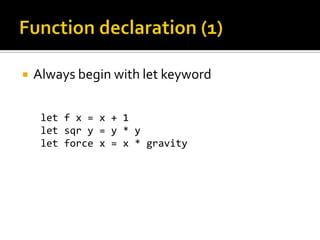
   Always begin with let keyword

     let f x = x + 1
     let sqr y = y * y
     let force x = x * gravity
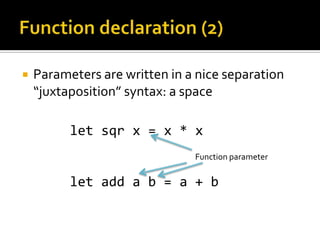
   Parameters are written in a nice separation
    “juxtaposition” syntax: a space

          let sqr x = x * x
                               Function parameter

          let add a b = a + b
The code in F#
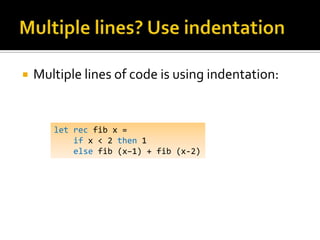
   Multiple lines of code is using indentation:


       let rec fib x =
           if x < 2 then 1
           else fib (x–1) + fib (x-2)
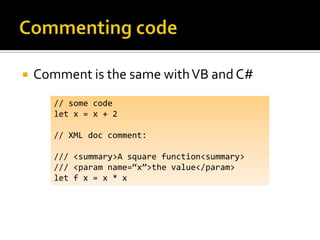
   Comment is the same with VB and C#
       // some code
       let x = x + 2

       // XML doc comment:

       /// <summary>A square function<summary>
       /// <param name=‚x‛>the value</param>
       let f x = x * x
The object oriented and imperative are here in F#
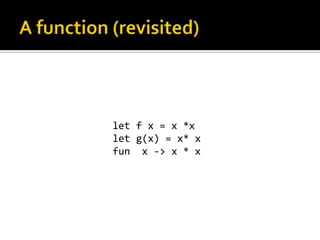
let f x = x *x
let g(x) = x* x
fun x -> x * x
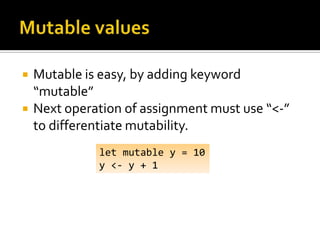
   Mutable is easy, by adding keyword
    “mutable”
   Next operation of assignment must use “<-”
    to differentiate mutability.
              let mutable y = 10
              y <- y + 1
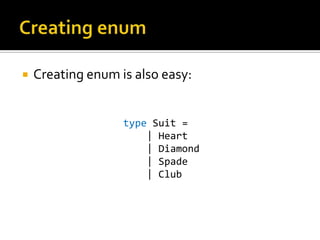
   Creating enum is also easy:


                   type Suit =
                       | Heart
                       | Diamond
                       | Spade
                       | Club
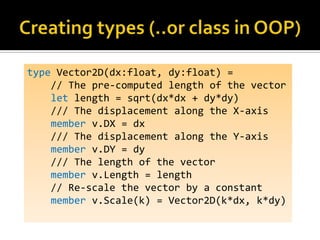
type Vector2D(dx:float, dy:float) =
    // The pre-computed length of the vector
    let length = sqrt(dx*dx + dy*dy)
    /// The displacement along the X-axis
    member v.DX = dx
    /// The displacement along the Y-axis
    member v.DY = dy
    /// The length of the vector
    member v.Length = length
    // Re-scale the vector by a constant
    member v.Scale(k) = Vector2D(k*dx, k*dy)
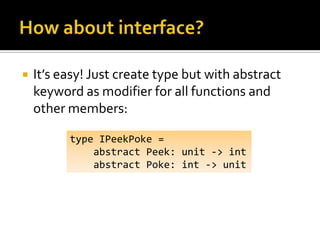
   It’s easy! Just create type but with abstract
    keyword as modifier for all functions and
    other members:

          type IPeekPoke =
              abstract Peek: unit -> int
              abstract Poke: int -> unit
Unit of measure in F# only!
[<Measure>]
type kg

[<Measure>]
type m

[<Measure>]
type s

let gravityOnEarth = 9.81<m/s^2>
let heightOfMyOfficeWindow = 3.5<m>
let speedOfImpact =
    sqrt (2.0 * gravityOnEarth + heightOfMyOfficeWindow)
Created by Eriawan Kusumawardhono, courtesy of RX Communica

F sharp _vs2010_beta2

  • 1.
  • 2.
    F# is starting from a research project of Microsoft, created by Don Syme  F# is a functional programming language that runs on top of .NET  F# is now part of VS 2010 built in programming language  Also part of OCAML programming language family
  • 3.
    There are many definitions about this, and there’s no simple standard definition  According to Erik Meijer and Brian Beckman of Microsoft, Functional Programming is programming with mathematical function, where function is a first class citizen of a program
  • 4.
    A simple operation that returns a value, that can have a parameter or more than one parameters
  • 5.
  • 6.
  • 7.
    F# OOP (C#, VB, C++…)  Immutable by default  Mutable by default  Function is the same as  Function is treated as a data in a program, and can method that must reside in be written as a standalone a body of a class function  ‘Noisy’ syntax  Succinct syntax  Type inference is only  Type inference is available available since C# 3.0 and from the start VB 9.0, not in C++ and others
  • 8.
    Comparison of F#to others such as C#, VB, C++
  • 9.
    Immutable by default  Mutable by default let y = x + 1 x = x +1  Mutable is explicit  Immutable is explicit. For example, in C#: let mutable x = x + 1 readonly x = 0  In VB: ReadOnly x As Integer
  • 10.
    In F#, it can be  In C# and VB, it must standalone and simple be enclosed in a class/module let f x = x +2 class SimpleFunc { public static Int32 f(Int32 x)  This is why it is called { return x + 2; “succinct” } }  This is “noisy”
  • 11.
    Already have at the first release  It is also a strong type language  Including built in support of Generic  The type inference is not just local type inference, but it then can be inferred based on the use of the parameters!
  • 12.
    Int32 let avalue =10 String let aName = ‘Hello’ let savingInterest = 0.2 Double
  • 13.
    Type inference on functions when it’s used let f x = sqr x + 1 Infers integer .. return type from a whole becomes int number… let sqr x = x * x Infers double from a double literal.. let f x = sqr x + 1.0
  • 14.
    Less noise syntaxbut it’s still strongly typed
  • 15.
    Always begin with keyword “let” let avalue = 10 let aName = ‘Hello’ let savingInterest = 0.2
  • 16.
    When there’s a need for explicit type system: let x:int = 0 let piConstant:float = 3.141 let Name:String = ‘Eriawan’
  • 17.
    Always begin with let keyword let f x = x + 1 let sqr y = y * y let force x = x * gravity
  • 18.
    Parameters are written in a nice separation “juxtaposition” syntax: a space let sqr x = x * x Function parameter let add a b = a + b
  • 19.
  • 20.
    Multiple lines of code is using indentation: let rec fib x = if x < 2 then 1 else fib (x–1) + fib (x-2)
  • 21.
    Comment is the same with VB and C# // some code let x = x + 2 // XML doc comment: /// <summary>A square function<summary> /// <param name=‚x‛>the value</param> let f x = x * x
  • 22.
    The object orientedand imperative are here in F#
  • 23.
    let f x= x *x let g(x) = x* x fun x -> x * x
  • 24.
    Mutable is easy, by adding keyword “mutable”  Next operation of assignment must use “<-” to differentiate mutability. let mutable y = 10 y <- y + 1
  • 25.
    Creating enum is also easy: type Suit = | Heart | Diamond | Spade | Club
  • 26.
    type Vector2D(dx:float, dy:float)= // The pre-computed length of the vector let length = sqrt(dx*dx + dy*dy) /// The displacement along the X-axis member v.DX = dx /// The displacement along the Y-axis member v.DY = dy /// The length of the vector member v.Length = length // Re-scale the vector by a constant member v.Scale(k) = Vector2D(k*dx, k*dy)
  • 27.
    It’s easy! Just create type but with abstract keyword as modifier for all functions and other members: type IPeekPoke = abstract Peek: unit -> int abstract Poke: int -> unit
  • 28.
    Unit of measurein F# only!
  • 29.
    [<Measure>] type kg [<Measure>] type m [<Measure>] types let gravityOnEarth = 9.81<m/s^2> let heightOfMyOfficeWindow = 3.5<m> let speedOfImpact = sqrt (2.0 * gravityOnEarth + heightOfMyOfficeWindow)
  • 30.
    Created by EriawanKusumawardhono, courtesy of RX Communica