
Growing Beyond


Positioned for growth
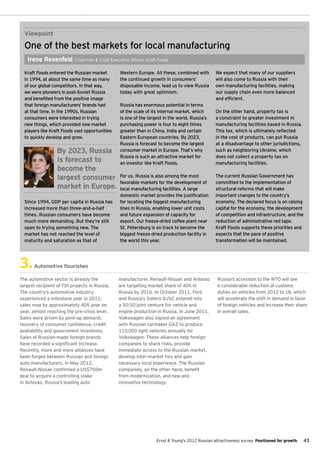
Ernst & Young’s 2012 attractiveness survey
Russia
Emerging Markets Center
The Emerging Markets Center is Ernst & Young's “Center
of Excellence” that quickly and effectively connects you
to the world's fastest-growing economies. Our continuous
investment in these markets allows us to share the breadth
of our knowledge through a wide range of initiatives,
tools and applications, thus offering businesses, in both
mature and emerging markets, an in-depth and cross-
border approach, supported by our leading and highly
globally integrated structure.


For further information on emerging markets,
please visit: http://emergingmarkets.ey.com
Positioned for growth
Ernst & Young's 2012 attractiveness survey

Russia

                          Contents
                          3	Foreword
                          4	 Executive summary


                          8     An optimistic outlook
                          9	    Global economic outlook
                          10	   Global FDI market: dynamic and demanding


                          12        Russia takes a step forward
                          13	   Russia in the global context
                          16	   Russia’s world-class natural resources
                          17	   Russia’s attractiveness: strengths and areas for improvement


                           22       Russia’s industrial progress
                          23	   FDI in Russia in 2011: larger projects
                          24	   Russia’s performance in the enlarged Europe
                          24	   Activities: manufacturing
                          26	   FDI sectors: diversification is underway
                          28	   Little change in FDI sources
                          30	   Russia’s top regions for FDI
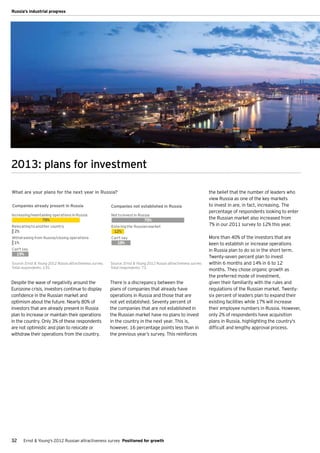
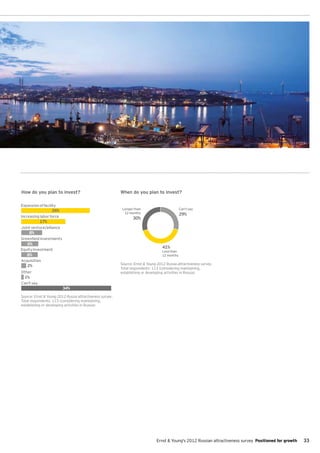
                          32	   2013: plans for investment


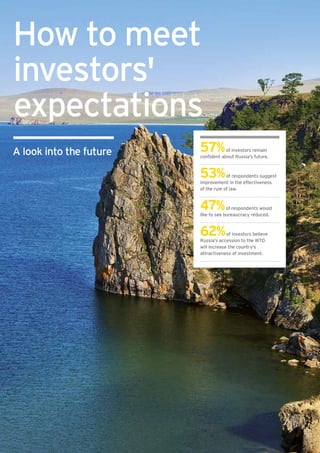
                          34        How to meet investors' expectations
                          35	   Expectations from investors
                          37	   Russia needs to create an investor-friendly environment
                          40	   Reducing Russia's dependence on oil and gas
                          42	   Sector opportunities


                          44	Methodology


                                           Ernst & Young's 2012 Russian attractiveness survey Positioned for growth   1
Viewpoint

Improving investment opportunities
    Igor Shuvalov, First Deputy Prime Minister of the Russian Federation

It might not be quite fair to assess Russia’s attractiveness              The Foreign Investment Advisory Council (FIAC) brings
ourselves, as it is foreign investors who must have their say.            together more than 40 major global companies operating in
Of course, international ratings show that we still have a lot to         Russia. The Council provides an important and useful forum
do. For example, although we have climbed up four positions               to handle issues related to investment activities in Russia.
in the World Bank’s Doing Business ranking, we are still
120th. Another example is the persistent outflow of capital               A few examples of what it has managed to do include:
from Russia, with the Bank of Russia estimating an outflow                •	 The Council made a decisive contribution to the drafting
of US$80b in 2011. And what is private capital outflow?                      of recently adopted amendments to the Law on Migration
It is, in fact, a real indication of the quality of the investment           Registration of Foreign Citizens and Stateless Persons
climate. So there is plenty of room for improvement.                         in the Russian Federation. The law creates favorable
                                                                             conditions for highly skilled foreign professionals and their
                      The Council provides                                   families to enter and live in Russia.
                                                                          •	 FIAC was actively involved in developing the Law on
                      an important and useful
                                                                             Customs Regulation, which greatly simplified customs
                      forum to handle issues                                 procedures.
                      related to investment                               •	 FIAC took part in drafting a law providing easier access
                      activities in Russia.                                  to Russia's strategic industries for foreign investors.
                                                                          •	 FIAC working groups put forward proposals to improve
However, I can say that all these years we have remained                     administrative and customs regulations (veterinary
consistent and resolute, albeit not always as fast as we would               control, food regulations and technical regulations).
like, in removing obstacles hindering the inflow of foreign               •	 Finally, in 2011, the Council prepared a list of projects
capital into our country. We have improved our laws in line                  to be implemented in Siberia and the Far East.
with global best practices and worked to make the system
for passing court rulings more transparent. Let me also                   Russia is a net exporter of capital. Last year, according to
mention the "humanization" of the Criminal Code, especially               the Bank of Russia, our country — I mean the private sector,
with regard to economic crimes, and the introduction of                   the state and households — invested US$76b in other
tax incentives for investors in a number of sectors. A most               countries on a net basis, i.e., net of investments in Russia.
important achievement in this area is the accession to the                Money is thus not the main reason why we need foreign
World Trade Organization (WTO). Finally, the Customs Union                investors. It is no secret that, in terms of their legal status,
significantly increased the size of the domestic market.                  many foreign investments are, in fact, made with money
As a result, we have a positive trend: the net inflow of foreign          that was previously taken out of Russia. We therefore need
direct investments (FDI) amounted to US$53b in 2011.                      real foreign investors to signal that the situation in Russia
                                                                          has improved and there are proper conditions for investment.
Since the autumn of 2010, when I started working as an                    And there is one more important thing. Foreign investments
ombudsman, we have reviewed around 100 complaints                         are primarily associated with innovative technologies,
from foreign investors. We have managed to resolve most                   managerial experience, modern standards of production
of the issues and find positive solutions. Investors most                 and market relations — and this is exactly what our economy
often complain about administrative barriers.                             really needs today.


2      Ernst & Young's 2012 Russian attractiveness survey Positioned for growth
Foreword


Foreword

                    Jay Nibbe                                                                Alexander Ivlev
                    Area Managing Partner EMEIA — Markets                                    Country Managing Partner
                    Ernst & Young                                                            Russia, Ernst & Young LLC


The global economy faces many challenges. In Europe, recession        Our panel of investors confirms that Russia has world-class
has returned to many economies, the Eurozone crisis continues         features: an abundance of natural resources, a huge domestic
and global economic power shifts from west to east and north          market and a very skilled labor force. They also note that
to south. In recent months, rapid-growth economies have               Russia has made a step forward in the global competition
slowed, in some cases notably, as a result of the financial crisis.   to attract FDI.

Despite this fact, many developing economies demonstrate              However, our survey also underlines some critical challenges
robust growth, and the group of 25 rapid-growth markets               for Russia: investors’ confidence in the future attractiveness of
(RGMs) that we monitor is expected to achieve overall GDP             Russia has declined and they repeated their concerns about the
growth of 5.9% in 2013 and 6.5% in 2014.                              country’s uncertain investment climate and innovation capacity.

Russia has proved to be resilient, experiencing growth in 2011        This report is designed to help the Russian Government remove
and 2012. An increase in consumption, a strong labor market           barriers to future growth and help business leaders make smart
and an increase in investments have been the prime drivers of         investment decisions. In the report, we look at the perceived
this growth. Oil prices have supported the sustained expansion        attractiveness of Russia and changes in FDI behavior, and
of the Russian economy.                                               we propose actions and identify opportunities to address the
                                                                      challenges that our country is facing.
Russia, like other countries, is facing the challenges of
increasing global competition, in which investment and                Russia, with its great development potential, is now exploring
technology play crucial roles in diversification and creating         new ways to compete and to lead.
sustainable growth. Our survey shows that foreign investors
are more demanding than they used to be: they now value               As we present our second edition of the Russian attractiveness
efficiency and transparency of the operating environment              survey, we would like to thank all the decision-makers and
as much as they do market opportunities.                              Ernst & Young professionals who have taken the time to share
                                                                      their insights with us.


                                                                 Ernst & Young's 2012 Russian attractiveness survey Positioned for growth   3
Executive summary


Executive summary
The global context                                                           Investors’ perception
An optimistic outlook                                                        Russia takes a step forward

•	 The global economic outlook is optimistic                                 •	 Russia has joined the competition
The global economy started to show signs of recovery in 2011.                The world is converging. China’s lead as the investment destination
It was weak and unbalanced, but there was optimism. As a result of           with the best image is widening and Europe’s attractiveness has
the financial crisis, the growth trajectories of rapid-growth economies      halved since 2006. With 19% of international investors perceiving
have declined – some notably. However, many developing economies             Russia as one of the most attractive global regions in 2012,
demonstrated robust growth, and the group of 25 RGMs that we                 it has unquestionably joined the competition for FDI. The country’s
monitor at Ernst & Young should recover to achieve overall GDP               attractiveness has grown by eight percentage points over 2011,
growth of 5.9% in 2013 and 6.5% in 2014.                                     the largest increase of any region.

•	 Global FDI has increased                                                  •	 Russia is attractive by nature
Despite the economic and financial crisis, global FDI increased by           According to our panel, Russia’s world-class features, such as its
16% to reach US$1.5t in 2011, exceeding the pre-crisis level. In             natural resources (43% of respondents), domestic market (19%)
comparison, Russia’s inflow of foreign investments (FDI) increased           and strong labor force, all support its leading role in the global
by 22%. According to the United Nations Conference on Trade and              recovery.
Development (UNCTAD), investors were motivated by the continued
growth of local consumer markets and manufacturing opportunities.            •	 Russia has balanced labor costs and skills
                                                                             The country’s cost-competitive and skilled labor force improves its
•	 Investors are more demanding                                              attractiveness. Nearly 56% of respondents described the availability
Business leaders are re-evaluating their selection criteria: at the top      of skilled labor as a positive factor for investing in Russia; low labor
are now market appeal (40% of investors) and the stability of their          costs were mentioned by 61% of investors.
investment destination (36%).
                                                                             •	 Concerns remain about Russia’s operating environment
                                                                             Investors’ concerns relate to the political, legislative and
                                                                             administrative environment of Russia, with 62% highlighting this
    Reality                                                                  factor as a challenge. Other factors that make Russia less attractive
                                                                             to foreign investors are its infrastructure and limited incentives for
    #1 In 2011, Russia was the most attractive destination                   sustainable development.
    for FDI in Central and Eastern Europe.


    42% of investment projects are located in Moscow and
    St. Petersburg.


    22%     inflow in terms of value resulted in a 4% increase in job
    creation in 2011.


    8 of the top 10            sources of FDI originate from Europe,
    with over 300 FDI projects between 2007 and 2011.


    51% of FDI in Russia has gone into manufacturing,
    with over 400 FDI projects, the fourth-largest in Europe — while 9%
    was directed to the business services sector.


4       Ernst & Young's 2012 Russian attractiveness survey Positioned for growth
Reality check                                                              A look into the future
Russia’s industrial progress                                               How to meet investors’
                                                                           expectations

•	 Russia attracted fewer, larger projects                                 •	 Expectations from investors
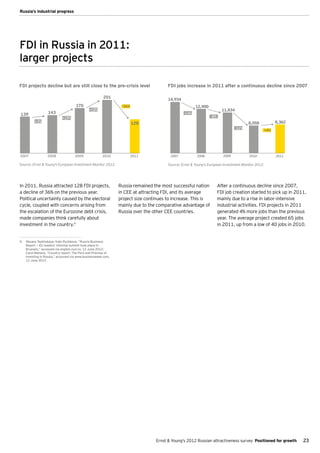
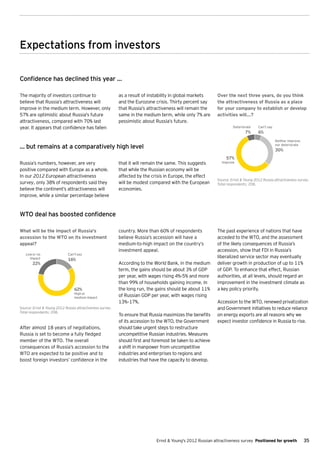
The number of FDI projects declined by 36% in 2011, even though            Although a majority (57%) of investors remain optimistic about
Russia led Central and Eastern Europe (CEE) at attracting FDI. Job         Russia’s attractiveness in the medium term, the level of confidence
creation grew by 4% in 2011. Labor-intensive industrial activities         has dropped from 70% last year.
increased the average number of jobs created per project to 65 in
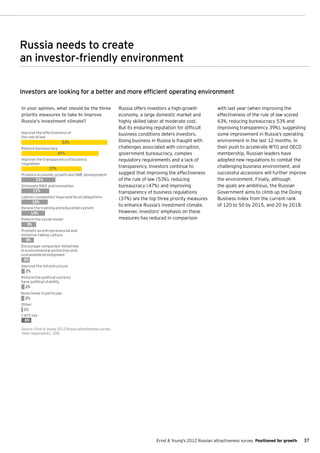
2011 from 40 in 2010.                                                      •	 Russia needs to create an investor-friendly environment
                                                                           Russia’s uncertain business climate deters investment from foreign
•	 Manufacturing is still central to Russia’s appeal                       companies. Investors chose the more effective rule of law (53%),
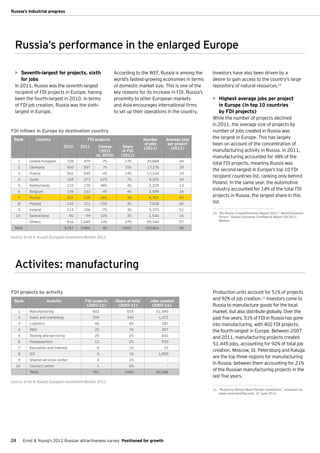
Manufacturing activity is key to Russia’s attractiveness, accounting for   reduced bureaucracy (47%) and an improvement in the transparency
51% of investment projects and 92% of job creation between 2007            of business regulations (37%) as the top three ways to enhance
and 2011. The industrial sector was another high performer, with           Russia’s investment climate.
automotive attracting 90 projects and machinery and equipment
recording 62 projects. The food sector was the second-largest              •	 Russia’s FDI portfolio is diversifying
number of projects (86), and business services also grew in FDI.           Nearly 39% of investors expect the mining, oil and gas sector
                                                                           to attract the most FDI in the next two years. Information and
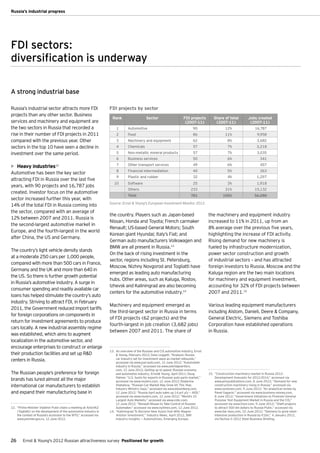
•	 Russia’s diversification is under way, driven by expansion in           communication technologies (ICT) was named second-most often
business services                                                          by investors (20%), followed by energy and utilities, agriculture,
FDI activity in Russia’s business services sector has been growing         consumer goods and automotive. The country’s focus on oil and gas
in recent years. It accounted for 9% of the total FDI projects in          creates a large mismatch between the attention that other strategic
2011, higher than its 5% share in 2010 and above its average of 6%         industries in Russia received from investors and their real potential.
between 2007 and 2011. When financial services and the software
industry are included in the business services category, this figure
rises to 14% of the projects between 2007 and 2011, compared with
the automotive industry’s 12%.

•	 Little change in FDI sources
The United States remains Russia’s primary investor with 122 FDI
projects between 2007 and 2011 (16% of the total), but 8 of the top
10 source countries are from Europe. European countries established
over 300 FDI projects in Russia from 2007 to 2011, 44% of the total.
FDI into Russia from emerging countries remained low between 2007
and 2011. India and China each accounted for less than 2% of FDI             Perception
projects in Russia. Brazil established just two projects in the country.
These economies also made a minor contribution to employment
generation.
                                                                             8 percentage point                  increase of international
                                                                             investors who find Russia attractive compared to 2011,
                                                                             the largest increase of any region.
•	 FDI is regionally concentrated
Russia’s two largest cities – Moscow and St. Petersburg – account for
42% of the projects. The Kaluga and Nizhny Novgorod regions are              39%      of business leaders expect the mining, oil and gas sector
also attractive investment destinations.                                     to attract the most FDI in the next two years, with 20% for the
                                                                             ICT sector.
•	 2013: strong plans for investment
Investors already present in Russia continue to demonstrate their            62%     of investors believe Russia’s accession to the WTO will
confidence in the Russian market. Nearly 80% of these investors plan         increase the country’s attractiveness for investment.
to increase or maintain their operations in the country. There is a wide
gap in plans between the companies that already have operations in
Russia and those that are not yet established. Seventy percent of the        62%      of respondents consider that the country’s political,
companies that are not established in Russia have no plans to invest         legislative and administrative environment needs improvement.
in the country in the next year. This is, however, 16 percentage points
lower than 2011, signaling an improvement in potential investors’
perceptions of the Russian economy as an investment destination.
                                                                             78%     of respondents already present in Russia plan to maintain
                                                                             or expand their operations in the country.


                                                                      Ernst & Young's 2012 Russian attractiveness survey Positioned for growth      5
Executive summary


6    Ernst & Young's 2012 Russian attractiveness survey Positioned for growth
Viewpoint

Growth is not only possible, but inevitable
 Kirill Dmitriev, Chief Executive Officer, Russian Direct Investment Fund

Russia has a unique opportunity to attract a record level          US$1.5t, foreign investors have become increasingly
of FDI. First, Russia really delivers: in 2011 we had a            interested in Russia. According to the survey, in April 2012,
budget surplus, the lowest inflation in 20 years and one           48% of FDI funds expressed the intention to expand their
of the lowest levels of state debt (11% of GDP compared            dealings in Russia and the Commonwealth of Independent
with some 80% in Europe and over 100% in the US). Russia           States (CIS) compared with just 25% in October 2011.
has the fourth-largest international reserves in the world         There are many factors that appeal to investors in
(around US$500b) and impressive 4.3% GDP growth. Such              Russia, including the country’s strong macroeconomic
                                               results can         performance, the threefold growth of the Russian middle
                                               cause a twinge      class over the last five years and prospects of lowering
                     There are                 of envy in other    export barriers as Russia prepares to join the World Trade
                     many factors countries,                       Organization.
                     that appeal               including
                     to investors              most of the         Coming to Russia primarily for high revenues, foreign
                                               developed           investors bring unique managerial expertise and knowledge
                     in Russia.                ones. Second,       of global markets. They facilitate the implementation of
                                               initiatives         advanced technology and contribute to the modernization
like the Russia Direct Investment Fund (RDIF) make it              of production in Russia. It all fits very well with the
easier to invest in Russia. RDIF is a partner for direct           Government’s agenda for attracting “smart” long-term
investment funds, state investment funds and transnational         foreign investments.
corporations that can share risks and elucidate the finer
points of the investment machinery in Russia. In addition,         While a member of BRICS, Russia has some big advantages
RDIF will attract foreign capital by showcasing real               over the rest of the group. Russia possesses huge mineral
examples of successful deals made in partnership with              resources and a more literate and educated population than
leading financial and strategic investors. The mere presence       other BRICS countries, which, unlike Russia, have to rely on
of such investors in Russia will be very good public relations     either mineral or human resources. In addition, Russia boasts
(PR) for the country. Third, Russia has a large-scale              the highest GDP per capita, the best capitalized banking
government program of investment in infrastructure under           system and the lowest corporate tax among BRICS nations.
way, as well as a new wave of privatizations, targeting
assets worth US$30b–US$50b, in total.                              Russia’s investment climate is often cited as one of this
                                                                   country’s weaknesses in comparison with other BRICS
Russia has to become more competitive in the international         countries (Brazil, Russia, India, China and South Africa),
capital market. The Russian Government has clearly realized        but, as stated above, the Russian Government intends to take
that it needs to improve the local business environment and        some serious steps to improve it.
is prepared to commit itself to state, corporate management
and regulatory reforms. There are some real problems that          International experts often speak about the low
the Government has been trying to solve. It is clear that we       competitiveness of Russian businesses. But the lower
still suffer from excessive bureaucracy and red tape, and          efficiency of Russian companies also has an upside, as it
there are concerns about the reliability of the Russian judicial   shows that there is growth potential, and, most importantly,
system, although we have recently seen some improvements           where this growth may come from is clear. In spite of
in all these areas. To tackle these challenges, a special          some pessimistic views of the current state of the Russian
institution, the ombudsman, has been established in Russia         economy, growth is not only possible, but inevitable. Suffice
during the transition period.                                      it to say that the Russian middle class, which, in relative
                                                                   terms, is the largest middle class in the BRICS group,
According to an Ernst & Young survey of more than                  has emerged only in the last five years, during which time
150 executives whose companies’ combined assets exceed             the number of middle-class Russians has tripled.


                                                           Ernst & Young's 2012 Russian attractiveness survey Positioned for growth   7
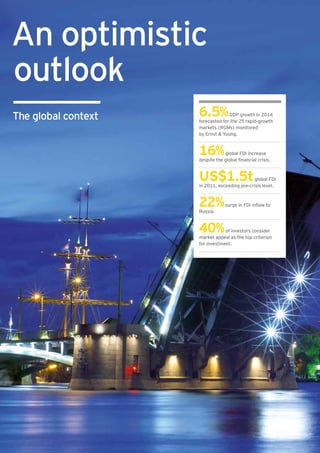
An optimistic
outlook
The global context                                                             6.5%          GDP growth in 2014
                                                                               forecasted for the 25 rapid-growth
                                                                               markets (RGMs) monitored
                                                                               by Ernst & Young.


                                                                               16%         global FDI increase
                                                                               despite the global financial crisis.


                                                                               US$1.5t                   global FDI
                                                                               in 2011, exceeding pre-crisis level.


                                                                               22%
                                                                               Russia.
                                                                                            surge in FDI inflow to


                                                                               40%         of investors consider
                                                                               market appeal as the top criterion
                                                                               for investment.


8   Ernst & Young's 2012 Russian attractiveness survey Positioned for growth
An optimistic outlook


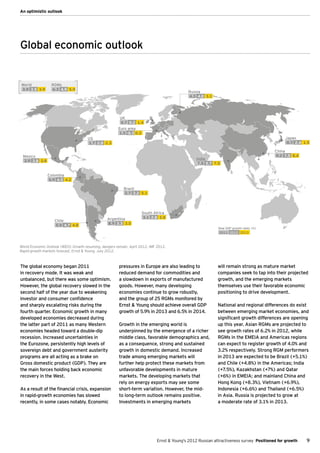
Global economic outlook


World             RGMs
3.9 3.5 3.9       6.3 4.9 5.9
                                                                                              Russia
                                                                                              4.3 4.0 3.1


                                                         UK
                                                         0.7 0.2 1.4
                                                        Euro area
                                                        1.5 -0.3 0.3
                                       US                                                                                                      Japan
                                       1.7 2.0 2.3                                                                                             -0.7 2.4 1.5

                                                                                                                                          China
 Mexico                                                                                                                                   9.2 7.5 8.4
                                                                                                  India
 3.9 3.8 3.8
                                                                                                   7.5 5.7 7.5


               Colombia
               5.9 4.5 4.2

                                                           Brazil
                                                           2.7 2.2 5.1


                                                                       South Africa
                                                  Argentina            3.1 2.8 3.8
                    Chile
                    5.9 4.7 4.8                   8.9 3.3 3.5
                                                                                                             Real GDP growth rates (%)
                                                                                                             2011 2012 2013


World Economic Outlook (WEO): Growth resuming, dangers remain, April 2012, IMF 2012.
Rapid-growth markets forecast, Ernst & Young, July 2012.


The global economy began 2011                            pressures in Europe are also leading to             will remain strong as mature market
in recovery mode. It was weak and                        reduced demand for commodities and                  companies seek to tap into their projected
unbalanced, but there was some optimism.                 a slowdown in exports of manufactured               growth, and the emerging markets
However, the global recovery slowed in the               goods. However, many developing                     themselves use their favorable economic
second half of the year due to weakening                 economies continue to grow robustly,                positioning to drive development.
investor and consumer confidence                         and the group of 25 RGMs monitored by
and sharply escalating risks during the                  Ernst & Young should achieve overall GDP            National and regional differences do exist
fourth quarter. Economic growth in many                  growth of 5.9% in 2013 and 6.5% in 2014.            between emerging market economies, and
developed economies decreased during                                                                         significant growth differences are opening
the latter part of 2011 as many Western                  Growth in the emerging world is                     up this year. Asian RGMs are projected to
economies headed toward a double-dip                     underpinned by the emergence of a richer            see growth rates of 6.2% in 2012, while
recession. Increased uncertainties in                    middle class, favorable demographics and,           RGMs in the EMEIA and Americas regions
the Eurozone, persistently high levels of                as a consequence, strong and sustained              can expect to register growth of 4.0% and
sovereign debt and government austerity                  growth in domestic demand. Increased                3.2% respectively. Strong RGM performers
programs are all acting as a brake on                    trade among emerging markets will                   in 2013 are expected to be Brazil (+5.1%)
Gross domestic product (GDP). They are                   further help protect these markets from             and Chile (+4.8%) in the Americas; India
the main forces holding back economic                    unfavorable developments in mature                  (+7.5%), Kazakhstan (+7%) and Qatar
recovery in the West.                                    markets. The developing markets that                (+6%) in EMEIA; and mainland China and
                                                         rely on energy exports may see some                 Hong Kong (+8.3%), Vietnam (+6.9%),
As a result of the financial crisis, expansion           short-term variation. However, the mid-             Indonesia (+6.6%) and Thailand (+6.5%)
in rapid-growth economies has slowed                     to long-term outlook remains positive.              in Asia. Russia is projected to grow at
recently, in some cases notably. Economic                Investments in emerging markets                     a moderate rate of 3.1% in 2013.


                                                                              Ernst & Young's 2012 Russian attractiveness survey Positioned for growth   9
An optimistic outlook


Global FDI market:
dynamic and demanding

  Viewpoint
  Our success will depend on us
     Herman Gref, Chairman of the Management Board & CEO of Sberbank

  If we assess the investment climate in           we still have a lot of hard work ahead of       kindergarten, but all we are concerned
  Russia retrospectively, we can say that,         us. The World Bank and the International        about is how to make sure our
   at the beginning of this century,               Finance Corporation have placed Russia in       kindergartens can accommodate all the
  the temperature was around zero.                 the 120th position in their recent Doing        children. Nobody seems to be thinking
  The nominal tax burden was twice as large        Business report, which is far from              about the quality of education — as if we
  as real tax payments, with massive red           satisfying. Making a leap from the 120th        were building some sort of luggage room
  tape and corruption. The macroeconomic           to the 20th place is not easy, but the fact     and assigning kindergarten teachers the
  situation was also awful, as was the             that President Vladimir Putin has declared      role of luggage security officers! In the
  nation’s credit history. The only attractive     this as an objective is very important.         morning, you deposit your kids at the
  features included perhaps the size of                                                            kindergarten and in the evening you take
  the market (and even this was no more                                                            them back home. Yet about 80% of a
  than potentially so) and our oil and gas                           Russia’s main                 nation’s successes rest upon the quality
  reserves.                                                          goal is to reform             of pre-school education. Eighty percent
                                                                                                   of a child’s potential is built during the
  By the middle of the 2000s, the
                                                                     its system of                 first seven years of their life. As for the
  investment climate in Russia had changed                           federal and local             quality of Russian secondary and higher
  significantly. This climate is not only, and                       government.                   education, I would rather not speak about
  not so much, about figures as it is about                                                        it at all.
  how it feels to do business in the country.      Russia’s main goal is to reform its system
  In 2006-2007, business in Russia was in          of federal and local Government. It needs       The third goal is to create a system of
  a state of elation at the pace of growth         to improve its blatantly inefficient judicial   values.
  we had achieved. We simplified the tax           system (all major transactions are carried
  system, cut interest rates and managed to        out in other jurisdictions now, which is        We can also mention the need to improve
  reduce red tape. We shortened the                evidence of the complete lack of trust          our infrastructure, etc. But above
  company registration process from two            in our own system); improve the law             I mentioned the fundamental things.
  months to three days in accordance with          enforcement system and customs
  the law. We amended the Civil Code and           legislation; eliminate corruption and           Foreign capital plays a critical, though not
  adopted the Land Code, Water Code,               the Government’s involvement in areas           decisive, role in the modernization of the
  Forestry Code and law concerning                 where it is unnecessary; and concentrate        Russian economy. And this is true for all
  minerals. All in all, we took a big step         its efforts on the priority areas of Russia’s   Russian industries, without exception. At
  forward and, as a result, enjoyed a foreign      development. Corruption is our number           the end of the day, our success will
  investment boom.                                 one problem, because it, too, is a measure      depend on our own preparedness to move
                                                   of the Government’s efficiency.                 in the direction of modernization.
  Unfortunately, the pace of growth then
  slowed down, primarily because of                Our second goal is to reform the system         I do not have enough empirical data
  corruption and Russia’s crippled judicial        of education. The notion that the quality       yet to make any predictions concerning
  system, while our competitors were               of education in Russia is much better           the efficiency of the modernization drive
  marching forward. Governments in                 than in any of the other BRICS countries        in Russia in the coming years. I do hope
  advanced economies did not simply work           is nothing but a myth inherited from            that modernization will take place,
  to accommodate the interests of their            Soviet times. In China, the quality of          yet I believe we need to wait for some
  business communities; but they actually          education is rising, while in our country it    systemic improvements from the
  tried to anticipate their needs. Therefore,      is falling. Education starts in                 new Government.


10    Ernst & Young's 2012 Russian attractiveness survey Positioned for growth
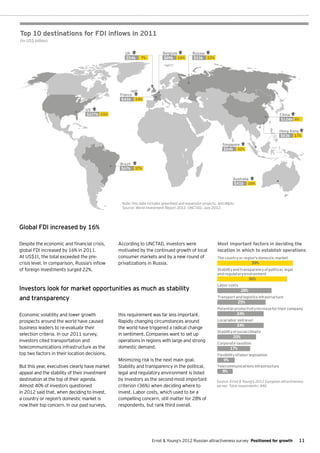
Top 10 destinations for FDI inflows in 2011
(in US$ billion)

                                                   UK                    Belgium           Russia
                                                   $54b     7%           $89b 10%          $53b 22%


                                                France
                                                 $41b 34%

                                 US
                                 $227b 15%                                                                                                      China
                                                                                                                                                $124b 8%


                                                                                                                                                Hong Kong
                                                                                                                                                $83b 17%

                                                                                                              Singapore
                                                                                                              $64b 32%


                                                Brazil
                                                $67b     37%

                                                                                                                     Australia
                                                                                                                     $41b 16%


                                                 Note: this data includes greenfield and expansion projects, and M&As.
                                                 Source: World Investment Report 2012, UNCTAD, July 2012.


Global FDI increased by 16%

Despite the economic and financial crisis,      According to UNCTAD, investors were                        Most important factors in deciding the
global FDI increased by 16% in 2011.            motivated by the continued growth of local                 location in which to establish operations
At US$1t, the total exceeded the pre-           consumer markets and by a new round of                     The country or region's domestic market
crisis level. In comparison, Russia’s inflow    privatizations in Russia.                                                         39%
of foreign investments surged 22%.                                                                         Stability and transparency of political, legal
                                                                                                           and regulatory environment
                                                                                                                                 36%
                                                                                                           Labor costs
Investors look for market opportunities as much as stability                                                               28%
and transparency                                                                                           Transport and logistics infrastructure
                                                                                                                         25%
                                                                                                           Potential productivity increase for their company
Economic volatility and lower growth            this requirement was far less important.                                 24%
prospects around the world have caused          Rapidly changing circumstances around                      Local labor skill level
                                                                                                                         24%
business leaders to re-evaluate their           the world have triggered a radical change
                                                                                                           Stability of social climate
selection criteria. In our 2011 survey,         in sentiment. Companies want to set up
                                                                                                                     20%
investors cited transportation and              operations in regions with large and strong
                                                                                                           Corporate taxation
telecommunications infrastructure as the        domestic demand.                                                   17%
top two factors in their location decisions.                                                               Flexibility of labor legislation
                                                Minimizing risk is the next main goal.                        9%
But this year, executives clearly have market   Stability and transparency in the political,               Telecommunications infrastructure
appeal and the stability of their investment    legal and regulatory environment is listed                    8%
destination at the top of their agenda.         by investors as the second-most important                 Source: Ernst & Young's 2012 European attractiveness
Almost 40% of investors questioned              criterion (36%) when deciding where to                    survey. Total respondents: 840
in 2012 said that, when deciding to invest,     invest. Labor costs, which used to be a
a country or region’s domestic market is        compelling concern, still matter for 28% of
now their top concern. In our past surveys,     respondents, but rank third overall.


                                                                   Ernst & Young's 2012 Russian attractiveness survey Positioned for growth                 11
Russia takes
a step forward
Investors' perception                                                           19%          of international investors
                                                                                perceive Russia as one of the most
                                                                                attractive global regions.


                                                                                8    percentage point increase
                                                                                of international investors who find Russia
                                                                                attractive compared to 2011, the largest
                                                                                increase of any region.


                                                                                43%         of respondents find natural
                                                                                resources to be Russia’s most attractive
                                                                                feature.


                                                                                56%           of investors deem availability
                                                                                of skilled labor a positive factor for
                                                                                investing in Russia.


                                                                                61%         of investors are attracted by
                                                                                low labor costs.


                                                                                62%         of respondents consider
                                                                                that the country’s political, legislative
                                                                                and administrative environment needs
                                                                                improvement.


12   Ernst & Young's 2012 Russian attractiveness survey Positioned for growth
Russia takes a step forward


Russia in the global context

China’s lead is widening

Investors are still focusing on rapid-growth               make the country a magnet for investors.              “attractiveness gap.” The gap between
markets. Business leaders see a larger                     Consequently, in Ernst & Young’s 2012                 China and Western Europe has increased
role for emerging economies, particularly                  European attractiveness survey, China                 from one percentage point in 2010 to
China, that offer greater returns on                       retains its position as the most attractive           three percentage points in 2011 and 11
their investments. In addition to the size                 FDI destination. It was named as the                  percentage points in 2012. Similarly, China
of its market and pace of consumption                      most attractive destination by 44% of                 has extended its attractiveness lead over
growth, China also has a broad economy,                    respondents — the highest level of investor           CEE. In contrast, competition among the
specialized clusters in key industries,                    confidence since 2009. Although the                   pack of other leading players — Brazil, CEE,
easy access to international markets                       rankings of the most attractive destinations          India, North America and Russia — remains
and an enduring image as a low-cost                        remain roughly similar to those of last               keen.
production base — all of which combine to                  year, there is a noticeable variation in the


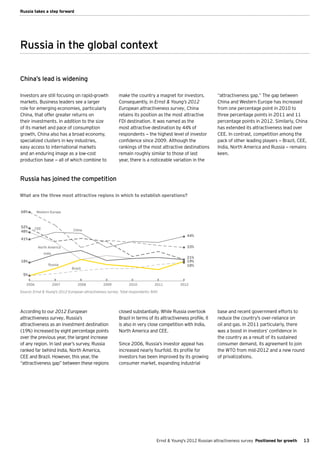
Russia has joined the competition

What are the three most attractive regions in which to establish operations?


68%       Western Europe


52%     CEE
48%                             China
                                                                                                 44%
41%

          North America                                                                          33%
              India
                                                                                                 21%
18%                                                                                              19%
                 Russia                                                                          18%
                               Brazil
 5%

   2006               2007        2008            2009           2010            2011         2012

Source: Ernst & Young's 2012 European attractiveness survey. Total respondents: 840


According to our 2012 European                             closed substantially. While Russia overtook           base and recent government efforts to
attractiveness survey, Russia’s                            Brazil in terms of its attractiveness profile, it     reduce the country's over-reliance on
attractiveness as an investment destination                is also in very close competition with India,         oil and gas. In 2011 particularly, there
(19%) increased by eight percentage points                 North America and CEE.                                was a boost in investors’ confidence in
over the previous year, the largest increase                                                                     the country as a result of its sustained
of any region. In last year’s survey, Russia               Since 2006, Russia’s investor appeal has              consumer demand, its agreement to join
ranked far behind India, North America,                    increased nearly fourfold. Its profile for            the WTO from mid-2012 and a new round
CEE and Brazil. However, this year, the                    investors has been improved by its growing            of privatizations.
“attractiveness gap” between these regions                 consumer market, expanding industrial


                                                                                  Ernst & Young's 2012 Russian attractiveness survey Positioned for growth   13
Russia takes a step forward


Europe’s attractiveness has halved since 2006

Europe continues to appeal strongly to           Yet the number of investors who rank Europe     other rapid-growth economies, means that
investors. Western Europe is ranked as           as the most attractive destination for an       CEE is now competing with North America
the second-most attractive investment            FDI project has fallen by more than half        and emerging markets such as India and
destination for global FDI (33%), followed       since 2006. In this year’s 2012 European        Brazil. It is clear that the global economy has
by CEE (21%). These results, which were          attractiveness survey, Western Europe’s         a growing number of attractive destinations
achieved during a period of extreme              attractiveness slid by two percentage           in which to invest. Western Europe, however,
uncertainty in the Eurozone, confirm the         points to 33% and CEE’s attractiveness          is still ranked far ahead of these markets and
continent's fundamental appeal.                  suffered a steep decline of eight percentage    is challenging China, the leading investment
                                                 points to 21%. This decline, coupled with a     destination.
                                                 simultaneous rise in the attractiveness of


Mixed messages between Central and Eastern Europe

Investor confidence in CEE has declined.         which contributed to the credit crunch in       banks have foreign parents. Labor costs
In 2006, 52% of respondents ranked the           the region — are among CEE’s problems.          have risen too, making manufacturing in
region as the most attractive place in the       Given the region’s strong trade and financial   CEE less attractive. With the increasing
world for investment. In 2012, this figure       links with Eurozone economies, it is no         appeal of BRIC countries and other
is just 21%. Many factors explain this           surprise that the International Monetary        rapid-growth economies, CEE now finds
decline. A few years ago, CEE benefited          Fund (IMF) expects CEE to be hit the            itself competing with North America and
from Western Europe’s success. It was            hardest by adverse knock-on effects of the      emerging markets such as Brazil and
seen as a low-cost location to serve free-       Eurozone crisis.                                India. Nonetheless, some CEE countries
spending Western consumers. Today,                                                               and regions, including the Baltic States,
Europe’s problems have hit CEE hardest.          In addition, debt levels in some CEE            the Czech Republic, Hungary and Poland,
A rise in non-performing loans, a very           countries are high and economic growth          continue to attract good FDI inflows from
high dependence on exports to Western            prospects low. Banks have cut their net         investors who seek relatively favorable
European economies and a weak and                aggregate lending to the private sector         labor costs and availability of skills.
largely foreign-owned banking system —           across CEE. Also, many of the region's


14   Ernst & Young's 2012 Russian attractiveness survey Positioned for growth
Viewpoint
Russia on the way to liberalization
 Yaroslav Lissovolik, Member of the Management Board, Chief Economist, Head of Research Department, Deutsche Bank Russia

Russia’s investment appeal has been           resources, Russia is still ahead of all         development of the Russian economy.
largely understated because of its            other BRICS nations, and Russia must            Key decisions must be taken by Russia to
controversial image in the world, and the     learn how to capitalize on this); and           move ahead with institutional reform,
Russian Government should do more to          abundant natural resources. If used in          create a better investment environment,
improve it. The market has overlooked         the right way, these resources could help       reduce red tape and fight corruption.
some important factors that have              Russia address numerous development             Meanwhile, foreign capital may be critical
become visible in Russia in recent years.     challenges instead of weighing down on          for large-scale infrastructure projects
For example, Russia is the only BRICS         the country like the so called “resource        such as the Sochi 2014 Winter Olympic
country that does not have any capital        curse,” which is only too often the case        Games or the 2018 FIFA World Cup. Such
flow restrictions. This makes the Russian     with developing markets.                        undertakings are simply too large a claim
market more open to foreign investment.                                                       on the Government’s purse to be
Progress made by Russia while preparing                                                       financed by the state on its own,
for accession to the World Trade
                                                         A nice cushion                       considering their cost inefficiency and
Organization has not received due                        for the Russian                      the possible decline in oil prices in the
appreciation either. However, it is very                 economy would                        next six to eight years. A nice cushion for
important not only for the liberalization                                                     the Russian economy, which remains
of the Russian economy, but also                         be a stable                          heavily dependent on oil prices, would be
because international standards are                      inflow of long-                      a stable inflow of long-term foreign
                                                                                              capital and FDI.
playing an increasingly significant role in
this country (though legal matters and
                                              term foreign capital,
the rule of law are still a matter of         direct foreign investment.                      Incidentally, saying things like, “We don’t
concern to many foreign investors).                                                           need any short-term investment — give us
                                              Speaking about Russia’s weaknesses in           only the long-term capital in the form of FDI
Furthermore, we have recently seen            comparison with the other BRICS                 instead” will hardly help Russia in achieving
some major improvements in corporate          nations, demographics are one of them.          its goals. Russia must improve the local
governance, which has never been              Notwithstanding the recent years’               environment for portfolio investment,
Russia’s strong suit. In this respect,        improvements in this area, population           which will help attract long-term
Russia has always been behind other           decline is still a formidable challenge for     investment. According to our analysis,
countries, including other BRICS nations.     Russia, as many investors regard                there is a connection between these.
But Russian companies have recently           demographic growth as a crucial
taken some important steps to modify          prerequisite for long-term sustainable          In general, although there is still a lot
their dividend policies, thus becoming        development. Russia’s other issues are          to be done in Russia, I am an optimist.
more open in many respects, including         the low efficiency of production and            However, given the inertia in perceptions
their financial reporting.                    labor, as well as inadequate investment.        regarding the changes in Russia's
                                              These issues are partly caused by the           economy, our country, in certain cases,
Other advantages of Russia include a          nation’s underdeveloped infrastructure.         may have to put in more effort than other
stable macroeconomic situation; good                                                          nations to persuade investors that the
quality human capital (in terms of the        Foreign capital plays an important,             positive changes in Russia are viable and
quality of education and human                though not decisive, role in the                will continue.


                                                                Ernst & Young's 2012 Russian attractiveness survey Positioned for growth   15
Russia takes a step forward


Russia’s world-class
natural resources


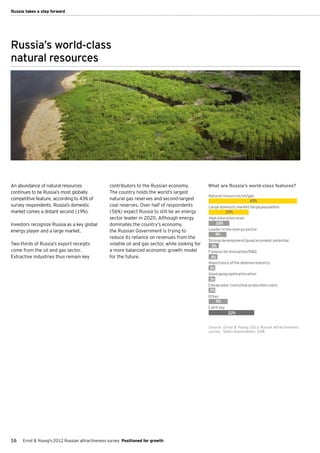
An abundance of natural resources                contributors to the Russian economy.             What are Russia's world-class features?
continues to be Russia’s most globally           The country holds the world’s largest
                                                                                                  Natural resources/oil/gas
competitive feature, according to 43% of         natural gas reserves and second-largest                                 43%
survey respondents. Russia’s domestic            coal reserves. Over half of respondents          Large domestic market/large population
market comes a distant second (19%).             (56%) expect Russia to still be an energy                    19%
                                                 sector leader in 2020. Although energy           High education level
Investors recognize Russia as a key global       dominates the country’s economy,                      10%
energy player and a large market.                the Russian Government is trying to              Leader in the energy sector
                                                                                                       9%
                                                 reduce its reliance on revenues from the
                                                                                                  Strong development/good economic potential
Two-thirds of Russia’s export receipts           volatile oil and gas sector, while looking for    5%
come from the oil and gas sector.                a more balanced economic growth model            Famous for innovation/R&D
Extractive industries thus remain key            for the future.                                   4%
                                                                                                  Importance of the defense industry
                                                                                                  3%
                                                                                                  Good geographical location
                                                                                                  3%
                                                                                                  Cheap labor costs/low production costs
                                                                                                  3%
                                                                                                  Other
                                                                                                        9%
                                                                                                  Can't say
                                                                                                               22%


                                                                                                  Source: Ernst & Young 2012 Russia attractiveness
                                                                                                  survey. Total respondents: 208.


16   Ernst & Young's 2012 Russian attractiveness survey Positioned for growth
Russia’s attractiveness:
strengths and areas for improvement

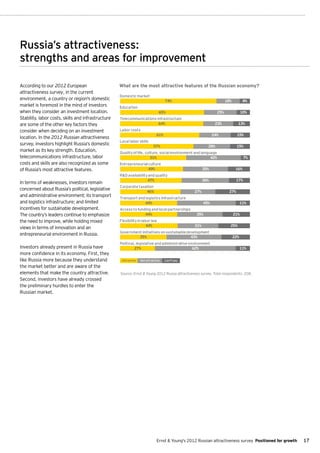
According to our 2012 European                      What are the most attractive features of the Russian economy?
attractiveness survey, in the current
                                                    Domestic market
environment, a country or region's domestic                                        74%                                18%          8%
market is foremost in the mind of investors         Education
when they consider an investment location.                                     65%                              25%               10%
Stability, labor costs, skills and infrastructure   Telecommunications infrastructure
are some of the other key factors they                                  64%                                   23%             13%
consider when deciding on an investment             Labor costs
                                                                             61%                             24%              15%
location. In the 2012 Russian attractiveness
                                                    Local labor skills
survey, investors highlight Russia’s domestic                              57%                           28%                  15%
market as its key strength. Education,              Quality of life, culture, social environment and language
telecommunications infrastructure, labor                                51%                               42%                      7%
costs and skills are also recognized as some        Entrepreneurial culture
of Russia’s most attractive features.                               49%                                35%                   16%
                                                    R&D availability and quality
                                                                    47%                                36%                   17%
In terms of weaknesses, investors remain
                                                    Corporate taxation
concerned about Russia’s political, legislative                   46%                            27%                    27%
and administrative environment; its transport       Transport and logistics infrastructure
and logistics infrastructure; and limited                         44%                                  45%                        11%
incentives for sustainable development.             Access to funding and local partnerships
The country’s leaders continue to emphasize                       44%                             35%                       21%
the need to improve, while holding mixed            Flexibility in labor law
                                                                      44%                        31%                    25%
views in terms of innovation and an
                                                    Government initiatives on sustainable development
entrepreneurial environment in Russia.
                                                             35%                            43%                             22%
                                                    Political, legislative and administrative environment
Investors already present in Russia have                     27%                                62%                               11%
more confidence in its economy. First, they
like Russia more because they understand             Attractive   Not attractive   Can't say

the market better and are aware of the
elements that make the country attractive.          Source: Ernst & Young 2012 Russia attractiveness survey. Total respondents: 208.
Second, investors have already crossed
the preliminary hurdles to enter the
Russian market.


                                                                             Ernst & Young's 2012 Russian attractiveness survey Positioned for growth   17
Russia takes a step forward


  Viewpoint
  Russia will become a more balanced economy than India or China
     Alexei Kudrin, Chairman of the Committee for Civil Initiatives, Minister of Finance 2000-2011

  Why are foreign companies that are                but an imitation of one dominated by          freedom and confidence, so that they feel
  already doing business in Russia more             state regulation, many procedures             freer to appeal to state institutions for
  optimistic about its investment climate           there are set up better than in Russia.       support and have greater trust in the
  than those who haven’t yet entered the            Take investment projects, for example.        judicial system. Russia will follow this
  Russian market? We don’t meet a                   In China, after reaching an agreement         path and ultimately, I think, become a
  number of standards that investors are            with the central authorities, an investor     more balanced market economy than
  used to in other countries. They have to          will face minimal problems. An investor       India or China.
  accommodate themselves to the specific            can’t count on that in Russia. Here,
  working styles of local and federal               unfortunately, problems can arise at any      For any BRICS country — Russia included
  government bodies, and even individuals.                                                        — foreign investments are important.
  They have to allow for the specifics of the                                                     But they are not decisive for successful
  tax system and financial reporting, and                     Investors simply                    economic development, although
  adjust to sometimes unaccustomed                            have to learn                       advanced technologies come along with
  inspections. They don’t always                                                                  the money, which is also very important.
  understand the mentality and motivation
                                                              to manage and                       In recent years, China had fixed capital
  behind decisions that are made here. But                    avoid specific                      investments of 30%–40% of GDP and
  those who go through this “school”                          risks; and to                       higher, and the contribution of foreign
  acquire an ability to resolve the issues                                                        investors accounted for approximately
  facing them and, most importantly, earn          devote a little more time                      4% of GDP. In 2011, these figures were
  a good income. Investors simply have to          to this than usual.                            48% and 1.5% of GDP (22% and 3% in
  learn to manage and avoid specific risks;                                                       Russia). A few countries have foreign
  and to devote a little more time to this                                                        investments totaling well over 10%,
  than usual. I understand that big Western         stage. In Brazil, there is probably no less   but I wouldn’t say that these are
  companies don’t like to deal with such            economic crime than there is in Russia,       stable countries in terms of their
  fine points or with country specifics.            but some market institutions function         macroeconomic indicators. The main
  They want everything to operate the way           better there than they do in Russia. India    source of investment is personal savings,
  it does at home. Since they’re bringing           is a very closed country. Building a          deposits made by the population — and
  money with them, they think everything            business there is even harder. As in          Russia is no exception.
  should be done for them. But Russia               Russia, obstacles can be encountered
  doesn’t work that way yet. Even                   after a project has been launched. But its
  businesspeople who go through this                colonial past and the English language
  “school” don’t always make everything             bring India a little closer to Western
  work. But half, or even more, do make it          business in terms of mentality and the
  work and are quite successful.                    legal system. Still, as strange as it may
                                                    seem, I believe most of all in Russia.
  If we talk about Russia in the context of         Russia will develop a more classical
  the BRICS, it should be noted that these          market model than China or India. In this
  countries are all very different and hardly       sense, we’re closer to Brazil. But we still
  comparable. We lag behind in a number             have a lot to do to make the political and
  of respects. Although China isn’t a               economic climate more competitive; to
  market in the direct sense of the word,           give market players a feeling of greater


18     Ernst & Young's 2012 Russian attractiveness survey Positioned for growth
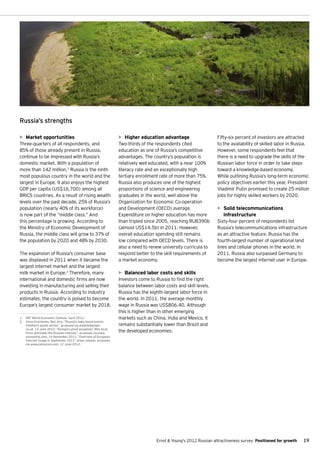
Russia’s strengths

•	 Market opportunities                                         •	 Higher education advantage                    Fifty-six percent of investors are attracted
Three-quarters of all respondents, and                          Two-thirds of the respondents cited              to the availability of skilled labor in Russia.
85% of those already present in Russia,                         education as one of Russia’s competitive         However, some respondents feel that
continue to be impressed with Russia’s                          advantages. The country’s population is          there is a need to upgrade the skills of the
domestic market. With a population of                           relatively well educated, with a near 100%       Russian labor force in order to take steps
more than 142 million,1 Russia is the ninth                     literacy rate and an exceptionally high          toward a knowledge-based economy.
most populous country in the world and the                      tertiary enrollment rate of more than 75%.       While outlining Russia’s long-term economic
largest in Europe. It also enjoys the highest                   Russia also produces one of the highest          policy objectives earlier this year, President
GDP per capita (US$16,700) among all                            proportions of science and engineering           Vladimir Putin promised to create 25 million
BRICS countries. As a result of rising wealth                   graduates in the world, well above the           jobs for highly skilled workers by 2020.
levels over the past decade, 25% of Russia’s                    Organization for Economic Co-operation
population (nearly 40% of its workforce)                        and Development (OECD) average.                  •	 Solid telecommunications
is now part of the “middle class.” And                          Expenditure on higher education has more            infrastructure
this percentage is growing. According to                        than tripled since 2005, reaching RUB390b        Sixty-four percent of respondents list
the Ministry of Economic Development of                         (almost US$14.5b) in 2011. However,              Russia’s telecommunications infrastructure
Russia, the middle class will grow to 37% of                    overall education spending still remains         as an attractive feature. Russia has the
the population by 2020 and 48% by 2030.                         low compared with OECD levels. There is          fourth-largest number of operational land
                                                                also a need to renew university curricula to     lines and cellular phones in the world. In
The expansion of Russia’s consumer base                         respond better to the skill requirements of      2011, Russia also surpassed Germany to
was displayed in 2011 when it became the                        a market economy.                                become the largest internet user in Europe.
largest internet market and the largest
milk market in Europe.2 Therefore, many                         •	 Balanced labor costs and skills
international and domestic firms are now                        Investors come to Russia to find the right
investing in manufacturing and selling their                    balance between labor costs and skill levels.
products in Russia. According to industry                       Russia has the eighth-largest labor force in
estimates, the country is poised to become                      the world. In 2011, the average monthly
Europe’s largest consumer market by 2018.                       wage in Russia was US$806.40. Although
                                                                this is higher than in other emerging
1.	 IMF World Economic Outlook, April 2012.                     markets such as China, India and Mexico, it
2.	 Anna Krachenko, Ben Aris, “Russia's baby boom boosts
    children's goods sector,” accessed via www.telegraph.       remains substantially lower than Brazil and
    co.uk, 12 June 2012; “Europe’s great exception: Why local
    firms dominate the Russian internet,” accessed via www.
                                                                the developed economies.
    economist.com, 14 November 2011; “Overview of European
    Internet Usage in September 2011” press release, accessed
    via www.comscore.com, 12 June 2012.


                                                                                  Ernst & Young's 2012 Russian attractiveness survey Positioned for growth   19
Russia takes a step forward


Russia’s areas for improvement

•	 Political, legislative and                                 •	 Infrastructure                                                •	 Innovation and a culture of
     administrative environment                               Respondents have mixed views on the                                  entrepreneurship
Sixty-two percent of respondents consider                     current state of Russian infrastructure.                         Russia’s performance on most of the
that Russia’s political, legislative and                      While 45% do not find Russia’s infrastructure                    innovation performance indicators is
administrative environment needs                              attractive, 44% consider the transport and                       mediocre overall and poor when it comes
improvement. Russia’s ranking of 120 out                      logistics infrastructure to be an advantage.                     to indices that involve technical achievement
of the 183 economies in the World Bank’s                      According to the OECD, more than 60% of                          or economic incentives. According to the
Doing Business 2012 report3 confirms the                      federal and regional highways do not meet                        recent OECD Innovation Review of the
operating and administrative challenges                       regulatory standards. The World Economic                         Russian Federation,8 innovation in the
faced by investors in the country. Getting                    Forum’s (WEF), global competitiveness                            country suffers because of very low levels of
electricity, dealing with construction permits                report 2011-20125 ranks Russia 130                               R&D and relevant activities in corporations;
and trading across borders continue to be                     out of 142 for the quality of its roads.                         weak framework conditions for innovation;
complex and costly activities in Russia.                      An adequate transportation infrastructure                        and inadequate infrastructure. According
Uncertain property rights, red tape and                       is only available in urban areas such as                         to Ernst & Young’s G20 Entrepreneurship
corruption still pose a huge challenge for                    Moscow and St. Petersburg. Russia also                           Barometer report, respondents face a
investors in the country.                                     ranks low (94) on the World Bank’s                               dilemma with respect to the country’s
                                                              overall Logistics Performance Index.6                            culture of entrepreneurship. Half (50%) of
Russia’s agreement to join the WTO and                        Russia’s current level of containerization                       the Russian respondents did not agree that
a new round of privatizations could provide                   is approximately 4%, compared with the                           their culture encourages entrepreneurship,
partial reassurance, helping to open up                       emerging markets’ average of 15%. Russia                         while the other 50% agreed that Russia’s
Russia’s huge energy sector to foreign                        has the second-largest railway network                           environment for entrepreneurs is supportive.
investors. Also, internal tensions that arose                 in the world. Its railroad infrastructure also                   The same report also highlighted that access
after the elections now seem to be easing,                    fares well in the WEF global competitiveness                     to funding continues to be one of the most
and Russia is also changing its system of civil               report,7 ranking at 29 out of 142 countries.                     significant challenges for the creation,
laws in September 2012. The new draft law                                                                                      growth and survival of small and medium
is designed to introduce fundamental changes                  Government spending on road and railway                          enterprises (SMEs), particularly innovative
to property rights, obligations, contracts,                   infrastructure is growing. The need to                           ones. Entrepreneurs also complain about
security instruments and intellectual property.               renew transport and logistics infrastructure                     the lack of tax incentives to start a business.
Finally, although the Russian Federation                      has now become a political priority at the
ranked 120 in the World Bank’s Doing                          highest levels. Infrastructure spending is
Business 2012 report,4 it was still ahead of                  expected to increase further in light of the
Brazil (126) and India (132).                                 upcoming 2012 Asia-Pacific Economic
                                                              Cooperation (APEC) summit, the 2014
                                                              Winter Olympic Games and the 2018 FIFA
                                                              World Cup, all to be held in Russia.

                                                              5.	 The Global Competitiveness Report 2011–2012, World
                                                                  Economic Forum, p. 307.
3.	 Doing business in a more transparent world, World Bank,   6.	 “World Bank overall Logistics Performance Index: Russian
    2012, p. 14.                                                  Federation,” accessed via www.worldbank.org, 11 June 2012.
4.	 Doing business in a more transparent world, World Bank,   7.	 The Global Competitiveness Report 2011–2012, World           8.	 OECD Reviews of Innovation Policy: Russian Federation
    2012, p. 14.                                                  Economic Forum, p. 307.                                          2011, p. 1.


20      Ernst & Young's 2012 Russian attractiveness survey Positioned for growth
Viewpoint
Foreign capital enhancing Russia’s competitiveness
 Alexander Shokhin, President, Russian Union of Industrialists and Entrepreneurs

What should be done to improve the         The priority measures to be taken right        capital out of the country, foreign
investment climate in Russia? The          now include the following:                     investors will either stay out of Russia or
question is far from simple. The acutest   •	 Reducing the state’s involvement in the     limit themselves to short-term
problems are the insufficient protection   economy and leveling the playing field for     investments of a speculative kind. We can
of property rights; administrative         private and public companies                   now see this in our own case. Last year,
barriers; inconsistent legislation;        •	 Reducing the fiscal burden on businesses    direct foreign investments accounted for
difficulties in connecting to the power    •	 Continuing efforts to improve the           less than 10% of total investment, while
grid and obtaining construction permits    efficacy and independence of judicial          “other credits” accounted for over 70%.
as well as complicated and costly          procedures                                     And even the Federal Statistics Service
customs procedures.                        •	 Eliminating excessive administrative        and the Bank of Russia cannot say what
                                           barriers                                       the proportion of foreign investments is.
           Foreign                         •	 Promoting a formalized expert
                                           examination procedure for all draft            Alas, we have not yet become a quiet
           investment                      regulations governing entrepreneurial          harbor for a crisis period in the world
           provides                        activities                                     economy, and the situation is unlikely to
                                                                                          improve in the near future.
           access to new                   Of course, this is not a complete list
           production and                  of priority measures. But even                 Meanwhile, a lack of foreign investments
management technologies,                   implementing only these, will make it          could make Russian economic
                                           possible to dramatically improve the           modernization too slow. Foreign
which are essential for                    business climate in Russia.                    investments provide access to new
further progress.                                                                         production and management
                                           A question that comes up periodically is       technologies, which are essential for
Human resources are an even trickier       how impartial our judges are when              further progress.
issue, as foreign investors believe that   considering disputes between domestic
Russia has enough of a qualified labor     and foreign companies. According to the        Here, it is enough to look at the auto
force, while Russian entrepreneurs take    Russian Union of Industrialists and            industry. Foreign investments changed
the opposite view.                         Entrepreneurs, there is no deliberate bias     the rules of the game. As it turned out, it
                                           here. Eighty percent of companies believe      was not enough to make cheap cars to
The key to improving the business          their chances of defending their rights are    remain in the market; you also had to
environment is a balance between           high and the results of a survey of Russian    think about quality, design and
specific and universal measures. Some      and foreign companies are virtually            maintenance costs. The next leap
specific measures have either already      identical. As regards disputes with control    forward should be in the production of
been taken or are currently being          and oversight bodies (including the tax        auto parts, for which the foundations
implemented (special economic zones,       authorities) or regional administrations,      have already been laid out. Some new
Skolkovo). But this approach cannot be     foreign companies are even more                producers have appeared in Russia, who
applied to the challenges involved in      optimistic. But we are now speaking            make auto parts based on international
developing the financial market or be      exclusively about courts of arbitration.       standards, although the number of such
used to simplify the complex procedure                                                    companies is still smaller than we would
of connecting all Russian regions to the   Foreign investors are very important for       like it to be.
power grid at once. Large-scale            economic modernization, but it is the
modernization requires universal           national companies that have a key role to     Success stories like this emphasize the
measures, and exempting new equipment      play. If the latter do not invest in their     importance of foreign capital in enhancing
from assets tax is only the first step.    “native” economy and prefer to take their      Russia’s ability to be competitive.


                                                            Ernst & Young's 2012 Russian attractiveness survey Positioned for growth    21
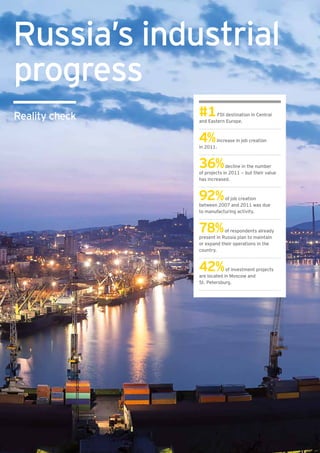
Russia’s industrial
progress
Reality check                                                                   #1      FDI destination in Central
                                                                                and Eastern Europe.


                                                                                4%
                                                                                in 2011.
                                                                                        increase in job creation


                                                                                36%          decline in the number
                                                                                of projects in 2011 — but their value
                                                                                has increased.


                                                                                92%        of job creation
                                                                                between 2007 and 2011 was due
                                                                                to manufacturing activity.


                                                                                78%         of respondents already
                                                                                present in Russia plan to maintain
                                                                                or expand their operations in the
                                                                                country.


                                                                                42%          of investment projects
                                                                                are located in Moscow and
                                                                                St. Petersburg.


22   Ernst & Young's 2012 Russian attractiveness survey Positioned for growth
Russia’s industrial progress


FDI in Russia in 2011:
larger projects

FDI projects decline but are still close to the pre-crisis level                      FDI jobs increase in 2011 after a continuous decline since 2007

                                                       201                            14,934
                                     170                        -36%                                  12,900
                                              +18%                                                                     11,834
139               143                                                                          -14%
                            +19%                                                                               -8%
         +3%                                                           128                                                            8,058         8,362
                                                                                                                               -32%
                                                                                                                                              +4%


2007              2008              2009               2010            2011            2007            2008             2009          2010          2011

Source: Ernst & Young's European Investment Monitor 2012.                             Source: Ernst & Young's European Investment Monitor 2012.


In 2011, Russia attracted 128 FDI projects,                    Russia remained the most successful nation            After a continuous decline since 2007,
a decline of 36% on the previous year.                         in CEE at attracting FDI, and its average             FDI job creation started to pick up in 2011,
Political uncertainty caused by the electoral                  project size continues to increase. This is           mainly due to a rise in labor-intensive
cycle, coupled with concerns arising from                      mainly due to the comparative advantage of            industrial activities. FDI projects in 2011
the escalation of the Eurozone debt crisis,                    Russia over the other CEE countries.                  generated 4% more jobs than the previous
made companies think carefully about                                                                                 year. The average project created 65 jobs
investment in the country.9                                                                                          in 2011, up from a low of 40 jobs in 2010.


9.	 Oksana Teplinskaya, Kate Ryzhkova, “Russia Business
    Report — EU leaders’ informal summit took place in
    Brussels,” accessed via english.ruvr.ru, 12 June 2012;
    Carol Matlack, “Country report: The Peril and Promise of
    Investing in Russia,” accessed via www.businessweek.com,
    12 June 2012.


                                                                                Ernst & Young's 2012 Russian attractiveness survey Positioned for growth       23
Russia’s industrial progress


  Russia’s performance in the enlarged Europe

  •	 Seventh-largest for projects, sixth                         According to the WEF, Russia is among the       Investors have also been driven by a
         for jobs                                                world's fastest-growing economies in terms      desire to gain access to the country’s large
  In 2011, Russia was the seventh-largest                        of domestic market size. This is one of the     repository of natural resources.10
  recipient of FDI projects in Europe, having                    key reasons for its increase in FDI. Russia’s
  been the fourth-largest in 2010. In terms                      proximity to other European markets             •	 Highest average jobs per project
  of FDI job creation, Russia was the sixth-                     and Asia encourages international firms             in Europe (in top 10 countries
  largest in Europe.                                             to set up their operations in the country.          by FDI projects)
                                                                                                                 While the number of projects declined
                                                                                                                 in 2011, the average size of projects by
FDI inflows in Europe by destination country                                                                     number of jobs created in Russia was
  Rank             Country                     FDI projects                       Number       Average jobs      the largest in Europe. This has largely
                                                                                  of jobs       per project      been on account of the concentration of
                                    2010    2011      Change         Share        (2011)         (2011)
                                                       (2011         of FDI                                      manufacturing activity in Russia. In 2011,
                                                     vs. 2010)      (2011)                                       manufacturing accounted for 48% of the
     1       United Kingdom           728    679           -7%        17%          29,888            44
                                                                                                                 total FDI projects, meaning Russia was
     2       Germany                 560     597           7%         15%          17,276            29
                                                                                                                 the second-largest in Europe’s top 10 FDI
     3       France                  562     540           -4%        14%          13,164             24
                                                                                                                 recipient countries list, ranking only behind
     4       Spain                   169     273          62%          7%           9,205            34
                                                                                                                 Poland. In the same year, the automotive
     5       Netherlands             115     170          48%          4%           2,229            13
     6       Belgium                 159     153           -4%         4%           3,599             24
                                                                                                                 industry accounted for 14% of the total FDI
     7       Russia                  201     128          -36%         3%           8,362            65
                                                                                                                 projects in Russia, the largest share in this
     8       Poland                  143     121      -15%             3%           7,838            65          list.
     9       Ireland                 114     106           -7%         3%           5,373            51
                                                                                                                 10.	 The Russia Competitiveness Report 2011,” World Economic
  10         Switzerland              90      99          10%          3%           1,546            16               Forum; “Global Consumer Confidence Report Q4 2011,
             Others                  916    1,040         14%         27%          59,344            57               Nielsen.

  Total                             3,757   3,906          4%        100%         157,824            40

Source: Ernst & Young's European Investment Monitor 2012.


  Activites: manufacturing

FDI projects by activity                                                                                         Production units account for 51% of projects
  Rank                   Activity             FDI projects       Share of total      Jobs created
                                                                                                                 and 92% of job creation.11 Investors come to
                                               (2007–11)          (2007–11)           (2007–11)                  Russia to manufacture goods for the local
     1       Manufacturing                          402                51%              51,445                   market, but also distribute globally. Over the
     2       Sales and marketing                    259                33%                  1,472                past five years, 51% of FDI in Russia has gone
     3       Logistics                              46                  6%                   287                 into manufacturing, with 402 FDI projects,
     4       R&D                                     25                 3%                   297                 the fourth-largest in Europe. Between 2007
     5       Testing and servicing                   20                 2%                   642
                                                                                                                 and 2011, manufacturing projects created
     6       Headquarters                           12                  2%                   930
                                                                                                                 51,445 jobs, accounting for 92% of total job
     7       Education and training                  8                  1%                    15
                                                                                                                 creation. Moscow, St. Petersburg and Kaluga
     8       IDC                                     4                  1%                  1,000
                                                                                                                 are the top three regions for manufacturing
     9       Shared services center                  4                  1%                      –
                                                                                                                 in Russia, between them accounting for 21%
   10        Contact center                          1                  0%                      –
             Total                                  781               100%              56,088
                                                                                                                 of the Russian manufacturing projects in the
                                                                                                                 last five years.
Source: Ernst & Young's European Investment Monitor 2012.

                                                                                                                 11.	 “Russia to Attract More Foreign Investment,” accessed via
                                                                                                                      www.russia-briefing.com, 12 June 2012.


24        Ernst & Young's 2012 Russian attractiveness survey Positioned for growth
Viewpoint
  Russia needs an “image-lift”
   Alex de Valukhoff, Chief Executive Officer, Lafarge Russia

  We started our operations in Russia in        industry resurrect, as it was not               •	 Has possibly the highest entry ticket
  1996. We bought an old, decayed asset         strangled by an overpriced currency and         price among the 64 countries where
  which had the advantage of being close        scarce liquidities any more. Then came          Lafarge operates
  to Moscow. Today, it’s a very different       the “period of stabilization,” with             •	 Is an over-expensive country by all
  country.                                      regular growth, only being dented by the        standards, which reflects the cost of
                                                2008 crisis, which led to a collapse in         corruption and inefficiency
                                                both prices and construction volume.            •	 Has an image problem, which makes
             Among the                          2012 sees the return of the pre-crisis          our jobs particularly difficult when it
             world’s large                      volumes, and prices should follow soon.         comes to convincing boardrooms
             economies,
                                                As we predicted, among the world’s large        Within Vladimir Putin's new presidential
             Russia was the                     economies, Russia was the most hurt by          term, we expect to see the implementation
             most hurt by                       the crisis — but it was also the fastest to     of what has been started and/or
  the crisis — but it was also                  recover. This explains why, in 2009,
                                                Lafarge decided to invest in a new
                                                                                                promised, such as:
                                                                                                •	 The 2020 Strategy for the construction
  the fastest to recover.                       greenfield plant — considered to be a bold      industry, which promises true innovation
                                                move by other players but, here again, we       that has yet to be seen
  Back then, the construction industry was      think that we are going to be proven right.     •	 The improvement of the economy’s
  at a third of what it was during the Soviet                                                   energy efficiency by 40%
  times in terms of volume, prices were so      Compared to 1996, Russia has:                   •	 The financing of infrastructure
  low that it was not possible to turn a        •	 A proven potential and a record of high      development through innovative means,
  profit and it was also plagued by a           returns on investment                           including Public–private partnerships
  bartering system (more than 90% of the        •	 A much more stable and predictable           (PPPs) and project financing
  trade was non-cash).                          environment
                                                •	 Huge reserves for growth                     Also, intensive work needs to be done on
  After Russia’s 1998 default, many                                                             the country’s image — to which we are
  investors moved away from the country,        But :                                           ready to participate in, as we have also
  but we chose the opposite. To stay and        •	 Has not been able to convert its             done in the past.
  grow was indeed the right thing to do:        economy from oil dependence, and
  the 1998 crisis helped the Russian            therefore is still prone to volatility


The sales and marketing function attracted      the average for R&D in the last five             Approval of the Government’s long-awaited
259 projects, 33% of the total FDI projects     years stands at 7%, and 3% for contact           privatization plan is expected to bolster
in Russia. More than 80% of these sales         centers. This highlights the need for            the country’s investment prospects. The
and marketing projects were concentrated        the Russian Government to introduce              reduction in state ownership will create a
in the two largest Russian cities – Moscow      measures to diversify its economy by             more competitive environment and lead to
and St. Petersburg.                             promoting innovative and more value-             an increased inflow of funds to develop the
                                                added services. President Vladimir               privatized enterprises.
Projects in the services sector and R&D,        Putin has said that the Government will
however, have remained low in number.           encourage major international companies
R&D accounted for only 3% of the total          to cooperate with Russia in the area of
investment in terms of FDI projects;            innovative technology, and will encourage
shared services centers constituted 1%          foreign firms in various industries to
and contact centers 0.2%. For the 43            set up production lines and establish
countries in Europe, excluding Russia,          technological centers in the country.


                                                                  Ernst & Young's 2012 Russian attractiveness survey Positioned for growth   25
Russia’s industrial progress


FDI sectors:
diversification is underway

A strong industrial base

Russia’s industrial sector attracts more FDI                        FDI projects by sector
projects than any other sector. Business
                                                                      Rank                    Sector                     FDI projects        Share of total          Jobs created
services and machinery and equipment are                                                                                  (2007–11)           (2007–11)               (2007–11)
the two sectors in Russia that recorded a                               1        Automotive                                     90                   12%                  16,787
rise in their number of FDI projects in 2011                            2        Food                                           86                   11%                   9,958
compared with the previous year. Other                                  3        Machinery and equipment                        62                     8%                  3,682
sectors in the top 10 have seen a decline in                            4        Chemicals                                      57                     7%                  3,218
investment over the same period.                                        5        Non-metallic mineral products                  57                     7%                  3,035
                                                                        6        Business services                              50                     6%                    341

•	 Heavy industries             12                                      7        Other transport services                       49                     6%                     457
                                                                        8        Financial intermediation                       40                     5%                     263
Automotive has been the key sector
                                                                        9        Plastic and rubber                             32                     4%                  1,297
attracting FDI in Russia over the last five
                                                                       10        Software                                       25                     3%                  1,918
years, with 90 projects and 16,787 jobs
                                                                                 Others                                        233                   31%                  15,132
created. Investor focus on the automotive
                                                                                 Total                                         781                  100%                  56,088
sector increased further this year, with
                                                                    Source: Ernst & Young's European Investment Monitor 2012.
14% of the total FDI in Russia coming into
the sector, compared with an average of
                                                                    the country. Players such as Japan-based                              the machinery and equipment industry
12% between 2007 and 2011. Russia is
                                                                    Nissan, Honda and Toyota; French carmaker                             increased to 11% in 2011, up from an
the second-largest automotive market in
                                                                    Renault; US-based General Motors; South                               8% average over the previous five years,
Europe, and the fourth-largest in the world
                                                                    Korean giant Hyundai; Italy’s Fiat; and                               highlighting the increase of FDI activity.
after China, the US and Germany.
                                                                    German auto manufacturers Volkswagen and                              Rising demand for new machinery is
                                                                    BMW are all present in Russia.13                                      fueled by infrastructure modernization,
The country’s light vehicle density stands
                                                                    On the back of rising investment in the                               power sector construction and growth
at a moderate 250 cars per 1,000 people,
                                                                    sector, regions including St. Petersburg,                             of industrial sectors – and has attracted
compared with more than 500 cars in France,
                                                                    Moscow, Nizhny Novgorod and Togliatti have                            foreign investors to Russia. Moscow and the
Germany and the UK and more than 640 in
                                                                    emerged as leading auto manufacturing                                 Kaluga region are the two main locations
the US. So there is further growth potential
                                                                    hubs. Other areas, such as Kaluga, Rostov,                            for machinery and equipment investment,
in Russia’s automotive industry. A surge in
                                                                    Izhevsk and Kaliningrad are also becoming                             accounting for 32% of FDI projects between
consumer spending and readily available car
                                                                    centers for the automotive industry.14                                2007 and 2011.15
loans has helped stimulate the country’s auto
industry. Striving to attract FDI, in February
                                                                    Machinery and equipment emerged as                                    Various leading equipment manufacturers
2011, the Government reduced import tariffs
                                                                    the third-largest sector in Russia in terms                           including Alstom, Danieli, Deere & Company,
for foreign corporations on components in
                                                                    of FDI projects (62 projects) and the                                 General Electric, Siemens and Toshiba
return for investment agreements to produce
                                                                    fourth-largest in job creation (3,682 jobs)                           Corporation have established operations
cars locally. A new industrial assembly regime
                                                                    between 2007 and 2011. The share of                                   in Russia.
was established, which aims to augment
localization in the automotive sector, and
encourage enterprises to construct or enlarge
                                                                    13.	 An overview of the Russian and CIS automotive industry, Ernst
their production facilities and set up R&D                               & Young, February 2012; Dave Leggett, “Analysis: Russia
centers in Russia.                                                       car industry set for investment wave as market rebounds,”
                                                                         accessed via www.just-auto.com, 12 June 2012; “Automobile
                                                                         industry in Russia,” accessed via www.oxbridgewriters.
                                                                         com, 12 June 2012; Getting up to speed: Russian economy
The Russian people’s preference for foreign                              and automotive industry, Ernst& Young, April 2011; Doug          15.	 “Construction machinery market in Russia 2012:
                                                                         Palmer, “U.S. hunts for exports in Russian auto parts market,”        Development forecasts for 2012-2014,” accessed via
brands has lured almost all the major                                    accessed via www.reuters.com, 12 June 2012; Ekaterina                 www.pmrpublications.com, 8 June 2012; “Demand for new
international car manufacturers to establish                             Shatalova, “Russian Car Market May Grow 6% This Year,                 construction machinery rising in Russia,” accessed via
                                                                         Industry Ministry Says,” accessed via www.bloomberg.com,              www.oxstones.com, 9 June 2012; “An analytical review by
and expand their manufacturing base in                                   12 June 2012; “Russia April auto sales up 14 pct y/y — AEB,”          Pavel Gagarin,” accessed via www.business-money.com,
                                                                         accessed via www.reuters.com, 12 June 2012; “World's 10               8 June 2012; “Government Initiatives to Promote General
                                                                         Largest Auto Markets,” accessed via www.cnbc.com,                     Purpose Test Equipment Market in Russia and the CIS,”
                                                                         12 June 2012; ”Renault-Nissan to Take Control of Russian              accessed via www.frost.com, 9 June 2012; “Shelf projects
12.	 “Prime Minister Vladimir Putin chairs a meeting at AvtoVAZ          Automaker,” accessed via www.nytimes.com, 12 June 2012.               to attract 500 bln dollars to Russia-Putin,” accessed via
     (Togliatti) on the development of the automotive industry in   14.	 “Kaliningrad To Become New Autos Hub With Magna-                      www.itar-tass.com, 10 June 2012; “Siemens to grow steel-
     the context of Russia’s accession to the WTO,” accessed via         Avtotor Investment,” Industry News, April 2012, BMI                   intensive production in Russia by €1bn,” 4 January 2012,
     www.premier.gov.ru, 12 June 2012.                                   Industry Insights — Automotives, Emerging Europe.                     via Factiva © 2012 Steel Business Briefing.


26      Ernst & Young's 2012 Russian attractiveness survey Positioned for growth
Viewpoint
   Stability: Russia’s biggest advantage
     Laurent Kleitman, Chief Executive Officer, JSC Concern Kalina (Unilever)

   I always personally believed that the                           Kalina, one of the best and most successful     of Russia is the excellent quality work
   Russian market would be highly attractive                       Russian companies. While demonstrating          force, and increasing global mindset of the
   for Unilever and foreign investment in                          consistency in developing a solid, long-        younger generations of managers.
   general. The appetite for consumption,                          term presence in Russia, we also continue
   the attractiveness of brands, the desire to                     to show our determination to serve the          On the downside, infrastructure is not
   access high-quality consumer goods — all                        needs of Russian consumers across a wide        developing as fast as it should and
   these trends were already apparent in the                       range of brands and categories.                 legislation is often still complex and
   early 1990s.                                                                                                    somewhat bureaucratic.
                                                                   I believe that Russia will continue to grow
   At that time, the Russian consumers were                        steadily in the coming years and remain         However, I firmly believe that there is no
   already very demanding, knowledgeable,                          attractive to Unilever and other foreign        fundamental obstacle that a company like
   educated and savvy in their choices. They                       investors.                                      Unilever cannot overcome, as the desire
   expected quality, consistency and                                                                               to win in Russia is bigger.
   superior value when consuming branded                                    As a foreign
   goods. Since then, we have seen the                                      investor, I would                      As a foreign investor, I would welcome
   explosion of the consumer goods market.
                                                                            welcome progress                       progress towards more transparency in
                                                                                                                   conducting business. A further simplified
   The attractiveness of Russia has never                                   toward more                            process for obtaining work permits for
   really been questioned, despite its growth                               transparency in                        foreign employees would also be welcome,
   rate being lower than China’s.                                                                                  as would simplification of visa legislation
                                                                   conducting business.                            and continuous reduction of imports tariffs
   Today, Russia is essential to our strategy.                     The biggest advantage of Russia is its          in line with World Trade Organization
   Twenty years ago, Unilever became one of                        stability. I am confident that the country is   membership. These measures will help
   the first movers into the Russian market                        going to continue its slow but steady           integrate Russia into global trade, and will
   when it bought its first business in St.                        modernization. Patience and resilience          also enable foreign investors to contribute
   Petersburg, Severnoye Siyanie. Twenty                           have always been strong qualities of the        to the economy’s growth and the
   years later, Unilever purchased Concern                         great Russian people! The other big plus        development of a solid local market.


•	 Consumer products driving growth16                              The industry created employment for 9,958        have further paved the way for the food
The food sector accounted for the second-                          people between 2007 and 2011. Rising levels      sector’s growth. This has been particularly
largest number of FDI projects (86) in Russia.                     of disposable income among consumers in          prominent in Moscow, St. Petersburg and
                                                                   Russia has led this growth. The development      Novosibirsk. Major global food and beverage
16.	 “Russia's food industry to be opened to foreign investors,”
     accessed via www.telegraph.co.uk, 10 June 2012; Andrew        of modern infrastructure including malls,        giants present in Russia include Burger King,
     E. Kramer, “Russia Becomes a Magnet for U.S. Fast-Food
     Chains,” accessed via www.nytimes.com, 11 June 2012;
                                                                   specialty suppliers of frozen foods and          Carlsberg, Coca-Cola, Heineken, McDonald’s,
     “Timeline: Wal-Mart eyeing Russian market,” accessed via      drive-through establishments in many cities      Nestlé, PepsiCo and Yum! Brands.
     www.reuters.com, 11 June 2012.


Business services

Russia’s business services sector has seen                         The growing strength of the services             than their contribution in 2010 (11%) and
a growth in FDI activity in recent years.                          industry is also shown by the increase in        over the last five years (14%).
It accounted for 9% of the total FDI projects                      the share of financial intermediation and
in 2011, higher than its share of 5% in                            software sector projects. Financial services     Moscow has developed as a hub for business
2010 and above the average of 6% between                           FDI has mainly gone into development of          services in the country. The capital city alone
2007 and 2011. FDI projects have been                              new offices and branches, and expansion          attracted 75% of FDI projects in the sector
primarily directed at areas including sales                        of subsidiaries in the areas of banking,         between 2007 and 2011. The city also acted
and marketing, data centers, laboratories,                         insurance and financial leasing. The software    as the prime location for financial services and
headquarters, representative offices,                              industry has seen growth in development          software sector projects in the last five years.
and technology and innovation centers.                             centers, programming facilities, IT training     The Russian Government’s plan to expand
This represents a slow but gradual sign of                         centers and R&D centers. Along with              Moscow as a financial center is expected to
services sector-led growth, in a country                           business services, these sectors accounted       boost foreign investment in the city.17
that has primarily had a manufacturing-                            for 17% of all the FDI projects undertaken
driven economy.                                                    by investors in Russia in 2011, much higher      17.	 Growing opportunities Russia FDI report, Ernst & Young, 2011.


                                                                                     Ernst & Young's 2012 Russian attractiveness survey Positioned for growth                    27
Russia’s industrial progress


Little change in FDI sources

The US continues to be the largest source of FDI

The US remains Russia’s leading investor           providing financing to US companies for         oil and gas. These include Boeing, Cisco,
with 122 FDI projects (16% of the total)           them to undertake projects in Russia,           ExxonMobil, Ford, Hewlett-Packard, Intel
that created 6,043 jobs. The Overseas              thus supporting the investment climate          and Kraft Foods.
Private Investment Corporation, an                 between the two countries. Leading US
organization that aims to promote                  multinationals are present in various
American companies overseas, has been              sectors such as automotive, IT, food and


  Viewpoint
  In many ways, Russia is already a free market
     Andrew Somers, President & Chief Executive Officer, American Chamber of Commerce in Russia

  I arrived in Moscow at the end of 2000 and       issues are being solved in a quiet way,         here in the short and medium term.
  I must say that the quality of the               there is a better environment for long-
  investment environment has been                  term strategic deals, like the one signed       The only challenge I would consider
  improving here, year in year out. Since          by Rosneft and ExxonMobil. Hopefully,           concerning the rapid economic
  then, the attitude of the Russian                recent differences on some issues will be       development of Russia is its dependence
  Government to foreign investment,                resolved or discussed privately between         on oil. Russia needs to diversify its
  particularly American investment, has            the two Governments.                            economy and, hopefully, the Russian
  changed significantly for the better.                                                            Government will continue to work upon it.
                                                   In many ways, Russia is already a free
                                                   market. Yes, there is a lot of state            In terms of Russia’s advantages in
          Russia needs                             influence in some strategic sectors, which      comparison with other emerging markets, I
          to diversify                             is not unusual around the world. But some       see, first of all, that the level of the
          its economy                              of the fast-growing sectors in the last 10      population’s education is pretty high,
                                                   years, like consumer goods retail and, in a     relative to other BRICS countries. That is
          and, hopefully,                          certain sense, automobile, are basically        very important. One can find a very
          the Russian                              left alone by the state. We do sometimes        well-educated population throughout the
                                                   run into bureaucratic hurdles but are able      country and that gives companies a
 Government will continue                          to resolve the problems in an open way.         platform on which to train people. You
 to work upon it.                                                                                  don’t have that same magnitude of
                                                   I expect that Russia’s WTO entry will           education in Brazil, China or India. The
  Russia’s recent drive for modernization          nudge those American companies who              second big advantage is, of course, the
  has attracted a number of American               refused to even look at the market to at        mineral wealth. Third — the amount of
  Chamber of Commerce (AmCham)                     least start to study it. There are very few     arable land for agriculture. Russia is going
  member-companies, including large                opportunities for growth in the world,          to play a key role in feeding the world
  companies but also global leaders in their       certainly few in the US and Europe. Russia      population by 2050 or even earlier. The
  niche, aiming, for example, to improve the       is one of those places that offer significant   disadvantages are well known: image,
  extraction of oil or the processing of steel.    growth. If the Russian Government               corruption and bureaucracy. In some
  It’s a new trend of the last two to three        continues to try to modernize the               American and Russian circles, you can still
  years. A second positive trend is the            economy, as I believe it will, there are        see the hangover of the Cold War. But I am
  changed tone in relations between the US         many sectors where US companies can             confident that the greater the economic
  and Russia. When companies, whether              play an important role. So, I feel pretty       relationship between Russia and the US,
  Russian or American, feel that geopolitical      positive about the growth going forward         the shorter this old view will last.


28     Ernst & Young's 2012 Russian attractiveness survey Positioned for growth
Eight of the top 10 source countries are from Europe

Europe continues to have the largest number                       FDI projects by country of origin
of realized FDI projects in Russia. This region
                                                                    Rank                  Country                    FDI Projects       Share of total          Jobs created
has provided 8 of the top 10 source countries                                                                         (2007–11)          (2007–11)               (2007–11)
in the last five years. European countries                             1      United States                               122                   16%                   6,043
originated 343 FDI projects between 2007                               2      Germany                                      99                   13%                   6,254
and 2011, 44% of the total in Russia.18                                3      United Kingdom                               46                    6%                   1,125
The European Union (EU) and Russia have                                4      France                                       45                    6%                   2,070
the Partnership and Cooperation Agreement                              5      Finland                                      43                    6%                   1,700
(PCA) in place, which forms the basis for                              6      Switzerland                                  38                    5%                   1,238
bilateral trade and investment relations.                              7      Japan                                        35                    5%                   3,443
The EU plans to advance its relations with                             8      Austria                                      25                    3%                     620
Russia by replacing the PCA and signing                                9      Sweden                                        24                   3%                   2,010

a new agreement with substantial provisions                          10       Denmark                                      23                    3%                   2,399
                                                                              Others                                      281                   34%                 29,186
related to trade and investment.19
                                                                              Total                                       781                 100%                  56,088

Germany20 emerged as the second-                                  Source: Ernst & Young's European Investment Monitor 2012.
largest investor globally and the largest                         The UK created employment for 1,125                               French investment into Russia. French
from Europe in terms of FDI projects (99                          people in Russia through 46 projects (6% of                       investment is centered in sectors such as
projects) in Russia, although it was the                          the total), making it the third largest country                   retail, energy, construction, automotive,
largest creator of jobs in Russia (6,254)                         of FDI origin between 2007 and 2011. The                          insurance and banking. Several French
between 2007 and 2011. Germany’s                                  Russian economy has been collaborating                            companies have established a presence in
relationship with Russia has primarily been                       more closely with the UK to assess                                Russia, such as Accor, Auchan, GDF Suez,
built on Russia supplying Germany with a                          investment opportunities in Russia and invite                     L'Oréal, Louis Dreyfus, Peugeot, Saint-
huge proportion of its energy needs. Several                      British corporate and financial investors to                      Gobain, and Sanofi-aventis.22
German companies are established in Russia                        set up businesses in the country. More than
in industries ranging from oil and gas to                         600 UK firms are doing business in Russia;                        After Russia’s formal accession to the WTO,
banking and consumer goods. Leading                               including AstraZeneca, BP, GlaxoSmithKline,                       the Russian economy should push toward
German companies that have invested in                            Pilkington and Shell, all of which have a                         attracting a larger share of investment from
the Russian market include adidas, Bayer,                         strong presence in the Russian economy.21                         its leading source regions such as the US
Bosch, Deutsche Bank and Siemens.                                                                                                   and Europe.
                                                                  Other leading investing countries from
18.	 Russia offers French cos to expand participation in Baltic
     nuke proj,” Prime Energy Service, 18 November 2011,          Europe include France and Finland, with
     via Factiva, © 2011 Prime ZAO. “UK Trade & Investment        45 and 43 FDI projects, respectively.
     and Russian Direct Investment Fund Host Joint "Invest in                                                                       22.	 “MAP: French Investments in Russia's Regions,” accessed via
     Russia" Conference,” accessed via www.prnewswire.com,        Russia has been increasing its cooperation                             www.themoscowtimes.com, 11 June 2012; “Ties at the Top,”
     12 June 2012.                                                                                                                       accessed via www.themoscowtimes.com, 12 June 2012;
19.	 “Countries: Russia,” accessed via ec.europa.eu, accessed     and dialogue with France to encourage                                  Kumaran Ira , “Russian President Medvedev signs strategic,
     11 June 2012.                                                                                                                       business deals in France,” accessed via www.wsws.org, 12
20.	 George Friedman, “Germany and Russia Move Closer,”                                                                                  June 2012; “UK in Russia: Business strengths — The UK's
     accessed via www.stratfor.com, 12 June 2012; “The Bavarian                                                                          economic and business strengths,” accessed via ukinrussia.
     Representative Office in Russia,” accessed via www.invest-   21.	 “UK Trade & Investment and Russian Direct Investment              fco.gov.uk, 12 June 2012; Damion Potter, “Supporting UK
     in-bavaria, 12 June 2012; “More German companies come to          Fund Host Joint "Invest in Russia" Conference,” accessed          companies doing business in Russia,” accessed via www.
     Russia,” accessed via english.ruvr.ru, 12 June 2012.              via www.prnewswire.com, 12 June 2012.                             modernrussia.com, 12 June 2012.


In search of new investors from emerging markets

FDI activity into Russia by emerging                              However, Russia has recently started                              These entities would also seek to raise
economies remained low between 2007                               negotiations with China to develop a                              another US$1b to US$2b from third parties.
and 2011. China and India each accounted                          mutually beneficial investment climate.                           More than 70% of the fund's capital would
for under 2% of FDI project creation in                           During President Vladimir Putin’s recent                          be targeted at projects across Russia and
Russia. Brazil originated just two projects                       visit to China, the two nations began                             other CIS members, with the rest focusing
in the country in the same period. These                          negotiations for opening a joint investment                       on China. In June 2012, a few Chinese
countries remained minor contributors on                          fund worth approximately US$2b — with the                         companies provisionally agreed to invest
the employment generation front too.                              RDIF and the China Investment Corporation                         US$2.5b to US$3b in construction projects
                                                                  contributing US$1b each to the fund.                              in southern Russia.


                                                                                            Ernst & Young's 2012 Russian attractiveness survey Positioned for growth                            29
Russia’s industrial progress


Russia’s top regions for FDI

The two largest cities attract most of the projects

FDI projects by destination city/region                                                                                the presence of special economic zones
                                                                                                                       within the region: Zelenograd and Dubna
  Rank                     Region                     FDI Projects      Share of total    Jobs created                 are located in the Moscow area and offer
                                                       (2007–11)         (2007–11)         (2007–11)
     1       Moscow (Federal City)                         231                30%              3,735
                                                                                                                       investors an appealing combination of
     2       St. Petersburg (Federal City)                   92               12%              9,843                   corporate tax incentives, easy access to real
     3       Kaluga (Region)                                 39                5%              7,260                   estate and lower VAT on imports.23
     4       Nizhny Novgorod (Region)                        14                2%               550
     5       Kazan (City)                                    13                2%               416                    St. Petersburg, Russia’s second largest city,
     6       Yekaterinburg (City)                            13                2%               630                    is another prominent FDI location. Between
     7       Voronezh (Region)                               12                1%              1,462                   2007 and 2011, the largest number of
     8       Novosibirsk (City)                              10                1%               753                    FDI jobs were created there (9,843) by
     9       Krasnodar (City)                                  9               1%               880                    92 projects. St. Petersburg is a major
   10        Togliatti (City)                                  9               1%              2,105                   financial and industrial center in Russia. Its
             Others                                         339               43%             28,454                   convenient proximity to Europe, modern
             Total                                          781              100%            56,088
                                                                                                                       transport infrastructure and educated
Source: Ernst & Young's European Investment Monitor 2012.                                                              workforce have led numerous international
                                                                                                                       corporations to set up their business in
Forty-two percent of FDI projects are                               intermediation, machinery and equipment,           the city. St. Petersburg has attracted more
concentrated in the Moscow and                                      and software.                                      companies from European neighbors,
St. Petersburg regions. Investors see                                                                                  including France, Germany and the UK, as
Moscow, the biggest city in Russia, as a                            Moscow's surge in FDI is based on a highly         well as from countries in the Middle East.24
key destination for FDI. The capital city has                       qualified workforce, supportive local
                                                                                                                       23.	 Growing opportunities Russia FDI report, Ernst & Young, 2011.
attracted 231 projects that have led to the                         authorities, subsidies and tax benefits and        24. “Business Guide: Investment Laws,” accessed via
creation of 3,735 jobs in the last five years.                      convenient residential options for foreign              petersburgcity.com, 13 June 2012; “Business Guide:
                                                                                                                            Investment Laws,” accessed via petersburgcity.com,
FDI in Moscow has been concentrated in                              nationals. Moscow’s attractiveness to                   13 June 2012; “Advantages,” accessed via www.
                                                                                                                            doingbusiness.ru, 13 June 2012; “New strategy:
sectors such as business services, financial                        foreign investors is further enhanced by                Department is a gateway for all foreign investors,”
                                                                                                                            accessed via www.investinmoscow.ru, 12 June 2012.


The Kaluga and Nizhny Novgorod regions are increasing their appeal

The Kaluga region is becoming established                           Foreign corporations that want to establish        food and non-metallic mineral products
as a hub for international enterprise in                            themselves in Russia have been drawn to the        sectors. The region is also one of the main
Russia.25 From 2007 to 2011, Kaluga was                             region's favorable business climate, tax reliefs   centers for IT and software, and boasts the
the third-largest region in terms of FDI                            and close proximity to Moscow. Also, business      presence of players such as Auriga, Intel,
projects (39), which created the second-                            and industrial parks in the region such as         MERA Networks and Teleca.	
highest number of jobs in the country                               Grabtsevo, Rosva and Vorsino have amenities,
(7,260). Sectors that received major                                which make them popular locations for              Supportive government policies on tax
investment include automotive, machinery                            foreign business operations.                       benefits and the decision to allow the
and equipment, transport, food and                                                                                     implementation of investment projects
pharmaceuticals.                                                                                                       using the “single window” mechanism
                                                                    Nizhny Novgorod is another developing
                                                                                                                       to reduce waiting periods are among its
                                                                    area for foreign investment. It recorded 14
                                                                                                                       appealing features.26
25.	 Alexander Bratersky, “L'Oreal Adds a French Face To Kaluga's   FDI projects from 2007 to 2011. These
     Business Hub,” accessed via www.themoscowtimes.com,
     12 June 2012; Maria Antonova, ”The Kaluga region in Russia     projects have primarily been directed at the
     offers economic opportunities,” accessed via www.telegraph.                                                       26.	 “Outsourcing to Russia: Nizhny Novgorod,” accessed via
     co.uk, 12 June 2012.                                           automotive, metals, financial intermediation,           goaleurope.com, 12 June 2012.


30       Ernst & Young's 2012 Russian attractiveness survey Positioned for growth
Viewpoint
Huge long-term potential
 Joseph Jimenez, Chief Executive Officer, Novartis

Novartis’ predecessor company, Geigy,        industry. This is reflected in the Pharma       One of the biggest competitive
first established trade relations with       2020 strategy. We are committed to              advantages of modern Russia is its
Russia in the middle of the 19th century,    helping Russia to achieve those                 economic stability and a growing
on the eve of Russia’s first leap into       aspirations, particularly in the health care    professional workforce capacity. Together
industrialization. In 1890, Geigy rented a   sector. We are currently building a new         with increased government effort to
site with production buildings in            full-scale pharmaceutical manufacturing         improve the investment climate and
Karavayevka, close to Moscow, where it       plant in the special economic zone in           create a friendly business environment,
began to manufacture dyewood extracts.                                                       this will become an important stimulus to
The company also sold products directly                                                      attract foreign investments to Russia.
from Basel, Switzerland, through its
                                                        One of the                           Obstacles are similar in all fast-growing
subsidiaries. At that time, government                  biggest                              countries — unpreparedness and cost of
reforms attempted to stimulate inflow of                competitive                          infrastructure, bureaucratic hurdles and
foreign capital, and growth of domestic                                                      often the absence of transparency in the
industrial production made Russia’s                     advantages of                        regulatory sphere.
market attractive for many foreign                      modern Russia
companies, especially from Europe.
                                             is its economic stability                       We stand ready to support the new
                                                                                             Presidential Administration and Cabinet in
Since that time, our interest in expanding   and a growing professional                      their actions to establish a regular and
operations in Russia has significantly       workforce capacity                              transparent two-way dialogue between
increased. At Novartis, we believe that                                                      the Government and business community.
today’s Russia will remain a fast-growing    St. Petersburg. This facility is part of the    We believe this will help overcome current
country with huge long-term economic         company’s US$500m, five-year strategic          obstacles and create new, mutually
potential. Moreover, Russia’s Government     investment plan in Russia. The investment       beneficial PPP opportunities.
has announced an ambitious economic          will address three core areas — local
modernization agenda, which                  manufacturing, R&D partnerships and
encompasses the pharmaceutical               public health development.


                                                               Ernst & Young's 2012 Russian attractiveness survey Positioned for growth   31
Russia’s industrial progress


2013: plans for investment

What are your plans for the next year in Russia?                                                                      the belief that the number of leaders who
                                                                                                                      view Russia as one of the key markets
Companies already present in Russia                        Companies not established in Russia                        to invest in are, in fact, increasing. The
                                                                                                                      percentage of respondents looking to enter
Increasing/maintaining operations in Russia                Not to invest in Russia
                  78%                                                          70%                                    the Russian market also increased from
Relocating to another country                              Entering the Russian market                                7% in our 2011 survey to 12% this year.
 2%                                                          12%
Withdrawing from Russia/closing operations                 Can't say                                                  More than 40% of the investors that are
 1%                                                            18%                                                    keen to establish or increase operations
Can't say                                                                                                             in Russia plan to do so in the short term.
  19%
                                                                                                                      Twenty-seven percent plan to invest
Source: Ernst & Young 2012 Russia attractiveness survey.   Source: Ernst & Young 2012 Russia attractiveness survey.   within 6 months and 14% in 6 to 12
Total respondents: 135.                                    Total respondents: 73.
                                                                                                                      months. They chose organic growth as
                                                                                                                      the preferred mode of investment,
Despite the wave of negativity around the                  There is a discrepancy between the                         given their familiarity with the rules and
Eurozone crisis, investors continue to display             plans of companies that already have                       regulations of the Russian market. Twenty-
confidence in the Russian market and                       operations in Russia and those that are                    six percent of leaders plan to expand their
optimism about the future. Nearly 80% of                   not yet established. Seventy percent of                    existing facilities while 17% will increase
investors that are already present in Russia               the companies that are not established in                  their employee numbers in Russia. However,
plan to increase or maintain their operations              the Russian market have no plans to invest                 only 2% of respondents have acquisition
in the country. Only 3% of these respondents               in the country in the next year. This is,                  plans in Russia, highlighting the country's
are not optimistic and plan to relocate or                 however, 16 percentage points less than in                 difficult and lengthy approval process.
withdraw their operations from the country.                the previous year’s survey. This reinforces


32     Ernst & Young's 2012 Russian attractiveness survey Positioned for growth
How do you plan to invest?                                    When do you plan to invest?

Expansion of facility
                                                               Longer than                          Can’t say
                  26%
                                                                12 months                           29%
Increasing labor force                                                30%
            17%
Joint venture/alliance
     8%
Greenfield investments
   6%
                                                                                        41%
Equity investment                                                                       Less than
   6%                                                                                   12 months
Acquisition
   2%                                                         Source: Ernst & Young 2012 Russia attractiveness survey.
                                                           Source: Ernst & Young’s113 (considering maintaining,
                                                              Total respondents: 2012 Russia attractiveness survey.
Other                                                         establishing or developing activities in Russia)
  1%
Can't say
                         34%
Source: Ernst & Young 2012 Russia attractiveness survey.
Total respondents: 113 (considering maintaining,
establishing or developing activities in Russia)


                                                                                     Ernst & Young's 2012 Russian attractiveness survey Positioned for growth   33
How to meet investors' expectations


How to meet
investors'
expectations
A look into the future                                                          57%         of investors remain
                                                                                confident about Russia’s future.


                                                                                53%          of respondents suggest
                                                                                improvement in the effectiveness
                                                                                of the rule of law.


                                                                                47%          of respondents would
                                                                                like to see bureaucracy reduced.


                                                                                62%          of investors believe
                                                                                Russia’s accession to the WTO
                                                                                will increase the country's
                                                                                attractiveness of investment.


34   Ernst & Young's 2012 Russian attractiveness survey Positioned for growth
Expectations from investors

Confidence has declined this year …

The majority of investors continue to                      as a result of instability in global markets     Over the next three years, do you think
believe that Russia’s attractiveness will                  and the Eurozone crisis. Thirty percent say      the attractiveness of Russia as a place
improve in the medium term. However, only                  that Russia’s attractiveness will remain the     for your company to establish or develop
57% are optimistic about Russia's future                   same in the medium term, while only 7% are       activities will...?
attractiveness, compared with 70% last                     pessimistic about Russia’s future.
year. It appears that confidence has fallen                                                                          Deteriorate    Can’t say
                                                                                                                            7%      6%
                                                                                                                                                Neither improve,
… but remains at a comparatively high level                                                                                                     nor deteriorate
                                                                                                                                                30%
                                                                                                                 57%
Russia’s numbers, however, are very                        that it will remain the same. This suggests        Improve

positive compared with Europe as a whole.                  that while the Russian economy will be
In our 2012 European attractiveness                        affected by the crisis in Europe, the effect
                                                                                                            Source: Ernst & Young 2012 Russia attractiveness survey.
survey, only 38% of respondents said they                  will be modest compared with the European        Total respondents: 208.
believe the continent’s attractiveness will                economies.
improve, while a similar percentage believe


WTO deal has boosted confidence

What will be the impact of Russia's                        country. More than 60% of respondents            The past experience of nations that have
accession to the WTO on its investment                     believe Russia’s accession will have a           acceded to the WTO, and the assessment
appeal?                                                    medium-to-high impact on the country’s           of the likely consequences of Russia’s
                                                           investment appeal.                               accession, show that FDI in Russia’s
   Low or no                 Can’t say
     impact                                                                                                 liberalized service sector may eventually
                             16%
       22%                                                 According to the World Bank, in the medium       deliver growth in production of up to 11%
                                                           term, the gains should be about 3% of GDP        of GDP. To enhance that effect, Russian
                                                           per year, with wages rising 4%-5% and more       authorities, at all levels, should regard an
                                                           than 99% of households gaining income. In        improvement in the investment climate as
                                 62%                       the long run, the gains should be about 11%      a key policy priority.
                                 High or
                                 medium impact
                                                           of Russian GDP per year, with wages rising
                                                           13%–17%.                                         Accession to the WTO, renewed privatization
Source: Ernst & Young 2012 Russia attractiveness survey.                                                    and Government initiatives to reduce reliance
Total respondents: 208.
                                                           To ensure that Russia maximizes the benefits     on energy exports are all reasons why we
                                                           of its accession to the WTO, the Government      expect investor confidence in Russia to rise.
After almost 18 years of negotiations,                     should take urgent steps to restructure
Russia is set to become a fully fledged                    uncompetitive Russian industries. Measures
member of the WTO. The overall                             should first and foremost be taken to achieve
consequences of Russia’s accession to the                  a shift in manpower from uncompetitive
WTO are expected to be positive and to                     industries and enterprises to regions and
boost foreign investors’ confidence in the                 industries that have the capacity to develop.


                                                                             Ernst & Young's 2012 Russian attractiveness survey Positioned for growth              35
How to meet investors' expectations


  WTO opportunities?
      According to a recent Ernst & Young report,* the following measures should be taken in order to exploit the opportunities
     that stem from Russia’s accession to the WTO:
  * Russia’s success in the WTO: What The Opportunities, Ernst & Young, April 2012.


  •	 Restructure the town-forming enterprises in the Russian                          •	 Train and retrain the residents of distressed towns,
       monotowns (towns with only one industry) that are in                             cities and regions. Human capital should be developed
       the high-risk zone of reduced production. This can be                            substantially to make those cities, towns and regions
       done with the withdrawal of non-core assets and their                            more attractive for investors.
       privatization.
                                                                                      •	 Support exports by extending regional programs to aid
  •	 Develop transportation, postal and communications                                  small and medium enterprises.
       infrastructure to reduce the costs of connecting cities and
       towns in the heightened risk zone with other regions and                       •	 Reduce administrative obstacles relating to customs
       countries.                                                                       procedures for exporters. Customs procedures can
                                                                                        be improved by reducing the number of documents,
  •	 Offer incentives to draw major investors into regions,                             simplifying the procedure for formalizing export permits,
       towns and cities in the heightened risk zone. Big businesses                     and optimizing the time limits for customs clearance and
       that operate on the basis of state order should be obliged to                    the issue of permits for the export and temporary import-
       acquire goods and services from small- and medium-sized                          export of goods for warranty repairs.
       companies in distressed regions, towns and cities.
                                                                                      •	 Improve the business climate in the country and
  •	 Allow small and medium-sized companies in the distressed                           regions by reducing administrative obstacles, investing
       regions, towns and cities to receive financial support.                          in infrastructure, counteracting corruption and creating
                                                                                        conditions of equal competition for all businesses.
  •	 Improve tax administration and the procedure 
       to reimburse VAT for exports.


36     Ernst & Young's 2012 Russian attractiveness survey Positioned for growth
Russia needs to create
an investor-friendly environment

Investors are looking for a better and more efficient operating environment

In your opinion, what should be the three                  Russia offers investors a high-growth           with last year (when improving the
priority measures to take to improve                       economy, a large domestic market and            effectiveness of the rule of law scored
Russia's investment climate?                               highly skilled labor at moderate cost.          63%, reducing bureaucracy 53% and
                                                           But its enduring reputation for difficult       improving transparency 39%), suggesting
Improve the effectiveness of                               business conditions deters investors.           some improvement in Russia’s operating
the rule of law
                         53%                               Doing business in Russia is fraught with        environment in the last 12 months. In
Reduce bureaucracy                                         challenges associated with corruption,          their push to accelerate WTO and OECD
                       47%                                 government bureaucracy, complex                 membership, Russian leaders have
Improve the transparency of business                       regulatory requirements and a lack of           adopted new regulations to combat the
 regulation
                 37%
                                                           transparency. Investors continue to             challenging business environment, and
Promote economic growth and SME development                suggest that improving the effectiveness        successful accessions will further improve
         21%                                               of the rule of law (53%), reducing              the environment. Finally, although
Stimulate R&D and innovation                               bureaucracy (47%) and improving                 the goals are ambitious, the Russian
        17%                                                transparency of business regulations            Government aims to climb up the Doing
Lighten companies' legal and fiscal obligations             (37%) are the top three priority measures       Business index from the current rank
        16%
                                                           to enhance Russia’s investment climate.         of 120 to 50 by 2015, and 20 by 2018.
Renew the training and education system
       14%                                                 However, investors’ emphasis on these
Reform the social model                                    measures has reduced in comparison
   9%
Promote an entrepreneurial and
initiative-taking culture
  8%
Encourage companies' initiatives
in environmental protection and
sustainable development
 5%
Improve the infrastructure
  2%
Reform the political system/
have political stability
  2%
None/none in particular
  2%
Other
 1%
Can't say
  6%

Source: Ernst & Young 2012 Russia attractiveness survey.
Total respondents: 208.


                                                                            Ernst & Young's 2012 Russian attractiveness survey Positioned for growth   37
How to meet investors' expectations


1.          Russia is tackling corruption and increasing transparency

Currently, investment in Russia is hindered                    and bribery, also pledging to sign               the amount of the bribe. Also, in March
by corruption that undermines the rule of                      international anti-corruption treaties.          2012, the former President signed a bill
law. According to Transparency                                 Russia was ranked 143 out of 182                 approving Russia's National Anti-
International’s Corruption Perception Index                    economies in Transparency International’s        Corruption Plan for 2012-13. The bill also
(CPI), Russia is perceived to be far more                      2011 CPI ranking, a huge improvement             made amendments to certain acts of the
corrupt than any OECD country and is also                      from its ranking of 154 in the previous          President of the Russian Federation on
the most corrupt BRICS country. The                            year.                                            countering corruption in the country. He
average size of bribes and commercial                                                                           also announced a draft law which compels
payoffs in reported crimes increased by                        In 2011, the Russian Interior Ministry's         public officials and members of their
approximately 250% in 2011 to                                  economic security department reported a          families to explain the origin of funds
RUB236,000 (US$7,866). In 2011,                                50% increase in funds recovered from             spent on major purchases.28 Russia’s
Russian law enforcement agencies                               corruption cases involving government            current President Vladimir Putin has also
detected 37,831 incidents of corruption                        contracts awarded in the health care,            affirmed his plans to tackle corruption by
against the Government, services in the                        utilities, construction and education            highlighting a need to introduce legislation
public sector and local authorities.                           sectors. The Russian Government signed a         to establish anti-corruption standards in
Although Russia is a member of the                             bill in February 2012 to accede to the           the law enforcement practices. These
Council of Europe Group of States Against                      OECD Anti-Bribery Convention. This               measures and examples illustrate that
Corruption (GRECO), the country has                            legislation subjects Russia to peer reviews      Russia’s fight against corruption is on.
fulfilled only about one-third of the                          of its compliance with the convention.
anti-corruption obligations set by the                         Under former president Dmitry Medvedev,          28.	 “Dmitry Medvedev's new assault on corruption in Russia,”
                                                                                                                     accessed via www.telegraph.co.uk, 5 July 2012; “Russia
GRECO.27 However, the Government was                           Russia undertook a series of initiatives to           Signs OECD Anti-Bribery Convention,” accessed via www.
                                                                                                                     themoscowtimes.com, 5 July 2012; “Putin points out
active in 2011 to curbing corruption cases                     deal with corruption. These included the              importance of public anti-corruption audit of all legal acts,”
                                                               establishment of the Anti-Corruption                  Interfax: Russia & CIS General Newswire, 30 May 2012,
                                                                                                                     via Factiva © 2012 Interfax Information Services, B.V.;
                                                               Council and the institution of an anti-               “Executive Order on National Anti-Corruption Plan for
27.	 "Over 37,000 cases of corruption registered in 2011 —                                                           2012-2013,” accessed via eng.kremlin.ru, 5 July 2012;
     prosecutors,” Interfax: Russia & CIS Military Newswire,   corruption law that raises fines for officials        “Russian paper details provisions of anti-corruption draft
     28 April 2012, via Factiva © 2012 Interfax Information                                                          law,” BBC Monitoring Former Soviet Union, 14 March 2012,
     Services, B.V.
                                                               caught taking bribes to up to 100 times               via Factiva © 2012 The British Broadcasting Corporation.


38      Ernst & Young's 2012 Russian attractiveness survey Positioned for growth
2.     Russia is reducing bureaucracy

Investors complain about the pervasive        including measures to fight corruption.          In April 2012, Russia officially expressed
influence of government bureaucracy in        Russia’s 2020 Strategy also details              its intention to join the Open Government
business operations and unofficial barriers   measures to reduce bureaucracy. The              Partnership (OGP), a global initiative that
imposed by regional authorities. However,     Russian President has proposed the               promotes transparent, effective and
it would be unfair to say that the Russian    creation of an anti-bureaucracy filter for       accountable government around the
Government is doing nothing about this. In    business legislation as part of the              world.29
early 2012, the “open government”             country’s long-term economic policy
project was introduced to attract outside     objectives.                                      29.	 “About OGP,” accessed via www.opengovpartnership.org,
                                                                                                    5 July 2012; “Country commitments: Russia,” accessed
experts to discuss government decisions,                                                            via www.opengovpartnership.org, 5 July 2012.


3.    Building an environment conducive to SME development

Russia has an underdeveloped SME              starting a business, a drop of five places       the country. In 2011, the Agency for
market. According to the OECD, SMEs           from the previous year. This low ranking         Strategic Initiatives was created to help
account for about one-fifth of employment     explains the reason for the low numbers of       talented people, especially young people,
in Russia and an even smaller share of        new firms setting up in Russia. To make          promote new and innovative ideas, and to
output. This is very low in comparison with   the country attractive for new SMEs a lot        help businesses overcome bureaucratic
most OECD economies, in which both            has to be done to improve the business           barriers. Russian banks have also shown
figures are over a half. Russia ranked        environment for entrepreneurs. The               more interest in lending money to SMEs
111th of 183 countries in the World Bank      Russian Government has been developing           because it is more profitable than lending
2012 Doing Business rankings for ease of      initiatives to promote entrepreneurship in       to large businesses.


                                                                Ernst & Young's 2012 Russian attractiveness survey Positioned for growth               39
How to meet investors' expectations


Reducing Russia's dependence on oil and gas

Overdependence on the oil and gas                 How do you see Russia in 2020?
sector and an unfavorable environment
                                                  A leader in the energy sector
for innovation and SMEs are among of                                              56%
the biggest challenges that the Russian           Surpassed by strong competition from more dynamic countries
economy faces today. These challenges                      18%
make apparent the need for structural             Challenged on its social and economic model
reforms. On the positive side, a reduced                  16%
                                                  One of the world leaders in strategic industries
percentage of investors think that Russia
                                                          14%
will be surpassed by strong competition           A leader in R&D and innovation
(18% in 2011 vs. 29% in 2010) and will                    13%
be challenged because of its social and           A country with one of the best education and higher learning plural
economic model (16% vs. 31%).                        7%
                                                  Can't say
                                                          15%
                                                  Source: Ernst & Young 2012 Russia attractiveness survey. Total respondents: 208.


1.     The diversification challenge

Fifty-six percent of respondents — compared       a large mismatch in Russia between the                     completely from the energy sector, which
with 51% last year — believe that Russia will     attention that other strategic industries                  remains Russia’s greatest strength.
be a leader in the energy sector in 2020.         receive from investors and their real                      However, there should be a more balanced
This indicates that Russia’s dependence on        potential. Although the Russian                            approach, and other key industries should
the oil and gas sector has strengthened in        Government has recognized the need for                     be given due attention. Investors highlight
the last year. Energy products currently          diversification for over a decade, there has               ICT (20%), agriculture (13%), consumer
account for approximately two-thirds of           not been much action yet to balance the                    goods (13%), and transport and automotive
Russian exports. On the other hand, as a          country’s economic growth. This does not                   (11%) sectors as the keys for growth in the
result of this focus on oil and gas, there is     mean that focus should be shifted                          next couple of years.


2.      The R&D and innovation challenge

While there is little or no doubt about           the development of science cities,                         published its revised strategy “Innovative
the abilities of Russian scientists and           technoparks and venture capital funds.                     Russia–2020,” which will drive economic
technicians, investors are more concerned         The Skolkovo Innovation Centre (also                       development. The success of these
about the unfavorable environment for R&D.        known as Russia’s Silicon Valley) will                     government initiatives is apparent in
Inadequate infrastructure and a lack of           benefit from innovative companies and will                 the GE Global Innovation Barometer 2012
government incentives are two of the              provide them with the necessary business                   survey. More than 87% of the top Russian
hindrances that are holding back                  and innovation support. In March 2012,                     managers surveyed said they had seen
innovation and R&D in Russia. The country         Cisco signed a strategy document with                      an improvement in Russia’s innovative
is behind Western economies when it               the Skolkovo Foundation that outlined                      environment over the past five years.
comes to R&D and innovation expenditure           its R&D plans, marking an important                        However, they continued to highlight weak
(1.3% of GDP), and business openness              milestone in Cisco's multi year, US$1b                     government and private sector support for
toward innovation. Russian authorities            investment in sustainable innovation                       innovative companies, as well as the poor
have recently pursued a series of                 in Russia. In February 2012, Russia’s                      quality of the regulatory environment.
innovation-related initiatives, including         Ministry of Economic Development


40    Ernst & Young's 2012 Russian attractiveness survey Positioned for growth
Viewpoint
  Business ethics in a global world
   Andrei Volkov, Dean, The Moscow School of Management Skolkovo

  Looking at Russia's investment                 Regrettably, sometimes we contribute            If major Russian businesses do not learn
  attractiveness from an historical              ourselves to the investors' negative            how to work in the global market, they
  perspective, it appears that we fall           perception of Russia by breaking the            are doomed to fail within 10-15 years. It
  somewhat short of foreign investors'           rules of business ethics. Ethics and            takes cooperation to avoid a fiasco:
  expectations. We are certainly moving in       confidence that business partners follow        raising investments, investing abroad
                                                 the same code of conduct can sometimes          and successfully working on a global
             "Investment"                        be much more important for improving            scale. "Investment" is not just money
                                                 the business environment than financial         that lands in a bank account. It means
             is not just                         indicators or prospects of returns on           getting engaged with other people and
             money that                          invested capital.                               working as partners in a broader sense.
             lands in a bank                     I would like to emphasize the role of           Foreign investment is extremely
             account. It                         foreign capital in the development of the       important — I would even go so far as to
   means getting engaged                         Russian economy. And I do not mean              say critical — for the Russian economy.
                                                 merely financial investments, though            Either we join the big leagues of global
   with other people and                         such capital inflow is certainly very           business or become a third-rate operator,
   working as partners in a                      important. I mean the whole educational         which would be a shame.
   broader sense.                                process, obtaining knowledge and skills
                                                 for working in the globalized market.
  the right direction, but not as fast as they   Globalization is a relatively new burden
  would have like us to do. On the other         on business which has emerged during
  hand, the Russian authorities                  the past 25 to 30 years. However, the
  now have a far better understanding of         success of almost every company worth
  how to work with these investors than          more than US$100m depends on how
  they did five or ten years ago.                well it tackles this challenge.


3.      The education challenge

A larger proportion of Russian high school       •	 Bring industry and academia closer            modernize its higher education system to
students go on to tertiary education than        together by encouraging collaboration            meet current global education standards.
in any OECD economy. The country has             To ensure preparedness for the market            In 2011, Vladimir Putin announced that the
a literacy rate of nearly 100%. Russia           environment, the current curricula of            Government will allocate RUB70b
also produces a substantial number of            universities and colleges require                (US$2.4b) to build an innovative
scientists, technicians and other skilled        upgrading. The new curricula should be           educational infrastructure in Russian
workers. Yet only 7% of respondents see          designed in collaboration with the business      universities in the next five years. However,
Russia as a country with one of the best         sector so that the skills learned are those      we believe this might not be enough. More
education and higher learning systems.           that business requires. The Government           needs to be done to improve the current
What explains this perception, and what          should also seek ways of strengthening           quality and infrastructure of Russian
can be done to improve it?                       vocational training.                             universities.

•	 Increase government spending                  •	 Develop universities of a global standard
Overall education spending in Russia             According to the 2011–12 Times Higher
remains low compared with OECD standards.        Education rankings, no Russian university
There is a need to increase government           is in the world’s top 200. Moscow State
spending on all levels to improve the quality    University is listed in the top 300 and
of teachers, infrastructure and the overall      St. Petersburg State University in the top
standard of education.                           400. The Russian Government needs to


                                                                   Ernst & Young's 2012 Russian attractiveness survey Positioned for growth   41
How to meet investors' expectations


Sector opportunities


Extraction has the strongest potential

Which business sectors will attract the               Unsurprisingly perhaps, a large majority of respondents view extractive industries as having
most foreign investments in Russia over               the greatest potential to attract foreign investments into Russia in the next two years.
the next two years?                                   According to 39% of the investors, the mining, oil and gas sector is expected to attract the
Mining, oil and gas                                   most FDI in the next two years. The distant second choice of investors was the information
                        39%                           and communication technologies (ICT) sector followed by energy and utilities, agriculture,
Information and communication technologies, ITC       consumer goods and automotive.
             20%
Energy and utilities


                                                      1.
            18%
Agriculture                                                   Strong ICT sector
       13%
Consumer goods
       13%                                            Beyond the extraction industries, investors    There is a significant demand in Russia
Transports industry and automotive                    see ICT as the prominent sector that will      for subsectors within ICT, such as data
      11%                                             attract most FDI in the next two years.        transfer, telephone systems and data
Real estate and construction                          Russia has made rapid advances in ICT          network optimization, information security,
     8%                                               in recent years. It has recorded marked        business process management(BPM)
The pharmaceutical industry and biotechnologies
                                                      growth in internet connections and cell        systems and software development. The
  6%
                                                      phone usage. In 2011, the number of            growth of some technologies has stemmed
Banking/finance/insurance
 5%                                                   Russians online went up by 14% to              from the fact that technology-oriented
Clean techs                                           53 million, making the country’s online        applications, including process
 4%                                                   population the largest in Europe. However,     management systems, are now being
B to B services excluding finance                      internet penetration is still comparatively    implemented in various functional areas
 3%
                                                      low at 37.1%, indicating huge potential.       of large organizations.
Aircraft manufacturing


                                                      2.
 3%
Logistics and distribution channels
3%                                                           Renewed interest in food and agriculture
Cultural activities
     2%                                               Rapidly rising disposable income is driving    open new business opportunities for
R&D                                                   the food and agriculture sector in Russia.     foreign companies that had been held back
  1%
Defense sector
                                                      Russia's membership of the WTO will have       from entering the Russian market by high
 1%                                                   a positive impact on this sector. The WTO      tariffs. The Government is also trying to
None/none in particular                               will give added impetus to the growth of       encourage investment in the grain sector,
     2%                                               agricultural exports, encouraging new          ruling out restrictions on exports and
Can't say                                             strategic investors to enter the sector.       preparing for privatization of the state
           16%
                                                      This membership will lower tariffs and         grain trader.
Source: Ernst & Young 2012 Russia attractiveness
survey. Total respondents: 208.


42        Ernst & Young's 2012 Russian attractiveness survey Positioned for growth
Viewpoint
  One of the best markets for local manufacturing
   Irene Rosenfeld, Chairman & Chief Executive Officer, Kraft Foods

  Kraft Foods entered the Russian market        Western Europe. All these, combined with        We expect that many of our suppliers
  in 1994, at about the same time as many       the continued growth in consumers’              will also come to Russia with their
  of our global competitors. In that way,       disposable income, lead us to view Russia       own manufacturing facilities, making
  we were pioneers in post-Soviet Russia        today with great optimism.                      our supply chain even more balanced
  and benefited from the positive image                                                         and efficient.
  that foreign manufacturers’ brands had        Russia has enormous potential in terms
  at that time. In the 1990s, Russian           of the scale of its internal market, which      On the other hand, property tax is
  consumers were interested in trying           is one of the largest in the world. Russia’s    a constraint to greater investment in
  new things, which provided new market         purchasing power is four to eight times         manufacturing facilities based in Russia.
  players like Kraft Foods vast opportunities   greater than in China, India and certain        This tax, which is ultimately reflected
  to quickly develop and grow.                  Eastern European countries. By 2023,            in the cost of products, can put Russia
                                                Russia is forecast to become the largest        at a disadvantage to other jurisdictions,
                  By 2023, Russia               consumer market in Europe. That’s why           such as neighboring Ukraine, which
                                                Russia is such an attractive market for         does not collect a property tax on
                  is forecast to                an investor like Kraft Foods.                   manufacturing facilities.
                  become the
                  largest consumer              For us, Russia is also among the most           The current Russian Government has
                                                favorable markets for the development of        committed to the implementation of
                  market in Europe.             local manufacturing facilities. A large         structural reforms that will make
                                                domestic market provides the justification      important changes to the country’s
  Since 1994, GDP per capita in Russia has      for locating the biggest manufacturing          economy. The declared focus is on raising
  increased more than three-and-a-half          lines in Russia, enabling lower unit costs      capital for the economy, the development
  times. Russian consumers have become          and future expansion of capacity for            of competition and infrastructure, and the
  much more demanding. But they’re still        export. Our freeze-dried coffee plant near      reduction of administrative red tape.
  open to trying something new. The             St. Petersburg is on track to become the        Kraft Foods supports these priorities and
  market has not reached the level of           biggest freeze-dried production facility in     expects that the pace of positive
  maturity and saturation as that of            the world this year.                            transformation will be maintained.


3.    Automotive flourishes

The automotive sector is already the            manufacturer. Renault-Nissan and Avtovaz         Russia’s accession to the WTO will see
largest recipient of FDI projects in Russia.    are targeting market share of 40% in             a considerable reduction of customs
The country’s automotive industry               Russia by 2016. In October 2011, Ford            duties on vehicles from 2012 to 18, which
experienced a milestone year in 2011:           and Russia’s Sollers OJSC entered into           will accelerate the shift in demand in favor
sales rose by approximately 40% year on         a 50:50 joint venture for vehicle and            of foreign vehicles and increase their share
year, almost reaching the pre-crisis level.     engine production in Russia. In June 2011,       in overall sales.
Sales were driven by pent-up demand,            Volkswagen also signed an agreement
recovery of consumer confidence, credit         with Russian carmaker GAZ to produce
availability and government incentives.         110,000 light vehicles annually for
Sales of Russian-made foreign brands            Volkswagen. These alliances help foreign
have recorded a significant increase.           companies to share risks, provide
Recently, more and more alliances have          immediate access to the Russian market,
been forged between Russian and foreign         develop inter-market ties and gain
auto manufacturers. In May 2012,                necessary local experience. The Russian
Renault-Nissan confirmed a US$750m              companies, on the other hand, benefit
deal to acquire a controlling stake             from modernization, and new and
in Avtovaz, Russia’s leading auto               innovative technology.


                                                                  Ernst & Young's 2012 Russian attractiveness survey Positioned for growth   43
Appendix


Methodology

Ernst & Young’s 2012 Russia attractiveness survey is based on a two-fold, original methodology that reflects:

•	 The “real” attractiveness of Russia for foreign investors.             •	 The “perceived” attractiveness of Russia and its
Our evaluation of the reality of FDI in Russia is based on Ernst &              competitors by foreign investors.
Young’s European Investment Monitor (EIM). This unique database           We define the attractiveness of a location as a combination
tracks FDI projects that have resulted in new facilities and the          of image, investors’ confidence and the perception of a country
creation of new jobs. By excluding portfolio investments and M&A,         or area’s ability to provide the most competitive benefits for FDI.
it shows the reality of investment in manufacturing or services           The field research was conducted by CSA Institute in April and
operations by foreign companies across the continent.                     May 2012, via telephone interviews with a representative panel
                                                                          of 208 international decision-makers.


Mapping the real attractiveness of Europe

Data is widely available on FDI. An investment in a company is            carried out in Europe, Ernst & Young created the Ernst & Young
normally included if the foreign investor has more than 10% of its        EIM in 1997. The EIM is a leading online information provider
equity and a voice in its management. FDI includes equity capital,        tracking inward investment across Europe. This flagship business
reinvested earnings and intracompany loans. But many analysts are         information tool from Ernst & Young is the most comprehensive
more interested in evaluating investment in physical assets, such         source of information on cross-border investment projects and
as plant and equipment, in a foreign country. These figures, rarely       trends throughout Europe. The EIM is a tool frequently used by
recorded by institutional sources, provide invaluable insights as to      government and private sector organizations and corporations
how inward investment projects are undertaken, in which activities,       wishing to identify trends, significant movements in jobs and
by whom and, of course, where. To map these real investments              industries, and business and investment.


The Ernst & Young European Investment Monitor

Researched and powered by Oxford Intelligence, EIM is a highly            is carefully noted so that any subsequent job creation from later
detailed source of information on cross-border investment projects        phases of the project can be cross-checked and to avoid double-
and trends in Europe, dating back to 1997. The database focuses           counting in later years.
on investment announcements, the number of new jobs created
and, where identifiable, the associated capital investment, thus          The following categories of investment projects are excluded from
providing exhaustive data on FDI in Europe. It allows users to            EIM:
monitor trends and movements in jobs and industries, and identify         •	 M&A or joint ventures (unless these result in new facilities and
emerging sectors and cluster development. Projects are identified            new jobs created)
through the daily monitoring and research of more than 10,000             •	 License agreements
news sources. The research team aims to contact directly 70% of           •	 Retail and leisure facilities, hotels and real estate investments
the companies undertaking the investment for direct validation            •	 Utility facilities including telecommunications networks,
purposes. This process of direct verification with the investing             airports, ports or other fixed infrastructure investments
company ensures that real investment data is accurately reflected.        •	 Extraction activities (ores, minerals or fuels)
                                                                          •	 Portfolio investments (i.e., pensions, insurance and financial
The employment figures collected by the research team reflect the            funds)
number of new jobs created at the start-up date of operations, as         •	 Factory and production replacement investments (e.g., a
communicated by the companies during our follow-up interview. In             new machine replacing an old one, but not creating any new
some cases, the only figures that a company can confirm are the              employment)
total employment numbers over the life of the project. This               •	 Not-for-profit organizations (e.g., charitable foundations, trade
                                                                             associations, governmental bodies)


44   Ernst & Young's 2012 Russian attractiveness survey Positioned for growth
Interviews

A series of interviews was conducted between May and June 2012,                          Russia’s business, academic and government spheres, presented
to discuss the views of a group of esteemed local leaders from                           in the “Viewpoint” sections of this report.


The perceived attractiveness of Russia and its competitors

An international panel of decision-makers of all origins, with clear                     We built a global panel from all business models and sectors
views and experience of Europe:                                                          to guarantee a representative opinion on the diversity of
•	 39% Western European businesses                                                       international strategies:
•	 18% Northern European businesses                                                      •	 SMEs (small and medium enterprises)
•	 7% Central and Eastern European businesses                                            •	 Multinationals
•	 2% Middle Eastern businesses                                                          •	 Industrial companies as well as service providers
•	 20% North American businesses
•	 14% Asian businesses                                                                  Divided into five main sectors, the businesses surveyed are
                                                                                         representative of the key European and global economic sectors:
Of the companies, 65% (135 out of 208) have established                                  •	 Industry, automotive, energy
operations in Russia.                                                                    •	 Private and business services
                                                                                         •	 Consumer
                                                                                         •	 Chemical and pharma industries
                                                                                         •	 Hi-tech and telecom infrastructure and equipment


Profile of companies surveyed                              Profile of companies surveyed                              Profile of companies surveyed
Geography                                                  Size of the company                                        Job titles
Western Europe                                                                                More than               Financial Director
                   39%                                       Less than                        €1.5 billion
                                                           €150 million                                                                        49%
North America                                                                                 21%
                                                                 32%                                                  Marketing Director
          20%                                                                                                                  21%
Northern Europe
                                                                                                                      Managing Director/Senior Vice President/COO
         18%                                                                                                             8%
Asia
                                                                                                                      Director of Development
       14%
                                                                                                                       5%
CEE
                                                                                47%                                   Export Manager/Overseas Manager
  7%                                                               From €150 million
                                                                                                                      3%
Middle East                                                            to €1.5 billion
                                                                                                                      Director of Strategy
   2%
                                                                                                                      3%
Source: Ernst & Young 2012 Russia attractiveness survey.   Source: Ernst & Young 2012 Russia attractiveness survey.   Director of Investments
Total respondents: 208.                                    Total respondents: 208.                                       3%
                                                                                                                      Chairman/President/CEO
Profile of companies surveyed                                                                                            2%
Sector of activities                                                                                                  Purchasing Manager
                                                                                                                        2%
                         Sectors                            Respondents                                               Director of Production
                                                                                                                       1%
 Industry, automitive, energy                                    35%
                                                                                                                      Logistics Manager/Transport Manager
 Private and business services                                   30%                                                   1%
 Consumer                                                        21%                                                  Human Resources Manager
 Chemical and pharma industries                                   6%                                                   1%
 Hi-tech and telecom infrastructure and equipment                 4%                                                  Other
 Others                                                           4%                                                   1%
 Total                                                         100%                                                   Source: Ernst & Young 2012 Russia attractiveness survey.
                                                                                                                      Total respondents: 208.
Source: Ernst & Young 2012 Russia attractiveness survey.
Total respondents: 208.


                                                                                   Ernst & Young's 2012 Russian attractiveness survey Positioned for growth                45
Ernst & Young in Russia
In 1989 Ernst & Young was the first professional services                  •	 Country and institutional development
organization to establish operations in Russia. Our Russian practice
has 2,500 employees working in nine offices located in Moscow,             Ernst & Young actively supports the development of the institutions
St. Petersburg, Ekaterinburg, Novosibirsk, Togliatti, Kazan,               and economics where we operate. We participate and support
Krasnodar, Vladivostok and Yuzhno-Sakhalinsk.                              the Foreign Investment Advisory Councils (FIAC) in Russia, which
                                                                           Ernst & Young co-chairs with the Prime Minister of the Russian
Ernst & Young is dedicated to helping its clients identify and             Government.
capitalize on business opportunities throughout Russia and the
world. Our key market sectors are: financial services; retail and          Ernst & Young also demonstrates its leadership by being involved
consumer products; industrial products; energy; technology and             in the Russian business community, as an active member of the
communications; government, real estate, transportation and                Russian Union of Industrialists and Entrepreneurs, the Association
infrastructure.                                                            of Russian Banks, the International Tax and Investment Center,
                                                                           the Association of European Businesses, the American Chamber
Our professionals are recognized for their leadership, know-how            of Commerce and the US-Russia Business Council. We also play an
and understanding of our clients’ business. In more than 20 years          important role in the Russian legislative and ministerial processes
in Russia, we have provided critical information and resources             affecting business.
to improve business performance and profitability.
                                                                           •	 Our clients

                                                                           We know that growing markets require innovative thinking and
                                                                           evolving practices for businesses to succeed. Many leading
                                                                           companies in Russia and the CIS have chosen Ernst & Young to
                                                                           advise them on the most demanding aspects of the fast-evolving
                                                                           business climate. Ernst & Young provides audit services to a large
                                                                           number of Russian and CIS companies listed on Forbes Global 2000.
                                 St. Petersburg


                               Moscow


                                                     Kazan


                                                                               Ekaterinburg

                                                  Togliatti


  Krasnodar


                                                                                                                                   Novosibirsk


  46    Ernst & Young's 2012 Russian attractiveness survey Positioned for growth
•	 Our publications


                  Doing business in Russia:                                                Exceptional CIS magazine
                  employee aspects
                                                                                           Exceptional CIS is a part of Ernst & Young’s
                  In this guide, we provide an overview of
                                                                                           Exceptional magazine, an award-winning
                  employee-related issues to be considered
                                                                                           publication distributed to business
                  when entering the Russian market.
                                                                                           leaders of high-growth companies.
                                                                                           It includes inspirational interviews with
                                                                                           the markets’ top success stories.


                  Russian retail industry survey 2011                                      Development of industrial parks in
                                                                                           Russia
                  Our retail industry survey shows how
                  Russian and international companies                                      The industrial parks market in Russia has
                  established in Russia assess the current                                 continued to develop rapidly over the past
                  market situation, and what plans they                                    year: the quality of projects has improved;
                  are making for the future. We also look at                               the degree of awareness among market
                  various aspects of the retail companies’                                 participants has significantly increased
                  activities and provide a summary of                                      and professional developers, as well as
                  respondents’ opinions on the most                                        management companies, have emerged.
                  pressing issues retailers are facing today.


                  How to make PPP work in Russia:                                          Ernst & Young’s Rapid-Growth
                  2012 overview                                                            Markets Forecast. July 2012
                  Our new survey on public-private                                         This edition of Ernst & Young’s quarterly
                  partnership (PPP) summarizes federal                                     Rapid Growth Markets Forecast highlights
                  and regional state officials’ opinions on a                              that despite recession, stalling growth
                  variety of legal, financial and commercial                               and high unemployment, the overall
                  issues related to PPP projects. It also                                  prospects for RGMs remain strong. The
                  promotes a better understanding of the                                   rise of the rapid-growth markets’ middle
                  prospects for PPP development in Russia                                  class, with the number households more
                  for both local and foreign organizations.                                than doubling by 2020, is forecasted to
                                                                                           boost domestic demand and transform
                                                                                           the global economy.


                                                                                                  Yuzhno-Sakhalinsk


                                                                                                     Vladivostok


                                                         Ernst & Young's 2012 Russian attractiveness survey Positioned for growth   47
48   Ernst & Young's 2012 Russian attractiveness survey Positioned for growth
Ernst & Young's 2012 Russian attractiveness survey Positioned for growth   C
Ernst & Young

Assurance | Tax | Transactions | Advisory

About Ernst & Young                                                                          Contacts
Ernst & Young is a global leader in assurance, tax, transaction                              Marc Lhermitte
and advisory services. Worldwide, our 152,000 people are united                              Partner, Ernst & Young Advisory
by our shared values and an unwavering commitment to quality.                                Tel: + 33 1 46 93 72 76
We make a difference by helping our people, our clients and our                              Email: marc.lhermitte@fr.ey.com
wider communities achieve their potential.                                                   Alexey Rybnikov
Ernst & Young refers to the global organization of member firms                              Director, CIS Knowledge Leader
of Ernst & Young Global Limited, each of which is a separate                                 Tel: +7 (495) 641 2968
legal entity. Ernst & Young Global Limited, a UK company limited                             Email: aleksey.rybnikov@ru.ey.com
by guarantee, does not provide services to clients. For more                                 Petr Yudin
information about our organization, please visit www.ey.com.                                 Russian PR Team
© 2012 EYGM Limited.                                                                         Tel: +7 (495) 755 9700
All Rights Reserved.                                                                         Email: petr.yudin@ru.ey.com
                                                                                             Sandra Sasson
EYG no. AU1261                                                                               EMEIA Marketing
           In line with Ernst & Young’s commitment to minimize                               Tel: +30 210 2886 032
           its impact on the environment, this document has been                             Email: sandra.sasson@gr.ey.com
           printed on paper with a high recycled content.                                    Bijal Tanna
This publication contains information in summary form and is therefore intended for          EMEIA Press Relations
general guidance only. It is not intended to be a substitute for detailed research or        Tel: +44 20 7951 8837
the exercise of professional judgment. Neither EYGM Limited nor any other member             Email: btanna@uk.ey.com
of the global Ernst & Young organization can accept any responsibility for loss
occasioned to any person acting or refraining from action as a result of any material
in this publication. On any specific matter, reference should be made to the
appropriate advisor.

The opinions of third parties set out in this publication are not necessarily the opinions
of the global Ernst & Young organization or its member firms. Moreover, they should
be seen in the context of the time they were expressed.


ED none

EMEIA MAS E020.612


Growing Beyond
In these challenging economic times,
opportunities still exist for growth.
In Growing Beyond, we’re exploring
how companies can best exploit
these opportunities — by expanding
into new markets, finding new ways
to innovate and taking new
approaches to talent. You’ll gain
practical insights into what you need
to do to grow. Join the debate at
www.ey.com/growingbeyond.

EY Russia Attractiveness Sept 2012

  • 1.
    Growing Beyond Positioned forgrowth Ernst & Young’s 2012 attractiveness survey Russia
  • 2.
    Emerging Markets Center TheEmerging Markets Center is Ernst & Young's “Center of Excellence” that quickly and effectively connects you to the world's fastest-growing economies. Our continuous investment in these markets allows us to share the breadth of our knowledge through a wide range of initiatives, tools and applications, thus offering businesses, in both mature and emerging markets, an in-depth and cross- border approach, supported by our leading and highly globally integrated structure. For further information on emerging markets, please visit: http://emergingmarkets.ey.com
  • 3.
    Positioned for growth Ernst& Young's 2012 attractiveness survey Russia Contents 3 Foreword 4 Executive summary 8 An optimistic outlook 9 Global economic outlook 10 Global FDI market: dynamic and demanding 12 Russia takes a step forward 13 Russia in the global context 16 Russia’s world-class natural resources 17 Russia’s attractiveness: strengths and areas for improvement 22 Russia’s industrial progress 23 FDI in Russia in 2011: larger projects 24 Russia’s performance in the enlarged Europe 24 Activities: manufacturing 26 FDI sectors: diversification is underway 28 Little change in FDI sources 30 Russia’s top regions for FDI 32 2013: plans for investment 34 How to meet investors' expectations 35 Expectations from investors 37 Russia needs to create an investor-friendly environment 40 Reducing Russia's dependence on oil and gas 42 Sector opportunities 44 Methodology Ernst & Young's 2012 Russian attractiveness survey Positioned for growth 1
  • 4.
    Viewpoint Improving investment opportunities Igor Shuvalov, First Deputy Prime Minister of the Russian Federation It might not be quite fair to assess Russia’s attractiveness The Foreign Investment Advisory Council (FIAC) brings ourselves, as it is foreign investors who must have their say. together more than 40 major global companies operating in Of course, international ratings show that we still have a lot to Russia. The Council provides an important and useful forum do. For example, although we have climbed up four positions to handle issues related to investment activities in Russia. in the World Bank’s Doing Business ranking, we are still 120th. Another example is the persistent outflow of capital A few examples of what it has managed to do include: from Russia, with the Bank of Russia estimating an outflow • The Council made a decisive contribution to the drafting of US$80b in 2011. And what is private capital outflow? of recently adopted amendments to the Law on Migration It is, in fact, a real indication of the quality of the investment Registration of Foreign Citizens and Stateless Persons climate. So there is plenty of room for improvement. in the Russian Federation. The law creates favorable conditions for highly skilled foreign professionals and their The Council provides families to enter and live in Russia. • FIAC was actively involved in developing the Law on an important and useful Customs Regulation, which greatly simplified customs forum to handle issues procedures. related to investment • FIAC took part in drafting a law providing easier access activities in Russia. to Russia's strategic industries for foreign investors. • FIAC working groups put forward proposals to improve However, I can say that all these years we have remained administrative and customs regulations (veterinary consistent and resolute, albeit not always as fast as we would control, food regulations and technical regulations). like, in removing obstacles hindering the inflow of foreign • Finally, in 2011, the Council prepared a list of projects capital into our country. We have improved our laws in line to be implemented in Siberia and the Far East. with global best practices and worked to make the system for passing court rulings more transparent. Let me also Russia is a net exporter of capital. Last year, according to mention the "humanization" of the Criminal Code, especially the Bank of Russia, our country — I mean the private sector, with regard to economic crimes, and the introduction of the state and households — invested US$76b in other tax incentives for investors in a number of sectors. A most countries on a net basis, i.e., net of investments in Russia. important achievement in this area is the accession to the Money is thus not the main reason why we need foreign World Trade Organization (WTO). Finally, the Customs Union investors. It is no secret that, in terms of their legal status, significantly increased the size of the domestic market. many foreign investments are, in fact, made with money As a result, we have a positive trend: the net inflow of foreign that was previously taken out of Russia. We therefore need direct investments (FDI) amounted to US$53b in 2011. real foreign investors to signal that the situation in Russia has improved and there are proper conditions for investment. Since the autumn of 2010, when I started working as an And there is one more important thing. Foreign investments ombudsman, we have reviewed around 100 complaints are primarily associated with innovative technologies, from foreign investors. We have managed to resolve most managerial experience, modern standards of production of the issues and find positive solutions. Investors most and market relations — and this is exactly what our economy often complain about administrative barriers. really needs today. 2 Ernst & Young's 2012 Russian attractiveness survey Positioned for growth
  • 5.
    Foreword Foreword Jay Nibbe Alexander Ivlev Area Managing Partner EMEIA — Markets Country Managing Partner Ernst & Young Russia, Ernst & Young LLC The global economy faces many challenges. In Europe, recession Our panel of investors confirms that Russia has world-class has returned to many economies, the Eurozone crisis continues features: an abundance of natural resources, a huge domestic and global economic power shifts from west to east and north market and a very skilled labor force. They also note that to south. In recent months, rapid-growth economies have Russia has made a step forward in the global competition slowed, in some cases notably, as a result of the financial crisis. to attract FDI. Despite this fact, many developing economies demonstrate However, our survey also underlines some critical challenges robust growth, and the group of 25 rapid-growth markets for Russia: investors’ confidence in the future attractiveness of (RGMs) that we monitor is expected to achieve overall GDP Russia has declined and they repeated their concerns about the growth of 5.9% in 2013 and 6.5% in 2014. country’s uncertain investment climate and innovation capacity. Russia has proved to be resilient, experiencing growth in 2011 This report is designed to help the Russian Government remove and 2012. An increase in consumption, a strong labor market barriers to future growth and help business leaders make smart and an increase in investments have been the prime drivers of investment decisions. In the report, we look at the perceived this growth. Oil prices have supported the sustained expansion attractiveness of Russia and changes in FDI behavior, and of the Russian economy. we propose actions and identify opportunities to address the challenges that our country is facing. Russia, like other countries, is facing the challenges of increasing global competition, in which investment and Russia, with its great development potential, is now exploring technology play crucial roles in diversification and creating new ways to compete and to lead. sustainable growth. Our survey shows that foreign investors are more demanding than they used to be: they now value As we present our second edition of the Russian attractiveness efficiency and transparency of the operating environment survey, we would like to thank all the decision-makers and as much as they do market opportunities. Ernst & Young professionals who have taken the time to share their insights with us. Ernst & Young's 2012 Russian attractiveness survey Positioned for growth 3
  • 6.
    Executive summary Executive summary Theglobal context Investors’ perception An optimistic outlook Russia takes a step forward • The global economic outlook is optimistic • Russia has joined the competition The global economy started to show signs of recovery in 2011. The world is converging. China’s lead as the investment destination It was weak and unbalanced, but there was optimism. As a result of with the best image is widening and Europe’s attractiveness has the financial crisis, the growth trajectories of rapid-growth economies halved since 2006. With 19% of international investors perceiving have declined – some notably. However, many developing economies Russia as one of the most attractive global regions in 2012, demonstrated robust growth, and the group of 25 RGMs that we it has unquestionably joined the competition for FDI. The country’s monitor at Ernst & Young should recover to achieve overall GDP attractiveness has grown by eight percentage points over 2011, growth of 5.9% in 2013 and 6.5% in 2014. the largest increase of any region. • Global FDI has increased • Russia is attractive by nature Despite the economic and financial crisis, global FDI increased by According to our panel, Russia’s world-class features, such as its 16% to reach US$1.5t in 2011, exceeding the pre-crisis level. In natural resources (43% of respondents), domestic market (19%) comparison, Russia’s inflow of foreign investments (FDI) increased and strong labor force, all support its leading role in the global by 22%. According to the United Nations Conference on Trade and recovery. Development (UNCTAD), investors were motivated by the continued growth of local consumer markets and manufacturing opportunities. • Russia has balanced labor costs and skills The country’s cost-competitive and skilled labor force improves its • Investors are more demanding attractiveness. Nearly 56% of respondents described the availability Business leaders are re-evaluating their selection criteria: at the top of skilled labor as a positive factor for investing in Russia; low labor are now market appeal (40% of investors) and the stability of their costs were mentioned by 61% of investors. investment destination (36%). • Concerns remain about Russia’s operating environment Investors’ concerns relate to the political, legislative and administrative environment of Russia, with 62% highlighting this Reality factor as a challenge. Other factors that make Russia less attractive to foreign investors are its infrastructure and limited incentives for #1 In 2011, Russia was the most attractive destination sustainable development. for FDI in Central and Eastern Europe. 42% of investment projects are located in Moscow and St. Petersburg. 22%  inflow in terms of value resulted in a 4% increase in job creation in 2011. 8 of the top 10  sources of FDI originate from Europe, with over 300 FDI projects between 2007 and 2011. 51% of FDI in Russia has gone into manufacturing, with over 400 FDI projects, the fourth-largest in Europe — while 9% was directed to the business services sector. 4 Ernst & Young's 2012 Russian attractiveness survey Positioned for growth
  • 7.
    Reality check A look into the future Russia’s industrial progress How to meet investors’ expectations • Russia attracted fewer, larger projects • Expectations from investors The number of FDI projects declined by 36% in 2011, even though Although a majority (57%) of investors remain optimistic about Russia led Central and Eastern Europe (CEE) at attracting FDI. Job Russia’s attractiveness in the medium term, the level of confidence creation grew by 4% in 2011. Labor-intensive industrial activities has dropped from 70% last year. increased the average number of jobs created per project to 65 in 2011 from 40 in 2010. • Russia needs to create an investor-friendly environment Russia’s uncertain business climate deters investment from foreign • Manufacturing is still central to Russia’s appeal companies. Investors chose the more effective rule of law (53%), Manufacturing activity is key to Russia’s attractiveness, accounting for reduced bureaucracy (47%) and an improvement in the transparency 51% of investment projects and 92% of job creation between 2007 of business regulations (37%) as the top three ways to enhance and 2011. The industrial sector was another high performer, with Russia’s investment climate. automotive attracting 90 projects and machinery and equipment recording 62 projects. The food sector was the second-largest • Russia’s FDI portfolio is diversifying number of projects (86), and business services also grew in FDI. Nearly 39% of investors expect the mining, oil and gas sector to attract the most FDI in the next two years. Information and • Russia’s diversification is under way, driven by expansion in communication technologies (ICT) was named second-most often business services by investors (20%), followed by energy and utilities, agriculture, FDI activity in Russia’s business services sector has been growing consumer goods and automotive. The country’s focus on oil and gas in recent years. It accounted for 9% of the total FDI projects in creates a large mismatch between the attention that other strategic 2011, higher than its 5% share in 2010 and above its average of 6% industries in Russia received from investors and their real potential. between 2007 and 2011. When financial services and the software industry are included in the business services category, this figure rises to 14% of the projects between 2007 and 2011, compared with the automotive industry’s 12%. • Little change in FDI sources The United States remains Russia’s primary investor with 122 FDI projects between 2007 and 2011 (16% of the total), but 8 of the top 10 source countries are from Europe. European countries established over 300 FDI projects in Russia from 2007 to 2011, 44% of the total. FDI into Russia from emerging countries remained low between 2007 and 2011. India and China each accounted for less than 2% of FDI Perception projects in Russia. Brazil established just two projects in the country. These economies also made a minor contribution to employment generation. 8 percentage point  increase of international investors who find Russia attractive compared to 2011, the largest increase of any region. • FDI is regionally concentrated Russia’s two largest cities – Moscow and St. Petersburg – account for 42% of the projects. The Kaluga and Nizhny Novgorod regions are 39%  of business leaders expect the mining, oil and gas sector also attractive investment destinations. to attract the most FDI in the next two years, with 20% for the ICT sector. • 2013: strong plans for investment Investors already present in Russia continue to demonstrate their 62%  of investors believe Russia’s accession to the WTO will confidence in the Russian market. Nearly 80% of these investors plan increase the country’s attractiveness for investment. to increase or maintain their operations in the country. There is a wide gap in plans between the companies that already have operations in Russia and those that are not yet established. Seventy percent of the 62%  of respondents consider that the country’s political, companies that are not established in Russia have no plans to invest legislative and administrative environment needs improvement. in the country in the next year. This is, however, 16 percentage points lower than 2011, signaling an improvement in potential investors’ perceptions of the Russian economy as an investment destination. 78%  of respondents already present in Russia plan to maintain or expand their operations in the country. Ernst & Young's 2012 Russian attractiveness survey Positioned for growth 5
  • 8.
    Executive summary 6 Ernst & Young's 2012 Russian attractiveness survey Positioned for growth
  • 9.
    Viewpoint Growth is notonly possible, but inevitable Kirill Dmitriev, Chief Executive Officer, Russian Direct Investment Fund Russia has a unique opportunity to attract a record level US$1.5t, foreign investors have become increasingly of FDI. First, Russia really delivers: in 2011 we had a interested in Russia. According to the survey, in April 2012, budget surplus, the lowest inflation in 20 years and one 48% of FDI funds expressed the intention to expand their of the lowest levels of state debt (11% of GDP compared dealings in Russia and the Commonwealth of Independent with some 80% in Europe and over 100% in the US). Russia States (CIS) compared with just 25% in October 2011. has the fourth-largest international reserves in the world There are many factors that appeal to investors in (around US$500b) and impressive 4.3% GDP growth. Such Russia, including the country’s strong macroeconomic results can performance, the threefold growth of the Russian middle cause a twinge class over the last five years and prospects of lowering There are of envy in other export barriers as Russia prepares to join the World Trade many factors countries, Organization. that appeal including to investors most of the Coming to Russia primarily for high revenues, foreign developed investors bring unique managerial expertise and knowledge in Russia. ones. Second, of global markets. They facilitate the implementation of initiatives advanced technology and contribute to the modernization like the Russia Direct Investment Fund (RDIF) make it of production in Russia. It all fits very well with the easier to invest in Russia. RDIF is a partner for direct Government’s agenda for attracting “smart” long-term investment funds, state investment funds and transnational foreign investments. corporations that can share risks and elucidate the finer points of the investment machinery in Russia. In addition, While a member of BRICS, Russia has some big advantages RDIF will attract foreign capital by showcasing real over the rest of the group. Russia possesses huge mineral examples of successful deals made in partnership with resources and a more literate and educated population than leading financial and strategic investors. The mere presence other BRICS countries, which, unlike Russia, have to rely on of such investors in Russia will be very good public relations either mineral or human resources. In addition, Russia boasts (PR) for the country. Third, Russia has a large-scale the highest GDP per capita, the best capitalized banking government program of investment in infrastructure under system and the lowest corporate tax among BRICS nations. way, as well as a new wave of privatizations, targeting assets worth US$30b–US$50b, in total. Russia’s investment climate is often cited as one of this country’s weaknesses in comparison with other BRICS Russia has to become more competitive in the international countries (Brazil, Russia, India, China and South Africa), capital market. The Russian Government has clearly realized but, as stated above, the Russian Government intends to take that it needs to improve the local business environment and some serious steps to improve it. is prepared to commit itself to state, corporate management and regulatory reforms. There are some real problems that International experts often speak about the low the Government has been trying to solve. It is clear that we competitiveness of Russian businesses. But the lower still suffer from excessive bureaucracy and red tape, and efficiency of Russian companies also has an upside, as it there are concerns about the reliability of the Russian judicial shows that there is growth potential, and, most importantly, system, although we have recently seen some improvements where this growth may come from is clear. In spite of in all these areas. To tackle these challenges, a special some pessimistic views of the current state of the Russian institution, the ombudsman, has been established in Russia economy, growth is not only possible, but inevitable. Suffice during the transition period. it to say that the Russian middle class, which, in relative terms, is the largest middle class in the BRICS group, According to an Ernst & Young survey of more than has emerged only in the last five years, during which time 150 executives whose companies’ combined assets exceed the number of middle-class Russians has tripled. Ernst & Young's 2012 Russian attractiveness survey Positioned for growth 7
  • 10.
    An optimistic outlook The globalcontext 6.5% GDP growth in 2014 forecasted for the 25 rapid-growth markets (RGMs) monitored by Ernst & Young. 16% global FDI increase despite the global financial crisis. US$1.5t global FDI in 2011, exceeding pre-crisis level. 22% Russia. surge in FDI inflow to 40% of investors consider market appeal as the top criterion for investment. 8 Ernst & Young's 2012 Russian attractiveness survey Positioned for growth
  • 11.
    An optimistic outlook Globaleconomic outlook World RGMs 3.9 3.5 3.9 6.3 4.9 5.9 Russia 4.3 4.0 3.1 UK 0.7 0.2 1.4 Euro area 1.5 -0.3 0.3 US Japan 1.7 2.0 2.3 -0.7 2.4 1.5 China Mexico 9.2 7.5 8.4 India 3.9 3.8 3.8 7.5 5.7 7.5 Colombia 5.9 4.5 4.2 Brazil 2.7 2.2 5.1 South Africa Argentina 3.1 2.8 3.8 Chile 5.9 4.7 4.8 8.9 3.3 3.5 Real GDP growth rates (%) 2011 2012 2013 World Economic Outlook (WEO): Growth resuming, dangers remain, April 2012, IMF 2012. Rapid-growth markets forecast, Ernst & Young, July 2012. The global economy began 2011 pressures in Europe are also leading to will remain strong as mature market in recovery mode. It was weak and reduced demand for commodities and companies seek to tap into their projected unbalanced, but there was some optimism. a slowdown in exports of manufactured growth, and the emerging markets However, the global recovery slowed in the goods. However, many developing themselves use their favorable economic second half of the year due to weakening economies continue to grow robustly, positioning to drive development. investor and consumer confidence and the group of 25 RGMs monitored by and sharply escalating risks during the Ernst & Young should achieve overall GDP National and regional differences do exist fourth quarter. Economic growth in many growth of 5.9% in 2013 and 6.5% in 2014. between emerging market economies, and developed economies decreased during significant growth differences are opening the latter part of 2011 as many Western Growth in the emerging world is up this year. Asian RGMs are projected to economies headed toward a double-dip underpinned by the emergence of a richer see growth rates of 6.2% in 2012, while recession. Increased uncertainties in middle class, favorable demographics and, RGMs in the EMEIA and Americas regions the Eurozone, persistently high levels of as a consequence, strong and sustained can expect to register growth of 4.0% and sovereign debt and government austerity growth in domestic demand. Increased 3.2% respectively. Strong RGM performers programs are all acting as a brake on trade among emerging markets will in 2013 are expected to be Brazil (+5.1%) Gross domestic product (GDP). They are further help protect these markets from and Chile (+4.8%) in the Americas; India the main forces holding back economic unfavorable developments in mature (+7.5%), Kazakhstan (+7%) and Qatar recovery in the West. markets. The developing markets that (+6%) in EMEIA; and mainland China and rely on energy exports may see some Hong Kong (+8.3%), Vietnam (+6.9%), As a result of the financial crisis, expansion short-term variation. However, the mid- Indonesia (+6.6%) and Thailand (+6.5%) in rapid-growth economies has slowed to long-term outlook remains positive. in Asia. Russia is projected to grow at recently, in some cases notably. Economic Investments in emerging markets a moderate rate of 3.1% in 2013. Ernst & Young's 2012 Russian attractiveness survey Positioned for growth 9
  • 12.
    An optimistic outlook GlobalFDI market: dynamic and demanding Viewpoint Our success will depend on us Herman Gref, Chairman of the Management Board & CEO of Sberbank If we assess the investment climate in we still have a lot of hard work ahead of kindergarten, but all we are concerned Russia retrospectively, we can say that, us. The World Bank and the International about is how to make sure our at the beginning of this century, Finance Corporation have placed Russia in kindergartens can accommodate all the the temperature was around zero. the 120th position in their recent Doing children. Nobody seems to be thinking The nominal tax burden was twice as large Business report, which is far from about the quality of education — as if we as real tax payments, with massive red satisfying. Making a leap from the 120th were building some sort of luggage room tape and corruption. The macroeconomic to the 20th place is not easy, but the fact and assigning kindergarten teachers the situation was also awful, as was the that President Vladimir Putin has declared role of luggage security officers! In the nation’s credit history. The only attractive this as an objective is very important. morning, you deposit your kids at the features included perhaps the size of kindergarten and in the evening you take the market (and even this was no more them back home. Yet about 80% of a than potentially so) and our oil and gas Russia’s main nation’s successes rest upon the quality reserves. goal is to reform of pre-school education. Eighty percent of a child’s potential is built during the By the middle of the 2000s, the its system of first seven years of their life. As for the investment climate in Russia had changed federal and local quality of Russian secondary and higher significantly. This climate is not only, and government. education, I would rather not speak about not so much, about figures as it is about it at all. how it feels to do business in the country. Russia’s main goal is to reform its system In 2006-2007, business in Russia was in of federal and local Government. It needs The third goal is to create a system of a state of elation at the pace of growth to improve its blatantly inefficient judicial values. we had achieved. We simplified the tax system (all major transactions are carried system, cut interest rates and managed to out in other jurisdictions now, which is We can also mention the need to improve reduce red tape. We shortened the evidence of the complete lack of trust our infrastructure, etc. But above company registration process from two in our own system); improve the law I mentioned the fundamental things. months to three days in accordance with enforcement system and customs the law. We amended the Civil Code and legislation; eliminate corruption and Foreign capital plays a critical, though not adopted the Land Code, Water Code, the Government’s involvement in areas decisive, role in the modernization of the Forestry Code and law concerning where it is unnecessary; and concentrate Russian economy. And this is true for all minerals. All in all, we took a big step its efforts on the priority areas of Russia’s Russian industries, without exception. At forward and, as a result, enjoyed a foreign development. Corruption is our number the end of the day, our success will investment boom. one problem, because it, too, is a measure depend on our own preparedness to move of the Government’s efficiency. in the direction of modernization. Unfortunately, the pace of growth then slowed down, primarily because of Our second goal is to reform the system I do not have enough empirical data corruption and Russia’s crippled judicial of education. The notion that the quality yet to make any predictions concerning system, while our competitors were of education in Russia is much better the efficiency of the modernization drive marching forward. Governments in than in any of the other BRICS countries in Russia in the coming years. I do hope advanced economies did not simply work is nothing but a myth inherited from that modernization will take place, to accommodate the interests of their Soviet times. In China, the quality of yet I believe we need to wait for some business communities; but they actually education is rising, while in our country it systemic improvements from the tried to anticipate their needs. Therefore, is falling. Education starts in new Government. 10 Ernst & Young's 2012 Russian attractiveness survey Positioned for growth
  • 13.
    Top 10 destinationsfor FDI inflows in 2011 (in US$ billion) UK Belgium Russia $54b 7% $89b 10% $53b 22% France $41b 34% US $227b 15% China $124b 8% Hong Kong $83b 17% Singapore $64b 32% Brazil $67b 37% Australia $41b 16% Note: this data includes greenfield and expansion projects, and M&As. Source: World Investment Report 2012, UNCTAD, July 2012. Global FDI increased by 16% Despite the economic and financial crisis, According to UNCTAD, investors were Most important factors in deciding the global FDI increased by 16% in 2011. motivated by the continued growth of local location in which to establish operations At US$1t, the total exceeded the pre- consumer markets and by a new round of The country or region's domestic market crisis level. In comparison, Russia’s inflow privatizations in Russia. 39% of foreign investments surged 22%. Stability and transparency of political, legal and regulatory environment 36% Labor costs Investors look for market opportunities as much as stability 28% and transparency Transport and logistics infrastructure 25% Potential productivity increase for their company Economic volatility and lower growth this requirement was far less important. 24% prospects around the world have caused Rapidly changing circumstances around Local labor skill level 24% business leaders to re-evaluate their the world have triggered a radical change Stability of social climate selection criteria. In our 2011 survey, in sentiment. Companies want to set up 20% investors cited transportation and operations in regions with large and strong Corporate taxation telecommunications infrastructure as the domestic demand. 17% top two factors in their location decisions. Flexibility of labor legislation Minimizing risk is the next main goal. 9% But this year, executives clearly have market Stability and transparency in the political, Telecommunications infrastructure appeal and the stability of their investment legal and regulatory environment is listed 8% destination at the top of their agenda. by investors as the second-most important Source: Ernst & Young's 2012 European attractiveness Almost 40% of investors questioned criterion (36%) when deciding where to survey. Total respondents: 840 in 2012 said that, when deciding to invest, invest. Labor costs, which used to be a a country or region’s domestic market is compelling concern, still matter for 28% of now their top concern. In our past surveys, respondents, but rank third overall. Ernst & Young's 2012 Russian attractiveness survey Positioned for growth 11
  • 14.
    Russia takes a stepforward Investors' perception 19% of international investors perceive Russia as one of the most attractive global regions. 8 percentage point increase of international investors who find Russia attractive compared to 2011, the largest increase of any region. 43% of respondents find natural resources to be Russia’s most attractive feature. 56% of investors deem availability of skilled labor a positive factor for investing in Russia. 61% of investors are attracted by low labor costs. 62% of respondents consider that the country’s political, legislative and administrative environment needs improvement. 12 Ernst & Young's 2012 Russian attractiveness survey Positioned for growth
  • 15.
    Russia takes astep forward Russia in the global context China’s lead is widening Investors are still focusing on rapid-growth make the country a magnet for investors. “attractiveness gap.” The gap between markets. Business leaders see a larger Consequently, in Ernst & Young’s 2012 China and Western Europe has increased role for emerging economies, particularly European attractiveness survey, China from one percentage point in 2010 to China, that offer greater returns on retains its position as the most attractive three percentage points in 2011 and 11 their investments. In addition to the size FDI destination. It was named as the percentage points in 2012. Similarly, China of its market and pace of consumption most attractive destination by 44% of has extended its attractiveness lead over growth, China also has a broad economy, respondents — the highest level of investor CEE. In contrast, competition among the specialized clusters in key industries, confidence since 2009. Although the pack of other leading players — Brazil, CEE, easy access to international markets rankings of the most attractive destinations India, North America and Russia — remains and an enduring image as a low-cost remain roughly similar to those of last keen. production base — all of which combine to year, there is a noticeable variation in the Russia has joined the competition What are the three most attractive regions in which to establish operations? 68% Western Europe 52% CEE 48% China 44% 41% North America 33% India 21% 18% 19% Russia 18% Brazil 5% 2006 2007 2008 2009 2010 2011 2012 Source: Ernst & Young's 2012 European attractiveness survey. Total respondents: 840 According to our 2012 European closed substantially. While Russia overtook base and recent government efforts to attractiveness survey, Russia’s Brazil in terms of its attractiveness profile, it reduce the country's over-reliance on attractiveness as an investment destination is also in very close competition with India, oil and gas. In 2011 particularly, there (19%) increased by eight percentage points North America and CEE. was a boost in investors’ confidence in over the previous year, the largest increase the country as a result of its sustained of any region. In last year’s survey, Russia Since 2006, Russia’s investor appeal has consumer demand, its agreement to join ranked far behind India, North America, increased nearly fourfold. Its profile for the WTO from mid-2012 and a new round CEE and Brazil. However, this year, the investors has been improved by its growing of privatizations. “attractiveness gap” between these regions consumer market, expanding industrial Ernst & Young's 2012 Russian attractiveness survey Positioned for growth 13
  • 16.
    Russia takes astep forward Europe’s attractiveness has halved since 2006 Europe continues to appeal strongly to Yet the number of investors who rank Europe other rapid-growth economies, means that investors. Western Europe is ranked as as the most attractive destination for an CEE is now competing with North America the second-most attractive investment FDI project has fallen by more than half and emerging markets such as India and destination for global FDI (33%), followed since 2006. In this year’s 2012 European Brazil. It is clear that the global economy has by CEE (21%). These results, which were attractiveness survey, Western Europe’s a growing number of attractive destinations achieved during a period of extreme attractiveness slid by two percentage in which to invest. Western Europe, however, uncertainty in the Eurozone, confirm the points to 33% and CEE’s attractiveness is still ranked far ahead of these markets and continent's fundamental appeal. suffered a steep decline of eight percentage is challenging China, the leading investment points to 21%. This decline, coupled with a destination. simultaneous rise in the attractiveness of Mixed messages between Central and Eastern Europe Investor confidence in CEE has declined. which contributed to the credit crunch in banks have foreign parents. Labor costs In 2006, 52% of respondents ranked the the region — are among CEE’s problems. have risen too, making manufacturing in region as the most attractive place in the Given the region’s strong trade and financial CEE less attractive. With the increasing world for investment. In 2012, this figure links with Eurozone economies, it is no appeal of BRIC countries and other is just 21%. Many factors explain this surprise that the International Monetary rapid-growth economies, CEE now finds decline. A few years ago, CEE benefited Fund (IMF) expects CEE to be hit the itself competing with North America and from Western Europe’s success. It was hardest by adverse knock-on effects of the emerging markets such as Brazil and seen as a low-cost location to serve free- Eurozone crisis. India. Nonetheless, some CEE countries spending Western consumers. Today, and regions, including the Baltic States, Europe’s problems have hit CEE hardest. In addition, debt levels in some CEE the Czech Republic, Hungary and Poland, A rise in non-performing loans, a very countries are high and economic growth continue to attract good FDI inflows from high dependence on exports to Western prospects low. Banks have cut their net investors who seek relatively favorable European economies and a weak and aggregate lending to the private sector labor costs and availability of skills. largely foreign-owned banking system — across CEE. Also, many of the region's 14 Ernst & Young's 2012 Russian attractiveness survey Positioned for growth
  • 17.
    Viewpoint Russia on theway to liberalization Yaroslav Lissovolik, Member of the Management Board, Chief Economist, Head of Research Department, Deutsche Bank Russia Russia’s investment appeal has been resources, Russia is still ahead of all development of the Russian economy. largely understated because of its other BRICS nations, and Russia must Key decisions must be taken by Russia to controversial image in the world, and the learn how to capitalize on this); and move ahead with institutional reform, Russian Government should do more to abundant natural resources. If used in create a better investment environment, improve it. The market has overlooked the right way, these resources could help reduce red tape and fight corruption. some important factors that have Russia address numerous development Meanwhile, foreign capital may be critical become visible in Russia in recent years. challenges instead of weighing down on for large-scale infrastructure projects For example, Russia is the only BRICS the country like the so called “resource such as the Sochi 2014 Winter Olympic country that does not have any capital curse,” which is only too often the case Games or the 2018 FIFA World Cup. Such flow restrictions. This makes the Russian with developing markets. undertakings are simply too large a claim market more open to foreign investment. on the Government’s purse to be Progress made by Russia while preparing financed by the state on its own, for accession to the World Trade A nice cushion considering their cost inefficiency and Organization has not received due for the Russian the possible decline in oil prices in the appreciation either. However, it is very economy would next six to eight years. A nice cushion for important not only for the liberalization the Russian economy, which remains of the Russian economy, but also be a stable heavily dependent on oil prices, would be because international standards are inflow of long- a stable inflow of long-term foreign capital and FDI. playing an increasingly significant role in this country (though legal matters and term foreign capital, the rule of law are still a matter of direct foreign investment. Incidentally, saying things like, “We don’t concern to many foreign investors). need any short-term investment — give us Speaking about Russia’s weaknesses in only the long-term capital in the form of FDI Furthermore, we have recently seen comparison with the other BRICS instead” will hardly help Russia in achieving some major improvements in corporate nations, demographics are one of them. its goals. Russia must improve the local governance, which has never been Notwithstanding the recent years’ environment for portfolio investment, Russia’s strong suit. In this respect, improvements in this area, population which will help attract long-term Russia has always been behind other decline is still a formidable challenge for investment. According to our analysis, countries, including other BRICS nations. Russia, as many investors regard there is a connection between these. But Russian companies have recently demographic growth as a crucial taken some important steps to modify prerequisite for long-term sustainable In general, although there is still a lot their dividend policies, thus becoming development. Russia’s other issues are to be done in Russia, I am an optimist. more open in many respects, including the low efficiency of production and However, given the inertia in perceptions their financial reporting. labor, as well as inadequate investment. regarding the changes in Russia's These issues are partly caused by the economy, our country, in certain cases, Other advantages of Russia include a nation’s underdeveloped infrastructure. may have to put in more effort than other stable macroeconomic situation; good nations to persuade investors that the quality human capital (in terms of the Foreign capital plays an important, positive changes in Russia are viable and quality of education and human though not decisive, role in the will continue. Ernst & Young's 2012 Russian attractiveness survey Positioned for growth 15
  • 18.
    Russia takes astep forward Russia’s world-class natural resources An abundance of natural resources contributors to the Russian economy. What are Russia's world-class features? continues to be Russia’s most globally The country holds the world’s largest Natural resources/oil/gas competitive feature, according to 43% of natural gas reserves and second-largest 43% survey respondents. Russia’s domestic coal reserves. Over half of respondents Large domestic market/large population market comes a distant second (19%). (56%) expect Russia to still be an energy 19% sector leader in 2020. Although energy High education level Investors recognize Russia as a key global dominates the country’s economy, 10% energy player and a large market. the Russian Government is trying to Leader in the energy sector 9% reduce its reliance on revenues from the Strong development/good economic potential Two-thirds of Russia’s export receipts volatile oil and gas sector, while looking for 5% come from the oil and gas sector. a more balanced economic growth model Famous for innovation/R&D Extractive industries thus remain key for the future. 4% Importance of the defense industry 3% Good geographical location 3% Cheap labor costs/low production costs 3% Other 9% Can't say 22% Source: Ernst & Young 2012 Russia attractiveness survey. Total respondents: 208. 16 Ernst & Young's 2012 Russian attractiveness survey Positioned for growth
  • 19.
    Russia’s attractiveness: strengths andareas for improvement According to our 2012 European What are the most attractive features of the Russian economy? attractiveness survey, in the current Domestic market environment, a country or region's domestic 74% 18% 8% market is foremost in the mind of investors Education when they consider an investment location. 65% 25% 10% Stability, labor costs, skills and infrastructure Telecommunications infrastructure are some of the other key factors they 64% 23% 13% consider when deciding on an investment Labor costs 61% 24% 15% location. In the 2012 Russian attractiveness Local labor skills survey, investors highlight Russia’s domestic 57% 28% 15% market as its key strength. Education, Quality of life, culture, social environment and language telecommunications infrastructure, labor 51% 42% 7% costs and skills are also recognized as some Entrepreneurial culture of Russia’s most attractive features. 49% 35% 16% R&D availability and quality 47% 36% 17% In terms of weaknesses, investors remain Corporate taxation concerned about Russia’s political, legislative 46% 27% 27% and administrative environment; its transport Transport and logistics infrastructure and logistics infrastructure; and limited 44% 45% 11% incentives for sustainable development. Access to funding and local partnerships The country’s leaders continue to emphasize 44% 35% 21% the need to improve, while holding mixed Flexibility in labor law 44% 31% 25% views in terms of innovation and an Government initiatives on sustainable development entrepreneurial environment in Russia. 35% 43% 22% Political, legislative and administrative environment Investors already present in Russia have 27% 62% 11% more confidence in its economy. First, they like Russia more because they understand Attractive Not attractive Can't say the market better and are aware of the elements that make the country attractive. Source: Ernst & Young 2012 Russia attractiveness survey. Total respondents: 208. Second, investors have already crossed the preliminary hurdles to enter the Russian market. Ernst & Young's 2012 Russian attractiveness survey Positioned for growth 17
  • 20.
    Russia takes astep forward Viewpoint Russia will become a more balanced economy than India or China Alexei Kudrin, Chairman of the Committee for Civil Initiatives, Minister of Finance 2000-2011 Why are foreign companies that are but an imitation of one dominated by freedom and confidence, so that they feel already doing business in Russia more state regulation, many procedures freer to appeal to state institutions for optimistic about its investment climate there are set up better than in Russia. support and have greater trust in the than those who haven’t yet entered the Take investment projects, for example. judicial system. Russia will follow this Russian market? We don’t meet a In China, after reaching an agreement path and ultimately, I think, become a number of standards that investors are with the central authorities, an investor more balanced market economy than used to in other countries. They have to will face minimal problems. An investor India or China. accommodate themselves to the specific can’t count on that in Russia. Here, working styles of local and federal unfortunately, problems can arise at any For any BRICS country — Russia included government bodies, and even individuals. — foreign investments are important. They have to allow for the specifics of the But they are not decisive for successful tax system and financial reporting, and Investors simply economic development, although adjust to sometimes unaccustomed have to learn advanced technologies come along with inspections. They don’t always the money, which is also very important. understand the mentality and motivation to manage and In recent years, China had fixed capital behind decisions that are made here. But avoid specific investments of 30%–40% of GDP and those who go through this “school” risks; and to higher, and the contribution of foreign acquire an ability to resolve the issues investors accounted for approximately facing them and, most importantly, earn devote a little more time 4% of GDP. In 2011, these figures were a good income. Investors simply have to to this than usual. 48% and 1.5% of GDP (22% and 3% in learn to manage and avoid specific risks; Russia). A few countries have foreign and to devote a little more time to this investments totaling well over 10%, than usual. I understand that big Western stage. In Brazil, there is probably no less but I wouldn’t say that these are companies don’t like to deal with such economic crime than there is in Russia, stable countries in terms of their fine points or with country specifics. but some market institutions function macroeconomic indicators. The main They want everything to operate the way better there than they do in Russia. India source of investment is personal savings, it does at home. Since they’re bringing is a very closed country. Building a deposits made by the population — and money with them, they think everything business there is even harder. As in Russia is no exception. should be done for them. But Russia Russia, obstacles can be encountered doesn’t work that way yet. Even after a project has been launched. But its businesspeople who go through this colonial past and the English language “school” don’t always make everything bring India a little closer to Western work. But half, or even more, do make it business in terms of mentality and the work and are quite successful. legal system. Still, as strange as it may seem, I believe most of all in Russia. If we talk about Russia in the context of Russia will develop a more classical the BRICS, it should be noted that these market model than China or India. In this countries are all very different and hardly sense, we’re closer to Brazil. But we still comparable. We lag behind in a number have a lot to do to make the political and of respects. Although China isn’t a economic climate more competitive; to market in the direct sense of the word, give market players a feeling of greater 18 Ernst & Young's 2012 Russian attractiveness survey Positioned for growth
  • 21.
    Russia’s strengths • Marketopportunities • Higher education advantage Fifty-six percent of investors are attracted Three-quarters of all respondents, and Two-thirds of the respondents cited to the availability of skilled labor in Russia. 85% of those already present in Russia, education as one of Russia’s competitive However, some respondents feel that continue to be impressed with Russia’s advantages. The country’s population is there is a need to upgrade the skills of the domestic market. With a population of relatively well educated, with a near 100% Russian labor force in order to take steps more than 142 million,1 Russia is the ninth literacy rate and an exceptionally high toward a knowledge-based economy. most populous country in the world and the tertiary enrollment rate of more than 75%. While outlining Russia’s long-term economic largest in Europe. It also enjoys the highest Russia also produces one of the highest policy objectives earlier this year, President GDP per capita (US$16,700) among all proportions of science and engineering Vladimir Putin promised to create 25 million BRICS countries. As a result of rising wealth graduates in the world, well above the jobs for highly skilled workers by 2020. levels over the past decade, 25% of Russia’s Organization for Economic Co-operation population (nearly 40% of its workforce) and Development (OECD) average. • Solid telecommunications is now part of the “middle class.” And Expenditure on higher education has more infrastructure this percentage is growing. According to than tripled since 2005, reaching RUB390b Sixty-four percent of respondents list the Ministry of Economic Development of (almost US$14.5b) in 2011. However, Russia’s telecommunications infrastructure Russia, the middle class will grow to 37% of overall education spending still remains as an attractive feature. Russia has the the population by 2020 and 48% by 2030. low compared with OECD levels. There is fourth-largest number of operational land also a need to renew university curricula to lines and cellular phones in the world. In The expansion of Russia’s consumer base respond better to the skill requirements of 2011, Russia also surpassed Germany to was displayed in 2011 when it became the a market economy. become the largest internet user in Europe. largest internet market and the largest milk market in Europe.2 Therefore, many • Balanced labor costs and skills international and domestic firms are now Investors come to Russia to find the right investing in manufacturing and selling their balance between labor costs and skill levels. products in Russia. According to industry Russia has the eighth-largest labor force in estimates, the country is poised to become the world. In 2011, the average monthly Europe’s largest consumer market by 2018. wage in Russia was US$806.40. Although this is higher than in other emerging 1. IMF World Economic Outlook, April 2012. markets such as China, India and Mexico, it 2. Anna Krachenko, Ben Aris, “Russia's baby boom boosts children's goods sector,” accessed via www.telegraph. remains substantially lower than Brazil and co.uk, 12 June 2012; “Europe’s great exception: Why local firms dominate the Russian internet,” accessed via www. the developed economies. economist.com, 14 November 2011; “Overview of European Internet Usage in September 2011” press release, accessed via www.comscore.com, 12 June 2012. Ernst & Young's 2012 Russian attractiveness survey Positioned for growth 19
  • 22.
    Russia takes astep forward Russia’s areas for improvement • Political, legislative and • Infrastructure • Innovation and a culture of administrative environment Respondents have mixed views on the entrepreneurship Sixty-two percent of respondents consider current state of Russian infrastructure. Russia’s performance on most of the that Russia’s political, legislative and While 45% do not find Russia’s infrastructure innovation performance indicators is administrative environment needs attractive, 44% consider the transport and mediocre overall and poor when it comes improvement. Russia’s ranking of 120 out logistics infrastructure to be an advantage. to indices that involve technical achievement of the 183 economies in the World Bank’s According to the OECD, more than 60% of or economic incentives. According to the Doing Business 2012 report3 confirms the federal and regional highways do not meet recent OECD Innovation Review of the operating and administrative challenges regulatory standards. The World Economic Russian Federation,8 innovation in the faced by investors in the country. Getting Forum’s (WEF), global competitiveness country suffers because of very low levels of electricity, dealing with construction permits report 2011-20125 ranks Russia 130 R&D and relevant activities in corporations; and trading across borders continue to be out of 142 for the quality of its roads. weak framework conditions for innovation; complex and costly activities in Russia. An adequate transportation infrastructure and inadequate infrastructure. According Uncertain property rights, red tape and is only available in urban areas such as to Ernst & Young’s G20 Entrepreneurship corruption still pose a huge challenge for Moscow and St. Petersburg. Russia also Barometer report, respondents face a investors in the country. ranks low (94) on the World Bank’s dilemma with respect to the country’s overall Logistics Performance Index.6 culture of entrepreneurship. Half (50%) of Russia’s agreement to join the WTO and Russia’s current level of containerization the Russian respondents did not agree that a new round of privatizations could provide is approximately 4%, compared with the their culture encourages entrepreneurship, partial reassurance, helping to open up emerging markets’ average of 15%. Russia while the other 50% agreed that Russia’s Russia’s huge energy sector to foreign has the second-largest railway network environment for entrepreneurs is supportive. investors. Also, internal tensions that arose in the world. Its railroad infrastructure also The same report also highlighted that access after the elections now seem to be easing, fares well in the WEF global competitiveness to funding continues to be one of the most and Russia is also changing its system of civil report,7 ranking at 29 out of 142 countries. significant challenges for the creation, laws in September 2012. The new draft law growth and survival of small and medium is designed to introduce fundamental changes Government spending on road and railway enterprises (SMEs), particularly innovative to property rights, obligations, contracts, infrastructure is growing. The need to ones. Entrepreneurs also complain about security instruments and intellectual property. renew transport and logistics infrastructure the lack of tax incentives to start a business. Finally, although the Russian Federation has now become a political priority at the ranked 120 in the World Bank’s Doing highest levels. Infrastructure spending is Business 2012 report,4 it was still ahead of expected to increase further in light of the Brazil (126) and India (132). upcoming 2012 Asia-Pacific Economic Cooperation (APEC) summit, the 2014 Winter Olympic Games and the 2018 FIFA World Cup, all to be held in Russia. 5. The Global Competitiveness Report 2011–2012, World Economic Forum, p. 307. 3. Doing business in a more transparent world, World Bank, 6. “World Bank overall Logistics Performance Index: Russian 2012, p. 14. Federation,” accessed via www.worldbank.org, 11 June 2012. 4. Doing business in a more transparent world, World Bank, 7. The Global Competitiveness Report 2011–2012, World 8. OECD Reviews of Innovation Policy: Russian Federation 2012, p. 14. Economic Forum, p. 307. 2011, p. 1. 20 Ernst & Young's 2012 Russian attractiveness survey Positioned for growth
  • 23.
    Viewpoint Foreign capital enhancingRussia’s competitiveness Alexander Shokhin, President, Russian Union of Industrialists and Entrepreneurs What should be done to improve the The priority measures to be taken right capital out of the country, foreign investment climate in Russia? The now include the following: investors will either stay out of Russia or question is far from simple. The acutest • Reducing the state’s involvement in the limit themselves to short-term problems are the insufficient protection economy and leveling the playing field for investments of a speculative kind. We can of property rights; administrative private and public companies now see this in our own case. Last year, barriers; inconsistent legislation; • Reducing the fiscal burden on businesses direct foreign investments accounted for difficulties in connecting to the power • Continuing efforts to improve the less than 10% of total investment, while grid and obtaining construction permits efficacy and independence of judicial “other credits” accounted for over 70%. as well as complicated and costly procedures And even the Federal Statistics Service customs procedures. • Eliminating excessive administrative and the Bank of Russia cannot say what barriers the proportion of foreign investments is. Foreign • Promoting a formalized expert examination procedure for all draft Alas, we have not yet become a quiet investment regulations governing entrepreneurial harbor for a crisis period in the world provides activities economy, and the situation is unlikely to improve in the near future. access to new Of course, this is not a complete list production and of priority measures. But even Meanwhile, a lack of foreign investments management technologies, implementing only these, will make it could make Russian economic possible to dramatically improve the modernization too slow. Foreign which are essential for business climate in Russia. investments provide access to new further progress. production and management A question that comes up periodically is technologies, which are essential for Human resources are an even trickier how impartial our judges are when further progress. issue, as foreign investors believe that considering disputes between domestic Russia has enough of a qualified labor and foreign companies. According to the Here, it is enough to look at the auto force, while Russian entrepreneurs take Russian Union of Industrialists and industry. Foreign investments changed the opposite view. Entrepreneurs, there is no deliberate bias the rules of the game. As it turned out, it here. Eighty percent of companies believe was not enough to make cheap cars to The key to improving the business their chances of defending their rights are remain in the market; you also had to environment is a balance between high and the results of a survey of Russian think about quality, design and specific and universal measures. Some and foreign companies are virtually maintenance costs. The next leap specific measures have either already identical. As regards disputes with control forward should be in the production of been taken or are currently being and oversight bodies (including the tax auto parts, for which the foundations implemented (special economic zones, authorities) or regional administrations, have already been laid out. Some new Skolkovo). But this approach cannot be foreign companies are even more producers have appeared in Russia, who applied to the challenges involved in optimistic. But we are now speaking make auto parts based on international developing the financial market or be exclusively about courts of arbitration. standards, although the number of such used to simplify the complex procedure companies is still smaller than we would of connecting all Russian regions to the Foreign investors are very important for like it to be. power grid at once. Large-scale economic modernization, but it is the modernization requires universal national companies that have a key role to Success stories like this emphasize the measures, and exempting new equipment play. If the latter do not invest in their importance of foreign capital in enhancing from assets tax is only the first step. “native” economy and prefer to take their Russia’s ability to be competitive. Ernst & Young's 2012 Russian attractiveness survey Positioned for growth 21
  • 24.
    Russia’s industrial progress Reality check #1 FDI destination in Central and Eastern Europe. 4% in 2011. increase in job creation 36% decline in the number of projects in 2011 — but their value has increased. 92% of job creation between 2007 and 2011 was due to manufacturing activity. 78% of respondents already present in Russia plan to maintain or expand their operations in the country. 42% of investment projects are located in Moscow and St. Petersburg. 22 Ernst & Young's 2012 Russian attractiveness survey Positioned for growth
  • 25.
    Russia’s industrial progress FDIin Russia in 2011: larger projects FDI projects decline but are still close to the pre-crisis level FDI jobs increase in 2011 after a continuous decline since 2007 201 14,934 170 -36% 12,900 +18% 11,834 139 143 -14% +19% -8% +3% 128 8,058 8,362 -32% +4% 2007 2008 2009 2010 2011 2007 2008 2009 2010 2011 Source: Ernst & Young's European Investment Monitor 2012. Source: Ernst & Young's European Investment Monitor 2012. In 2011, Russia attracted 128 FDI projects, Russia remained the most successful nation After a continuous decline since 2007, a decline of 36% on the previous year. in CEE at attracting FDI, and its average FDI job creation started to pick up in 2011, Political uncertainty caused by the electoral project size continues to increase. This is mainly due to a rise in labor-intensive cycle, coupled with concerns arising from mainly due to the comparative advantage of industrial activities. FDI projects in 2011 the escalation of the Eurozone debt crisis, Russia over the other CEE countries. generated 4% more jobs than the previous made companies think carefully about year. The average project created 65 jobs investment in the country.9 in 2011, up from a low of 40 jobs in 2010. 9. Oksana Teplinskaya, Kate Ryzhkova, “Russia Business Report — EU leaders’ informal summit took place in Brussels,” accessed via english.ruvr.ru, 12 June 2012; Carol Matlack, “Country report: The Peril and Promise of Investing in Russia,” accessed via www.businessweek.com, 12 June 2012. Ernst & Young's 2012 Russian attractiveness survey Positioned for growth 23
  • 26.
    Russia’s industrial progress Russia’s performance in the enlarged Europe • Seventh-largest for projects, sixth According to the WEF, Russia is among the Investors have also been driven by a for jobs world's fastest-growing economies in terms desire to gain access to the country’s large In 2011, Russia was the seventh-largest of domestic market size. This is one of the repository of natural resources.10 recipient of FDI projects in Europe, having key reasons for its increase in FDI. Russia’s been the fourth-largest in 2010. In terms proximity to other European markets • Highest average jobs per project of FDI job creation, Russia was the sixth- and Asia encourages international firms in Europe (in top 10 countries largest in Europe. to set up their operations in the country. by FDI projects) While the number of projects declined in 2011, the average size of projects by FDI inflows in Europe by destination country number of jobs created in Russia was Rank Country FDI projects Number Average jobs the largest in Europe. This has largely of jobs per project been on account of the concentration of 2010 2011 Change Share (2011) (2011) (2011 of FDI manufacturing activity in Russia. In 2011, vs. 2010) (2011) manufacturing accounted for 48% of the 1 United Kingdom 728 679 -7% 17% 29,888 44 total FDI projects, meaning Russia was 2 Germany 560 597 7% 15% 17,276 29 the second-largest in Europe’s top 10 FDI 3 France 562 540 -4% 14% 13,164 24 recipient countries list, ranking only behind 4 Spain 169 273 62% 7% 9,205 34 Poland. In the same year, the automotive 5 Netherlands 115 170 48% 4% 2,229 13 6 Belgium 159 153 -4% 4% 3,599 24 industry accounted for 14% of the total FDI 7 Russia 201 128 -36% 3% 8,362 65 projects in Russia, the largest share in this 8 Poland 143 121 -15% 3% 7,838 65 list. 9 Ireland 114 106 -7% 3% 5,373 51 10. The Russia Competitiveness Report 2011,” World Economic 10 Switzerland 90 99 10% 3% 1,546 16 Forum; “Global Consumer Confidence Report Q4 2011, Others 916 1,040 14% 27% 59,344 57 Nielsen. Total 3,757 3,906 4% 100% 157,824 40 Source: Ernst & Young's European Investment Monitor 2012. Activites: manufacturing FDI projects by activity Production units account for 51% of projects Rank Activity FDI projects Share of total Jobs created and 92% of job creation.11 Investors come to (2007–11) (2007–11) (2007–11) Russia to manufacture goods for the local 1 Manufacturing 402 51% 51,445 market, but also distribute globally. Over the 2 Sales and marketing 259 33% 1,472 past five years, 51% of FDI in Russia has gone 3 Logistics 46 6% 287 into manufacturing, with 402 FDI projects, 4 R&D 25 3% 297 the fourth-largest in Europe. Between 2007 5 Testing and servicing 20 2% 642 and 2011, manufacturing projects created 6 Headquarters 12 2% 930 51,445 jobs, accounting for 92% of total job 7 Education and training 8 1% 15 creation. Moscow, St. Petersburg and Kaluga 8 IDC 4 1% 1,000 are the top three regions for manufacturing 9 Shared services center 4 1% – in Russia, between them accounting for 21% 10 Contact center 1 0% – Total 781 100% 56,088 of the Russian manufacturing projects in the last five years. Source: Ernst & Young's European Investment Monitor 2012. 11. “Russia to Attract More Foreign Investment,” accessed via www.russia-briefing.com, 12 June 2012. 24 Ernst & Young's 2012 Russian attractiveness survey Positioned for growth
  • 27.
    Viewpoint Russianeeds an “image-lift” Alex de Valukhoff, Chief Executive Officer, Lafarge Russia We started our operations in Russia in industry resurrect, as it was not • Has possibly the highest entry ticket 1996. We bought an old, decayed asset strangled by an overpriced currency and price among the 64 countries where which had the advantage of being close scarce liquidities any more. Then came Lafarge operates to Moscow. Today, it’s a very different the “period of stabilization,” with • Is an over-expensive country by all country. regular growth, only being dented by the standards, which reflects the cost of 2008 crisis, which led to a collapse in corruption and inefficiency both prices and construction volume. • Has an image problem, which makes Among the 2012 sees the return of the pre-crisis our jobs particularly difficult when it world’s large volumes, and prices should follow soon. comes to convincing boardrooms economies, As we predicted, among the world’s large Within Vladimir Putin's new presidential Russia was the economies, Russia was the most hurt by term, we expect to see the implementation most hurt by the crisis — but it was also the fastest to of what has been started and/or the crisis — but it was also recover. This explains why, in 2009, Lafarge decided to invest in a new promised, such as: • The 2020 Strategy for the construction the fastest to recover. greenfield plant — considered to be a bold industry, which promises true innovation move by other players but, here again, we that has yet to be seen Back then, the construction industry was think that we are going to be proven right. • The improvement of the economy’s at a third of what it was during the Soviet energy efficiency by 40% times in terms of volume, prices were so Compared to 1996, Russia has: • The financing of infrastructure low that it was not possible to turn a • A proven potential and a record of high development through innovative means, profit and it was also plagued by a returns on investment including Public–private partnerships bartering system (more than 90% of the • A much more stable and predictable (PPPs) and project financing trade was non-cash). environment • Huge reserves for growth Also, intensive work needs to be done on After Russia’s 1998 default, many the country’s image — to which we are investors moved away from the country, But : ready to participate in, as we have also but we chose the opposite. To stay and • Has not been able to convert its done in the past. grow was indeed the right thing to do: economy from oil dependence, and the 1998 crisis helped the Russian therefore is still prone to volatility The sales and marketing function attracted the average for R&D in the last five Approval of the Government’s long-awaited 259 projects, 33% of the total FDI projects years stands at 7%, and 3% for contact privatization plan is expected to bolster in Russia. More than 80% of these sales centers. This highlights the need for the country’s investment prospects. The and marketing projects were concentrated the Russian Government to introduce reduction in state ownership will create a in the two largest Russian cities – Moscow measures to diversify its economy by more competitive environment and lead to and St. Petersburg. promoting innovative and more value- an increased inflow of funds to develop the added services. President Vladimir privatized enterprises. Projects in the services sector and R&D, Putin has said that the Government will however, have remained low in number. encourage major international companies R&D accounted for only 3% of the total to cooperate with Russia in the area of investment in terms of FDI projects; innovative technology, and will encourage shared services centers constituted 1% foreign firms in various industries to and contact centers 0.2%. For the 43 set up production lines and establish countries in Europe, excluding Russia, technological centers in the country. Ernst & Young's 2012 Russian attractiveness survey Positioned for growth 25
  • 28.
    Russia’s industrial progress FDIsectors: diversification is underway A strong industrial base Russia’s industrial sector attracts more FDI FDI projects by sector projects than any other sector. Business Rank Sector FDI projects Share of total Jobs created services and machinery and equipment are (2007–11) (2007–11) (2007–11) the two sectors in Russia that recorded a 1 Automotive 90 12% 16,787 rise in their number of FDI projects in 2011 2 Food 86 11% 9,958 compared with the previous year. Other 3 Machinery and equipment 62 8% 3,682 sectors in the top 10 have seen a decline in 4 Chemicals 57 7% 3,218 investment over the same period. 5 Non-metallic mineral products 57 7% 3,035 6 Business services 50 6% 341 • Heavy industries 12 7 Other transport services 49 6% 457 8 Financial intermediation 40 5% 263 Automotive has been the key sector 9 Plastic and rubber 32 4% 1,297 attracting FDI in Russia over the last five 10 Software 25 3% 1,918 years, with 90 projects and 16,787 jobs Others 233 31% 15,132 created. Investor focus on the automotive Total 781 100% 56,088 sector increased further this year, with Source: Ernst & Young's European Investment Monitor 2012. 14% of the total FDI in Russia coming into the sector, compared with an average of the country. Players such as Japan-based the machinery and equipment industry 12% between 2007 and 2011. Russia is Nissan, Honda and Toyota; French carmaker increased to 11% in 2011, up from an the second-largest automotive market in Renault; US-based General Motors; South 8% average over the previous five years, Europe, and the fourth-largest in the world Korean giant Hyundai; Italy’s Fiat; and highlighting the increase of FDI activity. after China, the US and Germany. German auto manufacturers Volkswagen and Rising demand for new machinery is BMW are all present in Russia.13 fueled by infrastructure modernization, The country’s light vehicle density stands On the back of rising investment in the power sector construction and growth at a moderate 250 cars per 1,000 people, sector, regions including St. Petersburg, of industrial sectors – and has attracted compared with more than 500 cars in France, Moscow, Nizhny Novgorod and Togliatti have foreign investors to Russia. Moscow and the Germany and the UK and more than 640 in emerged as leading auto manufacturing Kaluga region are the two main locations the US. So there is further growth potential hubs. Other areas, such as Kaluga, Rostov, for machinery and equipment investment, in Russia’s automotive industry. A surge in Izhevsk and Kaliningrad are also becoming accounting for 32% of FDI projects between consumer spending and readily available car centers for the automotive industry.14 2007 and 2011.15 loans has helped stimulate the country’s auto industry. Striving to attract FDI, in February Machinery and equipment emerged as Various leading equipment manufacturers 2011, the Government reduced import tariffs the third-largest sector in Russia in terms including Alstom, Danieli, Deere & Company, for foreign corporations on components in of FDI projects (62 projects) and the General Electric, Siemens and Toshiba return for investment agreements to produce fourth-largest in job creation (3,682 jobs) Corporation have established operations cars locally. A new industrial assembly regime between 2007 and 2011. The share of in Russia. was established, which aims to augment localization in the automotive sector, and encourage enterprises to construct or enlarge 13. An overview of the Russian and CIS automotive industry, Ernst their production facilities and set up R&D & Young, February 2012; Dave Leggett, “Analysis: Russia centers in Russia. car industry set for investment wave as market rebounds,” accessed via www.just-auto.com, 12 June 2012; “Automobile industry in Russia,” accessed via www.oxbridgewriters. com, 12 June 2012; Getting up to speed: Russian economy The Russian people’s preference for foreign and automotive industry, Ernst& Young, April 2011; Doug 15. “Construction machinery market in Russia 2012: Palmer, “U.S. hunts for exports in Russian auto parts market,” Development forecasts for 2012-2014,” accessed via brands has lured almost all the major accessed via www.reuters.com, 12 June 2012; Ekaterina www.pmrpublications.com, 8 June 2012; “Demand for new international car manufacturers to establish Shatalova, “Russian Car Market May Grow 6% This Year, construction machinery rising in Russia,” accessed via Industry Ministry Says,” accessed via www.bloomberg.com, www.oxstones.com, 9 June 2012; “An analytical review by and expand their manufacturing base in 12 June 2012; “Russia April auto sales up 14 pct y/y — AEB,” Pavel Gagarin,” accessed via www.business-money.com, accessed via www.reuters.com, 12 June 2012; “World's 10 8 June 2012; “Government Initiatives to Promote General Largest Auto Markets,” accessed via www.cnbc.com, Purpose Test Equipment Market in Russia and the CIS,” 12 June 2012; ”Renault-Nissan to Take Control of Russian accessed via www.frost.com, 9 June 2012; “Shelf projects 12. “Prime Minister Vladimir Putin chairs a meeting at AvtoVAZ Automaker,” accessed via www.nytimes.com, 12 June 2012. to attract 500 bln dollars to Russia-Putin,” accessed via (Togliatti) on the development of the automotive industry in 14. “Kaliningrad To Become New Autos Hub With Magna- www.itar-tass.com, 10 June 2012; “Siemens to grow steel- the context of Russia’s accession to the WTO,” accessed via Avtotor Investment,” Industry News, April 2012, BMI intensive production in Russia by €1bn,” 4 January 2012, www.premier.gov.ru, 12 June 2012. Industry Insights — Automotives, Emerging Europe. via Factiva © 2012 Steel Business Briefing. 26 Ernst & Young's 2012 Russian attractiveness survey Positioned for growth
  • 29.
    Viewpoint Stability: Russia’s biggest advantage Laurent Kleitman, Chief Executive Officer, JSC Concern Kalina (Unilever) I always personally believed that the Kalina, one of the best and most successful of Russia is the excellent quality work Russian market would be highly attractive Russian companies. While demonstrating force, and increasing global mindset of the for Unilever and foreign investment in consistency in developing a solid, long- younger generations of managers. general. The appetite for consumption, term presence in Russia, we also continue the attractiveness of brands, the desire to to show our determination to serve the On the downside, infrastructure is not access high-quality consumer goods — all needs of Russian consumers across a wide developing as fast as it should and these trends were already apparent in the range of brands and categories. legislation is often still complex and early 1990s. somewhat bureaucratic. I believe that Russia will continue to grow At that time, the Russian consumers were steadily in the coming years and remain However, I firmly believe that there is no already very demanding, knowledgeable, attractive to Unilever and other foreign fundamental obstacle that a company like educated and savvy in their choices. They investors. Unilever cannot overcome, as the desire expected quality, consistency and to win in Russia is bigger. superior value when consuming branded As a foreign goods. Since then, we have seen the investor, I would As a foreign investor, I would welcome explosion of the consumer goods market. welcome progress progress towards more transparency in conducting business. A further simplified The attractiveness of Russia has never toward more process for obtaining work permits for really been questioned, despite its growth transparency in foreign employees would also be welcome, rate being lower than China’s. as would simplification of visa legislation conducting business. and continuous reduction of imports tariffs Today, Russia is essential to our strategy. The biggest advantage of Russia is its in line with World Trade Organization Twenty years ago, Unilever became one of stability. I am confident that the country is membership. These measures will help the first movers into the Russian market going to continue its slow but steady integrate Russia into global trade, and will when it bought its first business in St. modernization. Patience and resilience also enable foreign investors to contribute Petersburg, Severnoye Siyanie. Twenty have always been strong qualities of the to the economy’s growth and the years later, Unilever purchased Concern great Russian people! The other big plus development of a solid local market. • Consumer products driving growth16 The industry created employment for 9,958 have further paved the way for the food The food sector accounted for the second- people between 2007 and 2011. Rising levels sector’s growth. This has been particularly largest number of FDI projects (86) in Russia. of disposable income among consumers in prominent in Moscow, St. Petersburg and Russia has led this growth. The development Novosibirsk. Major global food and beverage 16. “Russia's food industry to be opened to foreign investors,” accessed via www.telegraph.co.uk, 10 June 2012; Andrew of modern infrastructure including malls, giants present in Russia include Burger King, E. Kramer, “Russia Becomes a Magnet for U.S. Fast-Food Chains,” accessed via www.nytimes.com, 11 June 2012; specialty suppliers of frozen foods and Carlsberg, Coca-Cola, Heineken, McDonald’s, “Timeline: Wal-Mart eyeing Russian market,” accessed via drive-through establishments in many cities Nestlé, PepsiCo and Yum! Brands. www.reuters.com, 11 June 2012. Business services Russia’s business services sector has seen The growing strength of the services than their contribution in 2010 (11%) and a growth in FDI activity in recent years. industry is also shown by the increase in over the last five years (14%). It accounted for 9% of the total FDI projects the share of financial intermediation and in 2011, higher than its share of 5% in software sector projects. Financial services Moscow has developed as a hub for business 2010 and above the average of 6% between FDI has mainly gone into development of services in the country. The capital city alone 2007 and 2011. FDI projects have been new offices and branches, and expansion attracted 75% of FDI projects in the sector primarily directed at areas including sales of subsidiaries in the areas of banking, between 2007 and 2011. The city also acted and marketing, data centers, laboratories, insurance and financial leasing. The software as the prime location for financial services and headquarters, representative offices, industry has seen growth in development software sector projects in the last five years. and technology and innovation centers. centers, programming facilities, IT training The Russian Government’s plan to expand This represents a slow but gradual sign of centers and R&D centers. Along with Moscow as a financial center is expected to services sector-led growth, in a country business services, these sectors accounted boost foreign investment in the city.17 that has primarily had a manufacturing- for 17% of all the FDI projects undertaken driven economy. by investors in Russia in 2011, much higher 17. Growing opportunities Russia FDI report, Ernst & Young, 2011. Ernst & Young's 2012 Russian attractiveness survey Positioned for growth 27
  • 30.
    Russia’s industrial progress Littlechange in FDI sources The US continues to be the largest source of FDI The US remains Russia’s leading investor providing financing to US companies for oil and gas. These include Boeing, Cisco, with 122 FDI projects (16% of the total) them to undertake projects in Russia, ExxonMobil, Ford, Hewlett-Packard, Intel that created 6,043 jobs. The Overseas thus supporting the investment climate and Kraft Foods. Private Investment Corporation, an between the two countries. Leading US organization that aims to promote multinationals are present in various American companies overseas, has been sectors such as automotive, IT, food and Viewpoint In many ways, Russia is already a free market Andrew Somers, President & Chief Executive Officer, American Chamber of Commerce in Russia I arrived in Moscow at the end of 2000 and issues are being solved in a quiet way, here in the short and medium term. I must say that the quality of the there is a better environment for long- investment environment has been term strategic deals, like the one signed The only challenge I would consider improving here, year in year out. Since by Rosneft and ExxonMobil. Hopefully, concerning the rapid economic then, the attitude of the Russian recent differences on some issues will be development of Russia is its dependence Government to foreign investment, resolved or discussed privately between on oil. Russia needs to diversify its particularly American investment, has the two Governments. economy and, hopefully, the Russian changed significantly for the better. Government will continue to work upon it. In many ways, Russia is already a free market. Yes, there is a lot of state In terms of Russia’s advantages in Russia needs influence in some strategic sectors, which comparison with other emerging markets, I to diversify is not unusual around the world. But some see, first of all, that the level of the its economy of the fast-growing sectors in the last 10 population’s education is pretty high, years, like consumer goods retail and, in a relative to other BRICS countries. That is and, hopefully, certain sense, automobile, are basically very important. One can find a very the Russian left alone by the state. We do sometimes well-educated population throughout the run into bureaucratic hurdles but are able country and that gives companies a Government will continue to resolve the problems in an open way. platform on which to train people. You to work upon it. don’t have that same magnitude of I expect that Russia’s WTO entry will education in Brazil, China or India. The Russia’s recent drive for modernization nudge those American companies who second big advantage is, of course, the has attracted a number of American refused to even look at the market to at mineral wealth. Third — the amount of Chamber of Commerce (AmCham) least start to study it. There are very few arable land for agriculture. Russia is going member-companies, including large opportunities for growth in the world, to play a key role in feeding the world companies but also global leaders in their certainly few in the US and Europe. Russia population by 2050 or even earlier. The niche, aiming, for example, to improve the is one of those places that offer significant disadvantages are well known: image, extraction of oil or the processing of steel. growth. If the Russian Government corruption and bureaucracy. In some It’s a new trend of the last two to three continues to try to modernize the American and Russian circles, you can still years. A second positive trend is the economy, as I believe it will, there are see the hangover of the Cold War. But I am changed tone in relations between the US many sectors where US companies can confident that the greater the economic and Russia. When companies, whether play an important role. So, I feel pretty relationship between Russia and the US, Russian or American, feel that geopolitical positive about the growth going forward the shorter this old view will last. 28 Ernst & Young's 2012 Russian attractiveness survey Positioned for growth
  • 31.
    Eight of thetop 10 source countries are from Europe Europe continues to have the largest number FDI projects by country of origin of realized FDI projects in Russia. This region Rank Country FDI Projects Share of total Jobs created has provided 8 of the top 10 source countries (2007–11) (2007–11) (2007–11) in the last five years. European countries 1 United States 122 16% 6,043 originated 343 FDI projects between 2007 2 Germany 99 13% 6,254 and 2011, 44% of the total in Russia.18 3 United Kingdom 46 6% 1,125 The European Union (EU) and Russia have 4 France 45 6% 2,070 the Partnership and Cooperation Agreement 5 Finland 43 6% 1,700 (PCA) in place, which forms the basis for 6 Switzerland 38 5% 1,238 bilateral trade and investment relations. 7 Japan 35 5% 3,443 The EU plans to advance its relations with 8 Austria 25 3% 620 Russia by replacing the PCA and signing 9 Sweden 24 3% 2,010 a new agreement with substantial provisions 10 Denmark 23 3% 2,399 Others 281 34% 29,186 related to trade and investment.19 Total 781 100% 56,088 Germany20 emerged as the second- Source: Ernst & Young's European Investment Monitor 2012. largest investor globally and the largest The UK created employment for 1,125 French investment into Russia. French from Europe in terms of FDI projects (99 people in Russia through 46 projects (6% of investment is centered in sectors such as projects) in Russia, although it was the the total), making it the third largest country retail, energy, construction, automotive, largest creator of jobs in Russia (6,254) of FDI origin between 2007 and 2011. The insurance and banking. Several French between 2007 and 2011. Germany’s Russian economy has been collaborating companies have established a presence in relationship with Russia has primarily been more closely with the UK to assess Russia, such as Accor, Auchan, GDF Suez, built on Russia supplying Germany with a investment opportunities in Russia and invite L'Oréal, Louis Dreyfus, Peugeot, Saint- huge proportion of its energy needs. Several British corporate and financial investors to Gobain, and Sanofi-aventis.22 German companies are established in Russia set up businesses in the country. More than in industries ranging from oil and gas to 600 UK firms are doing business in Russia; After Russia’s formal accession to the WTO, banking and consumer goods. Leading including AstraZeneca, BP, GlaxoSmithKline, the Russian economy should push toward German companies that have invested in Pilkington and Shell, all of which have a attracting a larger share of investment from the Russian market include adidas, Bayer, strong presence in the Russian economy.21 its leading source regions such as the US Bosch, Deutsche Bank and Siemens. and Europe. Other leading investing countries from 18. Russia offers French cos to expand participation in Baltic nuke proj,” Prime Energy Service, 18 November 2011, Europe include France and Finland, with via Factiva, © 2011 Prime ZAO. “UK Trade & Investment 45 and 43 FDI projects, respectively. and Russian Direct Investment Fund Host Joint "Invest in 22. “MAP: French Investments in Russia's Regions,” accessed via Russia" Conference,” accessed via www.prnewswire.com, Russia has been increasing its cooperation www.themoscowtimes.com, 11 June 2012; “Ties at the Top,” 12 June 2012. accessed via www.themoscowtimes.com, 12 June 2012; 19. “Countries: Russia,” accessed via ec.europa.eu, accessed and dialogue with France to encourage Kumaran Ira , “Russian President Medvedev signs strategic, 11 June 2012. business deals in France,” accessed via www.wsws.org, 12 20. George Friedman, “Germany and Russia Move Closer,” June 2012; “UK in Russia: Business strengths — The UK's accessed via www.stratfor.com, 12 June 2012; “The Bavarian economic and business strengths,” accessed via ukinrussia. Representative Office in Russia,” accessed via www.invest- 21. “UK Trade & Investment and Russian Direct Investment fco.gov.uk, 12 June 2012; Damion Potter, “Supporting UK in-bavaria, 12 June 2012; “More German companies come to Fund Host Joint "Invest in Russia" Conference,” accessed companies doing business in Russia,” accessed via www. Russia,” accessed via english.ruvr.ru, 12 June 2012. via www.prnewswire.com, 12 June 2012. modernrussia.com, 12 June 2012. In search of new investors from emerging markets FDI activity into Russia by emerging However, Russia has recently started These entities would also seek to raise economies remained low between 2007 negotiations with China to develop a another US$1b to US$2b from third parties. and 2011. China and India each accounted mutually beneficial investment climate. More than 70% of the fund's capital would for under 2% of FDI project creation in During President Vladimir Putin’s recent be targeted at projects across Russia and Russia. Brazil originated just two projects visit to China, the two nations began other CIS members, with the rest focusing in the country in the same period. These negotiations for opening a joint investment on China. In June 2012, a few Chinese countries remained minor contributors on fund worth approximately US$2b — with the companies provisionally agreed to invest the employment generation front too. RDIF and the China Investment Corporation US$2.5b to US$3b in construction projects contributing US$1b each to the fund. in southern Russia. Ernst & Young's 2012 Russian attractiveness survey Positioned for growth 29
  • 32.
    Russia’s industrial progress Russia’stop regions for FDI The two largest cities attract most of the projects FDI projects by destination city/region the presence of special economic zones within the region: Zelenograd and Dubna Rank Region FDI Projects Share of total Jobs created are located in the Moscow area and offer (2007–11) (2007–11) (2007–11) 1 Moscow (Federal City) 231 30% 3,735 investors an appealing combination of 2 St. Petersburg (Federal City) 92 12% 9,843 corporate tax incentives, easy access to real 3 Kaluga (Region) 39 5% 7,260 estate and lower VAT on imports.23 4 Nizhny Novgorod (Region) 14 2% 550 5 Kazan (City) 13 2% 416 St. Petersburg, Russia’s second largest city, 6 Yekaterinburg (City) 13 2% 630 is another prominent FDI location. Between 7 Voronezh (Region) 12 1% 1,462 2007 and 2011, the largest number of 8 Novosibirsk (City) 10 1% 753 FDI jobs were created there (9,843) by 9 Krasnodar (City) 9 1% 880 92 projects. St. Petersburg is a major 10 Togliatti (City) 9 1% 2,105 financial and industrial center in Russia. Its Others 339 43% 28,454 convenient proximity to Europe, modern Total 781 100% 56,088 transport infrastructure and educated Source: Ernst & Young's European Investment Monitor 2012. workforce have led numerous international corporations to set up their business in Forty-two percent of FDI projects are intermediation, machinery and equipment, the city. St. Petersburg has attracted more concentrated in the Moscow and and software. companies from European neighbors, St. Petersburg regions. Investors see including France, Germany and the UK, as Moscow, the biggest city in Russia, as a Moscow's surge in FDI is based on a highly well as from countries in the Middle East.24 key destination for FDI. The capital city has qualified workforce, supportive local 23. Growing opportunities Russia FDI report, Ernst & Young, 2011. attracted 231 projects that have led to the authorities, subsidies and tax benefits and 24. “Business Guide: Investment Laws,” accessed via creation of 3,735 jobs in the last five years. convenient residential options for foreign petersburgcity.com, 13 June 2012; “Business Guide: Investment Laws,” accessed via petersburgcity.com, FDI in Moscow has been concentrated in nationals. Moscow’s attractiveness to 13 June 2012; “Advantages,” accessed via www. doingbusiness.ru, 13 June 2012; “New strategy: sectors such as business services, financial foreign investors is further enhanced by Department is a gateway for all foreign investors,” accessed via www.investinmoscow.ru, 12 June 2012. The Kaluga and Nizhny Novgorod regions are increasing their appeal The Kaluga region is becoming established Foreign corporations that want to establish food and non-metallic mineral products as a hub for international enterprise in themselves in Russia have been drawn to the sectors. The region is also one of the main Russia.25 From 2007 to 2011, Kaluga was region's favorable business climate, tax reliefs centers for IT and software, and boasts the the third-largest region in terms of FDI and close proximity to Moscow. Also, business presence of players such as Auriga, Intel, projects (39), which created the second- and industrial parks in the region such as MERA Networks and Teleca. highest number of jobs in the country Grabtsevo, Rosva and Vorsino have amenities, (7,260). Sectors that received major which make them popular locations for Supportive government policies on tax investment include automotive, machinery foreign business operations. benefits and the decision to allow the and equipment, transport, food and implementation of investment projects pharmaceuticals. using the “single window” mechanism Nizhny Novgorod is another developing to reduce waiting periods are among its area for foreign investment. It recorded 14 appealing features.26 25. Alexander Bratersky, “L'Oreal Adds a French Face To Kaluga's FDI projects from 2007 to 2011. These Business Hub,” accessed via www.themoscowtimes.com, 12 June 2012; Maria Antonova, ”The Kaluga region in Russia projects have primarily been directed at the offers economic opportunities,” accessed via www.telegraph. 26. “Outsourcing to Russia: Nizhny Novgorod,” accessed via co.uk, 12 June 2012. automotive, metals, financial intermediation, goaleurope.com, 12 June 2012. 30 Ernst & Young's 2012 Russian attractiveness survey Positioned for growth
  • 33.
    Viewpoint Huge long-term potential Joseph Jimenez, Chief Executive Officer, Novartis Novartis’ predecessor company, Geigy, industry. This is reflected in the Pharma One of the biggest competitive first established trade relations with 2020 strategy. We are committed to advantages of modern Russia is its Russia in the middle of the 19th century, helping Russia to achieve those economic stability and a growing on the eve of Russia’s first leap into aspirations, particularly in the health care professional workforce capacity. Together industrialization. In 1890, Geigy rented a sector. We are currently building a new with increased government effort to site with production buildings in full-scale pharmaceutical manufacturing improve the investment climate and Karavayevka, close to Moscow, where it plant in the special economic zone in create a friendly business environment, began to manufacture dyewood extracts. this will become an important stimulus to The company also sold products directly attract foreign investments to Russia. from Basel, Switzerland, through its One of the Obstacles are similar in all fast-growing subsidiaries. At that time, government biggest countries — unpreparedness and cost of reforms attempted to stimulate inflow of competitive infrastructure, bureaucratic hurdles and foreign capital, and growth of domestic often the absence of transparency in the industrial production made Russia’s advantages of regulatory sphere. market attractive for many foreign modern Russia companies, especially from Europe. is its economic stability We stand ready to support the new Presidential Administration and Cabinet in Since that time, our interest in expanding and a growing professional their actions to establish a regular and operations in Russia has significantly workforce capacity transparent two-way dialogue between increased. At Novartis, we believe that the Government and business community. today’s Russia will remain a fast-growing St. Petersburg. This facility is part of the We believe this will help overcome current country with huge long-term economic company’s US$500m, five-year strategic obstacles and create new, mutually potential. Moreover, Russia’s Government investment plan in Russia. The investment beneficial PPP opportunities. has announced an ambitious economic will address three core areas — local modernization agenda, which manufacturing, R&D partnerships and encompasses the pharmaceutical public health development. Ernst & Young's 2012 Russian attractiveness survey Positioned for growth 31
  • 34.
    Russia’s industrial progress 2013:plans for investment What are your plans for the next year in Russia? the belief that the number of leaders who view Russia as one of the key markets Companies already present in Russia Companies not established in Russia to invest in are, in fact, increasing. The percentage of respondents looking to enter Increasing/maintaining operations in Russia Not to invest in Russia 78% 70% the Russian market also increased from Relocating to another country Entering the Russian market 7% in our 2011 survey to 12% this year. 2% 12% Withdrawing from Russia/closing operations Can't say More than 40% of the investors that are 1% 18% keen to establish or increase operations Can't say in Russia plan to do so in the short term. 19% Twenty-seven percent plan to invest Source: Ernst & Young 2012 Russia attractiveness survey. Source: Ernst & Young 2012 Russia attractiveness survey. within 6 months and 14% in 6 to 12 Total respondents: 135. Total respondents: 73. months. They chose organic growth as the preferred mode of investment, Despite the wave of negativity around the There is a discrepancy between the given their familiarity with the rules and Eurozone crisis, investors continue to display plans of companies that already have regulations of the Russian market. Twenty- confidence in the Russian market and operations in Russia and those that are six percent of leaders plan to expand their optimism about the future. Nearly 80% of not yet established. Seventy percent of existing facilities while 17% will increase investors that are already present in Russia the companies that are not established in their employee numbers in Russia. However, plan to increase or maintain their operations the Russian market have no plans to invest only 2% of respondents have acquisition in the country. Only 3% of these respondents in the country in the next year. This is, plans in Russia, highlighting the country's are not optimistic and plan to relocate or however, 16 percentage points less than in difficult and lengthy approval process. withdraw their operations from the country. the previous year’s survey. This reinforces 32 Ernst & Young's 2012 Russian attractiveness survey Positioned for growth
  • 35.
    How do youplan to invest? When do you plan to invest? Expansion of facility Longer than Can’t say 26% 12 months 29% Increasing labor force 30% 17% Joint venture/alliance 8% Greenfield investments 6% 41% Equity investment Less than 6% 12 months Acquisition 2% Source: Ernst & Young 2012 Russia attractiveness survey. Source: Ernst & Young’s113 (considering maintaining, Total respondents: 2012 Russia attractiveness survey. Other establishing or developing activities in Russia) 1% Can't say 34% Source: Ernst & Young 2012 Russia attractiveness survey. Total respondents: 113 (considering maintaining, establishing or developing activities in Russia) Ernst & Young's 2012 Russian attractiveness survey Positioned for growth 33
  • 36.
    How to meetinvestors' expectations How to meet investors' expectations A look into the future 57% of investors remain confident about Russia’s future. 53% of respondents suggest improvement in the effectiveness of the rule of law. 47% of respondents would like to see bureaucracy reduced. 62% of investors believe Russia’s accession to the WTO will increase the country's attractiveness of investment. 34 Ernst & Young's 2012 Russian attractiveness survey Positioned for growth
  • 37.
    Expectations from investors Confidencehas declined this year … The majority of investors continue to as a result of instability in global markets Over the next three years, do you think believe that Russia’s attractiveness will and the Eurozone crisis. Thirty percent say the attractiveness of Russia as a place improve in the medium term. However, only that Russia’s attractiveness will remain the for your company to establish or develop 57% are optimistic about Russia's future same in the medium term, while only 7% are activities will...? attractiveness, compared with 70% last pessimistic about Russia’s future. year. It appears that confidence has fallen Deteriorate Can’t say 7% 6% Neither improve, … but remains at a comparatively high level nor deteriorate 30% 57% Russia’s numbers, however, are very that it will remain the same. This suggests Improve positive compared with Europe as a whole. that while the Russian economy will be In our 2012 European attractiveness affected by the crisis in Europe, the effect Source: Ernst & Young 2012 Russia attractiveness survey. survey, only 38% of respondents said they will be modest compared with the European Total respondents: 208. believe the continent’s attractiveness will economies. improve, while a similar percentage believe WTO deal has boosted confidence What will be the impact of Russia's country. More than 60% of respondents The past experience of nations that have accession to the WTO on its investment believe Russia’s accession will have a acceded to the WTO, and the assessment appeal? medium-to-high impact on the country’s of the likely consequences of Russia’s investment appeal. accession, show that FDI in Russia’s Low or no Can’t say impact liberalized service sector may eventually 16% 22% According to the World Bank, in the medium deliver growth in production of up to 11% term, the gains should be about 3% of GDP of GDP. To enhance that effect, Russian per year, with wages rising 4%-5% and more authorities, at all levels, should regard an than 99% of households gaining income. In improvement in the investment climate as 62% the long run, the gains should be about 11% a key policy priority. High or medium impact of Russian GDP per year, with wages rising 13%–17%. Accession to the WTO, renewed privatization Source: Ernst & Young 2012 Russia attractiveness survey. and Government initiatives to reduce reliance Total respondents: 208. To ensure that Russia maximizes the benefits on energy exports are all reasons why we of its accession to the WTO, the Government expect investor confidence in Russia to rise. After almost 18 years of negotiations, should take urgent steps to restructure Russia is set to become a fully fledged uncompetitive Russian industries. Measures member of the WTO. The overall should first and foremost be taken to achieve consequences of Russia’s accession to the a shift in manpower from uncompetitive WTO are expected to be positive and to industries and enterprises to regions and boost foreign investors’ confidence in the industries that have the capacity to develop. Ernst & Young's 2012 Russian attractiveness survey Positioned for growth 35
  • 38.
    How to meetinvestors' expectations WTO opportunities? According to a recent Ernst & Young report,* the following measures should be taken in order to exploit the opportunities that stem from Russia’s accession to the WTO: * Russia’s success in the WTO: What The Opportunities, Ernst & Young, April 2012. • Restructure the town-forming enterprises in the Russian • Train and retrain the residents of distressed towns, monotowns (towns with only one industry) that are in cities and regions. Human capital should be developed the high-risk zone of reduced production. This can be substantially to make those cities, towns and regions done with the withdrawal of non-core assets and their more attractive for investors. privatization. • Support exports by extending regional programs to aid • Develop transportation, postal and communications small and medium enterprises. infrastructure to reduce the costs of connecting cities and towns in the heightened risk zone with other regions and • Reduce administrative obstacles relating to customs countries. procedures for exporters. Customs procedures can be improved by reducing the number of documents, • Offer incentives to draw major investors into regions, simplifying the procedure for formalizing export permits, towns and cities in the heightened risk zone. Big businesses and optimizing the time limits for customs clearance and that operate on the basis of state order should be obliged to the issue of permits for the export and temporary import- acquire goods and services from small- and medium-sized export of goods for warranty repairs. companies in distressed regions, towns and cities. • Improve the business climate in the country and • Allow small and medium-sized companies in the distressed regions by reducing administrative obstacles, investing regions, towns and cities to receive financial support. in infrastructure, counteracting corruption and creating conditions of equal competition for all businesses. • Improve tax administration and the procedure  to reimburse VAT for exports. 36 Ernst & Young's 2012 Russian attractiveness survey Positioned for growth
  • 39.
    Russia needs tocreate an investor-friendly environment Investors are looking for a better and more efficient operating environment In your opinion, what should be the three Russia offers investors a high-growth with last year (when improving the priority measures to take to improve economy, a large domestic market and effectiveness of the rule of law scored Russia's investment climate? highly skilled labor at moderate cost. 63%, reducing bureaucracy 53% and But its enduring reputation for difficult improving transparency 39%), suggesting Improve the effectiveness of business conditions deters investors. some improvement in Russia’s operating the rule of law 53% Doing business in Russia is fraught with environment in the last 12 months. In Reduce bureaucracy challenges associated with corruption, their push to accelerate WTO and OECD 47% government bureaucracy, complex membership, Russian leaders have Improve the transparency of business regulatory requirements and a lack of adopted new regulations to combat the regulation 37% transparency. Investors continue to challenging business environment, and Promote economic growth and SME development suggest that improving the effectiveness successful accessions will further improve 21% of the rule of law (53%), reducing the environment. Finally, although Stimulate R&D and innovation bureaucracy (47%) and improving the goals are ambitious, the Russian 17% transparency of business regulations Government aims to climb up the Doing Lighten companies' legal and fiscal obligations (37%) are the top three priority measures Business index from the current rank 16% to enhance Russia’s investment climate. of 120 to 50 by 2015, and 20 by 2018. Renew the training and education system 14% However, investors’ emphasis on these Reform the social model measures has reduced in comparison 9% Promote an entrepreneurial and initiative-taking culture 8% Encourage companies' initiatives in environmental protection and sustainable development 5% Improve the infrastructure 2% Reform the political system/ have political stability 2% None/none in particular 2% Other 1% Can't say 6% Source: Ernst & Young 2012 Russia attractiveness survey. Total respondents: 208. Ernst & Young's 2012 Russian attractiveness survey Positioned for growth 37
  • 40.
    How to meetinvestors' expectations 1. Russia is tackling corruption and increasing transparency Currently, investment in Russia is hindered and bribery, also pledging to sign the amount of the bribe. Also, in March by corruption that undermines the rule of international anti-corruption treaties. 2012, the former President signed a bill law. According to Transparency Russia was ranked 143 out of 182 approving Russia's National Anti- International’s Corruption Perception Index economies in Transparency International’s Corruption Plan for 2012-13. The bill also (CPI), Russia is perceived to be far more 2011 CPI ranking, a huge improvement made amendments to certain acts of the corrupt than any OECD country and is also from its ranking of 154 in the previous President of the Russian Federation on the most corrupt BRICS country. The year. countering corruption in the country. He average size of bribes and commercial also announced a draft law which compels payoffs in reported crimes increased by In 2011, the Russian Interior Ministry's public officials and members of their approximately 250% in 2011 to economic security department reported a families to explain the origin of funds RUB236,000 (US$7,866). In 2011, 50% increase in funds recovered from spent on major purchases.28 Russia’s Russian law enforcement agencies corruption cases involving government current President Vladimir Putin has also detected 37,831 incidents of corruption contracts awarded in the health care, affirmed his plans to tackle corruption by against the Government, services in the utilities, construction and education highlighting a need to introduce legislation public sector and local authorities. sectors. The Russian Government signed a to establish anti-corruption standards in Although Russia is a member of the bill in February 2012 to accede to the the law enforcement practices. These Council of Europe Group of States Against OECD Anti-Bribery Convention. This measures and examples illustrate that Corruption (GRECO), the country has legislation subjects Russia to peer reviews Russia’s fight against corruption is on. fulfilled only about one-third of the of its compliance with the convention. anti-corruption obligations set by the Under former president Dmitry Medvedev, 28. “Dmitry Medvedev's new assault on corruption in Russia,” accessed via www.telegraph.co.uk, 5 July 2012; “Russia GRECO.27 However, the Government was Russia undertook a series of initiatives to Signs OECD Anti-Bribery Convention,” accessed via www. themoscowtimes.com, 5 July 2012; “Putin points out active in 2011 to curbing corruption cases deal with corruption. These included the importance of public anti-corruption audit of all legal acts,” establishment of the Anti-Corruption Interfax: Russia & CIS General Newswire, 30 May 2012, via Factiva © 2012 Interfax Information Services, B.V.; Council and the institution of an anti- “Executive Order on National Anti-Corruption Plan for 27. "Over 37,000 cases of corruption registered in 2011 — 2012-2013,” accessed via eng.kremlin.ru, 5 July 2012; prosecutors,” Interfax: Russia & CIS Military Newswire, corruption law that raises fines for officials “Russian paper details provisions of anti-corruption draft 28 April 2012, via Factiva © 2012 Interfax Information law,” BBC Monitoring Former Soviet Union, 14 March 2012, Services, B.V. caught taking bribes to up to 100 times via Factiva © 2012 The British Broadcasting Corporation. 38 Ernst & Young's 2012 Russian attractiveness survey Positioned for growth
  • 41.
    2. Russia is reducing bureaucracy Investors complain about the pervasive including measures to fight corruption. In April 2012, Russia officially expressed influence of government bureaucracy in Russia’s 2020 Strategy also details its intention to join the Open Government business operations and unofficial barriers measures to reduce bureaucracy. The Partnership (OGP), a global initiative that imposed by regional authorities. However, Russian President has proposed the promotes transparent, effective and it would be unfair to say that the Russian creation of an anti-bureaucracy filter for accountable government around the Government is doing nothing about this. In business legislation as part of the world.29 early 2012, the “open government” country’s long-term economic policy project was introduced to attract outside objectives. 29. “About OGP,” accessed via www.opengovpartnership.org, 5 July 2012; “Country commitments: Russia,” accessed experts to discuss government decisions, via www.opengovpartnership.org, 5 July 2012. 3. Building an environment conducive to SME development Russia has an underdeveloped SME starting a business, a drop of five places the country. In 2011, the Agency for market. According to the OECD, SMEs from the previous year. This low ranking Strategic Initiatives was created to help account for about one-fifth of employment explains the reason for the low numbers of talented people, especially young people, in Russia and an even smaller share of new firms setting up in Russia. To make promote new and innovative ideas, and to output. This is very low in comparison with the country attractive for new SMEs a lot help businesses overcome bureaucratic most OECD economies, in which both has to be done to improve the business barriers. Russian banks have also shown figures are over a half. Russia ranked environment for entrepreneurs. The more interest in lending money to SMEs 111th of 183 countries in the World Bank Russian Government has been developing because it is more profitable than lending 2012 Doing Business rankings for ease of initiatives to promote entrepreneurship in to large businesses. Ernst & Young's 2012 Russian attractiveness survey Positioned for growth 39
  • 42.
    How to meetinvestors' expectations Reducing Russia's dependence on oil and gas Overdependence on the oil and gas How do you see Russia in 2020? sector and an unfavorable environment A leader in the energy sector for innovation and SMEs are among of 56% the biggest challenges that the Russian Surpassed by strong competition from more dynamic countries economy faces today. These challenges 18% make apparent the need for structural Challenged on its social and economic model reforms. On the positive side, a reduced 16% One of the world leaders in strategic industries percentage of investors think that Russia 14% will be surpassed by strong competition A leader in R&D and innovation (18% in 2011 vs. 29% in 2010) and will 13% be challenged because of its social and A country with one of the best education and higher learning plural economic model (16% vs. 31%). 7% Can't say 15% Source: Ernst & Young 2012 Russia attractiveness survey. Total respondents: 208. 1. The diversification challenge Fifty-six percent of respondents — compared a large mismatch in Russia between the completely from the energy sector, which with 51% last year — believe that Russia will attention that other strategic industries remains Russia’s greatest strength. be a leader in the energy sector in 2020. receive from investors and their real However, there should be a more balanced This indicates that Russia’s dependence on potential. Although the Russian approach, and other key industries should the oil and gas sector has strengthened in Government has recognized the need for be given due attention. Investors highlight the last year. Energy products currently diversification for over a decade, there has ICT (20%), agriculture (13%), consumer account for approximately two-thirds of not been much action yet to balance the goods (13%), and transport and automotive Russian exports. On the other hand, as a country’s economic growth. This does not (11%) sectors as the keys for growth in the result of this focus on oil and gas, there is mean that focus should be shifted next couple of years. 2. The R&D and innovation challenge While there is little or no doubt about the development of science cities, published its revised strategy “Innovative the abilities of Russian scientists and technoparks and venture capital funds. Russia–2020,” which will drive economic technicians, investors are more concerned The Skolkovo Innovation Centre (also development. The success of these about the unfavorable environment for R&D. known as Russia’s Silicon Valley) will government initiatives is apparent in Inadequate infrastructure and a lack of benefit from innovative companies and will the GE Global Innovation Barometer 2012 government incentives are two of the provide them with the necessary business survey. More than 87% of the top Russian hindrances that are holding back and innovation support. In March 2012, managers surveyed said they had seen innovation and R&D in Russia. The country Cisco signed a strategy document with an improvement in Russia’s innovative is behind Western economies when it the Skolkovo Foundation that outlined environment over the past five years. comes to R&D and innovation expenditure its R&D plans, marking an important However, they continued to highlight weak (1.3% of GDP), and business openness milestone in Cisco's multi year, US$1b government and private sector support for toward innovation. Russian authorities investment in sustainable innovation innovative companies, as well as the poor have recently pursued a series of in Russia. In February 2012, Russia’s quality of the regulatory environment. innovation-related initiatives, including Ministry of Economic Development 40 Ernst & Young's 2012 Russian attractiveness survey Positioned for growth
  • 43.
    Viewpoint Businessethics in a global world Andrei Volkov, Dean, The Moscow School of Management Skolkovo Looking at Russia's investment Regrettably, sometimes we contribute If major Russian businesses do not learn attractiveness from an historical ourselves to the investors' negative how to work in the global market, they perspective, it appears that we fall perception of Russia by breaking the are doomed to fail within 10-15 years. It somewhat short of foreign investors' rules of business ethics. Ethics and takes cooperation to avoid a fiasco: expectations. We are certainly moving in confidence that business partners follow raising investments, investing abroad the same code of conduct can sometimes and successfully working on a global "Investment" be much more important for improving scale. "Investment" is not just money the business environment than financial that lands in a bank account. It means is not just indicators or prospects of returns on getting engaged with other people and money that invested capital. working as partners in a broader sense. lands in a bank I would like to emphasize the role of Foreign investment is extremely account. It foreign capital in the development of the important — I would even go so far as to means getting engaged Russian economy. And I do not mean say critical — for the Russian economy. merely financial investments, though Either we join the big leagues of global with other people and such capital inflow is certainly very business or become a third-rate operator, working as partners in a important. I mean the whole educational which would be a shame. broader sense. process, obtaining knowledge and skills for working in the globalized market. the right direction, but not as fast as they Globalization is a relatively new burden would have like us to do. On the other on business which has emerged during hand, the Russian authorities the past 25 to 30 years. However, the now have a far better understanding of success of almost every company worth how to work with these investors than more than US$100m depends on how they did five or ten years ago. well it tackles this challenge. 3. The education challenge A larger proportion of Russian high school • Bring industry and academia closer modernize its higher education system to students go on to tertiary education than together by encouraging collaboration meet current global education standards. in any OECD economy. The country has To ensure preparedness for the market In 2011, Vladimir Putin announced that the a literacy rate of nearly 100%. Russia environment, the current curricula of Government will allocate RUB70b also produces a substantial number of universities and colleges require (US$2.4b) to build an innovative scientists, technicians and other skilled upgrading. The new curricula should be educational infrastructure in Russian workers. Yet only 7% of respondents see designed in collaboration with the business universities in the next five years. However, Russia as a country with one of the best sector so that the skills learned are those we believe this might not be enough. More education and higher learning systems. that business requires. The Government needs to be done to improve the current What explains this perception, and what should also seek ways of strengthening quality and infrastructure of Russian can be done to improve it? vocational training. universities. • Increase government spending • Develop universities of a global standard Overall education spending in Russia According to the 2011–12 Times Higher remains low compared with OECD standards. Education rankings, no Russian university There is a need to increase government is in the world’s top 200. Moscow State spending on all levels to improve the quality University is listed in the top 300 and of teachers, infrastructure and the overall St. Petersburg State University in the top standard of education. 400. The Russian Government needs to Ernst & Young's 2012 Russian attractiveness survey Positioned for growth 41
  • 44.
    How to meetinvestors' expectations Sector opportunities Extraction has the strongest potential Which business sectors will attract the Unsurprisingly perhaps, a large majority of respondents view extractive industries as having most foreign investments in Russia over the greatest potential to attract foreign investments into Russia in the next two years. the next two years? According to 39% of the investors, the mining, oil and gas sector is expected to attract the Mining, oil and gas most FDI in the next two years. The distant second choice of investors was the information 39% and communication technologies (ICT) sector followed by energy and utilities, agriculture, Information and communication technologies, ITC consumer goods and automotive. 20% Energy and utilities 1. 18% Agriculture Strong ICT sector 13% Consumer goods 13% Beyond the extraction industries, investors There is a significant demand in Russia Transports industry and automotive see ICT as the prominent sector that will for subsectors within ICT, such as data 11% attract most FDI in the next two years. transfer, telephone systems and data Real estate and construction Russia has made rapid advances in ICT network optimization, information security, 8% in recent years. It has recorded marked business process management(BPM) The pharmaceutical industry and biotechnologies growth in internet connections and cell systems and software development. The 6% phone usage. In 2011, the number of growth of some technologies has stemmed Banking/finance/insurance 5% Russians online went up by 14% to from the fact that technology-oriented Clean techs 53 million, making the country’s online applications, including process 4% population the largest in Europe. However, management systems, are now being B to B services excluding finance internet penetration is still comparatively implemented in various functional areas 3% low at 37.1%, indicating huge potential. of large organizations. Aircraft manufacturing 2. 3% Logistics and distribution channels 3% Renewed interest in food and agriculture Cultural activities 2% Rapidly rising disposable income is driving open new business opportunities for R&D the food and agriculture sector in Russia. foreign companies that had been held back 1% Defense sector Russia's membership of the WTO will have from entering the Russian market by high 1% a positive impact on this sector. The WTO tariffs. The Government is also trying to None/none in particular will give added impetus to the growth of encourage investment in the grain sector, 2% agricultural exports, encouraging new ruling out restrictions on exports and Can't say strategic investors to enter the sector. preparing for privatization of the state 16% This membership will lower tariffs and grain trader. Source: Ernst & Young 2012 Russia attractiveness survey. Total respondents: 208. 42 Ernst & Young's 2012 Russian attractiveness survey Positioned for growth
  • 45.
    Viewpoint Oneof the best markets for local manufacturing Irene Rosenfeld, Chairman & Chief Executive Officer, Kraft Foods Kraft Foods entered the Russian market Western Europe. All these, combined with We expect that many of our suppliers in 1994, at about the same time as many the continued growth in consumers’ will also come to Russia with their of our global competitors. In that way, disposable income, lead us to view Russia own manufacturing facilities, making we were pioneers in post-Soviet Russia today with great optimism. our supply chain even more balanced and benefited from the positive image and efficient. that foreign manufacturers’ brands had Russia has enormous potential in terms at that time. In the 1990s, Russian of the scale of its internal market, which On the other hand, property tax is consumers were interested in trying is one of the largest in the world. Russia’s a constraint to greater investment in new things, which provided new market purchasing power is four to eight times manufacturing facilities based in Russia. players like Kraft Foods vast opportunities greater than in China, India and certain This tax, which is ultimately reflected to quickly develop and grow. Eastern European countries. By 2023, in the cost of products, can put Russia Russia is forecast to become the largest at a disadvantage to other jurisdictions, By 2023, Russia consumer market in Europe. That’s why such as neighboring Ukraine, which Russia is such an attractive market for does not collect a property tax on is forecast to an investor like Kraft Foods. manufacturing facilities. become the largest consumer For us, Russia is also among the most The current Russian Government has favorable markets for the development of committed to the implementation of market in Europe. local manufacturing facilities. A large structural reforms that will make domestic market provides the justification important changes to the country’s Since 1994, GDP per capita in Russia has for locating the biggest manufacturing economy. The declared focus is on raising increased more than three-and-a-half lines in Russia, enabling lower unit costs capital for the economy, the development times. Russian consumers have become and future expansion of capacity for of competition and infrastructure, and the much more demanding. But they’re still export. Our freeze-dried coffee plant near reduction of administrative red tape. open to trying something new. The St. Petersburg is on track to become the Kraft Foods supports these priorities and market has not reached the level of biggest freeze-dried production facility in expects that the pace of positive maturity and saturation as that of the world this year. transformation will be maintained. 3. Automotive flourishes The automotive sector is already the manufacturer. Renault-Nissan and Avtovaz Russia’s accession to the WTO will see largest recipient of FDI projects in Russia. are targeting market share of 40% in a considerable reduction of customs The country’s automotive industry Russia by 2016. In October 2011, Ford duties on vehicles from 2012 to 18, which experienced a milestone year in 2011: and Russia’s Sollers OJSC entered into will accelerate the shift in demand in favor sales rose by approximately 40% year on a 50:50 joint venture for vehicle and of foreign vehicles and increase their share year, almost reaching the pre-crisis level. engine production in Russia. In June 2011, in overall sales. Sales were driven by pent-up demand, Volkswagen also signed an agreement recovery of consumer confidence, credit with Russian carmaker GAZ to produce availability and government incentives. 110,000 light vehicles annually for Sales of Russian-made foreign brands Volkswagen. These alliances help foreign have recorded a significant increase. companies to share risks, provide Recently, more and more alliances have immediate access to the Russian market, been forged between Russian and foreign develop inter-market ties and gain auto manufacturers. In May 2012, necessary local experience. The Russian Renault-Nissan confirmed a US$750m companies, on the other hand, benefit deal to acquire a controlling stake from modernization, and new and in Avtovaz, Russia’s leading auto innovative technology. Ernst & Young's 2012 Russian attractiveness survey Positioned for growth 43
  • 46.
    Appendix Methodology Ernst & Young’s2012 Russia attractiveness survey is based on a two-fold, original methodology that reflects: • The “real” attractiveness of Russia for foreign investors. • The “perceived” attractiveness of Russia and its Our evaluation of the reality of FDI in Russia is based on Ernst & competitors by foreign investors. Young’s European Investment Monitor (EIM). This unique database We define the attractiveness of a location as a combination tracks FDI projects that have resulted in new facilities and the of image, investors’ confidence and the perception of a country creation of new jobs. By excluding portfolio investments and M&A, or area’s ability to provide the most competitive benefits for FDI. it shows the reality of investment in manufacturing or services The field research was conducted by CSA Institute in April and operations by foreign companies across the continent. May 2012, via telephone interviews with a representative panel of 208 international decision-makers. Mapping the real attractiveness of Europe Data is widely available on FDI. An investment in a company is carried out in Europe, Ernst & Young created the Ernst & Young normally included if the foreign investor has more than 10% of its EIM in 1997. The EIM is a leading online information provider equity and a voice in its management. FDI includes equity capital, tracking inward investment across Europe. This flagship business reinvested earnings and intracompany loans. But many analysts are information tool from Ernst & Young is the most comprehensive more interested in evaluating investment in physical assets, such source of information on cross-border investment projects and as plant and equipment, in a foreign country. These figures, rarely trends throughout Europe. The EIM is a tool frequently used by recorded by institutional sources, provide invaluable insights as to government and private sector organizations and corporations how inward investment projects are undertaken, in which activities, wishing to identify trends, significant movements in jobs and by whom and, of course, where. To map these real investments industries, and business and investment. The Ernst & Young European Investment Monitor Researched and powered by Oxford Intelligence, EIM is a highly is carefully noted so that any subsequent job creation from later detailed source of information on cross-border investment projects phases of the project can be cross-checked and to avoid double- and trends in Europe, dating back to 1997. The database focuses counting in later years. on investment announcements, the number of new jobs created and, where identifiable, the associated capital investment, thus The following categories of investment projects are excluded from providing exhaustive data on FDI in Europe. It allows users to EIM: monitor trends and movements in jobs and industries, and identify • M&A or joint ventures (unless these result in new facilities and emerging sectors and cluster development. Projects are identified new jobs created) through the daily monitoring and research of more than 10,000 • License agreements news sources. The research team aims to contact directly 70% of • Retail and leisure facilities, hotels and real estate investments the companies undertaking the investment for direct validation • Utility facilities including telecommunications networks, purposes. This process of direct verification with the investing airports, ports or other fixed infrastructure investments company ensures that real investment data is accurately reflected. • Extraction activities (ores, minerals or fuels) • Portfolio investments (i.e., pensions, insurance and financial The employment figures collected by the research team reflect the funds) number of new jobs created at the start-up date of operations, as • Factory and production replacement investments (e.g., a communicated by the companies during our follow-up interview. In new machine replacing an old one, but not creating any new some cases, the only figures that a company can confirm are the employment) total employment numbers over the life of the project. This • Not-for-profit organizations (e.g., charitable foundations, trade associations, governmental bodies) 44 Ernst & Young's 2012 Russian attractiveness survey Positioned for growth
  • 47.
    Interviews A series ofinterviews was conducted between May and June 2012, Russia’s business, academic and government spheres, presented to discuss the views of a group of esteemed local leaders from in the “Viewpoint” sections of this report. The perceived attractiveness of Russia and its competitors An international panel of decision-makers of all origins, with clear We built a global panel from all business models and sectors views and experience of Europe: to guarantee a representative opinion on the diversity of • 39% Western European businesses international strategies: • 18% Northern European businesses • SMEs (small and medium enterprises) • 7% Central and Eastern European businesses • Multinationals • 2% Middle Eastern businesses • Industrial companies as well as service providers • 20% North American businesses • 14% Asian businesses Divided into five main sectors, the businesses surveyed are representative of the key European and global economic sectors: Of the companies, 65% (135 out of 208) have established • Industry, automotive, energy operations in Russia. • Private and business services • Consumer • Chemical and pharma industries • Hi-tech and telecom infrastructure and equipment Profile of companies surveyed Profile of companies surveyed Profile of companies surveyed Geography Size of the company Job titles Western Europe More than Financial Director 39% Less than €1.5 billion €150 million 49% North America 21% 32% Marketing Director 20% 21% Northern Europe Managing Director/Senior Vice President/COO 18% 8% Asia Director of Development 14% 5% CEE 47% Export Manager/Overseas Manager 7% From €150 million 3% Middle East to €1.5 billion Director of Strategy 2% 3% Source: Ernst & Young 2012 Russia attractiveness survey. Source: Ernst & Young 2012 Russia attractiveness survey. Director of Investments Total respondents: 208. Total respondents: 208. 3% Chairman/President/CEO Profile of companies surveyed 2% Sector of activities Purchasing Manager 2% Sectors Respondents Director of Production 1% Industry, automitive, energy 35% Logistics Manager/Transport Manager Private and business services 30% 1% Consumer 21% Human Resources Manager Chemical and pharma industries 6% 1% Hi-tech and telecom infrastructure and equipment 4% Other Others 4% 1% Total 100% Source: Ernst & Young 2012 Russia attractiveness survey. Total respondents: 208. Source: Ernst & Young 2012 Russia attractiveness survey. Total respondents: 208. Ernst & Young's 2012 Russian attractiveness survey Positioned for growth 45
  • 48.
    Ernst & Youngin Russia In 1989 Ernst & Young was the first professional services • Country and institutional development organization to establish operations in Russia. Our Russian practice has 2,500 employees working in nine offices located in Moscow, Ernst & Young actively supports the development of the institutions St. Petersburg, Ekaterinburg, Novosibirsk, Togliatti, Kazan, and economics where we operate. We participate and support Krasnodar, Vladivostok and Yuzhno-Sakhalinsk. the Foreign Investment Advisory Councils (FIAC) in Russia, which Ernst & Young co-chairs with the Prime Minister of the Russian Ernst & Young is dedicated to helping its clients identify and Government. capitalize on business opportunities throughout Russia and the world. Our key market sectors are: financial services; retail and Ernst & Young also demonstrates its leadership by being involved consumer products; industrial products; energy; technology and in the Russian business community, as an active member of the communications; government, real estate, transportation and Russian Union of Industrialists and Entrepreneurs, the Association infrastructure. of Russian Banks, the International Tax and Investment Center, the Association of European Businesses, the American Chamber Our professionals are recognized for their leadership, know-how of Commerce and the US-Russia Business Council. We also play an and understanding of our clients’ business. In more than 20 years important role in the Russian legislative and ministerial processes in Russia, we have provided critical information and resources affecting business. to improve business performance and profitability. • Our clients We know that growing markets require innovative thinking and evolving practices for businesses to succeed. Many leading companies in Russia and the CIS have chosen Ernst & Young to advise them on the most demanding aspects of the fast-evolving business climate. Ernst & Young provides audit services to a large number of Russian and CIS companies listed on Forbes Global 2000. St. Petersburg Moscow Kazan Ekaterinburg Togliatti Krasnodar Novosibirsk 46 Ernst & Young's 2012 Russian attractiveness survey Positioned for growth
  • 49.
    • Our publications Doing business in Russia: Exceptional CIS magazine employee aspects Exceptional CIS is a part of Ernst & Young’s In this guide, we provide an overview of Exceptional magazine, an award-winning employee-related issues to be considered publication distributed to business when entering the Russian market. leaders of high-growth companies. It includes inspirational interviews with the markets’ top success stories. Russian retail industry survey 2011 Development of industrial parks in Russia Our retail industry survey shows how Russian and international companies The industrial parks market in Russia has established in Russia assess the current continued to develop rapidly over the past market situation, and what plans they year: the quality of projects has improved; are making for the future. We also look at the degree of awareness among market various aspects of the retail companies’ participants has significantly increased activities and provide a summary of and professional developers, as well as respondents’ opinions on the most management companies, have emerged. pressing issues retailers are facing today. How to make PPP work in Russia: Ernst & Young’s Rapid-Growth 2012 overview Markets Forecast. July 2012 Our new survey on public-private This edition of Ernst & Young’s quarterly partnership (PPP) summarizes federal Rapid Growth Markets Forecast highlights and regional state officials’ opinions on a that despite recession, stalling growth variety of legal, financial and commercial and high unemployment, the overall issues related to PPP projects. It also prospects for RGMs remain strong. The promotes a better understanding of the rise of the rapid-growth markets’ middle prospects for PPP development in Russia class, with the number households more for both local and foreign organizations. than doubling by 2020, is forecasted to boost domestic demand and transform the global economy. Yuzhno-Sakhalinsk Vladivostok Ernst & Young's 2012 Russian attractiveness survey Positioned for growth 47
  • 50.
    48 Ernst & Young's 2012 Russian attractiveness survey Positioned for growth
  • 51.
    Ernst & Young's2012 Russian attractiveness survey Positioned for growth C
  • 52.
    Ernst & Young Assurance| Tax | Transactions | Advisory About Ernst & Young Contacts Ernst & Young is a global leader in assurance, tax, transaction Marc Lhermitte and advisory services. Worldwide, our 152,000 people are united Partner, Ernst & Young Advisory by our shared values and an unwavering commitment to quality. Tel: + 33 1 46 93 72 76 We make a difference by helping our people, our clients and our Email: marc.lhermitte@fr.ey.com wider communities achieve their potential. Alexey Rybnikov Ernst & Young refers to the global organization of member firms Director, CIS Knowledge Leader of Ernst & Young Global Limited, each of which is a separate Tel: +7 (495) 641 2968 legal entity. Ernst & Young Global Limited, a UK company limited Email: aleksey.rybnikov@ru.ey.com by guarantee, does not provide services to clients. For more Petr Yudin information about our organization, please visit www.ey.com. Russian PR Team © 2012 EYGM Limited. Tel: +7 (495) 755 9700 All Rights Reserved. Email: petr.yudin@ru.ey.com Sandra Sasson EYG no. AU1261 EMEIA Marketing In line with Ernst & Young’s commitment to minimize Tel: +30 210 2886 032 its impact on the environment, this document has been Email: sandra.sasson@gr.ey.com printed on paper with a high recycled content. Bijal Tanna This publication contains information in summary form and is therefore intended for EMEIA Press Relations general guidance only. It is not intended to be a substitute for detailed research or Tel: +44 20 7951 8837 the exercise of professional judgment. Neither EYGM Limited nor any other member Email: btanna@uk.ey.com of the global Ernst & Young organization can accept any responsibility for loss occasioned to any person acting or refraining from action as a result of any material in this publication. On any specific matter, reference should be made to the appropriate advisor. The opinions of third parties set out in this publication are not necessarily the opinions of the global Ernst & Young organization or its member firms. Moreover, they should be seen in the context of the time they were expressed. ED none EMEIA MAS E020.612 Growing Beyond In these challenging economic times, opportunities still exist for growth. In Growing Beyond, we’re exploring how companies can best exploit these opportunities — by expanding into new markets, finding new ways to innovate and taking new approaches to talent. You’ll gain practical insights into what you need to do to grow. Join the debate at www.ey.com/growingbeyond.