Extreme Programming (XP)
 The most widely used approach to agile software development
 A variant of XP called Industrial XP (IXP) has been proposed to target process for large
organizations
 It uses object oriented approach as its preferred development model
XP Values
 Communication: To achieve effective communication, it emphasized close & informal
(verbal) collaboration between customers and developers
 Simplicity: It restricts developers to design for immediate needs not for future needs
 Feedback: It is derived from three sources the implemented software, the customer and
other software team members, it uses Unit testing as primary testing
 Courage: It demands courage (discipline), there is often significant pressure to design for
future requirements, XP team must have the discipline (courage) to design for today
 Respect: XP team respect among members
The XP Process
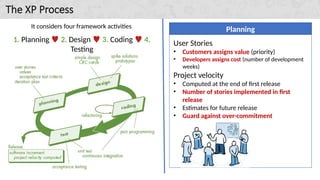
It considers four framework activities
1. Planning  2. Design  3. Coding  4.
Testing
Planning
User Stories
• Customers assigns value (priority)
• Developers assigns cost (number of development
weeks)
Project velocity
• Computed at the end of first release
• Number of stories implemented in first
release
• Estimates for future release
• Guard against over-commitment
The XP Process cont.
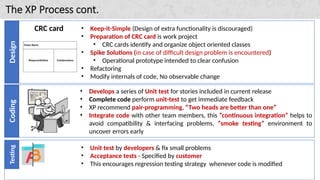
• Keep-it-Simple (Design of extra functionality is discouraged)
• Preparation of CRC card is work project
• CRC cards identify and organize object oriented classes
• Spike Solutions (in case of difficult design problem is encountered)
• Operational prototype intended to clear confusion
• Refactoring
• Modify internals of code, No observable change
Design
CRC card
Coding
• Develops a series of Unit test for stories included in current release
• Complete code perform unit-test to get immediate feedback
• XP recommend pair-programming, “Two heads are better than one”
• Integrate code with other team members, this “continuous integration” helps to
avoid compatibility & interfacing problems, “smoke testing” environment to
uncover errors early
• Unit test by developers & fix small problems
• Acceptance tests - Specified by customer
• This encourages regression testing strategy whenever code is modified
Testing

Extreme Programming (XP).pptx in devops.

  • 1.
    Extreme Programming (XP) The most widely used approach to agile software development  A variant of XP called Industrial XP (IXP) has been proposed to target process for large organizations  It uses object oriented approach as its preferred development model XP Values  Communication: To achieve effective communication, it emphasized close & informal (verbal) collaboration between customers and developers  Simplicity: It restricts developers to design for immediate needs not for future needs  Feedback: It is derived from three sources the implemented software, the customer and other software team members, it uses Unit testing as primary testing  Courage: It demands courage (discipline), there is often significant pressure to design for future requirements, XP team must have the discipline (courage) to design for today  Respect: XP team respect among members
  • 2.
    The XP Process Itconsiders four framework activities 1. Planning  2. Design  3. Coding  4. Testing Planning User Stories • Customers assigns value (priority) • Developers assigns cost (number of development weeks) Project velocity • Computed at the end of first release • Number of stories implemented in first release • Estimates for future release • Guard against over-commitment
  • 3.
    The XP Processcont. • Keep-it-Simple (Design of extra functionality is discouraged) • Preparation of CRC card is work project • CRC cards identify and organize object oriented classes • Spike Solutions (in case of difficult design problem is encountered) • Operational prototype intended to clear confusion • Refactoring • Modify internals of code, No observable change Design CRC card Coding • Develops a series of Unit test for stories included in current release • Complete code perform unit-test to get immediate feedback • XP recommend pair-programming, “Two heads are better than one” • Integrate code with other team members, this “continuous integration” helps to avoid compatibility & interfacing problems, “smoke testing” environment to uncover errors early • Unit test by developers & fix small problems • Acceptance tests - Specified by customer • This encourages regression testing strategy whenever code is modified Testing