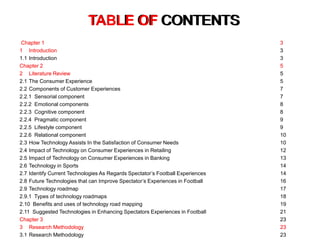
TABLE OF CONTENTS
Chapter 1 3
1 Introduction 3
1.1 Introduction 3
Chapter 2 5
2 Literature Review 5
2.1 The Consumer Experience 5
2.2 Components of Customer Experiences 7
2.2.1 Sensorial component 7
2.2.2 Emotional components 8
2.2.3 Cognitive component 8
2.2.4 Pragmatic component 9
2.2.5 Lifestyle component 9
2.2.6 Relational component 10
2.3 How Technology Assists In the Satisfaction of Consumer Needs 10
2.4 Impact of Technology on Consumer Experiences in Retailing 12
2.5 Impact of Technology on Consumer Experiences in Banking 13
2.6 Technology in Sports 14
2.7 Identify Current Technologies As Regards Spectator’s Football Experiences 14
2.8 Future Technologies that can Improve Spectator’s Experiences in Football 16
2.9 Technology roadmap 17
2.9.1 Types of technology roadmaps 18
2.10 Benefits and uses of technology road mapping 19
2.11 Suggested Technologies in Enhancing Spectators Experiences in Football 21
Chapter 3 23
3 Research Methodology 23
3.1 Research Methodology 23
TABLE OF CONTENTS
Chapter 1 3
1 Introduction 3
Chapter 2 5
2 Literature Review 5
Chapter 3 23
3 Research Methodology 23
CONTENTS
Chapter 1. Introduction 3
Chapter 2 Literature Review 5
2.1 The Consumer Experience 5
2.2 Components of Customer Experiences 7
2.2.1 Sensorial component 7
2.2.2 Emotional components 8
2.2.3 Cognitive component 8
2.2.4 Pragmatic component 9
2.2.5 Lifestyle component 9
2.2.6 Relational component 10
2.3 How Technology Assists In the Satisfaction of Consumer Needs 10
2.4 Impact of Technology on Consumer Experiences in Retailing 12
2.5 Impact of Technology on Consumer Experiences in Banking 13
2.6 Technology in Sports 14
2.7 Identify Current Technologies As Regards Spectator’s Football Experiences 14
2.8 Future Technologies that can Improve Spectator’s Experiences in Football 16
2.9 Technology roadmap 17
2.9.1 Types of technology roadmaps 18
2.10 Benefits and uses of technology road mapping 19
2.11 Suggested Technologies in Enhancing Spectators Experiences in Football 21
Chapter 3 Research Methodology 23
3.1 Research Methodology 23
3.2 Introduction to technology road mapping 23
3.3 Research design 24
3.4 Collection of data 25
3.5 Results 25
Chapter 1. Introduction 3
3.5 Results 25
CONTENTSChapter 1. Introduction 3
Chapter 2. Literature Review 5
2.1 The Consumer Experience 5
2.2 Components of Customer Experiences 7
2.2.1 Sensorial component 7
2.2.2 Emotional components 8
2.2.3 Cognitive component 8
2.2.4 Pragmatic component 9
2.2.5 Lifestyle component 9
2.2.6 Relational component 10
2.3 How Technology Assists In the Satisfaction of Consumer Needs 10
2.4 Impact of Technology on Consumer Experiences in Retailing 12
2.5 Impact of Technology on Consumer Experiences in Banking 13
2.6 Technology in Sports 14
2.7 Identify Current Technologies As Regards Spectator’s Football Experiences 14
2.8 Future Technologies that can Improve Spectator’s Experiences in Football 16
2.9 Technology roadmap 17
2.9.1 Types of technology roadmaps 18
2.10 Benefits and uses of technology road mapping 19
2.11 Suggested Technologies in Enhancing Spectators Experiences in Football 21
Chapter 3. Research Methodology 23
3.1 Research Methodology 23
3.2 Introduction to technology road mapping 23
3.3 Research design 24
3.4 Collection of data
Chapter 4. Results 25
Slide 4
Other Chapters and APPENDICES
Chapter 4. 27
4.1 Analysis and discussion 27
Chapter 5. 31
5.1 Conclusion 31
Chapter 6. References 33
Chapter 7. Appendices 36
Chapter 4. Analysis and Discussion 27
Chapter 5. Conclusion 31
Chapter 6. References 33
Chapter 7. Appendices 36
Slide 5
Other Chapters and APPENDICES
Chapter 4. Analysis and Discussion 27
Chapter 5. Conclusion 31
Chapter 6. Future Work 32
References 33
Appendix A Suitable Title A.1
Appendix B Relevant Title B.1
Appendix C Appropriate Title C.1
CONTENTSChapter 1. Introduction 1
Chapter 2. The Consumer Experience 3
2.1 Sensorial component 5
2.2 Emotional components 6
2.3 Cognitive component 7
2.4 Pragmatic component 9
2.5 Lifestyle component 9
2.6 Relational component 10
Chapter 3. Technology and Consumer Needs 10
3.1 Technology in Retailing 12
3.2 Technology in Banking 13
Chapter 4. Technology in Sports 14
4.1 Identify Current Technologies As Regards Spectator’s Football Experiences 14
4.2 Future Technologies that can Improve Spectator’s Experiences in Football 16
Chapter 5. Technology roadmap 17
5.1 Types of technology roadmaps 18
5.2 Benefits and uses of technology road mapping 19
5.3 Suggested Technologies in Enhancing Spectators Experiences in Football 21
Chapter 6. Design of Questionnaire 23
6.1 Justification of Research Methodology 23
6.2 Justification of Questions 25
6.3 Choice of Respondents 27
Slide 7
Dissertation Structure?
Chapter 1 discusses the growing interest of the concept of Emotional
Intelligence and various researchers that plays important roles in establishing it
and the objectives of this research. The subsequent chapters of this
dissertation will be grouped into five different chapters.
Chapter 2 of this dissertation will be a review about the origin and history of
Emotional Intelligence, a critical review of the literature, various definitions of
Emotional Intelligence developed by many researchers as well as different
models they have developed to establish the validity of the concept. This
dissertation will look at the impact of Emotional Intelligence on job
performance, particularly its effectiveness for project managers and members
of project teams in achieving their set goals in an organisation. The purpose of
this is to understand the concept of Emotional Intelligence, review the past
research findings about the impact of Emotional Intelligence on job
performance and personal success in a workplace environment.
Chapter 3 defines the research methodology that will be used in carrying out
the process of testing and measure the level of Emotional Intelligence of the
project managers and its impact on their job performance in the industries in
Nigeria.
Slide 8
Dissertation Structure?
State why the information is being presented –NOT what
has been included.
After explaining what problems exist and defining the objectives for this work, it
was necessary to review current, relevant literature. This review showed that
three distinct chapters were required, one concerning the consumer experience
and how it is enhanced by technology, another to show the impact of
technology on banking, retail and sports and the last to indicate future trends.
Data to satisfy the objectives were chosen and the justification for the
methodology followed is shown in Chapter 5 along with a justification for each
of the questions forming the questionnaire.
.
Slide 9
Why? not What?
6 Conclusion
6.1 Introduction
This chapter will present the outcome of the research
conducted to provide the answer to the research
objectives. The presentation will be in three sections
where the first section will give the summary of the
research, the second will provide the limitation of the
research and the last section will provide suggestion for
further research that can be conducted in the field.

Extract avoiding failure

  • 1.
    TABLE OF CONTENTS Chapter1 3 1 Introduction 3 1.1 Introduction 3 Chapter 2 5 2 Literature Review 5 2.1 The Consumer Experience 5 2.2 Components of Customer Experiences 7 2.2.1 Sensorial component 7 2.2.2 Emotional components 8 2.2.3 Cognitive component 8 2.2.4 Pragmatic component 9 2.2.5 Lifestyle component 9 2.2.6 Relational component 10 2.3 How Technology Assists In the Satisfaction of Consumer Needs 10 2.4 Impact of Technology on Consumer Experiences in Retailing 12 2.5 Impact of Technology on Consumer Experiences in Banking 13 2.6 Technology in Sports 14 2.7 Identify Current Technologies As Regards Spectator’s Football Experiences 14 2.8 Future Technologies that can Improve Spectator’s Experiences in Football 16 2.9 Technology roadmap 17 2.9.1 Types of technology roadmaps 18 2.10 Benefits and uses of technology road mapping 19 2.11 Suggested Technologies in Enhancing Spectators Experiences in Football 21 Chapter 3 23 3 Research Methodology 23 3.1 Research Methodology 23 TABLE OF CONTENTS Chapter 1 3 1 Introduction 3 Chapter 2 5 2 Literature Review 5 Chapter 3 23 3 Research Methodology 23
  • 2.
    CONTENTS Chapter 1. Introduction3 Chapter 2 Literature Review 5 2.1 The Consumer Experience 5 2.2 Components of Customer Experiences 7 2.2.1 Sensorial component 7 2.2.2 Emotional components 8 2.2.3 Cognitive component 8 2.2.4 Pragmatic component 9 2.2.5 Lifestyle component 9 2.2.6 Relational component 10 2.3 How Technology Assists In the Satisfaction of Consumer Needs 10 2.4 Impact of Technology on Consumer Experiences in Retailing 12 2.5 Impact of Technology on Consumer Experiences in Banking 13 2.6 Technology in Sports 14 2.7 Identify Current Technologies As Regards Spectator’s Football Experiences 14 2.8 Future Technologies that can Improve Spectator’s Experiences in Football 16 2.9 Technology roadmap 17 2.9.1 Types of technology roadmaps 18 2.10 Benefits and uses of technology road mapping 19 2.11 Suggested Technologies in Enhancing Spectators Experiences in Football 21 Chapter 3 Research Methodology 23 3.1 Research Methodology 23 3.2 Introduction to technology road mapping 23 3.3 Research design 24 3.4 Collection of data 25 3.5 Results 25 Chapter 1. Introduction 3 3.5 Results 25
  • 3.
    CONTENTSChapter 1. Introduction3 Chapter 2. Literature Review 5 2.1 The Consumer Experience 5 2.2 Components of Customer Experiences 7 2.2.1 Sensorial component 7 2.2.2 Emotional components 8 2.2.3 Cognitive component 8 2.2.4 Pragmatic component 9 2.2.5 Lifestyle component 9 2.2.6 Relational component 10 2.3 How Technology Assists In the Satisfaction of Consumer Needs 10 2.4 Impact of Technology on Consumer Experiences in Retailing 12 2.5 Impact of Technology on Consumer Experiences in Banking 13 2.6 Technology in Sports 14 2.7 Identify Current Technologies As Regards Spectator’s Football Experiences 14 2.8 Future Technologies that can Improve Spectator’s Experiences in Football 16 2.9 Technology roadmap 17 2.9.1 Types of technology roadmaps 18 2.10 Benefits and uses of technology road mapping 19 2.11 Suggested Technologies in Enhancing Spectators Experiences in Football 21 Chapter 3. Research Methodology 23 3.1 Research Methodology 23 3.2 Introduction to technology road mapping 23 3.3 Research design 24 3.4 Collection of data Chapter 4. Results 25
  • 4.
    Slide 4 Other Chaptersand APPENDICES Chapter 4. 27 4.1 Analysis and discussion 27 Chapter 5. 31 5.1 Conclusion 31 Chapter 6. References 33 Chapter 7. Appendices 36 Chapter 4. Analysis and Discussion 27 Chapter 5. Conclusion 31 Chapter 6. References 33 Chapter 7. Appendices 36
  • 5.
    Slide 5 Other Chaptersand APPENDICES Chapter 4. Analysis and Discussion 27 Chapter 5. Conclusion 31 Chapter 6. Future Work 32 References 33 Appendix A Suitable Title A.1 Appendix B Relevant Title B.1 Appendix C Appropriate Title C.1
  • 6.
    CONTENTSChapter 1. Introduction1 Chapter 2. The Consumer Experience 3 2.1 Sensorial component 5 2.2 Emotional components 6 2.3 Cognitive component 7 2.4 Pragmatic component 9 2.5 Lifestyle component 9 2.6 Relational component 10 Chapter 3. Technology and Consumer Needs 10 3.1 Technology in Retailing 12 3.2 Technology in Banking 13 Chapter 4. Technology in Sports 14 4.1 Identify Current Technologies As Regards Spectator’s Football Experiences 14 4.2 Future Technologies that can Improve Spectator’s Experiences in Football 16 Chapter 5. Technology roadmap 17 5.1 Types of technology roadmaps 18 5.2 Benefits and uses of technology road mapping 19 5.3 Suggested Technologies in Enhancing Spectators Experiences in Football 21 Chapter 6. Design of Questionnaire 23 6.1 Justification of Research Methodology 23 6.2 Justification of Questions 25 6.3 Choice of Respondents 27
  • 7.
    Slide 7 Dissertation Structure? Chapter1 discusses the growing interest of the concept of Emotional Intelligence and various researchers that plays important roles in establishing it and the objectives of this research. The subsequent chapters of this dissertation will be grouped into five different chapters. Chapter 2 of this dissertation will be a review about the origin and history of Emotional Intelligence, a critical review of the literature, various definitions of Emotional Intelligence developed by many researchers as well as different models they have developed to establish the validity of the concept. This dissertation will look at the impact of Emotional Intelligence on job performance, particularly its effectiveness for project managers and members of project teams in achieving their set goals in an organisation. The purpose of this is to understand the concept of Emotional Intelligence, review the past research findings about the impact of Emotional Intelligence on job performance and personal success in a workplace environment. Chapter 3 defines the research methodology that will be used in carrying out the process of testing and measure the level of Emotional Intelligence of the project managers and its impact on their job performance in the industries in Nigeria.
  • 8.
    Slide 8 Dissertation Structure? Statewhy the information is being presented –NOT what has been included. After explaining what problems exist and defining the objectives for this work, it was necessary to review current, relevant literature. This review showed that three distinct chapters were required, one concerning the consumer experience and how it is enhanced by technology, another to show the impact of technology on banking, retail and sports and the last to indicate future trends. Data to satisfy the objectives were chosen and the justification for the methodology followed is shown in Chapter 5 along with a justification for each of the questions forming the questionnaire. .
  • 9.
    Slide 9 Why? notWhat? 6 Conclusion 6.1 Introduction This chapter will present the outcome of the research conducted to provide the answer to the research objectives. The presentation will be in three sections where the first section will give the summary of the research, the second will provide the limitation of the research and the last section will provide suggestion for further research that can be conducted in the field.