BASIC FIRE SAFETY
TRAINING
Prepared and Induction by:
[Name Here]
(HSE)
Dated: 00/00/2020
EXTINGUISHER
Fire Safety &
Fire Safety &
Fire Extinguisher Use
Objectives
Objectives
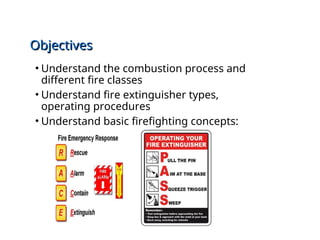
• Understand the combustion process and
different fire classes
• Understand fire extinguisher types,
operating procedures
• Understand basic firefighting concepts:
Fire Safety & Fire Extinguisher Use
The Combustion Process
Fire Safety & Fire Extinguisher Use
• Three components
• Need all three
components to start a
fire
• Fire extinguishers
remove one or more of
the components.
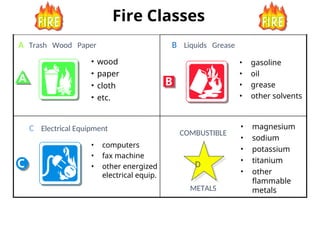
Fire Classes
• wood
• paper
• cloth
• etc.
A Trash Wood Paper
C Electrical Equipment
B Liquids Grease
COMBUSTIBLE
METALS
D
• gasoline
• oil
• grease
• other solvents
• computers
• fax machine
• other energized
electrical equip.
• magnesium
• sodium
• potassium
• titanium
• other
flammable
metals
Fire Classes (cont.)
K Cooking Media
• Recently recognized by NFPA 10
• Fires involving combustible oils,
lards and fats in commercial
cooking.
CLASS K FIRES
CLASS K FIRES
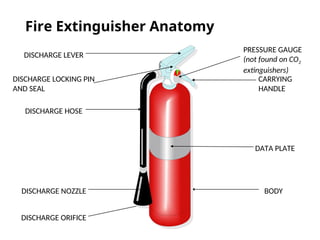
Fire Extinguisher Anatomy
DISCHARGE HOSE
DISCHARGE NOZZLE
DISCHARGE ORIFICE
BODY
DATA PLATE
CARRYING
HANDLE
PRESSURE GAUGE
(not found on CO2
extinguishers)
DISCHARGE LEVER
DISCHARGE LOCKING PIN
AND SEAL
Fire Extinguisher Types
• Class “A” fires only
• 2.5 gal. water
(up to 1 minute discharge time)
• Has pressure gauge to allow visual
capacity check
• 30-40 ft. maximum effective range
• Can be started and stopped as
necessary
• Extinguishes by cooling
cooling burning
material below the ignition point.
PRESSURIZED WATER
PRESSURIZED WATER
A Trash Wood Paper
B Liquids Grease
C Electrical Equipment
A Trash Wood Paper
B Liquids Grease
C Electrical Equipment
Fire Extinguisher Types (cont.)
• Class “B” or “C” fires
• 2.5-100 lb. of CO2 (8-30
seconds discharge time)
• Has NO
NO pressure gauge--capacity
verified by weight
• 3-8 ft. maximum effective range
• Extinguishes by smothering
smothering
burning materials
• Effectiveness decreases
decreases as
temperature of burning material
increases.
CARBON DIOXIDE (CO
CARBON DIOXIDE (CO2
2)
)
A Trash Wood Paper
B Liquids Grease
C Electrical Equipment
A Trash Wood Paper
B Liquids Grease
C Electrical Equipment
Fire Extinguisher Types (cont.)
• Class “A”, “B”, or “C” fires
• 2.5-20 lb. dry chemical
(ammonium phosphate)
8-25 seconds discharge time)
• Has pressure gauge to allow
visual capacity check
• 5-20 ft. maximum effective
range
• Extinguishes by smothering
smothering
burning materials.
MULTIPURPOSE DRY CHEMICAL
A Trash Wood Paper
B Liquids Grease
C Electrical Equipment
A Trash Wood Paper
B Liquids Grease
C Electrical Equipment
Fire Extinguisher Summary
EXTINGUISHER TYPE WORKS BY EFFECTIVE AGAINST
PRESSURIZED
WATER
CARBON DIOXIDE
MULTIPURPOSE
DRY CHEMICAL
COOLING
SMOTHERING
SMOTHERING
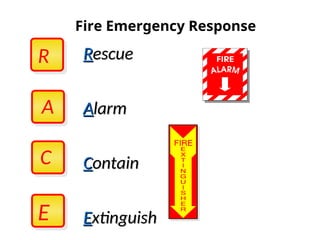
Fire Emergency Response
R R
Rescue
escue
A
Alarm
larm
C
Contain
ontain
E
Extinguish
xtinguish
A
C
E
Fighting the Fire
P
Pull the pin
ull the pin
A
Aim low at
im low at
the base of flames
the base of flames
S
Squeeze the handle
queeze the handle
S
Sweep side to side
weep side to side
P
A
S
S
Firefighting Decision Criteria
• Know department emergency procedures and evacuation routes
• Know locations of extinguishers in your area and how to use them
• Always sound the alarm regardless of fire size
• Avoid smoky conditions
• Ensure area is evacuated
• Don’t attempt to fight unless:
• Alarm is sounded
• Fire is small and contained
• You have safe egress route (can be reached without exposure to fire)
• Available extinguishers are rated for size and type of fire
• If in doubt, evacuate!
“DON’T ATTEMPT TO FIGHT UNLESS YOU ARE TRAINED”
Summary
• Combustion Process (Fire Triangle)
• Class A, B, C, D, K fires
• Types of portable fire extinguishers:
• Operating procedures
• Capabilities and limitations
• Basic firefighting concepts: R.A.C.E.
R.A.C.E.
P.A.S.S.
P.A.S.S.
Fire Safety & Fire Extinguisher Use
Quiz Question 1
• Fire extinguisher marked with an A is used on:
• A) oil fires
• B) Electrical fires
• C) paper material fires
• D) none of the above
Quiz Question 2
• Fire extinguishers marked with a B can be used on:
• A) Paper, trash
• B) Oil or Grease
• C) Electrical
• D) Non of the above
Quiz addendum
• How else you can kill a grease fire?
A) Smother
B) Baking Soda
C) A&B
Quiz Question 3
• Fire extinguisher marked ABC can be used on:
• A) Wood, Paper
• B) Electrical
• C) Liquids and grease
• D) All of the above
Quiz Question 4
• Fire Extinguishers marked with D are used for
• A) Combustible chemicals
• B) Magnesium
• C) Potassium
• D) other flammable metals
• E) all of the above
Quiz Question 5
• For what fires is a Halon Fire Extinguisher being used?
• Guess 1
• Guess 2
• Guess 3
• Guess 4
Halon
• Halon fire extinguisher is important device to have, especially for emergency
situations. It contains a gas that interrupts the chemical reaction that takes place
when fuels burn. Halon fire extinguisher is often used to protect valuable
electrical equipment since they leave no residue.
• Such on expensive computers, server rooms, etc.
• Since Halon manufacturing was banned, a hunt has been on for something that
works as well. According to the Halon Alternatives Research Corp., more than 20
different kinds of alternatives exist as direct replacements.
• Halon Replacement
• Those categories are inert gases and halocarbon compounds.

Basic Fire & Fire Extinguisher Training.ppt

  • 1.
    BASIC FIRE SAFETY TRAINING Preparedand Induction by: [Name Here] (HSE) Dated: 00/00/2020
  • 2.
    EXTINGUISHER Fire Safety & FireSafety & Fire Extinguisher Use Fire Extinguisher Use
  • 3.
    Objectives Objectives • Understand thecombustion process and different fire classes • Understand fire extinguisher types, operating procedures • Understand basic firefighting concepts: Fire Safety & Fire Extinguisher Use
  • 4.
    The Combustion Process FireSafety & Fire Extinguisher Use • Three components • Need all three components to start a fire • Fire extinguishers remove one or more of the components.
  • 5.
    Fire Classes • wood •paper • cloth • etc. A Trash Wood Paper C Electrical Equipment B Liquids Grease COMBUSTIBLE METALS D • gasoline • oil • grease • other solvents • computers • fax machine • other energized electrical equip. • magnesium • sodium • potassium • titanium • other flammable metals
  • 6.
    Fire Classes (cont.) KCooking Media • Recently recognized by NFPA 10 • Fires involving combustible oils, lards and fats in commercial cooking. CLASS K FIRES CLASS K FIRES
  • 7.
    Fire Extinguisher Anatomy DISCHARGEHOSE DISCHARGE NOZZLE DISCHARGE ORIFICE BODY DATA PLATE CARRYING HANDLE PRESSURE GAUGE (not found on CO2 extinguishers) DISCHARGE LEVER DISCHARGE LOCKING PIN AND SEAL
  • 8.
    Fire Extinguisher Types •Class “A” fires only • 2.5 gal. water (up to 1 minute discharge time) • Has pressure gauge to allow visual capacity check • 30-40 ft. maximum effective range • Can be started and stopped as necessary • Extinguishes by cooling cooling burning material below the ignition point. PRESSURIZED WATER PRESSURIZED WATER A Trash Wood Paper B Liquids Grease C Electrical Equipment A Trash Wood Paper B Liquids Grease C Electrical Equipment
  • 9.
    Fire Extinguisher Types(cont.) • Class “B” or “C” fires • 2.5-100 lb. of CO2 (8-30 seconds discharge time) • Has NO NO pressure gauge--capacity verified by weight • 3-8 ft. maximum effective range • Extinguishes by smothering smothering burning materials • Effectiveness decreases decreases as temperature of burning material increases. CARBON DIOXIDE (CO CARBON DIOXIDE (CO2 2) ) A Trash Wood Paper B Liquids Grease C Electrical Equipment A Trash Wood Paper B Liquids Grease C Electrical Equipment
  • 10.
    Fire Extinguisher Types(cont.) • Class “A”, “B”, or “C” fires • 2.5-20 lb. dry chemical (ammonium phosphate) 8-25 seconds discharge time) • Has pressure gauge to allow visual capacity check • 5-20 ft. maximum effective range • Extinguishes by smothering smothering burning materials. MULTIPURPOSE DRY CHEMICAL MULTIPURPOSE DRY CHEMICAL A Trash Wood Paper B Liquids Grease C Electrical Equipment A Trash Wood Paper B Liquids Grease C Electrical Equipment
  • 11.
    Fire Extinguisher Summary EXTINGUISHERTYPE WORKS BY EFFECTIVE AGAINST PRESSURIZED WATER CARBON DIOXIDE MULTIPURPOSE DRY CHEMICAL COOLING SMOTHERING SMOTHERING
  • 12.
    Fire Emergency Response RR Rescue escue A Alarm larm C Contain ontain E Extinguish xtinguish A C E
  • 13.
    Fighting the Fire P Pullthe pin ull the pin A Aim low at im low at the base of flames the base of flames S Squeeze the handle queeze the handle S Sweep side to side weep side to side P A S S
  • 14.
    Firefighting Decision Criteria •Know department emergency procedures and evacuation routes • Know locations of extinguishers in your area and how to use them • Always sound the alarm regardless of fire size • Avoid smoky conditions • Ensure area is evacuated • Don’t attempt to fight unless: • Alarm is sounded • Fire is small and contained • You have safe egress route (can be reached without exposure to fire) • Available extinguishers are rated for size and type of fire • If in doubt, evacuate! “DON’T ATTEMPT TO FIGHT UNLESS YOU ARE TRAINED”
  • 15.
    Summary • Combustion Process(Fire Triangle) • Class A, B, C, D, K fires • Types of portable fire extinguishers: • Operating procedures • Capabilities and limitations • Basic firefighting concepts: R.A.C.E. R.A.C.E. P.A.S.S. P.A.S.S. Fire Safety & Fire Extinguisher Use
  • 16.
    Quiz Question 1 •Fire extinguisher marked with an A is used on: • A) oil fires • B) Electrical fires • C) paper material fires • D) none of the above
  • 17.
    Quiz Question 2 •Fire extinguishers marked with a B can be used on: • A) Paper, trash • B) Oil or Grease • C) Electrical • D) Non of the above
  • 18.
    Quiz addendum • Howelse you can kill a grease fire? A) Smother B) Baking Soda C) A&B
  • 19.
    Quiz Question 3 •Fire extinguisher marked ABC can be used on: • A) Wood, Paper • B) Electrical • C) Liquids and grease • D) All of the above
  • 20.
    Quiz Question 4 •Fire Extinguishers marked with D are used for • A) Combustible chemicals • B) Magnesium • C) Potassium • D) other flammable metals • E) all of the above
  • 21.
    Quiz Question 5 •For what fires is a Halon Fire Extinguisher being used? • Guess 1 • Guess 2 • Guess 3 • Guess 4
  • 22.
    Halon • Halon fireextinguisher is important device to have, especially for emergency situations. It contains a gas that interrupts the chemical reaction that takes place when fuels burn. Halon fire extinguisher is often used to protect valuable electrical equipment since they leave no residue. • Such on expensive computers, server rooms, etc. • Since Halon manufacturing was banned, a hunt has been on for something that works as well. According to the Halon Alternatives Research Corp., more than 20 different kinds of alternatives exist as direct replacements. • Halon Replacement • Those categories are inert gases and halocarbon compounds.

Editor's Notes

  • #2 WELCOME STUDENTS. INTRODUCE YOURSELF. REMIND STUDENTS ABOUT: ATTENDANCE ROSTER. FEEDBACK FORM (IF USED). HANDOUTS (IF USED--COPIES OF SLIDES 8 AND 15).
  • #3 BRIEFLY REVIEW OBJECTIVES.
  • #4 ASK “WHAT FOUR INGREDIENTS ARE NEEDED TO CREATE A FIRE?” AND SHOW SLIDE. EXPLAIN HOW IT SHOWS “FIRE TETRAHEDRON”--FOUR-SIDED FIGURE SHOWING RELATIONSHIP BETWEEN COMPONENTS OF COMBUSTION PROCESS (UPDATE FROM OLD “FIRE TRIANGLE”--ADDS CHEMICAL CHAIN REACTION AS FOURTH ELEMENT). EXPLAIN THAT EACH COMPONENT IS EQUALLY IMPORTANT. ASK “HOW DO YOU PUT OUT A FIRE?” (REMOVE ONE OR MORE OF THE ABOVE ELEMENTS). EXPLAIN HOW EXTINGUISHERS WE USE ARE ALL DESIGNED TO DO THIS.
  • #5 DESCRIBE THE FIVE FIRE CLASSES ON THIS AND NEXT SLIDE. POINT OUT OLD AND NEW FIRE SYMBOLS--USED TO MARK EXTINGUISHERS FOR SUITABILITY FOR USE ON FIRE CLASSES. TO DECIDE IF EXTINGUISHER IS APPROPRIATE, MATCH SYMBOL TO TYPE OF FIRE BEING ENCOUNTERED.
  • #6 RECENT ADDITION TO NFPA 10. DESIGNED FOR USE WITH HOTTER BURNING NON-SATURATED FAT FIRES.
  • #7 POINT OUT DIFFERENT COMPONENTS OF PORTABLE FIRE EXTINGUISHER. POINT OUT THAT CO2 EXTINGUISHER IS UNIQUE IN THAT IT DOES NOT HAVE PRESSURE GAUGE.
  • #11 BRIEFLY REVIEW EACH EXTINGUISHER TYPE, STRENGTHS, WEAKNESSES. POINT OUT STUDENTS HAVE COPY OF THIS SLIDE AS ONE OF HANDOUTS.
  • #12 ASK “WHAT DO I DO IF I SEE A FIRE?” RESCUE VICTIMS. ALARM ACTIVATION TO SUMMON HELP. CONTAIN FIRE TO PREVENT SPREAD--CLOSE DOORS, WINDOWS, SHUT OFF EXHAUST, ETC. EXTINGUISH THE FLAMES--PUT THE FIRE OUT.
  • #13 IF YOU DECIDE TO FIGHT FIRE, USE “P.A.S.S.” ACRONYM TO REMEMBER HOW TO OPERATE THE EXTINGUISHER PROPERLY.
  • #14 ASK “HOW DO I DECIDE TO FIGHT THE FIRE OR EVACUATE?” IF ONE OR MORE OF THE ABOVE CRITERIA AREN’T MET, BUG OUT! IF YOU DO USE AN EXTINGUISHER, PLACE IT OUT OF SERVICE AND NOTIFY THE APPROPRIATE PERSON(S) SO IT CAN BE RECHARGED OR REPLACED.
  • #15 BRIEFLY REVIEW COMBUSTION PROCESS, FIRE CLASSES, TYPES OF EXTINGUISHERS, AND THEIR LIMITATIONS (REMIND STUDENTS OF HANDOUTS). REVIEW “R.A.C.E”, “P.A.S.S.” ACRONYMS. ASK FOR QUESTIONS. REMIND STUDENTS TO SIGN ROSTER.