Export Compliance LR INTERNATIONAL, INC. 343 N. Wood Dale Road Wood Dale, Illinois 60691 630 350 7100, 630 350 7101 Fax www.LRInternational.com
Overview Establish a System Knowledge/ Due Diligence Export Administration Regulations
Export Operation System Necessary Service Providers Know & Understand Restrictions Controlled Commodities Establish a Process/ Approving Customers
Service Providers Government Assistance Centers Bureau of Industry and Security (BIS)- Enforcement U.S. Doc/ Marketing Assistance & Rules & Regulations (EAR) Legal Assistance Terms & Conditions Liability Issues Contracts/ Sales, Reps, etc. Finance Bank- International Trade Finance Methods of Payment Foreign Exchange Receivable Insurance- Government (EX-IM Bank) & Public Sector Logistics U.S. Government Licensed International Freight Forwarder U.S. Treasury Department Licensed Customs Broker
Logistics Provider Freight Forwarder Ocean/ FMC- OTI License  NVOCC/ FMC-OTI License FMC/DOT SED/AES Filings Fraud Issues Insurance/ Cargo & Liability Customs Broker U.S. Department of Treasury  $$$$
Knowledge/ Due Diligence Treasury Department Country Embargoes Denied Company List Denied Client List Final Destination of Products
Knowledge Know where your goods will be used Diversionary Clause to confirm your efforts Diversionary issue clearly stated in your terms and conditions of sale Diversionary issue confirmed in your quotation/Proforma Invoice & Purchase Order Acknowledgement
Antidiversion Clause  To help ensure that U.S. exports go only to legally authorized destinations, the U.S. government requires a destination control statement on shipping documents. Under this requirement, the commercial invoice and bill of lading (or air waybill) for nearly all commercial shipments leaving the United States must display a statement notifying the carrier and all foreign parties (the ultimate and intermediate consignees and purchaser) that the U.S. material has been licensed for export only to certain destinations and may not be diverted contrary to U.S. law. Exceptions to the use of the destination control statement are shipments to Canada and intended for consumption in Canada and shipments being made under certain general licenses. Advice on the appropriate statement to be used can be provided by the Department of Commerce, an attorney, or the freight forwarder.  The minimum antidiversion statement for goods exported under Commerce Department authority is: "These commodities, technology, or software, were exported from the United States in accordance with the Export Administration Regulations. Diversion contrary to U.S. law is prohibited."
Controlled Commodities Required Special Government Permission in the form of an Export License Nature of the Commodity Dangerous Short Supply Destination of the Goods General Embargo Commodity Specific Embargo Application of the Goods Dual Use Items
Applying for a License and Application Processing  If an export license is required, you must prepare a Form BXA-748P, "Mulipurpose Application Form," and submit it to BXA. The form can be used for requesting an export license, reexports, or commodity classifications. You may request forms by fax at 202-219-9179 or by phone on 202-482-3332. You must be certain to follow the instructions on the form carefully. In some instances, technical brochures and support documentation must also be included.  In reviewing specific license applications, BXA will conduct a complete analysis of the license application along with all documentation submitted in support of the application. In addition to reviewing the item and end use, BXA will consider the reliability of each party to the transaction and review any available intelligence information. To the maximum extent possible, BXA will make licensing decisions without referral of license applications to other agencies; however, BXA may consult with other U.S. departments and agencies regarding any license application. Further information concerning the review policy for various controls is contained in parts 742 and 750.  You may contact BXA for status of your pending certification request, advisory opinion, or license application. For advisory opinion requests, telephone 202-482-4905 or send a fax to 202-219-9179. For license applications and classification requests, telephone BXA's System for Tracking Export License Applications (STELA) at 202-482-2752. STELA is an automated voice response system that, upon request via any standard touch-tone telephone, will provide you with up-to-the-minute status on any license application pending at BXA. Requests for status may be made only by the applicant or the applicant's agent.
Summary Know the Regulations Know your Customer Know the Destination Only use Licensed Logistics Providers Keep Good Records Create a Compliance Manual
Legal Aspects of Exporting Access to Export Administration Regs Shipper’s Export Declaration Automated Export System
SED/AES Shipper’s Export Declaration Know how to complete the form Required All Controlled Commodity Shipment Non Controlled Commodity Shipments with a H/S T commodity exceeds US$2500.00 Exceptions: Canada
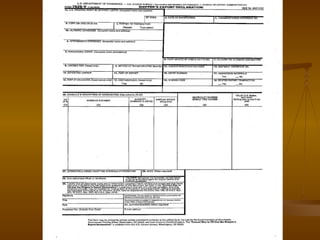
Shipper's Export Declaration (SED or form 7525-V) Filling out the Shipper's Export Declaration The Shipper's Export Declaration (SED or Form 7525-V) is used by the U.S. Census Bureau to compile trade statistics and to help prevent illegal exports. The SED and instructions on how to fill it out are available from a variety of sources including the U.S. Government Printing Office (202-512-0000) and the  U.S. Census Bureau's home page . Do I Need to Submit an SED for My Shipment? The following facts can be used to determine whether or not the SED is needed for shipment: The SED must be filled out for any shipment valued at $2,500 or above (If the shipment is valued at over $2,500 but is made up of various commodities falling under several Schedule B numbers none of which is valued at $2,500 or higher, no SED is required.) The SED is required for any shipment to particular countries, such as Cuba, Libya, and North Korea, and for any shipment requiring a validated export license [call the Trade Information Center 800-USA-TRAD(E) for more information]. An SED is required for shipments to Puerto Rico, the U.S. Virgin Islands and the former Pacific Trust Territories even though they are not considered exports (unless each Schedule B item is under $2,500). Shipments to Canada do not require an SED . (Shipments to third countries passing through Canada do need an SED.)
 
About AES Introduction       An Introduction to AES Before AES, the export system was paper-bound; expensive, labor intensive, error prone. AES uses proven technology in a new way to address a significant problem with the export process. It will contribute to a re-engineering of the way U.S. exports are accomplished.  The Automated Export System (AES) is a joint venture between CBP, the Foreign Trade Division of the Bureau of the Census (Commerce), the Bureau of Industry and Security (Commerce), the Directorate of Defense Trade Controls (State), other Federal agencies, and the export trade community. It is the central point through which export shipment data required by multiple agencies is filed electronically to Customs, using the efficiencies of Electronic Data Interchange (EDI). AES provides an alternative to filing paper Shipper's Export Declarations (SEDs). Export information is collected electronically and edited immediately, and errors are detected and corrected at the time of filing. AES is a nationwide system operational at all ports and for all methods of transportation. It was designed to assure compliance with and enforcement of laws relating to exporting, improve trade statistics, reduce duplicate reporting to multiple agencies, and improve customer service.                
Background During AES development, a Trade Resource Group convened regularly. To ensure that all voices were heard, the group was comprised of large and small exporters, carriers, freight forwarders, port authorities, and non-vessel operating common carriers (NVOCC). At the trade's request, separate coalitions for exporters and software vendors were formed.  At the start, position papers were collected from trade associations to determine what AES data requirements and automation capabilities should be included in AES. Public meetings were held around the country and comments were collected at each meeting in order to receive feedback from the trade community. This partnership with the trade continues as AES evolves. In 1998, Interest-Based Negotiations between the government and the trade generated enhancements to AES which provides filing options for exporters and their agents.  AES was implemented in phases. Phase I began July 1995 with participation at five vessel ports - Baltimore, Norfolk, Charleston, Houston, and Los Angeles/Long Beach. During Phase I, the participating companies were required to dual report their exports, i.e., the participant filed both paper and electronic versions of the Shipper's Export Declarations. This allowed Census to evaluate the integrity of the electronic data received. As a result of the positive evaluation of Phase I, completed in June 1996, the decision was made to expand AES to all vessel ports on October 1, 1996. In addition to expanding to all vessel ports, the requirement for dual reporting was removed. In July 1997, AES expanded to receive air and overland commodity data as well as all commodity data for vessel shipments from all ports.
How AES Works The export process begins when the exporter decides to export merchandise. The exporter or the authorized agent makes shipping arrangements (booking) with the carrier. The exporter or the authorized agent transmits the commodity (SED) information using AES. This information can come directly from the exporter or the authorized agent or through a service center or port authority. AES validates the data against editing tables and U.S. Government agency requirement files and generates a confirmation message or error messages back to the filer. If the carrier is participating in the Vessel Transportation Module the carrier transmits the Receipt of Booking message when the booked cargo is received and the departure message following the actual departure of the vessel. Within ten calendar days after departure, the carrier will transmit the entire export manifest electronically using AES. AES also validates the transportation data then generates either a confirmation message or an error message. Any errors messages generated by AES must be corrected and the corrections transmitted to AES.  Benefits of AES Whatever aspect of the export community you represent - exporter, carrier, freight forwarder, port authority, service center, non-vessel operating common carrier, consolidator - AES has advantages for you.
Ensure Your Export Compliance.  The AES, with its sophisticated editing system - and your subsequent corrections, ensures your compliance with current U.S. export reporting requirements. The system returns an Internal Transaction Number (ITN) as confirmation that you successfully filed your export documentation.  Correct Errors as They Occur.  AES provides immediate feedback to the filer when data is omitted or incorrect. AES allows you to correct errors at any point in time.  Decrease Your Costs.  Eliminate the cost of corrections with up-front data edits. Eliminate the costly delays of paper handling. Eliminate duplicate reporting.  There are potential large savings inherent in moving from a paper-based, data entry-intensive system to a single point of electronic data entry. Significant savings can be realized when the burden of keying multiple documents for each transaction, and/or repeated keying to/from paper environment and to/from electronic media and back, are greatly reduced. One carrier, who has been an AES participant since September 1995, researched their cost savings in terms of man-hours for data entry, couriers and messengers. According to a company spokesman, they anticipate future savings upwards of $2 million per year once most of their customers report through AES.
Eliminate Paper Review of Licenses Against Shipments.  The interface with the Commerce Department's Bureau of Industry and Security and the State Department's Directorate of Defense Trade Controls electronically validates data on export shipments against previously-approved licenses and transmits the transaction to the appropriate Partnership Agency.  Keep in Step With the Global Shift to EDI.  AES is in line with the NAFTA and GATT agreements. AES export certification could start the 60-day clock for presentation of evidence of duty payment to another NAFTA country. This will make it easier to do business in multiple countries.  Provide a Tool for Evaluating and Measuring Potential Markets.  Accurate and timely export statistics from accurate trade data will help your business stay ahead in the global trade market.
A Partnership of Agencies AES is a conduit through which required export shipment information reaches the appropriate agency.  The Bureau of the Census extracts AES data to compile and publish export trade statistics. Our goal is to eliminate manual processing and paper review of the SED by providing accurate data, electronically, to be used for analytical and statistical reporting.  AES checks dual-use shipments against licenses approved by the Bureau of Industry and Security and forwards the data to that agency.  Similarly, the Directorate of Defense Trade Controls utilizes the AES partnership agency interface to validate outbound munitions shipments against previously approved licenses and transmit the data to that agency.  We are continuing to create partnerships with other agencies for the future phases of AES
Trade & Technology Coming Together AES is trade and technology coming together because trade and technology belong together.  Manual processes are being replaced by automation in all aspects of life - in today's world automation is the norm, not the exception. AES is the tool that is keeping the export industry in step with the Information Age. AES offers you a chance to be competitive in today's global economy, to join the movement toward a global EDI climate, and to put technology to work for you.  Getting Started When you decide to join AES send a Letter of Intent to Census.  Upon receipt of the letter, a Customs Client Representative and a Census Client Representative will be assigned to serve as your technical advisor during development, testing and implementation.  This concludes the tour. We would like to thank you for taking the time to learn about AES. Again, we encourage you to sign our Guest Book before leaving the AES Web site.  For more information on AES you can call the AES toll-free Answerline at 1-800-549-0595 or send an e-mail to  [email_address]

Export compliance

  • 1.
    Export Compliance LRINTERNATIONAL, INC. 343 N. Wood Dale Road Wood Dale, Illinois 60691 630 350 7100, 630 350 7101 Fax www.LRInternational.com
  • 2.
    Overview Establish aSystem Knowledge/ Due Diligence Export Administration Regulations
  • 3.
    Export Operation SystemNecessary Service Providers Know & Understand Restrictions Controlled Commodities Establish a Process/ Approving Customers
  • 4.
    Service Providers GovernmentAssistance Centers Bureau of Industry and Security (BIS)- Enforcement U.S. Doc/ Marketing Assistance & Rules & Regulations (EAR) Legal Assistance Terms & Conditions Liability Issues Contracts/ Sales, Reps, etc. Finance Bank- International Trade Finance Methods of Payment Foreign Exchange Receivable Insurance- Government (EX-IM Bank) & Public Sector Logistics U.S. Government Licensed International Freight Forwarder U.S. Treasury Department Licensed Customs Broker
  • 5.
    Logistics Provider FreightForwarder Ocean/ FMC- OTI License NVOCC/ FMC-OTI License FMC/DOT SED/AES Filings Fraud Issues Insurance/ Cargo & Liability Customs Broker U.S. Department of Treasury $$$$
  • 6.
    Knowledge/ Due DiligenceTreasury Department Country Embargoes Denied Company List Denied Client List Final Destination of Products
  • 7.
    Knowledge Know whereyour goods will be used Diversionary Clause to confirm your efforts Diversionary issue clearly stated in your terms and conditions of sale Diversionary issue confirmed in your quotation/Proforma Invoice & Purchase Order Acknowledgement
  • 8.
    Antidiversion Clause To help ensure that U.S. exports go only to legally authorized destinations, the U.S. government requires a destination control statement on shipping documents. Under this requirement, the commercial invoice and bill of lading (or air waybill) for nearly all commercial shipments leaving the United States must display a statement notifying the carrier and all foreign parties (the ultimate and intermediate consignees and purchaser) that the U.S. material has been licensed for export only to certain destinations and may not be diverted contrary to U.S. law. Exceptions to the use of the destination control statement are shipments to Canada and intended for consumption in Canada and shipments being made under certain general licenses. Advice on the appropriate statement to be used can be provided by the Department of Commerce, an attorney, or the freight forwarder. The minimum antidiversion statement for goods exported under Commerce Department authority is: "These commodities, technology, or software, were exported from the United States in accordance with the Export Administration Regulations. Diversion contrary to U.S. law is prohibited."
  • 9.
    Controlled Commodities RequiredSpecial Government Permission in the form of an Export License Nature of the Commodity Dangerous Short Supply Destination of the Goods General Embargo Commodity Specific Embargo Application of the Goods Dual Use Items
  • 10.
    Applying for aLicense and Application Processing If an export license is required, you must prepare a Form BXA-748P, "Mulipurpose Application Form," and submit it to BXA. The form can be used for requesting an export license, reexports, or commodity classifications. You may request forms by fax at 202-219-9179 or by phone on 202-482-3332. You must be certain to follow the instructions on the form carefully. In some instances, technical brochures and support documentation must also be included. In reviewing specific license applications, BXA will conduct a complete analysis of the license application along with all documentation submitted in support of the application. In addition to reviewing the item and end use, BXA will consider the reliability of each party to the transaction and review any available intelligence information. To the maximum extent possible, BXA will make licensing decisions without referral of license applications to other agencies; however, BXA may consult with other U.S. departments and agencies regarding any license application. Further information concerning the review policy for various controls is contained in parts 742 and 750. You may contact BXA for status of your pending certification request, advisory opinion, or license application. For advisory opinion requests, telephone 202-482-4905 or send a fax to 202-219-9179. For license applications and classification requests, telephone BXA's System for Tracking Export License Applications (STELA) at 202-482-2752. STELA is an automated voice response system that, upon request via any standard touch-tone telephone, will provide you with up-to-the-minute status on any license application pending at BXA. Requests for status may be made only by the applicant or the applicant's agent.
  • 11.
    Summary Know theRegulations Know your Customer Know the Destination Only use Licensed Logistics Providers Keep Good Records Create a Compliance Manual
  • 12.
    Legal Aspects ofExporting Access to Export Administration Regs Shipper’s Export Declaration Automated Export System
  • 13.
    SED/AES Shipper’s ExportDeclaration Know how to complete the form Required All Controlled Commodity Shipment Non Controlled Commodity Shipments with a H/S T commodity exceeds US$2500.00 Exceptions: Canada
  • 14.
    Shipper's Export Declaration(SED or form 7525-V) Filling out the Shipper's Export Declaration The Shipper's Export Declaration (SED or Form 7525-V) is used by the U.S. Census Bureau to compile trade statistics and to help prevent illegal exports. The SED and instructions on how to fill it out are available from a variety of sources including the U.S. Government Printing Office (202-512-0000) and the U.S. Census Bureau's home page . Do I Need to Submit an SED for My Shipment? The following facts can be used to determine whether or not the SED is needed for shipment: The SED must be filled out for any shipment valued at $2,500 or above (If the shipment is valued at over $2,500 but is made up of various commodities falling under several Schedule B numbers none of which is valued at $2,500 or higher, no SED is required.) The SED is required for any shipment to particular countries, such as Cuba, Libya, and North Korea, and for any shipment requiring a validated export license [call the Trade Information Center 800-USA-TRAD(E) for more information]. An SED is required for shipments to Puerto Rico, the U.S. Virgin Islands and the former Pacific Trust Territories even though they are not considered exports (unless each Schedule B item is under $2,500). Shipments to Canada do not require an SED . (Shipments to third countries passing through Canada do need an SED.)
  • 15.
  • 16.
    About AES Introduction   An Introduction to AES Before AES, the export system was paper-bound; expensive, labor intensive, error prone. AES uses proven technology in a new way to address a significant problem with the export process. It will contribute to a re-engineering of the way U.S. exports are accomplished. The Automated Export System (AES) is a joint venture between CBP, the Foreign Trade Division of the Bureau of the Census (Commerce), the Bureau of Industry and Security (Commerce), the Directorate of Defense Trade Controls (State), other Federal agencies, and the export trade community. It is the central point through which export shipment data required by multiple agencies is filed electronically to Customs, using the efficiencies of Electronic Data Interchange (EDI). AES provides an alternative to filing paper Shipper's Export Declarations (SEDs). Export information is collected electronically and edited immediately, and errors are detected and corrected at the time of filing. AES is a nationwide system operational at all ports and for all methods of transportation. It was designed to assure compliance with and enforcement of laws relating to exporting, improve trade statistics, reduce duplicate reporting to multiple agencies, and improve customer service.                
  • 17.
    Background During AESdevelopment, a Trade Resource Group convened regularly. To ensure that all voices were heard, the group was comprised of large and small exporters, carriers, freight forwarders, port authorities, and non-vessel operating common carriers (NVOCC). At the trade's request, separate coalitions for exporters and software vendors were formed. At the start, position papers were collected from trade associations to determine what AES data requirements and automation capabilities should be included in AES. Public meetings were held around the country and comments were collected at each meeting in order to receive feedback from the trade community. This partnership with the trade continues as AES evolves. In 1998, Interest-Based Negotiations between the government and the trade generated enhancements to AES which provides filing options for exporters and their agents. AES was implemented in phases. Phase I began July 1995 with participation at five vessel ports - Baltimore, Norfolk, Charleston, Houston, and Los Angeles/Long Beach. During Phase I, the participating companies were required to dual report their exports, i.e., the participant filed both paper and electronic versions of the Shipper's Export Declarations. This allowed Census to evaluate the integrity of the electronic data received. As a result of the positive evaluation of Phase I, completed in June 1996, the decision was made to expand AES to all vessel ports on October 1, 1996. In addition to expanding to all vessel ports, the requirement for dual reporting was removed. In July 1997, AES expanded to receive air and overland commodity data as well as all commodity data for vessel shipments from all ports.
  • 18.
    How AES WorksThe export process begins when the exporter decides to export merchandise. The exporter or the authorized agent makes shipping arrangements (booking) with the carrier. The exporter or the authorized agent transmits the commodity (SED) information using AES. This information can come directly from the exporter or the authorized agent or through a service center or port authority. AES validates the data against editing tables and U.S. Government agency requirement files and generates a confirmation message or error messages back to the filer. If the carrier is participating in the Vessel Transportation Module the carrier transmits the Receipt of Booking message when the booked cargo is received and the departure message following the actual departure of the vessel. Within ten calendar days after departure, the carrier will transmit the entire export manifest electronically using AES. AES also validates the transportation data then generates either a confirmation message or an error message. Any errors messages generated by AES must be corrected and the corrections transmitted to AES. Benefits of AES Whatever aspect of the export community you represent - exporter, carrier, freight forwarder, port authority, service center, non-vessel operating common carrier, consolidator - AES has advantages for you.
  • 19.
    Ensure Your ExportCompliance. The AES, with its sophisticated editing system - and your subsequent corrections, ensures your compliance with current U.S. export reporting requirements. The system returns an Internal Transaction Number (ITN) as confirmation that you successfully filed your export documentation. Correct Errors as They Occur. AES provides immediate feedback to the filer when data is omitted or incorrect. AES allows you to correct errors at any point in time. Decrease Your Costs. Eliminate the cost of corrections with up-front data edits. Eliminate the costly delays of paper handling. Eliminate duplicate reporting. There are potential large savings inherent in moving from a paper-based, data entry-intensive system to a single point of electronic data entry. Significant savings can be realized when the burden of keying multiple documents for each transaction, and/or repeated keying to/from paper environment and to/from electronic media and back, are greatly reduced. One carrier, who has been an AES participant since September 1995, researched their cost savings in terms of man-hours for data entry, couriers and messengers. According to a company spokesman, they anticipate future savings upwards of $2 million per year once most of their customers report through AES.
  • 20.
    Eliminate Paper Reviewof Licenses Against Shipments. The interface with the Commerce Department's Bureau of Industry and Security and the State Department's Directorate of Defense Trade Controls electronically validates data on export shipments against previously-approved licenses and transmits the transaction to the appropriate Partnership Agency. Keep in Step With the Global Shift to EDI. AES is in line with the NAFTA and GATT agreements. AES export certification could start the 60-day clock for presentation of evidence of duty payment to another NAFTA country. This will make it easier to do business in multiple countries. Provide a Tool for Evaluating and Measuring Potential Markets. Accurate and timely export statistics from accurate trade data will help your business stay ahead in the global trade market.
  • 21.
    A Partnership ofAgencies AES is a conduit through which required export shipment information reaches the appropriate agency. The Bureau of the Census extracts AES data to compile and publish export trade statistics. Our goal is to eliminate manual processing and paper review of the SED by providing accurate data, electronically, to be used for analytical and statistical reporting. AES checks dual-use shipments against licenses approved by the Bureau of Industry and Security and forwards the data to that agency. Similarly, the Directorate of Defense Trade Controls utilizes the AES partnership agency interface to validate outbound munitions shipments against previously approved licenses and transmit the data to that agency. We are continuing to create partnerships with other agencies for the future phases of AES
  • 22.
    Trade & TechnologyComing Together AES is trade and technology coming together because trade and technology belong together. Manual processes are being replaced by automation in all aspects of life - in today's world automation is the norm, not the exception. AES is the tool that is keeping the export industry in step with the Information Age. AES offers you a chance to be competitive in today's global economy, to join the movement toward a global EDI climate, and to put technology to work for you. Getting Started When you decide to join AES send a Letter of Intent to Census. Upon receipt of the letter, a Customs Client Representative and a Census Client Representative will be assigned to serve as your technical advisor during development, testing and implementation. This concludes the tour. We would like to thank you for taking the time to learn about AES. Again, we encourage you to sign our Guest Book before leaving the AES Web site. For more information on AES you can call the AES toll-free Answerline at 1-800-549-0595 or send an e-mail to [email_address]