© Husch Blackwell LLP
International Trade Regulation and The
Supply Chain Jeffrey S. Neeley
Cortney O. Morgan
Michael S. Holton
July 23, 2014
Introduction
 International Regulation Areas
̶ Export Controls, Sanctions
̶ Trade Remedies – Dumping and Subsidy Cases
̶ Intellectual Property Cases (Section 337 of the Trade Act)
̶ Other Provisions – Lacey Act, Other Environmental
Standards, Product Safety
U.S. Export Controls
 The U.S. Government controls exports of sensitive U.S.
equipment, software, technology and services as a means to
promote national security interests and foreign policy
objectives.
 Under the current system, there are three (3) federal
government agencies which have the authority to regulate
exports: the Departments of State, Commerce and Treasury.
 U.S. export controls regimes are organized in several sets of
regulations: ITAR, EAR and country-specific embargoes.
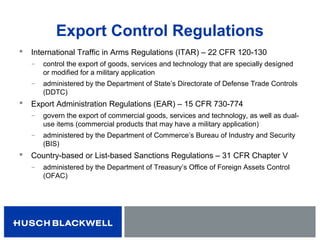
Export Control Regulations
 International Traffic in Arms Regulations (ITAR) – 22 CFR 120-130
̶ control the export of goods, services and technology that are specially designed
or modified for a military application
̶ administered by the Department of State’s Directorate of Defense Trade Controls
(DDTC)
 Export Administration Regulations (EAR) – 15 CFR 730-774
̶ govern the export of commercial goods, services and technology, as well as dual-
use items (commercial products that may have a military application)
̶ administered by the Department of Commerce’s Bureau of Industry and Security
(BIS)
 Country-based or List-based Sanctions Regulations – 31 CFR Chapter V
̶ administered by the Department of Treasury’s Office of Foreign Assets Control
(OFAC)
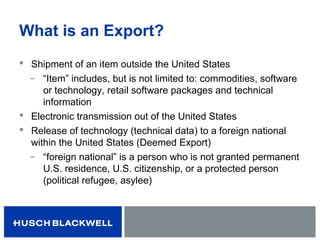
What is an Export?
 Shipment of an item outside the United States
̶ “Item” includes, but is not limited to: commodities, software
or technology, retail software packages and technical
information
 Electronic transmission out of the United States
 Release of technology (technical data) to a foreign national
within the United States (Deemed Export)
̶ “foreign national” is a person who is not granted permanent
U.S. residence, U.S. citizenship, or a protected person
(political refugee, asylee)
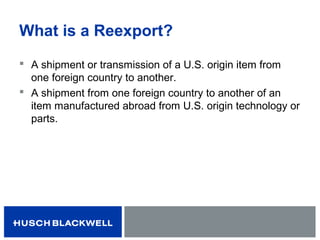
What is a Reexport?
 A shipment or transmission of a U.S. origin item from
one foreign country to another.
 A shipment from one foreign country to another of an
item manufactured abroad from U.S. origin technology or
parts.
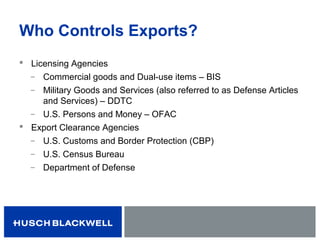
Who Controls Exports?
 Licensing Agencies
̶ Commercial goods and Dual-use items – BIS
̶ Military Goods and Services (also referred to as Defense Articles
and Services) – DDTC
̶ U.S. Persons and Money – OFAC
 Export Clearance Agencies
̶ U.S. Customs and Border Protection (CBP)
̶ U.S. Census Bureau
̶ Department of Defense
Critical Export Information
 WHAT is the product, service or technology?
 WHERE is it going?
̶ Where is the ultimate destination?
 WHO will receive it?
̶ Are there any intermediate consignees?
̶ Who is the ultimate consignee?
 WHY is the product, service or technology being exported?
̶ What will the end use be?
Export Control Reform
 DDTC and BIS spent 3 years revising the ITAR and EAR
to change the methods by which jurisdiction is
determined and the controls on exports.
 Numerous changes began to take place beginning in
October 2013 – Higher fences around fewer items
 Thousands of commodities have been migrated from
ITAR to EAR control and still more to come
Deemed Exports
 EAR 734.b(2)(ii) - Any release of technology or source code
subject to the EAR to a foreign national within the United
States “is deemed to be an export to the home country of the
foreign national.”
 ITAR 120.17(4) and 125.2(c) – “the oral, visual or
documentary disclosure of technical data by U.S. persons to
foreign persons.”
 Examples of deemed exports: product demonstrations,
technical trainings, sharing drawings, verbal conversations,
access to database containing controlled technology.
The Hiring Process – I-129
 CIS Form I-129, Part 6 requires Certification Regarding
the Release of Controlled Technology or Technical Data
to Foreign Persons in the United States
 Applies to U.S. employers filing H-1B, L-1 and O-1 visa
applications
Common Export Issues
 Failure to determine jurisdiction of new products
 Failure to obtain necessary licenses
 Technology released to foreign nationals within the
United States – deemed exports
 No control over server access
 No records of ongoing compliance procedures and
whether or not they were followed
OFAC Sanctions
 OFAC is responsible for administering and enforcing economic
and trade sanctions and embargoes against individuals and
countries.
 There are two general categories of OFAC sanctions: country-
based sanctions and list-based sanctions.
 There are currently three (3) country-wide sanctions programs:
̶ Cuba, Iran and Sudan
̶ US persons (individuals and entities) are prohibited from
doing business with or in the targeted countries absent a
license from OFAC.
̶ Certain exceptions exist for personal communications,
informational materials, food and medicine.
OFAC Sanctions (continued)
 List-based sanctions block certain individuals and entities in specific
countries (i.e., North Korea, Russia, Ivory Coast, Syria and Zimbabwe) from
transactions with US persons.
̶ OFAC maintains a list of specially designated nationals (SDN) which includes all
of the blocked persons that are targeted by the list-based sanctions
 http://www.treasury.gov/resource-center/sanctions/SDN-List/Pages/default.aspx
̶ Earlier this year, OFAC released the Foreign Sanctions Evaders (FSE) List which
targets individuals and entities which OFAC determines have violated, attempted
to violate, conspired to violate or caused violations of U.S. sanctions against Syria
and Iran.
 http://www.treasury.gov/resource-center/sanctions/SDN-List/Pages/fse_list.aspx
Export Control Penalties
 Penalties for EAR Violations:
̶ Criminal: Up to $1 million per violation/20 years imprisonment (individuals)
̶ Civil Fines: Up to $250,000 per violation or up to 2x the amount of the
transaction; suspension or debarment from government contracts and
revocation of export privileges
 Penalties for ITAR Violations:
̶ Criminal: Up to $1 million per violation/10 years imprisonment (individuals)
̶ Civil Fines: Up to $500,000 per violation, suspension or debarment from
government contracts and revocation of export privileges
 Penalties for OFAC Violations:
̶ Criminal: Up to $1 million per violation/10 years imprisonment
̶ Civil: Up to $250,000 per violation, suspension or debarment from
government contracts
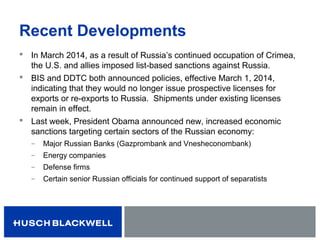
Recent Developments
 In March 2014, as a result of Russia’s continued occupation of Crimea,
the U.S. and allies imposed list-based sanctions against Russia.
 BIS and DDTC both announced policies, effective March 1, 2014,
indicating that they would no longer issue prospective licenses for
exports or re-exports to Russia. Shipments under existing licenses
remain in effect.
 Last week, President Obama announced new, increased economic
sanctions targeting certain sectors of the Russian economy:
̶ Major Russian Banks (Gazprombank and Vnesheconombank)
̶ Energy companies
̶ Defense firms
̶ Certain senior Russian officials for continued support of separatists
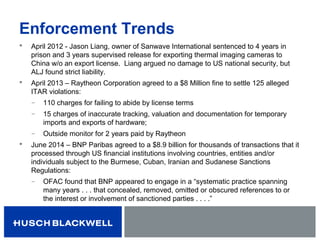
Enforcement Trends
 April 2012 - Jason Liang, owner of Sanwave International sentenced to 4 years in
prison and 3 years supervised release for exporting thermal imaging cameras to
China w/o an export license. Liang argued no damage to US national security, but
ALJ found strict liability.
 April 2013 – Raytheon Corporation agreed to a $8 Million fine to settle 125 alleged
ITAR violations:
̶ 110 charges for failing to abide by license terms
̶ 15 charges of inaccurate tracking, valuation and documentation for temporary
imports and exports of hardware;
̶ Outside monitor for 2 years paid by Raytheon
 June 2014 – BNP Paribas agreed to a $8.9 billion for thousands of transactions that it
processed through US financial institutions involving countries, entities and/or
individuals subject to the Burmese, Cuban, Iranian and Sudanese Sanctions
Regulations:
̶ OFAC found that BNP appeared to engage in a “systematic practice spanning
many years . . . that concealed, removed, omitted or obscured references to or
the interest or involvement of sanctioned parties . . . .”
Types of Trade Remedies Cases
 ANTIDUMPING
 COUNTERVAILING DUTIES (SUBSIDIES)
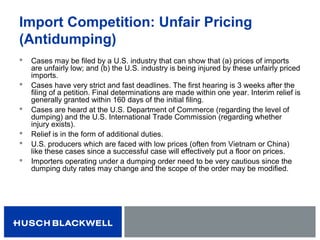
Import Competition: Unfair Pricing
(Antidumping)
 Cases may be filed by a U.S. industry that can show that (a) prices of imports
are unfairly low; and (b) the U.S. industry is being injured by these unfairly priced
imports.
 Cases have very strict and fast deadlines. The first hearing is 3 weeks after the
filing of a petition. Final determinations are made within one year. Interim relief is
generally granted within 160 days of the initial filing.
 Cases are heard at the U.S. Department of Commerce (regarding the level of
dumping) and the U.S. International Trade Commission (regarding whether
injury exists).
 Relief is in the form of additional duties.
 U.S. producers which are faced with low prices (often from Vietnam or China)
like these cases since a successful case will effectively put a floor on prices.
 Importers operating under a dumping order need to be very cautious since the
dumping duty rates may change and the scope of the order may be modified.
Import Competition: Subsidy Cases
(Countervailing Duties)
 Similar to dumping cases in that a U.S. industry must show (a) a
prohibited subsidy and (b) injury to a U.S. industry
 Remedy is increased duties
 Subsidies may be such things as export subsidies, special tax
zones for exporters, government loans at below market rates,
preferential tax benefits for exporters, preferential tax benefits for
certain industries, equity infusions in non-equity worthy companies
 CVD cases against China are a fairly recent development
 Subsidy cases are often filed simultaneously with dumping cases
Dumping: Mandatory vs. separate rates
respondents
 All companies from China will be covered by a dumping order on a product.
There are three categories of companies: (1) mandatory respondents, (2)
separate rates respondents, and (3) China-wide rate respondents. In market
economy countries only mandatory respondents and average rate respondents.
Either way, everyone is covered.
 DOC picks the top exporters (by volume) as the mandatory respondents.
Usually, in recent cases, DOC likes to pick about 2-3 mandatory respondents.
Mandatory respondents get their own individual rates
 Separate rates companies in China must fill out a form with basic information on
their operations and submit it to DOC. They must show that they are not
controlled by the Chinese government. If they are successful, they will obtain
the average rate of the mandatory respondents. China-wide respondents get
very high rates. No need to fill out much forms for market economy countries.
TWO SIDES OF DUMPING CALCULATION: U.S.
PRICE AND NORMAL VALUE
 USP is the price, f.o.b. the foreign factory. It is determined by taking the
gross price to the U.S. customer (first unrelated company) and
deducting ocean freight, customs duties, U.S. inland freight, other
similar expenses to get back to the f.o.b. factory price
 For normal value for non-market economies such as China, DOC takes
the actual inputs from China (such as the amount of each raw material,
the hours of labor, and then values these inputs from a “surrogate
country” which is a market economy (such as India) One problem with
this approach is that the data available from the surrogate country often
is itself distorted or is not exactly the same input as is being used in
China.
 Normal value for market economy countries is prices for products ??? In
home market, or if home market is too ????, than in largest third
country market.
CHINESE DUMPING -- INPUT – OUTPUT
CALCULATIONS
 Generally the US law firm will obtain the surrogate values, with the
input from the client and the foreign law firm regarding the
description of the merchandise.
 The foreign law firm generally takes the lead in preparing the input-
output calculations for labor, raw materials, energy for the Chinese
client, with the assistance of the US law firm. Input-output needs to
be an accurate reflection of the records during the period of
investigation (POI) which is usually 6 months.
 Under the law, DOC will “verify, ” i.e., audit the information during an
on-site visit to the companies in China, for all mandatory
respondents. The US and Chinese law firms will help prepare for
and assist in the verification, but DOC will require that the company
provide the information and answer its questions.
Administrative Reviews
 The US system is a “retrospective” system which is different from the
EU system or that of some other countries. In the US the dumping
duties are not the final amount owed but only an estimate, with the final
amount due decided only at the time of an administrative review.
 The original POI is only a sample period to determine the estimated
dumping duties.
 Administrative reviews are conducted annually and are to be requested
in the anniversary month of the order and cover sales and entries for
the prior one year period (but for a longer period for the first review
period)
 Administrative reviews are very much like an original DOC investigation
with the same types of questions.
Dumping -- New Shippers
 New shippers are companies that did not export to the US
during the original POI. They may apply for their exports to
be reviewed on the anniversary of the order or on the six-
month anniversary.
 Often companies make one shipment and apply for a new
shipper review in order to obtain their own rate.
 The DOC regulations require that a company show that the
“new shipper” did not export during the POI and was not
affiliated with a company or person who did export during the
POI.
Liability for dumping duties
 The law provides that the importer of record is the party that is
responsible for the payment of dumping duties
 As a practical matter, because of the risk of increased dumping
duties, customers often do not want to become the importer of
record.
 Foreign companies can set up their own operations in the US or
otherwise become the importer of record to absorb the risk of
increased dumping duties and retain customers
 The law forbids reimbursement of dumping duties from an exporter
to an importer. If DOC discovers this, it will make charge the
importer double the dumping duties.
Circumvention
 Statute intended to prevent evasion of AD and CVD
orders
 ITA, with input from ITC, can include out of scope
merchandise in the order if certain circumstances are
met
Circumvention
 Merchandise sold in the U.S. which is assembled in the
U.S. or in another country with a part or parts subject to
the order can be included in the order if the process of
assembly or completion is minor or insignificant and the
part or parts represent a significant portion of the value
of the finished good.
Circumvention
 Insignificant assembly
̶ Level of investment
̶ Amount of R&D
̶ Production process
̶ Value of processing
Circumvention
 Factors to Consider
̶ Patterns of trade
̶ Affiliation
̶ Increased shipments
Circumvention
 Later developed merchandise
̶ Same general physical characteristics
̶ Expectations of purchasers
̶ Ultimate use
̶ Channels of trade
̶ Advertising and display
Circumvention
 Later developed merchandise
̶ Exclusion
 Different classification
 Additional functions and cost
̶ Determinations to be made within 300 days
Risk #1 – The Customs Rulings Do
Not Solve the Problem
1. EU company buys an input (apparently outside the
scope of a dumping order)from China and transforms it
in the EU country
2. The EU company obtains a formal origin ruling from its
home country confirming that the appropriate country of
origin is the EU country
3. The company goes further and also obtains a ruling
from CBP that the goods are a product of the EU
country
Risk #1 continued
4. Despite these efforts, the U.S. industry with an order on
the final product files an “anti-circumvention” and scope
ruling request at the Department of Commerce
5. Commerce investigates the issue for over a year,
disrupting the business of the EU producer and decides
that both the EU and CBP rulings are irrelevant
6. In finding that the EU product is circumventing,
Commerce applies different standards from CBP that
are in part wholly subjective
Risk #2 – The Merger
1. EU company purchases Korean subsidiary, conducting
traditional due diligence on the transaction but not
examining impact of possible dumping circumvention
2. Acquired Korean company has been importing certain
products from China, into Korea, doing minor
alterations, but enough to obtain Korean country of
origin for US AD purposes. Thus, the product was
“product of China” for the purpose of the dumping duties
and duties were owed.
3. The duties may be retrospective, possibly making the
change in money owed material to the acquisition
Scope, Circumvention, and Tariff
Classifications
1. Statute intended to prevent evasion of AD and CVD
orders
2. ITA, with input from ITC, can include out of scope
merchandise in the order if certain circumstances are
met
3. While CBP uses the tariff classification for convenience,
and many importers rely on the HTS list to see if they
are “safe,” the classifications do NOT define the scope
4. HTS classifications are listed in the scope of AD/CVD
orders for convenience only and every AD/CVD order
states this explicitly
Scope, Circumvention, and Tariff
Classifications
5. One problem is that Customs usually uses the tariff to
identify the covered entries, for convenience purposes.
However, if an importer does not pay deposits on
products clearly covered by the order, there can be up
to 5 years of unpaid AD/CVD duties, plus interest and
penalties
6. Some examples of the confusion caused by certain
Commerce orders illustrates the problem
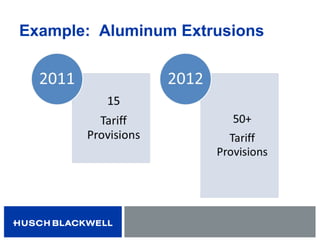
Example: Aluminum Extrusions
Aluminum Extrusions
By the written terms of the scope, no “additions” to the
scope
By tariff provision, a fivefold (or so) increase in scope
Importers and the new 35+ HTSUS provisions are liable for
the AD order
Isn’t The Extrusion Case Atypical?
Maybe it is not typical in terms of the number of HTS items
added, but it is typical as to how an order expands. It is not
unusual for a domestic US industry to obtain an order on a
product and then seek to expand the scope
“Misclassifications”
This can be the source of the greatest risk for liability – a
company that seems to have intentionally misclassified a
product to evade the dumping duty. Not only will dumping
duties be applied but also Customs penalties.
Examples made of individuals
The fact that CBP has made an example of a few people
has helped convince Congress that this is a larger problem
that needs to be addressed.
Frozen Fish Fillets from Vietnam
̶ Peter Xuong Lam sentenced to 63 months in prison for
fraudulently mislabeling and selling fish (May 19, 2009)
̶ Also ordered to forfeit $12 million in unpaid AD duties
̶ A dozen convictions in this case (so far)
Another Example – Honey from
China
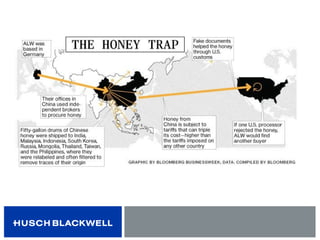
Antidumping duties in excess of 200% on Honey China.
China was the largest supplier to the U.S. of honey before
AD Major disruption for importing companies
The “clever idea” (“nobody has ever thought of this
before”)
1. Ship honey from China to other countries for repackaging and
adulteration
2. Create false documents to support origin from third countries
3. Involve personnel in Europe, Asia, and the U.S. to continue the
fraud.
The results of the “clever idea”
 At least 11 individuals indicted
 Several companies either indicted or “deferred prosecution
agreements”
 People went to jail for importing honey and “obstructing” the
investigation by creating faking documents. Junior executives
who “followed orders” went to U.S. Federal prison
 Senior executives who helped create fake documents were
indicted for obstructing the investigation
 Otherwise respected companies were in the press as
“criminals”
What else? Scope request at
Commerce?
 A different procedure from classification at Customs.
The purpose here is to determine if the product is clearly
within the scope of the order, not the HTS classification.
One initial issue is whether to file a scope request at all
if there is ambiguity.
Scope requests
 Only “subject goods” are those described in the order
 Sometimes possible to “clarify” the order to have your
imports excluded from the case and get the US industry
to agree
 Means that your imports are simply not subject to the
order
Scope
 ITA conducts scope reviews
 Any interested party may request (including importer)
 Two tier review
̶ First ITA decides whether the good is clearly outside of
scope on face of scope
̶ If not, further inquiry
Any recourse at CBP?
 There are very few ways to help yourself in a dumping
case at liquidation
 Rates in some industries can be enormous (383.60% for
Handtrucks from China, for example).
 Finding the best strategy early, in the case of ambiguity
about coverage, is critical
Circumvention
 If the scope is not apparent, there still could be coverage under the
order due to anti-circumvention due to insufficient further
manufacturing in the US or in third countries, or alternatively, due to
“newly developed products” parts of the statute. While those
provisions are only prospective in nature, they can disrupt a
company’s marketing plans.
 Merchandise sold in the U.S. which is assembled in the U.S. or in
another country with a part or parts subject to the order can be
included in the order if the process of assembly or completion is
minor or insignificant and the part or parts represent a significant
portion of the value of the finished good.
Circumvention – later developed
merchandise
The nightmare scenario – Candles from China
1.A dumping order was issues in 1986 that defined the subject
merchandise as “petroleum wax candles made from petroleum wax”
and the ITC defined the domestic like product as candles “composed of
over 50% petroleum wax.” Commerce agreed in a number of scope
rulings that candles below 50% petroleum wax were excluded from the
scope of the order. For example, a 19% petroleum wax candle that
was 81% beeswax was found to be excluded.
2.Relying on the rulings and clear definition of both agencies importers
declared certain products subject to the order and other products
outside.
The nightmare scenario – Candles
from China
3. Eighteen years later, in 2004, the US domestic industry filed a
request with Commerce asking for a later-developed merchandise
inquiry. They claimed that the late 1990s development of mixed-
wax candles allowed importers to avoid paying dumping duties.
4. Commerce reviewed the request and found that candles with any
petroleum wax (even trace amounts) were within the scope of the
order. Commerce found that even if the candles with less than
50% petroleum wax had been available for many years, there had
not been sufficient “commercial availability” for Commerce to find
that they had been “developed” earlier.
5. The lack of increase in commercial demand for the product is
hardly surprising
The nightmare scenario – Candles
from China
6. The importers appealed to both the Court of International Trade and
to the Federal Circuit in 2010. The Federal Circuit that “commercial
availability” test was an acceptable test and was a reasonable
interpretation of the statute. The fact that the companies had relied on
specific Commerce scope rulings for the past 24 years was of no
consequence to the courts, because the product was later developed.
7. The result is that some importers owed millions of dollars in
additional duties for simply following the explicit rulings of Commerce.
What is to be done?
What is to be done?
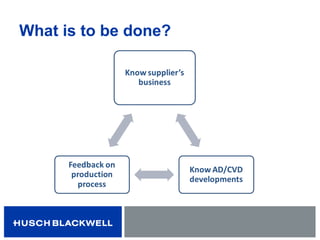
 The key to knowing the supplier’s business is knowing where the
inputs are coming from and determining if those inputs may be
subject to a dumping order
 If the product is subject to an order, the worst case is that it was
transshipped from a country under an order and no further
manufacturing done.
 If it is further manufactured using products subject to an order, or
making a product that is covered by an order from another country
(e.g. a Korean steel product that is covered by an order if made in
China) then a risk assessment should be conducted
What is to be done?
 The first instinct, to ask Commerce for a ruling or reveal
the possible problem to them, may not always be the
right approach. While it is critical to protect yourself
against any section 1592 issues with Customs, the anti-
circumvention standards are ambiguous and unclear.
The issue is usually one of business risk rather than a
requirement of disclosure (assuming that the product is
correctly classified and described on the invoice).
SECTION 337 CASES
1. Cases go before an administrative law judge. Similar to
U.S. district court proceeding.
2. Remedies available are exclusion orders or cease and
desist orders, not money damages.
3. Much faster relief than U.S. District Court proceedings,
usually within 18 months at the most.
SECTION 337 CASES
4. Cases mostly involve intellectual property violations such
as patents, copyrights, trademarks.
5. The enforcement for exclusion orders is by Customs &
Border Protection so effective relief for domestic
producers means that working with them on enforcement
is key.

International_Trade_Regulation_Presentation

  • 1.
    © Husch BlackwellLLP International Trade Regulation and The Supply Chain Jeffrey S. Neeley Cortney O. Morgan Michael S. Holton July 23, 2014
  • 2.
    Introduction  International RegulationAreas ̶ Export Controls, Sanctions ̶ Trade Remedies – Dumping and Subsidy Cases ̶ Intellectual Property Cases (Section 337 of the Trade Act) ̶ Other Provisions – Lacey Act, Other Environmental Standards, Product Safety
  • 3.
    U.S. Export Controls The U.S. Government controls exports of sensitive U.S. equipment, software, technology and services as a means to promote national security interests and foreign policy objectives.  Under the current system, there are three (3) federal government agencies which have the authority to regulate exports: the Departments of State, Commerce and Treasury.  U.S. export controls regimes are organized in several sets of regulations: ITAR, EAR and country-specific embargoes.
  • 4.
    Export Control Regulations International Traffic in Arms Regulations (ITAR) – 22 CFR 120-130 ̶ control the export of goods, services and technology that are specially designed or modified for a military application ̶ administered by the Department of State’s Directorate of Defense Trade Controls (DDTC)  Export Administration Regulations (EAR) – 15 CFR 730-774 ̶ govern the export of commercial goods, services and technology, as well as dual- use items (commercial products that may have a military application) ̶ administered by the Department of Commerce’s Bureau of Industry and Security (BIS)  Country-based or List-based Sanctions Regulations – 31 CFR Chapter V ̶ administered by the Department of Treasury’s Office of Foreign Assets Control (OFAC)
  • 5.
    What is anExport?  Shipment of an item outside the United States ̶ “Item” includes, but is not limited to: commodities, software or technology, retail software packages and technical information  Electronic transmission out of the United States  Release of technology (technical data) to a foreign national within the United States (Deemed Export) ̶ “foreign national” is a person who is not granted permanent U.S. residence, U.S. citizenship, or a protected person (political refugee, asylee)
  • 6.
    What is aReexport?  A shipment or transmission of a U.S. origin item from one foreign country to another.  A shipment from one foreign country to another of an item manufactured abroad from U.S. origin technology or parts.
  • 7.
    Who Controls Exports? Licensing Agencies ̶ Commercial goods and Dual-use items – BIS ̶ Military Goods and Services (also referred to as Defense Articles and Services) – DDTC ̶ U.S. Persons and Money – OFAC  Export Clearance Agencies ̶ U.S. Customs and Border Protection (CBP) ̶ U.S. Census Bureau ̶ Department of Defense
  • 8.
    Critical Export Information WHAT is the product, service or technology?  WHERE is it going? ̶ Where is the ultimate destination?  WHO will receive it? ̶ Are there any intermediate consignees? ̶ Who is the ultimate consignee?  WHY is the product, service or technology being exported? ̶ What will the end use be?
  • 9.
    Export Control Reform DDTC and BIS spent 3 years revising the ITAR and EAR to change the methods by which jurisdiction is determined and the controls on exports.  Numerous changes began to take place beginning in October 2013 – Higher fences around fewer items  Thousands of commodities have been migrated from ITAR to EAR control and still more to come
  • 10.
    Deemed Exports  EAR734.b(2)(ii) - Any release of technology or source code subject to the EAR to a foreign national within the United States “is deemed to be an export to the home country of the foreign national.”  ITAR 120.17(4) and 125.2(c) – “the oral, visual or documentary disclosure of technical data by U.S. persons to foreign persons.”  Examples of deemed exports: product demonstrations, technical trainings, sharing drawings, verbal conversations, access to database containing controlled technology.
  • 11.
    The Hiring Process– I-129  CIS Form I-129, Part 6 requires Certification Regarding the Release of Controlled Technology or Technical Data to Foreign Persons in the United States  Applies to U.S. employers filing H-1B, L-1 and O-1 visa applications
  • 12.
    Common Export Issues Failure to determine jurisdiction of new products  Failure to obtain necessary licenses  Technology released to foreign nationals within the United States – deemed exports  No control over server access  No records of ongoing compliance procedures and whether or not they were followed
  • 13.
    OFAC Sanctions  OFACis responsible for administering and enforcing economic and trade sanctions and embargoes against individuals and countries.  There are two general categories of OFAC sanctions: country- based sanctions and list-based sanctions.  There are currently three (3) country-wide sanctions programs: ̶ Cuba, Iran and Sudan ̶ US persons (individuals and entities) are prohibited from doing business with or in the targeted countries absent a license from OFAC. ̶ Certain exceptions exist for personal communications, informational materials, food and medicine.
  • 14.
    OFAC Sanctions (continued) List-based sanctions block certain individuals and entities in specific countries (i.e., North Korea, Russia, Ivory Coast, Syria and Zimbabwe) from transactions with US persons. ̶ OFAC maintains a list of specially designated nationals (SDN) which includes all of the blocked persons that are targeted by the list-based sanctions  http://www.treasury.gov/resource-center/sanctions/SDN-List/Pages/default.aspx ̶ Earlier this year, OFAC released the Foreign Sanctions Evaders (FSE) List which targets individuals and entities which OFAC determines have violated, attempted to violate, conspired to violate or caused violations of U.S. sanctions against Syria and Iran.  http://www.treasury.gov/resource-center/sanctions/SDN-List/Pages/fse_list.aspx
  • 15.
    Export Control Penalties Penalties for EAR Violations: ̶ Criminal: Up to $1 million per violation/20 years imprisonment (individuals) ̶ Civil Fines: Up to $250,000 per violation or up to 2x the amount of the transaction; suspension or debarment from government contracts and revocation of export privileges  Penalties for ITAR Violations: ̶ Criminal: Up to $1 million per violation/10 years imprisonment (individuals) ̶ Civil Fines: Up to $500,000 per violation, suspension or debarment from government contracts and revocation of export privileges  Penalties for OFAC Violations: ̶ Criminal: Up to $1 million per violation/10 years imprisonment ̶ Civil: Up to $250,000 per violation, suspension or debarment from government contracts
  • 16.
    Recent Developments  InMarch 2014, as a result of Russia’s continued occupation of Crimea, the U.S. and allies imposed list-based sanctions against Russia.  BIS and DDTC both announced policies, effective March 1, 2014, indicating that they would no longer issue prospective licenses for exports or re-exports to Russia. Shipments under existing licenses remain in effect.  Last week, President Obama announced new, increased economic sanctions targeting certain sectors of the Russian economy: ̶ Major Russian Banks (Gazprombank and Vnesheconombank) ̶ Energy companies ̶ Defense firms ̶ Certain senior Russian officials for continued support of separatists
  • 17.
    Enforcement Trends  April2012 - Jason Liang, owner of Sanwave International sentenced to 4 years in prison and 3 years supervised release for exporting thermal imaging cameras to China w/o an export license. Liang argued no damage to US national security, but ALJ found strict liability.  April 2013 – Raytheon Corporation agreed to a $8 Million fine to settle 125 alleged ITAR violations: ̶ 110 charges for failing to abide by license terms ̶ 15 charges of inaccurate tracking, valuation and documentation for temporary imports and exports of hardware; ̶ Outside monitor for 2 years paid by Raytheon  June 2014 – BNP Paribas agreed to a $8.9 billion for thousands of transactions that it processed through US financial institutions involving countries, entities and/or individuals subject to the Burmese, Cuban, Iranian and Sudanese Sanctions Regulations: ̶ OFAC found that BNP appeared to engage in a “systematic practice spanning many years . . . that concealed, removed, omitted or obscured references to or the interest or involvement of sanctioned parties . . . .”
  • 18.
    Types of TradeRemedies Cases  ANTIDUMPING  COUNTERVAILING DUTIES (SUBSIDIES)
  • 19.
    Import Competition: UnfairPricing (Antidumping)  Cases may be filed by a U.S. industry that can show that (a) prices of imports are unfairly low; and (b) the U.S. industry is being injured by these unfairly priced imports.  Cases have very strict and fast deadlines. The first hearing is 3 weeks after the filing of a petition. Final determinations are made within one year. Interim relief is generally granted within 160 days of the initial filing.  Cases are heard at the U.S. Department of Commerce (regarding the level of dumping) and the U.S. International Trade Commission (regarding whether injury exists).  Relief is in the form of additional duties.  U.S. producers which are faced with low prices (often from Vietnam or China) like these cases since a successful case will effectively put a floor on prices.  Importers operating under a dumping order need to be very cautious since the dumping duty rates may change and the scope of the order may be modified.
  • 20.
    Import Competition: SubsidyCases (Countervailing Duties)  Similar to dumping cases in that a U.S. industry must show (a) a prohibited subsidy and (b) injury to a U.S. industry  Remedy is increased duties  Subsidies may be such things as export subsidies, special tax zones for exporters, government loans at below market rates, preferential tax benefits for exporters, preferential tax benefits for certain industries, equity infusions in non-equity worthy companies  CVD cases against China are a fairly recent development  Subsidy cases are often filed simultaneously with dumping cases
  • 21.
    Dumping: Mandatory vs.separate rates respondents  All companies from China will be covered by a dumping order on a product. There are three categories of companies: (1) mandatory respondents, (2) separate rates respondents, and (3) China-wide rate respondents. In market economy countries only mandatory respondents and average rate respondents. Either way, everyone is covered.  DOC picks the top exporters (by volume) as the mandatory respondents. Usually, in recent cases, DOC likes to pick about 2-3 mandatory respondents. Mandatory respondents get their own individual rates  Separate rates companies in China must fill out a form with basic information on their operations and submit it to DOC. They must show that they are not controlled by the Chinese government. If they are successful, they will obtain the average rate of the mandatory respondents. China-wide respondents get very high rates. No need to fill out much forms for market economy countries.
  • 22.
    TWO SIDES OFDUMPING CALCULATION: U.S. PRICE AND NORMAL VALUE  USP is the price, f.o.b. the foreign factory. It is determined by taking the gross price to the U.S. customer (first unrelated company) and deducting ocean freight, customs duties, U.S. inland freight, other similar expenses to get back to the f.o.b. factory price  For normal value for non-market economies such as China, DOC takes the actual inputs from China (such as the amount of each raw material, the hours of labor, and then values these inputs from a “surrogate country” which is a market economy (such as India) One problem with this approach is that the data available from the surrogate country often is itself distorted or is not exactly the same input as is being used in China.  Normal value for market economy countries is prices for products ??? In home market, or if home market is too ????, than in largest third country market.
  • 23.
    CHINESE DUMPING --INPUT – OUTPUT CALCULATIONS  Generally the US law firm will obtain the surrogate values, with the input from the client and the foreign law firm regarding the description of the merchandise.  The foreign law firm generally takes the lead in preparing the input- output calculations for labor, raw materials, energy for the Chinese client, with the assistance of the US law firm. Input-output needs to be an accurate reflection of the records during the period of investigation (POI) which is usually 6 months.  Under the law, DOC will “verify, ” i.e., audit the information during an on-site visit to the companies in China, for all mandatory respondents. The US and Chinese law firms will help prepare for and assist in the verification, but DOC will require that the company provide the information and answer its questions.
  • 24.
    Administrative Reviews  TheUS system is a “retrospective” system which is different from the EU system or that of some other countries. In the US the dumping duties are not the final amount owed but only an estimate, with the final amount due decided only at the time of an administrative review.  The original POI is only a sample period to determine the estimated dumping duties.  Administrative reviews are conducted annually and are to be requested in the anniversary month of the order and cover sales and entries for the prior one year period (but for a longer period for the first review period)  Administrative reviews are very much like an original DOC investigation with the same types of questions.
  • 25.
    Dumping -- NewShippers  New shippers are companies that did not export to the US during the original POI. They may apply for their exports to be reviewed on the anniversary of the order or on the six- month anniversary.  Often companies make one shipment and apply for a new shipper review in order to obtain their own rate.  The DOC regulations require that a company show that the “new shipper” did not export during the POI and was not affiliated with a company or person who did export during the POI.
  • 26.
    Liability for dumpingduties  The law provides that the importer of record is the party that is responsible for the payment of dumping duties  As a practical matter, because of the risk of increased dumping duties, customers often do not want to become the importer of record.  Foreign companies can set up their own operations in the US or otherwise become the importer of record to absorb the risk of increased dumping duties and retain customers  The law forbids reimbursement of dumping duties from an exporter to an importer. If DOC discovers this, it will make charge the importer double the dumping duties.
  • 27.
    Circumvention  Statute intendedto prevent evasion of AD and CVD orders  ITA, with input from ITC, can include out of scope merchandise in the order if certain circumstances are met
  • 28.
    Circumvention  Merchandise soldin the U.S. which is assembled in the U.S. or in another country with a part or parts subject to the order can be included in the order if the process of assembly or completion is minor or insignificant and the part or parts represent a significant portion of the value of the finished good.
  • 29.
    Circumvention  Insignificant assembly ̶Level of investment ̶ Amount of R&D ̶ Production process ̶ Value of processing
  • 30.
    Circumvention  Factors toConsider ̶ Patterns of trade ̶ Affiliation ̶ Increased shipments
  • 31.
    Circumvention  Later developedmerchandise ̶ Same general physical characteristics ̶ Expectations of purchasers ̶ Ultimate use ̶ Channels of trade ̶ Advertising and display
  • 32.
    Circumvention  Later developedmerchandise ̶ Exclusion  Different classification  Additional functions and cost ̶ Determinations to be made within 300 days
  • 33.
    Risk #1 –The Customs Rulings Do Not Solve the Problem 1. EU company buys an input (apparently outside the scope of a dumping order)from China and transforms it in the EU country 2. The EU company obtains a formal origin ruling from its home country confirming that the appropriate country of origin is the EU country 3. The company goes further and also obtains a ruling from CBP that the goods are a product of the EU country
  • 34.
    Risk #1 continued 4.Despite these efforts, the U.S. industry with an order on the final product files an “anti-circumvention” and scope ruling request at the Department of Commerce 5. Commerce investigates the issue for over a year, disrupting the business of the EU producer and decides that both the EU and CBP rulings are irrelevant 6. In finding that the EU product is circumventing, Commerce applies different standards from CBP that are in part wholly subjective
  • 35.
    Risk #2 –The Merger 1. EU company purchases Korean subsidiary, conducting traditional due diligence on the transaction but not examining impact of possible dumping circumvention 2. Acquired Korean company has been importing certain products from China, into Korea, doing minor alterations, but enough to obtain Korean country of origin for US AD purposes. Thus, the product was “product of China” for the purpose of the dumping duties and duties were owed. 3. The duties may be retrospective, possibly making the change in money owed material to the acquisition
  • 36.
    Scope, Circumvention, andTariff Classifications 1. Statute intended to prevent evasion of AD and CVD orders 2. ITA, with input from ITC, can include out of scope merchandise in the order if certain circumstances are met 3. While CBP uses the tariff classification for convenience, and many importers rely on the HTS list to see if they are “safe,” the classifications do NOT define the scope 4. HTS classifications are listed in the scope of AD/CVD orders for convenience only and every AD/CVD order states this explicitly
  • 37.
    Scope, Circumvention, andTariff Classifications 5. One problem is that Customs usually uses the tariff to identify the covered entries, for convenience purposes. However, if an importer does not pay deposits on products clearly covered by the order, there can be up to 5 years of unpaid AD/CVD duties, plus interest and penalties 6. Some examples of the confusion caused by certain Commerce orders illustrates the problem
  • 38.
  • 39.
    Aluminum Extrusions By thewritten terms of the scope, no “additions” to the scope By tariff provision, a fivefold (or so) increase in scope Importers and the new 35+ HTSUS provisions are liable for the AD order
  • 40.
    Isn’t The ExtrusionCase Atypical? Maybe it is not typical in terms of the number of HTS items added, but it is typical as to how an order expands. It is not unusual for a domestic US industry to obtain an order on a product and then seek to expand the scope
  • 41.
    “Misclassifications” This can bethe source of the greatest risk for liability – a company that seems to have intentionally misclassified a product to evade the dumping duty. Not only will dumping duties be applied but also Customs penalties.
  • 42.
    Examples made ofindividuals The fact that CBP has made an example of a few people has helped convince Congress that this is a larger problem that needs to be addressed. Frozen Fish Fillets from Vietnam ̶ Peter Xuong Lam sentenced to 63 months in prison for fraudulently mislabeling and selling fish (May 19, 2009) ̶ Also ordered to forfeit $12 million in unpaid AD duties ̶ A dozen convictions in this case (so far)
  • 43.
    Another Example –Honey from China Antidumping duties in excess of 200% on Honey China. China was the largest supplier to the U.S. of honey before AD Major disruption for importing companies The “clever idea” (“nobody has ever thought of this before”) 1. Ship honey from China to other countries for repackaging and adulteration 2. Create false documents to support origin from third countries 3. Involve personnel in Europe, Asia, and the U.S. to continue the fraud.
  • 45.
    The results ofthe “clever idea”  At least 11 individuals indicted  Several companies either indicted or “deferred prosecution agreements”  People went to jail for importing honey and “obstructing” the investigation by creating faking documents. Junior executives who “followed orders” went to U.S. Federal prison  Senior executives who helped create fake documents were indicted for obstructing the investigation  Otherwise respected companies were in the press as “criminals”
  • 46.
    What else? Scoperequest at Commerce?  A different procedure from classification at Customs. The purpose here is to determine if the product is clearly within the scope of the order, not the HTS classification. One initial issue is whether to file a scope request at all if there is ambiguity.
  • 47.
    Scope requests  Only“subject goods” are those described in the order  Sometimes possible to “clarify” the order to have your imports excluded from the case and get the US industry to agree  Means that your imports are simply not subject to the order
  • 48.
    Scope  ITA conductsscope reviews  Any interested party may request (including importer)  Two tier review ̶ First ITA decides whether the good is clearly outside of scope on face of scope ̶ If not, further inquiry
  • 49.
    Any recourse atCBP?  There are very few ways to help yourself in a dumping case at liquidation  Rates in some industries can be enormous (383.60% for Handtrucks from China, for example).  Finding the best strategy early, in the case of ambiguity about coverage, is critical
  • 50.
    Circumvention  If thescope is not apparent, there still could be coverage under the order due to anti-circumvention due to insufficient further manufacturing in the US or in third countries, or alternatively, due to “newly developed products” parts of the statute. While those provisions are only prospective in nature, they can disrupt a company’s marketing plans.  Merchandise sold in the U.S. which is assembled in the U.S. or in another country with a part or parts subject to the order can be included in the order if the process of assembly or completion is minor or insignificant and the part or parts represent a significant portion of the value of the finished good.
  • 51.
    Circumvention – laterdeveloped merchandise The nightmare scenario – Candles from China 1.A dumping order was issues in 1986 that defined the subject merchandise as “petroleum wax candles made from petroleum wax” and the ITC defined the domestic like product as candles “composed of over 50% petroleum wax.” Commerce agreed in a number of scope rulings that candles below 50% petroleum wax were excluded from the scope of the order. For example, a 19% petroleum wax candle that was 81% beeswax was found to be excluded. 2.Relying on the rulings and clear definition of both agencies importers declared certain products subject to the order and other products outside.
  • 52.
    The nightmare scenario– Candles from China 3. Eighteen years later, in 2004, the US domestic industry filed a request with Commerce asking for a later-developed merchandise inquiry. They claimed that the late 1990s development of mixed- wax candles allowed importers to avoid paying dumping duties. 4. Commerce reviewed the request and found that candles with any petroleum wax (even trace amounts) were within the scope of the order. Commerce found that even if the candles with less than 50% petroleum wax had been available for many years, there had not been sufficient “commercial availability” for Commerce to find that they had been “developed” earlier. 5. The lack of increase in commercial demand for the product is hardly surprising
  • 53.
    The nightmare scenario– Candles from China 6. The importers appealed to both the Court of International Trade and to the Federal Circuit in 2010. The Federal Circuit that “commercial availability” test was an acceptable test and was a reasonable interpretation of the statute. The fact that the companies had relied on specific Commerce scope rulings for the past 24 years was of no consequence to the courts, because the product was later developed. 7. The result is that some importers owed millions of dollars in additional duties for simply following the explicit rulings of Commerce.
  • 54.
    What is tobe done?
  • 55.
    What is tobe done?  The key to knowing the supplier’s business is knowing where the inputs are coming from and determining if those inputs may be subject to a dumping order  If the product is subject to an order, the worst case is that it was transshipped from a country under an order and no further manufacturing done.  If it is further manufactured using products subject to an order, or making a product that is covered by an order from another country (e.g. a Korean steel product that is covered by an order if made in China) then a risk assessment should be conducted
  • 56.
    What is tobe done?  The first instinct, to ask Commerce for a ruling or reveal the possible problem to them, may not always be the right approach. While it is critical to protect yourself against any section 1592 issues with Customs, the anti- circumvention standards are ambiguous and unclear. The issue is usually one of business risk rather than a requirement of disclosure (assuming that the product is correctly classified and described on the invoice).
  • 57.
    SECTION 337 CASES 1.Cases go before an administrative law judge. Similar to U.S. district court proceeding. 2. Remedies available are exclusion orders or cease and desist orders, not money damages. 3. Much faster relief than U.S. District Court proceedings, usually within 18 months at the most.
  • 58.
    SECTION 337 CASES 4.Cases mostly involve intellectual property violations such as patents, copyrights, trademarks. 5. The enforcement for exclusion orders is by Customs & Border Protection so effective relief for domestic producers means that working with them on enforcement is key.