Exploring the Evolution of
Smart Homes: A Timeline
Author name
• Introduction
Smart homes are a rapidly growing technology, with new
features being constantly added and developed. This
presentation will explore the evolution of smart homes,
from the rst concept to the current advancements with
a timeline of events.
• Before the 21st Century
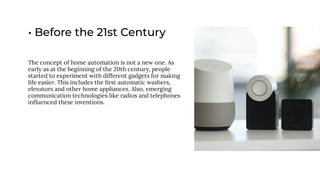
The concept of home automation is not a new one. As
early as at the beginning of the 20th century, people
started to experiment with different gadgets for making
life easier. This includes the rst automatic washers,
elevators and other home appliances. Also, emerging
communication technologies like radios and telephones
in uenced these inventions.
• Early 2000s – Wireless
Technology
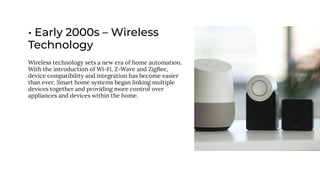
Wireless technology sets a new era of home automation.
With the introduction of Wi-Fi, Z-Wave and ZigBee,
device compatibility and integration has become easier
than ever. Smart home systems began linking multiple
devices together and providing more control over
appliances and devices within the home.
• Late 2000s – Home
Automation
At the turn of the century, home automation systems
began to spread widely, introducing voice-activated
virtual assistants and home security cameras. The early
2000s also saw the integration of home automation into
smarthomes. Controlling everything such as lights,
temperature, and security from a single app or website
became mainstream. With multiple home automation
companies providing a wide array of services, the
decade surely shifted the concept of smarthomes.
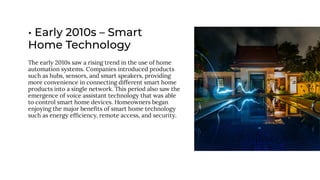
• Early 2010s – Smart
Home Technology
The early 2010s saw a rising trend in the use of home
automation systems. Companies introduced products
such as hubs, sensors, and smart speakers, providing
more convenience in connecting different smart home
products into a single network. This period also saw the
emergence of voice assistant technology that was able
to control smart home devices. Homeowners began
enjoying the major bene ts of smart home technology
such as energy ef ciency, remote access, and security.
• Mid to Late 2010s – Voice
Control Technology
Voice Control Technology
The mid 2010s saw the introduction of voice control
technology which allows users to control their devices
with just simple voice commands. This allows for a more
convenient and “hands-free” way to operate smart home
devices. By 2017, services like Google, Siri, and Alexa
became mainstream, providing users with a better
experience with their smart homes.
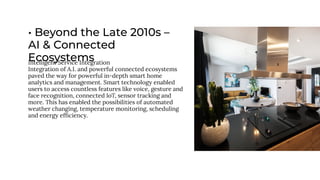
• Beyond the Late 2010s –
AI & Connected
Ecosystems
Intelligent Service Integration
Integration of A.I. and powerful connected ecosystems
paved the way for powerful in-depth smart home
analytics and management. Smart technology enabled
users to access countless features like voice, gesture and
face recognition, connected IoT, sensor tracking and
more. This has enabled the possibilities of automated
weather changing, temperature monitoring, scheduling
and energy ef ciency.
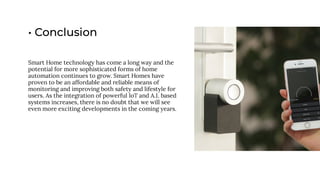
• Conclusion
Smart Home technology has come a long way and the
potential for more sophisticated forms of home
automation continues to grow. Smart Homes have
proven to be an affordable and reliable means of
monitoring and improving both safety and lifestyle for
users. As the integration of powerful IoT and A.I. based
systems increases, there is no doubt that we will see
even more exciting developments in the coming years.

exploring-the-evolution-of-smart-homes-a-timeline.pdf

  • 1.
    Exploring the Evolutionof Smart Homes: A Timeline Author name
  • 2.
    • Introduction Smart homesare a rapidly growing technology, with new features being constantly added and developed. This presentation will explore the evolution of smart homes, from the rst concept to the current advancements with a timeline of events.
  • 3.
    • Before the21st Century The concept of home automation is not a new one. As early as at the beginning of the 20th century, people started to experiment with different gadgets for making life easier. This includes the rst automatic washers, elevators and other home appliances. Also, emerging communication technologies like radios and telephones in uenced these inventions.
  • 4.
    • Early 2000s– Wireless Technology Wireless technology sets a new era of home automation. With the introduction of Wi-Fi, Z-Wave and ZigBee, device compatibility and integration has become easier than ever. Smart home systems began linking multiple devices together and providing more control over appliances and devices within the home.
  • 5.
    • Late 2000s– Home Automation At the turn of the century, home automation systems began to spread widely, introducing voice-activated virtual assistants and home security cameras. The early 2000s also saw the integration of home automation into smarthomes. Controlling everything such as lights, temperature, and security from a single app or website became mainstream. With multiple home automation companies providing a wide array of services, the decade surely shifted the concept of smarthomes.
  • 6.
    • Early 2010s– Smart Home Technology The early 2010s saw a rising trend in the use of home automation systems. Companies introduced products such as hubs, sensors, and smart speakers, providing more convenience in connecting different smart home products into a single network. This period also saw the emergence of voice assistant technology that was able to control smart home devices. Homeowners began enjoying the major bene ts of smart home technology such as energy ef ciency, remote access, and security.
  • 7.
    • Mid toLate 2010s – Voice Control Technology Voice Control Technology The mid 2010s saw the introduction of voice control technology which allows users to control their devices with just simple voice commands. This allows for a more convenient and “hands-free” way to operate smart home devices. By 2017, services like Google, Siri, and Alexa became mainstream, providing users with a better experience with their smart homes.
  • 8.
    • Beyond theLate 2010s – AI & Connected Ecosystems Intelligent Service Integration Integration of A.I. and powerful connected ecosystems paved the way for powerful in-depth smart home analytics and management. Smart technology enabled users to access countless features like voice, gesture and face recognition, connected IoT, sensor tracking and more. This has enabled the possibilities of automated weather changing, temperature monitoring, scheduling and energy ef ciency.
  • 9.
    • Conclusion Smart Hometechnology has come a long way and the potential for more sophisticated forms of home automation continues to grow. Smart Homes have proven to be an affordable and reliable means of monitoring and improving both safety and lifestyle for users. As the integration of powerful IoT and A.I. based systems increases, there is no doubt that we will see even more exciting developments in the coming years.