Expert Systems: Definition, Functioning, and Development Approach - [Part: 2]
1.
Artificial Intelligence
Expert Systems:Definition, Functioning, and
Development Approach - [Part: 2]
Dr. DEGHA Houssem Eddine
March 17, 2025
Dr. DEGHA Houssem Eddine Artificial Intelligence March 17, 2025 1/17
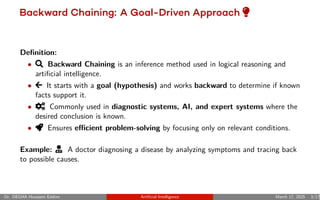
Backward Chaining: AGoal-Driven Approach Ď
Definition:
• f Backward Chaining is an inference method used in logical reasoning and
artificial intelligence.
• ± It starts with a goal (hypothesis) and works backward to determine if known
facts support it.
• Ð Commonly used in diagnostic systems, AI, and expert systems where the
desired conclusion is known.
• Ń Ensures efficient problem-solving by focusing only on relevant conditions.
Example: ď A doctor diagnosing a disease by analyzing symptoms and tracing back
to possible causes.
Dr. DEGHA Houssem Eddine Artificial Intelligence March 17, 2025 3/17
4.
Backward Chaining: Thinkingin Reverse
How it Works:
• Starts with a goal: Verifies its validity by analyzing prior conditions.
• Used in AI: Applied in decision support systems and logical reasoning.
• Efficient Processing: Focuses only on relevant information to reach conclusions.
Example Scenario: AI diagnosing a network issue by tracing root causes step by step.
Key Benefit: Increases efficiency by avoiding unnecessary data exploration.
Dr. DEGHA Houssem Eddine Artificial Intelligence March 17, 2025 4/17
5.
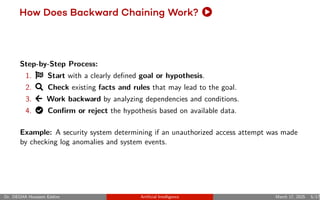
How Does BackwardChaining Work? Ŏ
Step-by-Step Process:
1. İ Start with a clearly defined goal or hypothesis.
2. f Check existing facts and rules that may lead to the goal.
3. ± Work backward by analyzing dependencies and conditions.
4. ¬ Confirm or reject the hypothesis based on available data.
Example: A security system determining if an unauthorized access attempt was made
by checking log anomalies and system events.
Dr. DEGHA Houssem Eddine Artificial Intelligence March 17, 2025 5/17
6.
Data and Relationships
Papersand Topics:
• Paper A: ”Deep Learning in NLP”
• Paper B: ”Neural Network Basics”
• Paper C: ”Advanced NLP Models”
• Paper D: ”Attention Mechanisms”
• Paper E: ”Transformer Networks”
• Paper F: ”Renewable Energy Systems”
• Paper G: ”Solar Power Innovations”
• Paper H: ”Wind Energy Optimization”
Known Relationships:
• cites(PaperA, PaperB)
• cites(PaperA, PaperC)
• cites(PaperB, PaperD)
• coCited(PaperC, PaperD)
• coCited(PaperD, PaperE)
• cites(PaperE, PaperF)
• coCited(PaperF, PaperG)
• cites(PaperG, PaperH)
Dr. DEGHA Houssem Eddine Artificial Intelligence March 17, 2025 6/17
7.
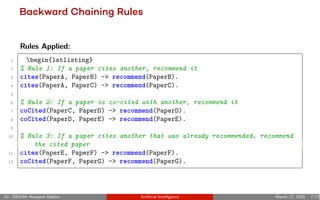
Backward Chaining Rules
RulesApplied:
1 begin{lstlisting}
2 % Rule 1: If a paper cites another, recommend it
3 cites(PaperA, PaperB) -> recommend(PaperB).
4 cites(PaperA, PaperC) -> recommend(PaperC).
5
6 % Rule 2: If a paper is co-cited with another, recommend it
7 coCited(PaperC, PaperD) -> recommend(PaperD).
8 coCited(PaperD, PaperE) -> recommend(PaperE).
9
10 % Rule 3: If a paper cites another that was already recommended, recommend
the cited paper
11 cites(PaperE, PaperF) -> recommend(PaperF).
12 coCited(PaperF, PaperG) -> recommend(PaperG).
Dr. DEGHA Houssem Eddine Artificial Intelligence March 17, 2025 7/17
8.
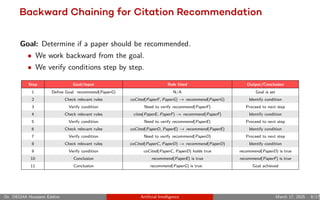
Backward Chaining forCitation Recommendation
Goal: Determine if a paper should be recommended.
• We work backward from the goal.
• We verify conditions step by step.
Step Goal/Input Rule Used Output/Conclusion
1 Define Goal: recommend(PaperG) N/A Goal is set
2 Check relevant rules coCited(PaperF, PaperG) → recommend(PaperG) Identify condition
3 Verify condition Need to verify recommend(PaperF) Proceed to next step
4 Check relevant rules cites(PaperE, PaperF) → recommend(PaperF) Identify condition
5 Verify condition Need to verify recommend(PaperE) Proceed to next step
6 Check relevant rules coCited(PaperD, PaperE) → recommend(PaperE) Identify condition
7 Verify condition Need to verify recommend(PaperD) Proceed to next step
8 Check relevant rules coCited(PaperC, PaperD) → recommend(PaperD) Identify condition
9 Verify condition coCited(PaperC, PaperD) holds true recommend(PaperD) is true
10 Conclusion recommend(PaperE) is true recommend(PaperF) is true
11 Conclusion recommend(PaperG) is true � Goal achieved
Dr. DEGHA Houssem Eddine Artificial Intelligence March 17, 2025 8/17
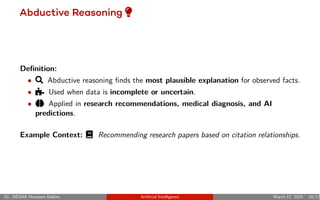
Abductive Reasoning Ď
Definition:
•f Abductive reasoning finds the most plausible explanation for observed facts.
• ľ Used when data is incomplete or uncertain.
• ͓ Applied in research recommendations, medical diagnosis, and AI
predictions.
Example Context: ‡ Recommending research papers based on citation relationships.
Dr. DEGHA Houssem Eddine Artificial Intelligence March 17, 2025 10/17
11.
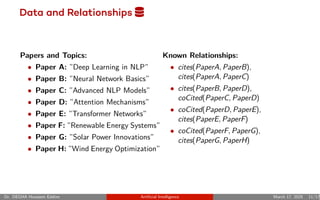
Data and RelationshipsƁ
Papers and Topics:
• Paper A: ”Deep Learning in NLP”
• Paper B: ”Neural Network Basics”
• Paper C: ”Advanced NLP Models”
• Paper D: ”Attention Mechanisms”
• Paper E: ”Transformer Networks”
• Paper F: ”Renewable Energy Systems”
• Paper G: ”Solar Power Innovations”
• Paper H: ”Wind Energy Optimization”
Known Relationships:
• cites(PaperA, PaperB),
cites(PaperA, PaperC)
• cites(PaperB, PaperD),
coCited(PaperC, PaperD)
• coCited(PaperD, PaperE),
cites(PaperE, PaperF)
• coCited(PaperF, PaperG),
cites(PaperG, PaperH)
Dr. DEGHA Houssem Eddine Artificial Intelligence March 17, 2025 11/17
12.
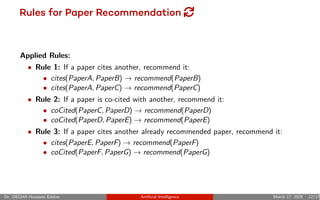
Rules for PaperRecommendation {
Applied Rules:
• Rule 1: If a paper cites another, recommend it:
• cites(PaperA, PaperB) → recommend(PaperB)
• cites(PaperA, PaperC) → recommend(PaperC)
• Rule 2: If a paper is co-cited with another, recommend it:
• coCited(PaperC, PaperD) → recommend(PaperD)
• coCited(PaperD, PaperE) → recommend(PaperE)
• Rule 3: If a paper cites another already recommended paper, recommend it:
• cites(PaperE, PaperF) → recommend(PaperF)
• coCited(PaperF, PaperG) → recommend(PaperG)
Dr. DEGHA Houssem Eddine Artificial Intelligence March 17, 2025 12/17
13.
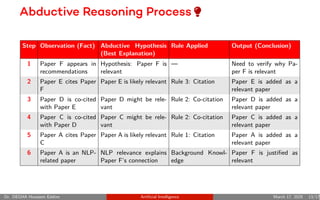
Abductive Reasoning ProcessĎ
Step Observation (Fact) Abductive Hypothesis
(Best Explanation)
Rule Applied Output (Conclusion)
1 Paper F appears in
recommendations
Hypothesis: Paper F is
relevant
— Need to verify why Pa-
per F is relevant
2 Paper E cites Paper
F
Paper E is likely relevant Rule 3: Citation Paper E is added as a
relevant paper
3 Paper D is co-cited
with Paper E
Paper D might be rele-
vant
Rule 2: Co-citation Paper D is added as a
relevant paper
4 Paper C is co-cited
with Paper D
Paper C might be rele-
vant
Rule 2: Co-citation Paper C is added as a
relevant paper
5 Paper A cites Paper
C
Paper A is likely relevant Rule 1: Citation Paper A is added as a
relevant paper
6 Paper A is an NLP-
related paper
NLP relevance explains
Paper F’s connection
Background Knowl-
edge
Paper F is justified as
relevant
Dr. DEGHA Houssem Eddine Artificial Intelligence March 17, 2025 13/17
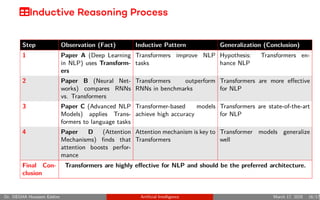
ĎInductive Reasoning: Concept
Definition:
Inductivereasoning generalizes from specific observations to broader principles or
rules. It is useful when patterns or trends are observed in the data, leading to
predictions.
Key Characteristics:
• fUsed for pattern recognition and trend analysis.
• ÐHelps in forming hypotheses and theories.
• ÍApplied in AI, machine learning, and scientific research.
Example: If multiple papers show a correlation between Transformer Networks and
high NLP performance, we can generalize that Transformers are effective for NLP
tasks.
Dr. DEGHA Houssem Eddine Artificial Intelligence March 17, 2025 15/17
16.
ûInductive Reasoning Process
StepObservation (Fact) Inductive Pattern Generalization (Conclusion)
1 Paper A (Deep Learning
in NLP) uses Transform-
ers
Transformers improve NLP
tasks
Hypothesis: Transformers en-
hance NLP
2 Paper B (Neural Net-
works) compares RNNs
vs. Transformers
Transformers outperform
RNNs in benchmarks
Transformers are more effective
for NLP
3 Paper C (Advanced NLP
Models) applies Trans-
formers to language tasks
Transformer-based models
achieve high accuracy
Transformers are state-of-the-art
for NLP
4 Paper D (Attention
Mechanisms) finds that
attention boosts perfor-
mance
Attention mechanism is key to
Transformers
Transformer models generalize
well
Final Con-
clusion
Transformers are highly effective for NLP and should be the preferred architecture.
Dr. DEGHA Houssem Eddine Artificial Intelligence March 17, 2025 16/17
17.
¬Benefits of InductiveReasoning
Why Use Inductive Reasoning?
• ͓Discovers hidden patterns in large datasets.
• ƥPredicts future trends based on past data.
• ĎForms general theories from real-world observations.
• ÐApplies to AI and machine learning for model training.
Example: The discovery of Transformers’ success in NLP led to their widespread
adoption in AI applications.
Dr. DEGHA Houssem Eddine Artificial Intelligence March 17, 2025 17/17
![Artificial Intelligence
Expert Systems: Definition, Functioning, and
Development Approach - [Part: 2]
Dr. DEGHA Houssem Eddine
March 17, 2025
Dr. DEGHA Houssem Eddine Artificial Intelligence March 17, 2025 1/17](https://image.slidesharecdn.com/ai-part-4compressed-250325210427-f643e6f6/85/Expert-Systems-Definition-Functioning-and-Development-Approach-Part-2-1-320.jpg)








![Expert Systems: Definition, Functioning, and Development Approach - [Part: 1]](https://cdn.slidesharecdn.com/ss_thumbnails/ai-part-3compressedcompressed-250325210228-b94546bf-thumbnail.jpg?width=640&height=640&fit=bounds)


