5 Key Principles for
Expanding Existing
Relationships
David Stott
Steven McIntosh
Agenda
• Market Trends
• Five Key Principles for Expanding Existing Accounts
• Summary
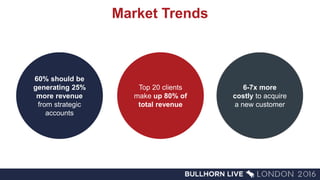
60% should be
generating 25%
more revenue
from strategic
accounts
6-7x more
costly to acquire
a new customer
Top 20 clients
make up 80% of
total revenue
Market Trends
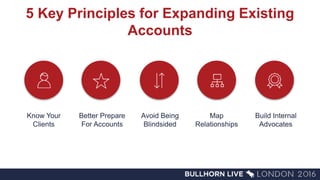
5 Key Principles for Expanding Existing
Accounts
Know Your
Clients
Better Prepare
For Accounts
Avoid Being
Blindsided
Map
Relationships
Build Internal
Advocates
Your Dad Is Your Father
(Stating The Obvious)
Know Your Clients
Understand Their
Strategy
Collaborate
For Success
Better Prepare for Accounts
Understand The State
Of Your Accounts
Better Prepare For
Client Meetings
Get Up To
Speed Quickly
Avoid Being Blindsided
Break Down
Departmental Silos
Mitigate And Reduce Escalations
Map Relationships
Map Relationships &
Focus On Engagement
Know Who You
Don’t Know
Build Internal Advocates
Identify Your Most Engaged
And Happy Contacts
Make It Personal
Work With Advocates To
Share Successes Internally
5 Key Principles for Expanding Existing
Accounts
Know Your
Clients
Better Prepare
For Accounts
Avoid Being
Blindsided
Map
Relationships
Build Internal
Advocates
Questions?

Expand Existing Accounts

Editor's Notes

  • #4 #2: Find a more specific statistic for recruitment Role dependent, type, etc. Client holds more power If can’t find better more specific stat, explanation will work Client efficiency – who are your top clients (great margin, don’t require effort or resources to serve, high win rate/success rate) 80/20 rule
  • #5 Care for your clients: Engagement card- not random names focus on engagement Blueprint: Who you do not know- filter Phone integration: within email/ tracking automatic Engagement Card Leverage your relationship for growth Pulse at at contact level VMS? Stare & Compare? What are you good at? Data entry, NPS: Reatvice Vs. Proactive Pulse digest--
  • #8 A key part to knowing your clients and being able to expand those relationships is working with the right clients. While it is may not always be as simple as the 3 categories here it is important to understand good clients form bad- and how you differentiate. Most businesses will have a way to measure this- it likely involved standard measures like average margin, volume of business but what about effort required to serve & win rate. If you do rank/ rate clients is this in Bullhorn & how do you use it. Additionally what data can bullhorn put in front of your consultants to help them understand which of the character on the screen they are dealing with? Benchmark and win rates Win ratios Amazon Vs. All companies Email & Phone activity- how hard are we working for success? A Rated clients Vs. B’s & C’s
  • #9 So you know who you want to work with. What do they care about & how do you keep aligned with your clients goals? Dave Content is King- Steven Demo News Feed
  • #10 Finally it is rare that any 1 person can be solely responsible for client success. In most cases client satisfaction is the result of a team effort. email notify, fast note slide out. Demo Steven fast note- Dave talk.
  • #12 We talked about aligning with client strategy- but that information is available in the market- if you can find it maybe your competitors can find it. So what make you unique? What makes a client choose to work with you? What makes any agency unique is the data they have & how they use that data. We understand this and that’s why we want you to have instant real time data available at your finger tips. A client calls and their normal contact is not there to help- what happens? Because Bullhorn is automatically capturing your data you can make the experience seamless for your client. You can see recent conversations and pick up where your colleague left off. Understanding what is happening in real time. Show Email conversation drill down into card subjects.
  • #13 This data can also be leverage for more formal preparation- like client reviews. Show a client dashboard with win rate planner and opportunities Speed to prepare How to get up to speed with the data available Tie this back to avoid being blindsided
  • #14 In recruitment time is not often on your side. Speed, combined with quality, can often control success. What happens when you don’t have a relationship? VMS access? Speed to prepare How to get up to speed with the data available Tie this back to avoid being blindsided
  • #16 The situations where something goes wrong are often the biggest opportunities. The way that you react to these situations can make or break relationships. Lets be honest no business relationship can be perfect everytime. Things will go wrong or not to plan how are you set up to deal with these.
  • #17 One way that we see clients using Bullhorn to turn these negative situations into positives is by breaking down silos within their own businesses. Collaborating and working together to resolve situations. I want to know what is going on with my key clients. Now traditionally this would be conversation with consultants or anecdotal information. With Bullhorn I can see real information as it happens. Management level: know whats going on in your biggest accounts (pulse) User level: trying to get more jobs, but another issue is preventing this from happening Email tracking, flagged dashboard- top accounts, phone integration.
  • #18 Management level: know whats going on in your biggest accounts (pulse) User level: trying to get more jobs, but another issue is preventing this from happening Proactive intelligence Pulse digest- art story
  • #20 Understand engagement Know who you are engaged with Know who you are not engaged with Identify relationship gaps Know where gaps exist in the relationship – by department, by level Plug those gaps by identifying and connecting with key stakeholders Know what you don’t know 4.5 people per sale. Pulse Cards
  • #21 Understand engagement Know who you are engaged with Know who you are not engaged with Identify relationship gaps Know where gaps exist in the relationship – by department, by level Plug those gaps by identifying and connecting with key stakeholders Know what you don’t know Steven Blueprint
  • #23 Warm referral or phone call/email Identify your most engaged and happy contacts Build personal relationships Get on a personal level with your best contacts Ask them about their family, life goals, etc. Provide a great experience Offer additional services if possible Make each interaction extremely high quality Provide value to your contacts Work with advocates to share successes internally Ask to create internal collateral in the form of video testimonials, case studies, quotes, etc. Even if they don’t want you to share it externally, it is still a piece that can be used internally and can help build rapport for future business opportunities Reward those internal advocates with an appreciation program NPS
  • #25 Warm referral or phone call/email Identify your most engaged and happy contacts Build personal relationships Get on a personal level with your best contacts Ask them about their family, life goals, etc. Provide a great experience Offer additional services if possible Make each interaction extremely high quality Provide value to your contacts Work with advocates to share successes internally Ask to create internal collateral in the form of video testimonials, case studies, quotes, etc. Even if they don’t want you to share it externally, it is still a piece that can be used internally and can help build rapport for future business opportunities Reward those internal advocates with an appreciation program
  • #26 Care for your clients: Engagement card- not random names focus on engagement Blueprint: Who you do not know- filter Phone integration: within email/ tracking automatic Engagement Card Leverage your relationship for growth Pulse at at contact level VMS? Stare & Compare? What are you good at? Data entry, NPS: Reatvice Vs. Proactive Pulse digest--