

Exemplo para embed.
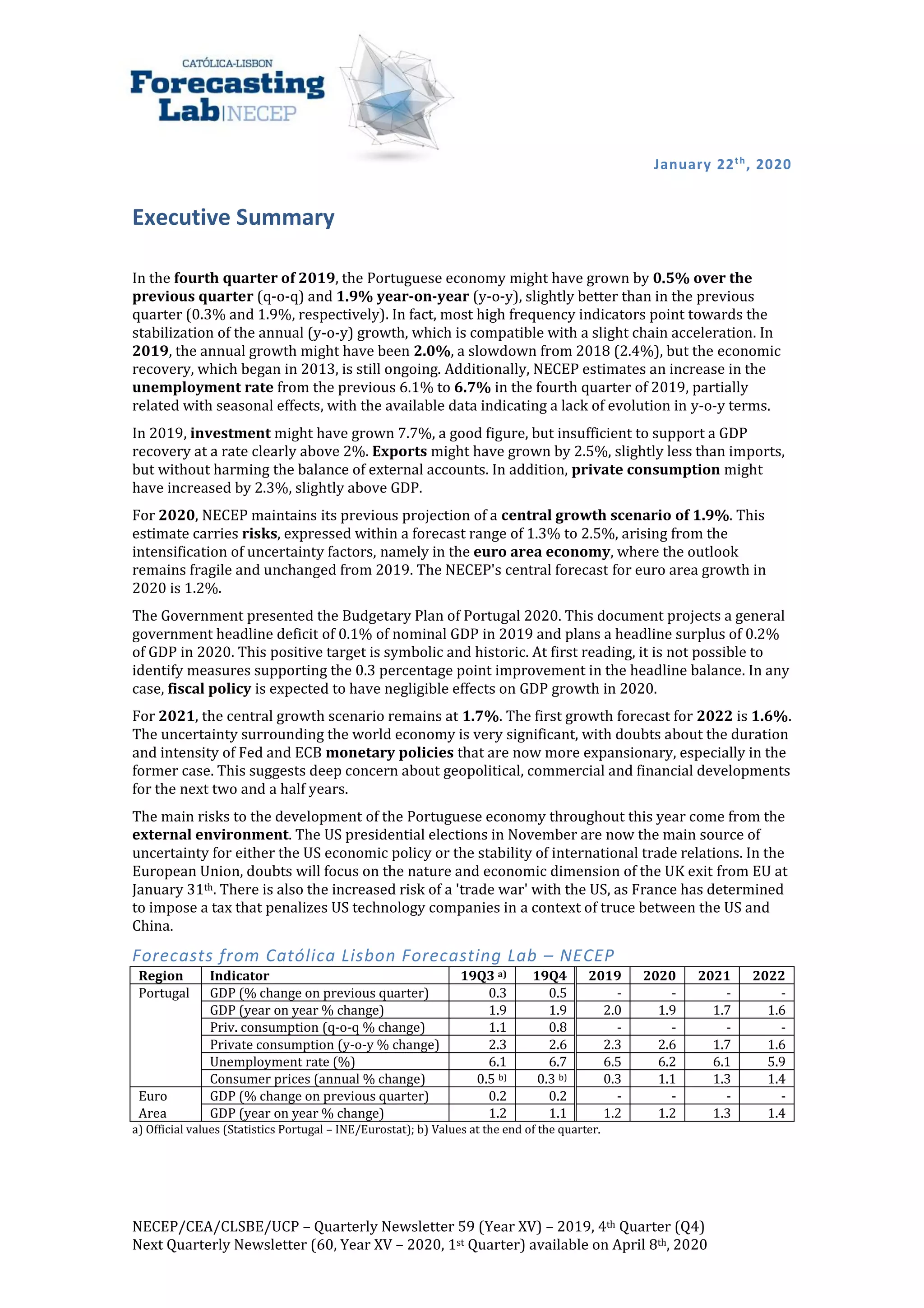
- 1. January 22th , 2020 NECEP/CEA/CLSBE/UCP– Quarterly Newsletter 59 (Year XV) – 2019, 4th Quarter (Q4) Next Quarterly Newsletter (60, Year XV – 2020, 1st Quarter) available on April 8th, 2020 Executive Summary In the fourth quarter of 2019, the Portuguese economy might have grown by 0.5% over the previous quarter (q-o-q) and 1.9% year-on-year (y-o-y), slightly better than in the previous quarter (0.3% and 1.9%, respectively). In fact, most high frequency indicators point towards the stabilization of the annual (y-o-y) growth, which is compatible with a slight chain acceleration. In 2019, the annual growth might have been 2.0%, a slowdown from 2018 (2.4%), but the economic recovery, which began in 2013, is still ongoing. Additionally, NECEP estimates an increase in the unemployment rate from the previous 6.1% to 6.7% in the fourth quarter of 2019, partially related with seasonal effects, with the available data indicating a lack of evolution in y-o-y terms. In 2019, investment might have grown 7.7%, a good figure, but insufficient to support a GDP recovery at a rate clearly above 2%. Exports might have grown by 2.5%, slightly less than imports, but without harming the balance of external accounts. In addition, private consumption might have increased by 2.3%, slightly above GDP. For 2020, NECEP maintains its previous projection of a central growth scenario of 1.9%. This estimate carries risks, expressed within a forecast range of 1.3% to 2.5%, arising from the intensification of uncertainty factors, namely in the euro area economy, where the outlook remains fragile and unchanged from 2019. The NECEP's central forecast for euro area growth in 2020 is 1.2%. The Government presented the Budgetary Plan of Portugal 2020. This document projects a general government headline deficit of 0.1% of nominal GDP in 2019 and plans a headline surplus of 0.2% of GDP in 2020. This positive target is symbolic and historic. At first reading, it is not possible to identify measures supporting the 0.3 percentage point improvement in the headline balance. In any case, fiscal policy is expected to have negligible effects on GDP growth in 2020. For 2021, the central growth scenario remains at 1.7%. The first growth forecast for 2022 is 1.6%. The uncertainty surrounding the world economy is very significant, with doubts about the duration and intensity of Fed and ECB monetary policies that are now more expansionary, especially in the former case. This suggests deep concern about geopolitical, commercial and financial developments for the next two and a half years. The main risks to the development of the Portuguese economy throughout this year come from the external environment. The US presidential elections in November are now the main source of uncertainty for either the US economic policy or the stability of international trade relations. In the European Union, doubts will focus on the nature and economic dimension of the UK exit from EU at January 31th. There is also the increased risk of a 'trade war' with the US, as France has determined to impose a tax that penalizes US technology companies in a context of truce between the US and China. Forecasts from Católica Lisbon Forecasting Lab – NECEP Region Indicator 19Q3 a) 19Q4 2019 2020 2021 2022 Portugal GDP (% change on previous quarter) 0.3 0.5 - - - - GDP (year on year % change) 1.9 1.9 2.0 1.9 1.7 1.6 Priv. consumption (q-o-q % change) 1.1 0.8 - - - - Private consumption (y-o-y % change) 2.3 2.6 2.3 2.6 1.7 1.6 Unemployment rate (%) 6.1 6.7 6.5 6.2 6.1 5.9 Consumer prices (annual % change) 0.5 b) 0.3 b) 0.3 1.1 1.3 1.4 Euro GDP (% change on previous quarter) 0.2 0.2 - - - - Area GDP (year on year % change) 1.2 1.1 1.2 1.2 1.3 1.4 a) Official values (Statistics Portugal – INE/Eurostat); b) Values at the end of the quarter.