Excellence in 
U.S. Hispanic Communications 
Professional Project 
By Marcelo Harfuch, 1998 Class 
January 6, 2001 NYC
Who is Hispanic in 
the United States? 
(For the purpose of this project Hispanics and Latinos 
can be used interchangeably) 
“Any person that has come from Latin America, Spain, 
or have born here in the U.S. and has Hispanic roots” 
Other Definition 
Any person living in the U.S. that speaks and 
understands Spanish
Brazilians are not Hispanics 
Although Brazil is the biggest and richest 
country in Latin America, Brazilians ARE 
NOT considered Hispanics, since their roots 
came from Portugal, NOT from Spain and 
they have a different language and culture
Research Problem 
U.S. Hispanic Communications is a new field 
I found during my research that not a great deal 
of information regarding Excellence in 
Hispanic Communications is available, nor has 
been previously published 
On the other hand, most of the studies in the 
Hispanic Communications field was conducted 
only by internal use of a few Hispanic 
advertising agencies or marketing companies
Hispanic Public Relations is a Totally 
New Area of Knowledge in the U.S. 
That is why for my project I basically 
conducted primary research to get new 
information from top Hispanic 
Communicators in the U.S. and Latin 
America
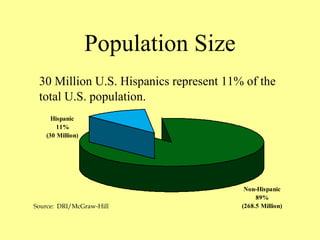
Population Size 
30 Million U.S. Hispanics represent 11% of the 
total U.S. population. 
Hispanic 
11% 
(30 Million) 
Non-Hispanic 
89% 
Source: DRI/McGraw-Hill (268.5 Million)
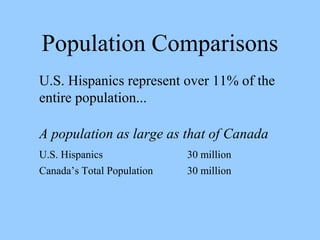
Population Comparisons 
U.S. Hispanics represent over 11% of the 
entire population... 
A population as large as that of Canada 
U.S. Hispanics 30 million 
Canada’s Total Population 30 million
U.S Hispanics Sub-Segments 
The Hispanic market is not a unit in the U.S. 
They are many sub-segments and the communication 
message must be different if (for example) we are 
targeting Hispanics in Miami or in Los Angeles 
“We can’t use Mariachi music for an event in Miami 
or Salsa to tap Mexicans in Los Angeles” 
So, different messages must be tailored according to 
each Hispanic sub-segment
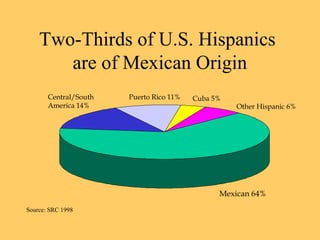
Two-Thirds of U.S. Hispanics 
are of Mexican Origin 
Puerto Rico 11% 
Cuba 5% 
Other Hispanic 6% 
Mexican 64% 
Central/South 
America 14% 
Source: SRC 1998
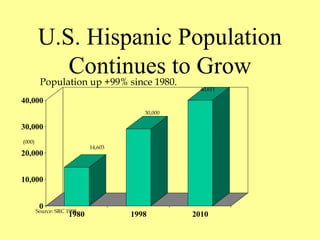
U.S. Hispanic Population 
Continues to Grow 
Population up +99% since 1980. 
40,000 
30,000 
20,000 
10,000 
0 
14,603 
30,000 
40,611 
Source: SRC 19199880 1998 2010 
(000)
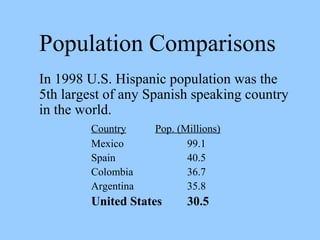
Population Comparisons 
In 1998 U.S. Hispanic population was the 
5th largest of any Spanish speaking country 
in the world. 
Country Pop. (Millions) 
Mexico 99.1 
Spain 40.5 
Colombia 36.7 
Argentina 35.8 
United States 30.5
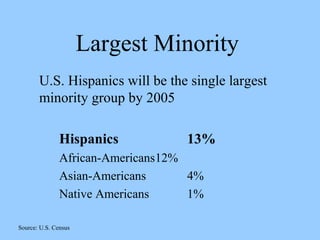
Largest Minority 
U.S. Hispanics will be the single largest 
minority group by 2005 
Hispanics 13% 
African-Americans12% 
Asian-Americans 4% 
Native Americans 1% 
Source: U.S. Census
Acculturation 
Upon arrival to the U.S., Hispanics come in contact 
with a different culture. Almost immediately they 
begin to realize that the life-style process, customs 
aspirations and values found in the new society, are 
different from their own 
As they become familiar with the traditions of the 
U.S., Hispanics develop new approaches to interact, 
living and understand the world around them. Slowly 
but steadily the acculturation process carries on.
Acculturation(cont’d) 
To be effective, communication campaigns for Hispanics, must 
respect the Hispanic culture at all message levels: symbolic, 
explicit, visual and subliminal 
There is a new generation composed by young Hispanics in their 
20s and 30s that have born in the U.S. called the “The 
Generation Ñ” (this letter is the extra flavor unit in the Spanish 
alphabet) 
This group, as different from their ancestors, is totally 
acculturated, fully bilingual and bicultural, and interacts 
perfectly well in both the General and the U.S. Hispanic market
Hispanic Acculturation 
87% of all Hispanics remain Relatively/Partially 
Unacculturated. 
Partially acculturated 59% 
Highly Acculturated 13% 
Relatively 
Unacculturated 28% 
Source: SRC 1998
Emotions are key for Hispanics 
Despite their degree of acculturation, a distinctive 
characteristic of all Hispanics is that they are very 
emotional and have their own symbols and traditions they 
inherited from their ancestors. This fact must be taken into 
account when designing any communications campaign 
targeting Hispanics 
. 
So, regardless the degree of acculturation any 
communication message targeting U.S. Hispanics must 
BE SENT IN SPANISH, respecting the language usage 
according to the different U.S. Hispanic sub-segments.
Ad Effectiveness 
1.Roslow Research Group, 1995. 
2. Document relative effectiveness of 
Spanish vs. English commercials 
among Hispanics. 
Advertising Recall 
Persuasiveness 
Communication
Ad Effectiveness - 
Findings 
Commercials in Spanish are: 
• 40% more effective at increasing 
awareness. 
• 5.2 times more persuasive. 
• 56% more effective in terms of 
message comprehension. 
Source: Roslow Research Group. 
+
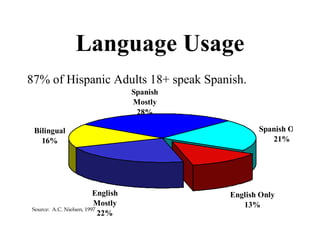
Language Usage 
Spanish Only 
21% 
87% of Hispanic Adults 18+ speak Spanish. 
English Only 
13% 
English 
Mostly 
22% 
Bilingual 
16% 
Spanish 
Mostly 
28% 
Source: A.C. Nielsen, 1997
Share of Heart 
Although many of them are totally acculturated, 
Hispanic people’s hearts remain with a Latino 
structure. 
So in order to EFFECTIVELY communicate with 
Hispanics first we have to win their hearts, then their 
minds…. and then their pockets… 
A key element to tap into the U.S. Hispanics 
“Building Share of Publics by Gaining 
Share of Heart”
Five Communications 
Elements to Gain Hispanic 
Share of Heart 
1. Cultural relevance 
2. Emotional involvement 
3. The benefit 
4. The product or message personality 
5. Compatibility with mainstream
A Big Mistake is… 
To apply the same communications messages or strategies 
used for the General Market to reach US Hispanic Audiences 
Or to think that if we have some member of our staff that 
speaks Spanish is enough. WRONG! This is just the 
beginning… 
Corporate America has begun to realize of the boom of the 
U.S. Hispanic Market and some companies have both, a 
general market public relations agency AND a Hispanic 
Public Relations agencies to specifically address Hispanics. 
For Example Mc Donald’s, Allstate, American Honda, etc., 
just to cite some examples
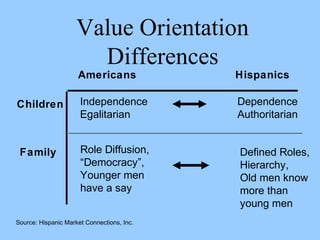
Value Orientation 
Differences 
Children 
Americans Hispanics 
Independence 
Egalitarian 
Dependence 
Authoritarian 
Family Role Diffusion, 
“Democracy”, 
Younger men 
have a say 
Defined Roles, 
Hierarchy, 
Old men know 
more than 
young men 
Source: Hispanic Market Connections, Inc.
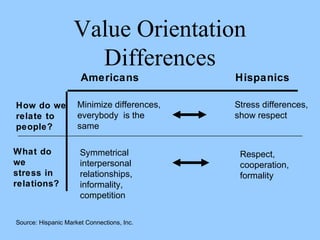
Value Orientation 
Differences 
How do we 
relate to 
people? 
Americans Hispanics 
Minimize differences, 
everybody is the 
same 
What do 
we 
stress in 
relations? 
Symmetrical 
interpersonal 
relationships, 
informality, 
competition 
Respect, 
cooperation, 
formality 
Source: Hispanic Market Connections, Inc. 
Stress differences, 
show respect
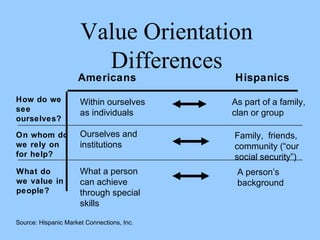
Value Orientation 
Differences 
How do we 
see 
ourselves? 
Americans Hispanics 
Within ourselves 
as individuals 
As part of a family, 
clan or group 
On whom do 
we rely on 
for help? 
Ourselves and 
institutions 
Family, friends, 
community (“our 
social security”) 
What do 
we value in 
people? 
What a person 
can achieve 
through special 
skills 
Source: Hispanic Market Connections, Inc. 
A person’s 
background
Lots of Hispanic Media 
2 National Television Networks 
8 Major Cable Networks 
75+ Television Stations 
400+ Radio Stations 
155+ Newspapers 
50+ Magazines 
Outdoor 
New Media: Internet Sites & Search Engines
New Entrants into the 
Hispanic Media Arena 
CNN en Español 
Canal Sur 
MTV Latino 
Telenoticias 
HBO en Español 
EcoStar 
Independent TV/LA, NY, Miami, SF
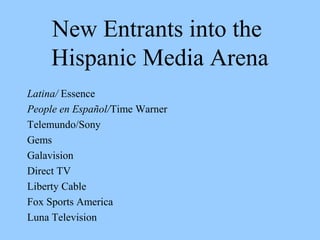
New Entrants into the 
Hispanic Media Arena 
Latina/ Essence 
People en Español/Time Warner 
Telemundo/Sony 
Gems 
Galavision 
Direct TV 
Liberty Cable 
Fox Sports America 
Luna Television
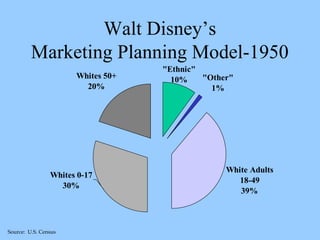
Walt Disney’s 
Marketing Planning Model-1950 
"Other" 
1% 
Whites 50+ 
20% 
"Ethnic" 
10% 
White Adults 
18-49 
39% 
Whites 0-17 
30% 
Source: U.S. Census
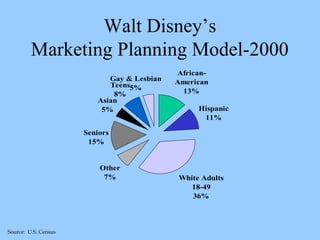
Walt Disney’s 
Marketing Planning Model-2000 
African- 
American 
13% 
Hispanic 
11% 
White Adults 
18-49 
36% 
Gay & Lesbian 
Teens 
8% 
Asian 
5% 
Seniors 
15% 
Other 
7% 
5% 
Source: U.S. Census
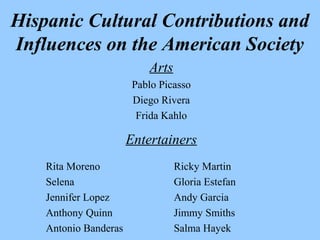
Hispanic Cultural Contributions and 
Influences on the American Society 
Arts 
Pablo Picasso 
Diego Rivera 
Frida Kahlo 
Entertainers 
Rita Moreno Ricky Martin 
Selena Gloria Estefan 
Jennifer Lopez Andy Garcia 
Anthony Quinn Jimmy Smiths 
Antonio Banderas Salma Hayek
Political Arena 
The LATINO VOTE at one moment was 
crucial in the 2000 presidential election’s 
results. 
For Example, Bush did a big part of his 
campaign SPEAKING IN SPANISH
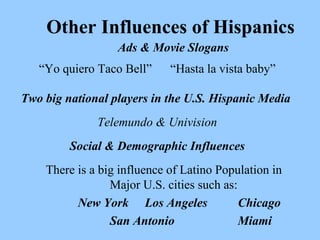
Other Influences of Hispanics 
Ads & Movie Slogans 
“Yo quiero Taco Bell” “Hasta la vista baby” 
Two big national players in the U.S. Hispanic Media 
Telemundo & Univision 
Social & Demographic Influences 
There is a big influence of Latino Population in 
Major U.S. cities such as: 
New York Los Angeles Chicago 
San Antonio Miami
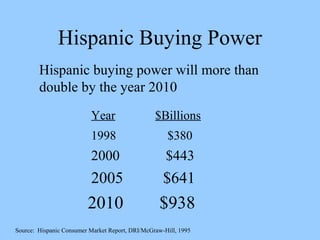
Hispanic Buying Power 
Hispanic buying power will more than 
double by the year 2010 
Year $Billions 
1998 $380 
2000 $443 
2005 $641 
2010 $938 
Source: Hispanic Consumer Market Report, DRI/McGraw-Hill, 1995
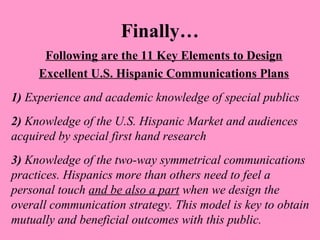
Finally… 
Following are the 11 Key Elements to Design 
Excellent U.S. Hispanic Communications Plans 
1) Experience and academic knowledge of special publics 
2) Knowledge of the U.S. Hispanic Market and audiences 
acquired by special first hand research 
3) Knowledge of the two-way symmetrical communications 
practices. Hispanics more than others need to feel a 
personal touch and be also a part when we design the 
overall communication strategy. This model is key to obtain 
mutually and beneficial outcomes with this public.
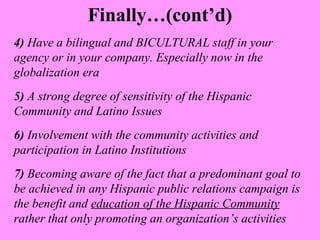
Finally…(cont’d) 
4) Have a bilingual and BICULTURAL staff in your 
agency or in your company. Especially now in the 
globalization era 
5) A strong degree of sensitivity of the Hispanic 
Community and Latino Issues 
6) Involvement with the community activities and 
participation in Latino Institutions 
7) Becoming aware of the fact that a predominant goal to 
be achieved in any Hispanic public relations campaign is 
the benefit and education of the Hispanic Community 
rather that only promoting an organization’s activities
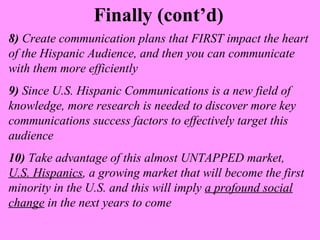
Finally (cont’d) 
8) Create communication plans that FIRST impact the heart 
of the Hispanic Audience, and then you can communicate 
with them more efficiently 
9) Since U.S. Hispanic Communications is a new field of 
knowledge, more research is needed to discover more key 
communications success factors to effectively target this 
audience 
10) Take advantage of this almost UNTAPPED market, 
U.S. Hispanics, a growing market that will become the first 
minority in the U.S. and this will imply a profound social 
change in the next years to come
11) Communications budgets assigned to the U.S. Hispanic 
market are NOT proportional to the size of this public. 
They are far bellow compared to budgets assigned to the 
general market
“…deal with changes that have 
already irreversibly happened.” 
-Peter F. Drucker 
Claremont Graduate School

Exellence in US Hispanic Communications - A Master Thesis by Marcelo Harfuch

  • 1.
    Excellence in U.S.Hispanic Communications Professional Project By Marcelo Harfuch, 1998 Class January 6, 2001 NYC
  • 2.
    Who is Hispanicin the United States? (For the purpose of this project Hispanics and Latinos can be used interchangeably) “Any person that has come from Latin America, Spain, or have born here in the U.S. and has Hispanic roots” Other Definition Any person living in the U.S. that speaks and understands Spanish
  • 3.
    Brazilians are notHispanics Although Brazil is the biggest and richest country in Latin America, Brazilians ARE NOT considered Hispanics, since their roots came from Portugal, NOT from Spain and they have a different language and culture
  • 4.
    Research Problem U.S.Hispanic Communications is a new field I found during my research that not a great deal of information regarding Excellence in Hispanic Communications is available, nor has been previously published On the other hand, most of the studies in the Hispanic Communications field was conducted only by internal use of a few Hispanic advertising agencies or marketing companies
  • 5.
    Hispanic Public Relationsis a Totally New Area of Knowledge in the U.S. That is why for my project I basically conducted primary research to get new information from top Hispanic Communicators in the U.S. and Latin America
  • 6.
    Population Size 30Million U.S. Hispanics represent 11% of the total U.S. population. Hispanic 11% (30 Million) Non-Hispanic 89% Source: DRI/McGraw-Hill (268.5 Million)
  • 7.
    Population Comparisons U.S.Hispanics represent over 11% of the entire population... A population as large as that of Canada U.S. Hispanics 30 million Canada’s Total Population 30 million
  • 8.
    U.S Hispanics Sub-Segments The Hispanic market is not a unit in the U.S. They are many sub-segments and the communication message must be different if (for example) we are targeting Hispanics in Miami or in Los Angeles “We can’t use Mariachi music for an event in Miami or Salsa to tap Mexicans in Los Angeles” So, different messages must be tailored according to each Hispanic sub-segment
  • 9.
    Two-Thirds of U.S.Hispanics are of Mexican Origin Puerto Rico 11% Cuba 5% Other Hispanic 6% Mexican 64% Central/South America 14% Source: SRC 1998
  • 10.
    U.S. Hispanic Population Continues to Grow Population up +99% since 1980. 40,000 30,000 20,000 10,000 0 14,603 30,000 40,611 Source: SRC 19199880 1998 2010 (000)
  • 11.
    Population Comparisons In1998 U.S. Hispanic population was the 5th largest of any Spanish speaking country in the world. Country Pop. (Millions) Mexico 99.1 Spain 40.5 Colombia 36.7 Argentina 35.8 United States 30.5
  • 12.
    Largest Minority U.S.Hispanics will be the single largest minority group by 2005 Hispanics 13% African-Americans12% Asian-Americans 4% Native Americans 1% Source: U.S. Census
  • 13.
    Acculturation Upon arrivalto the U.S., Hispanics come in contact with a different culture. Almost immediately they begin to realize that the life-style process, customs aspirations and values found in the new society, are different from their own As they become familiar with the traditions of the U.S., Hispanics develop new approaches to interact, living and understand the world around them. Slowly but steadily the acculturation process carries on.
  • 14.
    Acculturation(cont’d) To beeffective, communication campaigns for Hispanics, must respect the Hispanic culture at all message levels: symbolic, explicit, visual and subliminal There is a new generation composed by young Hispanics in their 20s and 30s that have born in the U.S. called the “The Generation Ñ” (this letter is the extra flavor unit in the Spanish alphabet) This group, as different from their ancestors, is totally acculturated, fully bilingual and bicultural, and interacts perfectly well in both the General and the U.S. Hispanic market
  • 15.
    Hispanic Acculturation 87%of all Hispanics remain Relatively/Partially Unacculturated. Partially acculturated 59% Highly Acculturated 13% Relatively Unacculturated 28% Source: SRC 1998
  • 16.
    Emotions are keyfor Hispanics Despite their degree of acculturation, a distinctive characteristic of all Hispanics is that they are very emotional and have their own symbols and traditions they inherited from their ancestors. This fact must be taken into account when designing any communications campaign targeting Hispanics . So, regardless the degree of acculturation any communication message targeting U.S. Hispanics must BE SENT IN SPANISH, respecting the language usage according to the different U.S. Hispanic sub-segments.
  • 17.
    Ad Effectiveness 1.RoslowResearch Group, 1995. 2. Document relative effectiveness of Spanish vs. English commercials among Hispanics. Advertising Recall Persuasiveness Communication
  • 18.
    Ad Effectiveness - Findings Commercials in Spanish are: • 40% more effective at increasing awareness. • 5.2 times more persuasive. • 56% more effective in terms of message comprehension. Source: Roslow Research Group. +
  • 19.
    Language Usage SpanishOnly 21% 87% of Hispanic Adults 18+ speak Spanish. English Only 13% English Mostly 22% Bilingual 16% Spanish Mostly 28% Source: A.C. Nielsen, 1997
  • 20.
    Share of Heart Although many of them are totally acculturated, Hispanic people’s hearts remain with a Latino structure. So in order to EFFECTIVELY communicate with Hispanics first we have to win their hearts, then their minds…. and then their pockets… A key element to tap into the U.S. Hispanics “Building Share of Publics by Gaining Share of Heart”
  • 21.
    Five Communications Elementsto Gain Hispanic Share of Heart 1. Cultural relevance 2. Emotional involvement 3. The benefit 4. The product or message personality 5. Compatibility with mainstream
  • 22.
    A Big Mistakeis… To apply the same communications messages or strategies used for the General Market to reach US Hispanic Audiences Or to think that if we have some member of our staff that speaks Spanish is enough. WRONG! This is just the beginning… Corporate America has begun to realize of the boom of the U.S. Hispanic Market and some companies have both, a general market public relations agency AND a Hispanic Public Relations agencies to specifically address Hispanics. For Example Mc Donald’s, Allstate, American Honda, etc., just to cite some examples
  • 23.
    Value Orientation Differences Children Americans Hispanics Independence Egalitarian Dependence Authoritarian Family Role Diffusion, “Democracy”, Younger men have a say Defined Roles, Hierarchy, Old men know more than young men Source: Hispanic Market Connections, Inc.
  • 24.
    Value Orientation Differences How do we relate to people? Americans Hispanics Minimize differences, everybody is the same What do we stress in relations? Symmetrical interpersonal relationships, informality, competition Respect, cooperation, formality Source: Hispanic Market Connections, Inc. Stress differences, show respect
  • 25.
    Value Orientation Differences How do we see ourselves? Americans Hispanics Within ourselves as individuals As part of a family, clan or group On whom do we rely on for help? Ourselves and institutions Family, friends, community (“our social security”) What do we value in people? What a person can achieve through special skills Source: Hispanic Market Connections, Inc. A person’s background
  • 26.
    Lots of HispanicMedia 2 National Television Networks 8 Major Cable Networks 75+ Television Stations 400+ Radio Stations 155+ Newspapers 50+ Magazines Outdoor New Media: Internet Sites & Search Engines
  • 27.
    New Entrants intothe Hispanic Media Arena CNN en Español Canal Sur MTV Latino Telenoticias HBO en Español EcoStar Independent TV/LA, NY, Miami, SF
  • 28.
    New Entrants intothe Hispanic Media Arena Latina/ Essence People en Español/Time Warner Telemundo/Sony Gems Galavision Direct TV Liberty Cable Fox Sports America Luna Television
  • 29.
    Walt Disney’s MarketingPlanning Model-1950 "Other" 1% Whites 50+ 20% "Ethnic" 10% White Adults 18-49 39% Whites 0-17 30% Source: U.S. Census
  • 30.
    Walt Disney’s MarketingPlanning Model-2000 African- American 13% Hispanic 11% White Adults 18-49 36% Gay & Lesbian Teens 8% Asian 5% Seniors 15% Other 7% 5% Source: U.S. Census
  • 31.
    Hispanic Cultural Contributionsand Influences on the American Society Arts Pablo Picasso Diego Rivera Frida Kahlo Entertainers Rita Moreno Ricky Martin Selena Gloria Estefan Jennifer Lopez Andy Garcia Anthony Quinn Jimmy Smiths Antonio Banderas Salma Hayek
  • 32.
    Political Arena TheLATINO VOTE at one moment was crucial in the 2000 presidential election’s results. For Example, Bush did a big part of his campaign SPEAKING IN SPANISH
  • 33.
    Other Influences ofHispanics Ads & Movie Slogans “Yo quiero Taco Bell” “Hasta la vista baby” Two big national players in the U.S. Hispanic Media Telemundo & Univision Social & Demographic Influences There is a big influence of Latino Population in Major U.S. cities such as: New York Los Angeles Chicago San Antonio Miami
  • 34.
    Hispanic Buying Power Hispanic buying power will more than double by the year 2010 Year $Billions 1998 $380 2000 $443 2005 $641 2010 $938 Source: Hispanic Consumer Market Report, DRI/McGraw-Hill, 1995
  • 35.
    Finally… Following arethe 11 Key Elements to Design Excellent U.S. Hispanic Communications Plans 1) Experience and academic knowledge of special publics 2) Knowledge of the U.S. Hispanic Market and audiences acquired by special first hand research 3) Knowledge of the two-way symmetrical communications practices. Hispanics more than others need to feel a personal touch and be also a part when we design the overall communication strategy. This model is key to obtain mutually and beneficial outcomes with this public.
  • 36.
    Finally…(cont’d) 4) Havea bilingual and BICULTURAL staff in your agency or in your company. Especially now in the globalization era 5) A strong degree of sensitivity of the Hispanic Community and Latino Issues 6) Involvement with the community activities and participation in Latino Institutions 7) Becoming aware of the fact that a predominant goal to be achieved in any Hispanic public relations campaign is the benefit and education of the Hispanic Community rather that only promoting an organization’s activities
  • 37.
    Finally (cont’d) 8)Create communication plans that FIRST impact the heart of the Hispanic Audience, and then you can communicate with them more efficiently 9) Since U.S. Hispanic Communications is a new field of knowledge, more research is needed to discover more key communications success factors to effectively target this audience 10) Take advantage of this almost UNTAPPED market, U.S. Hispanics, a growing market that will become the first minority in the U.S. and this will imply a profound social change in the next years to come
  • 38.
    11) Communications budgetsassigned to the U.S. Hispanic market are NOT proportional to the size of this public. They are far bellow compared to budgets assigned to the general market
  • 39.
    “…deal with changesthat have already irreversibly happened.” -Peter F. Drucker Claremont Graduate School