WMSU
GENERAL
GUIDELINES FOR
RECOMMENDING
EXECUTIVE
CLEMENCY
Bucane, Jamesteven R.
1
CDI 104
Traffic Management and Accident
Investigation with Driving
Malangas Campus
A.Y. 2023-2024
1st Semester
2
GENERAL PROVISIONS
3
SECTION 1. Plenary Power of the President to Grant
Executive Clemency
Under Section 19. Article VII of the Constitution, except in cases of
impeachment, or as otherwise provided in the Constitution, the President may
grant reprieves, commutations, and pardons, and remit fines and forfeitures,
after conviction by final judgment. Executive clemency rests exclusively within
the sound discretion of the President, and exercised with the objective of
preventing a miscarriage of justice or correcting a manifest injustice, such as
when there exist extraordinary circumstances in which the strict application of
the law will result in manifest injustice.
4
SECTION 1. Plenary Power of the President to Grant
Executive Clemency
These guidelines are meant solely for the guidance of the
Board of Pardons and Parole (hereafter the “Board”) in the
performance of its duty to assist the President in exercising the
power of executive clemency (pursuant to Executive Order No. 83
dated January 11, 1937). These guidelines create no vested or
enforceable right in persons applying for clemency. (As amended
by Resolution No 24-4-10)
5
SECTION 1. Plenary Power of the President to Grant
Executive Clemency
These guidelines do not restrict the plenary authority granted
to the President under Section 19, Article VII of the constitution.
The President may review, revise, amend, revoke or affirm the
recommendation of the Board; refer any matter pertaining to
executive clemency to the Board or to any other agency, or act
motu proprio or upon the recommendation of the Board or of any
other agency.
6
SECTION 2. Consideration of Cases for Executive Clemency
The Board may consider cases for executive clemency
upon petition, or referral of the Office of the President,
or motu proprio.
7
SECTION 3. Extraordinary Circumstances
The Board shall recommend to the President the grant of
executive clemency only when there exist extraordinary
circumstances such that the strict application of the law will result
in manifest injustice, such as when any of the following
circumstances are present:
8
SECTION 3. Extraordinary Circumstances
a. the trial court or appellate court in its decision recommended
the grant of executive clemency for the prisoner;
b. Under the peculiar circumstances of the case, the penalty
imposed is too harsh compared to the crime committed;
c. Youthful offenders who are over nine (9) years but under
eighteen (18) years of age at the time of the commission of the
offense,
9
SECTION 3. Extraordinary Circumstances
d. Prisoners who are seventy (70) years old and above whose
continued imprisonment is inimical to their health on humanitarian
grounds;
e. Those who are terminally-ill as certified by a panel of three (3)
government physicians composed of physician designated by the
Director of the bureau of Corrections, the Director of the
Malacanang Clinic, and a physician designated by the Secretary of
Health.
10
SECTION 3. Extraordinary Circumstances
f. Alien prisoners where diplomatic considerations and amity
among nations necessitate review;
g. Such other similar or analogous circumstances whenever the
interest of justice will be served thereby.
11
SECTION 3. Extraordinary Circumstances
However, notwithstanding the existence of any extraordinary
circumstances, including those enumerated above, the Board shall
not favorably recommend petitions for/executive clemency of the
following prisoners:
12
SECTION 3. Extraordinary Circumstances
a. Those convicted of Evasion of Service of Sentence;
b. Those who violated the conditions of their Conditional Pardon;
c. Those who are habitual delinquents or recidivists;
d. Those convicted of Kidnapping for Ransom;
13
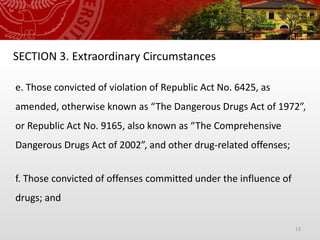
SECTION 3. Extraordinary Circumstances
e. Those convicted of violation of Republic Act No. 6425, as
amended, otherwise known as “The Dangerous Drugs Act of 1972”,
or Republic Act No. 9165, also known as “The Comprehensive
Dangerous Drugs Act of 2002”, and other drug-related offenses;
f. Those convicted of offenses committed under the influence of
drugs; and
14
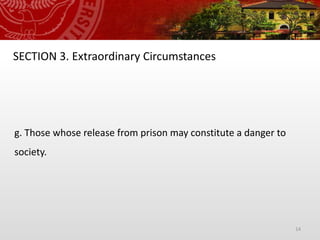
SECTION 3. Extraordinary Circumstances
g. Those whose release from prison may constitute a danger to
society.
15
(Who may apply for
Executive Clemency?)
16
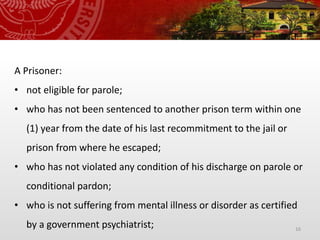
A Prisoner:
• not eligible for parole;
• who has not been sentenced to another prison term within one
(1) year from the date of his last recommitment to the jail or
prison from where he escaped;
• who has not violated any condition of his discharge on parole or
conditional pardon;
• who is not suffering from mental illness or disorder as certified
by a government psychiatrist;
17
(When to apply for Executive
Clemency?)
18
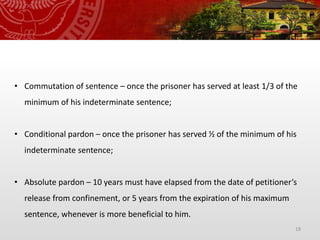
• Commutation of sentence – once the prisoner has served at least 1/3 of the
minimum of his indeterminate sentence;
• Conditional pardon – once the prisoner has served ½ of the minimum of his
indeterminate sentence;
• Absolute pardon – 10 years must have elapsed from the date of petitioner’s
release from confinement, or 5 years from the expiration of his maximum
sentence, whenever is more beneficial to him.
19
FORM AND CONTENTS OF
PETITION
20
SECTION 4. Petition
When a petition is filed by, or on behalf of, a prisoner, the form
of said petition shall substantially comply with the form prescribed
by the board and shall clearly show the following:
a. The prisoner’s biographic data;
b. The details of his conviction; and
c. The grounds upon which executive clemency is sought.
21
PROCEDURE
22
SECTION 5. Referral to Government Agencies
The Board may, in its discretion, refer a petition for executive
clemency to a Probation and Parole Officer who shall submit
within thirty (30) days from receipt of referral a Report on the
behavior, character antecedents, mental and physical condition of
the petitioner, and the results of the National Bureau of
Investigation records check.
23
SECTION 5. Referral to Government Agencies
The Board shall refer matters pertaining to executive clemency
for comment and recommendations as follows:
24
SECTION 5. Referral to Government Agencies
a. To the Commission on elections, if it involves violation of
election laws, rules and regulations, as required by Sec. 3. Art IX-C
of the Constitution which provides that no pardon, amnesty,
parole, or suspension of sentence for violation of election laws,
rules, and regulations shall be granted by the President without the
favorable recommendation of the Commission on elections;
25
SECTION 5. Referral to Government Agencies
b. To the Secretary of National Defense and the Secretary of
the Interior and Local Government, if a case for executive clemency
involves crimes against national security or public order or the law
of nations; and
c. To the Department of Foreign affairs, if the prisoner as an
alien.
26
SECTION 6. Transmittal of Carpeta and Prison Record
The Director or warden concerned shall forward the prison
record and carpeta of a prisoner being considered for executive
clemency.
27
SECTION 7. Notice to convicting Trial Judge, Prosecutor’s
Office, and Offended Party
In all cases when a prisoner is being considered for executive
clemency, the Board shall notify the following personally or by
registered mail:
a. The convicting trial judge.
b. The prosecutor’s office that handled the prosecution, and
28
SECTION 7. Notice to convicting Trial Judge, Prosecutor’s
Office, and Offended Party
c. The offended party or, in the event that the offended party is
unavailable for comment or otherwise cannot be located, the
immediate relatives of the offended party.
Said persons and offices shall be given thirty (30) days from
notice to comment on whether or not executive clemency may be
granted to the prisoner.
29
SECTION 8. Publication of Names of Those Being
Considered for Executive Clemency
The Bureau shall cause the publication in a newspaper of
national circulation the names of prisoners who are being
considered for executive clemency.
30
PROCEEDINGS OF THE
BOARD
31
SECTION 9. Board Deliberation
Any matter pertaining to executive clemency, including
petitions for executive clemency, shall be decided by the Board
only after deliberation during a meeting where there is a quorum.
32
SECTION 10. Board Meetings
The Board shall meet once a week, or oftener upon call by the
chairman, to deliberate matters pertaining to executive clemency.
33
SECTION 11. Quorum
A majority of all the members of the Board shall constitute
quorum.
34
SECTION 12. Contents of Minutes of Board Meeting
The minutes of the meeting of the Board shall show the votes
of its individual members and the reason(s) for voting for or against
recommending the grant executive clemency. Where at least four
(4) members vote in favor of recommending the grant of
executive clemency, the vote of any dissenting member shall be
reduced in writing and shall form part of the records of the
proceedings of the Board.
35
SECTION 13. Opposition to Grant of Executive Clemency
When an opposition to the grant of executive clemency is filed,
the board shall consider the same and may, in its discretion,
require the oppositor to submit supporting evidence.
36
SECTION 14. Documents to be Considered
In determining whether there exist extraordinary
circumstances such that the strict application of the law will result
in manifest injustice, and whether to recommend to the President
the grant of executive clemency, the board shall consider all
relevant documents, such as the carpeta and prison record of the
prisoner, the mittimus or commitment order, prosecutor’s
information and the decision of the trial and appellate courts.
37
SECTION 15. Board Recommendation, Resolution and
Certification
At least four (4) votes of the members of the Board shall be
necessary to recommend the grant of executive clemency Said
recommendation shall be contained in a resolution of the Board to
be submitted to the Office of the President, the form of which shall
substantially be as follows:
38
SECTION 15. Board Recommendation, Resolution and
Certification
“RESOLUTION NO.
re (Name of Prisoner or Prisoners)"
39
SECTION 15. Board Recommendation, Resolution and
Certification
“During the meeting of the board of Pardons and Parole held
on (Date), at (Time), at (Place), where the following members,
constituting a quorum, were present:
“(Indicate members present or absent)
40
SECTION 15. Board Recommendation, Resolution and
Certification
"1. The Board discussed the matter concerning the grant of
executive clemency in favor of (Name of prisoner or prisoners),
with the following circumstances:
a. (A summary of the decision of the trial and appellate courts,
indicating the crime for which the prisoner(s) was charged and
convicted and the date when his conviction became final;)
41
SECTION 15. Board Recommendation, Resolution and
Certification
b. (His personal circumstances;)
c. (The place where he is serving his sentence and the date
when he commenced the same; and)
d. (The actual time spent in prison [does not include Good
Conduct Time Allowance];)
42
SECTION 15. Board Recommendation, Resolution and
Certification
“2. After due deliberation, the Board has found extraordinary
circumstances present in the case such that the strict application of
the law will result in manifest injustice, particularly
(Explanation of what extraordinary circumstances are present);
43
SECTION 15. Board Recommendation, Resolution and
Certification
"3. After due deliberation, the Board, by the vote of at least four (4)
members, hereby recommends to the President of the Philippines the grant of
executive clemency in favor of the above named individual(s) in the form of
(State whether the executive clemency being recommended is in the form of
absolute pardon, conditional pardon, commutation of sentence, or reprieve; If
commutation, state the period; If reprieve, state the date certain) for the reason
that (State the reason why said form, or said period, or said date certain, is
being recommended).
44
SECTION 15. Board Recommendation, Resolution and
Certification
“We, the undersigned chairman and Members of the Board of
Pardons and Parole, hereby certify that after meeting and due
deliberation, we have determined that there exist extraordinary
circumstances such that the strict application of the law will result
in manifest injustice in the case(s) of the individual(s) mentioned
above and that said individual(s) deserve the grant of executive
clemency by the President.”
45
SECTION 15. Board Recommendation, Resolution and
Certification
Where at least four (4) members vote in favor of
recommending the grant of executive clemency, the vote of any
dissenting member and the reasons therefore shall be stated in the
resolution of the Board.
46
SECTION 16. Supporting Documents
The Board shall submit all relevant documents to the Office of
the President along with its resolution recommending the grant of
executive clemency, including the following documents:
47
SECTION 16. Supporting Documents
a. A summumary in matrix form of the following information
about the prisoner:
i. Name;
ii. Crime for which convicted;
iii. Penalty imposed;
iv. Actual time spent in prison (not including Good Conduct
Time Allowance)
48
SECTION 16. Supporting Documents
v. If recommended for commutation:
(a) Recommended commuted term;
(b) Time to be served without commutation;
(c) Time to be served with commutation.
49
SECTION 16. Supporting Documents
vi. State whether:
(a) Convicted (prior or subsequent to conviction of crime for
which executive clemency is sought) for Kidnap for Ransom or any
drug-related offense; and
(b) Previously granted executive clemency.
50
SECTION 16. Supporting Documents
b. The prisoner’s carpeta, prison record, and mittimus or
commitment order;
c. The prosecutor’s information, the decision of the trial court,
the decision of the appellate courts, if any, and the certificate of
finality of judgment; and
d. Pertinent minutes of the board meetings.
51
GUIDELINES AFTER GRANT
OF EXECUTIVE CLEMENCY
52
SECTION 17. Implementation of President’s Grant of
Executive Clemency
Upon receipt from the Office of the President of the
documents evidencing the President’s grant of executive clemency,
the Board shall cause the immediate implementation of said grant
of executive clemency.
53
SECTION 17. Implementation of President’s Grant of
Executive Clemency
Upon receipt from the Office of the President of the
documents evidencing the President’s grant of executive clemency,
the Board shall cause the immediate implementation of said grant
of executive clemency.
The Board shall send a copy of said document to the prisoner,
through the director of the Bureau of corrections or Warden of the
jail where he is confined.
54
SECTION 18. Certificate of Release
When the grant of executive clemency entitles the prisoner to
be released from prison, the director of the Bureau of corrections
or Warden of the jail where he is confined shall, on the date of
actual release of the prisoner, send a certification of release to the
Board and, if the document evidencing the President’s grant
executive clemency so states, to the concerned Probation and
Parole Officer.
55
SECTION 19. Monitoring of Compliance with Conditions of
Pardon
Where the President grants conditional pardon to a prisoner,
the Board shall monitor the prisoner’s compliance with the
conditions imposed for the duration of the period stated in the
document evidencing the President’s grant of executive clemency.
The Board shall also determine whether said prisoner has
complied with or violated the conditions of his pardon.
56
SECTION 19. Monitoring of Compliance with Conditions of
Pardon
To assist the Board in monitoring compliance with the
conditions imposed upon pardon, the Board shall place the
prisoner under the supervision of a Probation and Parole Officer.
57
SECTION 20. Presentation to Probation and Parole Officer
Within the period prescribed in the document evidencing the
President’s grant of executive clemency, the prisoner shall present
himself to the Probation and Parole Officer concerned. The
Probation and Parole Officer shall inform the Board if the prisoner
fails to report within forty five (45) days from the date of his
release from confinement.
58
SECTION 21. Arrival Report
The Probation and Parole Officer shall submit his Arrival Report
to the board, through the Technical Service of the Parole and
Probation Administration, within fifteen (15) working days from the
date when the prisoner reported for supervision.
59
SECTION 22. Violation Report
If a prisoner granted conditional pardon violates any of the
conditions of his conditional pardon or commits any serious
deviation or non-observance of the obligations imposed under the
supervision program, the Probation and Parole Officer concerned
shall immediately submit a violation Report to the Board.
60
SECTION 23. Infraction and Progress Report
If a prisoner granted conditional pardon is charged with
committing another offense during the period of his supervision,
the Probation and Parole Officer concerned shall periodically
submit a Progress Report to the Board detailing the progress of the
case filed against the prisoner. If said prisoner is eventually
convicted, the same officer shall submit an Infraction Report.
61
SECTION 24. Death of Prisoner Under Supervision
If a prisoner granted conditional pardon dies during the
period of supervision, the Probation and Parole Officer shall
immediately transmit a certified true copy of the prisoner’s death
certificate to the Board recommending the closing of the case.
However, in the absence of a death certificate, an affidavit
narrating the circumstances of the fact of death from the barangay
chairman or any authorized officer or any immediate relative
where the prisoner resided, shall suffice.
62
SECTION 25. Recommendation for Arrest of Prisoner for
Violation of Conditions of Pardon
Upon determination that a prisoner granted conditional
pardon has violated the conditions of his pardon, the board shall
recommend his arrest or recommitment to the President.
63
SECTION 26. Summary Report
Upon the expiration of the period stated in the document
evidencing the President’s grant of executive clemency, the
Probation and Parole Officer concerned shall submit to the Board,
through the Chief Probation and Parole Officer, a Summary Report
on his supervision of the prisoner.
The clearances from the police, court, prosecutor’s office and
barangay officials shall be attached to the Summary Report.
64
SECTION 27. Certificate of Compliance with Conditional
Pardon
Upon receipt of the Summary Report, the board shall, upon the
recommendation of the chief Probation and Parole Officer that the
prisoner granted conditional pardon has complied with all the
conditions of his pardon, issue a Certificate of Compliance with
Conditional Pardon.
65
SECTION 28. Transmitted of Certificate of Compliance with
Conditional Pardon
The Board shall forward a certified true copy of the Certificate
of Compliance with Conditional Pardon to the prisoner, the Court
which imposed the sentence, the Probation and Parole Officer
concerned, the Bureau of Corrections, the National Bureau of
Investigation, the Philippine National Police, and the Office of the
President.
66
SECTION 29. Executive Clemency of an Alien
An alien who is released on pardon shall be referred to the
Bureau of Immigration for disposition, documentation and
appropriate action.
67
REPEALING AND
EFFECTIVITY CLAUSES
68
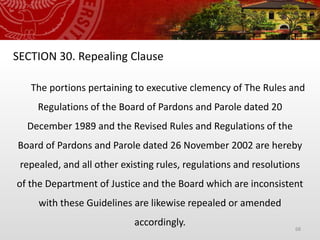
SECTION 30. Repealing Clause
The portions pertaining to executive clemency of The Rules and
Regulations of the Board of Pardons and Parole dated 20
December 1989 and the Revised Rules and Regulations of the
Board of Pardons and Parole dated 26 November 2002 are hereby
repealed, and all other existing rules, regulations and resolutions
of the Department of Justice and the Board which are inconsistent
with these Guidelines are likewise repealed or amended
accordingly.
69
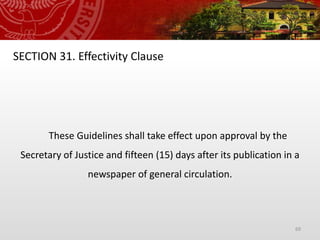
SECTION 31. Effectivity Clause
These Guidelines shall take effect upon approval by the
Secretary of Justice and fifteen (15) days after its publication in a
newspaper of general circulation.
70
71
Thank You!
72

Executive Clemency in Philippines (report).pptx

  • 1.
    WMSU GENERAL GUIDELINES FOR RECOMMENDING EXECUTIVE CLEMENCY Bucane, JamestevenR. 1 CDI 104 Traffic Management and Accident Investigation with Driving Malangas Campus A.Y. 2023-2024 1st Semester
  • 2.
  • 3.
    3 SECTION 1. PlenaryPower of the President to Grant Executive Clemency Under Section 19. Article VII of the Constitution, except in cases of impeachment, or as otherwise provided in the Constitution, the President may grant reprieves, commutations, and pardons, and remit fines and forfeitures, after conviction by final judgment. Executive clemency rests exclusively within the sound discretion of the President, and exercised with the objective of preventing a miscarriage of justice or correcting a manifest injustice, such as when there exist extraordinary circumstances in which the strict application of the law will result in manifest injustice.
  • 4.
    4 SECTION 1. PlenaryPower of the President to Grant Executive Clemency These guidelines are meant solely for the guidance of the Board of Pardons and Parole (hereafter the “Board”) in the performance of its duty to assist the President in exercising the power of executive clemency (pursuant to Executive Order No. 83 dated January 11, 1937). These guidelines create no vested or enforceable right in persons applying for clemency. (As amended by Resolution No 24-4-10)
  • 5.
    5 SECTION 1. PlenaryPower of the President to Grant Executive Clemency These guidelines do not restrict the plenary authority granted to the President under Section 19, Article VII of the constitution. The President may review, revise, amend, revoke or affirm the recommendation of the Board; refer any matter pertaining to executive clemency to the Board or to any other agency, or act motu proprio or upon the recommendation of the Board or of any other agency.
  • 6.
    6 SECTION 2. Considerationof Cases for Executive Clemency The Board may consider cases for executive clemency upon petition, or referral of the Office of the President, or motu proprio.
  • 7.
    7 SECTION 3. ExtraordinaryCircumstances The Board shall recommend to the President the grant of executive clemency only when there exist extraordinary circumstances such that the strict application of the law will result in manifest injustice, such as when any of the following circumstances are present:
  • 8.
    8 SECTION 3. ExtraordinaryCircumstances a. the trial court or appellate court in its decision recommended the grant of executive clemency for the prisoner; b. Under the peculiar circumstances of the case, the penalty imposed is too harsh compared to the crime committed; c. Youthful offenders who are over nine (9) years but under eighteen (18) years of age at the time of the commission of the offense,
  • 9.
    9 SECTION 3. ExtraordinaryCircumstances d. Prisoners who are seventy (70) years old and above whose continued imprisonment is inimical to their health on humanitarian grounds; e. Those who are terminally-ill as certified by a panel of three (3) government physicians composed of physician designated by the Director of the bureau of Corrections, the Director of the Malacanang Clinic, and a physician designated by the Secretary of Health.
  • 10.
    10 SECTION 3. ExtraordinaryCircumstances f. Alien prisoners where diplomatic considerations and amity among nations necessitate review; g. Such other similar or analogous circumstances whenever the interest of justice will be served thereby.
  • 11.
    11 SECTION 3. ExtraordinaryCircumstances However, notwithstanding the existence of any extraordinary circumstances, including those enumerated above, the Board shall not favorably recommend petitions for/executive clemency of the following prisoners:
  • 12.
    12 SECTION 3. ExtraordinaryCircumstances a. Those convicted of Evasion of Service of Sentence; b. Those who violated the conditions of their Conditional Pardon; c. Those who are habitual delinquents or recidivists; d. Those convicted of Kidnapping for Ransom;
  • 13.
    13 SECTION 3. ExtraordinaryCircumstances e. Those convicted of violation of Republic Act No. 6425, as amended, otherwise known as “The Dangerous Drugs Act of 1972”, or Republic Act No. 9165, also known as “The Comprehensive Dangerous Drugs Act of 2002”, and other drug-related offenses; f. Those convicted of offenses committed under the influence of drugs; and
  • 14.
    14 SECTION 3. ExtraordinaryCircumstances g. Those whose release from prison may constitute a danger to society.
  • 15.
    15 (Who may applyfor Executive Clemency?)
  • 16.
    16 A Prisoner: • noteligible for parole; • who has not been sentenced to another prison term within one (1) year from the date of his last recommitment to the jail or prison from where he escaped; • who has not violated any condition of his discharge on parole or conditional pardon; • who is not suffering from mental illness or disorder as certified by a government psychiatrist;
  • 17.
    17 (When to applyfor Executive Clemency?)
  • 18.
    18 • Commutation ofsentence – once the prisoner has served at least 1/3 of the minimum of his indeterminate sentence; • Conditional pardon – once the prisoner has served ½ of the minimum of his indeterminate sentence; • Absolute pardon – 10 years must have elapsed from the date of petitioner’s release from confinement, or 5 years from the expiration of his maximum sentence, whenever is more beneficial to him.
  • 19.
  • 20.
    20 SECTION 4. Petition Whena petition is filed by, or on behalf of, a prisoner, the form of said petition shall substantially comply with the form prescribed by the board and shall clearly show the following: a. The prisoner’s biographic data; b. The details of his conviction; and c. The grounds upon which executive clemency is sought.
  • 21.
  • 22.
    22 SECTION 5. Referralto Government Agencies The Board may, in its discretion, refer a petition for executive clemency to a Probation and Parole Officer who shall submit within thirty (30) days from receipt of referral a Report on the behavior, character antecedents, mental and physical condition of the petitioner, and the results of the National Bureau of Investigation records check.
  • 23.
    23 SECTION 5. Referralto Government Agencies The Board shall refer matters pertaining to executive clemency for comment and recommendations as follows:
  • 24.
    24 SECTION 5. Referralto Government Agencies a. To the Commission on elections, if it involves violation of election laws, rules and regulations, as required by Sec. 3. Art IX-C of the Constitution which provides that no pardon, amnesty, parole, or suspension of sentence for violation of election laws, rules, and regulations shall be granted by the President without the favorable recommendation of the Commission on elections;
  • 25.
    25 SECTION 5. Referralto Government Agencies b. To the Secretary of National Defense and the Secretary of the Interior and Local Government, if a case for executive clemency involves crimes against national security or public order or the law of nations; and c. To the Department of Foreign affairs, if the prisoner as an alien.
  • 26.
    26 SECTION 6. Transmittalof Carpeta and Prison Record The Director or warden concerned shall forward the prison record and carpeta of a prisoner being considered for executive clemency.
  • 27.
    27 SECTION 7. Noticeto convicting Trial Judge, Prosecutor’s Office, and Offended Party In all cases when a prisoner is being considered for executive clemency, the Board shall notify the following personally or by registered mail: a. The convicting trial judge. b. The prosecutor’s office that handled the prosecution, and
  • 28.
    28 SECTION 7. Noticeto convicting Trial Judge, Prosecutor’s Office, and Offended Party c. The offended party or, in the event that the offended party is unavailable for comment or otherwise cannot be located, the immediate relatives of the offended party. Said persons and offices shall be given thirty (30) days from notice to comment on whether or not executive clemency may be granted to the prisoner.
  • 29.
    29 SECTION 8. Publicationof Names of Those Being Considered for Executive Clemency The Bureau shall cause the publication in a newspaper of national circulation the names of prisoners who are being considered for executive clemency.
  • 30.
  • 31.
    31 SECTION 9. BoardDeliberation Any matter pertaining to executive clemency, including petitions for executive clemency, shall be decided by the Board only after deliberation during a meeting where there is a quorum.
  • 32.
    32 SECTION 10. BoardMeetings The Board shall meet once a week, or oftener upon call by the chairman, to deliberate matters pertaining to executive clemency.
  • 33.
    33 SECTION 11. Quorum Amajority of all the members of the Board shall constitute quorum.
  • 34.
    34 SECTION 12. Contentsof Minutes of Board Meeting The minutes of the meeting of the Board shall show the votes of its individual members and the reason(s) for voting for or against recommending the grant executive clemency. Where at least four (4) members vote in favor of recommending the grant of executive clemency, the vote of any dissenting member shall be reduced in writing and shall form part of the records of the proceedings of the Board.
  • 35.
    35 SECTION 13. Oppositionto Grant of Executive Clemency When an opposition to the grant of executive clemency is filed, the board shall consider the same and may, in its discretion, require the oppositor to submit supporting evidence.
  • 36.
    36 SECTION 14. Documentsto be Considered In determining whether there exist extraordinary circumstances such that the strict application of the law will result in manifest injustice, and whether to recommend to the President the grant of executive clemency, the board shall consider all relevant documents, such as the carpeta and prison record of the prisoner, the mittimus or commitment order, prosecutor’s information and the decision of the trial and appellate courts.
  • 37.
    37 SECTION 15. BoardRecommendation, Resolution and Certification At least four (4) votes of the members of the Board shall be necessary to recommend the grant of executive clemency Said recommendation shall be contained in a resolution of the Board to be submitted to the Office of the President, the form of which shall substantially be as follows:
  • 38.
    38 SECTION 15. BoardRecommendation, Resolution and Certification “RESOLUTION NO. re (Name of Prisoner or Prisoners)"
  • 39.
    39 SECTION 15. BoardRecommendation, Resolution and Certification “During the meeting of the board of Pardons and Parole held on (Date), at (Time), at (Place), where the following members, constituting a quorum, were present: “(Indicate members present or absent)
  • 40.
    40 SECTION 15. BoardRecommendation, Resolution and Certification "1. The Board discussed the matter concerning the grant of executive clemency in favor of (Name of prisoner or prisoners), with the following circumstances: a. (A summary of the decision of the trial and appellate courts, indicating the crime for which the prisoner(s) was charged and convicted and the date when his conviction became final;)
  • 41.
    41 SECTION 15. BoardRecommendation, Resolution and Certification b. (His personal circumstances;) c. (The place where he is serving his sentence and the date when he commenced the same; and) d. (The actual time spent in prison [does not include Good Conduct Time Allowance];)
  • 42.
    42 SECTION 15. BoardRecommendation, Resolution and Certification “2. After due deliberation, the Board has found extraordinary circumstances present in the case such that the strict application of the law will result in manifest injustice, particularly (Explanation of what extraordinary circumstances are present);
  • 43.
    43 SECTION 15. BoardRecommendation, Resolution and Certification "3. After due deliberation, the Board, by the vote of at least four (4) members, hereby recommends to the President of the Philippines the grant of executive clemency in favor of the above named individual(s) in the form of (State whether the executive clemency being recommended is in the form of absolute pardon, conditional pardon, commutation of sentence, or reprieve; If commutation, state the period; If reprieve, state the date certain) for the reason that (State the reason why said form, or said period, or said date certain, is being recommended).
  • 44.
    44 SECTION 15. BoardRecommendation, Resolution and Certification “We, the undersigned chairman and Members of the Board of Pardons and Parole, hereby certify that after meeting and due deliberation, we have determined that there exist extraordinary circumstances such that the strict application of the law will result in manifest injustice in the case(s) of the individual(s) mentioned above and that said individual(s) deserve the grant of executive clemency by the President.”
  • 45.
    45 SECTION 15. BoardRecommendation, Resolution and Certification Where at least four (4) members vote in favor of recommending the grant of executive clemency, the vote of any dissenting member and the reasons therefore shall be stated in the resolution of the Board.
  • 46.
    46 SECTION 16. SupportingDocuments The Board shall submit all relevant documents to the Office of the President along with its resolution recommending the grant of executive clemency, including the following documents:
  • 47.
    47 SECTION 16. SupportingDocuments a. A summumary in matrix form of the following information about the prisoner: i. Name; ii. Crime for which convicted; iii. Penalty imposed; iv. Actual time spent in prison (not including Good Conduct Time Allowance)
  • 48.
    48 SECTION 16. SupportingDocuments v. If recommended for commutation: (a) Recommended commuted term; (b) Time to be served without commutation; (c) Time to be served with commutation.
  • 49.
    49 SECTION 16. SupportingDocuments vi. State whether: (a) Convicted (prior or subsequent to conviction of crime for which executive clemency is sought) for Kidnap for Ransom or any drug-related offense; and (b) Previously granted executive clemency.
  • 50.
    50 SECTION 16. SupportingDocuments b. The prisoner’s carpeta, prison record, and mittimus or commitment order; c. The prosecutor’s information, the decision of the trial court, the decision of the appellate courts, if any, and the certificate of finality of judgment; and d. Pertinent minutes of the board meetings.
  • 51.
    51 GUIDELINES AFTER GRANT OFEXECUTIVE CLEMENCY
  • 52.
    52 SECTION 17. Implementationof President’s Grant of Executive Clemency Upon receipt from the Office of the President of the documents evidencing the President’s grant of executive clemency, the Board shall cause the immediate implementation of said grant of executive clemency.
  • 53.
    53 SECTION 17. Implementationof President’s Grant of Executive Clemency Upon receipt from the Office of the President of the documents evidencing the President’s grant of executive clemency, the Board shall cause the immediate implementation of said grant of executive clemency. The Board shall send a copy of said document to the prisoner, through the director of the Bureau of corrections or Warden of the jail where he is confined.
  • 54.
    54 SECTION 18. Certificateof Release When the grant of executive clemency entitles the prisoner to be released from prison, the director of the Bureau of corrections or Warden of the jail where he is confined shall, on the date of actual release of the prisoner, send a certification of release to the Board and, if the document evidencing the President’s grant executive clemency so states, to the concerned Probation and Parole Officer.
  • 55.
    55 SECTION 19. Monitoringof Compliance with Conditions of Pardon Where the President grants conditional pardon to a prisoner, the Board shall monitor the prisoner’s compliance with the conditions imposed for the duration of the period stated in the document evidencing the President’s grant of executive clemency. The Board shall also determine whether said prisoner has complied with or violated the conditions of his pardon.
  • 56.
    56 SECTION 19. Monitoringof Compliance with Conditions of Pardon To assist the Board in monitoring compliance with the conditions imposed upon pardon, the Board shall place the prisoner under the supervision of a Probation and Parole Officer.
  • 57.
    57 SECTION 20. Presentationto Probation and Parole Officer Within the period prescribed in the document evidencing the President’s grant of executive clemency, the prisoner shall present himself to the Probation and Parole Officer concerned. The Probation and Parole Officer shall inform the Board if the prisoner fails to report within forty five (45) days from the date of his release from confinement.
  • 58.
    58 SECTION 21. ArrivalReport The Probation and Parole Officer shall submit his Arrival Report to the board, through the Technical Service of the Parole and Probation Administration, within fifteen (15) working days from the date when the prisoner reported for supervision.
  • 59.
    59 SECTION 22. ViolationReport If a prisoner granted conditional pardon violates any of the conditions of his conditional pardon or commits any serious deviation or non-observance of the obligations imposed under the supervision program, the Probation and Parole Officer concerned shall immediately submit a violation Report to the Board.
  • 60.
    60 SECTION 23. Infractionand Progress Report If a prisoner granted conditional pardon is charged with committing another offense during the period of his supervision, the Probation and Parole Officer concerned shall periodically submit a Progress Report to the Board detailing the progress of the case filed against the prisoner. If said prisoner is eventually convicted, the same officer shall submit an Infraction Report.
  • 61.
    61 SECTION 24. Deathof Prisoner Under Supervision If a prisoner granted conditional pardon dies during the period of supervision, the Probation and Parole Officer shall immediately transmit a certified true copy of the prisoner’s death certificate to the Board recommending the closing of the case. However, in the absence of a death certificate, an affidavit narrating the circumstances of the fact of death from the barangay chairman or any authorized officer or any immediate relative where the prisoner resided, shall suffice.
  • 62.
    62 SECTION 25. Recommendationfor Arrest of Prisoner for Violation of Conditions of Pardon Upon determination that a prisoner granted conditional pardon has violated the conditions of his pardon, the board shall recommend his arrest or recommitment to the President.
  • 63.
    63 SECTION 26. SummaryReport Upon the expiration of the period stated in the document evidencing the President’s grant of executive clemency, the Probation and Parole Officer concerned shall submit to the Board, through the Chief Probation and Parole Officer, a Summary Report on his supervision of the prisoner. The clearances from the police, court, prosecutor’s office and barangay officials shall be attached to the Summary Report.
  • 64.
    64 SECTION 27. Certificateof Compliance with Conditional Pardon Upon receipt of the Summary Report, the board shall, upon the recommendation of the chief Probation and Parole Officer that the prisoner granted conditional pardon has complied with all the conditions of his pardon, issue a Certificate of Compliance with Conditional Pardon.
  • 65.
    65 SECTION 28. Transmittedof Certificate of Compliance with Conditional Pardon The Board shall forward a certified true copy of the Certificate of Compliance with Conditional Pardon to the prisoner, the Court which imposed the sentence, the Probation and Parole Officer concerned, the Bureau of Corrections, the National Bureau of Investigation, the Philippine National Police, and the Office of the President.
  • 66.
    66 SECTION 29. ExecutiveClemency of an Alien An alien who is released on pardon shall be referred to the Bureau of Immigration for disposition, documentation and appropriate action.
  • 67.
  • 68.
    68 SECTION 30. RepealingClause The portions pertaining to executive clemency of The Rules and Regulations of the Board of Pardons and Parole dated 20 December 1989 and the Revised Rules and Regulations of the Board of Pardons and Parole dated 26 November 2002 are hereby repealed, and all other existing rules, regulations and resolutions of the Department of Justice and the Board which are inconsistent with these Guidelines are likewise repealed or amended accordingly.
  • 69.
    69 SECTION 31. EffectivityClause These Guidelines shall take effect upon approval by the Secretary of Justice and fifteen (15) days after its publication in a newspaper of general circulation.
  • 70.
  • 71.
  • 72.