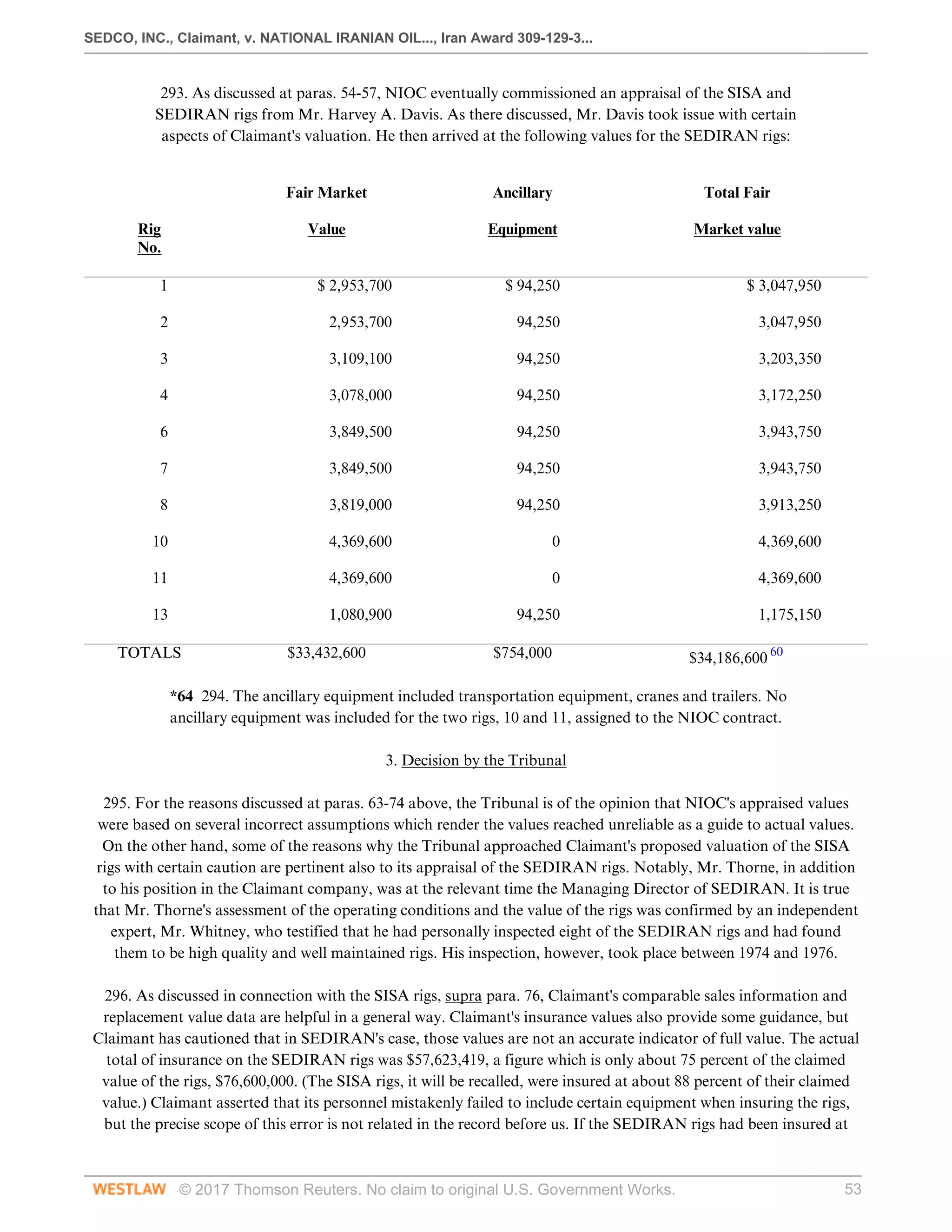
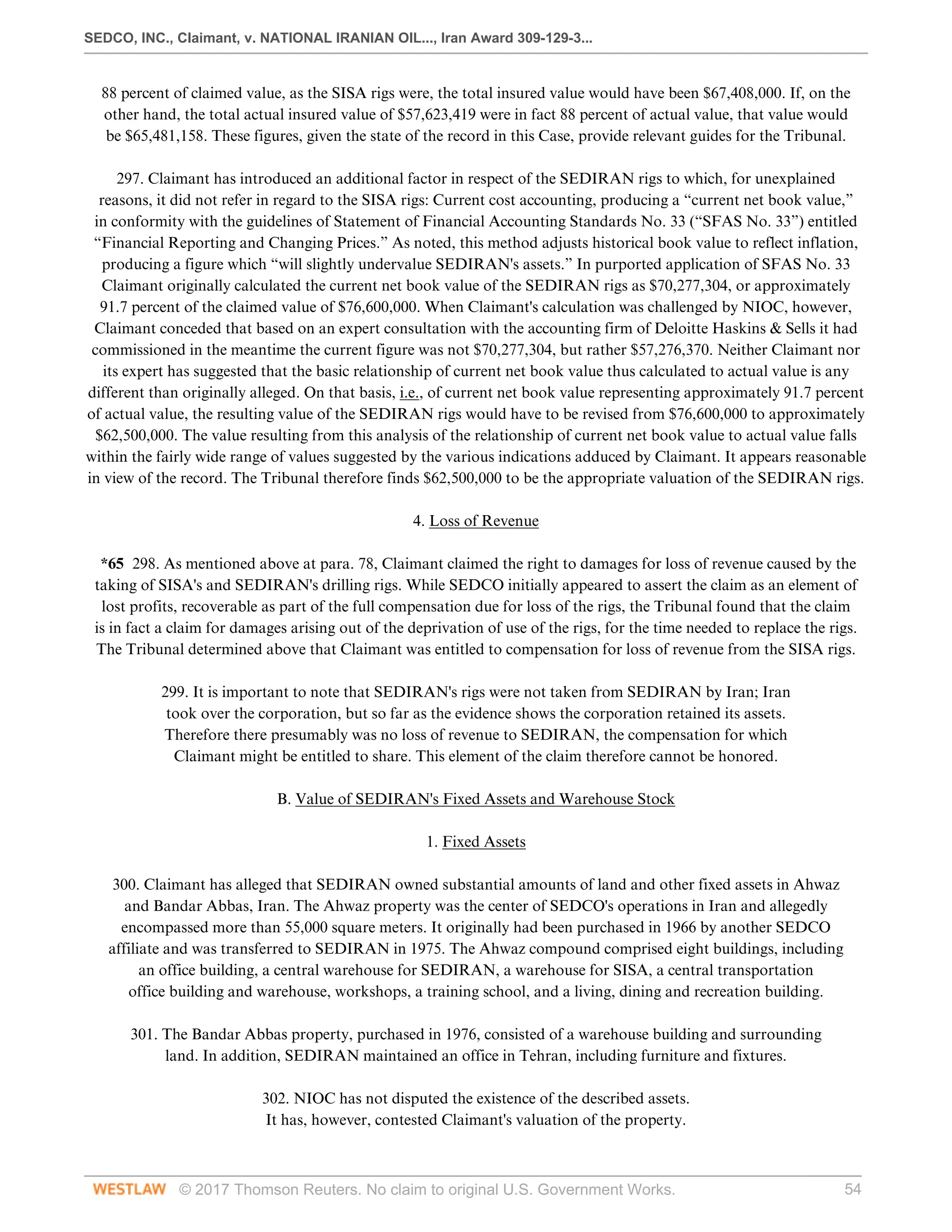
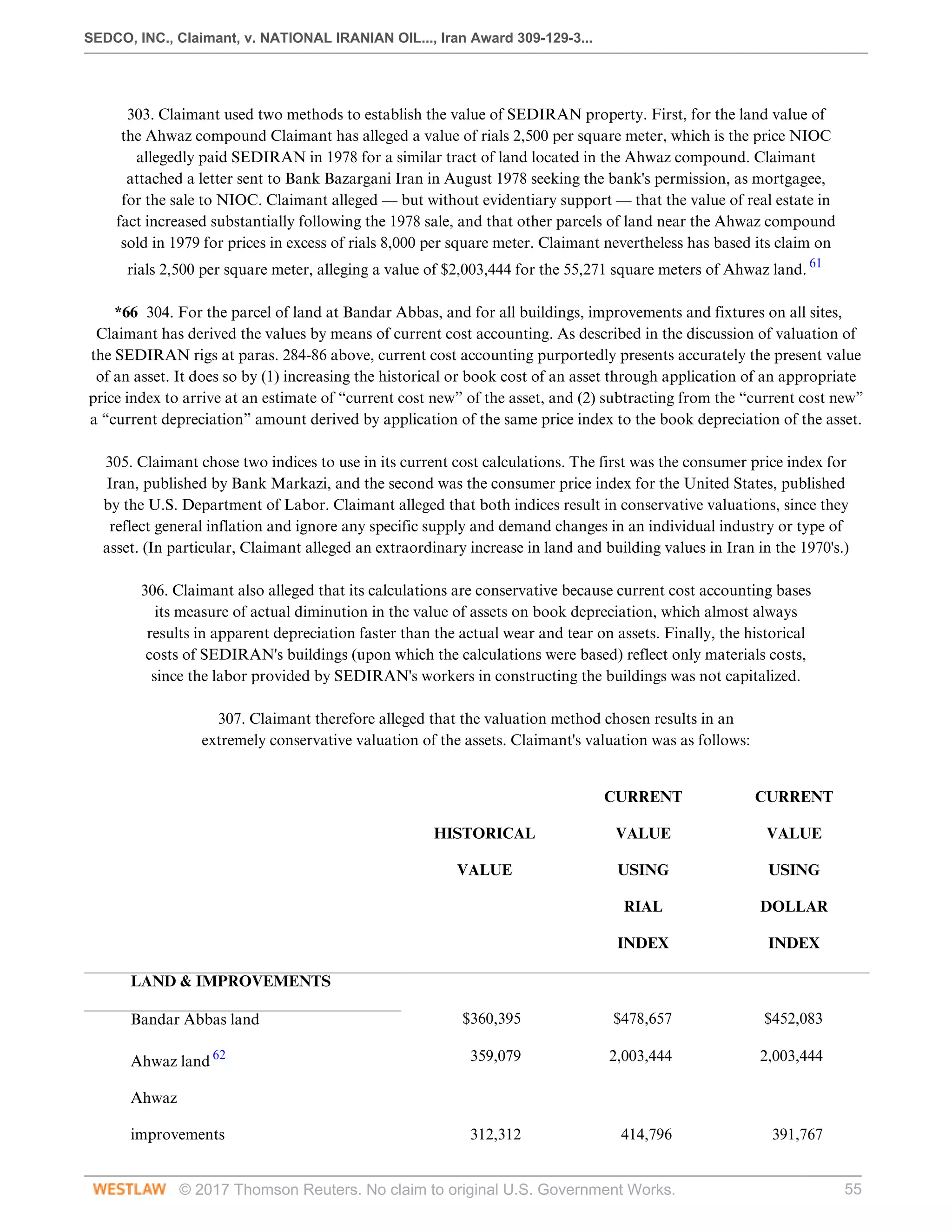
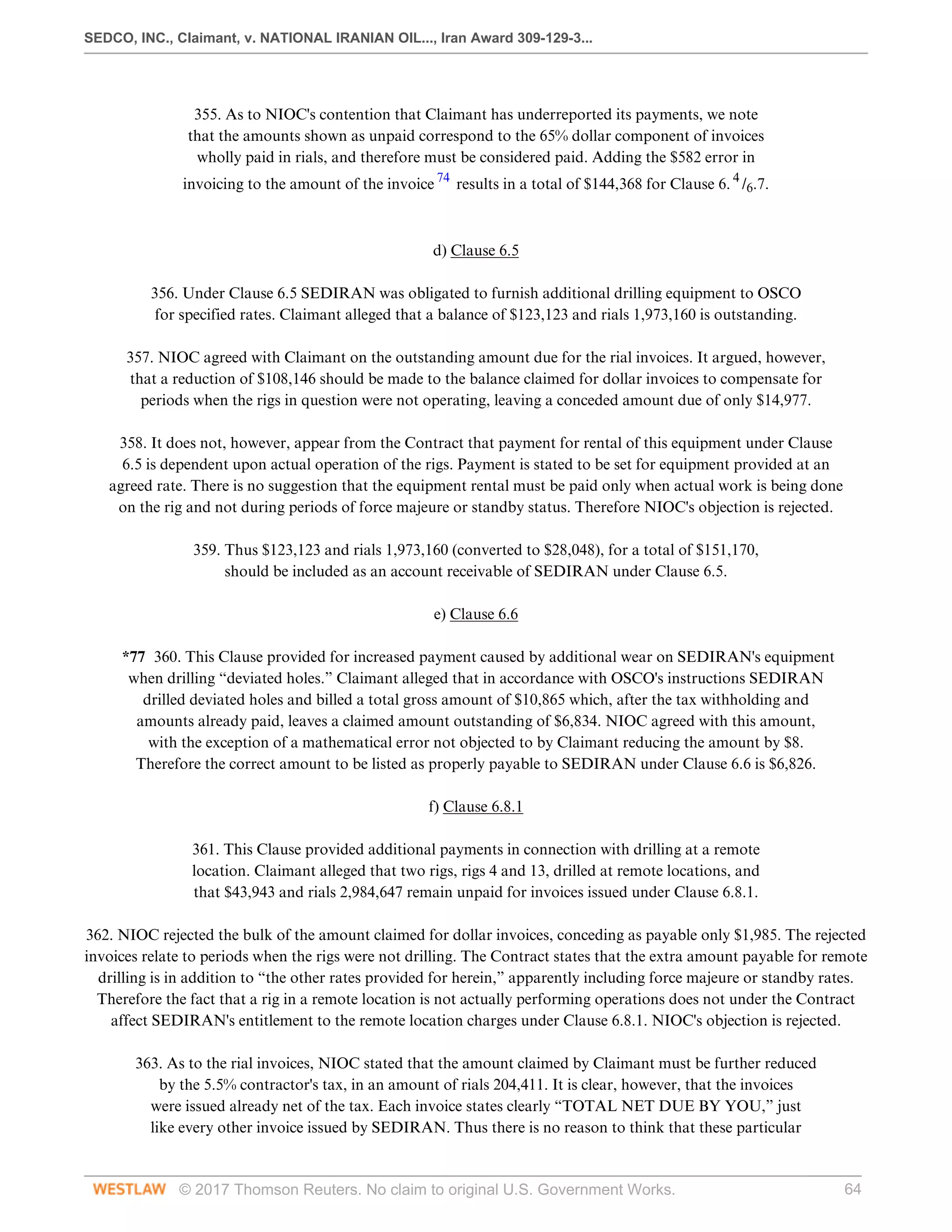
SEDCO, INC., Claimant, v. NATIONAL IRANIAN OIL..., Iran Award 309-129-3...
© 2017 Thomson Reuters. No claim to original U.S. Government Works. 1
Iran Award 309-129-3 (Iran-U.S.Cl.Trib.), 15 Iran-U.S.C.T.R. 23, 1987 WL 503885
SEDCO, INC., Claimant,
v.
NATIONAL IRANIAN OIL COMPANY and THE ISLAMIC REPUBLIC OF IRAN, Respondents.
CASE NO. 129
CHAMBER THREE
AWARD NO. 309-129-3
Iran - United States Claims Tribunal
Filed July 7, 1987
Signed July 2, 1987
'AWARD
 
Appearances:
 
*1 For the Claimant: Mr. Robert B. Davidson, Attorney for Claimant; Mr. Carl F. Thorne, President, SEDCO
International, S.A.; Mr. Paul Franzetti, Associate Counsel; Mr. Walter Cardwell, Special Counsel; Mr. Herman E.
Malone, Representative of Claimant.
For the Respondents: Mr. Alahyar Mouri, Attorney for and Representative of the National Iranian Oil Company;
Mr. Nozar Dabiran, Legal Adviser to the Agent of the Islamic Republic of Iran; Mr. Khosrow Arya, Financial
Expert; Mr. Abdolhamid Bigdeli, Financial Representative; Mr. Mehdi Sadri, Technical Representative; Mr.
Mohsen Shahrestani, Financial Representative; Mr. Mostafa Zaynoldin, Representative of the National Iranian Oil
Company; Mr. Hossein Piran, Assistant to the Agent; Mr. Salimi, Mr. Shenyani, Representatives of Social Insurance
Organization.
Also present: Mr. John R. Crook, Agent of the United States of America; Mr. Jose Alvarez, Assistant to the Agent.
 
I. INTRODUCTION
 
1. This Award follows two previous Awards issued in this Case. The Case involves claims by SEDCO, INC.
(“SEDCO” or “Claimant”), a company which leased and operated drilling rigs in Iran. Claimant brought both
direct claims and indirect claims relating to two subsidiaries, SEDCO INTERNATIONAL, S.A. (“SISA”) and
SEDIRAN DRILLING COMPANY (“SEDIRAN”), against the NATIONAL IRANIAN OIL COMPANY
(“NIOC”) and the ISLAMIC REPUBLIC OF IRAN (“Iran”). The Claims involve three contracts between
SEDCO affiliates and NIOC or the Oil Service Company of Iran (“OSCO”), and allegations of appropriation
or expropriation of drilling rigs and other property or interests owned by SEDCO and its affiliated companies.
 
2. In the first Interlocutory Award, SEDCO, Inc. and National Iranian Oil Company, Award No. ITL 55-129-3 (28
October 1985) (“October Interlocutory Award”), the Tribunal found that SEDCO is a U.S. national, as defined in
the Claims Settlement Declaration, and that it has jurisdiction over SEDCO's indirect claims relating to SISA. The
Tribunal declined to exercise jurisdiction over SEDCO's purported indirect claim on behalf of SEDIRAN, but found
that it does have jurisdiction over SEDCO's direct claim for the expropriation of its shareholder interest in SEDIRAN.
In addition, the Tribunal found that SEDCO's interest in SEDIRAN was expropriated by Iran on 22 November 1979.
 
SEDCO, INC., Claimant, v. NATIONAL IRANIAN OIL..., Iran Award 309-129-3...
© 2017 Thomson Reuters. No claim to original U.S. Government Works. 2
3. In the second Interlocutory Award, SEDCO, Inc. and National Iranian Oil Company, Award No. ITL 59-129-3
(27 March 1986) (“March Interlocutory Award”), the Tribunal determined the standard of compensation to be
applied in deciding SEDCO's right to recovery on its claim for the expropriation of its shareholder interest in
SEDIRAN, finding that Claimant is entitled to compensation for the full value if any of its expropriated interest.
 
*2 4. These prior Interlocutory Awards left for our decision in this Award the following principal issues:
 
a. NIOC's or Iran's liability for appropriation or expropriation of SISA's rigs and other property;
 
b. The value of SISA's property, if appropriated or expropriated;
 
c. The merits of SEDCO's claim for invoices issued by SISA under a contract with OSCO but unpaid;
 
d. The value of SEDCO's expropriated shareholder interest in SEDIRAN; and
 
e. Our jurisdiction over and the merits of the counterclaims asserted by NIOC against Claimant.
 
5. The procedural background of this Case is fully set forth in the earlier Interlocutory Awards. Subsequent to the
October Interlocutory Award, and in light of the Tribunal's finding therein that SEDCO's interest in SEDIRAN
was expropriated as of 22 November 1979, Claimant submitted a calculation of the liquidation value of SEDIRAN
as of 22 November 1979. This was followed by a submission of NIOC responding to Claimant's calculations.
  
II. INDIRECT CLAIMS RELATING TO SISA
  
A. Claims for the Appropriation of SISA's Rigs
  
1. General Background
 
6. Beginning in 1978 SISA, pursuant to Contract No. 3-75-322-339 (“Contract
339”) entered into with OSCO, supplied and operated six drilling rigs for OSCO
in Iran. These rigs were designated by SISA as rigs 52, 61, 68, 77, 83 and 87.
 
7. Claimant has alleged that until approximately November 1978 amounts invoiced to OSCO
were paid by it or its agent, Iranian Oil Services Ltd. (“IROS”), in the normal course of business,
but that thereafter “ OSCO
/NIOC failed and refused to make regular payments as contemplated
by the contract.” (SEDCO's claims for unpaid SISA invoices are discussed at para. 55 below.)
 
8. By 31 December 1978 all of SISA's expatriate personnel had departed Iran and work on the rigs was suspended.
Claimant alleged that the departure of its personnel was necessary given the political unrest in Iran at that time,
and that suspension of work was at OSCO's direction. As discussed in detail below at paras. 124-131, Claimant
alleged that OSCO authorized SISA to remain on “standby” status during the period of suspension of work. NIOC,
however, alleged that SISA's suspension of work constituted an unauthorized abandonment of its contractual duties.
 
9. On 27 February 1979 OSCO telexed SISA concerning Contract 339, stating:
Following advice from Iran please accept this telex as formal notice to terminate the abovementioned
contract. Our personnel in Iran will assist SEDCO in expediting customs clearance and release of rigs.
 
SEDCO, INC., Claimant, v. NATIONAL IRANIAN OIL..., Iran Award 309-129-3...
© 2017 Thomson Reuters. No claim to original U.S. Government Works. 3
SISA allegedly telexed OSCO shortly thereafter stating that it assumed the Contract was terminated
under Clause 40, “Termination by the Company Without Cause,” and that therefore the 180 day
notice period required by Clause 40 would commence 27 February. A telex from Mr. Raoofi of
OSCO in Ahwaz to IROS in London dated 9 April 1979 confirmed that “termination is without
cause” and that the rigs should operate for the 180 day notice period commencing 27 February 1979.
 
*3 10. Formal notice to restart rig operations during the 180 day period was given by Mr. Fakhraie, by then
NIOC's Manager of Drilling, in a letter to SISA dated 28 March 1979. Claimant alleged that by 31 March 1979
five of the six SISA rigs were started. Efforts were made to make the sixth rig (rig 87) operational as well, but on
13 April 1979 Mr. Fakhraie wrote to SISA purporting to terminate Contract 339 with cause as of that date. 1
 
11. Claimant alleged that upon expiry of the 180 day notice period on 29 August 1979 2
the Contract actually
terminated in accordance with Clause 40 with respect to rigs 61, 68 and 83; rigs 52 and 77 continued to operate
under Clause 39, “Termination Procedure,” at the request of NIOC, until 17 November 1979. Claimant alleged
that despite the assurance given by OSCO in its telex of 27 February 1979 neither OSCO nor NIOC assisted
SISA in the exportation of its rigs following termination of the Contract. Claimant alleged that SISA made many
verbal requests for return of the rigs, and that its Iranian materials manager, Mr. Babbibion, who remained in
Iran after the expatriates were evacuated, was instructed to obtain export approval. Claimant further alleged
that Mr. Babbibion had been threatened with physical harm if he continued to make export requests and that
ultimately he was arrested. NIOC's representative Mr. Sadri agreed at the Hearing that Mr. Babbibion had made
attempts to get export approval, but stated that his arrest was on charges of bribery unrelated to his export requests.
 
12. Three written requests from SISA requesting NIOC's assistance in exporting the rigs appear in the
record. On 24 July 1979 Mr. Carl Thorne, on behalf of SISA (and SEDIRAN), telexed NIOC stating:
We have been unable to secure any definitive information from NIOC nor OSCO concerning the
number of rigs which you will require.. . . We must, however, be allowed to export any rigs not
required by the Government of Iran so as to be able to put the said equipment to work thereby
generating urgently needed cash flow. . . . We therefore urgently solicit your advice relative to future
rig requirements and your permission to and assistance with export of any equipment not required.
 
 
13. On 8 November 1979 SISA telexed NIOC again as follows:
We understand that two of the six drilling rigs whose operations are covered by the Contract, Numbers
52 and 77, are still being operated, while the other four . . . are no longer being operated. We assume
that rigs 52 and 77 are being operated in accordance with Clause 39 of that Contract and that they
will therefore be released when appropriate work contemplated by that Clause has been completed.
 
*4 Since you have not chosen to exercise your option to purchase the rigs as permitted under Clause 14.1 of
the Contract, we have expected you to comply with your obligations under Clause 14.5 of the Contract and the
promise contained in your telex notice of termination, to arrange for the necessary permits to enable the rigs to
be exported from Iran. It appears, however, that you have made no efforts to facilitate exportation of any of
the six rigs. Your failure to comply with your obligations in this regard is a substantial breach of the Contract.
 
 
14. NIOC responded to this message on 28 November 1979, stating, inter alia:
As you have noticed termination . . . took effect on 27 August but upon written request of then
SEDCO
/SEDIRAN manager, operation of two units were allowed to continue to help financial position
SEDCO, INC., Claimant, v. NATIONAL IRANIAN OIL..., Iran Award 309-129-3...
© 2017 Thomson Reuters. No claim to original U.S. Government Works. 4
of SEDCO
/SEDIRAN which were not supported by its principales [sic]. . . . We assume these units [rigs]
are kept here by the contractor [SISA] for operational reasons and NIOC would reserve the right to
exercise its option if deemed necessary, before submission of such formal documents [requesting export].
 
 
15. Finally, SISA telexed NIOC on 4 December 1979, stating:
BBB) . . . The purchase option does not survive the termination of the
contract whether or not NIOC permits the rigs to be exported from Iran.
 
CCC) Several requests have been made to NIOC management to export the rigs.
 
GGG) In view of your failure to export our rigs, your failure to pay receivables, and other breaches
of contract, we have found it necessary to file a complaint against you in United States District
Court in New York for approximately forty three million dollars plus consequential damages.
 
 
16. Claimant stated on information and belief that the six SISA rigs continue to operate in Iran under
NIOC's supervision and control. NIOC alleged that it came into lawful possession of the six SISA rigs
following a “purchase” of the rigs by SEDIRAN (then Government-controlled) on or about 2 August 1980.
  
2. Conclusions of the Tribunal
  
a) The Applicable Law
 
17. The Tribunal has held in this Case that in the event of an expropriation implicating the rules of public
international law the Treaty of Amity, Economic Relations, and Consular Rights between the United
States of America and Iran, signed 15 August 1955, entered into force 16 June 1957, 284 U.N.T.S. 93,
T.I.A.S. No. 3853, 8 U.S.T. 899 (“Treaty of Amity), “is applicable to the issue of compensation due
Claimant . . . .” March Interlocutory Award, p. 7. Further, the Tribunal has stated that “the Treaty
of Amity on the particular issue of what constitutes a taking incorporates the rules of customary
international law . . . .” October Interlocutory Award, p. 34. To the extent the taking here alleged is seen
as a non-governmental appropriation, general principles of commercial law then become controlling.
  
b) The Events of Fall 1979 as a Taking
 
*5 18. Claimant alleged that the rigs were appropriated by NIOC on
various dates in 1979, as the Contract terminated for particular rigs:
 
Rig No.
 
Alleged Date of Taking
 
52
 
17 November 1979
 
61
 
29 August 1979
 
68
 
29 August 1979
 
77
 
17 November 1979
 
83
 
29 August 1979
 
SEDCO, INC., Claimant, v. NATIONAL IRANIAN OIL..., Iran Award 309-129-3...
© 2017 Thomson Reuters. No claim to original U.S. Government Works. 5
87
 
13 April 1979
 
19. In Raygo Wagner Equipment and Star Line Iran, Award No. 20-17-3, p. 8 (15 December 1982), reprinted in 1
Iran-U.S. C.T.R. 411, 414, the Tribunal held that a party “should . . . be compensated for the value of the equipment
which was not returned to the lessor after termination of the agreement.” According to Claimant, NIOC's failure to
provide essential assistance for the exportation of the rigs when they were released from work under the Contract
amounts to an appropriation of the rigs. NIOC, however, contended that it did not come into possession of the
equipment left behind after termination of the Contract until on or about 2 August 1980. NIOC also argued that it
was required contractually only to “use its best endeavors to secure export permits” for the rigs and that it would have
done so if Claimant had submitted to NIOC the proper request forms. Claimant contended that “[u]nder the political
circumstances then existing in Iran, SEDCO was hardly in a position to prepare customs forms in quadruplicate for
submittal to NIOC.” SEDCO pointed out that “NIOC was well aware of SEDCO's demand for return of its rigs”
and argued that “[i]f it was acting in good faith, NIOC could easily have arranged for export of the equipment . . . .”
 
20. Clause 14.3 of the Contract, referring to an option granted OSCO by Clause 14.1 to purchase SISA's
drilling plant at the completion or earlier termination of the Contract, provides that “[s]Should the Company
[OSCO] not exercise its above-mentioned right, the Contractor shall either . . . export the Drilling Plant or [pay
appropriate duties to permit sale of the equipment in Iran].” Clause 14.5 then contains the following provision:
On expiry or earlier termination of this Contract the Company will use its best endeavoour
to secure export permits for that part of the Contractor's Drilling Plant in respect of which
the Company does not exercise its right [ [ [ [ [ [ [ [ [to purchase] under subclause 14.1 hereof.
 
Thus, under the Contract SISA in principle had to arrange for the export of the rigs, while OSCO was
under a duty to cooperate in the exportation by using its best endeavors to secure necessary export
permits. The question to be examined here is therefore whether NIOC breached this contractual
duty and thereby, as contended by Claimant, caused SISA to be deprived of the use of its rigs.
 
21. It is true that Claimant or SISA requested in writing on at least three occasions that the rigs be exported. It is
also true that Claimant never provided NIOC with the customs forms which, according to NIOC, were a necessary
requirement for the obtaining of export permits. Due to the political situation in Iran in 1979 and the fact that all
SEDCO expatriates had left the country by then, it was no doubt difficult for SISA to handle the practical problems
related to the exportation, including the preparation of export forms. SISA therefore arguably had a legitimate
expectation that NIOC should take a more active part in the exportation than the more limited assistance required
by it under Clause 14.5, at least on the face of that provision. 3
The failure of a party to render contractually required
assistance towards exportation could at some point in time ripen into a taking or conversion of the property affected.
In view of its holdings, infra, on the issue of appropriation, however, the Tribunal need not determine whether
or not NIOC's failure to comply with Claimant's requests to have the rigs exported should in the circumstances
be deemed to constitute a breach of contract, as no separate claim for damages is based on such alleged breach.
 
*6 22. The Tribunal is unable to determine, on the basis of the evidence in the record, the precise status of the
SISA rigs during late 1979 and early 1980. Several facts indicate that they may have been taken by Iran or NIOC
during that time. For example, as the Tribunal has already held, SEDCO's shareholder interest in SEDIRAN
was expropriated on 22 November 1979 (as confirmed by Iran's subsequent application to SEDIRAN of Clause
C of the Law for the Protection and Development of Iranian Industries (“Clause C”)). October Interlocutory
Award, pp. 34-39. The Tribunal recognized that “Iran's intention to form the National Iranian Drilling Company
necessarily meant that 'all drilling activities in Iran will be taken over.”' Id. p. 42. SISA obviously was involved in
drilling activities, and also was closely associated with SEDIRAN. For example, the spare parts for the six SISA
rigs were stored at the SEDIRAN warehouse facility. In addition, NIOC appeared generally not to be maintaining
a distinction between SEDIRAN and SISA operations at this time. Indeed, SISA's affairs within Iran were then
SEDCO, INC., Claimant, v. NATIONAL IRANIAN OIL..., Iran Award 309-129-3...
© 2017 Thomson Reuters. No claim to original U.S. Government Works. 6
being directed by SEDIRAN's Iranian managers. The Tribunal does not, however, consider these evidences to
constitute sufficiently compelling proof that the SISA rigs were definitively taken as early as November 1979.
  
c) The Events of August 1980 as a Taking
 
23. NIOC alleged that following formal application of Clause C to SEDIRAN on 2 August 1980 SEDIRAN (in
fact Government-controlled since 22 November 1979) “decided to exercise its right to purchase the equipment
[rigs] in accordance with the terms of the Purchase and Mortgage Agreement dated January 1, 1975 [[[[[[[[[between
SISA and SEDIRAN] and it did purchase the equipment.” NIOC stated further that it began to use the rigs after
Iran, through SEDIRAN, took possession of them. NIOC thus admitted that it or Iran took possession of the six
SISA rigs on or about 2 August 1980 allegedly in accordance with the 1975 purchase agreement (the “Agreement”).
Indeed, NIOC has offered in its submissions here to credit SEDCO with the “fair and reasonable” value of the rigs,
thus conceding that it ultimately obtained possession of them and considers itself liable for their appropriation.
 
24. NIOC submitted to the Tribunal a copy of the Agreement (which in fact is
dated 1 February 1975). The Agreement grants SEDIRAN the option to purchase
a group of nine SISA rigs “at any time subsequent to the date of this Agreement.”
 
25. Claimant has not contested the validity of the Agreement, which it says “was granted as a means, in the
indefinite future, of consolidating SEDCO's Iranian operations if such a consolidation were deemed desirable,” a
goal which Claimant states it abandoned “as conditions worsened in Iran.” 4
Claimant has alleged, however, that
the Agreement as submitted by NIOC is not complete and that the option in the Agreement never was exercised.
 
*7 26. The Tribunal notes first that the Agreement submitted by NIOC appears on its face to be
complete, although the various annexes referred to therein are not attached; it is also noted, however,
that the minutes of a 28 April 1975 meeting of the Board of Directors of SEDIRAN indicate that
there was at least one amendment to the Agreement which has not been submitted to the Tribunal.
 
27. NIOC submitted no evidence whatsoever, however, that the purchase option in fact was exercised. Given
particularly that the option purchase price formula is somewhat complicated, consultations with SISA regarding
the option price necessarily would have accompanied any exercise of the option. 5
NIOC alleged the option
purchase price for the six rigs was “$5,500,000 or an even lesser amount,” which proportionally is far short
of the basic option price in the Agreement of $32,567,222 for nine rigs. 6
No record of payment nor any
relevant communication with SISA has been submitted to the Tribunal, and SEDCO denies that SISA was paid
anything. NIOC's contention that Iran, through SEDIRAN, purchased the rigs thus fails for lack of proof. 7
This conclusion does not negate, however, NIOC's admission that it or Iran, the other Respondent in this Case,
had taken possession of six rigs on approximately 2 August 1980, and that NIOC thereafter operated the rigs.
 
28. There is evidence in the record suggesting that the taking of the rigs may have been part of broader Government
policies nationalizing the oil drilling industry, thus amounting in effect to an expropriation of the rigs by
Iran. 8
In the circumstances of this case, however, a finding of expropriation by Iran is not necessary. Claimant
styled the taking of its rigs as an appropriation by NIOC and that characterization of the taking is adequately
supported by the record. Indeed, NIOC has in effect admitted it possesses the rigs and owes compensation
for them in offering to credit SEDCO with what NIOC considers a “fair and reasonable amount” for the rigs.
Since NIOC clearly is a controlled entity under the Claims Settlement Declaration we need not find that the
Government of Iran itself expropriated the rigs in order to grant Claimant compensation for the loss of the rigs.
 
SEDCO, INC., Claimant, v. NATIONAL IRANIAN OIL..., Iran Award 309-129-3...
© 2017 Thomson Reuters. No claim to original U.S. Government Works. 7
*8 29. The Tribunal thus concludes that NIOC appropriated the six rigs belonging
to SEDCO's wholly-owned subsidiary SISA not later than 2 August 1980.
  
B. Valuation of the Appropriated SISA Rigs
 
30. Having determined that NIOC appropriated SISA's six drilling rigs at the latest by 2 August 1980, the
Tribunal must now determine the compensation due Claimant for the appropriated rigs. As held by the
Tribunal in the March Interlocutory Award, p. 13, “Claimant must receive compensation for the full value of its
expropriated interest . . . as claimed, whether viewed as an application of the Treaty of Amity or, independently,
of customary international law, and regardless of whether or not the expropriation was otherwise lawful.” While
our earlier Award dealt specifically only with the standard of compensation due for the taking of SEDOC's
shareholder interest in SEDIRAN, the principles there expounded are equally relevant to the taking of SISA's
rigs and other property. See Oil Field of Texas, Inc. and Islamic Republic of Iran, Award No. 258-43-1,
para. 43 (8 October 1986). If NIOC's appropriation is seen as implicating Iran's duties under international
law (pursuant to either the Treaty of Amity 9
or customary law), then the holding of our earlier Award is
directly relevant. If, however, NIOC is considered to have acted in a purely private capacity, its conversion of
SISA's rigs would be unsupported by the rights of sovereignty which may justify expropriation, cf. American
International Group, Inc. and Islamic Republic of Iran, Award No. 93-2-3, pp. 11, 14 (19 December 1983),
reprinted in 4 Iran-U.S. C.T.R. 96, 103, 105, and thus a fortiori would give rise to a duty to pay full value for
wrongfully acquired property. Accordingly, we must award Claimant the full value of the appropriated assets.
 
*9 31. In determining the full value of tangible assets such as drilling rigs, our task is substantially to
determine the fair market value of the properties, i.e., what a willing buyer and a willing seller would
reasonably have agreed on as a fair price at the time of the taking in the absence of coercion on either
party. INA Corporation and Islamic Republic of Iran, Award No. 184-161-1, p. 10 (13 August 1985). In
making such a determination, we must not consider as an element of value the taking itself, nor events
preceding the taking calculated to diminish the value of the property. American International Group, Inc.
and Islamic Republic of Iran, supra, pp. 16-17. On the other hand, the general state of political, social
and economic conditions and their effect on the value of property may properly be considered. Id. p. 18.
 
32. The Tribunal obviously has no independent basis for determining the value of the rigs, but the Parties have
submitted an abundance of evidence substantiating their estimates of value. Claimant's appraisal of the value
of the rigs is $29,430,000. This figure is the estimate of SISA's President, Carl F. Thorne, who Claimant has
alleged is knowledgeable regarding oil rig values in general and is aware specifically of the condition and value
of each of SISA's rigs. NIOC has submitted its own valuation of the rigs based on an appraisal by Harvey A.
Davis, a professional property appraiser, who concludes that the total value of the SISA rigs is $10,382,800.
 
33. The evidence in support of the Parties' alternative valuations, as well as certain relevant
supplemental materials submitted, will be considered in turn in the following sections.
  
1. SEDCO's Valuation of the Appropriated Rigs
  
a) Thorne Valuation
 
34. Mr. Thorne purported to have based his valuation of SISA's rigs on his personal, first-hand knowledge of
the condition of the rigs and of their value in the market at the alleged dates of taking (between 13 April and
17 November 1979). According to Mr. Thorne, the value of a drilling rig is determined most significantly by
its drilling capacity, specifically the capacity of its “drawworks,” which determines the depth to which a rig
can drill. Other factors which Mr. Thorne considered as affecting value include the type of power transmission
SEDCO, INC., Claimant, v. NATIONAL IRANIAN OIL..., Iran Award 309-129-3...
© 2017 Thomson Reuters. No claim to original U.S. Government Works. 8
used on a rig 10
and the amount and quality of ancillary tools, drill pipe and collars, transportation equipment
and housing facilities assigned to a particular rig. Also relevant to value is the age of a rig, although Mr.
Thorne asserted that the value of a rig is more dependent upon its condition than upon its age. He stated that
if a rig is properly maintained, as various components wear out they are replaced by new parts so that after
several years nearly all major components would be significantly newer than the originally assembled rig.
 
*10 35. He stated that while the SISA rigs were relatively older and technically less advanced than the rigs owned by
SEDIRAN, they were nevertheless maintained “in first class operating condition,” consistent with SEDCO's operating
philosophy. Based on his assessment of the “top quality equipment” used in the rigs, his experience regarding rig
values in the drilling industry in general and his “specific experience in the Middle East and in Iran in particular,”
Mr. Thorne stated that the value of the rigs as of the alleged dates of appropriation in 1979 was as follows: 11
 
36. Mr. Thorne explained that rig 52 is valued at less than the others because it was a smaller rig, originally
used for workover operations and then upgraded for light drilling Rigs 61, 68 and 77 were older mechanical
rigs, while rigs 83 and 87 were newer and more advanced diesel electric rigs with superior drilling depth
capacity. These differences are said to account for the different values assigned to the rigs. The value
assigned to each rig by Mr. Thorne includes the value not only of the actual drilling unit, but also of
miscellaneous tools, drill pipe and collars, transportation equipment and housing facilities associated with
the rig. This allegedly is in accordance with industry practice. According to Mr. Thorne, the ancillary
equipment supplied with the rigs according to the Contract schedules was substantially identical for each rig.
 
37. Recognizing that the Tribunal might be reluctant to accept a valuation of property based
solely on the estimate of one of its officers, Claimant submitted certain purportedly independently
verifiable and objective information in support of the valuation proposed by Mr. Thorne. Included
are evidence regarding certain allegedly comparable contemporary sales, the amounts of coverage
in SISA's insurance policies, and calculations of 1979 replacement cost for the rigs. In addition, an
expert opinion of Mr. Lee A. Drake was submitted confirming the valuation made by Mr. Thorne.
  
b) Comparable Sales and Appraisals
 
38. As evidence that Mr. Thorne's valuation is accurate, and even conservative, Claimant has submitted
evidence of sales of allegedly similar rigs at substantially higher prices. The sales involved three mechanical
rigs similar in size to rig 52, but allegedly with inferior ancillary equipment, in Dubai (directly across the Gulf
from Iran). The rigs sold in October 1981 for approximately $6.6 million each. 12
Claimant initially alleged
that the market for land drilling rigs in the Middle East in 1981 was substantially similar to the market in 1979
when, it said, the rigs were taken. NIOC submitted evidence showing that in fact prices for rig equipment in
1981 were substantially higher than in 1979. Claimant subsequently agreed with that point, but alleged that
the 1981 sales nevertheless are comparable and instructive. Claimant argued that the price escalation between
1979 and 1981 to which NIOC referred is reflected in the difference between Mr. Thorne's valuation of SISA's
rig 52 at $4,155,000 in 1979 and the sales of allegedly similar but less complete rigs for $6.6 million in 1981.
 
*11 39. Claimant also pointed to certain appraisals that it commissioned as to the value of three rigs owned
by SEDIRAN which were outside of Iran at the time of the Revolution and of which SEDCO subsequently
took direct ownership. 13
Two of the rigs, SEDIRAN rig 12 and SEDIRAN rig 17, are alleged to be similar
to SISA rigs 52 and 77, respectively. The appraisals were conducted on site by two independent appraisers,
Miller & Miller and Davis Auctioneers, in April 1980. The two appraisers found, respectively, that SEDIRAN
rig 12 was worth $6,321,265 and $6,498,500. The values they placed on rig 17 were $5,645,301 and $5,902,000,
respectively. The appraisals of the SEDIRAN equipment did not include any value for transportation equipment,
SEDCO, INC., Claimant, v. NATIONAL IRANIAN OIL..., Iran Award 309-129-3...
© 2017 Thomson Reuters. No claim to original U.S. Government Works. 9
but nevertheless uniformly valued the rigs at levels substantially higher than Mr. Thorne's estimate of value for the
allegedly similar SISA rigs. Claimant argued that these appraisals (which were conducted less than four months
before the taking in August 1980) of similar rigs and conducted by independent appraisers with no affiliation
with SEDCO confirm and support the reasonableness and accuracy of the valuation submitted by Mr. Thorne.
 
40. While Claimant did not specifically press the point in this context it is significant as well that when SEDCO
subsequently took direct ownership of the SEDIRAN rigs for which the appraisals were performed, it did so
under a U.S. Treasury license permitting it to do so in exchange for the payment or cancellation of certain foreign
currency debts owed by SEDIRAN. The amount of the debts thus paid was $16,196,189.91. This amounts
in effect to an average purchase price of approximately $5,398,730 each. The fact that SEDCO was willing
to pay that much for rigs already in its control is strong support that they were worth at least that amount.
  
c) Insurance Policy Coverage
 
41. Claimant has submitted excerpts from its insurance policy insuring SISA's rigs against casualty risks. The policy
insured the rigs (including some but not all of the allocated ancillary equipment) for a total of $25,940,456, as follows:
Rig No.
 
Insured Values 14
 
52
 
$ 3,573,409.33
 
61
 
4,073,409.33
 
68
 
4,073,409.33
 
77
 
4,073,409.33
 
83
 
5,073,409.33
 
87
 
5,073,409.33
 
TOTAL
 
$25,940,455.98
 
Claimant alleged that these levels of insurance confirm the substantial accuracy of Mr. Thorne's valuation.
 
42. Claimant explained the $3.5 million discrepancy between its claimed valuation and the policy limits
as attributable to the non-inclusion of some ancillary equipment in the insurance policy, and to SEDCO's
practice of insuring for less than 100% of actual value. This allegedly is a result of SEDCO's conclusion
that in case of a casualty much of the equipment would likely remain undamaged. Claimant further
stated that oil field insurers encourage a margin of uninsured value as an incentive to careful operations.
  
d) Replacement Value
 
*12 43. As a further indication of the value of the expropriated rigs SEDCO calculated and submitted detailed
replacement cost data. It did so by obtaining vendor quotations for the 1979 costs of each item contained in
SISA's (and SEDIRAN's) drilling contracts. Claimant alleged that the lists actually undervalue the replacement
cost of the rigs as taken because the calculations do not include certain equipment actually assigned to the
rigs which was not listed in the Contract. Nevertheless Claimant alleged that the calculations are an accurate
indication of the replacement value of the appropriated rigs. Those values for the SISA rigs are as follows:
 
SISA Rig No. 1979 Replacement Cost
SEDCO, INC., Claimant, v. NATIONAL IRANIAN OIL..., Iran Award 309-129-3...
© 2017 Thomson Reuters. No claim to original U.S. Government Works. 10
   
52
 
$ 5,305,216.88
 
61
 
5,503,106.11
 
68
 
5,603,476.48
 
77
 
5,835,784.79
 
83
 
6,427,487.88
 
87
 
6,435,608.38
 
TOTAL
 
$35,110,680.52
 
44. In support of its replacement cost calculations Claimant submitted an affidavit of Mr. A. Reid Smith,
an executive of United States Steel Corporation's oil well operations, attesting that the calculations
done by SEDCO “accurately reflect the costs of the various rig components in 1979” and “fairly and
accurately reflect the cost, in 1979, of replacing the SISA and SEDIRAN rig equipment with new
equipment of comparable drilling capacity.” This opinion was subsequently affirmed by two other experts.
 
45. As further confirmation of its replacement cost calculations Claimant submitted an actual
quotation it received in October 1979 for a new rig of the same type as rig 52 (but without ancillary
equipment). Claimant calculated that the quoted price, plus the 1979 value of related ancillary
equipment, would result in a replacement cost for rig 52 of $5,332,806.74, which is substantially similar
to the $5,305,216.88 replacement cost obtained by Claimant's computation from vendor price lists.
 
46. Claimant has alleged that the differential between the replacement cost and the actual alleged
value of the rigs in 1979 accurately reflects the difference between new and well-maintained used
equipment. Claimant argued that the replacement value data shows that its asserted values for the rigs
are conservative and that the total amount claimed for the six rigs does not overstate their 1979 value.
  
e) Expert Opinion
 
47. In support of its valuation of the SISA rigs, and also in rebuttal of NIOC's valuation, Claimant
submitted an affidavit by Mr. Lee A. Drake, President of LTV Energy Products Company, an oil
drilling equipment company. As further discussed below, he confirmed the value of the SISA rigs as
stated by Mr. Thorne. He also confirmed the accuracy of Claimant's replacement value calculations.
  
2. NIOC's Valuation of the Appropriated Rigs
  
a) NIOC's General Objections
 
*13 48. NIOC objected that the Claimant's estimate of value for the appropriated rigs was “by
no means acceptable,” but NIOC did agree to give SEDCO credit for the “fair and reasonable
value” of the rigs. NIOC did not, however, originally propose in its Statement of Defense an
alternative “reasonable” value for the appropriated rigs to that claimed by Claimant. Rather
it pointed out several alleged defects which it said discredit Claimant's valuation evidence.
 
49. First NIOC objected to the Tribunal's giving credence to a valuation proposed by Mr. Thorne because he
is employed by Claimant. NIOC stated that under the (allegedly applicable) civil law of Iran, where there is a
SEDCO, INC., Claimant, v. NATIONAL IRANIAN OIL..., Iran Award 309-129-3...
© 2017 Thomson Reuters. No claim to original U.S. Government Works. 11
master and servant relationship between a party and a witness, such testimony is open to challenge. It alleged
that Mr. Thorne's valuation was biased and non-objective, and that the Tribunal should therefore reject it. 15
 
50. On the merits of Claimant's valuation, NIOC objected that Mr. Thorne did not take into account
the age of the rigs and alleged that at least one of them had been in service for 25 years in 1979. NIOC
also contested SEDCO's claim that the rigs were properly maintained, alleging particularly that in
the months following the Revolution SEDCO had failed to make available needed replacement parts.
 
51. NIOC also took issue with the evidence submitted to support the Thorne valuation. On the
issue of the three allegedly comparable 1981 rig sales NIOC contested Claimant's statement that the
price of drilling rigs remained stable throughout the period 1979 to 1981 and, as mentioned above,
offered a NIOC price index showing that prices for NIOC oil field equipment increased during that
period. NIOC also contested the technical comparability of the purchases alleged by Claimant to be
comparable, and noted particularly that the three rigs whose sale is alleged to be comparable were
“transferred under the terms of a relative contract,” which was said to increase the value of the rigs. 16
 
52. NIOC rejected Claimant's explanation as to the discrepancy between its insurance policy and alleged
value, and stated that Claimant's lower insurance coverage shows that the appraisal overstates true value.
NIOC argued that it is obvious “that for insurance of any unit the insurer usually fixes a maximum
which includes many factors . . . [and] the insurance value of the units is [[[[[[[[[normally] much higher
than the actual price.” In particular, NIOC alleged that SEDCO's insurance policy was intended to
insure the equipment at new equipment values. In support of that allegation, NIOC quoted a clause
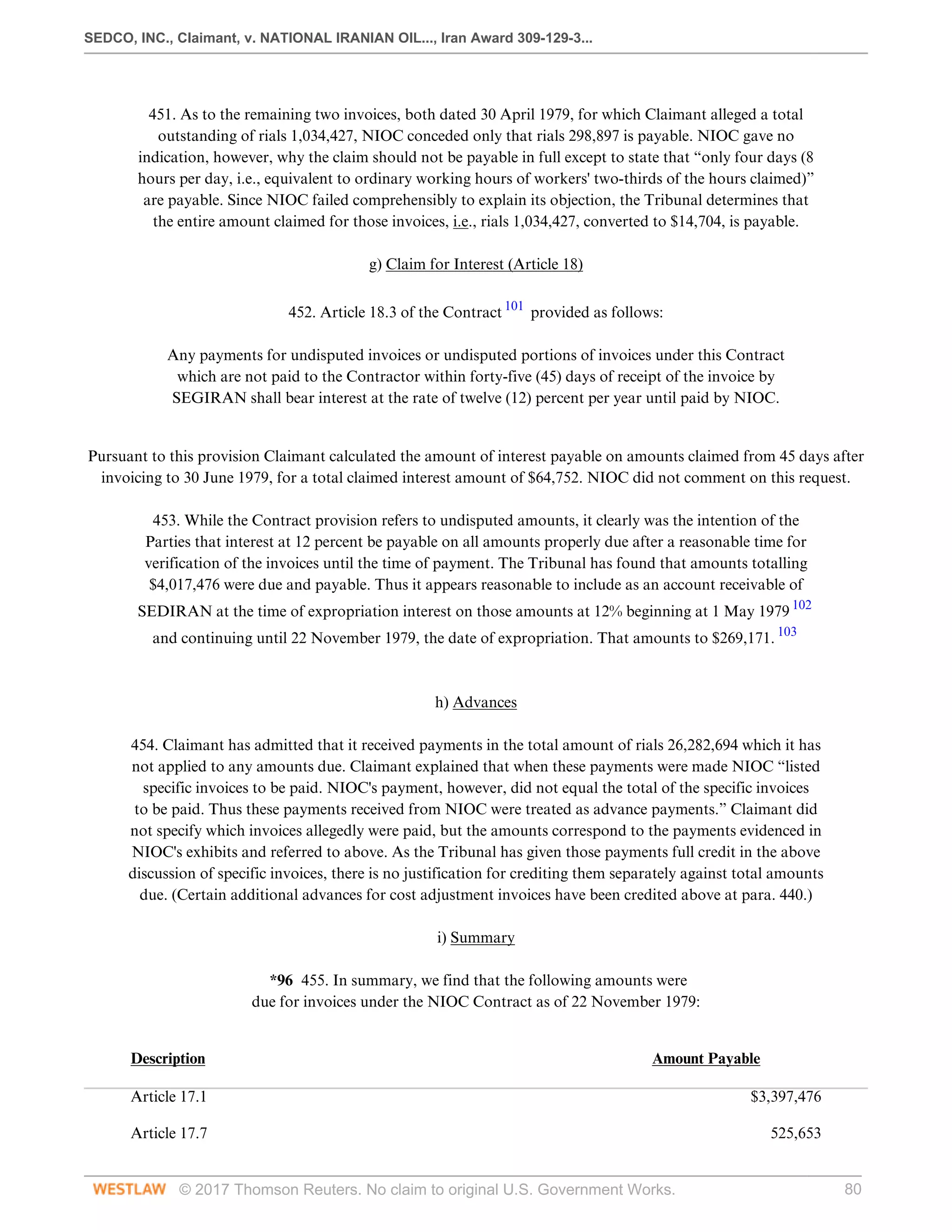
of an insurance policy issued by Bimeh Omid, an Iranian insurance company, for eleven land rigs:
*14 It is hereby understood and agreed that in respect of the property insured all cost of repair and replacement
for which the Company may be liable shall be on the basis of new for old with no deduction for depreciation.
 
 
53. Although NIOC did not allege that such a clause was included in SISA's or SEDIRAN's insurance policies, an
examination of those policies as submitted by Claimant discloses that such language was included. The Tribunal
does not agree, however, that the clause has the effect NIOC asserts. The policies do not state that the insured values
represent full replacement value, but rather they are stated to be agreed values, i.e., the limits of the policies. The
quoted clause merely provides that in case of repair or damage the insurance company will pay for actual replacement
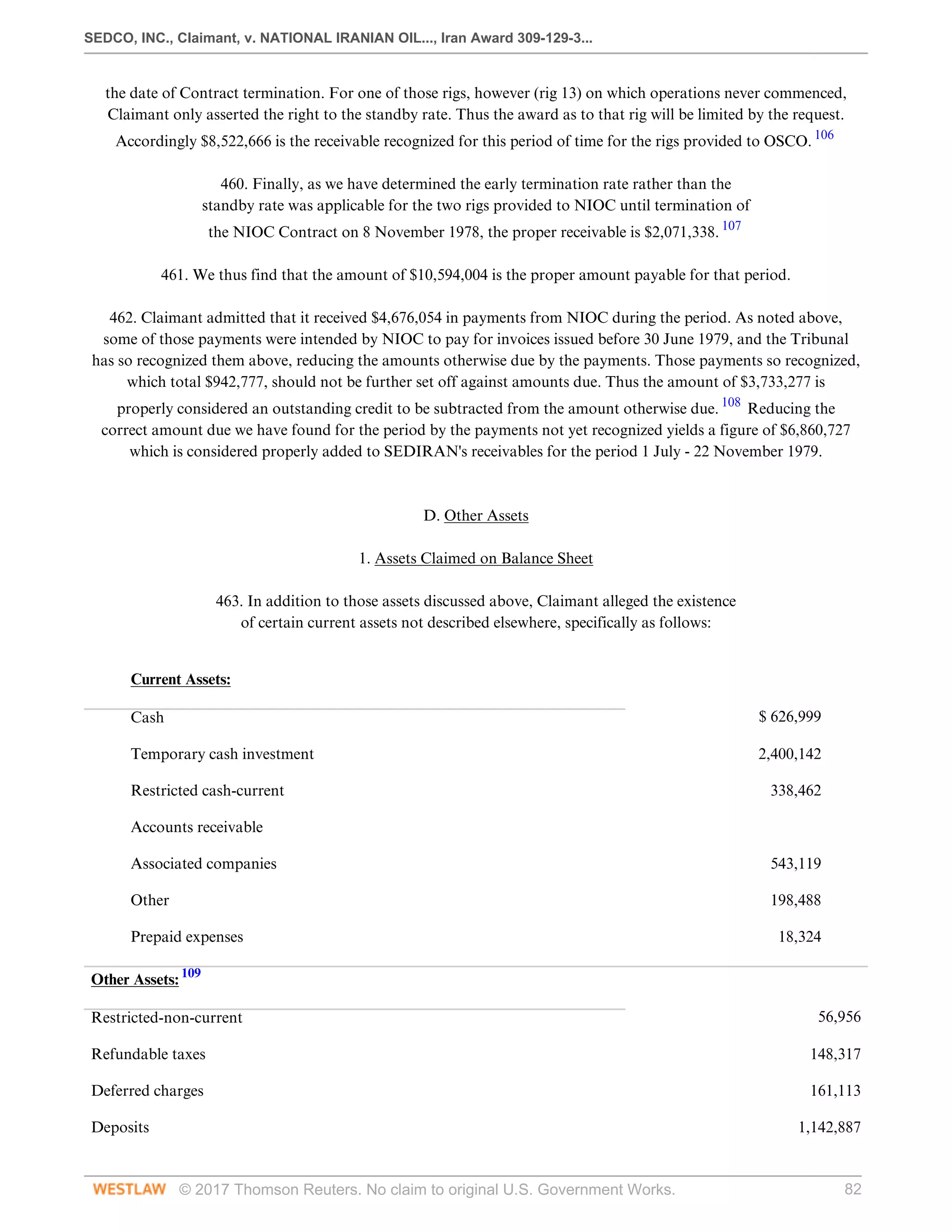
or repair costs at current values up to the limits of the policy. Given SEDCO's stated practice of underinsuring to
provide a margin of self-insurance, and in light of the substantial evidence on actual replacement values, the Tribunal
is not convinced that the insurance values should be considered to represent the full replacement cost of new rigs.
  
b) NIOC's Alternative Appraisal
 
54. NIOC ultimately commissioned an appraisal from an American property appraiser, Mr. Harvey A. Davis.
Mr. Davis formerly was a purchasing manager for an oil field equipment manufacturer and he began performing
rig appraisals in 1982. He stated at the Hearing that he had completed all the requirements for a business
appraisal certificate but had not yet received the certificate. The technical accuracy and professionalism of
his appraisal was supported by reviews by three other appraisers. The appraisal was based on inventories
furnished by NIOC (purportedly based on those submitted by Claimant) without an inspection of the equipment.
 
55. Mr. Davis stated that a major flaw in Claimant's appraisal was that it does not take into account the
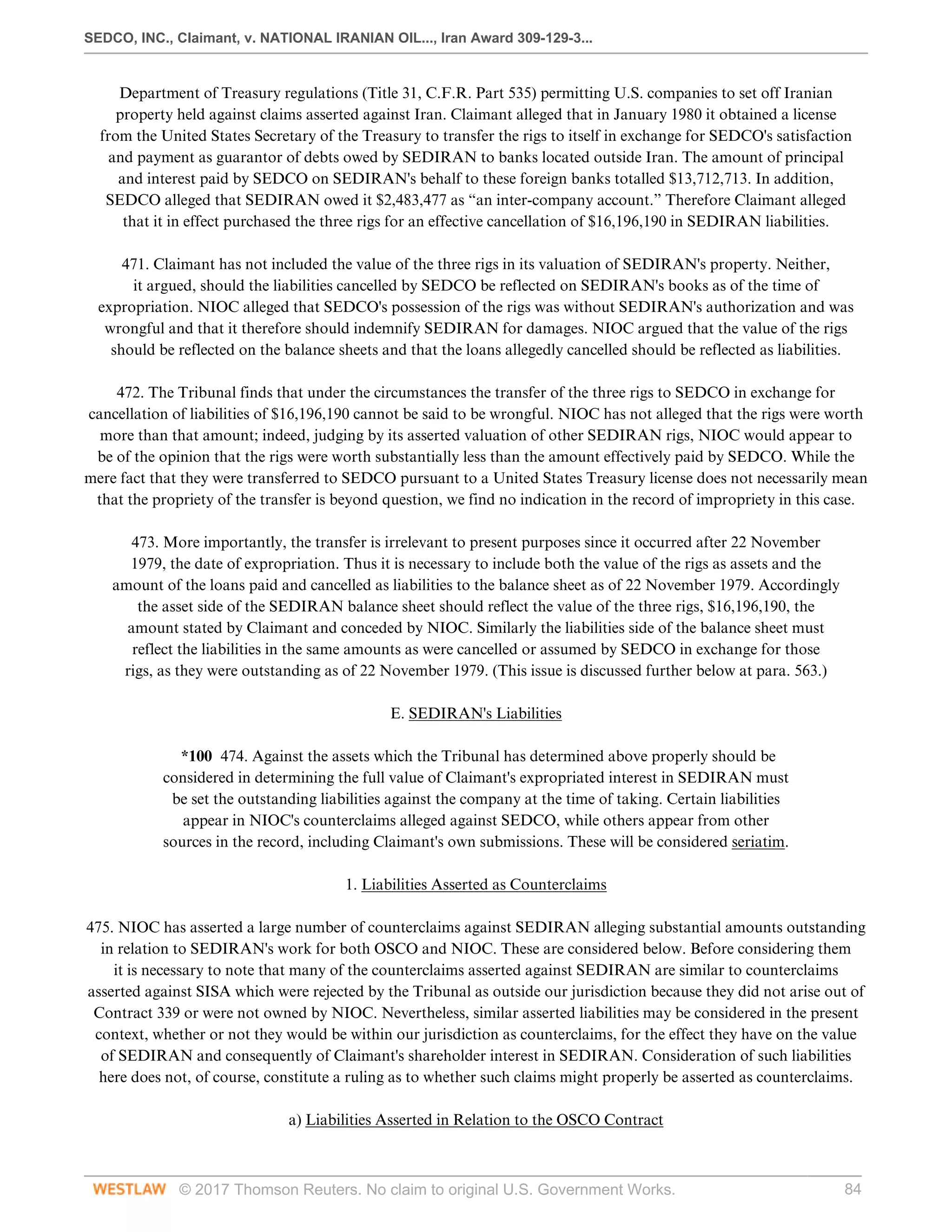
factors surrounding the “location market and its effect on the fair market value of the equipment.” Mr.
Davis' appraisal, on the other hand, purported to set the value of the rigs “on their location” in 1979.
The appraiser concluded that it would be “highly unlikely the rigs will be sold or moved from Iran.”
SEDCO, INC., Claimant, v. NATIONAL IRANIAN OIL..., Iran Award 309-129-3...
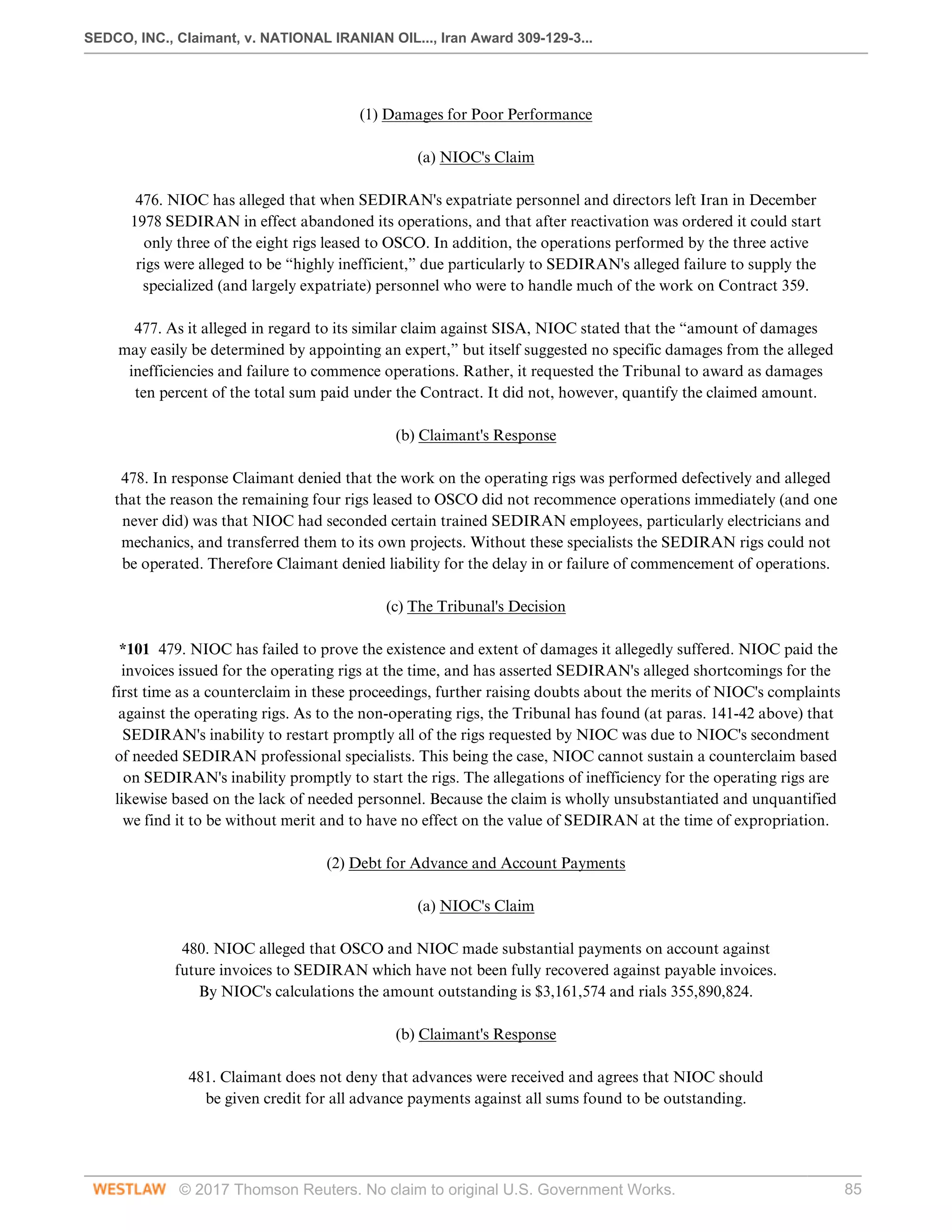
© 2017 Thomson Reuters. No claim to original U.S. Government Works. 12
 
56. The appraiser further stated that he identified a dip in the market in the first part of 1979 which resulted
in values being markedly lower in June 1979 than they were either before or after. This was based on data
about the source market, which Mr. Davis determined was the United States. According to the appraiser,
in 1979 the SISA equipment would have been “in average demand in the open market. Demand dropped
in 1979 which directly affected prices. The market demand increased dramatically in 1980 and 1981. . . .”
 
57. Applying these assumptions, Mr. Davis arrived at the following values:
Fair Market
 
Ancillary
 
Total Fair
 
Rig No.
 
Value
 
Equipment
 
Market Value
 
52
 
$ 765,800
 
$146,650
 
$ 912,450
 
61
 
1,078,600
 
146,650
 
1,225,250
 
68
 
842,400
 
146,650
 
989,050
 
77
 
1,183,200
 
146,650
 
1,329,850
 
83
 
2,826,500
 
146,650
 
2,973,150
 
87
 
2,806,400
 
146,650
 
2,953,050
 
TOTALS
 
$9,502,900
 
$879,900
 
$10,382,800
 
*15 The allocated ancillary equipment allegedly included transportation equipment and miscellaneous tools.
  
c) Purchase Option Values
 
58. It should be noted that all the SISA rigs and eight of the SEDIRAN rigs were subject to purchase
options whereby OSCO had a potential right to obtain the rigs “at the completion or earlier termination”
of the contracts. The option set a purchase price of $4.5 million each for the SISA rigs and $6 million
each for the SEDIRAN rigs, less depreciation at 12 ½% per year from the effective date of the
contracts. Claimant argued that the option is irrelevant to valuing the rigs and specifically stated that
The option prices largely reflected the rates provided for in the contracts and SEDCO's
anticipation that these rates would be paid through completion of the contract term. It would
be totally inequitable to SEDCO under these circumstances to be awarded only the option
prices without being awarded, for example, lost profits through the contracts' completion.
 
 
59. NIOC has not alleged that such options were exercised or that the option prices are
a proper measure of value for any of the rigs. 17
In any case no party has calculated
what the option price would have been at the time the contracts terminated. 18
 
60. In addition to the OSCO option, the SISA rigs had been subject to a prior “Purchase and
Mortgage Agreement” dated 1 January 1975 granting SEDIRAN the option to purchase the six
SISA rigs at issue here (and three others). 19
While it appears that this option was superseded by
or at least subject to the subsequent option granted to OSCO, noted above, NIOC stated that
after SEDIRAN was taken over by Iran it exercised the option (on or about 2 August 1980).
SEDCO, INC., Claimant, v. NATIONAL IRANIAN OIL..., Iran Award 309-129-3...
© 2017 Thomson Reuters. No claim to original U.S. Government Works. 13
 
61. Claimant denied that the option was exercised, and NIOC has provided no evidence that it or
SEDIRAN paid SISA for the rigs, merely stating that SEDIRAN paid “$5,500,000 or even lesser
amount” for all six rigs. In its Statement of Counterclaim NIOC stated that the option price was
“$4,303,323 subject to the terms stipulated in the agreement.” Elsewhere NIOC has alleged that “the
option to purchase the equipment for $5,000,000” shows that Claimant's valuation of the rigs is incorrect.
 
62. The Tribunal has already found these unsupported statements to be insufficient evidence
that the option was exercised. They also are not evidence as to the value of the SISA rigs.
  
3. Decision by the Tribunal
 
*16 63. Having reviewed the proposed valuations and supporting documents and arguments
of both sides, the Tribunal determines that the valuation submitted by Claimant more
reasonably and accurately reflects the full value of SISA's rigs appropriated by NIOC.
 
64. While the Tribunal has no independent knowledge of drilling rig values by which to evaluate the correctness
of the various competing appraisals offered by the Parties, it can and must assess the legal and factual sufficiency
of the assumptions upon which the Parties' appraisals were based. While Mr. Davis' appraisal may have been
reasonable given his assumptions, certain of his fundamental assumptions appear to be legally or factually flawed.
First is Mr. Davis' assumption that the rigs were appropriated in June 1979 and his apparent valuation of the
rigs as of that date. As noted above, however, the Tribunal has determined that SISA's rigs were appropriated in
August 1980; therefore the market as of June 1979 is not directly relevant. His use of June 1979 as his valuation
date is a particularly important assumption given his determination that the June 1979 market suffered a
sharp and anomalous dip compared to the otherwise steady growth in the market between 1978 and 1981.
 
65. For example, Mr. Davis emphasized that the market in 1979 “was so overshadowed by the previous year and
the following two years that the particular time of June 1979 and the preceding months were all but forgotten
as a period of time when there was a depressed market.” He referred to a “plunge” in the U.S. drilling rig
market “in the first six months [of 1979] and in June of 1979.” Later Mr. Davis stated that “it is obvious that the
problems of 1979 created a very soft demand for rigs and equipment, especially in the first haf [[sic] of 1979,”
that “the last half of 1979 was unlike the first half which had been down,” and that the first half of 1979 was
“totally opposite from the second half.” Thus although his appraisal purports to present an “average value”
for 1979, it is quite clear that his valuation was based on his assumptions about the market as of June 1979.
 
66. A second assumption upon which Mr. Davis based his appraisal was that the value of SISA's rigs should
be determined in the “context of the political situation in Iran.” While consideration of the political situation
in determining value is certainly proper, it is clear that Mr. Davis considered in addition the effect of the
appropriation itself on value. Indeed, he stated that he considered in his valuation the question of who would buy
a rig in Iran given that the drilling business had been nationalized by the Government, considering in particular
the location of the equipment and the associated political problems. There would have necessarily
have had to be a limited number of potential buyers for the equipment if it had been put on the
market for sale. Who would be interested in buying the equipment at any price? Who could have
purchased the equipment and removed it from Iran? Who could put the equipment to work in Iran
if it could not be moved? These are a few of the questions that I have considered in my valuation.
 
 
*17 67. This assumption is evident as well in an opinion by another rig appraiser, Mr.
Roger Armstrong, which Mr. Davis solicited and included as supporting evidence:
SEDCO, INC., Claimant, v. NATIONAL IRANIAN OIL..., Iran Award 309-129-3...
© 2017 Thomson Reuters. No claim to original U.S. Government Works. 14
In my opinion rigs located in Iran in June 1979 would have little or no value to drilling contractors anywhere.
The political problems of that time would have prevented a sale on a normal market. It is impossible to
determine a value without a market and the only buyers who would have been interested would have been
the Government. They would not want to buy something they already had control of. (Emphasis added.)
 
 
68. It is well recognized that in determining the value of appropriated property we must not consider the
effect on value of the appropriating act itself. This, however, appears to be exactly what Mr. Davis has done.
 
69. A further fundamental assumption made by Mr. Davis was that “Rigs in Iran under prevailing conditions as
I understand them could not have been removed from Iran” and that their value must therefore be determined
in the Iranian market. It seems evident, however, that the correct market for determining fair market value
is the entire Middle East area. As just stated, the effect of the appropriating act itself must not be taken into
consideration in our appraisal of the value of the rigs, which must be valued as if no appropriation had taken
place. The question is therefore whether their removal from Iran would have been impossible because of any
other circumstance of such a nature that it should be allowed to influence our valuation. When Mr. Davis
refers to the prevailing conditions in Iran he obviously means the political conditions there. We accept that
the general political (and economic) conditions in a country and their effect on the value of property may
properly be considered (supra para. 31). The Tribunal, however, is not convinced that the general political or
economic conditions prevailing in Iran in August 1980 would have restricted Claimant's possibilities to have
the rigs exported. It may rather be assumed that any obstacle Claimant at that time might have encountered
would have been due to the situation, affecting American nationals in particular, which was created by the
events of 4 November 1979, a situation for which the Iranian Government has been held responsible. See, e.g.,
Case Concerning United States Diplomatic and Consular Staff In Tehran (United States v. Iran), 1980 I.C.J. 3;
accord International Technical Products Corp. and Islamic Republic of Iran, Award No. 186-302-3, pp. 23-24
(19 August 1985) (Iran may not invoke hostage crisis as force majeure event). Considering the close connection
between NIOC and the Government it would be highly improper to let a restriction of the geographical market
due to a Government policy specifically directed against American interests affect the valuation of rigs in these
proceedings. Mr. Davis' assumption of a restriction of the market to Iran again suggests a likely depression of value.
 
*18 70. Certain factual errors also appear in Mr. Davis' analysis. Most notable is his assumption that the land
drilling rig market, which otherwise experienced a constant expansion in the 1978-1981 period, nevertheless suffered
a slump during or immediately before June 1979. As mentioned above, the relevance of the June 1979 market is
questionable. It appears, moreover, that Mr. Davis based his assumptions as to market strength on data relating
only to rigs in the United States. It appears clear, however, that the Middle East rig market was quite separate
from the U.S. market and was experiencing market conditions very different from those described by Mr. Davis as
occurring in the United States. Indeed, a price index submitted by NIOC purporting to show “the trend of prices
of drilling equipment” in Iran shows a steady increase between 1978 and 1981. This is confirmed by an exhibit
submitted by Claimant (from the same source used by Mr. Davis to derive his data on the United States market)
showing that the total number of active rigs in the Middle East and Africa, including Iran, rose dramatically in 1979.
 
71. Claimant provided support for its claim that the Middle East market in 1979 was strong and that rig
values were high with data from an American drilling rig supplier, LTV Energy Products Co. (then known
as Continental Emsco). The data show that the sales of rigs and components by the company in the Middle
East-North Africa area 20
increased sharply in 1979 and continued to increase in 1980 (i.e., a 74% increase
in 1979 and a 35% increase in 1980). Indeed, if Iran is excluded from the Middle East export figures (since
Iran, because of the 1979 Revolution, obviously was not following the general market trends), the Middle
East sales figure show increases of 212% in 1979 and 47% in 1980. These high levels of sales of new rigs would
have been unlikely if there were large numbers of idle rigs available at low prices as suggested by Mr. Davis.
SEDCO, INC., Claimant, v. NATIONAL IRANIAN OIL..., Iran Award 309-129-3...
© 2017 Thomson Reuters. No claim to original U.S. Government Works. 15
Therefore, it appears that, far from the slump described by Mr. Davis, the demand for drilling rigs grew
steadily during 1979 and 1980 in the Middle East, 21
suggesting that rig values must have been high as well.
 
*19 72. In addition, Mr. Davis apparently mixed figures from two different data sources in finding a downturn
in the U.S. market, where proper reference to each source separately would show instead that even in the
United States throughout 1979 the number of active rigs increased, and that between August 1979 and August
1980, during which time the SISA rigs were appropriated, the number of active rigs increased sharply and
the number of idle rigs decreased. This suggests quite strongly that the market was in fact expanding and
casts doubt on the existence of the slump in the U.S. market posited by Mr. Davis, even if it is relevant.
In turn, this puts into question his appraisals, which were based on the existence of a declining market. 22
 
73. A final factual error of Mr. Davis' appraisal is its apparent failure to include in
his equipment list certain equipment included in the Thorne appraisal. Claimant
alleged that the omitted equipment had a total replacement cost of $6,484,827. 23
 
74. As noted, the Tribunal cannot easily evaluate the substance of property appraisals, but it can evaluate the legal
and factual sufficiency of the assumptions underlying appraisals. For the above reasons the Tribunal is of the
opinion that the appraisal submitted by NIOC is based on assumptions which make the appraisal unreliable. On
the other hand, it appears that the Claimant's estimates and subsequent confirmations of value were performed
by persons with actual knowledge of the market conditions, based on their experience in the market area during
the relevant period. Their assessment of the rigs at substantially higher values than those proposed by Mr. Davis
by means of his reconstruction of market conditions is unanimous and is untainted by improper assumptions.
 
75. Although for these reasons the Tribunal is persuaded that Claimant's valuation forms a more credible basis
for a determination of the fair market value of the six SISA rigs than the valuation offered by NIOC, nevertheless
Claimant's appraisal must be approached with some caution. The task of the Tribunal is to appraise the value
of these specific rigs on the evidence before it. In that process certain inferences may of course be drawn from
rig values in the drilling industry in general. One of the most important elements on which to base the value of
a particular rig, however, appears to be the operating condition of that rig at the valuation date. The only one
of Claimant's expert witnesses who had personal knowledge of the SISA rigs during the five years preceding
the appropriation is Mr. Thorne, who stated that the rigs were maintained in “first class operating condition,”
consistent with SEDCO's operating philosophy and that the equipment was “top quality.” 24
Other experts
who have confirmed Mr. Thorne's appraisal have based their opinions on Mr. Thorne's assessment of the
operating condition of the rigs. Their opinions on this point thus must be approached with the same caution
as that of Mr. Thorne. Mr. Thorne is a leading officer of the Claimant company and the President of SISA.
In that last capacity he was ultimately responsible for the maintenance of the rigs. Although the Tribunal
in principle does not accept NIOC's objection to Claimant's experts as unreliable because of their alleged
master-servant relationship with Claimant, 25
Mr. Thorne's close affiliation to Claimant and SISA could quite
naturally have caused a certain subjectivity (which must be distinguished from bad faith) to taint his assessment.
Furthermore, it is arguable that he somewhat underestimated the relevance of the age factor to a prospective buyer.
 
*20 76. Reluctant to give full credence to Mr. Thorne's valuation, the Tribunal finds that the various types
of information provided by Claimant in support of Mr. Thorne's appraisal vary in their degree of independent
helpfulness. Comparable sales, which generally are higher than the claimed values of the SISA rigs, are a useful
but only approximate guide. 26
The fact that replacement values are higher than the claimed values is broadly
confirmatory, but there is an absence of expert testimony establishing a conventional ratio of actual value to
replacement value. As to the SISA rigs the insured value gives a helpful and independent indication of actual
value. While Claimant alleges that this value, a total of $25,946,456, is only a percentage of actual value in
SEDCO, INC., Claimant, v. NATIONAL IRANIAN OIL..., Iran Award 309-129-3...
© 2017 Thomson Reuters. No claim to original U.S. Government Works. 16
conformity with the practice of both Claimant and its insurers, the Tribunal has not been informed in this
Case of what conventionally or usually such percentage should be. Considering the range of values suggested
by these various indications, the Tribunal holds that a total amount of $26,000,000 represents a prudent
estimate of the value of the six SISA rigs at the dates in 1979 when according to Claimant the taking took place.
 
77. Claimant's appraisal was based on values as of mid- to late 1979, while the Tribunal has determined that the
proper valuation date is 2 August 1980. 27
Evidence submitted by both parties makes it clear that the demand for
drilling rigs grew steadily during 1979 and 1980 in the Middle East. As previously noted, that increase in demand
suggests that rig values in general must have been high as well (supra para. 71). One might therefore conclude
that as a consequence the value of the SISA rigs would have increased in the period between Claimant's proposed
valuation dates and the date ultimately chosen by the Tribunal. This seems not to be an inevitable conclusion,
however. To his original affidavit Mr. Thorne annexed a bar graph depicting the average revenue per day for land
rigs owned by SEDCO and SEDCO affiliated companies in the Middle East for the fiscal years ending 30 June
1977 through 30 June 1982. Referring to the graph Mr. Thorne stated that the day rates for land rigs remained
relatively stable from 1 July 1978 to 30 June 1981, and that because the value of the land rigs is a function of the day
rates which the rigs can command in the market place, the value of such rigs from 1979 through 1981 was stable.
Furthermore, even if properly maintained 28
the rigs were approximately one year older in August 1980 than at
the dates used by Mr. Thorne. 29
In any case, the Tribunal lacks the factual information upon which to calculate
the amount of any possible increase in the value of SISA rigs. Under the circumstances the Tribunal does not
find that its determination of 2 August 1980 as the proper valuation date warrants any amendment of its previous
estimate. Accordingly, Claimant is awarded the amount of $26,000,000 for the six SISA rigs appropriated by NIOC.
 
 
4. Loss of Revenue
 
*21 78. In its Statement of Claim SEDCO alleged that NIOC's appropriation of its rigs had deprived it of revenue in
the amount of $5,000 per day per rig. SEDCO also alleged that at the relevant time it took at most 60 days to place a
rig on lease and move it to its new drilling location, and requested that damages be assessed therefore in the amount
of $5,000 per rig per day starting 60 days after appropriation of the rigs and continuing “until the rigs' return.”
 
79. In its Memorial Claimant modified this claim, recharacterizing it as a claim for “profits lost during the
period of time which would have been required to replace the converted property.” SEDCO cited legal
authorities to the effect that compensation for property wrongfully destroyed or taken must include both
the fair market value of the property and recovery “for its loss of use during the time reasonably necessary
to secure a replacement. Failure to award recovery for loss of use undercompensates the Plaintiff, because
he was not only deprived of the chattel but of its use during the time reasonably required to replace it.” 30
 
80. SEDCO argued that if it had had the use of its rigs it could have leased them immediately to other oil
companies in the region at a profit of at least $5,000 per day. It alleged that it is entitled to damages in the
amount of $5,000 per day from the time of appropriation until the time at which SEDCO reasonably could
have procured and assembled replacement rigs. It introduced evidence that during that time it took at least
nine months to obtain new rigs, and that there were no surplus used rigs available for purchase or lease in
late 1979 or 1980. Thus it sought lost profits in the amount of $5,000 per day per rig for nine months. 31
 
81. To support its claim that it could have leased the rigs at a profit Claimant introduced evidence showing that
subsequent to NIOC's appropriation of the rigs SISA received over fifty unsolicited inquiries from potential
customers seeking land-drilling rigs. Claimant also introduced evidence that a similar rig, SEDIRAN rig 69,
SEDCO, INC., Claimant, v. NATIONAL IRANIAN OIL..., Iran Award 309-129-3...
© 2017 Thomson Reuters. No claim to original U.S. Government Works. 17
which before the Revolution had been moved to Dubai, showed a profit of $6,308 per day for the year ending
30 June 1980. Thus Claimant argued that its claim of $5,000 per day per rig was reasonable and conservative.
 
82. NIOC objected generally to Claimant's suggestion that it could have leased the rigs to other customers in the
Middle East, noting that the “inquiries are inquiries and that . . . is far from a firm contractual commitment.” NIOC
also took issue with Claimant's calculation that it reasonably could have expected $5,000 profit per day per rig. NIOC
pointed out that Claimant's exhibit which supposedly showed a per day income of $6,308 for SEDIRAN rig 69 in
fact shows an average daily income of only $4,840 for the year ending 30 June 1980. NIOC also provided income
statements for the ten SEDIRAN rigs operating in Iran for the six months ending 31 December 1978 that show an
average per day income ranging from only $1,017 to $2,916. NIOC alleged that these figures show that Claimant
has manipulated its profit figures and that in fact it could expect a profit much lower than the daily amount claimed.
 
*22 83. Claimant in response explained that it obtained the rate of $6,308 for rig 69 by adding to the daily income
figures shown on the income statement depreciation, which is a non-cash expense, in order properly to reflect
actual income. (Actually, adding the depreciation figures shown on the statement to the income figure provides
a total of $6,195.) Claimant also argued that in order to reflect actual profit accurately depreciation must be
added to the 1978 SEDIRAN figures NIOC submitted as well; if done, the result is an average daily profit of
$3,787 each for the ten SEDIRAN rigs in 1978. To the extent the 1978 SEDIRAN figures are less than $5,000
per day Claimant argued that this is attributable to the lower daily rates prevailing in 1978 compared to 1980.
It thus reasserted that $5,000 per rig per day is a conservative estimate and accurately reflects its lost revenue.
 
84. Although Claimant termed its claim for lost revenue a “lost profits” claim related to the value of SISA's
appropriated rigs, the Tribunal has determined that the claim is in fact “a direct loss resulting from the unavailability
of the rigs to Claimant for use elsewhere and as such is damnum emergens.” March Interlocutory Award, p. 4, n.2.
 
85. It appears from the evidence that Claimant indeed could have leased the rigs profitably had it had possession
of them. We also accept Claimant's statement that it would have taken nine months to replace the rigs. Claimant's
evidence supporting its claim for a daily profit of $5,000 per rig is not compelling, however, based as it is on figures
from only one rig operating in Dubai. A more reasonable guide to the amount of lost revenue is the average
amount of profit actually earned on the ten SEDIRAN rigs operating in Iran in 1978, i.e., $3,787 per rig per day.
 
86. It appears that recovery for the nine months during which SEDCO could not have mitigated its
damages should be reduced by the initial 60 days which SEDCO admits it ordinarily would have
taken to move and restart operations for another company. Thus lost revenue damages are properly
awardable for a period of seven months, beginning two months after appropriation. Accordingly,
the Tribunal awards as damages for loss of its use of SISA's rigs $4,817,064, an amount equal to
$3,787 per day for each of the six rigs for 212 days starting 2 October 1980 and ending 1 May 1981.
 
87. In addition, as NIOC pointed out and as Claimant in effect has conceded, where actual damages for
loss of use of an asset are awarded it is not appropriate to award interest on the value of the appropriated
property (which also is intended to compensate for loss of the use of the property) until the theoretical
replacement date, i.e., in this case nine months following the taking of the rigs on 2 August 1980. Therefore,
interest on the amounts awarded for compensation of the appropriated rigs will run from 2 May 1981.
  
C. Appropriation of SISA Warehouse Stock
 
*23 88. In its Statement of Claim Claimant alleged that SISA maintained a warehouse in SEDIRAN's Ahwaz
complex which contained equipment, materials and spare parts owned by SISA. Claimant alleged that NIOC
took the contents of the warehouse with an alleged value of $2,210,059. In a later submission Claimant stated that
SEDCO, INC., Claimant, v. NATIONAL IRANIAN OIL..., Iran Award 309-129-3...
© 2017 Thomson Reuters. No claim to original U.S. Government Works. 18
certain of the warehouse contents worth $87,619 that were included in its prior calculations actually had been “in
transit” to Iran at the time of taking and subsequently had been returned by carriers to SISA or to the equipment
suppliers. Other adjustments were also made for freight and insurance and for stock returned for credit totaling
$6,433. Therefore Claimant reduced the amount of its claim for SISA warehouse stock by $94,052, to $2,116,007.
 
89. In support of its claim SEDCO provided the stock records of the SISA warehouse allegedly maintained in the
ordinary course of business. Claimant explained that these company records showed the value of the items physically
in the SISA warehouse. The valuation was made by means of a hand posted cardex system which was used to control
warehouse balances. There was a cardex card made out for each individual item “in warehouse,” showing its original
purchase price (excluding freight to Iran and insurance). The warehouse balance was made by a monthly total of
each of the individual cards. From this total a monthly warehouse report was prepared. Claimant has submitted
the June 1979 warehouse reports covering SISA's warehouse stock. 32
To the purchase price amounts shown for the
goods actually “in warehouse” was then added the purchase price of in-transit goods not returned to SISA or its
suppliers. In addition, a “freight and insurance” component, equal to 4.2% of the price of the goods in warehouse and
in transit, was added. The total equals the amount claimed. Claimant noted that NIOC had submitted balance sheet
figures substantiating the accuracy of the SEDIRAN warehouse records (see discussion at paras. 315-16 below), and
alleged that because the SISA records were kept in the same manner they therefore should be considered credible.
 
90. NIOC in response alleged that the business records of SISA (and SEDIRAN) submitted by Claimant
do not sufficiently prove the existence of the warehouse goods in the amounts and values claimed, and
demanded instead “substantiating documents concerning the quantity and the value of the warehouse
stocks and documents related to purchase, shipment, receipt in the warehouses, and use of the goods.”
NIOC also denied that its earlier submission of the reconstructed balance sheet of SEDIRAN should
be construed as an admission of the value therein listed for the SEDIRAN warehouse stock or of the
accuracy of SISA's accounting methods. It stated that it had submitted the exhibit only “to show that
SEDIRAN liabilities exceeded those of its assets.” (It is of note that in NIOC's final submission it continues
to show the SEDIRAN warehouse stock at a book value higher than the amount sought by Claimant.)
 
*24 91. While NIOC has demanded the submission of further documentary evidence as to the
existence of the warehouse goods, it is clear that such evidence, if it exists, is within NIOC's control.
NIOC has made no attempt to provide correct or actual inventories of the warehouse. Therefore,
we agree that SISA's documents, apparently prepared in the ordinary course of business, adequately
substantiate the existence of the goods in the SISA warehouse in the amounts claimed as of June 1979.
 
92. As in the case of the SISA rigs, the Tribunal is unable to determine, on the basis of the evidence in
the record, the precise status of the SISA warehouse goods during the latter half of 1979 and early 1980.
While there is no evidence that the goods were taken already in June 1979, it could be argued that they were
expropriated by Iran or came into NIOC's possession on 22 November 1979, the date when, as the Tribunal
has held, SEDIRAN was expropriated. The expropriating act, i.e., the appointment of provisional managers,
however, was directed only towards SEDIRAN and would not necessarily have had any effect on property
belonging to a third party, even if such property were stored at the SEDIRAN warehouse facility. In the
absence of compelling proof that SISA was definitely deprived — legally or physically — of the use of its
warehouse stock at an earlier date than the presumed date of the appropriation by NIOC of the SISA rigs,
the Tribunal determines that also the SISA warehouse stock was appropriated by NIOC on 2 August 1980.
 
93. Both Claimant and NIOC asserted their view of the value of the SISA warehouse stock as of 30
June 1979, but neither Party supplied any evidence on the state of those goods on the date we have
found they were taken in August 1980. The obvious reason for this lack of evidence is that both
SEDCO, INC., Claimant, v. NATIONAL IRANIAN OIL..., Iran Award 309-129-3...
© 2017 Thomson Reuters. No claim to original U.S. Government Works. 19
Parties were laboring under the assumption that the stock would be valued as of 30 June 1979. The
Tribunal is faced therefore with deciding an issue that was not precisely addressed by the Parties.
 
94. There is reason to believe, however, that even if the Parties had been on notice of the proper valuation date,
no significantly different valuation would have been submitted. This can be inferred from the Parties' actual
submissions in the context of valuing SEDIRAN's warehouse contents. Claimant initially valued SEDIRAN's
warehouse goods as of 30 June 1979. Following our October Interlocutory Award finding that the proper valuation
date for SEDIRAN assets is 22 November 1979 both Parties submitted revised figures for other assets, but not
for the warehouse stock. They in fact did not even mention the possibility that the value of warehouse stock
changed in the ensuing months. NIOC's final submission listed the 22 November 1979 book value of the assets
at nearly the full value shown on NIOC's SEDIRAN balance sheet for 30 June 1979, an amount higher than
that sought by Claimant. Thus both Parties must be considered to have admitted that there was no substantial
increase or decrease in the value of the SEDIRAN warehouse goods. As previously noted, neither were there
any revised figures submitted for the SISA warehouse goods, although the Interlocutory Award must have made
the Parties aware of the possibility that a date later than 30 June 1979 might be determined as the date of the
taking also of the SISA property and of its valuation. It therefore appears reasonable that similar factors were
relevant there as well. As, moreover, there is no clear indication that the quantity or value of the goods stored
changed decisively between November 1979 and August 1980, the Tribunal determines that the 30 June 1979
figures should be deemed to represent the value of the SISA warehouse stock appropriated on 2 August 1980.
 
*25 95. We therefore find that SEDCO is entitled to recover from
NIOC for the taking of SISA warehouse stock the amount of $2,116,007.
  
D. SISA Invoice Claims
 
96. Following a review of the general background of the contractual relations between the
Parties, the specific invoice claims arising under Contract 339 will be described seriatim.
  
1. General Background
 
97. As described above, SISA and OSCO were parties to Contract 339, dated 30 January 1978, pursuant
to which SISA supplied OSCO with six drilling rigs (designated 52, 61, 68, 77, 83 and 87) together with the
personnel to operate them, and OSCO in return paid specified compensation. Invoices issued by SISA pursuant
to this Contract, but allegedly not paid by OSCO or NIOC, form the basis of the SISA contract claims.
 
98. In September and November of 1978 drilling operations were suspended twice because of strikes by Iranian
oilfield workers. Following the November strike work resumed until the assassination of OSCO's General Manager,
Mr. Grimm, in the latter part of December of 1978. According to Claimant, following Mr. Grimm's death OSCO
directed SISA to suspend drilling operations, evacuate all expatriate personnel from Iran, and go on “standby”
status. Operations ceased by 28 December 1978, and all non-Iranian SISA employees departed Iran by 31 December
1978. Claimant alleged that the rigs remained on “standby” until operations on the rigs were restarted, beginning
in late February, when OSCO's Iranian managers gave SISA verbal instructions to start up the rigs for operations.
 
99. On 27 February 1979 OSCO telexed SISA (via IROS) giving notice of termination of the Contract. In response
to a telexed inquiry by SISA, OSCO later confirmed that the termination was “without cause” and that therefore
the termination would be effective after the contractual 180 day notice period, during which time the rigs should
continue to be operated. On 28 March 1979 NIOC wrote SISA giving formal instructions to restart the rigs:
This is to advise you that this company desires for all drilling rigs stipulated under
contract No. 339 322 75 3 to be equipped to start operations as soon as possible.
SEDCO, INC., Claimant, v. NATIONAL IRANIAN OIL..., Iran Award 309-129-3...
© 2017 Thomson Reuters. No claim to original U.S. Government Works. 20
 
 
100. Claimant has alleged that pursuant to OSCO's verbal instructions SISA already had succeeded in starting up
operations with four of the six rigs (rigs 52, 61, 68 and 77) by the time the 28 March instructions were received,
and that one other rig (rig 83) was started by 31 March. The remaining rig (rig 87) was not started up because,
according to Claimant, the skilled workers to operate that rig were unavailable in Iran. Claimant alleged that its
inability to recommence operations with rig 87 was caused by NIOC's secondment, for work on NIOC's own projects,
of several trained Iranian specialists employed by SISA and SEDIRAN, two of whom were needed to operate
rig 87. Claimant alleged that it wrote to NIOC requesting the return of its specialists, and that it simultaneously
applied in early April to the proper government agency for approval for the entry of additional expatriate personnel
to start the rig. 33
NIOC ultimately did not return SISA's employees, however, and the permission for entry of
expatriate specialists had not been received by 13 April 1979, on which date NIOC notified SISA that it was
terminating Contract 339, at least with respect to rig 87, “with cause,” pursuant to Clause 41 of the Contract.
 
*26 101. Claimant has alleged that NIOC's purported termination with cause was unjustified,
and constituted a breach of the Contract. Accordingly, SISA itself gave notice of termination and
demanded that the rig be returned to it. Claimant has not argued, however, that it should have been
allowed to continue to work on the rig, and it has not requested damages for early termination.
 
102. According to Claimant, following the contractual 180 day notice period the Contract terminated as
to the five remaining rigs, on 29 August 1979, pursuant to the original 27 February termination order.
Two of those rigs (52 and 77), however, continued to be operated under Clause 39 of the Contract, which
permitted operations to continue following final Contract termination to the extent necessary “to protect
and preserve work already in progress.” 34
Operations eventually ceased on those rigs on 17 November 1979.
 
103. NIOC originally took issue with Claimant's views on Contract termination, stating that when work was
not restarted with rig 87 the entire Contract terminated immediately for all six rigs. It thus disputed Claimant's
characterization of Contract 339 as terminating at various times with respect to the different rigs. NIOC did
not deny that work on the other rigs continued under the Contract terms, but stated that this was based on
special permission granted SISA by OSCO at the time it terminated the Contract, and not on the continued
validity of the Contract. This appears contrary, however, to an OSCO telex of 24 April 1979, following upon
the termination of the Contract with respect to rig 87, which states that the “[o]ther rigs however, could, for
the remaining period of six months continue i.e. up to 29 Aug. 79 under existing contract.” (Emphasis added.)
Indeed, NIOC ultimately agreed with Claimant that “Rig 87 was terminated with cause since February 1979.
The contract with respect to other 5 rigs had been terminated after expiration of the notice of termination
in Aug. 1979 except for Rigs No. 52 and 77 which was kept until September 1979 for completing the work.”
 
*27 104. Under the terms of the Contract, which in any case concededly were valid both before and after the 13
April “termination,” SISA was to be paid monthly on the basis of invoices submitted for the preceding month. 35
Invoices were to be paid within one month after receipt by OSCO. Claimant alleged that until November 1978 the
invoices issued by SISA under the Contract were paid in the normal course of business (with certain exceptions
relating to adjustments and disputed amounts). After November 1978, however, OSCO allegedly failed to make
regular payments as contemplated by the Contract, and the payments which were received were insufficient to satisfy
all invoices issued. Claimant therefore has claimed the right to payment for amounts invoiced and not yet paid.
 
 
2. Liability of NIOC for Obligations of OSCO
 
SEDCO, INC., Claimant, v. NATIONAL IRANIAN OIL..., Iran Award 309-129-3...
© 2017 Thomson Reuters. No claim to original U.S. Government Works. 21
105. A preliminary issue concerns NIOC's objection that OSCO, the party to the Contract at issue, was a
private, foreign owned company, the obligations of which are not chargeable to NIOC and may not properly
be determined by this Tribunal. According to Claimant the basis for our jurisdiction over OSCO is that
[f]rom its inception, OSCO has been completely controlled and dominated by NIOC in all of its
operations, as well as its finances. Thus, OSCO has at all times been the alter-ego and agent of NIOC.
 
NIOC responded that OSCO was owned and controlled by the foreign oil companies,
not by NIOC, and that NIOC therefore is not liable for any obligations of OSCO.
 
106. This identical issue was raised and decided in Oil Field of Texas, Inc. and Islamic Republic of Iran,
Award No. ITL 10-43-FT (9 December 1982), reprinted in 1 Iran-U.S. C.T.R. 347. In that case the Full
Tribunal held that OSCO's relationship with NIOC was not such that it properly could be considered either
the agent of NIOC or so completely controlled that it should be considered its alter ego. Id. pp. 16-18. The
Full Tribunal nevertheless did find NIOC liable for OSCO's obligations, determining that the “factual
circumstances of NIOC's assumption of control over OSCO's personnel and operations and its taking over of
the contracts with sub-contractors and consultants, resulted in NIOC's de facto succession to OSCO's rights
and obligations with respect to these sub-contractors and consultants.” Id. p. 21. Therefore the Tribunal
determined that it had jurisdiction over claims against OSCO, id. p. 23, although it left to the individual
chambers in each case the “task of determining the extent and the amount of NIOC's liability.” Id. p. 22.
 
107. The record leaves no question but that NIOC took over OSCO's obligations completely. In a letter
dated 10 March 1979 from Mr. Hassa Nazihm, Chairman of NIOC, to OSCO's owners, the Consortium
Members, NIOC terminated the agreement between OSCO and NIOC and stated in addition that
*28 4. All Iranian personnel employed in the operations by OSCO shall be
transferred to NIOC under the terms and conditions of the contracts with OSCO.
 
5. NIOC is willing to take over all contracts which contractors and consultants
entered into by OSCO for its operations under the present arrangements.
 
Id. p. 19. In a March 1979 telex NIOC specifically represented itself as the successor to all OSCO contracts, stating
We are requested to inform you that Mr. Esmail Fakhraie has been appointed as Manager, Drilling and
that he will be the company representative in all OSCO contracts related to drilling, effective immediately.
 
We request you to advise your interested associated companies, subsidiaries and sub-contractors of this appointment.
 
See id. p. 20.
 
108. NIOC's stated approach to OSCO's contracts in general was followed in the context of the SISA Contract.
It was Mr. Fakhraie who on behalf of OSCO dealt with SISA concerning the continued operation and
termination of its Contract. As indicated above at paras. 99-100, NIOC at an early stage began exercising
rights belonging to OSCO under Contract 339 with SISA. On 28 March 1979 it was NIOC that wrote to
SISA requesting the restart of operations with all the rigs and NIOC that on 13 April 1979 purported to
terminate the Contract. Later events show that NIOC purported not only to avail itself of rights necessary
to protect basic Iranian interests in connection with the Contract, but also, in addition, to make full use of
the rights granted to OSCO by the Contract. On 28 November 1979 NIOC telexed SISA (through IROS)
purporting to reserve to itself the purchase option to which OSCO was entitled under Contract 339. NIOC
SEDCO, INC., Claimant, v. NATIONAL IRANIAN OIL..., Iran Award 309-129-3...
© 2017 Thomson Reuters. No claim to original U.S. Government Works. 22
stated further that, in case certain claims by Iranian employees were not satisfied, “NIOC would . . . seek legal
measures for all damages to the company in relation to various causes of breach of contract by SEDCO.”
 
109. Apart from NIOC purporting to have succeeded to OSCO's rights under the Contract, there is
contemporaneous evidence suggesting that NIOC recognized that it had taken over all of OSCO's
liabilities, too. Thus in the 28 November 1979 telex referred to above it is alleged that “[w]ith
regards to payment NIOC has so far remitted all invoices made out by SEDCO and is not in default
of non payment.” From this it can be concluded that, as a matter of principle, NIOC did not
dispute its liability for invoices submitted on the basis of Contract 339 between SISA and OSCO.
 
110. In view of the above the Tribunal concludes that NIOC is
successor to all of OSCO's rights and obligations under Contract 339.
  
3. Preliminary Issues
 
111. Claimant has arranged its claims pursuant to Contract 339 according to the clause of the Contract under which
the invoices were issued. Before examining the individual clauses, certain issues applicable to a large number of
invoices must be addressed. Thereafter the invoices relating to the various Contract clauses will be considered seriatim.
  
a) Alleged Errors in Invoicing
 
*29 112. In response to many invoices presented by Claimant NIOC submitted letters written shortly after
the invoicing describing technical errors in calculation of the invoice amount and declaring the amount in
error not payable. Claimant generally has presented no rebuttal to any of these letters offered by NIOC.
 
113. Such minor corrections made within a reasonable period after receipt of the invoice no
doubt occurred with some frequency. Indeed Clause 7.2 of the Contract recognizes such practice:
In the event that the Company disagrees with an invoice, or a part thereof, it shall correct the same and
notify the Contractor in writing as soon as possible, and Contractor shall respond within a reasonable time.
 
 
114. Therefore written corrections to invoices made by NIOC within a reasonable time
and not objected to by SISA in writing within a reasonable time thereafter are accepted
by the Tribunal. These deductions will be quantified in each section in which they appear.
  
b) Differences in Amounts Invoiced
 
115. In several instances NIOC alleged that instead of the invoice submitted by Claimant it received a different invoice
bearing the same date but charging a different, generally lower, amount. Claimant has not offered any rebuttal
to these differing invoices. The Tribunal notes no irregularities in either set of invoices but does observe that the
invoice number on the invoices submitted by NIOC often is followed by a letter “A” or “B.” The Tribunal presumes
that such invoices therefore are most likely revised invoices submitted to NIOC following comments by NIOC.
The Tribunal therefore accepts the amounts charged on such invoices having a letter added to the invoice number.
  
c) Rial Payment Issue
 
116. In respect to many of the amounts claimed for invoices issued to OSCO or NIOC by both SEDIRAN and SISA
NIOC's defense is that the amounts in question already have been paid. With respect to many of those invoices
it appears that the reason why Claimant continued to consider such invoices unpaid arises from the contractual
SEDCO, INC., Claimant, v. NATIONAL IRANIAN OIL..., Iran Award 309-129-3...
© 2017 Thomson Reuters. No claim to original U.S. Government Works. 23
provision obligating NIOC to pay dollar denominated invoices only 65% in dollars, while the remaining 35% was to
be paid in rials, converted at a specified rate of 70.5 rials per dollar. (Invoices originally denominated entirely in rials
were properly payable in rials.) In the event, however, many of the dollar invoices were paid entirely in rials. Claimant
stated that in its calculations it has given NIOC “full credit for rial payments, but only to the extent the pertinent
invoices were payable in rials.” For any excess which should have been paid in dollars Claimant considered the specific
invoices to be to that extent unpaid, but has agreed to credit the excess rial amount at the contractual exchange
rate as an overall deduction from total amounts due. SEDCO in effect has considered that NIOC has underpaid
dollar amounts and overpaid rial amounts, resulting in a net credit for excess rial payments under the Contract.
 
*30 117. NIOC alleged that the reason some dollar invoices were paid entirely in rials was that SEDIRAN's Iranian
management, on behalf of both SISA and SEDIRAN, requested such payments in rials. In support NIOC submitted
four letters in which various persons, writing on SEDIRAN stationery, and signing their names variously as “deputy
managing director,” “deputy for drilling operations,” “ SEDCO
/SEDIRAN manager,” or “general manager,” requested
that “100 percent of payables to SEDCO [SISA] and SEDIRAN rigs” for the months of Esfand 1357, Farvadin
1358, Ordibhesht 1358 and Khordad 1358 (February through June 1979) “be paid in rials in order that this company
may be able to pay the salaries and wages of more than 1800 Iranian workers and other pertinent expenses and
costs.” The letters all were addressed to Mr. Esmail Fakhraie, the “director of drilling equipment” of NIOC. 36
 
118. In support of the authority of the listed persons to make their request, and also in support of
SEDIRAN's authority to make the request on behalf of SISA, NIOC pointed to Claimant's statement
that one of the signatories, Mr. M. Dehghan, was “deputy managing director of SEDIRAN.” NIOC
also referred to a telex from Mr. Thorne of SEDCO specifying that the SEDIRAN management in
Iran “continues to look after the interests of both SEDCO International and SEDIRAN Drilling Co.”
 
119. Claimant has not seriously denied that the letters are authentic or that they were sent 37
and Claimant
conceded that both Mr. Dehghan and Mr. Farshi, one of the other signatories, arguably would have had
authority to bind the companies. It stated that Mr. Moosavi, the third signatory (one of the letters is unsigned),
was only a rig manager for SEDIRAN and could not have had the authority to bind the companies. In
other correspondence, however, Mr. Moosavi is referred to as “supervisor of SEDIRAN Drilling Company
and SEDCO in Ahwaz” as of 4 August 1979, soon after he signed the rial payment request as “general
manager.” Claimant argued that, in any case, neither SISA nor SEDIRAN authorized these local managers
to waive the companies' right to obtain payment of the 65 percent portion of the invoices in dollars.
 
120. While the Parties have expended considerable energy arguing the issue it does not appear that it has any
practical significance, since Claimant has agreed that credit ultimately must be given for excess rial payments at the
exchange rate specified in the Contract. Accordingly, we decide that NIOC will be given full credit for the excess
rial payments of invoices under the Contract, converted to dollars at the Contract rate, i.e., 70.5 rials per dollar.
  
d) Rial Invoice Awards
 
*31 121. Amounts awarded for claims or counterclaims based on invoices denominated and payable
entirely in rials, to which the contractual conversion rate is not applicable, will be converted to dollars
at the rate prevailing at the time payment was due. Claimant alleged that the official rate in 1978
and 1979 was 70.35 rials per dollar and that rate appears in numerous contemporaneous documents
submitted by both SEDCO and NIOC reflecting transactions at that time. Thus all conversions from
rials to dollars not subject to the contractual rate will be made at the rate of 70.35 rials per dollar.
  
e) Contractors' Tax
SEDCO, INC., Claimant, v. NATIONAL IRANIAN OIL..., Iran Award 309-129-3...
© 2017 Thomson Reuters. No claim to original U.S. Government Works. 24
 
122. In order to relate certain figures used in this Award to the evidence submitted by the Parties it is
helpful to recognize the Parties' different approach to one invoice item, the “contractors' tax.” This was
a 5.5% tax paid by means of a 5.5% reduction on the invoices in the gross amount payable for services;
thereafter OSCO, or NIOC, would actually pay the tax. In its discussions of the claims Claimant uniformly
has considered the tax as a valid reduction to gross amounts outstanding, and stated all the amounts due
as net of the tax. NIOC, however, used gross figures for all amounts although it stated that the tax must
be deducted. For convenience of discussion, NIOC's figures will be given in this Award net of the tax.
  
4. Amounts Claimed Pursuant to the Contract
  
a) Clause 6.1
 
123. This clause set forth the various rates pursuant to which OSCO would pay SISA for drilling operations. 38
SISA alleged in its Statement of Claim that invoiced amounts totalling $8,924,343 remained outstanding and unpaid
under Clause 6.1, but in its Memorial increased the amount claimed to $10,923,594. NIOC conceded only that a net
amount of $391,070 is payable under the invoices. It stated that the amount claimed must be reduced by payments
it alleges to have made totalling $4,628,117 in addition to the amounts shown as paid by Claimant. It also alleged
mistakes in invoicing totalling $231,821, and objected to payment of invoices totalling a net $5,672,586 as unpayable.
 
124. As described below there is generally no dispute as to invoices issued for operating rigs. Rather, the invoices
that NIOC contends are unpayable are for periods of time when no actual drilling operations were performed by
SISA, but SISA nevertheless billed OSCO at the “standby rate.” These periods include the strike periods in the
autumn of 1978 and the shutdown period following the evacuation of expatriate personnel between December
1978 and February 1979. Claimant has based its right to payment at the standby rate on its allegation that OSCO
authorized standby during the strike periods and during the shutdown that followed the assassination of Mr. Grimm.
 
*32 125. In support of this claim Claimant referred to a 17 January 1979 letter which SISA wrote to OSCO seeking
confirmation from OSCO that the standby rate was applicable during the period when the rigs were not operating
because of the strikes and following the evacuation of expatriate personnel. In pertinent part this letter states:
(2) You will recall that as a result of the recent political unrest in Iran, Contractor experienced two strikes
during the second half of 1978. The first strike lasted from approximately September 17, to September
23, 1978. For the period of the said strike, Company has paid Contractor at the Standby Rate. We would
request your formal confirmation that the Standby Rate was applicable during the referenced period.
 
(4) A second strike ensued which lasted approximately from November 6, to November 30, 1978.
During the continuation of this strike, Contractor was advised that it had been placed on the Standby
Rate, and we would again request your formal confirmation that Contractor will be so remunerated.
 
(6) Company suspended Contractor operations during the last week of December, 1978, and
verbally instructed Contractor to remain on Standby Rate and be ready to recommence operations
at any time. We would be grateful to receive your confirmation of this instruction, and that
Contractor shall continue to remain on Standby Rate until formal advice to the contrary is received.
 
These statements are “[a]Acknowledged and agreed” to on behalf of OSCO by Mr. “H. H. Bush.”
 
SEDCO, INC., Claimant, v. NATIONAL IRANIAN OIL..., Iran Award 309-129-3...
© 2017 Thomson Reuters. No claim to original U.S. Government Works. 25
126. Claimant argued that applicability of the standby rate during periods of strikes in September and November
1978 is further evidenced by the fact that OSCO and NIOC initially paid the invoices issued for the strike
time billed at the standby rates, and only later purported to deduct these payments from future invoices due.
 
127. NIOC has denied the relevance of the 17 January 1979 letter and argued that it resulted from Claimant's
efforts at “manufacturing supporting documents.” NIOC has objected further that even if the letter is genuine
the signatory of the letter confirming authorization of standby rates was not authorized to do so on behalf
of OSCO. NIOC objected that Mr. Bush had abandoned his post at OSCO without authorization and that
he was therefore “disqualified by deserting his duties and departing Iran” and that in any case to authorize
standby rates would have exceeded his authority. Finally NIOC argued that OSCO employees fraudulently were
favoring American contractors over NIOC and did not pay adequate attention to the interests of their employer.
 
128. We note initially that it appears entirely reasonable that amidst the unrest of late 1978 OSCO would
give only verbal instructions and that SISA would write to OSCO shortly thereafter seeking confirmation
of those instructions. The key issue thus presented is the authority of Mr. Bush to give those instructions.
 
129. Mr. Bush held the position of “Manager, Drilling” for OSCO and as such “was generally in charge of
OSCO's drilling operations and was designated as OSCO's representative” under the Contract. Under Clause
35 of the Contract Mr. Bush was “impowered [sic] to act on behalf of the Company in respect of all routine
day to day matters in connection with this Contract,” and under Clause 26.9.3 had the right to “modify, add to
or delete from the drilling and related work under the Contract in such terms as may be agreed by the parties
hereto.” As OSCO's manager of drilling, Mr. Bush thus had general supervisory control over SISA's performance.
 
*33 130. The Tribunal first notes that as to the authorization of standby Mr. Bush would not have required authority
on 17 January 1979, because he then was merely purporting to confirm earlier verbal instructions to invoice at the
standby rate allegedly given during a time when he clearly was in authority. Second, the Tribunal can not accept the
contention that the fact that Mr. Bush operated from OSCO's London office in January 1979 rather than its Ahwaz
office somehow deprived him of his authority. 39
There is no evidence that Mr. Bush abandoned his duties or severed
his relationship with OSCO when he left Iran in December of 1978. 40
That he left the country with Mr. Grimm's
body hardly can be considered in the circumstances as grounds for finding him disqualified by “deserting his duties.”
 
131. The first clear indication of OSCO or NIOC altering Mr. Bush's scope of authority arises in a
telex dated in March 1979 announcing the appointment of Mr. Esmail Fakhraie as Manager Drilling:
We are requested to inform you that Mr. Esmail Fakhraie has been appointed as Manager, Drilling and
that he will be the company representative in all OSCO contracts related to drilling, effective immediately.
 
Prior to this notice, the earliest possible date on which Mr. Bush may have been relieved of his duties at OSCO
appears in a 10 March 1979 telex of Mr. H. Nazih, NIOC Chairman and Managing Director, which states:
In our future operations, there will be no place for OSCO, nor for the large number of expatriate
personnel who used to work for it. Expatriate personnel for secondment or direct employment by
us, has already been advised as per our telex JR28 dated 22nd January 1979 and subsequent telexes.
 
 
132. Thus even if the referenced 22 January telex (which is not before us) can be said to imply a
loss of authority by Mr. Bush at, or at some date after, 22 January 1979, there is no reason to
doubt that Mr. Bush was still the Manager of Drilling for OSCO and the designated representative
of OSCO on 17 January 1979 when he “[a]Acknowledged and agreed” to the SISA letter. 41
 
SEDCO, INC., Claimant, v. NATIONAL IRANIAN OIL..., Iran Award 309-129-3...
© 2017 Thomson Reuters. No claim to original U.S. Government Works. 26
*34 133. The issue thus is whether Mr. Bush's authority extended to the authorization of standby under the
conditions prevailing in late 1978 and early 1979. NIOC has argued that even if Mr. Bush retained his authority at the
time he allegedly ordered standby, the use of standby rates in these circumstances was inconsistent with the purpose
for which that rate is contemplated in the Contract, asserting that the standby rate is properly applicable only when
“the contractor is ready to render services at the site with full crew and equipment, [but] the Employer may not be able
to utilize the contractor's services for reasons not related to contractor.” If such is not the situation “there were other
proper contractual ways and means to handle the case, inter alia, it could terminate the contract or declare the state of
force-majeure.” In support of its contention that the standby rate would be authorized only for short periods with the
only stoppage being “the rotation of drilling bit and digging of wells”, NIOC observed that the standby rate of $9,142
is only slightly less than the daywork rate of $9,726 but substantially greater than the force majeure rate of $5,544.
 
134. Clause 6.1 and Schedule VII of the Contract expressly provided specific situations
calling for billing at the standby rate. Those situations were limited to the following:
 
2. When delays occur due to the forward Drilling or Camp Sites or access thereto
not being ready or any other delay caused by the Company during rig moves.
 
4. Maintenance, repair, and replacement of Drilling Plant —
waiting on Contractor supplied plant, materials, or personnel.
a. 3 hours per occurrence subject to a maximum of 3 hours down-
time in any one day and subject to a maximum of 30 hours per Month.


135. Arguably neither of those situations could be said to apply at the times standby rates purportedly
were authorized by Mr. Bush. Since they were the sole contractual basis for the standby rate, authorization
of standby in any other situation necessarily would have required a modification to the Contract.
 
136. Such a Contract modification appears in fact to have occurred with respect to the standby rate for the September
and November strike periods. OSCO and NIOC originally paid the invoices at least for September at the standby
rate without objection, and only subsequently, after the Statement of Claim was filed, stated to Claimant that the
payments should not have been made and that the sums originally paid for those invoices should be credited to
other invoices. Whatever use NIOC ultimately determined to make of the sums paid, it is clear that by actually
paying invoices for strike periods at the standby rate NIOC and OSCO demonstrated that the rate was authorized
at the time by the necessary company officials. It appears entirely plausible that uncertainty as to the length of
the periods of strikes and a desire to resume normal operations as quickly as possible thereafter reasonably could
have lead OSCO to request SISA to stand by rather than stand down in a force majeure context. Thus the Tribunal
determines that the standby rate was authorized and properly was due during the strike periods in late 1978.
 
*35 137. No such basis appears for the standby rate charged after the evacuation of expatriates.
While we have found that Mr. Bush still held the position of Drilling Manager for OSCO, it does
not appear that his authority in that position would have empowered him to authorize such a change
in the express Contract terms, and there is no other indication that OSCO had agreed to a Contract
modification. Thus, although it appears SISA may in fact have “stood by” during the relevant months,
we find no contractual basis for payments at the standby rate in the period following 28 December 1978.
 
138. Instead, the proper rate provided for in the Contract during periods of disruption such as existed at the time
at issue appears to be the force majeure rate. “Force Majeure Rate” is defined in Clause 2.21 of Contract 339
as “a daily rate for a 24-hour operating day payable when work is not possible due to causes unforeseeable by
SEDCO, INC., Claimant, v. NATIONAL IRANIAN OIL..., Iran Award 309-129-3...
© 2017 Thomson Reuters. No claim to original U.S. Government Works. 27
and outside the control of either party to this Contract.” The general political unrest present in the instant case
presents a classic force majeure situation. Under Clause 6.1 the force majeure rate was $5,544 per rig per day.
 
139. Therefore we find that Claimant is entitled to payment at the standby rate for the periods of
non-operation because of the strikes in September and November 1978, and to payment at the force
majeure rate following the evacuation of SISA's expatriate personnel beginning on 28 December 1978.
 
140. Claimant has alleged the right to charge the standby rate for the entire period following OSCO's
instruction to cease operations until either actual operations were recommenced on a rig or the Contract
was terminated as to the rig. As mentioned above, Claimant has alleged that four of the rigs were started
towards the end of February (following oral instructions from OSCO) and a fifth, rig 83, by the end of
March 1979, following NIOC's official request that operations be recommenced. NIOC does not deny
that operations were recommenced as claimed. 42
It thus appears that SISA “stood by” on those five
rigs, albeit, as we have found, without proper authorization from OSCO. It is clear, in any case, that as
soon as it was possible, and upon NIOC's request, SISA recommenced operations on the five rigs. The
Tribunal therefore concludes that the Claimant is entitled to payment on invoices at the force majeure rate
for the period from 28 December 1978 to the commencement of operations for rigs 52, 61, 68, 77 and 83.
 
141. As noted, however, a sixth rig, rig 87, was not restarted. Claimant has alleged that it could not comply
with OSCO's request to restart the rig because of the lack of trained personnel, due to NIOC's transfer of
needed SISA specialists to itself. As shown by the evidence discussed above at para. 100, in response to
NIOC's instruction to start the rig SISA wrote to NIOC explaining that to do so it needed NIOC to return
its specialists; in addition, on 5 April 1979 SISA petitioned the “Foreign Resident Bureau” of the Iranian
Government for authorization to hire additional expatriate workers needed to restart the rig. Before permission
could be granted, however, and without returning the SISA workers, on 13 April 1979 NIOC notified SISA
that because the rig had not been restarted NIOC terminated the Contract (at least as to rig 87) for cause.
 
*36 142. The Tribunal concludes that SISA was doing what it could to recommence operations and that it was
ready to start such operations from the time force majeure ceased — in this Case at the latest 31 March 1979
— until the Contract was terminated on 13 April 1979. It appears that the reason the rig was not restarted was
NIOC's secondment of trained Iranian specialists employed by SISA and needed to operate the rig in the absence
of Iranian Government permission to import replacement expatriate workers. Obviously, if the rig had been
restarted SISA would have been entitled to payment at the operating day rate. Since the non-starting of the rig
was attributable to NIOC, a party to the Contract, there is no justification to believe that force majeure continued
beyond 31 March, or that payment should therefore be limited to the force majeure rate. Rather SISA would have
been entitled to submit invoices at the full operating rate for rig 87 during the period 31 March 1979 to 13 April
1979. SISA actually invoiced at the somewhat lower standby rate, however, and has claimed only for that amount.
Thus the Award for that period will be limited to an amount equal to the standby rate, as invoiced and claimed.
 
143. Accordingly, the Tribunal determines that NIOC owes SISA $1,050,776 for invoices issued at the
standby rate for the strike periods in 1978; $2,088,982 for the force majeure period commencing upon
evacuation of expatriates and continuing in each case until the rig was restarted or until 31 March 1979;
and $112,309 for the period following the cessation of force majeure for rig 87, at the standby rate. 43
 
144. In support of its claim that it already paid $4,628,117 for invoices issued for operating rigs which Claimant does
not acknowledge NIOC submitted payment advices purporting to evidence payment of the disputed amounts, but
paying them entirely in rials. The amounts listed by Claimant as unpaid correspond to the 65% of the invoices that
should have been paid in dollars. As noted above at para. 120, these invoices are properly considered paid in full.
 
SEDCO, INC., Claimant, v. NATIONAL IRANIAN OIL..., Iran Award 309-129-3...
© 2017 Thomson Reuters. No claim to original U.S. Government Works. 28
*37 145. As NIOC pointed out, Claimant erroneously included four invoices in its claim summary for
which subsequent corrected invoices (with a sub-letter “B”) were issued, totalling $231,821 less. Making this
correction results in the net amount NIOC conceded as due to Claimant under Clause 6.1, i.e., $391,070.
 
146. Finally, NIOC objected to payment of invoices for the operation of rigs 52 and 77 for the months of October
and November 1979. As noted above, despite the final termination of the Contract at the end of the 180 day
notice period on 29 August 1979 these two rigs continued to be operated under Clause 39 of the Contract. SISA
billed for work in the rigs through Aban 1358 (21 November 1979) and submitted invoices for such work at the
operating day rate. NIOC objected in its submission that the rigs were operated only through 22 September
1979, and that it had paid the invoices through that date. Thus it objected to further amounts due for the rigs.
 
147. NIOC's objection that operations ceased on the rigs in September is belied by the fact that there
was no contemporaneous objection to the invoices submitted for the October and November operations,
the contention appearing for the first time in NIOC's submissions here. It is also contradicted by SISA's
reference in an 8 November 1979 telex to NIOC that “two of the six drilling rigs .. . numbers 52 and 77 are
still being operated” and NIOC's confirmation on 28 November 1979 that “operation of two units were
allowed to continue to help the financial position of SEDCO . . . .” Thus we find the invoices to be payable.
 
148. NIOC conceded it has not yet made any payment for the October and November
1979 invoices. Accordingly, an amount of $1,029,398 is awarded for the October and
November invoices for rigs 52 and 77. The total award under Clause 6.1 thus is $4,660,547. 44
 
 
b) Clause 6.2
 
149. Under Clause 6.2 of the Contract SISA was entitled to a mathematical adjustment in the rates charged
under Clause 6.1, to compensate for increases in labor, material or transport costs above the levels prevailing on
30 January 1978. SEDCO claimed an amount of $1,410,234 in charges invoiced under this clause and unpaid.
NIOC did not dispute specifically SISA's calculation of the adjustments, but objected to paying the cost price
adjustment relative to invoices issued reflecting the standby rate for periods when the rigs were not actually operating.
 
150. Inasmuch as the Tribunal has determined above that the standby rate was properly invoiced for the
six SISA rigs during the 1978 strike periods the Tribunal concludes that the cost price adjustment invoices
pertaining to those rigs also are payable. The amount payable for those invoices totals $58,990. The Tribunal
has determined that for the remaining standby invoices billings should have been made instead at the force
majeure rate through 31 March 1979, and at the standby rate thereafter for rig 87. Making that correction, the
remaining cost adjustment invoices total $230,895. 45
NIOC conceded, in addition, that a net amount totalling
$1,067,893 is payable for invoices issued under Clause 6.2 with respect to operating rigs, taking into account
certain errors made by Claimant in its calculations. The total amount thus payable under Clause 6.2 is $1,357,778.
 
 
c) Clause 6.3
 
*38 151. Clause 6.3 of Contract 339 provided that upon termination of the Contract by OSCO
“without cause” SISA was to be paid a demobilization fee. Following termination of the Contract
with respect to rig 87, SISA invoiced OSCO for the demobilization amounts under 6.3. NIOC
did not challenge the amount of such invoices but argued instead that such amounts were not
payable because “SISA has never demobilized the mentioned rig from the site of operation.”
 
SEDCO, INC., Claimant, v. NATIONAL IRANIAN OIL..., Iran Award 309-129-3...
© 2017 Thomson Reuters. No claim to original U.S. Government Works. 29
152. The Contract does not, however, require that the rig actually be moved
from site, as NIOC's defense appears to assume. Rather, Clause 6.3 states:
The Company shall pay to the Contractor on expiry of this Contract or earlier termination by
the Company without cause, the Rate for Rig Moves to Ahwaz or equivalent. (Emphasis added.)
 
Thus the operative event is not the removal of the rig, but the expiry or termination of the Contract without
cause. We have already found the termination of rig 87 to have been caused by NIOC's own actions,
and thus to have been “without cause.” Accordingly, the amount of the invoices, $220,367, is awarded.
  
d) Clause 6. 4
/6.7
 
153. Under Contract Clauses 6.4 and 6.7 SISA was entitled to charge set rates for camp and rig moves necessary
during the life of the Contract. Claimant alleged that a total of $988,126 remained outstanding on such invoices.
NIOC did not object to the validity of the invoices, but alleged that substantially all the invoices have been
paid. In support NIOC submitted payment authorizations and orders relating to the invoices in question.
Again, Claimant appeared to have considered the invoices unpaid because payment was made in rials. For the
reasons discussed above, full credit will be given to NIOC for all payments made, whether in rials or dollars.
 
154. NIOC alleged that the remaining minor amounts claimed were unpayable because they related to invoices
which had been corrected and replaced with invoices carrying the subletter B, or resulted from improper billing and
various other technical mistakes in the invoices. On examination of the uncontested proof the Tribunal determines
that all the invoices properly payable have been fully paid, and no further amounts are due under Clause 6./ 6.7.
  
e) Clause 6.5
 
155. This clause provided that at OSCO's request SISA was to furnish drilling equipment
additional to the equipment listed in the Contract, for which SISA would bill OSCO at
specified rates. Claimant alleged that SISA provided certain equipment pursuant to Clause
6.5 and submitted invoices. Claimant alleged non-payment of $31,645 and rials 2,872,422.
 
156. NIOC agreed with the amount outstanding for rial invoices, but objected that only a net
amount of $12,618 remains payable under the dollar invoices. NIOC objected to payment
of the sums invoiced by two invoices issued during periods in which the rigs were not in
operation. The net amounts considered non-payable by NIOC for these invoices total $3,522.
 
*39 157. It does not appear, however, that payment for rental of this equipment under Clause 6.5 is
dependent upon operation of the rigs. Rather, payment is stated simply to be at the “standard U.S. Gulf
Coast Rates . . . plus 20%, or at local printed rental rates, if cheaper.” There is no suggestion that the
rental equipment was not on site and available at the relevant times. The objection is therefore rejected.
 
158. The remaining contested amounts sought are not payable. The two invoices for which the amount of
$15,505 is claimed either contained errors (such as miscalculation of the number of days for rental on pumps
and charging rental for two water pumps when only one pump was provided) or have been paid in rials. These
corrections were not refuted by Claimant and seem to have been raised in the ordinary course of business.
 
159. Therefore we find the total amount payable under Clause 6.5 to be
$16,140 46
and rials 2,872,422, converted to $40,830, for a total of $56,970.
 
SEDCO, INC., Claimant, v. NATIONAL IRANIAN OIL..., Iran Award 309-129-3...
© 2017 Thomson Reuters. No claim to original U.S. Government Works. 30
 
f) Clause 6.8.1
 
160. This Clause provided for an additional rate for transportation incurred with regard to drilling at
remote locations. Rig 87 was operated on Kharg Island, a remote location. 47
Claimant alleged that
invoices totalling $27,832 and rials 67,400 remain outstanding and unpaid. NIOC stated that only
$1,428 remains payable, rejecting the remainder since, it stated, the charges relate to periods during
which rig 87 was shut down and not operating and it had paid $1,655 not recognized by Claimant.
 
161. Clause 6.8.1 states “in the event that Contractor is required to drill [[[[[[[[[in] a remote location,” then
OSCO will be obligated to provide certain transportation and also to pay “in addition to the other rates
provided for herein” an extraordinary daily rate of $150 per day “until release with respect to the said
remote location.” Rig 87 was not released until 13 April 1979. The contested invoices all relate to periods
before that time. The fact that the rig was idle does not under the Contract affect the extraordinary daily
rate payable under Clause 6.8.1. The rates we have determined were properly due were among “the other
rates provided for herein” and the remote location charge thus is clearly payable during that period.
 
162. Therefore Claimant is entitled to payment in the full amount claimed (less $1,655
already paid in rials), i.e., $26,177 and rials 67,400, converted to $958, for a total of $27,135.
  
g) Clause 6.8.3
 
*40 163. Clause 6.8.3 of Contract 339 provided for the provision by SISA of oil field and pickup
trucks upon OSCO's request. SEDCO alleged that a total amount of $39,359 remains outstanding for
invoices issued under this clause. NIOC objected to payment of the remaining balance because the trucks
allegedly provided relate to rig 87, which was not operative during the period to which the invoices relate.
 
164. Again, it does not appear that payment for provision of trucks is dependent upon drilling operations
actually being performed at the time. NIOC has not disputed that it requested such trucks or that they were
provided, nor has it alleged that it notified SISA that the trucks were no longer needed. In these circumstances
the Tribunal rejects NIOC's objections to these invoices. Accordingly, we award $39,359 under Clause 6.8.3.
  
h) Clause 6.9
 
165. Clause 6.9 of the Contract obligated SISA to supply personnel requested by OSCO
in addition to those listed in the Contract at cost plus twenty percent. SEDCO claimed an
outstanding amount totalling 2,380,720 rials. NIOC admitted that that amount remains
payable. Claimant is therefore awarded rials 2,380,720, which is equivalent to $33,841.
  
i) Clause 6.11
 
166. Under Clause 6.11 SISA was to supply water for the operations at OSCO's request at cost plus ten percent.
SEDCO alleged that invoices totalling rials 10,787,213 remain outstanding. NIOC has conceded the payability
of that amount. Therefore SEDCO is awarded rials 10,787,213 under Clause 6.11, converted to $153,336.
  
j) Clause 6.13
 
167. Under Clause 6.13 SISA was obligated to provide “messing and accommodation” for
OSCO personnel at stated rates. SEDCO claimed an amount of $42,756 under this clause.
SEDCO, INC., Claimant, v. NATIONAL IRANIAN OIL..., Iran Award 309-129-3...
© 2017 Thomson Reuters. No claim to original U.S. Government Works. 31
 
168. NIOC alleged that it has substantially paid the amounts invoiced. It stated that it has paid a total of $35,385
not recognized by Claimant and that only a net amount of $7,313 remains outstanding. The difference between
the amounts NIOC alleged to have paid and those shown on Claimant's records to have been paid is accounted for
by the fact that the payments were made in rials. As noted above, full credit will be given for rial amounts paid.
 
169. NIOC noted in addition two minor corrections reducing the amount payable by $58. Claimant has not
contested the validity of those reductions. Therefore Claimant is awarded an amount of $7,313 under Clause 6.13.
  
k) Clause 7.7
 
170. Clause 7.7 provided that SISA's payments under Contract 339 would be “adjusted accordingly” to
reflect any changes “in the rates of Iranian taxation[[[[[[[[[,] tax surcharges, Iranian government dues,
SSO charges or similar levies such as local labour board decrees, from those in effect at 30 January,
1978,” so long as those “levies have not been included in the provisions for cost price adjustment as
set out in sub-clause 6.2.” SEDCO has made a series of claims for invoices issued under Clause 7.7 for
various cost increases totaling $3,123,543, broken down into five categories, i.e., increased Social Security
Organization (“SSO”) costs, increased labor costs, collective agreement labor costs, double time wages, and
new work schedule costs. NIOC denied the validity of all invoices and claimed that no amounts are due.
 
*41 171. As confirmation that the amounts are properly reimbursable under Clause 7.7 Claimant submitted
and relied upon certain cost projection analyses audited by SISA's independent accountants, Deloitte Haskins &
Sells, which it had submitted at the time to OSCO to substantiate the necessity and justification for the increases.
 
172. As additional proof that the increases were properly reimbursable under Clause
7.7 Claimant referred to the 17 January 1979 SISA letter, countersigned by Mr.
Bush of OSCO, which referred to the cost increases and the accountants' audit:
(1) Contractor has submitted to Company a rate adjustment request of U.S. $49 per rig day, effective March 21,
1978, in respect of increased premiums payable to the Social Security Organization (“S.S.O”), resulting from
both an increase in SSO rates and an increase in the base on which such premiums are calculated. This request
was supported by Deloitte Haskins and Sells audit opinion number 3553 dated October 30, 1978. Contractor
would request that Company honor seventy five percent of the said claim pending formal audit confirmation.
 
(3) As a result of the strike and the general industry wage settlement which followed, Contractor was obliged
to grant an extraordinary National salary and benefit increase amounting to U.S. $730 per rig day, effective as
from August 23, 1978. This increased operating cost was supported by Deloitte Haskins and Sells audit opinion
number 3555, dated October 30, 1978, a copy of which has been submitted to Company. We would request that
Company reimburse Contractor seventy five percent of the said amount pending formal audit confirmation.
 
(5) Upon cessation of [the November] strike, Contractor was instructed by the Military Governor of Khuzestan
province, General Jafarian, to make a double time payment to the National employees who had not participated
in the strike. The cost of complying with this instruction amounted to $213,243. We would request that
you pay seventy five percent of an invoice covering said payment, pending completion of a formal audit.
 
 
173. NIOC, as noted above, has rejected the Bush letter as fraudulent and entirely irrelevant. We have
already found the Bush letter to be authentic, and while we have determined that his authority did not
extend to modifying the contractual provisions governing standby rates, there is no reason to doubt
that as OSCO's Drilling Manager Mr. Bush would have had authority to confirm the applicability of
SEDCO, INC., Claimant, v. NATIONAL IRANIAN OIL..., Iran Award 309-129-3...
© 2017 Thomson Reuters. No claim to original U.S. Government Works. 32
the provisions of Clause 7.7 to the cost increases described in the letter. In addition, it is clear from
later payment authorizations and other documents submitted by NIOC that the provisional 75%
payment of the requested amounts was made by OSCO and NIOC as authorized in the Bush letter. This
demonstrates the substantial validity of the charges in principle, subject to correction in the auditing process.
 
174. NIOC also discounted the validity of the submitted cost projections, stating that they were never
approved by OSCO. NIOC did not allege, however, that it performed any audit disproving the costs alleged.
  
(1) Social Security Costs
 
*42 175. SEDCO alleged that certain increases in SSO costs were incurred by means of an increase in SSO rates and
an increase in the base on which the premiums were calculated. SEDCO argued that the relevant contract provision,
SISA's rate adjustment request, the Deloitte Haskins & Sells audit, and the 17 January 1979 letter countersigned by
Mr. Bush, all confirm its entitlement to the adjustment. Claimant argued that although the Bush letter only agreed
to pay 75% pending confirmation, it was an admission in principle of OSCO's liability for the entire correct amount.
 
176. NIOC countered that because no formal audit confirmation was ultimately given no amount should be payable.
 
177. The Tribunal notes that the cost calculation and audit by Deloitte Haskins & Sells appear to substantiate the
claim for increased costs. NIOC has submitted no evidence suggesting that the costs were not incurred. Rather it
stated that “practice and experience have shown that usually after studying [[[[[[[[[such] demands, it [is] revealed that
the contractors were either not justified in claiming the said costs adjustments or had indulged in exaggeration in
claiming them.” NIOC did not, however, allege that in this case any such exaggeration or inaccuracies were found.
 
178. NIOC also alleged that increases such as those sought would be reflected in the Clause 6.2 cost
adjustments. It does not appear, however, that SSO cost increases would necessarily be covered by Clause
6.2, which was intended to cover adjustments for general changes in labor or transport costs. This is
evident by examining the formula provided in the Contract for calculating the Clause 6.2 adjustments. The
formula was based on certain United States wholesale price indexes, U.S. Department of Labor reports
and Iranian price indexes. Therefore that formula would not reflect extraordinary increases related only
to SISA or the particular projects involved and, in particular, it would not reflect SSO cost increases.
Therefore it appears that Claimant is entitled to amounts claimed for increased SSO costs, i.e., $143,461.
  
(2) Increased Labor Costs
 
179. Claimant has alleged that because of the strikes in the fall of 1978 SISA was obliged to grant an extraordinary
salary and benefit increase amounting to $730 per rig per day retroactive to 23 August 1978. The increased cost
was also set forth in the report audited by Deloitte Haskins & Sells which had been submitted to OSCO. The
Bush letter similarly confirms payment of 75% of the requested amount pending formal audit confirmation.
 
180. Again, the supporting documentation here justifies Claimant's demand. NIOC has presented no evidence
that the costs were not incurred as claimed or that they are not reimbursable under this provision. Therefore
Claimant is entitled to recovery for increased labor costs under Clause 7.7 in the amount of $1,532,868.
  
(3) Subsequent Labor Cost Increase
 
*43 181. Claimant alleged that a further industry-wide wage increase settlement mandated by the
Government was effective retroactively to 1 January 1979. Claimant has listed invoices totalling
$716,423 which were issued to OSCO in June and October 1979 allegedly to recoup these increased costs.
SEDCO, INC., Claimant, v. NATIONAL IRANIAN OIL..., Iran Award 309-129-3...
© 2017 Thomson Reuters. No claim to original U.S. Government Works. 33
 
182. The Tribunal notes initially that the amount claimed should be reduced by $23,956 to reflect the erroneous
inclusion of a claim to that amount which relates to rig 11, one of the SEDIRAN rigs. In any event, Claimant
has supplied no proof that the wage settlement was imposed, that it actually paid the increased wages, or on
what basis it calculated the invoices. The wage settlement allegedly occurred subsequent to the date of the Bush
letter and thus was not mentioned therein. More importantly, there is no auditor's opinion or other report
purporting to explain the derivation of the costs. While the invoices issued refer to a letter of Mr. Fakhraie
No. “303-1C-58 dated 21-1-1358 (April 10, 1979),” neither that letter nor any other basis for the charges
other than the invoices was submitted. Therefore this portion of the Claim must fail for lack of evidence.
  
(4) Double Time Wages
 
183. Claimant alleges that upon cessation of the strike in November of 1978 SISA was
ordered by the military governor of Khuzestan Province, General Jafarian, to “make a
double time payment to the National [Iranian] employees who had not participated in
the strike.” Claimant alleged that those double time payments amounted to $213,233.
 
184. There is no evidence in the record of the order from the Iranian Government itself or on the calculation
of the amounts. However, the letter countersigned by Mr. Bush acknowledges the existence of the order and
commits OSCO to pay 75% pending formal audit. NIOC has not denied the existence of the wage order nor
has it alleged that it attempted an audit or that the result of the audit was other than the claimed amount.
Therefore the Tribunal decides that Claimant is entitled to recover the amount of $213,233 as claimed.
  
(5) Increased Crew Size
 
185. Claimant alleged that on 22 May 1979 NIOC imposed changes in the work schedule for
SISA's employees requiring SISA to give its employees 14 days off for every 14 days worked,
rather than 7 days off as previously done, in effect increasing the size of SISA's crews. SEDCO
alleged that invoices for the increased costs of this change totalling $517,558 are outstanding.
 
186. NIOC has not denied that this order was given. Rather it states that the invoices relate
to rigs which were not operating. Even if this were a defense, which is by no means clear,
it is incorrect, as the invoices relate to rigs 52 and 77, which the Tribunal has found were
operating during October and November 1979 (which period is covered by the invoices).
 
187. These invoices were issued pursuant to Clause 7.7, which speaks of cost increases caused by decrees of
Iranian public organs. The increased crew size was mandated by NIOC, however, not by the Government.
As we have noted before, it is possible, although we do not reach the question in this Award, that NIOC
was to all intents and purposes tantamount to the Government by May 1979, the time the order was
given. On the other hand, although NIOC did not object to the invoices on this ground, if NIOC was an
independent corporation, it may be that technically the increased cost would not fall within Clause 7.7.
 
*44 188. This is not to say, however, that NIOC would not be nevertheless liable for the increased costs. It
is apparent that SISA saw NIOC as quasi-governmental, at least, and thus felt both that it could not resist
NIOC's demand and that it would be compensated under Clause 7.7. Indeed, the nature of the order, i.e., to
give workers more time off, appears to be inherently governmental rather than commercial. In any case, such
a unilateral demand requiring changes in the operations is clearly additional to SISA's obligations under the
Contract, and was at the very least a breach of the Contract, for which NIOC should be responsible to SISA.
 
SEDCO, INC., Claimant, v. NATIONAL IRANIAN OIL..., Iran Award 309-129-3...
© 2017 Thomson Reuters. No claim to original U.S. Government Works. 34
189. The Tribunal therefore determines that Claimant is entitled to payment, whether under Clause 7.7 or under
general principles of contract law, for the cost of increased crew sizes demanded by NIOC in the amount of $517,558.
  
(6) Unneeded Employees
 
190. In its Statement of Claim SEDCO alleged that NIOC had forbidden
it to discharge any employees. Claimant since has abandoned that Claim.
  
l) Clause 12.6
 
191. In Clause 12.6 SISA agreed to supply emergency services and materials at agreed
rates. Claimant alleged that invoices totalling $1,378 and rials 803,831 are outstanding.
 
192. NIOC stated that the reason for the nonpayment of part of the dollars requested is that the invoice involved
was a duplicate and in fact SISA already had been paid for the services. SEDCO has not disputed that fact;
therefore the Tribunal finds that the amount claimed should be reduced by $991, leaving a total payable of $387.
 
193. As regards rial invoices, NIOC conceded that the full amount claimed remains payable. Therefore
under Clause 12.6 the Tribunal awards $387 and rials 803,831 (converted to $11,426), for a total of $11,813.
  
m) Clause 20.1
 
194. This clause obligated OSCO to provide gasoline and gas oil to SISA. When OSCO failed to meet this obligation
SISA was required to purchase these materials. SISA submitted invoices to OSCO for reimbursement of the
gasoline and gas oil purchased. SEDCO alleged that a total of rials 127,290 is outstanding. NIOC conceded that
that amount is payable; therefore Claimant is awarded rials 127,290, which equals $1,809, under Clause 20.1.
  
n) Clause 8.1
 
195. Under Clause 8.1 of Contract 339 SISA was obligated to provide OSCO with a bank guarantee for five
percent of the total amount payable by NIOC under the Contract, as a guarantee of SSO payments by SISA.
This Clause also provided that if SISA failed to provide such a guarantee OSCO could retain five percent of
all payable amounts. SEDCO alleged that SISA established the proper bank guarantees but that nevertheless
in early 1979 NIOC began deducting five percent of payable amounts. SEDCO accordingly claims the return
of these excess SSO deductions allegedly improperly made in the amount of $143,011 and rials 34,304,474.
 
196. NIOC objected both to SEDCO's claim for the return of the deducted amounts and to the amount
allegedly deducted. NIOC alleged that the five percent deduction was authorized. It agreed that SISA
originally had provided it with the necessary bank guarantees, but alleged that despite its “endeavors
to extend the SSO bank guarantee submitted by SISA to OSCO, the bank guarantee expired due to
illegal actions by SEDCO.” NIOC did not, however, specify what was the nature of those illegal actions.
 
*45 197. In disputing the amount retained NIOC stated that according to the books of account in Iran the
total retained was only $277,314. NIOC did not provide any documentary support for this claim, however.
 
198. It appears from the documents submitted that the necessary letter of guarantee was issued in a
total amount of rials 116,110,000 for an initial term ending “29 February 1979 [sic],” and that it was
subsequently extended at least to 10 April 1980. Other than to allege that SEDCO “contrived to block the
bank guarantee issued by former Bank Bazarghani (Tejarat), to be cashed” NIOC provided no basis for its
SEDCO, INC., Claimant, v. NATIONAL IRANIAN OIL..., Iran Award 309-129-3...
© 2017 Thomson Reuters. No claim to original U.S. Government Works. 35
claim that the guarantee expired or that it was otherwise entitled to deduct the amounts from Claimant's
invoices. Therefore we find that the deductions were not justified and that Claimant is entitled to a refund.
 
199. As to the amount that was deducted, certain payment orders introduced by NIOC to prove its payment
of SISA's invoices also show that it deducted at least $708,932 as the five percent SSO deduction, an
amount much greater than that now admitted by NIOC. NIOC offers no explanation for this discrepancy.
Accordingly, we accept Claimant's accounting of the amount of SSO deductions that were made,
i.e., $143,011 and rials 34,304,474 (converted to $487,626), the total of which, $630,637, more nearly
approximates that shown in NIOC's payment evidence. $630,637 is therefore awarded under Clause 8.1.
  
o) Improper Deductions from Invoices
 
200. Claimant alleged that NIOC issued certain “debit notes” deducting an amount totalling rials 7,120,231
from certain invoices between March and August 1979. Claimant originally had accepted the debit notes
as valid and thus included the amount of the notes in its calculations of amounts previously paid. Claimant
argued, however, that the debit notes were in fact issued without adequate explanation or support, and
therefore should not be recognized. Accordingly, Claimant alleged that the amount of the notes should
be deducted from the amounts shown as paid, and added to the total amount due under the Contract.
 
201. As NIOC made no response to this claim, it must be considered admitted. Accordingly, Claimant is awarded
the amount of rials 7,120,231, converted to $101,212, to compensate for improper deductions from invoices.
  
5. Advance Payments
 
202. Claimant conceded that advance payments were received totalling $2,957,961 and rials 196,000,000, while
NIOC alleged that advances of $2,428,512 and rials 202,375,562 should be credited against any amounts owed.
 
203. The reason for the discrepancy in the amounts claimed as advances made in rials appears to be
Claimant's omission of an advance which according to NIOC was issued 3 Mehr 1358 (i.e., late September
1979). The check is marked “Advance payment against 75% of the invoices Nos. B123326/28/36/46 and
B-23338/53/55/63/64 and claims for the increased insurance premium of that company's [sic] for the month
of Tir 1358 (month ending 22 July, 1979).” The invoice summary Claimant submitted shows that it received
and credited NIOC with payments made in the amount of 75% of the 22 July 1979 invoices referred to in the
check. 48
This shows that credit already has been given for the “advance” as an actual payment and it should
not be counted again. Therefore we find the Claimant's calculation of rial advances credited to be proper.
 
*46 204. The reason for the larger amount stated by Claimant to be owing for dollar advances is that
NIOC shows additional amounts “recovered” or charged off against the advances. As we have generally
accepted in this Award NIOC's proof on the amounts of payments it has made on various invoices,
NIOC's admission that part of the amounts originally paid in advance have been applied to pay those
invoices and are no longer outstanding should be accepted. Thus those amounts should be deducted
from the total amounts of dollar advances to be credited. Therefore $5,214,582 (i.e., $2,428,512, plus rials
196,000,000, converted to $2,786,070) shall be set off against the amounts due and owing for SISA invoices.
  
6. Summary
 
205. In summary, we find the following amounts due for invoices under Contract 339:
 
SEDCO, INC., Claimant, v. NATIONAL IRANIAN OIL..., Iran Award 309-129-3...
© 2017 Thomson Reuters. No claim to original U.S. Government Works. 36
  AMOUNT
 
DESCRIPTION
 
AWARDED
 
Clause 6.1
 
$4,660,547
 
Clause 6.2
 
1,357,778
 
Clause 6.3
 
220,367
 
Clause 6. 4
/6.7
 
0
 
Clause 6.5
 
56,970
 
Clause 6.8.1
 
27,135
 
Clause 6.8.3
 
39,359
 
Clause 6.9
 
33,841
 
Clause 6.11
 
153,336
 
Clause 6.13
 
7,313
 
Clause 7.7 (SSO costs)
 
143,461
 
Clause 7.7 (1978 labor costs)
 
1,532,868
 
Clause 7.7 (1979 labor costs)
 
0
 
Clause 7.7 (double time wages)
 
213,233
 
Clause 7.7 (increased crew size)
 
517,558
 
Clause 12.6
 
11,813
 
Clause 20.1
 
1,809
 
Clause 8.1
 
630,637
 
Improper Deductions
 
101,212
 
Subtotal
 
$9,709,237
 
Less Advances
 
(5,214,582)
 
TOTAL
 
$4,494,655
 
 
III. NIOC'S COUNTERCLAIMS RELATED TO SISA
  
A. Counterclaim for Poor Performance
  
1. NIOC's Claim
 
SEDCO, INC., Claimant, v. NATIONAL IRANIAN OIL..., Iran Award 309-129-3...
© 2017 Thomson Reuters. No claim to original U.S. Government Works. 37
206. NIOC has alleged that when SISA's expatriate personnel and directors left Iran in December 1978 SISA
in effect abandoned its operations. NIOC has argued further that SISA was thereafter able to restart only five
of the six rigs, and that those rigs that were restarted operated inefficiently because of the absence of expatriate
specialists. Accordingly, NIOC has counterclaimed that the full contractual rates were therefore not properly payable.
 
207. Specifically, as to the five rigs that were restarted, NIOC alleged that “reduced efficiency and failure to provide
complete, suitable rigs equipped with specialized man-power as undertaken by SISA in the contract” resulted
in “enormous damages.” NIOC stated that determination of the amount of the damages thus caused “is easily
possible through employing expert.” NIOC itself, however, did not propose a quantification of the damages
alleged, but instead suggested that, should the Tribunal decline to refer the matter to an expert, it should award
damages equivalent to “at least ten percent of the total sum paid to it under the contract, between signing of
the contract and termination thereof.” NIOC alleged that this proposed ten percent damage figure accords with
oil industry practice of providing a ten percent performance bond to guarantee implementation of a contract.
 
*47 208. In addition to the above damages NIOC counterclaimed for damages allegedly arising from the shutdown
of operations with rig 87, which was being operated on Kharg Island. NIOC alleged that it had paid SISA $300,000
to transport the rig to Kharg Island, and that SISA's inability to continue operations there deprived NIOC of
the value of the transport fees. In addition, it alleged that certain chemicals, drilling mud and other materials
which had been transported to Kharg Island during operations had decayed and become useless as a result of the
failure to resume operations. NIOC estimated the “minimum cost of the material thus lost” to be $500,000. In
addition, NIOC alleged the existence of “additional transportation and overhead costs” in the amount of $200,000.
 
209. In total NIOC counterclaimed for ten percent of the total amount paid under the
contract for the six rigs (an amount, however, which NIOC has not supplied) and $1
million in additional damages caused by the failure to resume operations with rig 87.
  
2. Claimant's Response
 
210. In response Claimant denied that SISA had breached the Contract and refuted NIOC's characterization
of the evacuation of expatriate personnel as an abandonment. Claimant noted that NIOC had never
claimed a breach at the time of the events in question, and that in fact it had terminated the Contract
explicitly “without cause.” Claimant denied that the evacuation of SISA's expatriate personnel constituted
abandonment of the work, since the rigs remained on standby status with Iranian crews ready to
commence operations. Claimant further denied that operations after the startup were incomplete
or inefficient, alleging that the Iranian crews who were left to operate the rigs were fully qualified.
 
211. As to the claim for damages related specifically to rig 87, Claimant admitted that the rig was never
restarted “[d]ue to reasons best known to NIOC.” Claimant alleged that the Contract was terminated with
respect to rig 87 as part of NIOC's overall decision to terminate the Contract “without cause” and that
its subsequent release was not motivated by the Claimant's inability to restart the rig. Claimant posited
instead that the rig was released by NIOC as part of an internal business decision and not a shortage of SISA
workers. Claimant provided a list of the personnel assigned to the rig in December 1978. Among the SISA
workers for rig 87 were only two non-Iranian personnel, two electricians needed to maintain the equipment
on the rig, which was a diesel-powered electric rig. Claimant argued that NIOC could have, if it wanted, sent
other electricians to help run the rig, especially since SISA's inability to restart the rig was caused in part
by NIOC's having requisitioned for NIOC projects other trained Iranian electricians employed by SISA.
  
3. The Tribunal's Decision
 
SEDCO, INC., Claimant, v. NATIONAL IRANIAN OIL..., Iran Award 309-129-3...
© 2017 Thomson Reuters. No claim to original U.S. Government Works. 38
212. NIOC, which has the burden of proof to support its counterclaims, has entirely failed to prove its claims of
inefficient and incomplete operations and any damages caused thereby. Other than general allegations there is no
description of what kinds of inefficiencies and inadequacies existed and what damages they caused NIOC. For five
of the six rigs NIOC did not even venture a quantification of the damages alleged. The fact that NIOC did not make
any claim at the time of the alleged breach, but rather paid the invoiced amounts for the operation of the rigs, casts
further doubt on its claims. Further, its suggestion that we award ten percent of the total contract amounts already
paid under the Contract (an amount which again it did not specify) is a request for purely speculative damages.
As for rig 87, we have already found that the rig was not started because of actions taken by NIOC, and that fact
cannot therefore be the basis of liability of SISA. Even if it were the case that SISA wrongfully ceased work on rig 87,
NIOC has totally failed to justify its claimed damages. NIOC's counterclaim therefore must fail for lack of evidence.
  
B. Counterclaim for Severance Pay and Nowrooz Bonus
  
1. NIOC's Claim
 
*48 213. Severance Pay: NIOC has alleged that SISA failed to pay severance benefits owing to its employees,
and that NIOC itself had to pay such amounts. In support NIOC submitted documents allegedly evidencing a
judgment for severance pay issued on 11 December 1979 in favor of SISA's workers by the “Workshop Council” (also
known as “labor board”) and apparently issued for enforcement on 13 May 1980 by the Khuzestan Province Justice
Department. The documents refer to SISA's liability “to pay the wages of the workers” in amounts “according
to the list herein;” NIOC later submitted the referenced list, which in fact shows “termination compensation”
in an amount of rials 562,022,412, which NIOC converted (at 70.35 rials per dollar) to a claim for $7,989,018.
 
214. Nowrooz Bonus: In addition, NIOC alleged that SISA failed to honor its obligations to pay its workers the
New Year's or “Nowrooz” bonus. According to NIOC the Nowrooz bonus “is paid at the end of the year or
proportionately equal to the months of services, at the time of severance of the work relation.” NIOC alleged that
SISA's employees “repeatedly referred to the proper judicial and administrative authorities and upon requests by
SEDCO and SEDIRAN officials NIOC was compelled to pay Nowrooz bonus and not consumed leaves to SEDCO's
workers.” To support its claim NIOC submitted a computer-generated list of employees, of unexplained origin,
headed “Sedco International S.A. - Bank List,” and showing, according to NIOC, balances owed employees by SISA.
In addition, there appears a handwritten summary titled “List of Balance Paid for Annual Leave and EIDI (New
Year Allowance 1358 (1971 49
) to SEDCO
/SEDIRAN Employees until the end of Nov. 1979.” This list shows rials
17,288,740 as “Total amount due to Sedco's employees.” NIOC also supplied a notice from the National Iranian
Drilling Company (“NIDC”) (the Government-owned company set up to perform drilling work) dated 12 May 1980
whereby NIDC invoiced NIOC for “Eid bonus” and leave salaries a total amount of rials 225,428,254, of which
17,288,740 (or $245,743) was shown to be chargeable to SEDCO. NIOC supplied, too, a telegram from the “Deputy
Director Oil Field Areas” of NIOC to a Dr. Morshad of NIOC dated 8 June 1980 approving the payment of 225
million rials to NIDC. Finally, there is what appears to be an invoice, dated Esfand 1360 (February - March 1982),
describing as “booked to” the account of “SEDCO Drilling Co.” the amount of $245,743 for “NIOC Vac. N.B.”
 
215. NIOC alleged that SISA's obligation for both severance pay and the Nowrooz bonus arises out of
Contract Clause 11, which makes SISA responsible for “all costs incurred in connection with the employment,
administration . . . and other matters relating hereto.” According to NIOC, this obligation constitutes a SISA
obligation vis-a-vis OSCO to pay the employee benefits. NIOC also claimed that even if this counterclaim
does not arise specifically out of SISA's contract claims, NIOC still may assert counterclaims arising out
of any obligations “related to the whole of [SISA's] relations (transactions)” in Iran. Together the total
amount alleged by NIOC to be owed to it for SISA employee severance pay and bonuses is $8,234,771. 50
 
 
SEDCO, INC., Claimant, v. NATIONAL IRANIAN OIL..., Iran Award 309-129-3...
© 2017 Thomson Reuters. No claim to original U.S. Government Works. 39
2. Claimant's Response
 
*49 216. SEDCO alleged initially that the counterclaim for employee severance or bonus payments did not arise
until after appropriation of the SISA rigs by NIOC. SEDCO based this objection on the fact that the Workshop
Council judgment on which the severance pay liability is based was dated 11 December 1979 and the letter from
NIDC requesting Nowrooz bonus payments is dated 12 May 1980, both subsequent to the date on which it alleged
the rigs were appropriated. Claimant argued in addition that NIOC has submitted no evidence that it in fact paid
the judgment of the Workshop Council or the bonuses and therefore NIOC has no standing to assert the claim here.
 
217. Claimant alleged also that in any case the counterclaim does not arise out of Contract 339 and is therefore
beyond the jurisdiction of the Tribunal. Claimant argued that Clause 11 of the Contract did not make
SISA's obligation to pay employee benefits a provision of the Contract, but rather simply made it clear that
as between OSCO and SISA the obligation was SISA's. SEDCO argued that any claim for such benefits is
a claim by an individual employee against SISA and not within the scope of the Contract. Claimant also
argued that there was no proof submitted that any of SISA's employees had in fact been terminated, which it
argued was an obvious necessary condition to entitlement to severance pay. SEDCO argued instead that in
fact SISA's employees continued to work at the same jobs on the same rigs after the rigs were appropriated.
 
218. Finally, as to the additional severance payment costs SEDCO argued that even if any were otherwise
chargeable to SISA, they were largely reimbursable under Clause 7.7 of the Contract, which provides:
Should any change occur in the rates of Iranian taxation, tax surcharges, Iranian Government dues, SSO
charges, or similar levies such as local labor board decrees, from those in effect at 30 January 1978, the
Contractor [ [ [ [ [ [ [ [ [SISA]'s remuneration under the contract shall be adjusted accordingly. (Emphasis added.)
 
Claimant argued that under the general labor law SISA normally was required to pay termination
benefits in the amount of only 15 days salary for each year of service. The law provides that amounts
in addition to the base 15 day payment may be awarded to a dismissed employee upon petition
to the local labor board. The labor board decree for which NIOC seeks compensation allegedly
increased this amount to approximately 207 days per year. Claimant argued accordingly that the
additional levy, if chargeable to SISA, would be reimbursable from NIOC under Clause 7.7. 51
 
 
3. The Tribunal's Decision
 
*50 219. Given the Tribunal's determination that SISA's rigs were appropriated in August 1980, SEDCO's argument
that the debts based on decrees issued in December 1979 and May 1980 necessarily were for NIOC's account must
fail. The Claims Settlement Declaration, however, permits counterclaims to be brought only by a respondent
against whom a claim has been brought. The claims here appear quite clearly to belong to the individual workers
alleging the right to payments. Such counterclaims could be considered as belonging to NIOC, and therefore
possibly within our jurisdiction, only if NIOC had paid the amounts allegedly due to the SISA employees under
legal obligation in circumstances giving rise to subrogation in favor of NIOC of the employees' claims against SISA.
 
220. So far as severance payments based on the Workshop Council decree are
concerned, there is no evidence purporting to show that NIOC in fact paid the workers
the amounts allegedly owing. Therefore the Tribunal dismisses the counterclaim.
 
221. As to the Nowrooz bonus claim, NIOC's evidence showed that NIDC, the company that took
over supervision of drilling operations in Iran, asked NIOC in May 1980 to “place at the disposal of
SEDCO, INC., Claimant, v. NATIONAL IRANIAN OIL..., Iran Award 309-129-3...
© 2017 Thomson Reuters. No claim to original U.S. Government Works. 40
NIDC as soon as possible, the following amounts into the accounts of relevant companies” so that the
drilling and service companies, SISA included, could pay the bonus to their workers. (Emphasis added.)
 
222. The legal status of such payments, whether as loans, grants or invoice payments, was not stated, nor was
the basis of NIDC's right to make the request on the companies' behalf. The stated purpose of NIDC's request
was not any legal or contractual obligation, but its desire that “by paying the said amounts, immediate financial
problems of the workers may be solved to a certain extent.” Further, while a NIOC telex authorizing payment
of the requested sums to NIDC is in evidence, there is no indication whether NIDC paid the sums over to the
companies or whether it paid the employees directly, if at all. The only evidence of any chargeability to SISA of the
alleged payment is an invoice of undisclosed origin dated February - March 1982 referencing NIDC's 12 May 1980
letter and charging “SEDCO Drlng Co.” $245,753 for “NIOC Vac. N.B.” On such evidence the Tribunal cannot
conclude that NIOC paid the Nowrooz bonus to SISA's workers, or that it paid SISA any sums to allow SISA to
pay the bonus, giving rise to a debt to NIOC. This counterclaim therefore is dismissed as outside our jurisdiction.
  
C. Counterclaim for Social Security Premiums and Taxes
  
1. NIOC's Claim
 
223. NIOC alleged that SISA owes SSO premiums for the period June through November 1979 in the
amount of rials 59,364,926 (which it converted to $843,851); income tax in the amount of rials 17,518,508
(converted to $249,019); and contractor's income tax of rials 656,490 (converted to $9,332). 52
NIOC
alleged that it paid to the SSO and tax authorities the amounts owed by SISA which now are being claimed.
 
*51 224. In support of SISA's liability NIOC submitted copies of 33 checks drawn on SISA's account at Bank
Bazargani Iran in Ahwaz but which allegedly were returned for insufficient funds. The 33 checks are dated variously
on the last days of June through November 1979. Thirteen are made “payable to the Bank Refah Kargaran Ahwaz
for SIO A
/C No. 5020,” seven of these checks bear the notation “27% national SIO of SEDCO rigs payroll” and
the other six “27% national SIO on special payrolls of SEDCO rigs.” The other twenty checks are made payable
to “Income Tax Department Ahwaz,” with notations showing payment for SEDCO rigs “National Income
Tax” (7 checks), “National Income Tax on Special Payroll” (6 checks), or “Contractor's Income tax” (7 checks).
 
225. NIOC did not explain how the amounts claimed due were calculated, 53
but alleged that in having
attempted to pay the amounts SISA has conceded its debt. NIOC alleged further that in response to a
request by Mr. M. Dehghan, the Deputy Managing Director of SEDIRAN, requesting a cash advance from
NIOC in order to pay tax and SSO liabilities, NIOC itself paid the amounts which now are being claimed.
 
226. NIOC alleged that its counterclaim for tax and SSO premiums is admissible because SISA
was obligated under the contract to pay SSO premiums and taxes. The Contract provisions state:
7.5 There shall be deducted on account from all payments made under this Contract
the applicable tax in accordance with Article 76 of the Direct Taxation Act . . . .
 
8.1 The Contractor shall produce to the Company a bank guarantee . . . for 5% of the total
amount estimated to be payable to the Contractor hereunder. Until the Contractor provides to the
Company such bank guarantee, the Company shall retain 5% of all sums payable to the Contractor.
 
8.2 In the event that the Contractor furnishes to the Company at any time, an interim clearance certificate
from the Social Security Organization (SSO) the amount guaranteed shall be revised accordingly. On the
SEDCO, INC., Claimant, v. NATIONAL IRANIAN OIL..., Iran Award 309-129-3...
© 2017 Thomson Reuters. No claim to original U.S. Government Works. 41
Contractor furnishing to the Company a final settlement of account certificate from the SSO, the Company
shall return such guarantee or any remaining retention held in respect of SSO premium, to the Contractor.
 
11.1.9 [The Contractor shall] comply with the provisions of the Workers Social Security
Law and in particular shall be responsible for payment of the compulsory Social Security
Organization contributions for Staff and Labour as provided in Article 29 thereof as amended. . . .
 
*52 NIOC therefore argued that payment of tax and SSO premiums
should be considered as obligations of SISA under the Contract.
  
2. Claimant's Response
 
227. In response SEDCO argued that as an initial matter the Tribunal lacks jurisdiction over counterclaims
alleging nonpayment of SSO premiums or taxes. Claimant argued that the counterclaims do not arise
out of SISA's claim, and while it confirmed NIOC's contention that the contract contains references to
SSO and tax obligations it argued that, as in T.C.S.B., Inc. and Iran, Award No. 114-140-2, pp. 23-24
(16 March 1984), reprinted in 5 Iran-U.S. C.T.R. 160, 173, mere reference to the tax or SSO obligation
of a party in a contract does not make claims under those obligations cognizable before the Tribunal.
 
228. On the merits Claimant alleged that it fulfilled the tax and SSO obligation as stated in the Contract and denied
that NIOC had been required to pay any of the claimed amounts. As to the tax referred to in Clause 7.5 of the
Contract, it stated that 5.5 percent of all invoices was automatically deducted as required. Accordingly, the amounts
were retained by OSCO, and OSCO (rather than SISA) actually paid the applicable tax. As for SSO premiums
referred to in Clauses 8.1 and 8.2 of the Contract, Claimant alleged that SISA fully paid all SSO premiums and
that in any case it had posted a valid guarantee which could have been used if any amounts were in fact owing.
 
229. Claimant also alleged that to the extent NIOC's claims for SSO premiums or
taxes were for amounts greater than those payable at the time of the execution of
the Contract, the additional amounts would be reimbursable under Clause 7.7.
  
3. The Tribunal's Decision
 
230. In the T.C.S.B. case, supra, the Tribunal found that claims for payment of taxes or SSO premiums
arising out of work performed in Iran cannot be asserted as counterclaims, even though the contract on
which the main claim is based may refer to the tax or SSO obligation of one of the parties. In the T.C.S.B.
case the contract stated that the contractor had the responsibility for “payment of any kind of taxes, custom
duties, levies and income taxes.” That was held not to transform the tax or SSO claim into a contract claim.
 
231. The Tribunal reaffirmed this holding in International Technical Products Corp. and Islamic
Republic of Iran, Award No. 196-302-3 (24 October 1985). There, as here, the contract at
issue required the claimant to pay taxes and SSO premia. Nevertheless the Tribunal held that
[Claimant's] obligation to pay [SSO] insurance premiums and taxes, if any, arose not under the Contract, but
independently under the relevant principles of municipal law. As such, the obligation upon which the counterclaim is
based does not arise out of the . . . Contract or any other contract, transaction or occurrence relating to the claims.
 
Id. p. 29. 54
We find this language to be equally apposite here, and therefore find that the
paragraphs of Contract 339 referring to SSO and tax obligations of SISA did not create an
independent contractual obligation to OSCO upon which NIOC may base a counterclaim.
SEDCO, INC., Claimant, v. NATIONAL IRANIAN OIL..., Iran Award 309-129-3...
© 2017 Thomson Reuters. No claim to original U.S. Government Works. 42
 
*53 232. Furthermore, even if the claim did arise out of the Contract, NIOC could state such a counterclaim only if
it could prove that under the Contract it was obligated to pay taxes and SSO premiums on behalf of SISA, that it had
done so, and that it was entitled to reimbursement from SISA for such payments. No provision to that effect appears
in the Contract and NIOC has submitted no proof that it paid the assessed amounts for taxes or SSO premiums
on SISA's behalf. Indeed, the letter from SISA's Deputy Managing Director upon which NIOC bases its claim that
it has paid these obligations makes it clear that despite SISA's requests for advance payments to cover, inter alia,
SSO and tax obligations, “the managers of NIOC in Ahwax [sic] refrained from payment of the said amount.”
 
233. Therefore we dismiss NIOC's counterclaims based on SISA's nonpayment of SSO premiums or taxes.
  
D. Counterclaim for Advance Payments
  
1. NIOC's Claim
 
234. NIOC alleged that OSCO and NIOC ordinarily advanced payments to SISA “on account”
pending verification and determination of the payability of invoices, or against future invoices. NIOC
alleged that advance payments in the amount of rials 202,375,562 and $2,428,512 remain outstanding.
  
2. Claimant's Response
 
235. Claimant stated that “there appears to be no dispute as to the amount of the 'advance'
received.” Claimant admitted that the payments had been received and were to be applied to
invoices outstanding and payable, although it alleged slightly different sums for the total advances.
  
3. The Tribunal's Decision
 
236. This counterclaim was properly considered above as part of the overall invoice claim. Claimant has conceded
the existence of advance payments and has agreed that all such payments received should be subtracted from
amounts found owing pursuant to Claimant's invoice claim. For the reasons outlined in para. 204 above we
have determined that advance payments totalling $2,428,512 and rials 196,000,000 will be credited against sums
owing. As those amounts were subtracted from the amounts due for invoices no further deduction is warranted.
  
E. Counterclaim for Services Rendered by OSCO
  
1. NIOC's Claim
 
237. NIOC alleged that under Contract 339 certain services were to be provided to SISA by
OSCO, for which SISA would pay the cost. Services for which payment remains outstanding
allegedly include provision of water, watchmen, and housing rental for a SISA employee.
 
238. Water: For water charges NIOC alleged an amount due of rials 646,380, which it converted
to $9,188. In support it has appended a payment authorization for drinking water supplied
“in the month of Azar 1358.” The authorization requests payment to a “Mr. Hossein Raji.”
 
239. Watchmen: NIOC has stated that after SISA's expatriate employees departed “the wages of
watchment [sic] responsible for the security and safety of SEDCO's rigs were paid on behalf of that
corporation.” In support NIOC submitted several contracts between NIOC and certain persons for
SEDCO, INC., Claimant, v. NATIONAL IRANIAN OIL..., Iran Award 309-129-3...
© 2017 Thomson Reuters. No claim to original U.S. Government Works. 43
the provision of guard service for SISA rigs in the months of Azar, Dey and Bahman 1359 (November
1980 to February 1981) specifying a total amount of rials 2,870,706, which NIOC converted to $40,806.
 
*54 240. House Rental: In addition NIOC has alleged that Claimant owes a debt of rials 890,000 for rent for
the months of January through June 1979 on a house leased to a SISA employee, Mr. Roy Flaman, in Ahwaz,
and for damages to the house as a result of the lessee's failure to deliver the property at the time of evacuation.
In support NIOC appended a copy of the lease agreement and a letter from a Mrs. Mahrokh Madanipoor dated
29 May 1982 wherein Mrs. Madanipoor represents herself to be the owner of a house leased to “a Mr. Roy
Fleming,” a SEDCO employee, and alleges the nonpayment of rials 390,000 in rent plus rials 500,000 in damages.
  
2. Claimant's Response
 
241. Water: Claimant stated that it has no independent knowledge of whether the invoice for water services
was valid or paid. It alleged, however, that under Clause 16.2 of the Contract OSCO was primarily liable
for provision of water, and that SISA was entitled under Clause 6.11 to pass on to OSCO any water service
cost, including a 10% surcharge. Thus Claimant argued that no amounts could be payable for the service
or, if payable, the expense would be ultimately chargeable to NIOC pursuant to Clauses 6.11 and 16.2.
 
242. Watchmen: Claimant denied this counterclaim in its entirety based on the fact that the service orders for all
invoices are dated in February of 1981, and that payment was made in February or March of 1981, making it clear
that the counterclaim arose, if at all, after 19 January 1981, and thus is outside the Tribunals' jurisdiction. Claimant
alleged in addition that all the claims clearly arose after appropriation of the SISA rigs and are for NIOC's account.
 
243. House Rental: Claimant responded that the counterclaim was in reality owned not by NIOC but by
a third party and it therefore is not admissible. Claimant noted that the lease agreement submitted states
clearly that it is made between the landlord and the lessee, Mr. Roy M. Flaman. Claimant denied that SISA
was a party to the lease and therefore denied the assertability of the claim as a counterclaim in this Case.
  
3. The Tribunal's Decision
 
244. Water: The Contract appears clear that OSCO, not SISA, was to provide water for the rigs
and that if SISA incurred costs for water it could pass those costs on to OSCO. Indeed NIOC has
admitted, and the Tribunal has awarded, NIOC's debt to SISA for water services for previous
months. See para. 166, supra. Thus the claim for payment for such services is not considered valid.
 
245. Watchmen: The Tribunal finds that because these services were provided between November 1980 and February
1981 at least part of the claim arose before 19 January 1981. Nevertheless it is clear that the services were provided for
rigs which already had been appropriated by NIOC several months earlier. Therefore no payment is owing from SISA.
 
246. House Rental: The Tribunal agrees with Claimant that the claim for rent payments, if it is valid, is a
claim of a private Iranian citizen who is not a respondent, against a private American citizen who is not a
claimant. As such it is not within our jurisdiction. Therefore the counterclaim for house rental is dismissed.
  
F. Counterclaim for Unpaid Loans
  
1. NIOC's Claim
 
SEDCO, INC., Claimant, v. NATIONAL IRANIAN OIL..., Iran Award 309-129-3...
© 2017 Thomson Reuters. No claim to original U.S. Government Works. 44
*55 247. NIOC claimed that SISA left unpaid certain debts to Bank Bazargani. These debts
allegedly include promissory notes in the amount of rials 130,000,000 and a “bank credit facility”
obtained by Mr. Amos Carter, a SEDCO director, in the amount of “more than rials 20,000,000.”
 
248. In support of its claim on promissory notes to the bank NIOC submitted a number of promissory notes payable
to Bank Bazargani totalling rials 116,200,000. Admitting that Bank Bazargani is not a respondent in this case,
NIOC argued that it should be permitted to file counterclaims on any subject related to Claimant's activities in Iran.
 
249. In support of its claim for the loan to Mr. Carter NIOC submitted four promissory notes dated 28
November 1978 totalling rials 17,500,000. NIOC alleged that since Mr. Carter was a SISA director he was an
“authorized signator[y] whose signatures could create a said obligations on SISA behalf.” Therefore, according
to NIOC, “the counterclaims . . . are claims against SISA and not against the directors of that company.”
  
2. Claimant's Response
 
250. As to the debt allegedly owed by SISA, Claimant argued first that since Bank Bazargani is not a respondent
in this Case the Tribunal has no jurisdiction over its claim against SEDCO. In addition, it stated that the
promissory notes were not in fact given in return for a loan and that they do not represent a valid debt. They
were instead, it argued, delivered to the bank as security for the issuance of the SSO premiums guarantee
referred in Clause 8 of the Contract. Claimant argued that since the guarantee never was called the promissory
notes should have been cancelled and returned. In support Claimant noted that the copies of the promissory
notes supplied by NIOC do not list maturity dates and argued that without maturity dates the notes were not
negotiable. Claimant asserted that the notes were issued without a maturity date in order to enable the bank to
insert a date only upon the event of default. Claimant denied, therefore, that the notes represent valid liabilities.
 
251. As to the promissory notes of Mr. Carter, Claimant asserted that the debt, if owed at all, is
owed by Mr. Carter and not SISA. Claimant argued that we lack jurisdiction over the claim because
it is asserted by an Iranian entity which is not a respondent against a private United States national
who is not a claimant. Claimant denied that Mr. Carter's position as a director of the company
necessarily makes any obligation entered into by Mr. Carter an obligation binding upon the company.
  
3. The Tribunal's Decision
 
252. The Tribunal holds that since Bank Bazargani is not a respondent in this Case the
claims cannot properly be asserted as counterclaims. NIOC has not alleged that it was under
any duty to pay the debts upon SISA's alleged default or that it did so. Therefore NIOC
is without standing to present these claims and the counterclaim is therefore dismissed.
  
G. Counterclaim for Debts Owed to Third Parties
  
1. NIOC's Claim
 
*56 253. NIOC has asserted as counterclaims certain miscellaneous debts allegedly owed by SEDCO for services
provided to SISA by various subcontractors. 55
NIOC alleged that SISA failed to pay for the services rendered.
 
254. Air Services: NIOC stated that charges for air services provided SISA remain unpaid in the amount
of rials 7,239,085. In support NIOC submitted a series of invoices from “Air Service (Private Company),”
“Pars Air Co.” and “Air Taxi (Private Co.)”; the invoices submitted in fact total rials 1,968,594.
 
SEDCO, INC., Claimant, v. NATIONAL IRANIAN OIL..., Iran Award 309-129-3...
© 2017 Thomson Reuters. No claim to original U.S. Government Works. 45
255. Telex and Postal Charges: NIOC claimed that SISA failed to pay its telex subscription fee of 8,000 rials
per month for the months of June through December 1979, and that in addition it failed to pay invoices
issued by DHL International for shipment of documents in November and December 1979. The telex
charges amount to a total of 74,151 rials and the DHL charges total 24,100 rials. NIOC stated that as a
result of SISA's failure to pay these invoices, “it has made the Employer face with these debts and liabilities.”
 
256. Guard Services: NIOC alleged that SISA subcontracted for watchman services but failed to pay for those
services. In support NIOC has appended a memorandum dated 21 January 1982 from a Mr. Habibollah Vaziriyan
to “Mr. Moorie” of NIOC requesting that an amount totalling rials 1,630,000 be “included in the counter-
claim against SEDCO Company” and referring to enclosed documents (not submitted) “pertaining to claims
of Mrs. Khavar, the widow of Safar Ali Najafiyan, and Mrs. Lalijan, the widow of Jaber Bahadori.” NIOC
subsequently explained that the contractors who had provided watchman services to SISA had died and that
their claims for remuneration under those contracts for those services were being asserted by their widows.
  
2. Claimant's Response
 
257. In response Claimant denied that any of the amounts are owing or are assertable as counterclaims. As to
all claims Claimant alleged that the owners of the claim are private companies or other persons who are not
respondents. Claimant repeated its objection to NIOC's assertion of damages for counterclaims it does not own
on behalf of third persons. Claimant in addition alleged that the air services charges invoices already were paid.
Concerning the guard services claim SEDCO also objected that there is a total lack of evidence supporting the claim.
  
3. The Tribunal's Decision
 
258. NIOC has not alleged that it had a legal duty to pay any of the charges and it
has provided no proof that it in fact did so. Therefore, the counterclaims asserted
by NIOC on behalf of third parties must be dismissed for lack of jurisdiction.
  
H. Counterlaims for Customs Duties on Sale of Pick-up Trucks
  
1. NIOC's Claim
 
*57 259. NIOC alleged that in 1974 SISA imported into Iran, in NIOC's name, a number of pick-up trucks. SISA
allegedly was granted an exemption from customs duties on condition that it not sell the trucks or that upon sale
it pay applicable duties. NIOC's evidence showed that 87 pick-up trucks had been imported in 1974, 44 by SISA
and 43 by SEDIRAN. A 1977 OSCO audit of the equipment assigned to the SEDIRAN and SEDCO rigs noted
that 44 of the vehicles had been sold by SEDIRAN to William Frank & Partners, and that 43 had been sold to
Martirossian. As reflected in the report of the audit, OSCO's accountant objected to the sales as a violation of
contractual provisions requiring SISA (and SEDIRAN) to obtain OSCO's permission before selling any equipment
imported for operations duty-free in NIOC's name and recommended “that SEDCO should pay all the relevant
customs duties and penalties, if any.” It does not appear, however, whether in 1977 or subsequently OSCO asked
SISA to pay the duties allegedly owed. NIOC estimated, apparently by reference to a similar import license granted
to another company in 1978, that the minimum amount of customs due “will reach to 1,566,000 rials approximately.”
NIOC did not, however, submit any assessment of customs duties from the customs authorities nor did it explain how
it arrived at the estimated figure. After Claimant pointed out that SEDIRAN was also involved NIOC stated that as
much of the claim as is attributable to SEDIRAN “should be considered in the aggregate claims against SEDIRAN.”
  
2. Claimant's Response
 
SEDCO, INC., Claimant, v. NATIONAL IRANIAN OIL..., Iran Award 309-129-3...
© 2017 Thomson Reuters. No claim to original U.S. Government Works. 46
260. SEDCO objected that the purported counterclaim does not arise out of the claim, noting
that the transaction is alleged to have taken place three years prior to the effective date of
the Contract at issue. Further it objected that the exhibits do not show any basis for damage
calculations or the applicable provisions of law that permit the imposition of customs duties.
 
261. Claimant explained that the vehicles were sold as a deferred sale to subcontractors because, in
SEDCO's view, if the subcontractors owned, or eventually would own, the trucks used, they would
perform better maintenance than if SEDCO kept the trucks in its own name. In any case, according to
Claimant, if there is any basis to the counterclaim it is owned by the customs authorities of Iran and
NIOC has no standing to bring the claim. Therefore, SEDCO argued, the claim is outside our jurisdiction.
  
3. The Tribunal's Decision
 
262. This counterclaim is owned by the Iranian customs authorities rather than NIOC.
More importantly, it arose long before the Contract at issue was signed and accordingly
cannot be said to arise out of it. It is not within our jurisdiction and therefore is dismissed.
 
263. Even were we to address the merits of the claim, the absence of any authoritative assessment of customs
obligations would make it impossible for us to award any amounts on this counterclaim. The Tribunal is in no
position to sit as a court applying the customs and revenue laws of Iran to evaluate SEDCO's alleged liability. 56
 
 
IV. SEDCO'S DIRECT CLAIM FOR THE VALUE OF ITS EXPROPRIATED INTEREST IN SEDIRAN
 
*58 264. The Tribunal previously has determined that SEDCO is entitled to receive from Iran the full value of
its expropriated shareholder interest in SEDIRAN as of 22 November 1979. Claimant asserted that at the time of
expropriation it owned 50% of the shares of SEDIRAN, i.e., 500 of 1000 issued shares. NIOC contended instead
that Claimant owned only 498 of the 1000 shares, the contested two shares belonging to Amos L. Carter and
Carl F. Thorne, two of SEDIRAN's SEDCO-appointed directors. Claimant countered that the two directors'
shares were assigned to SEDCO on 12 April 1977 and that it thereafter owned directly a full 50% of SEDIRAN.
 
265. The Tribunal in the October Interlocutory Award found that SEDCO owned at least 49.8% of
the shares of SEDIRAN, but did not resolve the question concerning the validity of the assignments
of the remaining two shares, since the issue was of no legal significance to the jurisdictional
questions under consideration in that Award. See October Interlocutory Award, pp. 16-18.
 
266. The Tribunal must now resolve the issue. The assignments from Messrs. Thorne and Carter of their shares to
SEDCO were submitted to the Tribunal and appear valid on their face. Even absent the assignment, it is clear from the
evidence that the two directors held their shares only as nominees of SEDCO in order to comply with the requirements
of Iranian law. SEDCO's independent accountants certified that at all relevant periods SEDCO was the beneficial
owner of 50% of the shares, including the two shares “nominally held by two Directors of SEDIRAN.” Thus, we
find that SEDCO should be considered the owner of 50% of the shares of SEDIRAN as of 22 November 1979.
 
267. As the Tribunal has noted, SEDCO is not seeking lost profits or its share of the value of SEDIRAN as
a going concern, but has asserted its right to recovery of its one-half share of what it called the “liquidation
value” of SEDIRAN as of 22 November 1979. See March Interlocutory Award, p. 4, n.2. Claimant does not
use “liquidation value” in the strict accountancy sense, as it does not request that we attempt to reconstruct
what it might have recovered had SEDIRAN actually undergone liquidation proceedings in November 1979.
Rather it requests that we assume “the winding up of Sediran's affairs and the disposition of its assets . . . on
SEDCO, INC., Claimant, v. NATIONAL IRANIAN OIL..., Iran Award 309-129-3...
© 2017 Thomson Reuters. No claim to original U.S. Government Works. 47
the open market,” presumably with no discount from the fair market value of the assets as might occur in
actual distress liquidation circumstances. Id. We agree that this is a fair measure of value in this Case. See
Tippetts, Abbett, McCarthy, Stratton and TAMS-AFFA Consulting Engineers, Award No. 141-7-2 (29 June
1984), reprinted in 6 Iran-U.S. C.T.R. 219, 226. Thus, in compensation for the expropriation of its shares in
SEDIRAN, Claimant is entitled to one-half of the full value of all of SEDIRAN's assets, including property, cash,
securities, and accounts receivable, reduced by the liabilities of the company outstanding at the date of taking.
 
*59 268. Claimant submitted its valuation of the properties owned by SEDIRAN as of 22 November 1979,
including drilling rigs, fixed assets, warehouse stock, cash and investments, as well as the value of accounts receivable
pursuant to a number of invoices issued by SEDIRAN to NIOC and OSCO which allegedly are still outstanding
and payable. Claimant also has stated the amount of liabilities it concedes SEDIRAN owed at the time of the
taking and which should be subtracted from its assets in determining its net value. Based on its calculations,
SEDCO alleged that the shareholder's equity, i.e., the total net value of SEDIRAN's assets over its liabilities at
the time of taking, was $96,493,476 and that it is entitled to one-half that amount or $48,246,738. In addition,
SEDCO alleged the right to recover damages in the amount of one-half of the lost revenues allegedly caused by
NIOC's expropriation of SEDIRAN and its rigs. This adds $6,750,000 to the claim, for a total of $54,996,738.
 
269. NIOC submitted its own valuations of the properties and the amounts payable on outstanding
invoices. In addition, it alleged the existence of liabilities (described in the form of counterclaims) to
be subtracted from the value of SEDIRAN's assets. NIOC's calculations showed that on 22 November
1979 SEDIRAN held assets with a total value ranging from $53,165,000 to $61,276,000 (depending on
the method of valuation). NIOC's alleged counterclaims and other liabilities total $66,599,000, which in
either valuation results in a net deficit. NIOC thus argued that Claimant's equity interest in SEDIRAN
was worthless and, indeed, has asserted counterclaims for Claimant's share of the alleged deficit.
 
270. The various elements of valuation of SEDCO's shareholder
equity in SEDIRAN will be discussed in the following sections.
  
A. Value of SEDIRAN's Rigs
 
271. As with the SISA rigs, both SEDCO and NIOC submitted appraisals of the value of the oil drilling rigs
owned by SEDIRAN. Claimant's appraisal of the value of the SEDIRAN rigs is $76,600,000. This figure
is the estimate of Mr. Carl F. Thorne, who, as noted above, was the Managing Director of SEDIRAN.
 
272. NIOC's valuation of the rigs, based on the appraisal by Mr. Harvey A. Davis, is $34,186,600.
  
1. SEDCO's Valuation of the SEDIRAN Rigs
  
a) Thorne Valuation
 
273. Mr. Thorne stated that he had personal, first-hand knowledge of the condition and value of SEDIRAN's
rigs, based on his experience in Iran with the rigs as Managing Director of SEDIRAN. Mr. Thorne stated that
the SEDIRAN rigs were all relatively new (less than five years old) and were modern diesel electric rigs assembled
with top quality equipment. They all were allegedly technically more advanced and had greater capacities
for depth of drilling than the SISA rigs. He alleged that, as with the SISA rigs, all the SEDIRAN rigs were
in first class operating condition. Accordingly, he stated that the value of the SEDIRAN rigs was as follows:
 
Rig No. Fair Market Value
SEDCO, INC., Claimant, v. NATIONAL IRANIAN OIL..., Iran Award 309-129-3...
© 2017 Thomson Reuters. No claim to original U.S. Government Works. 48
   
1
 
$ 7,500,000
 
2
 
7,500,000
 
3
 
7,500,000
 
4
 
7,500,000
 
6
 
7,500,000
 
7
 
7,900,000
 
8
 
7,900,000
 
10
 
8,300,000
 
11
 
8,300,000
 
13
 
6,700,000
 
TOTAL
 
$76,600,000
 
*60 274. Mr. Thorne explained that while all the SEDIRAN rigs were substantially equivalent in technological
features and drilling capacity, rigs 7, 8, 10 and 11 were newer than the other rigs, while rig 13 was somewhat
older. Rigs 10 and 11 are alleged to have been practically brand new; the NIOC contract was only their
second project. According to Mr. Thorne, the varying ages of the rigs explains the different values assigned.
 
275. As with the SISA rigs, Claimant alleged that certain objective data support the reasonableness of
the Thorne valuation. These data include comparable contemporary sales and appraisals, insurance
policy coverage values, and replacement value. In addition, Claimant provided computations
purporting to show the current net book value of the SEDIRAN rigs. Finally, Claimant submitted an
independent valuation by another expert, Mr. William E. Whitney, supporting that of Mr. Thorne.
  
b) Comparable Sales and Appraisals
 
276. Claimant has pointed to its sale of three rigs in Dubai in 1981, referred to above in the discussion of the
SISA rigs, which it stated confirms the accuracy of Mr. Thorne's valuation. Claimant alleged that the sale
of much smaller and technically less advanced mechanical rigs (allegedly most similar to the least valuable
SISA rig, rig 52) at an average value of $6.6 million shows the reasonableness of the Thorne appraisal of
much newer, technically more advanced and larger rigs for only relatively slightly higher amounts (i.e., an
average of $7 million each for the SEDIRAN rigs as opposed to $6.6 million each for the three Dubai rigs).
 
277. As further support Claimant referred to the record of another case before the Tribunal, Santa Fe International
Company and Government of Iran, Case No. 10, Chamber 2. Santa Fe, the claimant in that case, alleged that
three rigs it owned had been appropriated by NIOC. Claimant stated that the Santa Fe rigs were almost exactly
identical to six of the SEDIRAN rigs (rigs 3, 4, 6, 7, 8 and 10). A Santa Fe executive valued the rigs at an average
of $9,372,625, while an appraiser, James W. Davis, valued the rigs at an average of $9,225,862. SEDCO pointed
to Santa Fe's valuations of the rigs as evidence of the reasonable and conservative nature of its own rig valuations.
 
278. In addition, Claimant adverted to the appraisals it commissioned in April 1980 of the three rigs owned
by SEDIRAN that were outside Iran at the time of the Revolution. Claimant alleged that one of the three
SEDCO, INC., Claimant, v. NATIONAL IRANIAN OIL..., Iran Award 309-129-3...
© 2017 Thomson Reuters. No claim to original U.S. Government Works. 49
rigs, rig 16, was most comparable to SEDIRAN rig 11, one of the rigs owned by SEDIRAN at the time of
expropriation. The two appraisers found rig 16 to be worth $6,603,047 and $6,503,500, respectively. While
this is considerably less than the $8,300,000 claimed by SEDCO for rig 11, Claimant stated that the pumps
and engines on rig 16 were much older than those on rig 11, that rig 11 had substantially more drill pipe
assigned to it than rig 16, and that the appraisal of rig 16 did not include any transportation equipment.
 
*61 279. While Claimant did not mention it in this context, it appears in the record that SEDCO
eventually “paid” SEDIRAN $16,196,189.91 for the three rigs, by paying (or cancelling) certain
loans owed by SEDIRAN in that amount, pursuant to a U.S. Treasury license. 57
Allocated equally
among the three rigs, the purchase price SEDCO paid for the three rigs amounts to $5,398,730 per rig.
 
 
c) Insurance Policy Coverage
 
280. Claimant has submitted a copy of SEDIRAN's casualty insurance policy for its rigs and
some related equipment. The policy insured the rigs for a total of $57,623,419 as follows:
 
Rig No.
 
Insured Values
 
1
 
$ 5,762,341.90
 
2
 
5,762,341.90
 
3
 
5,762,341.90
 
4
 
5,762,341.90
 
6
 
5,762,341.90
 
7
 
5,762,341.90
 
8
 
5,762,341.90
 
10
 
5,762,341.90
 
11
 
5,762,341.90
 
13
 
5,762,341.90
 
TOTAL
 
$57,623,419.00 58
 
281. While in the case of the SISA rigs the insured value was not quite twelve percent less than the
claimed appraised value of the rigs, the insured value of the SEDIRAN rigs amounts to only 75% of the
claimed value. Claimant advanced two explanations for this discrepancy. First, as in the case of the SISA
rigs, the policy did not insure the rigs for 100% of value. Second, and allegedly most important, is that
SEDIRAN's accountants mistakenly failed to include in the policy a substantial amount of the miscellaneous
equipment assigned to the rigs. Claimant did not quantify, however, the amount of equipment alleged
to have been omitted from the policy, or explain how much of the discrepancy is due to which factor.
  
d) Replacement Value
 
SEDCO, INC., Claimant, v. NATIONAL IRANIAN OIL..., Iran Award 309-129-3...
© 2017 Thomson Reuters. No claim to original U.S. Government Works. 50
282. As with the SISA rigs, SEDCO calculated and submitted detailed replacement cost
data for the 1979 costs of replacing each of SEDIRAN's rigs. Those values are as follows:
 
Rig No.
 
1979 Replacement Cost
 
1
 
$ 8,686,788
 
2
 
8,686,788
 
3
 
8,703,577
 
4
 
8,604,982
 
6
 
8,694,919
 
7
 
8,694,919
 
8
 
8,703,577
 
10
 
8,522,029
 
11
 
11,574,512
 
13
 
11,641,020
 
TOTAL
 
$92,513,111
 
283. Like the SISA replacement cost data the SEDIRAN replacement cost calculations were
attested to by A. Reid Smith, an executive of the oil well operations of United States Steel
Corporation, and also in later expert submissions by Mr. William E. Whitney and Mr. Leo A. Drake.
  
e) Current Net Book Value
 
284. Claimant calculated the “current net book value” of the SEDIRAN rigs as an additional indication of
the reasonableness of Mr. Thorne's estimate. Current net book value, obtained by applying “current cost
accounting,” was alleged by Claimant to reflect the actual value of assets more accurately than does the
usual book value, since book value normally reflects only historical cost of the assets, less a rather arbitrary
depreciation percentage, while current cost book value purportedly makes an allowance for inflation of
values. Under current cost accounting methods the historical net book value of an asset is adjusted by
an appropriate price index in an attempt to reflect the effects of inflation on the actual value of an asset.
 
*62 285. Pursuant to this method Claimant originally calculated the current net book value of the rigs as
$70,277,304. However, after objection by NIOC to the method of calculation, Claimant submitted recalculated
figures obtained with the assistance of an accounting firm (Deloitte Haskins & Sells), showing the following values:
 
Rig No.
 
Historical Cost
 
Current Cost
 
1
 
$ 2,590,834
 
$ 4,859,440
 
2
 
2,580,328
 
4,918,354
 
3 2,782,287 5,147,553
SEDCO, INC., Claimant, v. NATIONAL IRANIAN OIL..., Iran Award 309-129-3...
© 2017 Thomson Reuters. No claim to original U.S. Government Works. 51
     
4
 
2,845,753
 
5,330,342
 
6
 
2,968,606
 
5,410,982
 
7
 
3,501,153
 
6,271,159
 
8
 
3,458,269
 
6,164,523
 
10
 
5,262,860
 
7,567,334
 
11
 
6,091,193
 
8,726,833
 
13
 
1,820,895
 
2,879,850
 
Common
 
   
Equipment
 
8,673,742
 
13,098,968
 
TOTALS
 
$33,848,178
 
$57,276,370
 
286. In its original valuation memorial Claimant emphasized the similarity between its original current cost value
($70,277,304) and Mr. Thorne's estimate ($76,600,000) as evidence of the correctness of the latter figure, noting
that “current cost accounting methods. . . will slightly undervalue SEDIRAN's assets,” because the analysis
overlooks the income earning capacity of the rigs. Claimant has not, however, stated whether the recalculated
and substantially lower figures subsequently provided affect the reasonableness of Mr. Thorne's valuation.
  
f) Whitney Valuation
 
287. As mentioned above, Claimant obtained and submitted a valuation by Mr. William E. Whitney, who had
extensive oil drilling experience in Iran and elsewhere in the Middle East for Chevron and the Arabian American
Oil Company, and who had held the position of “Manager Drilling” of OSCO and its predecessor from 1969 to
1974. Between 1974 and 1976 he had personally inspected the eight SEDIRAN rigs which were under contract
with OSCO (but not the two contracted to NIOC) and confirmed that the SEDIRAN rigs were at the time of his
inspection high quality and well maintained rigs. Mr. Whitney based his appraised value for the ten SEDIRAN rigs
on Claimant's calculations of new replacement costs for the rigs, as discussed above. He arrived at his valuation
essentially by discounting the replacement value by a percentage reflecting his estimate of the equipment's “remaining
working life, its comparative working efficiency versus new equipment, and the higher cost of maintenance.”
He based his valuation on an assumption that all the rigs were five years old, although he stated that in fact
several were substantially newer. His calculations resulted in the following values, which he termed “true value”:
 
  Replacement
 
Value
 
1979 True
 
Component
 
Cost
 
Factor
 
Value
 
Rig Surface
 
     
Equipment
 
$58,300,000
 
.88
 
$51,300,000
 
Rig Downhole
 
     
Equipment
 
12,000,000
 
.61
 
7,300,000
 
SEDCO, INC., Claimant, v. NATIONAL IRANIAN OIL..., Iran Award 309-129-3...
© 2017 Thomson Reuters. No claim to original U.S. Government Works. 52
Camp
 
     
Facilities
 
6,500,000
 
.82
 
5,300,000
 
Transport
 
     
Equipment
 
15,700,000
 
.82
 
12,900,000
 
SUBTOTAL
 
    $76,800,000
 
Freight Cost
 
     
Advantage
 
    $ 2,600,000
 
TOTAL
 
    $79,400,000
 
*63 288. Mr. Whitney concluded that because the rigs were available for use in the Middle East they
enjoyed a freight cost advantage of approximately 50% of what it would cost to transport the new rig
components from the United States to the Middle East. Accepting SEDCO's calculation of freight
cost of $5,200,000 for the ten rigs, he added a $2,600,000 freight advantage to their value determined
by reference to their remaining useful life. That resulted in a total appraised value of $79,400,000.
  
2. NIOC's Valuation of the SEDIRAN Rigs
  
a) NIOC's General Objections
 
289. As noted in the discussion of the valuation of the SISA rigs, NIOC did not originally
propose an alternative value for any rigs but raised certain objections as set forth above at
paras. 48-53. Those objections applied equally to Claimant's valuation of the SEDIRAN rigs.
 
290. NIOC also objected to Claimant's calculations of “current net book value” of the SEDIRAN rigs. As
noted above, NIOC objected that Claimant incorrectly applied the accounting principles applicable to current
cost accounting in arriving at its current net book value analysis. Refiguring the values using the proper
principles and methods, NIOC arrived at a current net book value of $58,170,589. Claimant, as noted above,
accepted NIOC's criticism of its calculations and substantially agreed to NIOC's net book valuation. 59
 
291. NIOC argued, however, that the current net book value should be further reduced by application
of a 12 ½% depreciation rate, instead of the 10% rate actually used. The use of this rate, which NIOC
alleged was stipulated in the SEDIRAN-OSCO contract, would lower the current net book value
of the assets to $47,854,657. NIOC also argued that mobilization costs should not be capitalized
but rather should be treated as expenses, and therefore subtracted the mobilization costs from the
current cost valuation for a final proposed value of $41,650,977 under the current cost analysis.
 
292. NIOC finally argued that the current cost accounting basis was in any case not a
proper method for valuation of assets, stating that historical book value is to be preferred.
NIOC calculated the historical net book value as $21,693,047. NIOC suggested that that
amount was “closer to reality,” although allegedly still higher than the rigs' actual value.
  
b) NIOC's Alternative Appraisal
 
SEDCO, INC., Claimant, v. NATIONAL IRANIAN OIL..., Iran Award 309-129-3...
© 2017 Thomson Reuters. No claim to original U.S. Government Works. 53
293. As discussed at paras. 54-57, NIOC eventually commissioned an appraisal of the SISA and
SEDIRAN rigs from Mr. Harvey A. Davis. As there discussed, Mr. Davis took issue with certain
aspects of Claimant's valuation. He then arrived at the following values for the SEDIRAN rigs:
 
  Fair Market
 
Ancillary
 
Total Fair
 
Rig
No.
 
Value
 
Equipment
 
Market value
 
1
 
$ 2,953,700
 
$ 94,250
 
$ 3,047,950
 
2
 
2,953,700
 
94,250
 
3,047,950
 
3
 
3,109,100
 
94,250
 
3,203,350
 
4
 
3,078,000
 
94,250
 
3,172,250
 
6
 
3,849,500
 
94,250
 
3,943,750
 
7
 
3,849,500
 
94,250
 
3,943,750
 
8
 
3,819,000
 
94,250
 
3,913,250
 
10
 
4,369,600
 
0
 
4,369,600
 
11
 
4,369,600
 
0
 
4,369,600
 
13
 
1,080,900
 
94,250
 
1,175,150
 
TOTALS
 
$33,432,600
 
$754,000
 
$34,186,600 60
 
*64 294. The ancillary equipment included transportation equipment, cranes and trailers. No
ancillary equipment was included for the two rigs, 10 and 11, assigned to the NIOC contract.
  
3. Decision by the Tribunal
 
295. For the reasons discussed at paras. 63-74 above, the Tribunal is of the opinion that NIOC's appraised values
were based on several incorrect assumptions which render the values reached unreliable as a guide to actual values.
On the other hand, some of the reasons why the Tribunal approached Claimant's proposed valuation of the SISA
rigs with certain caution are pertinent also to its appraisal of the SEDIRAN rigs. Notably, Mr. Thorne, in addition
to his position in the Claimant company, was at the relevant time the Managing Director of SEDIRAN. It is true
that Mr. Thorne's assessment of the operating conditions and the value of the rigs was confirmed by an independent
expert, Mr. Whitney, who testified that he had personally inspected eight of the SEDIRAN rigs and had found
them to be high quality and well maintained rigs. His inspection, however, took place between 1974 and 1976.
 
296. As discussed in connection with the SISA rigs, supra para. 76, Claimant's comparable sales information and
replacement value data are helpful in a general way. Claimant's insurance values also provide some guidance, but
Claimant has cautioned that in SEDIRAN's case, those values are not an accurate indicator of full value. The actual
total of insurance on the SEDIRAN rigs was $57,623,419, a figure which is only about 75 percent of the claimed
value of the rigs, $76,600,000. (The SISA rigs, it will be recalled, were insured at about 88 percent of their claimed
value.) Claimant asserted that its personnel mistakenly failed to include certain equipment when insuring the rigs,
but the precise scope of this error is not related in the record before us. If the SEDIRAN rigs had been insured at
SEDCO, INC., Claimant, v. NATIONAL IRANIAN OIL..., Iran Award 309-129-3...
© 2017 Thomson Reuters. No claim to original U.S. Government Works. 54
88 percent of claimed value, as the SISA rigs were, the total insured value would have been $67,408,000. If, on the
other hand, the total actual insured value of $57,623,419 were in fact 88 percent of actual value, that value would
be $65,481,158. These figures, given the state of the record in this Case, provide relevant guides for the Tribunal.
 
297. Claimant has introduced an additional factor in respect of the SEDIRAN rigs to which, for unexplained
reasons, it did not refer in regard to the SISA rigs: Current cost accounting, producing a “current net book value,”
in conformity with the guidelines of Statement of Financial Accounting Standards No. 33 (“SFAS No. 33”) entitled
“Financial Reporting and Changing Prices.” As noted, this method adjusts historical book value to reflect inflation,
producing a figure which “will slightly undervalue SEDIRAN's assets.” In purported application of SFAS No. 33
Claimant originally calculated the current net book value of the SEDIRAN rigs as $70,277,304, or approximately
91.7 percent of the claimed value of $76,600,000. When Claimant's calculation was challenged by NIOC, however,
Claimant conceded that based on an expert consultation with the accounting firm of Deloitte Haskins & Sells it had
commissioned in the meantime the current figure was not $70,277,304, but rather $57,276,370. Neither Claimant nor
its expert has suggested that the basic relationship of current net book value thus calculated to actual value is any
different than originally alleged. On that basis, i.e., of current net book value representing approximately 91.7 percent
of actual value, the resulting value of the SEDIRAN rigs would have to be revised from $76,600,000 to approximately
$62,500,000. The value resulting from this analysis of the relationship of current net book value to actual value falls
within the fairly wide range of values suggested by the various indications adduced by Claimant. It appears reasonable
in view of the record. The Tribunal therefore finds $62,500,000 to be the appropriate valuation of the SEDIRAN rigs.
  
4. Loss of Revenue
 
*65 298. As mentioned above at para. 78, Claimant claimed the right to damages for loss of revenue caused by the
taking of SISA's and SEDIRAN's drilling rigs. While SEDCO initially appeared to assert the claim as an element of
lost profits, recoverable as part of the full compensation due for loss of the rigs, the Tribunal found that the claim
is in fact a claim for damages arising out of the deprivation of use of the rigs, for the time needed to replace the rigs.
The Tribunal determined above that Claimant was entitled to compensation for loss of revenue from the SISA rigs.
 
299. It is important to note that SEDIRAN's rigs were not taken from SEDIRAN by Iran; Iran
took over the corporation, but so far as the evidence shows the corporation retained its assets.
Therefore there presumably was no loss of revenue to SEDIRAN, the compensation for which
Claimant might be entitled to share. This element of the claim therefore cannot be honored.
  
B. Value of SEDIRAN's Fixed Assets and Warehouse Stock
  
1. Fixed Assets
 
300. Claimant has alleged that SEDIRAN owned substantial amounts of land and other fixed assets in Ahwaz
and Bandar Abbas, Iran. The Ahwaz property was the center of SEDCO's operations in Iran and allegedly
encompassed more than 55,000 square meters. It originally had been purchased in 1966 by another SEDCO
affiliate and was transferred to SEDIRAN in 1975. The Ahwaz compound comprised eight buildings, including
an office building, a central warehouse for SEDIRAN, a warehouse for SISA, a central transportation
office building and warehouse, workshops, a training school, and a living, dining and recreation building.
 
301. The Bandar Abbas property, purchased in 1976, consisted of a warehouse building and surrounding
land. In addition, SEDIRAN maintained an office in Tehran, including furniture and fixtures.
 
302. NIOC has not disputed the existence of the described assets.
It has, however, contested Claimant's valuation of the property.
SEDCO, INC., Claimant, v. NATIONAL IRANIAN OIL..., Iran Award 309-129-3...
© 2017 Thomson Reuters. No claim to original U.S. Government Works. 55
 
303. Claimant used two methods to establish the value of SEDIRAN property. First, for the land value of
the Ahwaz compound Claimant has alleged a value of rials 2,500 per square meter, which is the price NIOC
allegedly paid SEDIRAN in 1978 for a similar tract of land located in the Ahwaz compound. Claimant
attached a letter sent to Bank Bazargani Iran in August 1978 seeking the bank's permission, as mortgagee,
for the sale to NIOC. Claimant alleged — but without evidentiary support — that the value of real estate in
fact increased substantially following the 1978 sale, and that other parcels of land near the Ahwaz compound
sold in 1979 for prices in excess of rials 8,000 per square meter. Claimant nevertheless has based its claim on
rials 2,500 per square meter, alleging a value of $2,003,444 for the 55,271 square meters of Ahwaz land. 61
 
*66 304. For the parcel of land at Bandar Abbas, and for all buildings, improvements and fixtures on all sites,
Claimant has derived the values by means of current cost accounting. As described in the discussion of valuation of
the SEDIRAN rigs at paras. 284-86 above, current cost accounting purportedly presents accurately the present value
of an asset. It does so by (1) increasing the historical or book cost of an asset through application of an appropriate
price index to arrive at an estimate of “current cost new” of the asset, and (2) subtracting from the “current cost new”
a “current depreciation” amount derived by application of the same price index to the book depreciation of the asset.
 
305. Claimant chose two indices to use in its current cost calculations. The first was the consumer price index for
Iran, published by Bank Markazi, and the second was the consumer price index for the United States, published
by the U.S. Department of Labor. Claimant alleged that both indices result in conservative valuations, since they
reflect general inflation and ignore any specific supply and demand changes in an individual industry or type of
asset. (In particular, Claimant alleged an extraordinary increase in land and building values in Iran in the 1970's.)
 
306. Claimant also alleged that its calculations are conservative because current cost accounting bases
its measure of actual diminution in the value of assets on book depreciation, which almost always
results in apparent depreciation faster than the actual wear and tear on assets. Finally, the historical
costs of SEDIRAN's buildings (upon which the calculations were based) reflect only materials costs,
since the labor provided by SEDIRAN's workers in constructing the buildings was not capitalized.
 
307. Claimant therefore alleged that the valuation method chosen results in an
extremely conservative valuation of the assets. Claimant's valuation was as follows:
 
    CURRENT
 
CURRENT
 
  HISTORICAL
 
VALUE
 
VALUE
 
  VALUE
 
USING
 
USING
 
    RIAL
 
DOLLAR
 
    INDEX
 
INDEX
 
LAND & IMPROVEMENTS
 
     
Bandar Abbas land
 
$360,395
 
$478,657
 
$452,083
 
Ahwaz land 62
 
359,079
 
2,003,444
 
2,003,444
 
Ahwaz
 
     
improvements 312,312 414,796 391,767
SEDCO, INC., Claimant, v. NATIONAL IRANIAN OIL..., Iran Award 309-129-3...
© 2017 Thomson Reuters. No claim to original U.S. Government Works. 56
       
BUILDINGS
 
     
Bandar Abbas
 
     
warehouse
 
269,332
 
357,712
 
337,853
 
School
 
212,229
 
281,871
 
266,222
 
Central trans-
 
     
portation bldg
 
532,795
 
707,629
 
668,343
 
Central
 
     
warehouse
 
186,630
 
247,872
 
234,111
 
Kangan warehouse
 
100,541
 
133,533
 
126,120
 
Other
 
85,211
 
113,173
 
106,890
 
FURNITURE AND FIXTURES
 
     
School
 
33,249
 
44,160
 
41,708
 
Ahwaz office
 
128,706
 
170,940
 
161,450
 
Tehran office
 
232,832
 
309,235
 
292,066
 
TOTALS
 
$2,813,311
 
$5,263,022
 
$5,082,057
 
*67 Claimant submitted an audit by the accounting firm Deloitte Haskins & Sells confirming the
applicability of the current cost accounting valuation method used, as well as Claimant's calculations.
 
308. Claimant stated that the valuations should not be the subject of dispute since NIOC had filed a
SEDIRAN balance sheet showing values as of 30 June 1979 and reflecting a value for “land, bldgs., camp
facil., etc.” and “construction in progress” of $8,357,221. When reduced by the amount of accumulated
depreciation (also shown in NIOC's exhibit) NIOC's version of SEDIRAN's balance sheet shows a
value for the SEDIRAN fixed assets of $5,293,304, an amount greater than Claimant's current net book
valuation using either index. Claimant relied on NIOC's submission as confirmation of its proposed values.
 
309. Following the Tribunal's October Interlocutory Award finding that SEDIRAN was
expropriated 22 November 1979, Claimant submitted revised figures, reflecting the increased values
of improvements, buildings and fixtures between the prior valuation date, 30 June 1979, and 22
November 1979. Based on an alleged 10.9 point increase in “the consumer price index” (which
index, Iranian or U.S., was not specified), Claimant alleged an increase in value of $139,953.
 
310. NIOC rejected Claimant's valuation as exaggerated. As counter-evidence it submitted internal
SEDIRAN correspondence allegedly showing that buildings in the Ahwaz compound consist of offices
and dormitories totalling 5,000 square meters and warehouses totaling 6,000 square meters. It then stated
that “there should be envisaged a figure of approximately Rls. 5,000 a square meter for the building type
'A' [office and dormitory] and Rls. 3,000 for type 'B' [[[[[[[[[warehouses].” This results in an alleged value of
only rials 43,000,000, or $611,230. NIOC, however, provided no support or source for its proposed figures.
SEDCO, INC., Claimant, v. NATIONAL IRANIAN OIL..., Iran Award 309-129-3...
© 2017 Thomson Reuters. No claim to original U.S. Government Works. 57
 
311. As for the claim for furniture and fixtures, NIOC stated simply that “SEDIRAN's office
furniture is not worth even one-fifth of the amount claimed” and therefore concluded that
“the Claimant cannot claim a figure for more than book value for immovable properties.”
 
312. NIOC has not adduced further proof as to the actual value of the fixed assets. In its final statement to the
Tribunal it provided two SEDIRAN balance sheets, one a proposed “Adjusted Balance Sheet — U.S. $,” prepared
by Mr. Khosrow Arya (formerly employed by OSCO, and now “Manager Finance” of NIDC), and the other a
“Statement of Affairs as of 22 November 1979,” compiled by NIOC's English accountant, Mr. John Coward. The
Adjusted Balance Sheet shows “Land, Buildings, Camp Facilities” at a value of $5,402,975, which, reduced by the
pro rata share of depreciation shown, equals $3,160,241. The “Statement of Affairs” lists “Land and Buildings”
plus “furniture and furnishings” at only $2,701,000. NIOC provided no explanation for these varying values.
 
*68 313. Even accepting the latter amount as an accurate representation of the book value of the assets,
it is clear that strict use of historical book value ignores the effects of inflation and appreciation of assets
which Claimant has demonstrated and which NIOC has not refuted. Therefore, the Tribunal determines
that Claimant's proposed figures reasonably present the value of SEDIRAN's fixed assets. Since Claimant
has alleged the applicability of two slightly different indices, it appears appropriate to average the amounts
thus obtained. Accordingly, we determine that SEDIRAN's fixed assets were worth $5,312,493. 63
 
 
2. Warehouse Stock
 
314. Claimant has asserted that the value of SEDIRAN's warehouse stock at the time SEDIRAN was
expropriated amounts to $7,152,950. 64
In support of its claim Claimant supplied warehouse reports
for the month of June 1979 (calculated in the same manner as SISA's reports, discussed at para. 89
above), which show the gross amounts in the three SEDIRAN warehouses as $8,214,215. Claimant
made certain deductions from these gross amounts to reflect goods listed on the report as in transit that
in fact eventually were recovered by SISA or returned to suppliers, to arrive at the amount claimed.
 
315. As noted above in the discussion of the SISA warehouse stock, NIOC filed a reconstructed SEDIRAN
balance sheet for 30 June 1979. On that exhibit NIOC listed an amount of $8,204,216 as warehouse stock under
the assets column. Claimant alleged that this confirmation of the gross value of the warehouse stock (i.e., the
gross value before subtraction of in-transit goods returned and other adjustments) demonstrates that there is
no material dispute between the Parties as to the value of the warehouse stock as reflected on the books and
records of the company. While NIOC responded that it was not vouching for the accuracy of those figures and
merely had relied on them to show that SEDIRAN's liabilities exceeded its assets, it is significant that it did
rely on those figures as proof of one of its major contentions in this case, i.e., SEDIRAN's alleged insolvency.
 
316. More important, in NIOC's final submission its accountant stated that “according to the Farsi books, the
warehouse stocks at 22 November 1979 amounted to: [$]7,724,000,” an amount still higher than that claimed by
SEDCO. As noted earlier, NIOC was in possession of actual warehouse reports for November 1979 and its submission
constitutes an admission of value, confirming that the goods had approximately the value claimed by SEDCO.
 
*69 317. NIOC's English accountant, Mr. John Coward, discounted by one-third the value of the warehouse stock
as shown in “the Farsi books,” but not on the basis that the warehouse stock did not exist or did not have the value
or quantities alleged by Claimant. Rather the accountant stated, “It is common knowledge that any major disposal
SEDCO, INC., Claimant, v. NATIONAL IRANIAN OIL..., Iran Award 309-129-3...
© 2017 Thomson Reuters. No claim to original U.S. Government Works. 58
of stocks fails to achieve full value, due to many factors such as physical shortages, obsolescence, and price resistance
of buyers. A realizable value has therefore been taken as being two thirds of book value, ie. [$]5,150[,000].” 65
 
318. Given the admission by NIOC of the actual recorded value for the stocks as of 22
November 1979, there appears to be no reason to engage in a presumption that the value in
case of actual liquidation would have been less. See, supra, para. 267. Therefore, we determine
that the value of the warehouse stocks of SEDIRAN at the time of taking was $7,152,950.
  
C. Value of SEDIRAN's Invoice Claims
 
319. SEDIRAN had two drilling contracts in Iran; one for the lease of eight rigs to OSCO, the
other for the lease of two rigs to NIOC. The outstanding receivables from operations under
those contracts must be considered an element of the value of SEDIRAN at the time of taking.
  
1. General Issues
  
a) Corrected Invoices
 
320. As discussed at paras. 112-15 above dealing with SISA invoices, certain invoices were
corrected by the contractor soon after objection by OSCO or NIOC; other errors in invoicing
or in Claimant's calculations have been corrected by NIOC in its submissions. As noted above,
the corrections generally have not been contested by Claimant and therefore are accepted.
  
b) Rial Payments
 
321. As described above at paras. 116-20, NIOC paid certain dollar denominated invoices
entirely in rials which under its contract should have been paid 65% in dollars and only 35% in
rials. Claimant has agreed to give credit for all rial payments received at the contractual rate of
70.5 rials per dollar, including those in excess of the contractual 35% for a particular invoice.
 
322. As also discussed above at para. 121, amounts awarded on invoices payable entirely in
rials will be converted in this Award at the then prevailing exchange rate, 70.35 rials per dollar.
  
2. OSCO Contract Background
 
323. Pursuant to Contract No. 3-75-270-359 (“Contract 359”), effective 1 April 1977,
SEDIRAN supplied to OSCO eight drilling rigs, numbered 1, 2, 3, 4, 6, 7, 8 and 13,
along with the necessary operating personnel, in return for the agreed compensation.
 
324. The strikes in late 1978 that affected the SISA rigs affected the SEDIRAN rigs at approximately
the same time and to roughly the same extent; consequently there were periods in September
and November when no operations were performed. Similarly, following the assassination
of OSCO's Mr. Grimm SEDIRAN interrupted its operations and evacuated its expatriate
employees, causing work on the SEDIRAN drilling rigs to cease as of about 28 December 1978.
 
*70 325. Claimant alleged that sometime prior to 1 March 1979 SEDIRAN received verbal instructions
from Iranian OSCO personnel to start up its rigs. NIOC confirmed that it notified SEDIRAN by
telex dated 27 February 1979 “to resume its disrupted services with respect to seven of the eight
SEDCO, INC., Claimant, v. NATIONAL IRANIAN OIL..., Iran Award 309-129-3...
© 2017 Thomson Reuters. No claim to original U.S. Government Works. 59
rigs under the Contract, terminating the eighth as per Article 42 of the Contract.” NIOC did not
submit that telex, but the record does contain a 27 February 1979 telex from OSCO, as follows:
Iran has requested a reduction of one of the rigs (no. 4) provided by you under
this contract. Please confirm by return your agreement to the rig being withdrawn.
 
 
Claimant responded by telex to OSCO, apparently dated 1 March, requesting confirmation that the termination
of rig 4 was under Clause 42, 66
that the 60 days notice period required for such termination would commence 27
February and that the rig should continue to operate during the notice period if required. OSCO thereafter, on 9
April 1979, wrote to IROS in London confirming that the termination of rig 4 was as stated by SEDIRAN in its telex.
 
326. Claimant has alleged that pursuant to the oral request to recommence it started two of its rigs, rigs 3
and 7, in early March. Thereafter, on 28 March 1979, NIOC wrote SEDIRAN giving formal notice “that
this company desires for all drilling rigs stipulated under contract No. 359-270-75-3 [sic] to be equipped
to start operations as soon as possible.” By 5 April 1979 SEDIRAN was able to restart operations on
one more rig, rig 8, but it was unable to restart any of the four remaining rigs until later in the summer.
 
327. SEDIRAN explained that it was unable to restart the rigs immediately upon NIOC's
request because of the lack of sufficient trained Iranian personnel. 67
In this regard Claimant
submitted evidence that it took steps to arrange for the arrival of necessary expatriate experts,
but that before approval was granted NIOC wrote to SEDIRAN on 13 April 1979 as follows:
 
[W]e would like to inform you that since the date of the [28 March 1979 letter requesting startup], no action
has so far been taken to spud the rigs 1-2-4-l and 13 of your company. While we reserve the other rights of
this company contemplated in the contract mutually agreed upon, on the basis of Article 41 of the contract,
this company cancels the said contract as of 24/1/58 (April 13, 1979). We would like to point out that the rigs
Nos. 3, 7 and 8 which are operating can remain under this company's service until the end of the contract. 68
 
 
*71 328. Claimant alleged that despite the 13 April 1979 letter the purported cancellation with respect to
the SEDIRAN rigs was never acted upon and both Parties continued their performance under the Contract.
SEDIRAN continued to operate the rigs, eventually getting into operation a total of six of the seven rigs
remaining under the Contract. Claimant alleged that operations on rigs started in the spring, i.e., 3, 7
and 8, continued through 8 November; and that operations on rigs 1, 2 and 6 began in mid-August, also
continuing until 8 November. Work never was recommenced on rig 13. According to Claimant, NIOC
continued to pay invoices, although only in rials. That NIOC did not consider the April termination to be
effective is confirmed by the fact that it purported again to terminate the Contract on 28 November 1979.
 
329. NIOC agreed that SEDIRAN succeeded in restarting rigs 3, 7 and 8 in March and April, and that rigs 1, 2 and
6 were started “after June 1979.” NIOC alleged, however, that these operations were pursuant to a “supplemental
agreement” entered 28 May 1979 between NIOC and SEDIRAN, which contained the following operations schedule:
1. Effective 27th February 1979 the number of rigs supplied by the Contractor shall be reduced by one in
accordance with clause 42 of the Main Agreement, bringing the total number of rigs operating to seven.
 
2. Effective 13th April 1979 the number of rigs supplied by the Contractor shall be further reduced by four
in accordance with clause 41 of the main agreement bringing the total number of rigs operating to three.
 
3. Effective 28th June 1979 the Contractor shall operate two more rigs, increasing the number of rigs operating to five.
SEDCO, INC., Claimant, v. NATIONAL IRANIAN OIL..., Iran Award 309-129-3...
© 2017 Thomson Reuters. No claim to original U.S. Government Works. 60
 
4. Effective 27th August 1979, the Contractor shall operate one
more rig, thus increasing the number of rigs operating to six.
 
5. In the event the operational needs of the Company changes [sic] and the Contractor is informed
of the nonrequirement of clause 3 and
/or 4 above, the expenses that contractor incurs in maintaining
the personnel required to operate the said rigs shall be submitted to the Company for consideration
and payment. The Company's liability for such reimbursement shall be limited to Personnel only.
 
NIOC alleged that the “said amendment was signed by the Deputy Managing Director of SEDIRAN” but
the “Conformed Copy” submitted is not signed or dated and merely bears a stamp stating “duly signed by
Company and Contractor,” giving no indication who purportedly signed for SEDIRAN. NIOC alleged
that the amendment was entered into “in response to the pleadings of contractor's Iranian managers, who
were in financial difficulties, and had no access to the company's funds under the Claimant's control.”
 
330. Upon receiving notice of the purported Contract amendment some months later, SEDIRAN's
Managing Director, Mr. Thorne, sent a telex to NIOC rejecting it, stating that no one in SEDIRAN's
Iran management was authorized to make such a change to the Contract. The telex further reiterated
that “any document commit[t]ing SEDIRAN Drilling Company must be executed by the Managing
Director,” and stated “Carl F Thorne continues to be Managing Director of SEDIRAN Drilling Company.”
 
*72 331. After attempting over the summer to normalize its relationship with NIOC, SEDIRAN itself ultimately
purported to terminate the contract by means of a telex dated 8 November 1979. The termination purportedly
was made pursuant to Clause 44 of the Contract, which permits termination by SEDIRAN for failure to to pay
amounts due “within a reasonable time.” In response, on 28 November 1979, NIOC also purported to terminate
the Contract, citing SEDIRAN's “failure, mismanagement, lack of sufficient skills, as well as shortage of the
required equipment.” By that time, as we have found, SEDIRAN already had been taken over by the Government.
  
3. OSCO Contract Invoice Claims
 
332. The terms of Contract 359 were substantially identical to SISA's Contract 339 with OSCO. The invoices relating
to specific clauses of the contract will be considered seriatim together with NIOC's objections to payment thereof.
 
333. Before addressing the specific Contract terms, however, we must consider NIOC's claim that Contract 359 had
been superseded, at least in part, by the alleged “Supplemental Agreement” of 24 May 1979 reducing the number
of rigs to be operated under Contract 359. As noted above, NIOC did not submit a signed copy of the alleged
agreement. Even were NIOC's assertion that the agreement was signed by SEDIRAN's local Deputy Managing
Director, Mr. Dehghan, substantiated, it does not appear that such a change in the Contract could be undertaken by
SEDIRAN's Iranian staff alone without the approval of the Managing Director, Mr. Thorne, who was then stationed
in Dubai. As noted, upon learning of the purported agreement in the autumn of 1979, Mr. Thorne denounced it
on behalf of SEDIRAN as unauthorized. It is clear from a telex of 24 July 1979 that Mr. Thorne in fact had no
knowledge of the purported Supplemental Agreement at that time, as he therein stated his frustration at NIOC's
failing to inform SEDIRAN of the numbers of rigs it wished to be operated, which is the information that the
Supplemental Agreement purports to convey. Thus, the alleged agreement, even if authentic, was unauthorized
and cannot be binding. Accordingly, we will consider the terms of the original Contract to be fully applicable.
  
a) Clause 6.1
 
SEDCO, INC., Claimant, v. NATIONAL IRANIAN OIL..., Iran Award 309-129-3...
© 2017 Thomson Reuters. No claim to original U.S. Government Works. 61
334. Clause 6.1 of the Contract provided basic rates for the lease and operation of the drilling rigs as follows:
6.1 The Company [OSCO] shall in accordance with Schedule VII
hereto, pay the Contractor [SEDIRAN] at the rates set out below:
 
Daywork Rate
 
=
 
U.S.$ 9920
 
Standby Rate
 
=
 
U.S.$ 9325
 
Force Majeure Rate
 
=
 
U.S.$ 5655
 
Reduced Rate
 
=
 
U.S.$ 7143
 
Move Rate
 
=
 
Lump Sum as per
 
Clause 6.4
 
Claimant alleged that invoices issued pursuant to Clause 6.1 in the amount of $13,774,904 remain unpaid.
 
335. NIOC objected that the amount claimed must be reduced by $10,666,759 for periods when the rigs
were not operating, by $570,345 for invoices allegedly not received, and by $285,707 for mistakes made
by SEDIRAN in invoicing. NIOC also alleged that it had made payments of $1,760,007 in addition to
those listed by Claimant. NIOC thus conceded a net amount payable of only $492,087. As was the case
with Contract 339, NIOC paid virtually all the invoices issued for the operating rigs (albeit wholly in rials,
as discussed below); therefore, the major dispute under Clause 6.1 of this Contract concerns SEDIRAN's
billing at “standby rate” when the rigs were not actually operating because of strikes in September
and November of 1978 and following the evacuation of expatriate personnel in late December 1978.
 
*73 336. NIOC alleged that no amounts should be receivable for periods when no actual operations were
performed. Claimant bases its right to payment for periods of non-operation at the standby rate on a 17 January
1979 letter, substantially identical to that involved in the SISA Contract with OSCO, sent by SEDIRAN to, and
countersigned by, the “Manager, Drilling” for OSCO, Mr. Bush. In that letter SEDIRAN requested and received
Mr. Bush's confirmation that SEDIRAN properly had billed OSCO at the standby rate during the strikes in late
1978 as well as his confirmation of OSCO's instruction for SEDIRAN to cease operations, maintain standby status
and invoice at the standby rate following evacuation of OSCO and SEDCO expatriates in late December 1978.
 
337. As discussed above at paras. 126-33 in the context of the SISA rigs, it appears that the Bush
letter was authentic. It, and the fact that OSCO paid the standby rate as invoiced for strike periods,
provides sufficient proof that OSCO authorized standby rates during strike periods. Accordingly,
we find that during the strike periods in late 1978 OSCO authorized SEDIRAN to maintain standby
status on its rigs and that invoices billed at the standby rate during the strike periods are payable.
 
338. As also discussed above, however, we find that Mr. Bush's authority did not extend to making
the kind of contractual alteration entailed in payment of the standby rate on a long-term basis
following evacuation of expatriate employees. In the absence of any indication of OSCO's approval
of such a change in the Contract terms other than Mr. Bush's authorization, we cannot find that
the standby rate properly was authorized for the suspension following the evacuation. Rather those
periods of non-operation appear to have been due initially to factors constituting force majeure.
 
339. Therefore, the invoices issued at the standby rate for the periods following evacuation of expatriates
are instead properly payable at the force majeure rate, commencing 28 December 1978, and continuing
SEDCO, INC., Claimant, v. NATIONAL IRANIAN OIL..., Iran Award 309-129-3...
© 2017 Thomson Reuters. No claim to original U.S. Government Works. 62
until force majeure ended, in this Case apparently 31 March 1979, the approximate date as of which
work on three of the SEDIRAN rigs (rigs 3, 7 and 8) as well as five of the six SISA rigs had started.
 
340. After 31 March, as we found above (see discussion of SISA rig 87, supra at paras. 141-42), the correct
rate payable on the disputed invoices for rigs would have been the operating day rate. While rigs 1, 2 and 6
did not recommence operations until several months after the instruction was given, and rigs 4 and 13 never
did, 69
the reason for SEDIRAN's inability to restart the rigs was NIOC's secondment, for its own projects, of
essential SISA and SEDIRAN employees. Therefore the operating day rate would have been applicable for all
rigs from 31 March 1979, regardless of when operations actually commenced, until the Contract terminated.
We find that the Contract terminated as to rig 4 on 28 April 1979 and on 8 November 1979 as to the other seven
rigs. As in the case of the SISA invoices, however, the invoices for the rigs that were not actually operating
were billed at the standby rate, rather than the operating rate. Thus, the Award will be limited to the amount
claimed. Accordingly, SEDIRAN was owed $1,689,689 for strike period invoices as billed; $3,679,199 for
invoices during the period of force majeure; and $3,142,257 for the period from after 31 March 1979. 70
 
*74 341. In addition, NIOC denied having received a series of seven invoices in an aggregate net amount of
$570,345. Claimant did not submit copies of the invoices or explain their absence. According to Claimant's
invoice summary, the invoices were all issued on 30 June 1979 and bear the notation “ACC” before the
invoice numbers. Since SEDIRAN normally billed on the last day of the Iranian month rather than the
last day of the Gregorian month, these invoices were special “accrual” invoices designed to reflect amounts
accrued as of 30 June 1979, although the normal billing date for the work would have been 22 July.
 
342. The invoices appear to have been issued because SEDCO originally sought the value of SEDIRAN's invoice
claims only as of 30 June 1979. Thus it is possible that the invoices never really existed. Indeed, other than listing
them in its summary, Claimant provided no proof of the invoices' existence or that they ever were sent to NIOC.
 
343. Even if the special invoices were not sent, however, a proper valuation of SEDIRAN's assets at the time of
expropriation should include billings for work performed or amounts otherwise receivable during the last week
of June 1979. SEDCO's calculations of amounts due for the period 1 July-22 November 1979 (submitted after the
Tribunal's determination that SEDIRAN was expropriated on 22 November 1979 rather than 30 June 1979 as
Claimant had supposed) do not include any June billings. Therefore, in order to reflect the value of work done
between 21 June 1979 (when the previous invoices were issued) and 30 June 1979, the Tribunal will accept the “ACC”
invoices as evidence of the value of SEDIRAN's invoice claim against NIOC. These invoices amount to $570,345.
 
344. No other amounts claimed are payable. An amount of $285,706 claimed by SEDCO is
disallowed due to invoices corrected and replaced with subsequent “B” invoices, as submitted
by NIOC. Other amounts are disallowed as already paid. $890,698 must be credited as the 65%
amount of certain dollar invoices paid entirely in rials and consequently not recognized by Claimant.
As we noted above, full credit is to be given for all payments whether made in rials or dollars.
 
345. In addition, $869,307 must be credited as payment for three invoices which Claimant has considered unpaid.
NIOC submitted evidence that it paid the invoices by a check dated 1 August 1979. Claimant's failure to recognize
this payment appears to arise from its former conclusion that the company was expropriated on 30 June 1979.
It did not consider applicable any payments received subsequent to 30 June 1979, although it conceded that
several payments totalling $4,676,054 were in fact received in the period between 1 July and 22 November
1979 and offered to set them off against amounts it claimed it were owed for that period. Given the Tribunal's
determination that the expropriation of SEDIRAN occurred on 22 November 1979, these payments should be
considered in payment of the invoices for which they were intended. (Of course, the payments must not, to the
SEDCO, INC., Claimant, v. NATIONAL IRANIAN OIL..., Iran Award 309-129-3...
© 2017 Thomson Reuters. No claim to original U.S. Government Works. 63
extent reflected as credits against invoices issued before 30 June, be further reflected in payment of July through
November obligations. See para. 462 below.) Thus the three invoices totalling $869,307 are considered paid.
 
*75 346. In summary, the books of SEDIRAN at the time of taking
should show a receivable for invoices issued under Clause 6.1 of $9,081,490.
  
b) Clause 6.2
 
347. Clause 6.2 of the Contract provided for a mathematical adjustment to compensate for changes
in labor, material or transport costs above or below the costs applicable on 1 April 1977. Claimant
has alleged invoices for such adjustments outstanding in the total net amount of $2,306,148. NIOC
conceded a net sum due of $1,016,740. 71
NIOC has not objected to Claimant's calculation of the
adjustment amount, but has argued that three items must be deducted from the amounts claimed.
 
348. Most importantly, NIOC objected to a large number of invoices issued during the periods when
the rigs were not operating, i.e., substantially the same periods during which it objected to paying the
standby or other rates under Clause 6.1. The Tribunal has determined above the proper rates that were
payable for the rigs for the strike and post-evacuation periods. For the reasons described above at paras.
149-50 such adjustments are properly made to those amounts. Therefore NIOC's objection is rejected,
and an amount of $1,016,581 is awarded for the invoices issued during periods of non-operation. 72
 
349. In addition, NIOC alleged that seven invoices, totalling $82,539, were not received. These invoices
are accrual invoices bearing the notation “ACC” before the invoice number. As discussed above, they
were specially issued for the period between the usual billing date, at the end of each Iranian month, and
the period which Claimant initially determined to cut off its invoice claim (i.e., 30 June 1979). For the
reasons discussed above, the Tribunal determines that the amount of the invoices should be payable.
 
350. Two claimed invoices were later rectified, as shown by NIOC; the
unpaid sum claimed under the invoices, $38,566, is therefore disallowed.
 
351. Therefore SEDIRAN's books should reflect an account receivable in the amount of $2,117,924 73
for Clause 6.2.
 
 
c) Clause 6. 4
/6.7
 
*76 352. Under Clauses 6.4 and 6.7 SEDIRAN was entitled to charge certain rates for camp and rig
moves necessary during the life of the Contract. Claimant has alleged outstanding an amount of $281,037.
 
353. NIOC argued that no amounts are still payable. NIOC stated that it has paid $137,252
for which Claimant has not given it credit. It rejected the balance as not payable, based on
an invoice billing $143,786 for a rig
/camp move of rig 4 which, according to NIOC, never
took place, although it conceded errors in another invoice totalling $582 in Claimant's favor.
 
354. It may be recalled that rig 4 was specifically released from the Contract without cause on 27 February, effective as
of 28 April 1979. Clause 42 specifies that in case of such termination “the Company shall . . . pay the equivalent Rate
for Rig Move to Ahwaz.” It appears that the disputed amount was billed in accordance with that provision. Therefore
NIOC's objection that the “job never has been done” is irrelevant, because the payment was due not for services but as
a form of liquidated damages under the Contract. NIOC's objection is rejected, and the invoice is considered payable.
SEDCO, INC., Claimant, v. NATIONAL IRANIAN OIL..., Iran Award 309-129-3...
© 2017 Thomson Reuters. No claim to original U.S. Government Works. 64
 
355. As to NIOC's contention that Claimant has underreported its payments, we note
that the amounts shown as unpaid correspond to the 65% dollar component of invoices
wholly paid in rials, and therefore must be considered paid. Adding the $582 error in
invoicing to the amount of the invoice 74
results in a total of $144,368 for Clause 6. 4
/6.7.
 
 
d) Clause 6.5
 
356. Under Clause 6.5 SEDIRAN was obligated to furnish additional drilling equipment to OSCO
for specified rates. Claimant alleged that a balance of $123,123 and rials 1,973,160 is outstanding.
 
357. NIOC agreed with Claimant on the outstanding amount due for the rial invoices. It argued, however,
that a reduction of $108,146 should be made to the balance claimed for dollar invoices to compensate for
periods when the rigs in question were not operating, leaving a conceded amount due of only $14,977.
 
358. It does not, however, appear from the Contract that payment for rental of this equipment under Clause
6.5 is dependent upon actual operation of the rigs. Payment is stated to be set for equipment provided at an
agreed rate. There is no suggestion that the equipment rental must be paid only when actual work is being done
on the rig and not during periods of force majeure or standby status. Therefore NIOC's objection is rejected.
 
359. Thus $123,123 and rials 1,973,160 (converted to $28,048), for a total of $151,170,
should be included as an account receivable of SEDIRAN under Clause 6.5.
  
e) Clause 6.6
 
*77 360. This Clause provided for increased payment caused by additional wear on SEDIRAN's equipment
when drilling “deviated holes.” Claimant alleged that in accordance with OSCO's instructions SEDIRAN
drilled deviated holes and billed a total gross amount of $10,865 which, after the tax withholding and
amounts already paid, leaves a claimed amount outstanding of $6,834. NIOC agreed with this amount,
with the exception of a mathematical error not objected to by Claimant reducing the amount by $8.
Therefore the correct amount to be listed as properly payable to SEDIRAN under Clause 6.6 is $6,826.
  
f) Clause 6.8.1
 
361. This Clause provided additional payments in connection with drilling at a remote
location. Claimant alleged that two rigs, rigs 4 and 13, drilled at remote locations, and
that $43,943 and rials 2,984,647 remain unpaid for invoices issued under Clause 6.8.1.
 
362. NIOC rejected the bulk of the amount claimed for dollar invoices, conceding as payable only $1,985. The rejected
invoices relate to periods when the rigs were not drilling. The Contract states that the extra amount payable for remote
drilling is in addition to “the other rates provided for herein,” apparently including force majeure or standby rates.
Therefore the fact that a rig in a remote location is not actually performing operations does not under the Contract
affect SEDIRAN's entitlement to the remote location charges under Clause 6.8.1. NIOC's objection is rejected.
 
363. As to the rial invoices, NIOC stated that the amount claimed by Claimant must be further reduced
by the 5.5% contractor's tax, in an amount of rials 204,411. It is clear, however, that the invoices
were issued already net of the tax. Each invoice states clearly “TOTAL NET DUE BY YOU,” just
like every other invoice issued by SEDIRAN. Thus there is no reason to think that these particular
SEDCO, INC., Claimant, v. NATIONAL IRANIAN OIL..., Iran Award 309-129-3...
© 2017 Thomson Reuters. No claim to original U.S. Government Works. 65
invoices were billed in the gross rather than net amounts. Claimant's summary shows that the 5.5%
tax has already been deducted from the amounts claimed. Therefore NIOC's objection is rejected.
 
364. Accordingly, SEDIRAN's books should reflect a receivable for Clause 6.8.1
of $43,943 and rials 2,984,647 (converted to $42,426), for a total of $85,852.
  
g) Clause 6.9
 
365. Clause 6.9 of the Contract provided for provision of additional personnel required by OSCO. SEDCO
claimed an outstanding amount due of rials 8,304,452. NIOC argued that the claim must be reduced by additional
payments of rials 1,115,176 not shown by Claimant, for a total net amount admitted payable by NIOC of
rials 7,189,277. NIOC submitted evidence that it paid the disputed amounts by check dated 1 August 1979. As
stated above at para. 345, Claimant did not recognize payments received after 30 June 1979. The rials 1,115,176
payment thus must be deducted from the amount due, leaving rials 7,189,277, converted to $102,193, that
properly should be considered a receivable due SEDIRAN. (Necessarily the payments here recognized will not
be further deducted from amounts due for the period July-November 1979, as discussed below at para. 462.
  
h) Clause 6.11
 
*78 366. Clause 6.11 of the Contract provided for payment by OSCO for water supplied by SEDIRAN.
Claimant alleged that a total amount of rials 25,140,184 remains due. NIOC alleged an additional payment
not recognized by Claimant of rials 1,190,228, leaving a total admitted net payable of rials 23,949,976.
 
367. The amounts excluded by Claimant were paid by check dated 1 August 1979.
For the reasons stated above, this payment must be credited against the amount due.
 
368. The Tribunal therefore determines that an amount of rials 23,949,976, 75
converted to $340,440, should be considered a receivable due SEDIRAN.
 
 
i) Clause 6.13
 
369. Clause 6.13 provided for payment for food and accommodation for
OSCO personnel. Claimant alleged a total amount payable of $35,369.
 
370. NIOC alleged that a net amount of $1,554 should be regarded as not payable because the invoice was for a
rig which was shut down at the time. The invoice was issued during the force majeure period in March 1979, but
this would not appear to preclude charges for food and housing actually provided. The invoice referred to actual
“messing and accommodation” provided at the rig site and attached “meal reports.” Thus the fact that the rig was
not actually operating is not relevant to payment of food and housing costs. This is confirmed by NIOC's payment
of other similar invoices issued at the same time for rig 4, which also was idle. Therefore that objection is dismissed.
 
371. NIOC also argued that it made additional payments not recognized by Claimant in a net amount of
$9,829. In fact, it appears that Claimant incorrectly excluded a total of $13,254, representing payments
of $9,651 made on 1 August 1979 and $3,603 paid in rials (corresponding to the 65% of dollar invoices
that should have been paid in dollars). For the reasons set forth in prior sections of this Award, those
invoices are considered paid and must be deducted from amounts claimed. Uncontested mistakes in
various invoices totalling a net amount of $2,379 are accepted and deducted from the amount claimed.
 
SEDCO, INC., Claimant, v. NATIONAL IRANIAN OIL..., Iran Award 309-129-3...
© 2017 Thomson Reuters. No claim to original U.S. Government Works. 66
372. Therefore, the Tribunal decides that an amount of $19,736 76
properly
should be reflected in SEDIRAN's books as receivable for Clause 6.13.
 
 
j) Clause 7.7
 
373. Claimant has alleged that SEDIRAN is owed certain sums for increased Iranian SSO premiums and labor
costs. In particular, Claimant alleged an amount outstanding of $341,528 for increased SSO costs; $1,101,768
for increased labor costs effective 1 July 1977; $1,528,588 for increased labor costs effective 23 August 1978;
$625,671 for increased labor costs effective 1 January 1979; $243,183 for double time wages imposed by the
military governor to employees who had not taken part in the strikes; and $275,449 for costs associated with
increased rig crew sizes imposed by NIOC. Claimant's evidence in support of these alleged increased costs and
its right to reimbursement is identical to its similar claim with respect to SISA's Contract 339. It claimed the
increases were costs reimbursable to SEDIRAN under Clause 7.7 of the Contract, the applicability of which
was supported by an auditors' report and specifically approved by Mr. Bush in the 17 January 1979 letter.
 
*79 374. NIOC objected to the payment of any of the amounts claimed under Clause 7.7, alleging, as it did in the
context of SISA's Contract 339, that none of the invoices were ever verified or approved by NIOC's representatives. 77
 
375. For the reasons fully set forth above at paras. 170-87, the Tribunal accepts the claim for payment
for increased SSO costs, the initial increased labor costs (those effective 1 July 1977 and 23 August
1978), the imposed double time wages, and the increased crew size, a total amount of $3,490,516.
 
376. This amount must, however, be reduced by an uncontested correction of $8,881 due to a reissued
invoice. The total amount thus properly considered an account receivable of SEDIRAN is $3,481,635.
  
k) Clause 12.6
 
377. Under this clause SEDIRAN invoiced OSCO for additional services and materials required
by OSCO. Claimant alleged net amounts outstanding and payable of $81,491 and rials 7,280,708.
 
378. NIOC in response argued that from the amounts claimed for dollar invoices deductions of $24,827
for alleged errors in invoicing must be made, as well as $1,546 for an invoice allegedly not received,
and $12,656 in payments not recognized by SEDIRAN, leaving a total admitted payable of $42,467.
 
379. NIOC's asserted corrections in invoices appear supported by the evidence submitted (except one for Invoice No.
7859 in the amount of $3,497), resulting in a deduction from the amount claimed of $21,330. The invoice allegedly
not issued was submitted to the Tribunal and it appears to have been issued in the ordinary course of business.
Therefore the amount ($1,546) is due and payable. Finally Claimant appears to have omitted payments totalling
$13,376, i.e., $6,033 received in rials rather than dollars, and a $7,343 payment made in August 1979. For the reasons
described above, these payments must be recognized. Therefore a total of $46,785 is properly considered due.
 
380. For the rial invoices NIOC alleged that Claimant's figures must be reduced by rials 2,978,272 for errors
in invoicing, by rials 18,880 for an unidentified invoice, rials 8,699 for other “minor and major mistakes,”
and by rials 1,620,315 to account for payments made but not recognized by SEDCO. The Tribunal finds the
corrections made by NIOC to be supported and uncontested; similarly, NIOC's objection to the unnumbered
and unidentified invoice is accepted. Its purported “minor and major mistakes” are not substantiated
or explained, however, and are rejected. Finally, a payment of rials 1,620,315 made in August 1979 was
SEDCO, INC., Claimant, v. NATIONAL IRANIAN OIL..., Iran Award 309-129-3...
© 2017 Thomson Reuters. No claim to original U.S. Government Works. 67
not recognized by Claimant. This also must be deducted from the amount claimed, for a correct payable
amount of rials 2,663,241 (converted to $37,857), for a total amount of $84,642 under Clause 12.6. 78
 
 
1) Clause 31.2.1
 
*80 381. This clause provided that OSCO was liable for loss of or damage to in-hole drilling equipment.
Claimant alleged that outstanding invoices issued under Clause 31.2.1 for equipment damaged totalled $31,318.
 
382. NIOC argued that the amount claimed should be reduced by $4,772 “due to mathematical error correction.”
The Tribunal accepts this correction and determines that therefore $26,546 is due and payable to SEDIRAN. 79
 
 
m) Clause 42.3
 
383. Clause 42.3 of the Contract provided that in case of termination of a rig by OSCO it would pay certain liquidated
damages, including “a special consideration of U.S. Dollars 233 per day.” Claimant alleged that as a result of
the termination by OSCO of rig 4 in April 1979 a net amount of $5,064 became payable and is still outstanding.
 
384. NIOC conceded that the amount is due. The Tribunal therefore determines that the
amount $5,064 should appear as a receivable on the books of SEDIRAN under Clause 42.3.
  
n) Clause 20.1
 
385. Clause 20.1 of the Contract required OSCO to provide materials such as gasoline
and gas oil. When OSCO failed to meet that obligation SEDIRAN purchased the
materials and invoiced OSCO for their cost. Unpaid invoices allegedly total rials 946,860.
 
386. NIOC alleged that it had made payments not recognized by Claimant of rials 46,441. 80
The evidence reveals a net unrecognized payment of rials 47,382 made in August 1979. This
amount should be subtracted from the claim; thus a total amount of rials 899,478, equivalent
to $12,786, is due under Clause 20.1 and should be included in the value of SEDIRAN.
 
 
o) Clause 8.1
 
387. As it did with respect to SISA and discussed above at paras. 195-99, in 1979 NIOC began deducting an additional
five percent from its payments to SEDIRAN, on the ground that SEDIRAN had failed to provide a guarantee for
SSO payments. Claimant alleged that SEDIRAN had in fact established the proper guarantee and that the deductions
were wrongful. Claimant therefore issued invoices for $184,936 and rials 6,637,452. NIOC rejected the invoices.
 
388. The record contains a copy of a Letter of Guarantee issued by Bank Bazargani to OSCO specifically
guaranteeing SEDIRAN's SSO payments as required in the Contract. We note other documents evidencing that
the guarantee was extended at least to 3 March 1980 and was considered by NIOC to be valid for an amount of
rials 212,700,999 on that date. The record contains no indications that the guarantee was not valid other than
NIOC's unsubstantiated claim that SEDIRAN “contrived to prevent a bank guarantee, deposited previously
as surety for [SSO] payments, from being cashed.” On this evidence the Tribunal must conclude that the SSO
SEDCO, INC., Claimant, v. NATIONAL IRANIAN OIL..., Iran Award 309-129-3...
© 2017 Thomson Reuters. No claim to original U.S. Government Works. 68
deductions were improper and that SEDIRAN was entitled to invoice for their refund. Accordingly, $134,936
and rials 6,637,452 (equivalent to $94,349), for a total of $229,285, is considered a receivable of SEDIRAN.
  
p) Improper Deductions from Invoices
 
*81 389. In addition Claimant has invoiced for amounts it claims were improperly deducted
by NIOC as “debit notes.” Claimant says that the debit notes were not adequately explained
or supported and that they therefore should be rejected. This amount totals rials 6,142,337.
 
390. NIOC did not deny Claimant's allegation or offer any explanation. Accordingly, the claim is considered
admitted and an amount of rials 6,142,337, equivalent to $87,311, is to be considered a valid receivable.
  
q) Advance Payments
 
391. Claimant has stated that SEDIRAN received advance payments from OSCO or NIOC which it agrees
must be deducted from the amounts otherwise payable. According to SEDCO, SEDIRAN received advance
payments in dollars in September 1978 and in January and March 1979 totalling $4,372,231. Rial advance
payments were received in September 1978 and in February, March and April 1979 totalling rials 258,927,989.
 
392. NIOC agreed with the amounts of dollar advance payments Claimant alleged had been made, 81
but
stated that part of the amounts had already been applied against Aban 1358 (October-November 1979)
invoices. The reason for Claimant's omission of the application of the advance shown by NIOC is that it
was made in February 1980, after the expropriation of SEDIRAN. It accordingly should not be taken into
account. (Of course, the invoices purported to have been paid by such advance must therefore be considered
unpaid as of the time of expropriation.) Therefore Claimant's listing of advance dollar payments is accepted.
 
393. NIOC agreed that it had made the advance rial payments in the amounts listed by Claimant, 82
though it stated that some amounts already had been recovered, reducing the amounts still outstanding.
The purported recoveries occurred after expropriation, however, and thus are not properly considered
here. We thus find that $4,372,231 and rials 258,927,989 (equivalent to $3,680,568), for a total of
$8,052,799, must be credited against the amounts above found to be owing under Contract 359.
 
 
r) Summary
 
394. In summary, the following amounts have been determined to
be valid receivables of SEDIRAN under the Contract with OSCO:
 
Description
 
Amount Payable
 
Clause 6.1
 
$9,081,490
 
Clause 6.2
 
2,117,924
 
Clause 6. 4
/6.7
 
144,368
 
Clause 6.5
 
151,170
 
Clause 6.6 6,826
SEDCO, INC., Claimant, v. NATIONAL IRANIAN OIL..., Iran Award 309-129-3...
© 2017 Thomson Reuters. No claim to original U.S. Government Works. 69
   
Clause 6.8.1
 
85,852
 
Clause 6.9
 
102,193
 
Clause 6.11
 
340,440
 
Clause 6.13
 
19,736
 
Clause 7.7
 
3,481,635
 
Clause 12.6
 
84,642
 
Clause 31.2.1
 
26,546
 
Clause 42.3
 
5,064
 
Clause 20.1
 
12,786
 
Clause 8.1
 
229,285
 
Improper deductions
 
87,311
 
Subtotal
 
$15,977,268
 
Less Advances
 
(8,052,799)
 
TOTAL
 
$7,924,469
 
 
4. NIOC Contract Background
 
*82 395. Claimant alleged that as of 28 January 1978 SEDIRAN and NIOC entered into Contract No. 3R
/D-1
(“NIOC Contract”) under which SEDIRAN supplied NIOC two drilling rigs designated numbers 10 and
11, with necessary operating personnel, for specified compensation. Under this Contract SEDIRAN was to
invoice NIOC's agent, a company called SEGIRAN, for work performed. The Contract specified that unpaid
invoices would bear interest at the rate of 12% per year until paid, and required further that amounts payable in
dollars actually be paid 65% in dollars and 35% in rials, converted at an exchange rate of 70.5 rials per dollar.
 
396. Article 17 and Appendix IV of the Contract specified the following rates for services:
 
T-1 Operating Rate
 
$12,073
/day
 
T-2 Standby Rate at Company's
 
Request
 
11,590
/day
 
T-3 Standby Rate at Contractor's
 
Request
 
11,590
/day
 
T-4a Standby Rate for Long Period
 
SEDCO, INC., Claimant, v. NATIONAL IRANIAN OIL..., Iran Award 309-129-3...
© 2017 Thomson Reuters. No claim to original U.S. Government Works. 70
with Crew
 
11,590
/day
 
T-4b Standby Rate for Long Period
 
without Crew
 
9,090
/day
 
T-5a Force Majeure with Crew in
 
Iran
 
10,866
/day
 
T-5b Force Majeure Without Crew
 
in Iran
 
8,366
/day
 
T-6 Rate for Early Termination
 
8,366
/day
 
397. An initial issue involves the Parties' dispute over the authentic text of the Contract. NIOC objected that
the copy of the Contract submitted by Claimant was not in fact authentic. Instead, NIOC argued that the
correct version was that originally submitted by SEDIRAN in response to NIOC's request for bids from various
drilling companies. NIOC alleged that SEDIRAN's original contract was based on a form NIOC sent to it:
“[The] Contractual relationship from the time of start of work . . . [was] entirely based on the provisions of
[[the] contract [form], dispatched to SEDIRAN together with the tender documents.” NIOC also explained that
[b]ased on the conditions of the said contract, participants in the tender, including SEDIRAN,
did their bids and gave their rates to NIOC. After studying bids received and quotations
therein contained, SEDIRAN was informed that it was recognized as the successful tenderer,
and that it could start operations in accordance with the contract presented with the tender.
 
NIOC alleged that the Contract submitted to the Tribunal by Claimant was not, however, the Contract
SEDIRAN originally submitted to NIOC with its tender; rather it argued that in September 1978, sometime
after Claimant's bid was accepted, SEDIRAN “suddenly submitted a different form of the contract to NIOC
for signature. The said new form was not approved by NIOC and it asked SEDIRAN to sign the initial form
agreed to, which was relied upon during the entire term, and the relationship with the contractor was based on it.”
 
*83 398. NIOC did not, however, argue that the version of the Contract which it submitted was in fact the
document initially submitted by SEDIRAN and agreed to; rather, it merely submitted the form contract which
NIOC had delivered to all drilling companies at the time it was soliciting bids in the “form desired by it.” The
document submitted by NIOC is not signed, does not show the names of the contracting parties, and does not
contain any rates, making it clear that it could not have been considered a completed contract. Also, at least
one of the appendices to the document submitted by NIOC was in fact taken from the version of the Contract
submitted by Claimant, as they are in the same type face and bear the same initials at the bottom of the page. 83
 
399. Claimant did not deny that the form of the Contract it submitted to NIOC with its initial bid may have
differed from the one submitted to the Tribunal and relied upon as effective. Claimant did insist, however, that
the Contract submitted to the Tribunal “constitutes the contract agreed upon and performed by the parties,”
although it, too, is not signed. As evidence that its version rather than NIOC's should be accepted, Claimant
noted that the version submitted by NIOC provides for payments to be made wholly in U.S. dollars, while in
fact payments were made 65% in U.S. dollars and 35% in rials as provided in the version submitted by Claimant.
 
SEDCO, INC., Claimant, v. NATIONAL IRANIAN OIL..., Iran Award 309-129-3...
© 2017 Thomson Reuters. No claim to original U.S. Government Works. 71
400. Most importantly, NIOC has not objected to the rates contained in the Claimant's
version of the Contract; and indeed, since its own version contains no rates, it clearly cannot
be relied upon. Therefore we accept Claimant's version of the Contract as the authentic one.
 
401. Operations under the Contract apparently began on 28 January 1978 and, according to Claimant,
continued without serious problem until the autumn of 1978. In September and November of 1978,
however, the rigs were subject to strikes by Iranian workers. Thereafter work proceeded until late December
1978, when work stopped on the two rigs with the evacuation of SEDIRAN's expatriate personnel.
 
402. Mr. A. Pierrot, Managing Director of NIOC's agent SEGIRAN, telexed SEDIRAN on 4 January 1979:
This is to confirm that NIOC has decided to suspend drilling operations on NAR [where the SEDIRAN rigs
were operating] for a period of 15 days. You are therefore requested to remain on standby “without crew” until
further notice. A further decision shall be taken before Jan 18 depending upon the situation then prevailing.
 
Thereafter, by letter of 16 January 1979, Mr. Pierrot wrote to SEDIRAN as follows:
With reference to our telex . . . of January 4th 1979, we wish to inform you that NIOC
has estimated that the suspension of drilling operations on NAR caused by the present
situation will most likely prevail for a much longer period than previously envisaged.
 
*84 NIOC has decided that a Force Majeure situation has existed as from January 4th 1979 the date of our above
mentioned telex. We advise you in your best interests to come to our offices as soon as possible to discuss the matter.
 
 
403. Claimant objected to the purported post hoc change of the status of the rigs from standby to force majeure and
so informed NIOC and SEGIRAN at a meeting held 3 February 1979. At the same meeting SEDIRAN voiced its
objection to the authorized standby rate “without crew” ( $9,090
/day), stating that such a rate was applicable under
the Contract only during long periods. It therefore argued that the proper rate was standby with crew ( $11,590
/day).
SEDIRAN thus considered itself entitled to bill at the “standby rate with crew at least until Jan. 16, 1979.”
 
404. Claimant alleged further that it informed NIOC that it would accept 16 January 1979 as the beginning date
for force majeure billings, and agreed as well to accept as of that date notice of termination of the Contract,
with the proviso that “we receive all our outstanding payments immediately.” Allegedly on that understanding
SEDIRAN invoiced at the force majeure with crew rate. 84
According to Claimant, however, NIOC did
not pay the outstanding invoices as requested. Therefore in March 1979 SEDIRAN submitted additional
invoices billing for the difference between the force majeure rate and the standby rate, and billed thereafter
at the standby rate. Claimant thus alleged the right to bill at the standby rate until the Contract terminated.
 
405. Following NIOC's initial instruction to cease operations the two rigs never were restarted. NIOC stated that
it terminated the Contract as from 4 February 1979. On 5 February 1979 SEGIRAN wrote SEDIRAN as follows:
With reference to the meeting held in the office of Mr. Salehi on February 3, 1979 and attended by your
Mr. Haghani and Mr. Deghan, we hereby confirm that NIOC's contractual obligations concerning Rigs
10 and 11 on NAR are deemed terminated as from February 4, 1979. You are therefore requested, as
suggested in our letter SE/9/0095 dated January 16, 1979, to assign your authorized representative to come
to our Tehran office within the shortest possible delay, in order to finalize the contractual termination.
 
Following NIOC's notice of termination Claimant telexed SEGIRAN and NIOC on 18 March 1979 as follows:
SEDCO, INC., Claimant, v. NATIONAL IRANIAN OIL..., Iran Award 309-129-3...
© 2017 Thomson Reuters. No claim to original U.S. Government Works. 72
BBB) Reference your letter SE
/9 0095 of January 16 which declared force majeure situation.
Article 17.4.5.1 requires notice within 10 days from beginning of event. Consequently
earliest date that force majeure situation could be considered to exist would be January
6. Article 17.4.5.2 provides the standby rate would be applicable until January 16.
 
*85 CCC) As you are aware, rigs 10 and 11 are completely staffed with Iranian personnel
and all personnel have been continuously on rigs and prepared to commence work. We again
commenced operations for OSCO on February 24
/25 and would submit for your consideration
that if a force majeure situation did exist, it ended when drilling operations again started in Iran.
 
DDD) Based on the foregoing, it would appear that no termination right exists under Article 5.3 85
, and that the
provisions of Article 5.4[ [ [ [ [ [ [ [ 86
would control in the event of termination. However, we would reiterate our
previous advice that we stand willing to work with NIOC and SEGIRAN in any way possible relative to this matter.
 
 
406. Thereafter, on 28 April 1979, NIOC wrote to SEDIRAN as follows:
As you are aware the contract concerning the use of your two drilling units in Nar and Kangan exploration
activities has been terminated. Please inform us about the date of removal of these units from the area as well
as the future steps that you may wish to take concerning the extension of time for keeping the units in Iran.
 
 
407. No further communications between the Parties appear in the record until an 8 November 1979 telex from
Carl F. Thorne as “Managing Director SEDIRAN Drilling Company” to NIOC and SEGIRAN as follows:
In view of your failure to comply with your obligations under the above contract [for rigs 10 and 11],
SEDIRAN as of this date hereby terminates the above contract pursuant to clause 5.5 thereof. 87
 
 
*86 We demand the immediate return of rigs 10 and 11 and that you take, without delay, the
necessary steps to obtain all appropriate export permits in keeping with your contractual obligations
and in view of your insistence that the rigs be imported into Iran under the name of NIOC.
 
We further demand immediate payment of all outstanding invoices. SEDIRAN
has closed its accounts with the Bank Bazargani and all payments are to be
remitted to the account of SEDIRAN at the First National Bank in Dallas, Texas.
 
 
408. Claimant alleged that the Contract terminated on the date of that telex,
i.e., 8 November 1979, rather than on 4 February 1979 as NIOC alleged.
  
5. NIOC Contract Invoice Claims
  
a) Payment for Day Rate Invoices (Article 17.1)
 
409. Article 17 of the Contract provided for compensation at various rates as stated above. 88
Claimant alleged that a net amount of $2,961,985 and rials 112,441,523 remain outstanding.
 
 
(1) November Invoices
SEDCO, INC., Claimant, v. NATIONAL IRANIAN OIL..., Iran Award 309-129-3...
© 2017 Thomson Reuters. No claim to original U.S. Government Works. 73
 
410. SEDIRAN billed at the “force majeure with crew in Iran” rate from 7 November to 1 December 1978, during
which time operations on its two rigs were shut down due to strikes by Iranian workers. Claimant alleged that
invoices totalling $417,759 and rials 15,858,785 were sent for work performed in November and that all amounts
remain unpaid. NIOC has rejected the claim for force majeure payment during the strike time, alleging that
the strike was caused in effect by SEDIRAN which, “contrary to other contractors, refrained from increasing
[workers'] wages.” NIOC argued that therefore only the amounts for the November invoices not relating to
strike time were payable. NIOC alleged that it had already paid those amounts, i.e., $187,953 and rials 7,135,102.
 
411. The strike by SEDIRAN's workers is a classic situation calling for force majeure rates. It is
unreasonable for NIOC to blame SEDIRAN for the strike by stating that it refused to increase the
workers' wages. Therefore the Tribunal determines that SEDIRAN properly billed at the force majeure
with crew rate during the strike period, and finds the full amount invoiced for strike time to be payable.
 
412. As to NIOC's claim that it had already paid $187,953 and rials 7,173,102, the Tribunal notes that
NIOC submitted two “payment orders” dated 28 and 30 May 1979, by which NIOC appears to have
paid the claimed amounts to SEDIRAN. The documents are signed by Mojtaba Mahmoud Dehghan
as payee, who at the time was acting as SEDIRAN's Deputy Managing Director inside Iran. Claimant
acknowledged receipt of the payments and explained that it considered the sums “advance payments” rather
than payment for specific invoices since the amount paid did not equal the amount billed. There is no reason
to consider the payments as advance payments, and thus they will be credited against the invoices to which
they were directed. Therefore an amount of $229,806 and rials 8,685,683 (reconverted to $123,201 at the
contractual rate of 70.5) — a total of $353,007 — is outstanding for the invoices related to the strike period.
  
(2) Subsequent Invoices
 
*87 413. SEDIRAN claimed the right to bill at the standby with crew rate at NIOC's request for the entire
month of January 1979. It based its right so to invoice on the 4 January 1979 telex from NIOC requiring
SEDIRAN to go on standby “without crew” for a period of 15 days. Claimant stated that SEDIRAN billed
at the higher standby “with crew” rate despite the language of the telex because standby “without crew”
was only applicable to “long periods” of inactivity — not just 15 days — under Contract Article 17.4.4.
 
414. As a practical matter the dispute over standby with or without crew rates for the first part of January
is of little significance, since in these proceedings NIOC apparently considers the “with crew” rate payable;
however, it bases the applicability of that rate on the provisions of the Contract governing its purported
declaration of force majeure as of 4 January 1979. Under Article 17.4.5.2 of the Contract, when force
majeure is declared the “standby with crew” rate is billed from the time the force majeure event took place
until notice of force majeure is given, and then for 10 more days after notice. As noted above at para. 402,
NIOC claimed that the notice given on 16 January was retroactive to 4 January, and therefore considers
that until 14 January the “standby with crew” rate was applicable. NIOC alleged that thereafter the force
majeure rate, without crew, was applicable, until it says it terminated the Contract on 4 February 1979.
 
415. Any difficulty the Tribunal would have in accepting NIOC's purported retroactive
declaration of force majeure is alleviated by the fact that SEDIRAN substantially accepted
the situation as now advanced by NIOC. In its telex of 18 March 1979 SEDIRAN stated:
[R]eference your letter . . . of January 16 which declared force majeure situation. Article
17.4.5.1 requires notice within ten days from beginning of event. Consequently, earliest
date that force majeure situation could be considered to exist would be January 6. Article
17.4.5.2 provides that standby rate would be applicable until January 16. (Emphasis added.)
SEDCO, INC., Claimant, v. NATIONAL IRANIAN OIL..., Iran Award 309-129-3...
© 2017 Thomson Reuters. No claim to original U.S. Government Works. 74
 
Accordingly, the Tribunal determines that the January 1979 charge under Article 17.1 should have
been billed at the standby rate with crew from the time the force majeure event began — apparently
1 January — to 16 January, when the force majeure rate became applicable. At $11,590 per day
for two rigs for 16 days, the gross amount payable for the standby period thus equals $370,880.
 
416. Although SEDIRAN initially billed the remainder of January at the force majeure rate, it
later asserted the right to bill at the full standby with crew rate for the remainder of January and
through the date on which Claimant considered that the Contract ultimately terminated, 8 November
1979. 89
NIOC stated its willingness to pay only the force majeure rate (following the initial standby
notice period), and that only until 4 February 1979. NIOC alleged that the Contract terminated
entirely as of 4 February 1979 and that it thereafter owed no obligations of any kind to SEDIRAN.
 
*88 417. The Tribunal finds the claim for invoices at the standby rate throughout 1979 to be
unsupportable. The initial authorization for standby was limited to 15 days, and the modification to
force majeure status resulted, by SEDIRAN's own admission, in the authorization for standby rate
ending on 16 January 1979. Thereafter the force majeure with crew rate was applicable, as initially billed.
 
418. It appears that NIOC did terminate the Contract as of 4 February 1979. It is not reasonable,
however, to conclude that NIOC thereby unilaterally could divest itself of all obligations under the
Contract. The letter sent to SEDIRAN by SEGIRAN on 5 February 1979 referring to termination does
not state that the parties had agreed to an immediate release of all Contract obligations. Rather it states:
[W]e hereby confirm that NIOC's contractual obligations concerning Rigs 10 and 11 on NAR are deemed terminated
as from February 4, 1979. You are therefore requested . . . to assign your authorized representative to come to our
Tehran office within the shortest possible delay, in order to finalize the contractual termination. (Emphasis added.)
 
NIOC did not allege that any such arrangements were made. NIOC could not unilaterally
evade the Contract provisions on “contractual termination” at its request which clearly
appear to be applicable. SEDIRAN invoked those provisions in its 18 March 1979 telex:
DDD) Based on the foregoing, it would appear that no termination right exists under Article 5.3
[termination with cause] and that the provisions of Article 5.4 would control in the event of termination.
 
Specifically, under Article 5.4, if the Contract is terminated without cause, NIOC must
Pay Contractor Rate T6 [$8,366 per day, same as force majeure without crew] up to the end of the initial term
or any extension of the contract, or in the case that Contractor has secured work for the unit with a third
party, up to the date that Contractor's personnel are on the field ready to commence dismantling the rig(s).
 
 
419. NIOC has not alleged that the Contract was terminated with cause. Indeed SEDIRAN's same
18 March 1979 telex indicated its willingness and ability to resume work whenever requested:
CCC) As you are aware, rigs 10 and 11 are completely staffed with Iranian personnel
and all personnel have been continuously on rigs and prepared to commence work. . . .
 
Therefore it appears that under the Contract, early termination by NIOC entitled
SEDIRAN to the payment of the early termination rate of $8,366 from 4 February,
the date of termination, up to the end of the original term of the Contract.
SEDCO, INC., Claimant, v. NATIONAL IRANIAN OIL..., Iran Award 309-129-3...
© 2017 Thomson Reuters. No claim to original U.S. Government Works. 75
 
420. The Contract provides for termination payments to cease upon SEDIRAN's provision of work for the rigs for
a third party. SEDIRAN apparently believed it could put those rigs to work outside Iran, and thus informed NIOC
in the meeting held 3 February 1979: “We feel that if we could get these rigs out of Iran, we could put them to work
almost immediately.” SEDIRAN recognized that if such work were secured, the termination payments would cease:
“If you cooperate and help us in getting all the permissions and documents to export the rigs, we are prepared to
waive the payment of the [termination] notice pay for the remaining period as soon as these rigs start working.” The
rigs were never exported for third-party work, however, and NIOC has not alleged that such work was available
or was secured inside Iran. Thus the termination payments were to continue until the end of the Contract term.
 
*89 421. The Contract initially had a term of 730 days (two years), which means it would have continued until
about January 1980. Claimant itself alleged that it terminated the Contract with cause on 8 November 1979,
however, thus ending its right to further termination payments. Thus the early termination payments were due
from 4 February to 8 November 1979. Since Claimant has alleged sums due in this portion of the claim only
to 30 June 1979, however, the payments are calculated only for the 147 days between 4 February and 30 June.
 
422. The gross amounts properly charged for force majeure with crew from 17 January 1979 through
3 February 1979 are thus $391,176 and for early termination from 4 February through 30 June 1979,
$2,459,604, yielding, together with the charges for the standby period of 1-16 January, a total gross
receivable for January - June 1979 of $3,224,660. Reduced by the 5.5% contractors tax, the net due is
$3,044,469. 90
Including the amount considered payable for the strike period invoices ($353,007), therefore,
the books of SEDIRAN should reflect as of 22 November 1979 a receivable in the amount of $3,397,476.
 
 
b) Payment for Miscellaneous Work Invoices (Article 17.7)
 
423. Under Article 17.7 of the Contract 91
NIOC was to pay for direct costs and expenses
plus a 15% fee for services and materials provided in addition to those specified in the
Contract. Claimant alleged that a net amount of $430,089 and rials 8,068,754 remain unpaid.
 
 
(1) November Invoices
 
424. For November 1978 invoices Claimant alleged that $14,200 and rials 539,016 remained unpaid. NIOC objected
that certain of the amounts claimed were related to the strike periods in November when no operations were
performed. It alleged that it already had paid the payable portion of the invoice, i.e., $6,026 and rials 228,737.
 
425. It appears from the invoices that the “miscellaneous work” performed under 17.7 amounted in fact to
rental of various extra drilling equipment. Payment for equipment rental that was at the disposal of NIOC
at the time should not depend on the actual operation of the equipment. Therefore it was proper to invoice
the full amount. NIOC submitted evidence, referred to above at para. 412, that it paid SEDIRAN $6,026 and
rials 228,737 for these invoices in May 1979. These amounts must be deducted from the amounts outstanding,
for a net November payable under Article 17.7 of $12,584 ($8,174 plus rials 310,279 (converted to $4,410)).
  
(2) Subsequent Invoices
 
426. As to the invoices issued in 1979 pursuant to Article 17.7 (totalling $415,889 and rials 7,529,738)
NIOC raised various objections. It alleged that it already had paid rials 693,112 in payment of
SEDCO, INC., Claimant, v. NATIONAL IRANIAN OIL..., Iran Award 309-129-3...
© 2017 Thomson Reuters. No claim to original U.S. Government Works. 76
three invoices Claimant shows as unpaid. 92
Again, Claimant has admitted that the payment
was made, but has not credited it against specific invoices because it was not full payment. The
amount of rials 693,112 will be considered credited against the amounts due for the invoices.
 
*90 427. NIOC rejected the bulk of the remaining amounts claimed, conceding only that $3,584 and rials 135,748
are properly payable. NIOC's calculation of the amounts conceded due is somewhat confused, but it appears to
be based on the assumption that the invoices are payable for only four days, i.e., the first four days of January,
based on the alleged “complete stoppage of the works as from January 5th.” It is clear, however, that the work
had stopped before 4 January, as SEDIRAN was billing at the standby rate for the first four days of January,
and not at the operational daily rate. Furthermore, there is no reason to deny payment for rental of miscellaneous
equipment, the subject of the invoices, for periods of non-operation. Thus the objection is without merit.
 
428. NIOC objected to three other invoices on the ground that they “include payments alleged to have been
effected abroad (on April 30, 1979) long after the termination of the contract to persons who had not been parties
to contract with the Employer.” This objection is baseless. The invoices themselves make clear that they refer
to services rendered by a sub-contractor in October, November and December of 1978. Sub-contractor services
are exactly the kind of charges contemplated under Article 17.7. NIOC also alleged that the invoices had been
rejected but it failed to provide any evidence to that effect. Accordingly the full amount claimed is due. NIOC
objected to a final invoice (No. 8386) on the ground that the items of equipment rented “were used only for a
very short time during the period until 4 January 1979 and after declaring force majeure they were never used
and returned to SEDIRAN.” The invoice shows the rental agreement extending from 22 Azar 1357 through
31 Farvadin 1358, i.e., until the time the invoice was issued. NIOC supplied no evidence to support its claim
that the rented equipment was returned early. Accordingly, the full net amount of the invoice, $170,667, is due.
 
429. NIOC rejected all of the remaining invoices categorically with the statement that they were issued
subsequent to 4 January 1979. As shown on the invoices, however, the equipment continued to be
provided to NIOC under Article 17.7 of the Contract. Thus it remained liable for charges incurred.
 
430. Accordingly, an amount of $513,069 ($415,889 and rials 6,836,626 (converted to $97,180)) is considered
payable for 1979 invoices under Article 17.7, for a total receivable (including November 1978 invoices) of $525,653.
  
c) Cost Increase Adjustment Invoices (Article 19)
 
431. Under Article 19 and Appendix IV-A of the Contract 93
SEDIRAN was entitled to apply a stated
adjustment formula to the basic rates provided for in Article 17 and Appendix IV. Applying that formula to the
amounts billed, SEDIRAN invoiced an additional net amount of $237,787 and rials 9,026,774 under Article 19.
 
*91 432. NIOC has objected to payment of the amounts on various grounds. It stated that as to the November
1978 invoices SEGIRAN had determined that invoices totalling only $10,717 and rials 406,778 were payable
and that those amounts already have been paid. The evidence indeed supports NIOC's claim of payment and
the amounts due will be reduced by the amounts paid. As for the January invoices NIOC alleged that its version
of the Contract did not include any cost price adjustment formula but relied on a specific agreement between
the parties; since no such agreement was reached, no amounts were payable. Further it stated that even if the
Claimant's adjustment formula were applicable amounts would be payable thereunder only for the first four days
of January, again on the misapprehension that actual operations were performed on those days but that after
that time force majeure was in effect. (Both premises are wrong, as the standby rate was charged for the first
sixteen days of January and has been upheld in this Award.) As to the remaining invoices from February through
June, NIOC denied that any amounts were due since the rigs were not providing any service during that period.
 
SEDCO, INC., Claimant, v. NATIONAL IRANIAN OIL..., Iran Award 309-129-3...
© 2017 Thomson Reuters. No claim to original U.S. Government Works. 77
433. As stated above, we have found Claimant's version of the Contract to be applicable
between the Parties. The cost price adjustment provisions of the Contract, Appendix IV-A,
explain in Clause (i) the rig operation days for which SEDIRAN is entitled to such adjustments:
“Eligible rig days” means all rig operating days, including rig move days, but excluding rig days to
which rates T-5b [force majeure without crew in Iran] and T6 [early termination rate] are applicable.
 
Thus, SEDIRAN was entitled to a cost increase adjustment in accordance with the contract formula for periods
of force majeure with crew in Iran (rate T-5a). Since that rate has been found proper for both the November
1978 strike period and the period from and including 17 January through 3 February 1979, and the standby
with crew rate from and including 1 January through 16 January 1979, the Tribunal determines that a total
amount of $46,489 94
and rials 1,764,870 95
for cost price adjustments is properly billable for these periods.
 
434. SEDIRAN further invoiced for cost price adjustment for the period from and including 4 February
through 30 June 1979. As stated above at paras. 418-21, we have found that the rigs were then billable at
the early termination rate (rate T-6). The main Contract provision on the obligations of NIOC in case it
elects to terminate the Contract prematurely (without cause) is contained in Article 5.4. It is stated there
that such termination does not give SEDIRAN the right to payment for any compensatory indemnity as
a consequence of the reduced Contract period other than payment at rate T-6 up to the end of the original
contract period. The provision in Clause (i) of Appendix IV-A excluding rig operation days to which
rate T-6 is applicable from eligibility for cost price adjustment is therefore in conformity with the main
Contract rule. Clause (iv) of the Appendix, however, envisages the possibility that a price adjustment may be
separately negotiated by the Contract parties in an early termination situation. Clause (iv) states as follows:
*92 Any adjustment in a[n] . . . early termination situation is left for separate negotiation
as and when necessary having regard to the circumstances leading to a particular situation.
 
Thus, cost price adjustment in an early termination situation is outside the normal scope of
the adjustment formula but is a matter open for negotiations under special circumstances.
 
435. It appears that negotiations on the subject were never held, although an attempt was made by NIOC
to bring about discussions in Tehran “in order to finalize the contractual termination.” It may be presumed
that, had such discussions taken place, they would have dealt also with the subject here at issue. In view
of the position taken by NIOC according to SEGIRAN's letter of 5 February 1979 that its contractual
obligations were deemed terminated as from 4 February 1979, a position maintained throughout the
present proceedings, it seems doubtful, however, whether any discussions in early 1979 would have led to
an agreement on any entitlements due to SEDIRAN for the remainder of the original Contract period.
 
436. Faced with this situation, the Tribunal notes once again that while the applicable provisions of Appendix
IV-A on the one hand do not automatically grant cost price adjustments in an early termination situation,
they on the other hand do not exclude that the parties may find such adjustment to be proper in certain
circumstances. The Tribunal therefore holds that this is an issue where the Tribunal may use its discretionary
power and determine whether, taking into consideration the Contract provisions and the circumstances
surrounding NIOC's termination of the Contract, SEDIRAN should reasonably be entitled to a cost price
adjustment according to the Contract formula for any part of the period subsequent to 3 February 1979.
 
437. The restrictive drafting of Article 5.4 and Clause (i) clearly indicates an intention of the contracting
parties that in principle the liquidated damages in the form of the payment of the T-6 rate should represent
a sufficient indemnification for a premature termination of the Contract, and that the application of Clause
SEDCO, INC., Claimant, v. NATIONAL IRANIAN OIL..., Iran Award 309-129-3...
© 2017 Thomson Reuters. No claim to original U.S. Government Works. 78
(iv) should be reserved for quite special circumstances. Even when exercising its equitable discretion the
Tribunal therefore must find convincing reasons for awarding any price adjustments under Clause (iv).
 
438. Examining the circumstances in which the Contract was terminated, the Tribunal notes the following. In its
letter of 16 January 1979 (para. 402 supra) SEGIRAN informed SEDIRAN of NIOC's decision to declare the
existence of a force majeure situation and its estimation that the suspension of drilling operations would most
likely prevail for a much longer period than previously envisaged. No indication of an intention to terminate the
Contract was given. NIOC's decision to terminate apparently was sprung upon the SEDIRAN representatives only
at the meeting of 3 February 1979. SEDIRAN then agreed to accept as of 16 January notice of termination (instead
of the 30 day notice period stipulated in Article 5.4) but only on condition that “we receive all our outstanding
payments immediately” (para. 404 supra). Although SEGIRAN in its letter of 5 February 1979 “confirmed” that
NIOC's contractual obligations regarding rigs 10 and 11 were “deemed terminated” as from 4 February we find
it reasonable that SEDIRAN, pending receipt of the requested payments (which eventually were never effected)
and waiting for an improvement of the political situation enabling the drilling operations to be restarted, kept
the rigs fully staffed for some time after 4 February. In its telex of 18 March 1979 SEDIRAN informed NIOC
that as of that date the rigs were still completely staffed with Iranian personnel and that all personnel had been
continuously on rigs and prepared to commence work. In these circumstances we find that there are sufficiently
strong reasons to accept a billing of cost price adjustment for the period of 60 days, from 4 February to 4 April 1979.
 
*93 439. The Tribunal lacks sufficient factual input to perform an exact calculation of the cost
increases according to the formula but the approximate amount may easily be estimated. We have
determined that for Article 17.1 day rates SEDIRAN should have invoiced at the termination rate
for the relevant period ($8,366 per day) rather than the standby with crew rate ($11,590). Applying
the ratio between those rates (72%) to the amounts invoiced for adjustment, based on Claimant's
application of the formula to its day rate billings at the higher standby rate, yields the amount properly
billable under this section, i.e., $48,604 and rials 1,845,130 96
for 4 February 1979 through 4 April 1979.
 
440. In summary, including the strike period invoices, the total receivable for cost price adjustments under Article
19 is $95,093 and rials 3,610,000 (converted to $51,315), for a total of $146,409. The Tribunal notes, however, that
NIOC alleged (as a counterclaim) that it paid a total of $210,675 97
as advance payments for cost price adjustment
invoices. Claimant did not deny that the advance payments were received. Therefore the advance payments exceed the
amounts properly considered outstanding, for a net liability on SEDIRAN's part as of 22 November 1979 of $64,267.
 
 
d) Invoices for Increases in Social Security and Labor Costs (Article 19)
 
441. Article 19 of the Contract also entitled SEDIRAN to bill for “any changes . . . in the rates of Iranian taxation, tax
surcharges, Iranian government dues, SSO charges or similar levies such as local labour board decrees, from those in
effect at 30 January, 1978,” so long as such increases are not reflected in the cost price adjustment formula. Pursuant
to this provision SEDIRAN issued a series of eight invoices purporting to bill NIOC for “an increase in SSO rates and
an increase in the base on which such premiums are calculated, effective as from 29 August, 1978, per attached,” 98
as
well as “for extraordinary increase in cost of National labor pursuant to the industry wide wage settlement effective
August 23, 1978.” The invoices purported to cover the entire period from August 1978 through June 1979 and all were
issued on 31 October 1979. The total amounts claimed are $51,712 for SSO increases and $312,726 for labor costs.
 
442. NIOC objected initially that the invoices were all issued on 30 June 1979, “i.e., exactly on the date that
SEDCO alleges that SEDIRAN was expropriated,” apparently implying that the invoices were issued without
authority. 99
NIOC further alleged that the negotiations specified in its version of the Contract before such
SEDCO, INC., Claimant, v. NATIONAL IRANIAN OIL..., Iran Award 309-129-3...
© 2017 Thomson Reuters. No claim to original U.S. Government Works. 79
adjustments could be made had not occurred and therefore that no amount was payable. Finally, it argued
that in any case no work was done after 4 January 1979 and that the invoices therefore are “irrelevant.”
 
*94 443. It is clear that the invoices were issued before SEDIRAN was expropriated and further that they were
issued pursuant to the provision of the Claimant's version of the Contract, which we already have found to be
applicable. NIOC's objections on those points therefore are rejected. As to the objection that the invoices are for
periods in which no work was done, to the extent that this would be a valid defense it is clear that the invoices
bill for increases beginning as early as March 1978 through June 1979, during a substantial portion of which
period the rigs were working. In any case, if labor and other costs in fact rose during the period, it would not
necessarily be relevant that no actual operations were performed, depending on the reasons for nonperformance.
 
444. Nevertheless we find that the claim must fail for lack of evidence. The invoices were
not issued contemporaneously with the accrual of the alleged cost increases, nor is there
any purported justification for or calculation of the amount of the increases. 100
Therefore
they lack credibility and factual basis and the claimed amounts are not considered payable.
 
 
e) Common Camp Invoices
 
445. Under Appendices II-B and IV of the Contract SEDIRAN was entitled to compensation at the specified
rate for the establishment of a common camp. Claimant alleged that this was done and has claimed unpaid
invoices, for the period November 1978 through June 1979, in the amount of $95,400 and rials 3,621,531.
 
446. NIOC conceded as payable a total of $3,832 and rials 145,475 for non-strike periods in November
1978, and alleged that those amounts already had been paid. As to the remaining amounts claimed,
NIOC alleged that $1,713 and rials 64,877 was payable for four days in January 1979 but that
thereafter, because of force majeure and termination of the Contract, no further payments are due.
 
447. As with rental of equipment discussed above, it does not appear that the rate for establishment
of a camp is necessarily dependent upon actual operations being underway with the rigs for which the
camp is established. The Contract specifically states that “[a]ll miscellaneous charges [including the
common camp charge] are applicable for all days during the continuance of this Contract without regard
to whether other rate, including no rate, lump sum move rate, etc. might be applicable.” Accordingly,
the amount claimed, reduced by any payments already made, is considered payable to SEDIRAN.
 
448. NIOC stated in its brief that it had paid $3,832 and rials 145,475. It is clear from its
evidence, however, that although in fact a total of $5,760 and rials 218,670 was approved
for payment, only $1,928 and rials 73,195 actually was paid. This leaves outstanding
and payable $93,472 and rials 3,548,336 (equivalent to $50,438), for a total of $143,910.
  
f) Invoices for Contract Labor (Article 4)
 
*95 449. Under Article 4 of the Contract SEDIRAN was to be compensated for the cost of “workers for
handling materials at the request of company: total cost of contract labor plus 15%.” Claimant alleged that
SEDIRAN invoiced a net amount of rials 5,246,572 under this Article, all of which is still outstanding.
 
450. NIOC demonstrated that it had paid all the claimed invoices issued for the periods
between November 1978 and 31 March 1979 (after making certain uncontested corrections),
in the amount of rials 3,892,748. These invoices are thus properly considered paid.
SEDCO, INC., Claimant, v. NATIONAL IRANIAN OIL..., Iran Award 309-129-3...
© 2017 Thomson Reuters. No claim to original U.S. Government Works. 80
 
451. As to the remaining two invoices, both dated 30 April 1979, for which Claimant alleged a total
outstanding of rials 1,034,427, NIOC conceded only that rials 298,897 is payable. NIOC gave no
indication, however, why the claim should not be payable in full except to state that “only four days (8
hours per day, i.e., equivalent to ordinary working hours of workers' two-thirds of the hours claimed)”
are payable. Since NIOC failed comprehensibly to explain its objection, the Tribunal determines that
the entire amount claimed for those invoices, i.e., rials 1,034,427, converted to $14,704, is payable.
  
g) Claim for Interest (Article 18)
 
452. Article 18.3 of the Contract 101
provided as follows:
 
Any payments for undisputed invoices or undisputed portions of invoices under this Contract
which are not paid to the Contractor within forty-five (45) days of receipt of the invoice by
SEGIRAN shall bear interest at the rate of twelve (12) percent per year until paid by NIOC.
 
Pursuant to this provision Claimant calculated the amount of interest payable on amounts claimed from 45 days after
invoicing to 30 June 1979, for a total claimed interest amount of $64,752. NIOC did not comment on this request.
 
453. While the Contract provision refers to undisputed amounts, it clearly was the intention of the
Parties that interest at 12 percent be payable on all amounts properly due after a reasonable time for
verification of the invoices until the time of payment. The Tribunal has found that amounts totalling
$4,017,476 were due and payable. Thus it appears reasonable to include as an account receivable of
SEDIRAN at the time of expropriation interest on those amounts at 12% beginning at 1 May 1979 102
and continuing until 22 November 1979, the date of expropriation. That amounts to $269,171. 103
 
 
h) Advances
 
454. Claimant has admitted that it received payments in the total amount of rials 26,282,694 which it has
not applied to any amounts due. Claimant explained that when these payments were made NIOC “listed
specific invoices to be paid. NIOC's payment, however, did not equal the total of the specific invoices
to be paid. Thus these payments received from NIOC were treated as advance payments.” Claimant did
not specify which invoices allegedly were paid, but the amounts correspond to the payments evidenced in
NIOC's exhibits and referred to above. As the Tribunal has given those payments full credit in the above
discussion of specific invoices, there is no justification for crediting them separately against total amounts
due. (Certain additional advances for cost adjustment invoices have been credited above at para. 440.)
  
i) Summary
 
*96 455. In summary, we find that the following amounts were
due for invoices under the NIOC Contract as of 22 November 1979:
 
Description
 
Amount Payable
 
Article 17.1
 
$3,397,476
 
Article 17.7 525,653
SEDCO, INC., Claimant, v. NATIONAL IRANIAN OIL..., Iran Award 309-129-3...
© 2017 Thomson Reuters. No claim to original U.S. Government Works. 81
   
Article 19 (cost increase
 
 
adjustment — net
 
 
overpayment)
 
(64,267)
 
Article 19 (SSO and labor costs)
 
0
 
Common Camp
 
143,910
 
Article 4
 
14,704
 
Article 18
 
269,171
 
Sub-Total
 
$4,286,647
 
Advances
 
(0)
 
TOTAL
 
$4,286,647
 
 
6. Post-30 June 1979 Invoices
 
456. Claimant originally claimed the value of its shareholder interest in SEDIRAN as of 30 June 1979.
Subsequent to the Tribunal's October Interlocutory Award, which determined that SEDIRAN was expropriated
as of 22 November 1979, Claimant submitted to the Tribunal additional documentation concerning its
estimate of the value of SEDIRAN at the time of expropriation. Included among the changes asserted was
an increase in the value of SEDIRAN's accounts receivable, based on amounts due for drilling services
rendered both under the OSCO Contract and the NIOC Contract in the period 1 July to 22 November 1979.
 
457. SEDIRAN apparently did not actually issue invoices for services performed during that period, or at least
Claimant has no access to them, as it submitted no such invoices to the Tribunal and has admitted that it has
no accounting records for that period. Rather, the figures claimed are based on a recent calculation of amounts
due. Specifically, Claimant claimed a gross amount receivable during the relevant period of $19,782,012. It
stated that it reached this figure by invoicing, apparently hypothetically, the six operating OSCO rigs 104
at the
operating day rate under the OSCO Contract from 1 July 1979 through 22 November 1979. It invoiced the idle
OSCO rig (rig 13) at the standby rate for the same period, 105
and invoiced the two rigs leased to NIOC at the
standby rate under the NIOC Contract for the period 1 July to 8 November. Claimant alleged that the totals so
obtained result in a gross total of invoices rendered of $19,782,012 which, when reduced by the 5.5% contractor's
tax, yield the $18,694,001 amount actually claimed as payable to SEDIRAN for the period 1 July-22 November.
 
458. In response to Claimant's presentation, NIOC pointed out that Claimant's figures do not match
its stated calculation method and argued “this is indicative of Mr. Malone's hasty approach and
desperate attempts in increasing stockholders' equity no matter how.” It did not otherwise refute
SEDIRAN's entitlement to payment or NIOC's liability during the relevant period. The Tribunal does
not agree entirely with Claimant's claim of SEDIRAN's revenue entitlement for the period, however,
and it is true, as NIOC pointed out, that Claimant's figures do not match its described calculations.
 
*97 459. Since the Tribunal has found that the delay in operating the seven remaining SEDIRAN rigs under
the OSCO Contract was attributable to NIOC, the Tribunal has agreed that the operating day rate would be
appropriate for the seven rigs both before and after operations actually commenced and until 8 November 1979,
SEDCO, INC., Claimant, v. NATIONAL IRANIAN OIL..., Iran Award 309-129-3...
© 2017 Thomson Reuters. No claim to original U.S. Government Works. 82
the date of Contract termination. For one of those rigs, however (rig 13) on which operations never commenced,
Claimant only asserted the right to the standby rate. Thus the award as to that rig will be limited by the request.
Accordingly $8,522,666 is the receivable recognized for this period of time for the rigs provided to OSCO. 106
 
460. Finally, as we have determined the early termination rate rather than the
standby rate was applicable for the two rigs provided to NIOC until termination of
the NIOC Contract on 8 November 1978, the proper receivable is $2,071,338. 107
 
461. We thus find that the amount of $10,594,004 is the proper amount payable for that period.
 
462. Claimant admitted that it received $4,676,054 in payments from NIOC during the period. As noted above,
some of those payments were intended by NIOC to pay for invoices issued before 30 June 1979, and the Tribunal
has so recognized them above, reducing the amounts otherwise due by the payments. Those payments so recognized,
which total $942,777, should not be further set off against amounts due. Thus the amount of $3,733,277 is
properly considered an outstanding credit to be subtracted from the amount otherwise due. 108
Reducing the
correct amount due we have found for the period by the payments not yet recognized yields a figure of $6,860,727
which is considered properly added to SEDIRAN's receivables for the period 1 July - 22 November 1979.
 
 
D. Other Assets
  
1. Assets Claimed on Balance Sheet
 
463. In addition to those assets discussed above, Claimant alleged the existence
of certain current assets not described elsewhere, specifically as follows:
 
Current Assets:
 
 
Cash
 
$ 626,999
 
Temporary cash investment
 
2,400,142
 
Restricted cash-current
 
338,462
 
Accounts receivable
 
 
Associated companies
 
543,119
 
Other
 
198,488
 
Prepaid expenses
 
18,324
 
Other Assets: 109
 
Restricted-non-current
 
56,956
 
Refundable taxes
 
148,317
 
Deferred charges
 
161,113
 
Deposits 1,142,887
SEDCO, INC., Claimant, v. NATIONAL IRANIAN OIL..., Iran Award 309-129-3...
© 2017 Thomson Reuters. No claim to original U.S. Government Works. 83
   
*98 464. NIOC objected to the inclusion of those amounts as unsupported, stating “It is the responsibility
of SEDIRAN
/SEDCO to prove the existence of these funds, taxes/deposits/refundable taxes.” The analysis of
the company's books done by NIOC's English accountant rejects the value of cash and receivables entirely,
stating that “in view of the pressure by creditors, all cash resources existing on 30 June 1979 would have
been utilized to pay expenses and other liabilities by 30 November 1979. For this reason, no cash amounts or
temporary cash investments are included in the current assets.” Other than this assumption by its accountant,
NIOC has provided no proof that the assets were in fact consumed, and it nowhere has denied their existence.
 
465. It is obvious that if SEDIRAN's cash and other assets were utilized to pay liabilities, the listed liabilities
on the other side of the balance sheet would have to reflect that fact as well. Claimant has shown all liabilities
for the period as outstanding and unpaid. Under the circumstances, it would be improper to reduce the amount
of current assets listed on the balance sheet without reducing the amount of liabilities as well. We therefore
accept Claimant's figures as regards current assets and other assets not otherwise discussed in the Award.
  
2. Aircraft
 
466. NIOC alleged that SEDCO removed from Iran a “Cessna aircraft” belonging to SEDIRAN. NIOC alleged
that the value of that aircraft “is reflected in the SEDIRAN's balance sheets prepared by SEDCO, in the assets
column, and SEDCO still expects to receive 50% of the value thereof!” It apparently demanded that any award to
SEDCO be reduced by the value of the aircraft, although NIOC's English accountant (despite NIOC's protestation
just quoted) included it as an asset, increasing SEDIRAN's value by the claimed value of the aircraft, $46,804.
 
467. Claimant responded that the aircraft at issue was owned by SISA, not by SEDIRAN, and denied that it appeared
anywhere on the SEDIRAN balance sheet submitted by SEDCO, and indeed no such entry is evident in any of
Claimant's submissions. Claimant submitted the purchase order and registration application for a plane showing
the owner as “SEDCO, Inc.” (i.e., SISA) and not SEDIRAN. The papers submitted by Claimant refer, however,
to a “Rockwell Turbo Commander” registration No. N9164N, not a Cessna; they also show its value (as sold in
December 1979) as $320,000, not the $46,000 claimed by NIOC. It may also be noted that invoices for service on
that plane, registration No. N9164N, were submitted by NIOC as counterclaims against SISA, not SEDIRAN.
 
468. Certain invoices NIOC submitted in support of its claim relating SEDIRAN's alleged debts to various air services
companies, however, disclose the existence of a Cessna aircraft as well. Invoices issued monthly to SEDIRAN by
“Air Taxi Private Co.” at Mehrabad Airport in Tehran evidence recurring charges of $750 per month “for royalty of
CESSNA 206 A
/C.” The exact nature of this monthly “royalty” charge is not explained but it would appear to have
been a monthly lease charge. It thus appears that SEDIRAN did not own but was only leasing the Cessna, explaining
Claimant's failure to include it as an asset. In addition, the invoices submitted by NIOC for “royalty” payments and
other services extend through March 1980, making it clear that SEDIRAN maintained possession after expropriation,
and disproving NIOC's claim that SEDCO removed the plane from Iran before SEDIRAN was expropriated.
 
*99 469. Whatever the actual status of the Cessna, there appears to be no basis to consider the
aircraft as either an asset or a liability on the SEDIRAN balance sheet as of 22 November 1979.
  
3. Three Rigs
 
470. NIOC alleged that SEDIRAN should show as assets three drilling rigs owned by SEDIRAN at the time
of the Revolution and allegedly transferred to SEDCO in 1980. Claimant conceded that following the Iranian
Revolution it transferred to itself three drilling rigs which were owned by SEDIRAN and which were located
outside of Iran at the time of the Revolution. It made the transfer allegedly in conformance with United States
SEDCO, INC., Claimant, v. NATIONAL IRANIAN OIL..., Iran Award 309-129-3...
© 2017 Thomson Reuters. No claim to original U.S. Government Works. 84
Department of Treasury regulations (Title 31, C.F.R. Part 535) permitting U.S. companies to set off Iranian
property held against claims asserted against Iran. Claimant alleged that in January 1980 it obtained a license
from the United States Secretary of the Treasury to transfer the rigs to itself in exchange for SEDCO's satisfaction
and payment as guarantor of debts owed by SEDIRAN to banks located outside Iran. The amount of principal
and interest paid by SEDCO on SEDIRAN's behalf to these foreign banks totalled $13,712,713. In addition,
SEDCO alleged that SEDIRAN owed it $2,483,477 as “an inter-company account.” Therefore Claimant alleged
that it in effect purchased the three rigs for an effective cancellation of $16,196,190 in SEDIRAN liabilities.
 
471. Claimant has not included the value of the three rigs in its valuation of SEDIRAN's property. Neither,
it argued, should the liabilities cancelled by SEDCO be reflected on SEDIRAN's books as of the time of
expropriation. NIOC alleged that SEDCO's possession of the rigs was without SEDIRAN's authorization and was
wrongful and that it therefore should indemnify SEDIRAN for damages. NIOC argued that the value of the rigs
should be reflected on the balance sheets and that the loans allegedly cancelled should be reflected as liabilities.
 
472. The Tribunal finds that under the circumstances the transfer of the three rigs to SEDCO in exchange for
cancellation of liabilities of $16,196,190 cannot be said to be wrongful. NIOC has not alleged that the rigs were worth
more than that amount; indeed, judging by its asserted valuation of other SEDIRAN rigs, NIOC would appear to
be of the opinion that the rigs were worth substantially less than the amount effectively paid by SEDCO. While the
mere fact that they were transferred to SEDCO pursuant to a United States Treasury license does not necessarily mean
that the propriety of the transfer is beyond question, we find no indication in the record of impropriety in this case.
 
473. More importantly, the transfer is irrelevant to present purposes since it occurred after 22 November
1979, the date of expropriation. Thus it is necessary to include both the value of the rigs as assets and the
amount of the loans paid and cancelled as liabilities to the balance sheet as of 22 November 1979. Accordingly
the asset side of the SEDIRAN balance sheet should reflect the value of the three rigs, $16,196,190, the
amount stated by Claimant and conceded by NIOC. Similarly the liabilities side of the balance sheet must
reflect the liabilities in the same amounts as were cancelled or assumed by SEDCO in exchange for those
rigs, as they were outstanding as of 22 November 1979. (This issue is discussed further below at para. 563.)
  
E. SEDIRAN's Liabilities
 
*100 474. Against the assets which the Tribunal has determined above properly should be
considered in determining the full value of Claimant's expropriated interest in SEDIRAN must
be set the outstanding liabilities against the company at the time of taking. Certain liabilities
appear in NIOC's counterclaims alleged against SEDCO, while others appear from other
sources in the record, including Claimant's own submissions. These will be considered seriatim.
  
1. Liabilities Asserted as Counterclaims
 
475. NIOC has asserted a large number of counterclaims against SEDIRAN alleging substantial amounts outstanding
in relation to SEDIRAN's work for both OSCO and NIOC. These are considered below. Before considering them
it is necessary to note that many of the counterclaims asserted against SEDIRAN are similar to counterclaims
asserted against SISA which were rejected by the Tribunal as outside our jurisdiction because they did not arise out of
Contract 339 or were not owned by NIOC. Nevertheless, similar asserted liabilities may be considered in the present
context, whether or not they would be within our jurisdiction as counterclaims, for the effect they have on the value
of SEDIRAN and consequently of Claimant's shareholder interest in SEDIRAN. Consideration of such liabilities
here does not, of course, constitute a ruling as to whether such claims might properly be asserted as counterclaims.
  
a) Liabilities Asserted in Relation to the OSCO Contract
SEDCO, INC., Claimant, v. NATIONAL IRANIAN OIL..., Iran Award 309-129-3...
© 2017 Thomson Reuters. No claim to original U.S. Government Works. 85
  
(1) Damages for Poor Performance
  
(a) NIOC's Claim
 
476. NIOC has alleged that when SEDIRAN's expatriate personnel and directors left Iran in December
1978 SEDIRAN in effect abandoned its operations, and that after reactivation was ordered it could start
only three of the eight rigs leased to OSCO. In addition, the operations performed by the three active
rigs were alleged to be “highly inefficient,” due particularly to SEDIRAN's alleged failure to supply the
specialized (and largely expatriate) personnel who were to handle much of the work on Contract 359.
 
477. As it alleged in regard to its similar claim against SISA, NIOC stated that the “amount of damages
may easily be determined by appointing an expert,” but itself suggested no specific damages from the alleged
inefficiencies and failure to commence operations. Rather, it requested the Tribunal to award as damages
ten percent of the total sum paid under the Contract. It did not, however, quantify the claimed amount.
  
(b) Claimant's Response
 
478. In response Claimant denied that the work on the operating rigs was performed defectively and alleged
that the reason the remaining four rigs leased to OSCO did not recommence operations immediately (and one
never did) was that NIOC had seconded certain trained SEDIRAN employees, particularly electricians and
mechanics, and transferred them to its own projects. Without these specialists the SEDIRAN rigs could not
be operated. Therefore Claimant denied liability for the delay in or failure of commencement of operations.
  
(c) The Tribunal's Decision
 
*101 479. NIOC has failed to prove the existence and extent of damages it allegedly suffered. NIOC paid the
invoices issued for the operating rigs at the time, and has asserted SEDIRAN's alleged shortcomings for the
first time as a counterclaim in these proceedings, further raising doubts about the merits of NIOC's complaints
against the operating rigs. As to the non-operating rigs, the Tribunal has found (at paras. 141-42 above) that
SEDIRAN's inability to restart promptly all of the rigs requested by NIOC was due to NIOC's secondment
of needed SEDIRAN professional specialists. This being the case, NIOC cannot sustain a counterclaim based
on SEDIRAN's inability promptly to start the rigs. The allegations of inefficiency for the operating rigs are
likewise based on the lack of needed personnel. Because the claim is wholly unsubstantiated and unquantified
we find it to be without merit and to have no effect on the value of SEDIRAN at the time of expropriation.
  
(2) Debt for Advance and Account Payments
  
(a) NIOC's Claim
 
480. NIOC alleged that OSCO and NIOC made substantial payments on account against
future invoices to SEDIRAN which have not been fully recovered against payable invoices.
By NIOC's calculations the amount outstanding is $3,161,574 and rials 355,890,824.
  
(b) Claimant's Response
 
481. Claimant does not deny that advances were received and agrees that NIOC should
be given credit for all advance payments against all sums found to be outstanding.
  
SEDCO, INC., Claimant, v. NATIONAL IRANIAN OIL..., Iran Award 309-129-3...
© 2017 Thomson Reuters. No claim to original U.S. Government Works. 86
(c) The Tribunal's Decision
 
482. The advance payments already have been reflected as a credit against invoices claimed, reducing the
amount outstanding. Therefore the advances will not be reflected as a further deduction against value.
  
(3) Liability for Severance Pay
  
(a) NIOC's Claim
 
483. NIOC has alleged that SEDIRAN failed to pay certain benefits owing to its employees in an aggregate
of $8,212,760. In support NIOC submitted a document allegedly evidencing an 11 December 1979
judgement issued in favor of SEDIRAN's workers by the “Workshop Council” and issued for enforcement
by the Justice Department of Khuzestan Province on 13 May 1980. An attached list and calculation
shows payments due of rials 1,778,663,435. NIOC also submitted a schedule, apparently prepared by
NIOC, headed “employee's claims” and showing termination compensation due from SEDIRAN in an
amount of $25,283,760. In addition, NIOC submitted a document issued by the “Ministry of Justice”
dated 23 September 1980, also stating that according to a resolution of the “Labour Department”
SEDIRAN was adjudged to pay the sum of rials 49,050 to Mr. Kiyoomars Karimie, a SEDIRAN worker.
  
(b) Claimant's Response
 
484. Claimant argued first that the alleged liability accrued after SEDIRAN was expropriated, and thus
that even if such amounts were owing they were irrelevant to valuation as of the date of expropriation.
 
485. Claimant argued further that no sums could be due. It alleged that payment of 15 days per year of
service was normal severance pay under the labor law. It noted further that even NIOC's evidence of pre-
revolutionary labor decrees, which Claimant alleged was not a random sample and shows only extremely
high awards, showed an average of 40 days per year of service awarded. The award against SEDIRAN,
it was alleged, ranged from 90 days to 240 days pay per year of service, with an average of over 200 days
per year of service. Claimant alleged that this magnitude of increase must be considered confiscatory
and itself an expropriatory act. It also argued that the labor decree was part of the revolutionary plan to
nationalize the oil service industry and that as such it should not be considered in determining the value
of SEDIRAN. It argued that the labor awards were excessive compared to pre-revolutionary practice.
 
*102 486. In addition, Claimant argued that even if any termination benefits above the 15-day
minimum were payable they would be reimbursable in accordance with Clause 7.7 of the Contract as
noted above in the context of the SISA claim. Clause 7.7 of the Contract provided for reimbursement
of increased labor costs caused by, inter alia, “local labour board decrees.” It alleged that the fact
of reimbursability under Clause 7.7 for this kind of cost increase was specifically confirmed by the
Bush letter. Therefore it argued that no amounts could properly be considered a debt of SEDIRAN.
 
487. Finally, SEDIRAN argued that in the absence of termination of SEDIRAN's employees
no termination benefits can be owing. It alleged that NIOC had made no showing that any of
SEDIRAN's employees were in fact terminated and instead pointed to documents suggesting that
upon expropriation the former staff of SEDIRAN was transferred to the new National Iranian
Drilling Company. Thus, it said, the labor decree was improper and should not be given effect.
  
(c) The Tribunal's Decision
 
SEDCO, INC., Claimant, v. NATIONAL IRANIAN OIL..., Iran Award 309-129-3...
© 2017 Thomson Reuters. No claim to original U.S. Government Works. 87
488. The law upon which the alleged liability is based states that if an employee is dismissed without cause an
employer must grant termination notice pay in the amount of 15 days pay for each year of work. It further states
that thereafter the worker may appeal to a labor board to show why, in light of the circumstances, he should
be granted an additional amount. (Labor Law Article 33.) At the time of expropriation no labor decree had
been issued increasing the basic notice pay for any employee. Thus the only liability with which SEDIRAN was
faced at the time of expropriation was the basic 15 day per year pay. There is no allegation that those payments
were not made when due or were not otherwise already reflected as a liability. 110
The liability asserted is based
entirely on the subsequent decree and is thus not relevant to SEDIRAN's valuation at the time of expropriation.
 
489. Accordingly, the Tribunal decides that no amounts for additional employee termination benefits should be
considered liabilities of SEDIRAN at the time of expropriation. Similarly, the claim of Mr. Karimie apparently was
not assessed until September 1980 and therefore is not relevant to SEDIRAN's value at the time of expropriation.
  
(4) Liability for Social Security Premiums and Taxes
  
(a) NIOC's Claim
 
490. June-November Liability: NIOC has alleged that SEDIRAN owed rials 139,117,565 for SSO premiums,
rials 48,098,930 for income tax and rials 1,323,096 for contractors' tax for the months of June through November
1979. NIOC did not introduce any tax assessment 111
but rather obtained the amount claimed by reference to a
series of 34 checks which were written on SEDIRAN's bank account for SSO and tax payments but all of which
were cancelled by the bank because of lack of funds. NIOC alleged that the fact that SEDIRAN attempted to
pay the amounts, and would have done so if its checks had cleared, is good evidence that the amounts were
owing and accepted as due by SEDIRAN. The checks all were written between June and November 1979.
 
*103 491. In support of the overall reasonableness of its tax and SSO claims NIOC referred to a
letter sent by SEDIRAN's Deputy Managing Director, Mr. Dehghan, to NIOC on 5 September 1979
in which SEDIRAN allegedly admitted an SSO and tax debt of rials 130,000,000 as of that date.
 
492. Additional SSO Liabilities: NIOC also alleged that SEDIRAN owed additional amounts to the SSO. It
stated that $3,179,814 was owed with respect to bank guarantees it had “contrived to prevent” from being cashed.
 
493. Additional Tax Liabilities: NIOC alleged that SEDIRAN owed back taxes for the years
1975 through 1978 in the amount of rials 210,991,856, which NIOC converted to $2,999,173.
  
(b) Claimant's Response
 
494. Claimant contested the tax and SSO claims because, it stated, the rates charged are so
high as to be “farcical” and also because of the “sound policy reasons” which are said to
militate against an international tribunal enforcing the tax and other revenue laws of a State.
 
495. Claimant further alleged that it had paid all its tax and SSO amounts due through 30 June 1979.
Following 30 June 1979 it admitted that additional tax and SSO obligations would have accrued between
30 June and 22 November 1979. It stated that it had no records as to what those would be, but based on
actual May and June 1979 figures it estimated a total amount of $887,332 for the tax and SSO premiums.
  
(c) The Tribunal's Decision
 
SEDCO, INC., Claimant, v. NATIONAL IRANIAN OIL..., Iran Award 309-129-3...
© 2017 Thomson Reuters. No claim to original U.S. Government Works. 88
496. SEDIRAN apparently accepted the SSO and tax assessments that were tendered to it in the months from June to
November 1979 and attempted to pay them by means of checks drawn on its account. Because of absence of sufficient
funds those checks did not clear. It is clear, however, that SEDIRAN intended to pay those amounts. That act must
be considered confirmation of the substantial correctness of those amounts. In addition, the total of the checks issued
through September 1979 corresponds to the amount admitted by Mr. Dehghan to be owing in September 1979.
 
497. The claims for additional tax and SSO liability are unsupported. Any recovery on the
SSO payment guarantee would be redundant, since it was to guarantee payment of premiums
due and we have already determined that the amounts due and unpaid must be accounted
for. Similarly, the claim for alleged tax arrears is entirely unsupported and is rejected.
 
498. Therefore the Tribunal determines that an amount of rials 188,539,591 (i.e., $2,680,023)
should be considered as a liability of SEDIRAN for taxes and SSO premiums at the time of taking.
  
(5) Liability for Nowrooz Bonus Payments
  
(a) NIOC's Claim
 
499. NIOC claimed that because of SEDIRAN's internal disorders in 1979 it was unable to meet its financial
obligations to its employees and that NIOC therefore was forced to pay “New Year's bonuses, salaries for
unused leave periods, and other fringe benefits, in order to keep order in the region and in the oil industry.”
NIOC alleged that it made these payments at the “repeated requests and approachings” of SEDIRAN's
managers. Specifically, NIOC stated that it put the amount of rials 62,319,866 112
($885,854) “at SEDIRAN's . . .
disposal for payment to their employees.” Elsewhere NIOC stated that “at the instruction of the labour dispute
authorities and other authorities NIOC was forced to pay [SEDIRAN's employees] New Year bonuses, salaries
for unused leave periods and other fringe benefits, in order to keep order in the region and in the oil industry.”
 
*104 500. In support of this liability NIOC submitted a letter dated 12 May 1980 in which NIDC requested
NIOC “to place at the disposal of NIDC as soon as possible the following amounts into the accounts of relevant
companies, so that by paying the said amounts, immediate financial problems of the workers may be solved to a
certain extent” and listed the amount purportedly needed for SEDIRAN as rials 62,319,866. An internal NIOC
telegram dated 8 June 1980 confirms that NIOC authorized paying a total of rials 225 million as bonuses and leave
salaries for the “workers of former drilling and service companies.” NIOC also submitted an accounting sheet
attached to a lengthy computer listing which purports to show the “balance paid for annual leave and EIDI (new
year's allowance) 1358 (197[9]) to SEDCO
/SEDIRAN Co. employees until the end of Nov. 1979,” which shows the
“amount due to Sediran's Employees: 62,319,866.” An invoice dated Esfand 1360 (February-March 1982) was also
submitted, appearing to bill SEDIRAN $885,854 for “NIOC Vac. N.B.,” and referring to NIDC's letter described
above. 113
NIOC accordingly alleged that that amount should be deducted from SEDIRAN's value as a liability.
 
 
(b) Claimant's Response
 
501. Claimant alleged that NIOC's own documents make it clear that NIOC's payment
to NIDC was made in mid-1980. Claimant thus argued that any debt SEDIRAN
may owe arose only after expropriation. It therefore rejected the claimed amount.
  
(c) The Tribunal's Decision
 
SEDCO, INC., Claimant, v. NATIONAL IRANIAN OIL..., Iran Award 309-129-3...
© 2017 Thomson Reuters. No claim to original U.S. Government Works. 89
502. The Tribunal dismissed NIOC's similar claim as a counterclaim against SISA because the evidence fails
to prove that the Nowrooz bonus payments were made on behalf of or to SISA's employees in circumstances
giving rise to liability on the part of SISA to NIOC. Thus the Tribunal held that NIOC could not assert the claim.
 
503. In the present case, however, the issue is not whether NIOC proved SEDIRAN owed specifically
to NIOC the debt on 22 November 1979 but merely whether SEDIRAN owed the debt to anyone
on that date. Claimant stated that the bonuses would have been paid in the ordinary course of
business, but did not provide any proof that the bonus and other benefits claimed were in fact
paid, concentrating instead on the defense that the claim arose after expropriation. Its evidence,
however, did show that it had accrued Nowrooz bonus amounts on its balance sheet for SEDIRAN.
 
504. NIOC did not explain when the debt was incurred or when it made the payment of the debt to SEDIRAN
or to its employees. The Nowrooz, or New Year, to which the bonus relates apparently was that of 1359,
i.e., 21 March 1980, yet NIOC's accounting chart submitted purports to show SEDIRAN's debt as of “the
end of Nov. 1979.” Thus while the documents referring to the payments and the apparent triggering event
for the payments (i.e., Nowrooz 1359) occurred in 1980, suggesting that the date of the accrual of the debt
was subsequent to expropriation, NIOC argued that “New Year bonus and unused leave pay are paid at the
end of each year but for the work done all through that year,” implying that the proportion of the amount
paid by NIOC in 1980 that related to work done before 22 November should be considered a liability.
 
*105 505. This appears reasonable. NIOC did not, however, substantiate that the amounts
claimed as Nowrooz bonus were the amounts accrued on 22 November 1979. Claimant, on
the other hand, has provided on its balance sheet for SEDIRAN as of 22 November 1979
an entry showing $254,215 accrued for Nowrooz bonus for July through November 1979.
 
506. That additional Nowrooz bonus liability amounts to approximately $50,843 per month.
Applying that accrual of the Nowrooz bonus for the 8 months from 21 March (when the
previous bonus would have been paid) to 22 November results in an amount of $406,744. This
appears to be a reasonable amount for the liability and is so considered. See para. 579, below.
  
(6) Debt for Damages Incurred by Workers
  
(a) NIOC's Claim
 
507. In this claim NIOC alleged a debt for death compensation from SEDIRAN in respect of a worker,
Mr. Javadipour, who died on 24 November 1979. NIOC alleged an amount due of rials 204,000.
  
(b) Claimant's Response
 
508. Claimant pointed out that the exhibit submitted in support does not refer to Mr. Javadipour's
death and further that the worker in question died 24 November 1979, after the date of expropriation.
Therefore Claimant denied that SEDIRAN was liable for that amount at the time of expropriation.
  
(c) The Tribunal's Decision
 
509. Because the claim arose after the date of expropriation the debt
cannot be considered a liability of SEDIRAN at the time of expropriation.
  
(7) Debt for Communications Charges
SEDCO, INC., Claimant, v. NATIONAL IRANIAN OIL..., Iran Award 309-129-3...
© 2017 Thomson Reuters. No claim to original U.S. Government Works. 90
  
(a) NIOC's Claim
 
510. Radio Equipment: Pursuant to four letters from the “Director General Telecommunications
Affairs” of the Ministry of Post, Telegraph, and Telephone NIOC alleged that SEDIRAN owed a
total of rials 3,010,800 for use of radio equipment from the period 22 June 1978 throughout 1979.
 
511. Telephone Charges: NIOC alleged that pursuant to certain bills SEDIRAN owed a total amount of rials
1,649,058 for telephone service for SEDIRAN's Tehran office from 20 February 1979 through 22 December 1979.
 
512. Telegraph Expenses: NIOC submitted certain telegraph bills
for October 1978 through January 1979 totalling 34,488 rials.
 
513. Telex Charges: In support of a claim for rials 10,122 rials for telexes sent by SEDIRAN
invoices were submitted from September and November 1979 totalling 15,642 rials.
 
514. Postage Charges: NIOC also submitted evidence of DHL delivery
charges, apparently dated 25 June 1980, for an amount of 18,000 rials.
  
(b) Claimant's Response
 
515. Claimant generally did not deny the validity of any of the bills and merely stated that it did not have
sufficient information to admit or deny the alleged claims. It did point out that in certain cases the bill
appeared to be dated after the expropriation of SEDIRAN. It also objected that the radio charges apparently
were duplicative since each of the four invoices appears to invoice for at least part of the same period.
  
(c) The Tribunal's Decision
 
*106 516. The Tribunal decides that the amount of 2,405,850 rials properly is payable for
radio charges. The documents submitted do not explain why the bills are duplicative and
therefore the Tribunal considers as a proper debt the amount of the largest of the invoices.
 
517. Telephone charges are accepted except to the extent the bills were for services rendered after 22
November 1979. The amount attributable to the period from 22 November to 22 December on the
bills is 280,915 rials, leaving an payable amount remaining of 1,368,143 rials for telephone charges.
 
518. The telegraph and telex charges are accepted as claimed, in a total amount of rials 50,130.
 
519. The postage charges appear to have been incurred after the date of expropriation and are therefore rejected.
 
520. Therefore the total amount to be considered a liability of
SEDIRAN under this heading is rials 3,824,123, or $54,359.
  
(8) Debt for Electricity Bills
  
(a) NIOC's claim
 
521. NIOC has submitted bills for electrical consumption in the amount of rials 12,039. The
bills appear to cover the four month period from mid-October 1979 to mid-February 1980.
SEDCO, INC., Claimant, v. NATIONAL IRANIAN OIL..., Iran Award 309-129-3...
© 2017 Thomson Reuters. No claim to original U.S. Government Works. 91
  
(b) Claimant's Response
 
522. Claimant does not contest the validity of the invoices but
notes that payment apparently was made after expropriation.
  
(c) The Tribunal's Decision
 
523. It appears that the invoice was for electrical service provided for four months, only one of
which was before expropriation. Therefore only one fourth of the amount shown on the bills
properly is attributable to SEDIRAN as of the date of expropriation, i.e., 3,010 rials, or $43.
  
(9) Debt for Watchmen's Salaries and Rental
  
(a) NIOC's Claim
 
524. NIOC submitted four invoices for rental for “one subletted room in the cellar” and a share of the salaries for
the watchmen for the same premises, for the period 21 October through 20 December, at a total fee of 40,000 rials.
  
(b) Claimant's Response
 
525. Claimant did not contest the validity of the invoices.
  
(c) The Tribunal's Decision
 
526. The invoices are for rent and services for the period from 21 October to 20 December. It is therefore clear
that only one-half of the claimed amount is properly attributable to SEDIRAN at the time of expropriation. The
amount of rials 20,000, converted to $284, is properly considered a liability of SEDIRAN at the time of taking.
  
(10) Debt for Water Bills
  
(a) NIOC's Claim
 
527. NIOC submitted two water bills invoicing SEDIRAN for water service for the period April to October 1979
in the amount of rials 4,424, and for the period 19 July 1979 to 18 January 1980 in the amount of rials 1,676,717.
  
(b) Claimant's Response
 
528. Claimant did not contest the validity of the invoices, except
to note that the bills were rendered, in part, after expropriation.
  
(c) The Tribunal's Decision
 
529. The invoice for service up to October 1979 in the amount of rials 4,424 is chargeable in full to
SEDIRAN's account. The other invoice, for service from 19 July 1979 through 18 January 1980, is considered
properly a liability of SEDIRAN only for the period from 19 July to 22 November, approximately two-
thirds of the billed period. Accordingly, the amount payable under that bill properly chargeable to
SEDIRAN is rials 1,117,811. The total liability thus is rials 1,122,235, which is equivalent to $15,952.
  
SEDCO, INC., Claimant, v. NATIONAL IRANIAN OIL..., Iran Award 309-129-3...
© 2017 Thomson Reuters. No claim to original U.S. Government Works. 92
(11) Debt for Sirjan Jonoob Company Services
  
(a) NIOC's Claim
 
*107 530. NIOC alleged that Sirjan Jonoob Company was a subcontractor employed by
SEDIRAN to perform certain services, payment for which NIOC alleges is outstanding.
 
531. Rig transportation: NIOC alleged that Sirjan Jonoob Company was owed a balance of rials
1,960,000 for services in transporting SEDIRAN's rig 12 from Bandar Abbas to Pakistan prior to the
Revolution. In support NIOC submitted a letter from a Sirjan Jonoob employee, Mr. Mohammad
Hassan Homai, stating that SEDIRAN had failed to pay the full amount for the transportation
services and requesting that the claim for the balance be submitted to this Tribunal in this case.
 
532. Security costs: Similarly, NIOC alleged that Sirjan Jonoob Company provided SEDIRAN with certain
security services and watchmen. The amount claimed is rials 4,887,622. In support of this claim NIOC submitted
invoices billing for services between June 1979 and May 1981 for a total claimed amount of rials 4,887,622.
  
(b) Claimant's Response
 
533. Rig transportation: Claimant agreed that Sirjan Jonoob Company transported SEDIRAN rig 12
to Bandar Abbas prior to its export from Iran in 1978. It stated that the amount claimed represents
the amount by which the original invoiced amount was reduced following a dispute and negotiated
settlement, as suggested in NIOC's exhibits. Claimant therefore denied that any amount is due.
 
534. Security costs: Claimant did not deny the validity of the submitted invoices, but
noted that the invoices were in large part for periods following expropriation and denied
that SEDIRAN should be considered liable for any services provided after expropriation.
  
(c) The Tribunal's Decision
 
535. The Tribunal decides that NIOC has failed to prove that additional amounts are still
outstanding for rig transportation. As for the guard services, the amounts payable for
the months prior to 22 November 1979 total rials 1,017,622. That amount, converted to
$14,465, is properly considered a liability of SEDIRAN at the time of the expropriation.
  
(12) Debt for Computer Services
  
(a) NIOC's Claim
 
536. NIOC claimed that SEDIRAN is liable for an amount of rials 29,090 for computer services provided by IBM.
In support NIOC supplied a 1982 letter from the post-Revolution successor company of IBM in Iran stating “debts
in arrear of the organization up to 31.12.1981 amounts to rials 29,090.” NIOC also submitted an account statement
dated in December 1981 listing six invoices as unpaid as of that date. Four of the listed invoices were also submitted,
albeit in connection with NIOC's separate claim for repair of typing machines. See para. 545, below. The four invoices
billed SEDIRAN a total of rials 20,129 for various services provided by IBM to SEDIRAN in 1978 and 1979.
  
(b) Claimant's Response
 
SEDCO, INC., Claimant, v. NATIONAL IRANIAN OIL..., Iran Award 309-129-3...
© 2017 Thomson Reuters. No claim to original U.S. Government Works. 93
537. Claimant did not deny the validity of the invoices but alleged that the claim arose after 19 January
1981. It elsewhere suggested that to the extent the debt arose before SEDIRAN's expropriation the debt
would already have been included on SEDIRAN's balance sheet as an accrued liability. See para. 546, infra.
  
(c) The Tribunal's Decision
 
*108 538. It appears that while the letter from the Iranian IBM company to NIOC stating the
amount owed in December 1981 was written subsequent to Iran's expropriation of SEDIRAN on
22 November 1979, the four invoices show that part of that amount accrued before expropriation.
Claimant did not deny the validity of the invoices or allege that they had been paid. Therefore the
amount of rials 20,129, converted to $286, is considered a liability of the company as of 22 November.
  
(13) Debt Owed to IPAC
  
(a) NIOC's Claim
 
539. NIOC claimed that certain services provided to SEDIRAN by Iran Pan American Oil Company
in 1976 remain uncompensated by SEDIRAN. In support NIOC submitted two invoices showing a
total due of rials 809,717. 114
The submission also includes a check from SEDIRAN to IPAC in the
amount of $107,968.78 dated 3 November 1977. NIOC did not explain the significance of the check.
 
 
(b) Claimant's Response
 
540. Claimant stated that it was unable to ascertain the validity or invalidity of this claim
but noted the substantial payment evidenced by the check included in NIOC's submission.
In addition, Claimant suggested that the invoice either was paid in the ordinary course of
business or already was included as a liability on its balance sheet submitted to the Tribunal.
  
(c) The Tribunal's Decision
 
541. The Tribunal decides that NIOC has failed to show that the invoices dating from
1976 remain outstanding despite substantial payment subsequently by SEDIRAN.
Accordingly, no amount for this counterclaim is considered a liability of SEDIRAN.
  
(14) Automobile Charges
  
(a) NIOC's claim
 
542. NIOC alleged that SEDIRAN owes an amount of rials 67,500 in respect of “automobile dues
and charges.” In support NIOC submitted a listing of three automobiles which apparently assesses
a tax for the years 1358 and 1359 (20 April 1979 through 19 April 1981) of 60,000 rials per car.
  
(b) Claimant's Response
 
543. Claimant stated that the submitted documents do not indicate how the claimed amount was
calculated and that in any case it appears to be for fees subsequent to the date of expropriation.
  
(c) The Tribunal's Decision
SEDCO, INC., Claimant, v. NATIONAL IRANIAN OIL..., Iran Award 309-129-3...
© 2017 Thomson Reuters. No claim to original U.S. Government Works. 94
 
544. The Tribunal is unable to derive from the document submitted the basis for NIOC's calculations
of the alleged liability. It appears in addition that a large part of the apparent charges would
relate to periods following the expropriation. Therefore the amount is not accepted as a liability.
  
(15) Debt for Repair of Typing Machines
  
(a) NIOC's Claim
 
545. NIOC alleged that certain typing repair services were provided to SEDIRAN and that
an amount totalling rials 20,129 remains outstanding, as shown on four submitted invoices.
  
(b) Claimant's Response
 
546. Claimant did not contest the validity of the invoices, but stated “to the extent these services were rendered
and the bills unpaid, the liability has been properly accrued in the SEDIRAN balance sheet as of June 30, 1979.”
  
(c) The Tribunal's Decision
 
*109 547. The Tribunal notes that this claim is a duplicate of NIOC's claim for computer services discussed above
at paras. 536-38. The liability based on the invoices has already been accepted, and will not be further considered.
  
(16) Debt for Air Services
  
(a) NIOC's Claim
 
548. NIOC submitted a series of invoices for air services rendered by various parties
between the months of July 1978 and May 1980. The invoices total rials 6,617,360.
  
(b) Claimant's Response
 
549. Claimant alleged that the liability, if any, already appears on SEDIRAN's 1979 balance
sheet. It also noted that certain of the invoices were rendered subsequent to expropriation.
  
(c) The Tribunal's Decision
 
550. The Tribunal decides that SEDIRAN was liable for all invoices rendered before expropriation. Accordingly,
a total liability of rials 6,299,660, equivalent to $89,547, should be considered a liability of SEDIRAN.
  
b) Liabilities Asserted in Relation to the NIOC Contract
  
(1) Debt for Charter Flights
  
(a) NIOC's Claim
 
551. NIOC alleged that SEDIRAN owed it contributions for use of NIOC charter flights pursuant to Appendix
5 of the Contract. The Contract provided for specified “services” to be furnished by NIOC, including “an Air
Charter Service between Ahwaz and Asalu for Contractor's personnel.” The Contract further specified that:
SEDCO, INC., Claimant, v. NATIONAL IRANIAN OIL..., Iran Award 309-129-3...
© 2017 Thomson Reuters. No claim to original U.S. Government Works. 95
Contractor shall contribute to the related expenses of such services [ [ [ [ [ [ [ [ [apparently
all the listed services, not just charter flights] in the manner defined herebelow:
 
A. SEDIRAN shall provide NIOC with a financial credit for certain services up to a total value
of two hundred and forty five thousand U.S. dollars ($245,000) for the two year contract . . . .
 
NIOC alleged that the amount of $245,000 later was increased to
$262,000 but that SEDIRAN never paid any of its contribution.
 
552. In support of its allegation that SEDIRAN was to pay for the air services NIOC provided a
recitation of facts and a calculation which it produced “by a simple calculation” from the Contract
provision quoted above, which appears to assign an amount of $124,058 to SEDIRAN for the services.
  
(b) Claimant's Response
 
553. Claimant denied that SEDIRAN had any liability to pay for the air services
under the Contract and rejected the validity of the proffered calculations.
  
(c) The Tribunal's Decision
 
554. While the Contract appears to contemplate contributions by SEDIRAN the contribution requirement
is subject to certain conditions, such as invoicing and reporting, the application of which is not clear. In
addition, the contribution apparently was intended to cover other services besides the air charter flights,
making it difficult to establish the amount of the air services debt alone, if any. In addition there is no evidence
for the change in the base contribution rate from $245,000 to $262,000. The Tribunal cannot conclude on
the basis of the documents submitted by NIOC that SEDIRAN accepted an obligation to pay the amount
alleged for services stated in the Contract to be provided by NIOC. Accordingly, the claim cannot be honored.
  
(2) Damages for Down Time Caused by Strikes
  
(a) NIOC's Claim
 
*110 555. NIOC alleged that the strikes in September and November 1978 were caused by SEDIRAN's inflexibility
and unreasonableness and that it therefore should not be allowed to recover any amounts for those periods.
NIOC submitted an exhibit which purports to calculate the rates charged during the strikes and concludes that a
total amount of $537,783 should be returned to NIOC, apparently as damages suffered as a result of the strikes.
  
(b) Claimant's Response
 
556. Claimant objected that the strikes were not its fault and that in any case it was entitled to bill
at the standby rate, which rate Claimant stated NIOC paid. 115
Therefore it rejected the claim.
 
 
(c) The Tribunal's Decision
 
557. The Tribunal is unable to discern any basis for the claim. As an initial matter it appears unreasonable to
suggest that SEDIRAN be charged with responsibility for the strikes. More importantly, the claim is based on
the assumption that NIOC paid the invoices billed and that it deserves a complete refund of all paid amounts. It
SEDCO, INC., Claimant, v. NATIONAL IRANIAN OIL..., Iran Award 309-129-3...
© 2017 Thomson Reuters. No claim to original U.S. Government Works. 96
is clear from NIOC's own submissions, however, that at least for the November strike period NIOC did not pay
the amounts billed. Indeed, NIOC's nonpayment of those invoices forms the basis of part of Claimant's invoice
claim. 116
In any case, as noted above in our discussion of the invoice claims, the Tribunal has determined that
billing at the force majeure rate during the strike period was proper and that NIOC is obligated to compensate
Claimant for the unpaid invoiced amounts. Accordingly, there is no basis for the claim asserted by NIOC.
 
 
(3) Debt for Unrecovered Advances and Account Payments
  
(a) NIOC's Claim
 
558. This claim is for reimbursement of invoices paid for unit price adjustments made pursuant to the
Contract. NIOC apparently sought an amount of $136,939 and rials 5,198,441 (a total of $210,675)
because the unit price adjustment invoices allegedly were paid on account pending negotiations.
The negotiations never were held and the advances, according to NIOC, thus should be returned.
  
(b) Claimant's Response
 
559. Claimant did not deny having received the advance payments. Rather it responded that the validity of the unit
price adjustments was fully shown in its claim for unpaid invoices and denied that there is any basis for the claim.
  
(c) The Tribunal's Decision
 
560. The Tribunal decided above at paras. 438-40 that SEDIRAN is entitled to payment for a portion
of the price adjustments under the Contract and took into account the advance payment here asserted.
As the amounts paid exceeded the amounts due, the overpayment was recognized and deducted from the
total Contract amounts recognized. Thus no further reduction is warranted in this section of the Award.
 
*111 561. Claimant also included in its calculations a credit in NIOC's favor of rials 26,282,694, which
it called “advance payments.” As we have noted, NIOC intended the payments not as advances, but as
payment of listed invoices, and they were so considered and fully credited in our examination of SEDCO's
invoice claims above. See para. 454 above. They are therefore not considered an outstanding liability.
  
2. Other Liabilities
 
562. Other liabilities of SEDIRAN at the time of expropriation appear in the record, both in NIOC's submissions
and in Claimant's, particularly in Claimant's balance sheets. These additional liabilities are listed below.
  
a) Liabilities to Foreign Banks (Three Rigs Issue)
 
563. Claimant conceded the existence of certain foreign bank loans, but alleged that the loans were satisfied
by SEDCO as part of the transfer to itself of three rigs discussed at paras. 470-73, above. While Claimant
suggested that the liabilities represented by these loans should not be included on the balance sheet, we find
that, since they were outstanding at the time of SEDIRAN's expropriation, they must be reflected in its value.
(So, too, will the value of the three rigs be reflected as an asset, as discussed above.) NIOC has not alleged the
existence of any foreign bank loans other than those assumed by SEDCO. Therefore the SEDIRAN liabilities will
reflect the amount of foreign bank loans conceded in its balance sheet for 22 November 1979, i.e., $10,142,335
as a long-term liability resulting from the foreign loans; $5,776,173 as the current liability portion of the
foreign loans; and $107,384 as interest accrued on the foreign loans, for a total of $16,025,892. In addition an
SEDCO, INC., Claimant, v. NATIONAL IRANIAN OIL..., Iran Award 309-129-3...
© 2017 Thomson Reuters. No claim to original U.S. Government Works. 97
amount of $370,992 described by Claimant as “Accrued Liabilities — Forward Contract” was purportedly
cancelled in the transaction related to the rig transfer. This amount must also be included as a liability. 117
 
 
b) Liabilities to Iranian Banks
 
564. NIOC alleged the existence of two outstanding loans from Iranian banks to SEDIRAN,
one with the Industrial and Mining Development Bank of Iran (“IMDBI”) and the other
with Bank Bazargani Iran. As to the IMDBI loan, both Parties agree that the principal
amount of $8,882,870 is outstanding and properly constitutes a liability of the company.
 
*112 565. To the admitted principal amount NIOC added further liabilities, including $76,669 for
“outstanding interest up to the end of 1357” (20 March 1979), $1,794,594 for “bank charges and guaranteed
interest” for the years 1358 and 1359, through Shahrivar 1360 (21 March 1979 through 22 September
1981), and $1,183,409 for “penalty for default” and “cost of extension services” up to 20 March 1981.
 
566. Claimant responded that the accrued interest for the periods prior to 30 June 1979 was already included in
its balance sheet under the head “Accrued Liabilities: Interest-Loans.” In its supplemental balance sheet, updated
as of 22 November 1979, Claimant agreed to the addition of accrued interest in the amount of $286,226 for the
“additional interest expense calculated on the total (current and long term) outstanding loan of $8,882,870 at 8%
(set rate).” Claimant rejected the other amounts, which accrued subsequent to 22 November 1979, as irrelevant.
 
567. The Tribunal agrees that to the extent the additions to the IMDBI loan amounts sought by NIOC accrued
after expropriation they are not relevant. The Tribunal finds that only the principal amount and accrued
interest as shown on Claimant's version of the 22 November 1979 SEDIRAN balance sheet properly should
be considered a liability of the company, as follows: principal — $3,701,200 as a long-term liability; $3,701,190
as a current liability (as of 30 June 1979); and $1,480,480 which became a current liability after 30 June 1979;
interest — $436,244 for interest accrued prior to 30 June 1979, and $286,226 for interest accruing thereafter.
 
568. As to the loan from Bank Bazargani, NIOC alleged that the company should show a liability
of $11,000,000. Claimant admitted that SEDIRAN had a line of credit available in the amount
of $11,000,000 but argued that it had used only $7,395,208 at 30 June 1979. In its updated
November balance sheet Claimant agreed to add to the $124,817 already shown an additional
$387,221 as interest accrued on the credit (termed “overdraft facility”) through 22 November 1979.
 
569. NIOC alleged that additional amounts apparently were drawn down leaving a balance of $10,120,361.
The evidence of this increased amount, however, is a letter dated 2 February 1982. The balances
reflected in that letter, which are not itemized or described, must be assumed to have accrued in
large part after expropriation. We therefore accept Claimant's statement as to the amount of accrued
interest through 22 November 1979, and accordingly find that the amounts of the overdraft facility
credit from Bank Bazargani should be listed as liabilities in the amounts conceded by Claimant on its
22 November 1979 SEDIRAN balance sheet, i.e., principal of $7,395,208 and interest of $512,038.
  
c) Other Conceded Liabilities
 
570. In addition to the amounts claimed by NIOC in its allegations of outstanding liabilities of SEDIRAN, Claimant
on its balance sheets has conceded the existence of additional liabilities which must be taken into account. With
the exception of those items already discussed above, NIOC did not contest the existence or the amounts of
SEDCO, INC., Claimant, v. NATIONAL IRANIAN OIL..., Iran Award 309-129-3...
© 2017 Thomson Reuters. No claim to original U.S. Government Works. 98
liabilities shown in SEDIRAN's balance sheet as submitted by Claimant. Accordingly, with the exceptions noted
below, we accept the figures shown there, to the extent they have not otherwise been modified by our holdings.
  
(1) Changes Rejected by January 1986 Order
 
*113 571. Two entries on the 22 November 1979 balance sheet submitted by Claimant must be modified.
These relate to the deletion of liabilities for “accounts payable: associated companies” in the amount
of $1,723,420 and “deferred income” in the amount of $2,878,652. These adjustments were proffered in
Claimant's final post-hearing reconstruction of the 22 November 1979 balance sheet but dealt with changes
that it stated should have been made on the prior balance sheets. By Order of 6 January 1986 the Tribunal
rejected as untimely those attempted changes. Therefore those amounts must be maintained as liabilities.
The entry for accounts payable to associated companies would be maintained in any event, as this amount
was among debts assumed or cancelled as part of the transfer of the three rigs discussed at para. 563.
  
(2) Accounts Payable
 
572. The Tribunal also notes that Claimant admitted an $8,102,598 liability for “accounts payable: trade.”
Many of the liabilities asserted by NIOC as counterclaims were recognized by Claimant as valid receivables
which would have been included in that entry on Claimant's balance sheet for SEDIRAN. The total amount
of trade accounts payable based on invoices the validity of which Claimant appeared to concede and which
we above found to be valid liabilities of the company as of 22 November 1979 is $174,936, substantially
lower than the amount already admitted by Claimant to exist. While Claimant did not in every case allege
that the amounts asserted by NIOC were already included in its balance sheet under this heading, it did so
on several occasions and the implication is that invoices to the validity of which Claimant did not object
would have been reflected here. To consider the amounts found above to be outstanding as additional
liabilities undoubtedly would result in double counting. Accordingly, the Tribunal decides to accept the
larger amount we find to be payable (see below) as the proper liability for trade accounts payable. 118
 
573. The $8,102,598 figure stated by Claimant as owing for trade accounts payable includes an amount
of $5,624,372 added in its final reconstruction of the balance sheet to its trade accounts payable
liability. This additional amount was an estimated “net materials cost” associated with the income
which Claimant alleged to have generated during the period 1 July to 22 November 1979. Claimant
estimated the amount based on an alleged historical ratio of 52% between its revenue and field costs.
 
574. NIOC contested the validity of the 52% costs to revenue ratio, stating that Claimant had included as costs
only direct drilling and related operations expenses and had omitted such costs as “general and administrative
($431,965), depreciation ($7,827,178), and interest ($3,652,789). Adding these expenses, according to NIOC, increases
the ratio of cost to revenue to 80%. The expenses which NIOC seeks to add to the cost of producing revenue,
however, appear already to be reflected elsewhere on the balance sheet, and should therefore not be added in
again here as a factor. We accept Claimant's estimate of the direct field costs of producing the late 1979 revenues.
 
*114 575. Claimant obtained its “net materials cost” by subtracting from the gross expenses obtained
by application of the 52% factor to total revenues its calculation of labor related expenses, for a net
materials cost of $5,624,372. 119
This alleged net materials cost amounts to 28.43% of the total amount
of $19,782,012 revenue Claimant alleged to have earned in the period. It divided this “net materials cost”
into two items, trade accounts payable, $5,438,274 (96.7%), and termination benefits, $186,098 (3.3%).
 
576. It should be noted, however, that we have found that the revenues properly calculated for the period
1 July to 22 November 1979 amount to $10,594,004 rather than the $19,782,012 claimed by Claimant.
SEDCO, INC., Claimant, v. NATIONAL IRANIAN OIL..., Iran Award 309-129-3...
© 2017 Thomson Reuters. No claim to original U.S. Government Works. 99
The ratios conceded by Claimant would appear nevertheless to be a valid guide to the amounts to be
considered as trade account liabilities. Applying the 28.43% ratio resulting in Claimant's calculations to
the properly calculated income figures yields a total “net materials cost” of $3,011,875. As per Claimant's
calculations, 96.7% of this, i.e., $2,921,483, should be considered the correct additional trade account
receivable for 1 July through 22 November 1979. Similarly, the remaining 3.3%, i.e., $99,392 will be
shown on the balance sheet as the additional “accrued termination benefits” for July - November 1979.
 
577. Therefore $2,912,483 for trade accounts payable for 1 July-22 November 1979 will be added to
Claimant's conceded liability of $2,664,324 for that entry as of 30 June 1979, for a total liability for trade
accounts payable of $5,576,807. Further, $99,392 will be added to Claimant's stated 30 June 1979 liability for
accrued termination benefits ($2,713,702), for a total entry for accrued termination benefits of $2,813,094.
  
(3) Employee Salary and Benefits
 
578. Claimant also conceded an outstanding liability for payroll, tax, SSO premiums, and Nowrooz
bonus benefits costs for the period 1 July-22 November 1979 amounting to $4,662,274. As the
Tribunal already has determined the amounts owed for tax, SSO and Nowrooz bonus, only the
payroll liability should be further deducted. See paras. 496, 506, supra. The amounts conceded by
Claimant for this expense, based on “actual Sediran payroll during May and June 1979,” is $3,520,727.
 
579. Claimant also showed $1,384,529 for “salary and employee benefits” accruing
prior to 30 June. Reduced by $152,529 which we have separately found as a liability for
Nowrooz bonus accrued before 30 June 1979, this is considered an additional liability in
the amount of $1,232,000. Thus the total liability for salary and benefits is $4,752,727.
  
F. SEDIRAN's Balance Sheet
 
580. In summary, the following balance sheet reflects the correct value of SEDIRAN at the
time of expropriation, and shows SEDCO's 50% share of net value to equal $30,679,100:
  
SEDIRAN DRILLING COMPANY
  
22 November 1979
 
ASSETS
 
 
Current Assets
 
 
Cash
 
$ 626,999 120
 
Temporary Cash Investments
 
2,400,142 121
 
Restricted Cash - Current
 
338,462 122
 
Accounts Receivable
 
 
Trade:
 
 
OSCO Contract
 
7,924,469 123
 
SEDCO, INC., Claimant, v. NATIONAL IRANIAN OIL..., Iran Award 309-129-3...
© 2017 Thomson Reuters. No claim to original U.S. Government Works. 100
NIOC Contract
 
4,286,647 124
 
July-Nov. Invoices
 
6,860,727 125
 
Associated Companies
 
543,119 126
 
Other
 
198,488 127
 
Warehouse Stock
 
7,152,950 128
 
Prepaid Expenses
 
18,324 129
 
TOTAL CURRENT ASSETS
 
$30,350,327
 
Property and Equipment
 
 
Drilling Equipment - ten rigs
 
62,500,000 130
 
Drilling Equipment - three rigs
 
16,196,190 131
 
Land and Buildings
 
5,312,493 132
 
TOTAL PROPERTY & EQUIPMENT
 
$84,008,683
 
TOTAL OTHER ASSETS
 
1,938,106 133
 
TOTAL ASSETS
 
$116,297,116
 
LIABILITIES
 
 
Current Liabilities
 
 
Current Maturities of Long Term Debt
 
$10,947,843 134
 
Accounts Payable
 
 
Trade
 
5,576,807 135
 
Associated Companies
 
1,723,420 136
 
Deferred Income
 
2,878,652 137
 
Accrued Liabilities
 
 
Forward Contract
 
370,992 138
 
Accrued Interest
 
829,854 139
 
Interest:-Bank Bazargani
 
512,038 140
 
Salary and Benefits
 
4,752,727 141
SEDCO, INC., Claimant, v. NATIONAL IRANIAN OIL..., Iran Award 309-129-3...
© 2017 Thomson Reuters. No claim to original U.S. Government Works. 101
 
SSO and Tax Liability
 
2,680,023 142
 
Nowrooz Bonus
 
406,744 143
 
TOTAL CURRENT LIABILITIES
 
$30,679,100
 
Long-Term Liabilities
 
 
Long-term Debts (less current maturities)
 
13,843,535 144
 
Overdraft Facility (less current portion)
 
7,395,208 145
 
Accrued Termination Benefits
 
2,813,094 146
 
TOTAL LONG-TERM LIABILITIES
 
$24,051,837
 
TOTAL LIABILITIES
 
$54,730,937
 
ASSETS
 
$116,297,116
 
LIABILITIES
 
$(54,730,937)
 
SHAREHOLDERS EQUITY
 
$61,566,179
 
SEDCO'S 50% SHARE
 
$30,783,090
 
 
V. IMICO CLAIMS
 
*115 581. In addition to the claims discussed above SEDCO has asserted claims against NIOC arising out of
contracts between NIOC and OSCO on the one hand and a private Iranian entity known as Iran Marine Industrial
Co. (“IMICO”) on the other. SEDCO alleged that it owned directly or indirectly 81% of the shares of IMICO.
It did not, however, assert here an indirect claim based on its ownership of IMICO. Rather it asserted a direct
claim based on an alleged assignment whereby IMICO transferred all its rights against NIOC to SEDCO. The
assignment is dated 16 November 1979, and was signed for Mr. Carl A. Thorne, as Managing Director of IMICO.
 
582. SEDCO, however, has brought before this Tribunal in a separate claim, Case No. 128, assigned to
Chamber Two, an inconsistent claim that Iran expropriated SEDCO's interest in IMICO in June 1979, i.e.,
some five months before the assignment. Since the assignment by IMICO was authorized by Mr. Thorne
in November 1979, its validity obviously depends on whether IMICO was in fact expropriated by Iran
in June 1979. In effect, the assignment claim brought by SEDCO in this case is an alternative claim, the
validity of which depends on SEDCO failing to prove in Case No. 128 that IMICO was expropriated. As
such it is not possible for us to determine the authenticity or effect of the assignment or Claimant's rights
thereunder. Accordingly, following issuance of this Award, the remainder of SEDCO's claim based on its
purported assignment from IMICO will be transferred to Chamber Two for consolidation with Case No. 128.
  
VI. INTEREST AND COSTS
  
A. Interest
 
SEDCO, INC., Claimant, v. NATIONAL IRANIAN OIL..., Iran Award 309-129-3...
© 2017 Thomson Reuters. No claim to original U.S. Government Works. 102
583. The Tribunal awards simple interest on the amounts awarded at
the rate of ten percent per annum (365 day) commencing as follows:
 
a. Award for appropriation of SISA rigs, $26,000,000 Interest to commence 2 May 1981; 147
 
b. Award for lost revenue for SISA rigs, $4,817,064 Interest to commence 17 January 1981; 148
 
c. Award for SISA warehouse stock, $2,116,007 Interest to commence 2 August 1980; 149
 
d. Award for SISA invoices, $4,494,655 Interest to commence 21 May 1979; 150
 
e. Award for expropriation of SEDIRAN, $30,783,090 Interest to commence 22 November 1979. 151
 
 
B. Costs
 
584. Claimant submitted evidence that its non-legal costs of this arbitration amounted to $194,866. Claimant
also has “suggested the amount of $2,000,000 as a reasonable fee” for legal costs, referring to “the extraordinary
length and complexity of these proceedings” as justification of an award of attorneys fees in that magnitude.
 
585. Given the fact that Claimant substantially has prevailed on its claims before us, and taking into
account the principles set forth in Articles 38 and 40 of the Tribunal Rules and Sylvania Technical
Systems, Inc. and Islamic Republic of Iran, Award No. 180-64-1, pp. 35-37 (27 June 1985), the Tribunal
decides to award costs as follows: Out-of-pocket costs of arbitration are awarded in the full amount
proved, i.e., $194,866. The Tribunal also considers as reasonable an award of $100,000 in legal fees.
 
*116 586. In addition, Claimant showed in its application of 21 May 1985 that it incurred $11,602
in unnecessary costs related to a Hearing scheduled for 14 and 15 May 1985 which Respondents
failed without cause to attend and which therefore was rescheduled in June 1985. The Tribunal
agrees that Claimant is entitled to reimbursement of extra costs which it was forced to bear because
of Respondents' actions. $9,567 of the amount requested is already reflected in the non-legal costs
awarded above at para. 585. The balance, $2,035 in legal fees, is therefore awarded as special costs.
  
VII. RELEASE OF ATTACHMENT
 
587. Claimant obtained judicial attachment of certain NIOC funds in the Federal Republic of Germany, apparently
to secure its recovery of any amounts awarded by the Tribunal. Claimant acknowledged that if the amount of the
Award granted it by this Tribunal is paid out of the Security Account it would have no further need of the attachment.
It therefore requested that our Award include a provision compelling SEDCO to withdraw the attachment, providing
that SEDCO and NIOC would share equally all court costs imposed but otherwise bear their own costs arising out
of the attachment, and enjoining NIOC to cooperate in the foregoing. Claimant stated that the requested provision
would “avoid imposition of substantial statutory fees and court costs in connection with vacating such attachment.”
 
588. While the Tribunal expects that, as Claimant has conceded, the attachment serves no further
purpose and should be withdrawn, there is no necessary incompatibility between the existence
of the attachment in German courts and Claimant's proceedings before this Tribunal. See
Islamic Republic of Iran v. Textron Inc. (USA), 6 Iran-U.S. C.T.R. 350, 354 (Court of Appeal of
Canton of Zurich, 10 Jan. 1984). Accordingly, the Tribunal declines to issue the proposed order.
SEDCO, INC., Claimant, v. NATIONAL IRANIAN OIL..., Iran Award 309-129-3...
© 2017 Thomson Reuters. No claim to original U.S. Government Works. 103
  
VIII. AWARD
 
589. For the foregoing reasons,
 
THE TRIBUNAL AWARDS AS FOLLOWS:
 
a. The NATIONAL IRANIAN OIL COMPANY is obligated to pay to SEDCO, INC.:
 
(i) The sum of $26,000,000 (twenty-six million United States dollars), plus simple interest due at the
rate of ten percent (10%) per annum (365 day basis) from 2 May 1981 up to and including the date on
which the Escrow Agent instructs the Depositary Bank to effect payment out of the Security Account;
 
(ii) The sum of $4,817,064 (four million eight hundred seventeen thousand sixty-four
United States dollars), plus simple interest due at the rate of ten percent (10%) per annum
(365 day basis) from 17 January 1981 up to and including the date on which the Escrow
Agent instructs the Depositary Bank to effect payment out of the Security Account;
 
(iii) The sum of $2,116,007 (two million one hundred sixteen thousand seven United States dollars), plus simple
interest due at the rate of ten percent (10%) per annum (365 day basis) from 2 August 1980 up to and including
the date on which the Escrow Agent instructs the Depositary Bank to effect payment out of the Security Account;
 
*117 (iv) The sum of $4,494,655 (four million four hundred ninety-four thousand six hundred
fifty-five United States dollars), plus simple interest due at the rate of ten percent (10%)
per annum (365 day basis) from 21 May 1979 up to and including the date on which the
Escrow Agent instructs the Depositary Bank to effect payment out of the Security Account.
 
b. The ISLAMIC REPUBLIC OF IRAN is obligated to pay to SEDCO, INC.:
 
(i) The sum of $30,783,090 (thirty million seven hundred eighty-three thousand ninety United States dollars), plus
interest due at the rate of ten percent (10%) per annum (365 day basis) from 22 November 1979 up to and including
the date on which the Escrow Agent instructs the Depositary Bank to effect payment out of the Security Account.
 
c. The NATIONAL IRANIAN OIL COMPANY and the ISLAMIC
REPUBLIC OF IRAN are jointly and severally liable to pay to SEDCO, INC.:
 
(i) The sum of $294,866 (two hundred ninety-four thousand eight
hundred sixty-six United States dollars) as costs of arbitration; and
 
(ii) The sum of $2,035 (two thousand thirty-five United States dollars) as special costs.
 
d. All of the above obligations shall be satisfied by payment out of the Security
Account established pursuant to paragraph 7 of the Declaration of the Government
of the Democratic and Popular Republic of Algeria dated 19 January 1981.
 
e. This Award is submitted to the President of the Tribunal for the purpose of notification to the Escrow Agent.
 
Dated, The Hague, 2 July 1987
 
SEDCO, INC., Claimant, v. NATIONAL IRANIAN OIL..., Iran Award 309-129-3...
© 2017 Thomson Reuters. No claim to original U.S. Government Works. 104
Nils Mangard
Chairman, Chamber Three
Charles N. Brower
Parviz Ansari Moin
Dissenting Opinion
 The Chairman in a memorandum to the Chamber Members of 11 June 1987 declared that the Award in
this Case would be signed during the week of 29 June 1987. On Thursday, 2 July 1987, the last working
day of that week, the Arbitrators met on the Tribunal's premises at which time the completed Award
was presented for signature. The Chairman and Judge Brower signed the Award at that time, and it
was agreed that Judge Ansari would sign an explanatory statement to be appended to the Award so
that it might be filed no later than 5 p.m. on Monday, 6 July 1987, thereby satisfying the requirement
of Article 32, paragraph 4, of the Tribunal Rules that the Award be signed by all three Arbitrators.
The Tribunal notes with regret that by the agreed deadline on 6 July Judge Ansari had not presented the statement and
consequently, although Judge Ansari participated fully in the deliberations, the Award does not bear his signature.
 Nils Mangard
Chairman, Chamber Three
 Charles N. Brower
STATEMENT BY JUDGE PARVIZ ANSARI CONCERNING HIS
REASONS FOR NOT SIGNING THE AWARD IN CASE NO.129
The present document, which the former Chairman of this Chamber has issued as an “arbitral award” for
the purpose of paying millions of dollars to the Claimant, is based upon numerous incorrect premises. These
incorrect premises, which include diverse substantive and fundamental errors, totally divest this “award”
of value and validity. I repeatedly directed the attention of the former Chairman to various instances of
these incorrect premises and substantive and fundamental errors but he unfortunately refused, on specious
grounds, to accept these views and to correct the errors. Such a blatantly biased practice on his part, aimed
at awarding American claimants the greatest possible amount of money, deprives such an “award” of
all value and validity, as to both its substance and its enforcement. It would be improper to sign such an
“award,” which fails to reflect just and equitable rules of arbitration in the slightest; and I therefore refuse
to sign the present document, which I would not characterize as an award. In view of the duties and legal
responsibility vested in the Escrow Agent, and in taking into account the principle that this arbitration should
be conducted in good faith (as to both issuance of awards and their enforceability), I believe and would
hope that the Escrow Agent will refuse to issue an order for payment of such an unenforceable “award.”
 
*118 In an annex to this Statement, I shall set forth some of my views as to the
substantive and fundamental errors to be found in the present “award.” In the future,
I will also elaborate more fully on these views, and file them as a Dissenting Opinion.
 
The Hague, 6 July, 1987
 
Parviz Ansari
 
ATTACHMENTS
Number
 
Title
 
I
 
SEDIRAN Drilling Co. Balance Sheet As at 22
 
SEDCO, INC., Claimant, v. NATIONAL IRANIAN OIL..., Iran Award 309-129-3...
© 2017 Thomson Reuters. No claim to original U.S. Government Works. 105
  November, 1979
 
II
 
Tax Computation Based on Excess of Assets Over
 
  Liabilities, Paid-up Capital, and Reserves
 
  Subject to Articles 85 and 134 Based on Liqui-
 
  dation Date of 22 Nov. 1979 As per Valuation in
 
  Tribunal's Award
 
III
 
Tax Computation Based on Excess of Assets Over
 
  Liabilities, Paid-up Capital and Reserves
 
  Subject to Articles 85 and 134 Based on Liqui-
 
  dation Date of 22 Nov. 1979 as Per corrections.
 
IV
 
SEDIRAN Drilling Company Balance Sheet As at 22
 
  November 1979 As Per Valuations of the Tri-
 
  bunal's Award and the corrections
 
V
 
Section “F” of SEDCO Insurance Policy for Land
 
  Drilling Rigs:-Extract from Claimant's Submis-
 
  sion in Support of Claim Relating to the
 
  Appropriation of Drilling Rigs Exhibit “54”,
 
  Volume IV of IV.
 
VI
 
Affidavit of John Milem:-Extract from Claim-
 
  ant's Submission in Support of Claim Relating
 
  to Appropriation of Drilling Rigs - Exhibit “M”
 
  Volume I of IV
 
VII
 
SEDIRAN Drilling Co. Balance Sheet As at 30
 
  June 1979:-Extract From Claimant's Submission
 
  in Support of Claim Relating to Appropriation
 
  of Drilling Rigs - Exhibit “D”, Volume I of IV
 
SEDCO, INC., Claimant, v. NATIONAL IRANIAN OIL..., Iran Award 309-129-3...
© 2017 Thomson Reuters. No claim to original U.S. Government Works. 106
ACCOUNTING AND FINANCIAL REVIEW OF THE TRIBUNAL AWARD
INTRODUCTION
1. The Tribunal Award for Case No. 129 for SISA and Sediran is reviewed from accounting and financial
aspect to show the substantive errors in it. The comments are categorized into two sections: Section I is
dealing with Sediran and in Section II SISA is dealt with. Section I on Sediran is divided into two parts.
Part A covers comments, in particular, on the income and expenditure of Sediran for the period from 1 July,
1979 to 22 November, 1979. Part B covers comments in the balance sheet and evaluation of the Tribunal
decisions in the Award limited to the data presented to the Tribunal by the Claimant and the Respondent.
In case of some minor discrepancies in the figures, that is due to the last minute changes in the Award.
 
SECTION I: SEDIRAN
Part A: Income and Expenditure for the Period Ending 22 November, 1979
2. In its Interlocutory Award No. ITL55-129-3, Chamber 3 determined that Sediran Drilling Co.
had been expropriated as at 22 November 1979, the date temporary directors were appointed to
manage the company. Following this Interlocutory Award Sedco calculated liquidation value
of Sediran as at 22 November 1979 and submitted this to the Tribunal on 10 December 1985. In
this submission Sedco calculates the Sediran's stockholders' equity as at 22 November 1979 at
$96,493,476 (Attachment I) which is an increase of $12,318,767 from its calculation as at June 30, 1979.
 
*119 3. $8,407,355 of the $12,318,767 (increase in equity for 145 days period from 1 July 1979 to
22 November 1979) is considered as net profit for this period based on data submitted by Sedco. I
reconstruct an income and expenditure account for this period under three different conditions: (a)
Data submitted by Sedco, (b) The Tribunal Award and (c) Corrections and adjustments as under:
 
RECONSTRUCTED INCOME AND EXPENDITURE ACCOUNT
(All figures in US$)
      Corrections and
 
  Sedco
 
Tribunal
 
Adjustment
 
Revenue
 
18,694,001
 
10,594,004
 
10,594,004
 
3 Rigs income
 
-
 
-
 
916,545
 
(para. 33)
 
     
  18,694,001
 
10,594,004
 
11,510,549
 
Labour cost
 
4,662,274
 
3,520,727
 
4,662,274
 
Materials cost
 
5,624,372
 
2,966,321
 
2,966,321
 
Depreciation
 
-
 
-
 
3,199,087
 
Net Profit
 
     
(Before tax) 8,407,355 4,106,956 682,867
SEDCO, INC., Claimant, v. NATIONAL IRANIAN OIL..., Iran Award 309-129-3...
© 2017 Thomson Reuters. No claim to original U.S. Government Works. 107
       
  18,696,001
 
10,594,004
 
11,510,549
 
4. Prior years profits, before tax, of Sediran as per Sedco submission
for the financial years ended (for the sake of comparison) are:
 
.................................................
 
1974/75
 
4,909,622
 
1975/76
 
7,193,666
 
1976/77
 
3,519,275
 
1977/78
 
9,625,340
 
1978/79
 
7,512,700
 
(Unaudited, as
 
admitted by Sedco)
 
5. This clearly shows Sedco's overestimation of profit by over valuation of revenue and underestimation or
exclusion of expenses. Net profit of $4,106,956 of the Tribunal Award is arrived at by reducing, erroneously Sediran
expenditure in connection with the incurrence of labour cost, depreciation and administrative costs for the entire
Sediran particularly its work force. However, it should be noted that administrative costs are not included here
and its inclusion will further reduce the above net profit. My detailed comments on the amounts entered under
the corrections column of the above Income and Expenditure Account is reflected under the following paras.:
 
Labour Cost
6. Sedco's computed labour cost is claimed to be based on actual amounts for the months
of May and June 1979 and it is not varied with the volume of revenue as Sediran Employees
are to be paid while employed. Sediran labour cost is reduced in the Award without regard
to the fact that Sediran has to pay the work force of idle rigs as well as the active ones.
 
Materials Cost
7. Materials cost is included in the amount of $2,966,321 as
considered in the Award and consistent with the activities of the Rigs.
 
Depreciation
8. Depreciation for the 12 months ended 30 June 1979 as per Sedco is $8,052,875 (Exhibit “D” volume
I of IV of submission relating to the appropriation of Rigs). No. of days from 1 July 79 to 22 Nov. 1979
is 145 days. Therefore depreciation for the 145 days ended 22 Nov. 1979 is approximated at: ( 145
/365) x
8,052,875 = $3,199,087 (page 3 of Attachment VII). The Award under para. 458 states that the Tribunal
does not agree entirely with Claimant's Claim of Sediran's revenue entitlement for the period, however,
and it is true, as NIOC pointed out, that Claimant's figures do not match its described calculations.
 
*120 9. The Award under para. 574 states that “NIOC contested the validity of the 52% costs to revenue
Ratio, stating that Claimant had included as costs only direct drilling and related operations expenses and
had omitted such costs as “General and Administrative ($431,965), depreciation ($7,827,178) and interest
SEDCO, INC., Claimant, v. NATIONAL IRANIAN OIL..., Iran Award 309-129-3...
© 2017 Thomson Reuters. No claim to original U.S. Government Works. 108
($3,652,789)”. The Award states further that “adding these expenses, according to NIOC, increases the ratio
of cost to revenue to 80%. The expenses which NIOC seeks to add to the cost of producing revenue, however,
appear already to be reflected elsewhere on the balance sheet and therefore not be added in again here as a factor”.
 
10. It is clear from the Award that depreciation, general admin. and interests are considered as legitimate
items of costs. It is accepted that interest on Iranian bank loans is considered (although its accuracy cannot
be substantiated). However, I could not trace inclusion of depreciation either in the Award or in SEDCO
submission of 10 December 1985 (calculating liquidation value of SEDIRAN Drilling Co. as at 22 Nov. 1979).
 
PART B: COMMENTS ON THE BALANCE SHEET ITEMS IN THE AWARD
VALUATION OF SEDIRAN RIGS
INSURED VALUE
11. The Tribunal in its Award (para. 295) is of the opinion that NIOC's appraised values were based on
several incorrect assumptions which render the values reached unreliable as a guide to actual values. Under
para. 296 it is further stated that “the Tribunal is deprived, in respect of the Sediran rigs, of data on which it
relied in valuing the SISA rigs, namely assertedly accurate insured values”. The Claimant's assertion that its
personnel mistakenly failed to include certain equipment when insuring the rigs is recorded and the Tribunal
in its Award states that “the precise scope of this error is not related in the record before us”. The Tribunal
states that “if the Sediran rigs had been insured at 88% of claimed value, as the SISA Rigs were, the total
insured value would have been $67,408,000. If on the other hand, the total actual insured value of $57,623,419
were in fact 88% of the actual value, that value would be $65,481,158”. The Tribunal from this argument
concludes that “these figures, given the state of the record in this case, provide relevant guide for the Tribunal”.
 
CURRENT COST ACCOUNTING
12. Under para. 297 of the Award it is stated that “Claimant has introduced an additional factor in
respect of the Sediran rigs to which for unexplained reasons, it did not refer in regard to SISA rigs:
 
Current cost Accounting in conformity with the guidelines of Statement of Financial Accounting
Standards No. 33 (SFAS No. 33) entitled Financial Reporting and Changing Prices”.
 
13. The Tribunal notes that “in purported application of SFAS No. 33 Claimant originally calculated
the current net book value of the Sediran rigs as $70,277,304 or approximately 91.7 percent of the
claimed value of $76,600,000. When Claimant's calculation was challenged by NIOC, however, Claimant
conceded that based on an expert consultation with the accounting firm of Deloitte Haskins & Sells it
had commissioned in the meantime the current figure was not $70,277,304, but rather $57,276,370”.
The Tribunal concludes that neither Claimant nor its expert has suggested that the basic relationship
of current net book value thus calculated to actual value is any different than originally alleged”.
 
*121 14. Surprisingly the Tribunal decides that on the basis of current net book value
representing approximately 91.7 percent of actual value, the resulting value of the Sediran
rigs would have to be revised from $76,600,000 to approximately $62,500,000. In view of the
record the Tribunal finds $62,500,000 to be the appropriate valuation of the Sediran rigs.
 
15. The Tribunal under para. 297 of its states that “Claimant has introduced an additional factor in respect of Sediran
rigs to which, for unexplained reasons, it did not refer in regard to the SISA rigs”. The Tribunal, however, should
note that because of the old ages of the SISA rigs their net book values were either “nill” or negligible and as a
SEDCO, INC., Claimant, v. NATIONAL IRANIAN OIL..., Iran Award 309-129-3...
© 2017 Thomson Reuters. No claim to original U.S. Government Works. 109
result could not be introduced as an additional indication of the reasonableness of Mr. Thorne's appraised value.
Certainly, had Sedco known the correct current net book value of the Sediran rigs ($57,276,370) it would not have
submitted it to the Tribunal, originally, as an indication of the reasonableness of Mr. Thorne's appraised value.
 
16. The Tribunal in its Award is aware of the fact that current net book values are submitted by Sedco as yet another
measure to prove Mr. Thorne's appraised value. Therefore, it is surprising to note the Tribunal decision in its Award
(para. 286) where it states that “Claimant, has not however, stated whether the recalculated and substantially lower
figures subsequently provided affect the reasonableness of Mr. Thorne's valuation”. It is clear, based on the data
submitted by Sedco that the current net book value does not support the reasonableness of Mr. Thorne's valuation.
This is yet another indication of unreasonableness of Mr. Thorne's valuation in addition to that of insurance values.
 
CRITICISM OF THE AWARD ON DRILLING RIGS VALUATION
17. The Tribunal in arriving at actual value of Sediran rigs
assumes that current net book value is 91.7% of the actual value.
 
18. Firstly, 91.7% is obtained from initially erroneous current net book value of $70,277,304 as
a percentage of $76,600,000 (Mr. Thorne appraised value). The question is if this erroneous net
book value of $70,277,304 was not presented to the Tribunal ab-initio and the net book value of
$57,276,370 was presented instead, what measures or choice the Tribunal could have at its disposal?
 
19. Secondly, the Tribunal appears to be confused as to the intention of the Claimant in its presentation
of the net book value as a measure to support the so-called appraised value of Mr. Thorne!
Thus, the current net book value has failed as a supportive measure of Mr. Thorne's valuation.
 
20. Thirdly, the Tribunal states that “it is deprived, in respect of the Sediran rigs, of supporting
data, on which it relied in valuing the SISA rigs, namely assertedly the accurate insurance
values”. Sedco claims that the insurance value of $57,623,419 is low because of two reasons:
a) a mistake by their accountant.
 
*122 b) as policy to under-insure!
 
and the Tribunal appears to believe the first argument, although, it admits, that the precise scope of this
error
/mistake is not before it. Sedco, knowing that Iranian Insurance Company (Bimeh Omid) having the
record of Sediran Insurance policy had to disclose insurance data on Sediran and advance reasons to
discredit the insurance value; as at $57,623,419 discredited the reliability of Mr. Thorne's appraised value.
 
21. Fourthly, the Tribunal under para. 76 of its Award states thus: “as to the SISA rigs the insured value gives a
helpful and independent indication of actual value”. The Tribunal under para. 52 of its Award notes a quotation by
NIOC Of clause 6 of the insurance policy between Sediran and Bimeh Omid (an Iranian insurance company) as under:
“It is hereby understood and agreed that in respect of the property insured all costs of repair and replacement
for which the company may be liable shall be on the basis of new for old with no deduction for depreciation”.
 
 
22. It should be noted that this insurance policy is discussed in Mr. Arya's affidavits (first and third
affidavits: Refer to NIOC submission Pre-hearing memorial 11-12 March, 1985). In these affidavits all
points discussed relate to points raised pertinent to the various valuation methods. Therefore, it cannot be
considered prudent to assume that this insurance policy has no relevance to the issue in front of the Tribunal.
SEDCO, INC., Claimant, v. NATIONAL IRANIAN OIL..., Iran Award 309-129-3...
© 2017 Thomson Reuters. No claim to original U.S. Government Works. 110
 
23. Furthermore, the Tribunal should refer to Exhibit 54 Volume IV of IV of Claimant's submission relating
to the appropriation of Drilling rigs which includes information on insurance of drilling rigs including that
of Sediran rigs. Section F of the policy includes land rigs of SISA and Sediran (ATTACHMENT “V”).
Incidentally, clause 6 of Section 6 of this policy includes exactly the same clause as noted in Mr. Arya's affidavits:
“It is hereby understood and agreed that in respect of the property insured all costs of repair and replacement
for which underwriters may be liable shall be on the basis of new for old with no deduction for depreciation”.
 
 
24. Under para. 43 of the Award arguments advanced by Sedco to explain the difference
between the insured value and appraised value of Mr. Thorne ($25,940,455.98
and $29,430,000 respectively for the six SISA rigs) are enumerated as below:
a) Sedco conclusion that in case of a casualty much of the equipment
would likely remain undamaged (1984 Hearing notes at 21)
 
b) Oil Field insurers encourage a margin of uninsured value as an incentive to careful operations.
 
As to the argument under “a” above insurance companies calculate their insurance premium on the
basis of the risk they take which depends on the nature of the equipment, job performed, location,
safety requirements
/regulations and inherent hazards involved and the degree of various risks taken from
small incidents up to total catastrophe. As to the argument advanced under “b” above, the incentive
for safe, careful and profitable operation is to keep the rigs in good working condition so that income
producing ability is maintained which is a real incentive to the rig owners' and not that of insurance money!
 
PURCHASE OPTION
*123 25. Purchase option in the contract between Sediran and OSCO places $6,000,000 for each
of the 8 rigs under contract with OSCO. The effective date of OSCO
/Sediran contract is 1 April 1977.
Assuming the option was exercised on 1 November 1979, the contract price should be depreciated for 2
years and seven months at the annual depreciation rate of 12 ½% as stipulated in the contract as under:
 
8 OSCO Rigs
 
 
Original contract price (8 x 6,000,000)
 
48,000,000
 
less depreciation for 31 months
 
 
(31 x 48,000,000) :-12) x 0.125
 
15,500,000
 
  32,500,000
 
2 NIOC Rigs (Assuming Purchase Option)
 
 
Using insurance value as stated by Sedco.
 
11,524,000
 
As these rigs were almost new no
 
 
depreciation is considered
 
 
Proposed actual value for the 10 rigs 44,024,000
SEDCO, INC., Claimant, v. NATIONAL IRANIAN OIL..., Iran Award 309-129-3...
© 2017 Thomson Reuters. No claim to original U.S. Government Works. 111
   
CONCLUSION
26. It is evident that while the insured value gives the most directly relevant evidence or a helpful and independent
indication of actual value (the Tribunal Award para. 76), it should not be inflated to reflect the actual value.
Rather, in consideration of Clause 6 referred above the insurance value should be discounted (for age, condition,
location, particular market, economical and political situation in Iran) to arrive at the actual value of the 10 rigs.
It is believed that discounting insurance value would render an actual value comparable to the purchase option.
 
27. The actual value for the 3 Sediran rigs is included in the amount of $16,196,190. It
is true that these values reflect 1981 prices, when rig prices were at their peak. However,
hence this is the amount materialized by Sedco it is included as actual value for the 3 rigs.
 
WAREHOUSE STOCK
28. Claimant has asserted the value of Sediran warehouse stock at the time Sediran was expropriated
amounts to $7,152,950. Under para. 315 of the Tribunal's Award it is noted that NIOC filed a
reconstructed Sediran balance sheet for 30 June 1979. In this same para. the Tribunal concludes that
“While NIOC responded that it was not vouching for the accuracy of those figures and merely had
relied on them to show that Sediran liabilities exceeded its assets, it is significant that it did rely on
those figures as proof of one of its major contentions in this case, i.e., Sediran's alleged insolvency”.
 
29. The Tribunal should be reminded that the balance sheet referred to was originally submitted
by the Claimant which included inflated amounts on the value of Sediran rigs with the intention
of showing Sediran stockholders' equity in total and the value of its 50% shareholding.
 
30. Naturally, NIOC not being in possession of Sediran records had to evaluate Sedco claim on the valuation of
Sediran rigs based on data submitted by Sedco and Court rulings it received on termination benefits, invoices
/notices
received from SIO authorities and sometimes rely on data supplied by Sediran employees. Therefore, with the
limited amount of information at the disposal of NIOC, which is evident from the records before the Tribunal and
NIOC's warning on the use of the balance sheet submitted by Sedco, for the sake of demonstrating a particular
point, with the assumption that Sedco being required to substantiate the validity of other items on the balance sheet,
it is surprising to note the Tribunal conclusion as to NIOC admission to a particular value! It is strongly believed
that the onus of proving the validity of balance sheet items submitted by Sedco should be placed on Sedco entirely.
 
*124 31. It should be noted that, according to submissions to the Tribunal by Sedco at a point (during the late
months of 78 or early months of 1979: the exact timing of which is known by Sedco). It has placed no new orders for
purchase of materials and according to information before the Tribunal (again submitted by Sedco) even some of the
consignments in transit to Iran for Sediran were rerouted by Sedco. Therefore, it is mandatory to deduct from stock
materials consumption of the rigs after 30 June 1979. The materials costs considered by the Tribunal for the period
from 1 July 1979 to 22 November 1979 is $2,966,321 which should be deducted from the stock. On the other hand,
as there were no purchases, there should be no increase in the amount of trade creditors. Eventually, Sedco should
be required to substantiate the accuracy of all items on balance sheet including that of stocks. On determination
of the stock value at 30 June 1979, it should be reduced by $2,966,321 to reflect stock at 22 November 1979.
 
32. As NIOC does not have a substantiated stock value of 30 June 1979, has no
option but for sake of argument to arrive at stock on 22 November 1979 by deducting
$2,966,321 from $7,152,950. Accordingly, stock value on 22 November 1979 is $4,186,629.
 
SEDCO, INC., Claimant, v. NATIONAL IRANIAN OIL..., Iran Award 309-129-3...
© 2017 Thomson Reuters. No claim to original U.S. Government Works. 112
INCOME OF THREE RIGS
33. Rigs 12, 16 and 17 as conceded by Sedco were at its disposal and therefore it should be required to account
for its income. Sedco has claimed $5,000 per day as average daily income. NIOC has shown that average daily
profit per rig is $2,107 as per Sedco's own records. The Tribunal in awarding loss of revenue for SISA, has
determined $3,787 as a loss of revenue, of course, erroneously by exclusion of depreciation. Therefore, it is
considered that Sedco should account for the income of those three rigs from 1 July 1979 to 22 November
1979 (145 days) in the amount of $916,545 (3 x 145 x 2,107). This amount should be added to the accounts
receivable (Associated Companies) and added to income earned after 30 June 1979 (para. 3). It is also worthy
to note that NIOC is not confident that the income of the three rigs are accounted for by Sedco for the
year ended 30 June 1979 and as a result this is an item which remains, among other items, for verification.
 
OTHER ASSETS AND LIABILITIES CLAIMED ON BALANCE SHEET BY SEDCO
34. The Tribunal in its Award under para. 463 states that Claimant alleged the
existence of certain current assets not described elsewhere, specially as follows:
 
Current Assets
 
$
 
$
 
Cash
 
626,999
 
 
Temporary Cash investment
 
2,400,142
 
 
Restricted cash-current
 
338,462
 
 
Accounts Receivable:
 
   
Associated companies
 
543,119
 
 
Other
 
198,488
 
 
Prepaid expenses
 
18,324
 
4,125,534
 
Other Assets
 
   
Gain on Forward Contracts
 
428,833
 
 
Restricted Non-current
 
56,956
 
 
Refundable taxes
 
148,317
 
 
Deferred charges
 
161,113
 
 
Deposits
 
1,142,887
 
1,938,106
 
    $6,063,640
 
*125 35. The Tribunal under para. 464 acknowledges NIOC objection to the inclusion of those amounts as
unsupported and its demand that Sediran
/Sedco are responsible to substantiate the existence of those assets.
The Tribunal further quotes “The analysis of the company's books done by NIOC's English accountant rejects
the value of cash and receivable entirely, stating that in view of the pressure by the creditors, all cash resources
existing on 30 June, 1979 would have been utilized to pay expenses and other liabilities by 30 November, 1979.
For this reason, no cash amounts or temporary cash investments are included in the current assets”. The Tribunal
SEDCO, INC., Claimant, v. NATIONAL IRANIAN OIL..., Iran Award 309-129-3...
© 2017 Thomson Reuters. No claim to original U.S. Government Works. 113
further states that “other than this assumption by its accountant NIOC has provided no proof that the assets
were in fact consumed and it nowhere has denied their existence”. It is also worthy to note that NIOC's English
Account analysis is based on the limited data available and consideration of circumstances prevailed at the time.
 
36. Once again the Tribunal appears to be confused in assuming that it is not the responsibility of Sedco
to prove its claim and if NIOC (without Tribunal's regard to the circumstances prevailed) is not able to
disprove a claim it is considered as valid! It is evident from the records before the Tribunal that books of
accounts, documents and records supporting balance sheet items are not presented to the Tribunal and they
are not verified by the Tribunal and therefore the resulting items in the balance sheet require substantiation.
 
37. Further, NIOC is not in possession of Sediran records and it is unfair of the Tribunal to
require NIOC to disprove validity of balance sheet items. However, NIOC from the analysis of
information supplied by Sedco has pointed out inconsistencies and errors in the presented data.
 
38. Sedco has produced voluminous end result information which could not have been presented if it did not have the
books of accounts at its disposal. Therefore, it is evident that it should be requested to provide documentary evidence.
 
39. NIOC objection to the inclusion of those amounts are based on factual information as under:
a. A letter sent by Sediran's Deputy Managing Director, Mr. Dehghan to NIOC on 5 September 1979 in which Sediran
admitted SSO and tax debt of Rls. 130,000,000 as of that date. This is also acknowledged in the Award (para. 496).
 
b. 34 dishonoured cheques of Sediran, which indicates that the Sediran cash
at bank was either “Nill” or lower than the amount of any single 34 cheques.
 
Therefore, the Tribunal conclusion that “Other than this assumption by its accountant, NIOC has
provided no proof that the assets were in fact consumed, and it nowhere has denied their existence”
is surprising! NIOC has demanded substantiation of the items in balance sheet and this cannot be
done unless the books of accounts with supporting documents are made available for examination.
 
40. The Tribunal in its Award under para. 465 states that “it is obvious that if Sediran's cash and other
assets were utilized to pay liabilities, the listed liabilities on the other side of the balance sheet would have
to reflect that fact as well. Claimant has shown all liabilities for the period as outstanding and unpaid.
Under the circumstances it would be improper to reduce the amount of current assets listed on the balance
sheet without reducing the amount of liabilities as well”. The Tribunal concludes that “We therefore,
accept Claimant's figures as regards current assets and other assets not otherwise discussed in the award”.
 
*126 41. The Tribunal is correct in stating that if assets were utilized to pay liabilities, the listed liabilities
on the other side of the balance sheet would have to reflect that fact. On the other hand, it should be noted
that Sedco has submitted end-result information without providing supporting documents and records
to substantiate items in the balance sheet. Sedco, however, arrived at different valuation by alteration of
figures in the balance sheet and treated the remaining balance as stockholders' equity; whereas the Tribunal
understanding is that of a “double entry” book keeping which is absent in Sedco's presentation to the Tribunal.
 
Tax Computation
42. According to Article 85 of Iran Tax Law the basis of tax computation for legal entities undergoing
liquidation for the last financial period ending the liquidation date is based on the value of its assets minus
its liabilities, its paid-up capital and all reserves on which tax has been paid earlier. It is further stated
that the value of assets is based on sales price for the items sold and for the rest of assets is the value at
SEDCO, INC., Claimant, v. NATIONAL IRANIAN OIL..., Iran Award 309-129-3...
© 2017 Thomson Reuters. No claim to original U.S. Government Works. 114
the date of liquidation. This determined taxable amount is subject to tax in accordance with the Table in
Article 134 of Iran Tax Law. For ease of reference Articles 85 and 134 are shown under Attachment II.
 
43. In Attachment II I have computed taxable amount and tax amount based on the
valuation of $84,008,683 as determined by the Tribunal for drilling rigs, equipment, land and
buildings. Tax computed for total assets of $116,297,116 (Attachment IV) after deduction of
current liabilities, long term loans, stockholders' equity and retained earnings is $19,569,369.
 
44. In Attachment III I have computed tax based on total assets of $99,289,425 (Attachment IV). The
value taken for property and equipment is arrived as under which forms a major part of the total assets.
US
 
(a)
 
Valuation of 10 drilling rigs
 
(Purchase option - para. 25)
 
44,024,000
 
(b)
 
Three Sediran rigs as deter-
 
mined by the Tribunal
 
16,196,190
 
(c)
 
Land and buildings as deter-
 
mined by the Tribunal
 
5,312,493
 
$65,532,683
 
Tax computed for total assets of $99,289,425 after deducting current liabilities,
long term loans, stock-holders' equity and retained earnings is $10,459,619.
 
Termination Benefits
45. Termination benefits are discussed under paras. 483-488 in Award
of the Tribunal. The Tribunal in paragraph 488 states the following:
(a) “The law upon which the alleged liability is based states that if an employee is dismissed without
cause an employer must grant termination notice pay in the amount of 15 days for each year of work”.
 
(b) “At the time of expropriation no labour decree had been issued increasing the basic notice pay for an employee.
Thus the only liability with which Sediran was faced at the time of expropriation was the basic 15 days per year”.
 
*127 The Tribunal finally concludes that “the liability asserted is based entirely on the
subsequent decree and is thus not relevant to Sediran's valuation at the time of expropriation”.
 
46. As to “a” in para. 45 above the requirement of the law under Labour
Law, Article 33 is a minimum of 15 days pay for each year of service.
 
47. As to “b” in para. 45 above that hence there was no decree at or prior to the date of expropriation
there is thus no liability is not a correct assumption. It should be noted that an amount of
$2,813,094 is shown as accrued termination benefits by Sedco and in para. 580 of the Tribunal's
Award. We should note that this amount is a provision for benefits that is to be paid to employees
on termination, liquidation of Sediran or to the company taking over Sediran's employees.
SEDCO, INC., Claimant, v. NATIONAL IRANIAN OIL..., Iran Award 309-129-3...
© 2017 Thomson Reuters. No claim to original U.S. Government Works. 115
 
48. Thus the issue before the Tribunal is to evaluate the reasonableness of values placed
on assets and liabilities in the balance sheet and in this case is to decide whether the
provision is adequate or not. To decide this we should pay attention to the following:
 
(a) The affidavit of Mr. Arya under Exhibit B of NIOC's reply to Claimant's liquidation valuation of Sediran Drilling
Co. as at 22 November 1979 submitted to the Tribunal on 14 March 1986. Schedule II to Mr. Arya's affidavit is a
translated copy of report of legal inspector to shareholders of Sediran Drilling Co. Note 2-5 of this schedule under the
heading of “severance allowance and benefits” states thus: “According to the company's practice, provision is made
for severance allowances and benefits for all Iranian workers in an amount equivalent to 20 days' salary for each year
of service”. Therefore, it is noted that, as conceded by Sedco, that termination benefits are calculated based on 15 days
termination benefits for each year of service which is contrary to Sediran policy (noting the legal inspector's report).
 
(b) Labour Law, Article 33 requires a minimum of 15 days termination benefits for each year of service.
 
(c) Examples of actual termination benefits paid by Sedco are submitted by the Respondent to
Tribunal which show a minimum of thirty days termination benefits paid to terminated employees.
 
49. Noting the above three points bearing in mind that the accrued termination benefits reflected in the
balance sheet is only a provision against incurrence of a liability in future, I conclude that the amount provided
by Sediran
/Sedco for termination benefits is not adequate. I consider a provision of thirty days termination
benefit for each year of service is a conservative minimum and in line with what Sedco
/Sediran paid before
the Islamic Revolution. Therefore, the accrued termination benefit of $2,813,094 (15 days for each year of
service) is increased to $5,626,188 to provide for thirty days termination benefit for each year of service.
 
Associated Companies
50. $543,119 is shown as accounts receivable and $1,723,420 as accounts payable for the associated companies
in para. 580 of the Tribunal's Award. The amount of associated companies' debt under accounts receivable
should be increased to $4,977,749 to account for the income of three rigs and the excess of the sale price of
the said rigs over the principal amount of the foreign bank loans settled (Note 1, page 3 of Attachment IV).
 
*128 51. Associated companies of Sediran by definition are those companies that are under the control of Sedco
and as such it should be required to account for this debt and in settlement of this debt, it should be given credit
for the balance in accounts payable for associated companies. Therefore, the net amount payable by Sedco is:
$
 
Accounts receivable:-associated
 
companies
 
4,977,749
 
Less:-Accounts payable - associated
 
companies
 
1,723,420
 
Amount required to be paid by Sedco
 
deducted from its 50% stockholders' equity
 
$ 3,254,329
 
SEDCO, INC., Claimant, v. NATIONAL IRANIAN OIL..., Iran Award 309-129-3...
© 2017 Thomson Reuters. No claim to original U.S. Government Works. 116
The Tribunal is not aware of details of inter-company transactions and therefore the points discussed
here are based on limited data submitted by Sedco and our knowledge of the three rigs being with Sedco.
 
52. It should be emphasized that details of intercompany transactions require careful scrutiny to determine
the balance of accounts under the heading of associated companies. It is also significant to note that the
revenue of the three rigs is included in total revenue for the financial year ended 30 June 1979, but we have
no record before us to ensure that while revenues are included in the income and expenditure account, they
are accounted for by Sedco through recording the transactions in the accounts of associated companies. The
effect of this is that while Sedco has taken 50 percent of the profit on the operation of these rigs through
increase in stockholders' equity, it has also retained 100% of this profit to itself without being accounted for.
 
Stockholders' Equity
53. Stockholders' equity as at 22 Nov. 1979 is calculated by SEDCO at $96,493,476 which is an increase
of $12,318,767 over their calculated stockholders' equity as at 30 June 1979. Under paras. 2-10 I examined
this increase and indicated that $8,407,355 was in effect net profit for the period from 1 July 1979 to
22 November 1979, which was a profit more than double, for the same period, of Sediran's best year.
 
54. The Tribunal in its Award has determined Sediran's stockholders' equity at $61,566,179.
 
55. By reviewing the Tribunal's Award and with consideration of circumstances of the case based
on the limited data before the Tribunal and application of the relevant Iran Tax Law for the
legal entities undergoing liquidation, one can arrive at $33,110,549 for Sediran's stockholders'
equity. Major adjustments and corrections made compared to the Tribunal Award are:
 
(a) Valuation of Sediran Drilling rigs (paras. 11-27)
 
(b) Application of Iran Tax Law for legal entities undergoing liquidation (paras. 42-44)
 
(c) Income of the three rigs (para. 33)
 
(d) Termination benefits (paras. 45-49).
 
56. Accordingly, Sedco's share in Sediran (50% of stockholders' equity) is calculated at $16,555,274. This amount
should be reduced by $3,254,329 for the settlement of accounts under the heading of Associated Companies (paras.
50-52). Of course, this evaluation is hampered by the lack of adequate information before the Tribunal. In determining
the value of stockholders' equity neither the Tribunal nor the Claimant followed a logical business and finance like
approach in determination of the value of stockholders' equity. In the following paras. I discuss the areas in which
the Tribunal requires additional information for a reasonable evaluation of a business undergoing liquidation.
 
*129 57. The Tribunal's evaluation of stockholders' equity is based heavily on the limited
and incomplete information supplied by Sedco and my evaluation is also effected accordingly.
 
58. From the facts before the Tribunal I have established instances whereby Sedco has submitted
either erroneous or inadequate information which is damaging in determination of stockholders'
equity. This conclusion is based on inconsistency in the submitted data. Examples are:
 
(a) Net book value originally was claimed at $70,277,304 which,
after NIOC criticism of calculation, it was reduced to $57,276,370.
 
SEDCO, INC., Claimant, v. NATIONAL IRANIAN OIL..., Iran Award 309-129-3...
© 2017 Thomson Reuters. No claim to original U.S. Government Works. 117
(b) In calculation of loss of revenue, Sedco submitted an income figure of $5,000 per
day as opposed to its average income of $2,107 as pointed out by NIOC or $3,787 as
determined by the Tribunal. The Tribunal's figure erroneously excludes depreciation.
 
(c) Sale of three rigs submitted as examples of market value included warehouse stock, a carriage and
the sale of a contract attached to the sale of each rig. Sedco has not quantified the values of these
additional elements and unfortunately the Tribunal has not paid sufficient attention to this matter.
 
(d) Sedco has claimed $19,782,012 for invoices after 30 June 1979. This is based on Sedco's own
assumption amounted to revenue of $17,877 for OSCO contract and $16,142 for NIOC contract
as opposed to contract daily rates of $9,920 and $12,073 respectively for the respective contracts.
 
(e) Sedco has included in Sediran's balance sheet for the period from
1 July 1979 to 22 November 1979 (145 days) $8,407,355 as net profit.
 
(f) Income of three rigs are not accounted for by Sedco while it has increased its share of
stockholders' equity by inclusion of this income in Income and Expenditure Account of Sediran.
 
(g) The Tribunal has no proof before it to ensure that tax on financial year ending 30 June
1978 has been paid. The Tribunal, further, from the facts before it, is aware that Sediran
has not obtained Tax Clearance Certificate which is a requirement of the law to prove the
settlement of its tax liability. Furthermore, Sediran does not have SSO Clearance Certificate.
 
(h) Sedco, without accounting for the income of three rigs and without disclosing the inter-company
transactions attempted to eliminate balance of associated companies under accounts receivable and
also the deferred income and thereby increasing further the stockholders' equity by over $4.5 million.
For the reasons enumerated above I am of the opinion that the Tribunal cannot place reliance on Sedco submitted
data in calculation of stockholders' equity, particularly I notice that a double entry book-keeping approach
is not evident and the remaining balance in the balance sheet has always been treated as stockholders' equity.
 
59. In addition to points raised in this evaluation I am of the opinion that
the following information is required for consideration and evaluation:
 
(a) Details of Inter-company Transactions
 
*130 (b) Bank statements regarding foreign loans
 
(c) Receipt and payment statement of Interfirst Bank of Dallas in order to reconcile the amount of cash lodged from
revenue earned from contracts (OSCO and NIOC) and the amounts drawn for procurement and other expenses.
 
(d) Details of residual value of assets disposed of (for tax
purposes) from which Sediran has received the specified sum of:
 
  US
 
1976
 
3,285,412
 
1977
 
3,200,567
 
SEDCO, INC., Claimant, v. NATIONAL IRANIAN OIL..., Iran Award 309-129-3...
© 2017 Thomson Reuters. No claim to original U.S. Government Works. 118
1978
 
1,264,918
 
  $7,750,897
 
(e) Sediran's book of accounts to substantiate the balance sheets items with balances
in their respective accounts, recorded transactions and their supporting documents.
 
60. Considering the foregoing paras. and evaluating various affidavits submitted by the Claimant
and Respondent I am strongly of the opinion that an independent reputable firm of accountants
should be requested to evaluate stockholders' equity of Sediran for submission to the Tribunal.
 
SECTION II: SISA
VALUATION OF SISA RIGS
INSURANCE VALUE
61. In para. 63 of the Award it is stated that “having reviewed the valuations and supporting
documents and arguments of both sides, the Tribunal determines that the valuation submitted by
Claimant more reasonably and accurately reflects the full value of SISA's rigs”. It is further stated that
NIOC's expert valuation is not acceptable for certain fundamental assumptions and factual errors.
 
Various valuations submitted by the Claimant are discussed in the Award and it concludes in para.
75 that “although for these reasons the Tribunal is persuaded that Claimant's valuation forms a more
credible basis for a determination of the fair market value of the six SISA rigs than the valuation
offered by NIOC, nevertheless Claimant's appraisal must be approached with some caution”.
 
62. The Tribunal finally concludes that “as to the SISA rigs the insured value gives a helpful and independent
indication of actual value. While Claimant alleges that this value, a total of $25,946,456, is only a percentage
of actual value in conformity with the practice of both the Claimant's and its insurers. The Tribunal has not
been informed in this case of what conventionally or usually such percentage should be” (para. 76 of Award).
Accordingly, the Tribunal in its Award held that a total amount of $26,000,000 represents a prudent estimate
of the value of the six SISA rigs at the dates in 1979 when according to Claimant the taking took place.
 
63. As the Tribunal determined that the taking took place in August 1980, it concluded that “under
the circumstances the Tribunal does not find that its determination of 2 August 1980 as the proper
valuation date warrants any amendment of its previous estimate. Accordingly, Claimant is awarded
the amount of $26,000,000 for the six SISA rigs appropriated by NIOC” (para. 77 of Award).
 
64. As stated above the Tribunal in its Award concluded that “as to the SISA rigs the insured value gives
a helpful and independent indication in actual value” and accordingly accepts the insurance value as
the actual value. However, the Tribunal in paras. 52 and 53 of its Award evaluates NIOC discussion on
insurance value. To avoid repetition, NIOC discussion and the Tribunal conclusion are in paras. 20-24 above.
 
*131 65. In brief, the Tribunal in para. 53 of its Award concludes that .... However, in support
of NIOC reasoning under para. 21 above “Section F” of Insurance Policy of Sedco contains this
same clause. Therefore, the Tribunal should reconsider its valuation in the light of this undisputed
information and discounts the insurance value to account for age, usage and wear and tear.
 
SEDCO, INC., Claimant, v. NATIONAL IRANIAN OIL..., Iran Award 309-129-3...
© 2017 Thomson Reuters. No claim to original U.S. Government Works. 119
PURCHASE OPTION
66. The option prices set forth in Sedco contract over period of time have changed in terms and value
(See Respondents' counter memorial filed 31 August 1983 supplement to Mr. Fakhraie's affidavit). It is
evident that SISA was aware of the significance and implication of this clause in its contract with OSCO.
Therefore, it is prudent and logical to assume that values placed on these rigs under the “purchase option”
were selected in such a manner that SISA would not be suffering losses in case of its enforcement by OSCO.
 
67. The Tribunal in its Award states that “the option set a purchase price of $4.5 million each for
the SISA rigs and $6 million each for the Sediran rigs, less depreciation of 12 ½% per year from the
effective date of the contract”. The Tribunal in its Award (footnote 18) assuming termination 1 ¾
years after signing of the contract on 30 January 1978 places an approximate value of $3.5 million for
each SISA rig. The total valuation of the six SISA rigs thus amounts to $21 million approximately.
 
68. It is believed that while the insured values are given the most directly relevant evidence
and a helpful and independent indication of actual value, it should not be inflated to
reflect the actual value. Rather in the light of Clause 6 referred in Sedco's Insurance
policy, the insurance value should be discounted to account for age and condition.
 
WAREHOUSE STOCK
69. In para. 88 of the Tribunal's Award it is stated that “Claimant reduced the amount of its claims for SISA
warehouse stock by $94,052 to $2,116,007. This is considered to be the stock for end of June 1979”. The Tribunal
in its Award (para. 91) stated that while NIOC has demanded the submission of further documentary evidence as
to the existence of the warehouse stock goods, it is clear that such evidence, if it exists, is within NIOC's control.
Sedco has submitted to the Tribunal stock records of SISA warehouse. Claimant has also submitted June 1979
warehouse reports covering SISA's warehouse stocks. These two documents are referred to in para. 89 of the Award.
 
70. It should also be noted that almost all materials and equipment for SISA and Sediran are procured by
Sedco outside Iran and they are paid by Sedco through bank accounts maintained overseas. Therefore, Sedco
submitting such detailed data on stock records and reports can provide supportive evidence of procurement and
consumption as well. On the other hand, the Tribunal should attempt to judge the accuracy of these amounts
by examination of bank statements or invoices that, in the normal course of business, are in the possession of
Sedco. As a result the Tribunal will be able to arrive at a more realistic appraisal than the one already drawn.
 
*132 71. In para. 91 of the Award it is stated that “therefore we agree that SISA's documents, apparently
prepared in the ordinary course of business, adequately substantiate the existence of the goods in the SISA
warehouse in the amounts claimed as of June 1979”. The Tribunal has further determined that “also the SISA
warehouse stock was appropriated by NIOC on 2 August 1980” (para. 92 of the Award). Surprisingly under
para. 95 of the Award it is concluded that “we therefore find that Sedco is entitled to recover from NIOC for
the taking of SISA warehouse stock in the amount of $2,116,007” which is the amount determined as at 30 June
1979, while the Tribunal is aware that the rigs were working after 30 June 1979 and it is obvious that we should
assume that the operating rigs for their operation should have drawn from the stock claimed as at 30 June 1979.
 
72. To approximate consumption of the five operating SISA rigs after 30 June 1979 there
remains no choice for the Tribunal but to resort to Sedco submitted data. To avoid repetition,
it is recommended to refer to paras. 28-32 above where warehouse stock of Sediran is discussed.
 
73. Sedco in its submission relating to liquidation value of Sediran Drilling Company as at 22 November
1979 (Exhibit I of Mr. Malone affidavit) claims $19,782,012 for invoices and estimates labour cost
SEDCO, INC., Claimant, v. NATIONAL IRANIAN OIL..., Iran Award 309-129-3...
© 2017 Thomson Reuters. No claim to original U.S. Government Works. 120
and material cost at 52% of the revenue. He further, claims the amount of labour cost in this respect,
based on actual May and June 1979 payroll to be $4,676,054. 52% of the revenue calculated by Mr.
Malone is $10,286,646 from which he deducted the amount of $4,662,274 (labour cost) to arrive at the
amount of &5,624,372 for the cost of material and supplies. This is 28.43% of revenue approximately.
 
74. The estimation of the rig revenues for the period from 1 July 1979 to 29 August
1979, the date that is determined in the Award as contract termination date is as under:
 
(1) Number of days from 1 July 1979 to 29 August 1979 is 60 days (31 days in July and 29 days in August).
 
(2) Five rigs were assumed to have been operated which amounts to a total of 300 days
for the five rigs at the rate of $9,726 (footnote 38 of the Award) amounts to $2,917,800.
 
(3) Further the Tribunal in its Award under para. 148 determined, for the two rigs operated
in October and November 1979 invoices for rigs 52 and 77, an Award of $1,029,398.
Therefore, total work done and paid for the period subsequent to 30 June
1979 is the total amounts under (2) and (3) above which is $3,947,398.
 
75. As a result of approximating the cost of the material and supplies at 28.43% of revenue I arrived at
an amount of $1,122,188 which should be deducted from warehouse stock of $2,116,007 (para. 95 of the
Award). Therefore, warehouse stock as at 2 August 1980 at the most is $993,819 ($2,116,007 - 1,122,188).
 
Attachment I
EXTRACT FROM CLAIMANT'S SUBMISSION CALCULATING
LIQUIDATION VALUE OF SEDIRAN DRILLING COMPANY
Sediran Drilling Co. Balance Sheet As at 22 Nov. 1979 (All figures in US$)
30 June 79
 
30 June 79
 
22 Nov 79
 
ASSETS
 
(Unaudited)
 
(Recons.)
 
Adjustments
 
(Recons.)
 
CURRENT ASSETS:
 
Cash.................................................................
 
626,999
 
626,999
 
626,999
 
Temporary cash investments............................
 
2,400,142
 
2,400,142
 
2,400,142
 
Restricted cash - current..................................
 
338,462
 
338,462
 
338,462
 
Accounts receivable:
 
           
Trade...............................................................
 
16,034,616
 
18,439,284
 
(a)
 
14,017,947
 
(1)
 
32,457,231
 
Associated companies......................................
 
543,119
 
543,119
 
      543,119
 
Other................................................................
 
198,488
 
198,488
 
      198,488
 
Warehouse stock..............................................
 
8,204,216
 
7,152,950
 
(b)
 
    7,152,950
 
Prepaid expenses..............................................
 
18,324
 
18,324
 
      18,324
 
SEDCO, INC., Claimant, v. NATIONAL IRANIAN OIL..., Iran Award 309-129-3...
© 2017 Thomson Reuters. No claim to original U.S. Government Works. 121
TOTAL CURRENT ASSETS........................
 
28,364,366
 
29,717,768
 
  14,017,947
 
  43,735,715
 
PROPERTY AND
EQUIPMENT:
 
           
Drilling equipment.............................................
 
57,036,473
 
76,600,000
 
(c)
 
    76,600,000
 
Transportation equipment.................................
 
8,172,771
 
         
Land, buildings, camp facilities, etc...................
 
8,063,525
 
5,263,022
 
(d)
 
139.953
 
(2)
 
5,402,975
 
Construction in progress....................................
 
293,696
 
         
Less:-accumulated depreciation..........................
 
(26,970,890)
 
         
TOTAL PROPERTY & EQUIPMENT............
 
46,595,575
 
81,863,022
 
  139.953
 
  82,002,975
 
OTHER ASSETS:
 
           
Restricted - non-current.................................
 
56,956
 
56,956
 
      56,956
 
Refundable taxes...........................................
 
148,317
 
148,317
 
      148,317
 
Deferred charges............................................
 
217,787
 
217,787
 
  (56,674)
 
(3)
 
161,113
 
Deposits.........................................................
 
1,142,887
 
1,142,887
 
      1,142,887
 
Gain on forward contracts.............................
 
428,833
 
-0-
 
(e)
 
     
TOTAL OTHER ASSETS............................
 
1,994,780
 
1,565,947
 
  (56,674)
 
  1,509,273
 
TOTAL..........................................................
 
76,954,721
 
113,146,737
 
  14,101,226
 
  127,247,963
 
  30 June 79
 
30 June
79
 
      22 Nov
79
 
LIABILITIES
 
(Unaudited)
 
(Recons.)
 
  Adjustments
 
  (Recons.)
 
CURRENT LIABILITIES:
 
           
Current maturities of long-
 
           
term debt.......................................................
 
9,467,363
 
3,701,190
 
(f)
 
1,480,480
 
(4)
 
5,181,670
 
Accounts payable:
 
           
Trade.............................................................
 
2,664,324
 
2,664,324
 
  5,438,274
 
(5)
 
8,102,598
 
Associated companies....................................
 
1,723,420
 
1,723,420
 
  (1,723,420)
 
(6)
 
-0-
 
Deferred income............................................
 
2,878,652
 
2,878,652
 
  (2,878,652)
 
(7)
 
-0-
 
Accrued liabilities:
 
           
Forward contract...........................................
 
370,992
 
-0-
 
(g)
 
     
Accrued interest............................................. 543,628 436,244 (f) 286,226 (8) 722,470
SEDCO, INC., Claimant, v. NATIONAL IRANIAN OIL..., Iran Award 309-129-3...
© 2017 Thomson Reuters. No claim to original U.S. Government Works. 122
             
Interest - overdraft facility.............................
 
124,817
 
124,817
 
  387,221
 
(9)
 
512,038
 
Salary and employee benefits.........................
 
1,384,529
 
1,384,529
 
  (13,780)
 
(10)
 
1,370,749
 
Local income taxes........................................
 
587,350
 
587,350
 
  100,492
 
(11)
 
687,842
 
Provision for contingent tax
 
           
liability...........................................................
 
180,912
 
180,912
 
      180,912
 
TOTAL CURRENT LIABILITIES..............
 
19,925,987
 
13,681,438
 
  3,076,841
 
  16,758,279
 
LONG-TERM LIABILITIES:
 
           
Long-term debts - less current
 
           
maturities.......................................................
 
15,324,015
 
5,181,680
 
(f)
 
(1,480,480)
 
(12)
 
3,701,200
 
Overdraft facility - less current
 
           
portion...........................................................
 
7,395,208
 
7,395,208
 
      7,395,208
 
Accrued termination benefits.........................
 
2,713,702
 
2,713,702
 
  186,098
 
(13)
 
2,899,800
 
TOTAL LONG-TERM LIABILITIES.........
 
25,432,925
 
15,290,590
 
  (1,294,382)
 
  13,996,208
 
STOCKHOLDERS
EQUITY:
 
           
Capital stock.................................................
 
15,512,214
 
15,512,214
 
      15,512,214
 
Retained earnings.........................................
 
16,083,595
 
68,662,495
 
  12,318,767
 
  80,981,262
 
TOTAL STOCKHOLDERS EQUITY........
 
31,595,809
 
84,174,709
 
  12,318,767
 
  96,493,476
 
TOTAL.........................................................
 
76,954,721
 
113,146,737
 
  14,101,226
 
  127,247,963
 
Attachment II
TAX COMPUTATION BASED ON EXCESS OF ASSETS OVER LIABILITIES,
PAID-UP CAPITAL AND RESERVES SUBJECT TO ARTICLES 85
AND 134 BASED ON LIQUIDATION DATE OF 22 NOVEMBER, 1979
      $
 
Total assets as per award
 
    116,297,116
 
less:
 
     
    $
 
 
Current liabilities
 
  30,679,100
 
 
  $
 
   
SEDCO, INC., Claimant, v. NATIONAL IRANIAN OIL..., Iran Award 309-129-3...
© 2017 Thomson Reuters. No claim to original U.S. Government Works. 123
Long Term loans
 
  21,238,743
 
 
* Stockholder's equity
 
15,512,214
 
   
* Retained earnings
 
16,083,595
 
31,595,809
 
83,513,652
 
Amount subject to tax
 
    $ 32,783,464
 
Conversion of taxable
 
     
amount to Rials at the
 
     
rate of 70.5
 
  Rls.
 
2,311,234,212
 
Tax amount as per att-
 
     
ached tax computation
 
  Rls.
 
1,260,646,651
 
Tax amount converted to
 
     
dollar at the rate of 70.5
 
    $ 19,569,369
 
TAX COMPUTATION AS PER ARTICLE 134 ON RLS. 2,279,493,067 EXCESS OF TOTAL
ASSETS OVER LIABILITIES, PAID-UP CAPITAL AND RESERVES AS PER AWARD
Accumulated
 
       
Taxable
 
Taxable
 
Tax
 
Tax
 
Accumulated Tax
 
Income
 
Income
 
Rate
 
Amount
 
Amount
 
400,000
 
400,000
 
15
 
60,000
 
60,000
 
600,000
 
200,000
 
18
 
36,000
 
96,000
 
800,000
 
200,000
 
20
 
40,000
 
136,000
 
1,000,000
 
200,000
 
22
 
44,000
 
180,000
 
2,000,000
 
1,000,000
 
24
 
240,000
 
420,000
 
4,000,000
 
2,000,000
 
26
 
520,000
 
940,000
 
6,000,000
 
2,000,000
 
28
 
560,000
 
1,500,000
 
9,000,000
 
3,000,000
 
30
 
900,000
 
2,400,000
 
12,000,000
 
3,000,000
 
35
 
1,050,000
 
3,450,000
 
15,000,000
 
3,000,000
 
40
 
1,200,000
 
4,650,000
 
20,000,000
 
5,000,000
 
45
 
2,250,000
 
6,900,000
 
30,000,000
 
10,000,000
 
50
 
5,000,000
 
11,900,000
 
SEDCO, INC., Claimant, v. NATIONAL IRANIAN OIL..., Iran Award 309-129-3...
© 2017 Thomson Reuters. No claim to original U.S. Government Works. 124
50,000,000
 
20,000,000
 
55
 
11,000,000
 
22,900,000
 
2,311,234,212
 
2,261,234,212
 
60
 
1,356,740,527
 
1,379,640,527
 
Attachment III
TAX COMPUTATION BASED ON EXCESS OF ASSETS OVER LIABILITIES,
PAID-UP CAPITAL AND RESERVES SUBJECT TO ARTICLES 85
AND 134 BASED ON LIQUIDATION DATE OF 22 NOVEMBER, 1979
    $
 
Total Assets as per proposed valuation
 
99,289,425
 
less:
 
   
  $
 
 
current liabilities
 
28,854,326
 
 
x
long term loans
 
21,238,743
 
 
*
Stock holders' 15,512,214
 
   
equity
 
   
*
Retained earnings 16,083,595
 
31,595,809
 
81,688,878
 
Amount subject to tax
 
  $ 17,600,547
 
Conversion of taxable amount to
 
   
rials at the rate of 70.5
 
  Rls. 1,240,838,563
 
Tax amount as per attached
 
  Rls. 737,403,138
 
schedule
 
   
Conversion of tax amount to
 
   
dollar at the rate of 70.5
 
  $ 10,459,619
 
Total as per draft award
 
30,679,100
 
Less decrease in trade
 
2,966,321
 
creditors
 
 
  27,712,779
 
Add increase in salary
 
 
and benefits
 
1,141,547
 
  28,854,326
SEDCO, INC., Claimant, v. NATIONAL IRANIAN OIL..., Iran Award 309-129-3...
© 2017 Thomson Reuters. No claim to original U.S. Government Works. 125
 
TAX COMPUTATION AS PER ARTICLE 134 ON RLS. 1,215,422,348
EXCESS OF TOTAL ASSETS OVER LIABILITIES PAID-UP CAPITAL AND
RESERVES ON WHICH TAX HAS BEEN PAID BASED ON CORRECTIONS
Accumulated
 
       
Taxable
 
Taxable
 
Tax
 
Tax
 
Accumulated Tax
 
Income
 
Income
 
Rate
 
Amount
 
Amount
 
400,000
 
400,000
 
15
 
60,000
 
60,000
 
600,000
 
200,000
 
18
 
36,000
 
96,000
 
800,000
 
200,000
 
20
 
40,000
 
136,000
 
1,000,000
 
200,000
 
22
 
44,000
 
180,000
 
2,000,000
 
1,000,000
 
24
 
240,000
 
420,000
 
4,000,000
 
2,000,000
 
26
 
520,000
 
940,000
 
6,000,000
 
2,000,000
 
28
 
560,000
 
1,500,000
 
9,000,000
 
3,000,000
 
30
 
900,000
 
2,400,000
 
12,000,000
 
3,000,000
 
35
 
1,050,000
 
3,450,000
 
15,000,000
 
3,000,000
 
40
 
1,200,000
 
4,650,000
 
20,000,000
 
5,000,000
 
45
 
2,250,000
 
6,900,000
 
30,000,000
 
10,000,000
 
50
 
5,000,000
 
11,900,000
 
50,000,000
 
20,000,000
 
55
 
11,000,000
 
22,900,000
 
1,240,838,563
 
1,190,838,563
 
60
 
714,503,138
 
737,403,138
 
Attachment IV
SEDIRAN DRILLING COMPANY
22 November 1979
ASSETS
 
     
  Award
 
Adjustments
 
Adjusted
 
Current Assets
 
  (in US$)
 
 
Cash
 
$ 626,999
 
-
 
626,999
 
Temporary Cash Investments 2,400,142 - 2,400,142
SEDCO, INC., Claimant, v. NATIONAL IRANIAN OIL..., Iran Award 309-129-3...
© 2017 Thomson Reuters. No claim to original U.S. Government Works. 126
       
Restricted Cash - Current
 
338,462
 
-
 
338,462
 
Trade:
 
     
OSCO Contract
 
7,924,469
 
-
 
7,924,469
 
NIOC Contract
 
4,286,647
 
-
 
4,286,647
 
July-Nov. Invoices
 
6,860,727
 
-
 
6,860,727
 
Associated Companies
 
543,119
 
4,434,630
 
4,977,749
 
(Note 1)
 
     
Others
 
198,488
 
-
 
198,488
 
Warehouse Stock (Note 2)
 
7,152,950
 
(2,966,321)
 
4,186,629
 
Prepaid Expenses
 
18,324
 
-
 
18,324
 
  $30,350,327u
 
u1,468,309u
 
u31,818,636
 
Property and Equipment
 
     
Drilling Equipment -
 
     
ten rigs (Note 3)
 
62,500,000
 
(18,476,000)
 
44,024,000
 
Drilling Equipment
 
     
three rigs
 
16,196,190
 
-
 
16,196,190
 
Land and Buildings
 
5,312,493
 
-
 
5,312,493
 
TOTAL PROPERTY &
EQUIPMENT
 
$84,008,683u
 
u(18,476,000)u
 
u65,532,683
 
TOTAL OTHER
ASSETS
 
1,938,106
 
-
 
1,938,106
 
TOTAL ASSETS
 
$116,297,116u
 
u17,007,691u
 
u99,289,425
 
SEDIRAN DRILLING COMPANY 22 NOVEMBER 1979
LIABILITIES
 
     
  Award
 
Adjustments
 
Adjusted
 
Current Liabilities
 
(in US$)
 
   
Current Maturities of Long
 
     
Term Debt
 
$10,947,843
 
-
 
10,947,843
 
Accounts Payable      
SEDCO, INC., Claimant, v. NATIONAL IRANIAN OIL..., Iran Award 309-129-3...
© 2017 Thomson Reuters. No claim to original U.S. Government Works. 127
 
Trade (Note 2)
 
5,576,807
 
(2,966,321)
 
2,610,486
 
Associated Companies
 
1,723,420
 
-
 
1,723,420
 
Deferred Income
 
2,878,652
 
-
 
2,878,652
 
Accrued Liabilities
 
     
Forward Contract
 
370,992
 
-
 
370,992
 
Accrued Interest
 
829,854
 
-
 
829,854
 
Interest:-Bank Bazargani
 
512,038
 
-
 
512,038
 
Salary and Benefits
 
     
(Note4)
 
4,752,727
 
1,141,547
 
5,894,274
 
SSO and Tax Liability
 
     
(Note 5)
 
2,680,023
 
-
 
2,680,023
 
Nowrooz Bonus
 
406,744
 
-
 
406,744
 
TOTAL CURRENT
LIABILITIES
 
$30,679,100
 
(1,824,774)
 
28,854,326
 
Long-Term Liabilities
 
     
Long-term Debts (less
 
     
Current Maturities)
 
13,843,535
 
-
 
13,843,535
 
Overdraft Facility
 
     
(less current portion)
 
7,395,208
 
-
 
7,395,208
 
Accrued Termination
 
     
Benefits (Note 6)
 
2,813,094
 
2,813,094
 
5,626,188
 
TOTAL LONG-TERM
LIABILIETIES
 
$24,051,837
 
2,813,094
 
26,864,931
 
TOTAL LIABILITIES
 
$54,730,937
 
988,320
 
55,719,257
 
  Award
 
Adjustments
 
Adjusted
 
ASSETS
 
$
116,297,116
 
17,007,691
 
$
99,289,425
 
LIABILITIES
 
$(54,730,937)
 
988,320
 
($55,719,257
 
SHAREHOLDERS
EQUITY
 
     
SEDCO, INC., Claimant, v. NATIONAL IRANIAN OIL..., Iran Award 309-129-3...
© 2017 Thomson Reuters. No claim to original U.S. Government Works. 128
BEFORE TAX
 
61,566,179
 
(17,996,011)
 
43,570,168
 
Tax Payable on
Liquidation
 
     
PARA 43 AND
ATTACHMENT II
 
19,569,369
 
-
 
 
PARA 44 AND
ATTACHMENT III
 
    10,459,619
 
SHAREHOLDERS
EQUITY AFTER
 
     
TAX
 
41,996,810
 
-
 
33,110,549
 
SEDCO'S 50% SHARE
 
20,998,405
 
-
 
16,555,274
 
NOTES TO THE BALANCE SHEET
NOTE 1: ACCOUNTS RECEIVABLE - ASSOCIATED COMPANIES
*133 The Tribunal in the Award shows $453,119 as debt of the associated companies to Sediran. Sedco in its
submission and the Tribunal in its Award under para. 463 has recorded a debt of $543,119 for associated companies
under current assets. I, therefore, assume $543,119 as debt of associated companies. Associated companies
debt to Sediran has been increased for the income of the three rigs for the period after 30 June 1979 and excess
of the sales price of the three rigs over the principal amount of loans paid to the three foreign banks as under:
 
      US
 
(1)
 
Amount already admitted by
 
   
  Sedco
 
  543,119
 
(2)
 
Income of the three rigs
 
   
  (para. 22)
 
  916,545
 
(3)
 
Sale price of the 3 rigs
 
16,196,190
 
 
  Less principal amount of
 
   
  debts (Attachment VI)
 
12,678,105
 
3,518,085
 
      $4,977,749
 
NOTE 2: WAREHOUSE STOCK
According to Sedco submission to the Tribunal no new orders were placed after expatriate personnel left Iran
and, in fact, according to Sedco's admission some of the consignments in transit to Iran for Sediran were rerouted.
Therefore, I have reduced the warehouse stock balance by $2,966,321. Also, I have deducted from trade creditors
the sum of $2,966,321 as there were no new purchases. The net effect of these two adjustments were made in line
with what happened in actual operation of Sediran. Warehouse stock is discussed in detail under paras. 28-32.
 
SEDCO, INC., Claimant, v. NATIONAL IRANIAN OIL..., Iran Award 309-129-3...
© 2017 Thomson Reuters. No claim to original U.S. Government Works. 129
NOTE 3: VALUATION OF TEN SEDIRAN RIGS
$44,024,000 value is placed on 10 Sediran rigs assuming purchase option is exercised. This valuation is
lower than the Tribunal Award by $18,476,000 and reduces the stockholders' equity by that amount.
This valuation method and the reasons for its adoption is discussed under paras. 11-27 in detail.
 
NOTE 4: SALARY AND BENEFITS
Sedco computed cost is claimed to be based on actual amounts for the months of May and June
1979. The Tribunal has in its Award determined $3,520,727 as labour cost as opposed to $4,662,274
admitted by Sedco. The Tribunal has computed the labour cost as a percentage of revenue;
whereas Sediran employees are to be paid while employed regardless of the operation of its rigs.
 
NOTE 5: TAX LIABILITY
Tax liability has been increased by $10,459,619 as a requirement of Iran tax law (Articles 85 and
134). I have presented details of my computation with a copy of the relevant part of Iran tax law in
Attachment III. This tax is based on the valuation of $44,024,000 for ten Sediran rigs based on the
assumption of purchase option. However, tax on revaluation of $62,500,000 as determined by the
Tribunal in its Award amounts to $19,569,369. Details of this computation is shown under Attachment II.
 
NOTE 6: ACCRUED TERMINATION BENEFITS
Termination benefits are provided by Sediran on the basis of fifteen days for one year service which is a
minimum requirement of the law. Sedco's own policy for provision is twenty days for each year of service
and Sedco
/Sediran have actually paid a minimum of thirty days salary for each year of service and examples
of these are before the Tribunal. Therefore, I consider a provision of thirty days termination benefit for each
year of service is conservative and as a result I have increased accrued termination benefits by $2,813,094.
 
Attachment V
EXTRACT FROM CLAIMANT'S SUBMISSION IN SUPPORT OF CLAIM RELATING
TO THE APPROPRIATION OF DRILLING RIGS EXHIBIT “54” VOLUEM IV OF IV
SECTION F
LAND DRILLING RIGS GENERAL AMENDMENTS
1. SCHEDULE OF PROPERTY INSURED:
      LOSS
 
  AMOUNT OF INSURANCE
 
ITEM
 
DESCRIPTION
 
ASSURED
 
PAYABLE
 
LOCATION
 
AND AGREED VALUE
 
1
 
RIG 52
 
a
 
a
 
a
 
US$ 3,500,000.00
 
2
 
RIG 17
 
a
 
a
 
d
 
US$ 4,000,000.00
 
3
 
RIG 59
 
a
 
a
 
e
 
US$ 4,000,000.00
 
4
 
RIG 61
 
a
 
a
 
a
 
US$ 4,000,000.00
 
5 RIG 68 a a a US$ 4,000,000.00
SEDCO, INC., Claimant, v. NATIONAL IRANIAN OIL..., Iran Award 309-129-3...
© 2017 Thomson Reuters. No claim to original U.S. Government Works. 130
           
6
 
RIG 69
 
a
 
a
 
e
 
US$ 4,000,000.00
 
7
 
RIG 76
 
a
 
a
 
b
 
US$ 5,000,000.00
 
8
 
RIG 77
 
a
 
a
 
a
 
US$ 4,000,000.00
 
9
 
RIG 83
 
a
 
a
 
a
 
US$ 5,000,000.00
 
10
 
RIG 87
 
a
 
a
 
a
 
US$ 5,000,000.00
 
11
 
RIG 91
 
a
 
a
 
c
 
US$ 5,500,000.00
 
12
 
RIG 92
 
a
 
a
 
c
 
US$ 500,000.00
 
13
 
RIG 93
 
a
 
a
 
c
 
US$ 4,000,000.00
 
14
 
RIG 16
 
a
 
a
 
b
 
US$ 5,500,000.00
 
15
 
RIG SEDIRAN 1
 
b
 
b
 
a
 
US$ 5,000,000.00
 
16
 
RIG SEDIRAN 2
 
b
 
b
 
a
 
US$ 5,000,000.00
 
17
 
RIG SEDIRAN 3
 
b
 
b
 
a
 
US$ 5,000,000.00
 
18
 
RIG SEDIRAN 4
 
b
 
b
 
a
 
US$ 5,000,000.00
 
19
 
RIG SEDIRAN 6
 
b
 
b
 
a
 
US$ 5,000,000.00
 
20
 
RIG SEDIRAN 7
 
b
 
b
 
a
 
US$ 5,000,000.00
 
21
 
RIG SEDIRAN 8
 
b
 
b
 
a
 
US$ 5,000,000.00
 
22
 
RIG SEDIRAN 10
 
b
 
c
 
a
 
US$ 5,000,000.00
 
23
 
RIG SEDIRAN 11
 
b
 
c
 
a
 
US$ 5,000,000.00
 
24
 
RIG SEDIRAN 12
 
b
 
c
 
e
 
US$ 4,000,000.00
 
25
 
RIG SEDIRAN 13
 
b
 
c
 
a
 
US$ 5,000,000.00
 
          $112,000,000
 
EACH ITEM DEEMED TO BE A SEPARATE INSURANCE.
 
2. ASSURED:
*134 a. SEDCO, Inc., and all subsidiary and affiliated companies in which SEDCO, Inc.,
or a subsidiary, as defined herein, owns 50% or more of the voting stock of said Company.
A subsidiary is any Company in which SEDCO, Inc. owns 50% or more of the voting stock of said Company.
 
b. SEDCO, Inc., and SEDIRAN Drilling Co.
 
 
SEDCO, INC., Claimant, v. NATIONAL IRANIAN OIL..., Iran Award 309-129-3...
© 2017 Thomson Reuters. No claim to original U.S. Government Works. 131
3. LOSS PAYABLE:
Loss, if any, hereunder, shall be payable as follows:
a. SEDCO, International, S.A., or Order.
 
b. SEDIRAN Drilling Co., or Order, except that (i) losses in excess of US $100,000.00 shall be paid to First National
Bank in Dallas for distribution to itself, SEDIRAN Drilling Co. and SEDCO, Inc., as their interests may appear,
or (ii) if SEDIRAN Drilling Co. shall be in default under the terms of the First National Bank in Dallas Agreement
and Said Bank shall have so notified the Insurer in writing to such effect, all losses shall be payable to First National
Bank in Dallas for distribution to itself, SEDIRAN Drilling Co. and SEDCO, Inc., as their interests may appear.
 
c. SEDIRAN Drilling Co. and Industrial and Mining Development Bank of Iran, or Order.
 
 
4. LOCATION:
The property insured hereunder is located as shown below as per schedule and
/or in transit on
or over land or water, between ports or places therein or in countries or territories adjacent
thereto, but excluding Ocean Marine Transit, it being understood that transit by barge within
territorial waters shall not be deemed “Ocean Marine Transit” as that term is used herein.
 
a. IRAN
 
b. SULTANATE OF OMAN
 
c. QATAR
 
d. PAKISTAN
 
e. DUBAI
 
 
5. The deductible shown in Paragraph 11 of the attached form shall not apply with
respect to claims for loss and
/or damage resulting from fire, lightning and
/or explosion.
 
6. It is hereby understood and agreed that in respect of the property insured all costs of repair and replacement
for which Underwriters may be liable shall be on the basis of NEW for OLD with no deduction for depreciation.
In no event shall Underwriters be liable for any increased cost of repair or reconstruction
by reason of law, ordinance, regulation, permit or license regulating construction or repair.
 
7. It is understood and agreed that with respect to SEDIRAN Rigs No. 10, 11, 12, and 13 only, ten (10)
days prior notice of cancellation shall be given to the Industrial and Mining Development Bank of Iran.
 
8. SUBROGATION:
Except as provided for in sub-paragraphs (a) and (b) below, in the event of any payment hereunder,
Underwriters shall be subrogated to all the Assured's rights of recovery therefor against any person,
firm, or corporation and the Assured shall execute and deliver instruments and papers and do whatever
else is necessary to secure such rights. The Assured shall do nothing after a loss to prejudice such rights.
SEDCO, INC., Claimant, v. NATIONAL IRANIAN OIL..., Iran Award 309-129-3...
© 2017 Thomson Reuters. No claim to original U.S. Government Works. 132
 
(a) Underwriters waive right of subrogation against any person, firm or corporation for whom the Assured
may be operating, but this waiver shall apply only in respect to the specific contract existing between the
Assured and such other person, firm or corporation, and shall not be construed to be a waiver in respect
of other operations of such person, firm or corporation in which the Assured has no contractual interest.
 
*135 (b) The Assured may grant release from liability with respect to loss of or damage to property insured
hereunder to any person, firm or corporation with whom the Assured is operating under contract, provided:
(1) the said release is granted prior to loss;
 
(2) the loss or damage subject to said release arises out of or in connection with such operations.


Underwriters three to waive their rights of subrogation against such per
son, firm, or corporation having been so released from such liability.
 
Attachment VI
AFFIDAVIT OF JOHN MILEM
Submitted by: BAKER & McKENZIE
 
805 Third Avenue, New York, New York 10022
 
Attorneys for Claimant
 
August 31, 1983
 
 
JOHN MILEM, being duly sworn, stated the following under oath:
 
1. My name is John Milem. I have been the Vice President-Finance of SEDCO, Inc., (“SEDCO”)
since 1976. My responsibilities for SEDCO include supervising all matters which relate to both debt
and equity financing for SEDCO's worldwide operations. SEDCO often carries on such operations
through subsidiaries and joint ventures such as SEDCO International, S.A. (“SISA”) and SEDIRAN
Drilling Company (“SEDIRAN”). It was my responsibility to monitor SEDIRAN's loan obligations
to lenders outside Iran. Among other things, I also supervise SEDCO's treasury department which
handles the day-to-day affairs relating to SEDCO's loan obligations to banks and other institutions.
 
2. I am informed that the National Iranian Oil Company (“NIOC”), in its Statement of Defense to SEDCO's Claim
No. 129 filed before the Iran-United States Claims Tribunal, has alleged that three SEDIRAN drilling rigs were
located outside of Iran at the time of the Iranian revolution and that the value of these three rigs should be awarded
to NIOC in the arbitration proceedings. While three SEDIRAN rigs were located outside Iran at the time of the
Iranian revolution (in Oman and in Pakistan), these rigs were transferred to SEDCO in or about January of 1980
under authority of a license issued to SEDCO by the Secretary of the Treasury of the United States pursuant to
Part 535 of Title 31 of the Code of Federal Regulations. These provisions of law permitted companies, such as
SEDCO, to obtain licenses permitting the setoff of Iranian property held against claims asserted against Iran.
 
SEDCO, INC., Claimant, v. NATIONAL IRANIAN OIL..., Iran Award 309-129-3...
© 2017 Thomson Reuters. No claim to original U.S. Government Works. 133
3. In the course of SEDIRAN's existence, SEDIRAN had borrowed funds from various banks to finance its
operations. Three of these banks were the First National Bank of Dallas (now known as InterFirst Bank Dallas),
Bayerische Vereinsbank of Munich, West Germany, and Bank Fuer Gemeinwirtschaft Aktiengesellschaft
of Frankfurt, West Germany. After the Iranian revolution, SEDIRAN did not have sufficient funds to
service its external loans, and SEDCO paid SEDIRAN's debts owed to banks located outside Iran. The
total principal paid to these banks by SEDCO was $12,678,105.00, $3,164,052.50 to each of the German
banks and $6,350,000 to the First National Bank of Dallas. Additional sums were also paid by SEDCO for
SEDIRAN's accounts. These included additional interest expenses on the loans and the cost of currency
exchange hedge contracts. These additional expenses totalled $1,034,607.91 Further, SEDCO also held an
inter-company account with SEDIRAN which, as of January 1, 1980, showed a receivable of $2,483,477.
 
*136 4. The Treasury Department license referred to above permitted SEDCO to acquire the three rigs owned
by SEDIRAN as a setoff against the debt of $16,196,189.91 described above, owed by SEDIRAN to SEDCO.
 
5. I am also informed that Herman E. Malone, in an affidavit filed herein, has computed the net worth for SEDIRAN
Drilling Company (“SEDIRAN”) as of June 30, 1979. The Property and Equipment schedules which he has prepared
include only the ten SEDIRAN rigs and related equipment located in Iran on that date. They do not include the three
SEDIRAN rigs which were located outside of Iran at the time of the revolution. Further, the balance sheets prepared
by Mr. Malone also delete, as liabilities, the bank loans, and other liabilities paid by SEDCO. The computation of
the net worth of SEDIRAN is therefore essentially unaffected by the transfer of the three SEDIRAN rigs to SEDCO
because SEDCO acquired the three rigs for an effective cancellation of $16,196,189.91 in SEDIRAN liabilities.
 
SEDCO'S INTEREST PAYMENTS
6. SEDCO uses debt as one method of financing its continuing worldwide operations.
SEDCO generally obtains financing through United States and foreign banks.
 
EXTRACT FROM CLAIMANT'S SUBMISSION IN SUPPORT OF CLAIM RELATING
TO APPROPRIATION OF DRILLING RIGS - EXHIBIT “D”, VOLUME I OF IV
TABULAR OR GRAPHIC MATERIAL SET FORTH AT THIS POINT IS NOT DISPLAYABLE
Iran - U.S.Cl.Trib. 1987
Sedco, Inc. v. National Iranian Oil Company
Footnotes
1 Claimant argued that Contract 339 terminated on 13 April 1979 only with respect to rig 87 and that the rest of the Contract
remained in effect, while NIOC contended that the entire Contract was terminated on that day. This issue is further addressed
below at paras. 100-03.
2 While it appears the 180 day period should technically have expired 27 August 1979, both Parties referred to expiry of the
period as of 29 August.
3 This expectation is confirmed by the telex of 27 February 1979 (supra para. 9) in which OSCO promised to “assist SEDCO
in expediting customs clearance and release of rigs.”
4 The Agreement in Article 1 recorded as the “Purpose of Agreement” the intention “to consolidate [SISA and SEDIRAN]
operations in Iran.” The practical abandonment of this Agreement by Claimant is supported by the fact that Contract 339,
which SISA entered into with OSCO in early 1978, granted OSCO an option to buy six of the same rigs in Clause 14.1 (see
infra para. 58) and by the apparent removal from Iran of three of the nine rigs subject to the Agreement prior to the alleged
appropriation.
SEDCO, INC., Claimant, v. NATIONAL IRANIAN OIL..., Iran Award 309-129-3...
© 2017 Thomson Reuters. No claim to original U.S. Government Works. 134
5 The “total consideration of U.S. $32,567,221.86” provided in Article 3.5 of the Agreement was for a group of nine rigs, not
six, and thus an allocation would have been required. In addition, this “total consideration” was to “be reduced by an amount
equal to the cash flow generated from [SISA's] operating the said nine rigs subsequent to February 1, 1975” and “increased by
the landed cost of any capital additions to the nine rigs subsequent to 1st October, 1974, plus interest on the cost thereof at 12%
per annum.” Only SISA could have supplied such information, and in recognition of this fact Article 3.5 of the Agreement
also required SISA to “submit to [SEDIRAN] quarterly a report indicating the current status of the purchase price as affected
by cash flow and capital additions as provided for hereinabove.” There is no evidence that such reports ever were submitted;
their absence would have left SEDIRAN presumably unknowledgeable as to the economic consequences of exercising the
option, which in turn would tend to cast doubt on NIOC's allegation that SEDIRAN exercised such contractual right.
6 All dollar figures used in this Award are United States dollars.
7 The Tribunal therefore need not consider whether the Agreement was in fact still in effect at the time of Iran's taking of
SEDIRAN or whether, if it was, it survived that taking.
8 In general, NIOC played a major role in implementing significant economic and political policies of the Government. More
specifically, the Government had expressly announced its intention to nationalize the drilling industry, and had formed
the National Iranian Drilling Company (“NIDC”) to take over the work formerly performed by SEDCO. See October
Interlocutory Award, p. 42. Significantly, SISA's sister company, SEDIRAN, was expressly expropriated by Iran, and its
assets put in NIOC's or NIDC's control. Id. Indeed, it was SEDIRAN which, after being taken over by the Government,
purported to purchase the SISA rigs subsequently used by NIOC in its operations.
9 NIOC argued that the Treaty of Amity, which we found to require full compensation for the taking of SEDCO's shareholder
equity in SEDIRAN, should not be applicable to the taking of SISA's properties, since SISA, unlike SEDCO, is not a United
States corporation, but is incorporated in Panama. This objection is without merit. As the Tribunal found in the March
Interlocutory Award, at p. 13, the Standard of compensation to be applied to a taking of property is the same whether viewed as
a requirement of the Treaty of Amity or as an application of principles of customary international law. Therefore, the fact that
SISA is a Panamanian corporation would not alter NIOC's obligation to pay full compensation for property appropriated,
even if the Treaty of Amity were not applicable.
Moreover, we find in any case that the Treaty of Amity should be considered applicable to an indirect claim. The Treaty of
Amity provides the following standard of compensation:
Property of nationals and companies of [Iran or the United States], including interests in property . . . shall not be taken except
for a public purpose, nor shall it be taken without the prompt payment of just compensation. Such compensation shall be in
an effectively realizable form and shall represent the full equivalent of the property taken; and adequate provision shall have
been made at or prior to the time of taking for the determination and payment thereof.
Article IV(2). (Emphasis added.) This provision explicitly applies both to “property” and to “interests in property” held
by nationals of the United States. The term “interests in property” clearly is broad enough to encompass property owned
indirectly through subsidiary corporations. This meaning is confirmed by the negotiating history of the Treaty of Amity.
The Iranian negotiators initially asked that the phrase “interests in property” be deleted. The United States negotiators
considered the provision essential, since, as expressed in Department of State messages, it was expected that many of the most
significant foreign investments in Iran “will be through companies registered in countries other than the United States and
Iran.” Therefore the State Department considered “Coverage [of] indirect interest essential and in Iran's interest . . . . U.S.
investment through third country operations also contributes Iran's economic development. Department cannot neglect U.S.
investors whether investments direct or indirect.” Affidavit of William M. Roundtree, Ex. A, Amoco International Finance
Corp. and Islamic Republic of Iran, Case 56, Doc. 118, Ex. 5. Iran receded from its objection and the provision protecting
“interests in property” was maintained. Affidavits by the principal U.S. negotiators of the Treaty of Amity confirm that
their Iranian counterparts understood the Treaty provision ultimately agreed upon applied “to indirect investments through
American owned corporations registered in countries other than the United States and Iran.” Affidavit of William. H. Bray,
Jr., id. at Ex. 4. It is clear, accordingly, that property indirectly owned by American nationals, as was the property appropriated
by NIOC, was intended to be covered by the Treaty of Amity.
10 Older rigs generally use a “mechanical power transmission,” whereby power is supplied from diesel engines to the drawworks
and rotary by means of pulleys and chains, while the technically more advanced method is “electric power transmission,”
whereby the diesel engines generate electricity, which in turn is used to power the rig.
11 In his original affidavit Mr. Thorne stated that he had valued the rigs based on his conclusion that they were expropriated as
of the date their respective contracts expired, which ranged from 13 April to 17 November 1979. The Tribunal has decided,
however, that in fact the taking may have occurred as late as 2 August 1980, and the rigs consequently will be valued as of
that date, not the dates proposed by Claimant.
SEDCO, INC., Claimant, v. NATIONAL IRANIAN OIL..., Iran Award 309-129-3...
© 2017 Thomson Reuters. No claim to original U.S. Government Works. 135
Rig No. Fair Market Value
52 $ 4,155,000
61 4,655,000
68 4,655,000
77 4,655,000
83 5,655,000
87 5,655,000
TOTAL $29,430,000
12 The contracts for the three sales show that the three rigs were sold for slightly differing prices totalling $19,770,423. The sales
contracts identify as the sellers of the three rigs SEDCO and two affiliates, including SISA. Claimant alleged that the rigs
were substantially identical and that the variation in price reflected an allocation for tax purposes. Claimant alleged that the
average price of $6,590,141 accurately reflects the sales price for each of the three rigs.
13 SEDCO's possession of the three SEDIRAN rigs is considered below at paras. 470-73.
14 The insured values include an allocation of $73,409.33 per rig for certain ancillary equipment assigned to the rigs.
15 NIOC extended this objection to Claimant's proffered testimony by other SEDCO employees, including Mr. Herman Malone
and Ms. Joy Sellers, who calculated replacement value. NIOC even objected to the expert testimony of Mr. William E.
Whitney, who is not a SEDCO employee, alleging that he is “an old friend” of Claimant.
16 In rebuttal to this last point Claimant pointed out that only two of the three rigs were sold subject to prior lease contracts and
that in any case all the SISA rigs were also under contract at the time they were taken.
17 It has, however, attempted to use the 12 ½% depreciation rate in constructing the value of the SEDIRAN rigs. See para.
291, infra.
18 A rough calculation of the magnitude of the option prices is approximately $4.1 million for each SEDIRAN rig, assuming
termination two and one-half years after signing (on 1 April 1977), and approximately $3.5 million for each SISA rig, assuming
termination one and three-fourths years after signing (as of 30 January 1978).
19 The option formula for determining the option price for a total of nine rigs is described at note 5 above.
20 Including Abu Dhabi, Algeria, Bahrain, Dubai, Egypt, Iran, Iraq, Kuwait, Libya, Nigeria, Oman, Qatar, Saudi Arabia, Syria,
and Yemen.
21 Indeed NIOC submitted a copy of the 11 June 1979 issue of The Oil and Gas Journal, which states that “a scramble for
land rigs might even develop during the second half, predict some of the nation's bit manufacturers, operators and drilling
contractors.” NIOC also included a November 1979 issue of The Land Rig Newsletter, which, under the heading “The Rig
Market, Other Foreign,” states “strong gains are reflected in non-communist active rig totals outside the U.S. and Canada.”
While the total in the Middle East is said to have dropped 16.2%, it appears that the cessation work by 43 of 53 formerly
active rigs in Iran accounts for that figure.
22 Claimant also took issue with certain sources that Mr. Davis made use of in ascertaining values, including magazine
advertisements which, according to Claimant's expert Mr. Drake, are not sufficiently detailed to provide a credible source of
quality and prices of rig components, and which list components which are not in fact comparable to the SEDCO rigs.
23 For both the SEDIRAN and SISA rigs.
24 It appears that Mr. Thorne moved from Iran to Dubai in December 1976. While he apparently maintained ultimate operational
responsibility for the SISA rigs, it does not appear in the record what his subsequent direct experience with the rigs might
have been.
25 Refusing categorically to accept evidence from those most closely associated with the subject matter of a claim would not
likely further the cause of establishing truth. The Tribunal notes that many of NIOC's evidentiary submissions were prepared
by its employees as well.
26 The conclusion is demonstrated by the fact that “comparable sales” adduced in support of Claimant's valuation of the
SEDIRAN rigs are uniformly lower than the claimed rig values. Thus in each case the information is only “comparable” and
requires substantial explanation in justification of its relevance.
27 While Claimant's witnesses occasionally have made reference to June 1979 in valuing rigs, they have not assigned any particular
significance to that date; it was chosen as a matter of convenience to coincide with the ending year of SEDIRAN's financial
books. Claimant has alleged that the market was strong and grew steadily throughout the year, and that a later valuation date
can only increase the value of the rigs relative to June 1979.
28 While it is possible that maintenance on the rigs may not have been performed at SEDCO's usual standards subsequent
to SEDCO's loss of control over the rigs in late 1979 and before NIOC's definitive taking of the rigs in August 1980, any
SEDCO, INC., Claimant, v. NATIONAL IRANIAN OIL..., Iran Award 309-129-3...
© 2017 Thomson Reuters. No claim to original U.S. Government Works. 136
consequent reduction of value should not be charged to SEDCO, which stood ready to export the rigs and had demanded
NIOC's help in doing so.
29 Cf., on the relevance of the age factor, Mr. Whitney's calculation of “true value,” para. 287 infra.
30 22 Am. Jur. 2d, Damages § 153 (1965).
31 Claimant alleged that in fact it did not act immediately to buy replacement rigs for two reasons. First, it was hoping that
relations with Iran and NIOC would normalize and that its rigs would be returned. Second, it allegedly does not buy rigs “on
speculation” without a contract for their use already obtained.
32 It can be seen by looking at the exhibits containing the warehouse reports that the SEDIRAN warehouse reports include
some goods that apparently properly should be assigned to SISA. There is, for example, a SEDIRAN warehouse report listing
goods assigned to rigs 52, 61, 68, 77, 83 and 87, which are all SISA rigs. By the same token, certain SISA warehouse reports
include goods which appear properly assignable to SEDIRAN, including schedules covering rigs 1, 3, 4, 6, 7, 8 and 13, as well
as the school, mess-hall, workshop, and other facilities which were owned by SEDIRAN. It appears likely, since there is a
cross-over of reports from both companies, that the net effect on values is insignificant.
33 In his letter to NIOC Mr. Dehghan, who as SEDIRAN's Deputy Managing Director was overseeing the affairs of both SISA
and SEDIRAN, stated:
You will indeed agree that it would not be fair that we train a great number of Iranian experts in drilling technology by years
of painstaking and by spending substantial amounts of money, and today when we need them more than before, you utilize
a number of them, while we are obliged to bring in expatriates from overseas.
In response NIOC appeared amenable to returning SISA's and SEDIRAN's Iranian experts, stating that
if SEDCO and Sediran are utilizing all of their personnel, and to start the operation of additional rigs they need these
employees, this company can replace them within one week and can put them at the contractor's disposal permanently or
temporarily.
It appears, however, that none of these experts was in fact returned.
34 Clause 39 of the Contract provides:
TERMINATION PROCEDURE
Any termination shall become effective in the manner specified in the notice of termination and shall be without prejudice
to any claims which the Company may have against the Contractor or the Contractor against the Company. On receipt
of such notice the Contractor shall, unless the notice of termination directs otherwise, immediately discontinue the Drilling
Works and the placing of any orders in connection with the performance of the Drilling Works and shall, if required, make
every reasonable effort to procure cancellation of all existing commitments upon terms satisfactory to the Company and shall
thereafter do only such work as may be necessary to preserve and protect the work already in progress and to protect materials
and Drilling Plant at the Drilling Sites or in transit thereto.
35 The invoices were sent at the end of each Iranian month, which means they were dated around the 21st or 22nd of each
Gregorian calendar month.
36 There appears to be a typographical error in one of the letters where the year 1358 is typed instead of the correct year, 1357.
(This is obvious because the month Esfand 1358 corresponds to the months February and March 1980 and the letter was
written in April 1979.)
37 It has questioned the authenticity of the signature of Mr. Dehghan, however, comparing it with another letter also signed by
Mr. Dehghan, which appears in the Farsi text to bear a different signature. The Tribunal, however, is unable to conclude that
the letter necessarily is a forgery.
38 Clause 6.1 reads as follows:
The Company [OSCO] shall in accordance with Schedule VII hereto, pay the Contractor [SISA] at the rates set out below:
Daywork Rate = U.S. $9726
Standby Rate = U.S. $9142
Force Majeure Rate = U.S. $5544
Reduced Rate = U.S. $7003
Move Rate = Lump Sum as per
Clause 6.4
39 NIOC contended that “Mr. Bush himself admitted that he abandoned . . . his duties in December 1978 and left OSCO . . . .
(Refer to his Affidavit in Case No. 71, Mrs. Paul Grimm's case).” Mr. Bush's affidavit of 26 October 1981 in Case No. 71
in this regard stated only “[o]n December 24, 1978, Mrs. Grimm left Iran to bring her husband's body back to the United
States. My wife and I accompanied her.”
SEDCO, INC., Claimant, v. NATIONAL IRANIAN OIL..., Iran Award 309-129-3...
© 2017 Thomson Reuters. No claim to original U.S. Government Works. 137
40 Mr. Bush did state in an affidavit that while enroute to London via the United States he appointed his assistant, Mr.
Muehlburger, to act temporarily in his stead within Iran as Manager of Drilling for OSCO.
41 It is clear indeed that OSCO recognized the authority of the Bush letter, since other matters authorized therein (i.e., advances
on 75% of social security and labor wages increases) were confirmed by OSCO in the months following the Bush letter as
requested by SISA and authorized in the Bush letter.
42 See paras. 206-09 below, however, for NIOC's counterclaim that operations on the restarted rigs were inefficient and
incomplete.
43 The strike period invoices are awarded as invoiced. The force majeure figure is obtained by multiplying the total standby
billings made for the period prior to 31 March 1979 by the ratio of the standby rate to the force majeure rate, i.e., $3,330,085
x 60.64% = $2,019,364. To this figure is added $57,630, 11 days force majeure for the final invoice for rig 87, not included
in the above calculations (for the reasons described below), for a total force majeure payment of $2,076,994. The final rig 87
invoice was for the period 21 March - 13 April 1979. Claimant billed at the standby rate for the entire period. We have found
that the proper rate was force majeure for the first 11 days to 31 March, i.e., 11 days x $5,544 - 5.5% (tax) = $57,630. While
the operating rate would have been proper for the remaining 13 days on rig 87, the claim was limited to the standby rate: 13
days x $9,142 - 5.5% (tax) = $112,309.
44 I.e., $1,050,776 (strike periods) $2,076,994 (1 Jan.-31 March 1979 force majeure) $112,309 (rig 87, April 1-13) $1,029,398 (rigs
52 and 77, Oct.-Nov. 1979) $391,070 (conceded for periods of operations).
45 I.e., Amounts invoiced at standby through 31 March 1979 (including first 11 days (48%) of final April invoice for rig 87:
$366,211 x 60.64% = $220,070; remaining 13 days billing for April invoice (52%) at standby, $8825. Total: $230,895.
46 I.e., $12,618 (conceded) $3,522 (non-operation periods) = $16,140; or, put another way, $31,645 (claimed) - $15,505
(disallowed) = $16,140.
47 Clause 6.8.1 of the Contract provides:
The Company and Contractor agree that certain locations are to be designated as remote locations. . . . Company shall furnish
air transportation or equivalent remuneration for Contractor personnel, foodstuffs and other minor items between Ahwaz and
the said remote location and shall also pay to Contractor, in addition to the other rates provided for herein, an extraordinary
daily rate of U.S. $150 per day . . . with respect to the said remote location.
48 NIOC shows the referenced invoices to be entirely unpaid.
49 The date 1971 in the heading is apparently in error. The year 1358 began 21 March 1979.
50 That figure is from NIOC's Memorial concerning its counterclaims. There is no explanation for the difference between this
figure and the $8,237,112 which NIOC originally claimed in its Statement of Counterclaim.
51 NIOC submitted accounting documents purporting to show that in fact SISA on occasion had paid termination benefits
exceeding 15 days per year. While this may be so, the fact that such amounts varied from case to case shows that SISA was
not required to do so. Under the law providing for the termination benefit, the normal amount payable is 15 days per year,
subject to increase in special situations by decree of a labor board. This latter eventuality appears to be exactly the kind of
occurrence provided for in Clause 7.7.
52 NIOC in its Statement of Defense originally alleged an additional amount due for SSO premiums of $4,372,232. It provided
no basis for the assessment of that sum, and apparently has abandoned the claim.
53 For the SSO claim NIOC did later submit what it alleged to be an accounting of SISA's SSO liability. It shows that SISA paid
fully all SSO premiums due from February 1978 through June 1979, but that thereafter assessments in the amount of rials
42,647,971 and penalties of rials 1,061,527 (totalling 43,709,498) through November 1979 remain unpaid. It did not explain
how those figures were reached or why they differ from the amounts sought. NIOC also figured the interest and penalties
further accruing up to 21 July 1983 totalling rials 72,603,427, but it does not appear to have sought recovery of that amount.
54 Accord Aeronutronic Overseas Services, Inc. and Islamic Republic of Iran, Award No. 238-151-1, para. 82 (20 June 1986);
Computer Sciences Corp. and Islamic Republic of Iran, Award No. 221-65-1, p. 58 (16 April 1986); General Dynamics
Telephone Systems Center, Inc. and Islamic Republic of Iran, Award No. 192-285-2 (4 October 1985); Questech, Inc. and
Ministry of National Defence of the Islamic Republic of Iran, Award No. 191-59-1 (25 September 1985); Sylvania Technical
Systems, Inc. and Islamic Republic of Iran, Award No. 180-64-1 (27 June 1985); Tippetts, Abbett, McCarthy, Stratton and
TAMS-AFFA Consulting Engineers of Iran, Award No. 141-7-2 (29 June 1984), reprinted in 6 Iran-U.S. C.T.R. 219.
55 In addition to the matters referred to herein the counterclaim originally also included claims for “damages occurred to
employees.” One of those claims subsequently was transferred as a claim against SEDIRAN and the other was withdrawn
because of the loss of supporting documents.
56 For this reason the potential liability of SEDIRAN on this claim will not be further considered.
57 See discussion of SEDCO's acquisition of the three rigs below at paras. 470-73.
SEDCO, INC., Claimant, v. NATIONAL IRANIAN OIL..., Iran Award 309-129-3...
© 2017 Thomson Reuters. No claim to original U.S. Government Works. 138
58 The insured values include an allocation of $762,341.90 per rig for certain miscellaneous equipment assigned to the rigs.
59 Indeed, Claimant's recalculated current net book value analysis resulted in a figure of approximately $1 million less than the
figure proposed by NIOC.
60 In its final submission NIOC's English accountant subtracted from Mr. Davis' appraised value the freight costs necessary to
move the rigs to the nearest port, allegedly amounting to $1,223,000, for a proposed value of $32,964,000 for the rigs and
equipment. NIOC's Iranian accountant Mr. Arya showed the value as per his “Adjusted Balance Sheet US$” as $37,008,976
for the rigs and equipment($63,299,749 book value minus $26,290,773 pro rata depreciation).
61 In its Statement of Claim Claimant had alleged a value for the Ahwaz land of $6,656,349, based on 154,000 square meters
at rials 3,000 per square meter. It corrected the Ahwaz property claim and made other reductions in amounts claimed in its
Memorial.
62 The Ahwaz land values were obtained by calculating the value at rials 2,500 per square meter for 55,271 square meters, as
discussed above.
63 I.e., the average of the two originally claimed amounts ($5,172,540), plus the June-November appreciation ($139,953). NIOC
has raised no question as to the accuracy of the calculations presented on this point by Claimant.
64 In the Statement of Claim the amount was stated as $7,153,426.80. The claimed amount was adjusted slightly in Claimant's
later Memorial.
65 Another accountant, Mr. Khosrow Arya, whose statement was submitted by NIOC, suggested that book value should be
reduced by one-half.
66 Clause 42 provided that “at any time during the term of this Contract the Company wishes to do so, it may release any one
of the eight drilling rigs supplied under this Contract without altering the terms herein specified by giving notice in writing 60
days in advance,” and paying specified costs. Accordingly rig 4 was eliminated from the Contract as of 28 April 1979.
67 See para. 100.
68 Under Clause 41.1.6 the earliest the purported termination could have been effective was 28 April 1979, following the
contractual 15-day notice period. It is indicative of the confusion of the time that NIOC's letter purporting to terminate the
Contract apparently ignores the fact that rig 4 already had been released, also effective 28 April 1979. In fact, as discussed
below, NIOC purported to terminate the Contract yet again in late November 1979.
69 The 60 day notice period for rig 4, which was terminated at NIOC's request on 27 February 1979, expired on about 28 April
1979. Under the termination procedures the rig should have been operated until the end of the period, but it never was restarted.
70 These figures are obtained by awarding the full amounts claimed for the strike period invoices; awarding 60.64% of the
amounts billed at the standby rate during the force majeure period (total $6,067,280 invoiced x 60.64% = $3,679,199); and
awarding the standby rate as billed and claimed for the periods properly billable at the operating rate ($3,142,257). 35% of
the 20 April 1979 invoice amounts were included in the force majeure totals (for 21-31 March) and 65% of the invoices were
included in the standby rate totals (for 1-20 April). These figures do not include post-30 June 1979 amounts, as these are dealt
with separately at paras. 456-62 below.
71 This apparently includes accounting errors in Claimant's favor in the amount of $72,753.
72 This amount is obtained as follows: The invoices during strike periods are accepted in the amount invoiced ($76,011), as were
the corresponding invoices under Clause 6.1. The invoices during the force majeure period are decreased to 60.64% of the
amounts billed to reflect the corresponding discount in amounts awarded under Clause 6.1 (total billed $761,034 x 60.64% =
$461,491), while the amounts awarded for idle time after 31 March 1979 are limited to the amounts invoiced ($476,339), as
were the corresponding invoices under Clause 6.1, even though the higher operating rate was actually applicable.
73 I.e., $76,011 (strike periods) $461,491 (force majeure periods) $476,339 (operating periods awarded at standby rate) $87,343
(ACC invoices) $1,016,740 (conceded, including $72,153 in errors in Claimant's favor) = $2,117,924.
74 NIOC alleged an additional error in Claimant's invoice summary, stating that Claimant had understated the amount of one
invoice by $11,642, but it also alleged that it had already paid the full correct amount. In the absence of any comment by
Claimant, the fact of payment is accepted.
75 This amount includes an additional 20 rials conceded by NIOC, reflecting errors made by SEDIRAN in invoicing. As above,
the August payment recognized here must not be further deducted at para. 462.
76 I.e., $35,369 (claim) - $13,254 (unrecognized payments) - $2,388 (errors).
77 NIOC also objected that it had not received the “ACC” invoices.
78 Again, the $7,343 and rials 1,620,315 August payments must be eliminated from July-November calculations (see para. 462
below).
79 No contractors' tax was deducted from that or other amounts under this clause of the Contract, and NIOC has not alleged
that it should have been.
SEDCO, INC., Claimant, v. NATIONAL IRANIAN OIL..., Iran Award 309-129-3...
© 2017 Thomson Reuters. No claim to original U.S. Government Works. 139
80 NIOC correctly pointed out in addition that Claimant mistakenly listed the gross amount of Invoice No. 8450 as rials 527,213,
when in fact that is the net amount shown on the invoice after tax. This mistake has no effect on the claim, however, as
Claimant has not further subtracted tax from the “gross” amount claimed.
81 The only difference was that NIOC listed the dollar equivalent of one rial payment in its dollar advances calculations.
82 Except that it omitted one rial payment which it instead listed as a payment in dollars.
83 See Appendix 5 of both versions of the Contract. NIOC in fact relies on Appendix 5 of Claimant's version of the Contract
as the basis for one of its counterclaims.
84 It appears that SEDIRAN actually billed at the standby rate for the first 18 days of January and at the force majeure rate
thereafter, perhaps reflecting NIOC's initial instructions in its 4 January 1979 telex. One of the invoices for the period submitted
to the Tribunal includes subsequent notations apparently recognizing that, as ultimately agreed, the standby rate should have
been billed for only 16 days.
85 The text of Article 5.3 is as follows:
5.3. Company reserves the right to terminate this contract, after a continuous of sixty (60) days during which a Drilling Unit
is prevented from operating due to force majeure, without any payment or compensation to Contractor except those sums
already earned and subject to article 27 and sub article 17.4.5. herein.
86 The text of Article 5.4 is as follows:
5.4 Company may elect to terminate the drilling program before the scheduled operations are completed by giving 30 days
formal notice to Contractor. The early termination of the Contract which may result does not give the Contractor the right
to be paid for any compensatory indemnity as a consequence of the reduced contract period, other than that specified here
below. In such event the Company may, either:
(a) Assign this Contract to a third party, with Contractor's consent . . . or,
(b) Pay Contractor rate T6 [rate for early termination, $8366 per day] up to the end of the initial term or any extension of
the contract, or in the case the Contractor has secured work for the unit with a third party, up to the date that Contractor's
personnel are on the field ready to commence dismantling the rig(s). In all cases Contractor shall terminate the last well
according to good oil field practices.
87 The text of Article 5.5 is as follows:
5.5 If Company fails to carry out any of its obligations under this contract, Contractor can terminate the contract by stopping
the work upon 30 days notice to Company and after Contractor has completed the work necessitated by good oil field practice
or existing regulations, without prejudice to compensation provided for in this Contract.
88 Unlike the OSCO contracts, which were invoiced entirely in dollars and paid in a specified dollar
/rial ratio, the NIOC Contract
was invoiced separately in dollars and rials. The same ratio was maintained, however, each item of work in effect being billed
for under two invoices, one for 35% of the cost in rials and the other for 65% in dollars.
89 Claimant originally claimed for payment of invoices only up to 30 June 1979. In a subsequent submission it extended its claims
beyond that date. The claim for post-30 June invoices is discussed at paras. 456-62 below.
90 I.e., standby: 16 days x $11,590 x 2 = $370,880; force majeure: 18 days x $10,866 x 2 = $391,176; early termination: 147 days
x $8,366 x 2 = $2,459,604; total gross: $3,221,660 - 5.5% = 3,044,469.
91 Article 16.8 in NIOC's version.
92 The three invoices issued 31 March 1979 were paid by check dated 19 June 1979. The net amount of the three invoices is rials
787,031 whereas NIOC paid only rials 693,112. This part payment explains why Claimant did not consider the invoices paid.
(See para. 412 above.)
93 Additional evidence that the Claimant's version of the Contract is the correct one is provided by the fact that the version
submitted by NIOC does not contain a cost price adjustment formula, but merely states that in case of price changes “Company
and Contractor shall meet and discuss an equitable adjustment of the rates.” NIOC did, however, pay invoices apparently
issued under the cost price adjustment formula of Claimant's version of the Contract before the difficulties forming the basis
of this controversy. The invoices issued for November 1978, for example, appear quite clearly to be based on an application
of the formula in Appendix IV-A of Claimant's version of the Contract. The voucher produced by SEGIRAN for those
November invoices appears to refer, in fact, to the escalation formula in Claimant's version of the Contract, stating that “final
settlement subject to final agreement between NIOC and SEDIRAN concerning local index in escalation formula.” The local
index referred to appears to be one of the inputs into the formula.
94 I.e., $25,252 (November invoices, as billed) - $10,717 (paid) $30,298 (January invoices, as billed) $1,656 (i.e., $2,696 (3 days
February, at rate of $898.781869 per day, as per February invoice (Doc. 219, Ex. 39, Invoice No. 8224) x 65% (dollar portion)
- 5.5% (tax)) = $46,489.
SEDCO, INC., Claimant, v. NATIONAL IRANIAN OIL..., Iran Award 309-129-3...
© 2017 Thomson Reuters. No claim to original U.S. Government Works. 140
95 I.e., rials 958,590 (November invoices, as billed) - rials 406,778 (paid) rials 1,150,172 (January invoices, as billed) rials 62,886
(i.e., $2,696 (3 days February, at rate of $898.789869 per day x 35% (rial portion) -5.5% (tax) x 70.5 (exchange rate) = rials
62,886) = rials 1,764,870.
96 I.e., 72% of the $67,506 and rials 2,562,680 billed based on standby rate from 4 February through 4 April (including 89% of
February invoice totals, 100% of March invoice totals, 13% of April invoice totals).
97 I.e., $136,939 rials 5,198,441 (at 70.5) = $73,737.
98 Two of the invoices state that the increase was effective 21 March 1978.
99 In fact the invoices are dated 31 October 1979, but the Tribunal already has found that SEDIRAN was not expropriated
until 22 November 1979.
100 Compare SISA's and SEDIRAN's practices with respect to labor and SSO cost increases claimed under the OSCO contracts,
where contemporaneous invoices as well as accountant's reports substantiating the claimed amounts were submitted.
101 Article 17.3 in NIOC's version.
102 The invoices were issued variously between 30 November and 30 June, and would thus have begun accruing interest between
15 January and 15 August. The midpoint between those two dates is 1 May, which is chosen for convenience as the date from
which to calculate interest.
103 I.e., 12% for 6.7 months (at 1% per month, 6.7%).
104 In one place in Claimant's submission it referred to five operating rigs, but it is clear from the statements of both Parties
elsewhere in the record that six rigs were operating before November 1979.
105 It made no claim for rig 4, which it conceded was released from the Contract in April 1979.
106 I.e., invoicing the six operating rigs at the OSCO operating rate yields a total of $7,797,120 ($9,920 x 6 rigs x 131 days), which,
reduced by the 5.5% contractors tax, yields a net receivable of $7,368,278 under Contract 359. The amount due for rig 13, at
the standby rate as requested, is $1,154,388 ($9,325 x 131 days - 5.5% tax).
107 I.e., $2,191,892 ($8,366 x 2 rigs x 131 days) - 5.5% (tax) = $2,071,338.
108 Claimant also conceded that certain additional costs relating to employee wages and benefits and materials costs would have
to be correspondingly entered on the liability side of the balance sheet. These are discussed below at paras. 572-79.
109 Claimant originally listed under the heading “Deferred charges” an amount of $217,787 as of 30 June 1979 but reduced it
by $56,674 to reflect certain “ writedown
/amortization” of various loans, services commissions and registration fees subsequent
to that date.
Claimantexcluded from its adjusted balance sheet for 22 November 1979 an amount of $428,833 described as “Gain on forward
contracts.” Claimant conceded that this asset was “reduced to 0” in 1980 as part of its payment of certain SEDIRAN liabilities
in relation to SEDCO's acquisition of three SEDIRAN rigs outside Iran. For the reasons discussed below at paras. 473 and
563, this amount must be included as an asset as of 22 November 1979.
110 SEDCO included $2,713,702 in “accrued termination benefits” reflecting the 15-day payment in its SEDIRAN balance sheet
as of 30 June 1979, and made further provision for later accruals. See para. 577, below.
111 Elsewhere in its submissions NIOC calculated the amount of the SSO component of the June through November 1979 debt
at rials 97,835,182 with penalty assessments (through 21 December 1981) of rials 37,876,346, a total of rials 135,711,528.
112 Actually NIOC claims rials 62,319,886, but this evidently is a typographical error, as the supporting exhibits and the stated
dollar equivalent both indicate the amount of rials 62,319,866.
113 NIOC also submitted as an exhibit an unexplained list of two alleged debts, one being “Debit Note No. 581201 for down
payment made for New year gift and leave prior to 22.12.1979 . . . $576,242.00.” NIOC never explained the relevance of this
document to the claim.
114 NIOC actually claimed a total due of rials 969,655, but did not explain the source of the additional liability.
115 Actually the evidence shows that Claimant billed NIOC at the force majeure rate during the strike periods, not the standby rate.
116 NIOC subsequently noted in a footnote that amounts “considered by Respondent not payable in Vol. 1 of this Memorial
should be deducted from the amount of this item of the reliefs sought.”
117 It may be noted that Claimant stated it assumed liabilities totalling $16,196,190 upon the transfer of the three rigs in January
1980. See para. 470. In its SEDIRAN balance sheet, however, Claimant valued those liabilities at $17,691,471 as of 22
November 1979 (i.e., $16,025,892 (foreign loans) $1,723,420 (intercompany account — see para. 371) $370,992 (forward
contract liability — see para. 371) - $428,833 (forward contract gains — see para. 463). Claimant has not explained whether the
difference in the amounts is a result of changes to the amounts outstanding on the liabilities between 22 November 1979 and
January 1980 or is the result of some other factor, but it has in any case conceded that the larger amount was on SEDIRAN's
books as of 22 November 1979.
SEDCO, INC., Claimant, v. NATIONAL IRANIAN OIL..., Iran Award 309-129-3...
© 2017 Thomson Reuters. No claim to original U.S. Government Works. 141
118 Among the counterclaims which appear to assert trade accounts payable are those for communications charges, electricity
bills, watchmen's salaries, water bills, computer services and air services.
119 I.e., $19,782,012 (total alleged revenue) x 52% = $10,286,646 - $4,662,274 (labor expenses, see infra para. 578) = $5,624,372.
120 Supra para. 463.
121 Id.
122 Id.
123 Para. 394.
124 Para. 455.
125 Para. 462.
126 Para. 463.
127 Id.
128 Para. 318.
129 Para. 463.
130 Para. 297.
131 Para. 473.
132 Para. 313.
133 Para. 463. This amount includes $1,509,273 as per Claimant's balance sheet, plus $428,833 for gain on forward contracts
excluded in connection with SEDCO's acquisition of SEDIRAN's three rigs located outside Iran. See note 109 Supra.
134 This includes $5,776,173 for foreign bank loans, see para. 563; $1,480,480 stated by Claimant to be the current maturities
of the IMDBI loan after 30 June 1979; and $3,701,190 not specifically identified but apparently corresponding to current
maturities of the IMDBI loan prior to 30 June 1979. See paras. 564-67.
135 This includes $2,664,324 accruing before 30 June 1979 and $2,912,483 accruing thereafter. Para. 577.
136 This includes amounts set off against the three rigs. Paras. 563, 571.
137 Para. 571.
138 Para. 563.
139 This includes $107,384 relating to foreign bank loans, para. 563, $286,226 for accrued interest on the IMDBI loan between
30 June 1979 and 22 November 1979, and $436,244 not specifically identified but apparently representing interest charges on
the IMDBI loan prior to 30 June 1979. Para. 567.
140 Interest on the Bank Bazargani overdraft facility through 22 November 1979. Para. 569.
141 Para. 579.
142 Para. 498.
143 Para. 506.
144 This includes $10,142,335 for foreign bank loans, para. 563, and $3,701,200 not specifically identified, but apparently
representing the noncurrent portion of the IMDBI loan. See para. 567.
145 Para. 569.
146 This represents the basic 15-day per year of service termination pay, $2,713,702 for accruals before 30 June 1979, and $99,392
for the period after 30 June 1979. Paras. 488, 577.
147 9 months after appropriation. See para. 87.
148 5.5 months after taking (midpoint in lost revenue compensation. See para. 86.).
149 Date of taking.
150 Midpoint in invoices payable between 21 October 1978 and 19 December 1979.
151 Date of taking.
* Stockholders' equity and retained earnings are considered as paid-up capital and reserves on which tax has been paid earlier
respectively as reported by Sedco (Attachment “II”)
Long term loans are reduced by $2,813,094 for accrued termination benefits which is a reserve on which tax has not been paid earlier.
+ Current liabilities is:
x Long term loans are decreased by $5,604,542 of accrued termination benefits, a provision on which tax has not been paid
earlier ($ 26,864,931 - $ 5,626,188 = 21,238,743).
* Stockholders' equity and retained earnings are considered as paid-up capital and reserves on which tax has been paid earlier.
Iran Award 309-129-3 (Iran-U.S.Cl.Trib.), 15 Iran-U.S.C.T.R. 23, 1987 WL 503885
SEDCO, INC., Claimant, v. NATIONAL IRANIAN OIL..., Iran Award 309-129-3...
© 2017 Thomson Reuters. No claim to original U.S. Government Works. 142
End of Document © 2017 Thomson Reuters. No claim to original U.S. Government Works.

Ex. 133

  • 1.
    SEDCO, INC., Claimant,v. NATIONAL IRANIAN OIL..., Iran Award 309-129-3... © 2017 Thomson Reuters. No claim to original U.S. Government Works. 1 Iran Award 309-129-3 (Iran-U.S.Cl.Trib.), 15 Iran-U.S.C.T.R. 23, 1987 WL 503885 SEDCO, INC., Claimant, v. NATIONAL IRANIAN OIL COMPANY and THE ISLAMIC REPUBLIC OF IRAN, Respondents. CASE NO. 129 CHAMBER THREE AWARD NO. 309-129-3 Iran - United States Claims Tribunal Filed July 7, 1987 Signed July 2, 1987 'AWARD   Appearances:   *1 For the Claimant: Mr. Robert B. Davidson, Attorney for Claimant; Mr. Carl F. Thorne, President, SEDCO International, S.A.; Mr. Paul Franzetti, Associate Counsel; Mr. Walter Cardwell, Special Counsel; Mr. Herman E. Malone, Representative of Claimant. For the Respondents: Mr. Alahyar Mouri, Attorney for and Representative of the National Iranian Oil Company; Mr. Nozar Dabiran, Legal Adviser to the Agent of the Islamic Republic of Iran; Mr. Khosrow Arya, Financial Expert; Mr. Abdolhamid Bigdeli, Financial Representative; Mr. Mehdi Sadri, Technical Representative; Mr. Mohsen Shahrestani, Financial Representative; Mr. Mostafa Zaynoldin, Representative of the National Iranian Oil Company; Mr. Hossein Piran, Assistant to the Agent; Mr. Salimi, Mr. Shenyani, Representatives of Social Insurance Organization. Also present: Mr. John R. Crook, Agent of the United States of America; Mr. Jose Alvarez, Assistant to the Agent.   I. INTRODUCTION   1. This Award follows two previous Awards issued in this Case. The Case involves claims by SEDCO, INC. (“SEDCO” or “Claimant”), a company which leased and operated drilling rigs in Iran. Claimant brought both direct claims and indirect claims relating to two subsidiaries, SEDCO INTERNATIONAL, S.A. (“SISA”) and SEDIRAN DRILLING COMPANY (“SEDIRAN”), against the NATIONAL IRANIAN OIL COMPANY (“NIOC”) and the ISLAMIC REPUBLIC OF IRAN (“Iran”). The Claims involve three contracts between SEDCO affiliates and NIOC or the Oil Service Company of Iran (“OSCO”), and allegations of appropriation or expropriation of drilling rigs and other property or interests owned by SEDCO and its affiliated companies.   2. In the first Interlocutory Award, SEDCO, Inc. and National Iranian Oil Company, Award No. ITL 55-129-3 (28 October 1985) (“October Interlocutory Award”), the Tribunal found that SEDCO is a U.S. national, as defined in the Claims Settlement Declaration, and that it has jurisdiction over SEDCO's indirect claims relating to SISA. The Tribunal declined to exercise jurisdiction over SEDCO's purported indirect claim on behalf of SEDIRAN, but found that it does have jurisdiction over SEDCO's direct claim for the expropriation of its shareholder interest in SEDIRAN. In addition, the Tribunal found that SEDCO's interest in SEDIRAN was expropriated by Iran on 22 November 1979.  
  • 2.
    SEDCO, INC., Claimant,v. NATIONAL IRANIAN OIL..., Iran Award 309-129-3... © 2017 Thomson Reuters. No claim to original U.S. Government Works. 2 3. In the second Interlocutory Award, SEDCO, Inc. and National Iranian Oil Company, Award No. ITL 59-129-3 (27 March 1986) (“March Interlocutory Award”), the Tribunal determined the standard of compensation to be applied in deciding SEDCO's right to recovery on its claim for the expropriation of its shareholder interest in SEDIRAN, finding that Claimant is entitled to compensation for the full value if any of its expropriated interest.   *2 4. These prior Interlocutory Awards left for our decision in this Award the following principal issues:   a. NIOC's or Iran's liability for appropriation or expropriation of SISA's rigs and other property;   b. The value of SISA's property, if appropriated or expropriated;   c. The merits of SEDCO's claim for invoices issued by SISA under a contract with OSCO but unpaid;   d. The value of SEDCO's expropriated shareholder interest in SEDIRAN; and   e. Our jurisdiction over and the merits of the counterclaims asserted by NIOC against Claimant.   5. The procedural background of this Case is fully set forth in the earlier Interlocutory Awards. Subsequent to the October Interlocutory Award, and in light of the Tribunal's finding therein that SEDCO's interest in SEDIRAN was expropriated as of 22 November 1979, Claimant submitted a calculation of the liquidation value of SEDIRAN as of 22 November 1979. This was followed by a submission of NIOC responding to Claimant's calculations.    II. INDIRECT CLAIMS RELATING TO SISA    A. Claims for the Appropriation of SISA's Rigs    1. General Background   6. Beginning in 1978 SISA, pursuant to Contract No. 3-75-322-339 (“Contract 339”) entered into with OSCO, supplied and operated six drilling rigs for OSCO in Iran. These rigs were designated by SISA as rigs 52, 61, 68, 77, 83 and 87.   7. Claimant has alleged that until approximately November 1978 amounts invoiced to OSCO were paid by it or its agent, Iranian Oil Services Ltd. (“IROS”), in the normal course of business, but that thereafter “ OSCO /NIOC failed and refused to make regular payments as contemplated by the contract.” (SEDCO's claims for unpaid SISA invoices are discussed at para. 55 below.)   8. By 31 December 1978 all of SISA's expatriate personnel had departed Iran and work on the rigs was suspended. Claimant alleged that the departure of its personnel was necessary given the political unrest in Iran at that time, and that suspension of work was at OSCO's direction. As discussed in detail below at paras. 124-131, Claimant alleged that OSCO authorized SISA to remain on “standby” status during the period of suspension of work. NIOC, however, alleged that SISA's suspension of work constituted an unauthorized abandonment of its contractual duties.   9. On 27 February 1979 OSCO telexed SISA concerning Contract 339, stating: Following advice from Iran please accept this telex as formal notice to terminate the abovementioned contract. Our personnel in Iran will assist SEDCO in expediting customs clearance and release of rigs.  
  • 3.
    SEDCO, INC., Claimant,v. NATIONAL IRANIAN OIL..., Iran Award 309-129-3... © 2017 Thomson Reuters. No claim to original U.S. Government Works. 3 SISA allegedly telexed OSCO shortly thereafter stating that it assumed the Contract was terminated under Clause 40, “Termination by the Company Without Cause,” and that therefore the 180 day notice period required by Clause 40 would commence 27 February. A telex from Mr. Raoofi of OSCO in Ahwaz to IROS in London dated 9 April 1979 confirmed that “termination is without cause” and that the rigs should operate for the 180 day notice period commencing 27 February 1979.   *3 10. Formal notice to restart rig operations during the 180 day period was given by Mr. Fakhraie, by then NIOC's Manager of Drilling, in a letter to SISA dated 28 March 1979. Claimant alleged that by 31 March 1979 five of the six SISA rigs were started. Efforts were made to make the sixth rig (rig 87) operational as well, but on 13 April 1979 Mr. Fakhraie wrote to SISA purporting to terminate Contract 339 with cause as of that date. 1   11. Claimant alleged that upon expiry of the 180 day notice period on 29 August 1979 2 the Contract actually terminated in accordance with Clause 40 with respect to rigs 61, 68 and 83; rigs 52 and 77 continued to operate under Clause 39, “Termination Procedure,” at the request of NIOC, until 17 November 1979. Claimant alleged that despite the assurance given by OSCO in its telex of 27 February 1979 neither OSCO nor NIOC assisted SISA in the exportation of its rigs following termination of the Contract. Claimant alleged that SISA made many verbal requests for return of the rigs, and that its Iranian materials manager, Mr. Babbibion, who remained in Iran after the expatriates were evacuated, was instructed to obtain export approval. Claimant further alleged that Mr. Babbibion had been threatened with physical harm if he continued to make export requests and that ultimately he was arrested. NIOC's representative Mr. Sadri agreed at the Hearing that Mr. Babbibion had made attempts to get export approval, but stated that his arrest was on charges of bribery unrelated to his export requests.   12. Three written requests from SISA requesting NIOC's assistance in exporting the rigs appear in the record. On 24 July 1979 Mr. Carl Thorne, on behalf of SISA (and SEDIRAN), telexed NIOC stating: We have been unable to secure any definitive information from NIOC nor OSCO concerning the number of rigs which you will require.. . . We must, however, be allowed to export any rigs not required by the Government of Iran so as to be able to put the said equipment to work thereby generating urgently needed cash flow. . . . We therefore urgently solicit your advice relative to future rig requirements and your permission to and assistance with export of any equipment not required.     13. On 8 November 1979 SISA telexed NIOC again as follows: We understand that two of the six drilling rigs whose operations are covered by the Contract, Numbers 52 and 77, are still being operated, while the other four . . . are no longer being operated. We assume that rigs 52 and 77 are being operated in accordance with Clause 39 of that Contract and that they will therefore be released when appropriate work contemplated by that Clause has been completed.   *4 Since you have not chosen to exercise your option to purchase the rigs as permitted under Clause 14.1 of the Contract, we have expected you to comply with your obligations under Clause 14.5 of the Contract and the promise contained in your telex notice of termination, to arrange for the necessary permits to enable the rigs to be exported from Iran. It appears, however, that you have made no efforts to facilitate exportation of any of the six rigs. Your failure to comply with your obligations in this regard is a substantial breach of the Contract.     14. NIOC responded to this message on 28 November 1979, stating, inter alia: As you have noticed termination . . . took effect on 27 August but upon written request of then SEDCO /SEDIRAN manager, operation of two units were allowed to continue to help financial position
  • 4.
    SEDCO, INC., Claimant,v. NATIONAL IRANIAN OIL..., Iran Award 309-129-3... © 2017 Thomson Reuters. No claim to original U.S. Government Works. 4 of SEDCO /SEDIRAN which were not supported by its principales [sic]. . . . We assume these units [rigs] are kept here by the contractor [SISA] for operational reasons and NIOC would reserve the right to exercise its option if deemed necessary, before submission of such formal documents [requesting export].     15. Finally, SISA telexed NIOC on 4 December 1979, stating: BBB) . . . The purchase option does not survive the termination of the contract whether or not NIOC permits the rigs to be exported from Iran.   CCC) Several requests have been made to NIOC management to export the rigs.   GGG) In view of your failure to export our rigs, your failure to pay receivables, and other breaches of contract, we have found it necessary to file a complaint against you in United States District Court in New York for approximately forty three million dollars plus consequential damages.     16. Claimant stated on information and belief that the six SISA rigs continue to operate in Iran under NIOC's supervision and control. NIOC alleged that it came into lawful possession of the six SISA rigs following a “purchase” of the rigs by SEDIRAN (then Government-controlled) on or about 2 August 1980.    2. Conclusions of the Tribunal    a) The Applicable Law   17. The Tribunal has held in this Case that in the event of an expropriation implicating the rules of public international law the Treaty of Amity, Economic Relations, and Consular Rights between the United States of America and Iran, signed 15 August 1955, entered into force 16 June 1957, 284 U.N.T.S. 93, T.I.A.S. No. 3853, 8 U.S.T. 899 (“Treaty of Amity), “is applicable to the issue of compensation due Claimant . . . .” March Interlocutory Award, p. 7. Further, the Tribunal has stated that “the Treaty of Amity on the particular issue of what constitutes a taking incorporates the rules of customary international law . . . .” October Interlocutory Award, p. 34. To the extent the taking here alleged is seen as a non-governmental appropriation, general principles of commercial law then become controlling.    b) The Events of Fall 1979 as a Taking   *5 18. Claimant alleged that the rigs were appropriated by NIOC on various dates in 1979, as the Contract terminated for particular rigs:   Rig No.   Alleged Date of Taking   52   17 November 1979   61   29 August 1979   68   29 August 1979   77   17 November 1979   83   29 August 1979  
  • 5.
    SEDCO, INC., Claimant,v. NATIONAL IRANIAN OIL..., Iran Award 309-129-3... © 2017 Thomson Reuters. No claim to original U.S. Government Works. 5 87   13 April 1979   19. In Raygo Wagner Equipment and Star Line Iran, Award No. 20-17-3, p. 8 (15 December 1982), reprinted in 1 Iran-U.S. C.T.R. 411, 414, the Tribunal held that a party “should . . . be compensated for the value of the equipment which was not returned to the lessor after termination of the agreement.” According to Claimant, NIOC's failure to provide essential assistance for the exportation of the rigs when they were released from work under the Contract amounts to an appropriation of the rigs. NIOC, however, contended that it did not come into possession of the equipment left behind after termination of the Contract until on or about 2 August 1980. NIOC also argued that it was required contractually only to “use its best endeavors to secure export permits” for the rigs and that it would have done so if Claimant had submitted to NIOC the proper request forms. Claimant contended that “[u]nder the political circumstances then existing in Iran, SEDCO was hardly in a position to prepare customs forms in quadruplicate for submittal to NIOC.” SEDCO pointed out that “NIOC was well aware of SEDCO's demand for return of its rigs” and argued that “[i]f it was acting in good faith, NIOC could easily have arranged for export of the equipment . . . .”   20. Clause 14.3 of the Contract, referring to an option granted OSCO by Clause 14.1 to purchase SISA's drilling plant at the completion or earlier termination of the Contract, provides that “[s]Should the Company [OSCO] not exercise its above-mentioned right, the Contractor shall either . . . export the Drilling Plant or [pay appropriate duties to permit sale of the equipment in Iran].” Clause 14.5 then contains the following provision: On expiry or earlier termination of this Contract the Company will use its best endeavoour to secure export permits for that part of the Contractor's Drilling Plant in respect of which the Company does not exercise its right [ [ [ [ [ [ [ [ [to purchase] under subclause 14.1 hereof.   Thus, under the Contract SISA in principle had to arrange for the export of the rigs, while OSCO was under a duty to cooperate in the exportation by using its best endeavors to secure necessary export permits. The question to be examined here is therefore whether NIOC breached this contractual duty and thereby, as contended by Claimant, caused SISA to be deprived of the use of its rigs.   21. It is true that Claimant or SISA requested in writing on at least three occasions that the rigs be exported. It is also true that Claimant never provided NIOC with the customs forms which, according to NIOC, were a necessary requirement for the obtaining of export permits. Due to the political situation in Iran in 1979 and the fact that all SEDCO expatriates had left the country by then, it was no doubt difficult for SISA to handle the practical problems related to the exportation, including the preparation of export forms. SISA therefore arguably had a legitimate expectation that NIOC should take a more active part in the exportation than the more limited assistance required by it under Clause 14.5, at least on the face of that provision. 3 The failure of a party to render contractually required assistance towards exportation could at some point in time ripen into a taking or conversion of the property affected. In view of its holdings, infra, on the issue of appropriation, however, the Tribunal need not determine whether or not NIOC's failure to comply with Claimant's requests to have the rigs exported should in the circumstances be deemed to constitute a breach of contract, as no separate claim for damages is based on such alleged breach.   *6 22. The Tribunal is unable to determine, on the basis of the evidence in the record, the precise status of the SISA rigs during late 1979 and early 1980. Several facts indicate that they may have been taken by Iran or NIOC during that time. For example, as the Tribunal has already held, SEDCO's shareholder interest in SEDIRAN was expropriated on 22 November 1979 (as confirmed by Iran's subsequent application to SEDIRAN of Clause C of the Law for the Protection and Development of Iranian Industries (“Clause C”)). October Interlocutory Award, pp. 34-39. The Tribunal recognized that “Iran's intention to form the National Iranian Drilling Company necessarily meant that 'all drilling activities in Iran will be taken over.”' Id. p. 42. SISA obviously was involved in drilling activities, and also was closely associated with SEDIRAN. For example, the spare parts for the six SISA rigs were stored at the SEDIRAN warehouse facility. In addition, NIOC appeared generally not to be maintaining a distinction between SEDIRAN and SISA operations at this time. Indeed, SISA's affairs within Iran were then
  • 6.
    SEDCO, INC., Claimant,v. NATIONAL IRANIAN OIL..., Iran Award 309-129-3... © 2017 Thomson Reuters. No claim to original U.S. Government Works. 6 being directed by SEDIRAN's Iranian managers. The Tribunal does not, however, consider these evidences to constitute sufficiently compelling proof that the SISA rigs were definitively taken as early as November 1979.    c) The Events of August 1980 as a Taking   23. NIOC alleged that following formal application of Clause C to SEDIRAN on 2 August 1980 SEDIRAN (in fact Government-controlled since 22 November 1979) “decided to exercise its right to purchase the equipment [rigs] in accordance with the terms of the Purchase and Mortgage Agreement dated January 1, 1975 [[[[[[[[[between SISA and SEDIRAN] and it did purchase the equipment.” NIOC stated further that it began to use the rigs after Iran, through SEDIRAN, took possession of them. NIOC thus admitted that it or Iran took possession of the six SISA rigs on or about 2 August 1980 allegedly in accordance with the 1975 purchase agreement (the “Agreement”). Indeed, NIOC has offered in its submissions here to credit SEDCO with the “fair and reasonable” value of the rigs, thus conceding that it ultimately obtained possession of them and considers itself liable for their appropriation.   24. NIOC submitted to the Tribunal a copy of the Agreement (which in fact is dated 1 February 1975). The Agreement grants SEDIRAN the option to purchase a group of nine SISA rigs “at any time subsequent to the date of this Agreement.”   25. Claimant has not contested the validity of the Agreement, which it says “was granted as a means, in the indefinite future, of consolidating SEDCO's Iranian operations if such a consolidation were deemed desirable,” a goal which Claimant states it abandoned “as conditions worsened in Iran.” 4 Claimant has alleged, however, that the Agreement as submitted by NIOC is not complete and that the option in the Agreement never was exercised.   *7 26. The Tribunal notes first that the Agreement submitted by NIOC appears on its face to be complete, although the various annexes referred to therein are not attached; it is also noted, however, that the minutes of a 28 April 1975 meeting of the Board of Directors of SEDIRAN indicate that there was at least one amendment to the Agreement which has not been submitted to the Tribunal.   27. NIOC submitted no evidence whatsoever, however, that the purchase option in fact was exercised. Given particularly that the option purchase price formula is somewhat complicated, consultations with SISA regarding the option price necessarily would have accompanied any exercise of the option. 5 NIOC alleged the option purchase price for the six rigs was “$5,500,000 or an even lesser amount,” which proportionally is far short of the basic option price in the Agreement of $32,567,222 for nine rigs. 6 No record of payment nor any relevant communication with SISA has been submitted to the Tribunal, and SEDCO denies that SISA was paid anything. NIOC's contention that Iran, through SEDIRAN, purchased the rigs thus fails for lack of proof. 7 This conclusion does not negate, however, NIOC's admission that it or Iran, the other Respondent in this Case, had taken possession of six rigs on approximately 2 August 1980, and that NIOC thereafter operated the rigs.   28. There is evidence in the record suggesting that the taking of the rigs may have been part of broader Government policies nationalizing the oil drilling industry, thus amounting in effect to an expropriation of the rigs by Iran. 8 In the circumstances of this case, however, a finding of expropriation by Iran is not necessary. Claimant styled the taking of its rigs as an appropriation by NIOC and that characterization of the taking is adequately supported by the record. Indeed, NIOC has in effect admitted it possesses the rigs and owes compensation for them in offering to credit SEDCO with what NIOC considers a “fair and reasonable amount” for the rigs. Since NIOC clearly is a controlled entity under the Claims Settlement Declaration we need not find that the Government of Iran itself expropriated the rigs in order to grant Claimant compensation for the loss of the rigs.  
  • 7.
    SEDCO, INC., Claimant,v. NATIONAL IRANIAN OIL..., Iran Award 309-129-3... © 2017 Thomson Reuters. No claim to original U.S. Government Works. 7 *8 29. The Tribunal thus concludes that NIOC appropriated the six rigs belonging to SEDCO's wholly-owned subsidiary SISA not later than 2 August 1980.    B. Valuation of the Appropriated SISA Rigs   30. Having determined that NIOC appropriated SISA's six drilling rigs at the latest by 2 August 1980, the Tribunal must now determine the compensation due Claimant for the appropriated rigs. As held by the Tribunal in the March Interlocutory Award, p. 13, “Claimant must receive compensation for the full value of its expropriated interest . . . as claimed, whether viewed as an application of the Treaty of Amity or, independently, of customary international law, and regardless of whether or not the expropriation was otherwise lawful.” While our earlier Award dealt specifically only with the standard of compensation due for the taking of SEDOC's shareholder interest in SEDIRAN, the principles there expounded are equally relevant to the taking of SISA's rigs and other property. See Oil Field of Texas, Inc. and Islamic Republic of Iran, Award No. 258-43-1, para. 43 (8 October 1986). If NIOC's appropriation is seen as implicating Iran's duties under international law (pursuant to either the Treaty of Amity 9 or customary law), then the holding of our earlier Award is directly relevant. If, however, NIOC is considered to have acted in a purely private capacity, its conversion of SISA's rigs would be unsupported by the rights of sovereignty which may justify expropriation, cf. American International Group, Inc. and Islamic Republic of Iran, Award No. 93-2-3, pp. 11, 14 (19 December 1983), reprinted in 4 Iran-U.S. C.T.R. 96, 103, 105, and thus a fortiori would give rise to a duty to pay full value for wrongfully acquired property. Accordingly, we must award Claimant the full value of the appropriated assets.   *9 31. In determining the full value of tangible assets such as drilling rigs, our task is substantially to determine the fair market value of the properties, i.e., what a willing buyer and a willing seller would reasonably have agreed on as a fair price at the time of the taking in the absence of coercion on either party. INA Corporation and Islamic Republic of Iran, Award No. 184-161-1, p. 10 (13 August 1985). In making such a determination, we must not consider as an element of value the taking itself, nor events preceding the taking calculated to diminish the value of the property. American International Group, Inc. and Islamic Republic of Iran, supra, pp. 16-17. On the other hand, the general state of political, social and economic conditions and their effect on the value of property may properly be considered. Id. p. 18.   32. The Tribunal obviously has no independent basis for determining the value of the rigs, but the Parties have submitted an abundance of evidence substantiating their estimates of value. Claimant's appraisal of the value of the rigs is $29,430,000. This figure is the estimate of SISA's President, Carl F. Thorne, who Claimant has alleged is knowledgeable regarding oil rig values in general and is aware specifically of the condition and value of each of SISA's rigs. NIOC has submitted its own valuation of the rigs based on an appraisal by Harvey A. Davis, a professional property appraiser, who concludes that the total value of the SISA rigs is $10,382,800.   33. The evidence in support of the Parties' alternative valuations, as well as certain relevant supplemental materials submitted, will be considered in turn in the following sections.    1. SEDCO's Valuation of the Appropriated Rigs    a) Thorne Valuation   34. Mr. Thorne purported to have based his valuation of SISA's rigs on his personal, first-hand knowledge of the condition of the rigs and of their value in the market at the alleged dates of taking (between 13 April and 17 November 1979). According to Mr. Thorne, the value of a drilling rig is determined most significantly by its drilling capacity, specifically the capacity of its “drawworks,” which determines the depth to which a rig can drill. Other factors which Mr. Thorne considered as affecting value include the type of power transmission
  • 8.
    SEDCO, INC., Claimant,v. NATIONAL IRANIAN OIL..., Iran Award 309-129-3... © 2017 Thomson Reuters. No claim to original U.S. Government Works. 8 used on a rig 10 and the amount and quality of ancillary tools, drill pipe and collars, transportation equipment and housing facilities assigned to a particular rig. Also relevant to value is the age of a rig, although Mr. Thorne asserted that the value of a rig is more dependent upon its condition than upon its age. He stated that if a rig is properly maintained, as various components wear out they are replaced by new parts so that after several years nearly all major components would be significantly newer than the originally assembled rig.   *10 35. He stated that while the SISA rigs were relatively older and technically less advanced than the rigs owned by SEDIRAN, they were nevertheless maintained “in first class operating condition,” consistent with SEDCO's operating philosophy. Based on his assessment of the “top quality equipment” used in the rigs, his experience regarding rig values in the drilling industry in general and his “specific experience in the Middle East and in Iran in particular,” Mr. Thorne stated that the value of the rigs as of the alleged dates of appropriation in 1979 was as follows: 11   36. Mr. Thorne explained that rig 52 is valued at less than the others because it was a smaller rig, originally used for workover operations and then upgraded for light drilling Rigs 61, 68 and 77 were older mechanical rigs, while rigs 83 and 87 were newer and more advanced diesel electric rigs with superior drilling depth capacity. These differences are said to account for the different values assigned to the rigs. The value assigned to each rig by Mr. Thorne includes the value not only of the actual drilling unit, but also of miscellaneous tools, drill pipe and collars, transportation equipment and housing facilities associated with the rig. This allegedly is in accordance with industry practice. According to Mr. Thorne, the ancillary equipment supplied with the rigs according to the Contract schedules was substantially identical for each rig.   37. Recognizing that the Tribunal might be reluctant to accept a valuation of property based solely on the estimate of one of its officers, Claimant submitted certain purportedly independently verifiable and objective information in support of the valuation proposed by Mr. Thorne. Included are evidence regarding certain allegedly comparable contemporary sales, the amounts of coverage in SISA's insurance policies, and calculations of 1979 replacement cost for the rigs. In addition, an expert opinion of Mr. Lee A. Drake was submitted confirming the valuation made by Mr. Thorne.    b) Comparable Sales and Appraisals   38. As evidence that Mr. Thorne's valuation is accurate, and even conservative, Claimant has submitted evidence of sales of allegedly similar rigs at substantially higher prices. The sales involved three mechanical rigs similar in size to rig 52, but allegedly with inferior ancillary equipment, in Dubai (directly across the Gulf from Iran). The rigs sold in October 1981 for approximately $6.6 million each. 12 Claimant initially alleged that the market for land drilling rigs in the Middle East in 1981 was substantially similar to the market in 1979 when, it said, the rigs were taken. NIOC submitted evidence showing that in fact prices for rig equipment in 1981 were substantially higher than in 1979. Claimant subsequently agreed with that point, but alleged that the 1981 sales nevertheless are comparable and instructive. Claimant argued that the price escalation between 1979 and 1981 to which NIOC referred is reflected in the difference between Mr. Thorne's valuation of SISA's rig 52 at $4,155,000 in 1979 and the sales of allegedly similar but less complete rigs for $6.6 million in 1981.   *11 39. Claimant also pointed to certain appraisals that it commissioned as to the value of three rigs owned by SEDIRAN which were outside of Iran at the time of the Revolution and of which SEDCO subsequently took direct ownership. 13 Two of the rigs, SEDIRAN rig 12 and SEDIRAN rig 17, are alleged to be similar to SISA rigs 52 and 77, respectively. The appraisals were conducted on site by two independent appraisers, Miller & Miller and Davis Auctioneers, in April 1980. The two appraisers found, respectively, that SEDIRAN rig 12 was worth $6,321,265 and $6,498,500. The values they placed on rig 17 were $5,645,301 and $5,902,000, respectively. The appraisals of the SEDIRAN equipment did not include any value for transportation equipment,
  • 9.
    SEDCO, INC., Claimant,v. NATIONAL IRANIAN OIL..., Iran Award 309-129-3... © 2017 Thomson Reuters. No claim to original U.S. Government Works. 9 but nevertheless uniformly valued the rigs at levels substantially higher than Mr. Thorne's estimate of value for the allegedly similar SISA rigs. Claimant argued that these appraisals (which were conducted less than four months before the taking in August 1980) of similar rigs and conducted by independent appraisers with no affiliation with SEDCO confirm and support the reasonableness and accuracy of the valuation submitted by Mr. Thorne.   40. While Claimant did not specifically press the point in this context it is significant as well that when SEDCO subsequently took direct ownership of the SEDIRAN rigs for which the appraisals were performed, it did so under a U.S. Treasury license permitting it to do so in exchange for the payment or cancellation of certain foreign currency debts owed by SEDIRAN. The amount of the debts thus paid was $16,196,189.91. This amounts in effect to an average purchase price of approximately $5,398,730 each. The fact that SEDCO was willing to pay that much for rigs already in its control is strong support that they were worth at least that amount.    c) Insurance Policy Coverage   41. Claimant has submitted excerpts from its insurance policy insuring SISA's rigs against casualty risks. The policy insured the rigs (including some but not all of the allocated ancillary equipment) for a total of $25,940,456, as follows: Rig No.   Insured Values 14   52   $ 3,573,409.33   61   4,073,409.33   68   4,073,409.33   77   4,073,409.33   83   5,073,409.33   87   5,073,409.33   TOTAL   $25,940,455.98   Claimant alleged that these levels of insurance confirm the substantial accuracy of Mr. Thorne's valuation.   42. Claimant explained the $3.5 million discrepancy between its claimed valuation and the policy limits as attributable to the non-inclusion of some ancillary equipment in the insurance policy, and to SEDCO's practice of insuring for less than 100% of actual value. This allegedly is a result of SEDCO's conclusion that in case of a casualty much of the equipment would likely remain undamaged. Claimant further stated that oil field insurers encourage a margin of uninsured value as an incentive to careful operations.    d) Replacement Value   *12 43. As a further indication of the value of the expropriated rigs SEDCO calculated and submitted detailed replacement cost data. It did so by obtaining vendor quotations for the 1979 costs of each item contained in SISA's (and SEDIRAN's) drilling contracts. Claimant alleged that the lists actually undervalue the replacement cost of the rigs as taken because the calculations do not include certain equipment actually assigned to the rigs which was not listed in the Contract. Nevertheless Claimant alleged that the calculations are an accurate indication of the replacement value of the appropriated rigs. Those values for the SISA rigs are as follows:   SISA Rig No. 1979 Replacement Cost
  • 10.
    SEDCO, INC., Claimant,v. NATIONAL IRANIAN OIL..., Iran Award 309-129-3... © 2017 Thomson Reuters. No claim to original U.S. Government Works. 10     52   $ 5,305,216.88   61   5,503,106.11   68   5,603,476.48   77   5,835,784.79   83   6,427,487.88   87   6,435,608.38   TOTAL   $35,110,680.52   44. In support of its replacement cost calculations Claimant submitted an affidavit of Mr. A. Reid Smith, an executive of United States Steel Corporation's oil well operations, attesting that the calculations done by SEDCO “accurately reflect the costs of the various rig components in 1979” and “fairly and accurately reflect the cost, in 1979, of replacing the SISA and SEDIRAN rig equipment with new equipment of comparable drilling capacity.” This opinion was subsequently affirmed by two other experts.   45. As further confirmation of its replacement cost calculations Claimant submitted an actual quotation it received in October 1979 for a new rig of the same type as rig 52 (but without ancillary equipment). Claimant calculated that the quoted price, plus the 1979 value of related ancillary equipment, would result in a replacement cost for rig 52 of $5,332,806.74, which is substantially similar to the $5,305,216.88 replacement cost obtained by Claimant's computation from vendor price lists.   46. Claimant has alleged that the differential between the replacement cost and the actual alleged value of the rigs in 1979 accurately reflects the difference between new and well-maintained used equipment. Claimant argued that the replacement value data shows that its asserted values for the rigs are conservative and that the total amount claimed for the six rigs does not overstate their 1979 value.    e) Expert Opinion   47. In support of its valuation of the SISA rigs, and also in rebuttal of NIOC's valuation, Claimant submitted an affidavit by Mr. Lee A. Drake, President of LTV Energy Products Company, an oil drilling equipment company. As further discussed below, he confirmed the value of the SISA rigs as stated by Mr. Thorne. He also confirmed the accuracy of Claimant's replacement value calculations.    2. NIOC's Valuation of the Appropriated Rigs    a) NIOC's General Objections   *13 48. NIOC objected that the Claimant's estimate of value for the appropriated rigs was “by no means acceptable,” but NIOC did agree to give SEDCO credit for the “fair and reasonable value” of the rigs. NIOC did not, however, originally propose in its Statement of Defense an alternative “reasonable” value for the appropriated rigs to that claimed by Claimant. Rather it pointed out several alleged defects which it said discredit Claimant's valuation evidence.   49. First NIOC objected to the Tribunal's giving credence to a valuation proposed by Mr. Thorne because he is employed by Claimant. NIOC stated that under the (allegedly applicable) civil law of Iran, where there is a
  • 11.
    SEDCO, INC., Claimant,v. NATIONAL IRANIAN OIL..., Iran Award 309-129-3... © 2017 Thomson Reuters. No claim to original U.S. Government Works. 11 master and servant relationship between a party and a witness, such testimony is open to challenge. It alleged that Mr. Thorne's valuation was biased and non-objective, and that the Tribunal should therefore reject it. 15   50. On the merits of Claimant's valuation, NIOC objected that Mr. Thorne did not take into account the age of the rigs and alleged that at least one of them had been in service for 25 years in 1979. NIOC also contested SEDCO's claim that the rigs were properly maintained, alleging particularly that in the months following the Revolution SEDCO had failed to make available needed replacement parts.   51. NIOC also took issue with the evidence submitted to support the Thorne valuation. On the issue of the three allegedly comparable 1981 rig sales NIOC contested Claimant's statement that the price of drilling rigs remained stable throughout the period 1979 to 1981 and, as mentioned above, offered a NIOC price index showing that prices for NIOC oil field equipment increased during that period. NIOC also contested the technical comparability of the purchases alleged by Claimant to be comparable, and noted particularly that the three rigs whose sale is alleged to be comparable were “transferred under the terms of a relative contract,” which was said to increase the value of the rigs. 16   52. NIOC rejected Claimant's explanation as to the discrepancy between its insurance policy and alleged value, and stated that Claimant's lower insurance coverage shows that the appraisal overstates true value. NIOC argued that it is obvious “that for insurance of any unit the insurer usually fixes a maximum which includes many factors . . . [and] the insurance value of the units is [[[[[[[[[normally] much higher than the actual price.” In particular, NIOC alleged that SEDCO's insurance policy was intended to insure the equipment at new equipment values. In support of that allegation, NIOC quoted a clause of an insurance policy issued by Bimeh Omid, an Iranian insurance company, for eleven land rigs: *14 It is hereby understood and agreed that in respect of the property insured all cost of repair and replacement for which the Company may be liable shall be on the basis of new for old with no deduction for depreciation.     53. Although NIOC did not allege that such a clause was included in SISA's or SEDIRAN's insurance policies, an examination of those policies as submitted by Claimant discloses that such language was included. The Tribunal does not agree, however, that the clause has the effect NIOC asserts. The policies do not state that the insured values represent full replacement value, but rather they are stated to be agreed values, i.e., the limits of the policies. The quoted clause merely provides that in case of repair or damage the insurance company will pay for actual replacement or repair costs at current values up to the limits of the policy. Given SEDCO's stated practice of underinsuring to provide a margin of self-insurance, and in light of the substantial evidence on actual replacement values, the Tribunal is not convinced that the insurance values should be considered to represent the full replacement cost of new rigs.    b) NIOC's Alternative Appraisal   54. NIOC ultimately commissioned an appraisal from an American property appraiser, Mr. Harvey A. Davis. Mr. Davis formerly was a purchasing manager for an oil field equipment manufacturer and he began performing rig appraisals in 1982. He stated at the Hearing that he had completed all the requirements for a business appraisal certificate but had not yet received the certificate. The technical accuracy and professionalism of his appraisal was supported by reviews by three other appraisers. The appraisal was based on inventories furnished by NIOC (purportedly based on those submitted by Claimant) without an inspection of the equipment.   55. Mr. Davis stated that a major flaw in Claimant's appraisal was that it does not take into account the factors surrounding the “location market and its effect on the fair market value of the equipment.” Mr. Davis' appraisal, on the other hand, purported to set the value of the rigs “on their location” in 1979. The appraiser concluded that it would be “highly unlikely the rigs will be sold or moved from Iran.”
  • 12.
    SEDCO, INC., Claimant,v. NATIONAL IRANIAN OIL..., Iran Award 309-129-3... © 2017 Thomson Reuters. No claim to original U.S. Government Works. 12   56. The appraiser further stated that he identified a dip in the market in the first part of 1979 which resulted in values being markedly lower in June 1979 than they were either before or after. This was based on data about the source market, which Mr. Davis determined was the United States. According to the appraiser, in 1979 the SISA equipment would have been “in average demand in the open market. Demand dropped in 1979 which directly affected prices. The market demand increased dramatically in 1980 and 1981. . . .”   57. Applying these assumptions, Mr. Davis arrived at the following values: Fair Market   Ancillary   Total Fair   Rig No.   Value   Equipment   Market Value   52   $ 765,800   $146,650   $ 912,450   61   1,078,600   146,650   1,225,250   68   842,400   146,650   989,050   77   1,183,200   146,650   1,329,850   83   2,826,500   146,650   2,973,150   87   2,806,400   146,650   2,953,050   TOTALS   $9,502,900   $879,900   $10,382,800   *15 The allocated ancillary equipment allegedly included transportation equipment and miscellaneous tools.    c) Purchase Option Values   58. It should be noted that all the SISA rigs and eight of the SEDIRAN rigs were subject to purchase options whereby OSCO had a potential right to obtain the rigs “at the completion or earlier termination” of the contracts. The option set a purchase price of $4.5 million each for the SISA rigs and $6 million each for the SEDIRAN rigs, less depreciation at 12 ½% per year from the effective date of the contracts. Claimant argued that the option is irrelevant to valuing the rigs and specifically stated that The option prices largely reflected the rates provided for in the contracts and SEDCO's anticipation that these rates would be paid through completion of the contract term. It would be totally inequitable to SEDCO under these circumstances to be awarded only the option prices without being awarded, for example, lost profits through the contracts' completion.     59. NIOC has not alleged that such options were exercised or that the option prices are a proper measure of value for any of the rigs. 17 In any case no party has calculated what the option price would have been at the time the contracts terminated. 18   60. In addition to the OSCO option, the SISA rigs had been subject to a prior “Purchase and Mortgage Agreement” dated 1 January 1975 granting SEDIRAN the option to purchase the six SISA rigs at issue here (and three others). 19 While it appears that this option was superseded by or at least subject to the subsequent option granted to OSCO, noted above, NIOC stated that after SEDIRAN was taken over by Iran it exercised the option (on or about 2 August 1980).
  • 13.
    SEDCO, INC., Claimant,v. NATIONAL IRANIAN OIL..., Iran Award 309-129-3... © 2017 Thomson Reuters. No claim to original U.S. Government Works. 13   61. Claimant denied that the option was exercised, and NIOC has provided no evidence that it or SEDIRAN paid SISA for the rigs, merely stating that SEDIRAN paid “$5,500,000 or even lesser amount” for all six rigs. In its Statement of Counterclaim NIOC stated that the option price was “$4,303,323 subject to the terms stipulated in the agreement.” Elsewhere NIOC has alleged that “the option to purchase the equipment for $5,000,000” shows that Claimant's valuation of the rigs is incorrect.   62. The Tribunal has already found these unsupported statements to be insufficient evidence that the option was exercised. They also are not evidence as to the value of the SISA rigs.    3. Decision by the Tribunal   *16 63. Having reviewed the proposed valuations and supporting documents and arguments of both sides, the Tribunal determines that the valuation submitted by Claimant more reasonably and accurately reflects the full value of SISA's rigs appropriated by NIOC.   64. While the Tribunal has no independent knowledge of drilling rig values by which to evaluate the correctness of the various competing appraisals offered by the Parties, it can and must assess the legal and factual sufficiency of the assumptions upon which the Parties' appraisals were based. While Mr. Davis' appraisal may have been reasonable given his assumptions, certain of his fundamental assumptions appear to be legally or factually flawed. First is Mr. Davis' assumption that the rigs were appropriated in June 1979 and his apparent valuation of the rigs as of that date. As noted above, however, the Tribunal has determined that SISA's rigs were appropriated in August 1980; therefore the market as of June 1979 is not directly relevant. His use of June 1979 as his valuation date is a particularly important assumption given his determination that the June 1979 market suffered a sharp and anomalous dip compared to the otherwise steady growth in the market between 1978 and 1981.   65. For example, Mr. Davis emphasized that the market in 1979 “was so overshadowed by the previous year and the following two years that the particular time of June 1979 and the preceding months were all but forgotten as a period of time when there was a depressed market.” He referred to a “plunge” in the U.S. drilling rig market “in the first six months [of 1979] and in June of 1979.” Later Mr. Davis stated that “it is obvious that the problems of 1979 created a very soft demand for rigs and equipment, especially in the first haf [[sic] of 1979,” that “the last half of 1979 was unlike the first half which had been down,” and that the first half of 1979 was “totally opposite from the second half.” Thus although his appraisal purports to present an “average value” for 1979, it is quite clear that his valuation was based on his assumptions about the market as of June 1979.   66. A second assumption upon which Mr. Davis based his appraisal was that the value of SISA's rigs should be determined in the “context of the political situation in Iran.” While consideration of the political situation in determining value is certainly proper, it is clear that Mr. Davis considered in addition the effect of the appropriation itself on value. Indeed, he stated that he considered in his valuation the question of who would buy a rig in Iran given that the drilling business had been nationalized by the Government, considering in particular the location of the equipment and the associated political problems. There would have necessarily have had to be a limited number of potential buyers for the equipment if it had been put on the market for sale. Who would be interested in buying the equipment at any price? Who could have purchased the equipment and removed it from Iran? Who could put the equipment to work in Iran if it could not be moved? These are a few of the questions that I have considered in my valuation.     *17 67. This assumption is evident as well in an opinion by another rig appraiser, Mr. Roger Armstrong, which Mr. Davis solicited and included as supporting evidence:
  • 14.
    SEDCO, INC., Claimant,v. NATIONAL IRANIAN OIL..., Iran Award 309-129-3... © 2017 Thomson Reuters. No claim to original U.S. Government Works. 14 In my opinion rigs located in Iran in June 1979 would have little or no value to drilling contractors anywhere. The political problems of that time would have prevented a sale on a normal market. It is impossible to determine a value without a market and the only buyers who would have been interested would have been the Government. They would not want to buy something they already had control of. (Emphasis added.)     68. It is well recognized that in determining the value of appropriated property we must not consider the effect on value of the appropriating act itself. This, however, appears to be exactly what Mr. Davis has done.   69. A further fundamental assumption made by Mr. Davis was that “Rigs in Iran under prevailing conditions as I understand them could not have been removed from Iran” and that their value must therefore be determined in the Iranian market. It seems evident, however, that the correct market for determining fair market value is the entire Middle East area. As just stated, the effect of the appropriating act itself must not be taken into consideration in our appraisal of the value of the rigs, which must be valued as if no appropriation had taken place. The question is therefore whether their removal from Iran would have been impossible because of any other circumstance of such a nature that it should be allowed to influence our valuation. When Mr. Davis refers to the prevailing conditions in Iran he obviously means the political conditions there. We accept that the general political (and economic) conditions in a country and their effect on the value of property may properly be considered (supra para. 31). The Tribunal, however, is not convinced that the general political or economic conditions prevailing in Iran in August 1980 would have restricted Claimant's possibilities to have the rigs exported. It may rather be assumed that any obstacle Claimant at that time might have encountered would have been due to the situation, affecting American nationals in particular, which was created by the events of 4 November 1979, a situation for which the Iranian Government has been held responsible. See, e.g., Case Concerning United States Diplomatic and Consular Staff In Tehran (United States v. Iran), 1980 I.C.J. 3; accord International Technical Products Corp. and Islamic Republic of Iran, Award No. 186-302-3, pp. 23-24 (19 August 1985) (Iran may not invoke hostage crisis as force majeure event). Considering the close connection between NIOC and the Government it would be highly improper to let a restriction of the geographical market due to a Government policy specifically directed against American interests affect the valuation of rigs in these proceedings. Mr. Davis' assumption of a restriction of the market to Iran again suggests a likely depression of value.   *18 70. Certain factual errors also appear in Mr. Davis' analysis. Most notable is his assumption that the land drilling rig market, which otherwise experienced a constant expansion in the 1978-1981 period, nevertheless suffered a slump during or immediately before June 1979. As mentioned above, the relevance of the June 1979 market is questionable. It appears, moreover, that Mr. Davis based his assumptions as to market strength on data relating only to rigs in the United States. It appears clear, however, that the Middle East rig market was quite separate from the U.S. market and was experiencing market conditions very different from those described by Mr. Davis as occurring in the United States. Indeed, a price index submitted by NIOC purporting to show “the trend of prices of drilling equipment” in Iran shows a steady increase between 1978 and 1981. This is confirmed by an exhibit submitted by Claimant (from the same source used by Mr. Davis to derive his data on the United States market) showing that the total number of active rigs in the Middle East and Africa, including Iran, rose dramatically in 1979.   71. Claimant provided support for its claim that the Middle East market in 1979 was strong and that rig values were high with data from an American drilling rig supplier, LTV Energy Products Co. (then known as Continental Emsco). The data show that the sales of rigs and components by the company in the Middle East-North Africa area 20 increased sharply in 1979 and continued to increase in 1980 (i.e., a 74% increase in 1979 and a 35% increase in 1980). Indeed, if Iran is excluded from the Middle East export figures (since Iran, because of the 1979 Revolution, obviously was not following the general market trends), the Middle East sales figure show increases of 212% in 1979 and 47% in 1980. These high levels of sales of new rigs would have been unlikely if there were large numbers of idle rigs available at low prices as suggested by Mr. Davis.
  • 15.
    SEDCO, INC., Claimant,v. NATIONAL IRANIAN OIL..., Iran Award 309-129-3... © 2017 Thomson Reuters. No claim to original U.S. Government Works. 15 Therefore, it appears that, far from the slump described by Mr. Davis, the demand for drilling rigs grew steadily during 1979 and 1980 in the Middle East, 21 suggesting that rig values must have been high as well.   *19 72. In addition, Mr. Davis apparently mixed figures from two different data sources in finding a downturn in the U.S. market, where proper reference to each source separately would show instead that even in the United States throughout 1979 the number of active rigs increased, and that between August 1979 and August 1980, during which time the SISA rigs were appropriated, the number of active rigs increased sharply and the number of idle rigs decreased. This suggests quite strongly that the market was in fact expanding and casts doubt on the existence of the slump in the U.S. market posited by Mr. Davis, even if it is relevant. In turn, this puts into question his appraisals, which were based on the existence of a declining market. 22   73. A final factual error of Mr. Davis' appraisal is its apparent failure to include in his equipment list certain equipment included in the Thorne appraisal. Claimant alleged that the omitted equipment had a total replacement cost of $6,484,827. 23   74. As noted, the Tribunal cannot easily evaluate the substance of property appraisals, but it can evaluate the legal and factual sufficiency of the assumptions underlying appraisals. For the above reasons the Tribunal is of the opinion that the appraisal submitted by NIOC is based on assumptions which make the appraisal unreliable. On the other hand, it appears that the Claimant's estimates and subsequent confirmations of value were performed by persons with actual knowledge of the market conditions, based on their experience in the market area during the relevant period. Their assessment of the rigs at substantially higher values than those proposed by Mr. Davis by means of his reconstruction of market conditions is unanimous and is untainted by improper assumptions.   75. Although for these reasons the Tribunal is persuaded that Claimant's valuation forms a more credible basis for a determination of the fair market value of the six SISA rigs than the valuation offered by NIOC, nevertheless Claimant's appraisal must be approached with some caution. The task of the Tribunal is to appraise the value of these specific rigs on the evidence before it. In that process certain inferences may of course be drawn from rig values in the drilling industry in general. One of the most important elements on which to base the value of a particular rig, however, appears to be the operating condition of that rig at the valuation date. The only one of Claimant's expert witnesses who had personal knowledge of the SISA rigs during the five years preceding the appropriation is Mr. Thorne, who stated that the rigs were maintained in “first class operating condition,” consistent with SEDCO's operating philosophy and that the equipment was “top quality.” 24 Other experts who have confirmed Mr. Thorne's appraisal have based their opinions on Mr. Thorne's assessment of the operating condition of the rigs. Their opinions on this point thus must be approached with the same caution as that of Mr. Thorne. Mr. Thorne is a leading officer of the Claimant company and the President of SISA. In that last capacity he was ultimately responsible for the maintenance of the rigs. Although the Tribunal in principle does not accept NIOC's objection to Claimant's experts as unreliable because of their alleged master-servant relationship with Claimant, 25 Mr. Thorne's close affiliation to Claimant and SISA could quite naturally have caused a certain subjectivity (which must be distinguished from bad faith) to taint his assessment. Furthermore, it is arguable that he somewhat underestimated the relevance of the age factor to a prospective buyer.   *20 76. Reluctant to give full credence to Mr. Thorne's valuation, the Tribunal finds that the various types of information provided by Claimant in support of Mr. Thorne's appraisal vary in their degree of independent helpfulness. Comparable sales, which generally are higher than the claimed values of the SISA rigs, are a useful but only approximate guide. 26 The fact that replacement values are higher than the claimed values is broadly confirmatory, but there is an absence of expert testimony establishing a conventional ratio of actual value to replacement value. As to the SISA rigs the insured value gives a helpful and independent indication of actual value. While Claimant alleges that this value, a total of $25,946,456, is only a percentage of actual value in
  • 16.
    SEDCO, INC., Claimant,v. NATIONAL IRANIAN OIL..., Iran Award 309-129-3... © 2017 Thomson Reuters. No claim to original U.S. Government Works. 16 conformity with the practice of both Claimant and its insurers, the Tribunal has not been informed in this Case of what conventionally or usually such percentage should be. Considering the range of values suggested by these various indications, the Tribunal holds that a total amount of $26,000,000 represents a prudent estimate of the value of the six SISA rigs at the dates in 1979 when according to Claimant the taking took place.   77. Claimant's appraisal was based on values as of mid- to late 1979, while the Tribunal has determined that the proper valuation date is 2 August 1980. 27 Evidence submitted by both parties makes it clear that the demand for drilling rigs grew steadily during 1979 and 1980 in the Middle East. As previously noted, that increase in demand suggests that rig values in general must have been high as well (supra para. 71). One might therefore conclude that as a consequence the value of the SISA rigs would have increased in the period between Claimant's proposed valuation dates and the date ultimately chosen by the Tribunal. This seems not to be an inevitable conclusion, however. To his original affidavit Mr. Thorne annexed a bar graph depicting the average revenue per day for land rigs owned by SEDCO and SEDCO affiliated companies in the Middle East for the fiscal years ending 30 June 1977 through 30 June 1982. Referring to the graph Mr. Thorne stated that the day rates for land rigs remained relatively stable from 1 July 1978 to 30 June 1981, and that because the value of the land rigs is a function of the day rates which the rigs can command in the market place, the value of such rigs from 1979 through 1981 was stable. Furthermore, even if properly maintained 28 the rigs were approximately one year older in August 1980 than at the dates used by Mr. Thorne. 29 In any case, the Tribunal lacks the factual information upon which to calculate the amount of any possible increase in the value of SISA rigs. Under the circumstances the Tribunal does not find that its determination of 2 August 1980 as the proper valuation date warrants any amendment of its previous estimate. Accordingly, Claimant is awarded the amount of $26,000,000 for the six SISA rigs appropriated by NIOC.     4. Loss of Revenue   *21 78. In its Statement of Claim SEDCO alleged that NIOC's appropriation of its rigs had deprived it of revenue in the amount of $5,000 per day per rig. SEDCO also alleged that at the relevant time it took at most 60 days to place a rig on lease and move it to its new drilling location, and requested that damages be assessed therefore in the amount of $5,000 per rig per day starting 60 days after appropriation of the rigs and continuing “until the rigs' return.”   79. In its Memorial Claimant modified this claim, recharacterizing it as a claim for “profits lost during the period of time which would have been required to replace the converted property.” SEDCO cited legal authorities to the effect that compensation for property wrongfully destroyed or taken must include both the fair market value of the property and recovery “for its loss of use during the time reasonably necessary to secure a replacement. Failure to award recovery for loss of use undercompensates the Plaintiff, because he was not only deprived of the chattel but of its use during the time reasonably required to replace it.” 30   80. SEDCO argued that if it had had the use of its rigs it could have leased them immediately to other oil companies in the region at a profit of at least $5,000 per day. It alleged that it is entitled to damages in the amount of $5,000 per day from the time of appropriation until the time at which SEDCO reasonably could have procured and assembled replacement rigs. It introduced evidence that during that time it took at least nine months to obtain new rigs, and that there were no surplus used rigs available for purchase or lease in late 1979 or 1980. Thus it sought lost profits in the amount of $5,000 per day per rig for nine months. 31   81. To support its claim that it could have leased the rigs at a profit Claimant introduced evidence showing that subsequent to NIOC's appropriation of the rigs SISA received over fifty unsolicited inquiries from potential customers seeking land-drilling rigs. Claimant also introduced evidence that a similar rig, SEDIRAN rig 69,
  • 17.
    SEDCO, INC., Claimant,v. NATIONAL IRANIAN OIL..., Iran Award 309-129-3... © 2017 Thomson Reuters. No claim to original U.S. Government Works. 17 which before the Revolution had been moved to Dubai, showed a profit of $6,308 per day for the year ending 30 June 1980. Thus Claimant argued that its claim of $5,000 per day per rig was reasonable and conservative.   82. NIOC objected generally to Claimant's suggestion that it could have leased the rigs to other customers in the Middle East, noting that the “inquiries are inquiries and that . . . is far from a firm contractual commitment.” NIOC also took issue with Claimant's calculation that it reasonably could have expected $5,000 profit per day per rig. NIOC pointed out that Claimant's exhibit which supposedly showed a per day income of $6,308 for SEDIRAN rig 69 in fact shows an average daily income of only $4,840 for the year ending 30 June 1980. NIOC also provided income statements for the ten SEDIRAN rigs operating in Iran for the six months ending 31 December 1978 that show an average per day income ranging from only $1,017 to $2,916. NIOC alleged that these figures show that Claimant has manipulated its profit figures and that in fact it could expect a profit much lower than the daily amount claimed.   *22 83. Claimant in response explained that it obtained the rate of $6,308 for rig 69 by adding to the daily income figures shown on the income statement depreciation, which is a non-cash expense, in order properly to reflect actual income. (Actually, adding the depreciation figures shown on the statement to the income figure provides a total of $6,195.) Claimant also argued that in order to reflect actual profit accurately depreciation must be added to the 1978 SEDIRAN figures NIOC submitted as well; if done, the result is an average daily profit of $3,787 each for the ten SEDIRAN rigs in 1978. To the extent the 1978 SEDIRAN figures are less than $5,000 per day Claimant argued that this is attributable to the lower daily rates prevailing in 1978 compared to 1980. It thus reasserted that $5,000 per rig per day is a conservative estimate and accurately reflects its lost revenue.   84. Although Claimant termed its claim for lost revenue a “lost profits” claim related to the value of SISA's appropriated rigs, the Tribunal has determined that the claim is in fact “a direct loss resulting from the unavailability of the rigs to Claimant for use elsewhere and as such is damnum emergens.” March Interlocutory Award, p. 4, n.2.   85. It appears from the evidence that Claimant indeed could have leased the rigs profitably had it had possession of them. We also accept Claimant's statement that it would have taken nine months to replace the rigs. Claimant's evidence supporting its claim for a daily profit of $5,000 per rig is not compelling, however, based as it is on figures from only one rig operating in Dubai. A more reasonable guide to the amount of lost revenue is the average amount of profit actually earned on the ten SEDIRAN rigs operating in Iran in 1978, i.e., $3,787 per rig per day.   86. It appears that recovery for the nine months during which SEDCO could not have mitigated its damages should be reduced by the initial 60 days which SEDCO admits it ordinarily would have taken to move and restart operations for another company. Thus lost revenue damages are properly awardable for a period of seven months, beginning two months after appropriation. Accordingly, the Tribunal awards as damages for loss of its use of SISA's rigs $4,817,064, an amount equal to $3,787 per day for each of the six rigs for 212 days starting 2 October 1980 and ending 1 May 1981.   87. In addition, as NIOC pointed out and as Claimant in effect has conceded, where actual damages for loss of use of an asset are awarded it is not appropriate to award interest on the value of the appropriated property (which also is intended to compensate for loss of the use of the property) until the theoretical replacement date, i.e., in this case nine months following the taking of the rigs on 2 August 1980. Therefore, interest on the amounts awarded for compensation of the appropriated rigs will run from 2 May 1981.    C. Appropriation of SISA Warehouse Stock   *23 88. In its Statement of Claim Claimant alleged that SISA maintained a warehouse in SEDIRAN's Ahwaz complex which contained equipment, materials and spare parts owned by SISA. Claimant alleged that NIOC took the contents of the warehouse with an alleged value of $2,210,059. In a later submission Claimant stated that
  • 18.
    SEDCO, INC., Claimant,v. NATIONAL IRANIAN OIL..., Iran Award 309-129-3... © 2017 Thomson Reuters. No claim to original U.S. Government Works. 18 certain of the warehouse contents worth $87,619 that were included in its prior calculations actually had been “in transit” to Iran at the time of taking and subsequently had been returned by carriers to SISA or to the equipment suppliers. Other adjustments were also made for freight and insurance and for stock returned for credit totaling $6,433. Therefore Claimant reduced the amount of its claim for SISA warehouse stock by $94,052, to $2,116,007.   89. In support of its claim SEDCO provided the stock records of the SISA warehouse allegedly maintained in the ordinary course of business. Claimant explained that these company records showed the value of the items physically in the SISA warehouse. The valuation was made by means of a hand posted cardex system which was used to control warehouse balances. There was a cardex card made out for each individual item “in warehouse,” showing its original purchase price (excluding freight to Iran and insurance). The warehouse balance was made by a monthly total of each of the individual cards. From this total a monthly warehouse report was prepared. Claimant has submitted the June 1979 warehouse reports covering SISA's warehouse stock. 32 To the purchase price amounts shown for the goods actually “in warehouse” was then added the purchase price of in-transit goods not returned to SISA or its suppliers. In addition, a “freight and insurance” component, equal to 4.2% of the price of the goods in warehouse and in transit, was added. The total equals the amount claimed. Claimant noted that NIOC had submitted balance sheet figures substantiating the accuracy of the SEDIRAN warehouse records (see discussion at paras. 315-16 below), and alleged that because the SISA records were kept in the same manner they therefore should be considered credible.   90. NIOC in response alleged that the business records of SISA (and SEDIRAN) submitted by Claimant do not sufficiently prove the existence of the warehouse goods in the amounts and values claimed, and demanded instead “substantiating documents concerning the quantity and the value of the warehouse stocks and documents related to purchase, shipment, receipt in the warehouses, and use of the goods.” NIOC also denied that its earlier submission of the reconstructed balance sheet of SEDIRAN should be construed as an admission of the value therein listed for the SEDIRAN warehouse stock or of the accuracy of SISA's accounting methods. It stated that it had submitted the exhibit only “to show that SEDIRAN liabilities exceeded those of its assets.” (It is of note that in NIOC's final submission it continues to show the SEDIRAN warehouse stock at a book value higher than the amount sought by Claimant.)   *24 91. While NIOC has demanded the submission of further documentary evidence as to the existence of the warehouse goods, it is clear that such evidence, if it exists, is within NIOC's control. NIOC has made no attempt to provide correct or actual inventories of the warehouse. Therefore, we agree that SISA's documents, apparently prepared in the ordinary course of business, adequately substantiate the existence of the goods in the SISA warehouse in the amounts claimed as of June 1979.   92. As in the case of the SISA rigs, the Tribunal is unable to determine, on the basis of the evidence in the record, the precise status of the SISA warehouse goods during the latter half of 1979 and early 1980. While there is no evidence that the goods were taken already in June 1979, it could be argued that they were expropriated by Iran or came into NIOC's possession on 22 November 1979, the date when, as the Tribunal has held, SEDIRAN was expropriated. The expropriating act, i.e., the appointment of provisional managers, however, was directed only towards SEDIRAN and would not necessarily have had any effect on property belonging to a third party, even if such property were stored at the SEDIRAN warehouse facility. In the absence of compelling proof that SISA was definitely deprived — legally or physically — of the use of its warehouse stock at an earlier date than the presumed date of the appropriation by NIOC of the SISA rigs, the Tribunal determines that also the SISA warehouse stock was appropriated by NIOC on 2 August 1980.   93. Both Claimant and NIOC asserted their view of the value of the SISA warehouse stock as of 30 June 1979, but neither Party supplied any evidence on the state of those goods on the date we have found they were taken in August 1980. The obvious reason for this lack of evidence is that both
  • 19.
    SEDCO, INC., Claimant,v. NATIONAL IRANIAN OIL..., Iran Award 309-129-3... © 2017 Thomson Reuters. No claim to original U.S. Government Works. 19 Parties were laboring under the assumption that the stock would be valued as of 30 June 1979. The Tribunal is faced therefore with deciding an issue that was not precisely addressed by the Parties.   94. There is reason to believe, however, that even if the Parties had been on notice of the proper valuation date, no significantly different valuation would have been submitted. This can be inferred from the Parties' actual submissions in the context of valuing SEDIRAN's warehouse contents. Claimant initially valued SEDIRAN's warehouse goods as of 30 June 1979. Following our October Interlocutory Award finding that the proper valuation date for SEDIRAN assets is 22 November 1979 both Parties submitted revised figures for other assets, but not for the warehouse stock. They in fact did not even mention the possibility that the value of warehouse stock changed in the ensuing months. NIOC's final submission listed the 22 November 1979 book value of the assets at nearly the full value shown on NIOC's SEDIRAN balance sheet for 30 June 1979, an amount higher than that sought by Claimant. Thus both Parties must be considered to have admitted that there was no substantial increase or decrease in the value of the SEDIRAN warehouse goods. As previously noted, neither were there any revised figures submitted for the SISA warehouse goods, although the Interlocutory Award must have made the Parties aware of the possibility that a date later than 30 June 1979 might be determined as the date of the taking also of the SISA property and of its valuation. It therefore appears reasonable that similar factors were relevant there as well. As, moreover, there is no clear indication that the quantity or value of the goods stored changed decisively between November 1979 and August 1980, the Tribunal determines that the 30 June 1979 figures should be deemed to represent the value of the SISA warehouse stock appropriated on 2 August 1980.   *25 95. We therefore find that SEDCO is entitled to recover from NIOC for the taking of SISA warehouse stock the amount of $2,116,007.    D. SISA Invoice Claims   96. Following a review of the general background of the contractual relations between the Parties, the specific invoice claims arising under Contract 339 will be described seriatim.    1. General Background   97. As described above, SISA and OSCO were parties to Contract 339, dated 30 January 1978, pursuant to which SISA supplied OSCO with six drilling rigs (designated 52, 61, 68, 77, 83 and 87) together with the personnel to operate them, and OSCO in return paid specified compensation. Invoices issued by SISA pursuant to this Contract, but allegedly not paid by OSCO or NIOC, form the basis of the SISA contract claims.   98. In September and November of 1978 drilling operations were suspended twice because of strikes by Iranian oilfield workers. Following the November strike work resumed until the assassination of OSCO's General Manager, Mr. Grimm, in the latter part of December of 1978. According to Claimant, following Mr. Grimm's death OSCO directed SISA to suspend drilling operations, evacuate all expatriate personnel from Iran, and go on “standby” status. Operations ceased by 28 December 1978, and all non-Iranian SISA employees departed Iran by 31 December 1978. Claimant alleged that the rigs remained on “standby” until operations on the rigs were restarted, beginning in late February, when OSCO's Iranian managers gave SISA verbal instructions to start up the rigs for operations.   99. On 27 February 1979 OSCO telexed SISA (via IROS) giving notice of termination of the Contract. In response to a telexed inquiry by SISA, OSCO later confirmed that the termination was “without cause” and that therefore the termination would be effective after the contractual 180 day notice period, during which time the rigs should continue to be operated. On 28 March 1979 NIOC wrote SISA giving formal instructions to restart the rigs: This is to advise you that this company desires for all drilling rigs stipulated under contract No. 339 322 75 3 to be equipped to start operations as soon as possible.
  • 20.
    SEDCO, INC., Claimant,v. NATIONAL IRANIAN OIL..., Iran Award 309-129-3... © 2017 Thomson Reuters. No claim to original U.S. Government Works. 20     100. Claimant has alleged that pursuant to OSCO's verbal instructions SISA already had succeeded in starting up operations with four of the six rigs (rigs 52, 61, 68 and 77) by the time the 28 March instructions were received, and that one other rig (rig 83) was started by 31 March. The remaining rig (rig 87) was not started up because, according to Claimant, the skilled workers to operate that rig were unavailable in Iran. Claimant alleged that its inability to recommence operations with rig 87 was caused by NIOC's secondment, for work on NIOC's own projects, of several trained Iranian specialists employed by SISA and SEDIRAN, two of whom were needed to operate rig 87. Claimant alleged that it wrote to NIOC requesting the return of its specialists, and that it simultaneously applied in early April to the proper government agency for approval for the entry of additional expatriate personnel to start the rig. 33 NIOC ultimately did not return SISA's employees, however, and the permission for entry of expatriate specialists had not been received by 13 April 1979, on which date NIOC notified SISA that it was terminating Contract 339, at least with respect to rig 87, “with cause,” pursuant to Clause 41 of the Contract.   *26 101. Claimant has alleged that NIOC's purported termination with cause was unjustified, and constituted a breach of the Contract. Accordingly, SISA itself gave notice of termination and demanded that the rig be returned to it. Claimant has not argued, however, that it should have been allowed to continue to work on the rig, and it has not requested damages for early termination.   102. According to Claimant, following the contractual 180 day notice period the Contract terminated as to the five remaining rigs, on 29 August 1979, pursuant to the original 27 February termination order. Two of those rigs (52 and 77), however, continued to be operated under Clause 39 of the Contract, which permitted operations to continue following final Contract termination to the extent necessary “to protect and preserve work already in progress.” 34 Operations eventually ceased on those rigs on 17 November 1979.   103. NIOC originally took issue with Claimant's views on Contract termination, stating that when work was not restarted with rig 87 the entire Contract terminated immediately for all six rigs. It thus disputed Claimant's characterization of Contract 339 as terminating at various times with respect to the different rigs. NIOC did not deny that work on the other rigs continued under the Contract terms, but stated that this was based on special permission granted SISA by OSCO at the time it terminated the Contract, and not on the continued validity of the Contract. This appears contrary, however, to an OSCO telex of 24 April 1979, following upon the termination of the Contract with respect to rig 87, which states that the “[o]ther rigs however, could, for the remaining period of six months continue i.e. up to 29 Aug. 79 under existing contract.” (Emphasis added.) Indeed, NIOC ultimately agreed with Claimant that “Rig 87 was terminated with cause since February 1979. The contract with respect to other 5 rigs had been terminated after expiration of the notice of termination in Aug. 1979 except for Rigs No. 52 and 77 which was kept until September 1979 for completing the work.”   *27 104. Under the terms of the Contract, which in any case concededly were valid both before and after the 13 April “termination,” SISA was to be paid monthly on the basis of invoices submitted for the preceding month. 35 Invoices were to be paid within one month after receipt by OSCO. Claimant alleged that until November 1978 the invoices issued by SISA under the Contract were paid in the normal course of business (with certain exceptions relating to adjustments and disputed amounts). After November 1978, however, OSCO allegedly failed to make regular payments as contemplated by the Contract, and the payments which were received were insufficient to satisfy all invoices issued. Claimant therefore has claimed the right to payment for amounts invoiced and not yet paid.     2. Liability of NIOC for Obligations of OSCO  
  • 21.
    SEDCO, INC., Claimant,v. NATIONAL IRANIAN OIL..., Iran Award 309-129-3... © 2017 Thomson Reuters. No claim to original U.S. Government Works. 21 105. A preliminary issue concerns NIOC's objection that OSCO, the party to the Contract at issue, was a private, foreign owned company, the obligations of which are not chargeable to NIOC and may not properly be determined by this Tribunal. According to Claimant the basis for our jurisdiction over OSCO is that [f]rom its inception, OSCO has been completely controlled and dominated by NIOC in all of its operations, as well as its finances. Thus, OSCO has at all times been the alter-ego and agent of NIOC.   NIOC responded that OSCO was owned and controlled by the foreign oil companies, not by NIOC, and that NIOC therefore is not liable for any obligations of OSCO.   106. This identical issue was raised and decided in Oil Field of Texas, Inc. and Islamic Republic of Iran, Award No. ITL 10-43-FT (9 December 1982), reprinted in 1 Iran-U.S. C.T.R. 347. In that case the Full Tribunal held that OSCO's relationship with NIOC was not such that it properly could be considered either the agent of NIOC or so completely controlled that it should be considered its alter ego. Id. pp. 16-18. The Full Tribunal nevertheless did find NIOC liable for OSCO's obligations, determining that the “factual circumstances of NIOC's assumption of control over OSCO's personnel and operations and its taking over of the contracts with sub-contractors and consultants, resulted in NIOC's de facto succession to OSCO's rights and obligations with respect to these sub-contractors and consultants.” Id. p. 21. Therefore the Tribunal determined that it had jurisdiction over claims against OSCO, id. p. 23, although it left to the individual chambers in each case the “task of determining the extent and the amount of NIOC's liability.” Id. p. 22.   107. The record leaves no question but that NIOC took over OSCO's obligations completely. In a letter dated 10 March 1979 from Mr. Hassa Nazihm, Chairman of NIOC, to OSCO's owners, the Consortium Members, NIOC terminated the agreement between OSCO and NIOC and stated in addition that *28 4. All Iranian personnel employed in the operations by OSCO shall be transferred to NIOC under the terms and conditions of the contracts with OSCO.   5. NIOC is willing to take over all contracts which contractors and consultants entered into by OSCO for its operations under the present arrangements.   Id. p. 19. In a March 1979 telex NIOC specifically represented itself as the successor to all OSCO contracts, stating We are requested to inform you that Mr. Esmail Fakhraie has been appointed as Manager, Drilling and that he will be the company representative in all OSCO contracts related to drilling, effective immediately.   We request you to advise your interested associated companies, subsidiaries and sub-contractors of this appointment.   See id. p. 20.   108. NIOC's stated approach to OSCO's contracts in general was followed in the context of the SISA Contract. It was Mr. Fakhraie who on behalf of OSCO dealt with SISA concerning the continued operation and termination of its Contract. As indicated above at paras. 99-100, NIOC at an early stage began exercising rights belonging to OSCO under Contract 339 with SISA. On 28 March 1979 it was NIOC that wrote to SISA requesting the restart of operations with all the rigs and NIOC that on 13 April 1979 purported to terminate the Contract. Later events show that NIOC purported not only to avail itself of rights necessary to protect basic Iranian interests in connection with the Contract, but also, in addition, to make full use of the rights granted to OSCO by the Contract. On 28 November 1979 NIOC telexed SISA (through IROS) purporting to reserve to itself the purchase option to which OSCO was entitled under Contract 339. NIOC
  • 22.
    SEDCO, INC., Claimant,v. NATIONAL IRANIAN OIL..., Iran Award 309-129-3... © 2017 Thomson Reuters. No claim to original U.S. Government Works. 22 stated further that, in case certain claims by Iranian employees were not satisfied, “NIOC would . . . seek legal measures for all damages to the company in relation to various causes of breach of contract by SEDCO.”   109. Apart from NIOC purporting to have succeeded to OSCO's rights under the Contract, there is contemporaneous evidence suggesting that NIOC recognized that it had taken over all of OSCO's liabilities, too. Thus in the 28 November 1979 telex referred to above it is alleged that “[w]ith regards to payment NIOC has so far remitted all invoices made out by SEDCO and is not in default of non payment.” From this it can be concluded that, as a matter of principle, NIOC did not dispute its liability for invoices submitted on the basis of Contract 339 between SISA and OSCO.   110. In view of the above the Tribunal concludes that NIOC is successor to all of OSCO's rights and obligations under Contract 339.    3. Preliminary Issues   111. Claimant has arranged its claims pursuant to Contract 339 according to the clause of the Contract under which the invoices were issued. Before examining the individual clauses, certain issues applicable to a large number of invoices must be addressed. Thereafter the invoices relating to the various Contract clauses will be considered seriatim.    a) Alleged Errors in Invoicing   *29 112. In response to many invoices presented by Claimant NIOC submitted letters written shortly after the invoicing describing technical errors in calculation of the invoice amount and declaring the amount in error not payable. Claimant generally has presented no rebuttal to any of these letters offered by NIOC.   113. Such minor corrections made within a reasonable period after receipt of the invoice no doubt occurred with some frequency. Indeed Clause 7.2 of the Contract recognizes such practice: In the event that the Company disagrees with an invoice, or a part thereof, it shall correct the same and notify the Contractor in writing as soon as possible, and Contractor shall respond within a reasonable time.     114. Therefore written corrections to invoices made by NIOC within a reasonable time and not objected to by SISA in writing within a reasonable time thereafter are accepted by the Tribunal. These deductions will be quantified in each section in which they appear.    b) Differences in Amounts Invoiced   115. In several instances NIOC alleged that instead of the invoice submitted by Claimant it received a different invoice bearing the same date but charging a different, generally lower, amount. Claimant has not offered any rebuttal to these differing invoices. The Tribunal notes no irregularities in either set of invoices but does observe that the invoice number on the invoices submitted by NIOC often is followed by a letter “A” or “B.” The Tribunal presumes that such invoices therefore are most likely revised invoices submitted to NIOC following comments by NIOC. The Tribunal therefore accepts the amounts charged on such invoices having a letter added to the invoice number.    c) Rial Payment Issue   116. In respect to many of the amounts claimed for invoices issued to OSCO or NIOC by both SEDIRAN and SISA NIOC's defense is that the amounts in question already have been paid. With respect to many of those invoices it appears that the reason why Claimant continued to consider such invoices unpaid arises from the contractual
  • 23.
    SEDCO, INC., Claimant,v. NATIONAL IRANIAN OIL..., Iran Award 309-129-3... © 2017 Thomson Reuters. No claim to original U.S. Government Works. 23 provision obligating NIOC to pay dollar denominated invoices only 65% in dollars, while the remaining 35% was to be paid in rials, converted at a specified rate of 70.5 rials per dollar. (Invoices originally denominated entirely in rials were properly payable in rials.) In the event, however, many of the dollar invoices were paid entirely in rials. Claimant stated that in its calculations it has given NIOC “full credit for rial payments, but only to the extent the pertinent invoices were payable in rials.” For any excess which should have been paid in dollars Claimant considered the specific invoices to be to that extent unpaid, but has agreed to credit the excess rial amount at the contractual exchange rate as an overall deduction from total amounts due. SEDCO in effect has considered that NIOC has underpaid dollar amounts and overpaid rial amounts, resulting in a net credit for excess rial payments under the Contract.   *30 117. NIOC alleged that the reason some dollar invoices were paid entirely in rials was that SEDIRAN's Iranian management, on behalf of both SISA and SEDIRAN, requested such payments in rials. In support NIOC submitted four letters in which various persons, writing on SEDIRAN stationery, and signing their names variously as “deputy managing director,” “deputy for drilling operations,” “ SEDCO /SEDIRAN manager,” or “general manager,” requested that “100 percent of payables to SEDCO [SISA] and SEDIRAN rigs” for the months of Esfand 1357, Farvadin 1358, Ordibhesht 1358 and Khordad 1358 (February through June 1979) “be paid in rials in order that this company may be able to pay the salaries and wages of more than 1800 Iranian workers and other pertinent expenses and costs.” The letters all were addressed to Mr. Esmail Fakhraie, the “director of drilling equipment” of NIOC. 36   118. In support of the authority of the listed persons to make their request, and also in support of SEDIRAN's authority to make the request on behalf of SISA, NIOC pointed to Claimant's statement that one of the signatories, Mr. M. Dehghan, was “deputy managing director of SEDIRAN.” NIOC also referred to a telex from Mr. Thorne of SEDCO specifying that the SEDIRAN management in Iran “continues to look after the interests of both SEDCO International and SEDIRAN Drilling Co.”   119. Claimant has not seriously denied that the letters are authentic or that they were sent 37 and Claimant conceded that both Mr. Dehghan and Mr. Farshi, one of the other signatories, arguably would have had authority to bind the companies. It stated that Mr. Moosavi, the third signatory (one of the letters is unsigned), was only a rig manager for SEDIRAN and could not have had the authority to bind the companies. In other correspondence, however, Mr. Moosavi is referred to as “supervisor of SEDIRAN Drilling Company and SEDCO in Ahwaz” as of 4 August 1979, soon after he signed the rial payment request as “general manager.” Claimant argued that, in any case, neither SISA nor SEDIRAN authorized these local managers to waive the companies' right to obtain payment of the 65 percent portion of the invoices in dollars.   120. While the Parties have expended considerable energy arguing the issue it does not appear that it has any practical significance, since Claimant has agreed that credit ultimately must be given for excess rial payments at the exchange rate specified in the Contract. Accordingly, we decide that NIOC will be given full credit for the excess rial payments of invoices under the Contract, converted to dollars at the Contract rate, i.e., 70.5 rials per dollar.    d) Rial Invoice Awards   *31 121. Amounts awarded for claims or counterclaims based on invoices denominated and payable entirely in rials, to which the contractual conversion rate is not applicable, will be converted to dollars at the rate prevailing at the time payment was due. Claimant alleged that the official rate in 1978 and 1979 was 70.35 rials per dollar and that rate appears in numerous contemporaneous documents submitted by both SEDCO and NIOC reflecting transactions at that time. Thus all conversions from rials to dollars not subject to the contractual rate will be made at the rate of 70.35 rials per dollar.    e) Contractors' Tax
  • 24.
    SEDCO, INC., Claimant,v. NATIONAL IRANIAN OIL..., Iran Award 309-129-3... © 2017 Thomson Reuters. No claim to original U.S. Government Works. 24   122. In order to relate certain figures used in this Award to the evidence submitted by the Parties it is helpful to recognize the Parties' different approach to one invoice item, the “contractors' tax.” This was a 5.5% tax paid by means of a 5.5% reduction on the invoices in the gross amount payable for services; thereafter OSCO, or NIOC, would actually pay the tax. In its discussions of the claims Claimant uniformly has considered the tax as a valid reduction to gross amounts outstanding, and stated all the amounts due as net of the tax. NIOC, however, used gross figures for all amounts although it stated that the tax must be deducted. For convenience of discussion, NIOC's figures will be given in this Award net of the tax.    4. Amounts Claimed Pursuant to the Contract    a) Clause 6.1   123. This clause set forth the various rates pursuant to which OSCO would pay SISA for drilling operations. 38 SISA alleged in its Statement of Claim that invoiced amounts totalling $8,924,343 remained outstanding and unpaid under Clause 6.1, but in its Memorial increased the amount claimed to $10,923,594. NIOC conceded only that a net amount of $391,070 is payable under the invoices. It stated that the amount claimed must be reduced by payments it alleges to have made totalling $4,628,117 in addition to the amounts shown as paid by Claimant. It also alleged mistakes in invoicing totalling $231,821, and objected to payment of invoices totalling a net $5,672,586 as unpayable.   124. As described below there is generally no dispute as to invoices issued for operating rigs. Rather, the invoices that NIOC contends are unpayable are for periods of time when no actual drilling operations were performed by SISA, but SISA nevertheless billed OSCO at the “standby rate.” These periods include the strike periods in the autumn of 1978 and the shutdown period following the evacuation of expatriate personnel between December 1978 and February 1979. Claimant has based its right to payment at the standby rate on its allegation that OSCO authorized standby during the strike periods and during the shutdown that followed the assassination of Mr. Grimm.   *32 125. In support of this claim Claimant referred to a 17 January 1979 letter which SISA wrote to OSCO seeking confirmation from OSCO that the standby rate was applicable during the period when the rigs were not operating because of the strikes and following the evacuation of expatriate personnel. In pertinent part this letter states: (2) You will recall that as a result of the recent political unrest in Iran, Contractor experienced two strikes during the second half of 1978. The first strike lasted from approximately September 17, to September 23, 1978. For the period of the said strike, Company has paid Contractor at the Standby Rate. We would request your formal confirmation that the Standby Rate was applicable during the referenced period.   (4) A second strike ensued which lasted approximately from November 6, to November 30, 1978. During the continuation of this strike, Contractor was advised that it had been placed on the Standby Rate, and we would again request your formal confirmation that Contractor will be so remunerated.   (6) Company suspended Contractor operations during the last week of December, 1978, and verbally instructed Contractor to remain on Standby Rate and be ready to recommence operations at any time. We would be grateful to receive your confirmation of this instruction, and that Contractor shall continue to remain on Standby Rate until formal advice to the contrary is received.   These statements are “[a]Acknowledged and agreed” to on behalf of OSCO by Mr. “H. H. Bush.”  
  • 25.
    SEDCO, INC., Claimant,v. NATIONAL IRANIAN OIL..., Iran Award 309-129-3... © 2017 Thomson Reuters. No claim to original U.S. Government Works. 25 126. Claimant argued that applicability of the standby rate during periods of strikes in September and November 1978 is further evidenced by the fact that OSCO and NIOC initially paid the invoices issued for the strike time billed at the standby rates, and only later purported to deduct these payments from future invoices due.   127. NIOC has denied the relevance of the 17 January 1979 letter and argued that it resulted from Claimant's efforts at “manufacturing supporting documents.” NIOC has objected further that even if the letter is genuine the signatory of the letter confirming authorization of standby rates was not authorized to do so on behalf of OSCO. NIOC objected that Mr. Bush had abandoned his post at OSCO without authorization and that he was therefore “disqualified by deserting his duties and departing Iran” and that in any case to authorize standby rates would have exceeded his authority. Finally NIOC argued that OSCO employees fraudulently were favoring American contractors over NIOC and did not pay adequate attention to the interests of their employer.   128. We note initially that it appears entirely reasonable that amidst the unrest of late 1978 OSCO would give only verbal instructions and that SISA would write to OSCO shortly thereafter seeking confirmation of those instructions. The key issue thus presented is the authority of Mr. Bush to give those instructions.   129. Mr. Bush held the position of “Manager, Drilling” for OSCO and as such “was generally in charge of OSCO's drilling operations and was designated as OSCO's representative” under the Contract. Under Clause 35 of the Contract Mr. Bush was “impowered [sic] to act on behalf of the Company in respect of all routine day to day matters in connection with this Contract,” and under Clause 26.9.3 had the right to “modify, add to or delete from the drilling and related work under the Contract in such terms as may be agreed by the parties hereto.” As OSCO's manager of drilling, Mr. Bush thus had general supervisory control over SISA's performance.   *33 130. The Tribunal first notes that as to the authorization of standby Mr. Bush would not have required authority on 17 January 1979, because he then was merely purporting to confirm earlier verbal instructions to invoice at the standby rate allegedly given during a time when he clearly was in authority. Second, the Tribunal can not accept the contention that the fact that Mr. Bush operated from OSCO's London office in January 1979 rather than its Ahwaz office somehow deprived him of his authority. 39 There is no evidence that Mr. Bush abandoned his duties or severed his relationship with OSCO when he left Iran in December of 1978. 40 That he left the country with Mr. Grimm's body hardly can be considered in the circumstances as grounds for finding him disqualified by “deserting his duties.”   131. The first clear indication of OSCO or NIOC altering Mr. Bush's scope of authority arises in a telex dated in March 1979 announcing the appointment of Mr. Esmail Fakhraie as Manager Drilling: We are requested to inform you that Mr. Esmail Fakhraie has been appointed as Manager, Drilling and that he will be the company representative in all OSCO contracts related to drilling, effective immediately.   Prior to this notice, the earliest possible date on which Mr. Bush may have been relieved of his duties at OSCO appears in a 10 March 1979 telex of Mr. H. Nazih, NIOC Chairman and Managing Director, which states: In our future operations, there will be no place for OSCO, nor for the large number of expatriate personnel who used to work for it. Expatriate personnel for secondment or direct employment by us, has already been advised as per our telex JR28 dated 22nd January 1979 and subsequent telexes.     132. Thus even if the referenced 22 January telex (which is not before us) can be said to imply a loss of authority by Mr. Bush at, or at some date after, 22 January 1979, there is no reason to doubt that Mr. Bush was still the Manager of Drilling for OSCO and the designated representative of OSCO on 17 January 1979 when he “[a]Acknowledged and agreed” to the SISA letter. 41  
  • 26.
    SEDCO, INC., Claimant,v. NATIONAL IRANIAN OIL..., Iran Award 309-129-3... © 2017 Thomson Reuters. No claim to original U.S. Government Works. 26 *34 133. The issue thus is whether Mr. Bush's authority extended to the authorization of standby under the conditions prevailing in late 1978 and early 1979. NIOC has argued that even if Mr. Bush retained his authority at the time he allegedly ordered standby, the use of standby rates in these circumstances was inconsistent with the purpose for which that rate is contemplated in the Contract, asserting that the standby rate is properly applicable only when “the contractor is ready to render services at the site with full crew and equipment, [but] the Employer may not be able to utilize the contractor's services for reasons not related to contractor.” If such is not the situation “there were other proper contractual ways and means to handle the case, inter alia, it could terminate the contract or declare the state of force-majeure.” In support of its contention that the standby rate would be authorized only for short periods with the only stoppage being “the rotation of drilling bit and digging of wells”, NIOC observed that the standby rate of $9,142 is only slightly less than the daywork rate of $9,726 but substantially greater than the force majeure rate of $5,544.   134. Clause 6.1 and Schedule VII of the Contract expressly provided specific situations calling for billing at the standby rate. Those situations were limited to the following:   2. When delays occur due to the forward Drilling or Camp Sites or access thereto not being ready or any other delay caused by the Company during rig moves.   4. Maintenance, repair, and replacement of Drilling Plant — waiting on Contractor supplied plant, materials, or personnel. a. 3 hours per occurrence subject to a maximum of 3 hours down- time in any one day and subject to a maximum of 30 hours per Month.       135. Arguably neither of those situations could be said to apply at the times standby rates purportedly were authorized by Mr. Bush. Since they were the sole contractual basis for the standby rate, authorization of standby in any other situation necessarily would have required a modification to the Contract.   136. Such a Contract modification appears in fact to have occurred with respect to the standby rate for the September and November strike periods. OSCO and NIOC originally paid the invoices at least for September at the standby rate without objection, and only subsequently, after the Statement of Claim was filed, stated to Claimant that the payments should not have been made and that the sums originally paid for those invoices should be credited to other invoices. Whatever use NIOC ultimately determined to make of the sums paid, it is clear that by actually paying invoices for strike periods at the standby rate NIOC and OSCO demonstrated that the rate was authorized at the time by the necessary company officials. It appears entirely plausible that uncertainty as to the length of the periods of strikes and a desire to resume normal operations as quickly as possible thereafter reasonably could have lead OSCO to request SISA to stand by rather than stand down in a force majeure context. Thus the Tribunal determines that the standby rate was authorized and properly was due during the strike periods in late 1978.   *35 137. No such basis appears for the standby rate charged after the evacuation of expatriates. While we have found that Mr. Bush still held the position of Drilling Manager for OSCO, it does not appear that his authority in that position would have empowered him to authorize such a change in the express Contract terms, and there is no other indication that OSCO had agreed to a Contract modification. Thus, although it appears SISA may in fact have “stood by” during the relevant months, we find no contractual basis for payments at the standby rate in the period following 28 December 1978.   138. Instead, the proper rate provided for in the Contract during periods of disruption such as existed at the time at issue appears to be the force majeure rate. “Force Majeure Rate” is defined in Clause 2.21 of Contract 339 as “a daily rate for a 24-hour operating day payable when work is not possible due to causes unforeseeable by
  • 27.
    SEDCO, INC., Claimant,v. NATIONAL IRANIAN OIL..., Iran Award 309-129-3... © 2017 Thomson Reuters. No claim to original U.S. Government Works. 27 and outside the control of either party to this Contract.” The general political unrest present in the instant case presents a classic force majeure situation. Under Clause 6.1 the force majeure rate was $5,544 per rig per day.   139. Therefore we find that Claimant is entitled to payment at the standby rate for the periods of non-operation because of the strikes in September and November 1978, and to payment at the force majeure rate following the evacuation of SISA's expatriate personnel beginning on 28 December 1978.   140. Claimant has alleged the right to charge the standby rate for the entire period following OSCO's instruction to cease operations until either actual operations were recommenced on a rig or the Contract was terminated as to the rig. As mentioned above, Claimant has alleged that four of the rigs were started towards the end of February (following oral instructions from OSCO) and a fifth, rig 83, by the end of March 1979, following NIOC's official request that operations be recommenced. NIOC does not deny that operations were recommenced as claimed. 42 It thus appears that SISA “stood by” on those five rigs, albeit, as we have found, without proper authorization from OSCO. It is clear, in any case, that as soon as it was possible, and upon NIOC's request, SISA recommenced operations on the five rigs. The Tribunal therefore concludes that the Claimant is entitled to payment on invoices at the force majeure rate for the period from 28 December 1978 to the commencement of operations for rigs 52, 61, 68, 77 and 83.   141. As noted, however, a sixth rig, rig 87, was not restarted. Claimant has alleged that it could not comply with OSCO's request to restart the rig because of the lack of trained personnel, due to NIOC's transfer of needed SISA specialists to itself. As shown by the evidence discussed above at para. 100, in response to NIOC's instruction to start the rig SISA wrote to NIOC explaining that to do so it needed NIOC to return its specialists; in addition, on 5 April 1979 SISA petitioned the “Foreign Resident Bureau” of the Iranian Government for authorization to hire additional expatriate workers needed to restart the rig. Before permission could be granted, however, and without returning the SISA workers, on 13 April 1979 NIOC notified SISA that because the rig had not been restarted NIOC terminated the Contract (at least as to rig 87) for cause.   *36 142. The Tribunal concludes that SISA was doing what it could to recommence operations and that it was ready to start such operations from the time force majeure ceased — in this Case at the latest 31 March 1979 — until the Contract was terminated on 13 April 1979. It appears that the reason the rig was not restarted was NIOC's secondment of trained Iranian specialists employed by SISA and needed to operate the rig in the absence of Iranian Government permission to import replacement expatriate workers. Obviously, if the rig had been restarted SISA would have been entitled to payment at the operating day rate. Since the non-starting of the rig was attributable to NIOC, a party to the Contract, there is no justification to believe that force majeure continued beyond 31 March, or that payment should therefore be limited to the force majeure rate. Rather SISA would have been entitled to submit invoices at the full operating rate for rig 87 during the period 31 March 1979 to 13 April 1979. SISA actually invoiced at the somewhat lower standby rate, however, and has claimed only for that amount. Thus the Award for that period will be limited to an amount equal to the standby rate, as invoiced and claimed.   143. Accordingly, the Tribunal determines that NIOC owes SISA $1,050,776 for invoices issued at the standby rate for the strike periods in 1978; $2,088,982 for the force majeure period commencing upon evacuation of expatriates and continuing in each case until the rig was restarted or until 31 March 1979; and $112,309 for the period following the cessation of force majeure for rig 87, at the standby rate. 43   144. In support of its claim that it already paid $4,628,117 for invoices issued for operating rigs which Claimant does not acknowledge NIOC submitted payment advices purporting to evidence payment of the disputed amounts, but paying them entirely in rials. The amounts listed by Claimant as unpaid correspond to the 65% of the invoices that should have been paid in dollars. As noted above at para. 120, these invoices are properly considered paid in full.  
  • 28.
    SEDCO, INC., Claimant,v. NATIONAL IRANIAN OIL..., Iran Award 309-129-3... © 2017 Thomson Reuters. No claim to original U.S. Government Works. 28 *37 145. As NIOC pointed out, Claimant erroneously included four invoices in its claim summary for which subsequent corrected invoices (with a sub-letter “B”) were issued, totalling $231,821 less. Making this correction results in the net amount NIOC conceded as due to Claimant under Clause 6.1, i.e., $391,070.   146. Finally, NIOC objected to payment of invoices for the operation of rigs 52 and 77 for the months of October and November 1979. As noted above, despite the final termination of the Contract at the end of the 180 day notice period on 29 August 1979 these two rigs continued to be operated under Clause 39 of the Contract. SISA billed for work in the rigs through Aban 1358 (21 November 1979) and submitted invoices for such work at the operating day rate. NIOC objected in its submission that the rigs were operated only through 22 September 1979, and that it had paid the invoices through that date. Thus it objected to further amounts due for the rigs.   147. NIOC's objection that operations ceased on the rigs in September is belied by the fact that there was no contemporaneous objection to the invoices submitted for the October and November operations, the contention appearing for the first time in NIOC's submissions here. It is also contradicted by SISA's reference in an 8 November 1979 telex to NIOC that “two of the six drilling rigs .. . numbers 52 and 77 are still being operated” and NIOC's confirmation on 28 November 1979 that “operation of two units were allowed to continue to help the financial position of SEDCO . . . .” Thus we find the invoices to be payable.   148. NIOC conceded it has not yet made any payment for the October and November 1979 invoices. Accordingly, an amount of $1,029,398 is awarded for the October and November invoices for rigs 52 and 77. The total award under Clause 6.1 thus is $4,660,547. 44     b) Clause 6.2   149. Under Clause 6.2 of the Contract SISA was entitled to a mathematical adjustment in the rates charged under Clause 6.1, to compensate for increases in labor, material or transport costs above the levels prevailing on 30 January 1978. SEDCO claimed an amount of $1,410,234 in charges invoiced under this clause and unpaid. NIOC did not dispute specifically SISA's calculation of the adjustments, but objected to paying the cost price adjustment relative to invoices issued reflecting the standby rate for periods when the rigs were not actually operating.   150. Inasmuch as the Tribunal has determined above that the standby rate was properly invoiced for the six SISA rigs during the 1978 strike periods the Tribunal concludes that the cost price adjustment invoices pertaining to those rigs also are payable. The amount payable for those invoices totals $58,990. The Tribunal has determined that for the remaining standby invoices billings should have been made instead at the force majeure rate through 31 March 1979, and at the standby rate thereafter for rig 87. Making that correction, the remaining cost adjustment invoices total $230,895. 45 NIOC conceded, in addition, that a net amount totalling $1,067,893 is payable for invoices issued under Clause 6.2 with respect to operating rigs, taking into account certain errors made by Claimant in its calculations. The total amount thus payable under Clause 6.2 is $1,357,778.     c) Clause 6.3   *38 151. Clause 6.3 of Contract 339 provided that upon termination of the Contract by OSCO “without cause” SISA was to be paid a demobilization fee. Following termination of the Contract with respect to rig 87, SISA invoiced OSCO for the demobilization amounts under 6.3. NIOC did not challenge the amount of such invoices but argued instead that such amounts were not payable because “SISA has never demobilized the mentioned rig from the site of operation.”  
  • 29.
    SEDCO, INC., Claimant,v. NATIONAL IRANIAN OIL..., Iran Award 309-129-3... © 2017 Thomson Reuters. No claim to original U.S. Government Works. 29 152. The Contract does not, however, require that the rig actually be moved from site, as NIOC's defense appears to assume. Rather, Clause 6.3 states: The Company shall pay to the Contractor on expiry of this Contract or earlier termination by the Company without cause, the Rate for Rig Moves to Ahwaz or equivalent. (Emphasis added.)   Thus the operative event is not the removal of the rig, but the expiry or termination of the Contract without cause. We have already found the termination of rig 87 to have been caused by NIOC's own actions, and thus to have been “without cause.” Accordingly, the amount of the invoices, $220,367, is awarded.    d) Clause 6. 4 /6.7   153. Under Contract Clauses 6.4 and 6.7 SISA was entitled to charge set rates for camp and rig moves necessary during the life of the Contract. Claimant alleged that a total of $988,126 remained outstanding on such invoices. NIOC did not object to the validity of the invoices, but alleged that substantially all the invoices have been paid. In support NIOC submitted payment authorizations and orders relating to the invoices in question. Again, Claimant appeared to have considered the invoices unpaid because payment was made in rials. For the reasons discussed above, full credit will be given to NIOC for all payments made, whether in rials or dollars.   154. NIOC alleged that the remaining minor amounts claimed were unpayable because they related to invoices which had been corrected and replaced with invoices carrying the subletter B, or resulted from improper billing and various other technical mistakes in the invoices. On examination of the uncontested proof the Tribunal determines that all the invoices properly payable have been fully paid, and no further amounts are due under Clause 6./ 6.7.    e) Clause 6.5   155. This clause provided that at OSCO's request SISA was to furnish drilling equipment additional to the equipment listed in the Contract, for which SISA would bill OSCO at specified rates. Claimant alleged that SISA provided certain equipment pursuant to Clause 6.5 and submitted invoices. Claimant alleged non-payment of $31,645 and rials 2,872,422.   156. NIOC agreed with the amount outstanding for rial invoices, but objected that only a net amount of $12,618 remains payable under the dollar invoices. NIOC objected to payment of the sums invoiced by two invoices issued during periods in which the rigs were not in operation. The net amounts considered non-payable by NIOC for these invoices total $3,522.   *39 157. It does not appear, however, that payment for rental of this equipment under Clause 6.5 is dependent upon operation of the rigs. Rather, payment is stated simply to be at the “standard U.S. Gulf Coast Rates . . . plus 20%, or at local printed rental rates, if cheaper.” There is no suggestion that the rental equipment was not on site and available at the relevant times. The objection is therefore rejected.   158. The remaining contested amounts sought are not payable. The two invoices for which the amount of $15,505 is claimed either contained errors (such as miscalculation of the number of days for rental on pumps and charging rental for two water pumps when only one pump was provided) or have been paid in rials. These corrections were not refuted by Claimant and seem to have been raised in the ordinary course of business.   159. Therefore we find the total amount payable under Clause 6.5 to be $16,140 46 and rials 2,872,422, converted to $40,830, for a total of $56,970.  
  • 30.
    SEDCO, INC., Claimant,v. NATIONAL IRANIAN OIL..., Iran Award 309-129-3... © 2017 Thomson Reuters. No claim to original U.S. Government Works. 30   f) Clause 6.8.1   160. This Clause provided for an additional rate for transportation incurred with regard to drilling at remote locations. Rig 87 was operated on Kharg Island, a remote location. 47 Claimant alleged that invoices totalling $27,832 and rials 67,400 remain outstanding and unpaid. NIOC stated that only $1,428 remains payable, rejecting the remainder since, it stated, the charges relate to periods during which rig 87 was shut down and not operating and it had paid $1,655 not recognized by Claimant.   161. Clause 6.8.1 states “in the event that Contractor is required to drill [[[[[[[[[in] a remote location,” then OSCO will be obligated to provide certain transportation and also to pay “in addition to the other rates provided for herein” an extraordinary daily rate of $150 per day “until release with respect to the said remote location.” Rig 87 was not released until 13 April 1979. The contested invoices all relate to periods before that time. The fact that the rig was idle does not under the Contract affect the extraordinary daily rate payable under Clause 6.8.1. The rates we have determined were properly due were among “the other rates provided for herein” and the remote location charge thus is clearly payable during that period.   162. Therefore Claimant is entitled to payment in the full amount claimed (less $1,655 already paid in rials), i.e., $26,177 and rials 67,400, converted to $958, for a total of $27,135.    g) Clause 6.8.3   *40 163. Clause 6.8.3 of Contract 339 provided for the provision by SISA of oil field and pickup trucks upon OSCO's request. SEDCO alleged that a total amount of $39,359 remains outstanding for invoices issued under this clause. NIOC objected to payment of the remaining balance because the trucks allegedly provided relate to rig 87, which was not operative during the period to which the invoices relate.   164. Again, it does not appear that payment for provision of trucks is dependent upon drilling operations actually being performed at the time. NIOC has not disputed that it requested such trucks or that they were provided, nor has it alleged that it notified SISA that the trucks were no longer needed. In these circumstances the Tribunal rejects NIOC's objections to these invoices. Accordingly, we award $39,359 under Clause 6.8.3.    h) Clause 6.9   165. Clause 6.9 of the Contract obligated SISA to supply personnel requested by OSCO in addition to those listed in the Contract at cost plus twenty percent. SEDCO claimed an outstanding amount totalling 2,380,720 rials. NIOC admitted that that amount remains payable. Claimant is therefore awarded rials 2,380,720, which is equivalent to $33,841.    i) Clause 6.11   166. Under Clause 6.11 SISA was to supply water for the operations at OSCO's request at cost plus ten percent. SEDCO alleged that invoices totalling rials 10,787,213 remain outstanding. NIOC has conceded the payability of that amount. Therefore SEDCO is awarded rials 10,787,213 under Clause 6.11, converted to $153,336.    j) Clause 6.13   167. Under Clause 6.13 SISA was obligated to provide “messing and accommodation” for OSCO personnel at stated rates. SEDCO claimed an amount of $42,756 under this clause.
  • 31.
    SEDCO, INC., Claimant,v. NATIONAL IRANIAN OIL..., Iran Award 309-129-3... © 2017 Thomson Reuters. No claim to original U.S. Government Works. 31   168. NIOC alleged that it has substantially paid the amounts invoiced. It stated that it has paid a total of $35,385 not recognized by Claimant and that only a net amount of $7,313 remains outstanding. The difference between the amounts NIOC alleged to have paid and those shown on Claimant's records to have been paid is accounted for by the fact that the payments were made in rials. As noted above, full credit will be given for rial amounts paid.   169. NIOC noted in addition two minor corrections reducing the amount payable by $58. Claimant has not contested the validity of those reductions. Therefore Claimant is awarded an amount of $7,313 under Clause 6.13.    k) Clause 7.7   170. Clause 7.7 provided that SISA's payments under Contract 339 would be “adjusted accordingly” to reflect any changes “in the rates of Iranian taxation[[[[[[[[[,] tax surcharges, Iranian government dues, SSO charges or similar levies such as local labour board decrees, from those in effect at 30 January, 1978,” so long as those “levies have not been included in the provisions for cost price adjustment as set out in sub-clause 6.2.” SEDCO has made a series of claims for invoices issued under Clause 7.7 for various cost increases totaling $3,123,543, broken down into five categories, i.e., increased Social Security Organization (“SSO”) costs, increased labor costs, collective agreement labor costs, double time wages, and new work schedule costs. NIOC denied the validity of all invoices and claimed that no amounts are due.   *41 171. As confirmation that the amounts are properly reimbursable under Clause 7.7 Claimant submitted and relied upon certain cost projection analyses audited by SISA's independent accountants, Deloitte Haskins & Sells, which it had submitted at the time to OSCO to substantiate the necessity and justification for the increases.   172. As additional proof that the increases were properly reimbursable under Clause 7.7 Claimant referred to the 17 January 1979 SISA letter, countersigned by Mr. Bush of OSCO, which referred to the cost increases and the accountants' audit: (1) Contractor has submitted to Company a rate adjustment request of U.S. $49 per rig day, effective March 21, 1978, in respect of increased premiums payable to the Social Security Organization (“S.S.O”), resulting from both an increase in SSO rates and an increase in the base on which such premiums are calculated. This request was supported by Deloitte Haskins and Sells audit opinion number 3553 dated October 30, 1978. Contractor would request that Company honor seventy five percent of the said claim pending formal audit confirmation.   (3) As a result of the strike and the general industry wage settlement which followed, Contractor was obliged to grant an extraordinary National salary and benefit increase amounting to U.S. $730 per rig day, effective as from August 23, 1978. This increased operating cost was supported by Deloitte Haskins and Sells audit opinion number 3555, dated October 30, 1978, a copy of which has been submitted to Company. We would request that Company reimburse Contractor seventy five percent of the said amount pending formal audit confirmation.   (5) Upon cessation of [the November] strike, Contractor was instructed by the Military Governor of Khuzestan province, General Jafarian, to make a double time payment to the National employees who had not participated in the strike. The cost of complying with this instruction amounted to $213,243. We would request that you pay seventy five percent of an invoice covering said payment, pending completion of a formal audit.     173. NIOC, as noted above, has rejected the Bush letter as fraudulent and entirely irrelevant. We have already found the Bush letter to be authentic, and while we have determined that his authority did not extend to modifying the contractual provisions governing standby rates, there is no reason to doubt that as OSCO's Drilling Manager Mr. Bush would have had authority to confirm the applicability of
  • 32.
    SEDCO, INC., Claimant,v. NATIONAL IRANIAN OIL..., Iran Award 309-129-3... © 2017 Thomson Reuters. No claim to original U.S. Government Works. 32 the provisions of Clause 7.7 to the cost increases described in the letter. In addition, it is clear from later payment authorizations and other documents submitted by NIOC that the provisional 75% payment of the requested amounts was made by OSCO and NIOC as authorized in the Bush letter. This demonstrates the substantial validity of the charges in principle, subject to correction in the auditing process.   174. NIOC also discounted the validity of the submitted cost projections, stating that they were never approved by OSCO. NIOC did not allege, however, that it performed any audit disproving the costs alleged.    (1) Social Security Costs   *42 175. SEDCO alleged that certain increases in SSO costs were incurred by means of an increase in SSO rates and an increase in the base on which the premiums were calculated. SEDCO argued that the relevant contract provision, SISA's rate adjustment request, the Deloitte Haskins & Sells audit, and the 17 January 1979 letter countersigned by Mr. Bush, all confirm its entitlement to the adjustment. Claimant argued that although the Bush letter only agreed to pay 75% pending confirmation, it was an admission in principle of OSCO's liability for the entire correct amount.   176. NIOC countered that because no formal audit confirmation was ultimately given no amount should be payable.   177. The Tribunal notes that the cost calculation and audit by Deloitte Haskins & Sells appear to substantiate the claim for increased costs. NIOC has submitted no evidence suggesting that the costs were not incurred. Rather it stated that “practice and experience have shown that usually after studying [[[[[[[[[such] demands, it [is] revealed that the contractors were either not justified in claiming the said costs adjustments or had indulged in exaggeration in claiming them.” NIOC did not, however, allege that in this case any such exaggeration or inaccuracies were found.   178. NIOC also alleged that increases such as those sought would be reflected in the Clause 6.2 cost adjustments. It does not appear, however, that SSO cost increases would necessarily be covered by Clause 6.2, which was intended to cover adjustments for general changes in labor or transport costs. This is evident by examining the formula provided in the Contract for calculating the Clause 6.2 adjustments. The formula was based on certain United States wholesale price indexes, U.S. Department of Labor reports and Iranian price indexes. Therefore that formula would not reflect extraordinary increases related only to SISA or the particular projects involved and, in particular, it would not reflect SSO cost increases. Therefore it appears that Claimant is entitled to amounts claimed for increased SSO costs, i.e., $143,461.    (2) Increased Labor Costs   179. Claimant has alleged that because of the strikes in the fall of 1978 SISA was obliged to grant an extraordinary salary and benefit increase amounting to $730 per rig per day retroactive to 23 August 1978. The increased cost was also set forth in the report audited by Deloitte Haskins & Sells which had been submitted to OSCO. The Bush letter similarly confirms payment of 75% of the requested amount pending formal audit confirmation.   180. Again, the supporting documentation here justifies Claimant's demand. NIOC has presented no evidence that the costs were not incurred as claimed or that they are not reimbursable under this provision. Therefore Claimant is entitled to recovery for increased labor costs under Clause 7.7 in the amount of $1,532,868.    (3) Subsequent Labor Cost Increase   *43 181. Claimant alleged that a further industry-wide wage increase settlement mandated by the Government was effective retroactively to 1 January 1979. Claimant has listed invoices totalling $716,423 which were issued to OSCO in June and October 1979 allegedly to recoup these increased costs.
  • 33.
    SEDCO, INC., Claimant,v. NATIONAL IRANIAN OIL..., Iran Award 309-129-3... © 2017 Thomson Reuters. No claim to original U.S. Government Works. 33   182. The Tribunal notes initially that the amount claimed should be reduced by $23,956 to reflect the erroneous inclusion of a claim to that amount which relates to rig 11, one of the SEDIRAN rigs. In any event, Claimant has supplied no proof that the wage settlement was imposed, that it actually paid the increased wages, or on what basis it calculated the invoices. The wage settlement allegedly occurred subsequent to the date of the Bush letter and thus was not mentioned therein. More importantly, there is no auditor's opinion or other report purporting to explain the derivation of the costs. While the invoices issued refer to a letter of Mr. Fakhraie No. “303-1C-58 dated 21-1-1358 (April 10, 1979),” neither that letter nor any other basis for the charges other than the invoices was submitted. Therefore this portion of the Claim must fail for lack of evidence.    (4) Double Time Wages   183. Claimant alleges that upon cessation of the strike in November of 1978 SISA was ordered by the military governor of Khuzestan Province, General Jafarian, to “make a double time payment to the National [Iranian] employees who had not participated in the strike.” Claimant alleged that those double time payments amounted to $213,233.   184. There is no evidence in the record of the order from the Iranian Government itself or on the calculation of the amounts. However, the letter countersigned by Mr. Bush acknowledges the existence of the order and commits OSCO to pay 75% pending formal audit. NIOC has not denied the existence of the wage order nor has it alleged that it attempted an audit or that the result of the audit was other than the claimed amount. Therefore the Tribunal decides that Claimant is entitled to recover the amount of $213,233 as claimed.    (5) Increased Crew Size   185. Claimant alleged that on 22 May 1979 NIOC imposed changes in the work schedule for SISA's employees requiring SISA to give its employees 14 days off for every 14 days worked, rather than 7 days off as previously done, in effect increasing the size of SISA's crews. SEDCO alleged that invoices for the increased costs of this change totalling $517,558 are outstanding.   186. NIOC has not denied that this order was given. Rather it states that the invoices relate to rigs which were not operating. Even if this were a defense, which is by no means clear, it is incorrect, as the invoices relate to rigs 52 and 77, which the Tribunal has found were operating during October and November 1979 (which period is covered by the invoices).   187. These invoices were issued pursuant to Clause 7.7, which speaks of cost increases caused by decrees of Iranian public organs. The increased crew size was mandated by NIOC, however, not by the Government. As we have noted before, it is possible, although we do not reach the question in this Award, that NIOC was to all intents and purposes tantamount to the Government by May 1979, the time the order was given. On the other hand, although NIOC did not object to the invoices on this ground, if NIOC was an independent corporation, it may be that technically the increased cost would not fall within Clause 7.7.   *44 188. This is not to say, however, that NIOC would not be nevertheless liable for the increased costs. It is apparent that SISA saw NIOC as quasi-governmental, at least, and thus felt both that it could not resist NIOC's demand and that it would be compensated under Clause 7.7. Indeed, the nature of the order, i.e., to give workers more time off, appears to be inherently governmental rather than commercial. In any case, such a unilateral demand requiring changes in the operations is clearly additional to SISA's obligations under the Contract, and was at the very least a breach of the Contract, for which NIOC should be responsible to SISA.  
  • 34.
    SEDCO, INC., Claimant,v. NATIONAL IRANIAN OIL..., Iran Award 309-129-3... © 2017 Thomson Reuters. No claim to original U.S. Government Works. 34 189. The Tribunal therefore determines that Claimant is entitled to payment, whether under Clause 7.7 or under general principles of contract law, for the cost of increased crew sizes demanded by NIOC in the amount of $517,558.    (6) Unneeded Employees   190. In its Statement of Claim SEDCO alleged that NIOC had forbidden it to discharge any employees. Claimant since has abandoned that Claim.    l) Clause 12.6   191. In Clause 12.6 SISA agreed to supply emergency services and materials at agreed rates. Claimant alleged that invoices totalling $1,378 and rials 803,831 are outstanding.   192. NIOC stated that the reason for the nonpayment of part of the dollars requested is that the invoice involved was a duplicate and in fact SISA already had been paid for the services. SEDCO has not disputed that fact; therefore the Tribunal finds that the amount claimed should be reduced by $991, leaving a total payable of $387.   193. As regards rial invoices, NIOC conceded that the full amount claimed remains payable. Therefore under Clause 12.6 the Tribunal awards $387 and rials 803,831 (converted to $11,426), for a total of $11,813.    m) Clause 20.1   194. This clause obligated OSCO to provide gasoline and gas oil to SISA. When OSCO failed to meet this obligation SISA was required to purchase these materials. SISA submitted invoices to OSCO for reimbursement of the gasoline and gas oil purchased. SEDCO alleged that a total of rials 127,290 is outstanding. NIOC conceded that that amount is payable; therefore Claimant is awarded rials 127,290, which equals $1,809, under Clause 20.1.    n) Clause 8.1   195. Under Clause 8.1 of Contract 339 SISA was obligated to provide OSCO with a bank guarantee for five percent of the total amount payable by NIOC under the Contract, as a guarantee of SSO payments by SISA. This Clause also provided that if SISA failed to provide such a guarantee OSCO could retain five percent of all payable amounts. SEDCO alleged that SISA established the proper bank guarantees but that nevertheless in early 1979 NIOC began deducting five percent of payable amounts. SEDCO accordingly claims the return of these excess SSO deductions allegedly improperly made in the amount of $143,011 and rials 34,304,474.   196. NIOC objected both to SEDCO's claim for the return of the deducted amounts and to the amount allegedly deducted. NIOC alleged that the five percent deduction was authorized. It agreed that SISA originally had provided it with the necessary bank guarantees, but alleged that despite its “endeavors to extend the SSO bank guarantee submitted by SISA to OSCO, the bank guarantee expired due to illegal actions by SEDCO.” NIOC did not, however, specify what was the nature of those illegal actions.   *45 197. In disputing the amount retained NIOC stated that according to the books of account in Iran the total retained was only $277,314. NIOC did not provide any documentary support for this claim, however.   198. It appears from the documents submitted that the necessary letter of guarantee was issued in a total amount of rials 116,110,000 for an initial term ending “29 February 1979 [sic],” and that it was subsequently extended at least to 10 April 1980. Other than to allege that SEDCO “contrived to block the bank guarantee issued by former Bank Bazarghani (Tejarat), to be cashed” NIOC provided no basis for its
  • 35.
    SEDCO, INC., Claimant,v. NATIONAL IRANIAN OIL..., Iran Award 309-129-3... © 2017 Thomson Reuters. No claim to original U.S. Government Works. 35 claim that the guarantee expired or that it was otherwise entitled to deduct the amounts from Claimant's invoices. Therefore we find that the deductions were not justified and that Claimant is entitled to a refund.   199. As to the amount that was deducted, certain payment orders introduced by NIOC to prove its payment of SISA's invoices also show that it deducted at least $708,932 as the five percent SSO deduction, an amount much greater than that now admitted by NIOC. NIOC offers no explanation for this discrepancy. Accordingly, we accept Claimant's accounting of the amount of SSO deductions that were made, i.e., $143,011 and rials 34,304,474 (converted to $487,626), the total of which, $630,637, more nearly approximates that shown in NIOC's payment evidence. $630,637 is therefore awarded under Clause 8.1.    o) Improper Deductions from Invoices   200. Claimant alleged that NIOC issued certain “debit notes” deducting an amount totalling rials 7,120,231 from certain invoices between March and August 1979. Claimant originally had accepted the debit notes as valid and thus included the amount of the notes in its calculations of amounts previously paid. Claimant argued, however, that the debit notes were in fact issued without adequate explanation or support, and therefore should not be recognized. Accordingly, Claimant alleged that the amount of the notes should be deducted from the amounts shown as paid, and added to the total amount due under the Contract.   201. As NIOC made no response to this claim, it must be considered admitted. Accordingly, Claimant is awarded the amount of rials 7,120,231, converted to $101,212, to compensate for improper deductions from invoices.    5. Advance Payments   202. Claimant conceded that advance payments were received totalling $2,957,961 and rials 196,000,000, while NIOC alleged that advances of $2,428,512 and rials 202,375,562 should be credited against any amounts owed.   203. The reason for the discrepancy in the amounts claimed as advances made in rials appears to be Claimant's omission of an advance which according to NIOC was issued 3 Mehr 1358 (i.e., late September 1979). The check is marked “Advance payment against 75% of the invoices Nos. B123326/28/36/46 and B-23338/53/55/63/64 and claims for the increased insurance premium of that company's [sic] for the month of Tir 1358 (month ending 22 July, 1979).” The invoice summary Claimant submitted shows that it received and credited NIOC with payments made in the amount of 75% of the 22 July 1979 invoices referred to in the check. 48 This shows that credit already has been given for the “advance” as an actual payment and it should not be counted again. Therefore we find the Claimant's calculation of rial advances credited to be proper.   *46 204. The reason for the larger amount stated by Claimant to be owing for dollar advances is that NIOC shows additional amounts “recovered” or charged off against the advances. As we have generally accepted in this Award NIOC's proof on the amounts of payments it has made on various invoices, NIOC's admission that part of the amounts originally paid in advance have been applied to pay those invoices and are no longer outstanding should be accepted. Thus those amounts should be deducted from the total amounts of dollar advances to be credited. Therefore $5,214,582 (i.e., $2,428,512, plus rials 196,000,000, converted to $2,786,070) shall be set off against the amounts due and owing for SISA invoices.    6. Summary   205. In summary, we find the following amounts due for invoices under Contract 339:  
  • 36.
    SEDCO, INC., Claimant,v. NATIONAL IRANIAN OIL..., Iran Award 309-129-3... © 2017 Thomson Reuters. No claim to original U.S. Government Works. 36   AMOUNT   DESCRIPTION   AWARDED   Clause 6.1   $4,660,547   Clause 6.2   1,357,778   Clause 6.3   220,367   Clause 6. 4 /6.7   0   Clause 6.5   56,970   Clause 6.8.1   27,135   Clause 6.8.3   39,359   Clause 6.9   33,841   Clause 6.11   153,336   Clause 6.13   7,313   Clause 7.7 (SSO costs)   143,461   Clause 7.7 (1978 labor costs)   1,532,868   Clause 7.7 (1979 labor costs)   0   Clause 7.7 (double time wages)   213,233   Clause 7.7 (increased crew size)   517,558   Clause 12.6   11,813   Clause 20.1   1,809   Clause 8.1   630,637   Improper Deductions   101,212   Subtotal   $9,709,237   Less Advances   (5,214,582)   TOTAL   $4,494,655     III. NIOC'S COUNTERCLAIMS RELATED TO SISA    A. Counterclaim for Poor Performance    1. NIOC's Claim  
  • 37.
    SEDCO, INC., Claimant,v. NATIONAL IRANIAN OIL..., Iran Award 309-129-3... © 2017 Thomson Reuters. No claim to original U.S. Government Works. 37 206. NIOC has alleged that when SISA's expatriate personnel and directors left Iran in December 1978 SISA in effect abandoned its operations. NIOC has argued further that SISA was thereafter able to restart only five of the six rigs, and that those rigs that were restarted operated inefficiently because of the absence of expatriate specialists. Accordingly, NIOC has counterclaimed that the full contractual rates were therefore not properly payable.   207. Specifically, as to the five rigs that were restarted, NIOC alleged that “reduced efficiency and failure to provide complete, suitable rigs equipped with specialized man-power as undertaken by SISA in the contract” resulted in “enormous damages.” NIOC stated that determination of the amount of the damages thus caused “is easily possible through employing expert.” NIOC itself, however, did not propose a quantification of the damages alleged, but instead suggested that, should the Tribunal decline to refer the matter to an expert, it should award damages equivalent to “at least ten percent of the total sum paid to it under the contract, between signing of the contract and termination thereof.” NIOC alleged that this proposed ten percent damage figure accords with oil industry practice of providing a ten percent performance bond to guarantee implementation of a contract.   *47 208. In addition to the above damages NIOC counterclaimed for damages allegedly arising from the shutdown of operations with rig 87, which was being operated on Kharg Island. NIOC alleged that it had paid SISA $300,000 to transport the rig to Kharg Island, and that SISA's inability to continue operations there deprived NIOC of the value of the transport fees. In addition, it alleged that certain chemicals, drilling mud and other materials which had been transported to Kharg Island during operations had decayed and become useless as a result of the failure to resume operations. NIOC estimated the “minimum cost of the material thus lost” to be $500,000. In addition, NIOC alleged the existence of “additional transportation and overhead costs” in the amount of $200,000.   209. In total NIOC counterclaimed for ten percent of the total amount paid under the contract for the six rigs (an amount, however, which NIOC has not supplied) and $1 million in additional damages caused by the failure to resume operations with rig 87.    2. Claimant's Response   210. In response Claimant denied that SISA had breached the Contract and refuted NIOC's characterization of the evacuation of expatriate personnel as an abandonment. Claimant noted that NIOC had never claimed a breach at the time of the events in question, and that in fact it had terminated the Contract explicitly “without cause.” Claimant denied that the evacuation of SISA's expatriate personnel constituted abandonment of the work, since the rigs remained on standby status with Iranian crews ready to commence operations. Claimant further denied that operations after the startup were incomplete or inefficient, alleging that the Iranian crews who were left to operate the rigs were fully qualified.   211. As to the claim for damages related specifically to rig 87, Claimant admitted that the rig was never restarted “[d]ue to reasons best known to NIOC.” Claimant alleged that the Contract was terminated with respect to rig 87 as part of NIOC's overall decision to terminate the Contract “without cause” and that its subsequent release was not motivated by the Claimant's inability to restart the rig. Claimant posited instead that the rig was released by NIOC as part of an internal business decision and not a shortage of SISA workers. Claimant provided a list of the personnel assigned to the rig in December 1978. Among the SISA workers for rig 87 were only two non-Iranian personnel, two electricians needed to maintain the equipment on the rig, which was a diesel-powered electric rig. Claimant argued that NIOC could have, if it wanted, sent other electricians to help run the rig, especially since SISA's inability to restart the rig was caused in part by NIOC's having requisitioned for NIOC projects other trained Iranian electricians employed by SISA.    3. The Tribunal's Decision  
  • 38.
    SEDCO, INC., Claimant,v. NATIONAL IRANIAN OIL..., Iran Award 309-129-3... © 2017 Thomson Reuters. No claim to original U.S. Government Works. 38 212. NIOC, which has the burden of proof to support its counterclaims, has entirely failed to prove its claims of inefficient and incomplete operations and any damages caused thereby. Other than general allegations there is no description of what kinds of inefficiencies and inadequacies existed and what damages they caused NIOC. For five of the six rigs NIOC did not even venture a quantification of the damages alleged. The fact that NIOC did not make any claim at the time of the alleged breach, but rather paid the invoiced amounts for the operation of the rigs, casts further doubt on its claims. Further, its suggestion that we award ten percent of the total contract amounts already paid under the Contract (an amount which again it did not specify) is a request for purely speculative damages. As for rig 87, we have already found that the rig was not started because of actions taken by NIOC, and that fact cannot therefore be the basis of liability of SISA. Even if it were the case that SISA wrongfully ceased work on rig 87, NIOC has totally failed to justify its claimed damages. NIOC's counterclaim therefore must fail for lack of evidence.    B. Counterclaim for Severance Pay and Nowrooz Bonus    1. NIOC's Claim   *48 213. Severance Pay: NIOC has alleged that SISA failed to pay severance benefits owing to its employees, and that NIOC itself had to pay such amounts. In support NIOC submitted documents allegedly evidencing a judgment for severance pay issued on 11 December 1979 in favor of SISA's workers by the “Workshop Council” (also known as “labor board”) and apparently issued for enforcement on 13 May 1980 by the Khuzestan Province Justice Department. The documents refer to SISA's liability “to pay the wages of the workers” in amounts “according to the list herein;” NIOC later submitted the referenced list, which in fact shows “termination compensation” in an amount of rials 562,022,412, which NIOC converted (at 70.35 rials per dollar) to a claim for $7,989,018.   214. Nowrooz Bonus: In addition, NIOC alleged that SISA failed to honor its obligations to pay its workers the New Year's or “Nowrooz” bonus. According to NIOC the Nowrooz bonus “is paid at the end of the year or proportionately equal to the months of services, at the time of severance of the work relation.” NIOC alleged that SISA's employees “repeatedly referred to the proper judicial and administrative authorities and upon requests by SEDCO and SEDIRAN officials NIOC was compelled to pay Nowrooz bonus and not consumed leaves to SEDCO's workers.” To support its claim NIOC submitted a computer-generated list of employees, of unexplained origin, headed “Sedco International S.A. - Bank List,” and showing, according to NIOC, balances owed employees by SISA. In addition, there appears a handwritten summary titled “List of Balance Paid for Annual Leave and EIDI (New Year Allowance 1358 (1971 49 ) to SEDCO /SEDIRAN Employees until the end of Nov. 1979.” This list shows rials 17,288,740 as “Total amount due to Sedco's employees.” NIOC also supplied a notice from the National Iranian Drilling Company (“NIDC”) (the Government-owned company set up to perform drilling work) dated 12 May 1980 whereby NIDC invoiced NIOC for “Eid bonus” and leave salaries a total amount of rials 225,428,254, of which 17,288,740 (or $245,743) was shown to be chargeable to SEDCO. NIOC supplied, too, a telegram from the “Deputy Director Oil Field Areas” of NIOC to a Dr. Morshad of NIOC dated 8 June 1980 approving the payment of 225 million rials to NIDC. Finally, there is what appears to be an invoice, dated Esfand 1360 (February - March 1982), describing as “booked to” the account of “SEDCO Drilling Co.” the amount of $245,743 for “NIOC Vac. N.B.”   215. NIOC alleged that SISA's obligation for both severance pay and the Nowrooz bonus arises out of Contract Clause 11, which makes SISA responsible for “all costs incurred in connection with the employment, administration . . . and other matters relating hereto.” According to NIOC, this obligation constitutes a SISA obligation vis-a-vis OSCO to pay the employee benefits. NIOC also claimed that even if this counterclaim does not arise specifically out of SISA's contract claims, NIOC still may assert counterclaims arising out of any obligations “related to the whole of [SISA's] relations (transactions)” in Iran. Together the total amount alleged by NIOC to be owed to it for SISA employee severance pay and bonuses is $8,234,771. 50    
  • 39.
    SEDCO, INC., Claimant,v. NATIONAL IRANIAN OIL..., Iran Award 309-129-3... © 2017 Thomson Reuters. No claim to original U.S. Government Works. 39 2. Claimant's Response   *49 216. SEDCO alleged initially that the counterclaim for employee severance or bonus payments did not arise until after appropriation of the SISA rigs by NIOC. SEDCO based this objection on the fact that the Workshop Council judgment on which the severance pay liability is based was dated 11 December 1979 and the letter from NIDC requesting Nowrooz bonus payments is dated 12 May 1980, both subsequent to the date on which it alleged the rigs were appropriated. Claimant argued in addition that NIOC has submitted no evidence that it in fact paid the judgment of the Workshop Council or the bonuses and therefore NIOC has no standing to assert the claim here.   217. Claimant alleged also that in any case the counterclaim does not arise out of Contract 339 and is therefore beyond the jurisdiction of the Tribunal. Claimant argued that Clause 11 of the Contract did not make SISA's obligation to pay employee benefits a provision of the Contract, but rather simply made it clear that as between OSCO and SISA the obligation was SISA's. SEDCO argued that any claim for such benefits is a claim by an individual employee against SISA and not within the scope of the Contract. Claimant also argued that there was no proof submitted that any of SISA's employees had in fact been terminated, which it argued was an obvious necessary condition to entitlement to severance pay. SEDCO argued instead that in fact SISA's employees continued to work at the same jobs on the same rigs after the rigs were appropriated.   218. Finally, as to the additional severance payment costs SEDCO argued that even if any were otherwise chargeable to SISA, they were largely reimbursable under Clause 7.7 of the Contract, which provides: Should any change occur in the rates of Iranian taxation, tax surcharges, Iranian Government dues, SSO charges, or similar levies such as local labor board decrees, from those in effect at 30 January 1978, the Contractor [ [ [ [ [ [ [ [ [SISA]'s remuneration under the contract shall be adjusted accordingly. (Emphasis added.)   Claimant argued that under the general labor law SISA normally was required to pay termination benefits in the amount of only 15 days salary for each year of service. The law provides that amounts in addition to the base 15 day payment may be awarded to a dismissed employee upon petition to the local labor board. The labor board decree for which NIOC seeks compensation allegedly increased this amount to approximately 207 days per year. Claimant argued accordingly that the additional levy, if chargeable to SISA, would be reimbursable from NIOC under Clause 7.7. 51     3. The Tribunal's Decision   *50 219. Given the Tribunal's determination that SISA's rigs were appropriated in August 1980, SEDCO's argument that the debts based on decrees issued in December 1979 and May 1980 necessarily were for NIOC's account must fail. The Claims Settlement Declaration, however, permits counterclaims to be brought only by a respondent against whom a claim has been brought. The claims here appear quite clearly to belong to the individual workers alleging the right to payments. Such counterclaims could be considered as belonging to NIOC, and therefore possibly within our jurisdiction, only if NIOC had paid the amounts allegedly due to the SISA employees under legal obligation in circumstances giving rise to subrogation in favor of NIOC of the employees' claims against SISA.   220. So far as severance payments based on the Workshop Council decree are concerned, there is no evidence purporting to show that NIOC in fact paid the workers the amounts allegedly owing. Therefore the Tribunal dismisses the counterclaim.   221. As to the Nowrooz bonus claim, NIOC's evidence showed that NIDC, the company that took over supervision of drilling operations in Iran, asked NIOC in May 1980 to “place at the disposal of
  • 40.
    SEDCO, INC., Claimant,v. NATIONAL IRANIAN OIL..., Iran Award 309-129-3... © 2017 Thomson Reuters. No claim to original U.S. Government Works. 40 NIDC as soon as possible, the following amounts into the accounts of relevant companies” so that the drilling and service companies, SISA included, could pay the bonus to their workers. (Emphasis added.)   222. The legal status of such payments, whether as loans, grants or invoice payments, was not stated, nor was the basis of NIDC's right to make the request on the companies' behalf. The stated purpose of NIDC's request was not any legal or contractual obligation, but its desire that “by paying the said amounts, immediate financial problems of the workers may be solved to a certain extent.” Further, while a NIOC telex authorizing payment of the requested sums to NIDC is in evidence, there is no indication whether NIDC paid the sums over to the companies or whether it paid the employees directly, if at all. The only evidence of any chargeability to SISA of the alleged payment is an invoice of undisclosed origin dated February - March 1982 referencing NIDC's 12 May 1980 letter and charging “SEDCO Drlng Co.” $245,753 for “NIOC Vac. N.B.” On such evidence the Tribunal cannot conclude that NIOC paid the Nowrooz bonus to SISA's workers, or that it paid SISA any sums to allow SISA to pay the bonus, giving rise to a debt to NIOC. This counterclaim therefore is dismissed as outside our jurisdiction.    C. Counterclaim for Social Security Premiums and Taxes    1. NIOC's Claim   223. NIOC alleged that SISA owes SSO premiums for the period June through November 1979 in the amount of rials 59,364,926 (which it converted to $843,851); income tax in the amount of rials 17,518,508 (converted to $249,019); and contractor's income tax of rials 656,490 (converted to $9,332). 52 NIOC alleged that it paid to the SSO and tax authorities the amounts owed by SISA which now are being claimed.   *51 224. In support of SISA's liability NIOC submitted copies of 33 checks drawn on SISA's account at Bank Bazargani Iran in Ahwaz but which allegedly were returned for insufficient funds. The 33 checks are dated variously on the last days of June through November 1979. Thirteen are made “payable to the Bank Refah Kargaran Ahwaz for SIO A /C No. 5020,” seven of these checks bear the notation “27% national SIO of SEDCO rigs payroll” and the other six “27% national SIO on special payrolls of SEDCO rigs.” The other twenty checks are made payable to “Income Tax Department Ahwaz,” with notations showing payment for SEDCO rigs “National Income Tax” (7 checks), “National Income Tax on Special Payroll” (6 checks), or “Contractor's Income tax” (7 checks).   225. NIOC did not explain how the amounts claimed due were calculated, 53 but alleged that in having attempted to pay the amounts SISA has conceded its debt. NIOC alleged further that in response to a request by Mr. M. Dehghan, the Deputy Managing Director of SEDIRAN, requesting a cash advance from NIOC in order to pay tax and SSO liabilities, NIOC itself paid the amounts which now are being claimed.   226. NIOC alleged that its counterclaim for tax and SSO premiums is admissible because SISA was obligated under the contract to pay SSO premiums and taxes. The Contract provisions state: 7.5 There shall be deducted on account from all payments made under this Contract the applicable tax in accordance with Article 76 of the Direct Taxation Act . . . .   8.1 The Contractor shall produce to the Company a bank guarantee . . . for 5% of the total amount estimated to be payable to the Contractor hereunder. Until the Contractor provides to the Company such bank guarantee, the Company shall retain 5% of all sums payable to the Contractor.   8.2 In the event that the Contractor furnishes to the Company at any time, an interim clearance certificate from the Social Security Organization (SSO) the amount guaranteed shall be revised accordingly. On the
  • 41.
    SEDCO, INC., Claimant,v. NATIONAL IRANIAN OIL..., Iran Award 309-129-3... © 2017 Thomson Reuters. No claim to original U.S. Government Works. 41 Contractor furnishing to the Company a final settlement of account certificate from the SSO, the Company shall return such guarantee or any remaining retention held in respect of SSO premium, to the Contractor.   11.1.9 [The Contractor shall] comply with the provisions of the Workers Social Security Law and in particular shall be responsible for payment of the compulsory Social Security Organization contributions for Staff and Labour as provided in Article 29 thereof as amended. . . .   *52 NIOC therefore argued that payment of tax and SSO premiums should be considered as obligations of SISA under the Contract.    2. Claimant's Response   227. In response SEDCO argued that as an initial matter the Tribunal lacks jurisdiction over counterclaims alleging nonpayment of SSO premiums or taxes. Claimant argued that the counterclaims do not arise out of SISA's claim, and while it confirmed NIOC's contention that the contract contains references to SSO and tax obligations it argued that, as in T.C.S.B., Inc. and Iran, Award No. 114-140-2, pp. 23-24 (16 March 1984), reprinted in 5 Iran-U.S. C.T.R. 160, 173, mere reference to the tax or SSO obligation of a party in a contract does not make claims under those obligations cognizable before the Tribunal.   228. On the merits Claimant alleged that it fulfilled the tax and SSO obligation as stated in the Contract and denied that NIOC had been required to pay any of the claimed amounts. As to the tax referred to in Clause 7.5 of the Contract, it stated that 5.5 percent of all invoices was automatically deducted as required. Accordingly, the amounts were retained by OSCO, and OSCO (rather than SISA) actually paid the applicable tax. As for SSO premiums referred to in Clauses 8.1 and 8.2 of the Contract, Claimant alleged that SISA fully paid all SSO premiums and that in any case it had posted a valid guarantee which could have been used if any amounts were in fact owing.   229. Claimant also alleged that to the extent NIOC's claims for SSO premiums or taxes were for amounts greater than those payable at the time of the execution of the Contract, the additional amounts would be reimbursable under Clause 7.7.    3. The Tribunal's Decision   230. In the T.C.S.B. case, supra, the Tribunal found that claims for payment of taxes or SSO premiums arising out of work performed in Iran cannot be asserted as counterclaims, even though the contract on which the main claim is based may refer to the tax or SSO obligation of one of the parties. In the T.C.S.B. case the contract stated that the contractor had the responsibility for “payment of any kind of taxes, custom duties, levies and income taxes.” That was held not to transform the tax or SSO claim into a contract claim.   231. The Tribunal reaffirmed this holding in International Technical Products Corp. and Islamic Republic of Iran, Award No. 196-302-3 (24 October 1985). There, as here, the contract at issue required the claimant to pay taxes and SSO premia. Nevertheless the Tribunal held that [Claimant's] obligation to pay [SSO] insurance premiums and taxes, if any, arose not under the Contract, but independently under the relevant principles of municipal law. As such, the obligation upon which the counterclaim is based does not arise out of the . . . Contract or any other contract, transaction or occurrence relating to the claims.   Id. p. 29. 54 We find this language to be equally apposite here, and therefore find that the paragraphs of Contract 339 referring to SSO and tax obligations of SISA did not create an independent contractual obligation to OSCO upon which NIOC may base a counterclaim.
  • 42.
    SEDCO, INC., Claimant,v. NATIONAL IRANIAN OIL..., Iran Award 309-129-3... © 2017 Thomson Reuters. No claim to original U.S. Government Works. 42   *53 232. Furthermore, even if the claim did arise out of the Contract, NIOC could state such a counterclaim only if it could prove that under the Contract it was obligated to pay taxes and SSO premiums on behalf of SISA, that it had done so, and that it was entitled to reimbursement from SISA for such payments. No provision to that effect appears in the Contract and NIOC has submitted no proof that it paid the assessed amounts for taxes or SSO premiums on SISA's behalf. Indeed, the letter from SISA's Deputy Managing Director upon which NIOC bases its claim that it has paid these obligations makes it clear that despite SISA's requests for advance payments to cover, inter alia, SSO and tax obligations, “the managers of NIOC in Ahwax [sic] refrained from payment of the said amount.”   233. Therefore we dismiss NIOC's counterclaims based on SISA's nonpayment of SSO premiums or taxes.    D. Counterclaim for Advance Payments    1. NIOC's Claim   234. NIOC alleged that OSCO and NIOC ordinarily advanced payments to SISA “on account” pending verification and determination of the payability of invoices, or against future invoices. NIOC alleged that advance payments in the amount of rials 202,375,562 and $2,428,512 remain outstanding.    2. Claimant's Response   235. Claimant stated that “there appears to be no dispute as to the amount of the 'advance' received.” Claimant admitted that the payments had been received and were to be applied to invoices outstanding and payable, although it alleged slightly different sums for the total advances.    3. The Tribunal's Decision   236. This counterclaim was properly considered above as part of the overall invoice claim. Claimant has conceded the existence of advance payments and has agreed that all such payments received should be subtracted from amounts found owing pursuant to Claimant's invoice claim. For the reasons outlined in para. 204 above we have determined that advance payments totalling $2,428,512 and rials 196,000,000 will be credited against sums owing. As those amounts were subtracted from the amounts due for invoices no further deduction is warranted.    E. Counterclaim for Services Rendered by OSCO    1. NIOC's Claim   237. NIOC alleged that under Contract 339 certain services were to be provided to SISA by OSCO, for which SISA would pay the cost. Services for which payment remains outstanding allegedly include provision of water, watchmen, and housing rental for a SISA employee.   238. Water: For water charges NIOC alleged an amount due of rials 646,380, which it converted to $9,188. In support it has appended a payment authorization for drinking water supplied “in the month of Azar 1358.” The authorization requests payment to a “Mr. Hossein Raji.”   239. Watchmen: NIOC has stated that after SISA's expatriate employees departed “the wages of watchment [sic] responsible for the security and safety of SEDCO's rigs were paid on behalf of that corporation.” In support NIOC submitted several contracts between NIOC and certain persons for
  • 43.
    SEDCO, INC., Claimant,v. NATIONAL IRANIAN OIL..., Iran Award 309-129-3... © 2017 Thomson Reuters. No claim to original U.S. Government Works. 43 the provision of guard service for SISA rigs in the months of Azar, Dey and Bahman 1359 (November 1980 to February 1981) specifying a total amount of rials 2,870,706, which NIOC converted to $40,806.   *54 240. House Rental: In addition NIOC has alleged that Claimant owes a debt of rials 890,000 for rent for the months of January through June 1979 on a house leased to a SISA employee, Mr. Roy Flaman, in Ahwaz, and for damages to the house as a result of the lessee's failure to deliver the property at the time of evacuation. In support NIOC appended a copy of the lease agreement and a letter from a Mrs. Mahrokh Madanipoor dated 29 May 1982 wherein Mrs. Madanipoor represents herself to be the owner of a house leased to “a Mr. Roy Fleming,” a SEDCO employee, and alleges the nonpayment of rials 390,000 in rent plus rials 500,000 in damages.    2. Claimant's Response   241. Water: Claimant stated that it has no independent knowledge of whether the invoice for water services was valid or paid. It alleged, however, that under Clause 16.2 of the Contract OSCO was primarily liable for provision of water, and that SISA was entitled under Clause 6.11 to pass on to OSCO any water service cost, including a 10% surcharge. Thus Claimant argued that no amounts could be payable for the service or, if payable, the expense would be ultimately chargeable to NIOC pursuant to Clauses 6.11 and 16.2.   242. Watchmen: Claimant denied this counterclaim in its entirety based on the fact that the service orders for all invoices are dated in February of 1981, and that payment was made in February or March of 1981, making it clear that the counterclaim arose, if at all, after 19 January 1981, and thus is outside the Tribunals' jurisdiction. Claimant alleged in addition that all the claims clearly arose after appropriation of the SISA rigs and are for NIOC's account.   243. House Rental: Claimant responded that the counterclaim was in reality owned not by NIOC but by a third party and it therefore is not admissible. Claimant noted that the lease agreement submitted states clearly that it is made between the landlord and the lessee, Mr. Roy M. Flaman. Claimant denied that SISA was a party to the lease and therefore denied the assertability of the claim as a counterclaim in this Case.    3. The Tribunal's Decision   244. Water: The Contract appears clear that OSCO, not SISA, was to provide water for the rigs and that if SISA incurred costs for water it could pass those costs on to OSCO. Indeed NIOC has admitted, and the Tribunal has awarded, NIOC's debt to SISA for water services for previous months. See para. 166, supra. Thus the claim for payment for such services is not considered valid.   245. Watchmen: The Tribunal finds that because these services were provided between November 1980 and February 1981 at least part of the claim arose before 19 January 1981. Nevertheless it is clear that the services were provided for rigs which already had been appropriated by NIOC several months earlier. Therefore no payment is owing from SISA.   246. House Rental: The Tribunal agrees with Claimant that the claim for rent payments, if it is valid, is a claim of a private Iranian citizen who is not a respondent, against a private American citizen who is not a claimant. As such it is not within our jurisdiction. Therefore the counterclaim for house rental is dismissed.    F. Counterclaim for Unpaid Loans    1. NIOC's Claim  
  • 44.
    SEDCO, INC., Claimant,v. NATIONAL IRANIAN OIL..., Iran Award 309-129-3... © 2017 Thomson Reuters. No claim to original U.S. Government Works. 44 *55 247. NIOC claimed that SISA left unpaid certain debts to Bank Bazargani. These debts allegedly include promissory notes in the amount of rials 130,000,000 and a “bank credit facility” obtained by Mr. Amos Carter, a SEDCO director, in the amount of “more than rials 20,000,000.”   248. In support of its claim on promissory notes to the bank NIOC submitted a number of promissory notes payable to Bank Bazargani totalling rials 116,200,000. Admitting that Bank Bazargani is not a respondent in this case, NIOC argued that it should be permitted to file counterclaims on any subject related to Claimant's activities in Iran.   249. In support of its claim for the loan to Mr. Carter NIOC submitted four promissory notes dated 28 November 1978 totalling rials 17,500,000. NIOC alleged that since Mr. Carter was a SISA director he was an “authorized signator[y] whose signatures could create a said obligations on SISA behalf.” Therefore, according to NIOC, “the counterclaims . . . are claims against SISA and not against the directors of that company.”    2. Claimant's Response   250. As to the debt allegedly owed by SISA, Claimant argued first that since Bank Bazargani is not a respondent in this Case the Tribunal has no jurisdiction over its claim against SEDCO. In addition, it stated that the promissory notes were not in fact given in return for a loan and that they do not represent a valid debt. They were instead, it argued, delivered to the bank as security for the issuance of the SSO premiums guarantee referred in Clause 8 of the Contract. Claimant argued that since the guarantee never was called the promissory notes should have been cancelled and returned. In support Claimant noted that the copies of the promissory notes supplied by NIOC do not list maturity dates and argued that without maturity dates the notes were not negotiable. Claimant asserted that the notes were issued without a maturity date in order to enable the bank to insert a date only upon the event of default. Claimant denied, therefore, that the notes represent valid liabilities.   251. As to the promissory notes of Mr. Carter, Claimant asserted that the debt, if owed at all, is owed by Mr. Carter and not SISA. Claimant argued that we lack jurisdiction over the claim because it is asserted by an Iranian entity which is not a respondent against a private United States national who is not a claimant. Claimant denied that Mr. Carter's position as a director of the company necessarily makes any obligation entered into by Mr. Carter an obligation binding upon the company.    3. The Tribunal's Decision   252. The Tribunal holds that since Bank Bazargani is not a respondent in this Case the claims cannot properly be asserted as counterclaims. NIOC has not alleged that it was under any duty to pay the debts upon SISA's alleged default or that it did so. Therefore NIOC is without standing to present these claims and the counterclaim is therefore dismissed.    G. Counterclaim for Debts Owed to Third Parties    1. NIOC's Claim   *56 253. NIOC has asserted as counterclaims certain miscellaneous debts allegedly owed by SEDCO for services provided to SISA by various subcontractors. 55 NIOC alleged that SISA failed to pay for the services rendered.   254. Air Services: NIOC stated that charges for air services provided SISA remain unpaid in the amount of rials 7,239,085. In support NIOC submitted a series of invoices from “Air Service (Private Company),” “Pars Air Co.” and “Air Taxi (Private Co.)”; the invoices submitted in fact total rials 1,968,594.  
  • 45.
    SEDCO, INC., Claimant,v. NATIONAL IRANIAN OIL..., Iran Award 309-129-3... © 2017 Thomson Reuters. No claim to original U.S. Government Works. 45 255. Telex and Postal Charges: NIOC claimed that SISA failed to pay its telex subscription fee of 8,000 rials per month for the months of June through December 1979, and that in addition it failed to pay invoices issued by DHL International for shipment of documents in November and December 1979. The telex charges amount to a total of 74,151 rials and the DHL charges total 24,100 rials. NIOC stated that as a result of SISA's failure to pay these invoices, “it has made the Employer face with these debts and liabilities.”   256. Guard Services: NIOC alleged that SISA subcontracted for watchman services but failed to pay for those services. In support NIOC has appended a memorandum dated 21 January 1982 from a Mr. Habibollah Vaziriyan to “Mr. Moorie” of NIOC requesting that an amount totalling rials 1,630,000 be “included in the counter- claim against SEDCO Company” and referring to enclosed documents (not submitted) “pertaining to claims of Mrs. Khavar, the widow of Safar Ali Najafiyan, and Mrs. Lalijan, the widow of Jaber Bahadori.” NIOC subsequently explained that the contractors who had provided watchman services to SISA had died and that their claims for remuneration under those contracts for those services were being asserted by their widows.    2. Claimant's Response   257. In response Claimant denied that any of the amounts are owing or are assertable as counterclaims. As to all claims Claimant alleged that the owners of the claim are private companies or other persons who are not respondents. Claimant repeated its objection to NIOC's assertion of damages for counterclaims it does not own on behalf of third persons. Claimant in addition alleged that the air services charges invoices already were paid. Concerning the guard services claim SEDCO also objected that there is a total lack of evidence supporting the claim.    3. The Tribunal's Decision   258. NIOC has not alleged that it had a legal duty to pay any of the charges and it has provided no proof that it in fact did so. Therefore, the counterclaims asserted by NIOC on behalf of third parties must be dismissed for lack of jurisdiction.    H. Counterlaims for Customs Duties on Sale of Pick-up Trucks    1. NIOC's Claim   *57 259. NIOC alleged that in 1974 SISA imported into Iran, in NIOC's name, a number of pick-up trucks. SISA allegedly was granted an exemption from customs duties on condition that it not sell the trucks or that upon sale it pay applicable duties. NIOC's evidence showed that 87 pick-up trucks had been imported in 1974, 44 by SISA and 43 by SEDIRAN. A 1977 OSCO audit of the equipment assigned to the SEDIRAN and SEDCO rigs noted that 44 of the vehicles had been sold by SEDIRAN to William Frank & Partners, and that 43 had been sold to Martirossian. As reflected in the report of the audit, OSCO's accountant objected to the sales as a violation of contractual provisions requiring SISA (and SEDIRAN) to obtain OSCO's permission before selling any equipment imported for operations duty-free in NIOC's name and recommended “that SEDCO should pay all the relevant customs duties and penalties, if any.” It does not appear, however, whether in 1977 or subsequently OSCO asked SISA to pay the duties allegedly owed. NIOC estimated, apparently by reference to a similar import license granted to another company in 1978, that the minimum amount of customs due “will reach to 1,566,000 rials approximately.” NIOC did not, however, submit any assessment of customs duties from the customs authorities nor did it explain how it arrived at the estimated figure. After Claimant pointed out that SEDIRAN was also involved NIOC stated that as much of the claim as is attributable to SEDIRAN “should be considered in the aggregate claims against SEDIRAN.”    2. Claimant's Response  
  • 46.
    SEDCO, INC., Claimant,v. NATIONAL IRANIAN OIL..., Iran Award 309-129-3... © 2017 Thomson Reuters. No claim to original U.S. Government Works. 46 260. SEDCO objected that the purported counterclaim does not arise out of the claim, noting that the transaction is alleged to have taken place three years prior to the effective date of the Contract at issue. Further it objected that the exhibits do not show any basis for damage calculations or the applicable provisions of law that permit the imposition of customs duties.   261. Claimant explained that the vehicles were sold as a deferred sale to subcontractors because, in SEDCO's view, if the subcontractors owned, or eventually would own, the trucks used, they would perform better maintenance than if SEDCO kept the trucks in its own name. In any case, according to Claimant, if there is any basis to the counterclaim it is owned by the customs authorities of Iran and NIOC has no standing to bring the claim. Therefore, SEDCO argued, the claim is outside our jurisdiction.    3. The Tribunal's Decision   262. This counterclaim is owned by the Iranian customs authorities rather than NIOC. More importantly, it arose long before the Contract at issue was signed and accordingly cannot be said to arise out of it. It is not within our jurisdiction and therefore is dismissed.   263. Even were we to address the merits of the claim, the absence of any authoritative assessment of customs obligations would make it impossible for us to award any amounts on this counterclaim. The Tribunal is in no position to sit as a court applying the customs and revenue laws of Iran to evaluate SEDCO's alleged liability. 56     IV. SEDCO'S DIRECT CLAIM FOR THE VALUE OF ITS EXPROPRIATED INTEREST IN SEDIRAN   *58 264. The Tribunal previously has determined that SEDCO is entitled to receive from Iran the full value of its expropriated shareholder interest in SEDIRAN as of 22 November 1979. Claimant asserted that at the time of expropriation it owned 50% of the shares of SEDIRAN, i.e., 500 of 1000 issued shares. NIOC contended instead that Claimant owned only 498 of the 1000 shares, the contested two shares belonging to Amos L. Carter and Carl F. Thorne, two of SEDIRAN's SEDCO-appointed directors. Claimant countered that the two directors' shares were assigned to SEDCO on 12 April 1977 and that it thereafter owned directly a full 50% of SEDIRAN.   265. The Tribunal in the October Interlocutory Award found that SEDCO owned at least 49.8% of the shares of SEDIRAN, but did not resolve the question concerning the validity of the assignments of the remaining two shares, since the issue was of no legal significance to the jurisdictional questions under consideration in that Award. See October Interlocutory Award, pp. 16-18.   266. The Tribunal must now resolve the issue. The assignments from Messrs. Thorne and Carter of their shares to SEDCO were submitted to the Tribunal and appear valid on their face. Even absent the assignment, it is clear from the evidence that the two directors held their shares only as nominees of SEDCO in order to comply with the requirements of Iranian law. SEDCO's independent accountants certified that at all relevant periods SEDCO was the beneficial owner of 50% of the shares, including the two shares “nominally held by two Directors of SEDIRAN.” Thus, we find that SEDCO should be considered the owner of 50% of the shares of SEDIRAN as of 22 November 1979.   267. As the Tribunal has noted, SEDCO is not seeking lost profits or its share of the value of SEDIRAN as a going concern, but has asserted its right to recovery of its one-half share of what it called the “liquidation value” of SEDIRAN as of 22 November 1979. See March Interlocutory Award, p. 4, n.2. Claimant does not use “liquidation value” in the strict accountancy sense, as it does not request that we attempt to reconstruct what it might have recovered had SEDIRAN actually undergone liquidation proceedings in November 1979. Rather it requests that we assume “the winding up of Sediran's affairs and the disposition of its assets . . . on
  • 47.
    SEDCO, INC., Claimant,v. NATIONAL IRANIAN OIL..., Iran Award 309-129-3... © 2017 Thomson Reuters. No claim to original U.S. Government Works. 47 the open market,” presumably with no discount from the fair market value of the assets as might occur in actual distress liquidation circumstances. Id. We agree that this is a fair measure of value in this Case. See Tippetts, Abbett, McCarthy, Stratton and TAMS-AFFA Consulting Engineers, Award No. 141-7-2 (29 June 1984), reprinted in 6 Iran-U.S. C.T.R. 219, 226. Thus, in compensation for the expropriation of its shares in SEDIRAN, Claimant is entitled to one-half of the full value of all of SEDIRAN's assets, including property, cash, securities, and accounts receivable, reduced by the liabilities of the company outstanding at the date of taking.   *59 268. Claimant submitted its valuation of the properties owned by SEDIRAN as of 22 November 1979, including drilling rigs, fixed assets, warehouse stock, cash and investments, as well as the value of accounts receivable pursuant to a number of invoices issued by SEDIRAN to NIOC and OSCO which allegedly are still outstanding and payable. Claimant also has stated the amount of liabilities it concedes SEDIRAN owed at the time of the taking and which should be subtracted from its assets in determining its net value. Based on its calculations, SEDCO alleged that the shareholder's equity, i.e., the total net value of SEDIRAN's assets over its liabilities at the time of taking, was $96,493,476 and that it is entitled to one-half that amount or $48,246,738. In addition, SEDCO alleged the right to recover damages in the amount of one-half of the lost revenues allegedly caused by NIOC's expropriation of SEDIRAN and its rigs. This adds $6,750,000 to the claim, for a total of $54,996,738.   269. NIOC submitted its own valuations of the properties and the amounts payable on outstanding invoices. In addition, it alleged the existence of liabilities (described in the form of counterclaims) to be subtracted from the value of SEDIRAN's assets. NIOC's calculations showed that on 22 November 1979 SEDIRAN held assets with a total value ranging from $53,165,000 to $61,276,000 (depending on the method of valuation). NIOC's alleged counterclaims and other liabilities total $66,599,000, which in either valuation results in a net deficit. NIOC thus argued that Claimant's equity interest in SEDIRAN was worthless and, indeed, has asserted counterclaims for Claimant's share of the alleged deficit.   270. The various elements of valuation of SEDCO's shareholder equity in SEDIRAN will be discussed in the following sections.    A. Value of SEDIRAN's Rigs   271. As with the SISA rigs, both SEDCO and NIOC submitted appraisals of the value of the oil drilling rigs owned by SEDIRAN. Claimant's appraisal of the value of the SEDIRAN rigs is $76,600,000. This figure is the estimate of Mr. Carl F. Thorne, who, as noted above, was the Managing Director of SEDIRAN.   272. NIOC's valuation of the rigs, based on the appraisal by Mr. Harvey A. Davis, is $34,186,600.    1. SEDCO's Valuation of the SEDIRAN Rigs    a) Thorne Valuation   273. Mr. Thorne stated that he had personal, first-hand knowledge of the condition and value of SEDIRAN's rigs, based on his experience in Iran with the rigs as Managing Director of SEDIRAN. Mr. Thorne stated that the SEDIRAN rigs were all relatively new (less than five years old) and were modern diesel electric rigs assembled with top quality equipment. They all were allegedly technically more advanced and had greater capacities for depth of drilling than the SISA rigs. He alleged that, as with the SISA rigs, all the SEDIRAN rigs were in first class operating condition. Accordingly, he stated that the value of the SEDIRAN rigs was as follows:   Rig No. Fair Market Value
  • 48.
    SEDCO, INC., Claimant,v. NATIONAL IRANIAN OIL..., Iran Award 309-129-3... © 2017 Thomson Reuters. No claim to original U.S. Government Works. 48     1   $ 7,500,000   2   7,500,000   3   7,500,000   4   7,500,000   6   7,500,000   7   7,900,000   8   7,900,000   10   8,300,000   11   8,300,000   13   6,700,000   TOTAL   $76,600,000   *60 274. Mr. Thorne explained that while all the SEDIRAN rigs were substantially equivalent in technological features and drilling capacity, rigs 7, 8, 10 and 11 were newer than the other rigs, while rig 13 was somewhat older. Rigs 10 and 11 are alleged to have been practically brand new; the NIOC contract was only their second project. According to Mr. Thorne, the varying ages of the rigs explains the different values assigned.   275. As with the SISA rigs, Claimant alleged that certain objective data support the reasonableness of the Thorne valuation. These data include comparable contemporary sales and appraisals, insurance policy coverage values, and replacement value. In addition, Claimant provided computations purporting to show the current net book value of the SEDIRAN rigs. Finally, Claimant submitted an independent valuation by another expert, Mr. William E. Whitney, supporting that of Mr. Thorne.    b) Comparable Sales and Appraisals   276. Claimant has pointed to its sale of three rigs in Dubai in 1981, referred to above in the discussion of the SISA rigs, which it stated confirms the accuracy of Mr. Thorne's valuation. Claimant alleged that the sale of much smaller and technically less advanced mechanical rigs (allegedly most similar to the least valuable SISA rig, rig 52) at an average value of $6.6 million shows the reasonableness of the Thorne appraisal of much newer, technically more advanced and larger rigs for only relatively slightly higher amounts (i.e., an average of $7 million each for the SEDIRAN rigs as opposed to $6.6 million each for the three Dubai rigs).   277. As further support Claimant referred to the record of another case before the Tribunal, Santa Fe International Company and Government of Iran, Case No. 10, Chamber 2. Santa Fe, the claimant in that case, alleged that three rigs it owned had been appropriated by NIOC. Claimant stated that the Santa Fe rigs were almost exactly identical to six of the SEDIRAN rigs (rigs 3, 4, 6, 7, 8 and 10). A Santa Fe executive valued the rigs at an average of $9,372,625, while an appraiser, James W. Davis, valued the rigs at an average of $9,225,862. SEDCO pointed to Santa Fe's valuations of the rigs as evidence of the reasonable and conservative nature of its own rig valuations.   278. In addition, Claimant adverted to the appraisals it commissioned in April 1980 of the three rigs owned by SEDIRAN that were outside Iran at the time of the Revolution. Claimant alleged that one of the three
  • 49.
    SEDCO, INC., Claimant,v. NATIONAL IRANIAN OIL..., Iran Award 309-129-3... © 2017 Thomson Reuters. No claim to original U.S. Government Works. 49 rigs, rig 16, was most comparable to SEDIRAN rig 11, one of the rigs owned by SEDIRAN at the time of expropriation. The two appraisers found rig 16 to be worth $6,603,047 and $6,503,500, respectively. While this is considerably less than the $8,300,000 claimed by SEDCO for rig 11, Claimant stated that the pumps and engines on rig 16 were much older than those on rig 11, that rig 11 had substantially more drill pipe assigned to it than rig 16, and that the appraisal of rig 16 did not include any transportation equipment.   *61 279. While Claimant did not mention it in this context, it appears in the record that SEDCO eventually “paid” SEDIRAN $16,196,189.91 for the three rigs, by paying (or cancelling) certain loans owed by SEDIRAN in that amount, pursuant to a U.S. Treasury license. 57 Allocated equally among the three rigs, the purchase price SEDCO paid for the three rigs amounts to $5,398,730 per rig.     c) Insurance Policy Coverage   280. Claimant has submitted a copy of SEDIRAN's casualty insurance policy for its rigs and some related equipment. The policy insured the rigs for a total of $57,623,419 as follows:   Rig No.   Insured Values   1   $ 5,762,341.90   2   5,762,341.90   3   5,762,341.90   4   5,762,341.90   6   5,762,341.90   7   5,762,341.90   8   5,762,341.90   10   5,762,341.90   11   5,762,341.90   13   5,762,341.90   TOTAL   $57,623,419.00 58   281. While in the case of the SISA rigs the insured value was not quite twelve percent less than the claimed appraised value of the rigs, the insured value of the SEDIRAN rigs amounts to only 75% of the claimed value. Claimant advanced two explanations for this discrepancy. First, as in the case of the SISA rigs, the policy did not insure the rigs for 100% of value. Second, and allegedly most important, is that SEDIRAN's accountants mistakenly failed to include in the policy a substantial amount of the miscellaneous equipment assigned to the rigs. Claimant did not quantify, however, the amount of equipment alleged to have been omitted from the policy, or explain how much of the discrepancy is due to which factor.    d) Replacement Value  
  • 50.
    SEDCO, INC., Claimant,v. NATIONAL IRANIAN OIL..., Iran Award 309-129-3... © 2017 Thomson Reuters. No claim to original U.S. Government Works. 50 282. As with the SISA rigs, SEDCO calculated and submitted detailed replacement cost data for the 1979 costs of replacing each of SEDIRAN's rigs. Those values are as follows:   Rig No.   1979 Replacement Cost   1   $ 8,686,788   2   8,686,788   3   8,703,577   4   8,604,982   6   8,694,919   7   8,694,919   8   8,703,577   10   8,522,029   11   11,574,512   13   11,641,020   TOTAL   $92,513,111   283. Like the SISA replacement cost data the SEDIRAN replacement cost calculations were attested to by A. Reid Smith, an executive of the oil well operations of United States Steel Corporation, and also in later expert submissions by Mr. William E. Whitney and Mr. Leo A. Drake.    e) Current Net Book Value   284. Claimant calculated the “current net book value” of the SEDIRAN rigs as an additional indication of the reasonableness of Mr. Thorne's estimate. Current net book value, obtained by applying “current cost accounting,” was alleged by Claimant to reflect the actual value of assets more accurately than does the usual book value, since book value normally reflects only historical cost of the assets, less a rather arbitrary depreciation percentage, while current cost book value purportedly makes an allowance for inflation of values. Under current cost accounting methods the historical net book value of an asset is adjusted by an appropriate price index in an attempt to reflect the effects of inflation on the actual value of an asset.   *62 285. Pursuant to this method Claimant originally calculated the current net book value of the rigs as $70,277,304. However, after objection by NIOC to the method of calculation, Claimant submitted recalculated figures obtained with the assistance of an accounting firm (Deloitte Haskins & Sells), showing the following values:   Rig No.   Historical Cost   Current Cost   1   $ 2,590,834   $ 4,859,440   2   2,580,328   4,918,354   3 2,782,287 5,147,553
  • 51.
    SEDCO, INC., Claimant,v. NATIONAL IRANIAN OIL..., Iran Award 309-129-3... © 2017 Thomson Reuters. No claim to original U.S. Government Works. 51       4   2,845,753   5,330,342   6   2,968,606   5,410,982   7   3,501,153   6,271,159   8   3,458,269   6,164,523   10   5,262,860   7,567,334   11   6,091,193   8,726,833   13   1,820,895   2,879,850   Common       Equipment   8,673,742   13,098,968   TOTALS   $33,848,178   $57,276,370   286. In its original valuation memorial Claimant emphasized the similarity between its original current cost value ($70,277,304) and Mr. Thorne's estimate ($76,600,000) as evidence of the correctness of the latter figure, noting that “current cost accounting methods. . . will slightly undervalue SEDIRAN's assets,” because the analysis overlooks the income earning capacity of the rigs. Claimant has not, however, stated whether the recalculated and substantially lower figures subsequently provided affect the reasonableness of Mr. Thorne's valuation.    f) Whitney Valuation   287. As mentioned above, Claimant obtained and submitted a valuation by Mr. William E. Whitney, who had extensive oil drilling experience in Iran and elsewhere in the Middle East for Chevron and the Arabian American Oil Company, and who had held the position of “Manager Drilling” of OSCO and its predecessor from 1969 to 1974. Between 1974 and 1976 he had personally inspected the eight SEDIRAN rigs which were under contract with OSCO (but not the two contracted to NIOC) and confirmed that the SEDIRAN rigs were at the time of his inspection high quality and well maintained rigs. Mr. Whitney based his appraised value for the ten SEDIRAN rigs on Claimant's calculations of new replacement costs for the rigs, as discussed above. He arrived at his valuation essentially by discounting the replacement value by a percentage reflecting his estimate of the equipment's “remaining working life, its comparative working efficiency versus new equipment, and the higher cost of maintenance.” He based his valuation on an assumption that all the rigs were five years old, although he stated that in fact several were substantially newer. His calculations resulted in the following values, which he termed “true value”:     Replacement   Value   1979 True   Component   Cost   Factor   Value   Rig Surface         Equipment   $58,300,000   .88   $51,300,000   Rig Downhole         Equipment   12,000,000   .61   7,300,000  
  • 52.
    SEDCO, INC., Claimant,v. NATIONAL IRANIAN OIL..., Iran Award 309-129-3... © 2017 Thomson Reuters. No claim to original U.S. Government Works. 52 Camp         Facilities   6,500,000   .82   5,300,000   Transport         Equipment   15,700,000   .82   12,900,000   SUBTOTAL       $76,800,000   Freight Cost         Advantage       $ 2,600,000   TOTAL       $79,400,000   *63 288. Mr. Whitney concluded that because the rigs were available for use in the Middle East they enjoyed a freight cost advantage of approximately 50% of what it would cost to transport the new rig components from the United States to the Middle East. Accepting SEDCO's calculation of freight cost of $5,200,000 for the ten rigs, he added a $2,600,000 freight advantage to their value determined by reference to their remaining useful life. That resulted in a total appraised value of $79,400,000.    2. NIOC's Valuation of the SEDIRAN Rigs    a) NIOC's General Objections   289. As noted in the discussion of the valuation of the SISA rigs, NIOC did not originally propose an alternative value for any rigs but raised certain objections as set forth above at paras. 48-53. Those objections applied equally to Claimant's valuation of the SEDIRAN rigs.   290. NIOC also objected to Claimant's calculations of “current net book value” of the SEDIRAN rigs. As noted above, NIOC objected that Claimant incorrectly applied the accounting principles applicable to current cost accounting in arriving at its current net book value analysis. Refiguring the values using the proper principles and methods, NIOC arrived at a current net book value of $58,170,589. Claimant, as noted above, accepted NIOC's criticism of its calculations and substantially agreed to NIOC's net book valuation. 59   291. NIOC argued, however, that the current net book value should be further reduced by application of a 12 ½% depreciation rate, instead of the 10% rate actually used. The use of this rate, which NIOC alleged was stipulated in the SEDIRAN-OSCO contract, would lower the current net book value of the assets to $47,854,657. NIOC also argued that mobilization costs should not be capitalized but rather should be treated as expenses, and therefore subtracted the mobilization costs from the current cost valuation for a final proposed value of $41,650,977 under the current cost analysis.   292. NIOC finally argued that the current cost accounting basis was in any case not a proper method for valuation of assets, stating that historical book value is to be preferred. NIOC calculated the historical net book value as $21,693,047. NIOC suggested that that amount was “closer to reality,” although allegedly still higher than the rigs' actual value.    b) NIOC's Alternative Appraisal  
  • 53.
    SEDCO, INC., Claimant,v. NATIONAL IRANIAN OIL..., Iran Award 309-129-3... © 2017 Thomson Reuters. No claim to original U.S. Government Works. 53 293. As discussed at paras. 54-57, NIOC eventually commissioned an appraisal of the SISA and SEDIRAN rigs from Mr. Harvey A. Davis. As there discussed, Mr. Davis took issue with certain aspects of Claimant's valuation. He then arrived at the following values for the SEDIRAN rigs:     Fair Market   Ancillary   Total Fair   Rig No.   Value   Equipment   Market value   1   $ 2,953,700   $ 94,250   $ 3,047,950   2   2,953,700   94,250   3,047,950   3   3,109,100   94,250   3,203,350   4   3,078,000   94,250   3,172,250   6   3,849,500   94,250   3,943,750   7   3,849,500   94,250   3,943,750   8   3,819,000   94,250   3,913,250   10   4,369,600   0   4,369,600   11   4,369,600   0   4,369,600   13   1,080,900   94,250   1,175,150   TOTALS   $33,432,600   $754,000   $34,186,600 60   *64 294. The ancillary equipment included transportation equipment, cranes and trailers. No ancillary equipment was included for the two rigs, 10 and 11, assigned to the NIOC contract.    3. Decision by the Tribunal   295. For the reasons discussed at paras. 63-74 above, the Tribunal is of the opinion that NIOC's appraised values were based on several incorrect assumptions which render the values reached unreliable as a guide to actual values. On the other hand, some of the reasons why the Tribunal approached Claimant's proposed valuation of the SISA rigs with certain caution are pertinent also to its appraisal of the SEDIRAN rigs. Notably, Mr. Thorne, in addition to his position in the Claimant company, was at the relevant time the Managing Director of SEDIRAN. It is true that Mr. Thorne's assessment of the operating conditions and the value of the rigs was confirmed by an independent expert, Mr. Whitney, who testified that he had personally inspected eight of the SEDIRAN rigs and had found them to be high quality and well maintained rigs. His inspection, however, took place between 1974 and 1976.   296. As discussed in connection with the SISA rigs, supra para. 76, Claimant's comparable sales information and replacement value data are helpful in a general way. Claimant's insurance values also provide some guidance, but Claimant has cautioned that in SEDIRAN's case, those values are not an accurate indicator of full value. The actual total of insurance on the SEDIRAN rigs was $57,623,419, a figure which is only about 75 percent of the claimed value of the rigs, $76,600,000. (The SISA rigs, it will be recalled, were insured at about 88 percent of their claimed value.) Claimant asserted that its personnel mistakenly failed to include certain equipment when insuring the rigs, but the precise scope of this error is not related in the record before us. If the SEDIRAN rigs had been insured at
  • 54.
    SEDCO, INC., Claimant,v. NATIONAL IRANIAN OIL..., Iran Award 309-129-3... © 2017 Thomson Reuters. No claim to original U.S. Government Works. 54 88 percent of claimed value, as the SISA rigs were, the total insured value would have been $67,408,000. If, on the other hand, the total actual insured value of $57,623,419 were in fact 88 percent of actual value, that value would be $65,481,158. These figures, given the state of the record in this Case, provide relevant guides for the Tribunal.   297. Claimant has introduced an additional factor in respect of the SEDIRAN rigs to which, for unexplained reasons, it did not refer in regard to the SISA rigs: Current cost accounting, producing a “current net book value,” in conformity with the guidelines of Statement of Financial Accounting Standards No. 33 (“SFAS No. 33”) entitled “Financial Reporting and Changing Prices.” As noted, this method adjusts historical book value to reflect inflation, producing a figure which “will slightly undervalue SEDIRAN's assets.” In purported application of SFAS No. 33 Claimant originally calculated the current net book value of the SEDIRAN rigs as $70,277,304, or approximately 91.7 percent of the claimed value of $76,600,000. When Claimant's calculation was challenged by NIOC, however, Claimant conceded that based on an expert consultation with the accounting firm of Deloitte Haskins & Sells it had commissioned in the meantime the current figure was not $70,277,304, but rather $57,276,370. Neither Claimant nor its expert has suggested that the basic relationship of current net book value thus calculated to actual value is any different than originally alleged. On that basis, i.e., of current net book value representing approximately 91.7 percent of actual value, the resulting value of the SEDIRAN rigs would have to be revised from $76,600,000 to approximately $62,500,000. The value resulting from this analysis of the relationship of current net book value to actual value falls within the fairly wide range of values suggested by the various indications adduced by Claimant. It appears reasonable in view of the record. The Tribunal therefore finds $62,500,000 to be the appropriate valuation of the SEDIRAN rigs.    4. Loss of Revenue   *65 298. As mentioned above at para. 78, Claimant claimed the right to damages for loss of revenue caused by the taking of SISA's and SEDIRAN's drilling rigs. While SEDCO initially appeared to assert the claim as an element of lost profits, recoverable as part of the full compensation due for loss of the rigs, the Tribunal found that the claim is in fact a claim for damages arising out of the deprivation of use of the rigs, for the time needed to replace the rigs. The Tribunal determined above that Claimant was entitled to compensation for loss of revenue from the SISA rigs.   299. It is important to note that SEDIRAN's rigs were not taken from SEDIRAN by Iran; Iran took over the corporation, but so far as the evidence shows the corporation retained its assets. Therefore there presumably was no loss of revenue to SEDIRAN, the compensation for which Claimant might be entitled to share. This element of the claim therefore cannot be honored.    B. Value of SEDIRAN's Fixed Assets and Warehouse Stock    1. Fixed Assets   300. Claimant has alleged that SEDIRAN owned substantial amounts of land and other fixed assets in Ahwaz and Bandar Abbas, Iran. The Ahwaz property was the center of SEDCO's operations in Iran and allegedly encompassed more than 55,000 square meters. It originally had been purchased in 1966 by another SEDCO affiliate and was transferred to SEDIRAN in 1975. The Ahwaz compound comprised eight buildings, including an office building, a central warehouse for SEDIRAN, a warehouse for SISA, a central transportation office building and warehouse, workshops, a training school, and a living, dining and recreation building.   301. The Bandar Abbas property, purchased in 1976, consisted of a warehouse building and surrounding land. In addition, SEDIRAN maintained an office in Tehran, including furniture and fixtures.   302. NIOC has not disputed the existence of the described assets. It has, however, contested Claimant's valuation of the property.
  • 55.
    SEDCO, INC., Claimant,v. NATIONAL IRANIAN OIL..., Iran Award 309-129-3... © 2017 Thomson Reuters. No claim to original U.S. Government Works. 55   303. Claimant used two methods to establish the value of SEDIRAN property. First, for the land value of the Ahwaz compound Claimant has alleged a value of rials 2,500 per square meter, which is the price NIOC allegedly paid SEDIRAN in 1978 for a similar tract of land located in the Ahwaz compound. Claimant attached a letter sent to Bank Bazargani Iran in August 1978 seeking the bank's permission, as mortgagee, for the sale to NIOC. Claimant alleged — but without evidentiary support — that the value of real estate in fact increased substantially following the 1978 sale, and that other parcels of land near the Ahwaz compound sold in 1979 for prices in excess of rials 8,000 per square meter. Claimant nevertheless has based its claim on rials 2,500 per square meter, alleging a value of $2,003,444 for the 55,271 square meters of Ahwaz land. 61   *66 304. For the parcel of land at Bandar Abbas, and for all buildings, improvements and fixtures on all sites, Claimant has derived the values by means of current cost accounting. As described in the discussion of valuation of the SEDIRAN rigs at paras. 284-86 above, current cost accounting purportedly presents accurately the present value of an asset. It does so by (1) increasing the historical or book cost of an asset through application of an appropriate price index to arrive at an estimate of “current cost new” of the asset, and (2) subtracting from the “current cost new” a “current depreciation” amount derived by application of the same price index to the book depreciation of the asset.   305. Claimant chose two indices to use in its current cost calculations. The first was the consumer price index for Iran, published by Bank Markazi, and the second was the consumer price index for the United States, published by the U.S. Department of Labor. Claimant alleged that both indices result in conservative valuations, since they reflect general inflation and ignore any specific supply and demand changes in an individual industry or type of asset. (In particular, Claimant alleged an extraordinary increase in land and building values in Iran in the 1970's.)   306. Claimant also alleged that its calculations are conservative because current cost accounting bases its measure of actual diminution in the value of assets on book depreciation, which almost always results in apparent depreciation faster than the actual wear and tear on assets. Finally, the historical costs of SEDIRAN's buildings (upon which the calculations were based) reflect only materials costs, since the labor provided by SEDIRAN's workers in constructing the buildings was not capitalized.   307. Claimant therefore alleged that the valuation method chosen results in an extremely conservative valuation of the assets. Claimant's valuation was as follows:       CURRENT   CURRENT     HISTORICAL   VALUE   VALUE     VALUE   USING   USING       RIAL   DOLLAR       INDEX   INDEX   LAND & IMPROVEMENTS         Bandar Abbas land   $360,395   $478,657   $452,083   Ahwaz land 62   359,079   2,003,444   2,003,444   Ahwaz         improvements 312,312 414,796 391,767
  • 56.
    SEDCO, INC., Claimant,v. NATIONAL IRANIAN OIL..., Iran Award 309-129-3... © 2017 Thomson Reuters. No claim to original U.S. Government Works. 56         BUILDINGS         Bandar Abbas         warehouse   269,332   357,712   337,853   School   212,229   281,871   266,222   Central trans-         portation bldg   532,795   707,629   668,343   Central         warehouse   186,630   247,872   234,111   Kangan warehouse   100,541   133,533   126,120   Other   85,211   113,173   106,890   FURNITURE AND FIXTURES         School   33,249   44,160   41,708   Ahwaz office   128,706   170,940   161,450   Tehran office   232,832   309,235   292,066   TOTALS   $2,813,311   $5,263,022   $5,082,057   *67 Claimant submitted an audit by the accounting firm Deloitte Haskins & Sells confirming the applicability of the current cost accounting valuation method used, as well as Claimant's calculations.   308. Claimant stated that the valuations should not be the subject of dispute since NIOC had filed a SEDIRAN balance sheet showing values as of 30 June 1979 and reflecting a value for “land, bldgs., camp facil., etc.” and “construction in progress” of $8,357,221. When reduced by the amount of accumulated depreciation (also shown in NIOC's exhibit) NIOC's version of SEDIRAN's balance sheet shows a value for the SEDIRAN fixed assets of $5,293,304, an amount greater than Claimant's current net book valuation using either index. Claimant relied on NIOC's submission as confirmation of its proposed values.   309. Following the Tribunal's October Interlocutory Award finding that SEDIRAN was expropriated 22 November 1979, Claimant submitted revised figures, reflecting the increased values of improvements, buildings and fixtures between the prior valuation date, 30 June 1979, and 22 November 1979. Based on an alleged 10.9 point increase in “the consumer price index” (which index, Iranian or U.S., was not specified), Claimant alleged an increase in value of $139,953.   310. NIOC rejected Claimant's valuation as exaggerated. As counter-evidence it submitted internal SEDIRAN correspondence allegedly showing that buildings in the Ahwaz compound consist of offices and dormitories totalling 5,000 square meters and warehouses totaling 6,000 square meters. It then stated that “there should be envisaged a figure of approximately Rls. 5,000 a square meter for the building type 'A' [office and dormitory] and Rls. 3,000 for type 'B' [[[[[[[[[warehouses].” This results in an alleged value of only rials 43,000,000, or $611,230. NIOC, however, provided no support or source for its proposed figures.
  • 57.
    SEDCO, INC., Claimant,v. NATIONAL IRANIAN OIL..., Iran Award 309-129-3... © 2017 Thomson Reuters. No claim to original U.S. Government Works. 57   311. As for the claim for furniture and fixtures, NIOC stated simply that “SEDIRAN's office furniture is not worth even one-fifth of the amount claimed” and therefore concluded that “the Claimant cannot claim a figure for more than book value for immovable properties.”   312. NIOC has not adduced further proof as to the actual value of the fixed assets. In its final statement to the Tribunal it provided two SEDIRAN balance sheets, one a proposed “Adjusted Balance Sheet — U.S. $,” prepared by Mr. Khosrow Arya (formerly employed by OSCO, and now “Manager Finance” of NIDC), and the other a “Statement of Affairs as of 22 November 1979,” compiled by NIOC's English accountant, Mr. John Coward. The Adjusted Balance Sheet shows “Land, Buildings, Camp Facilities” at a value of $5,402,975, which, reduced by the pro rata share of depreciation shown, equals $3,160,241. The “Statement of Affairs” lists “Land and Buildings” plus “furniture and furnishings” at only $2,701,000. NIOC provided no explanation for these varying values.   *68 313. Even accepting the latter amount as an accurate representation of the book value of the assets, it is clear that strict use of historical book value ignores the effects of inflation and appreciation of assets which Claimant has demonstrated and which NIOC has not refuted. Therefore, the Tribunal determines that Claimant's proposed figures reasonably present the value of SEDIRAN's fixed assets. Since Claimant has alleged the applicability of two slightly different indices, it appears appropriate to average the amounts thus obtained. Accordingly, we determine that SEDIRAN's fixed assets were worth $5,312,493. 63     2. Warehouse Stock   314. Claimant has asserted that the value of SEDIRAN's warehouse stock at the time SEDIRAN was expropriated amounts to $7,152,950. 64 In support of its claim Claimant supplied warehouse reports for the month of June 1979 (calculated in the same manner as SISA's reports, discussed at para. 89 above), which show the gross amounts in the three SEDIRAN warehouses as $8,214,215. Claimant made certain deductions from these gross amounts to reflect goods listed on the report as in transit that in fact eventually were recovered by SISA or returned to suppliers, to arrive at the amount claimed.   315. As noted above in the discussion of the SISA warehouse stock, NIOC filed a reconstructed SEDIRAN balance sheet for 30 June 1979. On that exhibit NIOC listed an amount of $8,204,216 as warehouse stock under the assets column. Claimant alleged that this confirmation of the gross value of the warehouse stock (i.e., the gross value before subtraction of in-transit goods returned and other adjustments) demonstrates that there is no material dispute between the Parties as to the value of the warehouse stock as reflected on the books and records of the company. While NIOC responded that it was not vouching for the accuracy of those figures and merely had relied on them to show that SEDIRAN's liabilities exceeded its assets, it is significant that it did rely on those figures as proof of one of its major contentions in this case, i.e., SEDIRAN's alleged insolvency.   316. More important, in NIOC's final submission its accountant stated that “according to the Farsi books, the warehouse stocks at 22 November 1979 amounted to: [$]7,724,000,” an amount still higher than that claimed by SEDCO. As noted earlier, NIOC was in possession of actual warehouse reports for November 1979 and its submission constitutes an admission of value, confirming that the goods had approximately the value claimed by SEDCO.   *69 317. NIOC's English accountant, Mr. John Coward, discounted by one-third the value of the warehouse stock as shown in “the Farsi books,” but not on the basis that the warehouse stock did not exist or did not have the value or quantities alleged by Claimant. Rather the accountant stated, “It is common knowledge that any major disposal
  • 58.
    SEDCO, INC., Claimant,v. NATIONAL IRANIAN OIL..., Iran Award 309-129-3... © 2017 Thomson Reuters. No claim to original U.S. Government Works. 58 of stocks fails to achieve full value, due to many factors such as physical shortages, obsolescence, and price resistance of buyers. A realizable value has therefore been taken as being two thirds of book value, ie. [$]5,150[,000].” 65   318. Given the admission by NIOC of the actual recorded value for the stocks as of 22 November 1979, there appears to be no reason to engage in a presumption that the value in case of actual liquidation would have been less. See, supra, para. 267. Therefore, we determine that the value of the warehouse stocks of SEDIRAN at the time of taking was $7,152,950.    C. Value of SEDIRAN's Invoice Claims   319. SEDIRAN had two drilling contracts in Iran; one for the lease of eight rigs to OSCO, the other for the lease of two rigs to NIOC. The outstanding receivables from operations under those contracts must be considered an element of the value of SEDIRAN at the time of taking.    1. General Issues    a) Corrected Invoices   320. As discussed at paras. 112-15 above dealing with SISA invoices, certain invoices were corrected by the contractor soon after objection by OSCO or NIOC; other errors in invoicing or in Claimant's calculations have been corrected by NIOC in its submissions. As noted above, the corrections generally have not been contested by Claimant and therefore are accepted.    b) Rial Payments   321. As described above at paras. 116-20, NIOC paid certain dollar denominated invoices entirely in rials which under its contract should have been paid 65% in dollars and only 35% in rials. Claimant has agreed to give credit for all rial payments received at the contractual rate of 70.5 rials per dollar, including those in excess of the contractual 35% for a particular invoice.   322. As also discussed above at para. 121, amounts awarded on invoices payable entirely in rials will be converted in this Award at the then prevailing exchange rate, 70.35 rials per dollar.    2. OSCO Contract Background   323. Pursuant to Contract No. 3-75-270-359 (“Contract 359”), effective 1 April 1977, SEDIRAN supplied to OSCO eight drilling rigs, numbered 1, 2, 3, 4, 6, 7, 8 and 13, along with the necessary operating personnel, in return for the agreed compensation.   324. The strikes in late 1978 that affected the SISA rigs affected the SEDIRAN rigs at approximately the same time and to roughly the same extent; consequently there were periods in September and November when no operations were performed. Similarly, following the assassination of OSCO's Mr. Grimm SEDIRAN interrupted its operations and evacuated its expatriate employees, causing work on the SEDIRAN drilling rigs to cease as of about 28 December 1978.   *70 325. Claimant alleged that sometime prior to 1 March 1979 SEDIRAN received verbal instructions from Iranian OSCO personnel to start up its rigs. NIOC confirmed that it notified SEDIRAN by telex dated 27 February 1979 “to resume its disrupted services with respect to seven of the eight
  • 59.
    SEDCO, INC., Claimant,v. NATIONAL IRANIAN OIL..., Iran Award 309-129-3... © 2017 Thomson Reuters. No claim to original U.S. Government Works. 59 rigs under the Contract, terminating the eighth as per Article 42 of the Contract.” NIOC did not submit that telex, but the record does contain a 27 February 1979 telex from OSCO, as follows: Iran has requested a reduction of one of the rigs (no. 4) provided by you under this contract. Please confirm by return your agreement to the rig being withdrawn.     Claimant responded by telex to OSCO, apparently dated 1 March, requesting confirmation that the termination of rig 4 was under Clause 42, 66 that the 60 days notice period required for such termination would commence 27 February and that the rig should continue to operate during the notice period if required. OSCO thereafter, on 9 April 1979, wrote to IROS in London confirming that the termination of rig 4 was as stated by SEDIRAN in its telex.   326. Claimant has alleged that pursuant to the oral request to recommence it started two of its rigs, rigs 3 and 7, in early March. Thereafter, on 28 March 1979, NIOC wrote SEDIRAN giving formal notice “that this company desires for all drilling rigs stipulated under contract No. 359-270-75-3 [sic] to be equipped to start operations as soon as possible.” By 5 April 1979 SEDIRAN was able to restart operations on one more rig, rig 8, but it was unable to restart any of the four remaining rigs until later in the summer.   327. SEDIRAN explained that it was unable to restart the rigs immediately upon NIOC's request because of the lack of sufficient trained Iranian personnel. 67 In this regard Claimant submitted evidence that it took steps to arrange for the arrival of necessary expatriate experts, but that before approval was granted NIOC wrote to SEDIRAN on 13 April 1979 as follows:   [W]e would like to inform you that since the date of the [28 March 1979 letter requesting startup], no action has so far been taken to spud the rigs 1-2-4-l and 13 of your company. While we reserve the other rights of this company contemplated in the contract mutually agreed upon, on the basis of Article 41 of the contract, this company cancels the said contract as of 24/1/58 (April 13, 1979). We would like to point out that the rigs Nos. 3, 7 and 8 which are operating can remain under this company's service until the end of the contract. 68     *71 328. Claimant alleged that despite the 13 April 1979 letter the purported cancellation with respect to the SEDIRAN rigs was never acted upon and both Parties continued their performance under the Contract. SEDIRAN continued to operate the rigs, eventually getting into operation a total of six of the seven rigs remaining under the Contract. Claimant alleged that operations on rigs started in the spring, i.e., 3, 7 and 8, continued through 8 November; and that operations on rigs 1, 2 and 6 began in mid-August, also continuing until 8 November. Work never was recommenced on rig 13. According to Claimant, NIOC continued to pay invoices, although only in rials. That NIOC did not consider the April termination to be effective is confirmed by the fact that it purported again to terminate the Contract on 28 November 1979.   329. NIOC agreed that SEDIRAN succeeded in restarting rigs 3, 7 and 8 in March and April, and that rigs 1, 2 and 6 were started “after June 1979.” NIOC alleged, however, that these operations were pursuant to a “supplemental agreement” entered 28 May 1979 between NIOC and SEDIRAN, which contained the following operations schedule: 1. Effective 27th February 1979 the number of rigs supplied by the Contractor shall be reduced by one in accordance with clause 42 of the Main Agreement, bringing the total number of rigs operating to seven.   2. Effective 13th April 1979 the number of rigs supplied by the Contractor shall be further reduced by four in accordance with clause 41 of the main agreement bringing the total number of rigs operating to three.   3. Effective 28th June 1979 the Contractor shall operate two more rigs, increasing the number of rigs operating to five.
  • 60.
    SEDCO, INC., Claimant,v. NATIONAL IRANIAN OIL..., Iran Award 309-129-3... © 2017 Thomson Reuters. No claim to original U.S. Government Works. 60   4. Effective 27th August 1979, the Contractor shall operate one more rig, thus increasing the number of rigs operating to six.   5. In the event the operational needs of the Company changes [sic] and the Contractor is informed of the nonrequirement of clause 3 and /or 4 above, the expenses that contractor incurs in maintaining the personnel required to operate the said rigs shall be submitted to the Company for consideration and payment. The Company's liability for such reimbursement shall be limited to Personnel only.   NIOC alleged that the “said amendment was signed by the Deputy Managing Director of SEDIRAN” but the “Conformed Copy” submitted is not signed or dated and merely bears a stamp stating “duly signed by Company and Contractor,” giving no indication who purportedly signed for SEDIRAN. NIOC alleged that the amendment was entered into “in response to the pleadings of contractor's Iranian managers, who were in financial difficulties, and had no access to the company's funds under the Claimant's control.”   330. Upon receiving notice of the purported Contract amendment some months later, SEDIRAN's Managing Director, Mr. Thorne, sent a telex to NIOC rejecting it, stating that no one in SEDIRAN's Iran management was authorized to make such a change to the Contract. The telex further reiterated that “any document commit[t]ing SEDIRAN Drilling Company must be executed by the Managing Director,” and stated “Carl F Thorne continues to be Managing Director of SEDIRAN Drilling Company.”   *72 331. After attempting over the summer to normalize its relationship with NIOC, SEDIRAN itself ultimately purported to terminate the contract by means of a telex dated 8 November 1979. The termination purportedly was made pursuant to Clause 44 of the Contract, which permits termination by SEDIRAN for failure to to pay amounts due “within a reasonable time.” In response, on 28 November 1979, NIOC also purported to terminate the Contract, citing SEDIRAN's “failure, mismanagement, lack of sufficient skills, as well as shortage of the required equipment.” By that time, as we have found, SEDIRAN already had been taken over by the Government.    3. OSCO Contract Invoice Claims   332. The terms of Contract 359 were substantially identical to SISA's Contract 339 with OSCO. The invoices relating to specific clauses of the contract will be considered seriatim together with NIOC's objections to payment thereof.   333. Before addressing the specific Contract terms, however, we must consider NIOC's claim that Contract 359 had been superseded, at least in part, by the alleged “Supplemental Agreement” of 24 May 1979 reducing the number of rigs to be operated under Contract 359. As noted above, NIOC did not submit a signed copy of the alleged agreement. Even were NIOC's assertion that the agreement was signed by SEDIRAN's local Deputy Managing Director, Mr. Dehghan, substantiated, it does not appear that such a change in the Contract could be undertaken by SEDIRAN's Iranian staff alone without the approval of the Managing Director, Mr. Thorne, who was then stationed in Dubai. As noted, upon learning of the purported agreement in the autumn of 1979, Mr. Thorne denounced it on behalf of SEDIRAN as unauthorized. It is clear from a telex of 24 July 1979 that Mr. Thorne in fact had no knowledge of the purported Supplemental Agreement at that time, as he therein stated his frustration at NIOC's failing to inform SEDIRAN of the numbers of rigs it wished to be operated, which is the information that the Supplemental Agreement purports to convey. Thus, the alleged agreement, even if authentic, was unauthorized and cannot be binding. Accordingly, we will consider the terms of the original Contract to be fully applicable.    a) Clause 6.1  
  • 61.
    SEDCO, INC., Claimant,v. NATIONAL IRANIAN OIL..., Iran Award 309-129-3... © 2017 Thomson Reuters. No claim to original U.S. Government Works. 61 334. Clause 6.1 of the Contract provided basic rates for the lease and operation of the drilling rigs as follows: 6.1 The Company [OSCO] shall in accordance with Schedule VII hereto, pay the Contractor [SEDIRAN] at the rates set out below:   Daywork Rate   =   U.S.$ 9920   Standby Rate   =   U.S.$ 9325   Force Majeure Rate   =   U.S.$ 5655   Reduced Rate   =   U.S.$ 7143   Move Rate   =   Lump Sum as per   Clause 6.4   Claimant alleged that invoices issued pursuant to Clause 6.1 in the amount of $13,774,904 remain unpaid.   335. NIOC objected that the amount claimed must be reduced by $10,666,759 for periods when the rigs were not operating, by $570,345 for invoices allegedly not received, and by $285,707 for mistakes made by SEDIRAN in invoicing. NIOC also alleged that it had made payments of $1,760,007 in addition to those listed by Claimant. NIOC thus conceded a net amount payable of only $492,087. As was the case with Contract 339, NIOC paid virtually all the invoices issued for the operating rigs (albeit wholly in rials, as discussed below); therefore, the major dispute under Clause 6.1 of this Contract concerns SEDIRAN's billing at “standby rate” when the rigs were not actually operating because of strikes in September and November of 1978 and following the evacuation of expatriate personnel in late December 1978.   *73 336. NIOC alleged that no amounts should be receivable for periods when no actual operations were performed. Claimant bases its right to payment for periods of non-operation at the standby rate on a 17 January 1979 letter, substantially identical to that involved in the SISA Contract with OSCO, sent by SEDIRAN to, and countersigned by, the “Manager, Drilling” for OSCO, Mr. Bush. In that letter SEDIRAN requested and received Mr. Bush's confirmation that SEDIRAN properly had billed OSCO at the standby rate during the strikes in late 1978 as well as his confirmation of OSCO's instruction for SEDIRAN to cease operations, maintain standby status and invoice at the standby rate following evacuation of OSCO and SEDCO expatriates in late December 1978.   337. As discussed above at paras. 126-33 in the context of the SISA rigs, it appears that the Bush letter was authentic. It, and the fact that OSCO paid the standby rate as invoiced for strike periods, provides sufficient proof that OSCO authorized standby rates during strike periods. Accordingly, we find that during the strike periods in late 1978 OSCO authorized SEDIRAN to maintain standby status on its rigs and that invoices billed at the standby rate during the strike periods are payable.   338. As also discussed above, however, we find that Mr. Bush's authority did not extend to making the kind of contractual alteration entailed in payment of the standby rate on a long-term basis following evacuation of expatriate employees. In the absence of any indication of OSCO's approval of such a change in the Contract terms other than Mr. Bush's authorization, we cannot find that the standby rate properly was authorized for the suspension following the evacuation. Rather those periods of non-operation appear to have been due initially to factors constituting force majeure.   339. Therefore, the invoices issued at the standby rate for the periods following evacuation of expatriates are instead properly payable at the force majeure rate, commencing 28 December 1978, and continuing
  • 62.
    SEDCO, INC., Claimant,v. NATIONAL IRANIAN OIL..., Iran Award 309-129-3... © 2017 Thomson Reuters. No claim to original U.S. Government Works. 62 until force majeure ended, in this Case apparently 31 March 1979, the approximate date as of which work on three of the SEDIRAN rigs (rigs 3, 7 and 8) as well as five of the six SISA rigs had started.   340. After 31 March, as we found above (see discussion of SISA rig 87, supra at paras. 141-42), the correct rate payable on the disputed invoices for rigs would have been the operating day rate. While rigs 1, 2 and 6 did not recommence operations until several months after the instruction was given, and rigs 4 and 13 never did, 69 the reason for SEDIRAN's inability to restart the rigs was NIOC's secondment, for its own projects, of essential SISA and SEDIRAN employees. Therefore the operating day rate would have been applicable for all rigs from 31 March 1979, regardless of when operations actually commenced, until the Contract terminated. We find that the Contract terminated as to rig 4 on 28 April 1979 and on 8 November 1979 as to the other seven rigs. As in the case of the SISA invoices, however, the invoices for the rigs that were not actually operating were billed at the standby rate, rather than the operating rate. Thus, the Award will be limited to the amount claimed. Accordingly, SEDIRAN was owed $1,689,689 for strike period invoices as billed; $3,679,199 for invoices during the period of force majeure; and $3,142,257 for the period from after 31 March 1979. 70   *74 341. In addition, NIOC denied having received a series of seven invoices in an aggregate net amount of $570,345. Claimant did not submit copies of the invoices or explain their absence. According to Claimant's invoice summary, the invoices were all issued on 30 June 1979 and bear the notation “ACC” before the invoice numbers. Since SEDIRAN normally billed on the last day of the Iranian month rather than the last day of the Gregorian month, these invoices were special “accrual” invoices designed to reflect amounts accrued as of 30 June 1979, although the normal billing date for the work would have been 22 July.   342. The invoices appear to have been issued because SEDCO originally sought the value of SEDIRAN's invoice claims only as of 30 June 1979. Thus it is possible that the invoices never really existed. Indeed, other than listing them in its summary, Claimant provided no proof of the invoices' existence or that they ever were sent to NIOC.   343. Even if the special invoices were not sent, however, a proper valuation of SEDIRAN's assets at the time of expropriation should include billings for work performed or amounts otherwise receivable during the last week of June 1979. SEDCO's calculations of amounts due for the period 1 July-22 November 1979 (submitted after the Tribunal's determination that SEDIRAN was expropriated on 22 November 1979 rather than 30 June 1979 as Claimant had supposed) do not include any June billings. Therefore, in order to reflect the value of work done between 21 June 1979 (when the previous invoices were issued) and 30 June 1979, the Tribunal will accept the “ACC” invoices as evidence of the value of SEDIRAN's invoice claim against NIOC. These invoices amount to $570,345.   344. No other amounts claimed are payable. An amount of $285,706 claimed by SEDCO is disallowed due to invoices corrected and replaced with subsequent “B” invoices, as submitted by NIOC. Other amounts are disallowed as already paid. $890,698 must be credited as the 65% amount of certain dollar invoices paid entirely in rials and consequently not recognized by Claimant. As we noted above, full credit is to be given for all payments whether made in rials or dollars.   345. In addition, $869,307 must be credited as payment for three invoices which Claimant has considered unpaid. NIOC submitted evidence that it paid the invoices by a check dated 1 August 1979. Claimant's failure to recognize this payment appears to arise from its former conclusion that the company was expropriated on 30 June 1979. It did not consider applicable any payments received subsequent to 30 June 1979, although it conceded that several payments totalling $4,676,054 were in fact received in the period between 1 July and 22 November 1979 and offered to set them off against amounts it claimed it were owed for that period. Given the Tribunal's determination that the expropriation of SEDIRAN occurred on 22 November 1979, these payments should be considered in payment of the invoices for which they were intended. (Of course, the payments must not, to the
  • 63.
    SEDCO, INC., Claimant,v. NATIONAL IRANIAN OIL..., Iran Award 309-129-3... © 2017 Thomson Reuters. No claim to original U.S. Government Works. 63 extent reflected as credits against invoices issued before 30 June, be further reflected in payment of July through November obligations. See para. 462 below.) Thus the three invoices totalling $869,307 are considered paid.   *75 346. In summary, the books of SEDIRAN at the time of taking should show a receivable for invoices issued under Clause 6.1 of $9,081,490.    b) Clause 6.2   347. Clause 6.2 of the Contract provided for a mathematical adjustment to compensate for changes in labor, material or transport costs above or below the costs applicable on 1 April 1977. Claimant has alleged invoices for such adjustments outstanding in the total net amount of $2,306,148. NIOC conceded a net sum due of $1,016,740. 71 NIOC has not objected to Claimant's calculation of the adjustment amount, but has argued that three items must be deducted from the amounts claimed.   348. Most importantly, NIOC objected to a large number of invoices issued during the periods when the rigs were not operating, i.e., substantially the same periods during which it objected to paying the standby or other rates under Clause 6.1. The Tribunal has determined above the proper rates that were payable for the rigs for the strike and post-evacuation periods. For the reasons described above at paras. 149-50 such adjustments are properly made to those amounts. Therefore NIOC's objection is rejected, and an amount of $1,016,581 is awarded for the invoices issued during periods of non-operation. 72   349. In addition, NIOC alleged that seven invoices, totalling $82,539, were not received. These invoices are accrual invoices bearing the notation “ACC” before the invoice number. As discussed above, they were specially issued for the period between the usual billing date, at the end of each Iranian month, and the period which Claimant initially determined to cut off its invoice claim (i.e., 30 June 1979). For the reasons discussed above, the Tribunal determines that the amount of the invoices should be payable.   350. Two claimed invoices were later rectified, as shown by NIOC; the unpaid sum claimed under the invoices, $38,566, is therefore disallowed.   351. Therefore SEDIRAN's books should reflect an account receivable in the amount of $2,117,924 73 for Clause 6.2.     c) Clause 6. 4 /6.7   *76 352. Under Clauses 6.4 and 6.7 SEDIRAN was entitled to charge certain rates for camp and rig moves necessary during the life of the Contract. Claimant has alleged outstanding an amount of $281,037.   353. NIOC argued that no amounts are still payable. NIOC stated that it has paid $137,252 for which Claimant has not given it credit. It rejected the balance as not payable, based on an invoice billing $143,786 for a rig /camp move of rig 4 which, according to NIOC, never took place, although it conceded errors in another invoice totalling $582 in Claimant's favor.   354. It may be recalled that rig 4 was specifically released from the Contract without cause on 27 February, effective as of 28 April 1979. Clause 42 specifies that in case of such termination “the Company shall . . . pay the equivalent Rate for Rig Move to Ahwaz.” It appears that the disputed amount was billed in accordance with that provision. Therefore NIOC's objection that the “job never has been done” is irrelevant, because the payment was due not for services but as a form of liquidated damages under the Contract. NIOC's objection is rejected, and the invoice is considered payable.
  • 64.
    SEDCO, INC., Claimant,v. NATIONAL IRANIAN OIL..., Iran Award 309-129-3... © 2017 Thomson Reuters. No claim to original U.S. Government Works. 64   355. As to NIOC's contention that Claimant has underreported its payments, we note that the amounts shown as unpaid correspond to the 65% dollar component of invoices wholly paid in rials, and therefore must be considered paid. Adding the $582 error in invoicing to the amount of the invoice 74 results in a total of $144,368 for Clause 6. 4 /6.7.     d) Clause 6.5   356. Under Clause 6.5 SEDIRAN was obligated to furnish additional drilling equipment to OSCO for specified rates. Claimant alleged that a balance of $123,123 and rials 1,973,160 is outstanding.   357. NIOC agreed with Claimant on the outstanding amount due for the rial invoices. It argued, however, that a reduction of $108,146 should be made to the balance claimed for dollar invoices to compensate for periods when the rigs in question were not operating, leaving a conceded amount due of only $14,977.   358. It does not, however, appear from the Contract that payment for rental of this equipment under Clause 6.5 is dependent upon actual operation of the rigs. Payment is stated to be set for equipment provided at an agreed rate. There is no suggestion that the equipment rental must be paid only when actual work is being done on the rig and not during periods of force majeure or standby status. Therefore NIOC's objection is rejected.   359. Thus $123,123 and rials 1,973,160 (converted to $28,048), for a total of $151,170, should be included as an account receivable of SEDIRAN under Clause 6.5.    e) Clause 6.6   *77 360. This Clause provided for increased payment caused by additional wear on SEDIRAN's equipment when drilling “deviated holes.” Claimant alleged that in accordance with OSCO's instructions SEDIRAN drilled deviated holes and billed a total gross amount of $10,865 which, after the tax withholding and amounts already paid, leaves a claimed amount outstanding of $6,834. NIOC agreed with this amount, with the exception of a mathematical error not objected to by Claimant reducing the amount by $8. Therefore the correct amount to be listed as properly payable to SEDIRAN under Clause 6.6 is $6,826.    f) Clause 6.8.1   361. This Clause provided additional payments in connection with drilling at a remote location. Claimant alleged that two rigs, rigs 4 and 13, drilled at remote locations, and that $43,943 and rials 2,984,647 remain unpaid for invoices issued under Clause 6.8.1.   362. NIOC rejected the bulk of the amount claimed for dollar invoices, conceding as payable only $1,985. The rejected invoices relate to periods when the rigs were not drilling. The Contract states that the extra amount payable for remote drilling is in addition to “the other rates provided for herein,” apparently including force majeure or standby rates. Therefore the fact that a rig in a remote location is not actually performing operations does not under the Contract affect SEDIRAN's entitlement to the remote location charges under Clause 6.8.1. NIOC's objection is rejected.   363. As to the rial invoices, NIOC stated that the amount claimed by Claimant must be further reduced by the 5.5% contractor's tax, in an amount of rials 204,411. It is clear, however, that the invoices were issued already net of the tax. Each invoice states clearly “TOTAL NET DUE BY YOU,” just like every other invoice issued by SEDIRAN. Thus there is no reason to think that these particular
  • 65.
    SEDCO, INC., Claimant,v. NATIONAL IRANIAN OIL..., Iran Award 309-129-3... © 2017 Thomson Reuters. No claim to original U.S. Government Works. 65 invoices were billed in the gross rather than net amounts. Claimant's summary shows that the 5.5% tax has already been deducted from the amounts claimed. Therefore NIOC's objection is rejected.   364. Accordingly, SEDIRAN's books should reflect a receivable for Clause 6.8.1 of $43,943 and rials 2,984,647 (converted to $42,426), for a total of $85,852.    g) Clause 6.9   365. Clause 6.9 of the Contract provided for provision of additional personnel required by OSCO. SEDCO claimed an outstanding amount due of rials 8,304,452. NIOC argued that the claim must be reduced by additional payments of rials 1,115,176 not shown by Claimant, for a total net amount admitted payable by NIOC of rials 7,189,277. NIOC submitted evidence that it paid the disputed amounts by check dated 1 August 1979. As stated above at para. 345, Claimant did not recognize payments received after 30 June 1979. The rials 1,115,176 payment thus must be deducted from the amount due, leaving rials 7,189,277, converted to $102,193, that properly should be considered a receivable due SEDIRAN. (Necessarily the payments here recognized will not be further deducted from amounts due for the period July-November 1979, as discussed below at para. 462.    h) Clause 6.11   *78 366. Clause 6.11 of the Contract provided for payment by OSCO for water supplied by SEDIRAN. Claimant alleged that a total amount of rials 25,140,184 remains due. NIOC alleged an additional payment not recognized by Claimant of rials 1,190,228, leaving a total admitted net payable of rials 23,949,976.   367. The amounts excluded by Claimant were paid by check dated 1 August 1979. For the reasons stated above, this payment must be credited against the amount due.   368. The Tribunal therefore determines that an amount of rials 23,949,976, 75 converted to $340,440, should be considered a receivable due SEDIRAN.     i) Clause 6.13   369. Clause 6.13 provided for payment for food and accommodation for OSCO personnel. Claimant alleged a total amount payable of $35,369.   370. NIOC alleged that a net amount of $1,554 should be regarded as not payable because the invoice was for a rig which was shut down at the time. The invoice was issued during the force majeure period in March 1979, but this would not appear to preclude charges for food and housing actually provided. The invoice referred to actual “messing and accommodation” provided at the rig site and attached “meal reports.” Thus the fact that the rig was not actually operating is not relevant to payment of food and housing costs. This is confirmed by NIOC's payment of other similar invoices issued at the same time for rig 4, which also was idle. Therefore that objection is dismissed.   371. NIOC also argued that it made additional payments not recognized by Claimant in a net amount of $9,829. In fact, it appears that Claimant incorrectly excluded a total of $13,254, representing payments of $9,651 made on 1 August 1979 and $3,603 paid in rials (corresponding to the 65% of dollar invoices that should have been paid in dollars). For the reasons set forth in prior sections of this Award, those invoices are considered paid and must be deducted from amounts claimed. Uncontested mistakes in various invoices totalling a net amount of $2,379 are accepted and deducted from the amount claimed.  
  • 66.
    SEDCO, INC., Claimant,v. NATIONAL IRANIAN OIL..., Iran Award 309-129-3... © 2017 Thomson Reuters. No claim to original U.S. Government Works. 66 372. Therefore, the Tribunal decides that an amount of $19,736 76 properly should be reflected in SEDIRAN's books as receivable for Clause 6.13.     j) Clause 7.7   373. Claimant has alleged that SEDIRAN is owed certain sums for increased Iranian SSO premiums and labor costs. In particular, Claimant alleged an amount outstanding of $341,528 for increased SSO costs; $1,101,768 for increased labor costs effective 1 July 1977; $1,528,588 for increased labor costs effective 23 August 1978; $625,671 for increased labor costs effective 1 January 1979; $243,183 for double time wages imposed by the military governor to employees who had not taken part in the strikes; and $275,449 for costs associated with increased rig crew sizes imposed by NIOC. Claimant's evidence in support of these alleged increased costs and its right to reimbursement is identical to its similar claim with respect to SISA's Contract 339. It claimed the increases were costs reimbursable to SEDIRAN under Clause 7.7 of the Contract, the applicability of which was supported by an auditors' report and specifically approved by Mr. Bush in the 17 January 1979 letter.   *79 374. NIOC objected to the payment of any of the amounts claimed under Clause 7.7, alleging, as it did in the context of SISA's Contract 339, that none of the invoices were ever verified or approved by NIOC's representatives. 77   375. For the reasons fully set forth above at paras. 170-87, the Tribunal accepts the claim for payment for increased SSO costs, the initial increased labor costs (those effective 1 July 1977 and 23 August 1978), the imposed double time wages, and the increased crew size, a total amount of $3,490,516.   376. This amount must, however, be reduced by an uncontested correction of $8,881 due to a reissued invoice. The total amount thus properly considered an account receivable of SEDIRAN is $3,481,635.    k) Clause 12.6   377. Under this clause SEDIRAN invoiced OSCO for additional services and materials required by OSCO. Claimant alleged net amounts outstanding and payable of $81,491 and rials 7,280,708.   378. NIOC in response argued that from the amounts claimed for dollar invoices deductions of $24,827 for alleged errors in invoicing must be made, as well as $1,546 for an invoice allegedly not received, and $12,656 in payments not recognized by SEDIRAN, leaving a total admitted payable of $42,467.   379. NIOC's asserted corrections in invoices appear supported by the evidence submitted (except one for Invoice No. 7859 in the amount of $3,497), resulting in a deduction from the amount claimed of $21,330. The invoice allegedly not issued was submitted to the Tribunal and it appears to have been issued in the ordinary course of business. Therefore the amount ($1,546) is due and payable. Finally Claimant appears to have omitted payments totalling $13,376, i.e., $6,033 received in rials rather than dollars, and a $7,343 payment made in August 1979. For the reasons described above, these payments must be recognized. Therefore a total of $46,785 is properly considered due.   380. For the rial invoices NIOC alleged that Claimant's figures must be reduced by rials 2,978,272 for errors in invoicing, by rials 18,880 for an unidentified invoice, rials 8,699 for other “minor and major mistakes,” and by rials 1,620,315 to account for payments made but not recognized by SEDCO. The Tribunal finds the corrections made by NIOC to be supported and uncontested; similarly, NIOC's objection to the unnumbered and unidentified invoice is accepted. Its purported “minor and major mistakes” are not substantiated or explained, however, and are rejected. Finally, a payment of rials 1,620,315 made in August 1979 was
  • 67.
    SEDCO, INC., Claimant,v. NATIONAL IRANIAN OIL..., Iran Award 309-129-3... © 2017 Thomson Reuters. No claim to original U.S. Government Works. 67 not recognized by Claimant. This also must be deducted from the amount claimed, for a correct payable amount of rials 2,663,241 (converted to $37,857), for a total amount of $84,642 under Clause 12.6. 78     1) Clause 31.2.1   *80 381. This clause provided that OSCO was liable for loss of or damage to in-hole drilling equipment. Claimant alleged that outstanding invoices issued under Clause 31.2.1 for equipment damaged totalled $31,318.   382. NIOC argued that the amount claimed should be reduced by $4,772 “due to mathematical error correction.” The Tribunal accepts this correction and determines that therefore $26,546 is due and payable to SEDIRAN. 79     m) Clause 42.3   383. Clause 42.3 of the Contract provided that in case of termination of a rig by OSCO it would pay certain liquidated damages, including “a special consideration of U.S. Dollars 233 per day.” Claimant alleged that as a result of the termination by OSCO of rig 4 in April 1979 a net amount of $5,064 became payable and is still outstanding.   384. NIOC conceded that the amount is due. The Tribunal therefore determines that the amount $5,064 should appear as a receivable on the books of SEDIRAN under Clause 42.3.    n) Clause 20.1   385. Clause 20.1 of the Contract required OSCO to provide materials such as gasoline and gas oil. When OSCO failed to meet that obligation SEDIRAN purchased the materials and invoiced OSCO for their cost. Unpaid invoices allegedly total rials 946,860.   386. NIOC alleged that it had made payments not recognized by Claimant of rials 46,441. 80 The evidence reveals a net unrecognized payment of rials 47,382 made in August 1979. This amount should be subtracted from the claim; thus a total amount of rials 899,478, equivalent to $12,786, is due under Clause 20.1 and should be included in the value of SEDIRAN.     o) Clause 8.1   387. As it did with respect to SISA and discussed above at paras. 195-99, in 1979 NIOC began deducting an additional five percent from its payments to SEDIRAN, on the ground that SEDIRAN had failed to provide a guarantee for SSO payments. Claimant alleged that SEDIRAN had in fact established the proper guarantee and that the deductions were wrongful. Claimant therefore issued invoices for $184,936 and rials 6,637,452. NIOC rejected the invoices.   388. The record contains a copy of a Letter of Guarantee issued by Bank Bazargani to OSCO specifically guaranteeing SEDIRAN's SSO payments as required in the Contract. We note other documents evidencing that the guarantee was extended at least to 3 March 1980 and was considered by NIOC to be valid for an amount of rials 212,700,999 on that date. The record contains no indications that the guarantee was not valid other than NIOC's unsubstantiated claim that SEDIRAN “contrived to prevent a bank guarantee, deposited previously as surety for [SSO] payments, from being cashed.” On this evidence the Tribunal must conclude that the SSO
  • 68.
    SEDCO, INC., Claimant,v. NATIONAL IRANIAN OIL..., Iran Award 309-129-3... © 2017 Thomson Reuters. No claim to original U.S. Government Works. 68 deductions were improper and that SEDIRAN was entitled to invoice for their refund. Accordingly, $134,936 and rials 6,637,452 (equivalent to $94,349), for a total of $229,285, is considered a receivable of SEDIRAN.    p) Improper Deductions from Invoices   *81 389. In addition Claimant has invoiced for amounts it claims were improperly deducted by NIOC as “debit notes.” Claimant says that the debit notes were not adequately explained or supported and that they therefore should be rejected. This amount totals rials 6,142,337.   390. NIOC did not deny Claimant's allegation or offer any explanation. Accordingly, the claim is considered admitted and an amount of rials 6,142,337, equivalent to $87,311, is to be considered a valid receivable.    q) Advance Payments   391. Claimant has stated that SEDIRAN received advance payments from OSCO or NIOC which it agrees must be deducted from the amounts otherwise payable. According to SEDCO, SEDIRAN received advance payments in dollars in September 1978 and in January and March 1979 totalling $4,372,231. Rial advance payments were received in September 1978 and in February, March and April 1979 totalling rials 258,927,989.   392. NIOC agreed with the amounts of dollar advance payments Claimant alleged had been made, 81 but stated that part of the amounts had already been applied against Aban 1358 (October-November 1979) invoices. The reason for Claimant's omission of the application of the advance shown by NIOC is that it was made in February 1980, after the expropriation of SEDIRAN. It accordingly should not be taken into account. (Of course, the invoices purported to have been paid by such advance must therefore be considered unpaid as of the time of expropriation.) Therefore Claimant's listing of advance dollar payments is accepted.   393. NIOC agreed that it had made the advance rial payments in the amounts listed by Claimant, 82 though it stated that some amounts already had been recovered, reducing the amounts still outstanding. The purported recoveries occurred after expropriation, however, and thus are not properly considered here. We thus find that $4,372,231 and rials 258,927,989 (equivalent to $3,680,568), for a total of $8,052,799, must be credited against the amounts above found to be owing under Contract 359.     r) Summary   394. In summary, the following amounts have been determined to be valid receivables of SEDIRAN under the Contract with OSCO:   Description   Amount Payable   Clause 6.1   $9,081,490   Clause 6.2   2,117,924   Clause 6. 4 /6.7   144,368   Clause 6.5   151,170   Clause 6.6 6,826
  • 69.
    SEDCO, INC., Claimant,v. NATIONAL IRANIAN OIL..., Iran Award 309-129-3... © 2017 Thomson Reuters. No claim to original U.S. Government Works. 69     Clause 6.8.1   85,852   Clause 6.9   102,193   Clause 6.11   340,440   Clause 6.13   19,736   Clause 7.7   3,481,635   Clause 12.6   84,642   Clause 31.2.1   26,546   Clause 42.3   5,064   Clause 20.1   12,786   Clause 8.1   229,285   Improper deductions   87,311   Subtotal   $15,977,268   Less Advances   (8,052,799)   TOTAL   $7,924,469     4. NIOC Contract Background   *82 395. Claimant alleged that as of 28 January 1978 SEDIRAN and NIOC entered into Contract No. 3R /D-1 (“NIOC Contract”) under which SEDIRAN supplied NIOC two drilling rigs designated numbers 10 and 11, with necessary operating personnel, for specified compensation. Under this Contract SEDIRAN was to invoice NIOC's agent, a company called SEGIRAN, for work performed. The Contract specified that unpaid invoices would bear interest at the rate of 12% per year until paid, and required further that amounts payable in dollars actually be paid 65% in dollars and 35% in rials, converted at an exchange rate of 70.5 rials per dollar.   396. Article 17 and Appendix IV of the Contract specified the following rates for services:   T-1 Operating Rate   $12,073 /day   T-2 Standby Rate at Company's   Request   11,590 /day   T-3 Standby Rate at Contractor's   Request   11,590 /day   T-4a Standby Rate for Long Period  
  • 70.
    SEDCO, INC., Claimant,v. NATIONAL IRANIAN OIL..., Iran Award 309-129-3... © 2017 Thomson Reuters. No claim to original U.S. Government Works. 70 with Crew   11,590 /day   T-4b Standby Rate for Long Period   without Crew   9,090 /day   T-5a Force Majeure with Crew in   Iran   10,866 /day   T-5b Force Majeure Without Crew   in Iran   8,366 /day   T-6 Rate for Early Termination   8,366 /day   397. An initial issue involves the Parties' dispute over the authentic text of the Contract. NIOC objected that the copy of the Contract submitted by Claimant was not in fact authentic. Instead, NIOC argued that the correct version was that originally submitted by SEDIRAN in response to NIOC's request for bids from various drilling companies. NIOC alleged that SEDIRAN's original contract was based on a form NIOC sent to it: “[The] Contractual relationship from the time of start of work . . . [was] entirely based on the provisions of [[the] contract [form], dispatched to SEDIRAN together with the tender documents.” NIOC also explained that [b]ased on the conditions of the said contract, participants in the tender, including SEDIRAN, did their bids and gave their rates to NIOC. After studying bids received and quotations therein contained, SEDIRAN was informed that it was recognized as the successful tenderer, and that it could start operations in accordance with the contract presented with the tender.   NIOC alleged that the Contract submitted to the Tribunal by Claimant was not, however, the Contract SEDIRAN originally submitted to NIOC with its tender; rather it argued that in September 1978, sometime after Claimant's bid was accepted, SEDIRAN “suddenly submitted a different form of the contract to NIOC for signature. The said new form was not approved by NIOC and it asked SEDIRAN to sign the initial form agreed to, which was relied upon during the entire term, and the relationship with the contractor was based on it.”   *83 398. NIOC did not, however, argue that the version of the Contract which it submitted was in fact the document initially submitted by SEDIRAN and agreed to; rather, it merely submitted the form contract which NIOC had delivered to all drilling companies at the time it was soliciting bids in the “form desired by it.” The document submitted by NIOC is not signed, does not show the names of the contracting parties, and does not contain any rates, making it clear that it could not have been considered a completed contract. Also, at least one of the appendices to the document submitted by NIOC was in fact taken from the version of the Contract submitted by Claimant, as they are in the same type face and bear the same initials at the bottom of the page. 83   399. Claimant did not deny that the form of the Contract it submitted to NIOC with its initial bid may have differed from the one submitted to the Tribunal and relied upon as effective. Claimant did insist, however, that the Contract submitted to the Tribunal “constitutes the contract agreed upon and performed by the parties,” although it, too, is not signed. As evidence that its version rather than NIOC's should be accepted, Claimant noted that the version submitted by NIOC provides for payments to be made wholly in U.S. dollars, while in fact payments were made 65% in U.S. dollars and 35% in rials as provided in the version submitted by Claimant.  
  • 71.
    SEDCO, INC., Claimant,v. NATIONAL IRANIAN OIL..., Iran Award 309-129-3... © 2017 Thomson Reuters. No claim to original U.S. Government Works. 71 400. Most importantly, NIOC has not objected to the rates contained in the Claimant's version of the Contract; and indeed, since its own version contains no rates, it clearly cannot be relied upon. Therefore we accept Claimant's version of the Contract as the authentic one.   401. Operations under the Contract apparently began on 28 January 1978 and, according to Claimant, continued without serious problem until the autumn of 1978. In September and November of 1978, however, the rigs were subject to strikes by Iranian workers. Thereafter work proceeded until late December 1978, when work stopped on the two rigs with the evacuation of SEDIRAN's expatriate personnel.   402. Mr. A. Pierrot, Managing Director of NIOC's agent SEGIRAN, telexed SEDIRAN on 4 January 1979: This is to confirm that NIOC has decided to suspend drilling operations on NAR [where the SEDIRAN rigs were operating] for a period of 15 days. You are therefore requested to remain on standby “without crew” until further notice. A further decision shall be taken before Jan 18 depending upon the situation then prevailing.   Thereafter, by letter of 16 January 1979, Mr. Pierrot wrote to SEDIRAN as follows: With reference to our telex . . . of January 4th 1979, we wish to inform you that NIOC has estimated that the suspension of drilling operations on NAR caused by the present situation will most likely prevail for a much longer period than previously envisaged.   *84 NIOC has decided that a Force Majeure situation has existed as from January 4th 1979 the date of our above mentioned telex. We advise you in your best interests to come to our offices as soon as possible to discuss the matter.     403. Claimant objected to the purported post hoc change of the status of the rigs from standby to force majeure and so informed NIOC and SEGIRAN at a meeting held 3 February 1979. At the same meeting SEDIRAN voiced its objection to the authorized standby rate “without crew” ( $9,090 /day), stating that such a rate was applicable under the Contract only during long periods. It therefore argued that the proper rate was standby with crew ( $11,590 /day). SEDIRAN thus considered itself entitled to bill at the “standby rate with crew at least until Jan. 16, 1979.”   404. Claimant alleged further that it informed NIOC that it would accept 16 January 1979 as the beginning date for force majeure billings, and agreed as well to accept as of that date notice of termination of the Contract, with the proviso that “we receive all our outstanding payments immediately.” Allegedly on that understanding SEDIRAN invoiced at the force majeure with crew rate. 84 According to Claimant, however, NIOC did not pay the outstanding invoices as requested. Therefore in March 1979 SEDIRAN submitted additional invoices billing for the difference between the force majeure rate and the standby rate, and billed thereafter at the standby rate. Claimant thus alleged the right to bill at the standby rate until the Contract terminated.   405. Following NIOC's initial instruction to cease operations the two rigs never were restarted. NIOC stated that it terminated the Contract as from 4 February 1979. On 5 February 1979 SEGIRAN wrote SEDIRAN as follows: With reference to the meeting held in the office of Mr. Salehi on February 3, 1979 and attended by your Mr. Haghani and Mr. Deghan, we hereby confirm that NIOC's contractual obligations concerning Rigs 10 and 11 on NAR are deemed terminated as from February 4, 1979. You are therefore requested, as suggested in our letter SE/9/0095 dated January 16, 1979, to assign your authorized representative to come to our Tehran office within the shortest possible delay, in order to finalize the contractual termination.   Following NIOC's notice of termination Claimant telexed SEGIRAN and NIOC on 18 March 1979 as follows:
  • 72.
    SEDCO, INC., Claimant,v. NATIONAL IRANIAN OIL..., Iran Award 309-129-3... © 2017 Thomson Reuters. No claim to original U.S. Government Works. 72 BBB) Reference your letter SE /9 0095 of January 16 which declared force majeure situation. Article 17.4.5.1 requires notice within 10 days from beginning of event. Consequently earliest date that force majeure situation could be considered to exist would be January 6. Article 17.4.5.2 provides the standby rate would be applicable until January 16.   *85 CCC) As you are aware, rigs 10 and 11 are completely staffed with Iranian personnel and all personnel have been continuously on rigs and prepared to commence work. We again commenced operations for OSCO on February 24 /25 and would submit for your consideration that if a force majeure situation did exist, it ended when drilling operations again started in Iran.   DDD) Based on the foregoing, it would appear that no termination right exists under Article 5.3 85 , and that the provisions of Article 5.4[ [ [ [ [ [ [ [ 86 would control in the event of termination. However, we would reiterate our previous advice that we stand willing to work with NIOC and SEGIRAN in any way possible relative to this matter.     406. Thereafter, on 28 April 1979, NIOC wrote to SEDIRAN as follows: As you are aware the contract concerning the use of your two drilling units in Nar and Kangan exploration activities has been terminated. Please inform us about the date of removal of these units from the area as well as the future steps that you may wish to take concerning the extension of time for keeping the units in Iran.     407. No further communications between the Parties appear in the record until an 8 November 1979 telex from Carl F. Thorne as “Managing Director SEDIRAN Drilling Company” to NIOC and SEGIRAN as follows: In view of your failure to comply with your obligations under the above contract [for rigs 10 and 11], SEDIRAN as of this date hereby terminates the above contract pursuant to clause 5.5 thereof. 87     *86 We demand the immediate return of rigs 10 and 11 and that you take, without delay, the necessary steps to obtain all appropriate export permits in keeping with your contractual obligations and in view of your insistence that the rigs be imported into Iran under the name of NIOC.   We further demand immediate payment of all outstanding invoices. SEDIRAN has closed its accounts with the Bank Bazargani and all payments are to be remitted to the account of SEDIRAN at the First National Bank in Dallas, Texas.     408. Claimant alleged that the Contract terminated on the date of that telex, i.e., 8 November 1979, rather than on 4 February 1979 as NIOC alleged.    5. NIOC Contract Invoice Claims    a) Payment for Day Rate Invoices (Article 17.1)   409. Article 17 of the Contract provided for compensation at various rates as stated above. 88 Claimant alleged that a net amount of $2,961,985 and rials 112,441,523 remain outstanding.     (1) November Invoices
  • 73.
    SEDCO, INC., Claimant,v. NATIONAL IRANIAN OIL..., Iran Award 309-129-3... © 2017 Thomson Reuters. No claim to original U.S. Government Works. 73   410. SEDIRAN billed at the “force majeure with crew in Iran” rate from 7 November to 1 December 1978, during which time operations on its two rigs were shut down due to strikes by Iranian workers. Claimant alleged that invoices totalling $417,759 and rials 15,858,785 were sent for work performed in November and that all amounts remain unpaid. NIOC has rejected the claim for force majeure payment during the strike time, alleging that the strike was caused in effect by SEDIRAN which, “contrary to other contractors, refrained from increasing [workers'] wages.” NIOC argued that therefore only the amounts for the November invoices not relating to strike time were payable. NIOC alleged that it had already paid those amounts, i.e., $187,953 and rials 7,135,102.   411. The strike by SEDIRAN's workers is a classic situation calling for force majeure rates. It is unreasonable for NIOC to blame SEDIRAN for the strike by stating that it refused to increase the workers' wages. Therefore the Tribunal determines that SEDIRAN properly billed at the force majeure with crew rate during the strike period, and finds the full amount invoiced for strike time to be payable.   412. As to NIOC's claim that it had already paid $187,953 and rials 7,173,102, the Tribunal notes that NIOC submitted two “payment orders” dated 28 and 30 May 1979, by which NIOC appears to have paid the claimed amounts to SEDIRAN. The documents are signed by Mojtaba Mahmoud Dehghan as payee, who at the time was acting as SEDIRAN's Deputy Managing Director inside Iran. Claimant acknowledged receipt of the payments and explained that it considered the sums “advance payments” rather than payment for specific invoices since the amount paid did not equal the amount billed. There is no reason to consider the payments as advance payments, and thus they will be credited against the invoices to which they were directed. Therefore an amount of $229,806 and rials 8,685,683 (reconverted to $123,201 at the contractual rate of 70.5) — a total of $353,007 — is outstanding for the invoices related to the strike period.    (2) Subsequent Invoices   *87 413. SEDIRAN claimed the right to bill at the standby with crew rate at NIOC's request for the entire month of January 1979. It based its right so to invoice on the 4 January 1979 telex from NIOC requiring SEDIRAN to go on standby “without crew” for a period of 15 days. Claimant stated that SEDIRAN billed at the higher standby “with crew” rate despite the language of the telex because standby “without crew” was only applicable to “long periods” of inactivity — not just 15 days — under Contract Article 17.4.4.   414. As a practical matter the dispute over standby with or without crew rates for the first part of January is of little significance, since in these proceedings NIOC apparently considers the “with crew” rate payable; however, it bases the applicability of that rate on the provisions of the Contract governing its purported declaration of force majeure as of 4 January 1979. Under Article 17.4.5.2 of the Contract, when force majeure is declared the “standby with crew” rate is billed from the time the force majeure event took place until notice of force majeure is given, and then for 10 more days after notice. As noted above at para. 402, NIOC claimed that the notice given on 16 January was retroactive to 4 January, and therefore considers that until 14 January the “standby with crew” rate was applicable. NIOC alleged that thereafter the force majeure rate, without crew, was applicable, until it says it terminated the Contract on 4 February 1979.   415. Any difficulty the Tribunal would have in accepting NIOC's purported retroactive declaration of force majeure is alleviated by the fact that SEDIRAN substantially accepted the situation as now advanced by NIOC. In its telex of 18 March 1979 SEDIRAN stated: [R]eference your letter . . . of January 16 which declared force majeure situation. Article 17.4.5.1 requires notice within ten days from beginning of event. Consequently, earliest date that force majeure situation could be considered to exist would be January 6. Article 17.4.5.2 provides that standby rate would be applicable until January 16. (Emphasis added.)
  • 74.
    SEDCO, INC., Claimant,v. NATIONAL IRANIAN OIL..., Iran Award 309-129-3... © 2017 Thomson Reuters. No claim to original U.S. Government Works. 74   Accordingly, the Tribunal determines that the January 1979 charge under Article 17.1 should have been billed at the standby rate with crew from the time the force majeure event began — apparently 1 January — to 16 January, when the force majeure rate became applicable. At $11,590 per day for two rigs for 16 days, the gross amount payable for the standby period thus equals $370,880.   416. Although SEDIRAN initially billed the remainder of January at the force majeure rate, it later asserted the right to bill at the full standby with crew rate for the remainder of January and through the date on which Claimant considered that the Contract ultimately terminated, 8 November 1979. 89 NIOC stated its willingness to pay only the force majeure rate (following the initial standby notice period), and that only until 4 February 1979. NIOC alleged that the Contract terminated entirely as of 4 February 1979 and that it thereafter owed no obligations of any kind to SEDIRAN.   *88 417. The Tribunal finds the claim for invoices at the standby rate throughout 1979 to be unsupportable. The initial authorization for standby was limited to 15 days, and the modification to force majeure status resulted, by SEDIRAN's own admission, in the authorization for standby rate ending on 16 January 1979. Thereafter the force majeure with crew rate was applicable, as initially billed.   418. It appears that NIOC did terminate the Contract as of 4 February 1979. It is not reasonable, however, to conclude that NIOC thereby unilaterally could divest itself of all obligations under the Contract. The letter sent to SEDIRAN by SEGIRAN on 5 February 1979 referring to termination does not state that the parties had agreed to an immediate release of all Contract obligations. Rather it states: [W]e hereby confirm that NIOC's contractual obligations concerning Rigs 10 and 11 on NAR are deemed terminated as from February 4, 1979. You are therefore requested . . . to assign your authorized representative to come to our Tehran office within the shortest possible delay, in order to finalize the contractual termination. (Emphasis added.)   NIOC did not allege that any such arrangements were made. NIOC could not unilaterally evade the Contract provisions on “contractual termination” at its request which clearly appear to be applicable. SEDIRAN invoked those provisions in its 18 March 1979 telex: DDD) Based on the foregoing, it would appear that no termination right exists under Article 5.3 [termination with cause] and that the provisions of Article 5.4 would control in the event of termination.   Specifically, under Article 5.4, if the Contract is terminated without cause, NIOC must Pay Contractor Rate T6 [$8,366 per day, same as force majeure without crew] up to the end of the initial term or any extension of the contract, or in the case that Contractor has secured work for the unit with a third party, up to the date that Contractor's personnel are on the field ready to commence dismantling the rig(s).     419. NIOC has not alleged that the Contract was terminated with cause. Indeed SEDIRAN's same 18 March 1979 telex indicated its willingness and ability to resume work whenever requested: CCC) As you are aware, rigs 10 and 11 are completely staffed with Iranian personnel and all personnel have been continuously on rigs and prepared to commence work. . . .   Therefore it appears that under the Contract, early termination by NIOC entitled SEDIRAN to the payment of the early termination rate of $8,366 from 4 February, the date of termination, up to the end of the original term of the Contract.
  • 75.
    SEDCO, INC., Claimant,v. NATIONAL IRANIAN OIL..., Iran Award 309-129-3... © 2017 Thomson Reuters. No claim to original U.S. Government Works. 75   420. The Contract provides for termination payments to cease upon SEDIRAN's provision of work for the rigs for a third party. SEDIRAN apparently believed it could put those rigs to work outside Iran, and thus informed NIOC in the meeting held 3 February 1979: “We feel that if we could get these rigs out of Iran, we could put them to work almost immediately.” SEDIRAN recognized that if such work were secured, the termination payments would cease: “If you cooperate and help us in getting all the permissions and documents to export the rigs, we are prepared to waive the payment of the [termination] notice pay for the remaining period as soon as these rigs start working.” The rigs were never exported for third-party work, however, and NIOC has not alleged that such work was available or was secured inside Iran. Thus the termination payments were to continue until the end of the Contract term.   *89 421. The Contract initially had a term of 730 days (two years), which means it would have continued until about January 1980. Claimant itself alleged that it terminated the Contract with cause on 8 November 1979, however, thus ending its right to further termination payments. Thus the early termination payments were due from 4 February to 8 November 1979. Since Claimant has alleged sums due in this portion of the claim only to 30 June 1979, however, the payments are calculated only for the 147 days between 4 February and 30 June.   422. The gross amounts properly charged for force majeure with crew from 17 January 1979 through 3 February 1979 are thus $391,176 and for early termination from 4 February through 30 June 1979, $2,459,604, yielding, together with the charges for the standby period of 1-16 January, a total gross receivable for January - June 1979 of $3,224,660. Reduced by the 5.5% contractors tax, the net due is $3,044,469. 90 Including the amount considered payable for the strike period invoices ($353,007), therefore, the books of SEDIRAN should reflect as of 22 November 1979 a receivable in the amount of $3,397,476.     b) Payment for Miscellaneous Work Invoices (Article 17.7)   423. Under Article 17.7 of the Contract 91 NIOC was to pay for direct costs and expenses plus a 15% fee for services and materials provided in addition to those specified in the Contract. Claimant alleged that a net amount of $430,089 and rials 8,068,754 remain unpaid.     (1) November Invoices   424. For November 1978 invoices Claimant alleged that $14,200 and rials 539,016 remained unpaid. NIOC objected that certain of the amounts claimed were related to the strike periods in November when no operations were performed. It alleged that it already had paid the payable portion of the invoice, i.e., $6,026 and rials 228,737.   425. It appears from the invoices that the “miscellaneous work” performed under 17.7 amounted in fact to rental of various extra drilling equipment. Payment for equipment rental that was at the disposal of NIOC at the time should not depend on the actual operation of the equipment. Therefore it was proper to invoice the full amount. NIOC submitted evidence, referred to above at para. 412, that it paid SEDIRAN $6,026 and rials 228,737 for these invoices in May 1979. These amounts must be deducted from the amounts outstanding, for a net November payable under Article 17.7 of $12,584 ($8,174 plus rials 310,279 (converted to $4,410)).    (2) Subsequent Invoices   426. As to the invoices issued in 1979 pursuant to Article 17.7 (totalling $415,889 and rials 7,529,738) NIOC raised various objections. It alleged that it already had paid rials 693,112 in payment of
  • 76.
    SEDCO, INC., Claimant,v. NATIONAL IRANIAN OIL..., Iran Award 309-129-3... © 2017 Thomson Reuters. No claim to original U.S. Government Works. 76 three invoices Claimant shows as unpaid. 92 Again, Claimant has admitted that the payment was made, but has not credited it against specific invoices because it was not full payment. The amount of rials 693,112 will be considered credited against the amounts due for the invoices.   *90 427. NIOC rejected the bulk of the remaining amounts claimed, conceding only that $3,584 and rials 135,748 are properly payable. NIOC's calculation of the amounts conceded due is somewhat confused, but it appears to be based on the assumption that the invoices are payable for only four days, i.e., the first four days of January, based on the alleged “complete stoppage of the works as from January 5th.” It is clear, however, that the work had stopped before 4 January, as SEDIRAN was billing at the standby rate for the first four days of January, and not at the operational daily rate. Furthermore, there is no reason to deny payment for rental of miscellaneous equipment, the subject of the invoices, for periods of non-operation. Thus the objection is without merit.   428. NIOC objected to three other invoices on the ground that they “include payments alleged to have been effected abroad (on April 30, 1979) long after the termination of the contract to persons who had not been parties to contract with the Employer.” This objection is baseless. The invoices themselves make clear that they refer to services rendered by a sub-contractor in October, November and December of 1978. Sub-contractor services are exactly the kind of charges contemplated under Article 17.7. NIOC also alleged that the invoices had been rejected but it failed to provide any evidence to that effect. Accordingly the full amount claimed is due. NIOC objected to a final invoice (No. 8386) on the ground that the items of equipment rented “were used only for a very short time during the period until 4 January 1979 and after declaring force majeure they were never used and returned to SEDIRAN.” The invoice shows the rental agreement extending from 22 Azar 1357 through 31 Farvadin 1358, i.e., until the time the invoice was issued. NIOC supplied no evidence to support its claim that the rented equipment was returned early. Accordingly, the full net amount of the invoice, $170,667, is due.   429. NIOC rejected all of the remaining invoices categorically with the statement that they were issued subsequent to 4 January 1979. As shown on the invoices, however, the equipment continued to be provided to NIOC under Article 17.7 of the Contract. Thus it remained liable for charges incurred.   430. Accordingly, an amount of $513,069 ($415,889 and rials 6,836,626 (converted to $97,180)) is considered payable for 1979 invoices under Article 17.7, for a total receivable (including November 1978 invoices) of $525,653.    c) Cost Increase Adjustment Invoices (Article 19)   431. Under Article 19 and Appendix IV-A of the Contract 93 SEDIRAN was entitled to apply a stated adjustment formula to the basic rates provided for in Article 17 and Appendix IV. Applying that formula to the amounts billed, SEDIRAN invoiced an additional net amount of $237,787 and rials 9,026,774 under Article 19.   *91 432. NIOC has objected to payment of the amounts on various grounds. It stated that as to the November 1978 invoices SEGIRAN had determined that invoices totalling only $10,717 and rials 406,778 were payable and that those amounts already have been paid. The evidence indeed supports NIOC's claim of payment and the amounts due will be reduced by the amounts paid. As for the January invoices NIOC alleged that its version of the Contract did not include any cost price adjustment formula but relied on a specific agreement between the parties; since no such agreement was reached, no amounts were payable. Further it stated that even if the Claimant's adjustment formula were applicable amounts would be payable thereunder only for the first four days of January, again on the misapprehension that actual operations were performed on those days but that after that time force majeure was in effect. (Both premises are wrong, as the standby rate was charged for the first sixteen days of January and has been upheld in this Award.) As to the remaining invoices from February through June, NIOC denied that any amounts were due since the rigs were not providing any service during that period.  
  • 77.
    SEDCO, INC., Claimant,v. NATIONAL IRANIAN OIL..., Iran Award 309-129-3... © 2017 Thomson Reuters. No claim to original U.S. Government Works. 77 433. As stated above, we have found Claimant's version of the Contract to be applicable between the Parties. The cost price adjustment provisions of the Contract, Appendix IV-A, explain in Clause (i) the rig operation days for which SEDIRAN is entitled to such adjustments: “Eligible rig days” means all rig operating days, including rig move days, but excluding rig days to which rates T-5b [force majeure without crew in Iran] and T6 [early termination rate] are applicable.   Thus, SEDIRAN was entitled to a cost increase adjustment in accordance with the contract formula for periods of force majeure with crew in Iran (rate T-5a). Since that rate has been found proper for both the November 1978 strike period and the period from and including 17 January through 3 February 1979, and the standby with crew rate from and including 1 January through 16 January 1979, the Tribunal determines that a total amount of $46,489 94 and rials 1,764,870 95 for cost price adjustments is properly billable for these periods.   434. SEDIRAN further invoiced for cost price adjustment for the period from and including 4 February through 30 June 1979. As stated above at paras. 418-21, we have found that the rigs were then billable at the early termination rate (rate T-6). The main Contract provision on the obligations of NIOC in case it elects to terminate the Contract prematurely (without cause) is contained in Article 5.4. It is stated there that such termination does not give SEDIRAN the right to payment for any compensatory indemnity as a consequence of the reduced Contract period other than payment at rate T-6 up to the end of the original contract period. The provision in Clause (i) of Appendix IV-A excluding rig operation days to which rate T-6 is applicable from eligibility for cost price adjustment is therefore in conformity with the main Contract rule. Clause (iv) of the Appendix, however, envisages the possibility that a price adjustment may be separately negotiated by the Contract parties in an early termination situation. Clause (iv) states as follows: *92 Any adjustment in a[n] . . . early termination situation is left for separate negotiation as and when necessary having regard to the circumstances leading to a particular situation.   Thus, cost price adjustment in an early termination situation is outside the normal scope of the adjustment formula but is a matter open for negotiations under special circumstances.   435. It appears that negotiations on the subject were never held, although an attempt was made by NIOC to bring about discussions in Tehran “in order to finalize the contractual termination.” It may be presumed that, had such discussions taken place, they would have dealt also with the subject here at issue. In view of the position taken by NIOC according to SEGIRAN's letter of 5 February 1979 that its contractual obligations were deemed terminated as from 4 February 1979, a position maintained throughout the present proceedings, it seems doubtful, however, whether any discussions in early 1979 would have led to an agreement on any entitlements due to SEDIRAN for the remainder of the original Contract period.   436. Faced with this situation, the Tribunal notes once again that while the applicable provisions of Appendix IV-A on the one hand do not automatically grant cost price adjustments in an early termination situation, they on the other hand do not exclude that the parties may find such adjustment to be proper in certain circumstances. The Tribunal therefore holds that this is an issue where the Tribunal may use its discretionary power and determine whether, taking into consideration the Contract provisions and the circumstances surrounding NIOC's termination of the Contract, SEDIRAN should reasonably be entitled to a cost price adjustment according to the Contract formula for any part of the period subsequent to 3 February 1979.   437. The restrictive drafting of Article 5.4 and Clause (i) clearly indicates an intention of the contracting parties that in principle the liquidated damages in the form of the payment of the T-6 rate should represent a sufficient indemnification for a premature termination of the Contract, and that the application of Clause
  • 78.
    SEDCO, INC., Claimant,v. NATIONAL IRANIAN OIL..., Iran Award 309-129-3... © 2017 Thomson Reuters. No claim to original U.S. Government Works. 78 (iv) should be reserved for quite special circumstances. Even when exercising its equitable discretion the Tribunal therefore must find convincing reasons for awarding any price adjustments under Clause (iv).   438. Examining the circumstances in which the Contract was terminated, the Tribunal notes the following. In its letter of 16 January 1979 (para. 402 supra) SEGIRAN informed SEDIRAN of NIOC's decision to declare the existence of a force majeure situation and its estimation that the suspension of drilling operations would most likely prevail for a much longer period than previously envisaged. No indication of an intention to terminate the Contract was given. NIOC's decision to terminate apparently was sprung upon the SEDIRAN representatives only at the meeting of 3 February 1979. SEDIRAN then agreed to accept as of 16 January notice of termination (instead of the 30 day notice period stipulated in Article 5.4) but only on condition that “we receive all our outstanding payments immediately” (para. 404 supra). Although SEGIRAN in its letter of 5 February 1979 “confirmed” that NIOC's contractual obligations regarding rigs 10 and 11 were “deemed terminated” as from 4 February we find it reasonable that SEDIRAN, pending receipt of the requested payments (which eventually were never effected) and waiting for an improvement of the political situation enabling the drilling operations to be restarted, kept the rigs fully staffed for some time after 4 February. In its telex of 18 March 1979 SEDIRAN informed NIOC that as of that date the rigs were still completely staffed with Iranian personnel and that all personnel had been continuously on rigs and prepared to commence work. In these circumstances we find that there are sufficiently strong reasons to accept a billing of cost price adjustment for the period of 60 days, from 4 February to 4 April 1979.   *93 439. The Tribunal lacks sufficient factual input to perform an exact calculation of the cost increases according to the formula but the approximate amount may easily be estimated. We have determined that for Article 17.1 day rates SEDIRAN should have invoiced at the termination rate for the relevant period ($8,366 per day) rather than the standby with crew rate ($11,590). Applying the ratio between those rates (72%) to the amounts invoiced for adjustment, based on Claimant's application of the formula to its day rate billings at the higher standby rate, yields the amount properly billable under this section, i.e., $48,604 and rials 1,845,130 96 for 4 February 1979 through 4 April 1979.   440. In summary, including the strike period invoices, the total receivable for cost price adjustments under Article 19 is $95,093 and rials 3,610,000 (converted to $51,315), for a total of $146,409. The Tribunal notes, however, that NIOC alleged (as a counterclaim) that it paid a total of $210,675 97 as advance payments for cost price adjustment invoices. Claimant did not deny that the advance payments were received. Therefore the advance payments exceed the amounts properly considered outstanding, for a net liability on SEDIRAN's part as of 22 November 1979 of $64,267.     d) Invoices for Increases in Social Security and Labor Costs (Article 19)   441. Article 19 of the Contract also entitled SEDIRAN to bill for “any changes . . . in the rates of Iranian taxation, tax surcharges, Iranian government dues, SSO charges or similar levies such as local labour board decrees, from those in effect at 30 January, 1978,” so long as such increases are not reflected in the cost price adjustment formula. Pursuant to this provision SEDIRAN issued a series of eight invoices purporting to bill NIOC for “an increase in SSO rates and an increase in the base on which such premiums are calculated, effective as from 29 August, 1978, per attached,” 98 as well as “for extraordinary increase in cost of National labor pursuant to the industry wide wage settlement effective August 23, 1978.” The invoices purported to cover the entire period from August 1978 through June 1979 and all were issued on 31 October 1979. The total amounts claimed are $51,712 for SSO increases and $312,726 for labor costs.   442. NIOC objected initially that the invoices were all issued on 30 June 1979, “i.e., exactly on the date that SEDCO alleges that SEDIRAN was expropriated,” apparently implying that the invoices were issued without authority. 99 NIOC further alleged that the negotiations specified in its version of the Contract before such
  • 79.
    SEDCO, INC., Claimant,v. NATIONAL IRANIAN OIL..., Iran Award 309-129-3... © 2017 Thomson Reuters. No claim to original U.S. Government Works. 79 adjustments could be made had not occurred and therefore that no amount was payable. Finally, it argued that in any case no work was done after 4 January 1979 and that the invoices therefore are “irrelevant.”   *94 443. It is clear that the invoices were issued before SEDIRAN was expropriated and further that they were issued pursuant to the provision of the Claimant's version of the Contract, which we already have found to be applicable. NIOC's objections on those points therefore are rejected. As to the objection that the invoices are for periods in which no work was done, to the extent that this would be a valid defense it is clear that the invoices bill for increases beginning as early as March 1978 through June 1979, during a substantial portion of which period the rigs were working. In any case, if labor and other costs in fact rose during the period, it would not necessarily be relevant that no actual operations were performed, depending on the reasons for nonperformance.   444. Nevertheless we find that the claim must fail for lack of evidence. The invoices were not issued contemporaneously with the accrual of the alleged cost increases, nor is there any purported justification for or calculation of the amount of the increases. 100 Therefore they lack credibility and factual basis and the claimed amounts are not considered payable.     e) Common Camp Invoices   445. Under Appendices II-B and IV of the Contract SEDIRAN was entitled to compensation at the specified rate for the establishment of a common camp. Claimant alleged that this was done and has claimed unpaid invoices, for the period November 1978 through June 1979, in the amount of $95,400 and rials 3,621,531.   446. NIOC conceded as payable a total of $3,832 and rials 145,475 for non-strike periods in November 1978, and alleged that those amounts already had been paid. As to the remaining amounts claimed, NIOC alleged that $1,713 and rials 64,877 was payable for four days in January 1979 but that thereafter, because of force majeure and termination of the Contract, no further payments are due.   447. As with rental of equipment discussed above, it does not appear that the rate for establishment of a camp is necessarily dependent upon actual operations being underway with the rigs for which the camp is established. The Contract specifically states that “[a]ll miscellaneous charges [including the common camp charge] are applicable for all days during the continuance of this Contract without regard to whether other rate, including no rate, lump sum move rate, etc. might be applicable.” Accordingly, the amount claimed, reduced by any payments already made, is considered payable to SEDIRAN.   448. NIOC stated in its brief that it had paid $3,832 and rials 145,475. It is clear from its evidence, however, that although in fact a total of $5,760 and rials 218,670 was approved for payment, only $1,928 and rials 73,195 actually was paid. This leaves outstanding and payable $93,472 and rials 3,548,336 (equivalent to $50,438), for a total of $143,910.    f) Invoices for Contract Labor (Article 4)   *95 449. Under Article 4 of the Contract SEDIRAN was to be compensated for the cost of “workers for handling materials at the request of company: total cost of contract labor plus 15%.” Claimant alleged that SEDIRAN invoiced a net amount of rials 5,246,572 under this Article, all of which is still outstanding.   450. NIOC demonstrated that it had paid all the claimed invoices issued for the periods between November 1978 and 31 March 1979 (after making certain uncontested corrections), in the amount of rials 3,892,748. These invoices are thus properly considered paid.
  • 80.
    SEDCO, INC., Claimant,v. NATIONAL IRANIAN OIL..., Iran Award 309-129-3... © 2017 Thomson Reuters. No claim to original U.S. Government Works. 80   451. As to the remaining two invoices, both dated 30 April 1979, for which Claimant alleged a total outstanding of rials 1,034,427, NIOC conceded only that rials 298,897 is payable. NIOC gave no indication, however, why the claim should not be payable in full except to state that “only four days (8 hours per day, i.e., equivalent to ordinary working hours of workers' two-thirds of the hours claimed)” are payable. Since NIOC failed comprehensibly to explain its objection, the Tribunal determines that the entire amount claimed for those invoices, i.e., rials 1,034,427, converted to $14,704, is payable.    g) Claim for Interest (Article 18)   452. Article 18.3 of the Contract 101 provided as follows:   Any payments for undisputed invoices or undisputed portions of invoices under this Contract which are not paid to the Contractor within forty-five (45) days of receipt of the invoice by SEGIRAN shall bear interest at the rate of twelve (12) percent per year until paid by NIOC.   Pursuant to this provision Claimant calculated the amount of interest payable on amounts claimed from 45 days after invoicing to 30 June 1979, for a total claimed interest amount of $64,752. NIOC did not comment on this request.   453. While the Contract provision refers to undisputed amounts, it clearly was the intention of the Parties that interest at 12 percent be payable on all amounts properly due after a reasonable time for verification of the invoices until the time of payment. The Tribunal has found that amounts totalling $4,017,476 were due and payable. Thus it appears reasonable to include as an account receivable of SEDIRAN at the time of expropriation interest on those amounts at 12% beginning at 1 May 1979 102 and continuing until 22 November 1979, the date of expropriation. That amounts to $269,171. 103     h) Advances   454. Claimant has admitted that it received payments in the total amount of rials 26,282,694 which it has not applied to any amounts due. Claimant explained that when these payments were made NIOC “listed specific invoices to be paid. NIOC's payment, however, did not equal the total of the specific invoices to be paid. Thus these payments received from NIOC were treated as advance payments.” Claimant did not specify which invoices allegedly were paid, but the amounts correspond to the payments evidenced in NIOC's exhibits and referred to above. As the Tribunal has given those payments full credit in the above discussion of specific invoices, there is no justification for crediting them separately against total amounts due. (Certain additional advances for cost adjustment invoices have been credited above at para. 440.)    i) Summary   *96 455. In summary, we find that the following amounts were due for invoices under the NIOC Contract as of 22 November 1979:   Description   Amount Payable   Article 17.1   $3,397,476   Article 17.7 525,653
  • 81.
    SEDCO, INC., Claimant,v. NATIONAL IRANIAN OIL..., Iran Award 309-129-3... © 2017 Thomson Reuters. No claim to original U.S. Government Works. 81     Article 19 (cost increase     adjustment — net     overpayment)   (64,267)   Article 19 (SSO and labor costs)   0   Common Camp   143,910   Article 4   14,704   Article 18   269,171   Sub-Total   $4,286,647   Advances   (0)   TOTAL   $4,286,647     6. Post-30 June 1979 Invoices   456. Claimant originally claimed the value of its shareholder interest in SEDIRAN as of 30 June 1979. Subsequent to the Tribunal's October Interlocutory Award, which determined that SEDIRAN was expropriated as of 22 November 1979, Claimant submitted to the Tribunal additional documentation concerning its estimate of the value of SEDIRAN at the time of expropriation. Included among the changes asserted was an increase in the value of SEDIRAN's accounts receivable, based on amounts due for drilling services rendered both under the OSCO Contract and the NIOC Contract in the period 1 July to 22 November 1979.   457. SEDIRAN apparently did not actually issue invoices for services performed during that period, or at least Claimant has no access to them, as it submitted no such invoices to the Tribunal and has admitted that it has no accounting records for that period. Rather, the figures claimed are based on a recent calculation of amounts due. Specifically, Claimant claimed a gross amount receivable during the relevant period of $19,782,012. It stated that it reached this figure by invoicing, apparently hypothetically, the six operating OSCO rigs 104 at the operating day rate under the OSCO Contract from 1 July 1979 through 22 November 1979. It invoiced the idle OSCO rig (rig 13) at the standby rate for the same period, 105 and invoiced the two rigs leased to NIOC at the standby rate under the NIOC Contract for the period 1 July to 8 November. Claimant alleged that the totals so obtained result in a gross total of invoices rendered of $19,782,012 which, when reduced by the 5.5% contractor's tax, yield the $18,694,001 amount actually claimed as payable to SEDIRAN for the period 1 July-22 November.   458. In response to Claimant's presentation, NIOC pointed out that Claimant's figures do not match its stated calculation method and argued “this is indicative of Mr. Malone's hasty approach and desperate attempts in increasing stockholders' equity no matter how.” It did not otherwise refute SEDIRAN's entitlement to payment or NIOC's liability during the relevant period. The Tribunal does not agree entirely with Claimant's claim of SEDIRAN's revenue entitlement for the period, however, and it is true, as NIOC pointed out, that Claimant's figures do not match its described calculations.   *97 459. Since the Tribunal has found that the delay in operating the seven remaining SEDIRAN rigs under the OSCO Contract was attributable to NIOC, the Tribunal has agreed that the operating day rate would be appropriate for the seven rigs both before and after operations actually commenced and until 8 November 1979,
  • 82.
    SEDCO, INC., Claimant,v. NATIONAL IRANIAN OIL..., Iran Award 309-129-3... © 2017 Thomson Reuters. No claim to original U.S. Government Works. 82 the date of Contract termination. For one of those rigs, however (rig 13) on which operations never commenced, Claimant only asserted the right to the standby rate. Thus the award as to that rig will be limited by the request. Accordingly $8,522,666 is the receivable recognized for this period of time for the rigs provided to OSCO. 106   460. Finally, as we have determined the early termination rate rather than the standby rate was applicable for the two rigs provided to NIOC until termination of the NIOC Contract on 8 November 1978, the proper receivable is $2,071,338. 107   461. We thus find that the amount of $10,594,004 is the proper amount payable for that period.   462. Claimant admitted that it received $4,676,054 in payments from NIOC during the period. As noted above, some of those payments were intended by NIOC to pay for invoices issued before 30 June 1979, and the Tribunal has so recognized them above, reducing the amounts otherwise due by the payments. Those payments so recognized, which total $942,777, should not be further set off against amounts due. Thus the amount of $3,733,277 is properly considered an outstanding credit to be subtracted from the amount otherwise due. 108 Reducing the correct amount due we have found for the period by the payments not yet recognized yields a figure of $6,860,727 which is considered properly added to SEDIRAN's receivables for the period 1 July - 22 November 1979.     D. Other Assets    1. Assets Claimed on Balance Sheet   463. In addition to those assets discussed above, Claimant alleged the existence of certain current assets not described elsewhere, specifically as follows:   Current Assets:     Cash   $ 626,999   Temporary cash investment   2,400,142   Restricted cash-current   338,462   Accounts receivable     Associated companies   543,119   Other   198,488   Prepaid expenses   18,324   Other Assets: 109   Restricted-non-current   56,956   Refundable taxes   148,317   Deferred charges   161,113   Deposits 1,142,887
  • 83.
    SEDCO, INC., Claimant,v. NATIONAL IRANIAN OIL..., Iran Award 309-129-3... © 2017 Thomson Reuters. No claim to original U.S. Government Works. 83     *98 464. NIOC objected to the inclusion of those amounts as unsupported, stating “It is the responsibility of SEDIRAN /SEDCO to prove the existence of these funds, taxes/deposits/refundable taxes.” The analysis of the company's books done by NIOC's English accountant rejects the value of cash and receivables entirely, stating that “in view of the pressure by creditors, all cash resources existing on 30 June 1979 would have been utilized to pay expenses and other liabilities by 30 November 1979. For this reason, no cash amounts or temporary cash investments are included in the current assets.” Other than this assumption by its accountant, NIOC has provided no proof that the assets were in fact consumed, and it nowhere has denied their existence.   465. It is obvious that if SEDIRAN's cash and other assets were utilized to pay liabilities, the listed liabilities on the other side of the balance sheet would have to reflect that fact as well. Claimant has shown all liabilities for the period as outstanding and unpaid. Under the circumstances, it would be improper to reduce the amount of current assets listed on the balance sheet without reducing the amount of liabilities as well. We therefore accept Claimant's figures as regards current assets and other assets not otherwise discussed in the Award.    2. Aircraft   466. NIOC alleged that SEDCO removed from Iran a “Cessna aircraft” belonging to SEDIRAN. NIOC alleged that the value of that aircraft “is reflected in the SEDIRAN's balance sheets prepared by SEDCO, in the assets column, and SEDCO still expects to receive 50% of the value thereof!” It apparently demanded that any award to SEDCO be reduced by the value of the aircraft, although NIOC's English accountant (despite NIOC's protestation just quoted) included it as an asset, increasing SEDIRAN's value by the claimed value of the aircraft, $46,804.   467. Claimant responded that the aircraft at issue was owned by SISA, not by SEDIRAN, and denied that it appeared anywhere on the SEDIRAN balance sheet submitted by SEDCO, and indeed no such entry is evident in any of Claimant's submissions. Claimant submitted the purchase order and registration application for a plane showing the owner as “SEDCO, Inc.” (i.e., SISA) and not SEDIRAN. The papers submitted by Claimant refer, however, to a “Rockwell Turbo Commander” registration No. N9164N, not a Cessna; they also show its value (as sold in December 1979) as $320,000, not the $46,000 claimed by NIOC. It may also be noted that invoices for service on that plane, registration No. N9164N, were submitted by NIOC as counterclaims against SISA, not SEDIRAN.   468. Certain invoices NIOC submitted in support of its claim relating SEDIRAN's alleged debts to various air services companies, however, disclose the existence of a Cessna aircraft as well. Invoices issued monthly to SEDIRAN by “Air Taxi Private Co.” at Mehrabad Airport in Tehran evidence recurring charges of $750 per month “for royalty of CESSNA 206 A /C.” The exact nature of this monthly “royalty” charge is not explained but it would appear to have been a monthly lease charge. It thus appears that SEDIRAN did not own but was only leasing the Cessna, explaining Claimant's failure to include it as an asset. In addition, the invoices submitted by NIOC for “royalty” payments and other services extend through March 1980, making it clear that SEDIRAN maintained possession after expropriation, and disproving NIOC's claim that SEDCO removed the plane from Iran before SEDIRAN was expropriated.   *99 469. Whatever the actual status of the Cessna, there appears to be no basis to consider the aircraft as either an asset or a liability on the SEDIRAN balance sheet as of 22 November 1979.    3. Three Rigs   470. NIOC alleged that SEDIRAN should show as assets three drilling rigs owned by SEDIRAN at the time of the Revolution and allegedly transferred to SEDCO in 1980. Claimant conceded that following the Iranian Revolution it transferred to itself three drilling rigs which were owned by SEDIRAN and which were located outside of Iran at the time of the Revolution. It made the transfer allegedly in conformance with United States
  • 84.
    SEDCO, INC., Claimant,v. NATIONAL IRANIAN OIL..., Iran Award 309-129-3... © 2017 Thomson Reuters. No claim to original U.S. Government Works. 84 Department of Treasury regulations (Title 31, C.F.R. Part 535) permitting U.S. companies to set off Iranian property held against claims asserted against Iran. Claimant alleged that in January 1980 it obtained a license from the United States Secretary of the Treasury to transfer the rigs to itself in exchange for SEDCO's satisfaction and payment as guarantor of debts owed by SEDIRAN to banks located outside Iran. The amount of principal and interest paid by SEDCO on SEDIRAN's behalf to these foreign banks totalled $13,712,713. In addition, SEDCO alleged that SEDIRAN owed it $2,483,477 as “an inter-company account.” Therefore Claimant alleged that it in effect purchased the three rigs for an effective cancellation of $16,196,190 in SEDIRAN liabilities.   471. Claimant has not included the value of the three rigs in its valuation of SEDIRAN's property. Neither, it argued, should the liabilities cancelled by SEDCO be reflected on SEDIRAN's books as of the time of expropriation. NIOC alleged that SEDCO's possession of the rigs was without SEDIRAN's authorization and was wrongful and that it therefore should indemnify SEDIRAN for damages. NIOC argued that the value of the rigs should be reflected on the balance sheets and that the loans allegedly cancelled should be reflected as liabilities.   472. The Tribunal finds that under the circumstances the transfer of the three rigs to SEDCO in exchange for cancellation of liabilities of $16,196,190 cannot be said to be wrongful. NIOC has not alleged that the rigs were worth more than that amount; indeed, judging by its asserted valuation of other SEDIRAN rigs, NIOC would appear to be of the opinion that the rigs were worth substantially less than the amount effectively paid by SEDCO. While the mere fact that they were transferred to SEDCO pursuant to a United States Treasury license does not necessarily mean that the propriety of the transfer is beyond question, we find no indication in the record of impropriety in this case.   473. More importantly, the transfer is irrelevant to present purposes since it occurred after 22 November 1979, the date of expropriation. Thus it is necessary to include both the value of the rigs as assets and the amount of the loans paid and cancelled as liabilities to the balance sheet as of 22 November 1979. Accordingly the asset side of the SEDIRAN balance sheet should reflect the value of the three rigs, $16,196,190, the amount stated by Claimant and conceded by NIOC. Similarly the liabilities side of the balance sheet must reflect the liabilities in the same amounts as were cancelled or assumed by SEDCO in exchange for those rigs, as they were outstanding as of 22 November 1979. (This issue is discussed further below at para. 563.)    E. SEDIRAN's Liabilities   *100 474. Against the assets which the Tribunal has determined above properly should be considered in determining the full value of Claimant's expropriated interest in SEDIRAN must be set the outstanding liabilities against the company at the time of taking. Certain liabilities appear in NIOC's counterclaims alleged against SEDCO, while others appear from other sources in the record, including Claimant's own submissions. These will be considered seriatim.    1. Liabilities Asserted as Counterclaims   475. NIOC has asserted a large number of counterclaims against SEDIRAN alleging substantial amounts outstanding in relation to SEDIRAN's work for both OSCO and NIOC. These are considered below. Before considering them it is necessary to note that many of the counterclaims asserted against SEDIRAN are similar to counterclaims asserted against SISA which were rejected by the Tribunal as outside our jurisdiction because they did not arise out of Contract 339 or were not owned by NIOC. Nevertheless, similar asserted liabilities may be considered in the present context, whether or not they would be within our jurisdiction as counterclaims, for the effect they have on the value of SEDIRAN and consequently of Claimant's shareholder interest in SEDIRAN. Consideration of such liabilities here does not, of course, constitute a ruling as to whether such claims might properly be asserted as counterclaims.    a) Liabilities Asserted in Relation to the OSCO Contract
  • 85.
    SEDCO, INC., Claimant,v. NATIONAL IRANIAN OIL..., Iran Award 309-129-3... © 2017 Thomson Reuters. No claim to original U.S. Government Works. 85    (1) Damages for Poor Performance    (a) NIOC's Claim   476. NIOC has alleged that when SEDIRAN's expatriate personnel and directors left Iran in December 1978 SEDIRAN in effect abandoned its operations, and that after reactivation was ordered it could start only three of the eight rigs leased to OSCO. In addition, the operations performed by the three active rigs were alleged to be “highly inefficient,” due particularly to SEDIRAN's alleged failure to supply the specialized (and largely expatriate) personnel who were to handle much of the work on Contract 359.   477. As it alleged in regard to its similar claim against SISA, NIOC stated that the “amount of damages may easily be determined by appointing an expert,” but itself suggested no specific damages from the alleged inefficiencies and failure to commence operations. Rather, it requested the Tribunal to award as damages ten percent of the total sum paid under the Contract. It did not, however, quantify the claimed amount.    (b) Claimant's Response   478. In response Claimant denied that the work on the operating rigs was performed defectively and alleged that the reason the remaining four rigs leased to OSCO did not recommence operations immediately (and one never did) was that NIOC had seconded certain trained SEDIRAN employees, particularly electricians and mechanics, and transferred them to its own projects. Without these specialists the SEDIRAN rigs could not be operated. Therefore Claimant denied liability for the delay in or failure of commencement of operations.    (c) The Tribunal's Decision   *101 479. NIOC has failed to prove the existence and extent of damages it allegedly suffered. NIOC paid the invoices issued for the operating rigs at the time, and has asserted SEDIRAN's alleged shortcomings for the first time as a counterclaim in these proceedings, further raising doubts about the merits of NIOC's complaints against the operating rigs. As to the non-operating rigs, the Tribunal has found (at paras. 141-42 above) that SEDIRAN's inability to restart promptly all of the rigs requested by NIOC was due to NIOC's secondment of needed SEDIRAN professional specialists. This being the case, NIOC cannot sustain a counterclaim based on SEDIRAN's inability promptly to start the rigs. The allegations of inefficiency for the operating rigs are likewise based on the lack of needed personnel. Because the claim is wholly unsubstantiated and unquantified we find it to be without merit and to have no effect on the value of SEDIRAN at the time of expropriation.    (2) Debt for Advance and Account Payments    (a) NIOC's Claim   480. NIOC alleged that OSCO and NIOC made substantial payments on account against future invoices to SEDIRAN which have not been fully recovered against payable invoices. By NIOC's calculations the amount outstanding is $3,161,574 and rials 355,890,824.    (b) Claimant's Response   481. Claimant does not deny that advances were received and agrees that NIOC should be given credit for all advance payments against all sums found to be outstanding.   
  • 86.
    SEDCO, INC., Claimant,v. NATIONAL IRANIAN OIL..., Iran Award 309-129-3... © 2017 Thomson Reuters. No claim to original U.S. Government Works. 86 (c) The Tribunal's Decision   482. The advance payments already have been reflected as a credit against invoices claimed, reducing the amount outstanding. Therefore the advances will not be reflected as a further deduction against value.    (3) Liability for Severance Pay    (a) NIOC's Claim   483. NIOC has alleged that SEDIRAN failed to pay certain benefits owing to its employees in an aggregate of $8,212,760. In support NIOC submitted a document allegedly evidencing an 11 December 1979 judgement issued in favor of SEDIRAN's workers by the “Workshop Council” and issued for enforcement by the Justice Department of Khuzestan Province on 13 May 1980. An attached list and calculation shows payments due of rials 1,778,663,435. NIOC also submitted a schedule, apparently prepared by NIOC, headed “employee's claims” and showing termination compensation due from SEDIRAN in an amount of $25,283,760. In addition, NIOC submitted a document issued by the “Ministry of Justice” dated 23 September 1980, also stating that according to a resolution of the “Labour Department” SEDIRAN was adjudged to pay the sum of rials 49,050 to Mr. Kiyoomars Karimie, a SEDIRAN worker.    (b) Claimant's Response   484. Claimant argued first that the alleged liability accrued after SEDIRAN was expropriated, and thus that even if such amounts were owing they were irrelevant to valuation as of the date of expropriation.   485. Claimant argued further that no sums could be due. It alleged that payment of 15 days per year of service was normal severance pay under the labor law. It noted further that even NIOC's evidence of pre- revolutionary labor decrees, which Claimant alleged was not a random sample and shows only extremely high awards, showed an average of 40 days per year of service awarded. The award against SEDIRAN, it was alleged, ranged from 90 days to 240 days pay per year of service, with an average of over 200 days per year of service. Claimant alleged that this magnitude of increase must be considered confiscatory and itself an expropriatory act. It also argued that the labor decree was part of the revolutionary plan to nationalize the oil service industry and that as such it should not be considered in determining the value of SEDIRAN. It argued that the labor awards were excessive compared to pre-revolutionary practice.   *102 486. In addition, Claimant argued that even if any termination benefits above the 15-day minimum were payable they would be reimbursable in accordance with Clause 7.7 of the Contract as noted above in the context of the SISA claim. Clause 7.7 of the Contract provided for reimbursement of increased labor costs caused by, inter alia, “local labour board decrees.” It alleged that the fact of reimbursability under Clause 7.7 for this kind of cost increase was specifically confirmed by the Bush letter. Therefore it argued that no amounts could properly be considered a debt of SEDIRAN.   487. Finally, SEDIRAN argued that in the absence of termination of SEDIRAN's employees no termination benefits can be owing. It alleged that NIOC had made no showing that any of SEDIRAN's employees were in fact terminated and instead pointed to documents suggesting that upon expropriation the former staff of SEDIRAN was transferred to the new National Iranian Drilling Company. Thus, it said, the labor decree was improper and should not be given effect.    (c) The Tribunal's Decision  
  • 87.
    SEDCO, INC., Claimant,v. NATIONAL IRANIAN OIL..., Iran Award 309-129-3... © 2017 Thomson Reuters. No claim to original U.S. Government Works. 87 488. The law upon which the alleged liability is based states that if an employee is dismissed without cause an employer must grant termination notice pay in the amount of 15 days pay for each year of work. It further states that thereafter the worker may appeal to a labor board to show why, in light of the circumstances, he should be granted an additional amount. (Labor Law Article 33.) At the time of expropriation no labor decree had been issued increasing the basic notice pay for any employee. Thus the only liability with which SEDIRAN was faced at the time of expropriation was the basic 15 day per year pay. There is no allegation that those payments were not made when due or were not otherwise already reflected as a liability. 110 The liability asserted is based entirely on the subsequent decree and is thus not relevant to SEDIRAN's valuation at the time of expropriation.   489. Accordingly, the Tribunal decides that no amounts for additional employee termination benefits should be considered liabilities of SEDIRAN at the time of expropriation. Similarly, the claim of Mr. Karimie apparently was not assessed until September 1980 and therefore is not relevant to SEDIRAN's value at the time of expropriation.    (4) Liability for Social Security Premiums and Taxes    (a) NIOC's Claim   490. June-November Liability: NIOC has alleged that SEDIRAN owed rials 139,117,565 for SSO premiums, rials 48,098,930 for income tax and rials 1,323,096 for contractors' tax for the months of June through November 1979. NIOC did not introduce any tax assessment 111 but rather obtained the amount claimed by reference to a series of 34 checks which were written on SEDIRAN's bank account for SSO and tax payments but all of which were cancelled by the bank because of lack of funds. NIOC alleged that the fact that SEDIRAN attempted to pay the amounts, and would have done so if its checks had cleared, is good evidence that the amounts were owing and accepted as due by SEDIRAN. The checks all were written between June and November 1979.   *103 491. In support of the overall reasonableness of its tax and SSO claims NIOC referred to a letter sent by SEDIRAN's Deputy Managing Director, Mr. Dehghan, to NIOC on 5 September 1979 in which SEDIRAN allegedly admitted an SSO and tax debt of rials 130,000,000 as of that date.   492. Additional SSO Liabilities: NIOC also alleged that SEDIRAN owed additional amounts to the SSO. It stated that $3,179,814 was owed with respect to bank guarantees it had “contrived to prevent” from being cashed.   493. Additional Tax Liabilities: NIOC alleged that SEDIRAN owed back taxes for the years 1975 through 1978 in the amount of rials 210,991,856, which NIOC converted to $2,999,173.    (b) Claimant's Response   494. Claimant contested the tax and SSO claims because, it stated, the rates charged are so high as to be “farcical” and also because of the “sound policy reasons” which are said to militate against an international tribunal enforcing the tax and other revenue laws of a State.   495. Claimant further alleged that it had paid all its tax and SSO amounts due through 30 June 1979. Following 30 June 1979 it admitted that additional tax and SSO obligations would have accrued between 30 June and 22 November 1979. It stated that it had no records as to what those would be, but based on actual May and June 1979 figures it estimated a total amount of $887,332 for the tax and SSO premiums.    (c) The Tribunal's Decision  
  • 88.
    SEDCO, INC., Claimant,v. NATIONAL IRANIAN OIL..., Iran Award 309-129-3... © 2017 Thomson Reuters. No claim to original U.S. Government Works. 88 496. SEDIRAN apparently accepted the SSO and tax assessments that were tendered to it in the months from June to November 1979 and attempted to pay them by means of checks drawn on its account. Because of absence of sufficient funds those checks did not clear. It is clear, however, that SEDIRAN intended to pay those amounts. That act must be considered confirmation of the substantial correctness of those amounts. In addition, the total of the checks issued through September 1979 corresponds to the amount admitted by Mr. Dehghan to be owing in September 1979.   497. The claims for additional tax and SSO liability are unsupported. Any recovery on the SSO payment guarantee would be redundant, since it was to guarantee payment of premiums due and we have already determined that the amounts due and unpaid must be accounted for. Similarly, the claim for alleged tax arrears is entirely unsupported and is rejected.   498. Therefore the Tribunal determines that an amount of rials 188,539,591 (i.e., $2,680,023) should be considered as a liability of SEDIRAN for taxes and SSO premiums at the time of taking.    (5) Liability for Nowrooz Bonus Payments    (a) NIOC's Claim   499. NIOC claimed that because of SEDIRAN's internal disorders in 1979 it was unable to meet its financial obligations to its employees and that NIOC therefore was forced to pay “New Year's bonuses, salaries for unused leave periods, and other fringe benefits, in order to keep order in the region and in the oil industry.” NIOC alleged that it made these payments at the “repeated requests and approachings” of SEDIRAN's managers. Specifically, NIOC stated that it put the amount of rials 62,319,866 112 ($885,854) “at SEDIRAN's . . . disposal for payment to their employees.” Elsewhere NIOC stated that “at the instruction of the labour dispute authorities and other authorities NIOC was forced to pay [SEDIRAN's employees] New Year bonuses, salaries for unused leave periods and other fringe benefits, in order to keep order in the region and in the oil industry.”   *104 500. In support of this liability NIOC submitted a letter dated 12 May 1980 in which NIDC requested NIOC “to place at the disposal of NIDC as soon as possible the following amounts into the accounts of relevant companies, so that by paying the said amounts, immediate financial problems of the workers may be solved to a certain extent” and listed the amount purportedly needed for SEDIRAN as rials 62,319,866. An internal NIOC telegram dated 8 June 1980 confirms that NIOC authorized paying a total of rials 225 million as bonuses and leave salaries for the “workers of former drilling and service companies.” NIOC also submitted an accounting sheet attached to a lengthy computer listing which purports to show the “balance paid for annual leave and EIDI (new year's allowance) 1358 (197[9]) to SEDCO /SEDIRAN Co. employees until the end of Nov. 1979,” which shows the “amount due to Sediran's Employees: 62,319,866.” An invoice dated Esfand 1360 (February-March 1982) was also submitted, appearing to bill SEDIRAN $885,854 for “NIOC Vac. N.B.,” and referring to NIDC's letter described above. 113 NIOC accordingly alleged that that amount should be deducted from SEDIRAN's value as a liability.     (b) Claimant's Response   501. Claimant alleged that NIOC's own documents make it clear that NIOC's payment to NIDC was made in mid-1980. Claimant thus argued that any debt SEDIRAN may owe arose only after expropriation. It therefore rejected the claimed amount.    (c) The Tribunal's Decision  
  • 89.
    SEDCO, INC., Claimant,v. NATIONAL IRANIAN OIL..., Iran Award 309-129-3... © 2017 Thomson Reuters. No claim to original U.S. Government Works. 89 502. The Tribunal dismissed NIOC's similar claim as a counterclaim against SISA because the evidence fails to prove that the Nowrooz bonus payments were made on behalf of or to SISA's employees in circumstances giving rise to liability on the part of SISA to NIOC. Thus the Tribunal held that NIOC could not assert the claim.   503. In the present case, however, the issue is not whether NIOC proved SEDIRAN owed specifically to NIOC the debt on 22 November 1979 but merely whether SEDIRAN owed the debt to anyone on that date. Claimant stated that the bonuses would have been paid in the ordinary course of business, but did not provide any proof that the bonus and other benefits claimed were in fact paid, concentrating instead on the defense that the claim arose after expropriation. Its evidence, however, did show that it had accrued Nowrooz bonus amounts on its balance sheet for SEDIRAN.   504. NIOC did not explain when the debt was incurred or when it made the payment of the debt to SEDIRAN or to its employees. The Nowrooz, or New Year, to which the bonus relates apparently was that of 1359, i.e., 21 March 1980, yet NIOC's accounting chart submitted purports to show SEDIRAN's debt as of “the end of Nov. 1979.” Thus while the documents referring to the payments and the apparent triggering event for the payments (i.e., Nowrooz 1359) occurred in 1980, suggesting that the date of the accrual of the debt was subsequent to expropriation, NIOC argued that “New Year bonus and unused leave pay are paid at the end of each year but for the work done all through that year,” implying that the proportion of the amount paid by NIOC in 1980 that related to work done before 22 November should be considered a liability.   *105 505. This appears reasonable. NIOC did not, however, substantiate that the amounts claimed as Nowrooz bonus were the amounts accrued on 22 November 1979. Claimant, on the other hand, has provided on its balance sheet for SEDIRAN as of 22 November 1979 an entry showing $254,215 accrued for Nowrooz bonus for July through November 1979.   506. That additional Nowrooz bonus liability amounts to approximately $50,843 per month. Applying that accrual of the Nowrooz bonus for the 8 months from 21 March (when the previous bonus would have been paid) to 22 November results in an amount of $406,744. This appears to be a reasonable amount for the liability and is so considered. See para. 579, below.    (6) Debt for Damages Incurred by Workers    (a) NIOC's Claim   507. In this claim NIOC alleged a debt for death compensation from SEDIRAN in respect of a worker, Mr. Javadipour, who died on 24 November 1979. NIOC alleged an amount due of rials 204,000.    (b) Claimant's Response   508. Claimant pointed out that the exhibit submitted in support does not refer to Mr. Javadipour's death and further that the worker in question died 24 November 1979, after the date of expropriation. Therefore Claimant denied that SEDIRAN was liable for that amount at the time of expropriation.    (c) The Tribunal's Decision   509. Because the claim arose after the date of expropriation the debt cannot be considered a liability of SEDIRAN at the time of expropriation.    (7) Debt for Communications Charges
  • 90.
    SEDCO, INC., Claimant,v. NATIONAL IRANIAN OIL..., Iran Award 309-129-3... © 2017 Thomson Reuters. No claim to original U.S. Government Works. 90    (a) NIOC's Claim   510. Radio Equipment: Pursuant to four letters from the “Director General Telecommunications Affairs” of the Ministry of Post, Telegraph, and Telephone NIOC alleged that SEDIRAN owed a total of rials 3,010,800 for use of radio equipment from the period 22 June 1978 throughout 1979.   511. Telephone Charges: NIOC alleged that pursuant to certain bills SEDIRAN owed a total amount of rials 1,649,058 for telephone service for SEDIRAN's Tehran office from 20 February 1979 through 22 December 1979.   512. Telegraph Expenses: NIOC submitted certain telegraph bills for October 1978 through January 1979 totalling 34,488 rials.   513. Telex Charges: In support of a claim for rials 10,122 rials for telexes sent by SEDIRAN invoices were submitted from September and November 1979 totalling 15,642 rials.   514. Postage Charges: NIOC also submitted evidence of DHL delivery charges, apparently dated 25 June 1980, for an amount of 18,000 rials.    (b) Claimant's Response   515. Claimant generally did not deny the validity of any of the bills and merely stated that it did not have sufficient information to admit or deny the alleged claims. It did point out that in certain cases the bill appeared to be dated after the expropriation of SEDIRAN. It also objected that the radio charges apparently were duplicative since each of the four invoices appears to invoice for at least part of the same period.    (c) The Tribunal's Decision   *106 516. The Tribunal decides that the amount of 2,405,850 rials properly is payable for radio charges. The documents submitted do not explain why the bills are duplicative and therefore the Tribunal considers as a proper debt the amount of the largest of the invoices.   517. Telephone charges are accepted except to the extent the bills were for services rendered after 22 November 1979. The amount attributable to the period from 22 November to 22 December on the bills is 280,915 rials, leaving an payable amount remaining of 1,368,143 rials for telephone charges.   518. The telegraph and telex charges are accepted as claimed, in a total amount of rials 50,130.   519. The postage charges appear to have been incurred after the date of expropriation and are therefore rejected.   520. Therefore the total amount to be considered a liability of SEDIRAN under this heading is rials 3,824,123, or $54,359.    (8) Debt for Electricity Bills    (a) NIOC's claim   521. NIOC has submitted bills for electrical consumption in the amount of rials 12,039. The bills appear to cover the four month period from mid-October 1979 to mid-February 1980.
  • 91.
    SEDCO, INC., Claimant,v. NATIONAL IRANIAN OIL..., Iran Award 309-129-3... © 2017 Thomson Reuters. No claim to original U.S. Government Works. 91    (b) Claimant's Response   522. Claimant does not contest the validity of the invoices but notes that payment apparently was made after expropriation.    (c) The Tribunal's Decision   523. It appears that the invoice was for electrical service provided for four months, only one of which was before expropriation. Therefore only one fourth of the amount shown on the bills properly is attributable to SEDIRAN as of the date of expropriation, i.e., 3,010 rials, or $43.    (9) Debt for Watchmen's Salaries and Rental    (a) NIOC's Claim   524. NIOC submitted four invoices for rental for “one subletted room in the cellar” and a share of the salaries for the watchmen for the same premises, for the period 21 October through 20 December, at a total fee of 40,000 rials.    (b) Claimant's Response   525. Claimant did not contest the validity of the invoices.    (c) The Tribunal's Decision   526. The invoices are for rent and services for the period from 21 October to 20 December. It is therefore clear that only one-half of the claimed amount is properly attributable to SEDIRAN at the time of expropriation. The amount of rials 20,000, converted to $284, is properly considered a liability of SEDIRAN at the time of taking.    (10) Debt for Water Bills    (a) NIOC's Claim   527. NIOC submitted two water bills invoicing SEDIRAN for water service for the period April to October 1979 in the amount of rials 4,424, and for the period 19 July 1979 to 18 January 1980 in the amount of rials 1,676,717.    (b) Claimant's Response   528. Claimant did not contest the validity of the invoices, except to note that the bills were rendered, in part, after expropriation.    (c) The Tribunal's Decision   529. The invoice for service up to October 1979 in the amount of rials 4,424 is chargeable in full to SEDIRAN's account. The other invoice, for service from 19 July 1979 through 18 January 1980, is considered properly a liability of SEDIRAN only for the period from 19 July to 22 November, approximately two- thirds of the billed period. Accordingly, the amount payable under that bill properly chargeable to SEDIRAN is rials 1,117,811. The total liability thus is rials 1,122,235, which is equivalent to $15,952.   
  • 92.
    SEDCO, INC., Claimant,v. NATIONAL IRANIAN OIL..., Iran Award 309-129-3... © 2017 Thomson Reuters. No claim to original U.S. Government Works. 92 (11) Debt for Sirjan Jonoob Company Services    (a) NIOC's Claim   *107 530. NIOC alleged that Sirjan Jonoob Company was a subcontractor employed by SEDIRAN to perform certain services, payment for which NIOC alleges is outstanding.   531. Rig transportation: NIOC alleged that Sirjan Jonoob Company was owed a balance of rials 1,960,000 for services in transporting SEDIRAN's rig 12 from Bandar Abbas to Pakistan prior to the Revolution. In support NIOC submitted a letter from a Sirjan Jonoob employee, Mr. Mohammad Hassan Homai, stating that SEDIRAN had failed to pay the full amount for the transportation services and requesting that the claim for the balance be submitted to this Tribunal in this case.   532. Security costs: Similarly, NIOC alleged that Sirjan Jonoob Company provided SEDIRAN with certain security services and watchmen. The amount claimed is rials 4,887,622. In support of this claim NIOC submitted invoices billing for services between June 1979 and May 1981 for a total claimed amount of rials 4,887,622.    (b) Claimant's Response   533. Rig transportation: Claimant agreed that Sirjan Jonoob Company transported SEDIRAN rig 12 to Bandar Abbas prior to its export from Iran in 1978. It stated that the amount claimed represents the amount by which the original invoiced amount was reduced following a dispute and negotiated settlement, as suggested in NIOC's exhibits. Claimant therefore denied that any amount is due.   534. Security costs: Claimant did not deny the validity of the submitted invoices, but noted that the invoices were in large part for periods following expropriation and denied that SEDIRAN should be considered liable for any services provided after expropriation.    (c) The Tribunal's Decision   535. The Tribunal decides that NIOC has failed to prove that additional amounts are still outstanding for rig transportation. As for the guard services, the amounts payable for the months prior to 22 November 1979 total rials 1,017,622. That amount, converted to $14,465, is properly considered a liability of SEDIRAN at the time of the expropriation.    (12) Debt for Computer Services    (a) NIOC's Claim   536. NIOC claimed that SEDIRAN is liable for an amount of rials 29,090 for computer services provided by IBM. In support NIOC supplied a 1982 letter from the post-Revolution successor company of IBM in Iran stating “debts in arrear of the organization up to 31.12.1981 amounts to rials 29,090.” NIOC also submitted an account statement dated in December 1981 listing six invoices as unpaid as of that date. Four of the listed invoices were also submitted, albeit in connection with NIOC's separate claim for repair of typing machines. See para. 545, below. The four invoices billed SEDIRAN a total of rials 20,129 for various services provided by IBM to SEDIRAN in 1978 and 1979.    (b) Claimant's Response  
  • 93.
    SEDCO, INC., Claimant,v. NATIONAL IRANIAN OIL..., Iran Award 309-129-3... © 2017 Thomson Reuters. No claim to original U.S. Government Works. 93 537. Claimant did not deny the validity of the invoices but alleged that the claim arose after 19 January 1981. It elsewhere suggested that to the extent the debt arose before SEDIRAN's expropriation the debt would already have been included on SEDIRAN's balance sheet as an accrued liability. See para. 546, infra.    (c) The Tribunal's Decision   *108 538. It appears that while the letter from the Iranian IBM company to NIOC stating the amount owed in December 1981 was written subsequent to Iran's expropriation of SEDIRAN on 22 November 1979, the four invoices show that part of that amount accrued before expropriation. Claimant did not deny the validity of the invoices or allege that they had been paid. Therefore the amount of rials 20,129, converted to $286, is considered a liability of the company as of 22 November.    (13) Debt Owed to IPAC    (a) NIOC's Claim   539. NIOC claimed that certain services provided to SEDIRAN by Iran Pan American Oil Company in 1976 remain uncompensated by SEDIRAN. In support NIOC submitted two invoices showing a total due of rials 809,717. 114 The submission also includes a check from SEDIRAN to IPAC in the amount of $107,968.78 dated 3 November 1977. NIOC did not explain the significance of the check.     (b) Claimant's Response   540. Claimant stated that it was unable to ascertain the validity or invalidity of this claim but noted the substantial payment evidenced by the check included in NIOC's submission. In addition, Claimant suggested that the invoice either was paid in the ordinary course of business or already was included as a liability on its balance sheet submitted to the Tribunal.    (c) The Tribunal's Decision   541. The Tribunal decides that NIOC has failed to show that the invoices dating from 1976 remain outstanding despite substantial payment subsequently by SEDIRAN. Accordingly, no amount for this counterclaim is considered a liability of SEDIRAN.    (14) Automobile Charges    (a) NIOC's claim   542. NIOC alleged that SEDIRAN owes an amount of rials 67,500 in respect of “automobile dues and charges.” In support NIOC submitted a listing of three automobiles which apparently assesses a tax for the years 1358 and 1359 (20 April 1979 through 19 April 1981) of 60,000 rials per car.    (b) Claimant's Response   543. Claimant stated that the submitted documents do not indicate how the claimed amount was calculated and that in any case it appears to be for fees subsequent to the date of expropriation.    (c) The Tribunal's Decision
  • 94.
    SEDCO, INC., Claimant,v. NATIONAL IRANIAN OIL..., Iran Award 309-129-3... © 2017 Thomson Reuters. No claim to original U.S. Government Works. 94   544. The Tribunal is unable to derive from the document submitted the basis for NIOC's calculations of the alleged liability. It appears in addition that a large part of the apparent charges would relate to periods following the expropriation. Therefore the amount is not accepted as a liability.    (15) Debt for Repair of Typing Machines    (a) NIOC's Claim   545. NIOC alleged that certain typing repair services were provided to SEDIRAN and that an amount totalling rials 20,129 remains outstanding, as shown on four submitted invoices.    (b) Claimant's Response   546. Claimant did not contest the validity of the invoices, but stated “to the extent these services were rendered and the bills unpaid, the liability has been properly accrued in the SEDIRAN balance sheet as of June 30, 1979.”    (c) The Tribunal's Decision   *109 547. The Tribunal notes that this claim is a duplicate of NIOC's claim for computer services discussed above at paras. 536-38. The liability based on the invoices has already been accepted, and will not be further considered.    (16) Debt for Air Services    (a) NIOC's Claim   548. NIOC submitted a series of invoices for air services rendered by various parties between the months of July 1978 and May 1980. The invoices total rials 6,617,360.    (b) Claimant's Response   549. Claimant alleged that the liability, if any, already appears on SEDIRAN's 1979 balance sheet. It also noted that certain of the invoices were rendered subsequent to expropriation.    (c) The Tribunal's Decision   550. The Tribunal decides that SEDIRAN was liable for all invoices rendered before expropriation. Accordingly, a total liability of rials 6,299,660, equivalent to $89,547, should be considered a liability of SEDIRAN.    b) Liabilities Asserted in Relation to the NIOC Contract    (1) Debt for Charter Flights    (a) NIOC's Claim   551. NIOC alleged that SEDIRAN owed it contributions for use of NIOC charter flights pursuant to Appendix 5 of the Contract. The Contract provided for specified “services” to be furnished by NIOC, including “an Air Charter Service between Ahwaz and Asalu for Contractor's personnel.” The Contract further specified that:
  • 95.
    SEDCO, INC., Claimant,v. NATIONAL IRANIAN OIL..., Iran Award 309-129-3... © 2017 Thomson Reuters. No claim to original U.S. Government Works. 95 Contractor shall contribute to the related expenses of such services [ [ [ [ [ [ [ [ [apparently all the listed services, not just charter flights] in the manner defined herebelow:   A. SEDIRAN shall provide NIOC with a financial credit for certain services up to a total value of two hundred and forty five thousand U.S. dollars ($245,000) for the two year contract . . . .   NIOC alleged that the amount of $245,000 later was increased to $262,000 but that SEDIRAN never paid any of its contribution.   552. In support of its allegation that SEDIRAN was to pay for the air services NIOC provided a recitation of facts and a calculation which it produced “by a simple calculation” from the Contract provision quoted above, which appears to assign an amount of $124,058 to SEDIRAN for the services.    (b) Claimant's Response   553. Claimant denied that SEDIRAN had any liability to pay for the air services under the Contract and rejected the validity of the proffered calculations.    (c) The Tribunal's Decision   554. While the Contract appears to contemplate contributions by SEDIRAN the contribution requirement is subject to certain conditions, such as invoicing and reporting, the application of which is not clear. In addition, the contribution apparently was intended to cover other services besides the air charter flights, making it difficult to establish the amount of the air services debt alone, if any. In addition there is no evidence for the change in the base contribution rate from $245,000 to $262,000. The Tribunal cannot conclude on the basis of the documents submitted by NIOC that SEDIRAN accepted an obligation to pay the amount alleged for services stated in the Contract to be provided by NIOC. Accordingly, the claim cannot be honored.    (2) Damages for Down Time Caused by Strikes    (a) NIOC's Claim   *110 555. NIOC alleged that the strikes in September and November 1978 were caused by SEDIRAN's inflexibility and unreasonableness and that it therefore should not be allowed to recover any amounts for those periods. NIOC submitted an exhibit which purports to calculate the rates charged during the strikes and concludes that a total amount of $537,783 should be returned to NIOC, apparently as damages suffered as a result of the strikes.    (b) Claimant's Response   556. Claimant objected that the strikes were not its fault and that in any case it was entitled to bill at the standby rate, which rate Claimant stated NIOC paid. 115 Therefore it rejected the claim.     (c) The Tribunal's Decision   557. The Tribunal is unable to discern any basis for the claim. As an initial matter it appears unreasonable to suggest that SEDIRAN be charged with responsibility for the strikes. More importantly, the claim is based on the assumption that NIOC paid the invoices billed and that it deserves a complete refund of all paid amounts. It
  • 96.
    SEDCO, INC., Claimant,v. NATIONAL IRANIAN OIL..., Iran Award 309-129-3... © 2017 Thomson Reuters. No claim to original U.S. Government Works. 96 is clear from NIOC's own submissions, however, that at least for the November strike period NIOC did not pay the amounts billed. Indeed, NIOC's nonpayment of those invoices forms the basis of part of Claimant's invoice claim. 116 In any case, as noted above in our discussion of the invoice claims, the Tribunal has determined that billing at the force majeure rate during the strike period was proper and that NIOC is obligated to compensate Claimant for the unpaid invoiced amounts. Accordingly, there is no basis for the claim asserted by NIOC.     (3) Debt for Unrecovered Advances and Account Payments    (a) NIOC's Claim   558. This claim is for reimbursement of invoices paid for unit price adjustments made pursuant to the Contract. NIOC apparently sought an amount of $136,939 and rials 5,198,441 (a total of $210,675) because the unit price adjustment invoices allegedly were paid on account pending negotiations. The negotiations never were held and the advances, according to NIOC, thus should be returned.    (b) Claimant's Response   559. Claimant did not deny having received the advance payments. Rather it responded that the validity of the unit price adjustments was fully shown in its claim for unpaid invoices and denied that there is any basis for the claim.    (c) The Tribunal's Decision   560. The Tribunal decided above at paras. 438-40 that SEDIRAN is entitled to payment for a portion of the price adjustments under the Contract and took into account the advance payment here asserted. As the amounts paid exceeded the amounts due, the overpayment was recognized and deducted from the total Contract amounts recognized. Thus no further reduction is warranted in this section of the Award.   *111 561. Claimant also included in its calculations a credit in NIOC's favor of rials 26,282,694, which it called “advance payments.” As we have noted, NIOC intended the payments not as advances, but as payment of listed invoices, and they were so considered and fully credited in our examination of SEDCO's invoice claims above. See para. 454 above. They are therefore not considered an outstanding liability.    2. Other Liabilities   562. Other liabilities of SEDIRAN at the time of expropriation appear in the record, both in NIOC's submissions and in Claimant's, particularly in Claimant's balance sheets. These additional liabilities are listed below.    a) Liabilities to Foreign Banks (Three Rigs Issue)   563. Claimant conceded the existence of certain foreign bank loans, but alleged that the loans were satisfied by SEDCO as part of the transfer to itself of three rigs discussed at paras. 470-73, above. While Claimant suggested that the liabilities represented by these loans should not be included on the balance sheet, we find that, since they were outstanding at the time of SEDIRAN's expropriation, they must be reflected in its value. (So, too, will the value of the three rigs be reflected as an asset, as discussed above.) NIOC has not alleged the existence of any foreign bank loans other than those assumed by SEDCO. Therefore the SEDIRAN liabilities will reflect the amount of foreign bank loans conceded in its balance sheet for 22 November 1979, i.e., $10,142,335 as a long-term liability resulting from the foreign loans; $5,776,173 as the current liability portion of the foreign loans; and $107,384 as interest accrued on the foreign loans, for a total of $16,025,892. In addition an
  • 97.
    SEDCO, INC., Claimant,v. NATIONAL IRANIAN OIL..., Iran Award 309-129-3... © 2017 Thomson Reuters. No claim to original U.S. Government Works. 97 amount of $370,992 described by Claimant as “Accrued Liabilities — Forward Contract” was purportedly cancelled in the transaction related to the rig transfer. This amount must also be included as a liability. 117     b) Liabilities to Iranian Banks   564. NIOC alleged the existence of two outstanding loans from Iranian banks to SEDIRAN, one with the Industrial and Mining Development Bank of Iran (“IMDBI”) and the other with Bank Bazargani Iran. As to the IMDBI loan, both Parties agree that the principal amount of $8,882,870 is outstanding and properly constitutes a liability of the company.   *112 565. To the admitted principal amount NIOC added further liabilities, including $76,669 for “outstanding interest up to the end of 1357” (20 March 1979), $1,794,594 for “bank charges and guaranteed interest” for the years 1358 and 1359, through Shahrivar 1360 (21 March 1979 through 22 September 1981), and $1,183,409 for “penalty for default” and “cost of extension services” up to 20 March 1981.   566. Claimant responded that the accrued interest for the periods prior to 30 June 1979 was already included in its balance sheet under the head “Accrued Liabilities: Interest-Loans.” In its supplemental balance sheet, updated as of 22 November 1979, Claimant agreed to the addition of accrued interest in the amount of $286,226 for the “additional interest expense calculated on the total (current and long term) outstanding loan of $8,882,870 at 8% (set rate).” Claimant rejected the other amounts, which accrued subsequent to 22 November 1979, as irrelevant.   567. The Tribunal agrees that to the extent the additions to the IMDBI loan amounts sought by NIOC accrued after expropriation they are not relevant. The Tribunal finds that only the principal amount and accrued interest as shown on Claimant's version of the 22 November 1979 SEDIRAN balance sheet properly should be considered a liability of the company, as follows: principal — $3,701,200 as a long-term liability; $3,701,190 as a current liability (as of 30 June 1979); and $1,480,480 which became a current liability after 30 June 1979; interest — $436,244 for interest accrued prior to 30 June 1979, and $286,226 for interest accruing thereafter.   568. As to the loan from Bank Bazargani, NIOC alleged that the company should show a liability of $11,000,000. Claimant admitted that SEDIRAN had a line of credit available in the amount of $11,000,000 but argued that it had used only $7,395,208 at 30 June 1979. In its updated November balance sheet Claimant agreed to add to the $124,817 already shown an additional $387,221 as interest accrued on the credit (termed “overdraft facility”) through 22 November 1979.   569. NIOC alleged that additional amounts apparently were drawn down leaving a balance of $10,120,361. The evidence of this increased amount, however, is a letter dated 2 February 1982. The balances reflected in that letter, which are not itemized or described, must be assumed to have accrued in large part after expropriation. We therefore accept Claimant's statement as to the amount of accrued interest through 22 November 1979, and accordingly find that the amounts of the overdraft facility credit from Bank Bazargani should be listed as liabilities in the amounts conceded by Claimant on its 22 November 1979 SEDIRAN balance sheet, i.e., principal of $7,395,208 and interest of $512,038.    c) Other Conceded Liabilities   570. In addition to the amounts claimed by NIOC in its allegations of outstanding liabilities of SEDIRAN, Claimant on its balance sheets has conceded the existence of additional liabilities which must be taken into account. With the exception of those items already discussed above, NIOC did not contest the existence or the amounts of
  • 98.
    SEDCO, INC., Claimant,v. NATIONAL IRANIAN OIL..., Iran Award 309-129-3... © 2017 Thomson Reuters. No claim to original U.S. Government Works. 98 liabilities shown in SEDIRAN's balance sheet as submitted by Claimant. Accordingly, with the exceptions noted below, we accept the figures shown there, to the extent they have not otherwise been modified by our holdings.    (1) Changes Rejected by January 1986 Order   *113 571. Two entries on the 22 November 1979 balance sheet submitted by Claimant must be modified. These relate to the deletion of liabilities for “accounts payable: associated companies” in the amount of $1,723,420 and “deferred income” in the amount of $2,878,652. These adjustments were proffered in Claimant's final post-hearing reconstruction of the 22 November 1979 balance sheet but dealt with changes that it stated should have been made on the prior balance sheets. By Order of 6 January 1986 the Tribunal rejected as untimely those attempted changes. Therefore those amounts must be maintained as liabilities. The entry for accounts payable to associated companies would be maintained in any event, as this amount was among debts assumed or cancelled as part of the transfer of the three rigs discussed at para. 563.    (2) Accounts Payable   572. The Tribunal also notes that Claimant admitted an $8,102,598 liability for “accounts payable: trade.” Many of the liabilities asserted by NIOC as counterclaims were recognized by Claimant as valid receivables which would have been included in that entry on Claimant's balance sheet for SEDIRAN. The total amount of trade accounts payable based on invoices the validity of which Claimant appeared to concede and which we above found to be valid liabilities of the company as of 22 November 1979 is $174,936, substantially lower than the amount already admitted by Claimant to exist. While Claimant did not in every case allege that the amounts asserted by NIOC were already included in its balance sheet under this heading, it did so on several occasions and the implication is that invoices to the validity of which Claimant did not object would have been reflected here. To consider the amounts found above to be outstanding as additional liabilities undoubtedly would result in double counting. Accordingly, the Tribunal decides to accept the larger amount we find to be payable (see below) as the proper liability for trade accounts payable. 118   573. The $8,102,598 figure stated by Claimant as owing for trade accounts payable includes an amount of $5,624,372 added in its final reconstruction of the balance sheet to its trade accounts payable liability. This additional amount was an estimated “net materials cost” associated with the income which Claimant alleged to have generated during the period 1 July to 22 November 1979. Claimant estimated the amount based on an alleged historical ratio of 52% between its revenue and field costs.   574. NIOC contested the validity of the 52% costs to revenue ratio, stating that Claimant had included as costs only direct drilling and related operations expenses and had omitted such costs as “general and administrative ($431,965), depreciation ($7,827,178), and interest ($3,652,789). Adding these expenses, according to NIOC, increases the ratio of cost to revenue to 80%. The expenses which NIOC seeks to add to the cost of producing revenue, however, appear already to be reflected elsewhere on the balance sheet, and should therefore not be added in again here as a factor. We accept Claimant's estimate of the direct field costs of producing the late 1979 revenues.   *114 575. Claimant obtained its “net materials cost” by subtracting from the gross expenses obtained by application of the 52% factor to total revenues its calculation of labor related expenses, for a net materials cost of $5,624,372. 119 This alleged net materials cost amounts to 28.43% of the total amount of $19,782,012 revenue Claimant alleged to have earned in the period. It divided this “net materials cost” into two items, trade accounts payable, $5,438,274 (96.7%), and termination benefits, $186,098 (3.3%).   576. It should be noted, however, that we have found that the revenues properly calculated for the period 1 July to 22 November 1979 amount to $10,594,004 rather than the $19,782,012 claimed by Claimant.
  • 99.
    SEDCO, INC., Claimant,v. NATIONAL IRANIAN OIL..., Iran Award 309-129-3... © 2017 Thomson Reuters. No claim to original U.S. Government Works. 99 The ratios conceded by Claimant would appear nevertheless to be a valid guide to the amounts to be considered as trade account liabilities. Applying the 28.43% ratio resulting in Claimant's calculations to the properly calculated income figures yields a total “net materials cost” of $3,011,875. As per Claimant's calculations, 96.7% of this, i.e., $2,921,483, should be considered the correct additional trade account receivable for 1 July through 22 November 1979. Similarly, the remaining 3.3%, i.e., $99,392 will be shown on the balance sheet as the additional “accrued termination benefits” for July - November 1979.   577. Therefore $2,912,483 for trade accounts payable for 1 July-22 November 1979 will be added to Claimant's conceded liability of $2,664,324 for that entry as of 30 June 1979, for a total liability for trade accounts payable of $5,576,807. Further, $99,392 will be added to Claimant's stated 30 June 1979 liability for accrued termination benefits ($2,713,702), for a total entry for accrued termination benefits of $2,813,094.    (3) Employee Salary and Benefits   578. Claimant also conceded an outstanding liability for payroll, tax, SSO premiums, and Nowrooz bonus benefits costs for the period 1 July-22 November 1979 amounting to $4,662,274. As the Tribunal already has determined the amounts owed for tax, SSO and Nowrooz bonus, only the payroll liability should be further deducted. See paras. 496, 506, supra. The amounts conceded by Claimant for this expense, based on “actual Sediran payroll during May and June 1979,” is $3,520,727.   579. Claimant also showed $1,384,529 for “salary and employee benefits” accruing prior to 30 June. Reduced by $152,529 which we have separately found as a liability for Nowrooz bonus accrued before 30 June 1979, this is considered an additional liability in the amount of $1,232,000. Thus the total liability for salary and benefits is $4,752,727.    F. SEDIRAN's Balance Sheet   580. In summary, the following balance sheet reflects the correct value of SEDIRAN at the time of expropriation, and shows SEDCO's 50% share of net value to equal $30,679,100:    SEDIRAN DRILLING COMPANY    22 November 1979   ASSETS     Current Assets     Cash   $ 626,999 120   Temporary Cash Investments   2,400,142 121   Restricted Cash - Current   338,462 122   Accounts Receivable     Trade:     OSCO Contract   7,924,469 123  
  • 100.
    SEDCO, INC., Claimant,v. NATIONAL IRANIAN OIL..., Iran Award 309-129-3... © 2017 Thomson Reuters. No claim to original U.S. Government Works. 100 NIOC Contract   4,286,647 124   July-Nov. Invoices   6,860,727 125   Associated Companies   543,119 126   Other   198,488 127   Warehouse Stock   7,152,950 128   Prepaid Expenses   18,324 129   TOTAL CURRENT ASSETS   $30,350,327   Property and Equipment     Drilling Equipment - ten rigs   62,500,000 130   Drilling Equipment - three rigs   16,196,190 131   Land and Buildings   5,312,493 132   TOTAL PROPERTY & EQUIPMENT   $84,008,683   TOTAL OTHER ASSETS   1,938,106 133   TOTAL ASSETS   $116,297,116   LIABILITIES     Current Liabilities     Current Maturities of Long Term Debt   $10,947,843 134   Accounts Payable     Trade   5,576,807 135   Associated Companies   1,723,420 136   Deferred Income   2,878,652 137   Accrued Liabilities     Forward Contract   370,992 138   Accrued Interest   829,854 139   Interest:-Bank Bazargani   512,038 140   Salary and Benefits   4,752,727 141
  • 101.
    SEDCO, INC., Claimant,v. NATIONAL IRANIAN OIL..., Iran Award 309-129-3... © 2017 Thomson Reuters. No claim to original U.S. Government Works. 101   SSO and Tax Liability   2,680,023 142   Nowrooz Bonus   406,744 143   TOTAL CURRENT LIABILITIES   $30,679,100   Long-Term Liabilities     Long-term Debts (less current maturities)   13,843,535 144   Overdraft Facility (less current portion)   7,395,208 145   Accrued Termination Benefits   2,813,094 146   TOTAL LONG-TERM LIABILITIES   $24,051,837   TOTAL LIABILITIES   $54,730,937   ASSETS   $116,297,116   LIABILITIES   $(54,730,937)   SHAREHOLDERS EQUITY   $61,566,179   SEDCO'S 50% SHARE   $30,783,090     V. IMICO CLAIMS   *115 581. In addition to the claims discussed above SEDCO has asserted claims against NIOC arising out of contracts between NIOC and OSCO on the one hand and a private Iranian entity known as Iran Marine Industrial Co. (“IMICO”) on the other. SEDCO alleged that it owned directly or indirectly 81% of the shares of IMICO. It did not, however, assert here an indirect claim based on its ownership of IMICO. Rather it asserted a direct claim based on an alleged assignment whereby IMICO transferred all its rights against NIOC to SEDCO. The assignment is dated 16 November 1979, and was signed for Mr. Carl A. Thorne, as Managing Director of IMICO.   582. SEDCO, however, has brought before this Tribunal in a separate claim, Case No. 128, assigned to Chamber Two, an inconsistent claim that Iran expropriated SEDCO's interest in IMICO in June 1979, i.e., some five months before the assignment. Since the assignment by IMICO was authorized by Mr. Thorne in November 1979, its validity obviously depends on whether IMICO was in fact expropriated by Iran in June 1979. In effect, the assignment claim brought by SEDCO in this case is an alternative claim, the validity of which depends on SEDCO failing to prove in Case No. 128 that IMICO was expropriated. As such it is not possible for us to determine the authenticity or effect of the assignment or Claimant's rights thereunder. Accordingly, following issuance of this Award, the remainder of SEDCO's claim based on its purported assignment from IMICO will be transferred to Chamber Two for consolidation with Case No. 128.    VI. INTEREST AND COSTS    A. Interest  
  • 102.
    SEDCO, INC., Claimant,v. NATIONAL IRANIAN OIL..., Iran Award 309-129-3... © 2017 Thomson Reuters. No claim to original U.S. Government Works. 102 583. The Tribunal awards simple interest on the amounts awarded at the rate of ten percent per annum (365 day) commencing as follows:   a. Award for appropriation of SISA rigs, $26,000,000 Interest to commence 2 May 1981; 147   b. Award for lost revenue for SISA rigs, $4,817,064 Interest to commence 17 January 1981; 148   c. Award for SISA warehouse stock, $2,116,007 Interest to commence 2 August 1980; 149   d. Award for SISA invoices, $4,494,655 Interest to commence 21 May 1979; 150   e. Award for expropriation of SEDIRAN, $30,783,090 Interest to commence 22 November 1979. 151     B. Costs   584. Claimant submitted evidence that its non-legal costs of this arbitration amounted to $194,866. Claimant also has “suggested the amount of $2,000,000 as a reasonable fee” for legal costs, referring to “the extraordinary length and complexity of these proceedings” as justification of an award of attorneys fees in that magnitude.   585. Given the fact that Claimant substantially has prevailed on its claims before us, and taking into account the principles set forth in Articles 38 and 40 of the Tribunal Rules and Sylvania Technical Systems, Inc. and Islamic Republic of Iran, Award No. 180-64-1, pp. 35-37 (27 June 1985), the Tribunal decides to award costs as follows: Out-of-pocket costs of arbitration are awarded in the full amount proved, i.e., $194,866. The Tribunal also considers as reasonable an award of $100,000 in legal fees.   *116 586. In addition, Claimant showed in its application of 21 May 1985 that it incurred $11,602 in unnecessary costs related to a Hearing scheduled for 14 and 15 May 1985 which Respondents failed without cause to attend and which therefore was rescheduled in June 1985. The Tribunal agrees that Claimant is entitled to reimbursement of extra costs which it was forced to bear because of Respondents' actions. $9,567 of the amount requested is already reflected in the non-legal costs awarded above at para. 585. The balance, $2,035 in legal fees, is therefore awarded as special costs.    VII. RELEASE OF ATTACHMENT   587. Claimant obtained judicial attachment of certain NIOC funds in the Federal Republic of Germany, apparently to secure its recovery of any amounts awarded by the Tribunal. Claimant acknowledged that if the amount of the Award granted it by this Tribunal is paid out of the Security Account it would have no further need of the attachment. It therefore requested that our Award include a provision compelling SEDCO to withdraw the attachment, providing that SEDCO and NIOC would share equally all court costs imposed but otherwise bear their own costs arising out of the attachment, and enjoining NIOC to cooperate in the foregoing. Claimant stated that the requested provision would “avoid imposition of substantial statutory fees and court costs in connection with vacating such attachment.”   588. While the Tribunal expects that, as Claimant has conceded, the attachment serves no further purpose and should be withdrawn, there is no necessary incompatibility between the existence of the attachment in German courts and Claimant's proceedings before this Tribunal. See Islamic Republic of Iran v. Textron Inc. (USA), 6 Iran-U.S. C.T.R. 350, 354 (Court of Appeal of Canton of Zurich, 10 Jan. 1984). Accordingly, the Tribunal declines to issue the proposed order.
  • 103.
    SEDCO, INC., Claimant,v. NATIONAL IRANIAN OIL..., Iran Award 309-129-3... © 2017 Thomson Reuters. No claim to original U.S. Government Works. 103    VIII. AWARD   589. For the foregoing reasons,   THE TRIBUNAL AWARDS AS FOLLOWS:   a. The NATIONAL IRANIAN OIL COMPANY is obligated to pay to SEDCO, INC.:   (i) The sum of $26,000,000 (twenty-six million United States dollars), plus simple interest due at the rate of ten percent (10%) per annum (365 day basis) from 2 May 1981 up to and including the date on which the Escrow Agent instructs the Depositary Bank to effect payment out of the Security Account;   (ii) The sum of $4,817,064 (four million eight hundred seventeen thousand sixty-four United States dollars), plus simple interest due at the rate of ten percent (10%) per annum (365 day basis) from 17 January 1981 up to and including the date on which the Escrow Agent instructs the Depositary Bank to effect payment out of the Security Account;   (iii) The sum of $2,116,007 (two million one hundred sixteen thousand seven United States dollars), plus simple interest due at the rate of ten percent (10%) per annum (365 day basis) from 2 August 1980 up to and including the date on which the Escrow Agent instructs the Depositary Bank to effect payment out of the Security Account;   *117 (iv) The sum of $4,494,655 (four million four hundred ninety-four thousand six hundred fifty-five United States dollars), plus simple interest due at the rate of ten percent (10%) per annum (365 day basis) from 21 May 1979 up to and including the date on which the Escrow Agent instructs the Depositary Bank to effect payment out of the Security Account.   b. The ISLAMIC REPUBLIC OF IRAN is obligated to pay to SEDCO, INC.:   (i) The sum of $30,783,090 (thirty million seven hundred eighty-three thousand ninety United States dollars), plus interest due at the rate of ten percent (10%) per annum (365 day basis) from 22 November 1979 up to and including the date on which the Escrow Agent instructs the Depositary Bank to effect payment out of the Security Account.   c. The NATIONAL IRANIAN OIL COMPANY and the ISLAMIC REPUBLIC OF IRAN are jointly and severally liable to pay to SEDCO, INC.:   (i) The sum of $294,866 (two hundred ninety-four thousand eight hundred sixty-six United States dollars) as costs of arbitration; and   (ii) The sum of $2,035 (two thousand thirty-five United States dollars) as special costs.   d. All of the above obligations shall be satisfied by payment out of the Security Account established pursuant to paragraph 7 of the Declaration of the Government of the Democratic and Popular Republic of Algeria dated 19 January 1981.   e. This Award is submitted to the President of the Tribunal for the purpose of notification to the Escrow Agent.   Dated, The Hague, 2 July 1987  
  • 104.
    SEDCO, INC., Claimant,v. NATIONAL IRANIAN OIL..., Iran Award 309-129-3... © 2017 Thomson Reuters. No claim to original U.S. Government Works. 104 Nils Mangard Chairman, Chamber Three Charles N. Brower Parviz Ansari Moin Dissenting Opinion  The Chairman in a memorandum to the Chamber Members of 11 June 1987 declared that the Award in this Case would be signed during the week of 29 June 1987. On Thursday, 2 July 1987, the last working day of that week, the Arbitrators met on the Tribunal's premises at which time the completed Award was presented for signature. The Chairman and Judge Brower signed the Award at that time, and it was agreed that Judge Ansari would sign an explanatory statement to be appended to the Award so that it might be filed no later than 5 p.m. on Monday, 6 July 1987, thereby satisfying the requirement of Article 32, paragraph 4, of the Tribunal Rules that the Award be signed by all three Arbitrators. The Tribunal notes with regret that by the agreed deadline on 6 July Judge Ansari had not presented the statement and consequently, although Judge Ansari participated fully in the deliberations, the Award does not bear his signature.  Nils Mangard Chairman, Chamber Three  Charles N. Brower STATEMENT BY JUDGE PARVIZ ANSARI CONCERNING HIS REASONS FOR NOT SIGNING THE AWARD IN CASE NO.129 The present document, which the former Chairman of this Chamber has issued as an “arbitral award” for the purpose of paying millions of dollars to the Claimant, is based upon numerous incorrect premises. These incorrect premises, which include diverse substantive and fundamental errors, totally divest this “award” of value and validity. I repeatedly directed the attention of the former Chairman to various instances of these incorrect premises and substantive and fundamental errors but he unfortunately refused, on specious grounds, to accept these views and to correct the errors. Such a blatantly biased practice on his part, aimed at awarding American claimants the greatest possible amount of money, deprives such an “award” of all value and validity, as to both its substance and its enforcement. It would be improper to sign such an “award,” which fails to reflect just and equitable rules of arbitration in the slightest; and I therefore refuse to sign the present document, which I would not characterize as an award. In view of the duties and legal responsibility vested in the Escrow Agent, and in taking into account the principle that this arbitration should be conducted in good faith (as to both issuance of awards and their enforceability), I believe and would hope that the Escrow Agent will refuse to issue an order for payment of such an unenforceable “award.”   *118 In an annex to this Statement, I shall set forth some of my views as to the substantive and fundamental errors to be found in the present “award.” In the future, I will also elaborate more fully on these views, and file them as a Dissenting Opinion.   The Hague, 6 July, 1987   Parviz Ansari   ATTACHMENTS Number   Title   I   SEDIRAN Drilling Co. Balance Sheet As at 22  
  • 105.
    SEDCO, INC., Claimant,v. NATIONAL IRANIAN OIL..., Iran Award 309-129-3... © 2017 Thomson Reuters. No claim to original U.S. Government Works. 105   November, 1979   II   Tax Computation Based on Excess of Assets Over     Liabilities, Paid-up Capital, and Reserves     Subject to Articles 85 and 134 Based on Liqui-     dation Date of 22 Nov. 1979 As per Valuation in     Tribunal's Award   III   Tax Computation Based on Excess of Assets Over     Liabilities, Paid-up Capital and Reserves     Subject to Articles 85 and 134 Based on Liqui-     dation Date of 22 Nov. 1979 as Per corrections.   IV   SEDIRAN Drilling Company Balance Sheet As at 22     November 1979 As Per Valuations of the Tri-     bunal's Award and the corrections   V   Section “F” of SEDCO Insurance Policy for Land     Drilling Rigs:-Extract from Claimant's Submis-     sion in Support of Claim Relating to the     Appropriation of Drilling Rigs Exhibit “54”,     Volume IV of IV.   VI   Affidavit of John Milem:-Extract from Claim-     ant's Submission in Support of Claim Relating     to Appropriation of Drilling Rigs - Exhibit “M”     Volume I of IV   VII   SEDIRAN Drilling Co. Balance Sheet As at 30     June 1979:-Extract From Claimant's Submission     in Support of Claim Relating to Appropriation     of Drilling Rigs - Exhibit “D”, Volume I of IV  
  • 106.
    SEDCO, INC., Claimant,v. NATIONAL IRANIAN OIL..., Iran Award 309-129-3... © 2017 Thomson Reuters. No claim to original U.S. Government Works. 106 ACCOUNTING AND FINANCIAL REVIEW OF THE TRIBUNAL AWARD INTRODUCTION 1. The Tribunal Award for Case No. 129 for SISA and Sediran is reviewed from accounting and financial aspect to show the substantive errors in it. The comments are categorized into two sections: Section I is dealing with Sediran and in Section II SISA is dealt with. Section I on Sediran is divided into two parts. Part A covers comments, in particular, on the income and expenditure of Sediran for the period from 1 July, 1979 to 22 November, 1979. Part B covers comments in the balance sheet and evaluation of the Tribunal decisions in the Award limited to the data presented to the Tribunal by the Claimant and the Respondent. In case of some minor discrepancies in the figures, that is due to the last minute changes in the Award.   SECTION I: SEDIRAN Part A: Income and Expenditure for the Period Ending 22 November, 1979 2. In its Interlocutory Award No. ITL55-129-3, Chamber 3 determined that Sediran Drilling Co. had been expropriated as at 22 November 1979, the date temporary directors were appointed to manage the company. Following this Interlocutory Award Sedco calculated liquidation value of Sediran as at 22 November 1979 and submitted this to the Tribunal on 10 December 1985. In this submission Sedco calculates the Sediran's stockholders' equity as at 22 November 1979 at $96,493,476 (Attachment I) which is an increase of $12,318,767 from its calculation as at June 30, 1979.   *119 3. $8,407,355 of the $12,318,767 (increase in equity for 145 days period from 1 July 1979 to 22 November 1979) is considered as net profit for this period based on data submitted by Sedco. I reconstruct an income and expenditure account for this period under three different conditions: (a) Data submitted by Sedco, (b) The Tribunal Award and (c) Corrections and adjustments as under:   RECONSTRUCTED INCOME AND EXPENDITURE ACCOUNT (All figures in US$)       Corrections and     Sedco   Tribunal   Adjustment   Revenue   18,694,001   10,594,004   10,594,004   3 Rigs income   -   -   916,545   (para. 33)           18,694,001   10,594,004   11,510,549   Labour cost   4,662,274   3,520,727   4,662,274   Materials cost   5,624,372   2,966,321   2,966,321   Depreciation   -   -   3,199,087   Net Profit         (Before tax) 8,407,355 4,106,956 682,867
  • 107.
    SEDCO, INC., Claimant,v. NATIONAL IRANIAN OIL..., Iran Award 309-129-3... © 2017 Thomson Reuters. No claim to original U.S. Government Works. 107           18,696,001   10,594,004   11,510,549   4. Prior years profits, before tax, of Sediran as per Sedco submission for the financial years ended (for the sake of comparison) are:   .................................................   1974/75   4,909,622   1975/76   7,193,666   1976/77   3,519,275   1977/78   9,625,340   1978/79   7,512,700   (Unaudited, as   admitted by Sedco)   5. This clearly shows Sedco's overestimation of profit by over valuation of revenue and underestimation or exclusion of expenses. Net profit of $4,106,956 of the Tribunal Award is arrived at by reducing, erroneously Sediran expenditure in connection with the incurrence of labour cost, depreciation and administrative costs for the entire Sediran particularly its work force. However, it should be noted that administrative costs are not included here and its inclusion will further reduce the above net profit. My detailed comments on the amounts entered under the corrections column of the above Income and Expenditure Account is reflected under the following paras.:   Labour Cost 6. Sedco's computed labour cost is claimed to be based on actual amounts for the months of May and June 1979 and it is not varied with the volume of revenue as Sediran Employees are to be paid while employed. Sediran labour cost is reduced in the Award without regard to the fact that Sediran has to pay the work force of idle rigs as well as the active ones.   Materials Cost 7. Materials cost is included in the amount of $2,966,321 as considered in the Award and consistent with the activities of the Rigs.   Depreciation 8. Depreciation for the 12 months ended 30 June 1979 as per Sedco is $8,052,875 (Exhibit “D” volume I of IV of submission relating to the appropriation of Rigs). No. of days from 1 July 79 to 22 Nov. 1979 is 145 days. Therefore depreciation for the 145 days ended 22 Nov. 1979 is approximated at: ( 145 /365) x 8,052,875 = $3,199,087 (page 3 of Attachment VII). The Award under para. 458 states that the Tribunal does not agree entirely with Claimant's Claim of Sediran's revenue entitlement for the period, however, and it is true, as NIOC pointed out, that Claimant's figures do not match its described calculations.   *120 9. The Award under para. 574 states that “NIOC contested the validity of the 52% costs to revenue Ratio, stating that Claimant had included as costs only direct drilling and related operations expenses and had omitted such costs as “General and Administrative ($431,965), depreciation ($7,827,178) and interest
  • 108.
    SEDCO, INC., Claimant,v. NATIONAL IRANIAN OIL..., Iran Award 309-129-3... © 2017 Thomson Reuters. No claim to original U.S. Government Works. 108 ($3,652,789)”. The Award states further that “adding these expenses, according to NIOC, increases the ratio of cost to revenue to 80%. The expenses which NIOC seeks to add to the cost of producing revenue, however, appear already to be reflected elsewhere on the balance sheet and therefore not be added in again here as a factor”.   10. It is clear from the Award that depreciation, general admin. and interests are considered as legitimate items of costs. It is accepted that interest on Iranian bank loans is considered (although its accuracy cannot be substantiated). However, I could not trace inclusion of depreciation either in the Award or in SEDCO submission of 10 December 1985 (calculating liquidation value of SEDIRAN Drilling Co. as at 22 Nov. 1979).   PART B: COMMENTS ON THE BALANCE SHEET ITEMS IN THE AWARD VALUATION OF SEDIRAN RIGS INSURED VALUE 11. The Tribunal in its Award (para. 295) is of the opinion that NIOC's appraised values were based on several incorrect assumptions which render the values reached unreliable as a guide to actual values. Under para. 296 it is further stated that “the Tribunal is deprived, in respect of the Sediran rigs, of data on which it relied in valuing the SISA rigs, namely assertedly accurate insured values”. The Claimant's assertion that its personnel mistakenly failed to include certain equipment when insuring the rigs is recorded and the Tribunal in its Award states that “the precise scope of this error is not related in the record before us”. The Tribunal states that “if the Sediran rigs had been insured at 88% of claimed value, as the SISA Rigs were, the total insured value would have been $67,408,000. If on the other hand, the total actual insured value of $57,623,419 were in fact 88% of the actual value, that value would be $65,481,158”. The Tribunal from this argument concludes that “these figures, given the state of the record in this case, provide relevant guide for the Tribunal”.   CURRENT COST ACCOUNTING 12. Under para. 297 of the Award it is stated that “Claimant has introduced an additional factor in respect of the Sediran rigs to which for unexplained reasons, it did not refer in regard to SISA rigs:   Current cost Accounting in conformity with the guidelines of Statement of Financial Accounting Standards No. 33 (SFAS No. 33) entitled Financial Reporting and Changing Prices”.   13. The Tribunal notes that “in purported application of SFAS No. 33 Claimant originally calculated the current net book value of the Sediran rigs as $70,277,304 or approximately 91.7 percent of the claimed value of $76,600,000. When Claimant's calculation was challenged by NIOC, however, Claimant conceded that based on an expert consultation with the accounting firm of Deloitte Haskins & Sells it had commissioned in the meantime the current figure was not $70,277,304, but rather $57,276,370”. The Tribunal concludes that neither Claimant nor its expert has suggested that the basic relationship of current net book value thus calculated to actual value is any different than originally alleged”.   *121 14. Surprisingly the Tribunal decides that on the basis of current net book value representing approximately 91.7 percent of actual value, the resulting value of the Sediran rigs would have to be revised from $76,600,000 to approximately $62,500,000. In view of the record the Tribunal finds $62,500,000 to be the appropriate valuation of the Sediran rigs.   15. The Tribunal under para. 297 of its states that “Claimant has introduced an additional factor in respect of Sediran rigs to which, for unexplained reasons, it did not refer in regard to the SISA rigs”. The Tribunal, however, should note that because of the old ages of the SISA rigs their net book values were either “nill” or negligible and as a
  • 109.
    SEDCO, INC., Claimant,v. NATIONAL IRANIAN OIL..., Iran Award 309-129-3... © 2017 Thomson Reuters. No claim to original U.S. Government Works. 109 result could not be introduced as an additional indication of the reasonableness of Mr. Thorne's appraised value. Certainly, had Sedco known the correct current net book value of the Sediran rigs ($57,276,370) it would not have submitted it to the Tribunal, originally, as an indication of the reasonableness of Mr. Thorne's appraised value.   16. The Tribunal in its Award is aware of the fact that current net book values are submitted by Sedco as yet another measure to prove Mr. Thorne's appraised value. Therefore, it is surprising to note the Tribunal decision in its Award (para. 286) where it states that “Claimant, has not however, stated whether the recalculated and substantially lower figures subsequently provided affect the reasonableness of Mr. Thorne's valuation”. It is clear, based on the data submitted by Sedco that the current net book value does not support the reasonableness of Mr. Thorne's valuation. This is yet another indication of unreasonableness of Mr. Thorne's valuation in addition to that of insurance values.   CRITICISM OF THE AWARD ON DRILLING RIGS VALUATION 17. The Tribunal in arriving at actual value of Sediran rigs assumes that current net book value is 91.7% of the actual value.   18. Firstly, 91.7% is obtained from initially erroneous current net book value of $70,277,304 as a percentage of $76,600,000 (Mr. Thorne appraised value). The question is if this erroneous net book value of $70,277,304 was not presented to the Tribunal ab-initio and the net book value of $57,276,370 was presented instead, what measures or choice the Tribunal could have at its disposal?   19. Secondly, the Tribunal appears to be confused as to the intention of the Claimant in its presentation of the net book value as a measure to support the so-called appraised value of Mr. Thorne! Thus, the current net book value has failed as a supportive measure of Mr. Thorne's valuation.   20. Thirdly, the Tribunal states that “it is deprived, in respect of the Sediran rigs, of supporting data, on which it relied in valuing the SISA rigs, namely assertedly the accurate insurance values”. Sedco claims that the insurance value of $57,623,419 is low because of two reasons: a) a mistake by their accountant.   *122 b) as policy to under-insure!   and the Tribunal appears to believe the first argument, although, it admits, that the precise scope of this error /mistake is not before it. Sedco, knowing that Iranian Insurance Company (Bimeh Omid) having the record of Sediran Insurance policy had to disclose insurance data on Sediran and advance reasons to discredit the insurance value; as at $57,623,419 discredited the reliability of Mr. Thorne's appraised value.   21. Fourthly, the Tribunal under para. 76 of its Award states thus: “as to the SISA rigs the insured value gives a helpful and independent indication of actual value”. The Tribunal under para. 52 of its Award notes a quotation by NIOC Of clause 6 of the insurance policy between Sediran and Bimeh Omid (an Iranian insurance company) as under: “It is hereby understood and agreed that in respect of the property insured all costs of repair and replacement for which the company may be liable shall be on the basis of new for old with no deduction for depreciation”.     22. It should be noted that this insurance policy is discussed in Mr. Arya's affidavits (first and third affidavits: Refer to NIOC submission Pre-hearing memorial 11-12 March, 1985). In these affidavits all points discussed relate to points raised pertinent to the various valuation methods. Therefore, it cannot be considered prudent to assume that this insurance policy has no relevance to the issue in front of the Tribunal.
  • 110.
    SEDCO, INC., Claimant,v. NATIONAL IRANIAN OIL..., Iran Award 309-129-3... © 2017 Thomson Reuters. No claim to original U.S. Government Works. 110   23. Furthermore, the Tribunal should refer to Exhibit 54 Volume IV of IV of Claimant's submission relating to the appropriation of Drilling rigs which includes information on insurance of drilling rigs including that of Sediran rigs. Section F of the policy includes land rigs of SISA and Sediran (ATTACHMENT “V”). Incidentally, clause 6 of Section 6 of this policy includes exactly the same clause as noted in Mr. Arya's affidavits: “It is hereby understood and agreed that in respect of the property insured all costs of repair and replacement for which underwriters may be liable shall be on the basis of new for old with no deduction for depreciation”.     24. Under para. 43 of the Award arguments advanced by Sedco to explain the difference between the insured value and appraised value of Mr. Thorne ($25,940,455.98 and $29,430,000 respectively for the six SISA rigs) are enumerated as below: a) Sedco conclusion that in case of a casualty much of the equipment would likely remain undamaged (1984 Hearing notes at 21)   b) Oil Field insurers encourage a margin of uninsured value as an incentive to careful operations.   As to the argument under “a” above insurance companies calculate their insurance premium on the basis of the risk they take which depends on the nature of the equipment, job performed, location, safety requirements /regulations and inherent hazards involved and the degree of various risks taken from small incidents up to total catastrophe. As to the argument advanced under “b” above, the incentive for safe, careful and profitable operation is to keep the rigs in good working condition so that income producing ability is maintained which is a real incentive to the rig owners' and not that of insurance money!   PURCHASE OPTION *123 25. Purchase option in the contract between Sediran and OSCO places $6,000,000 for each of the 8 rigs under contract with OSCO. The effective date of OSCO /Sediran contract is 1 April 1977. Assuming the option was exercised on 1 November 1979, the contract price should be depreciated for 2 years and seven months at the annual depreciation rate of 12 ½% as stipulated in the contract as under:   8 OSCO Rigs     Original contract price (8 x 6,000,000)   48,000,000   less depreciation for 31 months     (31 x 48,000,000) :-12) x 0.125   15,500,000     32,500,000   2 NIOC Rigs (Assuming Purchase Option)     Using insurance value as stated by Sedco.   11,524,000   As these rigs were almost new no     depreciation is considered     Proposed actual value for the 10 rigs 44,024,000
  • 111.
    SEDCO, INC., Claimant,v. NATIONAL IRANIAN OIL..., Iran Award 309-129-3... © 2017 Thomson Reuters. No claim to original U.S. Government Works. 111     CONCLUSION 26. It is evident that while the insured value gives the most directly relevant evidence or a helpful and independent indication of actual value (the Tribunal Award para. 76), it should not be inflated to reflect the actual value. Rather, in consideration of Clause 6 referred above the insurance value should be discounted (for age, condition, location, particular market, economical and political situation in Iran) to arrive at the actual value of the 10 rigs. It is believed that discounting insurance value would render an actual value comparable to the purchase option.   27. The actual value for the 3 Sediran rigs is included in the amount of $16,196,190. It is true that these values reflect 1981 prices, when rig prices were at their peak. However, hence this is the amount materialized by Sedco it is included as actual value for the 3 rigs.   WAREHOUSE STOCK 28. Claimant has asserted the value of Sediran warehouse stock at the time Sediran was expropriated amounts to $7,152,950. Under para. 315 of the Tribunal's Award it is noted that NIOC filed a reconstructed Sediran balance sheet for 30 June 1979. In this same para. the Tribunal concludes that “While NIOC responded that it was not vouching for the accuracy of those figures and merely had relied on them to show that Sediran liabilities exceeded its assets, it is significant that it did rely on those figures as proof of one of its major contentions in this case, i.e., Sediran's alleged insolvency”.   29. The Tribunal should be reminded that the balance sheet referred to was originally submitted by the Claimant which included inflated amounts on the value of Sediran rigs with the intention of showing Sediran stockholders' equity in total and the value of its 50% shareholding.   30. Naturally, NIOC not being in possession of Sediran records had to evaluate Sedco claim on the valuation of Sediran rigs based on data submitted by Sedco and Court rulings it received on termination benefits, invoices /notices received from SIO authorities and sometimes rely on data supplied by Sediran employees. Therefore, with the limited amount of information at the disposal of NIOC, which is evident from the records before the Tribunal and NIOC's warning on the use of the balance sheet submitted by Sedco, for the sake of demonstrating a particular point, with the assumption that Sedco being required to substantiate the validity of other items on the balance sheet, it is surprising to note the Tribunal conclusion as to NIOC admission to a particular value! It is strongly believed that the onus of proving the validity of balance sheet items submitted by Sedco should be placed on Sedco entirely.   *124 31. It should be noted that, according to submissions to the Tribunal by Sedco at a point (during the late months of 78 or early months of 1979: the exact timing of which is known by Sedco). It has placed no new orders for purchase of materials and according to information before the Tribunal (again submitted by Sedco) even some of the consignments in transit to Iran for Sediran were rerouted by Sedco. Therefore, it is mandatory to deduct from stock materials consumption of the rigs after 30 June 1979. The materials costs considered by the Tribunal for the period from 1 July 1979 to 22 November 1979 is $2,966,321 which should be deducted from the stock. On the other hand, as there were no purchases, there should be no increase in the amount of trade creditors. Eventually, Sedco should be required to substantiate the accuracy of all items on balance sheet including that of stocks. On determination of the stock value at 30 June 1979, it should be reduced by $2,966,321 to reflect stock at 22 November 1979.   32. As NIOC does not have a substantiated stock value of 30 June 1979, has no option but for sake of argument to arrive at stock on 22 November 1979 by deducting $2,966,321 from $7,152,950. Accordingly, stock value on 22 November 1979 is $4,186,629.  
  • 112.
    SEDCO, INC., Claimant,v. NATIONAL IRANIAN OIL..., Iran Award 309-129-3... © 2017 Thomson Reuters. No claim to original U.S. Government Works. 112 INCOME OF THREE RIGS 33. Rigs 12, 16 and 17 as conceded by Sedco were at its disposal and therefore it should be required to account for its income. Sedco has claimed $5,000 per day as average daily income. NIOC has shown that average daily profit per rig is $2,107 as per Sedco's own records. The Tribunal in awarding loss of revenue for SISA, has determined $3,787 as a loss of revenue, of course, erroneously by exclusion of depreciation. Therefore, it is considered that Sedco should account for the income of those three rigs from 1 July 1979 to 22 November 1979 (145 days) in the amount of $916,545 (3 x 145 x 2,107). This amount should be added to the accounts receivable (Associated Companies) and added to income earned after 30 June 1979 (para. 3). It is also worthy to note that NIOC is not confident that the income of the three rigs are accounted for by Sedco for the year ended 30 June 1979 and as a result this is an item which remains, among other items, for verification.   OTHER ASSETS AND LIABILITIES CLAIMED ON BALANCE SHEET BY SEDCO 34. The Tribunal in its Award under para. 463 states that Claimant alleged the existence of certain current assets not described elsewhere, specially as follows:   Current Assets   $   $   Cash   626,999     Temporary Cash investment   2,400,142     Restricted cash-current   338,462     Accounts Receivable:       Associated companies   543,119     Other   198,488     Prepaid expenses   18,324   4,125,534   Other Assets       Gain on Forward Contracts   428,833     Restricted Non-current   56,956     Refundable taxes   148,317     Deferred charges   161,113     Deposits   1,142,887   1,938,106       $6,063,640   *125 35. The Tribunal under para. 464 acknowledges NIOC objection to the inclusion of those amounts as unsupported and its demand that Sediran /Sedco are responsible to substantiate the existence of those assets. The Tribunal further quotes “The analysis of the company's books done by NIOC's English accountant rejects the value of cash and receivable entirely, stating that in view of the pressure by the creditors, all cash resources existing on 30 June, 1979 would have been utilized to pay expenses and other liabilities by 30 November, 1979. For this reason, no cash amounts or temporary cash investments are included in the current assets”. The Tribunal
  • 113.
    SEDCO, INC., Claimant,v. NATIONAL IRANIAN OIL..., Iran Award 309-129-3... © 2017 Thomson Reuters. No claim to original U.S. Government Works. 113 further states that “other than this assumption by its accountant NIOC has provided no proof that the assets were in fact consumed and it nowhere has denied their existence”. It is also worthy to note that NIOC's English Account analysis is based on the limited data available and consideration of circumstances prevailed at the time.   36. Once again the Tribunal appears to be confused in assuming that it is not the responsibility of Sedco to prove its claim and if NIOC (without Tribunal's regard to the circumstances prevailed) is not able to disprove a claim it is considered as valid! It is evident from the records before the Tribunal that books of accounts, documents and records supporting balance sheet items are not presented to the Tribunal and they are not verified by the Tribunal and therefore the resulting items in the balance sheet require substantiation.   37. Further, NIOC is not in possession of Sediran records and it is unfair of the Tribunal to require NIOC to disprove validity of balance sheet items. However, NIOC from the analysis of information supplied by Sedco has pointed out inconsistencies and errors in the presented data.   38. Sedco has produced voluminous end result information which could not have been presented if it did not have the books of accounts at its disposal. Therefore, it is evident that it should be requested to provide documentary evidence.   39. NIOC objection to the inclusion of those amounts are based on factual information as under: a. A letter sent by Sediran's Deputy Managing Director, Mr. Dehghan to NIOC on 5 September 1979 in which Sediran admitted SSO and tax debt of Rls. 130,000,000 as of that date. This is also acknowledged in the Award (para. 496).   b. 34 dishonoured cheques of Sediran, which indicates that the Sediran cash at bank was either “Nill” or lower than the amount of any single 34 cheques.   Therefore, the Tribunal conclusion that “Other than this assumption by its accountant, NIOC has provided no proof that the assets were in fact consumed, and it nowhere has denied their existence” is surprising! NIOC has demanded substantiation of the items in balance sheet and this cannot be done unless the books of accounts with supporting documents are made available for examination.   40. The Tribunal in its Award under para. 465 states that “it is obvious that if Sediran's cash and other assets were utilized to pay liabilities, the listed liabilities on the other side of the balance sheet would have to reflect that fact as well. Claimant has shown all liabilities for the period as outstanding and unpaid. Under the circumstances it would be improper to reduce the amount of current assets listed on the balance sheet without reducing the amount of liabilities as well”. The Tribunal concludes that “We therefore, accept Claimant's figures as regards current assets and other assets not otherwise discussed in the award”.   *126 41. The Tribunal is correct in stating that if assets were utilized to pay liabilities, the listed liabilities on the other side of the balance sheet would have to reflect that fact. On the other hand, it should be noted that Sedco has submitted end-result information without providing supporting documents and records to substantiate items in the balance sheet. Sedco, however, arrived at different valuation by alteration of figures in the balance sheet and treated the remaining balance as stockholders' equity; whereas the Tribunal understanding is that of a “double entry” book keeping which is absent in Sedco's presentation to the Tribunal.   Tax Computation 42. According to Article 85 of Iran Tax Law the basis of tax computation for legal entities undergoing liquidation for the last financial period ending the liquidation date is based on the value of its assets minus its liabilities, its paid-up capital and all reserves on which tax has been paid earlier. It is further stated that the value of assets is based on sales price for the items sold and for the rest of assets is the value at
  • 114.
    SEDCO, INC., Claimant,v. NATIONAL IRANIAN OIL..., Iran Award 309-129-3... © 2017 Thomson Reuters. No claim to original U.S. Government Works. 114 the date of liquidation. This determined taxable amount is subject to tax in accordance with the Table in Article 134 of Iran Tax Law. For ease of reference Articles 85 and 134 are shown under Attachment II.   43. In Attachment II I have computed taxable amount and tax amount based on the valuation of $84,008,683 as determined by the Tribunal for drilling rigs, equipment, land and buildings. Tax computed for total assets of $116,297,116 (Attachment IV) after deduction of current liabilities, long term loans, stockholders' equity and retained earnings is $19,569,369.   44. In Attachment III I have computed tax based on total assets of $99,289,425 (Attachment IV). The value taken for property and equipment is arrived as under which forms a major part of the total assets. US   (a)   Valuation of 10 drilling rigs   (Purchase option - para. 25)   44,024,000   (b)   Three Sediran rigs as deter-   mined by the Tribunal   16,196,190   (c)   Land and buildings as deter-   mined by the Tribunal   5,312,493   $65,532,683   Tax computed for total assets of $99,289,425 after deducting current liabilities, long term loans, stock-holders' equity and retained earnings is $10,459,619.   Termination Benefits 45. Termination benefits are discussed under paras. 483-488 in Award of the Tribunal. The Tribunal in paragraph 488 states the following: (a) “The law upon which the alleged liability is based states that if an employee is dismissed without cause an employer must grant termination notice pay in the amount of 15 days for each year of work”.   (b) “At the time of expropriation no labour decree had been issued increasing the basic notice pay for an employee. Thus the only liability with which Sediran was faced at the time of expropriation was the basic 15 days per year”.   *127 The Tribunal finally concludes that “the liability asserted is based entirely on the subsequent decree and is thus not relevant to Sediran's valuation at the time of expropriation”.   46. As to “a” in para. 45 above the requirement of the law under Labour Law, Article 33 is a minimum of 15 days pay for each year of service.   47. As to “b” in para. 45 above that hence there was no decree at or prior to the date of expropriation there is thus no liability is not a correct assumption. It should be noted that an amount of $2,813,094 is shown as accrued termination benefits by Sedco and in para. 580 of the Tribunal's Award. We should note that this amount is a provision for benefits that is to be paid to employees on termination, liquidation of Sediran or to the company taking over Sediran's employees.
  • 115.
    SEDCO, INC., Claimant,v. NATIONAL IRANIAN OIL..., Iran Award 309-129-3... © 2017 Thomson Reuters. No claim to original U.S. Government Works. 115   48. Thus the issue before the Tribunal is to evaluate the reasonableness of values placed on assets and liabilities in the balance sheet and in this case is to decide whether the provision is adequate or not. To decide this we should pay attention to the following:   (a) The affidavit of Mr. Arya under Exhibit B of NIOC's reply to Claimant's liquidation valuation of Sediran Drilling Co. as at 22 November 1979 submitted to the Tribunal on 14 March 1986. Schedule II to Mr. Arya's affidavit is a translated copy of report of legal inspector to shareholders of Sediran Drilling Co. Note 2-5 of this schedule under the heading of “severance allowance and benefits” states thus: “According to the company's practice, provision is made for severance allowances and benefits for all Iranian workers in an amount equivalent to 20 days' salary for each year of service”. Therefore, it is noted that, as conceded by Sedco, that termination benefits are calculated based on 15 days termination benefits for each year of service which is contrary to Sediran policy (noting the legal inspector's report).   (b) Labour Law, Article 33 requires a minimum of 15 days termination benefits for each year of service.   (c) Examples of actual termination benefits paid by Sedco are submitted by the Respondent to Tribunal which show a minimum of thirty days termination benefits paid to terminated employees.   49. Noting the above three points bearing in mind that the accrued termination benefits reflected in the balance sheet is only a provision against incurrence of a liability in future, I conclude that the amount provided by Sediran /Sedco for termination benefits is not adequate. I consider a provision of thirty days termination benefit for each year of service is a conservative minimum and in line with what Sedco /Sediran paid before the Islamic Revolution. Therefore, the accrued termination benefit of $2,813,094 (15 days for each year of service) is increased to $5,626,188 to provide for thirty days termination benefit for each year of service.   Associated Companies 50. $543,119 is shown as accounts receivable and $1,723,420 as accounts payable for the associated companies in para. 580 of the Tribunal's Award. The amount of associated companies' debt under accounts receivable should be increased to $4,977,749 to account for the income of three rigs and the excess of the sale price of the said rigs over the principal amount of the foreign bank loans settled (Note 1, page 3 of Attachment IV).   *128 51. Associated companies of Sediran by definition are those companies that are under the control of Sedco and as such it should be required to account for this debt and in settlement of this debt, it should be given credit for the balance in accounts payable for associated companies. Therefore, the net amount payable by Sedco is: $   Accounts receivable:-associated   companies   4,977,749   Less:-Accounts payable - associated   companies   1,723,420   Amount required to be paid by Sedco   deducted from its 50% stockholders' equity   $ 3,254,329  
  • 116.
    SEDCO, INC., Claimant,v. NATIONAL IRANIAN OIL..., Iran Award 309-129-3... © 2017 Thomson Reuters. No claim to original U.S. Government Works. 116 The Tribunal is not aware of details of inter-company transactions and therefore the points discussed here are based on limited data submitted by Sedco and our knowledge of the three rigs being with Sedco.   52. It should be emphasized that details of intercompany transactions require careful scrutiny to determine the balance of accounts under the heading of associated companies. It is also significant to note that the revenue of the three rigs is included in total revenue for the financial year ended 30 June 1979, but we have no record before us to ensure that while revenues are included in the income and expenditure account, they are accounted for by Sedco through recording the transactions in the accounts of associated companies. The effect of this is that while Sedco has taken 50 percent of the profit on the operation of these rigs through increase in stockholders' equity, it has also retained 100% of this profit to itself without being accounted for.   Stockholders' Equity 53. Stockholders' equity as at 22 Nov. 1979 is calculated by SEDCO at $96,493,476 which is an increase of $12,318,767 over their calculated stockholders' equity as at 30 June 1979. Under paras. 2-10 I examined this increase and indicated that $8,407,355 was in effect net profit for the period from 1 July 1979 to 22 November 1979, which was a profit more than double, for the same period, of Sediran's best year.   54. The Tribunal in its Award has determined Sediran's stockholders' equity at $61,566,179.   55. By reviewing the Tribunal's Award and with consideration of circumstances of the case based on the limited data before the Tribunal and application of the relevant Iran Tax Law for the legal entities undergoing liquidation, one can arrive at $33,110,549 for Sediran's stockholders' equity. Major adjustments and corrections made compared to the Tribunal Award are:   (a) Valuation of Sediran Drilling rigs (paras. 11-27)   (b) Application of Iran Tax Law for legal entities undergoing liquidation (paras. 42-44)   (c) Income of the three rigs (para. 33)   (d) Termination benefits (paras. 45-49).   56. Accordingly, Sedco's share in Sediran (50% of stockholders' equity) is calculated at $16,555,274. This amount should be reduced by $3,254,329 for the settlement of accounts under the heading of Associated Companies (paras. 50-52). Of course, this evaluation is hampered by the lack of adequate information before the Tribunal. In determining the value of stockholders' equity neither the Tribunal nor the Claimant followed a logical business and finance like approach in determination of the value of stockholders' equity. In the following paras. I discuss the areas in which the Tribunal requires additional information for a reasonable evaluation of a business undergoing liquidation.   *129 57. The Tribunal's evaluation of stockholders' equity is based heavily on the limited and incomplete information supplied by Sedco and my evaluation is also effected accordingly.   58. From the facts before the Tribunal I have established instances whereby Sedco has submitted either erroneous or inadequate information which is damaging in determination of stockholders' equity. This conclusion is based on inconsistency in the submitted data. Examples are:   (a) Net book value originally was claimed at $70,277,304 which, after NIOC criticism of calculation, it was reduced to $57,276,370.  
  • 117.
    SEDCO, INC., Claimant,v. NATIONAL IRANIAN OIL..., Iran Award 309-129-3... © 2017 Thomson Reuters. No claim to original U.S. Government Works. 117 (b) In calculation of loss of revenue, Sedco submitted an income figure of $5,000 per day as opposed to its average income of $2,107 as pointed out by NIOC or $3,787 as determined by the Tribunal. The Tribunal's figure erroneously excludes depreciation.   (c) Sale of three rigs submitted as examples of market value included warehouse stock, a carriage and the sale of a contract attached to the sale of each rig. Sedco has not quantified the values of these additional elements and unfortunately the Tribunal has not paid sufficient attention to this matter.   (d) Sedco has claimed $19,782,012 for invoices after 30 June 1979. This is based on Sedco's own assumption amounted to revenue of $17,877 for OSCO contract and $16,142 for NIOC contract as opposed to contract daily rates of $9,920 and $12,073 respectively for the respective contracts.   (e) Sedco has included in Sediran's balance sheet for the period from 1 July 1979 to 22 November 1979 (145 days) $8,407,355 as net profit.   (f) Income of three rigs are not accounted for by Sedco while it has increased its share of stockholders' equity by inclusion of this income in Income and Expenditure Account of Sediran.   (g) The Tribunal has no proof before it to ensure that tax on financial year ending 30 June 1978 has been paid. The Tribunal, further, from the facts before it, is aware that Sediran has not obtained Tax Clearance Certificate which is a requirement of the law to prove the settlement of its tax liability. Furthermore, Sediran does not have SSO Clearance Certificate.   (h) Sedco, without accounting for the income of three rigs and without disclosing the inter-company transactions attempted to eliminate balance of associated companies under accounts receivable and also the deferred income and thereby increasing further the stockholders' equity by over $4.5 million. For the reasons enumerated above I am of the opinion that the Tribunal cannot place reliance on Sedco submitted data in calculation of stockholders' equity, particularly I notice that a double entry book-keeping approach is not evident and the remaining balance in the balance sheet has always been treated as stockholders' equity.   59. In addition to points raised in this evaluation I am of the opinion that the following information is required for consideration and evaluation:   (a) Details of Inter-company Transactions   *130 (b) Bank statements regarding foreign loans   (c) Receipt and payment statement of Interfirst Bank of Dallas in order to reconcile the amount of cash lodged from revenue earned from contracts (OSCO and NIOC) and the amounts drawn for procurement and other expenses.   (d) Details of residual value of assets disposed of (for tax purposes) from which Sediran has received the specified sum of:     US   1976   3,285,412   1977   3,200,567  
  • 118.
    SEDCO, INC., Claimant,v. NATIONAL IRANIAN OIL..., Iran Award 309-129-3... © 2017 Thomson Reuters. No claim to original U.S. Government Works. 118 1978   1,264,918     $7,750,897   (e) Sediran's book of accounts to substantiate the balance sheets items with balances in their respective accounts, recorded transactions and their supporting documents.   60. Considering the foregoing paras. and evaluating various affidavits submitted by the Claimant and Respondent I am strongly of the opinion that an independent reputable firm of accountants should be requested to evaluate stockholders' equity of Sediran for submission to the Tribunal.   SECTION II: SISA VALUATION OF SISA RIGS INSURANCE VALUE 61. In para. 63 of the Award it is stated that “having reviewed the valuations and supporting documents and arguments of both sides, the Tribunal determines that the valuation submitted by Claimant more reasonably and accurately reflects the full value of SISA's rigs”. It is further stated that NIOC's expert valuation is not acceptable for certain fundamental assumptions and factual errors.   Various valuations submitted by the Claimant are discussed in the Award and it concludes in para. 75 that “although for these reasons the Tribunal is persuaded that Claimant's valuation forms a more credible basis for a determination of the fair market value of the six SISA rigs than the valuation offered by NIOC, nevertheless Claimant's appraisal must be approached with some caution”.   62. The Tribunal finally concludes that “as to the SISA rigs the insured value gives a helpful and independent indication of actual value. While Claimant alleges that this value, a total of $25,946,456, is only a percentage of actual value in conformity with the practice of both the Claimant's and its insurers. The Tribunal has not been informed in this case of what conventionally or usually such percentage should be” (para. 76 of Award). Accordingly, the Tribunal in its Award held that a total amount of $26,000,000 represents a prudent estimate of the value of the six SISA rigs at the dates in 1979 when according to Claimant the taking took place.   63. As the Tribunal determined that the taking took place in August 1980, it concluded that “under the circumstances the Tribunal does not find that its determination of 2 August 1980 as the proper valuation date warrants any amendment of its previous estimate. Accordingly, Claimant is awarded the amount of $26,000,000 for the six SISA rigs appropriated by NIOC” (para. 77 of Award).   64. As stated above the Tribunal in its Award concluded that “as to the SISA rigs the insured value gives a helpful and independent indication in actual value” and accordingly accepts the insurance value as the actual value. However, the Tribunal in paras. 52 and 53 of its Award evaluates NIOC discussion on insurance value. To avoid repetition, NIOC discussion and the Tribunal conclusion are in paras. 20-24 above.   *131 65. In brief, the Tribunal in para. 53 of its Award concludes that .... However, in support of NIOC reasoning under para. 21 above “Section F” of Insurance Policy of Sedco contains this same clause. Therefore, the Tribunal should reconsider its valuation in the light of this undisputed information and discounts the insurance value to account for age, usage and wear and tear.  
  • 119.
    SEDCO, INC., Claimant,v. NATIONAL IRANIAN OIL..., Iran Award 309-129-3... © 2017 Thomson Reuters. No claim to original U.S. Government Works. 119 PURCHASE OPTION 66. The option prices set forth in Sedco contract over period of time have changed in terms and value (See Respondents' counter memorial filed 31 August 1983 supplement to Mr. Fakhraie's affidavit). It is evident that SISA was aware of the significance and implication of this clause in its contract with OSCO. Therefore, it is prudent and logical to assume that values placed on these rigs under the “purchase option” were selected in such a manner that SISA would not be suffering losses in case of its enforcement by OSCO.   67. The Tribunal in its Award states that “the option set a purchase price of $4.5 million each for the SISA rigs and $6 million each for the Sediran rigs, less depreciation of 12 ½% per year from the effective date of the contract”. The Tribunal in its Award (footnote 18) assuming termination 1 ¾ years after signing of the contract on 30 January 1978 places an approximate value of $3.5 million for each SISA rig. The total valuation of the six SISA rigs thus amounts to $21 million approximately.   68. It is believed that while the insured values are given the most directly relevant evidence and a helpful and independent indication of actual value, it should not be inflated to reflect the actual value. Rather in the light of Clause 6 referred in Sedco's Insurance policy, the insurance value should be discounted to account for age and condition.   WAREHOUSE STOCK 69. In para. 88 of the Tribunal's Award it is stated that “Claimant reduced the amount of its claims for SISA warehouse stock by $94,052 to $2,116,007. This is considered to be the stock for end of June 1979”. The Tribunal in its Award (para. 91) stated that while NIOC has demanded the submission of further documentary evidence as to the existence of the warehouse stock goods, it is clear that such evidence, if it exists, is within NIOC's control. Sedco has submitted to the Tribunal stock records of SISA warehouse. Claimant has also submitted June 1979 warehouse reports covering SISA's warehouse stocks. These two documents are referred to in para. 89 of the Award.   70. It should also be noted that almost all materials and equipment for SISA and Sediran are procured by Sedco outside Iran and they are paid by Sedco through bank accounts maintained overseas. Therefore, Sedco submitting such detailed data on stock records and reports can provide supportive evidence of procurement and consumption as well. On the other hand, the Tribunal should attempt to judge the accuracy of these amounts by examination of bank statements or invoices that, in the normal course of business, are in the possession of Sedco. As a result the Tribunal will be able to arrive at a more realistic appraisal than the one already drawn.   *132 71. In para. 91 of the Award it is stated that “therefore we agree that SISA's documents, apparently prepared in the ordinary course of business, adequately substantiate the existence of the goods in the SISA warehouse in the amounts claimed as of June 1979”. The Tribunal has further determined that “also the SISA warehouse stock was appropriated by NIOC on 2 August 1980” (para. 92 of the Award). Surprisingly under para. 95 of the Award it is concluded that “we therefore find that Sedco is entitled to recover from NIOC for the taking of SISA warehouse stock in the amount of $2,116,007” which is the amount determined as at 30 June 1979, while the Tribunal is aware that the rigs were working after 30 June 1979 and it is obvious that we should assume that the operating rigs for their operation should have drawn from the stock claimed as at 30 June 1979.   72. To approximate consumption of the five operating SISA rigs after 30 June 1979 there remains no choice for the Tribunal but to resort to Sedco submitted data. To avoid repetition, it is recommended to refer to paras. 28-32 above where warehouse stock of Sediran is discussed.   73. Sedco in its submission relating to liquidation value of Sediran Drilling Company as at 22 November 1979 (Exhibit I of Mr. Malone affidavit) claims $19,782,012 for invoices and estimates labour cost
  • 120.
    SEDCO, INC., Claimant,v. NATIONAL IRANIAN OIL..., Iran Award 309-129-3... © 2017 Thomson Reuters. No claim to original U.S. Government Works. 120 and material cost at 52% of the revenue. He further, claims the amount of labour cost in this respect, based on actual May and June 1979 payroll to be $4,676,054. 52% of the revenue calculated by Mr. Malone is $10,286,646 from which he deducted the amount of $4,662,274 (labour cost) to arrive at the amount of &5,624,372 for the cost of material and supplies. This is 28.43% of revenue approximately.   74. The estimation of the rig revenues for the period from 1 July 1979 to 29 August 1979, the date that is determined in the Award as contract termination date is as under:   (1) Number of days from 1 July 1979 to 29 August 1979 is 60 days (31 days in July and 29 days in August).   (2) Five rigs were assumed to have been operated which amounts to a total of 300 days for the five rigs at the rate of $9,726 (footnote 38 of the Award) amounts to $2,917,800.   (3) Further the Tribunal in its Award under para. 148 determined, for the two rigs operated in October and November 1979 invoices for rigs 52 and 77, an Award of $1,029,398. Therefore, total work done and paid for the period subsequent to 30 June 1979 is the total amounts under (2) and (3) above which is $3,947,398.   75. As a result of approximating the cost of the material and supplies at 28.43% of revenue I arrived at an amount of $1,122,188 which should be deducted from warehouse stock of $2,116,007 (para. 95 of the Award). Therefore, warehouse stock as at 2 August 1980 at the most is $993,819 ($2,116,007 - 1,122,188).   Attachment I EXTRACT FROM CLAIMANT'S SUBMISSION CALCULATING LIQUIDATION VALUE OF SEDIRAN DRILLING COMPANY Sediran Drilling Co. Balance Sheet As at 22 Nov. 1979 (All figures in US$) 30 June 79   30 June 79   22 Nov 79   ASSETS   (Unaudited)   (Recons.)   Adjustments   (Recons.)   CURRENT ASSETS:   Cash.................................................................   626,999   626,999   626,999   Temporary cash investments............................   2,400,142   2,400,142   2,400,142   Restricted cash - current..................................   338,462   338,462   338,462   Accounts receivable:               Trade...............................................................   16,034,616   18,439,284   (a)   14,017,947   (1)   32,457,231   Associated companies......................................   543,119   543,119         543,119   Other................................................................   198,488   198,488         198,488   Warehouse stock..............................................   8,204,216   7,152,950   (b)       7,152,950   Prepaid expenses..............................................   18,324   18,324         18,324  
  • 121.
    SEDCO, INC., Claimant,v. NATIONAL IRANIAN OIL..., Iran Award 309-129-3... © 2017 Thomson Reuters. No claim to original U.S. Government Works. 121 TOTAL CURRENT ASSETS........................   28,364,366   29,717,768     14,017,947     43,735,715   PROPERTY AND EQUIPMENT:               Drilling equipment.............................................   57,036,473   76,600,000   (c)       76,600,000   Transportation equipment.................................   8,172,771             Land, buildings, camp facilities, etc...................   8,063,525   5,263,022   (d)   139.953   (2)   5,402,975   Construction in progress....................................   293,696             Less:-accumulated depreciation..........................   (26,970,890)             TOTAL PROPERTY & EQUIPMENT............   46,595,575   81,863,022     139.953     82,002,975   OTHER ASSETS:               Restricted - non-current.................................   56,956   56,956         56,956   Refundable taxes...........................................   148,317   148,317         148,317   Deferred charges............................................   217,787   217,787     (56,674)   (3)   161,113   Deposits.........................................................   1,142,887   1,142,887         1,142,887   Gain on forward contracts.............................   428,833   -0-   (e)         TOTAL OTHER ASSETS............................   1,994,780   1,565,947     (56,674)     1,509,273   TOTAL..........................................................   76,954,721   113,146,737     14,101,226     127,247,963     30 June 79   30 June 79         22 Nov 79   LIABILITIES   (Unaudited)   (Recons.)     Adjustments     (Recons.)   CURRENT LIABILITIES:               Current maturities of long-               term debt.......................................................   9,467,363   3,701,190   (f)   1,480,480   (4)   5,181,670   Accounts payable:               Trade.............................................................   2,664,324   2,664,324     5,438,274   (5)   8,102,598   Associated companies....................................   1,723,420   1,723,420     (1,723,420)   (6)   -0-   Deferred income............................................   2,878,652   2,878,652     (2,878,652)   (7)   -0-   Accrued liabilities:               Forward contract...........................................   370,992   -0-   (g)         Accrued interest............................................. 543,628 436,244 (f) 286,226 (8) 722,470
  • 122.
    SEDCO, INC., Claimant,v. NATIONAL IRANIAN OIL..., Iran Award 309-129-3... © 2017 Thomson Reuters. No claim to original U.S. Government Works. 122               Interest - overdraft facility.............................   124,817   124,817     387,221   (9)   512,038   Salary and employee benefits.........................   1,384,529   1,384,529     (13,780)   (10)   1,370,749   Local income taxes........................................   587,350   587,350     100,492   (11)   687,842   Provision for contingent tax               liability...........................................................   180,912   180,912         180,912   TOTAL CURRENT LIABILITIES..............   19,925,987   13,681,438     3,076,841     16,758,279   LONG-TERM LIABILITIES:               Long-term debts - less current               maturities.......................................................   15,324,015   5,181,680   (f)   (1,480,480)   (12)   3,701,200   Overdraft facility - less current               portion...........................................................   7,395,208   7,395,208         7,395,208   Accrued termination benefits.........................   2,713,702   2,713,702     186,098   (13)   2,899,800   TOTAL LONG-TERM LIABILITIES.........   25,432,925   15,290,590     (1,294,382)     13,996,208   STOCKHOLDERS EQUITY:               Capital stock.................................................   15,512,214   15,512,214         15,512,214   Retained earnings.........................................   16,083,595   68,662,495     12,318,767     80,981,262   TOTAL STOCKHOLDERS EQUITY........   31,595,809   84,174,709     12,318,767     96,493,476   TOTAL.........................................................   76,954,721   113,146,737     14,101,226     127,247,963   Attachment II TAX COMPUTATION BASED ON EXCESS OF ASSETS OVER LIABILITIES, PAID-UP CAPITAL AND RESERVES SUBJECT TO ARTICLES 85 AND 134 BASED ON LIQUIDATION DATE OF 22 NOVEMBER, 1979       $   Total assets as per award       116,297,116   less:             $     Current liabilities     30,679,100       $      
  • 123.
    SEDCO, INC., Claimant,v. NATIONAL IRANIAN OIL..., Iran Award 309-129-3... © 2017 Thomson Reuters. No claim to original U.S. Government Works. 123 Long Term loans     21,238,743     * Stockholder's equity   15,512,214       * Retained earnings   16,083,595   31,595,809   83,513,652   Amount subject to tax       $ 32,783,464   Conversion of taxable         amount to Rials at the         rate of 70.5     Rls.   2,311,234,212   Tax amount as per att-         ached tax computation     Rls.   1,260,646,651   Tax amount converted to         dollar at the rate of 70.5       $ 19,569,369   TAX COMPUTATION AS PER ARTICLE 134 ON RLS. 2,279,493,067 EXCESS OF TOTAL ASSETS OVER LIABILITIES, PAID-UP CAPITAL AND RESERVES AS PER AWARD Accumulated           Taxable   Taxable   Tax   Tax   Accumulated Tax   Income   Income   Rate   Amount   Amount   400,000   400,000   15   60,000   60,000   600,000   200,000   18   36,000   96,000   800,000   200,000   20   40,000   136,000   1,000,000   200,000   22   44,000   180,000   2,000,000   1,000,000   24   240,000   420,000   4,000,000   2,000,000   26   520,000   940,000   6,000,000   2,000,000   28   560,000   1,500,000   9,000,000   3,000,000   30   900,000   2,400,000   12,000,000   3,000,000   35   1,050,000   3,450,000   15,000,000   3,000,000   40   1,200,000   4,650,000   20,000,000   5,000,000   45   2,250,000   6,900,000   30,000,000   10,000,000   50   5,000,000   11,900,000  
  • 124.
    SEDCO, INC., Claimant,v. NATIONAL IRANIAN OIL..., Iran Award 309-129-3... © 2017 Thomson Reuters. No claim to original U.S. Government Works. 124 50,000,000   20,000,000   55   11,000,000   22,900,000   2,311,234,212   2,261,234,212   60   1,356,740,527   1,379,640,527   Attachment III TAX COMPUTATION BASED ON EXCESS OF ASSETS OVER LIABILITIES, PAID-UP CAPITAL AND RESERVES SUBJECT TO ARTICLES 85 AND 134 BASED ON LIQUIDATION DATE OF 22 NOVEMBER, 1979     $   Total Assets as per proposed valuation   99,289,425   less:         $     current liabilities   28,854,326     x long term loans   21,238,743     * Stock holders' 15,512,214       equity       * Retained earnings 16,083,595   31,595,809   81,688,878   Amount subject to tax     $ 17,600,547   Conversion of taxable amount to       rials at the rate of 70.5     Rls. 1,240,838,563   Tax amount as per attached     Rls. 737,403,138   schedule       Conversion of tax amount to       dollar at the rate of 70.5     $ 10,459,619   Total as per draft award   30,679,100   Less decrease in trade   2,966,321   creditors       27,712,779   Add increase in salary     and benefits   1,141,547     28,854,326
  • 125.
    SEDCO, INC., Claimant,v. NATIONAL IRANIAN OIL..., Iran Award 309-129-3... © 2017 Thomson Reuters. No claim to original U.S. Government Works. 125   TAX COMPUTATION AS PER ARTICLE 134 ON RLS. 1,215,422,348 EXCESS OF TOTAL ASSETS OVER LIABILITIES PAID-UP CAPITAL AND RESERVES ON WHICH TAX HAS BEEN PAID BASED ON CORRECTIONS Accumulated           Taxable   Taxable   Tax   Tax   Accumulated Tax   Income   Income   Rate   Amount   Amount   400,000   400,000   15   60,000   60,000   600,000   200,000   18   36,000   96,000   800,000   200,000   20   40,000   136,000   1,000,000   200,000   22   44,000   180,000   2,000,000   1,000,000   24   240,000   420,000   4,000,000   2,000,000   26   520,000   940,000   6,000,000   2,000,000   28   560,000   1,500,000   9,000,000   3,000,000   30   900,000   2,400,000   12,000,000   3,000,000   35   1,050,000   3,450,000   15,000,000   3,000,000   40   1,200,000   4,650,000   20,000,000   5,000,000   45   2,250,000   6,900,000   30,000,000   10,000,000   50   5,000,000   11,900,000   50,000,000   20,000,000   55   11,000,000   22,900,000   1,240,838,563   1,190,838,563   60   714,503,138   737,403,138   Attachment IV SEDIRAN DRILLING COMPANY 22 November 1979 ASSETS           Award   Adjustments   Adjusted   Current Assets     (in US$)     Cash   $ 626,999   -   626,999   Temporary Cash Investments 2,400,142 - 2,400,142
  • 126.
    SEDCO, INC., Claimant,v. NATIONAL IRANIAN OIL..., Iran Award 309-129-3... © 2017 Thomson Reuters. No claim to original U.S. Government Works. 126         Restricted Cash - Current   338,462   -   338,462   Trade:         OSCO Contract   7,924,469   -   7,924,469   NIOC Contract   4,286,647   -   4,286,647   July-Nov. Invoices   6,860,727   -   6,860,727   Associated Companies   543,119   4,434,630   4,977,749   (Note 1)         Others   198,488   -   198,488   Warehouse Stock (Note 2)   7,152,950   (2,966,321)   4,186,629   Prepaid Expenses   18,324   -   18,324     $30,350,327u   u1,468,309u   u31,818,636   Property and Equipment         Drilling Equipment -         ten rigs (Note 3)   62,500,000   (18,476,000)   44,024,000   Drilling Equipment         three rigs   16,196,190   -   16,196,190   Land and Buildings   5,312,493   -   5,312,493   TOTAL PROPERTY & EQUIPMENT   $84,008,683u   u(18,476,000)u   u65,532,683   TOTAL OTHER ASSETS   1,938,106   -   1,938,106   TOTAL ASSETS   $116,297,116u   u17,007,691u   u99,289,425   SEDIRAN DRILLING COMPANY 22 NOVEMBER 1979 LIABILITIES           Award   Adjustments   Adjusted   Current Liabilities   (in US$)       Current Maturities of Long         Term Debt   $10,947,843   -   10,947,843   Accounts Payable      
  • 127.
    SEDCO, INC., Claimant,v. NATIONAL IRANIAN OIL..., Iran Award 309-129-3... © 2017 Thomson Reuters. No claim to original U.S. Government Works. 127   Trade (Note 2)   5,576,807   (2,966,321)   2,610,486   Associated Companies   1,723,420   -   1,723,420   Deferred Income   2,878,652   -   2,878,652   Accrued Liabilities         Forward Contract   370,992   -   370,992   Accrued Interest   829,854   -   829,854   Interest:-Bank Bazargani   512,038   -   512,038   Salary and Benefits         (Note4)   4,752,727   1,141,547   5,894,274   SSO and Tax Liability         (Note 5)   2,680,023   -   2,680,023   Nowrooz Bonus   406,744   -   406,744   TOTAL CURRENT LIABILITIES   $30,679,100   (1,824,774)   28,854,326   Long-Term Liabilities         Long-term Debts (less         Current Maturities)   13,843,535   -   13,843,535   Overdraft Facility         (less current portion)   7,395,208   -   7,395,208   Accrued Termination         Benefits (Note 6)   2,813,094   2,813,094   5,626,188   TOTAL LONG-TERM LIABILIETIES   $24,051,837   2,813,094   26,864,931   TOTAL LIABILITIES   $54,730,937   988,320   55,719,257     Award   Adjustments   Adjusted   ASSETS   $ 116,297,116   17,007,691   $ 99,289,425   LIABILITIES   $(54,730,937)   988,320   ($55,719,257   SHAREHOLDERS EQUITY        
  • 128.
    SEDCO, INC., Claimant,v. NATIONAL IRANIAN OIL..., Iran Award 309-129-3... © 2017 Thomson Reuters. No claim to original U.S. Government Works. 128 BEFORE TAX   61,566,179   (17,996,011)   43,570,168   Tax Payable on Liquidation         PARA 43 AND ATTACHMENT II   19,569,369   -     PARA 44 AND ATTACHMENT III       10,459,619   SHAREHOLDERS EQUITY AFTER         TAX   41,996,810   -   33,110,549   SEDCO'S 50% SHARE   20,998,405   -   16,555,274   NOTES TO THE BALANCE SHEET NOTE 1: ACCOUNTS RECEIVABLE - ASSOCIATED COMPANIES *133 The Tribunal in the Award shows $453,119 as debt of the associated companies to Sediran. Sedco in its submission and the Tribunal in its Award under para. 463 has recorded a debt of $543,119 for associated companies under current assets. I, therefore, assume $543,119 as debt of associated companies. Associated companies debt to Sediran has been increased for the income of the three rigs for the period after 30 June 1979 and excess of the sales price of the three rigs over the principal amount of loans paid to the three foreign banks as under:         US   (1)   Amount already admitted by         Sedco     543,119   (2)   Income of the three rigs         (para. 22)     916,545   (3)   Sale price of the 3 rigs   16,196,190       Less principal amount of         debts (Attachment VI)   12,678,105   3,518,085         $4,977,749   NOTE 2: WAREHOUSE STOCK According to Sedco submission to the Tribunal no new orders were placed after expatriate personnel left Iran and, in fact, according to Sedco's admission some of the consignments in transit to Iran for Sediran were rerouted. Therefore, I have reduced the warehouse stock balance by $2,966,321. Also, I have deducted from trade creditors the sum of $2,966,321 as there were no new purchases. The net effect of these two adjustments were made in line with what happened in actual operation of Sediran. Warehouse stock is discussed in detail under paras. 28-32.  
  • 129.
    SEDCO, INC., Claimant,v. NATIONAL IRANIAN OIL..., Iran Award 309-129-3... © 2017 Thomson Reuters. No claim to original U.S. Government Works. 129 NOTE 3: VALUATION OF TEN SEDIRAN RIGS $44,024,000 value is placed on 10 Sediran rigs assuming purchase option is exercised. This valuation is lower than the Tribunal Award by $18,476,000 and reduces the stockholders' equity by that amount. This valuation method and the reasons for its adoption is discussed under paras. 11-27 in detail.   NOTE 4: SALARY AND BENEFITS Sedco computed cost is claimed to be based on actual amounts for the months of May and June 1979. The Tribunal has in its Award determined $3,520,727 as labour cost as opposed to $4,662,274 admitted by Sedco. The Tribunal has computed the labour cost as a percentage of revenue; whereas Sediran employees are to be paid while employed regardless of the operation of its rigs.   NOTE 5: TAX LIABILITY Tax liability has been increased by $10,459,619 as a requirement of Iran tax law (Articles 85 and 134). I have presented details of my computation with a copy of the relevant part of Iran tax law in Attachment III. This tax is based on the valuation of $44,024,000 for ten Sediran rigs based on the assumption of purchase option. However, tax on revaluation of $62,500,000 as determined by the Tribunal in its Award amounts to $19,569,369. Details of this computation is shown under Attachment II.   NOTE 6: ACCRUED TERMINATION BENEFITS Termination benefits are provided by Sediran on the basis of fifteen days for one year service which is a minimum requirement of the law. Sedco's own policy for provision is twenty days for each year of service and Sedco /Sediran have actually paid a minimum of thirty days salary for each year of service and examples of these are before the Tribunal. Therefore, I consider a provision of thirty days termination benefit for each year of service is conservative and as a result I have increased accrued termination benefits by $2,813,094.   Attachment V EXTRACT FROM CLAIMANT'S SUBMISSION IN SUPPORT OF CLAIM RELATING TO THE APPROPRIATION OF DRILLING RIGS EXHIBIT “54” VOLUEM IV OF IV SECTION F LAND DRILLING RIGS GENERAL AMENDMENTS 1. SCHEDULE OF PROPERTY INSURED:       LOSS     AMOUNT OF INSURANCE   ITEM   DESCRIPTION   ASSURED   PAYABLE   LOCATION   AND AGREED VALUE   1   RIG 52   a   a   a   US$ 3,500,000.00   2   RIG 17   a   a   d   US$ 4,000,000.00   3   RIG 59   a   a   e   US$ 4,000,000.00   4   RIG 61   a   a   a   US$ 4,000,000.00   5 RIG 68 a a a US$ 4,000,000.00
  • 130.
    SEDCO, INC., Claimant,v. NATIONAL IRANIAN OIL..., Iran Award 309-129-3... © 2017 Thomson Reuters. No claim to original U.S. Government Works. 130             6   RIG 69   a   a   e   US$ 4,000,000.00   7   RIG 76   a   a   b   US$ 5,000,000.00   8   RIG 77   a   a   a   US$ 4,000,000.00   9   RIG 83   a   a   a   US$ 5,000,000.00   10   RIG 87   a   a   a   US$ 5,000,000.00   11   RIG 91   a   a   c   US$ 5,500,000.00   12   RIG 92   a   a   c   US$ 500,000.00   13   RIG 93   a   a   c   US$ 4,000,000.00   14   RIG 16   a   a   b   US$ 5,500,000.00   15   RIG SEDIRAN 1   b   b   a   US$ 5,000,000.00   16   RIG SEDIRAN 2   b   b   a   US$ 5,000,000.00   17   RIG SEDIRAN 3   b   b   a   US$ 5,000,000.00   18   RIG SEDIRAN 4   b   b   a   US$ 5,000,000.00   19   RIG SEDIRAN 6   b   b   a   US$ 5,000,000.00   20   RIG SEDIRAN 7   b   b   a   US$ 5,000,000.00   21   RIG SEDIRAN 8   b   b   a   US$ 5,000,000.00   22   RIG SEDIRAN 10   b   c   a   US$ 5,000,000.00   23   RIG SEDIRAN 11   b   c   a   US$ 5,000,000.00   24   RIG SEDIRAN 12   b   c   e   US$ 4,000,000.00   25   RIG SEDIRAN 13   b   c   a   US$ 5,000,000.00             $112,000,000   EACH ITEM DEEMED TO BE A SEPARATE INSURANCE.   2. ASSURED: *134 a. SEDCO, Inc., and all subsidiary and affiliated companies in which SEDCO, Inc., or a subsidiary, as defined herein, owns 50% or more of the voting stock of said Company. A subsidiary is any Company in which SEDCO, Inc. owns 50% or more of the voting stock of said Company.   b. SEDCO, Inc., and SEDIRAN Drilling Co.    
  • 131.
    SEDCO, INC., Claimant,v. NATIONAL IRANIAN OIL..., Iran Award 309-129-3... © 2017 Thomson Reuters. No claim to original U.S. Government Works. 131 3. LOSS PAYABLE: Loss, if any, hereunder, shall be payable as follows: a. SEDCO, International, S.A., or Order.   b. SEDIRAN Drilling Co., or Order, except that (i) losses in excess of US $100,000.00 shall be paid to First National Bank in Dallas for distribution to itself, SEDIRAN Drilling Co. and SEDCO, Inc., as their interests may appear, or (ii) if SEDIRAN Drilling Co. shall be in default under the terms of the First National Bank in Dallas Agreement and Said Bank shall have so notified the Insurer in writing to such effect, all losses shall be payable to First National Bank in Dallas for distribution to itself, SEDIRAN Drilling Co. and SEDCO, Inc., as their interests may appear.   c. SEDIRAN Drilling Co. and Industrial and Mining Development Bank of Iran, or Order.     4. LOCATION: The property insured hereunder is located as shown below as per schedule and /or in transit on or over land or water, between ports or places therein or in countries or territories adjacent thereto, but excluding Ocean Marine Transit, it being understood that transit by barge within territorial waters shall not be deemed “Ocean Marine Transit” as that term is used herein.   a. IRAN   b. SULTANATE OF OMAN   c. QATAR   d. PAKISTAN   e. DUBAI     5. The deductible shown in Paragraph 11 of the attached form shall not apply with respect to claims for loss and /or damage resulting from fire, lightning and /or explosion.   6. It is hereby understood and agreed that in respect of the property insured all costs of repair and replacement for which Underwriters may be liable shall be on the basis of NEW for OLD with no deduction for depreciation. In no event shall Underwriters be liable for any increased cost of repair or reconstruction by reason of law, ordinance, regulation, permit or license regulating construction or repair.   7. It is understood and agreed that with respect to SEDIRAN Rigs No. 10, 11, 12, and 13 only, ten (10) days prior notice of cancellation shall be given to the Industrial and Mining Development Bank of Iran.   8. SUBROGATION: Except as provided for in sub-paragraphs (a) and (b) below, in the event of any payment hereunder, Underwriters shall be subrogated to all the Assured's rights of recovery therefor against any person, firm, or corporation and the Assured shall execute and deliver instruments and papers and do whatever else is necessary to secure such rights. The Assured shall do nothing after a loss to prejudice such rights.
  • 132.
    SEDCO, INC., Claimant,v. NATIONAL IRANIAN OIL..., Iran Award 309-129-3... © 2017 Thomson Reuters. No claim to original U.S. Government Works. 132   (a) Underwriters waive right of subrogation against any person, firm or corporation for whom the Assured may be operating, but this waiver shall apply only in respect to the specific contract existing between the Assured and such other person, firm or corporation, and shall not be construed to be a waiver in respect of other operations of such person, firm or corporation in which the Assured has no contractual interest.   *135 (b) The Assured may grant release from liability with respect to loss of or damage to property insured hereunder to any person, firm or corporation with whom the Assured is operating under contract, provided: (1) the said release is granted prior to loss;   (2) the loss or damage subject to said release arises out of or in connection with such operations.       Underwriters three to waive their rights of subrogation against such per son, firm, or corporation having been so released from such liability.   Attachment VI AFFIDAVIT OF JOHN MILEM Submitted by: BAKER & McKENZIE   805 Third Avenue, New York, New York 10022   Attorneys for Claimant   August 31, 1983     JOHN MILEM, being duly sworn, stated the following under oath:   1. My name is John Milem. I have been the Vice President-Finance of SEDCO, Inc., (“SEDCO”) since 1976. My responsibilities for SEDCO include supervising all matters which relate to both debt and equity financing for SEDCO's worldwide operations. SEDCO often carries on such operations through subsidiaries and joint ventures such as SEDCO International, S.A. (“SISA”) and SEDIRAN Drilling Company (“SEDIRAN”). It was my responsibility to monitor SEDIRAN's loan obligations to lenders outside Iran. Among other things, I also supervise SEDCO's treasury department which handles the day-to-day affairs relating to SEDCO's loan obligations to banks and other institutions.   2. I am informed that the National Iranian Oil Company (“NIOC”), in its Statement of Defense to SEDCO's Claim No. 129 filed before the Iran-United States Claims Tribunal, has alleged that three SEDIRAN drilling rigs were located outside of Iran at the time of the Iranian revolution and that the value of these three rigs should be awarded to NIOC in the arbitration proceedings. While three SEDIRAN rigs were located outside Iran at the time of the Iranian revolution (in Oman and in Pakistan), these rigs were transferred to SEDCO in or about January of 1980 under authority of a license issued to SEDCO by the Secretary of the Treasury of the United States pursuant to Part 535 of Title 31 of the Code of Federal Regulations. These provisions of law permitted companies, such as SEDCO, to obtain licenses permitting the setoff of Iranian property held against claims asserted against Iran.  
  • 133.
    SEDCO, INC., Claimant,v. NATIONAL IRANIAN OIL..., Iran Award 309-129-3... © 2017 Thomson Reuters. No claim to original U.S. Government Works. 133 3. In the course of SEDIRAN's existence, SEDIRAN had borrowed funds from various banks to finance its operations. Three of these banks were the First National Bank of Dallas (now known as InterFirst Bank Dallas), Bayerische Vereinsbank of Munich, West Germany, and Bank Fuer Gemeinwirtschaft Aktiengesellschaft of Frankfurt, West Germany. After the Iranian revolution, SEDIRAN did not have sufficient funds to service its external loans, and SEDCO paid SEDIRAN's debts owed to banks located outside Iran. The total principal paid to these banks by SEDCO was $12,678,105.00, $3,164,052.50 to each of the German banks and $6,350,000 to the First National Bank of Dallas. Additional sums were also paid by SEDCO for SEDIRAN's accounts. These included additional interest expenses on the loans and the cost of currency exchange hedge contracts. These additional expenses totalled $1,034,607.91 Further, SEDCO also held an inter-company account with SEDIRAN which, as of January 1, 1980, showed a receivable of $2,483,477.   *136 4. The Treasury Department license referred to above permitted SEDCO to acquire the three rigs owned by SEDIRAN as a setoff against the debt of $16,196,189.91 described above, owed by SEDIRAN to SEDCO.   5. I am also informed that Herman E. Malone, in an affidavit filed herein, has computed the net worth for SEDIRAN Drilling Company (“SEDIRAN”) as of June 30, 1979. The Property and Equipment schedules which he has prepared include only the ten SEDIRAN rigs and related equipment located in Iran on that date. They do not include the three SEDIRAN rigs which were located outside of Iran at the time of the revolution. Further, the balance sheets prepared by Mr. Malone also delete, as liabilities, the bank loans, and other liabilities paid by SEDCO. The computation of the net worth of SEDIRAN is therefore essentially unaffected by the transfer of the three SEDIRAN rigs to SEDCO because SEDCO acquired the three rigs for an effective cancellation of $16,196,189.91 in SEDIRAN liabilities.   SEDCO'S INTEREST PAYMENTS 6. SEDCO uses debt as one method of financing its continuing worldwide operations. SEDCO generally obtains financing through United States and foreign banks.   EXTRACT FROM CLAIMANT'S SUBMISSION IN SUPPORT OF CLAIM RELATING TO APPROPRIATION OF DRILLING RIGS - EXHIBIT “D”, VOLUME I OF IV TABULAR OR GRAPHIC MATERIAL SET FORTH AT THIS POINT IS NOT DISPLAYABLE Iran - U.S.Cl.Trib. 1987 Sedco, Inc. v. National Iranian Oil Company Footnotes 1 Claimant argued that Contract 339 terminated on 13 April 1979 only with respect to rig 87 and that the rest of the Contract remained in effect, while NIOC contended that the entire Contract was terminated on that day. This issue is further addressed below at paras. 100-03. 2 While it appears the 180 day period should technically have expired 27 August 1979, both Parties referred to expiry of the period as of 29 August. 3 This expectation is confirmed by the telex of 27 February 1979 (supra para. 9) in which OSCO promised to “assist SEDCO in expediting customs clearance and release of rigs.” 4 The Agreement in Article 1 recorded as the “Purpose of Agreement” the intention “to consolidate [SISA and SEDIRAN] operations in Iran.” The practical abandonment of this Agreement by Claimant is supported by the fact that Contract 339, which SISA entered into with OSCO in early 1978, granted OSCO an option to buy six of the same rigs in Clause 14.1 (see infra para. 58) and by the apparent removal from Iran of three of the nine rigs subject to the Agreement prior to the alleged appropriation.
  • 134.
    SEDCO, INC., Claimant,v. NATIONAL IRANIAN OIL..., Iran Award 309-129-3... © 2017 Thomson Reuters. No claim to original U.S. Government Works. 134 5 The “total consideration of U.S. $32,567,221.86” provided in Article 3.5 of the Agreement was for a group of nine rigs, not six, and thus an allocation would have been required. In addition, this “total consideration” was to “be reduced by an amount equal to the cash flow generated from [SISA's] operating the said nine rigs subsequent to February 1, 1975” and “increased by the landed cost of any capital additions to the nine rigs subsequent to 1st October, 1974, plus interest on the cost thereof at 12% per annum.” Only SISA could have supplied such information, and in recognition of this fact Article 3.5 of the Agreement also required SISA to “submit to [SEDIRAN] quarterly a report indicating the current status of the purchase price as affected by cash flow and capital additions as provided for hereinabove.” There is no evidence that such reports ever were submitted; their absence would have left SEDIRAN presumably unknowledgeable as to the economic consequences of exercising the option, which in turn would tend to cast doubt on NIOC's allegation that SEDIRAN exercised such contractual right. 6 All dollar figures used in this Award are United States dollars. 7 The Tribunal therefore need not consider whether the Agreement was in fact still in effect at the time of Iran's taking of SEDIRAN or whether, if it was, it survived that taking. 8 In general, NIOC played a major role in implementing significant economic and political policies of the Government. More specifically, the Government had expressly announced its intention to nationalize the drilling industry, and had formed the National Iranian Drilling Company (“NIDC”) to take over the work formerly performed by SEDCO. See October Interlocutory Award, p. 42. Significantly, SISA's sister company, SEDIRAN, was expressly expropriated by Iran, and its assets put in NIOC's or NIDC's control. Id. Indeed, it was SEDIRAN which, after being taken over by the Government, purported to purchase the SISA rigs subsequently used by NIOC in its operations. 9 NIOC argued that the Treaty of Amity, which we found to require full compensation for the taking of SEDCO's shareholder equity in SEDIRAN, should not be applicable to the taking of SISA's properties, since SISA, unlike SEDCO, is not a United States corporation, but is incorporated in Panama. This objection is without merit. As the Tribunal found in the March Interlocutory Award, at p. 13, the Standard of compensation to be applied to a taking of property is the same whether viewed as a requirement of the Treaty of Amity or as an application of principles of customary international law. Therefore, the fact that SISA is a Panamanian corporation would not alter NIOC's obligation to pay full compensation for property appropriated, even if the Treaty of Amity were not applicable. Moreover, we find in any case that the Treaty of Amity should be considered applicable to an indirect claim. The Treaty of Amity provides the following standard of compensation: Property of nationals and companies of [Iran or the United States], including interests in property . . . shall not be taken except for a public purpose, nor shall it be taken without the prompt payment of just compensation. Such compensation shall be in an effectively realizable form and shall represent the full equivalent of the property taken; and adequate provision shall have been made at or prior to the time of taking for the determination and payment thereof. Article IV(2). (Emphasis added.) This provision explicitly applies both to “property” and to “interests in property” held by nationals of the United States. The term “interests in property” clearly is broad enough to encompass property owned indirectly through subsidiary corporations. This meaning is confirmed by the negotiating history of the Treaty of Amity. The Iranian negotiators initially asked that the phrase “interests in property” be deleted. The United States negotiators considered the provision essential, since, as expressed in Department of State messages, it was expected that many of the most significant foreign investments in Iran “will be through companies registered in countries other than the United States and Iran.” Therefore the State Department considered “Coverage [of] indirect interest essential and in Iran's interest . . . . U.S. investment through third country operations also contributes Iran's economic development. Department cannot neglect U.S. investors whether investments direct or indirect.” Affidavit of William M. Roundtree, Ex. A, Amoco International Finance Corp. and Islamic Republic of Iran, Case 56, Doc. 118, Ex. 5. Iran receded from its objection and the provision protecting “interests in property” was maintained. Affidavits by the principal U.S. negotiators of the Treaty of Amity confirm that their Iranian counterparts understood the Treaty provision ultimately agreed upon applied “to indirect investments through American owned corporations registered in countries other than the United States and Iran.” Affidavit of William. H. Bray, Jr., id. at Ex. 4. It is clear, accordingly, that property indirectly owned by American nationals, as was the property appropriated by NIOC, was intended to be covered by the Treaty of Amity. 10 Older rigs generally use a “mechanical power transmission,” whereby power is supplied from diesel engines to the drawworks and rotary by means of pulleys and chains, while the technically more advanced method is “electric power transmission,” whereby the diesel engines generate electricity, which in turn is used to power the rig. 11 In his original affidavit Mr. Thorne stated that he had valued the rigs based on his conclusion that they were expropriated as of the date their respective contracts expired, which ranged from 13 April to 17 November 1979. The Tribunal has decided, however, that in fact the taking may have occurred as late as 2 August 1980, and the rigs consequently will be valued as of that date, not the dates proposed by Claimant.
  • 135.
    SEDCO, INC., Claimant,v. NATIONAL IRANIAN OIL..., Iran Award 309-129-3... © 2017 Thomson Reuters. No claim to original U.S. Government Works. 135 Rig No. Fair Market Value 52 $ 4,155,000 61 4,655,000 68 4,655,000 77 4,655,000 83 5,655,000 87 5,655,000 TOTAL $29,430,000 12 The contracts for the three sales show that the three rigs were sold for slightly differing prices totalling $19,770,423. The sales contracts identify as the sellers of the three rigs SEDCO and two affiliates, including SISA. Claimant alleged that the rigs were substantially identical and that the variation in price reflected an allocation for tax purposes. Claimant alleged that the average price of $6,590,141 accurately reflects the sales price for each of the three rigs. 13 SEDCO's possession of the three SEDIRAN rigs is considered below at paras. 470-73. 14 The insured values include an allocation of $73,409.33 per rig for certain ancillary equipment assigned to the rigs. 15 NIOC extended this objection to Claimant's proffered testimony by other SEDCO employees, including Mr. Herman Malone and Ms. Joy Sellers, who calculated replacement value. NIOC even objected to the expert testimony of Mr. William E. Whitney, who is not a SEDCO employee, alleging that he is “an old friend” of Claimant. 16 In rebuttal to this last point Claimant pointed out that only two of the three rigs were sold subject to prior lease contracts and that in any case all the SISA rigs were also under contract at the time they were taken. 17 It has, however, attempted to use the 12 ½% depreciation rate in constructing the value of the SEDIRAN rigs. See para. 291, infra. 18 A rough calculation of the magnitude of the option prices is approximately $4.1 million for each SEDIRAN rig, assuming termination two and one-half years after signing (on 1 April 1977), and approximately $3.5 million for each SISA rig, assuming termination one and three-fourths years after signing (as of 30 January 1978). 19 The option formula for determining the option price for a total of nine rigs is described at note 5 above. 20 Including Abu Dhabi, Algeria, Bahrain, Dubai, Egypt, Iran, Iraq, Kuwait, Libya, Nigeria, Oman, Qatar, Saudi Arabia, Syria, and Yemen. 21 Indeed NIOC submitted a copy of the 11 June 1979 issue of The Oil and Gas Journal, which states that “a scramble for land rigs might even develop during the second half, predict some of the nation's bit manufacturers, operators and drilling contractors.” NIOC also included a November 1979 issue of The Land Rig Newsletter, which, under the heading “The Rig Market, Other Foreign,” states “strong gains are reflected in non-communist active rig totals outside the U.S. and Canada.” While the total in the Middle East is said to have dropped 16.2%, it appears that the cessation work by 43 of 53 formerly active rigs in Iran accounts for that figure. 22 Claimant also took issue with certain sources that Mr. Davis made use of in ascertaining values, including magazine advertisements which, according to Claimant's expert Mr. Drake, are not sufficiently detailed to provide a credible source of quality and prices of rig components, and which list components which are not in fact comparable to the SEDCO rigs. 23 For both the SEDIRAN and SISA rigs. 24 It appears that Mr. Thorne moved from Iran to Dubai in December 1976. While he apparently maintained ultimate operational responsibility for the SISA rigs, it does not appear in the record what his subsequent direct experience with the rigs might have been. 25 Refusing categorically to accept evidence from those most closely associated with the subject matter of a claim would not likely further the cause of establishing truth. The Tribunal notes that many of NIOC's evidentiary submissions were prepared by its employees as well. 26 The conclusion is demonstrated by the fact that “comparable sales” adduced in support of Claimant's valuation of the SEDIRAN rigs are uniformly lower than the claimed rig values. Thus in each case the information is only “comparable” and requires substantial explanation in justification of its relevance. 27 While Claimant's witnesses occasionally have made reference to June 1979 in valuing rigs, they have not assigned any particular significance to that date; it was chosen as a matter of convenience to coincide with the ending year of SEDIRAN's financial books. Claimant has alleged that the market was strong and grew steadily throughout the year, and that a later valuation date can only increase the value of the rigs relative to June 1979. 28 While it is possible that maintenance on the rigs may not have been performed at SEDCO's usual standards subsequent to SEDCO's loss of control over the rigs in late 1979 and before NIOC's definitive taking of the rigs in August 1980, any
  • 136.
    SEDCO, INC., Claimant,v. NATIONAL IRANIAN OIL..., Iran Award 309-129-3... © 2017 Thomson Reuters. No claim to original U.S. Government Works. 136 consequent reduction of value should not be charged to SEDCO, which stood ready to export the rigs and had demanded NIOC's help in doing so. 29 Cf., on the relevance of the age factor, Mr. Whitney's calculation of “true value,” para. 287 infra. 30 22 Am. Jur. 2d, Damages § 153 (1965). 31 Claimant alleged that in fact it did not act immediately to buy replacement rigs for two reasons. First, it was hoping that relations with Iran and NIOC would normalize and that its rigs would be returned. Second, it allegedly does not buy rigs “on speculation” without a contract for their use already obtained. 32 It can be seen by looking at the exhibits containing the warehouse reports that the SEDIRAN warehouse reports include some goods that apparently properly should be assigned to SISA. There is, for example, a SEDIRAN warehouse report listing goods assigned to rigs 52, 61, 68, 77, 83 and 87, which are all SISA rigs. By the same token, certain SISA warehouse reports include goods which appear properly assignable to SEDIRAN, including schedules covering rigs 1, 3, 4, 6, 7, 8 and 13, as well as the school, mess-hall, workshop, and other facilities which were owned by SEDIRAN. It appears likely, since there is a cross-over of reports from both companies, that the net effect on values is insignificant. 33 In his letter to NIOC Mr. Dehghan, who as SEDIRAN's Deputy Managing Director was overseeing the affairs of both SISA and SEDIRAN, stated: You will indeed agree that it would not be fair that we train a great number of Iranian experts in drilling technology by years of painstaking and by spending substantial amounts of money, and today when we need them more than before, you utilize a number of them, while we are obliged to bring in expatriates from overseas. In response NIOC appeared amenable to returning SISA's and SEDIRAN's Iranian experts, stating that if SEDCO and Sediran are utilizing all of their personnel, and to start the operation of additional rigs they need these employees, this company can replace them within one week and can put them at the contractor's disposal permanently or temporarily. It appears, however, that none of these experts was in fact returned. 34 Clause 39 of the Contract provides: TERMINATION PROCEDURE Any termination shall become effective in the manner specified in the notice of termination and shall be without prejudice to any claims which the Company may have against the Contractor or the Contractor against the Company. On receipt of such notice the Contractor shall, unless the notice of termination directs otherwise, immediately discontinue the Drilling Works and the placing of any orders in connection with the performance of the Drilling Works and shall, if required, make every reasonable effort to procure cancellation of all existing commitments upon terms satisfactory to the Company and shall thereafter do only such work as may be necessary to preserve and protect the work already in progress and to protect materials and Drilling Plant at the Drilling Sites or in transit thereto. 35 The invoices were sent at the end of each Iranian month, which means they were dated around the 21st or 22nd of each Gregorian calendar month. 36 There appears to be a typographical error in one of the letters where the year 1358 is typed instead of the correct year, 1357. (This is obvious because the month Esfand 1358 corresponds to the months February and March 1980 and the letter was written in April 1979.) 37 It has questioned the authenticity of the signature of Mr. Dehghan, however, comparing it with another letter also signed by Mr. Dehghan, which appears in the Farsi text to bear a different signature. The Tribunal, however, is unable to conclude that the letter necessarily is a forgery. 38 Clause 6.1 reads as follows: The Company [OSCO] shall in accordance with Schedule VII hereto, pay the Contractor [SISA] at the rates set out below: Daywork Rate = U.S. $9726 Standby Rate = U.S. $9142 Force Majeure Rate = U.S. $5544 Reduced Rate = U.S. $7003 Move Rate = Lump Sum as per Clause 6.4 39 NIOC contended that “Mr. Bush himself admitted that he abandoned . . . his duties in December 1978 and left OSCO . . . . (Refer to his Affidavit in Case No. 71, Mrs. Paul Grimm's case).” Mr. Bush's affidavit of 26 October 1981 in Case No. 71 in this regard stated only “[o]n December 24, 1978, Mrs. Grimm left Iran to bring her husband's body back to the United States. My wife and I accompanied her.”
  • 137.
    SEDCO, INC., Claimant,v. NATIONAL IRANIAN OIL..., Iran Award 309-129-3... © 2017 Thomson Reuters. No claim to original U.S. Government Works. 137 40 Mr. Bush did state in an affidavit that while enroute to London via the United States he appointed his assistant, Mr. Muehlburger, to act temporarily in his stead within Iran as Manager of Drilling for OSCO. 41 It is clear indeed that OSCO recognized the authority of the Bush letter, since other matters authorized therein (i.e., advances on 75% of social security and labor wages increases) were confirmed by OSCO in the months following the Bush letter as requested by SISA and authorized in the Bush letter. 42 See paras. 206-09 below, however, for NIOC's counterclaim that operations on the restarted rigs were inefficient and incomplete. 43 The strike period invoices are awarded as invoiced. The force majeure figure is obtained by multiplying the total standby billings made for the period prior to 31 March 1979 by the ratio of the standby rate to the force majeure rate, i.e., $3,330,085 x 60.64% = $2,019,364. To this figure is added $57,630, 11 days force majeure for the final invoice for rig 87, not included in the above calculations (for the reasons described below), for a total force majeure payment of $2,076,994. The final rig 87 invoice was for the period 21 March - 13 April 1979. Claimant billed at the standby rate for the entire period. We have found that the proper rate was force majeure for the first 11 days to 31 March, i.e., 11 days x $5,544 - 5.5% (tax) = $57,630. While the operating rate would have been proper for the remaining 13 days on rig 87, the claim was limited to the standby rate: 13 days x $9,142 - 5.5% (tax) = $112,309. 44 I.e., $1,050,776 (strike periods) $2,076,994 (1 Jan.-31 March 1979 force majeure) $112,309 (rig 87, April 1-13) $1,029,398 (rigs 52 and 77, Oct.-Nov. 1979) $391,070 (conceded for periods of operations). 45 I.e., Amounts invoiced at standby through 31 March 1979 (including first 11 days (48%) of final April invoice for rig 87: $366,211 x 60.64% = $220,070; remaining 13 days billing for April invoice (52%) at standby, $8825. Total: $230,895. 46 I.e., $12,618 (conceded) $3,522 (non-operation periods) = $16,140; or, put another way, $31,645 (claimed) - $15,505 (disallowed) = $16,140. 47 Clause 6.8.1 of the Contract provides: The Company and Contractor agree that certain locations are to be designated as remote locations. . . . Company shall furnish air transportation or equivalent remuneration for Contractor personnel, foodstuffs and other minor items between Ahwaz and the said remote location and shall also pay to Contractor, in addition to the other rates provided for herein, an extraordinary daily rate of U.S. $150 per day . . . with respect to the said remote location. 48 NIOC shows the referenced invoices to be entirely unpaid. 49 The date 1971 in the heading is apparently in error. The year 1358 began 21 March 1979. 50 That figure is from NIOC's Memorial concerning its counterclaims. There is no explanation for the difference between this figure and the $8,237,112 which NIOC originally claimed in its Statement of Counterclaim. 51 NIOC submitted accounting documents purporting to show that in fact SISA on occasion had paid termination benefits exceeding 15 days per year. While this may be so, the fact that such amounts varied from case to case shows that SISA was not required to do so. Under the law providing for the termination benefit, the normal amount payable is 15 days per year, subject to increase in special situations by decree of a labor board. This latter eventuality appears to be exactly the kind of occurrence provided for in Clause 7.7. 52 NIOC in its Statement of Defense originally alleged an additional amount due for SSO premiums of $4,372,232. It provided no basis for the assessment of that sum, and apparently has abandoned the claim. 53 For the SSO claim NIOC did later submit what it alleged to be an accounting of SISA's SSO liability. It shows that SISA paid fully all SSO premiums due from February 1978 through June 1979, but that thereafter assessments in the amount of rials 42,647,971 and penalties of rials 1,061,527 (totalling 43,709,498) through November 1979 remain unpaid. It did not explain how those figures were reached or why they differ from the amounts sought. NIOC also figured the interest and penalties further accruing up to 21 July 1983 totalling rials 72,603,427, but it does not appear to have sought recovery of that amount. 54 Accord Aeronutronic Overseas Services, Inc. and Islamic Republic of Iran, Award No. 238-151-1, para. 82 (20 June 1986); Computer Sciences Corp. and Islamic Republic of Iran, Award No. 221-65-1, p. 58 (16 April 1986); General Dynamics Telephone Systems Center, Inc. and Islamic Republic of Iran, Award No. 192-285-2 (4 October 1985); Questech, Inc. and Ministry of National Defence of the Islamic Republic of Iran, Award No. 191-59-1 (25 September 1985); Sylvania Technical Systems, Inc. and Islamic Republic of Iran, Award No. 180-64-1 (27 June 1985); Tippetts, Abbett, McCarthy, Stratton and TAMS-AFFA Consulting Engineers of Iran, Award No. 141-7-2 (29 June 1984), reprinted in 6 Iran-U.S. C.T.R. 219. 55 In addition to the matters referred to herein the counterclaim originally also included claims for “damages occurred to employees.” One of those claims subsequently was transferred as a claim against SEDIRAN and the other was withdrawn because of the loss of supporting documents. 56 For this reason the potential liability of SEDIRAN on this claim will not be further considered. 57 See discussion of SEDCO's acquisition of the three rigs below at paras. 470-73.
  • 138.
    SEDCO, INC., Claimant,v. NATIONAL IRANIAN OIL..., Iran Award 309-129-3... © 2017 Thomson Reuters. No claim to original U.S. Government Works. 138 58 The insured values include an allocation of $762,341.90 per rig for certain miscellaneous equipment assigned to the rigs. 59 Indeed, Claimant's recalculated current net book value analysis resulted in a figure of approximately $1 million less than the figure proposed by NIOC. 60 In its final submission NIOC's English accountant subtracted from Mr. Davis' appraised value the freight costs necessary to move the rigs to the nearest port, allegedly amounting to $1,223,000, for a proposed value of $32,964,000 for the rigs and equipment. NIOC's Iranian accountant Mr. Arya showed the value as per his “Adjusted Balance Sheet US$” as $37,008,976 for the rigs and equipment($63,299,749 book value minus $26,290,773 pro rata depreciation). 61 In its Statement of Claim Claimant had alleged a value for the Ahwaz land of $6,656,349, based on 154,000 square meters at rials 3,000 per square meter. It corrected the Ahwaz property claim and made other reductions in amounts claimed in its Memorial. 62 The Ahwaz land values were obtained by calculating the value at rials 2,500 per square meter for 55,271 square meters, as discussed above. 63 I.e., the average of the two originally claimed amounts ($5,172,540), plus the June-November appreciation ($139,953). NIOC has raised no question as to the accuracy of the calculations presented on this point by Claimant. 64 In the Statement of Claim the amount was stated as $7,153,426.80. The claimed amount was adjusted slightly in Claimant's later Memorial. 65 Another accountant, Mr. Khosrow Arya, whose statement was submitted by NIOC, suggested that book value should be reduced by one-half. 66 Clause 42 provided that “at any time during the term of this Contract the Company wishes to do so, it may release any one of the eight drilling rigs supplied under this Contract without altering the terms herein specified by giving notice in writing 60 days in advance,” and paying specified costs. Accordingly rig 4 was eliminated from the Contract as of 28 April 1979. 67 See para. 100. 68 Under Clause 41.1.6 the earliest the purported termination could have been effective was 28 April 1979, following the contractual 15-day notice period. It is indicative of the confusion of the time that NIOC's letter purporting to terminate the Contract apparently ignores the fact that rig 4 already had been released, also effective 28 April 1979. In fact, as discussed below, NIOC purported to terminate the Contract yet again in late November 1979. 69 The 60 day notice period for rig 4, which was terminated at NIOC's request on 27 February 1979, expired on about 28 April 1979. Under the termination procedures the rig should have been operated until the end of the period, but it never was restarted. 70 These figures are obtained by awarding the full amounts claimed for the strike period invoices; awarding 60.64% of the amounts billed at the standby rate during the force majeure period (total $6,067,280 invoiced x 60.64% = $3,679,199); and awarding the standby rate as billed and claimed for the periods properly billable at the operating rate ($3,142,257). 35% of the 20 April 1979 invoice amounts were included in the force majeure totals (for 21-31 March) and 65% of the invoices were included in the standby rate totals (for 1-20 April). These figures do not include post-30 June 1979 amounts, as these are dealt with separately at paras. 456-62 below. 71 This apparently includes accounting errors in Claimant's favor in the amount of $72,753. 72 This amount is obtained as follows: The invoices during strike periods are accepted in the amount invoiced ($76,011), as were the corresponding invoices under Clause 6.1. The invoices during the force majeure period are decreased to 60.64% of the amounts billed to reflect the corresponding discount in amounts awarded under Clause 6.1 (total billed $761,034 x 60.64% = $461,491), while the amounts awarded for idle time after 31 March 1979 are limited to the amounts invoiced ($476,339), as were the corresponding invoices under Clause 6.1, even though the higher operating rate was actually applicable. 73 I.e., $76,011 (strike periods) $461,491 (force majeure periods) $476,339 (operating periods awarded at standby rate) $87,343 (ACC invoices) $1,016,740 (conceded, including $72,153 in errors in Claimant's favor) = $2,117,924. 74 NIOC alleged an additional error in Claimant's invoice summary, stating that Claimant had understated the amount of one invoice by $11,642, but it also alleged that it had already paid the full correct amount. In the absence of any comment by Claimant, the fact of payment is accepted. 75 This amount includes an additional 20 rials conceded by NIOC, reflecting errors made by SEDIRAN in invoicing. As above, the August payment recognized here must not be further deducted at para. 462. 76 I.e., $35,369 (claim) - $13,254 (unrecognized payments) - $2,388 (errors). 77 NIOC also objected that it had not received the “ACC” invoices. 78 Again, the $7,343 and rials 1,620,315 August payments must be eliminated from July-November calculations (see para. 462 below). 79 No contractors' tax was deducted from that or other amounts under this clause of the Contract, and NIOC has not alleged that it should have been.
  • 139.
    SEDCO, INC., Claimant,v. NATIONAL IRANIAN OIL..., Iran Award 309-129-3... © 2017 Thomson Reuters. No claim to original U.S. Government Works. 139 80 NIOC correctly pointed out in addition that Claimant mistakenly listed the gross amount of Invoice No. 8450 as rials 527,213, when in fact that is the net amount shown on the invoice after tax. This mistake has no effect on the claim, however, as Claimant has not further subtracted tax from the “gross” amount claimed. 81 The only difference was that NIOC listed the dollar equivalent of one rial payment in its dollar advances calculations. 82 Except that it omitted one rial payment which it instead listed as a payment in dollars. 83 See Appendix 5 of both versions of the Contract. NIOC in fact relies on Appendix 5 of Claimant's version of the Contract as the basis for one of its counterclaims. 84 It appears that SEDIRAN actually billed at the standby rate for the first 18 days of January and at the force majeure rate thereafter, perhaps reflecting NIOC's initial instructions in its 4 January 1979 telex. One of the invoices for the period submitted to the Tribunal includes subsequent notations apparently recognizing that, as ultimately agreed, the standby rate should have been billed for only 16 days. 85 The text of Article 5.3 is as follows: 5.3. Company reserves the right to terminate this contract, after a continuous of sixty (60) days during which a Drilling Unit is prevented from operating due to force majeure, without any payment or compensation to Contractor except those sums already earned and subject to article 27 and sub article 17.4.5. herein. 86 The text of Article 5.4 is as follows: 5.4 Company may elect to terminate the drilling program before the scheduled operations are completed by giving 30 days formal notice to Contractor. The early termination of the Contract which may result does not give the Contractor the right to be paid for any compensatory indemnity as a consequence of the reduced contract period, other than that specified here below. In such event the Company may, either: (a) Assign this Contract to a third party, with Contractor's consent . . . or, (b) Pay Contractor rate T6 [rate for early termination, $8366 per day] up to the end of the initial term or any extension of the contract, or in the case the Contractor has secured work for the unit with a third party, up to the date that Contractor's personnel are on the field ready to commence dismantling the rig(s). In all cases Contractor shall terminate the last well according to good oil field practices. 87 The text of Article 5.5 is as follows: 5.5 If Company fails to carry out any of its obligations under this contract, Contractor can terminate the contract by stopping the work upon 30 days notice to Company and after Contractor has completed the work necessitated by good oil field practice or existing regulations, without prejudice to compensation provided for in this Contract. 88 Unlike the OSCO contracts, which were invoiced entirely in dollars and paid in a specified dollar /rial ratio, the NIOC Contract was invoiced separately in dollars and rials. The same ratio was maintained, however, each item of work in effect being billed for under two invoices, one for 35% of the cost in rials and the other for 65% in dollars. 89 Claimant originally claimed for payment of invoices only up to 30 June 1979. In a subsequent submission it extended its claims beyond that date. The claim for post-30 June invoices is discussed at paras. 456-62 below. 90 I.e., standby: 16 days x $11,590 x 2 = $370,880; force majeure: 18 days x $10,866 x 2 = $391,176; early termination: 147 days x $8,366 x 2 = $2,459,604; total gross: $3,221,660 - 5.5% = 3,044,469. 91 Article 16.8 in NIOC's version. 92 The three invoices issued 31 March 1979 were paid by check dated 19 June 1979. The net amount of the three invoices is rials 787,031 whereas NIOC paid only rials 693,112. This part payment explains why Claimant did not consider the invoices paid. (See para. 412 above.) 93 Additional evidence that the Claimant's version of the Contract is the correct one is provided by the fact that the version submitted by NIOC does not contain a cost price adjustment formula, but merely states that in case of price changes “Company and Contractor shall meet and discuss an equitable adjustment of the rates.” NIOC did, however, pay invoices apparently issued under the cost price adjustment formula of Claimant's version of the Contract before the difficulties forming the basis of this controversy. The invoices issued for November 1978, for example, appear quite clearly to be based on an application of the formula in Appendix IV-A of Claimant's version of the Contract. The voucher produced by SEGIRAN for those November invoices appears to refer, in fact, to the escalation formula in Claimant's version of the Contract, stating that “final settlement subject to final agreement between NIOC and SEDIRAN concerning local index in escalation formula.” The local index referred to appears to be one of the inputs into the formula. 94 I.e., $25,252 (November invoices, as billed) - $10,717 (paid) $30,298 (January invoices, as billed) $1,656 (i.e., $2,696 (3 days February, at rate of $898.781869 per day, as per February invoice (Doc. 219, Ex. 39, Invoice No. 8224) x 65% (dollar portion) - 5.5% (tax)) = $46,489.
  • 140.
    SEDCO, INC., Claimant,v. NATIONAL IRANIAN OIL..., Iran Award 309-129-3... © 2017 Thomson Reuters. No claim to original U.S. Government Works. 140 95 I.e., rials 958,590 (November invoices, as billed) - rials 406,778 (paid) rials 1,150,172 (January invoices, as billed) rials 62,886 (i.e., $2,696 (3 days February, at rate of $898.789869 per day x 35% (rial portion) -5.5% (tax) x 70.5 (exchange rate) = rials 62,886) = rials 1,764,870. 96 I.e., 72% of the $67,506 and rials 2,562,680 billed based on standby rate from 4 February through 4 April (including 89% of February invoice totals, 100% of March invoice totals, 13% of April invoice totals). 97 I.e., $136,939 rials 5,198,441 (at 70.5) = $73,737. 98 Two of the invoices state that the increase was effective 21 March 1978. 99 In fact the invoices are dated 31 October 1979, but the Tribunal already has found that SEDIRAN was not expropriated until 22 November 1979. 100 Compare SISA's and SEDIRAN's practices with respect to labor and SSO cost increases claimed under the OSCO contracts, where contemporaneous invoices as well as accountant's reports substantiating the claimed amounts were submitted. 101 Article 17.3 in NIOC's version. 102 The invoices were issued variously between 30 November and 30 June, and would thus have begun accruing interest between 15 January and 15 August. The midpoint between those two dates is 1 May, which is chosen for convenience as the date from which to calculate interest. 103 I.e., 12% for 6.7 months (at 1% per month, 6.7%). 104 In one place in Claimant's submission it referred to five operating rigs, but it is clear from the statements of both Parties elsewhere in the record that six rigs were operating before November 1979. 105 It made no claim for rig 4, which it conceded was released from the Contract in April 1979. 106 I.e., invoicing the six operating rigs at the OSCO operating rate yields a total of $7,797,120 ($9,920 x 6 rigs x 131 days), which, reduced by the 5.5% contractors tax, yields a net receivable of $7,368,278 under Contract 359. The amount due for rig 13, at the standby rate as requested, is $1,154,388 ($9,325 x 131 days - 5.5% tax). 107 I.e., $2,191,892 ($8,366 x 2 rigs x 131 days) - 5.5% (tax) = $2,071,338. 108 Claimant also conceded that certain additional costs relating to employee wages and benefits and materials costs would have to be correspondingly entered on the liability side of the balance sheet. These are discussed below at paras. 572-79. 109 Claimant originally listed under the heading “Deferred charges” an amount of $217,787 as of 30 June 1979 but reduced it by $56,674 to reflect certain “ writedown /amortization” of various loans, services commissions and registration fees subsequent to that date. Claimantexcluded from its adjusted balance sheet for 22 November 1979 an amount of $428,833 described as “Gain on forward contracts.” Claimant conceded that this asset was “reduced to 0” in 1980 as part of its payment of certain SEDIRAN liabilities in relation to SEDCO's acquisition of three SEDIRAN rigs outside Iran. For the reasons discussed below at paras. 473 and 563, this amount must be included as an asset as of 22 November 1979. 110 SEDCO included $2,713,702 in “accrued termination benefits” reflecting the 15-day payment in its SEDIRAN balance sheet as of 30 June 1979, and made further provision for later accruals. See para. 577, below. 111 Elsewhere in its submissions NIOC calculated the amount of the SSO component of the June through November 1979 debt at rials 97,835,182 with penalty assessments (through 21 December 1981) of rials 37,876,346, a total of rials 135,711,528. 112 Actually NIOC claims rials 62,319,886, but this evidently is a typographical error, as the supporting exhibits and the stated dollar equivalent both indicate the amount of rials 62,319,866. 113 NIOC also submitted as an exhibit an unexplained list of two alleged debts, one being “Debit Note No. 581201 for down payment made for New year gift and leave prior to 22.12.1979 . . . $576,242.00.” NIOC never explained the relevance of this document to the claim. 114 NIOC actually claimed a total due of rials 969,655, but did not explain the source of the additional liability. 115 Actually the evidence shows that Claimant billed NIOC at the force majeure rate during the strike periods, not the standby rate. 116 NIOC subsequently noted in a footnote that amounts “considered by Respondent not payable in Vol. 1 of this Memorial should be deducted from the amount of this item of the reliefs sought.” 117 It may be noted that Claimant stated it assumed liabilities totalling $16,196,190 upon the transfer of the three rigs in January 1980. See para. 470. In its SEDIRAN balance sheet, however, Claimant valued those liabilities at $17,691,471 as of 22 November 1979 (i.e., $16,025,892 (foreign loans) $1,723,420 (intercompany account — see para. 371) $370,992 (forward contract liability — see para. 371) - $428,833 (forward contract gains — see para. 463). Claimant has not explained whether the difference in the amounts is a result of changes to the amounts outstanding on the liabilities between 22 November 1979 and January 1980 or is the result of some other factor, but it has in any case conceded that the larger amount was on SEDIRAN's books as of 22 November 1979.
  • 141.
    SEDCO, INC., Claimant,v. NATIONAL IRANIAN OIL..., Iran Award 309-129-3... © 2017 Thomson Reuters. No claim to original U.S. Government Works. 141 118 Among the counterclaims which appear to assert trade accounts payable are those for communications charges, electricity bills, watchmen's salaries, water bills, computer services and air services. 119 I.e., $19,782,012 (total alleged revenue) x 52% = $10,286,646 - $4,662,274 (labor expenses, see infra para. 578) = $5,624,372. 120 Supra para. 463. 121 Id. 122 Id. 123 Para. 394. 124 Para. 455. 125 Para. 462. 126 Para. 463. 127 Id. 128 Para. 318. 129 Para. 463. 130 Para. 297. 131 Para. 473. 132 Para. 313. 133 Para. 463. This amount includes $1,509,273 as per Claimant's balance sheet, plus $428,833 for gain on forward contracts excluded in connection with SEDCO's acquisition of SEDIRAN's three rigs located outside Iran. See note 109 Supra. 134 This includes $5,776,173 for foreign bank loans, see para. 563; $1,480,480 stated by Claimant to be the current maturities of the IMDBI loan after 30 June 1979; and $3,701,190 not specifically identified but apparently corresponding to current maturities of the IMDBI loan prior to 30 June 1979. See paras. 564-67. 135 This includes $2,664,324 accruing before 30 June 1979 and $2,912,483 accruing thereafter. Para. 577. 136 This includes amounts set off against the three rigs. Paras. 563, 571. 137 Para. 571. 138 Para. 563. 139 This includes $107,384 relating to foreign bank loans, para. 563, $286,226 for accrued interest on the IMDBI loan between 30 June 1979 and 22 November 1979, and $436,244 not specifically identified but apparently representing interest charges on the IMDBI loan prior to 30 June 1979. Para. 567. 140 Interest on the Bank Bazargani overdraft facility through 22 November 1979. Para. 569. 141 Para. 579. 142 Para. 498. 143 Para. 506. 144 This includes $10,142,335 for foreign bank loans, para. 563, and $3,701,200 not specifically identified, but apparently representing the noncurrent portion of the IMDBI loan. See para. 567. 145 Para. 569. 146 This represents the basic 15-day per year of service termination pay, $2,713,702 for accruals before 30 June 1979, and $99,392 for the period after 30 June 1979. Paras. 488, 577. 147 9 months after appropriation. See para. 87. 148 5.5 months after taking (midpoint in lost revenue compensation. See para. 86.). 149 Date of taking. 150 Midpoint in invoices payable between 21 October 1978 and 19 December 1979. 151 Date of taking. * Stockholders' equity and retained earnings are considered as paid-up capital and reserves on which tax has been paid earlier respectively as reported by Sedco (Attachment “II”) Long term loans are reduced by $2,813,094 for accrued termination benefits which is a reserve on which tax has not been paid earlier. + Current liabilities is: x Long term loans are decreased by $5,604,542 of accrued termination benefits, a provision on which tax has not been paid earlier ($ 26,864,931 - $ 5,626,188 = 21,238,743). * Stockholders' equity and retained earnings are considered as paid-up capital and reserves on which tax has been paid earlier. Iran Award 309-129-3 (Iran-U.S.Cl.Trib.), 15 Iran-U.S.C.T.R. 23, 1987 WL 503885
  • 142.
    SEDCO, INC., Claimant,v. NATIONAL IRANIAN OIL..., Iran Award 309-129-3... © 2017 Thomson Reuters. No claim to original U.S. Government Works. 142 End of Document © 2017 Thomson Reuters. No claim to original U.S. Government Works.