EWRT 30 Class 14
• Review: Eliminating “to be” verbs
• Lecture: Fiction Seven plots
• Guided Writing:
The Review: Strategies to
Eliminate the “to be” verb
1. Substitute a new word.
2. Rearrange the sentence.
3. Change another word in the
   sentence into a verb.
4. Combine sentences.
Lecture: Basic Plots

  According to the British journalist and
author Christopher Booker, there are only
     seven „storylines‟ in the world.
Booker’s Seven Basic Plots
1.Overcoming the Monster
2.Rags to Riches
3.The Quest
4.Voyage and Return
5.Comedy
6.Tragedy
7.Rebirth
The basic premise:
  Christopher Booker argues that all
 storytelling is woven around basic plots and
 archetypes that are inescapable and help to
 define the human condition. We are
 psychologically programmed to tell stories
 in a way that reflects our most basic
 physiological needs.
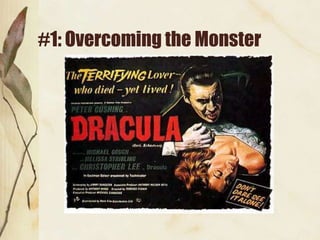
#1: Overcoming the Monster
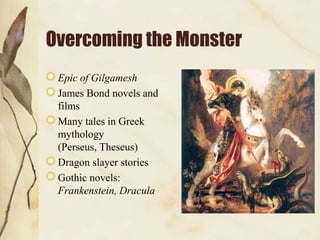
Overcoming the Monster
 Epic of Gilgamesh
 James Bond novels and
 films
 Many tales in Greek
 mythology
 (Perseus, Theseus)
 Dragon slayer stories
 Gothic novels:
 Frankenstein, Dracula
Overcoming the Monster: plot
outline
 The Call: The monster is introduced as a threat to
 a community, country, kingdom, or mankind in
 general. The hero is called to confront it.
 Dream Stage: The hero makes preparations for
 battle; he and the monster are brought closer
 together. Things are going reasonably well, and
 there is a comfortable remoteness from danger.
Overcoming the Monster: plot
outline
 Frustration Stage: Hero comes face to face with
 the monster in all its awesome power. The hero
 seems inferior by comparison and may even fall
 into the monster‟s clutches.
 Nightmare Stage: final ordeal begins, a nightmare
 battle in which the odds seem stacked against the
 hero. But, just when all seems lost…
Overcoming the Monster: plot
outline
 Thrilling Escape from Death/ Death of the
 Monster: in a miraculous reversal, the hero
 gains the upper hand and delivers a final
 fatal blow to the monster. Its dark power is
 overthrown. The community under its
 shadow is liberated. The hero wins his
 prize, his princess, and/or his kingdom.
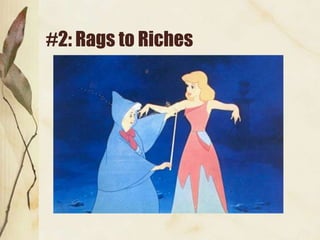
#2: Rags to Riches
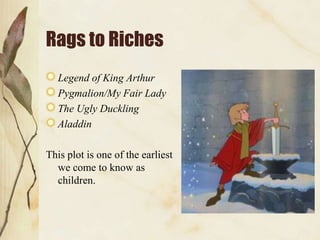
Rags to Riches
   Legend of King Arthur
   Pygmalion/My Fair Lady
   The Ugly Duckling
   Aladdin

This plot is one of the earliest
  we come to know as
  children.
Rags to Riches: plot outline
 Initial wretchedness at home & “the call”: we are
 introduced to the hero in his lowly and unhappy
 state. The dark figures are the source of his
 misery. This phase ends when something happens
 to call them out into a wider world.
 Out into the world, initial success: early efforts are
 rewarded, and the hero may have some glimpse of
 the greater glory he will someday achieve.
Rags to Riches: plot outline
 The central crisis: reduced to a new
 powerlessness, this is the worst part of the story
 for the hero or heroine.
 Independence and the final ordeal: the hero is
 discovering in himself a new independent
 strength. The hero is put to a final test, in which a
 dark rival may stand between the hero and
 ultimate fulfillment.
Rags to Riches: plot outline
 Final union, completion and fulfillment: the
 reward is usually a state of complete, loving
 union with the “Prince” or “Princess”. They
 may also succeed to some kind of kingdom.
 The implied ending is that “they lived
 happily ever after”.
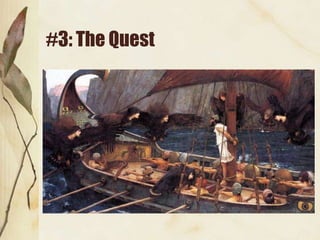
#3: The Quest
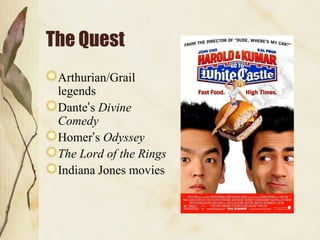
The Quest
 Arthurian/Grail
 legends
 Dante‟s Divine
 Comedy
 Homer‟s Odyssey
 The Lord of the Rings
 Indiana Jones movies
Essence of the plot
 Far away, there is a priceless goal, worth
 any effort to achieve: a treasure, a promised
 land, 30 sliders from White
 Castle, something of infinite value. The
 hero sets out on a hazardous journey to
 attain the goal and overcomes any number
 of perilous hindrances in order to achieve
 the objective.
The Quest: plot outline
 The Call: life in some “City of Destruction” has
 become oppressive and intolerable, and the hero
 recognizes that the only way to rectify the
 situation is to take a long and perilous journey to
 achieve some related goal.
 The Journey: a series of ordeals.
The Quest: plot outline
 Arrival and frustration: the hero arrives within
 sight of his goal, but a singular or series of
 terrifying obstacles looms before him.
 The final ordeal: time to face and defeat obstacles.
 The goal: after a last “thrilling escape from death.”
 the life-renewing goal is achieved.
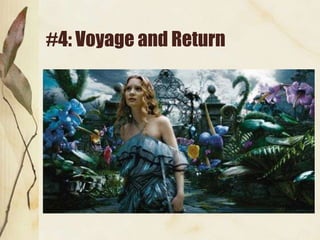
#4: Voyage and Return
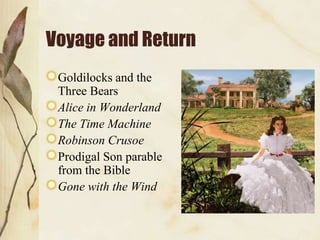
Voyage and Return
 Goldilocks and the
 Three Bears
 Alice in Wonderland
 The Time Machine
 Robinson Crusoe
 Prodigal Son parable
 from the Bible
 Gone with the Wind
Voyage and Return: essence of
the plot
 The hero or heroine travels out of their
 familiar, everyday “normal” surroundings
 into another world completely cut off from
 the first, where everything seems abnormal.
 The early experience might feel
 exhilarating, but eventually a shadow
 intrudes. By a “thrilling escape” the hero is
 returned to his normal world.
Voyage and Return
While this plot is as old as storytelling
itself, it became much more fashionable in
Western literature after the
Renaissance, when voyagers were traveling
to every corner of the globe.
These stories generally fall into two types: a)
the hero is marooned on a deserted island, or
b) the hero visits a land of some strange
people or civilization
Voyage and Return: variations
 As fewer areas of the world were left to be
 explored, more authors sent their heroes into
 different parts of time or space
 A “social” voyage and return features a hero who
 finds himself in a different group of people with
 whom he would not normally associate. Think of
 The Devil Wears Prada.
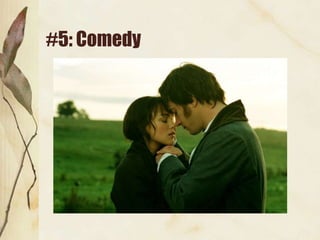
#5: Comedy
Comedy
The “New Comedy” plot:
  There are two ways that the lovers are kept
  apart until the end…
  1. Two lovers passionately desire to get
  married, but a selfish and unrelenting father (the
  dark figure) prevents them from doing so.
  2. There is quarrel and confusion between the
  lovers themselves, based on a misunderstanding
Comedy: conventions
 Always present in comedy is the device of
 mistaken identity. Identities can be confused
 through:
   Mysterious births and origins
   Characters in disguise or deliberately assuming new
   identities
   Cross-dressing
   Characters concealed in exile, or eavesdropping in
   closets or nearby rooms
Comedy: steps of recognition
1.   The dark figures imprisoned in an unloving
     state must be softened and liberated by some
     act of self-recognition and change of heart.
2.   The identity of one or more characters must be
     revealed in a more literal sense.
3.   Characters must discover who they are meant
     to pair off with.
4.   Wherever there is division, separation or
     loss, it must be repaired.
…so where do the laughs come
from?
 Almost uniformly, the aspect of comedy that
 elicits laughter from the audience is a character‟s
 egocentricity, his tunnel-vision, his inability to see
 the world as it is.
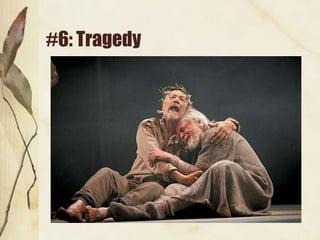
#6: Tragedy
Tragedy: Five Stages
 1. Anticipation Stage: hero is in some way
 incomplete or unfulfilled. Some object of desire
 or course of action presents itself to the hero.
 When the hero succumbs to this desire or
 thought, he has found his “focus”: Macbeth
 decides to assassinate King Duncan, Icarus yields
 to his desire to fly close to the sun; Dr. Jekyll
 drinks his potion.
Tragedy: Five Stages
 2. Dream Stage: hero commits to his focus, and
 for awhile everything is peachy. He feels gratified
 and seems to be getting away with his crime or
 error.
 3. Frustration Stage: Things begin to go wrong.
 Hero feels restless and insecure, commits further
 dark acts to secure or retain his position and
 feelings from the Dream Stage.
Tragedy (1): Five Stages
 4. Nightmare Stage: Things are now slipping
 completely out of the hero‟s control. Forces of
 opposition and fate are closing in on him; hero
 falls into rage or despair.
 5. Destruction or Death Wish: either by the forces
 he has aroused against him, or by some final act of
 violence which precipitates his own death, the
 hero is destroyed.
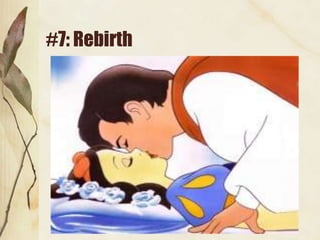
#7: Rebirth
Rebirth: synopsis
 A hero or heroine falls under a dark spell which
 eventually traps them in some wintry state, akin to
 living death: physical or spiritual
 imprisonment, sleep, sickness or some other form
 of enchantment. For a long time they languish in
 this frozen condition Then a miraculous act of
 redemption takes place, focused on a particular
 figure who helps liberate the hero or heroine from
 imprisonment.
Rebirth: Plot points
 1. Hero falls under the shadow of a dark power.
 2. Poison takes some time to work up to its full
 effect.
 3. Total isolation: the darkness emerges in full
 force
 4. Nightmare stage: odds seem stacked against a
 rescue of the hero
 5. Reversal/ awakening: imprisoned figure is freed
 by the power of love
The Universal Plot
The Universal Plot
 The overlap and interrelationships between the
 plots are immediately recognizable.
 What is really to be gained from this exploration
 of seven plots is NOT the compartmentalizing of
 stories, but rather the joining together of all stories
 into basic universal elements.
The Universal Plot
 The Beginning: a hero is
 undeveloped, frustrated, or incomplete. This state
 sets up the tensio that drives the plot.
 The Middle: The hero falls under the shadow of a
 dark power. This power may exist outside the hero
 or within the characters themselves.
 The End: Through a reversal or unknotting, the
 dark power is overthrown.
The Universal Plot
 Fundamental movements:
   Dark to light
   Isolated to integrated, or vice versa
   Incomplete to whole
   Juvenile to mature
   Constriction/release
   Ignorance to self-realization
Discussion

What kind of story are you writing?
Guided
                                 Writing

1. Have you included the basic plot points in your story?
2. Outline your story to see which you have included:
   Note what you are missing—these are places where
   you might be able to improve your story.
3. Write a scene to include in your story.
More Story Starters
1. The harder she scratch away at her forearm the quicker the flesh fell away. From outside the
   containment unit, Dr. Elena Miles and Dr. Mark Rustenburg watched on dismay as the...

2. Marcus could hear the horn sound in the distance, a sign he was getting closer to the island.
   Soon he would be face to face with the father he left behind ten years ago. Every day since he
   left …

3. 45 minutes ago my cover was blown. I'd been under for...

4. I sat in the taxi fidgeting the tulle under my gown and thinking I'd rather be at home in my
   flannel pajamas instead of going to...

5. I really wanted to see you again," said Rebecca. She repeatedly twirled a strand of her long
   auburn hair tightly around her right forefinger until the tip blushed then released it. "I was afraid
   you didn't want to see me because of…

6. He was lying face down on the raft. At first we thought he was sleeping with his head using the
   inflated side as a pillow and one hand hanging over grazing the water's edge but then the...

7. It‟s hard to describe the sound of ripping fleshing. Even more difficult is the sound the flesh
   makes when a vampire makes first bite.
Homework

• Post #14 Post a good scene from your
  story.
• Work on your fiction project.

Ewrt 30 class 14

  • 1.
  • 2.
    • Review: Eliminating“to be” verbs • Lecture: Fiction Seven plots • Guided Writing:
  • 3.
    The Review: Strategiesto Eliminate the “to be” verb 1. Substitute a new word. 2. Rearrange the sentence. 3. Change another word in the sentence into a verb. 4. Combine sentences.
  • 4.
    Lecture: Basic Plots According to the British journalist and author Christopher Booker, there are only seven „storylines‟ in the world.
  • 5.
    Booker’s Seven BasicPlots 1.Overcoming the Monster 2.Rags to Riches 3.The Quest 4.Voyage and Return 5.Comedy 6.Tragedy 7.Rebirth
  • 6.
    The basic premise: Christopher Booker argues that all storytelling is woven around basic plots and archetypes that are inescapable and help to define the human condition. We are psychologically programmed to tell stories in a way that reflects our most basic physiological needs.
  • 7.
  • 8.
    Overcoming the Monster Epic of Gilgamesh James Bond novels and films Many tales in Greek mythology (Perseus, Theseus) Dragon slayer stories Gothic novels: Frankenstein, Dracula
  • 9.
    Overcoming the Monster:plot outline The Call: The monster is introduced as a threat to a community, country, kingdom, or mankind in general. The hero is called to confront it. Dream Stage: The hero makes preparations for battle; he and the monster are brought closer together. Things are going reasonably well, and there is a comfortable remoteness from danger.
  • 10.
    Overcoming the Monster:plot outline Frustration Stage: Hero comes face to face with the monster in all its awesome power. The hero seems inferior by comparison and may even fall into the monster‟s clutches. Nightmare Stage: final ordeal begins, a nightmare battle in which the odds seem stacked against the hero. But, just when all seems lost…
  • 11.
    Overcoming the Monster:plot outline Thrilling Escape from Death/ Death of the Monster: in a miraculous reversal, the hero gains the upper hand and delivers a final fatal blow to the monster. Its dark power is overthrown. The community under its shadow is liberated. The hero wins his prize, his princess, and/or his kingdom.
  • 12.
  • 13.
    Rags to Riches Legend of King Arthur Pygmalion/My Fair Lady The Ugly Duckling Aladdin This plot is one of the earliest we come to know as children.
  • 14.
    Rags to Riches:plot outline Initial wretchedness at home & “the call”: we are introduced to the hero in his lowly and unhappy state. The dark figures are the source of his misery. This phase ends when something happens to call them out into a wider world. Out into the world, initial success: early efforts are rewarded, and the hero may have some glimpse of the greater glory he will someday achieve.
  • 15.
    Rags to Riches:plot outline The central crisis: reduced to a new powerlessness, this is the worst part of the story for the hero or heroine. Independence and the final ordeal: the hero is discovering in himself a new independent strength. The hero is put to a final test, in which a dark rival may stand between the hero and ultimate fulfillment.
  • 16.
    Rags to Riches:plot outline Final union, completion and fulfillment: the reward is usually a state of complete, loving union with the “Prince” or “Princess”. They may also succeed to some kind of kingdom. The implied ending is that “they lived happily ever after”.
  • 17.
  • 18.
    The Quest Arthurian/Grail legends Dante‟s Divine Comedy Homer‟s Odyssey The Lord of the Rings Indiana Jones movies
  • 19.
    Essence of theplot Far away, there is a priceless goal, worth any effort to achieve: a treasure, a promised land, 30 sliders from White Castle, something of infinite value. The hero sets out on a hazardous journey to attain the goal and overcomes any number of perilous hindrances in order to achieve the objective.
  • 20.
    The Quest: plotoutline The Call: life in some “City of Destruction” has become oppressive and intolerable, and the hero recognizes that the only way to rectify the situation is to take a long and perilous journey to achieve some related goal. The Journey: a series of ordeals.
  • 21.
    The Quest: plotoutline Arrival and frustration: the hero arrives within sight of his goal, but a singular or series of terrifying obstacles looms before him. The final ordeal: time to face and defeat obstacles. The goal: after a last “thrilling escape from death.” the life-renewing goal is achieved.
  • 22.
  • 23.
    Voyage and Return Goldilocks and the Three Bears Alice in Wonderland The Time Machine Robinson Crusoe Prodigal Son parable from the Bible Gone with the Wind
  • 24.
    Voyage and Return:essence of the plot The hero or heroine travels out of their familiar, everyday “normal” surroundings into another world completely cut off from the first, where everything seems abnormal. The early experience might feel exhilarating, but eventually a shadow intrudes. By a “thrilling escape” the hero is returned to his normal world.
  • 25.
    Voyage and Return Whilethis plot is as old as storytelling itself, it became much more fashionable in Western literature after the Renaissance, when voyagers were traveling to every corner of the globe. These stories generally fall into two types: a) the hero is marooned on a deserted island, or b) the hero visits a land of some strange people or civilization
  • 26.
    Voyage and Return:variations As fewer areas of the world were left to be explored, more authors sent their heroes into different parts of time or space A “social” voyage and return features a hero who finds himself in a different group of people with whom he would not normally associate. Think of The Devil Wears Prada.
  • 27.
  • 28.
    Comedy The “New Comedy”plot: There are two ways that the lovers are kept apart until the end… 1. Two lovers passionately desire to get married, but a selfish and unrelenting father (the dark figure) prevents them from doing so. 2. There is quarrel and confusion between the lovers themselves, based on a misunderstanding
  • 29.
    Comedy: conventions Alwayspresent in comedy is the device of mistaken identity. Identities can be confused through: Mysterious births and origins Characters in disguise or deliberately assuming new identities Cross-dressing Characters concealed in exile, or eavesdropping in closets or nearby rooms
  • 30.
    Comedy: steps ofrecognition 1. The dark figures imprisoned in an unloving state must be softened and liberated by some act of self-recognition and change of heart. 2. The identity of one or more characters must be revealed in a more literal sense. 3. Characters must discover who they are meant to pair off with. 4. Wherever there is division, separation or loss, it must be repaired.
  • 31.
    …so where dothe laughs come from? Almost uniformly, the aspect of comedy that elicits laughter from the audience is a character‟s egocentricity, his tunnel-vision, his inability to see the world as it is.
  • 32.
  • 33.
    Tragedy: Five Stages 1. Anticipation Stage: hero is in some way incomplete or unfulfilled. Some object of desire or course of action presents itself to the hero. When the hero succumbs to this desire or thought, he has found his “focus”: Macbeth decides to assassinate King Duncan, Icarus yields to his desire to fly close to the sun; Dr. Jekyll drinks his potion.
  • 34.
    Tragedy: Five Stages 2. Dream Stage: hero commits to his focus, and for awhile everything is peachy. He feels gratified and seems to be getting away with his crime or error. 3. Frustration Stage: Things begin to go wrong. Hero feels restless and insecure, commits further dark acts to secure or retain his position and feelings from the Dream Stage.
  • 35.
    Tragedy (1): FiveStages 4. Nightmare Stage: Things are now slipping completely out of the hero‟s control. Forces of opposition and fate are closing in on him; hero falls into rage or despair. 5. Destruction or Death Wish: either by the forces he has aroused against him, or by some final act of violence which precipitates his own death, the hero is destroyed.
  • 36.
  • 37.
    Rebirth: synopsis Ahero or heroine falls under a dark spell which eventually traps them in some wintry state, akin to living death: physical or spiritual imprisonment, sleep, sickness or some other form of enchantment. For a long time they languish in this frozen condition Then a miraculous act of redemption takes place, focused on a particular figure who helps liberate the hero or heroine from imprisonment.
  • 38.
    Rebirth: Plot points 1. Hero falls under the shadow of a dark power. 2. Poison takes some time to work up to its full effect. 3. Total isolation: the darkness emerges in full force 4. Nightmare stage: odds seem stacked against a rescue of the hero 5. Reversal/ awakening: imprisoned figure is freed by the power of love
  • 39.
  • 40.
    The Universal Plot The overlap and interrelationships between the plots are immediately recognizable. What is really to be gained from this exploration of seven plots is NOT the compartmentalizing of stories, but rather the joining together of all stories into basic universal elements.
  • 41.
    The Universal Plot The Beginning: a hero is undeveloped, frustrated, or incomplete. This state sets up the tensio that drives the plot. The Middle: The hero falls under the shadow of a dark power. This power may exist outside the hero or within the characters themselves. The End: Through a reversal or unknotting, the dark power is overthrown.
  • 42.
    The Universal Plot Fundamental movements: Dark to light Isolated to integrated, or vice versa Incomplete to whole Juvenile to mature Constriction/release Ignorance to self-realization
  • 43.
    Discussion What kind ofstory are you writing?
  • 44.
    Guided Writing 1. Have you included the basic plot points in your story? 2. Outline your story to see which you have included: Note what you are missing—these are places where you might be able to improve your story. 3. Write a scene to include in your story.
  • 45.
    More Story Starters 1.The harder she scratch away at her forearm the quicker the flesh fell away. From outside the containment unit, Dr. Elena Miles and Dr. Mark Rustenburg watched on dismay as the... 2. Marcus could hear the horn sound in the distance, a sign he was getting closer to the island. Soon he would be face to face with the father he left behind ten years ago. Every day since he left … 3. 45 minutes ago my cover was blown. I'd been under for... 4. I sat in the taxi fidgeting the tulle under my gown and thinking I'd rather be at home in my flannel pajamas instead of going to... 5. I really wanted to see you again," said Rebecca. She repeatedly twirled a strand of her long auburn hair tightly around her right forefinger until the tip blushed then released it. "I was afraid you didn't want to see me because of… 6. He was lying face down on the raft. At first we thought he was sleeping with his head using the inflated side as a pillow and one hand hanging over grazing the water's edge but then the... 7. It‟s hard to describe the sound of ripping fleshing. Even more difficult is the sound the flesh makes when a vampire makes first bite.
  • 46.
    Homework • Post #14Post a good scene from your story. • Work on your fiction project.