EXAMINE HOW THE NARRATIVE 
STRUCTURE AND TIMESCALE IN 
WHICH THE NOVEL IS SET HELPS TO 
INTENSIFY THE ACTION OF THE 
PLOT.
Narrative Structure 
Narrative structure in a book is made up of 6 elements: 
• Structure – this is not the same as the order in which 
things to happen to characters but it is the order in 
which they are revealed to us. 
• Point of view – character insight, 3rd person. 
• Characterisation – how we view characters. 
• Setting – how this helps build.. 
• .. Genre/type. 
• Authorial voice and style – this is when we hear or see 
parts of Jenkins within the novel through setting or 
characters such as Duror.
Structure and Time 
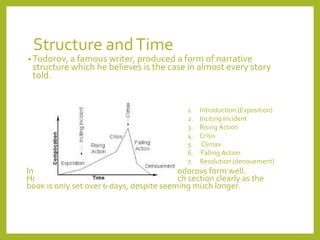
•Todorov, a famous writer, produced a form of narrative 
structure which he believes is the case in almost every story 
told. 
1. Introduction (Exposition) 
2. Inciting Incident 
3. Rising Action 
4. Crisis 
5. Climax 
6. Falling Action 
7. Resolution (denouement) 
In the case of the Cone Gatherers, it fits Todorovs form well. 
However, It is more difficult to identify each section clearly as the 
book is only set over 6 days, despite seeming much longer.
1. Introduction (Day 1) 
• At the beginning, Jenkins sets the scene in order to tell us when and where this 
novel is set. For example, he makes reference to a ‘sea-loch’ in the first paragraph 
which relates to areas in Scotland. It tells us about the time period on page 3 which 
says: ‘all over the world in the war now being fought men, women, and children 
were being slaughtered in thousands.’ This has reference to the war, giving us a clear 
idea of when this novel has taken place. 
• The introduction is also likely to introduce important, main characters. In the first 2 
chapters Neil and Calum are described to us in opinion from the 3rd person narrative. 
• Neil is shown as the wiser of brothers and makes him seem mysterious: ‘Neil, the 
elder of the brothers… gazed at the great house with a calm yet bitter intentness 
and anticipation.. Waiting for it to change.’ (p.2) ‘intentness’ is creating this idea 
that Neil is focused and never distracted from his task. ‘elder’ which is used in 
replace of older creates the idea that he is wise and more knowledgeable. 
• Calum is shown as being more child-like, innocent and adventurous. For example, 
Jenkins uses the first image of Calum up in the top of tree, where he fits in well: ‘For 
Calum the tree-top was interest enough; in it he was indigenious as a squirrel or 
bird.. He was a much faster gatherer… reached far out to where the brittle branches 
drooped and creaked under his weight.’ (p.2) ‘indigenous’ shows that he should be 
up there all the time and it is natural for him to be there. The alliteration of ‘brittle 
branches’ directs the attention to how adventurous he is as ‘brittle’ is likely to be 
used about bones that will snap easily without much pressure.
Inciting Incident (Day 2) 
Incite – to stir up unlawful behaviour. 
After seeing in the first two chapters that Duror is not at all fond of 
the brothers we start to feel a slight tension. This is proven when on 
day 2 Duror tells Mrs Morton about what he has heard and saw 
Calumdo in the wood: ‘I’m referring, of course, to assaults on wee 
lassies.’ (pg.47) Duror uses the word ‘assault’ which is sugar-coating 
what he is thinking about happening. It still is an intense word where 
it implies a sudden attack by Calum. ‘Wee’ always makes things seem 
smaller than the word little. This makes any attacks on ‘wee lassies’ 
seem more immoral and unlawful. Duror later goes onto say: ‘I saw 
that imbecile exposing himself… and worse’ With there being no 
other witness than Duror it is difficult to believe his conviction. He 
uses the word ‘worse’ in replace of an extra added bit to the story, 
making the conversation less formal however, leaving the rest up to 
the imagination.
Rising Action (Day 3) 
• The rising action begins when Calum, the most innocent of 
characters is forced into a deer drive for Lady Runcie-Campbell and 
her family. With him not having a choice, it makes the situation 
climactic as it builds up tension. 
• This is the first main scene of action. 
• It starts by showing us and the other characters an insight to Durors 
mental stability. Despite this being unusual the main focus to 
eveyone is that Calum disturbed the drive. 
• "He seems to have a spite against you. Is there any reason for it?... 
She blames Calum for spoiling the deer hunt." 
• LRC is aware that Duror isn't well and she favours him, making it 
difficult for the cone gatherers to stand up against him.
A settlement 
• Within the novel there are certain areas that settle down and become 
more normal. For example, we see LRC visiting Peggy for the first time in 
the novel. This is seen to be familiar as we are told that she used to visit her 
before. 
• We also see LRC becoming more caring towards the cone gatherers at 
certain points as she realises she has not been true to herself and questions 
whether she has acted immoral. 
• "As his wife, and the cherisher of his title, she had to agree with him; but as 
an ambitious Christian, and as her father's daughter, she could not help 
seeing ow barran and impious was that argument." 
• We also see Duror going out his way to get some help and guidance from 
the Doctor.
Crisis – Beach hut (Day 5) 
• After Calum and Neil are caught by LRC in the beach hut we see the 
opinions of everyone in the situation. 
• The point of view in this chapter makes the scene chaotic as things 
seem the change and fall apart. 
• Neil becomes ashamed of Calum in his appearance and personality, 
proving that he isn't as strong as he makes out. He lets LRC walk 
over her and he can't stand up for himself, leaving Calum to pick up 
his mess. 
• After LRC throwing them out into the storm, Roderick becomes 
ashamed and angry at his mother. He believes that she is in the 
wrong and that they should be treated equally.
Climax (Day 6) 
• Throughout the novel we see a build of tension in a short period of 
time. This build up leads to the major piece of action when Roderick 
climbs up the tallest tree in order to be the same as the cone 
gatherers. 
• With a lot of LRC's workers being older they aren't able to retrieve 
him from the tree. 
• During this day Jenkins shows the actions of almost every character 
that is trying to help Roderick. Which helps create a crazed scene. 
• The main point of climax is when Grahem reaches the Scour Point 
and Neil refuses to help Roderick unless LRC asks them herself. 
• 'We are not her servants.' 
• 'If she wishes our help, let her come and ask for it'
Falling action (Day 6) 
•With Neil refusing, it shows him acting slightly more 
confident than the night before and standing up for Calum. 
•LRC understands why Neil has refused and becomes quite 
selfish. She does give in to go and ask Neil however, it's not 
for his sake but for her own good. She may seem like she is 
doing it to respect Neil's wishes but this is not the case. 
• By this time we feel that things will get resolved as she is 
acting how Neil wishes. 
• 'Lady Runcie-Campbell tried to make her anger against the 
cone-gatherers grow.'
Resolution (Day 6) 
• At the end of this novel we are left with an incomplete resolution. 
This means that the ending has been left open, this could be for us 
to imagine what would happen next, could introduce a sequel or for 
us to solve an enigma. 
• With the thought of Duror heading towards the brothers with his 
gun, LRC regrets every decision she made about the brothers. 
• With the climax, falling action and the resolution all happening in 
the last chapter it makes the ending seem rushed however it helps 
keep the structure and intensifies the plot. 
• The fact that Duror has deterioated very quickly in just 6 days 
makes us aware of his mental decline and this is the reason the 
novel feels like it is over a longer timescale.

Presentation

  • 1.
    EXAMINE HOW THENARRATIVE STRUCTURE AND TIMESCALE IN WHICH THE NOVEL IS SET HELPS TO INTENSIFY THE ACTION OF THE PLOT.
  • 2.
    Narrative Structure Narrativestructure in a book is made up of 6 elements: • Structure – this is not the same as the order in which things to happen to characters but it is the order in which they are revealed to us. • Point of view – character insight, 3rd person. • Characterisation – how we view characters. • Setting – how this helps build.. • .. Genre/type. • Authorial voice and style – this is when we hear or see parts of Jenkins within the novel through setting or characters such as Duror.
  • 3.
    Structure and Time •Todorov, a famous writer, produced a form of narrative structure which he believes is the case in almost every story told. 1. Introduction (Exposition) 2. Inciting Incident 3. Rising Action 4. Crisis 5. Climax 6. Falling Action 7. Resolution (denouement) In the case of the Cone Gatherers, it fits Todorovs form well. However, It is more difficult to identify each section clearly as the book is only set over 6 days, despite seeming much longer.
  • 4.
    1. Introduction (Day1) • At the beginning, Jenkins sets the scene in order to tell us when and where this novel is set. For example, he makes reference to a ‘sea-loch’ in the first paragraph which relates to areas in Scotland. It tells us about the time period on page 3 which says: ‘all over the world in the war now being fought men, women, and children were being slaughtered in thousands.’ This has reference to the war, giving us a clear idea of when this novel has taken place. • The introduction is also likely to introduce important, main characters. In the first 2 chapters Neil and Calum are described to us in opinion from the 3rd person narrative. • Neil is shown as the wiser of brothers and makes him seem mysterious: ‘Neil, the elder of the brothers… gazed at the great house with a calm yet bitter intentness and anticipation.. Waiting for it to change.’ (p.2) ‘intentness’ is creating this idea that Neil is focused and never distracted from his task. ‘elder’ which is used in replace of older creates the idea that he is wise and more knowledgeable. • Calum is shown as being more child-like, innocent and adventurous. For example, Jenkins uses the first image of Calum up in the top of tree, where he fits in well: ‘For Calum the tree-top was interest enough; in it he was indigenious as a squirrel or bird.. He was a much faster gatherer… reached far out to where the brittle branches drooped and creaked under his weight.’ (p.2) ‘indigenous’ shows that he should be up there all the time and it is natural for him to be there. The alliteration of ‘brittle branches’ directs the attention to how adventurous he is as ‘brittle’ is likely to be used about bones that will snap easily without much pressure.
  • 5.
    Inciting Incident (Day2) Incite – to stir up unlawful behaviour. After seeing in the first two chapters that Duror is not at all fond of the brothers we start to feel a slight tension. This is proven when on day 2 Duror tells Mrs Morton about what he has heard and saw Calumdo in the wood: ‘I’m referring, of course, to assaults on wee lassies.’ (pg.47) Duror uses the word ‘assault’ which is sugar-coating what he is thinking about happening. It still is an intense word where it implies a sudden attack by Calum. ‘Wee’ always makes things seem smaller than the word little. This makes any attacks on ‘wee lassies’ seem more immoral and unlawful. Duror later goes onto say: ‘I saw that imbecile exposing himself… and worse’ With there being no other witness than Duror it is difficult to believe his conviction. He uses the word ‘worse’ in replace of an extra added bit to the story, making the conversation less formal however, leaving the rest up to the imagination.
  • 6.
    Rising Action (Day3) • The rising action begins when Calum, the most innocent of characters is forced into a deer drive for Lady Runcie-Campbell and her family. With him not having a choice, it makes the situation climactic as it builds up tension. • This is the first main scene of action. • It starts by showing us and the other characters an insight to Durors mental stability. Despite this being unusual the main focus to eveyone is that Calum disturbed the drive. • "He seems to have a spite against you. Is there any reason for it?... She blames Calum for spoiling the deer hunt." • LRC is aware that Duror isn't well and she favours him, making it difficult for the cone gatherers to stand up against him.
  • 7.
    A settlement •Within the novel there are certain areas that settle down and become more normal. For example, we see LRC visiting Peggy for the first time in the novel. This is seen to be familiar as we are told that she used to visit her before. • We also see LRC becoming more caring towards the cone gatherers at certain points as she realises she has not been true to herself and questions whether she has acted immoral. • "As his wife, and the cherisher of his title, she had to agree with him; but as an ambitious Christian, and as her father's daughter, she could not help seeing ow barran and impious was that argument." • We also see Duror going out his way to get some help and guidance from the Doctor.
  • 8.
    Crisis – Beachhut (Day 5) • After Calum and Neil are caught by LRC in the beach hut we see the opinions of everyone in the situation. • The point of view in this chapter makes the scene chaotic as things seem the change and fall apart. • Neil becomes ashamed of Calum in his appearance and personality, proving that he isn't as strong as he makes out. He lets LRC walk over her and he can't stand up for himself, leaving Calum to pick up his mess. • After LRC throwing them out into the storm, Roderick becomes ashamed and angry at his mother. He believes that she is in the wrong and that they should be treated equally.
  • 9.
    Climax (Day 6) • Throughout the novel we see a build of tension in a short period of time. This build up leads to the major piece of action when Roderick climbs up the tallest tree in order to be the same as the cone gatherers. • With a lot of LRC's workers being older they aren't able to retrieve him from the tree. • During this day Jenkins shows the actions of almost every character that is trying to help Roderick. Which helps create a crazed scene. • The main point of climax is when Grahem reaches the Scour Point and Neil refuses to help Roderick unless LRC asks them herself. • 'We are not her servants.' • 'If she wishes our help, let her come and ask for it'
  • 10.
    Falling action (Day6) •With Neil refusing, it shows him acting slightly more confident than the night before and standing up for Calum. •LRC understands why Neil has refused and becomes quite selfish. She does give in to go and ask Neil however, it's not for his sake but for her own good. She may seem like she is doing it to respect Neil's wishes but this is not the case. • By this time we feel that things will get resolved as she is acting how Neil wishes. • 'Lady Runcie-Campbell tried to make her anger against the cone-gatherers grow.'
  • 11.
    Resolution (Day 6) • At the end of this novel we are left with an incomplete resolution. This means that the ending has been left open, this could be for us to imagine what would happen next, could introduce a sequel or for us to solve an enigma. • With the thought of Duror heading towards the brothers with his gun, LRC regrets every decision she made about the brothers. • With the climax, falling action and the resolution all happening in the last chapter it makes the ending seem rushed however it helps keep the structure and intensifies the plot. • The fact that Duror has deterioated very quickly in just 6 days makes us aware of his mental decline and this is the reason the novel feels like it is over a longer timescale.