1
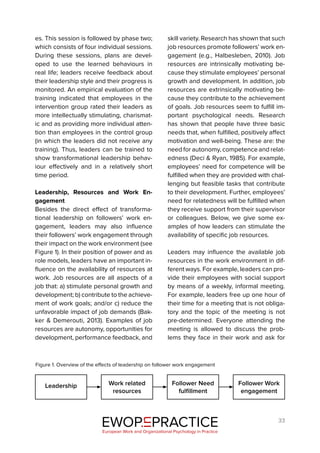
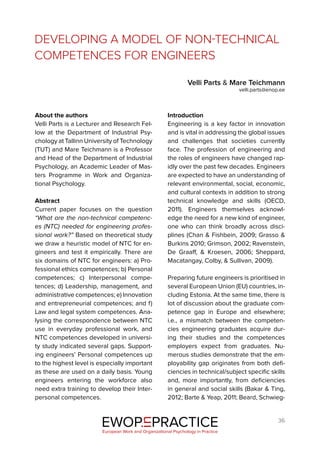
in
EWOP PRACTICEEuropean Work and Organizational Psychology in Practice
e-journal of the European Association of Work and Organizational Psychology (EAWOP)
ISSUE 5/2013
2
CONTENT
Editorial ................................................................................. ................................................................. 3
Mare Teichmann & Liina Randmann
Myths among Personnel (HR) Professionals .................................................................................. 5
Dr Kathryn Waddington & Julie Lister
Human Resource Management (HRM) strategies and academic engagement
in UK universities: Reflections on an academic-practitioner study .......................................... 12
Dr. Diana Rus
Leading for engagement and performance - EAWOP WorkLab 2012 .................................... 26
Kimberley Breevaart & Arnold B. Bakker
How leaders influence their followers’ work engagement ........................................................ 31
Velli Parts & Mare Teichmann
Developing a model of Non-technical competences for engineers ....................................... 36
Dr. Laura Liguori
Attachment theory: The relationship between Human Resources and organizations ...... 55
ISSUE 5/2013
Copyright information: copyright of articles published in EWOP in PRACTICE belongs to the author(s).
EWOP PRACTICE
in
European Work and Organizational Psychology in Practice
3
Angela J. Carter
Hello readers
Welcome to the 5th issue of EWOPin-
PRACTICE with papers on the application
of Work and Organizational Psychology.
It has been a busy time for EAWOP since
the previous edition of in-Practice. We
have held the widely acclaimed 1st prac-
titioner WorkLab, in Helsinki, and another
successful Summer School and are about
to enjoy our bi-annual congress in Mun-
ster, Germany and WorkLab 2013 in Am-
sterdam.
This edition offers six excellent papers
representing a range of Work and Organi-
zational Psychology (WOP) practice in Eu-
rope. These papers follow a theme about
the quality of Human Resource Manage-
ment (HRM) and development supporting
leaders, managers and workers in organi-
zations. Further, there is a strong reflexive
component to the articles encouraging us
to spend time looking at our own profes-
sional practice.
The edition opens with an intriguing study
conducted by Mare Teichmann and Liina
Randmann examining the evidence-base
for HRM practices across Europe, and in
particular a knowledge-base comparison
between HR Practitioners and non-HR
professional (such as book keepers and
accountants) in Estonian. This paper is fol-
lowed by an excellent reflexive account of
a study of HRM strategies from six UK uni-
versities written by Kathryn Waddington
and Julie Lister. Next, Diana Rus explores
some of the content from the 1st practi-
tioner WorkLab building on a workshop
conducted by Professor Beverly Alimo-
Metcalfe. Diana examines leadership be-
haviours that are likely to engage workers
in difficult economic climates; and ones
that will not. Kimberley Breevaart and Ar-
nold Bakker follow with a valuable piece
about how leaders can influence their
followers’ work engagement. The theme
of development is picked up in the next
paper by Velli Parts and Mare Teichmann
specifically looking at Non-Technical Com-
petencies for engineers. Finally, Laura
Liguori offers us a valuable account of at-
tachment theory applied to organizational
life and the role of the manager/leader as
potential care-giver. This paper, along with
the others will cause you to pause and re-
flect on your own and others’ practice to
consider how you can add value to your
own workplace offerings and solutions. I
would like to thank the authors for their
insightful contributions to in-Practice and
look forward to further papers being pre-
sented for our next edition.
Hopefully these articles will inspire you
and make you wish to comment and re-
flect. Please contact the authors directly
by email to continue the discussion; or ad-
dress your thoughts to myself; your editor.
With the authors’ permission I will summa-
EDITORIAL
EWOP PRACTICE
in
European Work and Organizational Psychology in Practice
4
rise these discussions for you in the next
edition of in-Practice.
In-Practice is for you and also made by
you. Think about writing for the journal
yourself. The philosophy of the journal is
to publish papers about the practice of
WOP in Europe. We are interested in ar-
ticles describing practices, procedures,
tools, or even changes in organizational
procedures stimulated by shifts in national
economies and organizational processes.
We want to know much more about pro-
fessional activities across Europe, thus we
are looking for a contribution from you.
Are you an expert in Organizational De-
velopment? Training? Work stress inter-
ventions? Is there a successful project
that you have led, or contributed to, that
you would like to share with others? Here
you can find the right place to present and
discuss these types of experiences. As for
length, a two-three page contribution is
perfectly OK; or more if you wish.
The format for the papers is described in
the style guide associated with this page.
If you would like to discuss your ideas
for a contribution or send me an outline I
would be happy to comment on this and
assist in its preparation.
Would you like to comment on topics from
the 1st WorkLab (see http://www.eawop.
org/worklab-2012 for an account and
contributions) or look ahead to those of
“The good, the bad and the ugly of lead-
er behaviour” that form part of WorkLab
2013 (http://eawop.org/news/2nd-eawop-
worklab-2013). Or perhaps suggest topics
for future WorkLabs? If you would like to
meet us and discuss these ideas in per-
son we are holding a WorkLab reunion
on Friday 24th May 2013 at the Munster
congress, in the entrance hall of the Mun-
ster Palace at 18.00.
Best wishes for spring; and some warmer
weather. Enjoy in-Practice and … don’t for-
get … I look forward to your contribution.
Professor Angela Carter
Editor EWOPinPRACTICE
a.carter@shefieild.ac.uk
EWOP PRACTICE
in
European Work and Organizational Psychology in Practice
5
About the authors
Professor Mare Teichmann is Director of
Institute of Industrial Psychology at Tal-
linn University of Technology and the aca-
demic leader of the Masters programme
in Work and Organizational Psychology.
Her research interests are in the field of
occupational stress, work locus of con-
trol and quality of life, including quality of
working life.
Liina Randmann is lecturer at the same
institute. She is an academic leader of
Masters programme in Personnel and De-
velopment. Currently her priority is her
doctoral dissertation in the topic of psy-
chological contracts, engagement and
commitment.
Abstract
In this paper we share our experience and
examine some myths that exist among
personnel (HR) professionals. In order to
get an overview how deep is the gap be-
tween academic knowledge and everyday
truths regarding personnel management
we carried out the study in two phases. In
the first phase we interviewed outstand-
ing Estonian personnel managers as an
expert group, and the second phase inter-
viewed personnel professionals and non-
HR professionals from different occupa-
tions (engineers, bookkeepers, lawyers,
civil servants, and teachers). We explored
issues of knowledge in the field by look-
ing at the levels of agreement regarding
the quality of research evidence in Work
and Organizational Psychology (WOP).
The study revealed that the work done
in many personnel management fields is
based on similar myths that exist among
non-personnel professionals.
Background
The past decade has seen a divide de-
velop between academic knowledge and
everyday truths regarding personnel man-
agement, and as a result differences have
developed in the practical everyday work
of human resource (HR) employees. Well-
known publications of human resource
management (HRM, such as Human Re-
source Management and Human Re-
source Magazine) act as a bridge between
knowledge and practice. These journals
attempt to intermediate, reflect, and re-
phrase major academic positions, based
on empirical studies and scientific fact, for
those working in the personnel field. Un-
fortunately, these efforts sometimes end
up looking like a fun-house mirror rather
than a true reflection of the evidence that
they are trying to represent. The afore-
mentioned publications and personnel
management training textbooks and
handbooks fail to address some of the ac-
ademic knowledge that is vital to HR work.
Analysing the content of articles published
over five years, researchers in the USA
MYTHS AMONG PERSONNEL (HR) PROFESSIONALS
Mare Teichmann & Liina Randmann
mare@pekonsult.ee Liina.Randmann@ttu.ee
EWOP PRACTICE
in
European Work and Organizational Psychology in Practice
6
(Rynes, Giluk, & Brown, 2007) reached
the conclusion that topics addressed in
publications and books that were geared
towards practitioners addressed far less
academic studies and literature. The au-
thors’ describe that most of the material
concerned rotating topics du jour (such
as emotional and social intelligence, 360°
feedback) while knowledge necessary
to personnel work (such as employees’
mental abilities, personalities, and setting
goals; topics that are directly tied to and
influence work and productivity) were ad-
dressed remarkably little. For example, the
role of personality in choosing employees
was addressed by three articles (0.4% of
all articles published) in Human Resource
Magazine and by two articles (1.2%) in
Human Resource Management. Another
negative trend affecting practices in HR is
the quality of supporting evidence in arti-
cles and books geared towards practition-
ers. Many articles are based on individual
experiences of practitioners; which leads
to generalisations being made based on
limited evidence. As a result of this trend,
divergent and incompatible knowledge is
widespread among personnel managers
resulting in decisions being made based
on poor quality, or unproven knowledge.
Current research
In order to get an overview of the evi-
dence-base used in WOP in European
countries, the European Network of Work
and Organizational Psychology Professors
(ENOP) carried out a study among the top
specialists in WOP in 14 countries (Guest
& Zijlstra, 2012). This study explored lev-
els of agreement on the quality of the
research evidence base using a pan-
European sample of 75 senior academic
WOP psychologists. In Estonia this study
was broadened by adding 15 of most out-
standing Estonian personnel managers to
the expert group. This work was the first
phase of the study that we describe in this
article.
In the second part of our study we exam-
ined two samples: a group of HR profes-
sionals and a control group of profession-
als from a variety of different occupations.
We interviewed 63 HR professionals (58
females, five males, with an average age
32.4 years). The control group consists of
64 non-HR professionals from different oc-
cupations such as engineers, book-keep-
ers, lawyers, civil servants, and teachers
(56 females, eight males, with an average
age 31.9 years). We proposed the same
eight statements to both samples asking if
they agreed or disagreed with each state-
ment (e.g., “Money does not motivate an
employee to boost their productivity”).
These statements were taken from the
misunderstandings of research evidence
(“myths”) that had vividly occurred in the
first part of interview study. Both parts of
Estonian study were carried out by the
Department of Industrial Psychology at
Tallinn University of Technology.
Results
Our study shows there were few differ-
ences between the appreciations of re-
search evidence between the two sam-
ples. That is that both groups were likely
to make judgements based on a general
understanding of WOP than a specific
knowledge-based known to their profes-
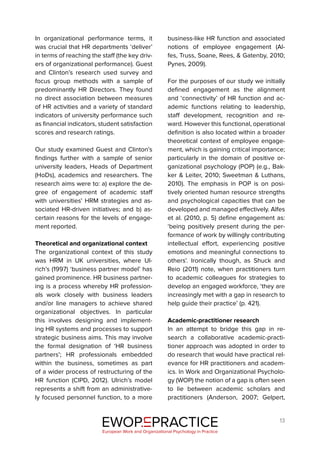
sion. With reference to Table 1 below it
is apparent that in accepting or rejecting
proposed statements HR professionals
did not use or did not have the profes-
sional knowledge in their own field.
EWOP PRACTICE
in
European Work and Organizational Psychology in Practice
7
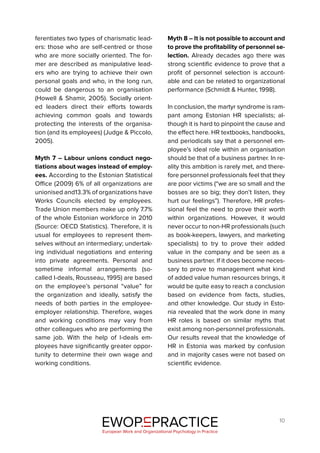
Table 1 shows that there are a number of
embedded attitudes (myths) that are not
evidence-based. Four statements were
judged, by the majority in both samples,
adequately:
1. Money does not motivate an em-
ployee to boost productivity (66.6%
disagree HR; 85% disagree non-HR);
6. Charismatic leaders are not as good
(94.4% disagree HR; 100% disagree
non-HR);
7. Labour unions conduct negotiations
about wages instead of employees
(86.1% disagree HR; 85% disagree non-
HR);
8. It is not possible to account and to
prove the profitability of personnel se-
lection (66.7% HR disagree; 65% disa-
gree non-HR).
In contrast there were three statements in
which majority from both samples judged
inadequately:
Sample1 HR group Sample2 Non-HR
group
Statements Agree
(%)
Disagree
(%)
Agree
(%)
Disagree
(%)
Money does not motivate an employee to
boost their productivity.
33.4 66.6 15* 85*
It’s not possible to use a test to gauge an
employee’s integrity in order to help decide
whether to hire him or not.
63.9 36.1 65 35
Work stress is the primary reason for em-
ployees falling ill.
47.2 52.8 75* 25*
Including employees in the decision-making
process is vital to improving work produc-
tivity.
83.3 16.7 95 5
Satisfaction with one’s work guarantees
greater productivity and more loyalty to an
organisation.
94.4 5.6 85 15
Charismatic leaders are not as good. 5.6 94.4 0 100
Labour unions conduct negotiations about
wages instead of employees.
13.9 86.1 15 85
It is not possible to account and to prove
the profitability of personnel selection.
33.3 66.7 35 65
Table 1. Personnel professionals’ and non-personnel professionals’ judgements
*Statistically different from the HR group (Sample 1) at p<0.05
EWOP PRACTICE
in
European Work and Organizational Psychology in Practice
8
2. It’s not possible to use a test to
gauge an employee’s integrity in order
to help decide whether to hire him or
not (36.1% disagree HR: 35% disagree
non-HR);
4. Including employees in the decision-
making process is vital to improving
work productivity (16.7% disagree HR;
5% disagree non-HR);
5. Satisfaction with one’s work guaran-
tees greater productivity and more loy-
alty to an organisation (5.6% disagree
HR; 15% disagree non-HR).
One statement did show a significant dif-
ference (p<0.05) between the judgments
of HR and non-HR samples:
3. Work stress is the primary reason for
employees falling ill; (47.2% HR; 75%
agree non-HR).
The prevailing view among non-person-
nel professionals was (incorrect) that work
stress was the primary reason for employ-
ees falling ill.
Discussion
The results of ENOP WO Psychologists’
study shows that there were only seven
of the 24 core findings on which over 75%
of the participants agreed that there was
good-quality evidence (Guest & Zijlstra,
2012). It is concluded, in agreement with
Briner and Rousseau (2011), that there is
some way to go before WO Psycholo-
gists can begin to feel confident about the
quality of much of their research evidence
(Guest & Zijlstra, 2012).
Based on results of the current study, four
statements were judged in both samples
adequately, and there were three state-
ments in which both samples judged inad-
equately. One statement did show a sig-
nificant difference (p<0.05) between the
judgments of HR and non-HR samples i.e.
“Work stress is the primary reason for em-
ployees falling ill”. We have to conclude
that personnel professionals’ knowledge
has not progressed far as 37.5% of judg-
ments made by personnel specialists
were not supported by evidence. Most in-
triguing was the finding that there was not
much difference between HR and non-HR
samples by their level of knowledge.
Next we will examine, in turn, each of the
statements we used in the study.
Myth 1 – Money does not motivate an
employee to boost their productivity.
This statement can be found in just about
every HR management handbook or man-
agement training course. Empirical stud-
ies done in countries with a high standard
of living confirm this statement. But, stud-
ies that have been carried out in countries
that do not have such a high standard
of living and quality of life (for example
Eastern European countries) reveal that
money is actually a very strong motiva-
tor. It seems that money loses its power
as a motivator when the standard of living
and quality of life are about equal to the
employee’s expectations. As long as that
balance does not exist, money is an im-
portant motivator in improving work pro-
ductivity. Even in the USA, studies reveal
contradictions in employees’ statements
regarding money as a motivator and their
actual behaviour – employees talk about
money as the least important motivator
but their actual decisions and choices tell
EWOP PRACTICE
in
European Work and Organizational Psychology in Practice
9
a different story (Rynes, Gerhart, & Parks,
2005; Rynes, Schwab, & Heneman, 1983).
Myth 2 – It’s not possible to use a test to
gauge an employee’s integrity in order to
help decide whether to hire him or not.
Integrity tests are a type of personality test
and can successfully predict whether a
person will start stealing, or missing work
on false pretexts (Ones, Viswesvaran, &
Schmidt, 1993; Ones, Viswesvaran, & Re-
iss, 1996). In terms of their ability to predict
work productivity, integrity tests are only
slightly less effective than tests of work-
specific knowledge and trial assignments.
To predict potential work motivators and
work behaviours, organisations don’t nec-
essarily need to work out their own organ-
isation-specific integrity tests. Even gen-
eral integrity tests can reveal whether an
employee will behave in accordance with
an organisation’s standards and interests.
Myth 3 – Work stress is the primary rea-
son for employees falling ill. Statistics on
employee illnesses do not support this
statement in any European country. Work
stress is directly related to an employee’s
productivity with companies likely to loose
5-10% of their profit due to work stress
(European Commission, 1999; Cooper,
2011). Therefore, reducing work stress
can mean more productive work is being
done; with fewer errors or sub-standard
products being produced, and friendlier
customer service. The indirect role played
by work stress in psychosomatic illnesses
in employees has been proven, but it is
quite certain that work stress is not the pri-
mary reason employees get sick. People
can fall ill even when they feel no stress at
all with common colds and ailments, and
musculo-skeletal injuries.
Myth 4 – Including employees in the de-
cision-making process is vital to improv-
ing work productivity. Setting work-relat-
ed goals and giving employees’ feedback
on their productivity are more necessary
and effective methods to improve produc-
tivity than including them in the decision-
making process (Locke, Feren, McCaleb,
Shaw, & Denny, 1980; Locke & Latham,
1990; Wagner, 1994). Work productivity is
boosted by specific goals (with set dead-
lines) that are meaningful and challenging
(Latham, 2006). However, instructions to
“work better” are actually more likely to
decrease motivation and productivity.
Myth 5 – Satisfaction with one’s work
guarantees greater productivity and
more loyalty to an organisation. Sat-
isfaction with one’s work does have a
positive (but weak) correlation with pro-
ductivity, but it is not the major factor that
affects performance. Work productivity
indicators are actually more closely tied
to the relationship the employee has with
their direct supervisor (Gerstner & Day,
1997). When employees sense that they
are being treated fairly and relationships
are positive and supportive, much better
work results are seen (Greenberg, 1990).
Myth 6 – Charismatic leaders are not as
good. There are clearly different views
on charisma, mainly due to the fact that
charisma possesses a different meaning
for practitioners than it does in academic
literature. Practitioners relate charisma
with charm and mystery and attribute all-
powerful, superhero characteristics to
charismatic people. Academic literature
views charisma more broadly and gen-
erally sees such people as transforming
leaders. The academic literature also dif-
EWOP PRACTICE
in
European Work and Organizational Psychology in Practice
10
ferentiates two types of charismatic lead-
ers: those who are self-centred or those
who are more socially oriented. The for-
mer are described as manipulative lead-
ers who are trying to achieve their own
personal goals and who, in the long run,
could be dangerous to an organisation
(Howell & Shamir, 2005). Socially orient-
ed leaders direct their efforts towards
achieving common goals and towards
protecting the interests of the organisa-
tion (and its employees) (Judge & Piccolo,
2005).
Myth 7 – Labour unions conduct nego-
tiations about wages instead of employ-
ees. According to the Estonian Statistical
Office (2009) 6% of all organizations are
unionised and13.3% of organizations have
Works Councils elected by employees.
Trade Union members make up only 7.7%
of the whole Estonian workforce in 2010
(Source: OECD Statistics). Therefore, it is
usual for employees to represent them-
selves without an intermediary; undertak-
ing individual negotiations and entering
into private agreements. Personal and
sometime informal arrangements (so-
called I-deals, Rousseau, 1995) are based
on the employee’s personal “value” for
the organization and ideally, satisfy the
needs of both parties in the employee-
employer relationship. Therefore, wages
and working conditions may vary from
other colleagues who are performing the
same job. With the help of I-deals em-
ployees have significantly greater oppor-
tunity to determine their own wage and
working conditions.
Myth 8 – It is not possible to account and
to prove the profitability of personnel se-
lection. Already decades ago there was
strong scientific evidence to prove that a
profit of personnel selection is account-
able and can be related to organizational
performance (Schmidt & Hunter, 1998).
In conclusion, the martyr syndrome is ram-
pant among Estonian HR specialists; al-
though it is hard to pinpoint the cause and
the effect here. HR textbooks, handbooks,
and periodicals say that a personnel em-
ployee’s ideal role within an organisation
should be that of a business partner. In re-
ality this ambition is rarely met, and there-
fore personnel professionals feel that they
are poor victims (“we are so small and the
bosses are so big; they don’t listen, they
hurt our feelings”). Therefore, HR profes-
sional feel the need to prove their worth
within organizations. However, it would
never occur to non-HR professionals (such
as book-keepers, lawyers, and marketing
specialists) to try to prove their added
value in the company and be seen as a
business partner. If it does become neces-
sary to prove to management what kind
of added value human resources brings, it
would be quite easy to reach a conclusion
based on evidence from facts, studies,
and other knowledge. Our study in Esto-
nia revealed that the work done in many
HR roles is based on similar myths that
exist among non-personnel professionals.
Our results reveal that the knowledge of
HR in Estonia was marked by confusion
and in majority cases were not based on
scientific evidence.
EWOP PRACTICE
in
European Work and Organizational Psychology in Practice
11
EWOP PRACTICE
in
European Work and Organizational Psychology in Practice
References
Briner, R.B., & Rousseau, D.M. (2011). Evidence-
based I-O psychology: Not there yet. Industrial
and Organizational Psychology, 4(1), 3-22.
Brockner, J., & Greenberg, J., (1990). The Impact
of Layoffs on Survivors: An Organizational Justice
Perspective, in J. Carroll (Ed.), Advances in Applied
Social Psychology Business Settings, Lawrence
Erlbaum Associates, Hilisdale, NJ.
Cooper, C.L. (2011). Enhancing mental capital and
well-being at work. Creating Value through Occu-
pational Psychology, Annual Conference of The
British Psychological Society, Division of Occupa-
tional Psychology.
Gerstner, C.R., & Day, D.V. (1997). Meta-analytic
review of leader-member exchange theory: cor-
relates and construct issues. Journal of Applied
Psychology, 82(6), 827 - 844.
Greenberg, J. (1990). Employee theft as a reaction
to underpayment inequity: The hidden cost of pay
cuts. Journal of Applied Psychology, 75(5), 561-
568.
Guest, D., & Zijlstra, F. (2012). Academic percep-
tions of the research evidence base in work and
organizational psychology: A European perspec-
tive. Journal of Occupational and Organizational
Psychology, 85(4), 542-555.
Howell, J.M., & Shamir, B. (2005). The role of fol-
lowers in the charismatic leadership process: Re-
lationships and their consequences. Academy of
Management Review, 30, 96–112.
European Commission (1999). Guidance on work-
related stress. “Spice of Life – or Kiss of Death?”
Latham, G.P. (2006). Work motivation: History, the-
ory, research and practice. Thousand Oaks, CA:
Sage.
Locke, E., Feren, A., McCaleb, V.M., Shaw, K.N., &
Denny, A.T. (1980). The relative effectiveness of four
methods of motivating employee performance. In
K. D. Duncan, M. M. Gruneberg, & D. Wallis (Eds.),
Changes in working life. London: Wiley.
Locke, E., & Latham, B.V. (1990). A theory of goal-
setting and performance. Englewood Cliffs, NJ:
Prentice Hall.
Ones, D.S., Viswesvaran, C., & Schmidt, F.L. (1993).
Comprehensive meta-analysis of integrity test va-
lidities: Findings and implications for personnel
selection and theories of job performance. Jour-
nal of Applied Psychology, 78(4), 679–703.
Ones, D.S., Viswesvaran, C., & Reiss, A.D. (1996).
Role of social desirability in personality testing for
personnel selection: The red herring. Journal of
Applied Psychology, 81(6), 660–679.
Rousseau, D.M. (1995). Psychological Contracts
in Organizations: Understanding Written and Un-
written Agreements. Thousand Oaks, CA: Sage.
Rynes, S.L., Giluk, T.L., & Brown, K.G. (2007). The
very separate worlds of academic and practition-
er periodicals in human resource management:
Implications for evidence-based management.
Academy of Management Journal, 50(5), 987–
1008.
Rynes, S.L., Gerhart, B., & Parks, L. (2005). Person-
nel psychology: Performance evaluation and pay-
for-performance. In S. Fiske, D. L. Schacter, & A.
Kasdin (Eds.), Annual Review of Psychology, 56,
571– 600. Palo Alto, CA: Annual Reviews.
Rynes, S.L., Schwab, D.P., & Heneman, H.G. (1983).
The role of pay and market pay variability in job
application decisions. Organizational Behavior
and Human Performance, 31, 353–364.
Schmidt, F.L., & Hunter, J.E. (1998). The Validity
and Utility of Selection Methods in Personnel Psy-
chology: Practical and Theoretical Implications of
85 Years of Research Findings. Psychological Bul-
letin, 124,(2), 267-274.
Wagner (1994). Participation’s effect on perfor-
mance and satisfaction: A reconsideration of the
research evidence. Academy of Management Re-
view, 19(2), 312–330.
12
HUMAN RESOURCE MANAGEMENT (HRM) STRATEGIES
AND ACADEMIC ENGAGEMENT IN UK UNIVERSITIES:
REFLECTIONS ON AN ACADEMIC-PRACTITIONER STUDY
Dr Kathryn Waddington
City University London, UK
k.waddington@city.ac.uk
EWOP PRACTICE
in
European Work and Organizational Psychology in Practice
Julie Lister
University of Westminster, UK
j.lister@westminster.ac.uk&
About the authors
Kathryn Waddington is a Chartered Psy-
chologist working in the field of applied
Work and Organizational Psychology,
with a practitioner background in nursing
and healthcare. Julie Lister provided the
original thinking behind the project when
she was working as an HR practitioner in
strategy and planning in a university, and
is now a Lecturer in Management.
Abstract
In this paper we present and discuss find-
ings from a small-scale mixed methods
study exploring Human Resource Man-
agement (HRM) strategies and academic
engagement in six universities in England.
A collaborative academic-practitioner
model of research was adopted, with the
explicit intention of generating research
findings of interest and value to HR prac-
titioners, managers, and researchers. Key
findings included: a) some recognition
by HR directors that the profession has
been slow to provide metrics to evalu-
ate/demonstrate HR ‘added value’; and
b) a perception by academic staff of HR
as part of ‘management armoury’, and
the means by which unpopular initiatives
are implemented; rather than a strategic
driving force. Our identities and syner-
gies as reflective practitioners and reflex-
ive researchers are an important aspect
of our academic-practitioner model. We
will therefore reflect upon the meaning of
these findings with regard to evidence-
based HR practice. We argue that reflec-
tive practice is important both for the role
of HRM in the management of toxic emo-
tion in the workplace, and the potential for
the development of ethical HRM practice
and organizational compassion.
Background to the study
The initial impetus for our research was
Guest and Clinton’s (2007) study into HRM
and university performance in the UK.
Their study was carried out in the context
of two UK government-led initiatives. The
first was a financial incentive scheme, of-
fered to universities if they could demon-
strate progress in the development of an
HR strategy. The second was a review of
employee engagement, which also made
the case for establishing causal links be-
tween high levels of employee engage-
ment, individual well-being, and organi-
zational performance (MacLeod & Clarke,
2009).
Through their HR strategies, developed
under the government’s financial incen-
tives, many universities in the UK located
the leadership of staff development, en-
gagement and organizational commit-
ment initiatives in their HR departments.
13
In organizational performance terms, it
was crucial that HR departments ‘deliver’
in terms of reaching the staff (the key driv-
ers of organizational performance). Guest
and Clinton’s research used survey and
focus group methods with a sample of
predominantly HR Directors. They found
no direct association between measures
of HR activities and a variety of standard
indicators of university performance such
as financial indicators, student satisfaction
scores and research ratings.
Our study examined Guest and Clinton’s
findings further with a sample of senior
university leaders, Heads of Department
(HoDs), academics and researchers. The
research aims were to: a) explore the de-
gree of engagement of academic staff
with universities’ HRM strategies and as-
sociated HR-driven initiatives; and b) as-
certain reasons for the levels of engage-
ment reported.
Theoretical and organizational context
The organizational context of this study
was HRM in UK universities, where Ul-
rich’s (1997) ‘business partner model’ has
gained prominence. HR business partner-
ing is a process whereby HR profession-
als work closely with business leaders
and/or line managers to achieve shared
organizational objectives. In particular
this involves designing and implement-
ing HR systems and processes to support
strategic business aims. This may involve
the formal designation of ‘HR business
partners’; HR professionals embedded
within the business, sometimes as part
of a wider process of restructuring of the
HR function (CIPD, 2012). Ulrich’s model
represents a shift from an administrative-
ly focused personnel function, to a more
business-like HR function and associated
notions of employee engagement (Al-
fes, Truss, Soane, Rees, & Gatenby, 2010;
Pynes, 2009).
For the purposes of our study we initially
defined engagement as the alignment
and ‘connectivity’ of HR function and ac-
ademic functions relating to leadership,
staff development, recognition and re-
ward. However this functional, operational
definition is also located within a broader
theoretical context of employee engage-
ment, which is gaining critical importance;
particularly in the domain of positive or-
ganizational psychology (POP) (e.g., Bak-
ker & Leiter, 2010; Sweetman & Luthans,
2010). The emphasis in POP is on posi-
tively oriented human resource strengths
and psychological capacities that can be
developed and managed effectively. Alfes
et al. (2010, p. 5) define engagement as:
‘being positively present during the per-
formance of work by willingly contributing
intellectual effort, experiencing positive
emotions and meaningful connections to
others’. Ironically though, as Shuck and
Reio (2011) note, when practitioners turn
to academic colleagues for strategies to
develop an engaged workforce, ‘they are
increasingly met with a gap in research to
help guide their practice’ (p. 421).
Academic-practitioner research
In an attempt to bridge this gap in re-
search a collaborative academic-practi-
tioner approach was adopted in order to
do research that would have practical rel-
evance for HR practitioners and academ-
ics. In Work and Organizational Psycholo-
gy (WOP) the notion of a gap is often seen
to lie between academic scholars and
practitioners (Anderson, 2007; Gelpert,
EWOP PRACTICE
in
European Work and Organizational Psychology in Practice
14
2006). Our approach was slightly differ-
ent. We took the view that individually we
each brought different and unique blends
of academic-practitioner skills and expe-
rience. In other words we did not simply
see one of us as ‘the academic’ and the
other as ‘the practitioner’. Our identities
and synergies as reflective practitioners
and reflexive researchers are important
aspects of our approach to academic-
practitioner research, which we define
further below.
Reflective practice has many meanings,
ranging from professionals engaging
in individual introspection, to engage-
ment in critical dialogue with others (Fin-
lay, 2008). Reflexive research practice is
about attending to thoughts, values, feel-
ings, actions and identity, and their effect
on others. Being reflective and reflexive,
and then describing it to others - as we
are doing in this paper - is not necessar-
ily easy. Waddington (2010, pp. 312-313,
citing Cunliffe, 2003) identifies reflexive
principles, which we embedded into our
academic-practitioner model:
Acknowledging the constitutive na-
ture of our research conversations;
Adopting multi-perspective practic-
es;
Questioning and challenging our
own intellectual assumptions;
Making sense of actions in practical
and responsive ways;
Constructing emerging practical
theories rather than objective truths.
In practice, reflective and reflexive princi-
ples were used in a cyclical manner, sum-
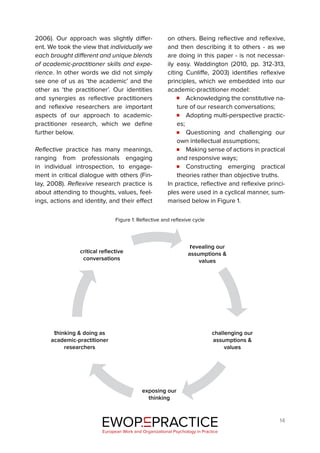
marised below in Figure 1.
EWOP PRACTICE
in
European Work and Organizational Psychology in Practice
critical reflective
conversations
revealing our
assumptions &
values
challenging our
assumptions &
values
exposing our
thinking
thinking & doing as
academic-practitioner
researchers
Figure 1: Reflective and reflexive cycle
15
Study design
This was a small-scale descriptive re-
search study that used a mixed-methods
approach to collecting, analysing and
integrating qualitative and quantitative
data. Ethical approval was granted by
City University London, and data collec-
tion took place between March and July
2010 with a representative sample of six
universities. Kathryn interviewed six HR
directors (HRDs) and Julie interviewed six
Pro Vice-Chancellors (PVCs). In UK univer-
sities PVCs provide academic leadership
in specific areas of strategy and policy
(e.g., research and enterprise), and act as
deputies to the Vice-Chancellor (equiva-
lent to the European title of Rector). In-
terviews lasted 45-90 minutes and were
digitally recorded and transcribed using
high quality voice recognition software.
Together, we carried out focus group in-
terviews in five out of the six participating
universities, each lasting 60-90 minutes
and typically involving six to ten academic
and research staff. In addition, an on-line
quantitative questionnaire survey (which
included opportunity for free text qualita-
tive comment) was sent to 120 academic
HoDs at the six research sites.
The qualitative interviews and focus
groups took place during a field visit to
each of the participating institutions. The
online survey drew on Guest and Clinton’s
(2007) questionnaire, and qualitative find-
ings from our fieldwork, reflecting HoDs’
impressions and opinions of HRM func-
tion and effectiveness. The survey was
administered via email using the Bristol
Online Survey tool (http://www.survey.
bris.ac.uk), and consisted of a rating scale
of 56 statements and three opened-end-
ed questions relating to: a) HR policies
and practices; b) HR effectiveness; and
c) HR influence (see Waddington & Lister,
2010). Template analysis was used as a
framework to facilitate the integration of
qualitative and quantitative data. Briefly,
template analysis is the process of or-
ganising and analysing data according to
themes which are further refined as text is
analysed (see King, 2012).
Summary of key findings
The full research report and results can be
found in Waddington and Lister (2010). In
this paper we summarise and reflect upon
key findings and cross-cutting themes re-
lating to: a) academic perceptions of HR;
b) status, visibility and influence of HR
strategy; c) academic values; and d) aca-
demic-practitioner crossover.
Results from the quantitative survey with
HoDs indicated that HR practices such as
appraisal, recruitment and staff develop-
ment were generally perceived as effec-
tive. A notable exception was in the area
of managing poor performance (see Table
1 on the next page).
EWOP PRACTICE
in
European Work and Organizational Psychology in Practice
16
However HoDs’ perceptions of HR influ-
ence upon university performance support-
ed Guest and Clinton’s (2007) findings that
there is little association between measures
of HR activity and standard indicators of
university performance (see Table 2 below).
EWOP PRACTICE
in
European Work and Organizational Psychology in Practice
Please give your opinion, as far as you are able to, of the effectiveness of the following broad
range of HR practices with regard to the way they are currently implemented in your univer-
sity
Options were: not at all effective/not very effective/fairly effective/very effective/don’t know
% overall not ef-
fective
% overall effec-
tive
% don’t know
Recruitment and selection of academic staff 16 81 3
Ability to attract top quality staff 47 50 3
Staff development for academic staff 19 78 3
Academic leadership development 28 66 6
University leadership development 31 53 16
Appraisal 12 88 0
Processes of employee involvement e.g. consulta-
tion, staff surveys
31 69 0
Succession planning 56 31 13
Reward systems 47 44 9
Managing poor performance 72 22 6
Discipline 53 38 9
Attendance/absence management 37 50 13
Ability to retain top quality staff 34 63 3
Table 1:	 Perceptions of effectiveness of HR practices
Please indicate the extent to which you consider the HR function in your university is able to
influence the following
Options were: no influence/small influence/sizeable influence/large influence/don’t know
% overall little
influence
% overall
larger influ-
ence
% don’t know
The quality of teaching 84 13 3
The quality of research 88 9 3
The quality of senior university management and
leadership
63 34 3
The ability to retain staff 59 38 3
The university’s financial position 59 34 7
The quality of the HR function 32 66 12
The quality of student outcomes e.g. grades, com-
pletion rates, employment rates
94 3 3
Table 2: Perceptions of HR influence upon university performance
17
The survey response rate was low, at
27% (N= 32), which although disappoint-
ing, was not entirely unexpected, as all of
the universities in the study had indicated
they were also undertaking a range of on-
line staff surveys. More generally, survey
response rates are declining over time as
a consequence of the increasing popu-
larity and ease of electronic distribution
of surveys (Anseel, Lievens, Schollaert, &
Choragwicka, 2010).
Key findings from the qualitative data in-
cluded some recognition by HR directors
that the profession has been slow to pro-
vide metrics to evaluate or demonstrate
HR ‘added value’ in core areas of univer-
sity business. For example as one HR Di-
rector (HRD) reflected:
“I have been trying to provide a vehicle
by which people become better lead-
ers and managers but my knowledge
of the deliverables around what makes
a better teacher is non-existent… One
of the failures that I have got is the
inability to demonstrate what works;
there is no good evidence that I have
managed to have a 10% improvement
in X or Y, I can’t show that and that’s is
a failure and a disappointment to me”.
(HRD interview)
Some senior academics expressed a de-
gree of concern about HR departments
becoming populated by people who do
not understand universities. For exam-
ple during one interview, a PVC raised
concerns about the relevance of Ulrich’s
(1997) ‘business partner model’:
“I have to say I have some concerns
about this [the Ulrich model] because
I don’t think HR issues in academic
departments are functionally equiva-
lent to HR issues in the service areas.
And, I have to say, that I’m not sure
that enough people in HR have much
experience of academic departments
and how they operate… leading aca-
demics is difficult for us as PVCs, and
we are academics”. (PVC interview)
Focus group data and qualitative com-
ment in the on-line survey suggest that ac-
ademics perceive HR as part of ‘manage-
ment armoury’, and the means by which
unpopular initiatives are implemented,
rather than a strategic driving force. There
was an underlying sense of disruption and
threat. For example:
“I have heard people say that aca-
demic staff are an endangered spe-
cies here, they are seen as a problem…
there is a view that academics have
become some kind of beast that has
to be controlled by HR… and I think the
reason for this is there was also a view
that the HR function needed to be pro-
fessionalised… and it now feels like HR
is the tail wagging the dog… there’s a
bit of treading on toes, it feels like they
are muscling in on areas traditionally
held by academics”. (Academic focus
group)
“HR is not perceived in a positive light.
The organization has gone through
extensive change, which was not han-
dled appropriately and proved to be
extremely disruptive and has had a
negative impact on how the organi-
zation is perceived from within. HR is
valuable in as much as they provide a
supportive/informative role, not a cen-
EWOP PRACTICE
in
European Work and Organizational Psychology in Practice
18
tral role to the organization”. (HoD sur-
vey comment)
On the other hand, academics valued HR
for its advisory/support role:
“HR has been my ‘saviour’ - I found
myself managing a team that had
been cobbled together by somebody
else and there were a lot of issues
and resistance in the team. I felt like I
had been thrown in at the deep end
but every time I needed help and they
were there for me and enabled me to
stay well and truly within the law”. (Aca-
demic focus group)
We also asked HRDs and PVCs about the
extent of collaboration between the HR
department and academic HR specialists
within their university. It appeared that col-
laboration was very rare, and a variety of
reasons were given which included: aca-
demics not being invited to contribute;
academics being invited to contribute,
but not wishing to participate; academ-
ics interested in theory and not practice;
HR not wishing to invite scrutiny which
would delay implementation of pragmatic
and timely solutions; academics consider
it ‘unseemly’ to offer the advice within the
institution that they may offer outside (to
industry and commerce, for example):
“Indeed, when you have the leading
X professor in the UK working for you
and you’re talking about the X position
of British institutions, you know, he can
tell you whether you’re right or wrong
in three minutes. Interestingly enough,
they are not very often consulted by
universities, their own experts, in that
sense”. (PVC interview)
“There is no evidence to me that ‘Manage-
ment’ or ‘Law’ are managed any better
because of their specialisation in manage-
ment and law because of course they are
specialisations are in the theory of it rather
than in the practice of it”. (HRD interview)
There were some notable exceptions, for
instance where HR directors worked with
and/or consulted with colleagues in HR
related faculties/schools or vice versa.
These collaborations tended to be based
upon existing relationships and informal
networks:
“There are some linkages so I know
that I will phone somebody up in HR
but that’s more because I know that
person and I have respect for them
and I will say what do you think about?
But I think I’m using her to test my idea
… and there are a few people in there
[the business school] that we use as a
sounding board because of their man-
agement experience and one of those
is from HR”. (HRD interview)
As the analytic template developed it be-
came clear that certain integrative cross-
cutting themes seemed to pervade much
of the data. King (2012) suggests that one
way to conceptualise integrative themes
is ‘as undercurrents running through par-
ticipants’ accounts; often, perhaps, not ad-
dressed explicitly but very apparent to a
careful reader (p. 432, emphasis added).
These themes and undercurrents became
apparent in reflective and reflexive con-
versations (see Figure 1 above) that took
place during data analysis. We also shared
our reflections with the research steering
group, and at conferences, as a means of
‘exposing our thinking’.
EWOP PRACTICE
in
European Work and Organizational Psychology in Practice
19
There were two themes of particular in-
terest to us as reflective practitioners and
reflexive researchers working in univer-
sities. First was the lack of engagement
between academics who generate re-
search-based evidence in HRM and their
practitioner colleagues. Second was the
underlying notion of HR departments as
repositories of toxic emotion (see Gallos,
2008). Therefore we now reflect upon the
meaning of our findings with regard to
evidence-based HR practice and the man-
agement of toxic emotion at work.
Reflecting upon findings
We have reflected (and continue to reflect)
upon our research at many points during
the study. We have had critical conversa-
tions about our engagement with each
other as collaborative researchers, aca-
demics and practitioners, and about what
impact the findings will have for HR practi-
tioners. Our initial reflections at the begin-
ning of the study were:
Kathryn: The bridge between research
and practice should be strong enough to
support two-way traffic and wide enough
to give academics and practitioners space
to stop, look, listen, think and talk togeth-
er, and create shared understandings and
measures of effective collaboration.
Julie: My primary interest is what research
on bridging the academic practitioner
divide can teach practitioners about the
values and motivation of academic staff
and the implications of this for leadership
and management in higher education.
In our initial reflections we talked in terms
of gaps and bridges, and this is mirrored
in the literature (Anderson, 2007; Bar-
tunek, 2007; Gray, Iles, & Watson, 2011).
Nevertheless we also take the view (as
discussed earlier in the paper) that individ-
ually, we each bring different and unique
blends of academic-practitioner skills and
experience. Looking out from our individ-
ual perspectives, but looking together, we
have been able to synergise theory and
practice in: a) applied WOP, healthcare
and nursing (Kathryn); and b) HRM, man-
agement, strategy and planning (Julie).
Notably, evidence-based practice is cen-
tral to both healthcare and HRM, albeit
arguably more fully articulated and devel-
oped in the former (Guest & Zijlstra, 2012).
Evidence-based management generally,
and evidence-based HRM specifically, is
characterised by four key features: a) use
of the best available scientific evidence
from peer-reviewed sources; b) system-
atic gathering of organizational facts, indi-
cators and metrics to better act on the evi-
dence; c) practitioner judgment assisted
by procedures, practices and frameworks
that reduce bias, improve decision quality
and create more valid learning over time;
and d) ethical considerations weighing
the short- and long-term impacts of deci-
sions on stakeholders and society (Rous-
seau & Barends, 2011, p. 224, emphasis
added). We will not focus in depth or de-
tail on the current debates and discourses
in the field of evidence-based HRM; nor
is it our intention to focus on similar de-
bates in the field of WOP, as others have
addressed these issues comprehensively
(e.g., Briner & Rousseau, 2011; Guest & Zijl-
stra, 2012). Instead, we reflect further upon
the insights, paradoxes and puzzles that
have emerged from exposing our think-
ing, revealing, challenging and unsettling
our assumptions.
EWOP PRACTICE
in
European Work and Organizational Psychology in Practice
20
Reflecting further
In our reflections about reflective practice
it became apparent that we were coming
from different perspectives and assump-
tions. For Kathryn, as a healthcare pro-
fessional and nurse, reflection is a core
aspect of her academic and research
practice (e.g., see Molloy & Waddington,
2011; Waddington, 2010). For Julie, as a
HRM practitioner and academic, reflection
is a relevant, but less prominent aspect of
her practice. In order to try and articulate
the reality of ‘doing reflective practice’ we
will use the above points b) – systematic
gathering of organizational facts, indica-
tors and metrics to better act on the evi-
dence; and c) – ethical considerations –
as our starting points for further reflection
in this paper.
Ethics and evidence in HRM
Because of the potential of HRM policy
and practice to influence the lives and
well-being of organizational members, the
profession arguably has a special status
which elevates the desirability of ethical,
evidence-based practice relative to that
of other managerial domains. A HoD re-
ferred to perceptions of HR in the follow-
ing terms: ‘HR is essentially used to imple-
ment unpleasantness’. They went on to
talk about senior management ‘taking HR
out of the drawer’ when there was some-
thing unpleasant to implement, then put-
ting it away afterwards. This reflected an
underlying perception and sense of HR as
a ‘tool in the management armoury’. An
armoury is a supply of weapons for de-
fence or attack, and this is a striking meta-
phor with which to think about notions of
harm, minimizing harm, and ethical HRM.
Wilcox (2012) considers the potential for
moral agency in HRM practice, that is, an
individual’s ability to make moral judg-
ments based on some commonly held
notion of right and wrong. She concludes
that this ability to make moral judgements
is contingent upon ‘managers being able
to create for themselves relational spaces
that allow for critical reflection and con-
versation’ (p. 95). Critically reflective con-
versations are an important element of
professional/peer supervision (as distinct
from managerial supervision), which Teh-
rani (2010) suggests may be helpful on
promoting personal and professional de-
velopment and growth.
However, the sensitivity and confidential-
ity of much that falls within the HRM remit
may also constrain opportunities for such
conversations. For example, as in a pre-
vious study by Tehrani (2011) an Absence
Co-ordinator comments:
“Some managers do not see why I can-
not tell them what is in a GP’s report,
particularly where an absence is hav-
ing an adverse impact on productivity,
or there is a belief that the employee is
“swinging the lead”. At times I feel to-
tally alone, having to deal with difficult
situations which I cannot share with
anyone”. Tehrani (2011, p. 55)
Sensitivity of subject matter can mean
that conversations have to take place ‘up’
the chain of command, where there is no
formal supervision, or any other form of
external support. HR practitioners may
be reluctant to instigate such conversa-
tions because of the potential for conflict.
That is, the person who is a source of sup-
port and guidance may also evaluate and
judge the HR practitioner’s potential and
EWOP PRACTICE
in
European Work and Organizational Psychology in Practice
21
future career through appraisal and line
management responsibilities. Perhaps
this scenario implies a particular need for
high-quality leadership and support within
HRM teams as, uniquely, HR practitioners
cannot take their concerns externally.
The potential for ethical and evidence-
based HRM is dependent upon the organ-
izational context. In other words the insti-
tutional features, organizational values,
climate and core business. The organiza-
tional context of our study was universi-
ties, all of whom had business schools/
management faculties where HRM was
taught and researched. There was rec-
ognition by HR directors that the profes-
sion has been slow to provide metrics to
evaluate/demonstrate HR ‘added value’.
Historically, HR has been perceived as
having ‘Cinderella’ status – in other words
not fully integrated into the core business
(Pynes, 2009). Lack of power and influ-
ence, together with perceptions of HR as
a ‘tool in the management armoury’ may
also conspire against the best efforts of
HR directors to implement what they know
to be evidence-based practice.
HRM and toxic emotion
The undercurrent of some of the negative
perceptions of HRM and its role in ‘imple-
menting unpleasantness’ is an aspect of
managing toxic emotions at work. In the
current climate of austerity, HR practition-
ers are often ‘bearers of bad news’, and
Gallos (2008) cautions:
“Handling strong emotions in the work-
place—dealing over time with others’
frustration, anger, and disappointment
resulting from organizational life in a
competitive world of scarce resources
and nonstop change—can be hazard-
ous to body and soul”. Gallos (2008, p.
354)
Frost (2003) used the term toxic emotion
to describe the ways that organizations,
during their day-to-day course of conduct-
ing business, generate a certain amount
of emotional pain or ‘toxicity’:
“The word toxicity may sound overly
dramatic applied to aspects of or-
ganizational life, but in many ways it is
uniquely appropriate. It suggests ele-
ments that can poison, whether a per-
son or an entire system; toxins spread
and seep, often undetected, in varying
degrees”. Frost (2003, p. 5; emphasis
in original)
HR practitioners handle toxic emotion, and
this can come at a cost to their well-being.
For example Tehrani (2010) examined the
effect that working with distressed em-
ployees, clients and members of the pub-
lic had upon practitioners working in
HR, Occupational Health, Counselling and
Police Family Liaison. Two hundred and
seventy-six professionals completed the
Goldberg short-form anxiety and depres-
sion questionnaire and the Carer Belief
Inventory (CBI) (Goldberg et al., 1988; Teh-
rani, 2007; cited in Tehrani, 2010). The CBI
measured four positive and nine negative
attitudes and beliefs, using a five-point
scale, with additional questions on super-
vision, other sources of support and cop-
ing strategies. Mean scores for positive
items for the HR group were compared
with the scores of the other groups ‘which
showed that they had a statistically signifi-
cantly lower level of positive growth com-
pared with other groups’ (Tehrani, 2010,
EWOP PRACTICE
in
European Work and Organizational Psychology in Practice
22
p. 134). The study concludes that it is im-
portant to provide practitioners who deal
with distressed or traumatised clients with
the time and opportunity to reflect on their
experiences: ‘This reflection through pro-
fessional or peer supervision helps them
to learn and become more competent in
their profession’ (p. 137). The implications
for practice are clear: meaningful reflec-
tion is crucial in order to instil compassion
– the antidote to toxic emotion – into HRM
practice.
Strengths and limitations of the research
This was a small-scale descriptive study
in six universities in the UK at a time of
turbulence in the higher education sec-
tor caused by the economic downturn
and cuts in public funding. Therefore, our
findings may not be generalisable or ap-
plicable to European counterparts. In ad-
dition, the higher education landscape is a
rapidly changing one, and this study may
simply be a ‘snap shot in time’. The sam-
ple was made up of HR directors, senior
university leaders, academics, research-
ers and HoDs, and the voice and perspec-
tive of frontline HR practitioners is absent.
It was an exploratory study, and does not
make a significant contribution to meas-
ures of employee engagement or metrics
for evidence-based HRM. Furthermore,
some of the questions we needed to ask
in order to ‘get underneath’ Guest and
Clinton’s (2007) findings – that there was
little evidence of a positive link between
HRM and university performance – might
cause unease. Firstly, participants might
have worried that they were exposing fis-
sures between different groups in their
university. Secondly, participation in the
study could have been interpreted as an
invitation to criticise the HR function. Both
of these factors could have been poten-
tially divisive, serving to reinforce notions
of an academic-practitioner divide.
Nevertheless we contend that the study
has given a worthwhile insight into the
perception of HR departments within uni-
versities. Participants raised some valid
and interesting questions on the appro-
priateness of the Ulrich (1997) business
partner model in universities, relating pri-
marily to the nature of universities and the
variable nature of academic disciplines
and academics. We also suggest that our
collaborative academic-practitioner ap-
proach has great value and relevance for
the HRD agenda regarding role of ‘schol-
ar-practitioner’ (Ruona & Gilley, 2009).
This approach is also highly relevant in
addressing the ‘practitioner-researcher
divide’ in WOP and the incongruence be-
tween strategic management research
undertaken by academics and that used
by practitioners (Anderson, 2007; Bar-
tunek, 2007).
Future directions for HR academic-prac-
titioner research
We asked HR directors for their views
upon the potential value and application
of a collaborative academic-practitioner
model, citing this study as one such exam-
ple. Their views were unanimously posi-
tive and favourable, for example:
“I think it is a must ....if you don’t do
it from that joint perspective, people
with different perspectives between
them and seeing what’s between them
joins up the whole I think is the way to
go. I think part of my struggle is that
I am doing it [change management]
from HR perspective not from that joint
EWOP PRACTICE
in
European Work and Organizational Psychology in Practice
23
perspective and I think I would have a
lot more credibility if I had a joint per-
spective”. (HRD interview)
In particular, there is also potentially use-
ful information within this paper that might
enable HR directors and practitioners to:
Develop innovative interdisciplinary
‘academic-HR practitioner partnerships’;
Generate opportunities for research
and evaluation;
Enable HR practitioners to contribute
to developing the theory, scholarship
and evidence-base of HRM.
Arguably our findings run counter to the
emphasis on positively oriented human
resource strengths and psychological ca-
pacities found in the POP and employee
engagement literature. On the other hand,
our findings also reflect the realities of
HRM where practitioners are indeed the
‘bearers of bad news’ and toxic emotion
handlers. There is thus a need to design
HRM strategies and interventions that ad-
dress these darker issues, and which also
instil compassion into HRM practice and
research.
Concluding reflections
We conclude the paper with some reflec-
tions on the collaborative aspects of our
work, and give a brief indication of the
next phase in the study:
Kathryn: I think that one of the reasons
the academic-practitioner approach to
this research has worked is because of
the relationship we have established
over time. We first worked together at
City University London when I was a HoD
and Julie was working in HRM, so our col-
laboration in this study has strong roots.
We trust each other’s judgement, respect
each other’s perspective and experience
and, paradoxically, feel comfortable with
the discomfort of exposing our thinking
and revealing and challenging our as-
sumptions.
Julie: For me, this research is about con-
necting HRM practitioner and academic
communities. Thinking now as someone
with a presence in both of those commu-
nities I can see how challenging it can be
from a practitioner perspective to have
one’s thinking exposed and subject to
scrutiny. But it is crucial for practitioners
and the wider HR profession to create
time and space for reflective practice and
peer supervision in order promote ethi-
cal, compassionate and evidence-based
practice.
Finally, we remain curious about the lack
of ‘academic-practitioner’ collaboration
between university HR Departments and
WOP, and HRM academics. There is a par-
adox in that knowledge transfer in these
fields has an external engagement, to
industry and commerce for example, but
the same knowledge is not transferred
and often fails to engage internally. This
is the focus of the second phase of our
study, which involves exploration of the
barriers and enablers to academic-practi-
tioner collaboration, and identification of
case studies of good practice.
Acknowledgements
We would like to thank the Leadership
Foundation for Higher Education for fund-
ing this small development project, Tina
Buckle, Jose Chambers and Anthony
Pryce who were our steering group, and
all of the research participants.
EWOP PRACTICE
in
European Work and Organizational Psychology in Practice
24
References
Alfes, K., Truss, C., Soane, E.C., Rees, C., & Gaten-
by, M. (2010). Creating an Engaged Workforce.
London: Chartered Institute of Personnel and De-
velopment.
Anderson, N. (2007). The practitioner–researcher
divide revisited: Strategic-level bridges and the
roles of IWO psychologists. Journal of Occupa-
tional and Organizational Psychology, 80, 175-183.
Anseel, F., Lievens, F., Schollaert, E., & Chorag-
wicka, B. (2010). Response rates in organizational
science, 1995-2008: A meta-analytic review and
guidelines for survey researchers. Journal of Busi-
ness and Psychology, 25, 335-349.
Bakker, A. E., & Leiter, M. P. (Eds.) (2010). Work en-
gagement: A handbook of essential theory and
research. Hove: Psychology Press.
Bartunek, J. (2007). Academic-practitioner col-
laboration need not require joint or relevant re-
search: Toward a relational scholarship of integra-
tion. Academy of Management Journal, 50(6),
1323–1333.
Briner, R. B. & Rousseau, D. M. (2011). Evidence-
based I-O psychology: Not there yet. Industrial
and Organizational Psychology, 4, 3-22.
Chartered Institute of Personnel and Develop-
ment (CIPD) (2012). HR and business partnering.
Available at: http://www.cipd.co.uk/hr-resources/
factsheets/hr-business-partnering.aspx
Finlay, L. (2008). Reflecting on ‘reflective practice’.
PBPC Paper 52. The Open University. Available at:
http://www.open.ac.uk/opencetl/resources/pbpl-
resources/finlay-l-2008-reflecting-reflective-prac-
tice-pbpl-paper-52
Frost, P. J. (2003). Toxic emotion at work: How
compassionate managers handle pain and con-
flict. Boston, MA: Harvard Business School Pub-
lishing.
Gallos, J. V. (2008). Learning from the toxic trench-
es: The winding road to healthier organizations—
and to healthy everyday leaders. Journal of Man-
agement Inquiry, 17(4), 354 – 367.
Gelpert, G. A. (2006). But what does it mean in
practice? The Journal of Occupational and Or-
ganizational Psychology from a practitioner per-
spective. Journal of Occupational and Organiza-
tional Psychology, 79, 153-160.
Gray, D. E., Iles, P., & Watson, S. (2011). Spanning
the HRD academic-practitioner divide: Bridging
the gap through mode 2 research. Journal of Eu-
ropean Industrial Training, 35(3), 247-263.
Guest, D. E., & Clinton, M. (2007). Human re-
source management and university performance.
London: LFHE.
Guest, D. E. & Zijlstra, F. R. H. (2012). Academic
perceptions of the research evidence base in
work and organizational psychology: A European
perspective. Journal of Occupational and Organ-
izational Psychology, 85, 542–555
King, N. (2012). Doing template analysis. In C.
Cassell & G. Symon (Eds.), Qualitative organiza-
tional research: Core methods and current chal-
lenges (pp. 426-450). London: Sage.
MacLeod, D., & Clarke, N. (2009). Engaging for
success: Enhancing performance through em-
ployee engagement. London: Office of Public
Sector Information.
Molloy, K., & Waddington, K. (2011). Learning
about leadership through critical reflection and
practitioner-academic co-inquiry, European Work
and Organizational Psychology in Practice, 4, 18-
30.
Pynes, J. E. (2009). Human resources manage-
ment for public and nonprofit organizations: A
strategic approach (3rd Ed). San Francisco, CA:
Jossey-Bass.
Rousseau, D. M. & Barends, E. G. R. (2011). Becom-
ing an evidence-based HR practitioner. Human
Resource Management Journal, 21(3), 221-235.
Ruona, W. E. A., & Gilley, J. W. (2009). Practition-
ers in applied professions: A model applied to hu-
man resource development. Advances in Devel-
oping Human Resources, 11(4), 438–453.
EWOP PRACTICE
in
European Work and Organizational Psychology in Practice
25
Shuck, B. & Reio, Jr., T. G. (2011). The employee
engagement landscape and HRD: How do we link
theory and scholarship to current practice? Ad-
vances in Developing Human Resources, 13(4),
419-428.
Sweetman, D., & Luthans, F. (2010). The power of
positive psychology: Psychological capital and
work engagement. In A. E. Bakker, & M. P. Leiter
(Eds.), Work engagement: A handbook of essen-
tial theory and research (pp. 54-68), Hove: Psy-
chology Press.
Tehrani, N. (2010). Compassion fatigue: Experi-
ences in occupational health, human resources,
counselling and police. Occupational Medicine,
60,133-138.
Tehrani, N. (2011). Compassion fatigue and hu-
man resource professionals. In N. Tehrani (Ed.),
Managing trauma in the workplace: Supporting
workers and organisations (pp. 51-62), Hove/New
York: Routledge.
Ulrich, D. (1997). Human resource champions.
Boston, MA: Harvard Business School Press.
Waddington, K. (2010) ‘Organisational gossip,
sense-making and the spookfish: A reflexive ac-
count’. International Journal of Management
Concepts and Philosophy, 4(2), 311-325.
Waddington, K., & Lister, J. (2010). HRM Strategies
and Academic Engagement. London: LFHE. Avail-
able at: http://www.lfhe.ac.uk/research/smallpro-
jects/finalreportcity.pdf.
Wilcox, T. (2012). Human resource management
in a compartmentalized world: Whither moral
agency? Journal of Business Ethics, 111, 85-96.
EWOP PRACTICE
in
European Work and Organizational Psychology in Practice
26
LEADING FOR ENGAGEMENT AND PERFORMANCE
EAWOP WORKLAB 2012
Dr. Diana Rus
Creative Peas - The Netherlands
d.rus@creative-peas.com
EWOP PRACTICE
in
European Work and Organizational Psychology in Practice
Information about the author
Dr. Diana Rus is an Organizational Psy-
chologist who works with companies in-
terested in steering the innovation pro-
cess by creating innovation cultures that
drive performance and engagement. She
also conducts research on leadership and
innovation and teaches executive educa-
tion programmes.
Abstract
This article aims to open up a discussion
on the role of leadership in organizations
based on the contribution of Professor
Beverly Alimo-Metcalfe at the first EAWOP
WorkLab held in October 2012 in Helsinki.
In this article, I examine some current or-
ganizational and leadership challenges,
introduce the concept of engaging lead-
ership and discuss its role in creating and
embedding an organizational culture of
engagement and high performance. I will
conclude with some nudges for leaders
interested in developing their leadership
capabilities.
Introduction
The first EAWOP WorkLab held in Octo-
ber 2012 in Helsinki was successful in
bringing together a mix of practitioners
and scientists interested in furthering
their understanding of the current state of
the art on leadership and decision-mak-
ing in organizations. The talk of Profes-
sor Beverly Alimo-Metcalfe on engaging
leadership was timely given the ever-
increasing challenges organizations are
facing in the currently volatile economic
environment. In this article I will examine
some current organizational and leader-
ship challenges, introduce the concept of
engaging leadership, and, discuss its role
in creating and embedding a culture of
engagement and high performance. I will
conclude with some nudges for leaders
interested in developing their leadership
capabilities.
Organizational and leadership challeng-
es
In the current economic environment
mired by uncertainty, organizations are
faced with ever more complex challenges
that many are poorly equipped to handle.
Judging by the popularity of news arti-
cles, blogs and tweets on leadership, it
appears that, at least in popular opinion,
leadership is seen as being instrumental
in helping organizations deal with such
challenges. Research on leadership tends
to confirm that leaders play a dispropor-
tionate role in shaping the course of their
organizations (e.g., Bono & Judge, 2004;
Yukl, 2009). But what are some of these
challenges that organizations are dealing
with and how does leadership come into
play?
Some typical examples of organizational
challenges would be: a) finding ways to
accelerate the rate of innovation to cap-
ture or create a greater market share in
27
an environment where competition is
relentless; b) finding ways to deal with
disruptive technologies; c) creating new
business models; and d) crafting and im-
plementing strategies that will ensure
the organization’s long-term survival and
profitability. Adding to these challenges
is the fact that many organizations have
seen their revenue shrinking. To cut costs,
some have chosen massive restructuring
programmes, while others have imple-
mented a hiring stop, and yet many others
have cut budgets for everything ranging
from the procurement of new IT systems
to employee development programmes.
In short, a large number of companies
feel pressured to maintain or increase ef-
fectiveness with a dwindling amount of
resources. That is, they need to do more
with less.
Adapting to these challenges does, how-
ever, intensify the already existing pres-
sures on employees and leaders alike.
Employees are faced with increasing
workloads, changing job-demands, in-
creased job uncertainty and a need to
innovate and react speedily to change.
These added pressures are bound to un-
doubtedly take a toll on their motivation,
well-being and ultimately performance.
For instance, the Global Workforce
Study 2012, performed by Towers Wat-
son among 32,000 employees across 30
countries, provides a strong argument for
the link between engagement and organ-
izational performance. One of the main
conclusions of the study was that: “When
engagement starts to decline, companies
become vulnerable not only to a measur-
able drop in productivity, but also to poor-
er customer service and greater rates of
absenteeism and turnover”(2012 Global
Workforce Study, p. 5). More importantly,
in a separate analysis of 50 global com-
panies, Towers Watson found that com-
panies with low engagement scores had
an average one-year operating margin
just under 10%, whereas those with high
“sustainable engagement” scores had
an average one-year operating margin of
27%. These results are nothing short of
staggering. Moreover, they mirror a state
of affairs we have more than once en-
countered in our own work. For instance,
a medium-sized manufacturing company,
we were working with, was dealing with
increasing quality problems in its prod-
ucts. In the months prior to these prob-
lems occurring, the company had laid-off
part of its workforce and had increased
the working hours of the remaining staff.
Upon talking to a number of employees,
it turned out that they felt disillusioned
and disengaged from their jobs. One of
the most common complaints centered
around the increasing amount of stress
on the job and the fact that their direct
supervisors did not seem to acknowl-
edge, let alone, show appreciation for
good performance; focusing instead only
on the mistakes that had been made. It
should come as no surprise that individu-
al performance did indeed suffer.
As a result, leaders face the critical task
of increasing effectiveness, while at the
same time sustaining employee motiva-
tion, maintaining well-being and creating
the conditions necessary for innovation
and collective learning (e.g., Yukl, 2009).
In other words, leaders need to be able
to find the sweet spot that allows them
to get more out of their staff, while at the
same time, not damaging motivation or
employee well-being.
EWOP PRACTICE
in
European Work and Organizational Psychology in Practice
28
Unfortunately, many organizations seem
to pursue increased effectiveness at the
cost of employee motivation and well-
being. Whereas this strategy may deliver
short-term results, it will also ensure that
these benefits are short-lived and, in fact,
will wreak havoc in the long-term. To this
end, research has clearly demonstrated
that employee well-being is positively re-
lated to commitment (Ryan & Deci, 2006),
creativity and performance (Ilies, Morge-
son, & Nahrgang, 2005), and negatively
related to absenteeism, and turnover
(Wright & Bonnett, 2007).
This current gloomy state of affairs rais-
es serious questions about the nature of
leadership and the management of hu-
man capital in organizations. I believe
that there are ways in which organiza-
tions can build leadership capacity that
would enable them to craft a work-en-
vironment in which employees not only
perform better but also experience high-
er levels of engagement and well-being.
In the next section I will briefly introduce
the concept of engaging leadership and
discuss its role in creating organizational
cultures that drive engagement and per-
formance.
Engaging leadership
Over the past decade, an increasing
number of leadership researchers (e.g.,
Mintzberg, 1999; Tourish & Vatcha, 2005)
have started to question the effective-
ness of ‘established’ leadership models
such as those espoused by theories of
transformational/charismatic and trans-
actional leadership. One of the main
points of criticism has rested on the pas-
sive role afforded to followers in these
models. As such, followers have tended
to be seen as relatively powerless pawns
on a stage where leaders pulled all the
strings.
In contrast, more recent theories of leader-
ship such as servant-leadership (e.g., Nui-
jten, 2009) and engaging leadership (e.g.,
Alimo-Metcalfe & Alban-Metcalfe, 2001)
have shifted the focus from the leader as
distant hero to conceptualising leadership
as a dynamic, collective process where
influence and learning happen bi-direc-
tionally. Importantly, in these models, lead-
ership is intimately tied to learning and
growth for the individuals involved (i.e.,
leaders and followers) as well as for the
organization at large (e.g., Fletcher, 2004).
One of the central tenets of these newer
leadership models is that engagement is
crucial for performance. Whereas this may
sound mundane to most practitioners, up
until recently, leadership research has
been lagging in empirically establishing
this link between engagement and perfor-
mance. More importantly, recent research
has shown that the fundamental require-
ment for engagement is meaningful work
(e.g., Amabile & Kramer, 2011). That is, peo-
ple that find their work to be meaningful
and see themselves making progress in
their work tend to be more engaged and
as a result tend to perform better.
Hence, one of the primary functions of the
leader is to help employees find meaning
in their work and assist them on their path
to becoming better at their jobs and to
grow as individuals. An equally important
point that tends to often be overlooked is
that leaders should ‘first do no harm’. In
this context, it means that leaders should
refrain from (inadvertently) stripping work
EWOP PRACTICE
in
European Work and Organizational Psychology in Practice
29
of its meaning. For instance, managers
that ignore employee suggestions or
ideas, micro-manage, provide controlling
feedback or fail to keep people informed
about important changes, are reducing
employee influence and reduce mean-
ing, thereby negatively influencing per-
formance (e.g., Amabile & Kramer, 2011).
According to Alimo-Metcalfe and Alban-
Metcalfe (2002; 2003) there are three
key principles to engaging leadership
that help leaders imbue work with mean-
ing and thereby, promote employee en-
gagement. First, the focus is no longer
on the leader being the heroic figure that
saves the day, but rather on the leader
enabling others to develop and display
leadership themselves. Engaging types
of leaders are open, transparent indi-
viduals that dare to be humble and vul-
nerable. In short, leaders are seen as
both servants and partners (e.g., Nuijten,
2009). Second, leadership is seen as a
social process that is distributed. The
dominant theme is one of collaboration,
team-based working and connectedness.
Engaging leaders are those that are able
to connect people and ideas through a
shared vision and that empower others
to execute this vision. This requires that
leaders are willing and able to see the
world through the eyes of others and are
willing and able to take on board others’
ideas and concerns. In short, they listen
to others and include others’ concerns
in their decision-making. Third, engaging
leaders encourage others to challenge
the status quo and ensure that an envi-
ronment is created in which these maver-
icks are valued and their ideas are taken
into account. Hence, they serve as role-
models in building a culture that supports
learning and development. This is a cul-
ture in which failure is not a dirty word as
long as people learn from their mistakes.
This is also a culture in which innovation
and entrepreneurialism are desired and
valued.
Importantly, empirical evidence suggests
that engaging leader behaviours not only
have a positive effect on employee mo-
rale and well-being, but also on long-term
employee productivity (e.g., Alimo-Met-
calfe et al., 2007). Therefore, being hum-
ble, listening to others and helping others
develop, does not only pay off in terms
of so-called soft factors such as engage-
ment and well-being, but also in terms of
actual performance.
Nudges for developing leadership capa-
bilities
As a leader interested in developing your
leadership capabilities what are some
of the things you can do? Below I will
list some questions that you can use to
gauge your leadership behaviors against
the framework of engaging leadership.
In how far am I really listening to
my employees? (e.g., do I understand
their point of view?)
Am I really as accessible as I think I
am? (e.g., is my office door open; when
people come into my office do I keep
glancing at my computer screen or do
I really engage in a conversation?)
In how far do I help my employees
learn and develop on the job? (e.g., do
I provide them opportunities for
growth; do I ensure that they have the
resources necessary to do their jobs?)
In how far do I really encourage
dissent? (e.g., how do I deal with peo-
ple that disagree with me; do I follow
up on ideas provided by others?)
EWOP PRACTICE
in
European Work and Organizational Psychology in Practice
30
In how far am I honest and open?
(e.g., can I honestly admit mistakes
and vulnerabilities?)
Organizations that invest in developing
engaging leaders who are focused not
only on the short-term bottom-line but
also on the long-term development of
their employees are better positioned
to craft high-performance work environ-
ments that not only spur financial growth
but also imbue work with meaning. This in
turn, can help them successfully weather
current challenges and be better pre-
pared for any challenges the future may
bring.
References
Alimo-Metcalfe, B. (2012). Engaging Leadership.
Presentation held at the EAWOP WorkLab, Octo-
ber 2012, Helsinki.
Alimo-Metcalfe, B., & Alban-Metcalfe, R. J. (2001).
The development of a new Transformational Lead-
ership Questionnaire. Journal of Occupational
and Organizational Psychology, 74, 1–27.
Alimo-Metcalfe, B., & Alban-Metcalfe, R. J. (2002).
The great and the good. People Management, 8,
32–34.
Alimo-Metcalfe, B., & Alban-Metcalfe, R. J. (2003).
Under the influence. People Management, 9, 32–
35.
Alimo-Metcalfe, B., Alban-Metcalfe, R. J., Bradley,
M., Mariathasan, J., & Samele, C. (2007). The im-
pact of leadership factors in implementing change
in complex health and social care environments:
NHS plan clinical priority for mental health crisis
resolution teams (CRTs). Department of Health
NHS SDO, Project 22/2002.
Amabile, T., & Kramer, S. (2011). The progress prin-
ciple: Using small wins to ignite joy, engagement,
and creativity at work. Boston: Harvard Business
Review Press.
Bono, J. E., & Judge, T. A. (2004). Personality and
transformational and transactional leadership: A
meta-analysis. Journal of Applied Psychology, 89,
901-910.
Fletcher, J. (2004). The paradox of post heroic
leadership: an essay on gender, power and trans-
formational change. Leadership Quarterly, 15, 647-
661.
Ilies, R., Morgeson, F. P., & Nahrgang, J. D. (2005).
Authentic leadership and eudaimonic well-being:
Understanding leader-follower outcomes. Leader-
ship Quarterly, 16, 373-394.
Mintzberg, H. (1999). Managing quietly. Leader to
Leader, 12, 24–30.
Nuijten, I. (2009). Servant-Leadership: Paradox or
diamond in the rough? A multidimensional meas-
ure and empirical evidence. Rotterdam: Erasmus
Research Institute of Management.
Ryan, R. M., & Deci, E. L. (2006). Self-regulation
and the problem of human autonomy: Does psy-
chology need choice, self-determination, and will?
Journal of Personality, 74, 1557-1586.
Towers Watson Global Workforce Study 2012:
http://towerswatson.com/assets/pdf/2012-Towers-
Watson-Global-Workforce-Study.pdf
Tourish, D., & Vatcha, N. (2005). Charismatic lead-
ership and corporate cultism at Enron: The elimi-
nation of dissent, the promotion of conformity and
organizational change. Leadership, 1, 455-480.
Wright, T. A., & Bonett, D. G. (2007). Job satisfac-
tion and psychological well-being as no additive
predictors of workplace turnover. Journal of Man-
agement, 33, 141-160.
Yukl, G. A. (2009). Leadership in organizations.
Upper Saddle River, NJ: Prentice Hall.
EWOP PRACTICE
in
European Work and Organizational Psychology in Practice
31
HOW LEADERS INFLUENCE THEIR
FOLLOWERS’ WORK ENGAGEMENT
Kimberley Breevaart & Arnold B. Bakker
Department of Work and Organizational Psychology,
Erasmus Universiteit Rotterdam
breevaart@fsw.eur.nl
EWOP PRACTICE
in
European Work and Organizational Psychology in Practice
Information about the author
Kimberley Breevaart works a PhD student
at the Department of Work and Organi-
zational Psychology at the Erasmus Uni-
versity Rotterdam. The main focus of her
PhD is how leadership affects followers’
daily work engagement.
Arnold B. Bakker is Professor of Work and
Organizational Psychology at Erasmus
University Rotterdam, and Adjunct Pro-
fessor at Lingnan University, Hong Kong.
He is also the President of EAWOP. His re-
search focuses on positive organizational
psychology.
Abstract
Because of the worldwide economic cri-
sis, an increasing number of organiza-
tions have to deal with financial problems.
This has forced organizations to reorgan-
ise their structures and processes, and
has led to a growing global competition.
It seems evident that in such a situation
employee work engagement is crucial. In
this article, we address the role of leaders
in inspiring their employees. We specifi-
cally focus on the impact of transforma-
tional leadership on employees’ work en-
vironment and work engagement. Using
specific examples, we provide leaders
and coaches with tools to enhance em-
ployee work engagement within a short
time period.
Work Engagement
Work engagement is a positive, work-
related, motivational state of mind that is
characterized by vigor, dedication and ab-
sorption (Bakker & Leiter, 2010; Schaufeli
& Bakker, 2004). Vigor refers to high en-
ergy levels during work, and the mental
resilience to cope with difficult situations.
Dedication refers to being enthusias-
tic about work; engaged employees are
proud of their work and inspired by their
daily tasks. Finally, absorption refers to
concentration during work and immer-
sion in work activities. Work engagement
differs from job satisfaction, because the
latter is a less active state. Satisfied em-
ployees are content with their situation
and therefore do not feel the urge to act
or change anything. In contrast, engaged
employees are very active and take the
initiative whenever necessary. This sug-
gests that engagement may be of crucial
importance for organizations in the cur-
rent, turbulent economic times.
Importance of Work Engagement
There are several reasons why engaged
employees are important for organiza-
tions. First, research has shown that en-
gaged employees perform better com-
pared to non-engaged employees. For
example, a study by Xanthopoulou, Bak-
ker, Demerouti, and Schaufeli (2009)
32
showed that financial returns were higher
on days that employees were more en-
gaged. Second, engaged employees have
better health; both mentally and physical-
ly. Research has shown that engaged em-
ployees less often have a cold and report
fewer head- and back-aches compared
to non-engaged employees (Demerouti,
Bakker, De Jonge, Janssen, & Schaufeli,
2001). This means that engaged employ-
ees can use all their energy during their
work. Third, engaged employees are less
often absent and are more committed to
the organization (Halbesleben & Wheeler,
2008; Schaufeli, Bakker, & Van Rhenen,
2009). Finally, work engagement is of
high importance to organizations because
engaged employees influence the work
atmosphere in a positive way – engage-
ment is contagious. Engaged employees
transfer their enthusiasm to others; caus-
ing colleagues to become engaged as
well and perform at a high level (Bakker &
Xanthopoulou, 2009).
Transformational Leadership and Work
Engagement
The leadership style used by leaders
can have a profound influence on em-
ployee work engagement. Some leader-
ship styles undermine employees’ moti-
vation and well-being, while other styles
contribute to motivation and well-being
(Einarsen, Aasland, & Skogstad, 2007).
Here, we focus on transformational lead-
ership, because this leadership style has
the potential to influence employee work
engagement. Transformational leadership
consists of four dimensions: a) idealised
influence; b) inspirational motivation; c)
intellectual stimulation; and d) individual
attention (Bass, 1985). Idealised influence
means that leaders are role models/men-
tors to their employees and employees
trust and respect their leaders. Inspira-
tional motivation refers to leaders inspir-
ing their employees with their vision of
the future. Leaders are optimistic about
the future and create a team spirit that
transcends employees’ self-interest. Ide-
alised influence and inspirational motiva-
tion together are also called charisma.
Leaders, who use intellectual stimulation,
encourage their employees to approach
existing problems in a different way and
to come up with new ideas, even if these
ideas differ from the leaders’ ideas. This
is also promoted by providing employees
with individual attention and by delegat-
ing tasks that match employees’ needs
and abilities. Finally, transformational
leaders acknowledge that every follower
is unique, has specific needs, and needs
attention. By using transformational lead-
ership, leaders give meaning to the work
and make employees feel that they con-
tribute to the organization in an important
and meaningful way by performing their
work well. This ensures that employees
are more dedicated to their work and per-
form their work with more energy and en-
thusiasm; in other words, they are more
engaged. Furthermore, transformational
leaders may influence their followers’
work engagement because their own en-
thusiasm, optimism and positive attitude
may cross over to the followers.
Research has shown that transformational
leadership can be trained. In 1996, Bar-
ling, Weber, and Kelloway developed a
transformational leadership training that
consists of two phases. Phase 1 consists
of a group session in which leaders are
provided with information about transfor-
mational leadership and its consequenc-
EWOP PRACTICE
in
European Work and Organizational Psychology in Practice
33
es. This session is followed by phase two;
which consists of four individual sessions.
During these sessions, plans are devel-
oped to use the learned behaviours in
real life; leaders receive feedback about
their leadership style and their progress is
monitored. An empirical evaluation of the
training indicated that employees in the
intervention group rated their leaders as
more intellectually stimulating, charismat-
ic and as providing more individual atten-
tion than employees in the control group
(in which the leaders did not receive any
training). Thus, leaders can be trained to
show transformational leadership behav-
iour effectively and in a relatively short
time period.
Leadership, Resources and Work En-
gagement
Besides the direct effect of transforma-
tional leadership on followers’ work en-
gagement, leaders may also influence
their followers’ work engagement through
their impact on the work environment (see
Figure 1). In their position of power and as
role models, leaders have an important in-
fluence on the availability of resources at
work. Job resources are all aspects of a
job that: a) stimulate personal growth and
development; b) contribute to the achieve-
ment of work goals; and/or c) reduce the
unfavorable impact of job demands (Bak-
ker & Demerouti, 2013). Examples of job
resources are autonomy, opportunities for
development, performance feedback, and
skill variety. Research has shown that such
job resources promote followers’ work en-
gagement (e.g., Halbesleben, 2010). Job
resources are intrinsically motivating be-
cause they stimulate employees’ personal
growth and development. In addition, job
resources are extrinsically motivating be-
cause they contribute to the achievement
of goals. Job resources seem to fulfill im-
portant psychological needs. Research
has shown that people have three basic
needs that, when fulfilled, positively affect
motivation and well-being. These are: the
need for autonomy, competence and relat-
edness (Deci & Ryan, 1985). For example,
employees’ need for competence will be
fulfilled when they are provided with chal-
lenging but feasible tasks that contribute
to their development. Further, employees’
need for relatedness will be fulfilled when
they receive support from their supervisor
or colleagues. Below, we give some ex-
amples of how leaders can stimulate the
availability of specific job resources.
Leaders may influence the available job
resources in the work environment in dif-
ferent ways. For example, leaders can pro-
vide their employees with social support
by means of a weekly, informal meeting.
For example, leaders free up one hour of
their time for a meeting that is not obliga-
tory and the topic of the meeting is not
pre-determined. Everyone attending the
meeting is allowed to discuss the prob-
lems they face in their work and ask for
EWOP PRACTICE
in
European Work and Organizational Psychology in Practice
Leadership Work related
resources
Follower Need
fulfillment
Follower Work
engagement
Figure 1. Overview of the effects of leadership on follower work engagement
34
advice about how to cope with these prob-
lems. Leaders may also encourage their
employees to work together to increase
social support. For example, leaders may
stimulate their followers to jointly divide
the tasks that need to be performed each
week. In this way, followers can divide the
workload in such a way that those with a
low workload can help their co-workers
with a high workload. Not only does this
increase social support between employ-
ees, it also creates an optimal workload.
In a relatively simple way, social support
can also be influenced by creating a place
where colleagues can meet more private-
ly to talk about the things that preoccupy
them.
A way in which leaders may influence their
followers’opportunitiesfordevelopmentis
by delegating tasks that match the needs
and abilities of employees. Furthermore,
leaders can use employees’ potential for
development by involving them in the de-
cision-making process. Specific actions to
contribute to followers’ development can
also be taken. For example, employees
who want to practice their presentation
skill can be provided with the opportunity
to practice these skills. This can start with
a presentation for one or two colleagues
that give feedback afterwards, followed
by a presentation for a small group of col-
leagues. Eventually, the leader may pro-
vide the follower with more responsibility
and the opportunity to present in front of
the entire team on a regular basis. Another
example is that employees’ organisational
skills can be developed by having them
organise a team-development day. Finally,
leaders can present their followers with a
problem and give them the opportunity to
come up with and try different solutions to
this problem. Afterwards, followers report
on and discuss the effectiveness of their
solutions with the leader. Hereby, leaders
stimulate their followers to think different-
ly and to use a variety of skills.
Feedback provided to employees can
be influenced by the leader by organis-
ing monthly meetings in which employ-
ees discuss what they have been doing,
what went well and what could have gone
better and what could be done differently
in the future. This can be discussed with
the leader, who may ask further questions
and give advice. These meetings can also
be held with the entire team, in which
several cases are discussed. In this way,
employees have to opportunity to learn
from each other. What did someone else
do differently and did it work? What were
the results of this approach and what can
I learn from it?
We have given an impression of what
leaders can do to enhance their followers’
work engagement and create a resource-
ful work environment. Importantly, every
profession has its own specific job de-
mands and resources. For example, social
support may be much more important for
a nurse working at the oncology depart-
ment compared to a painter creating art.
Depending on the importance of specific
job resources for a certain profession,
leaders can take several steps to promote
these resources.
References
Bakker, A.B., & Demerouti, E. (2013). Job Demands
– Resources theory. In C. Cooper, & P. Chen (Eds.),
Wellbeing: A Complete Reference Guide. Chiches-
ter: Wiley-Blackwell.
EWOP PRACTICE
in
European Work and Organizational Psychology in Practice
35
Bakker, A.B., & Leiter, M.P. (Eds.) (2010). Work en-
gagement: A handbook of essential theory and
research. New York: Psychology Press.
Bakker, A.B., & Xanthopoulou, D. (2009). The
crossover of daily work engagement: Test of an
actor-partner interdependence model. Journal of
Applied Psychology, 94, 1562–1571.
Barling, J., Weber, T., & Kelloway, E.K. (1996). Ef-
fects of transformational leadership training on
attitudinal and financial outcomes: A field experi-
ment. Journal of Applied Psychology, 81, 827-
832.
Bass, B.M. (1985). Leadership performance be-
yond expectations. New York: Academic Press.
Deci, E.L., & Ryan, R.M. (1985). Intrinsic motivation
and self-determination in human behavior. New
York: Plenum.
Demerouti, E., Bakker, A.B., De Jonge, J., Janssen,
P.P.M., & Schaufeli, W.B. (2001). Burnout and en-
gagement at work as a function of demands and
control. Scandinavian Journal of Work, Environ-
ment, & Health, 27, 279-286.
Einarsen, S., Aasland, M.S., & Skogstad, A. (2007).
Destructive leadership behaviour: A definition and
conceptual model. The Leadership Quarterly, 18,
207-216.
Halbesleben, J.R.B. (2010). A meta-analysis of
work engagement: Relationships with burnout,
demands, resources, and consequences. In M.P.
Leiter & A.B. Bakker (Eds.). Work engagement: A
handbook of essential theory and research. New
York: Psychology Press.
Halbesleben, J.R.B., & Wheeler, A.R. (2008). The
relative roles of engagement and embeddedness
in predicting job performance and intention to
leave. Work & Stress, 22, 242-256.
Schaufeli, W.B., & Bakker, A.B. (2004). Work en-
gagement: The measurement of a concept. Ge-
drag en Organisatie, 17, 89-112.
Schaufeli, W.B., Bakker, A.B., & Van Rhenen, W.
(2009). How changes in job demand and job re-
sources predict burnout, work engagement, and
sickness absenteeism. Journal of Organizational
Behavior, 30, 893-917.
Xanthopoulou, D., Bakker, A.B., Demerouti, E. &
Schaufeli, W.B. (2009). Work engagement and fi-
nancial returns: A diary study on the role of job and
personal resources. Journal of Organizational and
Occupational Psychology, 82, 183-200.
EWOP PRACTICE
in
European Work and Organizational Psychology in Practice
36
DEVELOPING A MODEL OF NON-TECHNICAL
COMPETENCES FOR ENGINEERS
Velli Parts & Mare Teichmann
velli.parts@enop.ee
EWOP PRACTICE
in
European Work and Organizational Psychology in Practice
About the authors
Velli Parts is a Lecturer and Research Fel-
low at the Department of Industrial Psy-
chology at Tallinn University of Technology
(TUT) and Mare Teichmann is a Professor
and Head of the Department of Industrial
Psychology, an Academic Leader of Mas-
ters Programme in Work and Organiza-
tional Psychology.
Abstract
Current paper focuses on the question
“What are the non-technical competenc-
es (NTC) needed for engineering profes-
sional work?” Based on theoretical study
we draw a heuristic model of NTC for en-
gineers and test it empirically. There are
six domains of NTC for engineers: a) Pro-
fessional ethics competences; b) Personal
competences; c) Interpersonal compe-
tences; d) Leadership, management, and
administrative competences; e) Innovation
and entrepreneurial competences; and f)
Law and legal system competences. Ana-
lysing the correspondence between NTC
use in everyday professional work, and
NTC competences developed in universi-
ty study indicated several gaps. Support-
ing engineers’ Personal competences up
to the highest level is especially important
as these are used on a daily basis. Young
engineers entering the workforce also
need extra training to develop their Inter-
personal competences.
Introduction
Engineering is a key factor in innovation
and is vital in addressing the global issues
and challenges that societies currently
face. The profession of engineering and
the roles of engineers have changed rap-
idly over the past few decades. Engineers
are expected to have an understanding of
relevant environmental, social, economic,
and cultural contexts in addition to strong
technical knowledge and skills (OECD,
2011). Engineers themselves acknowl-
edge the need for a new kind of engineer,
one who can think broadly across disci-
plines (Chan & Fishbein, 2009; Grasso &
Burkins 2010; Grimson, 2002; Ravenstein,
De Graaff, & Kroesen, 2006; Sheppard,
Macatangay, Colby, & Sullivan, 2009).
Preparing future engineers is prioritised in
several European Union (EU) countries, in-
cluding Estonia. At the same time, there is
lot of discussion about the graduate com-
petence gap in Europe and elsewhere;
i.e., a mismatch between the competen-
cies engineering graduates acquire dur-
ing their studies and the competences
employers expect from graduates. Nu-
merous studies demonstrate that the em-
ployability gap originates from both defi-
ciencies in technical/subject specific skills
and, more importantly, from deficiencies
in general and social skills (Bakar & Ting,
2012; Barte & Yeap, 2011; Beard, Schwieg-
37
er, & Surendran, 2007; Brown, Lee, & Ale-
jandre, 2009; Carter, 2011; Conlon, 2008;
Markes, 2006; Saravanan, 2009; Spinks,
Silburn, & Birchall, 2007).
The relation between education and
world of work is now conceptualised
through competence-based education.
Tertiary education degree programmes
in vocationally focused disciplines like
engineering have always aimed to pro-
duce graduates equipped with compe-
tences appropriate for employment (Coll
& Zegwaard, 2006). For now, there exists
considerable consensus that the modern
engineering profession requires not only
technical excellence, but also some addi-
tional, non-technical competences (NTC).
In recent years engineers’ educators and
professional bodies have accepted the
challenge of teaching NTC. Unfortunately,
no agreement has been reached regard-
ing what exactly the non-technical skills
and/or competences are in their deeper
content. On-going debate clearly shows
that different researchers and educators
understand this issue differently and are
offering different “packages” of engineers’
non-technical skills and/or competences.
The problem facing many of the approach-
es to engineering NTCs is that the com-
petence models used in the engineering
literature follow different theoretical ap-
proaches to competence and the exact
content of each engineering NTC is vague
and undefined. The current challenge en-
gineers, employers, and engineers’ edu-
cators are facing is getting a thorough
understanding about “What exactly are
the NTCs needed for engineering profes-
sional work?” This was the main research
question leading the studies conducted in
the department of Industrial Psychology
at TUT.
First, this article introduces the results of
these studies, on the basis of which the
model of NTCs for engineers was devel-
oped. Second, as the aim of competence
based education is to prepare students
with competences appropriate for em-
ployment we focus on correspondence
between the NTC engineers use in their
everyday professional work, and the NTC
competences developed in university by
teaching special NT subjects. Altogether
we aim to map the NTCs needed in en-
gineering work and the preparation of fu-
ture engineers in Estonia.
Concept of competence
Competence is about mastery in relation
to specified goals, outcomes or standards.
The concept of competence was original-
ly developed in psychology to refer to an
individual’s ability to respond to certain
demands placed on them by their envi-
ronment (Sampson, 2009). Whereas R.H.
White is credited with the introduction of
the term competence in 1959, David Mc-
Clelland (1973) proposed competence
testing instead of intelligence testing as
the critical differentiator of performance.
A clear and coherent definition of com-
petence is needed when one wants to
develop a competence model. Unfortu-
nately, this is not as straightforward as
it may seem, as the lack of a generally
accepted operational definition of com-
petence/competency is widely acknowl-
edged (e.g., Garavan & McGuire, 2001;
Winterton, 2009). The lack of consensus
originates in the diversity of disciplines in
which the concept is developed and ap-
plied: law, clinical psychology, vocational
EWOP PRACTICE
in
European Work and Organizational Psychology in Practice
38
counselling, education, training, and man-
agement (Voskuijl & Evers, 2012; p.149).
The confusion and inconsistent usage of
the term competence derives from differ-
ences in systems, structures and cultures
of Human Resource development and vo-
cational-educational training in different
countries (e.g., USA, UK, France, Germany
and Austria) (Delamare-Le Deist & Winter-
ton, 2005).
Theoretically, there are several competing
approaches in the literature; for example
in Work and Organisational Psychology
(WOP) two main approaches are distin-
guished: the competency or the person-
based approach; and the competence
or job/work based approach (Voskuijl &
Evers, 2012; p.150).
The competency approach finds its origin
in the USA where competency is mainly
defined as any characteristics relating to
superior performance. In this approach
competency equals the basic features of
a person that are associated with excel-
lent or superior performance in a situa-
tion. This worker-oriented perspective is
based on the seminal work of McClelland
(1973) who found that academic aptitude
and knowledge content tests, as well as
school grades and credentials; did not
predict job performance or success in life,
and were often biased against minorities.
This approach is concerned with the input
of individuals in terms of behaviour, skills,
or other underlying personal characteris-
tics of job holders that are causally related
to superior performance in a job or situa-
tion (Boyatzis, 1982; Spencer & Spencer,
1993). Person-based competency frame-
works are widely adopted in business or-
ganizations where consultants have de-
veloped a variety of ‘unique’ competence
systems which have found their way into
use with larger client organizations.
The competence or the job/work-based
approach is widely used in the EU. This
approach is task centred and focuses
on the purpose of the job or occupation
(i.e. on output), rather than the job holder
(Voskuijl & Evers, 2012; p. 150). The origin
of the model is the foundation of scientific
management, and subsequent develop-
ment of the National Vocational Qualifica-
tions. Competences in terms of the occu-
pational standards models used in many
EU countries are described as being
the minimum standards of performance
(known as threshold performance) and
the characteristics required by job holders
that are assumed to exist when standards
are met (ibid).
Roe (2002) defines competence as a
“learned ability to adequately perform a
task, duty or role”, relating to a specific
type of work. Competence integrates
several types of knowledge, skills, and at-
titudes in a dynamic way, and should be
distinguished from abilities, personality
traits, and other more stable characteris-
tics of the individual (ibid.). The latter can
be seen as the basis for what the individual
learns and how well they perform. There’s
enough research evidence that learning
process and performance also depend
on personal and situational factors and on
time. Thus, dispositions cannot be equat-
ed with knowledge, skills, and attitudes
that are learned qualities. Competence is
a “proximal antecedent” of performance
but whether a competent person per-
forms well also depends on other factors,
including motivation, current state (e.g.,
being in good health or not, energetic
EWOP PRACTICE
in
European Work and Organizational Psychology in Practice
39
state, level of vitality) and the opportunity
to perform (ibid.). While the presence of a
high level of competence is a prerequisite
for good performance, it does not guaran-
tee adequate performance.
While the terms competence and skills are
often used simultaneously, they should be
treated as distinctive terms. Skill concerns
the execution of a single task, while com-
petence deals more with the execution of
a whole series of different tasks in a cer-
tain domain, all of them performed well
and in an integrated manner (Coll & Zeg-
waard, 2006). People demonstrate com-
petence by applying their competencies
in a goal-directed manner within a work
setting (Kurz & Bartram, 2002; p.226).
Therefore, competencies relate to the
behaviours that underpin successful per-
formance; they are the “behavioural rep-
ertoires” that people use in order to meet
their objectives. The questions we want to
ask are: how do people go about achiev-
ing the required outcomes; and what ena-
bles competent performance?
Engineering competence
Engineering competence is defined as
the application of relevant skills and
knowledge in solving problems of interest
to an engineer. Engineering competences
can be divided into technical competenc-
es and non-technical competences. The
first are based on technical knowledge,
understanding, and skills (i.e., made up
of competences in basic and engineer-
ing sciences), and therefore are called
“technical competences” (TC). “Non-tech-
nical engineering competences” (NTC)
describe the broad field of competences
relevant to professional work in the engi-
neering domain. They are different from
transferable competences as they are
context-specific, that is they are appli-
cable in the context of the engineering
profession (although in a rather general
way; they are not specific to a concrete
occupation). Non-technical engineering
competences are defined in the current
work as “a specific range of non-techni-
cal knowledge, skills, and attitudes/value
system needed to adequately perform the
professional work and professional roles
of an engineer.”
According to Tuning-AHELO model en-
gineering competences are divided into
subject-specific competences and gener-
ic competences (OECD, 2009; 2011). Sub-
ject-specific engineering competences
are made up of competences in basic and
engineering sciences as well as compe-
tence in engineering processes. Generic
(or general academic) competences are
divided into generic engineering compe-
tences (competences important to gradu-
ates across all different engineering fields)
and generic competences (also named
transferable competences/skills or gener-
al competences/skills). To elaborate: there
are three types of generic competences:
Instrumental competences refers
to cognitive abilities, methodological
abilities, technological abilities and lin-
guistic abilities;
Interpersonal competences refers
to individual abilities relating to the ca-
pacity to express one’s own feelings,
critical and self-critical abilities, and so-
cial skills relating to interpersonal skills
(e.g., used in team working) or the ex-
pression of social or ethical commit-
ment that facilitates processes of so-
cial interaction and co-operation;
EWOP PRACTICE
in
European Work and Organizational Psychology in Practice
40
Systemic competences refer to abil-
ities and skills concerning whole sys-
tems. For example, the combination of
understanding, sensibility and knowl-
edge that allows one to see how the
parts of a whole relate and come to-
gether; capacities that include the abil-
ity to plan changes to make improve-
ments in whole systems and to design
new systems. Systemic competences
require as a base the prior acquisition
of both instrumental and interpersonal
competences; and are used for the at-
tainment of both TCs and NTCs.
We choose to position our research to
the Tuning-AHELO model (hereafter “the
model”) as it is the most recent attempt
to define engineering competences and
compiles prior work on learning out-
comes/competences in the field of engi-
neering. In the model, TCs are engineer-
ing subject specific competences, and
NTCs are generic engineering compe-
tences, and include generic interpersonal
and generic systemic competences. The
relationships between the aforemen-
tioned competences are depicted below
in Figure 1.
EWOP PRACTICE
in
European Work and Organizational Psychology in Practice
Engineering competences
Technical competences Non-technical competences
Engineering subject specific competences Generic engineering competences
Figure 1: Positioning of Non-Technical Competences in relation to engineering subject specific and
generic competences as suggested by the Tuning-AHELO model
Generic Systemic competences
Generic Instrumental competences
Generic Interpersonal competences
Developing model of non-technical com-
petences for engineers
Creating a competence model for an oc-
cupational group is of value if it’s useful
and applicable for a broad audience (i.e.,
all the relevant groups that hope to ben-
efit from it). First, the model should be
capable of being utilised by and provide
benefit to specialists that address the
competences of engineers in their every-
day work; such as WO Psychologists and
human resource management (HRM) spe-
cialists, as well as the educators of engi-
neers. In curricula development, learning
objectives are essentially competences,
and engineering organizations can speci-
fy or update professional qualifications, to
include those: a) concrete competences
Tuning
typology of
competences
41
(and sub-competences) already required
of their engineers; and b) areas of compe-
tence and professional requirements that
reflect both the current and future needs
in the working world,
Second, the model should cover/include
competences for engineers in various ca-
reer levels: such as: a) competences that
entry-level professional engineers use
in their everyday work; b) competences
used by engineers with longer work ex-
perience; and c) competences used by
engineers with management responsibili-
ties at various management levels within
an organization.
Third, the model of NTC for engineers
should be of help to analyse and design
engineering curricula in Higher Education
Institutions (HEIs) for entry-level engineers
and for developing supplementary train-
ing programmes for engineers at different
career stages.
We conducted two studies to develop
and test the model of NTCs for engineers.
First, we identified the ideal NTCs for en-
gineers on the basis of a comprehensive
review of research literature, visions of the
engineers of the future, analysis of quali-
fication criteria for engineers prescribed
by professional bodies, and expected
outcomes of engineering graduate pro-
grammes (see Figure 2 below). The next
step was empirically testing this model.
EWOP PRACTICE
in
European Work and Organizational Psychology in Practice
Figure 2. The Model of Non-Technical Competences for Engineers
There are six NTC domains in this model
for engineers. Each domain, in turn, is di-
vided into several competences and each
competence consists of various compe-
tencies. The six domains of NTC are:
Professional ethics (E): competences that
are an essential part of the education and
everyday working of engineers. Providing
knowledge of the relationship between
science, technology, and the ethical prob-
Professional
ethics
Law and
legal system
Innovation
and entrepre-
neurial
competencies
Personal
competen-
ces
Interpresonal
competences
Leadership,
management-
administrative
competences
42
lems of engineers in industry, helps en-
gineers to deal with ethical issues within
their professional practice. Three impor-
tant components in this domain are:
Ethics of personality (E1): honesty
and other ethical values, tolerance of
differences, including cultural differ-
ences, following principles of ethical
behaviour in general;
Professional ethics (E2): adhering to
engineering ethical standards, such as
knowing where assignments extend
beyond an engineer’s competence;
Social responsibility of engineers
(E3): an engineer’s responsibility to so-
ciety (socially responsible behaviour)
such as providing clearly understood
information to the public that allows
others to consider the impact of deci-
sions related to science and technolo-
gy on nature and the environment.
Personal (P): competences are the ba-
sis that allows individuals to act autono-
mously, manage their own lives, and situ-
ate their lives in a broader social context.
Personal competences promote expected
professional behaviour and productivity in
engineers. Because they affect goal adop-
tion, pursuit, and disengagement, they are
critical for productivity in multiple life do-
mains. The common thread among these
attributes is self-regulation. Mastering
self-regulation allows one to counteract
undesired influences that may arise from
within the person or from the environment
and support volitional behaviour. The four
competences in this domain are:
Flexibility (P1):adaptability, coming
to terms with new or rapidly changing
situations, objectively evaluating a situ-
ation and changing plans if necessary;
Stress tolerance and coping with
stress (P2): coping with working in
stressful situations (techno-stress),
coming to terms with work stress and
burnout;
Self-management (P3): setting per-
sonal goals and priorities, effective use
of time, realistic evaluation of resourc-
es, adapting activities according to
feedback, learning from mistakes, self-
motivation and a positive, optimistic
outlook on life, the ability to control
one’s emotions (self-control), calmness
and balance, persistence in complet-
ing a task that has been started;
Learning skills and motivation (P4):
understanding the importance of life-
long learning, participating in supple-
mentary training, curiosity forms the
basis of continuous learning.
Interpersonal (IP): competences are the
bases individuals use when engaging with
others, and since they encounter people
from a range of backgrounds, it is impor-
tant that they are able to interact in het-
erogeneous groups. Skills of co-operation
and collaboration, creating and maintain-
ing relationships, influence, conflict resolu-
tion, and negotiation are needed for effec-
tive professional conduct in engineering.
The competences in this domain are:
Communication (IP1): effective com-
munication (face-to-face and in a virtual
environment) that involves listening,
providing feedback, using language
that is appropriate to the situation, abil-
ity to speak before an audience, clear
oral and written expression, and creat-
ing an atmosphere that is conducive to
good communication;
Cooperation and creating relation-
ships (IP2): the ability to create and
maintain good relationships, empathy,
EWOP PRACTICE
in
European Work and Organizational Psychology in Practice
43
the ability to listen to others and take
the needs of all parties into account,
creating and participating in co-opera-
tion networks;
Negotiation and conflict manage-
ment (IP3): the ability to rephrase a
problem, achieving solutions that are
helpful to all parties, construction reso-
lution of arguments, and achieve a
consensus;
Influencing (IP4): consciously creat-
ing a certain impression, inspiring, con-
vincing, implementing, motivating, in-
cluding, delegating, and display of
mentorship and leadership behaviours.
Leadership, management and adminis-
trative (LMA): competences that provide a
foundation for successfully handling work
situations related to team, project, and di-
vision management, and other tasks and
duties in the professional work of engi-
neers. Competences in this domain in-
clude:
Project management (LMA1): plan-
ning and implementing activities to
achieve desired results while remain-
ing within the limits of the given sched-
ule, budget and other resources;
Leadership of an organization or
unit/division (LMA2): planning, organis-
ing, controlling, directing resources,
coming to terms with crises, directing
processes, administering, directing
and encouraging results, delegating,
knowing and influencing the culture of
the organization, initiating and direct-
ing changes, including leading meet-
ings;
Team leadership (LMA3): creating
and developing a team, initiating work,
projects, being familiar with and influ-
encing group processes, leading an in-
terdisciplinary and multicultural team.
Innovation and entrepreneurial (IE): com-
petences that guarantee the success of
engineers, depending on their ability to
identify unconventional, emerging oppor-
tunities using entrepreneurial skills. Two
competences in this domain are:
Creativity and innovativeness (IE1):
creating a vision and strategy for the
development of new products/servic-
es, finding a solution to problems, gen-
erating new ideas and approaches,
finding/seeing innovative solutions,
striving towards innovation;
Entrepreneurship (IE2): defining
and recognising a market niche for
new products and services, develop-
ing an idea into an actual product or
service, being oriented to the needs of
the client, developing products or ser-
vices that suit the given market and
product development, willingness to
take risks, working in a focused and
goal-oriented way, and finding resourc-
es to carry out ideas.
Law and the legal system (L): these com-
petences are important in engineering as
engineers should be aware of their rights
and responsibilities, legal and social as-
pects of technology and its usage and
possible legal consequences related to
their productions. The primary value-add-
ed knowledge is related to understanding
intellectual property and patent law. En-
gineers should also understand the legal
landscape that they are bound to. Compe-
tences in this domain include:
Intellectual property law (L1): copy-
right, patent law, brand law, trade se-
crets;
Commercial law (L2): rights and re-
EWOP PRACTICE
in
European Work and Organizational Psychology in Practice
44
sponsibilities associated with leading a
business;
Knowledge of legal issues in engi-
neer’s work (L3): knowing legislation
that pertains to one’s work, work envi-
ronment, and work safety.
These six domains of NTC are separate
and yet have a shared component with
their neighbouring and other competenc-
es. For example, knowledge and under-
standing about ethical principles is need-
ed and engineers are expected to have
professional ethics in situations when the
requirements prescribed by law are open
to interpretation. Also, for effective leader-
ship and management good communica-
tion skills are essential, which fall under
interpersonal competences.
Empirical Study
A web-based survey was conducted to
empirically test the model of NTC for en-
gineers. Altogether 1,011 engineers (681
males, 322 females and eight non disclo-
sures) with an average age of 28.11 years
(SD=7.60), and average professional engi-
neering work experience 6.45 (SD=0.25)
years participated in the survey. Of the re-
spondents 44% had a Bachelor’s degree,
34% a Master’s degree, and 18% had grad-
uated from high school. In addition, four
respondents had completed their doctoral
studies.
The questionnaire consisted of 19 items;
each of them was an NTC name followed
by a brief description (i.e., an explanation
of the content-opening list of keywords).
For example: Stress tolerance (tolerance
of pressure, working in stressful situations,
techno-stress, coping with occupational
stress, and burnout).
Respondents had to estimate how often
they used the19 NTCs in professional en-
gineering work. Figure 3 below shows the
results with the most frequently used com-
petences listed first.
E1 Personal ethics
P1 Flexibility
P4 Learning skills, motivation
P3 Self management
P2 Stress tolerance and coping
IP1 Communication
IP2 Relationship/cooperation
IE1 Innovation
E2 Professional ethics
IP3 Negotiations/conflicts
L3Engineer’s work legal issues
LMA1 Project management
E3 Social ethics
IP4 Inflence
LMA2 Organization/division management
IE2 Entrepreneurship
LMA3 Team leadership
L1 Intellectual property
L2 Commercial law
0% 10% 20% 30% 40% 50% 60% 70% 80% 90% 100%
59 29 9 31
49 38 10 21
47 38 12 21
46 36 14 31
40 36 18 5 1
37 36 20 6 1
34 40 21 5 1
27 41 24 7 1
24 48 19 7 2
23 40 28 9 1
23 25 27 20 6..
22 30 26 15 6..
19 37 27 13 4.
17 35 30 15 3
16 22 25 20 18........
15 29 31 20 5.
15 23 23 24 15......
11 19 24 28 19........
8 15 23 29 26...........
Figure 3. Frequency of use Non-technical competences in engineering practice
Every day Frequently Sometimes Rarely Never
45
It appears that approximately nine engi-
neers out of ten use Personal ethics com-
petences on a daily basis or frequently. In
addition, more than 75% of engineers use
all four Personal competences on a daily
basis or frequently. Further, 40-49% of en-
gineers report they are expected to be
flexible, ready and motivated to learn new
things, as well as cope with techno-stress,
and come to terms with work stress on a
daily basis.
Approximately 2/3rds of engineers use In-
terpersonal competences, Innovation and
Creativity competences as well as Profes-
sional ethics competences on a daily ba-
sis or frequently. It appears that most en-
gineers are daily or frequently required to
think about honesty and other ethical val-
ues and follow principles of ethical behav-
iour in general. Good self-management
skills are also required in the everyday
work of an engineer.
Communication competencies, relation-
ships and cooperation competences were
reported by 70% of engineers on a daily
basis or frequently. Further, half of the en-
gineers use project management, influ-
encing, and entrepreneurship competenc-
es as well as competences related to legal
issues on a daily basis, or frequently. How-
ever, Leadership, Management and Ad-
ministrative domain competences (LMA)
were used by 41-51% of the engineers;
while Intellectual property and business
law competences were sometimes or
rarely (with a small percent of engineers
never having used them).
Innovation competences based on crea-
tivity and insightful thinking were reported
by 41% of respondents frequently and by
27% of respondents on a daily basis.
The length of professional engineering
work experience was positively and signif-
icantly correlated with using competences
in all domains. The strongest correlations
were found with Innovation/Entrepreneur-
ial competences and LMA competences. It
appeared that ratings of engineers without
work experience (no work experience or
work limited to a few months) were signifi-
cantly lower in all six domains compared
to ratings of engineers with work experi-
ence of more than five years. The ratings
of engineers with one to five years of work
experience were closer to the ratings of
the more experienced engineers in the
Personal competences domain. In IE and
LMA competences domains the ratings of
engineers with some work experience (1-5
yrs.) were similar to the ratings of inexpe-
rienced engineers but significantly lower
than ratings obtained from more experi-
enced engineers.
Competences developed by teaching
Non-technical subjects in Engineering
Curricula in TUT
In engineering education the tradition-
al “knowledge-oriented” approach has
moved towards developing degree pro-
grammes which focus on competence de-
velopment. The aim is to make students as
competent as is feasible in a given time-
frame for their future role in society, by
making optimum use of the interests and
capabilities of the students (OECD, 2011).
The aim of competence-based education
is to prepare students with competences
appropriate for employment, work life,
and professional career. It is argued that
the development of generic competences
or transferable skills is becoming more rel-
evant for preparing students for their fu-
EWOP PRACTICE
in
European Work and Organizational Psychology in Practice
46
ture role in society in terms of employabil-
ity and citizenship (Tuning, 2006). Thus, it
is relevant to know whether NT subjects
taught in the engineering curricula foster
the generic competences needed for suc-
cessful employment.
As previously stated, the model of NTC for
engineers could be helpful to analyse en-
gineering curricula in HEIs; exploring how
many topics develop the NTCs that engi-
neers need for their professional careers.
Our empirical study of the NTCs engineers
use in their everyday professional work
can serve as starting point to estimate
how well engineering curricula are in ac-
cordance with employment demands. An
analysis of engineering curricula of the
engineering faculties of TTU from the van-
tage point of NTCs indicated that:
Although there is a large number of
NT subjects, the content of those sub-
jects and especially students’ learning
outcomes are not in accordance with
general understanding of non-techni-
cal engineering competences;
None of the curricula offer the pos-
sibility of the full development of non-
technical engineering competences.
Subjects were mainly electives for stu-
dents, and for example, there is no one
subject for developing leadership and
managerial competences on either the
undergraduate or postgraduate pro-
grammes.
In order to understand this further we un-
dertook an in-depth content analysis of
the aims, content and learning outcomes
of NT subjects taught as compulsory sub-
jects or electives to undergraduate and
postgraduate engineering students. The
research question guiding our study was
“Which NTCs are systematically devel-
oped by teaching NT subjects for engi-
neering undergraduate and postgraduate
students?” Answering this question will al-
lows us to find the main gaps and suggest
what NTCs are needed in professional en-
gineering work in order to prepare engi-
neering students in Estonia.
All engineering curricula in TUT include
modules on: General Studies; Econom-
ics and Entrepreneurship; and Free elec-
tives. The purpose of teaching the Gen-
eral Studies module is to raise the overall
educational level and to satisfy common
educational needs of the students. Com-
pulsory subjects in this module are Philos-
ophy, Law and Sustainable Development,
Science of Risk and Safety, and foreign
language. First four subjects are aimed to
develop students’ general systemic com-
petences; the latter aims to develop stu-
dents’ general instrumental competences
(i.e., their language skills). There are few
additional compulsory general subjects
such as those that develop students’ writ-
ing skills and ethical competences.
The purpose of teaching free electives
is to allow students to choose courses
according to their individual interests,
planned career needs and trends in new
technology. For example, some curricula
offer Sociology, Psychology and Logic as
optional general subjects.
The purpose of teaching the Econom-
ics and Entrepreneurship module is to
provide students with knowledge of the
basics of economics and business and
to improve their knowledge and skills of
entrepreneurship. In addition, Micro- and
Macro-economics is a compulsory subject
EWOP PRACTICE
in
European Work and Organizational Psychology in Practice
47
for undergraduate students (developing
their generic systemic and instrumental
competences). On average, postgraduate
engineering curricula contain two or three
subjects from the Innovation-Entrepre-
neurship (IE) competences or Leadership,
Managerial and Administrative (LMA) com-
petences domain (these are presented in
Table 1).
EWOP PRACTICE
in
European Work and Organizational Psychology in Practice
NTC NT subject
Law
competences
Commercial law Contract Law
Intellectual property Intellectual property
Engineer’s work legal issues Grounds of Law
InnovationandEntrepreneurship
competences
Innovation
Innovation and creative problem solving
Product Development, Innovation and Product De-
velopment, Product Development and Design
Innovation management
Technological Innovation
Research work and Innovation
Research & Development and Innovation
Entrepreneurship
Technology-based Entrepreneurship and Innovation
Introduction to Entrepreneurship
Entrepreneurship and Small Business Management
Entrepreneurship and Business Planning
Business Administration
Leadership,Mana-
gerial,Administra-
tivecompetences
Team leadership
Team Management in Developing Information Sys-
tems; Teamwork – project
Organization/division
management
Quality management, Project and Quality Manage-
ment
Organisational Behavior, Managerial Psychology
Project management Project management
Table 1. Law, IE, LMA competences and corresponding NT subjects taught in TUT
Leadership, Managerial and Administra-
tive (LMA) competences
MostengineeringcurriculaincludeProject
Management courses to develop these re-
spective competences. The Quality Man-
agement course, in part, focuses on de-
veloping students’ Organization/Division
management competences. Only Faculty
of Information Technology offers specific
subjects aimed to develop students’ team-
work and team leadership competences.
However, there are just a few curricula in
different engineering faculties that offer
Organizational Behaviour or Managerial
Psychology courses. Thus, whereas Pro-
ject Management competences are sys-
tematically developed, there are few engi-
neering specialities where postgraduate
48
students are offered the opportunity to
develop Team leadership and Organiza-
tion/Division management competences.
Innovation / Entrepreneurship (IE) com-
petences
Although creativeness and innovative so-
lutions are seen as core in the engineering
profession; only a few subjects specifical-
ly deal with developing students’ creativ-
ity and innovative thinking (e.g., Faculty of
Information Technology teaches innova-
tion and creative problem solving, Tech-
nological Innovation). Product Develop-
ment courses focus on basic knowledge
about product development processes in
enterprises and aim to educate students
about principles and methodologies of
modern product development. While the
aims and content of Innovation Manage-
ment are similar to Product Development
courses (i.e., the subject aims to develop
students’ understanding of the process of
innovation and product development in
companies); the role of the state and wid-
er socioeconomic context in innovation
are given more attention. These courses
also aim to prepare students for participa-
tion in product development team activi-
ties (such as Research and Development,
R&D), and the development of elementary
team leadership skills. Further, Research
Work and Innovation, Research & Devel-
opment and Innovation aim to develop
students’ skills for planning and realising
independent research, R&D or innovation
projects.
Subjects offered in TUT to develop engi-
neering students’ entrepreneurship com-
petences aim to provide the knowledge
and skills one needs to start new business
venture ( such as, understanding busi-
ness environment, evaluation of business
opportunities, developing business ideas
into business plan, financial planning, and
solving problems related to starting one’s
ownbusiness).Creatinganunderstanding
about the essence of entrepreneurship,
and providing knowledge that enables
students to evaluate their potential for be-
coming entrepreneurs and to appreciate
team working are valuable competences
these courses aim to develop.
Law domain competences
These competences are developed by
teaching Grounds of Law as compulsory
subject to all engineering students. How-
ever, it would appear that the majority of
engineering curricula do not contain sub-
jects that would enable the development
of commercial law and intellectual proper-
tycompetences.Onlyacoupleofcurricula
in Faculty of Chemical and Materials Tech-
nology and in Faculty of Civil Engineering
offer courses on Intellectual property and
Contract Law respectively.
Table 2 overleaf describes the Interper-
sonal, Personal, Ethics competences and
corresponding NT subjects taught at TUT.
These are described below.
Interpersonal competences
Engineering curricula contain many sub-
jects aimed seemingly to develop stu-
dents’ Communication competences; but
the focus of those subjects is in fact on
developing instrumental competences
(such as language skills). Only a couple
of curricula include optional subjects that
aim to develop students’ Interpersonal
communication competence (Communi-
cation Psychology, Business Communi-
cation and Negotiations). The Faculty of
EWOP PRACTICE
in
European Work and Organizational Psychology in Practice
49
Social Sciences offers Communicational
Psychology as a free elective that aims
to develop a wider range of communica-
tion competences (e.g., listening, self-
presentation, cooperation, team building,
and conflict management). Interpersonal
competences related to effective commu-
nication skills and building and maintain-
ing cooperative relationships as well as
negotiation and conflict management and
influence competences are not systemati-
cally developed in engineering curricula.
EWOP PRACTICE
in
European Work and Organizational Psychology in Practice
NTC NT subject
Interpersonalcompetences
Influence
Negotiations / conflicts
Relationships / cooperation
Communication
Communicational psychology
Business Communication and Negotiations
Human communication
Estonian Language and Culture
Giving Presentations in English
Revision of Productive Skills in the Estonian Language
Scientific Communication/Science communication
Scientific writing
Visual Communication I, II
Personal
competences
Flexibility
Self-management (Free elective)
Stress tolerance
Self management
Learning skills and motivation
Ethics
compe-
tences
Social ethics Business ethics
Professional ethics Ethics of engineering profession
Personal ethics Social Skills and Ethics
Table 2. Interpersonal, Personal, Ethics competences and corresponding NT subjects taught in TUT
Personal competences
Only one subject, Self-management, is
taught in TUT to systematically develop
students’ Personal competences. This
subject is free elective (i.e., not included in
any engineering curricula as compulsory
or optional). The Self-Management course
was specifically designed to diminish the
student dropout rate, and many first-year
students attend it.
Professional Ethics competences
Several engineering curricula include Eth-
ics of the Engineering Profession as a
subject which aims to develop students’
Ethics of personality, Professional ethics,
and Social ethics competences. Some
curricula contain a Business ethics course
focusing on ethical problems and dilem-
mas in the business context and issues of
Corporate Social Responsibility. However,
50
these courses tend not to address specific
engineering professional ethics questions
and issues that engineers may encoun-
ter regarding their social responsibility.
It appears, although many engineering
curricula give students an opportunity to
develop Ethical competences, the choice
has to be made by students themselves
which are the specific concerns requiring
the development of Ethical domain com-
petences.
In summary, it appears that the NTCs sys-
tematically developed by teaching (com-
pulsory or optional) NT subjects for engi-
neering students in TUT are: a) engineers’
work legal issues; b) entrepreneurship
competences; c) project management
competences; and d) ethical competenc-
es.
Engineering curricula partially develop
students’ innovation competences, and
team leadership competences. The lat-
ter is achieved mainly by using teamwork
in achieving course’s aims and therefore
does not include thorough preparation for
team leadership (e.g., influencing group
processes, leading interdisciplinary and
multicultural teams).
Supporting the development of follow-
ing NTC of engineering students cannot
be considered systematic in TUT: a) inter-
personal and personal competences; b)
organization / division management; and
c) intellectual property and business law
competences.
Discussion
On the whole, there appears to be an im-
balance in the NTCs that engineers report
using most in their professional work and
the NT subjects offered to under- and
post-graduate students during their stud-
ies. General subjects in engineering cur-
ricula are aimed to develop students’ gen-
eral understanding of the world including
understanding of safety, and legal rights
and responsibilities. Principles of project
management, understanding the process-
es of product development, and principles
of ethical conduct in engineering profes-
sion have been taught to engineers over
the last 50 years.
However, the need to develop engineers’
soft skills and their business focus to bet-
ter serve the learners and their eventual
employers (in business and/or industry)
has been voiced for several decades. En-
gineers of the 21st century are expected to
possess cross-functional inter-disciplinary
knowledge, skills, and attitudes which ex-
tend well beyond the traditional scope of
technological training. For some time, sur-
veys have suggested that employers find
engineering graduates weak in communi-
cation and associated professional skills;
particularly creative thinking and innova-
tiveness (e.g., Markes, 2006). Understand-
ing the very nature of the organization
and their contribution to its performance is
also expected from engineers (Meier, Wil-
liams, & Humphreys, 2000, Ravenstein et
al., 2006, Spinks et al., 2007). But, not pos-
sessing those qualities after under- and
post-graduate training is not the fault of
the student; but rather the question of ad-
equacy of the professional skills require-
ments in the engineering curricula.
It is argued that knowledge, skills, and at-
titudes of the 21st century worker must
be universally recognised, understood,
and taught (e.g., Meier et al., 2000). To
be successful, engineers of today can
no longer be the isolated innovator; they
EWOP PRACTICE
in
European Work and Organizational Psychology in Practice
51
must consider also what personal skills
are involved in the position, from working
with others to successfully communicat-
ing ideas with environmental and social
sensitivity (Grasso & Burkings, 2010; Wis-
sey, 2000). Thus, developing NTCs adds
value to the performance of engineers as
well as supports their employability. The
results of our studies suggest that the de-
velopment of the competences in the Per-
sonal, Interpersonal, and Professional Eth-
ics domains is highly recommended for
competence-based engineering educa-
tion. As engineering graduates estimate
the level of their existing NTCs as lower
than those needed in their current pro-
fessional work; organizations should not
expect high levels of these competences
from newly recruited engineers.
Analyses of the responses of TUT alumni
18 months after their graduation demon-
strated concerns with such competences
as: social ones (e.g., teamwork, nego-
tiations, self-assertion), self-expression,
presentation, and foreign language. A
considerable gap was found between
the real competences of engineers and
those competencies required for the job.
Also, it appears that graduates do not fully
perceive or underestimate the influence
of NTCs on their employability. This may
be that an understanding of the necessity
for NTCs only develops after a graduate
has already been hired and is working in
that job. Of course, perhaps employers do
not consider NTCs during their recruiting
processes; but they certainly are required
in everyday work. Therefore, sadly, when
graduates start their professional careers
they discover that the level of NTCs re-
quired and that they possess are unfortu-
nately, different.
Most NT subjects in TUT are electives; so
if the student does not choose the subject
the development of specific NTCs is not
supported. The gap in graduates’ NTCs
might be related to the fact that develop-
ment of the Interpersonal and Personal
competences of engineering students is
not systematic during their studies and/
or is missing. For example, there is no
one subject designed for developing
leadership and managerial competences
at graduate or post-graduate levels. Cer-
tain teaching methods (such as project
work and problem-based learning) used
in technical subjects, are also supposed
to support the development of students’
personal, interpersonal and leadership
competences. However, the attainment
of these competencies seems doubtful
when we look at the results of alumni
surveys. Further, Intellectual Property
Law competences were used by approxi-
mately half of the engineers we studied.
As only a few curricula contain this sub-
ject, developing this competence is left
on the shoulders of students and/or fu-
ture employers.
Activities supporting the development of
Personal competences up to the high-
est level are especially important as en-
gineers reported using them practically
every day. Young engineers entering
the workforce require extra training to
develop the Interpersonal competenc-
es. In, addition, innovation and creative
problem solving is core to engineering.
Therefore, we suggest, there should be
special courses in engineering curricula
to develop students’ innovative thinking,
creativity, and problem solving skills. At
the moment, the aims, learning outcomes
and content of subjects supposed to de-
EWOP PRACTICE
in
European Work and Organizational Psychology in Practice
52
velop students’ innovation competences
are focused on developing innovation
process management competencies and
not creativeness. We were pleased to
see that developing students’ entrepre-
neurship competences was regarded
important in engineering studies with
subjects such as Economics and Entre-
preneurship emphasising the develop-
ment of students’ entrepreneurial skills.
The finding that inexperienced engineers
use all competences less compared to
engineers with five or more years’ work
experience indicates that undergraduate
students have a somewhat vague picture
concerning the everyday work of engi-
neers. Not all NTCs are equally required
during the initial period of an engineer’s
career; for example the development of
managerial competences as well as those
of business law will only be required as
the engineer’s career progresses. Addi-
tional training in developing organization/
division management and team leader-
ship competences, as well as knowledge
of business law will be needed when an
engineer is assigned managerial respon-
sibilities as these competences are not
systematically developed during gradu-
ate and post-graduate studies.
Conclusion
In everyday work, engineers use a broad
range of competences simultaneously,
and distinguishing one type of compe-
tence from another is quite abstract,
even on the analytical level. However,
the findings of this research are applica-
ble to many areas of WOP; such as work
analysis, recruitment, selection, training,
development and the appraisal of engi-
neers in companies.
There are many questions left for future
research: How are different engineer-
ing competences integrated and used in
practice? How do different competences
or combinations of competences support
each other and lead to successful per-
formance? Which competences are the
most crucial for success? Which compe-
tencies can compensate for the lack of
one specific skill? However, these stud-
ies have established the need for contin-
uous collaboration between universities
and enterprises in order to develop the
competences necessary for today’s engi-
neering work; and this need is becoming
more and more urgent.
References
Bakar, A.A., & Ting, C-Y. (2011, June 28-29) Soft
Skills Recommendation Systems for IT jobs: A
Bayesian Network Approach, 3rd Conference on
Data Mining and Optimization (DMO), IEEE, 82-87,
Putrajaya.
Barte, G.B. & Yeap, G.H. (2011). Problem-based
Learning Approach in Enhancing Engineering
Graduates’ Employability, IEEE Colloquium on
Humanities, Science and Engineering Research
(CHUSER 2011), 771-775, Penang.
Beard, D., Schwieger, D., & Surendran, K. (2007,
April 19-21). Incorporating Soft Skills into Account-
ing and MIS Curricula, ACM SIGMIS CPR confer-
ence on Computer personnel research: The global
information technology workforce, SIGMIS-CPR’07,
179-185, St. Louis, Missouri, USA.
Boyatzis, R.E. (1982), The Competent Manager:
A Model for Effective Performance. John Wiley &
Sons, New York, NY.
Brown, Q., Lee, F., & Alejandre, S. (2009, April
26-30). Emphasizing Soft Skills and Team Devel-
opment in an Educational Digital Game Design
Course. ICFDG 2009, Orlando, FL, USA.
EWOP PRACTICE
in
European Work and Organizational Psychology in Practice
53
Carter, L. (2011). Ideas for adding soft skills educa-
tion to service learning and capstone courses for
computer science students, 42nd ACM techni-
cal symposium on Computer science education,
SIGCSE ‘11, 517-522, Raleigh: North Carolina, USA.
Chan, C.D.A., & Fishbein, J. (2009). A Global Engi-
neer for Global Community, Journal of Policy En-
gagement, 1(2), 4-8.
Coll, R.K., & Zegwaard, K.E. (2006). Perceptions of
desirable graduate competencies for science and
technology new graduates, Research in Science &
Technological Education, 24(1), 29-58.
Conlon, E. (2008). The New Engineer: Between
Employability and Social Responsibility European,
Journal of Engineering Education, 33(2), 151-159.
Delamare-Le Deist, F., & Winterton, J. (2005). What
is competence?, Human Resource Development
International, 8(1), 27–46.
Garavan, T.N., & McGuire, D. (2001). Competen-
cies and workplace learning: some reflections on
the rhetoric and the reality, Journal of Workplace
Learning, 13(4), 144 – 164.
Grasso, D., & Burkins, M. (Eds.) (2010). Holistic Engi-
neering Education: Beyond Technology, Springer.
Grimson, J. (2002). Re-engineering the Curriculum
for the 21st Century, European Journal of Engi-
neering Education, 27(1), 31–37.
Kurz, R., & Bartram, D. (2002). Competency and
Individual Performance: Modelling the world of
work. In Robertson, I.T., Callinan, M. & Bartram, D.
(Eds.) Organisational effectiveness: The role of
Psychology. Wiley, 227-258.
Markes, I. (2006). A Review of Literature on Em-
ployability Skill Needs in Engineering, European
Journal of Engineering Education, 31(10), 637-650.
McClelland, D.C. (1973). Testing for competence
rather than intelligence, American Psychologist,
28(1), 1-40.
Meier, R.L., Williams, M.R., & Humphreys,
M.A.(2000). Refocusing Our Efforts: Assessing
Non-Technical Competency Gaps, Journal of Engi-
neering Education, 89(3), 377-385.
OECD (2009). A Tuning-AHELO Conceptual
Framework of Expected/Desired Learning Out-
comes in Engineering. www.oecd.org/datao-
ecd/46/34/43160507.pdf
OECD (2011). A Tuning-AHELO Conceptual
Framework of Expected Desired/ Learning Out-
comes in Engineering. Paris, France: OECD Pub-
lishing.
Ravesteijn, W., De Graaff E., & Kroesen, O. (2006).
Engineering the Future: the Social Necessity of
Communicative Engineers, European Journal of
Engineering Education, 31, 63-71.
Roe, R.A. (2002). Competenties - Een sleutel tot
integratie in theorie en praktijk van de A&O-psy-
chologie (Competences - A key towards integra-
tion in theory and practice in W&O Psychology).
Gedrag and Organisatie, 15(4), 203-224.
Roe, R.A. (2002). What makes a competent psy-
chologist? European Psychologist, 7, 192–202.
Saravanan, V. (2009). Sustainable employability
skills for engineering professionals. The Indian
Review of World Literature in English, 5, 1-9.
Sheppard, S., Macatangay, K., Colby, A., & Sulli-
van, W. (2009). Educating Engineers: Designing
for the Future of the Field, San Francisco, CA:
Jossey-Bass.
Sampson, D. G. (2009). Competence-related
Metadata for Educational Resources that Sup-
port Lifelong Competence Development Pro-
grammes. Educational Technology and Society,
12(4), 149–159.
Spencer, L.M., & Spencer, S.M. (1993). Compe-
tence at Work: Models for superior performance.
New York: John Wiley and Sons.
Spinks, N., Silburn, N.L., & Birchall, D.W. (2007).
Making it All Work: The Engineering Graduate of
the Future, a UK Perspective. European Journal
of Engineering Education, 32(3), 325- 335.
Tuning (2006). An Introduction to Tuning Educa-
tional Structures in Europe: Universities’ contribu-
tion to the Bologna Process. http://www.ihep.org/
assets/files/gcfp-files/Tuning_Educational_Struc-
tures_in_Europe_Universities__contribution.pdf.
EWOP PRACTICE
in
European Work and Organizational Psychology in Practice
54
Voskuijl, O.F., & Evers, A. (2008). Job analysis and
competency modelling. In S. Cartwright & C. L.
Cooper (Eds.), The Oxford handbook of personnel
psychology, Oxford, NY: Oxford University Press,
139-162.
White, R.W. (1959). Motivation reconsidered: The
concept of competence. Psychological Review,
66(5): 297–333.
Winterton, J. (2009) Competence across Europe:
highest common factor or lowest common denom-
inator? Journal of European Industrial Training,
33(8/9), 681–700.
Wissey, T.W. (2000). Enhanced skills for engineers.
Proceedings of the IEEE, 88(8).
EWOP PRACTICE
in
European Work and Organizational Psychology in Practice
European Association of Work 
and Organizational Psychology
e a w o p
55
ATTACHMENT THEORY:
THE RELATIONSHIP BETWEEN HUMAN
RESOURCES AND ORGANIZATIONS
Dr. Laura Liguori
Tuscia University, Italy
laura.liguori@live.com
EWOP PRACTICE
in
European Work and Organizational Psychology in Practice
About the Author
Laura is Italian and 25 years old. She is
the Quality Director and Social Media
manager for Etruscasa RE and researcher
in Organizational Psychology and Medi-
atic Communication Psychology at Vit-
erbo’s Università della Tuscia. Laura is
the author of numerous articles for trade
publications such as PsyJob.it, and Psico-
logiadellavoro.org, AIR news.
Abstract
In this article, Bowlby’s attachment theory
is related to the organizational context. I
have highlighted how the influence and
the importance of the relationship be-
tween the child and the caregiver (usually
the mother-figure) can be compared to
organizations and, in particular; the rela-
tionship between employees and manag-
ers. The purpose of the article is to pro-
vide you with an idea for reflection about
the world of relationships within organiza-
tions.
Attachment theory and leadership
Attachment theory describes an innate
predisposition in humans to establish
emotional relationships with a reference
figure (the caregiver); ensuring the conti-
nuity of care essential for psychophysical
survival. This relationship performs the
essential function of protecting the per-
son in dangerous situations. For, an adult
working in an organization similar attach-
ment relationships develop with internal
company figures; offering a marked par-
allel between the child’s relationship with
the care giver and the adult one with their
leader.
The author of attachment theory is John
Bowlby (1969); and he states that pick-
ing up a baby who cries is the most ap-
propriate reply, from the carer/mother,
to the distress signals of a child. This is
a supportive behaviour for the baby and
encourages them to develop. Similarly,
leaders in the workplace who wish to help
employees who are in trouble, for various
reasons, aims not to make the employee
incapable of personal initiative. The lead-
er will provide the employee with a little
help to enable them to resume control
over the situation that is causing them dif-
ficulty. This principle is often the basis of
psychological techniques used within or-
ganizations to assist employees; such as
mentoring and coaching.
Attachment theory and development of
relationships
Bowlby understood that the harmonious
development of personality depends pri-
56
marily on the formation of appropriate
attachment to a caregiver figure. The in-
fant and young child should experience
a warm, intimate, and continuous rela-
tionship with their mother (or permanent
mother substitute). Both carer and child
should find satisfaction and enjoyment
in this relationship; but if they do not this
may have significant and irreversible
mental health consequences (Bowlby,
1950; Bowlby, 1988; Van der Horst, Van
der Veer, & Van IJzendoorn, 2007). This
concept, applied to working life, suggests
the development of a harmonious work
identity relies largely on the presence
of an appropriate emotional relationship
with the leader. Further, Bowlby believes
that ‘proximity pursuit’ is the most explicit
manifestation of attachment. Childhood
behaviours seeking proximity are observ-
able such as: smiling, crying, following,
approaching, and clinging. Each of these
behaviours has the predictable outcome
of increasing proximity with the caregiver.
People have an innate predisposition to
form relationships with the primary paren-
tal figures. The mother/ caregiver / close
family members (and the relationship with
them) gives a child a secure base from
which they can go and explore the world
giving them a safe base to return to. Per-
sonality development is affected by the
experience of a solid, secure base. The
healthy personality grows to rely on cer-
tain people (their base) and, at the same
time, to have confidence in themselves
and to give their support to others. How-
ever, when a child feels there is a threat
their exploration will cease and the child
promptly reaches for the mother/care giv-
er to receive comfort and safety.
Extending Bowlby’s ideas to an organi-
zational context the secure base is the
leader and their relationship with them.
Without the secure base, workers may de-
velop situations of distress or psychologi-
cal drift (also phenomena as occupational
stalking and the horizontal mobbing). Em-
ployees who are more emotionally frag-
ile, or do not have a solid character, are
more prone to attacks by people how are
emotionally stronger than themselves. At-
tacks made on an individual by a group is
sometimes known as horizontal mobbing.
This is not so much to do with incompat-
ibilities within the work environment; but
as a group reaction against stress in the
work environment. Those individuals who
are more fragile and less self-confident
of themselves are ideal victims; and they
may be used as a “scapegoat” on which
to blame of issues of disorganization, in-
efficiency and failure.
Peoples’ working lives are heavily influ-
enced by the presence or absence of a
secure leader. If the worker perceives
their leader as a secure base this will instil
trust and the formation of a secure base
for themselves within the workplace, and
for others. Thus, we can see that percep-
tions of attachment are critical for strong
organizational relationships. However,
the configuration of attachment relation-
ships are fragile and subject to change;
they emerge from a process of small ad-
justments that are constantly being made
to individuals’ internal working models
and strategies in order to maintain a dy-
namic balance between self and context.
Aspects of the relationship with the car-
egiver are internalised and transformed
into cognitive schemes, called the Inter-
nal Working Models (IWM). The IWM pro-
EWOP PRACTICE
in
European Work and Organizational Psychology in Practice
57
cess is related to the individual’s percep-
tion and interpretation of events, allowing
them to make predictions and create
expectations about the things that are
happening in their life. IWMs allow the
individual to assess and analyse differ-
ent alternatives of reality enabling them
to select the action they perceive to be
the best reaction to future situation. Thus,
the IWM process allows the child, and
then the adult, to predict the behaviour
of others; especially in situations of anxi-
ety or need. These predictions will drive
individual’s behavioural responses in a
given situation. An example of this pro-
cess is offered by the practice of mentor-
ing. Mentoring is a training methodology
which refers to a one-to-one relationship
between a person with more experience
(the manager) and one with less experi-
ence, a pupil (or worker); in order to de-
velop in the latter not only skills, but also
the ability to react and manage emotions
and situations within the working environ-
ment. This relationship Is accomplished
by building a long-term relationship de-
scribed as a Guided Learning Path; where
the manager serves as a model to encour-
age the personal and professional growth
of the pupil. To enable the mentoring
relationship to be effective the relation-
ship between mentor and pupil should
be deep and confidential. The pupil must
see the manager as a secure base where
they can go to in the case of trouble.
When the pupil has grown professionally
and can act without the manager; they
will always consider the mentor as a ref-
erence model. In this way the pupil does
not become a copy of the manager, but a
person with their own personal skills and
original ways of acting and thinking. The
influence of the manager acts only on the
basic knowledge of the organization and
allows the pupil to develop a force that
can successfully deal with organizational
life.
As a child develops their interpersonal
processes, such as the formation of psy-
chic functions, they are dependent on
inter-subjective encounters. So, a key
element in this development is maternal
sensivity; that is the mother’s capacity to
implement the child’s needs and to re-
spond promptly to those needs when re-
quired. This theory is seen not only in re-
lation to the parent-child dyad; but other
powerful attachment relationships which
exist in the context of a web of relation-
ships. It is hard to appreciate the strength
of these relationships unless we fully un-
derstand the context in which these re-
lationships occur. Therefore, in order to
fully understand the individual-organi-
zation relationships we must also obtain
information about interactions between
leaders, between leaders and individuals,
and also between individuals and their
colleagues.
The leader as a manager of attachment
The basic skills that are fundamental for
a leader to positively advance an organi-
zation and to accommodate change are
highly similar to that of the caregiver.
They are:
Sensitivity to be able to identify
weaknesses and critical issues of the
old cultural model (as in maternal sen-
sivity). Organizational culture is the
soul of a company, the glue that gives
meaning to actions. Culture consists
of artefacts, norms, values, and beliefs
that are an integral part of the organi-
EWOP PRACTICE
in
European Work and Organizational Psychology in Practice
58
zation. The leader must be sensitive to
know how to build and manage the
culture of an organization, and to un-
derstand the weaknesses and chal-
lenges that face the workers. The
leaders’ role is to enable change in a
way that it has minimal negative im-
pact on the workers (LIzza, 1985).
Motivation to make the appropriate
communications, and develop essen-
tial interpersonal and group relation-
ships. (If communication is the essen-
tial prerogative of the relationship,
motivation is the sine qua non condi-
tion of attachment). Thus motivation of
employees is a critical factor for the
success of an organization and their
response to change. Motivation serves
as a stimulus that determines the field-
ing of energies in order to realise a
goal of need satisfaction. Thus, these
are elements that are “internal” to per-
son.
Self-esteem, a sense of responsi-
bility, and “representation” of work
that matches with the “external” ele-
ments; such as organizational culture
(which is managed by the leader) and
the leader’s ability to motivate. It is
crucial that leaders can motivate em-
ployees; by first establishing a rela-
tionship, and understanding their
character and the things that are im-
portant to them. Once a strong rela-
tionship is built the leader will then be
able to use the right motivational le-
vers to motivate employees; such an
economic incentive, a compliment, a
bonus, professional recognition or a
simple way of joking.
Emotional strength to transfer secu-
rity over future prospects (the ability to
be secure base). It is important that a
manager can sweep away fears of em-
ployees in order to increase the overall
efficiency of the organization. Manag-
ers must set standards and operational
levels to provide the tools necessary to
create a positive environment that en-
courages cooperation, identification
and resolution of problems.
Ability to change cultural assump-
tions. As individual development is
based on interpersonal processes, so
the leader needs to act in relation to
specific patterns of behaviour that
aimed to change the IWM of individu-
als and thus benefit the organization.
Depth of vision. The ability to as-
sess adequately the cultural character-
istics both inside and outside the or-
ganization; in order to build the best
tools with which to manage attachment
relationships. This means understand-
ing the potential of workers, their aspi-
rations and weaknesses, and to use
this knowledge in the best way to build
a strategy of effective action against
competitors.
Conclusion
Leadership is an essential component of
managing people (Human Resources);
and successful leaders do this is partly
by managing attachment relationships. I
have shown that it is necessary that lead-
ers know how to act as caregivers, see-
ing and monitoring what it is necessary to
act for the sake of individuals’ and groups’
survival.
EWOP PRACTICE
in
European Work and Organizational Psychology in Practice
59
References
Albanese, F (may 2012), L’attaccamento nella
relazione psicoterapeutica con adulti, on www.
psicoterapia.it.
Bowlby J. (1950). Maternal Care and Mental
Health. The Master Work Series. London: Jason
Aronson
Bowlby J. (1969). Attachment and Loss, Volume 1:
Attachment. London, Tavistock.
Bowlby, J. (1979). The Making And Breaking Of Af-
fectional Bonds. London, Tavistock.
Bowlby J. (1988). A Secure Base: Parent-Child At-
tachment and Healthy Human Development. New
York: Basic Books
Cardani, M., Martone, A., Quintarelli, L., & Tassa-
rotti, S. (2008). Business Coaching. Una tecnica
per migliorare le performance aziendali, Italy, Ip-
soa.
Cena, L., Imbasciati, A., & Baldoni, F. (2010), La
relazione genitore-bambino. Dalla psicoanalisi
infantile alle nuove prospettive evoluzionistiche
dell’attaccamento, Milan, Spinger Verlag.
Crittenden, Patricia M. (1997). Pericolo, sviluppo e
adattamento, Milan, Elsevier.
Donley, M. (1993, July). Le teorie dell’attaccamento
e l’unità emozionale. Terapia Familiare, 42, 5-23.
Ege, H. (2005). Oltre il Mobbing. Straining, Stalk-
ing e altre forme di conflittualità sul posto di la-
voro. Milan: Franco Angeli.
Gabassi, P.G. (2006). Psicologia del lavoro nelle
organizzazioni, Milan: Franco Angeli.
Geof, A., & Garvey, B. (2010). Mentoring pocketbook
3rd Ed, Alresford: Management Pocketbooks Ltd.
Giachino, C. (2012). La strategia di sviluppo pro-
dotto: il DNA dell’azienda. Torino: Giappichelli.
Holmes, J. (1993). In J. Bowlby (Ed.) Attachment
Theory. London, Routledge.
LIzza, P.(1985). La cultura aziendale. Profili di ana-
lisi e di management. Milan: Giuffrè Editore
Schein, E. (1985). Organizational Culture and Lead-
ership. San Francisco: Jossey-Bass Publishers
Lorenz, K. (1949). L’Anello Di Re Salomone,
Munchen. Adelphi.
Loriedo, C., & Picardi, A. (2000). Dalla teoria gen-
erale dei sistemi alla teoria dell’attaccamento.
Percorsi e modelli della psicoterapia sistemico-
relazionale. Milan: Franco Angeli.
Mantovani, S. (1976). Psicologia e Pedagogia. Mi-
lan: Angeli.
Meldolesi, G.N. (2011). Panico, ossessioni e fobie:
psicobiologia dell’ansia. Dalle origini del compor-
tamento ai rapporti familiari. Milan: Franco Angeli.
Nesurini, M. (2007), Good Morning Mr. Brand. Il
senso, il valore e la personalità del brand. Milan:
Hoepli.
Trentini, G. (2012). Oltre il mobbing: le nuove fron-
tiere della persecutività. Milan: Franco Angeli.
Van der Horst F.C.P., Van der Veer R., & Van IJzen-
doorn, M.H. (2007, December) John Bowlby and
ethology: An annotated interview with Robert
Hinde, Attachment & Human Development, 9(4),
321-335.
EWOP PRACTICE
in
European Work and Organizational Psychology in Practice
60
European Association of Work 
and Organizational Psychology
e a w o p

E-journal 5 de Asociación Europea de Psicología Organizacional y Laboral EWOP

  • 1.
    1 in EWOP PRACTICEEuropean Workand Organizational Psychology in Practice e-journal of the European Association of Work and Organizational Psychology (EAWOP) ISSUE 5/2013
  • 2.
    2 CONTENT Editorial ................................................................................. .................................................................3 Mare Teichmann & Liina Randmann Myths among Personnel (HR) Professionals .................................................................................. 5 Dr Kathryn Waddington & Julie Lister Human Resource Management (HRM) strategies and academic engagement in UK universities: Reflections on an academic-practitioner study .......................................... 12 Dr. Diana Rus Leading for engagement and performance - EAWOP WorkLab 2012 .................................... 26 Kimberley Breevaart & Arnold B. Bakker How leaders influence their followers’ work engagement ........................................................ 31 Velli Parts & Mare Teichmann Developing a model of Non-technical competences for engineers ....................................... 36 Dr. Laura Liguori Attachment theory: The relationship between Human Resources and organizations ...... 55 ISSUE 5/2013 Copyright information: copyright of articles published in EWOP in PRACTICE belongs to the author(s). EWOP PRACTICE in European Work and Organizational Psychology in Practice
  • 3.
    3 Angela J. Carter Helloreaders Welcome to the 5th issue of EWOPin- PRACTICE with papers on the application of Work and Organizational Psychology. It has been a busy time for EAWOP since the previous edition of in-Practice. We have held the widely acclaimed 1st prac- titioner WorkLab, in Helsinki, and another successful Summer School and are about to enjoy our bi-annual congress in Mun- ster, Germany and WorkLab 2013 in Am- sterdam. This edition offers six excellent papers representing a range of Work and Organi- zational Psychology (WOP) practice in Eu- rope. These papers follow a theme about the quality of Human Resource Manage- ment (HRM) and development supporting leaders, managers and workers in organi- zations. Further, there is a strong reflexive component to the articles encouraging us to spend time looking at our own profes- sional practice. The edition opens with an intriguing study conducted by Mare Teichmann and Liina Randmann examining the evidence-base for HRM practices across Europe, and in particular a knowledge-base comparison between HR Practitioners and non-HR professional (such as book keepers and accountants) in Estonian. This paper is fol- lowed by an excellent reflexive account of a study of HRM strategies from six UK uni- versities written by Kathryn Waddington and Julie Lister. Next, Diana Rus explores some of the content from the 1st practi- tioner WorkLab building on a workshop conducted by Professor Beverly Alimo- Metcalfe. Diana examines leadership be- haviours that are likely to engage workers in difficult economic climates; and ones that will not. Kimberley Breevaart and Ar- nold Bakker follow with a valuable piece about how leaders can influence their followers’ work engagement. The theme of development is picked up in the next paper by Velli Parts and Mare Teichmann specifically looking at Non-Technical Com- petencies for engineers. Finally, Laura Liguori offers us a valuable account of at- tachment theory applied to organizational life and the role of the manager/leader as potential care-giver. This paper, along with the others will cause you to pause and re- flect on your own and others’ practice to consider how you can add value to your own workplace offerings and solutions. I would like to thank the authors for their insightful contributions to in-Practice and look forward to further papers being pre- sented for our next edition. Hopefully these articles will inspire you and make you wish to comment and re- flect. Please contact the authors directly by email to continue the discussion; or ad- dress your thoughts to myself; your editor. With the authors’ permission I will summa- EDITORIAL EWOP PRACTICE in European Work and Organizational Psychology in Practice
  • 4.
    4 rise these discussionsfor you in the next edition of in-Practice. In-Practice is for you and also made by you. Think about writing for the journal yourself. The philosophy of the journal is to publish papers about the practice of WOP in Europe. We are interested in ar- ticles describing practices, procedures, tools, or even changes in organizational procedures stimulated by shifts in national economies and organizational processes. We want to know much more about pro- fessional activities across Europe, thus we are looking for a contribution from you. Are you an expert in Organizational De- velopment? Training? Work stress inter- ventions? Is there a successful project that you have led, or contributed to, that you would like to share with others? Here you can find the right place to present and discuss these types of experiences. As for length, a two-three page contribution is perfectly OK; or more if you wish. The format for the papers is described in the style guide associated with this page. If you would like to discuss your ideas for a contribution or send me an outline I would be happy to comment on this and assist in its preparation. Would you like to comment on topics from the 1st WorkLab (see http://www.eawop. org/worklab-2012 for an account and contributions) or look ahead to those of “The good, the bad and the ugly of lead- er behaviour” that form part of WorkLab 2013 (http://eawop.org/news/2nd-eawop- worklab-2013). Or perhaps suggest topics for future WorkLabs? If you would like to meet us and discuss these ideas in per- son we are holding a WorkLab reunion on Friday 24th May 2013 at the Munster congress, in the entrance hall of the Mun- ster Palace at 18.00. Best wishes for spring; and some warmer weather. Enjoy in-Practice and … don’t for- get … I look forward to your contribution. Professor Angela Carter Editor EWOPinPRACTICE a.carter@shefieild.ac.uk EWOP PRACTICE in European Work and Organizational Psychology in Practice
  • 5.
    5 About the authors ProfessorMare Teichmann is Director of Institute of Industrial Psychology at Tal- linn University of Technology and the aca- demic leader of the Masters programme in Work and Organizational Psychology. Her research interests are in the field of occupational stress, work locus of con- trol and quality of life, including quality of working life. Liina Randmann is lecturer at the same institute. She is an academic leader of Masters programme in Personnel and De- velopment. Currently her priority is her doctoral dissertation in the topic of psy- chological contracts, engagement and commitment. Abstract In this paper we share our experience and examine some myths that exist among personnel (HR) professionals. In order to get an overview how deep is the gap be- tween academic knowledge and everyday truths regarding personnel management we carried out the study in two phases. In the first phase we interviewed outstand- ing Estonian personnel managers as an expert group, and the second phase inter- viewed personnel professionals and non- HR professionals from different occupa- tions (engineers, bookkeepers, lawyers, civil servants, and teachers). We explored issues of knowledge in the field by look- ing at the levels of agreement regarding the quality of research evidence in Work and Organizational Psychology (WOP). The study revealed that the work done in many personnel management fields is based on similar myths that exist among non-personnel professionals. Background The past decade has seen a divide de- velop between academic knowledge and everyday truths regarding personnel man- agement, and as a result differences have developed in the practical everyday work of human resource (HR) employees. Well- known publications of human resource management (HRM, such as Human Re- source Management and Human Re- source Magazine) act as a bridge between knowledge and practice. These journals attempt to intermediate, reflect, and re- phrase major academic positions, based on empirical studies and scientific fact, for those working in the personnel field. Un- fortunately, these efforts sometimes end up looking like a fun-house mirror rather than a true reflection of the evidence that they are trying to represent. The afore- mentioned publications and personnel management training textbooks and handbooks fail to address some of the ac- ademic knowledge that is vital to HR work. Analysing the content of articles published over five years, researchers in the USA MYTHS AMONG PERSONNEL (HR) PROFESSIONALS Mare Teichmann & Liina Randmann mare@pekonsult.ee Liina.Randmann@ttu.ee EWOP PRACTICE in European Work and Organizational Psychology in Practice
  • 6.
    6 (Rynes, Giluk, &Brown, 2007) reached the conclusion that topics addressed in publications and books that were geared towards practitioners addressed far less academic studies and literature. The au- thors’ describe that most of the material concerned rotating topics du jour (such as emotional and social intelligence, 360° feedback) while knowledge necessary to personnel work (such as employees’ mental abilities, personalities, and setting goals; topics that are directly tied to and influence work and productivity) were ad- dressed remarkably little. For example, the role of personality in choosing employees was addressed by three articles (0.4% of all articles published) in Human Resource Magazine and by two articles (1.2%) in Human Resource Management. Another negative trend affecting practices in HR is the quality of supporting evidence in arti- cles and books geared towards practition- ers. Many articles are based on individual experiences of practitioners; which leads to generalisations being made based on limited evidence. As a result of this trend, divergent and incompatible knowledge is widespread among personnel managers resulting in decisions being made based on poor quality, or unproven knowledge. Current research In order to get an overview of the evi- dence-base used in WOP in European countries, the European Network of Work and Organizational Psychology Professors (ENOP) carried out a study among the top specialists in WOP in 14 countries (Guest & Zijlstra, 2012). This study explored lev- els of agreement on the quality of the research evidence base using a pan- European sample of 75 senior academic WOP psychologists. In Estonia this study was broadened by adding 15 of most out- standing Estonian personnel managers to the expert group. This work was the first phase of the study that we describe in this article. In the second part of our study we exam- ined two samples: a group of HR profes- sionals and a control group of profession- als from a variety of different occupations. We interviewed 63 HR professionals (58 females, five males, with an average age 32.4 years). The control group consists of 64 non-HR professionals from different oc- cupations such as engineers, book-keep- ers, lawyers, civil servants, and teachers (56 females, eight males, with an average age 31.9 years). We proposed the same eight statements to both samples asking if they agreed or disagreed with each state- ment (e.g., “Money does not motivate an employee to boost their productivity”). These statements were taken from the misunderstandings of research evidence (“myths”) that had vividly occurred in the first part of interview study. Both parts of Estonian study were carried out by the Department of Industrial Psychology at Tallinn University of Technology. Results Our study shows there were few differ- ences between the appreciations of re- search evidence between the two sam- ples. That is that both groups were likely to make judgements based on a general understanding of WOP than a specific knowledge-based known to their profes- sion. With reference to Table 1 below it is apparent that in accepting or rejecting proposed statements HR professionals did not use or did not have the profes- sional knowledge in their own field. EWOP PRACTICE in European Work and Organizational Psychology in Practice
  • 7.
    7 Table 1 showsthat there are a number of embedded attitudes (myths) that are not evidence-based. Four statements were judged, by the majority in both samples, adequately: 1. Money does not motivate an em- ployee to boost productivity (66.6% disagree HR; 85% disagree non-HR); 6. Charismatic leaders are not as good (94.4% disagree HR; 100% disagree non-HR); 7. Labour unions conduct negotiations about wages instead of employees (86.1% disagree HR; 85% disagree non- HR); 8. It is not possible to account and to prove the profitability of personnel se- lection (66.7% HR disagree; 65% disa- gree non-HR). In contrast there were three statements in which majority from both samples judged inadequately: Sample1 HR group Sample2 Non-HR group Statements Agree (%) Disagree (%) Agree (%) Disagree (%) Money does not motivate an employee to boost their productivity. 33.4 66.6 15* 85* It’s not possible to use a test to gauge an employee’s integrity in order to help decide whether to hire him or not. 63.9 36.1 65 35 Work stress is the primary reason for em- ployees falling ill. 47.2 52.8 75* 25* Including employees in the decision-making process is vital to improving work produc- tivity. 83.3 16.7 95 5 Satisfaction with one’s work guarantees greater productivity and more loyalty to an organisation. 94.4 5.6 85 15 Charismatic leaders are not as good. 5.6 94.4 0 100 Labour unions conduct negotiations about wages instead of employees. 13.9 86.1 15 85 It is not possible to account and to prove the profitability of personnel selection. 33.3 66.7 35 65 Table 1. Personnel professionals’ and non-personnel professionals’ judgements *Statistically different from the HR group (Sample 1) at p<0.05 EWOP PRACTICE in European Work and Organizational Psychology in Practice
  • 8.
    8 2. It’s notpossible to use a test to gauge an employee’s integrity in order to help decide whether to hire him or not (36.1% disagree HR: 35% disagree non-HR); 4. Including employees in the decision- making process is vital to improving work productivity (16.7% disagree HR; 5% disagree non-HR); 5. Satisfaction with one’s work guaran- tees greater productivity and more loy- alty to an organisation (5.6% disagree HR; 15% disagree non-HR). One statement did show a significant dif- ference (p<0.05) between the judgments of HR and non-HR samples: 3. Work stress is the primary reason for employees falling ill; (47.2% HR; 75% agree non-HR). The prevailing view among non-person- nel professionals was (incorrect) that work stress was the primary reason for employ- ees falling ill. Discussion The results of ENOP WO Psychologists’ study shows that there were only seven of the 24 core findings on which over 75% of the participants agreed that there was good-quality evidence (Guest & Zijlstra, 2012). It is concluded, in agreement with Briner and Rousseau (2011), that there is some way to go before WO Psycholo- gists can begin to feel confident about the quality of much of their research evidence (Guest & Zijlstra, 2012). Based on results of the current study, four statements were judged in both samples adequately, and there were three state- ments in which both samples judged inad- equately. One statement did show a sig- nificant difference (p<0.05) between the judgments of HR and non-HR samples i.e. “Work stress is the primary reason for em- ployees falling ill”. We have to conclude that personnel professionals’ knowledge has not progressed far as 37.5% of judg- ments made by personnel specialists were not supported by evidence. Most in- triguing was the finding that there was not much difference between HR and non-HR samples by their level of knowledge. Next we will examine, in turn, each of the statements we used in the study. Myth 1 – Money does not motivate an employee to boost their productivity. This statement can be found in just about every HR management handbook or man- agement training course. Empirical stud- ies done in countries with a high standard of living confirm this statement. But, stud- ies that have been carried out in countries that do not have such a high standard of living and quality of life (for example Eastern European countries) reveal that money is actually a very strong motiva- tor. It seems that money loses its power as a motivator when the standard of living and quality of life are about equal to the employee’s expectations. As long as that balance does not exist, money is an im- portant motivator in improving work pro- ductivity. Even in the USA, studies reveal contradictions in employees’ statements regarding money as a motivator and their actual behaviour – employees talk about money as the least important motivator but their actual decisions and choices tell EWOP PRACTICE in European Work and Organizational Psychology in Practice
  • 9.
    9 a different story(Rynes, Gerhart, & Parks, 2005; Rynes, Schwab, & Heneman, 1983). Myth 2 – It’s not possible to use a test to gauge an employee’s integrity in order to help decide whether to hire him or not. Integrity tests are a type of personality test and can successfully predict whether a person will start stealing, or missing work on false pretexts (Ones, Viswesvaran, & Schmidt, 1993; Ones, Viswesvaran, & Re- iss, 1996). In terms of their ability to predict work productivity, integrity tests are only slightly less effective than tests of work- specific knowledge and trial assignments. To predict potential work motivators and work behaviours, organisations don’t nec- essarily need to work out their own organ- isation-specific integrity tests. Even gen- eral integrity tests can reveal whether an employee will behave in accordance with an organisation’s standards and interests. Myth 3 – Work stress is the primary rea- son for employees falling ill. Statistics on employee illnesses do not support this statement in any European country. Work stress is directly related to an employee’s productivity with companies likely to loose 5-10% of their profit due to work stress (European Commission, 1999; Cooper, 2011). Therefore, reducing work stress can mean more productive work is being done; with fewer errors or sub-standard products being produced, and friendlier customer service. The indirect role played by work stress in psychosomatic illnesses in employees has been proven, but it is quite certain that work stress is not the pri- mary reason employees get sick. People can fall ill even when they feel no stress at all with common colds and ailments, and musculo-skeletal injuries. Myth 4 – Including employees in the de- cision-making process is vital to improv- ing work productivity. Setting work-relat- ed goals and giving employees’ feedback on their productivity are more necessary and effective methods to improve produc- tivity than including them in the decision- making process (Locke, Feren, McCaleb, Shaw, & Denny, 1980; Locke & Latham, 1990; Wagner, 1994). Work productivity is boosted by specific goals (with set dead- lines) that are meaningful and challenging (Latham, 2006). However, instructions to “work better” are actually more likely to decrease motivation and productivity. Myth 5 – Satisfaction with one’s work guarantees greater productivity and more loyalty to an organisation. Sat- isfaction with one’s work does have a positive (but weak) correlation with pro- ductivity, but it is not the major factor that affects performance. Work productivity indicators are actually more closely tied to the relationship the employee has with their direct supervisor (Gerstner & Day, 1997). When employees sense that they are being treated fairly and relationships are positive and supportive, much better work results are seen (Greenberg, 1990). Myth 6 – Charismatic leaders are not as good. There are clearly different views on charisma, mainly due to the fact that charisma possesses a different meaning for practitioners than it does in academic literature. Practitioners relate charisma with charm and mystery and attribute all- powerful, superhero characteristics to charismatic people. Academic literature views charisma more broadly and gen- erally sees such people as transforming leaders. The academic literature also dif- EWOP PRACTICE in European Work and Organizational Psychology in Practice
  • 10.
    10 ferentiates two typesof charismatic lead- ers: those who are self-centred or those who are more socially oriented. The for- mer are described as manipulative lead- ers who are trying to achieve their own personal goals and who, in the long run, could be dangerous to an organisation (Howell & Shamir, 2005). Socially orient- ed leaders direct their efforts towards achieving common goals and towards protecting the interests of the organisa- tion (and its employees) (Judge & Piccolo, 2005). Myth 7 – Labour unions conduct nego- tiations about wages instead of employ- ees. According to the Estonian Statistical Office (2009) 6% of all organizations are unionised and13.3% of organizations have Works Councils elected by employees. Trade Union members make up only 7.7% of the whole Estonian workforce in 2010 (Source: OECD Statistics). Therefore, it is usual for employees to represent them- selves without an intermediary; undertak- ing individual negotiations and entering into private agreements. Personal and sometime informal arrangements (so- called I-deals, Rousseau, 1995) are based on the employee’s personal “value” for the organization and ideally, satisfy the needs of both parties in the employee- employer relationship. Therefore, wages and working conditions may vary from other colleagues who are performing the same job. With the help of I-deals em- ployees have significantly greater oppor- tunity to determine their own wage and working conditions. Myth 8 – It is not possible to account and to prove the profitability of personnel se- lection. Already decades ago there was strong scientific evidence to prove that a profit of personnel selection is account- able and can be related to organizational performance (Schmidt & Hunter, 1998). In conclusion, the martyr syndrome is ram- pant among Estonian HR specialists; al- though it is hard to pinpoint the cause and the effect here. HR textbooks, handbooks, and periodicals say that a personnel em- ployee’s ideal role within an organisation should be that of a business partner. In re- ality this ambition is rarely met, and there- fore personnel professionals feel that they are poor victims (“we are so small and the bosses are so big; they don’t listen, they hurt our feelings”). Therefore, HR profes- sional feel the need to prove their worth within organizations. However, it would never occur to non-HR professionals (such as book-keepers, lawyers, and marketing specialists) to try to prove their added value in the company and be seen as a business partner. If it does become neces- sary to prove to management what kind of added value human resources brings, it would be quite easy to reach a conclusion based on evidence from facts, studies, and other knowledge. Our study in Esto- nia revealed that the work done in many HR roles is based on similar myths that exist among non-personnel professionals. Our results reveal that the knowledge of HR in Estonia was marked by confusion and in majority cases were not based on scientific evidence. EWOP PRACTICE in European Work and Organizational Psychology in Practice
  • 11.
    11 EWOP PRACTICE in European Workand Organizational Psychology in Practice References Briner, R.B., & Rousseau, D.M. (2011). Evidence- based I-O psychology: Not there yet. Industrial and Organizational Psychology, 4(1), 3-22. Brockner, J., & Greenberg, J., (1990). The Impact of Layoffs on Survivors: An Organizational Justice Perspective, in J. Carroll (Ed.), Advances in Applied Social Psychology Business Settings, Lawrence Erlbaum Associates, Hilisdale, NJ. Cooper, C.L. (2011). Enhancing mental capital and well-being at work. Creating Value through Occu- pational Psychology, Annual Conference of The British Psychological Society, Division of Occupa- tional Psychology. Gerstner, C.R., & Day, D.V. (1997). Meta-analytic review of leader-member exchange theory: cor- relates and construct issues. Journal of Applied Psychology, 82(6), 827 - 844. Greenberg, J. (1990). Employee theft as a reaction to underpayment inequity: The hidden cost of pay cuts. Journal of Applied Psychology, 75(5), 561- 568. Guest, D., & Zijlstra, F. (2012). Academic percep- tions of the research evidence base in work and organizational psychology: A European perspec- tive. Journal of Occupational and Organizational Psychology, 85(4), 542-555. Howell, J.M., & Shamir, B. (2005). The role of fol- lowers in the charismatic leadership process: Re- lationships and their consequences. Academy of Management Review, 30, 96–112. European Commission (1999). Guidance on work- related stress. “Spice of Life – or Kiss of Death?” Latham, G.P. (2006). Work motivation: History, the- ory, research and practice. Thousand Oaks, CA: Sage. Locke, E., Feren, A., McCaleb, V.M., Shaw, K.N., & Denny, A.T. (1980). The relative effectiveness of four methods of motivating employee performance. In K. D. Duncan, M. M. Gruneberg, & D. Wallis (Eds.), Changes in working life. London: Wiley. Locke, E., & Latham, B.V. (1990). A theory of goal- setting and performance. Englewood Cliffs, NJ: Prentice Hall. Ones, D.S., Viswesvaran, C., & Schmidt, F.L. (1993). Comprehensive meta-analysis of integrity test va- lidities: Findings and implications for personnel selection and theories of job performance. Jour- nal of Applied Psychology, 78(4), 679–703. Ones, D.S., Viswesvaran, C., & Reiss, A.D. (1996). Role of social desirability in personality testing for personnel selection: The red herring. Journal of Applied Psychology, 81(6), 660–679. Rousseau, D.M. (1995). Psychological Contracts in Organizations: Understanding Written and Un- written Agreements. Thousand Oaks, CA: Sage. Rynes, S.L., Giluk, T.L., & Brown, K.G. (2007). The very separate worlds of academic and practition- er periodicals in human resource management: Implications for evidence-based management. Academy of Management Journal, 50(5), 987– 1008. Rynes, S.L., Gerhart, B., & Parks, L. (2005). Person- nel psychology: Performance evaluation and pay- for-performance. In S. Fiske, D. L. Schacter, & A. Kasdin (Eds.), Annual Review of Psychology, 56, 571– 600. Palo Alto, CA: Annual Reviews. Rynes, S.L., Schwab, D.P., & Heneman, H.G. (1983). The role of pay and market pay variability in job application decisions. Organizational Behavior and Human Performance, 31, 353–364. Schmidt, F.L., & Hunter, J.E. (1998). The Validity and Utility of Selection Methods in Personnel Psy- chology: Practical and Theoretical Implications of 85 Years of Research Findings. Psychological Bul- letin, 124,(2), 267-274. Wagner (1994). Participation’s effect on perfor- mance and satisfaction: A reconsideration of the research evidence. Academy of Management Re- view, 19(2), 312–330.
  • 12.
    12 HUMAN RESOURCE MANAGEMENT(HRM) STRATEGIES AND ACADEMIC ENGAGEMENT IN UK UNIVERSITIES: REFLECTIONS ON AN ACADEMIC-PRACTITIONER STUDY Dr Kathryn Waddington City University London, UK k.waddington@city.ac.uk EWOP PRACTICE in European Work and Organizational Psychology in Practice Julie Lister University of Westminster, UK j.lister@westminster.ac.uk& About the authors Kathryn Waddington is a Chartered Psy- chologist working in the field of applied Work and Organizational Psychology, with a practitioner background in nursing and healthcare. Julie Lister provided the original thinking behind the project when she was working as an HR practitioner in strategy and planning in a university, and is now a Lecturer in Management. Abstract In this paper we present and discuss find- ings from a small-scale mixed methods study exploring Human Resource Man- agement (HRM) strategies and academic engagement in six universities in England. A collaborative academic-practitioner model of research was adopted, with the explicit intention of generating research findings of interest and value to HR prac- titioners, managers, and researchers. Key findings included: a) some recognition by HR directors that the profession has been slow to provide metrics to evalu- ate/demonstrate HR ‘added value’; and b) a perception by academic staff of HR as part of ‘management armoury’, and the means by which unpopular initiatives are implemented; rather than a strategic driving force. Our identities and syner- gies as reflective practitioners and reflex- ive researchers are an important aspect of our academic-practitioner model. We will therefore reflect upon the meaning of these findings with regard to evidence- based HR practice. We argue that reflec- tive practice is important both for the role of HRM in the management of toxic emo- tion in the workplace, and the potential for the development of ethical HRM practice and organizational compassion. Background to the study The initial impetus for our research was Guest and Clinton’s (2007) study into HRM and university performance in the UK. Their study was carried out in the context of two UK government-led initiatives. The first was a financial incentive scheme, of- fered to universities if they could demon- strate progress in the development of an HR strategy. The second was a review of employee engagement, which also made the case for establishing causal links be- tween high levels of employee engage- ment, individual well-being, and organi- zational performance (MacLeod & Clarke, 2009). Through their HR strategies, developed under the government’s financial incen- tives, many universities in the UK located the leadership of staff development, en- gagement and organizational commit- ment initiatives in their HR departments.
  • 13.
    13 In organizational performanceterms, it was crucial that HR departments ‘deliver’ in terms of reaching the staff (the key driv- ers of organizational performance). Guest and Clinton’s research used survey and focus group methods with a sample of predominantly HR Directors. They found no direct association between measures of HR activities and a variety of standard indicators of university performance such as financial indicators, student satisfaction scores and research ratings. Our study examined Guest and Clinton’s findings further with a sample of senior university leaders, Heads of Department (HoDs), academics and researchers. The research aims were to: a) explore the de- gree of engagement of academic staff with universities’ HRM strategies and as- sociated HR-driven initiatives; and b) as- certain reasons for the levels of engage- ment reported. Theoretical and organizational context The organizational context of this study was HRM in UK universities, where Ul- rich’s (1997) ‘business partner model’ has gained prominence. HR business partner- ing is a process whereby HR profession- als work closely with business leaders and/or line managers to achieve shared organizational objectives. In particular this involves designing and implement- ing HR systems and processes to support strategic business aims. This may involve the formal designation of ‘HR business partners’; HR professionals embedded within the business, sometimes as part of a wider process of restructuring of the HR function (CIPD, 2012). Ulrich’s model represents a shift from an administrative- ly focused personnel function, to a more business-like HR function and associated notions of employee engagement (Al- fes, Truss, Soane, Rees, & Gatenby, 2010; Pynes, 2009). For the purposes of our study we initially defined engagement as the alignment and ‘connectivity’ of HR function and ac- ademic functions relating to leadership, staff development, recognition and re- ward. However this functional, operational definition is also located within a broader theoretical context of employee engage- ment, which is gaining critical importance; particularly in the domain of positive or- ganizational psychology (POP) (e.g., Bak- ker & Leiter, 2010; Sweetman & Luthans, 2010). The emphasis in POP is on posi- tively oriented human resource strengths and psychological capacities that can be developed and managed effectively. Alfes et al. (2010, p. 5) define engagement as: ‘being positively present during the per- formance of work by willingly contributing intellectual effort, experiencing positive emotions and meaningful connections to others’. Ironically though, as Shuck and Reio (2011) note, when practitioners turn to academic colleagues for strategies to develop an engaged workforce, ‘they are increasingly met with a gap in research to help guide their practice’ (p. 421). Academic-practitioner research In an attempt to bridge this gap in re- search a collaborative academic-practi- tioner approach was adopted in order to do research that would have practical rel- evance for HR practitioners and academ- ics. In Work and Organizational Psycholo- gy (WOP) the notion of a gap is often seen to lie between academic scholars and practitioners (Anderson, 2007; Gelpert, EWOP PRACTICE in European Work and Organizational Psychology in Practice
  • 14.
    14 2006). Our approachwas slightly differ- ent. We took the view that individually we each brought different and unique blends of academic-practitioner skills and expe- rience. In other words we did not simply see one of us as ‘the academic’ and the other as ‘the practitioner’. Our identities and synergies as reflective practitioners and reflexive researchers are important aspects of our approach to academic- practitioner research, which we define further below. Reflective practice has many meanings, ranging from professionals engaging in individual introspection, to engage- ment in critical dialogue with others (Fin- lay, 2008). Reflexive research practice is about attending to thoughts, values, feel- ings, actions and identity, and their effect on others. Being reflective and reflexive, and then describing it to others - as we are doing in this paper - is not necessar- ily easy. Waddington (2010, pp. 312-313, citing Cunliffe, 2003) identifies reflexive principles, which we embedded into our academic-practitioner model: Acknowledging the constitutive na- ture of our research conversations; Adopting multi-perspective practic- es; Questioning and challenging our own intellectual assumptions; Making sense of actions in practical and responsive ways; Constructing emerging practical theories rather than objective truths. In practice, reflective and reflexive princi- ples were used in a cyclical manner, sum- marised below in Figure 1. EWOP PRACTICE in European Work and Organizational Psychology in Practice critical reflective conversations revealing our assumptions & values challenging our assumptions & values exposing our thinking thinking & doing as academic-practitioner researchers Figure 1: Reflective and reflexive cycle
  • 15.
    15 Study design This wasa small-scale descriptive re- search study that used a mixed-methods approach to collecting, analysing and integrating qualitative and quantitative data. Ethical approval was granted by City University London, and data collec- tion took place between March and July 2010 with a representative sample of six universities. Kathryn interviewed six HR directors (HRDs) and Julie interviewed six Pro Vice-Chancellors (PVCs). In UK univer- sities PVCs provide academic leadership in specific areas of strategy and policy (e.g., research and enterprise), and act as deputies to the Vice-Chancellor (equiva- lent to the European title of Rector). In- terviews lasted 45-90 minutes and were digitally recorded and transcribed using high quality voice recognition software. Together, we carried out focus group in- terviews in five out of the six participating universities, each lasting 60-90 minutes and typically involving six to ten academic and research staff. In addition, an on-line quantitative questionnaire survey (which included opportunity for free text qualita- tive comment) was sent to 120 academic HoDs at the six research sites. The qualitative interviews and focus groups took place during a field visit to each of the participating institutions. The online survey drew on Guest and Clinton’s (2007) questionnaire, and qualitative find- ings from our fieldwork, reflecting HoDs’ impressions and opinions of HRM func- tion and effectiveness. The survey was administered via email using the Bristol Online Survey tool (http://www.survey. bris.ac.uk), and consisted of a rating scale of 56 statements and three opened-end- ed questions relating to: a) HR policies and practices; b) HR effectiveness; and c) HR influence (see Waddington & Lister, 2010). Template analysis was used as a framework to facilitate the integration of qualitative and quantitative data. Briefly, template analysis is the process of or- ganising and analysing data according to themes which are further refined as text is analysed (see King, 2012). Summary of key findings The full research report and results can be found in Waddington and Lister (2010). In this paper we summarise and reflect upon key findings and cross-cutting themes re- lating to: a) academic perceptions of HR; b) status, visibility and influence of HR strategy; c) academic values; and d) aca- demic-practitioner crossover. Results from the quantitative survey with HoDs indicated that HR practices such as appraisal, recruitment and staff develop- ment were generally perceived as effec- tive. A notable exception was in the area of managing poor performance (see Table 1 on the next page). EWOP PRACTICE in European Work and Organizational Psychology in Practice
  • 16.
    16 However HoDs’ perceptionsof HR influ- ence upon university performance support- ed Guest and Clinton’s (2007) findings that there is little association between measures of HR activity and standard indicators of university performance (see Table 2 below). EWOP PRACTICE in European Work and Organizational Psychology in Practice Please give your opinion, as far as you are able to, of the effectiveness of the following broad range of HR practices with regard to the way they are currently implemented in your univer- sity Options were: not at all effective/not very effective/fairly effective/very effective/don’t know % overall not ef- fective % overall effec- tive % don’t know Recruitment and selection of academic staff 16 81 3 Ability to attract top quality staff 47 50 3 Staff development for academic staff 19 78 3 Academic leadership development 28 66 6 University leadership development 31 53 16 Appraisal 12 88 0 Processes of employee involvement e.g. consulta- tion, staff surveys 31 69 0 Succession planning 56 31 13 Reward systems 47 44 9 Managing poor performance 72 22 6 Discipline 53 38 9 Attendance/absence management 37 50 13 Ability to retain top quality staff 34 63 3 Table 1: Perceptions of effectiveness of HR practices Please indicate the extent to which you consider the HR function in your university is able to influence the following Options were: no influence/small influence/sizeable influence/large influence/don’t know % overall little influence % overall larger influ- ence % don’t know The quality of teaching 84 13 3 The quality of research 88 9 3 The quality of senior university management and leadership 63 34 3 The ability to retain staff 59 38 3 The university’s financial position 59 34 7 The quality of the HR function 32 66 12 The quality of student outcomes e.g. grades, com- pletion rates, employment rates 94 3 3 Table 2: Perceptions of HR influence upon university performance
  • 17.
    17 The survey responserate was low, at 27% (N= 32), which although disappoint- ing, was not entirely unexpected, as all of the universities in the study had indicated they were also undertaking a range of on- line staff surveys. More generally, survey response rates are declining over time as a consequence of the increasing popu- larity and ease of electronic distribution of surveys (Anseel, Lievens, Schollaert, & Choragwicka, 2010). Key findings from the qualitative data in- cluded some recognition by HR directors that the profession has been slow to pro- vide metrics to evaluate or demonstrate HR ‘added value’ in core areas of univer- sity business. For example as one HR Di- rector (HRD) reflected: “I have been trying to provide a vehicle by which people become better lead- ers and managers but my knowledge of the deliverables around what makes a better teacher is non-existent… One of the failures that I have got is the inability to demonstrate what works; there is no good evidence that I have managed to have a 10% improvement in X or Y, I can’t show that and that’s is a failure and a disappointment to me”. (HRD interview) Some senior academics expressed a de- gree of concern about HR departments becoming populated by people who do not understand universities. For exam- ple during one interview, a PVC raised concerns about the relevance of Ulrich’s (1997) ‘business partner model’: “I have to say I have some concerns about this [the Ulrich model] because I don’t think HR issues in academic departments are functionally equiva- lent to HR issues in the service areas. And, I have to say, that I’m not sure that enough people in HR have much experience of academic departments and how they operate… leading aca- demics is difficult for us as PVCs, and we are academics”. (PVC interview) Focus group data and qualitative com- ment in the on-line survey suggest that ac- ademics perceive HR as part of ‘manage- ment armoury’, and the means by which unpopular initiatives are implemented, rather than a strategic driving force. There was an underlying sense of disruption and threat. For example: “I have heard people say that aca- demic staff are an endangered spe- cies here, they are seen as a problem… there is a view that academics have become some kind of beast that has to be controlled by HR… and I think the reason for this is there was also a view that the HR function needed to be pro- fessionalised… and it now feels like HR is the tail wagging the dog… there’s a bit of treading on toes, it feels like they are muscling in on areas traditionally held by academics”. (Academic focus group) “HR is not perceived in a positive light. The organization has gone through extensive change, which was not han- dled appropriately and proved to be extremely disruptive and has had a negative impact on how the organi- zation is perceived from within. HR is valuable in as much as they provide a supportive/informative role, not a cen- EWOP PRACTICE in European Work and Organizational Psychology in Practice
  • 18.
    18 tral role tothe organization”. (HoD sur- vey comment) On the other hand, academics valued HR for its advisory/support role: “HR has been my ‘saviour’ - I found myself managing a team that had been cobbled together by somebody else and there were a lot of issues and resistance in the team. I felt like I had been thrown in at the deep end but every time I needed help and they were there for me and enabled me to stay well and truly within the law”. (Aca- demic focus group) We also asked HRDs and PVCs about the extent of collaboration between the HR department and academic HR specialists within their university. It appeared that col- laboration was very rare, and a variety of reasons were given which included: aca- demics not being invited to contribute; academics being invited to contribute, but not wishing to participate; academ- ics interested in theory and not practice; HR not wishing to invite scrutiny which would delay implementation of pragmatic and timely solutions; academics consider it ‘unseemly’ to offer the advice within the institution that they may offer outside (to industry and commerce, for example): “Indeed, when you have the leading X professor in the UK working for you and you’re talking about the X position of British institutions, you know, he can tell you whether you’re right or wrong in three minutes. Interestingly enough, they are not very often consulted by universities, their own experts, in that sense”. (PVC interview) “There is no evidence to me that ‘Manage- ment’ or ‘Law’ are managed any better because of their specialisation in manage- ment and law because of course they are specialisations are in the theory of it rather than in the practice of it”. (HRD interview) There were some notable exceptions, for instance where HR directors worked with and/or consulted with colleagues in HR related faculties/schools or vice versa. These collaborations tended to be based upon existing relationships and informal networks: “There are some linkages so I know that I will phone somebody up in HR but that’s more because I know that person and I have respect for them and I will say what do you think about? But I think I’m using her to test my idea … and there are a few people in there [the business school] that we use as a sounding board because of their man- agement experience and one of those is from HR”. (HRD interview) As the analytic template developed it be- came clear that certain integrative cross- cutting themes seemed to pervade much of the data. King (2012) suggests that one way to conceptualise integrative themes is ‘as undercurrents running through par- ticipants’ accounts; often, perhaps, not ad- dressed explicitly but very apparent to a careful reader (p. 432, emphasis added). These themes and undercurrents became apparent in reflective and reflexive con- versations (see Figure 1 above) that took place during data analysis. We also shared our reflections with the research steering group, and at conferences, as a means of ‘exposing our thinking’. EWOP PRACTICE in European Work and Organizational Psychology in Practice
  • 19.
    19 There were twothemes of particular in- terest to us as reflective practitioners and reflexive researchers working in univer- sities. First was the lack of engagement between academics who generate re- search-based evidence in HRM and their practitioner colleagues. Second was the underlying notion of HR departments as repositories of toxic emotion (see Gallos, 2008). Therefore we now reflect upon the meaning of our findings with regard to evidence-based HR practice and the man- agement of toxic emotion at work. Reflecting upon findings We have reflected (and continue to reflect) upon our research at many points during the study. We have had critical conversa- tions about our engagement with each other as collaborative researchers, aca- demics and practitioners, and about what impact the findings will have for HR practi- tioners. Our initial reflections at the begin- ning of the study were: Kathryn: The bridge between research and practice should be strong enough to support two-way traffic and wide enough to give academics and practitioners space to stop, look, listen, think and talk togeth- er, and create shared understandings and measures of effective collaboration. Julie: My primary interest is what research on bridging the academic practitioner divide can teach practitioners about the values and motivation of academic staff and the implications of this for leadership and management in higher education. In our initial reflections we talked in terms of gaps and bridges, and this is mirrored in the literature (Anderson, 2007; Bar- tunek, 2007; Gray, Iles, & Watson, 2011). Nevertheless we also take the view (as discussed earlier in the paper) that individ- ually, we each bring different and unique blends of academic-practitioner skills and experience. Looking out from our individ- ual perspectives, but looking together, we have been able to synergise theory and practice in: a) applied WOP, healthcare and nursing (Kathryn); and b) HRM, man- agement, strategy and planning (Julie). Notably, evidence-based practice is cen- tral to both healthcare and HRM, albeit arguably more fully articulated and devel- oped in the former (Guest & Zijlstra, 2012). Evidence-based management generally, and evidence-based HRM specifically, is characterised by four key features: a) use of the best available scientific evidence from peer-reviewed sources; b) system- atic gathering of organizational facts, indi- cators and metrics to better act on the evi- dence; c) practitioner judgment assisted by procedures, practices and frameworks that reduce bias, improve decision quality and create more valid learning over time; and d) ethical considerations weighing the short- and long-term impacts of deci- sions on stakeholders and society (Rous- seau & Barends, 2011, p. 224, emphasis added). We will not focus in depth or de- tail on the current debates and discourses in the field of evidence-based HRM; nor is it our intention to focus on similar de- bates in the field of WOP, as others have addressed these issues comprehensively (e.g., Briner & Rousseau, 2011; Guest & Zijl- stra, 2012). Instead, we reflect further upon the insights, paradoxes and puzzles that have emerged from exposing our think- ing, revealing, challenging and unsettling our assumptions. EWOP PRACTICE in European Work and Organizational Psychology in Practice
  • 20.
    20 Reflecting further In ourreflections about reflective practice it became apparent that we were coming from different perspectives and assump- tions. For Kathryn, as a healthcare pro- fessional and nurse, reflection is a core aspect of her academic and research practice (e.g., see Molloy & Waddington, 2011; Waddington, 2010). For Julie, as a HRM practitioner and academic, reflection is a relevant, but less prominent aspect of her practice. In order to try and articulate the reality of ‘doing reflective practice’ we will use the above points b) – systematic gathering of organizational facts, indica- tors and metrics to better act on the evi- dence; and c) – ethical considerations – as our starting points for further reflection in this paper. Ethics and evidence in HRM Because of the potential of HRM policy and practice to influence the lives and well-being of organizational members, the profession arguably has a special status which elevates the desirability of ethical, evidence-based practice relative to that of other managerial domains. A HoD re- ferred to perceptions of HR in the follow- ing terms: ‘HR is essentially used to imple- ment unpleasantness’. They went on to talk about senior management ‘taking HR out of the drawer’ when there was some- thing unpleasant to implement, then put- ting it away afterwards. This reflected an underlying perception and sense of HR as a ‘tool in the management armoury’. An armoury is a supply of weapons for de- fence or attack, and this is a striking meta- phor with which to think about notions of harm, minimizing harm, and ethical HRM. Wilcox (2012) considers the potential for moral agency in HRM practice, that is, an individual’s ability to make moral judg- ments based on some commonly held notion of right and wrong. She concludes that this ability to make moral judgements is contingent upon ‘managers being able to create for themselves relational spaces that allow for critical reflection and con- versation’ (p. 95). Critically reflective con- versations are an important element of professional/peer supervision (as distinct from managerial supervision), which Teh- rani (2010) suggests may be helpful on promoting personal and professional de- velopment and growth. However, the sensitivity and confidential- ity of much that falls within the HRM remit may also constrain opportunities for such conversations. For example, as in a pre- vious study by Tehrani (2011) an Absence Co-ordinator comments: “Some managers do not see why I can- not tell them what is in a GP’s report, particularly where an absence is hav- ing an adverse impact on productivity, or there is a belief that the employee is “swinging the lead”. At times I feel to- tally alone, having to deal with difficult situations which I cannot share with anyone”. Tehrani (2011, p. 55) Sensitivity of subject matter can mean that conversations have to take place ‘up’ the chain of command, where there is no formal supervision, or any other form of external support. HR practitioners may be reluctant to instigate such conversa- tions because of the potential for conflict. That is, the person who is a source of sup- port and guidance may also evaluate and judge the HR practitioner’s potential and EWOP PRACTICE in European Work and Organizational Psychology in Practice
  • 21.
    21 future career throughappraisal and line management responsibilities. Perhaps this scenario implies a particular need for high-quality leadership and support within HRM teams as, uniquely, HR practitioners cannot take their concerns externally. The potential for ethical and evidence- based HRM is dependent upon the organ- izational context. In other words the insti- tutional features, organizational values, climate and core business. The organiza- tional context of our study was universi- ties, all of whom had business schools/ management faculties where HRM was taught and researched. There was rec- ognition by HR directors that the profes- sion has been slow to provide metrics to evaluate/demonstrate HR ‘added value’. Historically, HR has been perceived as having ‘Cinderella’ status – in other words not fully integrated into the core business (Pynes, 2009). Lack of power and influ- ence, together with perceptions of HR as a ‘tool in the management armoury’ may also conspire against the best efforts of HR directors to implement what they know to be evidence-based practice. HRM and toxic emotion The undercurrent of some of the negative perceptions of HRM and its role in ‘imple- menting unpleasantness’ is an aspect of managing toxic emotions at work. In the current climate of austerity, HR practition- ers are often ‘bearers of bad news’, and Gallos (2008) cautions: “Handling strong emotions in the work- place—dealing over time with others’ frustration, anger, and disappointment resulting from organizational life in a competitive world of scarce resources and nonstop change—can be hazard- ous to body and soul”. Gallos (2008, p. 354) Frost (2003) used the term toxic emotion to describe the ways that organizations, during their day-to-day course of conduct- ing business, generate a certain amount of emotional pain or ‘toxicity’: “The word toxicity may sound overly dramatic applied to aspects of or- ganizational life, but in many ways it is uniquely appropriate. It suggests ele- ments that can poison, whether a per- son or an entire system; toxins spread and seep, often undetected, in varying degrees”. Frost (2003, p. 5; emphasis in original) HR practitioners handle toxic emotion, and this can come at a cost to their well-being. For example Tehrani (2010) examined the effect that working with distressed em- ployees, clients and members of the pub- lic had upon practitioners working in HR, Occupational Health, Counselling and Police Family Liaison. Two hundred and seventy-six professionals completed the Goldberg short-form anxiety and depres- sion questionnaire and the Carer Belief Inventory (CBI) (Goldberg et al., 1988; Teh- rani, 2007; cited in Tehrani, 2010). The CBI measured four positive and nine negative attitudes and beliefs, using a five-point scale, with additional questions on super- vision, other sources of support and cop- ing strategies. Mean scores for positive items for the HR group were compared with the scores of the other groups ‘which showed that they had a statistically signifi- cantly lower level of positive growth com- pared with other groups’ (Tehrani, 2010, EWOP PRACTICE in European Work and Organizational Psychology in Practice
  • 22.
    22 p. 134). Thestudy concludes that it is im- portant to provide practitioners who deal with distressed or traumatised clients with the time and opportunity to reflect on their experiences: ‘This reflection through pro- fessional or peer supervision helps them to learn and become more competent in their profession’ (p. 137). The implications for practice are clear: meaningful reflec- tion is crucial in order to instil compassion – the antidote to toxic emotion – into HRM practice. Strengths and limitations of the research This was a small-scale descriptive study in six universities in the UK at a time of turbulence in the higher education sec- tor caused by the economic downturn and cuts in public funding. Therefore, our findings may not be generalisable or ap- plicable to European counterparts. In ad- dition, the higher education landscape is a rapidly changing one, and this study may simply be a ‘snap shot in time’. The sam- ple was made up of HR directors, senior university leaders, academics, research- ers and HoDs, and the voice and perspec- tive of frontline HR practitioners is absent. It was an exploratory study, and does not make a significant contribution to meas- ures of employee engagement or metrics for evidence-based HRM. Furthermore, some of the questions we needed to ask in order to ‘get underneath’ Guest and Clinton’s (2007) findings – that there was little evidence of a positive link between HRM and university performance – might cause unease. Firstly, participants might have worried that they were exposing fis- sures between different groups in their university. Secondly, participation in the study could have been interpreted as an invitation to criticise the HR function. Both of these factors could have been poten- tially divisive, serving to reinforce notions of an academic-practitioner divide. Nevertheless we contend that the study has given a worthwhile insight into the perception of HR departments within uni- versities. Participants raised some valid and interesting questions on the appro- priateness of the Ulrich (1997) business partner model in universities, relating pri- marily to the nature of universities and the variable nature of academic disciplines and academics. We also suggest that our collaborative academic-practitioner ap- proach has great value and relevance for the HRD agenda regarding role of ‘schol- ar-practitioner’ (Ruona & Gilley, 2009). This approach is also highly relevant in addressing the ‘practitioner-researcher divide’ in WOP and the incongruence be- tween strategic management research undertaken by academics and that used by practitioners (Anderson, 2007; Bar- tunek, 2007). Future directions for HR academic-prac- titioner research We asked HR directors for their views upon the potential value and application of a collaborative academic-practitioner model, citing this study as one such exam- ple. Their views were unanimously posi- tive and favourable, for example: “I think it is a must ....if you don’t do it from that joint perspective, people with different perspectives between them and seeing what’s between them joins up the whole I think is the way to go. I think part of my struggle is that I am doing it [change management] from HR perspective not from that joint EWOP PRACTICE in European Work and Organizational Psychology in Practice
  • 23.
    23 perspective and Ithink I would have a lot more credibility if I had a joint per- spective”. (HRD interview) In particular, there is also potentially use- ful information within this paper that might enable HR directors and practitioners to: Develop innovative interdisciplinary ‘academic-HR practitioner partnerships’; Generate opportunities for research and evaluation; Enable HR practitioners to contribute to developing the theory, scholarship and evidence-base of HRM. Arguably our findings run counter to the emphasis on positively oriented human resource strengths and psychological ca- pacities found in the POP and employee engagement literature. On the other hand, our findings also reflect the realities of HRM where practitioners are indeed the ‘bearers of bad news’ and toxic emotion handlers. There is thus a need to design HRM strategies and interventions that ad- dress these darker issues, and which also instil compassion into HRM practice and research. Concluding reflections We conclude the paper with some reflec- tions on the collaborative aspects of our work, and give a brief indication of the next phase in the study: Kathryn: I think that one of the reasons the academic-practitioner approach to this research has worked is because of the relationship we have established over time. We first worked together at City University London when I was a HoD and Julie was working in HRM, so our col- laboration in this study has strong roots. We trust each other’s judgement, respect each other’s perspective and experience and, paradoxically, feel comfortable with the discomfort of exposing our thinking and revealing and challenging our as- sumptions. Julie: For me, this research is about con- necting HRM practitioner and academic communities. Thinking now as someone with a presence in both of those commu- nities I can see how challenging it can be from a practitioner perspective to have one’s thinking exposed and subject to scrutiny. But it is crucial for practitioners and the wider HR profession to create time and space for reflective practice and peer supervision in order promote ethi- cal, compassionate and evidence-based practice. Finally, we remain curious about the lack of ‘academic-practitioner’ collaboration between university HR Departments and WOP, and HRM academics. There is a par- adox in that knowledge transfer in these fields has an external engagement, to industry and commerce for example, but the same knowledge is not transferred and often fails to engage internally. This is the focus of the second phase of our study, which involves exploration of the barriers and enablers to academic-practi- tioner collaboration, and identification of case studies of good practice. Acknowledgements We would like to thank the Leadership Foundation for Higher Education for fund- ing this small development project, Tina Buckle, Jose Chambers and Anthony Pryce who were our steering group, and all of the research participants. EWOP PRACTICE in European Work and Organizational Psychology in Practice
  • 24.
    24 References Alfes, K., Truss,C., Soane, E.C., Rees, C., & Gaten- by, M. (2010). Creating an Engaged Workforce. London: Chartered Institute of Personnel and De- velopment. Anderson, N. (2007). The practitioner–researcher divide revisited: Strategic-level bridges and the roles of IWO psychologists. Journal of Occupa- tional and Organizational Psychology, 80, 175-183. Anseel, F., Lievens, F., Schollaert, E., & Chorag- wicka, B. (2010). Response rates in organizational science, 1995-2008: A meta-analytic review and guidelines for survey researchers. Journal of Busi- ness and Psychology, 25, 335-349. Bakker, A. E., & Leiter, M. P. (Eds.) (2010). Work en- gagement: A handbook of essential theory and research. Hove: Psychology Press. Bartunek, J. (2007). Academic-practitioner col- laboration need not require joint or relevant re- search: Toward a relational scholarship of integra- tion. Academy of Management Journal, 50(6), 1323–1333. Briner, R. B. & Rousseau, D. M. (2011). Evidence- based I-O psychology: Not there yet. Industrial and Organizational Psychology, 4, 3-22. Chartered Institute of Personnel and Develop- ment (CIPD) (2012). HR and business partnering. Available at: http://www.cipd.co.uk/hr-resources/ factsheets/hr-business-partnering.aspx Finlay, L. (2008). Reflecting on ‘reflective practice’. PBPC Paper 52. The Open University. Available at: http://www.open.ac.uk/opencetl/resources/pbpl- resources/finlay-l-2008-reflecting-reflective-prac- tice-pbpl-paper-52 Frost, P. J. (2003). Toxic emotion at work: How compassionate managers handle pain and con- flict. Boston, MA: Harvard Business School Pub- lishing. Gallos, J. V. (2008). Learning from the toxic trench- es: The winding road to healthier organizations— and to healthy everyday leaders. Journal of Man- agement Inquiry, 17(4), 354 – 367. Gelpert, G. A. (2006). But what does it mean in practice? The Journal of Occupational and Or- ganizational Psychology from a practitioner per- spective. Journal of Occupational and Organiza- tional Psychology, 79, 153-160. Gray, D. E., Iles, P., & Watson, S. (2011). Spanning the HRD academic-practitioner divide: Bridging the gap through mode 2 research. Journal of Eu- ropean Industrial Training, 35(3), 247-263. Guest, D. E., & Clinton, M. (2007). Human re- source management and university performance. London: LFHE. Guest, D. E. & Zijlstra, F. R. H. (2012). Academic perceptions of the research evidence base in work and organizational psychology: A European perspective. Journal of Occupational and Organ- izational Psychology, 85, 542–555 King, N. (2012). Doing template analysis. In C. Cassell & G. Symon (Eds.), Qualitative organiza- tional research: Core methods and current chal- lenges (pp. 426-450). London: Sage. MacLeod, D., & Clarke, N. (2009). Engaging for success: Enhancing performance through em- ployee engagement. London: Office of Public Sector Information. Molloy, K., & Waddington, K. (2011). Learning about leadership through critical reflection and practitioner-academic co-inquiry, European Work and Organizational Psychology in Practice, 4, 18- 30. Pynes, J. E. (2009). Human resources manage- ment for public and nonprofit organizations: A strategic approach (3rd Ed). San Francisco, CA: Jossey-Bass. Rousseau, D. M. & Barends, E. G. R. (2011). Becom- ing an evidence-based HR practitioner. Human Resource Management Journal, 21(3), 221-235. Ruona, W. E. A., & Gilley, J. W. (2009). Practition- ers in applied professions: A model applied to hu- man resource development. Advances in Devel- oping Human Resources, 11(4), 438–453. EWOP PRACTICE in European Work and Organizational Psychology in Practice
  • 25.
    25 Shuck, B. &Reio, Jr., T. G. (2011). The employee engagement landscape and HRD: How do we link theory and scholarship to current practice? Ad- vances in Developing Human Resources, 13(4), 419-428. Sweetman, D., & Luthans, F. (2010). The power of positive psychology: Psychological capital and work engagement. In A. E. Bakker, & M. P. Leiter (Eds.), Work engagement: A handbook of essen- tial theory and research (pp. 54-68), Hove: Psy- chology Press. Tehrani, N. (2010). Compassion fatigue: Experi- ences in occupational health, human resources, counselling and police. Occupational Medicine, 60,133-138. Tehrani, N. (2011). Compassion fatigue and hu- man resource professionals. In N. Tehrani (Ed.), Managing trauma in the workplace: Supporting workers and organisations (pp. 51-62), Hove/New York: Routledge. Ulrich, D. (1997). Human resource champions. Boston, MA: Harvard Business School Press. Waddington, K. (2010) ‘Organisational gossip, sense-making and the spookfish: A reflexive ac- count’. International Journal of Management Concepts and Philosophy, 4(2), 311-325. Waddington, K., & Lister, J. (2010). HRM Strategies and Academic Engagement. London: LFHE. Avail- able at: http://www.lfhe.ac.uk/research/smallpro- jects/finalreportcity.pdf. Wilcox, T. (2012). Human resource management in a compartmentalized world: Whither moral agency? Journal of Business Ethics, 111, 85-96. EWOP PRACTICE in European Work and Organizational Psychology in Practice
  • 26.
    26 LEADING FOR ENGAGEMENTAND PERFORMANCE EAWOP WORKLAB 2012 Dr. Diana Rus Creative Peas - The Netherlands d.rus@creative-peas.com EWOP PRACTICE in European Work and Organizational Psychology in Practice Information about the author Dr. Diana Rus is an Organizational Psy- chologist who works with companies in- terested in steering the innovation pro- cess by creating innovation cultures that drive performance and engagement. She also conducts research on leadership and innovation and teaches executive educa- tion programmes. Abstract This article aims to open up a discussion on the role of leadership in organizations based on the contribution of Professor Beverly Alimo-Metcalfe at the first EAWOP WorkLab held in October 2012 in Helsinki. In this article, I examine some current or- ganizational and leadership challenges, introduce the concept of engaging lead- ership and discuss its role in creating and embedding an organizational culture of engagement and high performance. I will conclude with some nudges for leaders interested in developing their leadership capabilities. Introduction The first EAWOP WorkLab held in Octo- ber 2012 in Helsinki was successful in bringing together a mix of practitioners and scientists interested in furthering their understanding of the current state of the art on leadership and decision-mak- ing in organizations. The talk of Profes- sor Beverly Alimo-Metcalfe on engaging leadership was timely given the ever- increasing challenges organizations are facing in the currently volatile economic environment. In this article I will examine some current organizational and leader- ship challenges, introduce the concept of engaging leadership, and, discuss its role in creating and embedding a culture of engagement and high performance. I will conclude with some nudges for leaders interested in developing their leadership capabilities. Organizational and leadership challeng- es In the current economic environment mired by uncertainty, organizations are faced with ever more complex challenges that many are poorly equipped to handle. Judging by the popularity of news arti- cles, blogs and tweets on leadership, it appears that, at least in popular opinion, leadership is seen as being instrumental in helping organizations deal with such challenges. Research on leadership tends to confirm that leaders play a dispropor- tionate role in shaping the course of their organizations (e.g., Bono & Judge, 2004; Yukl, 2009). But what are some of these challenges that organizations are dealing with and how does leadership come into play? Some typical examples of organizational challenges would be: a) finding ways to accelerate the rate of innovation to cap- ture or create a greater market share in
  • 27.
    27 an environment wherecompetition is relentless; b) finding ways to deal with disruptive technologies; c) creating new business models; and d) crafting and im- plementing strategies that will ensure the organization’s long-term survival and profitability. Adding to these challenges is the fact that many organizations have seen their revenue shrinking. To cut costs, some have chosen massive restructuring programmes, while others have imple- mented a hiring stop, and yet many others have cut budgets for everything ranging from the procurement of new IT systems to employee development programmes. In short, a large number of companies feel pressured to maintain or increase ef- fectiveness with a dwindling amount of resources. That is, they need to do more with less. Adapting to these challenges does, how- ever, intensify the already existing pres- sures on employees and leaders alike. Employees are faced with increasing workloads, changing job-demands, in- creased job uncertainty and a need to innovate and react speedily to change. These added pressures are bound to un- doubtedly take a toll on their motivation, well-being and ultimately performance. For instance, the Global Workforce Study 2012, performed by Towers Wat- son among 32,000 employees across 30 countries, provides a strong argument for the link between engagement and organ- izational performance. One of the main conclusions of the study was that: “When engagement starts to decline, companies become vulnerable not only to a measur- able drop in productivity, but also to poor- er customer service and greater rates of absenteeism and turnover”(2012 Global Workforce Study, p. 5). More importantly, in a separate analysis of 50 global com- panies, Towers Watson found that com- panies with low engagement scores had an average one-year operating margin just under 10%, whereas those with high “sustainable engagement” scores had an average one-year operating margin of 27%. These results are nothing short of staggering. Moreover, they mirror a state of affairs we have more than once en- countered in our own work. For instance, a medium-sized manufacturing company, we were working with, was dealing with increasing quality problems in its prod- ucts. In the months prior to these prob- lems occurring, the company had laid-off part of its workforce and had increased the working hours of the remaining staff. Upon talking to a number of employees, it turned out that they felt disillusioned and disengaged from their jobs. One of the most common complaints centered around the increasing amount of stress on the job and the fact that their direct supervisors did not seem to acknowl- edge, let alone, show appreciation for good performance; focusing instead only on the mistakes that had been made. It should come as no surprise that individu- al performance did indeed suffer. As a result, leaders face the critical task of increasing effectiveness, while at the same time sustaining employee motiva- tion, maintaining well-being and creating the conditions necessary for innovation and collective learning (e.g., Yukl, 2009). In other words, leaders need to be able to find the sweet spot that allows them to get more out of their staff, while at the same time, not damaging motivation or employee well-being. EWOP PRACTICE in European Work and Organizational Psychology in Practice
  • 28.
    28 Unfortunately, many organizationsseem to pursue increased effectiveness at the cost of employee motivation and well- being. Whereas this strategy may deliver short-term results, it will also ensure that these benefits are short-lived and, in fact, will wreak havoc in the long-term. To this end, research has clearly demonstrated that employee well-being is positively re- lated to commitment (Ryan & Deci, 2006), creativity and performance (Ilies, Morge- son, & Nahrgang, 2005), and negatively related to absenteeism, and turnover (Wright & Bonnett, 2007). This current gloomy state of affairs rais- es serious questions about the nature of leadership and the management of hu- man capital in organizations. I believe that there are ways in which organiza- tions can build leadership capacity that would enable them to craft a work-en- vironment in which employees not only perform better but also experience high- er levels of engagement and well-being. In the next section I will briefly introduce the concept of engaging leadership and discuss its role in creating organizational cultures that drive engagement and per- formance. Engaging leadership Over the past decade, an increasing number of leadership researchers (e.g., Mintzberg, 1999; Tourish & Vatcha, 2005) have started to question the effective- ness of ‘established’ leadership models such as those espoused by theories of transformational/charismatic and trans- actional leadership. One of the main points of criticism has rested on the pas- sive role afforded to followers in these models. As such, followers have tended to be seen as relatively powerless pawns on a stage where leaders pulled all the strings. In contrast, more recent theories of leader- ship such as servant-leadership (e.g., Nui- jten, 2009) and engaging leadership (e.g., Alimo-Metcalfe & Alban-Metcalfe, 2001) have shifted the focus from the leader as distant hero to conceptualising leadership as a dynamic, collective process where influence and learning happen bi-direc- tionally. Importantly, in these models, lead- ership is intimately tied to learning and growth for the individuals involved (i.e., leaders and followers) as well as for the organization at large (e.g., Fletcher, 2004). One of the central tenets of these newer leadership models is that engagement is crucial for performance. Whereas this may sound mundane to most practitioners, up until recently, leadership research has been lagging in empirically establishing this link between engagement and perfor- mance. More importantly, recent research has shown that the fundamental require- ment for engagement is meaningful work (e.g., Amabile & Kramer, 2011). That is, peo- ple that find their work to be meaningful and see themselves making progress in their work tend to be more engaged and as a result tend to perform better. Hence, one of the primary functions of the leader is to help employees find meaning in their work and assist them on their path to becoming better at their jobs and to grow as individuals. An equally important point that tends to often be overlooked is that leaders should ‘first do no harm’. In this context, it means that leaders should refrain from (inadvertently) stripping work EWOP PRACTICE in European Work and Organizational Psychology in Practice
  • 29.
    29 of its meaning.For instance, managers that ignore employee suggestions or ideas, micro-manage, provide controlling feedback or fail to keep people informed about important changes, are reducing employee influence and reduce mean- ing, thereby negatively influencing per- formance (e.g., Amabile & Kramer, 2011). According to Alimo-Metcalfe and Alban- Metcalfe (2002; 2003) there are three key principles to engaging leadership that help leaders imbue work with mean- ing and thereby, promote employee en- gagement. First, the focus is no longer on the leader being the heroic figure that saves the day, but rather on the leader enabling others to develop and display leadership themselves. Engaging types of leaders are open, transparent indi- viduals that dare to be humble and vul- nerable. In short, leaders are seen as both servants and partners (e.g., Nuijten, 2009). Second, leadership is seen as a social process that is distributed. The dominant theme is one of collaboration, team-based working and connectedness. Engaging leaders are those that are able to connect people and ideas through a shared vision and that empower others to execute this vision. This requires that leaders are willing and able to see the world through the eyes of others and are willing and able to take on board others’ ideas and concerns. In short, they listen to others and include others’ concerns in their decision-making. Third, engaging leaders encourage others to challenge the status quo and ensure that an envi- ronment is created in which these maver- icks are valued and their ideas are taken into account. Hence, they serve as role- models in building a culture that supports learning and development. This is a cul- ture in which failure is not a dirty word as long as people learn from their mistakes. This is also a culture in which innovation and entrepreneurialism are desired and valued. Importantly, empirical evidence suggests that engaging leader behaviours not only have a positive effect on employee mo- rale and well-being, but also on long-term employee productivity (e.g., Alimo-Met- calfe et al., 2007). Therefore, being hum- ble, listening to others and helping others develop, does not only pay off in terms of so-called soft factors such as engage- ment and well-being, but also in terms of actual performance. Nudges for developing leadership capa- bilities As a leader interested in developing your leadership capabilities what are some of the things you can do? Below I will list some questions that you can use to gauge your leadership behaviors against the framework of engaging leadership. In how far am I really listening to my employees? (e.g., do I understand their point of view?) Am I really as accessible as I think I am? (e.g., is my office door open; when people come into my office do I keep glancing at my computer screen or do I really engage in a conversation?) In how far do I help my employees learn and develop on the job? (e.g., do I provide them opportunities for growth; do I ensure that they have the resources necessary to do their jobs?) In how far do I really encourage dissent? (e.g., how do I deal with peo- ple that disagree with me; do I follow up on ideas provided by others?) EWOP PRACTICE in European Work and Organizational Psychology in Practice
  • 30.
    30 In how faram I honest and open? (e.g., can I honestly admit mistakes and vulnerabilities?) Organizations that invest in developing engaging leaders who are focused not only on the short-term bottom-line but also on the long-term development of their employees are better positioned to craft high-performance work environ- ments that not only spur financial growth but also imbue work with meaning. This in turn, can help them successfully weather current challenges and be better pre- pared for any challenges the future may bring. References Alimo-Metcalfe, B. (2012). Engaging Leadership. Presentation held at the EAWOP WorkLab, Octo- ber 2012, Helsinki. Alimo-Metcalfe, B., & Alban-Metcalfe, R. J. (2001). The development of a new Transformational Lead- ership Questionnaire. Journal of Occupational and Organizational Psychology, 74, 1–27. Alimo-Metcalfe, B., & Alban-Metcalfe, R. J. (2002). The great and the good. People Management, 8, 32–34. Alimo-Metcalfe, B., & Alban-Metcalfe, R. J. (2003). Under the influence. People Management, 9, 32– 35. Alimo-Metcalfe, B., Alban-Metcalfe, R. J., Bradley, M., Mariathasan, J., & Samele, C. (2007). The im- pact of leadership factors in implementing change in complex health and social care environments: NHS plan clinical priority for mental health crisis resolution teams (CRTs). Department of Health NHS SDO, Project 22/2002. Amabile, T., & Kramer, S. (2011). The progress prin- ciple: Using small wins to ignite joy, engagement, and creativity at work. Boston: Harvard Business Review Press. Bono, J. E., & Judge, T. A. (2004). Personality and transformational and transactional leadership: A meta-analysis. Journal of Applied Psychology, 89, 901-910. Fletcher, J. (2004). The paradox of post heroic leadership: an essay on gender, power and trans- formational change. Leadership Quarterly, 15, 647- 661. Ilies, R., Morgeson, F. P., & Nahrgang, J. D. (2005). Authentic leadership and eudaimonic well-being: Understanding leader-follower outcomes. Leader- ship Quarterly, 16, 373-394. Mintzberg, H. (1999). Managing quietly. Leader to Leader, 12, 24–30. Nuijten, I. (2009). Servant-Leadership: Paradox or diamond in the rough? A multidimensional meas- ure and empirical evidence. Rotterdam: Erasmus Research Institute of Management. Ryan, R. M., & Deci, E. L. (2006). Self-regulation and the problem of human autonomy: Does psy- chology need choice, self-determination, and will? Journal of Personality, 74, 1557-1586. Towers Watson Global Workforce Study 2012: http://towerswatson.com/assets/pdf/2012-Towers- Watson-Global-Workforce-Study.pdf Tourish, D., & Vatcha, N. (2005). Charismatic lead- ership and corporate cultism at Enron: The elimi- nation of dissent, the promotion of conformity and organizational change. Leadership, 1, 455-480. Wright, T. A., & Bonett, D. G. (2007). Job satisfac- tion and psychological well-being as no additive predictors of workplace turnover. Journal of Man- agement, 33, 141-160. Yukl, G. A. (2009). Leadership in organizations. Upper Saddle River, NJ: Prentice Hall. EWOP PRACTICE in European Work and Organizational Psychology in Practice
  • 31.
    31 HOW LEADERS INFLUENCETHEIR FOLLOWERS’ WORK ENGAGEMENT Kimberley Breevaart & Arnold B. Bakker Department of Work and Organizational Psychology, Erasmus Universiteit Rotterdam breevaart@fsw.eur.nl EWOP PRACTICE in European Work and Organizational Psychology in Practice Information about the author Kimberley Breevaart works a PhD student at the Department of Work and Organi- zational Psychology at the Erasmus Uni- versity Rotterdam. The main focus of her PhD is how leadership affects followers’ daily work engagement. Arnold B. Bakker is Professor of Work and Organizational Psychology at Erasmus University Rotterdam, and Adjunct Pro- fessor at Lingnan University, Hong Kong. He is also the President of EAWOP. His re- search focuses on positive organizational psychology. Abstract Because of the worldwide economic cri- sis, an increasing number of organiza- tions have to deal with financial problems. This has forced organizations to reorgan- ise their structures and processes, and has led to a growing global competition. It seems evident that in such a situation employee work engagement is crucial. In this article, we address the role of leaders in inspiring their employees. We specifi- cally focus on the impact of transforma- tional leadership on employees’ work en- vironment and work engagement. Using specific examples, we provide leaders and coaches with tools to enhance em- ployee work engagement within a short time period. Work Engagement Work engagement is a positive, work- related, motivational state of mind that is characterized by vigor, dedication and ab- sorption (Bakker & Leiter, 2010; Schaufeli & Bakker, 2004). Vigor refers to high en- ergy levels during work, and the mental resilience to cope with difficult situations. Dedication refers to being enthusias- tic about work; engaged employees are proud of their work and inspired by their daily tasks. Finally, absorption refers to concentration during work and immer- sion in work activities. Work engagement differs from job satisfaction, because the latter is a less active state. Satisfied em- ployees are content with their situation and therefore do not feel the urge to act or change anything. In contrast, engaged employees are very active and take the initiative whenever necessary. This sug- gests that engagement may be of crucial importance for organizations in the cur- rent, turbulent economic times. Importance of Work Engagement There are several reasons why engaged employees are important for organiza- tions. First, research has shown that en- gaged employees perform better com- pared to non-engaged employees. For example, a study by Xanthopoulou, Bak- ker, Demerouti, and Schaufeli (2009)
  • 32.
    32 showed that financialreturns were higher on days that employees were more en- gaged. Second, engaged employees have better health; both mentally and physical- ly. Research has shown that engaged em- ployees less often have a cold and report fewer head- and back-aches compared to non-engaged employees (Demerouti, Bakker, De Jonge, Janssen, & Schaufeli, 2001). This means that engaged employ- ees can use all their energy during their work. Third, engaged employees are less often absent and are more committed to the organization (Halbesleben & Wheeler, 2008; Schaufeli, Bakker, & Van Rhenen, 2009). Finally, work engagement is of high importance to organizations because engaged employees influence the work atmosphere in a positive way – engage- ment is contagious. Engaged employees transfer their enthusiasm to others; caus- ing colleagues to become engaged as well and perform at a high level (Bakker & Xanthopoulou, 2009). Transformational Leadership and Work Engagement The leadership style used by leaders can have a profound influence on em- ployee work engagement. Some leader- ship styles undermine employees’ moti- vation and well-being, while other styles contribute to motivation and well-being (Einarsen, Aasland, & Skogstad, 2007). Here, we focus on transformational lead- ership, because this leadership style has the potential to influence employee work engagement. Transformational leadership consists of four dimensions: a) idealised influence; b) inspirational motivation; c) intellectual stimulation; and d) individual attention (Bass, 1985). Idealised influence means that leaders are role models/men- tors to their employees and employees trust and respect their leaders. Inspira- tional motivation refers to leaders inspir- ing their employees with their vision of the future. Leaders are optimistic about the future and create a team spirit that transcends employees’ self-interest. Ide- alised influence and inspirational motiva- tion together are also called charisma. Leaders, who use intellectual stimulation, encourage their employees to approach existing problems in a different way and to come up with new ideas, even if these ideas differ from the leaders’ ideas. This is also promoted by providing employees with individual attention and by delegat- ing tasks that match employees’ needs and abilities. Finally, transformational leaders acknowledge that every follower is unique, has specific needs, and needs attention. By using transformational lead- ership, leaders give meaning to the work and make employees feel that they con- tribute to the organization in an important and meaningful way by performing their work well. This ensures that employees are more dedicated to their work and per- form their work with more energy and en- thusiasm; in other words, they are more engaged. Furthermore, transformational leaders may influence their followers’ work engagement because their own en- thusiasm, optimism and positive attitude may cross over to the followers. Research has shown that transformational leadership can be trained. In 1996, Bar- ling, Weber, and Kelloway developed a transformational leadership training that consists of two phases. Phase 1 consists of a group session in which leaders are provided with information about transfor- mational leadership and its consequenc- EWOP PRACTICE in European Work and Organizational Psychology in Practice
  • 33.
    33 es. This sessionis followed by phase two; which consists of four individual sessions. During these sessions, plans are devel- oped to use the learned behaviours in real life; leaders receive feedback about their leadership style and their progress is monitored. An empirical evaluation of the training indicated that employees in the intervention group rated their leaders as more intellectually stimulating, charismat- ic and as providing more individual atten- tion than employees in the control group (in which the leaders did not receive any training). Thus, leaders can be trained to show transformational leadership behav- iour effectively and in a relatively short time period. Leadership, Resources and Work En- gagement Besides the direct effect of transforma- tional leadership on followers’ work en- gagement, leaders may also influence their followers’ work engagement through their impact on the work environment (see Figure 1). In their position of power and as role models, leaders have an important in- fluence on the availability of resources at work. Job resources are all aspects of a job that: a) stimulate personal growth and development; b) contribute to the achieve- ment of work goals; and/or c) reduce the unfavorable impact of job demands (Bak- ker & Demerouti, 2013). Examples of job resources are autonomy, opportunities for development, performance feedback, and skill variety. Research has shown that such job resources promote followers’ work en- gagement (e.g., Halbesleben, 2010). Job resources are intrinsically motivating be- cause they stimulate employees’ personal growth and development. In addition, job resources are extrinsically motivating be- cause they contribute to the achievement of goals. Job resources seem to fulfill im- portant psychological needs. Research has shown that people have three basic needs that, when fulfilled, positively affect motivation and well-being. These are: the need for autonomy, competence and relat- edness (Deci & Ryan, 1985). For example, employees’ need for competence will be fulfilled when they are provided with chal- lenging but feasible tasks that contribute to their development. Further, employees’ need for relatedness will be fulfilled when they receive support from their supervisor or colleagues. Below, we give some ex- amples of how leaders can stimulate the availability of specific job resources. Leaders may influence the available job resources in the work environment in dif- ferent ways. For example, leaders can pro- vide their employees with social support by means of a weekly, informal meeting. For example, leaders free up one hour of their time for a meeting that is not obliga- tory and the topic of the meeting is not pre-determined. Everyone attending the meeting is allowed to discuss the prob- lems they face in their work and ask for EWOP PRACTICE in European Work and Organizational Psychology in Practice Leadership Work related resources Follower Need fulfillment Follower Work engagement Figure 1. Overview of the effects of leadership on follower work engagement
  • 34.
    34 advice about howto cope with these prob- lems. Leaders may also encourage their employees to work together to increase social support. For example, leaders may stimulate their followers to jointly divide the tasks that need to be performed each week. In this way, followers can divide the workload in such a way that those with a low workload can help their co-workers with a high workload. Not only does this increase social support between employ- ees, it also creates an optimal workload. In a relatively simple way, social support can also be influenced by creating a place where colleagues can meet more private- ly to talk about the things that preoccupy them. A way in which leaders may influence their followers’opportunitiesfordevelopmentis by delegating tasks that match the needs and abilities of employees. Furthermore, leaders can use employees’ potential for development by involving them in the de- cision-making process. Specific actions to contribute to followers’ development can also be taken. For example, employees who want to practice their presentation skill can be provided with the opportunity to practice these skills. This can start with a presentation for one or two colleagues that give feedback afterwards, followed by a presentation for a small group of col- leagues. Eventually, the leader may pro- vide the follower with more responsibility and the opportunity to present in front of the entire team on a regular basis. Another example is that employees’ organisational skills can be developed by having them organise a team-development day. Finally, leaders can present their followers with a problem and give them the opportunity to come up with and try different solutions to this problem. Afterwards, followers report on and discuss the effectiveness of their solutions with the leader. Hereby, leaders stimulate their followers to think different- ly and to use a variety of skills. Feedback provided to employees can be influenced by the leader by organis- ing monthly meetings in which employ- ees discuss what they have been doing, what went well and what could have gone better and what could be done differently in the future. This can be discussed with the leader, who may ask further questions and give advice. These meetings can also be held with the entire team, in which several cases are discussed. In this way, employees have to opportunity to learn from each other. What did someone else do differently and did it work? What were the results of this approach and what can I learn from it? We have given an impression of what leaders can do to enhance their followers’ work engagement and create a resource- ful work environment. Importantly, every profession has its own specific job de- mands and resources. For example, social support may be much more important for a nurse working at the oncology depart- ment compared to a painter creating art. Depending on the importance of specific job resources for a certain profession, leaders can take several steps to promote these resources. References Bakker, A.B., & Demerouti, E. (2013). Job Demands – Resources theory. In C. Cooper, & P. Chen (Eds.), Wellbeing: A Complete Reference Guide. Chiches- ter: Wiley-Blackwell. EWOP PRACTICE in European Work and Organizational Psychology in Practice
  • 35.
    35 Bakker, A.B., &Leiter, M.P. (Eds.) (2010). Work en- gagement: A handbook of essential theory and research. New York: Psychology Press. Bakker, A.B., & Xanthopoulou, D. (2009). The crossover of daily work engagement: Test of an actor-partner interdependence model. Journal of Applied Psychology, 94, 1562–1571. Barling, J., Weber, T., & Kelloway, E.K. (1996). Ef- fects of transformational leadership training on attitudinal and financial outcomes: A field experi- ment. Journal of Applied Psychology, 81, 827- 832. Bass, B.M. (1985). Leadership performance be- yond expectations. New York: Academic Press. Deci, E.L., & Ryan, R.M. (1985). Intrinsic motivation and self-determination in human behavior. New York: Plenum. Demerouti, E., Bakker, A.B., De Jonge, J., Janssen, P.P.M., & Schaufeli, W.B. (2001). Burnout and en- gagement at work as a function of demands and control. Scandinavian Journal of Work, Environ- ment, & Health, 27, 279-286. Einarsen, S., Aasland, M.S., & Skogstad, A. (2007). Destructive leadership behaviour: A definition and conceptual model. The Leadership Quarterly, 18, 207-216. Halbesleben, J.R.B. (2010). A meta-analysis of work engagement: Relationships with burnout, demands, resources, and consequences. In M.P. Leiter & A.B. Bakker (Eds.). Work engagement: A handbook of essential theory and research. New York: Psychology Press. Halbesleben, J.R.B., & Wheeler, A.R. (2008). The relative roles of engagement and embeddedness in predicting job performance and intention to leave. Work & Stress, 22, 242-256. Schaufeli, W.B., & Bakker, A.B. (2004). Work en- gagement: The measurement of a concept. Ge- drag en Organisatie, 17, 89-112. Schaufeli, W.B., Bakker, A.B., & Van Rhenen, W. (2009). How changes in job demand and job re- sources predict burnout, work engagement, and sickness absenteeism. Journal of Organizational Behavior, 30, 893-917. Xanthopoulou, D., Bakker, A.B., Demerouti, E. & Schaufeli, W.B. (2009). Work engagement and fi- nancial returns: A diary study on the role of job and personal resources. Journal of Organizational and Occupational Psychology, 82, 183-200. EWOP PRACTICE in European Work and Organizational Psychology in Practice
  • 36.
    36 DEVELOPING A MODELOF NON-TECHNICAL COMPETENCES FOR ENGINEERS Velli Parts & Mare Teichmann velli.parts@enop.ee EWOP PRACTICE in European Work and Organizational Psychology in Practice About the authors Velli Parts is a Lecturer and Research Fel- low at the Department of Industrial Psy- chology at Tallinn University of Technology (TUT) and Mare Teichmann is a Professor and Head of the Department of Industrial Psychology, an Academic Leader of Mas- ters Programme in Work and Organiza- tional Psychology. Abstract Current paper focuses on the question “What are the non-technical competenc- es (NTC) needed for engineering profes- sional work?” Based on theoretical study we draw a heuristic model of NTC for en- gineers and test it empirically. There are six domains of NTC for engineers: a) Pro- fessional ethics competences; b) Personal competences; c) Interpersonal compe- tences; d) Leadership, management, and administrative competences; e) Innovation and entrepreneurial competences; and f) Law and legal system competences. Ana- lysing the correspondence between NTC use in everyday professional work, and NTC competences developed in universi- ty study indicated several gaps. Support- ing engineers’ Personal competences up to the highest level is especially important as these are used on a daily basis. Young engineers entering the workforce also need extra training to develop their Inter- personal competences. Introduction Engineering is a key factor in innovation and is vital in addressing the global issues and challenges that societies currently face. The profession of engineering and the roles of engineers have changed rap- idly over the past few decades. Engineers are expected to have an understanding of relevant environmental, social, economic, and cultural contexts in addition to strong technical knowledge and skills (OECD, 2011). Engineers themselves acknowl- edge the need for a new kind of engineer, one who can think broadly across disci- plines (Chan & Fishbein, 2009; Grasso & Burkins 2010; Grimson, 2002; Ravenstein, De Graaff, & Kroesen, 2006; Sheppard, Macatangay, Colby, & Sullivan, 2009). Preparing future engineers is prioritised in several European Union (EU) countries, in- cluding Estonia. At the same time, there is lot of discussion about the graduate com- petence gap in Europe and elsewhere; i.e., a mismatch between the competen- cies engineering graduates acquire dur- ing their studies and the competences employers expect from graduates. Nu- merous studies demonstrate that the em- ployability gap originates from both defi- ciencies in technical/subject specific skills and, more importantly, from deficiencies in general and social skills (Bakar & Ting, 2012; Barte & Yeap, 2011; Beard, Schwieg-
  • 37.
    37 er, & Surendran,2007; Brown, Lee, & Ale- jandre, 2009; Carter, 2011; Conlon, 2008; Markes, 2006; Saravanan, 2009; Spinks, Silburn, & Birchall, 2007). The relation between education and world of work is now conceptualised through competence-based education. Tertiary education degree programmes in vocationally focused disciplines like engineering have always aimed to pro- duce graduates equipped with compe- tences appropriate for employment (Coll & Zegwaard, 2006). For now, there exists considerable consensus that the modern engineering profession requires not only technical excellence, but also some addi- tional, non-technical competences (NTC). In recent years engineers’ educators and professional bodies have accepted the challenge of teaching NTC. Unfortunately, no agreement has been reached regard- ing what exactly the non-technical skills and/or competences are in their deeper content. On-going debate clearly shows that different researchers and educators understand this issue differently and are offering different “packages” of engineers’ non-technical skills and/or competences. The problem facing many of the approach- es to engineering NTCs is that the com- petence models used in the engineering literature follow different theoretical ap- proaches to competence and the exact content of each engineering NTC is vague and undefined. The current challenge en- gineers, employers, and engineers’ edu- cators are facing is getting a thorough understanding about “What exactly are the NTCs needed for engineering profes- sional work?” This was the main research question leading the studies conducted in the department of Industrial Psychology at TUT. First, this article introduces the results of these studies, on the basis of which the model of NTCs for engineers was devel- oped. Second, as the aim of competence based education is to prepare students with competences appropriate for em- ployment we focus on correspondence between the NTC engineers use in their everyday professional work, and the NTC competences developed in university by teaching special NT subjects. Altogether we aim to map the NTCs needed in en- gineering work and the preparation of fu- ture engineers in Estonia. Concept of competence Competence is about mastery in relation to specified goals, outcomes or standards. The concept of competence was original- ly developed in psychology to refer to an individual’s ability to respond to certain demands placed on them by their envi- ronment (Sampson, 2009). Whereas R.H. White is credited with the introduction of the term competence in 1959, David Mc- Clelland (1973) proposed competence testing instead of intelligence testing as the critical differentiator of performance. A clear and coherent definition of com- petence is needed when one wants to develop a competence model. Unfortu- nately, this is not as straightforward as it may seem, as the lack of a generally accepted operational definition of com- petence/competency is widely acknowl- edged (e.g., Garavan & McGuire, 2001; Winterton, 2009). The lack of consensus originates in the diversity of disciplines in which the concept is developed and ap- plied: law, clinical psychology, vocational EWOP PRACTICE in European Work and Organizational Psychology in Practice
  • 38.
    38 counselling, education, training,and man- agement (Voskuijl & Evers, 2012; p.149). The confusion and inconsistent usage of the term competence derives from differ- ences in systems, structures and cultures of Human Resource development and vo- cational-educational training in different countries (e.g., USA, UK, France, Germany and Austria) (Delamare-Le Deist & Winter- ton, 2005). Theoretically, there are several competing approaches in the literature; for example in Work and Organisational Psychology (WOP) two main approaches are distin- guished: the competency or the person- based approach; and the competence or job/work based approach (Voskuijl & Evers, 2012; p.150). The competency approach finds its origin in the USA where competency is mainly defined as any characteristics relating to superior performance. In this approach competency equals the basic features of a person that are associated with excel- lent or superior performance in a situa- tion. This worker-oriented perspective is based on the seminal work of McClelland (1973) who found that academic aptitude and knowledge content tests, as well as school grades and credentials; did not predict job performance or success in life, and were often biased against minorities. This approach is concerned with the input of individuals in terms of behaviour, skills, or other underlying personal characteris- tics of job holders that are causally related to superior performance in a job or situa- tion (Boyatzis, 1982; Spencer & Spencer, 1993). Person-based competency frame- works are widely adopted in business or- ganizations where consultants have de- veloped a variety of ‘unique’ competence systems which have found their way into use with larger client organizations. The competence or the job/work-based approach is widely used in the EU. This approach is task centred and focuses on the purpose of the job or occupation (i.e. on output), rather than the job holder (Voskuijl & Evers, 2012; p. 150). The origin of the model is the foundation of scientific management, and subsequent develop- ment of the National Vocational Qualifica- tions. Competences in terms of the occu- pational standards models used in many EU countries are described as being the minimum standards of performance (known as threshold performance) and the characteristics required by job holders that are assumed to exist when standards are met (ibid). Roe (2002) defines competence as a “learned ability to adequately perform a task, duty or role”, relating to a specific type of work. Competence integrates several types of knowledge, skills, and at- titudes in a dynamic way, and should be distinguished from abilities, personality traits, and other more stable characteris- tics of the individual (ibid.). The latter can be seen as the basis for what the individual learns and how well they perform. There’s enough research evidence that learning process and performance also depend on personal and situational factors and on time. Thus, dispositions cannot be equat- ed with knowledge, skills, and attitudes that are learned qualities. Competence is a “proximal antecedent” of performance but whether a competent person per- forms well also depends on other factors, including motivation, current state (e.g., being in good health or not, energetic EWOP PRACTICE in European Work and Organizational Psychology in Practice
  • 39.
    39 state, level ofvitality) and the opportunity to perform (ibid.). While the presence of a high level of competence is a prerequisite for good performance, it does not guaran- tee adequate performance. While the terms competence and skills are often used simultaneously, they should be treated as distinctive terms. Skill concerns the execution of a single task, while com- petence deals more with the execution of a whole series of different tasks in a cer- tain domain, all of them performed well and in an integrated manner (Coll & Zeg- waard, 2006). People demonstrate com- petence by applying their competencies in a goal-directed manner within a work setting (Kurz & Bartram, 2002; p.226). Therefore, competencies relate to the behaviours that underpin successful per- formance; they are the “behavioural rep- ertoires” that people use in order to meet their objectives. The questions we want to ask are: how do people go about achiev- ing the required outcomes; and what ena- bles competent performance? Engineering competence Engineering competence is defined as the application of relevant skills and knowledge in solving problems of interest to an engineer. Engineering competences can be divided into technical competenc- es and non-technical competences. The first are based on technical knowledge, understanding, and skills (i.e., made up of competences in basic and engineer- ing sciences), and therefore are called “technical competences” (TC). “Non-tech- nical engineering competences” (NTC) describe the broad field of competences relevant to professional work in the engi- neering domain. They are different from transferable competences as they are context-specific, that is they are appli- cable in the context of the engineering profession (although in a rather general way; they are not specific to a concrete occupation). Non-technical engineering competences are defined in the current work as “a specific range of non-techni- cal knowledge, skills, and attitudes/value system needed to adequately perform the professional work and professional roles of an engineer.” According to Tuning-AHELO model en- gineering competences are divided into subject-specific competences and gener- ic competences (OECD, 2009; 2011). Sub- ject-specific engineering competences are made up of competences in basic and engineering sciences as well as compe- tence in engineering processes. Generic (or general academic) competences are divided into generic engineering compe- tences (competences important to gradu- ates across all different engineering fields) and generic competences (also named transferable competences/skills or gener- al competences/skills). To elaborate: there are three types of generic competences: Instrumental competences refers to cognitive abilities, methodological abilities, technological abilities and lin- guistic abilities; Interpersonal competences refers to individual abilities relating to the ca- pacity to express one’s own feelings, critical and self-critical abilities, and so- cial skills relating to interpersonal skills (e.g., used in team working) or the ex- pression of social or ethical commit- ment that facilitates processes of so- cial interaction and co-operation; EWOP PRACTICE in European Work and Organizational Psychology in Practice
  • 40.
    40 Systemic competences referto abil- ities and skills concerning whole sys- tems. For example, the combination of understanding, sensibility and knowl- edge that allows one to see how the parts of a whole relate and come to- gether; capacities that include the abil- ity to plan changes to make improve- ments in whole systems and to design new systems. Systemic competences require as a base the prior acquisition of both instrumental and interpersonal competences; and are used for the at- tainment of both TCs and NTCs. We choose to position our research to the Tuning-AHELO model (hereafter “the model”) as it is the most recent attempt to define engineering competences and compiles prior work on learning out- comes/competences in the field of engi- neering. In the model, TCs are engineer- ing subject specific competences, and NTCs are generic engineering compe- tences, and include generic interpersonal and generic systemic competences. The relationships between the aforemen- tioned competences are depicted below in Figure 1. EWOP PRACTICE in European Work and Organizational Psychology in Practice Engineering competences Technical competences Non-technical competences Engineering subject specific competences Generic engineering competences Figure 1: Positioning of Non-Technical Competences in relation to engineering subject specific and generic competences as suggested by the Tuning-AHELO model Generic Systemic competences Generic Instrumental competences Generic Interpersonal competences Developing model of non-technical com- petences for engineers Creating a competence model for an oc- cupational group is of value if it’s useful and applicable for a broad audience (i.e., all the relevant groups that hope to ben- efit from it). First, the model should be capable of being utilised by and provide benefit to specialists that address the competences of engineers in their every- day work; such as WO Psychologists and human resource management (HRM) spe- cialists, as well as the educators of engi- neers. In curricula development, learning objectives are essentially competences, and engineering organizations can speci- fy or update professional qualifications, to include those: a) concrete competences Tuning typology of competences
  • 41.
    41 (and sub-competences) alreadyrequired of their engineers; and b) areas of compe- tence and professional requirements that reflect both the current and future needs in the working world, Second, the model should cover/include competences for engineers in various ca- reer levels: such as: a) competences that entry-level professional engineers use in their everyday work; b) competences used by engineers with longer work ex- perience; and c) competences used by engineers with management responsibili- ties at various management levels within an organization. Third, the model of NTC for engineers should be of help to analyse and design engineering curricula in Higher Education Institutions (HEIs) for entry-level engineers and for developing supplementary train- ing programmes for engineers at different career stages. We conducted two studies to develop and test the model of NTCs for engineers. First, we identified the ideal NTCs for en- gineers on the basis of a comprehensive review of research literature, visions of the engineers of the future, analysis of quali- fication criteria for engineers prescribed by professional bodies, and expected outcomes of engineering graduate pro- grammes (see Figure 2 below). The next step was empirically testing this model. EWOP PRACTICE in European Work and Organizational Psychology in Practice Figure 2. The Model of Non-Technical Competences for Engineers There are six NTC domains in this model for engineers. Each domain, in turn, is di- vided into several competences and each competence consists of various compe- tencies. The six domains of NTC are: Professional ethics (E): competences that are an essential part of the education and everyday working of engineers. Providing knowledge of the relationship between science, technology, and the ethical prob- Professional ethics Law and legal system Innovation and entrepre- neurial competencies Personal competen- ces Interpresonal competences Leadership, management- administrative competences
  • 42.
    42 lems of engineersin industry, helps en- gineers to deal with ethical issues within their professional practice. Three impor- tant components in this domain are: Ethics of personality (E1): honesty and other ethical values, tolerance of differences, including cultural differ- ences, following principles of ethical behaviour in general; Professional ethics (E2): adhering to engineering ethical standards, such as knowing where assignments extend beyond an engineer’s competence; Social responsibility of engineers (E3): an engineer’s responsibility to so- ciety (socially responsible behaviour) such as providing clearly understood information to the public that allows others to consider the impact of deci- sions related to science and technolo- gy on nature and the environment. Personal (P): competences are the ba- sis that allows individuals to act autono- mously, manage their own lives, and situ- ate their lives in a broader social context. Personal competences promote expected professional behaviour and productivity in engineers. Because they affect goal adop- tion, pursuit, and disengagement, they are critical for productivity in multiple life do- mains. The common thread among these attributes is self-regulation. Mastering self-regulation allows one to counteract undesired influences that may arise from within the person or from the environment and support volitional behaviour. The four competences in this domain are: Flexibility (P1):adaptability, coming to terms with new or rapidly changing situations, objectively evaluating a situ- ation and changing plans if necessary; Stress tolerance and coping with stress (P2): coping with working in stressful situations (techno-stress), coming to terms with work stress and burnout; Self-management (P3): setting per- sonal goals and priorities, effective use of time, realistic evaluation of resourc- es, adapting activities according to feedback, learning from mistakes, self- motivation and a positive, optimistic outlook on life, the ability to control one’s emotions (self-control), calmness and balance, persistence in complet- ing a task that has been started; Learning skills and motivation (P4): understanding the importance of life- long learning, participating in supple- mentary training, curiosity forms the basis of continuous learning. Interpersonal (IP): competences are the bases individuals use when engaging with others, and since they encounter people from a range of backgrounds, it is impor- tant that they are able to interact in het- erogeneous groups. Skills of co-operation and collaboration, creating and maintain- ing relationships, influence, conflict resolu- tion, and negotiation are needed for effec- tive professional conduct in engineering. The competences in this domain are: Communication (IP1): effective com- munication (face-to-face and in a virtual environment) that involves listening, providing feedback, using language that is appropriate to the situation, abil- ity to speak before an audience, clear oral and written expression, and creat- ing an atmosphere that is conducive to good communication; Cooperation and creating relation- ships (IP2): the ability to create and maintain good relationships, empathy, EWOP PRACTICE in European Work and Organizational Psychology in Practice
  • 43.
    43 the ability tolisten to others and take the needs of all parties into account, creating and participating in co-opera- tion networks; Negotiation and conflict manage- ment (IP3): the ability to rephrase a problem, achieving solutions that are helpful to all parties, construction reso- lution of arguments, and achieve a consensus; Influencing (IP4): consciously creat- ing a certain impression, inspiring, con- vincing, implementing, motivating, in- cluding, delegating, and display of mentorship and leadership behaviours. Leadership, management and adminis- trative (LMA): competences that provide a foundation for successfully handling work situations related to team, project, and di- vision management, and other tasks and duties in the professional work of engi- neers. Competences in this domain in- clude: Project management (LMA1): plan- ning and implementing activities to achieve desired results while remain- ing within the limits of the given sched- ule, budget and other resources; Leadership of an organization or unit/division (LMA2): planning, organis- ing, controlling, directing resources, coming to terms with crises, directing processes, administering, directing and encouraging results, delegating, knowing and influencing the culture of the organization, initiating and direct- ing changes, including leading meet- ings; Team leadership (LMA3): creating and developing a team, initiating work, projects, being familiar with and influ- encing group processes, leading an in- terdisciplinary and multicultural team. Innovation and entrepreneurial (IE): com- petences that guarantee the success of engineers, depending on their ability to identify unconventional, emerging oppor- tunities using entrepreneurial skills. Two competences in this domain are: Creativity and innovativeness (IE1): creating a vision and strategy for the development of new products/servic- es, finding a solution to problems, gen- erating new ideas and approaches, finding/seeing innovative solutions, striving towards innovation; Entrepreneurship (IE2): defining and recognising a market niche for new products and services, develop- ing an idea into an actual product or service, being oriented to the needs of the client, developing products or ser- vices that suit the given market and product development, willingness to take risks, working in a focused and goal-oriented way, and finding resourc- es to carry out ideas. Law and the legal system (L): these com- petences are important in engineering as engineers should be aware of their rights and responsibilities, legal and social as- pects of technology and its usage and possible legal consequences related to their productions. The primary value-add- ed knowledge is related to understanding intellectual property and patent law. En- gineers should also understand the legal landscape that they are bound to. Compe- tences in this domain include: Intellectual property law (L1): copy- right, patent law, brand law, trade se- crets; Commercial law (L2): rights and re- EWOP PRACTICE in European Work and Organizational Psychology in Practice
  • 44.
    44 sponsibilities associated withleading a business; Knowledge of legal issues in engi- neer’s work (L3): knowing legislation that pertains to one’s work, work envi- ronment, and work safety. These six domains of NTC are separate and yet have a shared component with their neighbouring and other competenc- es. For example, knowledge and under- standing about ethical principles is need- ed and engineers are expected to have professional ethics in situations when the requirements prescribed by law are open to interpretation. Also, for effective leader- ship and management good communica- tion skills are essential, which fall under interpersonal competences. Empirical Study A web-based survey was conducted to empirically test the model of NTC for en- gineers. Altogether 1,011 engineers (681 males, 322 females and eight non disclo- sures) with an average age of 28.11 years (SD=7.60), and average professional engi- neering work experience 6.45 (SD=0.25) years participated in the survey. Of the re- spondents 44% had a Bachelor’s degree, 34% a Master’s degree, and 18% had grad- uated from high school. In addition, four respondents had completed their doctoral studies. The questionnaire consisted of 19 items; each of them was an NTC name followed by a brief description (i.e., an explanation of the content-opening list of keywords). For example: Stress tolerance (tolerance of pressure, working in stressful situations, techno-stress, coping with occupational stress, and burnout). Respondents had to estimate how often they used the19 NTCs in professional en- gineering work. Figure 3 below shows the results with the most frequently used com- petences listed first. E1 Personal ethics P1 Flexibility P4 Learning skills, motivation P3 Self management P2 Stress tolerance and coping IP1 Communication IP2 Relationship/cooperation IE1 Innovation E2 Professional ethics IP3 Negotiations/conflicts L3Engineer’s work legal issues LMA1 Project management E3 Social ethics IP4 Inflence LMA2 Organization/division management IE2 Entrepreneurship LMA3 Team leadership L1 Intellectual property L2 Commercial law 0% 10% 20% 30% 40% 50% 60% 70% 80% 90% 100% 59 29 9 31 49 38 10 21 47 38 12 21 46 36 14 31 40 36 18 5 1 37 36 20 6 1 34 40 21 5 1 27 41 24 7 1 24 48 19 7 2 23 40 28 9 1 23 25 27 20 6.. 22 30 26 15 6.. 19 37 27 13 4. 17 35 30 15 3 16 22 25 20 18........ 15 29 31 20 5. 15 23 23 24 15...... 11 19 24 28 19........ 8 15 23 29 26........... Figure 3. Frequency of use Non-technical competences in engineering practice Every day Frequently Sometimes Rarely Never
  • 45.
    45 It appears thatapproximately nine engi- neers out of ten use Personal ethics com- petences on a daily basis or frequently. In addition, more than 75% of engineers use all four Personal competences on a daily basis or frequently. Further, 40-49% of en- gineers report they are expected to be flexible, ready and motivated to learn new things, as well as cope with techno-stress, and come to terms with work stress on a daily basis. Approximately 2/3rds of engineers use In- terpersonal competences, Innovation and Creativity competences as well as Profes- sional ethics competences on a daily ba- sis or frequently. It appears that most en- gineers are daily or frequently required to think about honesty and other ethical val- ues and follow principles of ethical behav- iour in general. Good self-management skills are also required in the everyday work of an engineer. Communication competencies, relation- ships and cooperation competences were reported by 70% of engineers on a daily basis or frequently. Further, half of the en- gineers use project management, influ- encing, and entrepreneurship competenc- es as well as competences related to legal issues on a daily basis, or frequently. How- ever, Leadership, Management and Ad- ministrative domain competences (LMA) were used by 41-51% of the engineers; while Intellectual property and business law competences were sometimes or rarely (with a small percent of engineers never having used them). Innovation competences based on crea- tivity and insightful thinking were reported by 41% of respondents frequently and by 27% of respondents on a daily basis. The length of professional engineering work experience was positively and signif- icantly correlated with using competences in all domains. The strongest correlations were found with Innovation/Entrepreneur- ial competences and LMA competences. It appeared that ratings of engineers without work experience (no work experience or work limited to a few months) were signifi- cantly lower in all six domains compared to ratings of engineers with work experi- ence of more than five years. The ratings of engineers with one to five years of work experience were closer to the ratings of the more experienced engineers in the Personal competences domain. In IE and LMA competences domains the ratings of engineers with some work experience (1-5 yrs.) were similar to the ratings of inexpe- rienced engineers but significantly lower than ratings obtained from more experi- enced engineers. Competences developed by teaching Non-technical subjects in Engineering Curricula in TUT In engineering education the tradition- al “knowledge-oriented” approach has moved towards developing degree pro- grammes which focus on competence de- velopment. The aim is to make students as competent as is feasible in a given time- frame for their future role in society, by making optimum use of the interests and capabilities of the students (OECD, 2011). The aim of competence-based education is to prepare students with competences appropriate for employment, work life, and professional career. It is argued that the development of generic competences or transferable skills is becoming more rel- evant for preparing students for their fu- EWOP PRACTICE in European Work and Organizational Psychology in Practice
  • 46.
    46 ture role insociety in terms of employabil- ity and citizenship (Tuning, 2006). Thus, it is relevant to know whether NT subjects taught in the engineering curricula foster the generic competences needed for suc- cessful employment. As previously stated, the model of NTC for engineers could be helpful to analyse en- gineering curricula in HEIs; exploring how many topics develop the NTCs that engi- neers need for their professional careers. Our empirical study of the NTCs engineers use in their everyday professional work can serve as starting point to estimate how well engineering curricula are in ac- cordance with employment demands. An analysis of engineering curricula of the engineering faculties of TTU from the van- tage point of NTCs indicated that: Although there is a large number of NT subjects, the content of those sub- jects and especially students’ learning outcomes are not in accordance with general understanding of non-techni- cal engineering competences; None of the curricula offer the pos- sibility of the full development of non- technical engineering competences. Subjects were mainly electives for stu- dents, and for example, there is no one subject for developing leadership and managerial competences on either the undergraduate or postgraduate pro- grammes. In order to understand this further we un- dertook an in-depth content analysis of the aims, content and learning outcomes of NT subjects taught as compulsory sub- jects or electives to undergraduate and postgraduate engineering students. The research question guiding our study was “Which NTCs are systematically devel- oped by teaching NT subjects for engi- neering undergraduate and postgraduate students?” Answering this question will al- lows us to find the main gaps and suggest what NTCs are needed in professional en- gineering work in order to prepare engi- neering students in Estonia. All engineering curricula in TUT include modules on: General Studies; Econom- ics and Entrepreneurship; and Free elec- tives. The purpose of teaching the Gen- eral Studies module is to raise the overall educational level and to satisfy common educational needs of the students. Com- pulsory subjects in this module are Philos- ophy, Law and Sustainable Development, Science of Risk and Safety, and foreign language. First four subjects are aimed to develop students’ general systemic com- petences; the latter aims to develop stu- dents’ general instrumental competences (i.e., their language skills). There are few additional compulsory general subjects such as those that develop students’ writ- ing skills and ethical competences. The purpose of teaching free electives is to allow students to choose courses according to their individual interests, planned career needs and trends in new technology. For example, some curricula offer Sociology, Psychology and Logic as optional general subjects. The purpose of teaching the Econom- ics and Entrepreneurship module is to provide students with knowledge of the basics of economics and business and to improve their knowledge and skills of entrepreneurship. In addition, Micro- and Macro-economics is a compulsory subject EWOP PRACTICE in European Work and Organizational Psychology in Practice
  • 47.
    47 for undergraduate students(developing their generic systemic and instrumental competences). On average, postgraduate engineering curricula contain two or three subjects from the Innovation-Entrepre- neurship (IE) competences or Leadership, Managerial and Administrative (LMA) com- petences domain (these are presented in Table 1). EWOP PRACTICE in European Work and Organizational Psychology in Practice NTC NT subject Law competences Commercial law Contract Law Intellectual property Intellectual property Engineer’s work legal issues Grounds of Law InnovationandEntrepreneurship competences Innovation Innovation and creative problem solving Product Development, Innovation and Product De- velopment, Product Development and Design Innovation management Technological Innovation Research work and Innovation Research & Development and Innovation Entrepreneurship Technology-based Entrepreneurship and Innovation Introduction to Entrepreneurship Entrepreneurship and Small Business Management Entrepreneurship and Business Planning Business Administration Leadership,Mana- gerial,Administra- tivecompetences Team leadership Team Management in Developing Information Sys- tems; Teamwork – project Organization/division management Quality management, Project and Quality Manage- ment Organisational Behavior, Managerial Psychology Project management Project management Table 1. Law, IE, LMA competences and corresponding NT subjects taught in TUT Leadership, Managerial and Administra- tive (LMA) competences MostengineeringcurriculaincludeProject Management courses to develop these re- spective competences. The Quality Man- agement course, in part, focuses on de- veloping students’ Organization/Division management competences. Only Faculty of Information Technology offers specific subjects aimed to develop students’ team- work and team leadership competences. However, there are just a few curricula in different engineering faculties that offer Organizational Behaviour or Managerial Psychology courses. Thus, whereas Pro- ject Management competences are sys- tematically developed, there are few engi- neering specialities where postgraduate
  • 48.
    48 students are offeredthe opportunity to develop Team leadership and Organiza- tion/Division management competences. Innovation / Entrepreneurship (IE) com- petences Although creativeness and innovative so- lutions are seen as core in the engineering profession; only a few subjects specifical- ly deal with developing students’ creativ- ity and innovative thinking (e.g., Faculty of Information Technology teaches innova- tion and creative problem solving, Tech- nological Innovation). Product Develop- ment courses focus on basic knowledge about product development processes in enterprises and aim to educate students about principles and methodologies of modern product development. While the aims and content of Innovation Manage- ment are similar to Product Development courses (i.e., the subject aims to develop students’ understanding of the process of innovation and product development in companies); the role of the state and wid- er socioeconomic context in innovation are given more attention. These courses also aim to prepare students for participa- tion in product development team activi- ties (such as Research and Development, R&D), and the development of elementary team leadership skills. Further, Research Work and Innovation, Research & Devel- opment and Innovation aim to develop students’ skills for planning and realising independent research, R&D or innovation projects. Subjects offered in TUT to develop engi- neering students’ entrepreneurship com- petences aim to provide the knowledge and skills one needs to start new business venture ( such as, understanding busi- ness environment, evaluation of business opportunities, developing business ideas into business plan, financial planning, and solving problems related to starting one’s ownbusiness).Creatinganunderstanding about the essence of entrepreneurship, and providing knowledge that enables students to evaluate their potential for be- coming entrepreneurs and to appreciate team working are valuable competences these courses aim to develop. Law domain competences These competences are developed by teaching Grounds of Law as compulsory subject to all engineering students. How- ever, it would appear that the majority of engineering curricula do not contain sub- jects that would enable the development of commercial law and intellectual proper- tycompetences.Onlyacoupleofcurricula in Faculty of Chemical and Materials Tech- nology and in Faculty of Civil Engineering offer courses on Intellectual property and Contract Law respectively. Table 2 overleaf describes the Interper- sonal, Personal, Ethics competences and corresponding NT subjects taught at TUT. These are described below. Interpersonal competences Engineering curricula contain many sub- jects aimed seemingly to develop stu- dents’ Communication competences; but the focus of those subjects is in fact on developing instrumental competences (such as language skills). Only a couple of curricula include optional subjects that aim to develop students’ Interpersonal communication competence (Communi- cation Psychology, Business Communi- cation and Negotiations). The Faculty of EWOP PRACTICE in European Work and Organizational Psychology in Practice
  • 49.
    49 Social Sciences offersCommunicational Psychology as a free elective that aims to develop a wider range of communica- tion competences (e.g., listening, self- presentation, cooperation, team building, and conflict management). Interpersonal competences related to effective commu- nication skills and building and maintain- ing cooperative relationships as well as negotiation and conflict management and influence competences are not systemati- cally developed in engineering curricula. EWOP PRACTICE in European Work and Organizational Psychology in Practice NTC NT subject Interpersonalcompetences Influence Negotiations / conflicts Relationships / cooperation Communication Communicational psychology Business Communication and Negotiations Human communication Estonian Language and Culture Giving Presentations in English Revision of Productive Skills in the Estonian Language Scientific Communication/Science communication Scientific writing Visual Communication I, II Personal competences Flexibility Self-management (Free elective) Stress tolerance Self management Learning skills and motivation Ethics compe- tences Social ethics Business ethics Professional ethics Ethics of engineering profession Personal ethics Social Skills and Ethics Table 2. Interpersonal, Personal, Ethics competences and corresponding NT subjects taught in TUT Personal competences Only one subject, Self-management, is taught in TUT to systematically develop students’ Personal competences. This subject is free elective (i.e., not included in any engineering curricula as compulsory or optional). The Self-Management course was specifically designed to diminish the student dropout rate, and many first-year students attend it. Professional Ethics competences Several engineering curricula include Eth- ics of the Engineering Profession as a subject which aims to develop students’ Ethics of personality, Professional ethics, and Social ethics competences. Some curricula contain a Business ethics course focusing on ethical problems and dilem- mas in the business context and issues of Corporate Social Responsibility. However,
  • 50.
    50 these courses tendnot to address specific engineering professional ethics questions and issues that engineers may encoun- ter regarding their social responsibility. It appears, although many engineering curricula give students an opportunity to develop Ethical competences, the choice has to be made by students themselves which are the specific concerns requiring the development of Ethical domain com- petences. In summary, it appears that the NTCs sys- tematically developed by teaching (com- pulsory or optional) NT subjects for engi- neering students in TUT are: a) engineers’ work legal issues; b) entrepreneurship competences; c) project management competences; and d) ethical competenc- es. Engineering curricula partially develop students’ innovation competences, and team leadership competences. The lat- ter is achieved mainly by using teamwork in achieving course’s aims and therefore does not include thorough preparation for team leadership (e.g., influencing group processes, leading interdisciplinary and multicultural teams). Supporting the development of follow- ing NTC of engineering students cannot be considered systematic in TUT: a) inter- personal and personal competences; b) organization / division management; and c) intellectual property and business law competences. Discussion On the whole, there appears to be an im- balance in the NTCs that engineers report using most in their professional work and the NT subjects offered to under- and post-graduate students during their stud- ies. General subjects in engineering cur- ricula are aimed to develop students’ gen- eral understanding of the world including understanding of safety, and legal rights and responsibilities. Principles of project management, understanding the process- es of product development, and principles of ethical conduct in engineering profes- sion have been taught to engineers over the last 50 years. However, the need to develop engineers’ soft skills and their business focus to bet- ter serve the learners and their eventual employers (in business and/or industry) has been voiced for several decades. En- gineers of the 21st century are expected to possess cross-functional inter-disciplinary knowledge, skills, and attitudes which ex- tend well beyond the traditional scope of technological training. For some time, sur- veys have suggested that employers find engineering graduates weak in communi- cation and associated professional skills; particularly creative thinking and innova- tiveness (e.g., Markes, 2006). Understand- ing the very nature of the organization and their contribution to its performance is also expected from engineers (Meier, Wil- liams, & Humphreys, 2000, Ravenstein et al., 2006, Spinks et al., 2007). But, not pos- sessing those qualities after under- and post-graduate training is not the fault of the student; but rather the question of ad- equacy of the professional skills require- ments in the engineering curricula. It is argued that knowledge, skills, and at- titudes of the 21st century worker must be universally recognised, understood, and taught (e.g., Meier et al., 2000). To be successful, engineers of today can no longer be the isolated innovator; they EWOP PRACTICE in European Work and Organizational Psychology in Practice
  • 51.
    51 must consider alsowhat personal skills are involved in the position, from working with others to successfully communicat- ing ideas with environmental and social sensitivity (Grasso & Burkings, 2010; Wis- sey, 2000). Thus, developing NTCs adds value to the performance of engineers as well as supports their employability. The results of our studies suggest that the de- velopment of the competences in the Per- sonal, Interpersonal, and Professional Eth- ics domains is highly recommended for competence-based engineering educa- tion. As engineering graduates estimate the level of their existing NTCs as lower than those needed in their current pro- fessional work; organizations should not expect high levels of these competences from newly recruited engineers. Analyses of the responses of TUT alumni 18 months after their graduation demon- strated concerns with such competences as: social ones (e.g., teamwork, nego- tiations, self-assertion), self-expression, presentation, and foreign language. A considerable gap was found between the real competences of engineers and those competencies required for the job. Also, it appears that graduates do not fully perceive or underestimate the influence of NTCs on their employability. This may be that an understanding of the necessity for NTCs only develops after a graduate has already been hired and is working in that job. Of course, perhaps employers do not consider NTCs during their recruiting processes; but they certainly are required in everyday work. Therefore, sadly, when graduates start their professional careers they discover that the level of NTCs re- quired and that they possess are unfortu- nately, different. Most NT subjects in TUT are electives; so if the student does not choose the subject the development of specific NTCs is not supported. The gap in graduates’ NTCs might be related to the fact that develop- ment of the Interpersonal and Personal competences of engineering students is not systematic during their studies and/ or is missing. For example, there is no one subject designed for developing leadership and managerial competences at graduate or post-graduate levels. Cer- tain teaching methods (such as project work and problem-based learning) used in technical subjects, are also supposed to support the development of students’ personal, interpersonal and leadership competences. However, the attainment of these competencies seems doubtful when we look at the results of alumni surveys. Further, Intellectual Property Law competences were used by approxi- mately half of the engineers we studied. As only a few curricula contain this sub- ject, developing this competence is left on the shoulders of students and/or fu- ture employers. Activities supporting the development of Personal competences up to the high- est level are especially important as en- gineers reported using them practically every day. Young engineers entering the workforce require extra training to develop the Interpersonal competenc- es. In, addition, innovation and creative problem solving is core to engineering. Therefore, we suggest, there should be special courses in engineering curricula to develop students’ innovative thinking, creativity, and problem solving skills. At the moment, the aims, learning outcomes and content of subjects supposed to de- EWOP PRACTICE in European Work and Organizational Psychology in Practice
  • 52.
    52 velop students’ innovationcompetences are focused on developing innovation process management competencies and not creativeness. We were pleased to see that developing students’ entrepre- neurship competences was regarded important in engineering studies with subjects such as Economics and Entre- preneurship emphasising the develop- ment of students’ entrepreneurial skills. The finding that inexperienced engineers use all competences less compared to engineers with five or more years’ work experience indicates that undergraduate students have a somewhat vague picture concerning the everyday work of engi- neers. Not all NTCs are equally required during the initial period of an engineer’s career; for example the development of managerial competences as well as those of business law will only be required as the engineer’s career progresses. Addi- tional training in developing organization/ division management and team leader- ship competences, as well as knowledge of business law will be needed when an engineer is assigned managerial respon- sibilities as these competences are not systematically developed during gradu- ate and post-graduate studies. Conclusion In everyday work, engineers use a broad range of competences simultaneously, and distinguishing one type of compe- tence from another is quite abstract, even on the analytical level. However, the findings of this research are applica- ble to many areas of WOP; such as work analysis, recruitment, selection, training, development and the appraisal of engi- neers in companies. There are many questions left for future research: How are different engineer- ing competences integrated and used in practice? How do different competences or combinations of competences support each other and lead to successful per- formance? Which competences are the most crucial for success? Which compe- tencies can compensate for the lack of one specific skill? However, these stud- ies have established the need for contin- uous collaboration between universities and enterprises in order to develop the competences necessary for today’s engi- neering work; and this need is becoming more and more urgent. References Bakar, A.A., & Ting, C-Y. (2011, June 28-29) Soft Skills Recommendation Systems for IT jobs: A Bayesian Network Approach, 3rd Conference on Data Mining and Optimization (DMO), IEEE, 82-87, Putrajaya. Barte, G.B. & Yeap, G.H. (2011). Problem-based Learning Approach in Enhancing Engineering Graduates’ Employability, IEEE Colloquium on Humanities, Science and Engineering Research (CHUSER 2011), 771-775, Penang. Beard, D., Schwieger, D., & Surendran, K. (2007, April 19-21). Incorporating Soft Skills into Account- ing and MIS Curricula, ACM SIGMIS CPR confer- ence on Computer personnel research: The global information technology workforce, SIGMIS-CPR’07, 179-185, St. Louis, Missouri, USA. Boyatzis, R.E. (1982), The Competent Manager: A Model for Effective Performance. John Wiley & Sons, New York, NY. Brown, Q., Lee, F., & Alejandre, S. (2009, April 26-30). Emphasizing Soft Skills and Team Devel- opment in an Educational Digital Game Design Course. ICFDG 2009, Orlando, FL, USA. EWOP PRACTICE in European Work and Organizational Psychology in Practice
  • 53.
    53 Carter, L. (2011).Ideas for adding soft skills educa- tion to service learning and capstone courses for computer science students, 42nd ACM techni- cal symposium on Computer science education, SIGCSE ‘11, 517-522, Raleigh: North Carolina, USA. Chan, C.D.A., & Fishbein, J. (2009). A Global Engi- neer for Global Community, Journal of Policy En- gagement, 1(2), 4-8. Coll, R.K., & Zegwaard, K.E. (2006). Perceptions of desirable graduate competencies for science and technology new graduates, Research in Science & Technological Education, 24(1), 29-58. Conlon, E. (2008). The New Engineer: Between Employability and Social Responsibility European, Journal of Engineering Education, 33(2), 151-159. Delamare-Le Deist, F., & Winterton, J. (2005). What is competence?, Human Resource Development International, 8(1), 27–46. Garavan, T.N., & McGuire, D. (2001). Competen- cies and workplace learning: some reflections on the rhetoric and the reality, Journal of Workplace Learning, 13(4), 144 – 164. Grasso, D., & Burkins, M. (Eds.) (2010). Holistic Engi- neering Education: Beyond Technology, Springer. Grimson, J. (2002). Re-engineering the Curriculum for the 21st Century, European Journal of Engi- neering Education, 27(1), 31–37. Kurz, R., & Bartram, D. (2002). Competency and Individual Performance: Modelling the world of work. In Robertson, I.T., Callinan, M. & Bartram, D. (Eds.) Organisational effectiveness: The role of Psychology. Wiley, 227-258. Markes, I. (2006). A Review of Literature on Em- ployability Skill Needs in Engineering, European Journal of Engineering Education, 31(10), 637-650. McClelland, D.C. (1973). Testing for competence rather than intelligence, American Psychologist, 28(1), 1-40. Meier, R.L., Williams, M.R., & Humphreys, M.A.(2000). Refocusing Our Efforts: Assessing Non-Technical Competency Gaps, Journal of Engi- neering Education, 89(3), 377-385. OECD (2009). A Tuning-AHELO Conceptual Framework of Expected/Desired Learning Out- comes in Engineering. www.oecd.org/datao- ecd/46/34/43160507.pdf OECD (2011). A Tuning-AHELO Conceptual Framework of Expected Desired/ Learning Out- comes in Engineering. Paris, France: OECD Pub- lishing. Ravesteijn, W., De Graaff E., & Kroesen, O. (2006). Engineering the Future: the Social Necessity of Communicative Engineers, European Journal of Engineering Education, 31, 63-71. Roe, R.A. (2002). Competenties - Een sleutel tot integratie in theorie en praktijk van de A&O-psy- chologie (Competences - A key towards integra- tion in theory and practice in W&O Psychology). Gedrag and Organisatie, 15(4), 203-224. Roe, R.A. (2002). What makes a competent psy- chologist? European Psychologist, 7, 192–202. Saravanan, V. (2009). Sustainable employability skills for engineering professionals. The Indian Review of World Literature in English, 5, 1-9. Sheppard, S., Macatangay, K., Colby, A., & Sulli- van, W. (2009). Educating Engineers: Designing for the Future of the Field, San Francisco, CA: Jossey-Bass. Sampson, D. G. (2009). Competence-related Metadata for Educational Resources that Sup- port Lifelong Competence Development Pro- grammes. Educational Technology and Society, 12(4), 149–159. Spencer, L.M., & Spencer, S.M. (1993). Compe- tence at Work: Models for superior performance. New York: John Wiley and Sons. Spinks, N., Silburn, N.L., & Birchall, D.W. (2007). Making it All Work: The Engineering Graduate of the Future, a UK Perspective. European Journal of Engineering Education, 32(3), 325- 335. Tuning (2006). An Introduction to Tuning Educa- tional Structures in Europe: Universities’ contribu- tion to the Bologna Process. http://www.ihep.org/ assets/files/gcfp-files/Tuning_Educational_Struc- tures_in_Europe_Universities__contribution.pdf. EWOP PRACTICE in European Work and Organizational Psychology in Practice
  • 54.
    54 Voskuijl, O.F., &Evers, A. (2008). Job analysis and competency modelling. In S. Cartwright & C. L. Cooper (Eds.), The Oxford handbook of personnel psychology, Oxford, NY: Oxford University Press, 139-162. White, R.W. (1959). Motivation reconsidered: The concept of competence. Psychological Review, 66(5): 297–333. Winterton, J. (2009) Competence across Europe: highest common factor or lowest common denom- inator? Journal of European Industrial Training, 33(8/9), 681–700. Wissey, T.W. (2000). Enhanced skills for engineers. Proceedings of the IEEE, 88(8). EWOP PRACTICE in European Work and Organizational Psychology in Practice European Association of Work  and Organizational Psychology e a w o p
  • 55.
    55 ATTACHMENT THEORY: THE RELATIONSHIPBETWEEN HUMAN RESOURCES AND ORGANIZATIONS Dr. Laura Liguori Tuscia University, Italy laura.liguori@live.com EWOP PRACTICE in European Work and Organizational Psychology in Practice About the Author Laura is Italian and 25 years old. She is the Quality Director and Social Media manager for Etruscasa RE and researcher in Organizational Psychology and Medi- atic Communication Psychology at Vit- erbo’s Università della Tuscia. Laura is the author of numerous articles for trade publications such as PsyJob.it, and Psico- logiadellavoro.org, AIR news. Abstract In this article, Bowlby’s attachment theory is related to the organizational context. I have highlighted how the influence and the importance of the relationship be- tween the child and the caregiver (usually the mother-figure) can be compared to organizations and, in particular; the rela- tionship between employees and manag- ers. The purpose of the article is to pro- vide you with an idea for reflection about the world of relationships within organiza- tions. Attachment theory and leadership Attachment theory describes an innate predisposition in humans to establish emotional relationships with a reference figure (the caregiver); ensuring the conti- nuity of care essential for psychophysical survival. This relationship performs the essential function of protecting the per- son in dangerous situations. For, an adult working in an organization similar attach- ment relationships develop with internal company figures; offering a marked par- allel between the child’s relationship with the care giver and the adult one with their leader. The author of attachment theory is John Bowlby (1969); and he states that pick- ing up a baby who cries is the most ap- propriate reply, from the carer/mother, to the distress signals of a child. This is a supportive behaviour for the baby and encourages them to develop. Similarly, leaders in the workplace who wish to help employees who are in trouble, for various reasons, aims not to make the employee incapable of personal initiative. The lead- er will provide the employee with a little help to enable them to resume control over the situation that is causing them dif- ficulty. This principle is often the basis of psychological techniques used within or- ganizations to assist employees; such as mentoring and coaching. Attachment theory and development of relationships Bowlby understood that the harmonious development of personality depends pri-
  • 56.
    56 marily on theformation of appropriate attachment to a caregiver figure. The in- fant and young child should experience a warm, intimate, and continuous rela- tionship with their mother (or permanent mother substitute). Both carer and child should find satisfaction and enjoyment in this relationship; but if they do not this may have significant and irreversible mental health consequences (Bowlby, 1950; Bowlby, 1988; Van der Horst, Van der Veer, & Van IJzendoorn, 2007). This concept, applied to working life, suggests the development of a harmonious work identity relies largely on the presence of an appropriate emotional relationship with the leader. Further, Bowlby believes that ‘proximity pursuit’ is the most explicit manifestation of attachment. Childhood behaviours seeking proximity are observ- able such as: smiling, crying, following, approaching, and clinging. Each of these behaviours has the predictable outcome of increasing proximity with the caregiver. People have an innate predisposition to form relationships with the primary paren- tal figures. The mother/ caregiver / close family members (and the relationship with them) gives a child a secure base from which they can go and explore the world giving them a safe base to return to. Per- sonality development is affected by the experience of a solid, secure base. The healthy personality grows to rely on cer- tain people (their base) and, at the same time, to have confidence in themselves and to give their support to others. How- ever, when a child feels there is a threat their exploration will cease and the child promptly reaches for the mother/care giv- er to receive comfort and safety. Extending Bowlby’s ideas to an organi- zational context the secure base is the leader and their relationship with them. Without the secure base, workers may de- velop situations of distress or psychologi- cal drift (also phenomena as occupational stalking and the horizontal mobbing). Em- ployees who are more emotionally frag- ile, or do not have a solid character, are more prone to attacks by people how are emotionally stronger than themselves. At- tacks made on an individual by a group is sometimes known as horizontal mobbing. This is not so much to do with incompat- ibilities within the work environment; but as a group reaction against stress in the work environment. Those individuals who are more fragile and less self-confident of themselves are ideal victims; and they may be used as a “scapegoat” on which to blame of issues of disorganization, in- efficiency and failure. Peoples’ working lives are heavily influ- enced by the presence or absence of a secure leader. If the worker perceives their leader as a secure base this will instil trust and the formation of a secure base for themselves within the workplace, and for others. Thus, we can see that percep- tions of attachment are critical for strong organizational relationships. However, the configuration of attachment relation- ships are fragile and subject to change; they emerge from a process of small ad- justments that are constantly being made to individuals’ internal working models and strategies in order to maintain a dy- namic balance between self and context. Aspects of the relationship with the car- egiver are internalised and transformed into cognitive schemes, called the Inter- nal Working Models (IWM). The IWM pro- EWOP PRACTICE in European Work and Organizational Psychology in Practice
  • 57.
    57 cess is relatedto the individual’s percep- tion and interpretation of events, allowing them to make predictions and create expectations about the things that are happening in their life. IWMs allow the individual to assess and analyse differ- ent alternatives of reality enabling them to select the action they perceive to be the best reaction to future situation. Thus, the IWM process allows the child, and then the adult, to predict the behaviour of others; especially in situations of anxi- ety or need. These predictions will drive individual’s behavioural responses in a given situation. An example of this pro- cess is offered by the practice of mentor- ing. Mentoring is a training methodology which refers to a one-to-one relationship between a person with more experience (the manager) and one with less experi- ence, a pupil (or worker); in order to de- velop in the latter not only skills, but also the ability to react and manage emotions and situations within the working environ- ment. This relationship Is accomplished by building a long-term relationship de- scribed as a Guided Learning Path; where the manager serves as a model to encour- age the personal and professional growth of the pupil. To enable the mentoring relationship to be effective the relation- ship between mentor and pupil should be deep and confidential. The pupil must see the manager as a secure base where they can go to in the case of trouble. When the pupil has grown professionally and can act without the manager; they will always consider the mentor as a ref- erence model. In this way the pupil does not become a copy of the manager, but a person with their own personal skills and original ways of acting and thinking. The influence of the manager acts only on the basic knowledge of the organization and allows the pupil to develop a force that can successfully deal with organizational life. As a child develops their interpersonal processes, such as the formation of psy- chic functions, they are dependent on inter-subjective encounters. So, a key element in this development is maternal sensivity; that is the mother’s capacity to implement the child’s needs and to re- spond promptly to those needs when re- quired. This theory is seen not only in re- lation to the parent-child dyad; but other powerful attachment relationships which exist in the context of a web of relation- ships. It is hard to appreciate the strength of these relationships unless we fully un- derstand the context in which these re- lationships occur. Therefore, in order to fully understand the individual-organi- zation relationships we must also obtain information about interactions between leaders, between leaders and individuals, and also between individuals and their colleagues. The leader as a manager of attachment The basic skills that are fundamental for a leader to positively advance an organi- zation and to accommodate change are highly similar to that of the caregiver. They are: Sensitivity to be able to identify weaknesses and critical issues of the old cultural model (as in maternal sen- sivity). Organizational culture is the soul of a company, the glue that gives meaning to actions. Culture consists of artefacts, norms, values, and beliefs that are an integral part of the organi- EWOP PRACTICE in European Work and Organizational Psychology in Practice
  • 58.
    58 zation. The leadermust be sensitive to know how to build and manage the culture of an organization, and to un- derstand the weaknesses and chal- lenges that face the workers. The leaders’ role is to enable change in a way that it has minimal negative im- pact on the workers (LIzza, 1985). Motivation to make the appropriate communications, and develop essen- tial interpersonal and group relation- ships. (If communication is the essen- tial prerogative of the relationship, motivation is the sine qua non condi- tion of attachment). Thus motivation of employees is a critical factor for the success of an organization and their response to change. Motivation serves as a stimulus that determines the field- ing of energies in order to realise a goal of need satisfaction. Thus, these are elements that are “internal” to per- son. Self-esteem, a sense of responsi- bility, and “representation” of work that matches with the “external” ele- ments; such as organizational culture (which is managed by the leader) and the leader’s ability to motivate. It is crucial that leaders can motivate em- ployees; by first establishing a rela- tionship, and understanding their character and the things that are im- portant to them. Once a strong rela- tionship is built the leader will then be able to use the right motivational le- vers to motivate employees; such an economic incentive, a compliment, a bonus, professional recognition or a simple way of joking. Emotional strength to transfer secu- rity over future prospects (the ability to be secure base). It is important that a manager can sweep away fears of em- ployees in order to increase the overall efficiency of the organization. Manag- ers must set standards and operational levels to provide the tools necessary to create a positive environment that en- courages cooperation, identification and resolution of problems. Ability to change cultural assump- tions. As individual development is based on interpersonal processes, so the leader needs to act in relation to specific patterns of behaviour that aimed to change the IWM of individu- als and thus benefit the organization. Depth of vision. The ability to as- sess adequately the cultural character- istics both inside and outside the or- ganization; in order to build the best tools with which to manage attachment relationships. This means understand- ing the potential of workers, their aspi- rations and weaknesses, and to use this knowledge in the best way to build a strategy of effective action against competitors. Conclusion Leadership is an essential component of managing people (Human Resources); and successful leaders do this is partly by managing attachment relationships. I have shown that it is necessary that lead- ers know how to act as caregivers, see- ing and monitoring what it is necessary to act for the sake of individuals’ and groups’ survival. EWOP PRACTICE in European Work and Organizational Psychology in Practice
  • 59.
    59 References Albanese, F (may2012), L’attaccamento nella relazione psicoterapeutica con adulti, on www. psicoterapia.it. Bowlby J. (1950). Maternal Care and Mental Health. The Master Work Series. London: Jason Aronson Bowlby J. (1969). Attachment and Loss, Volume 1: Attachment. London, Tavistock. Bowlby, J. (1979). The Making And Breaking Of Af- fectional Bonds. London, Tavistock. Bowlby J. (1988). A Secure Base: Parent-Child At- tachment and Healthy Human Development. New York: Basic Books Cardani, M., Martone, A., Quintarelli, L., & Tassa- rotti, S. (2008). Business Coaching. Una tecnica per migliorare le performance aziendali, Italy, Ip- soa. Cena, L., Imbasciati, A., & Baldoni, F. (2010), La relazione genitore-bambino. Dalla psicoanalisi infantile alle nuove prospettive evoluzionistiche dell’attaccamento, Milan, Spinger Verlag. Crittenden, Patricia M. (1997). Pericolo, sviluppo e adattamento, Milan, Elsevier. Donley, M. (1993, July). Le teorie dell’attaccamento e l’unità emozionale. Terapia Familiare, 42, 5-23. Ege, H. (2005). Oltre il Mobbing. Straining, Stalk- ing e altre forme di conflittualità sul posto di la- voro. Milan: Franco Angeli. Gabassi, P.G. (2006). Psicologia del lavoro nelle organizzazioni, Milan: Franco Angeli. Geof, A., & Garvey, B. (2010). Mentoring pocketbook 3rd Ed, Alresford: Management Pocketbooks Ltd. Giachino, C. (2012). La strategia di sviluppo pro- dotto: il DNA dell’azienda. Torino: Giappichelli. Holmes, J. (1993). In J. Bowlby (Ed.) Attachment Theory. London, Routledge. LIzza, P.(1985). La cultura aziendale. Profili di ana- lisi e di management. Milan: Giuffrè Editore Schein, E. (1985). Organizational Culture and Lead- ership. San Francisco: Jossey-Bass Publishers Lorenz, K. (1949). L’Anello Di Re Salomone, Munchen. Adelphi. Loriedo, C., & Picardi, A. (2000). Dalla teoria gen- erale dei sistemi alla teoria dell’attaccamento. Percorsi e modelli della psicoterapia sistemico- relazionale. Milan: Franco Angeli. Mantovani, S. (1976). Psicologia e Pedagogia. Mi- lan: Angeli. Meldolesi, G.N. (2011). Panico, ossessioni e fobie: psicobiologia dell’ansia. Dalle origini del compor- tamento ai rapporti familiari. Milan: Franco Angeli. Nesurini, M. (2007), Good Morning Mr. Brand. Il senso, il valore e la personalità del brand. Milan: Hoepli. Trentini, G. (2012). Oltre il mobbing: le nuove fron- tiere della persecutività. Milan: Franco Angeli. Van der Horst F.C.P., Van der Veer R., & Van IJzen- doorn, M.H. (2007, December) John Bowlby and ethology: An annotated interview with Robert Hinde, Attachment & Human Development, 9(4), 321-335. EWOP PRACTICE in European Work and Organizational Psychology in Practice
  • 60.