Major Steps
in Early Animal
Evolution
(Review Nielsen, 2008)
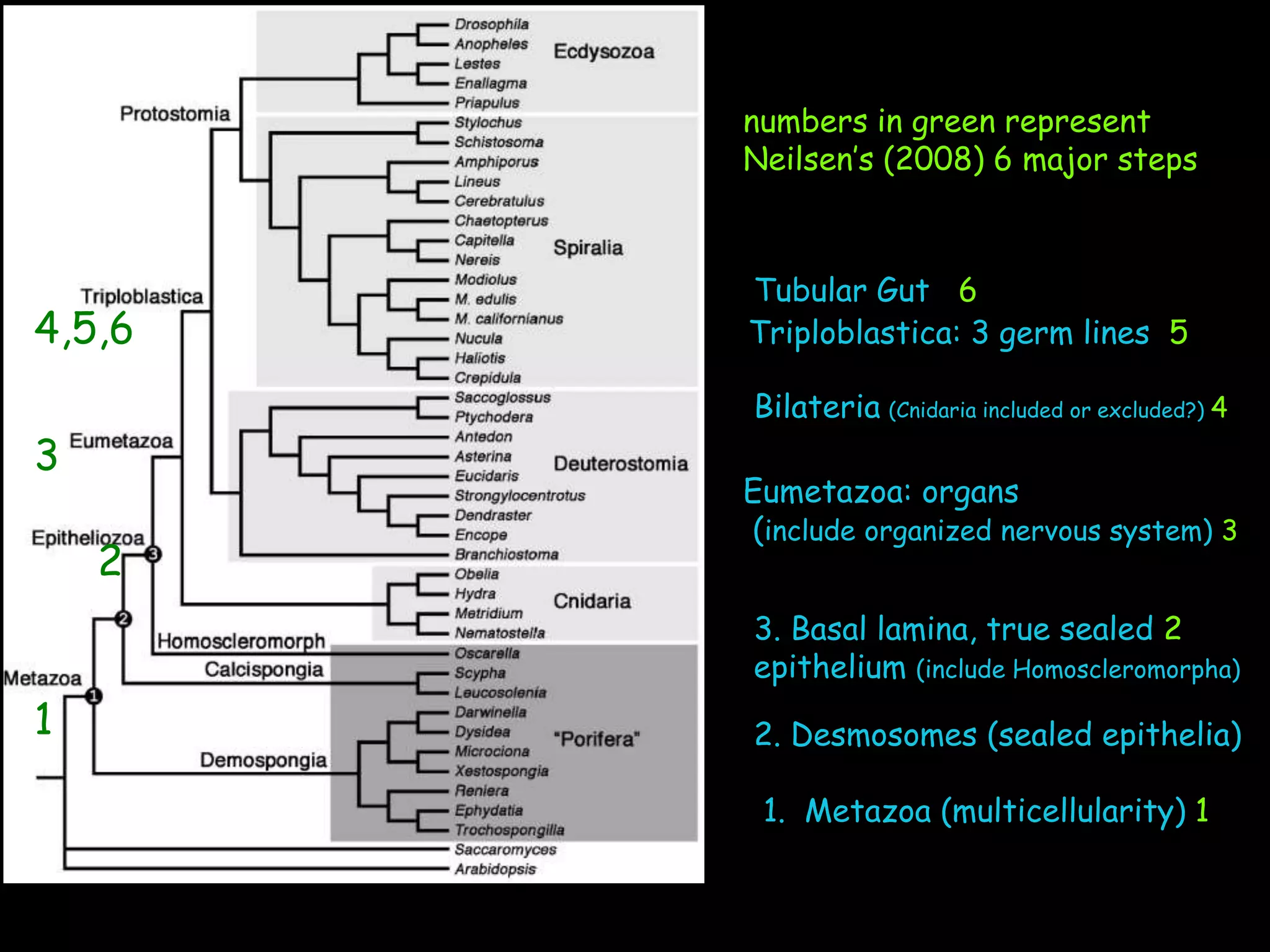
3. Basal lamina, true sealed 2
epithelium (include Homoscleromorpha)
2. Desmosomes (sealed epithelia)
1. Metazoa (multicellularity) 1
Eumetazoa: organs
(include organized nervous system) 3
Triploblastica: 3 germ lines 5
Bilateria (Cnidaria included or excluded?) 4
Tubular Gut 6
numbers in green represent
Neilsen’s (2008) 6 major steps
1
2
3
4,5,6
Rudolph Zallinger’s March of Progress
There is support, from both 18S rDNA and the Hox
gene sequences that most flatworms are derived
coelomates.
What is the (mis)perception depicted in Zallinger’s
“March of Progress” ? How is the evolution of
flatworms relevant to the “March of Progress”?
Major Steps
in Early Animal
Evolution
(Review Nielsen, 2008)
Outline
1. Multicellularity
Self non-self recognition, immunity
2. True Sealed Epithelium
3. An Organized Nervous System
4. Third Germ Line
5. Bilateral Symmetry
6. Tubular (Through) gut
Why were these steps important?
In what groups were these characters first evident?
1. Multicellularity
A. The ancestral metazoa or
Urmetazoa was a highly
specialized pelagic
choanoflagellate
B. nutrients were shared between
cells, and integrity is maintained by
cadherins etc.
C. Differentiation of roles charac-
terizes the more advanced
choanoblastea.
D. Differentiation followed by
transition to bottom dwelling adult
phase (pelago-benthic) and life
cycle with drifting larvae
1. Multicellularity (cntd)
E. Evolution of multicellularity
perhaps accompanied/or closely
followed by individuation, including self
recognition, histoincompatibility
Immune system, and apoptosis
(Mueller 2003)
The Urmetazoa possessed these
characters, which were passed on to
PORIFERA
(but dedicated sensory cells and nerve
cells are not present)
4 WERNER E. G
FIG. 1. Hypothetical steps towards the evolution to the Urmetazoa
with the Porifera as the next closest taxon. Adhesion molecules were
required to allow the transition from a fungal-like ancestor to a co-
lonial system, a stage which made the further development of im-
mune- and apoptotic systems possible that led to the evolution of
the Urmetazoa, as an integrated system.
In the following review I present a summary of the
recent achievements in the understanding of principles
of individuation in sponges, based on protein sequences
functioning in the immune response and apoptosis, two
processes which play central roles in the maintenance
2. Origin of sealed epithelia and extracellular digestion
A. scattered cadherin molecules become organized near apical pole of cells,
where they form occluding and adherens juctions and seal the epithelia
B. Sealed epithelia allow
for extracellular
digestion; digestive
processes can only
function in an enclosed
space; invagination of the
epithelium could lead to
origin of archenteron.
C. Digestive epithelium
becomes endoderm
2. Origin of sealed epithelia and extracellular digestion
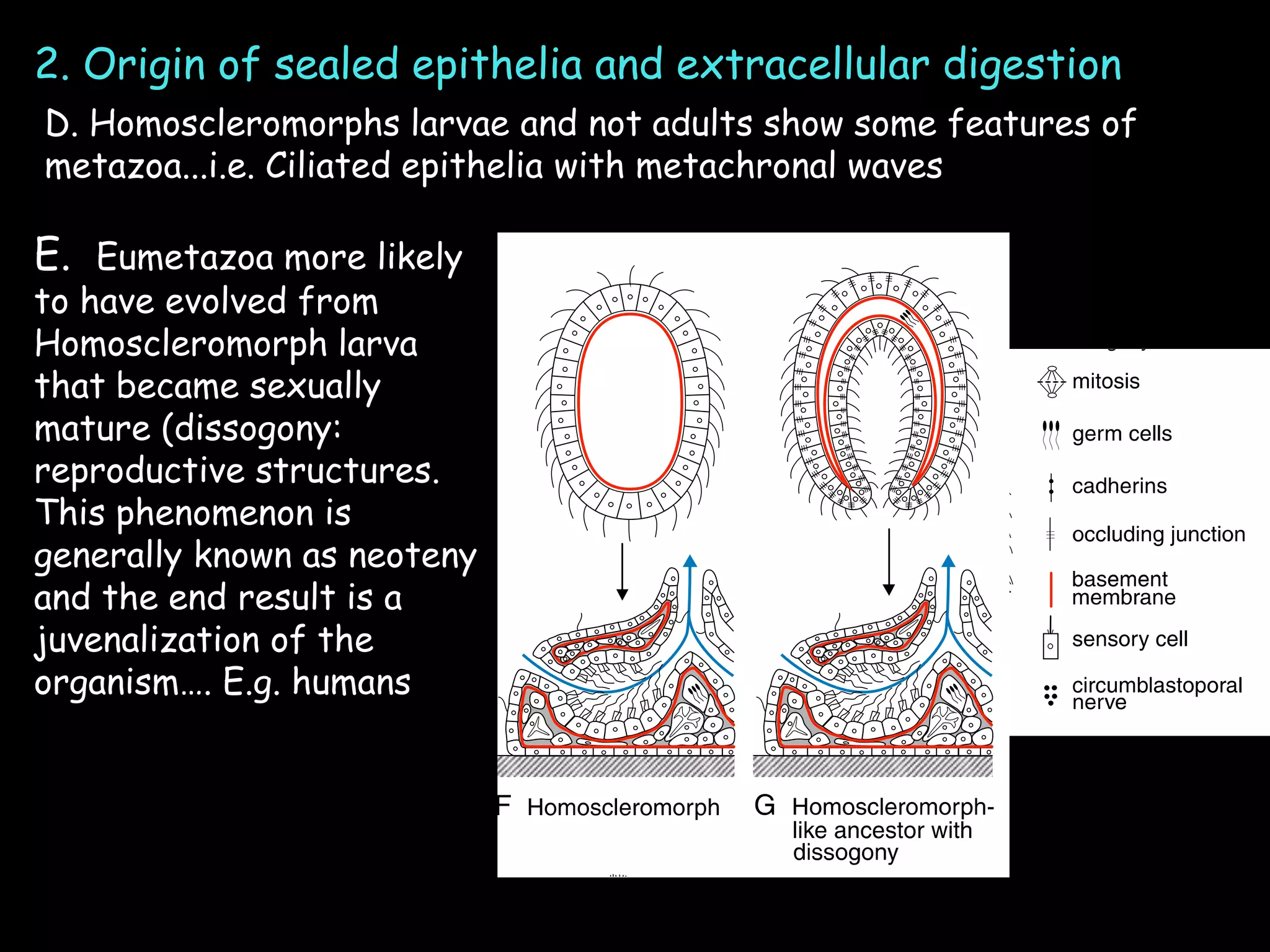
D. Homoscleromorphs larvae and not adults show some features of
metazoa...i.e. Ciliated epithelia with metachronal waves
E. Eumetazoa more likely
to have evolved from
Homoscleromorph larva
that became sexually
mature (dissogony:
reproductive structures.
This phenomenon is
generally known as neoteny
and the end result is a
juvenalization of the
organism…. E.g. humans
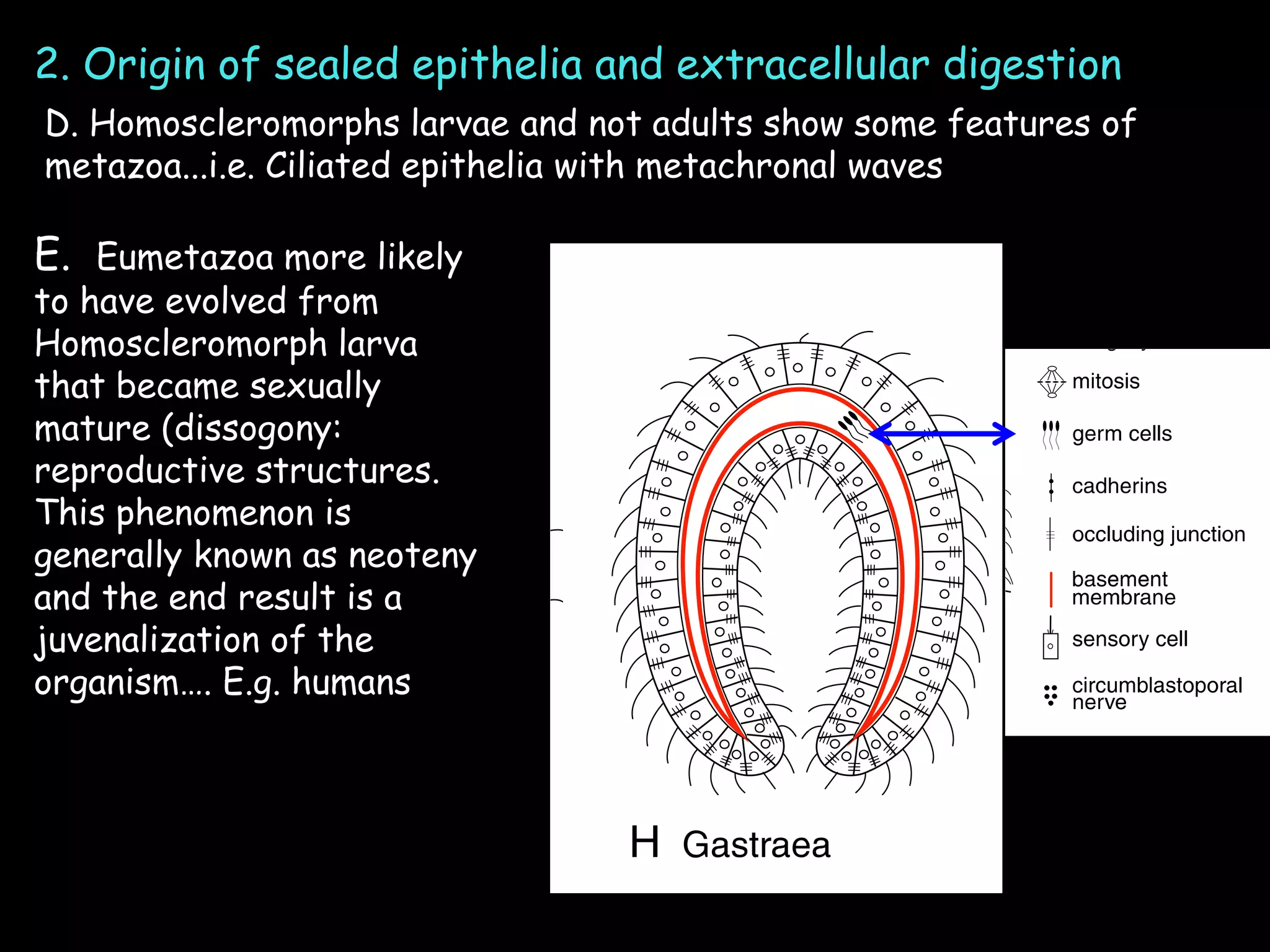
2. Origin of sealed epithelia and extracellular digestion
D. Homoscleromorphs larvae and not adults show some features of
metazoa...i.e. Ciliated epithelia with metachronal waves
E. Eumetazoa more likely
to have evolved from
Homoscleromorph larva
that became sexually
mature (dissogony:
reproductive structures.
This phenomenon is
generally known as neoteny
and the end result is a
juvenalization of the
organism…. E.g. humans
3. Origin of a Nervous System
• Absent in Sponges and Placozoa
• Electrical and Chemical Synapses present in Cnidaria
• Animals with a nervous system except Ctenophora form a
monophyletic unit
• Apical organs found in all Eumetazoa may be first nervous system
Precursors of many of the genes involved in nervous system
function are present in sponges (e.g. post-synaptic scaffold)
• Neurogastrea develops
ciliated band to resemble
trochaea, which is a larva
found in most Eumetazoa.
4. Origin of Mesoderm (Triploblastica)
A. Exact phylogenetic origin uncertain
(Ctenophore mesoderm has independent origin)
B. Mesoderm certainly derived from Endoderm;
cells involved in specification and differentiation
of mesodermal cell types are found in the
the starlet anemone Nematostella
oral
Radial
aboral
dorsal
bilateral
ventral
Body Plan
Radial Bilateral
Asymmetry Symmetry Symmetry
Porifera Cnidaria all other animals
Placozoa Ctenophora (~ 32 phyla)
Echinodermata
•32 Phyla of Bilateria share:
• Triploblasty
• Coeloms
• Through-guts
• Central nervous system
Why the great success?
5. Evolution of Bilateral Symmetry
Symmetry along A-P axis and an anterior brain
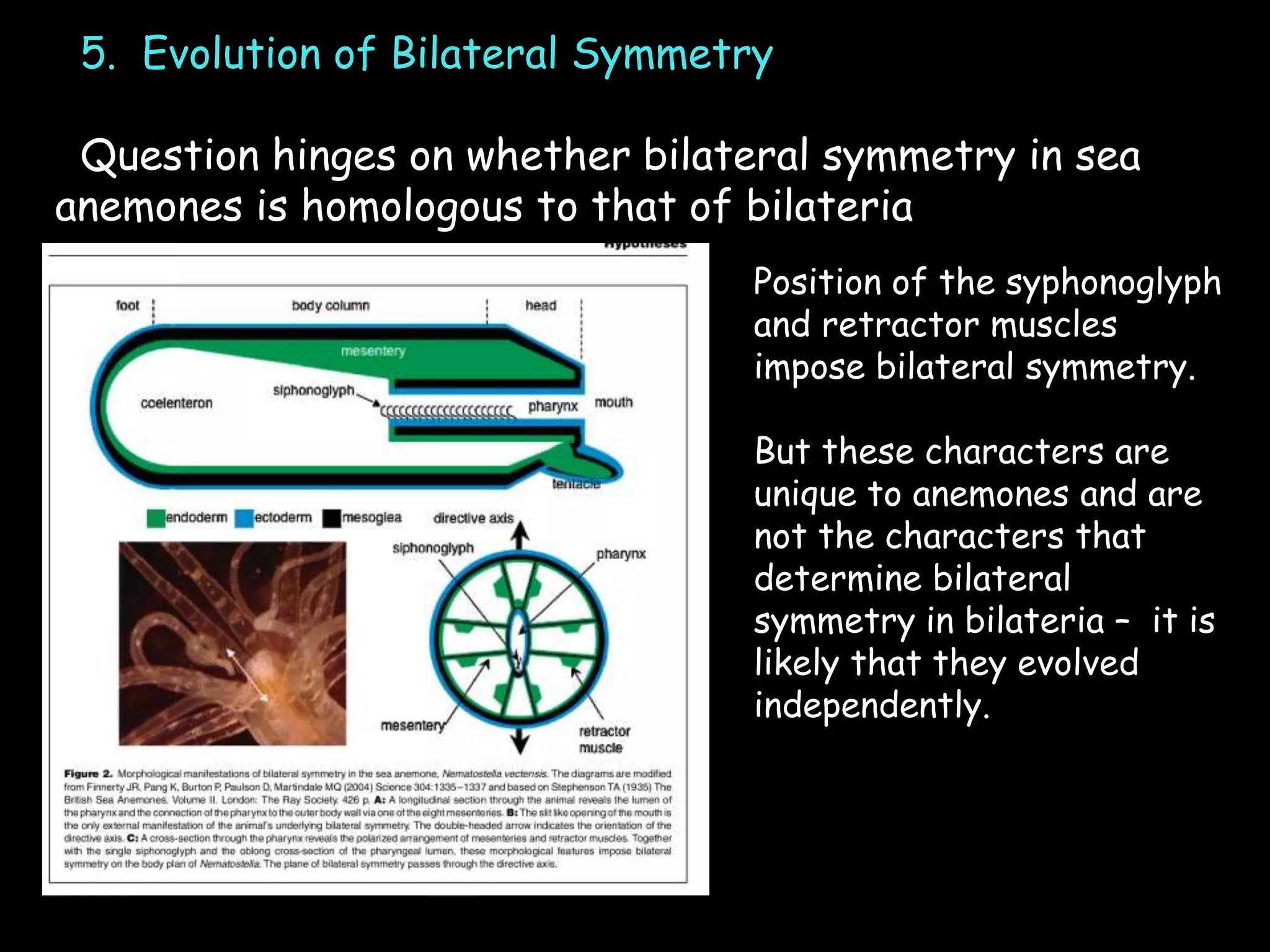
5. Evolution of Bilateral Symmetry
Question hinges on whether bilateral symmetry in sea
anemones is homologous to that of bilateria
Position of the syphonoglyph
and retractor muscles
impose bilateral symmetry.
But these characters are
unique to anemones and are
not the characters that
determine bilateral
symmetry in bilateria – it is
likely that they evolved
independently.
At what point did Bilateral Symmetry Evolve?
Ancestor of Cnidaria Bilateria? (homologous; lost in most
Cnidaria)
Independently in Anthozoa and Bilateria
5. Establishment of a Tubular Gut (Eubilateria)
- More efficient digestion, food absorption
- Enabled evolution of larger organisms with more
complicated behaviors; exact point of origin unknown
- Acoels are most primitive bilateria ; lack a thru gut
while Platyhelminthes lost a thru gut and Ctenophores
evolved thru gut independently
Origin of tubular gut not resolved phylogenetically

Evolution.ppt

  • 1.
    Major Steps in EarlyAnimal Evolution (Review Nielsen, 2008)
  • 2.
    3. Basal lamina,true sealed 2 epithelium (include Homoscleromorpha) 2. Desmosomes (sealed epithelia) 1. Metazoa (multicellularity) 1 Eumetazoa: organs (include organized nervous system) 3 Triploblastica: 3 germ lines 5 Bilateria (Cnidaria included or excluded?) 4 Tubular Gut 6 numbers in green represent Neilsen’s (2008) 6 major steps 1 2 3 4,5,6
  • 3.
    Rudolph Zallinger’s Marchof Progress There is support, from both 18S rDNA and the Hox gene sequences that most flatworms are derived coelomates. What is the (mis)perception depicted in Zallinger’s “March of Progress” ? How is the evolution of flatworms relevant to the “March of Progress”?
  • 4.
    Major Steps in EarlyAnimal Evolution (Review Nielsen, 2008)
  • 5.
    Outline 1. Multicellularity Self non-selfrecognition, immunity 2. True Sealed Epithelium 3. An Organized Nervous System 4. Third Germ Line 5. Bilateral Symmetry 6. Tubular (Through) gut Why were these steps important? In what groups were these characters first evident?
  • 6.
    1. Multicellularity A. Theancestral metazoa or Urmetazoa was a highly specialized pelagic choanoflagellate B. nutrients were shared between cells, and integrity is maintained by cadherins etc. C. Differentiation of roles charac- terizes the more advanced choanoblastea. D. Differentiation followed by transition to bottom dwelling adult phase (pelago-benthic) and life cycle with drifting larvae
  • 7.
    1. Multicellularity (cntd) E.Evolution of multicellularity perhaps accompanied/or closely followed by individuation, including self recognition, histoincompatibility Immune system, and apoptosis (Mueller 2003) The Urmetazoa possessed these characters, which were passed on to PORIFERA (but dedicated sensory cells and nerve cells are not present) 4 WERNER E. G FIG. 1. Hypothetical steps towards the evolution to the Urmetazoa with the Porifera as the next closest taxon. Adhesion molecules were required to allow the transition from a fungal-like ancestor to a co- lonial system, a stage which made the further development of im- mune- and apoptotic systems possible that led to the evolution of the Urmetazoa, as an integrated system. In the following review I present a summary of the recent achievements in the understanding of principles of individuation in sponges, based on protein sequences functioning in the immune response and apoptosis, two processes which play central roles in the maintenance
  • 8.
    2. Origin ofsealed epithelia and extracellular digestion A. scattered cadherin molecules become organized near apical pole of cells, where they form occluding and adherens juctions and seal the epithelia B. Sealed epithelia allow for extracellular digestion; digestive processes can only function in an enclosed space; invagination of the epithelium could lead to origin of archenteron. C. Digestive epithelium becomes endoderm
  • 9.
    2. Origin ofsealed epithelia and extracellular digestion D. Homoscleromorphs larvae and not adults show some features of metazoa...i.e. Ciliated epithelia with metachronal waves E. Eumetazoa more likely to have evolved from Homoscleromorph larva that became sexually mature (dissogony: reproductive structures. This phenomenon is generally known as neoteny and the end result is a juvenalization of the organism…. E.g. humans
  • 10.
    2. Origin ofsealed epithelia and extracellular digestion D. Homoscleromorphs larvae and not adults show some features of metazoa...i.e. Ciliated epithelia with metachronal waves E. Eumetazoa more likely to have evolved from Homoscleromorph larva that became sexually mature (dissogony: reproductive structures. This phenomenon is generally known as neoteny and the end result is a juvenalization of the organism…. E.g. humans
  • 11.
    3. Origin ofa Nervous System • Absent in Sponges and Placozoa • Electrical and Chemical Synapses present in Cnidaria • Animals with a nervous system except Ctenophora form a monophyletic unit • Apical organs found in all Eumetazoa may be first nervous system Precursors of many of the genes involved in nervous system function are present in sponges (e.g. post-synaptic scaffold) • Neurogastrea develops ciliated band to resemble trochaea, which is a larva found in most Eumetazoa.
  • 12.
    4. Origin ofMesoderm (Triploblastica) A. Exact phylogenetic origin uncertain (Ctenophore mesoderm has independent origin) B. Mesoderm certainly derived from Endoderm; cells involved in specification and differentiation of mesodermal cell types are found in the the starlet anemone Nematostella
  • 13.
    oral Radial aboral dorsal bilateral ventral Body Plan Radial Bilateral AsymmetrySymmetry Symmetry Porifera Cnidaria all other animals Placozoa Ctenophora (~ 32 phyla) Echinodermata •32 Phyla of Bilateria share: • Triploblasty • Coeloms • Through-guts • Central nervous system Why the great success? 5. Evolution of Bilateral Symmetry Symmetry along A-P axis and an anterior brain
  • 14.
    5. Evolution ofBilateral Symmetry Question hinges on whether bilateral symmetry in sea anemones is homologous to that of bilateria Position of the syphonoglyph and retractor muscles impose bilateral symmetry. But these characters are unique to anemones and are not the characters that determine bilateral symmetry in bilateria – it is likely that they evolved independently.
  • 15.
    At what pointdid Bilateral Symmetry Evolve? Ancestor of Cnidaria Bilateria? (homologous; lost in most Cnidaria) Independently in Anthozoa and Bilateria
  • 16.
    5. Establishment ofa Tubular Gut (Eubilateria) - More efficient digestion, food absorption - Enabled evolution of larger organisms with more complicated behaviors; exact point of origin unknown - Acoels are most primitive bilateria ; lack a thru gut while Platyhelminthes lost a thru gut and Ctenophores evolved thru gut independently Origin of tubular gut not resolved phylogenetically