EVENT LOGGER Contd..
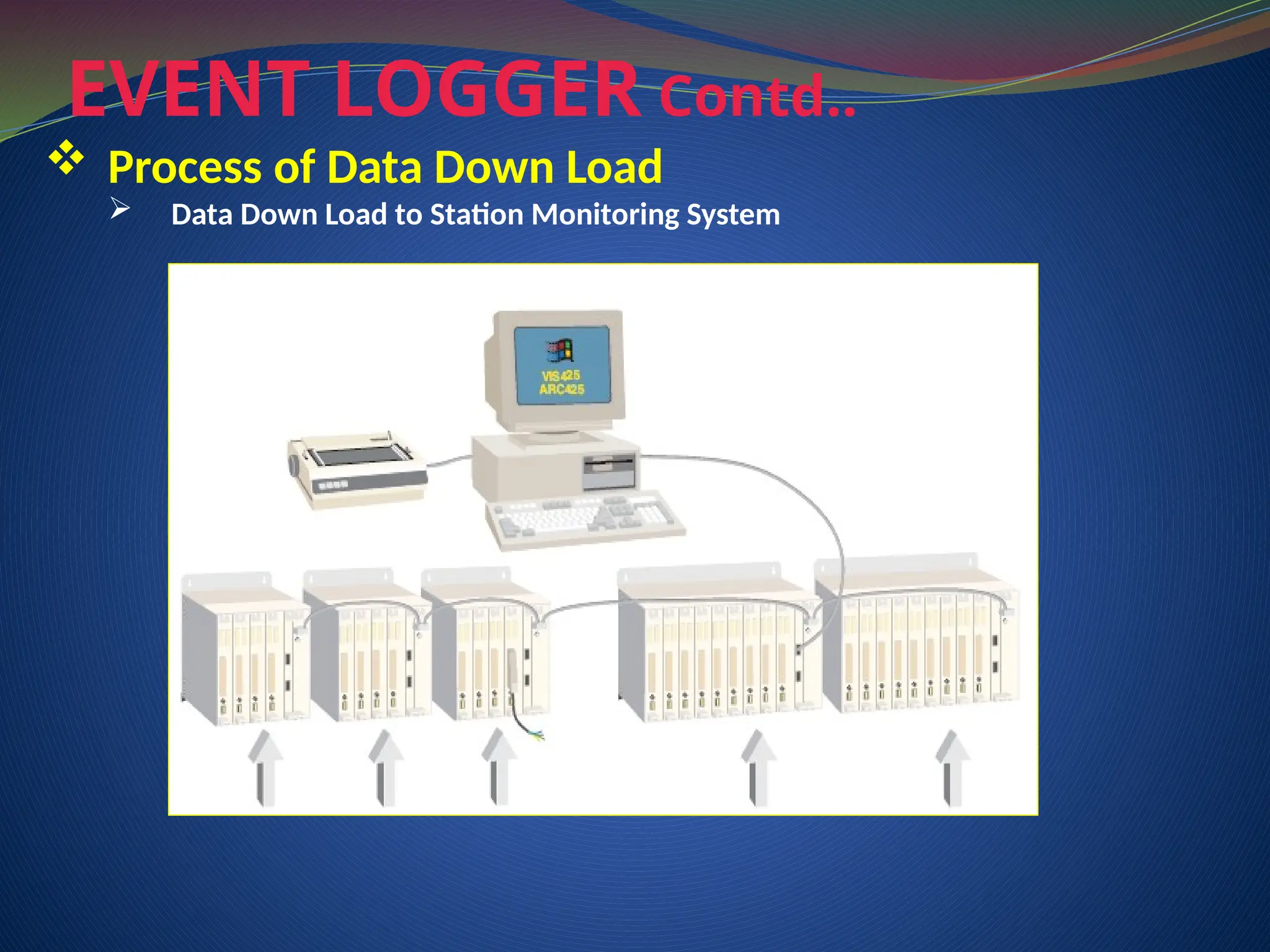
 Process of Data Down Load
 Data Down Load to Station Monitoring System
EVENT LOGGER Contd..
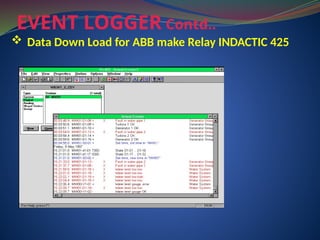
 Data Down Load for ABB make Relay INDACTIC 425
EVENT LOGGER Contd..
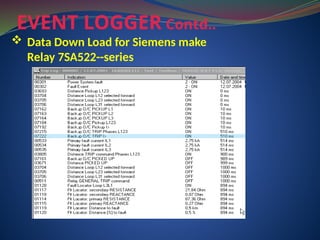
 Data Down Load for Siemens make
Relay 7SA522--series
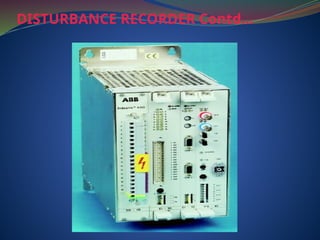
DISTURBANCE RECORDER
 What is Disturbance Recorder?
 Why is it required for Sub-Station?
 Functions of disturbance Recorder
 Records the sequential data events.
 Provides the status of power systems
 Pre and post fault data of parameters
 Information of the disturbances
 Analysis of values in wave form or vectorial
form .
DISTURBANCE RECORDER Contd…
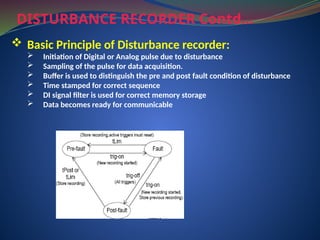
 Basic Principle of Disturbance recorder:
 Initiation of Digital or Analog pulse due to disturbance
 Sampling of the pulse for data acquisition.
 Buffer is used to distinguish the pre and post fault condition of disturbance
 Time stamped for correct sequence
 DI signal filter is used for correct memory storage
 Data becomes ready for communicable
DISTURBANCE RECORDER Contd…
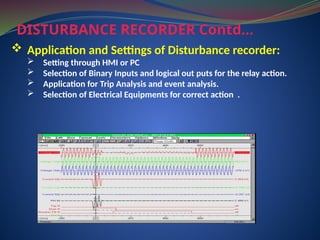
 Application and Settings of Disturbance recorder:
 Setting through HMI or PC
 Selection of Binary Inputs and logical out puts for the relay action.
 Application for Trip Analysis and event analysis.
 Selection of Electrical Equipments for correct action .
FAULT LOCATOR
 What is Fault Locator?
 Why is it required for Sub-Station?
 Functions of fault Locator
 Records the fault data .
 Pre and post fault data of parameters
 Locates and indicates the distance of fault
occurrence.
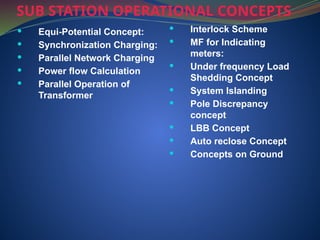
SUB STATION OPERATIONAL CONCEPTS
 Equi-Potential Concept:
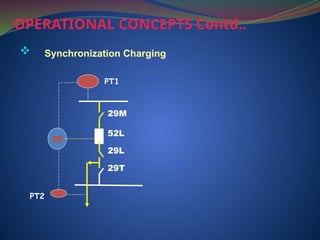
 Synchronization Charging:
 Parallel Network Charging
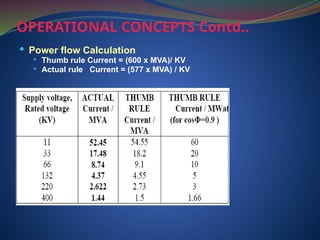
 Power flow Calculation
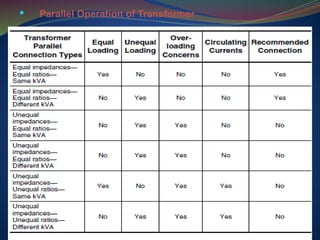
 Parallel Operation of
Transformer
 Interlock Scheme
 MF for Indicating
meters:
 Under frequency Load
Shedding Concept
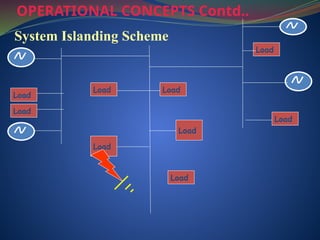
 System Islanding
 Pole Discrepancy
concept
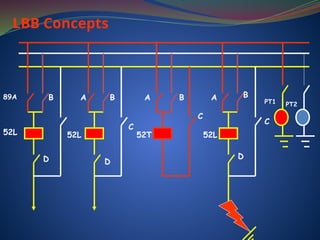
 LBB Concept
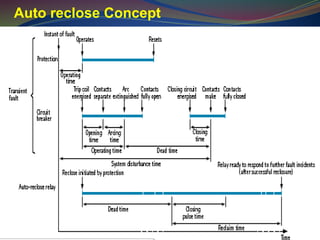
 Auto reclose Concept
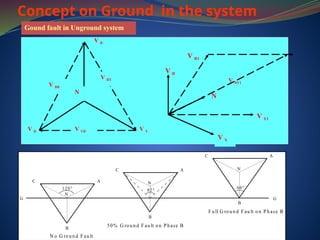
 Concepts on Ground
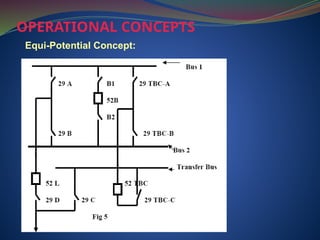
OPERATIONAL CONCEPTS
Equi-Potential Concept:
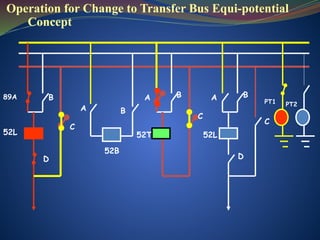
Operation for Change to Transfer Bus Equi-potential
Concept
B
A
A
C
B
52B
89A
52L
C
D
B B
A
52T
52L
C
D
PT1 PT2
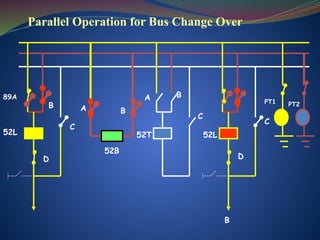
Parallel Operation for Bus Change Over
B
A
A
C
B
52B
89A
52L
C
D
B
B
52T
52L
C
D
PT1 PT2
 Synchronization Charging
OPERATIONAL CONCEPTS Contd..
29M
52L
29L
29T
25
PT1
PT2
 Power flow Calculation
 Thumb rule Current = (600 x MVA)/ KV
 Actual rule Current = (577 x MVA) / KV
OPERATIONAL CONCEPTS Contd..
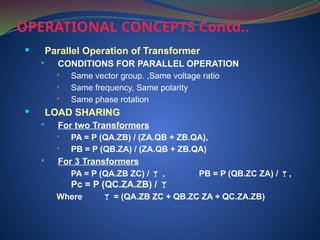
 Parallel Operation of Transformer
 CONDITIONS FOR PARALLEL OPERATION
 Same vector group. ,Same voltage ratio
 Same frequency, Same polarity
 Same phase rotation
 LOAD SHARING
 For two Transformers
 PA = P (QA.ZB) / (ZA.QB + ZB.QA),
 PB = P (QB.ZA) / (ZA.QB + ZB.QA)
 For 3 Transformers
PA = P (QA.ZB ZC) /  , PB = P (QB.ZC ZA) / ,
Pc = P (QC.ZA.ZB) / 
Where  = (QA.ZB ZC + QB.ZC ZA + QC.ZA.ZB)
OPERATIONAL CONCEPTS Contd..
 Parallel Operation of Transformer
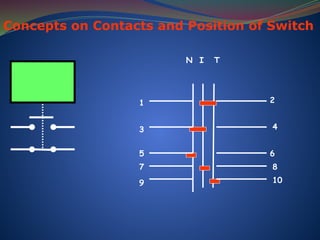
Concepts on Contacts and Position of Switch
N I T
1
5
3
10
8
4
6
2
7
9
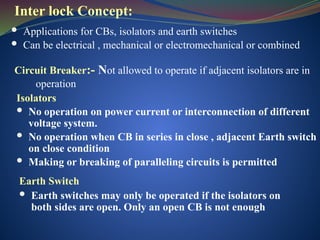
Circuit Breaker:- Not allowed to operate if adjacent isolators are in
operation
 Applications for CBs, isolators and earth switches
 Can be electrical , mechanical or electromechanical or combined
Inter lock Concept:
Isolators
 No operation on power current or interconnection of different
voltage system.
 No operation when CB in series in close , adjacent Earth switch
on close condition
 Making or breaking of paralleling circuits is permitted
Earth Switch
 Earth switches may only be operated if the isolators on
both sides are open. Only an open CB is not enough
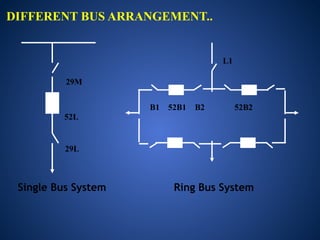
L1
B1 52B1 B2 52B2
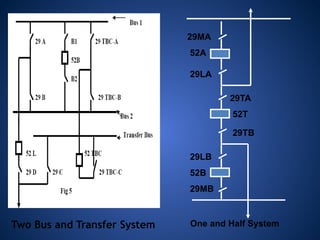
Ring Bus System
DIFFERENT BUS ARRANGEMENT..
29M
52L
29L
Single Bus System
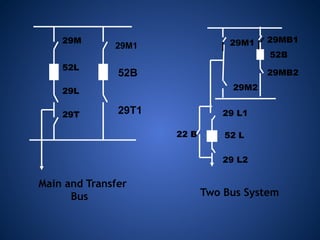
Main and Transfer
Bus
29M
52L
29L
29T
29M1
29T1
52B
29M1
29M2
52B
29 L1
52 L
29 L2
22 B
29MB1
29MB2
Two Bus System
Two Bus and Transfer System
29MA
52A
29LA
29TA
52T
29TB
52B
29LB
29MB
One and Half System
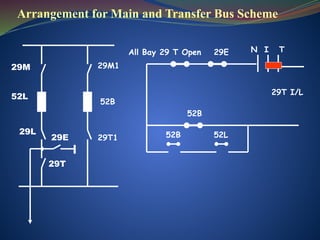
Arrangement for Main and Transfer Bus Scheme
29M
52L
29L
29T
29M1
29T1
52B
29E
52B
29E
29T I/L
All Bay 29 T Open N I T
52B 52L
OPERATIONAL CONCEPTS Contd..
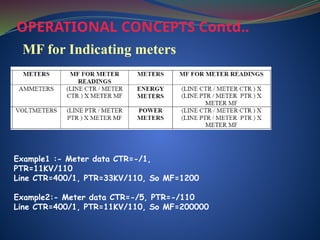
MF for Indicating meters
Example1 :- Meter data CTR=-/1,
PTR=11KV/110
Line CTR=400/1, PTR=33KV/110, So MF=1200
Example2:- Meter data CTR=-/5, PTR=-/110
Line CTR=400/1, PTR=11KV/110, So MF=200000
OPERATIONAL CONCEPTS Contd..
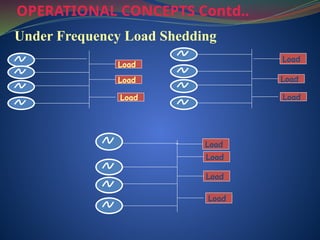
Under Frequency Load Shedding
Load
Load
Load
Load
Load
Load
Load
Load
Load
Load
OPERATIONAL CONCEPTS Contd..
System Islanding Scheme
Load
Load
Load
Load
Load
Load
Load
Load
Load
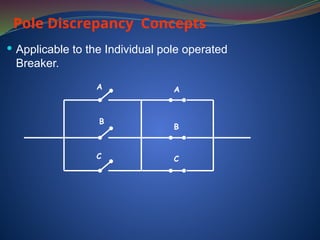
Pole Discrepancy Concepts
 Applicable to the Individual pole operated
Breaker.
A A
C
C
B
B
B
A
A
C
B
52L
89A
52L
C
D
B B
A
52T
52L
C
D
PT1 PT2
LBB Concepts
D
Auto reclose Concept
.
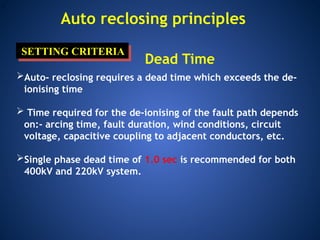
Auto reclosing principles
SETTING CRITERIA
Dead Time
Auto- reclosing requires a dead time which exceeds the de-
ionising time
 Time required for the de-ionising of the fault path depends
on:- arcing time, fault duration, wind conditions, circuit
voltage, capacitive coupling to adjacent conductors, etc.
Single phase dead time of 1.0 sec is recommended for both
400kV and 220kV system.
Minimum Dead Time (IEEE)
System
Voltage
Minimum deionization time
[ms]
kV Based on Field
and
Laboratory
Tests
Based on
Operating
Experience
23 110 180
46 120 200
69 130 210
115 150 230
132 160 240
230 210 280
345 260 340
400 280 370
500 330 420
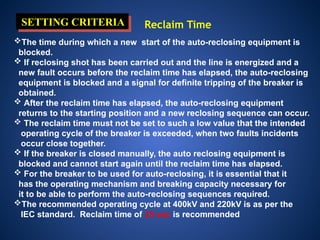
SETTING CRITERIA Reclaim Time
The time during which a new start of the auto-reclosing equipment is
blocked.
 If reclosing shot has been carried out and the line is energized and a
new fault occurs before the reclaim time has elapsed, the auto-reclosing
equipment is blocked and a signal for definite tripping of the breaker is
obtained.
 After the reclaim time has elapsed, the auto-reclosing equipment
returns to the starting position and a new reclosing sequence can occur.
 The reclaim time must not be set to such a low value that the intended
operating cycle of the breaker is exceeded, when two faults incidents
occur close together.
 If the breaker is closed manually, the auto reclosing equipment is
blocked and cannot start again until the reclaim time has elapsed.
 For the breaker to be used for auto-reclosing, it is essential that it
has the operating mechanism and breaking capacity necessary for
it to be able to perform the auto-reclosing sequences required.
The recommended operating cycle at 400kV and 220kV is as per the
IEC standard. Reclaim time of 25 sec is recommended
Concept on Ground in the system
N
60°
B
C A
N
120°
B
C A
G
N o G ro u n d Fau lt
F u ll G ro u n d F au lt o n P h ase B
N
B
C A
50% G ro u n d F au lt o n P hase B
G
82°
Gound fault in Unground system
V R
N
V Y
V B
V RY
V YB
V BR
N
V Y1
V RY1
V R1
V R
V Y
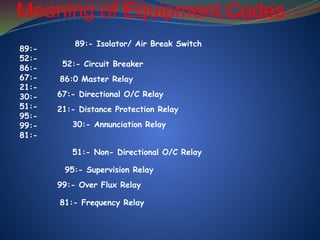
Meaning of Equipment Codes
89:-
52:-
86:-
67:-
21:-
30:-
51:-
95:-
99:-
81:-
89:- Isolator/ Air Break Switch
52:- Circuit Breaker
67:- Directional O/C Relay
21:- Distance Protection Relay
30:- Annunciation Relay
51:- Non- Directional O/C Relay
95:- Supervision Relay
99:- Over Flux Relay
81:- Frequency Relay
86:0 Master Relay
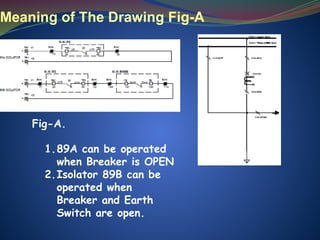
Meaning of The Drawing Fig-A
1.89A can be operated
when Breaker is OPEN
2.Isolator 89B can be
operated when
Breaker and Earth
Switch are open.
Fig-A.
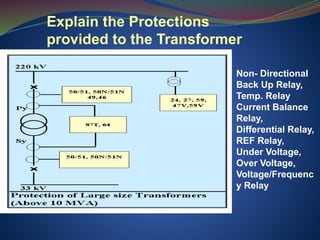
Explain the Protections
provided to the Transformer
Non- Directional
Back Up Relay,
Temp. Relay
Current Balance
Relay,
Differential Relay,
REF Relay,
Under Voltage,
Over Voltage,
Voltage/Frequenc
y Relay
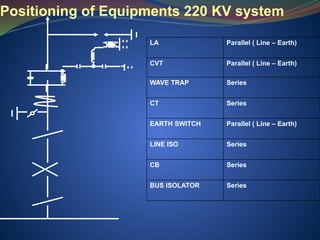
Positioning of Equipments 220 KV system
LA Parallel ( Line – Earth)
CVT Parallel ( Line – Earth)
WAVE TRAP Series
CT Series
EARTH SWITCH Parallel ( Line – Earth)
LINE ISO Series
CB Series
BUS ISOLATOR Series
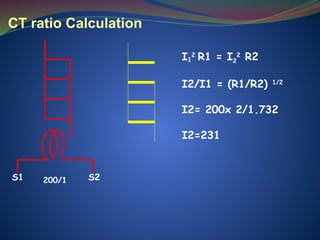
CT ratio Calculation
S2
S1
I1
2
R1 = I2
2
R2
I2/I1 = (R1/R2) 1/2
I2= 200x 2/1.732
I2=231
200/1
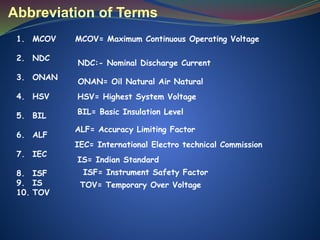
Abbreviation of Terms
1. MCOV
2. NDC
3. ONAN
4. HSV
5. BIL
6. ALF
7. IEC
8. ISF
9. IS
10. TOV
MCOV= Maximum Continuous Operating Voltage
NDC:- Nominal Discharge Current
ONAN= Oil Natural Air Natural
HSV= Highest System Voltage
BIL= Basic Insulation Level
ALF= Accuracy Limiting Factor
IEC= International Electro technical Commission
IS= Indian Standard
TOV= Temporary Over Voltage
ISF= Instrument Safety Factor
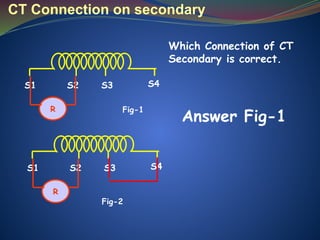
CT Connection on secondary
Which Connection of CT
Secondary is correct.
S2
S1 S3 S4
R
S2
S1 S3 S4
R
Fig-1
Fig-2
Answer Fig-1
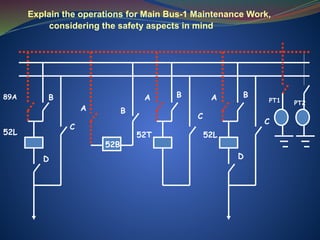
Explain the operations for Main Bus-1 Maintenance Work,
considering the safety aspects in mind
B
A
A
C
B
52B
89A
52L
C
D
B B
A
52T
52L
C
D
PT1 PT2
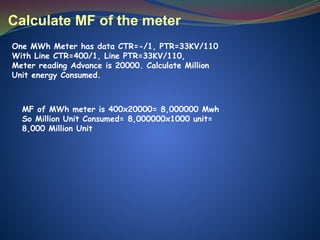
Calculate MF of the meter
One MWh Meter has data CTR=-/1, PTR=33KV/110
With Line CTR=400/1, Line PTR=33KV/110,
Meter reading Advance is 20000. Calculate Million
Unit energy Consumed.
MF of MWh meter is 400x20000= 8,000000 Mwh
So Million Unit Consumed= 8,000000x1000 unit=
8,000 Million Unit
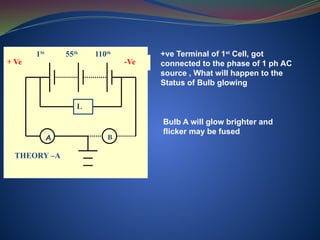
L
A B
-Ve
+ Ve
1St
55th
110th
THEORY –A
+ve Terminal of 1st
Cell, got
connected to the phase of 1 ph AC
source , What will happen to the
Status of Bulb glowing
Bulb A will glow brighter and
flicker may be fused
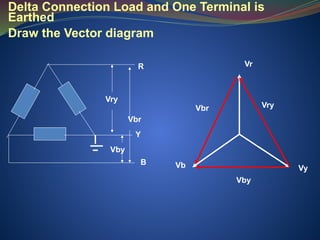
Delta Connection Load and One Terminal is
Earthed
Draw the Vector diagram
B
Y
R
Vbr
Vry
Vby
Vr
Vb Vy
Vby
Vbr Vry
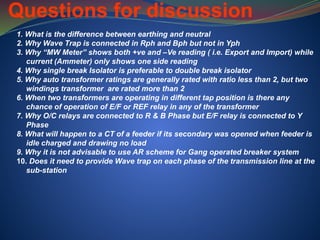
Questions for discussion
1. What is the difference between earthing and neutral
2. Why Wave Trap is connected in Rph and Bph but not in Yph
3. Why “MW Meter” shows both +ve and –Ve reading ( i.e. Export and Import) while
current (Ammeter) only shows one side reading
4. Why single break Isolator is preferable to double break isolator
5. Why auto transformer ratings are generally rated with ratio less than 2, but two
windings transformer are rated more than 2
6. When two transformers are operating in different tap position is there any
chance of operation of E/F or REF relay in any of the transformer
7. Why O/C relays are connected to R & B Phase but E/F relay is connected to Y
Phase
8. What will happen to a CT of a feeder if its secondary was opened when feeder is
idle charged and drawing no load
9. Why it is not advisable to use AR scheme for Gang operated breaker system
10. Does it need to provide Wave trap on each phase of the transmission line at the
sub-station
Questions for discussion
11. Why the use of combined instrument transformer is not gaining
popularity in India.
12. Why the spring-spring mechanism is gaining popularity in Breaker
Technology
13. Which circuit is important for supervision of breaker trip coil status?
(Pre-close supervision, post-close supervision)
14 Why DC Voltage is preferable for the protection and control circuit in
System Network
15. What are the reasons for variation of voltage due to increase of
load in the system
16. Most of the Power transformers are of Y connected, why not ∆
connected
17. We know that Voltage is directly proportional to frequency, but
sometimes voltage decreases but not the frequencies why?
18. In case of 3ph, 4wire system, and the neutral is disconnected. Why
the meter showing the value above 350volts in 2 phases?
19. Why REF protection is not considered as 100% protection to the
equipment winding
20. Why PT of different rating is used [110V /√3 and 110V]
 21. Why PS class core is best suitable for the application to Differential Relay
 22. Can performance of REF relay be reduced if its residual current circuit is
obtained in series with E/F relay in the scheme
 23. Which protection is better, either REF protection or Differential protection for
Transformer
 24. Why REF relay is grouped under high impedance relay?
 25. What is the significance of INTER position for a NIT switch on a feeder bay
control panel.
 26. Why Guard terminal is used during the measurement of IR value of electrical
equipment.
 27. Explain the concept for which the IR value at 30 sec becomes more than the
IR value at 15 sec, for good insulator system.
 28.Can the Magnetic Balance Test be considered as a signature test for
transformer fault diagnosis?
 29.
Questions for discussion
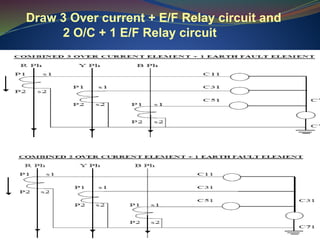
Draw 3 Over current + E/F Relay circuit and
2 O/C + 1 E/F Relay circuit
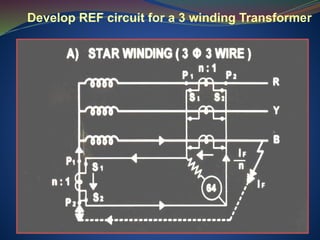
Develop REF circuit for a 3 winding Transformer
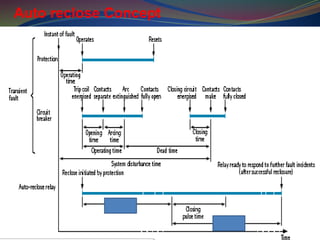
Auto reclose Concept
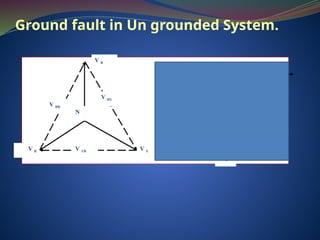
Ground fault in Un grounded System.
V R
N
V Y
V B
V RY
V YB
V BR
N
V Y1
V RY1
V R1
V R
V Y

event looger & Distrubance Recorders.ppt

  • 1.
    EVENT LOGGER Contd.. Process of Data Down Load  Data Down Load to Station Monitoring System
  • 2.
    EVENT LOGGER Contd.. Data Down Load for ABB make Relay INDACTIC 425
  • 3.
    EVENT LOGGER Contd.. Data Down Load for Siemens make Relay 7SA522--series
  • 4.
    DISTURBANCE RECORDER  Whatis Disturbance Recorder?  Why is it required for Sub-Station?  Functions of disturbance Recorder  Records the sequential data events.  Provides the status of power systems  Pre and post fault data of parameters  Information of the disturbances  Analysis of values in wave form or vectorial form .
  • 5.
    DISTURBANCE RECORDER Contd… Basic Principle of Disturbance recorder:  Initiation of Digital or Analog pulse due to disturbance  Sampling of the pulse for data acquisition.  Buffer is used to distinguish the pre and post fault condition of disturbance  Time stamped for correct sequence  DI signal filter is used for correct memory storage  Data becomes ready for communicable
  • 6.
  • 7.
    DISTURBANCE RECORDER Contd… Application and Settings of Disturbance recorder:  Setting through HMI or PC  Selection of Binary Inputs and logical out puts for the relay action.  Application for Trip Analysis and event analysis.  Selection of Electrical Equipments for correct action .
  • 8.
    FAULT LOCATOR  Whatis Fault Locator?  Why is it required for Sub-Station?  Functions of fault Locator  Records the fault data .  Pre and post fault data of parameters  Locates and indicates the distance of fault occurrence.
  • 9.
    SUB STATION OPERATIONALCONCEPTS  Equi-Potential Concept:  Synchronization Charging:  Parallel Network Charging  Power flow Calculation  Parallel Operation of Transformer  Interlock Scheme  MF for Indicating meters:  Under frequency Load Shedding Concept  System Islanding  Pole Discrepancy concept  LBB Concept  Auto reclose Concept  Concepts on Ground
  • 10.
  • 11.
    Operation for Changeto Transfer Bus Equi-potential Concept B A A C B 52B 89A 52L C D B B A 52T 52L C D PT1 PT2
  • 12.
    Parallel Operation forBus Change Over B A A C B 52B 89A 52L C D B B 52T 52L C D PT1 PT2
  • 13.
     Synchronization Charging OPERATIONALCONCEPTS Contd.. 29M 52L 29L 29T 25 PT1 PT2
  • 14.
     Power flowCalculation  Thumb rule Current = (600 x MVA)/ KV  Actual rule Current = (577 x MVA) / KV OPERATIONAL CONCEPTS Contd..
  • 15.
     Parallel Operationof Transformer  CONDITIONS FOR PARALLEL OPERATION  Same vector group. ,Same voltage ratio  Same frequency, Same polarity  Same phase rotation  LOAD SHARING  For two Transformers  PA = P (QA.ZB) / (ZA.QB + ZB.QA),  PB = P (QB.ZA) / (ZA.QB + ZB.QA)  For 3 Transformers PA = P (QA.ZB ZC) /  , PB = P (QB.ZC ZA) / , Pc = P (QC.ZA.ZB) /  Where  = (QA.ZB ZC + QB.ZC ZA + QC.ZA.ZB) OPERATIONAL CONCEPTS Contd..
  • 16.
     Parallel Operationof Transformer
  • 17.
    Concepts on Contactsand Position of Switch N I T 1 5 3 10 8 4 6 2 7 9
  • 18.
    Circuit Breaker:- Notallowed to operate if adjacent isolators are in operation  Applications for CBs, isolators and earth switches  Can be electrical , mechanical or electromechanical or combined Inter lock Concept: Isolators  No operation on power current or interconnection of different voltage system.  No operation when CB in series in close , adjacent Earth switch on close condition  Making or breaking of paralleling circuits is permitted Earth Switch  Earth switches may only be operated if the isolators on both sides are open. Only an open CB is not enough
  • 19.
    L1 B1 52B1 B252B2 Ring Bus System DIFFERENT BUS ARRANGEMENT.. 29M 52L 29L Single Bus System
  • 20.
    Main and Transfer Bus 29M 52L 29L 29T 29M1 29T1 52B 29M1 29M2 52B 29L1 52 L 29 L2 22 B 29MB1 29MB2 Two Bus System
  • 21.
    Two Bus andTransfer System 29MA 52A 29LA 29TA 52T 29TB 52B 29LB 29MB One and Half System
  • 22.
    Arrangement for Mainand Transfer Bus Scheme 29M 52L 29L 29T 29M1 29T1 52B 29E 52B 29E 29T I/L All Bay 29 T Open N I T 52B 52L
  • 23.
    OPERATIONAL CONCEPTS Contd.. MFfor Indicating meters Example1 :- Meter data CTR=-/1, PTR=11KV/110 Line CTR=400/1, PTR=33KV/110, So MF=1200 Example2:- Meter data CTR=-/5, PTR=-/110 Line CTR=400/1, PTR=11KV/110, So MF=200000
  • 24.
    OPERATIONAL CONCEPTS Contd.. UnderFrequency Load Shedding Load Load Load Load Load Load Load Load Load Load
  • 25.
    OPERATIONAL CONCEPTS Contd.. SystemIslanding Scheme Load Load Load Load Load Load Load Load Load
  • 27.
    Pole Discrepancy Concepts Applicable to the Individual pole operated Breaker. A A C C B B
  • 28.
  • 29.
  • 30.
    . Auto reclosing principles SETTINGCRITERIA Dead Time Auto- reclosing requires a dead time which exceeds the de- ionising time  Time required for the de-ionising of the fault path depends on:- arcing time, fault duration, wind conditions, circuit voltage, capacitive coupling to adjacent conductors, etc. Single phase dead time of 1.0 sec is recommended for both 400kV and 220kV system.
  • 31.
    Minimum Dead Time(IEEE) System Voltage Minimum deionization time [ms] kV Based on Field and Laboratory Tests Based on Operating Experience 23 110 180 46 120 200 69 130 210 115 150 230 132 160 240 230 210 280 345 260 340 400 280 370 500 330 420
  • 32.
    SETTING CRITERIA ReclaimTime The time during which a new start of the auto-reclosing equipment is blocked.  If reclosing shot has been carried out and the line is energized and a new fault occurs before the reclaim time has elapsed, the auto-reclosing equipment is blocked and a signal for definite tripping of the breaker is obtained.  After the reclaim time has elapsed, the auto-reclosing equipment returns to the starting position and a new reclosing sequence can occur.  The reclaim time must not be set to such a low value that the intended operating cycle of the breaker is exceeded, when two faults incidents occur close together.  If the breaker is closed manually, the auto reclosing equipment is blocked and cannot start again until the reclaim time has elapsed.  For the breaker to be used for auto-reclosing, it is essential that it has the operating mechanism and breaking capacity necessary for it to be able to perform the auto-reclosing sequences required. The recommended operating cycle at 400kV and 220kV is as per the IEC standard. Reclaim time of 25 sec is recommended
  • 33.
    Concept on Groundin the system N 60° B C A N 120° B C A G N o G ro u n d Fau lt F u ll G ro u n d F au lt o n P h ase B N B C A 50% G ro u n d F au lt o n P hase B G 82° Gound fault in Unground system V R N V Y V B V RY V YB V BR N V Y1 V RY1 V R1 V R V Y
  • 34.
    Meaning of EquipmentCodes 89:- 52:- 86:- 67:- 21:- 30:- 51:- 95:- 99:- 81:- 89:- Isolator/ Air Break Switch 52:- Circuit Breaker 67:- Directional O/C Relay 21:- Distance Protection Relay 30:- Annunciation Relay 51:- Non- Directional O/C Relay 95:- Supervision Relay 99:- Over Flux Relay 81:- Frequency Relay 86:0 Master Relay
  • 35.
    Meaning of TheDrawing Fig-A 1.89A can be operated when Breaker is OPEN 2.Isolator 89B can be operated when Breaker and Earth Switch are open. Fig-A.
  • 36.
    Explain the Protections providedto the Transformer Non- Directional Back Up Relay, Temp. Relay Current Balance Relay, Differential Relay, REF Relay, Under Voltage, Over Voltage, Voltage/Frequenc y Relay
  • 37.
    Positioning of Equipments220 KV system LA Parallel ( Line – Earth) CVT Parallel ( Line – Earth) WAVE TRAP Series CT Series EARTH SWITCH Parallel ( Line – Earth) LINE ISO Series CB Series BUS ISOLATOR Series
  • 38.
    CT ratio Calculation S2 S1 I1 2 R1= I2 2 R2 I2/I1 = (R1/R2) 1/2 I2= 200x 2/1.732 I2=231 200/1
  • 39.
    Abbreviation of Terms 1.MCOV 2. NDC 3. ONAN 4. HSV 5. BIL 6. ALF 7. IEC 8. ISF 9. IS 10. TOV MCOV= Maximum Continuous Operating Voltage NDC:- Nominal Discharge Current ONAN= Oil Natural Air Natural HSV= Highest System Voltage BIL= Basic Insulation Level ALF= Accuracy Limiting Factor IEC= International Electro technical Commission IS= Indian Standard TOV= Temporary Over Voltage ISF= Instrument Safety Factor
  • 40.
    CT Connection onsecondary Which Connection of CT Secondary is correct. S2 S1 S3 S4 R S2 S1 S3 S4 R Fig-1 Fig-2 Answer Fig-1
  • 41.
    Explain the operationsfor Main Bus-1 Maintenance Work, considering the safety aspects in mind B A A C B 52B 89A 52L C D B B A 52T 52L C D PT1 PT2
  • 42.
    Calculate MF ofthe meter One MWh Meter has data CTR=-/1, PTR=33KV/110 With Line CTR=400/1, Line PTR=33KV/110, Meter reading Advance is 20000. Calculate Million Unit energy Consumed. MF of MWh meter is 400x20000= 8,000000 Mwh So Million Unit Consumed= 8,000000x1000 unit= 8,000 Million Unit
  • 43.
    L A B -Ve + Ve 1St 55th 110th THEORY–A +ve Terminal of 1st Cell, got connected to the phase of 1 ph AC source , What will happen to the Status of Bulb glowing Bulb A will glow brighter and flicker may be fused
  • 44.
    Delta Connection Loadand One Terminal is Earthed Draw the Vector diagram B Y R Vbr Vry Vby Vr Vb Vy Vby Vbr Vry
  • 45.
    Questions for discussion 1.What is the difference between earthing and neutral 2. Why Wave Trap is connected in Rph and Bph but not in Yph 3. Why “MW Meter” shows both +ve and –Ve reading ( i.e. Export and Import) while current (Ammeter) only shows one side reading 4. Why single break Isolator is preferable to double break isolator 5. Why auto transformer ratings are generally rated with ratio less than 2, but two windings transformer are rated more than 2 6. When two transformers are operating in different tap position is there any chance of operation of E/F or REF relay in any of the transformer 7. Why O/C relays are connected to R & B Phase but E/F relay is connected to Y Phase 8. What will happen to a CT of a feeder if its secondary was opened when feeder is idle charged and drawing no load 9. Why it is not advisable to use AR scheme for Gang operated breaker system 10. Does it need to provide Wave trap on each phase of the transmission line at the sub-station
  • 46.
    Questions for discussion 11.Why the use of combined instrument transformer is not gaining popularity in India. 12. Why the spring-spring mechanism is gaining popularity in Breaker Technology 13. Which circuit is important for supervision of breaker trip coil status? (Pre-close supervision, post-close supervision) 14 Why DC Voltage is preferable for the protection and control circuit in System Network 15. What are the reasons for variation of voltage due to increase of load in the system 16. Most of the Power transformers are of Y connected, why not ∆ connected 17. We know that Voltage is directly proportional to frequency, but sometimes voltage decreases but not the frequencies why? 18. In case of 3ph, 4wire system, and the neutral is disconnected. Why the meter showing the value above 350volts in 2 phases? 19. Why REF protection is not considered as 100% protection to the equipment winding 20. Why PT of different rating is used [110V /√3 and 110V]
  • 47.
     21. WhyPS class core is best suitable for the application to Differential Relay  22. Can performance of REF relay be reduced if its residual current circuit is obtained in series with E/F relay in the scheme  23. Which protection is better, either REF protection or Differential protection for Transformer  24. Why REF relay is grouped under high impedance relay?  25. What is the significance of INTER position for a NIT switch on a feeder bay control panel.  26. Why Guard terminal is used during the measurement of IR value of electrical equipment.  27. Explain the concept for which the IR value at 30 sec becomes more than the IR value at 15 sec, for good insulator system.  28.Can the Magnetic Balance Test be considered as a signature test for transformer fault diagnosis?  29. Questions for discussion
  • 48.
    Draw 3 Overcurrent + E/F Relay circuit and 2 O/C + 1 E/F Relay circuit
  • 49.
    Develop REF circuitfor a 3 winding Transformer
  • 50.
  • 51.
    Ground fault inUn grounded System. V R N V Y V B V RY V YB V BR N V Y1 V RY1 V R1 V R V Y