In what ways does your media
product use, develop or challenge
forms and conventions of real
media products?
Goodwin’s Theory
• According to Andrew Goodwin, there are 5
aspects of a music video that you should look
at when analysing;
• voyeurism,
• intertextuality,
• genre characteristics,
• star image,
• relationship between music/lyrics and visuals.
Voyeurism
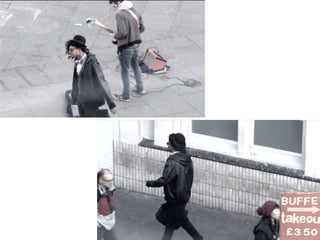
• Voyeurism is when the audience is able to see the
character in a private or intimate position with them
acting as if they are not being watched. In my main
music video, there were not any intentional forms of
voyeurism, however the beginning showed the
protagonist stumbling through Camden while maybe
inebriated. The shot was taken from a high angle
looking downwards, which helps with the spying
effect that it would have on the audience, as the
protagonist would not usually notice someone from
an angle.
Intertextuality
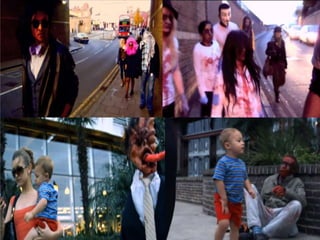
• There were many forms of intertextuality used when
making this music video. The first one intentionally
placed was the hallucinated characters suddenly
appearing and following the main character. This
sequence was inspired by the scenes that are seen in
the video for ‘Kids’ by MGMT, when the baby is
fearful of the monsters that he sees in his dreams,
but is the only one who can see them when his
mother takes him out through the streets. I wanted
to capture the helplessness of the character and to
leave them feeling isolated with their nightmares.
Intertextuality
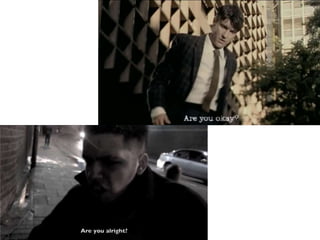
• In Radiohead’s music video ‘Just’, one guy is
laying on a concrete floor being persistently
questioned by people walking past as to why
he is laying down. The video includes subtitles
and has no audio. We decided to incorporate
this into the end of the video, when an extra
goes up to the troubled protagonist and offers
him assistance when he is caught crawled up
traumatically on the sidewalk.
Genre Characteristics
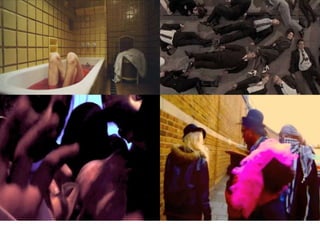
• When asked to research music videos in the same
genre as the one I pitched for (Bodysnatchers), I
looked out for the most frequently used conventions
within psychedelic rock and pop visuals. The use of
unusual imagery was quite frequent, such as in ‘Just’
by Radiohead when the whole sidewalk is filled with
laying office workers, and in ‘Call It What You Want’
by Foster the People, where people are missing limbs
and are in unusual positions. I incorporated this by
circling the extras around the protagonist, and had
them crawling at him while he’s on the floor.
Star Image
• The main character is a member of the band in
this course, named ‘The Tox’. His image was
carefully constructed with many influences and
relations from funk artist Jimi Hendrix mainly.
Known for his psychedelic rock and soul
contribution, his image became iconic amongst
recreational drug users at the time, and they
started to adopt his style of rough, ripped colour
suits, ragged shirts and many buckles all over his
outfit. His hair is also backcombed yet well-kept,
which I wanted to definitely include with the
protagonist of the video.
Relationship between music and
visuals
• The lyrics and visuals had a very vague link, due
to the fact that the lyrics are very obscure and
cannot be defined as a narrative, with the band
constantly repeating in the song ‘I’ve no idea
what I am talking about’. The video was intended
to be produced in a similar, obscure way, but in
order to make the music video as vague and
distorted as possible, I think there needs to be a
complete off-set between the lyrics and the
visual. The structure of the lyrics are also off-
track, which links well with the lyrics themselves
and the video accompanied.
Relationship between music and
visuals
• I thought the most important link between the
music and the visuals was for them to
synchronize and have a similar rhythmic time.
When watching a video, if you have the clips
trade back and forth with every rhythmic bar or
beat, it tends to print better on the audience’s
memory, and they are more likely to find it
catchier if a coinciding, on-beat visual has been
applied with the song. The music also possessed
an eerie quality, pairing with the enigmatic lyrics,
which allowed me to produce such a psychedelic
video, to help visualize the song.

Evaluation question 1

  • 1.
    In what waysdoes your media product use, develop or challenge forms and conventions of real media products?
  • 2.
    Goodwin’s Theory • Accordingto Andrew Goodwin, there are 5 aspects of a music video that you should look at when analysing; • voyeurism, • intertextuality, • genre characteristics, • star image, • relationship between music/lyrics and visuals.
  • 3.
    Voyeurism • Voyeurism iswhen the audience is able to see the character in a private or intimate position with them acting as if they are not being watched. In my main music video, there were not any intentional forms of voyeurism, however the beginning showed the protagonist stumbling through Camden while maybe inebriated. The shot was taken from a high angle looking downwards, which helps with the spying effect that it would have on the audience, as the protagonist would not usually notice someone from an angle.
  • 5.
    Intertextuality • There weremany forms of intertextuality used when making this music video. The first one intentionally placed was the hallucinated characters suddenly appearing and following the main character. This sequence was inspired by the scenes that are seen in the video for ‘Kids’ by MGMT, when the baby is fearful of the monsters that he sees in his dreams, but is the only one who can see them when his mother takes him out through the streets. I wanted to capture the helplessness of the character and to leave them feeling isolated with their nightmares.
  • 7.
    Intertextuality • In Radiohead’smusic video ‘Just’, one guy is laying on a concrete floor being persistently questioned by people walking past as to why he is laying down. The video includes subtitles and has no audio. We decided to incorporate this into the end of the video, when an extra goes up to the troubled protagonist and offers him assistance when he is caught crawled up traumatically on the sidewalk.
  • 9.
    Genre Characteristics • Whenasked to research music videos in the same genre as the one I pitched for (Bodysnatchers), I looked out for the most frequently used conventions within psychedelic rock and pop visuals. The use of unusual imagery was quite frequent, such as in ‘Just’ by Radiohead when the whole sidewalk is filled with laying office workers, and in ‘Call It What You Want’ by Foster the People, where people are missing limbs and are in unusual positions. I incorporated this by circling the extras around the protagonist, and had them crawling at him while he’s on the floor.
  • 11.
    Star Image • Themain character is a member of the band in this course, named ‘The Tox’. His image was carefully constructed with many influences and relations from funk artist Jimi Hendrix mainly. Known for his psychedelic rock and soul contribution, his image became iconic amongst recreational drug users at the time, and they started to adopt his style of rough, ripped colour suits, ragged shirts and many buckles all over his outfit. His hair is also backcombed yet well-kept, which I wanted to definitely include with the protagonist of the video.
  • 13.
    Relationship between musicand visuals • The lyrics and visuals had a very vague link, due to the fact that the lyrics are very obscure and cannot be defined as a narrative, with the band constantly repeating in the song ‘I’ve no idea what I am talking about’. The video was intended to be produced in a similar, obscure way, but in order to make the music video as vague and distorted as possible, I think there needs to be a complete off-set between the lyrics and the visual. The structure of the lyrics are also off- track, which links well with the lyrics themselves and the video accompanied.
  • 14.
    Relationship between musicand visuals • I thought the most important link between the music and the visuals was for them to synchronize and have a similar rhythmic time. When watching a video, if you have the clips trade back and forth with every rhythmic bar or beat, it tends to print better on the audience’s memory, and they are more likely to find it catchier if a coinciding, on-beat visual has been applied with the song. The music also possessed an eerie quality, pairing with the enigmatic lyrics, which allowed me to produce such a psychedelic video, to help visualize the song.