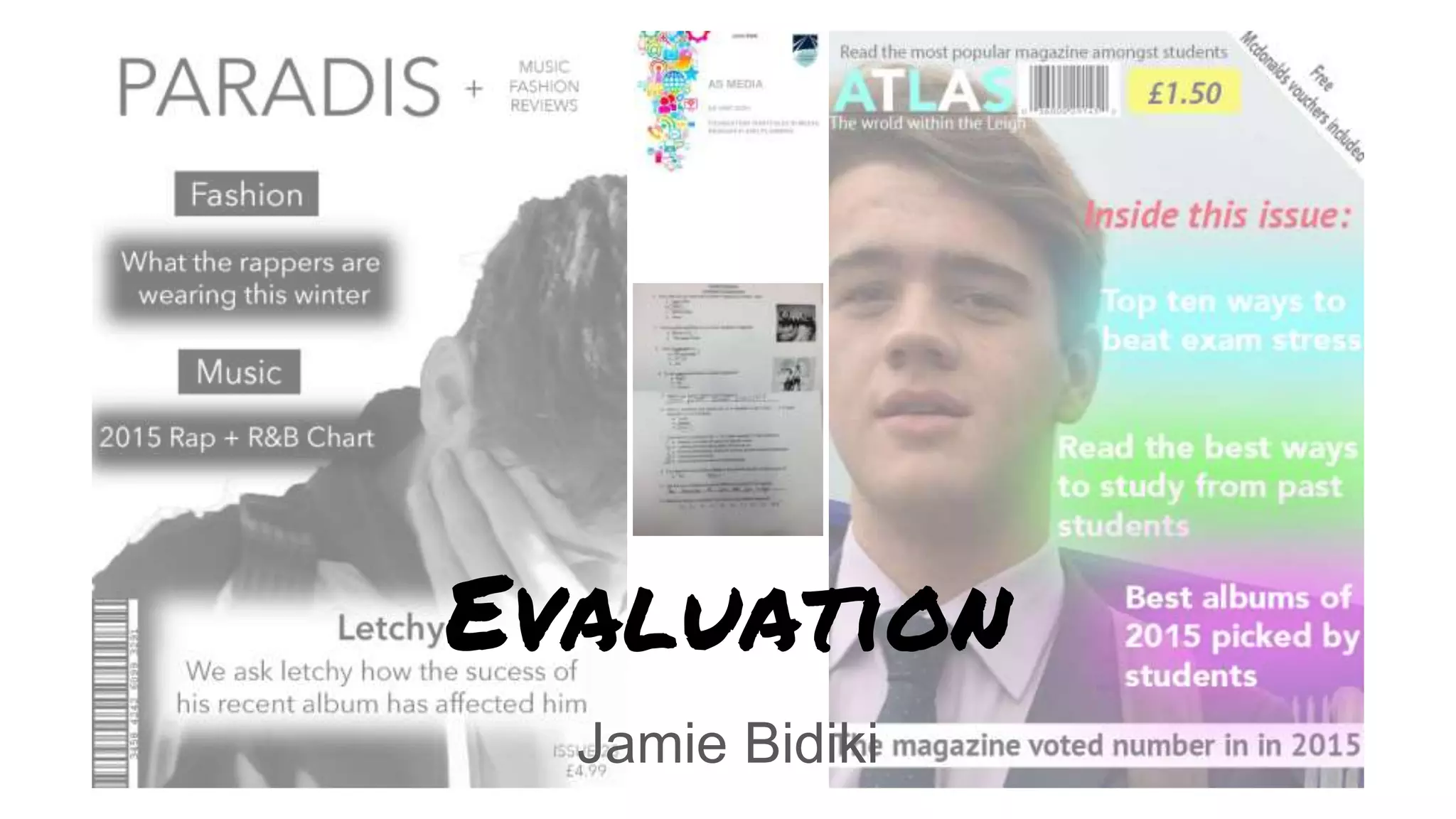
Evaluation
Jamie Bidiki
In what ways does your magazine use, develop or
challenge forms and conventions of real magazines?
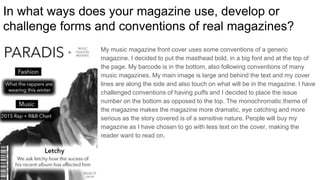
My music magazine front cover uses some conventions of a generic
magazine. I decided to put the masthead bold, in a big font and at the top of
the page. My barcode is in the bottom, also following conventions of many
music magazines. My main image is large and behind the text and my cover
lines are along the side and also touch on what will be in the magazine. I have
challenged conventions of having puffs and I decided to place the issue
number on the bottom as opposed to the top. The monochromatic theme of
the magazine makes the magazine more dramatic, eye catching and more
serious as the story covered is of a sensitive nature. People will buy my
magazine as I have chosen to go with less text on the cover, making the
reader want to read on.
In what ways does your magazine use, develop or
challenge forms and conventions of real magazines?
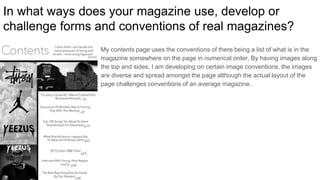
My contents page uses the conventions of there being a list of what is in the
magazine somewhere on the page in numerical order. By having images along
the top and sides, I am developing on certain image conventions, the images
are diverse and spread amongst the page although the actual layout of the
page challenges conventions of an average magazine.
In what ways does your magazine use, develop or
challenge forms and conventions of real magazines?
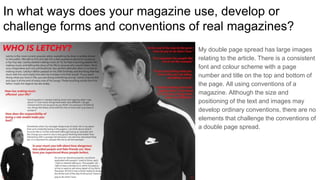
My double page spread has large images
relating to the article. There is a consistent
font and colour scheme with a page
number and title on the top and bottom of
the page. All using conventions of a
magazine. Although the size and
positioning of the text and images may
develop ordinary conventions, there are no
elements that challenge the conventions of
a double page spread.
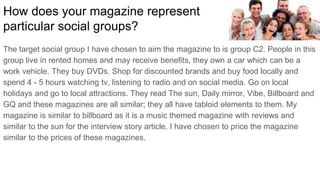
The target social group I have chosen to aim the magazine to is group C2. People in this
group live in rented homes and may receive benefits, they own a car which can be a
work vehicle. They buy DVDs. Shop for discounted brands and buy food locally and
spend 4 - 5 hours watching tv, listening to radio and on social media. Go on local
holidays and go to local attractions. They read The sun, Daily mirror, Vibe, Billboard and
GQ and these magazines are all similar; they all have tabloid elements to them. My
magazine is similar to billboard as it is a music themed magazine with reviews and
similar to the sun for the interview story article. I have chosen to price the magazine
similar to the prices of these magazines.
How does your magazine represent
particular social groups?
Examples of Group C2
What kind of media institution might distribute your
magazine and why?
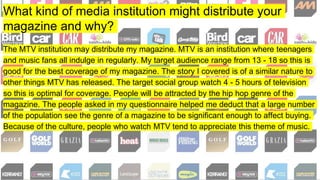
The MTV institution may distribute my magazine. MTV is an institution where teenagers
and music fans all indulge in regularly. My target audience range from 13 - 18 so this is
good for the best coverage of my magazine. The story I covered is of a similar nature to
other things MTV has released. The target social group watch 4 - 5 hours of television
so this is optimal for coverage. People will be attracted by the hip hop genre of the
magazine. The people asked in my questionnaire helped me deduct that a large number
of the population see the genre of a magazine to be significant enough to affect buying.
Because of the culture, people who watch MTV tend to appreciate this theme of music.
Who would be the audience for your
magazine?
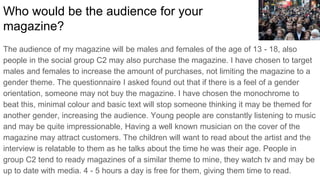
The audience of my magazine will be males and females of the age of 13 - 18, also
people in the social group C2 may also purchase the magazine. I have chosen to target
males and females to increase the amount of purchases, not limiting the magazine to a
gender theme. The questionnaire I asked found out that if there is a feel of a gender
orientation, someone may not buy the magazine. I have chosen the monochrome to
beat this, minimal colour and basic text will stop someone thinking it may be themed for
another gender, increasing the audience. Young people are constantly listening to music
and may be quite impressionable, Having a well known musician on the cover of the
magazine may attract customers. The children will want to read about the artist and the
interview is relatable to them as he talks about the time he was their age. People in
group C2 tend to ready magazines of a similar theme to mine, they watch tv and may be
up to date with media. 4 - 5 hours a day is free for them, giving them time to read.
How did you attract / address your audience?
I spoke about a story that may apply to any of the readers in the target audience, a hip
hop themed music magazine will be best for the audience as the questionnaire helped
me realise it was most popular. Choosing to have the words: “Music”, “Rap” and “R&B”
will attract these readers as these are the elements incorporated in the magazine, The
simple look means any gender or age can pick it up and read on. My creative positioning
of text and photo will attract more readers also. Males may be attracted to the darker
hues of the page, the serious nature of the image and the mystery of what may be
inside. The fact the main image is a male allows for there to be a connection. Females
may be attracted to the lighter hues of the page, and may like the artist being
interviewed.
What have you learnt about technologies from the
process of constructing your magazine?
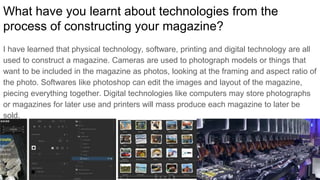
I have learned that physical technology, software, printing and digital technology are all
used to construct a magazine. Cameras are used to photograph models or things that
want to be included in the magazine as photos, looking at the framing and aspect ratio of
the photo. Softwares like photoshop can edit the images and layout of the magazine,
piecing everything together. Digital technologies like computers may store photographs
or magazines for later use and printers will mass produce each magazine to later be
sold.
Looking at your preliminary task - what do you feel you
have learnt in the progression from it to the full product?
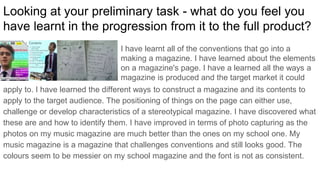
apply to. I have learned the different ways to construct a magazine and its contents to
apply to the target audience. The positioning of things on the page can either use,
challenge or develop characteristics of a stereotypical magazine. I have discovered what
these are and how to identify them. I have improved in terms of photo capturing as the
photos on my music magazine are much better than the ones on my school one. My
music magazine is a magazine that challenges conventions and still looks good. The
colours seem to be messier on my school magazine and the font is not as consistent.
I have learnt all of the conventions that go into a
making a magazine. I have learned about the elements
on a magazine's page. I have a learned all the ways a
magazine is produced and the target market it could

Evaluation

  • 1.
  • 2.
    In what waysdoes your magazine use, develop or challenge forms and conventions of real magazines? My music magazine front cover uses some conventions of a generic magazine. I decided to put the masthead bold, in a big font and at the top of the page. My barcode is in the bottom, also following conventions of many music magazines. My main image is large and behind the text and my cover lines are along the side and also touch on what will be in the magazine. I have challenged conventions of having puffs and I decided to place the issue number on the bottom as opposed to the top. The monochromatic theme of the magazine makes the magazine more dramatic, eye catching and more serious as the story covered is of a sensitive nature. People will buy my magazine as I have chosen to go with less text on the cover, making the reader want to read on.
  • 3.
    In what waysdoes your magazine use, develop or challenge forms and conventions of real magazines? My contents page uses the conventions of there being a list of what is in the magazine somewhere on the page in numerical order. By having images along the top and sides, I am developing on certain image conventions, the images are diverse and spread amongst the page although the actual layout of the page challenges conventions of an average magazine.
  • 4.
    In what waysdoes your magazine use, develop or challenge forms and conventions of real magazines? My double page spread has large images relating to the article. There is a consistent font and colour scheme with a page number and title on the top and bottom of the page. All using conventions of a magazine. Although the size and positioning of the text and images may develop ordinary conventions, there are no elements that challenge the conventions of a double page spread.
  • 5.
    The target socialgroup I have chosen to aim the magazine to is group C2. People in this group live in rented homes and may receive benefits, they own a car which can be a work vehicle. They buy DVDs. Shop for discounted brands and buy food locally and spend 4 - 5 hours watching tv, listening to radio and on social media. Go on local holidays and go to local attractions. They read The sun, Daily mirror, Vibe, Billboard and GQ and these magazines are all similar; they all have tabloid elements to them. My magazine is similar to billboard as it is a music themed magazine with reviews and similar to the sun for the interview story article. I have chosen to price the magazine similar to the prices of these magazines. How does your magazine represent particular social groups?
  • 6.
  • 7.
    What kind ofmedia institution might distribute your magazine and why? The MTV institution may distribute my magazine. MTV is an institution where teenagers and music fans all indulge in regularly. My target audience range from 13 - 18 so this is good for the best coverage of my magazine. The story I covered is of a similar nature to other things MTV has released. The target social group watch 4 - 5 hours of television so this is optimal for coverage. People will be attracted by the hip hop genre of the magazine. The people asked in my questionnaire helped me deduct that a large number of the population see the genre of a magazine to be significant enough to affect buying. Because of the culture, people who watch MTV tend to appreciate this theme of music.
  • 8.
    Who would bethe audience for your magazine? The audience of my magazine will be males and females of the age of 13 - 18, also people in the social group C2 may also purchase the magazine. I have chosen to target males and females to increase the amount of purchases, not limiting the magazine to a gender theme. The questionnaire I asked found out that if there is a feel of a gender orientation, someone may not buy the magazine. I have chosen the monochrome to beat this, minimal colour and basic text will stop someone thinking it may be themed for another gender, increasing the audience. Young people are constantly listening to music and may be quite impressionable, Having a well known musician on the cover of the magazine may attract customers. The children will want to read about the artist and the interview is relatable to them as he talks about the time he was their age. People in group C2 tend to ready magazines of a similar theme to mine, they watch tv and may be up to date with media. 4 - 5 hours a day is free for them, giving them time to read.
  • 9.
    How did youattract / address your audience? I spoke about a story that may apply to any of the readers in the target audience, a hip hop themed music magazine will be best for the audience as the questionnaire helped me realise it was most popular. Choosing to have the words: “Music”, “Rap” and “R&B” will attract these readers as these are the elements incorporated in the magazine, The simple look means any gender or age can pick it up and read on. My creative positioning of text and photo will attract more readers also. Males may be attracted to the darker hues of the page, the serious nature of the image and the mystery of what may be inside. The fact the main image is a male allows for there to be a connection. Females may be attracted to the lighter hues of the page, and may like the artist being interviewed.
  • 10.
    What have youlearnt about technologies from the process of constructing your magazine? I have learned that physical technology, software, printing and digital technology are all used to construct a magazine. Cameras are used to photograph models or things that want to be included in the magazine as photos, looking at the framing and aspect ratio of the photo. Softwares like photoshop can edit the images and layout of the magazine, piecing everything together. Digital technologies like computers may store photographs or magazines for later use and printers will mass produce each magazine to later be sold.
  • 11.
    Looking at yourpreliminary task - what do you feel you have learnt in the progression from it to the full product? apply to. I have learned the different ways to construct a magazine and its contents to apply to the target audience. The positioning of things on the page can either use, challenge or develop characteristics of a stereotypical magazine. I have discovered what these are and how to identify them. I have improved in terms of photo capturing as the photos on my music magazine are much better than the ones on my school one. My music magazine is a magazine that challenges conventions and still looks good. The colours seem to be messier on my school magazine and the font is not as consistent. I have learnt all of the conventions that go into a making a magazine. I have learned about the elements on a magazine's page. I have a learned all the ways a magazine is produced and the target market it could