Evaluation Task 3
What have I learnt from audience feedback?
How did I gather my audience feedback?
ack using a variety of methods including Focus Groups, Surveys,
s group and interviews in order to analyse the content of the video
All the information I gathered can be found on my blog.
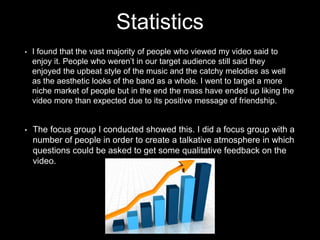
• I found that the vast majority of people who viewed my video said to
enjoy it. People who weren’t in our target audience still said they enjoyed
the upbeat style of the music and the catchy melodies as well as the
aesthetic looks of the band as a whole. I went to target a more niche
market of people but in the end the mass have ended up liking the video
more than expected due to its positive message of friendship.
Statistics
• The focus group I conducted showed this. I did a focus group with a
number of people in order to create a talkative atmosphere in which
questions could be asked to get some qualitative feedback on the
video.
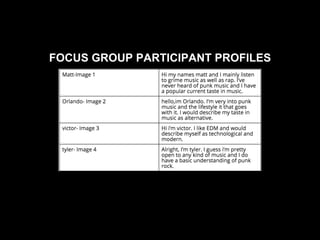
FOCUS GROUP PARTICIPANT PROFILES
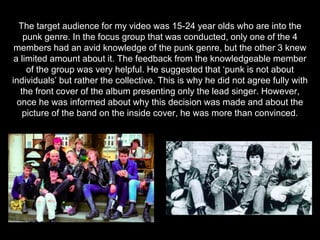
The target audience for my video was 15-24 year olds who are into the
punk genre. In the focus group that was conducted, only one of the 4
members had an avid knowledge of the punk genre, but the other 3 knew
a limited amount about it. The feedback from the knowledgeable member
of the group was very helpful. He suggested that ‘punk is not about
individuals’ but rather the collective. This is why he did not agree fully with
the front cover of the album presenting only the lead singer. However,
once he was informed about why this decision was made and about the
picture of the band on the inside cover, he was more than convinced.
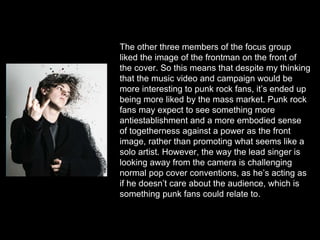
The other three members of the focus group
liked the image of the frontman on the front of
the cover. So this means that despite my thinking
that the music video and campaign would be
more interesting to punk rock fans, it’s ended up
being more liked by the mass market. Punk rock
fans may expect to see something more
antiestablishment and a more embodied sense
of togetherness against a power as the front
image, rather than promoting what seems like a
solo artist. However, the way the lead singer is
looking away from the camera is challenging
normal pop cover conventions, as he’s acting as
if he doesn’t care about the audience, which is
something punk fans could relate to.
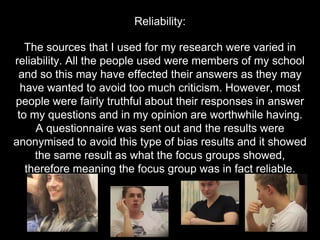
The sources that I used for my research were varied in
reliability. All the people used were members of my school
and so this may have effected their answers as they may
have wanted to avoid too much criticism. However, most
people were fairly truthful about their responses in answer
to my questions and in my opinion are worthwhile having.
A questionnaire was sent out and the results were
anonymised to avoid this type of bias results and it showed
the same result as what the focus groups showed,
therefore meaning the focus group was in fact reliable.
Reliability:
The research that was conducted showed that my video is
appealing to the vast majority of people, which is a very
good thing. It shows that the star image of the frontman is
easy to buy into and suggests a good USP for the
product, meaning it may be able to take a place in an
already saturated market. Unfortunately, the product isn’t
quite as popular with the punk fans as I thought it would
be; however, it seems as though they can still appreciate
the music and the style of the video, but maybe not
enough to invest themselves and their money into it.
Strengths:
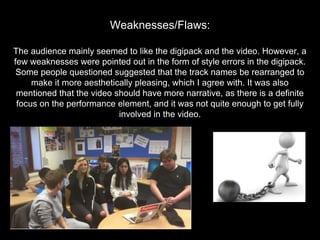
The audience mainly seemed to like the digipack and the video. However, a
few weaknesses were pointed out in the form of style errors in the digipack.
Some people questioned suggested that the track names be rearranged to
make it more aesthetically pleasing, which I agree with. It was also
mentioned that the video should have more narrative, as there is a definite
focus on the performance element, and it was not quite enough to get fully
involved in the video.
Weaknesses/Flaws:
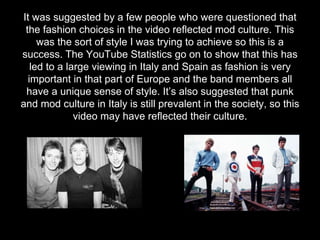
It was suggested by a few people who were questioned that
the fashion choices in the video reflected mod culture. This
was the sort of style I was trying to achieve so this is a
success. The YouTube Statistics go on to show that this has
led to a large viewing in Italy and Spain as fashion is very
important in that part of Europe and the band members all
have a unique sense of style. It’s also suggested that punk
and mod culture in Italy is still prevalent in the society, so this
video may have reflected their culture.
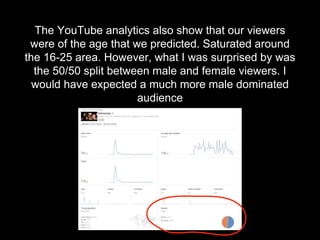
The YouTube analytics also show that our viewers
were of the age that we predicted. Saturated around
the 16-25 area. However, what I was surprised by was
the 50/50 split between male and female viewers. I
would have expected a much more male dominated
audience
sy to read, well designed and eye catching. Some people pointed
The Logo:
Encoding and Decoding
Encoding:
I intended to have a number of meanings behind
my music video, the first being the idea of strong
friendship being valued higher than anything
else. The boys in the band all want the same
record, but instead of fighting, they become
friends, thus forming their band.
Message 1 - Values of Friendship
Encoding and Decoding
Encoding:
I also wanted to represent how much of a shame
vinyl and CD’s is being replaced with digital
downloads. I wanted to put across the message
that music shopping is much more fun and
rewarding than shopping for singles online, and
one can even meet and become friends with
some interesting people whilst doing so. Music is
becoming much less sociable.
Message 2 - Music is becoming less sociable.
Encoding and Decoding
Encoding:
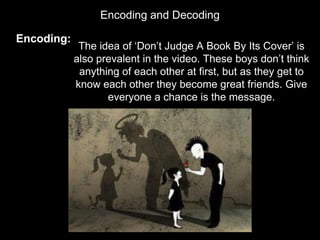
The idea of ‘Don’t Judge A Book By Its Cover’ is
also prevalent in the video. These boys don’t think
anything of each other at first, but as they get to
know each other they become great friends. Give
everyone a chance is the message.
Encoding and Decoding
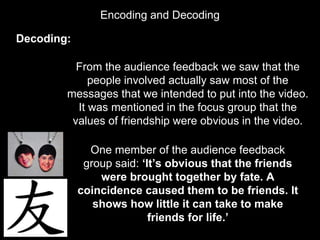
Decoding:
From the audience feedback we saw that the
people involved actually saw most of the
messages that we intended to put into the video.
It was mentioned in the focus group that the
values of friendship were obvious in the video.
One member of the audience feedback
group said: ‘It’s obvious that the friends
were brought together by fate. A
coincidence caused them to be friends. It
shows how little it can take to make
friends for life.’
Encoding and Decoding
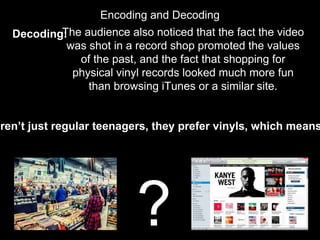
Decoding:The audience also noticed that the fact the video
was shot in a record shop promoted the values
of the past, and the fact that shopping for
physical vinyl records looked much more fun
than browsing iTunes or a similar site.
?
aren’t just regular teenagers, they prefer vinyls, which means
Encoding and Decoding
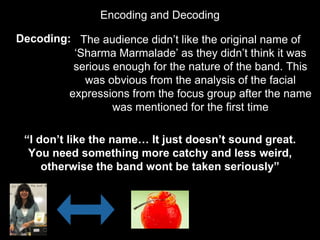
Decoding: The audience didn’t like the original name of
‘Sharma Marmalade’ as they didn’t think it was
serious enough for the nature of the band. This
was obvious from the analysis of the facial
expressions from the focus group after the name
was mentioned for the first time
“I don’t like the name… It just doesn’t sound great.
You need something more catchy and less weird,
otherwise the band wont be taken seriously”
Encoding and Decoding
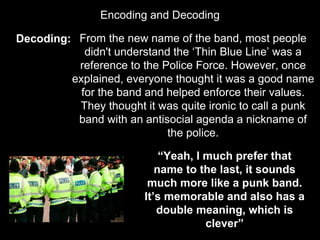
Decoding: From the new name of the band, most people
didn't understand the ‘Thin Blue Line’ was a
reference to the Police Force. However, once
explained, everyone thought it was a good name
for the band and helped enforce their values.
They thought it was quite ironic to call a punk
band with an antisocial agenda a nickname of
the police.
“Yeah, I much prefer that
name to the last, it sounds
much more like a punk band.
It’s memorable and also has a
double meaning, which is
clever”
The Gratification Model
Uses and Gratifications Theory is a popular approach to
understanding mass communication. The theory places
more focus on the consumer, or audience, instead of
the actual message itself by asking “what people do
with media” rather than “what media does to people”
(Katz, 1959).
It assumes that members of the audience are not
passive but take an active role in interpreting and
integrating media into their own lives. The theory
also holds that audiences are responsible for
choosing media to meet their needs. The approach
suggests that people use the media to fulfil specific
gratifications. This theory would then imply that the
media compete against other information sources
for viewers' gratification
The Gratification Model
Over the course of the two focus groups, the key elements
that came up were what we expected. It was mainly talked
about that the audience liked the style of the band and
also liked the attitude of the band as well as their
friendship. It’s evident that the balance of the attitude
compared to consumer relations is good, and the lead
singer comes across as moody, but not rude or
unlikable.
The Gratification Model
eir facial expressions during the watching of the video all show
Quotes: “I really like the way this is shot. Also, I
think the way it ends sums up the whole
video for me, which is nice.”
“The friendship is clear in the video, even
though they’ve only just met, you can tell
they’ll be good friends. There’s also a clear
chemistry in the performance shots”
I have learned from my audience feedback that I have constructed
an intended star image and an effective campaign. My target
audience has informed what went well, for example, the costumes in
the video, as well as area’s for development. If I was to make any
future changes to the campaign I would edit the website and make
the continuity something that is impeccable, I’d also like to make my
own font to use for the logo of the band.
Taking note of the audience feedback I understand how the
audience inform me the success of the campaign is and indeed
allowed me time to make adjustments to the campaign before it
went to distribution. Audience feedback is important market testing
in post-production to see if I created the right star image and
marketed this purposefully. As Henry Jenkins informs us that we
live in a ‘participatory culture’, where fans and audiences are
important in circulating meaning and the strength of media
messages.
I also recognise that my audience has engaged with the
meanings in my music video in different ways, bringing their own
contexts to the reading of the star image – what Hall argues is
reception theory. I can understand how my audience can either
reinforce or challenge intended meanings in the text.

Eval. tsk 3

  • 1.
    Evaluation Task 3 Whathave I learnt from audience feedback?
  • 2.
    How did Igather my audience feedback? ack using a variety of methods including Focus Groups, Surveys, s group and interviews in order to analyse the content of the video All the information I gathered can be found on my blog.
  • 3.
    • I foundthat the vast majority of people who viewed my video said to enjoy it. People who weren’t in our target audience still said they enjoyed the upbeat style of the music and the catchy melodies as well as the aesthetic looks of the band as a whole. I went to target a more niche market of people but in the end the mass have ended up liking the video more than expected due to its positive message of friendship. Statistics • The focus group I conducted showed this. I did a focus group with a number of people in order to create a talkative atmosphere in which questions could be asked to get some qualitative feedback on the video.
  • 4.
  • 5.
    The target audiencefor my video was 15-24 year olds who are into the punk genre. In the focus group that was conducted, only one of the 4 members had an avid knowledge of the punk genre, but the other 3 knew a limited amount about it. The feedback from the knowledgeable member of the group was very helpful. He suggested that ‘punk is not about individuals’ but rather the collective. This is why he did not agree fully with the front cover of the album presenting only the lead singer. However, once he was informed about why this decision was made and about the picture of the band on the inside cover, he was more than convinced.
  • 6.
    The other threemembers of the focus group liked the image of the frontman on the front of the cover. So this means that despite my thinking that the music video and campaign would be more interesting to punk rock fans, it’s ended up being more liked by the mass market. Punk rock fans may expect to see something more antiestablishment and a more embodied sense of togetherness against a power as the front image, rather than promoting what seems like a solo artist. However, the way the lead singer is looking away from the camera is challenging normal pop cover conventions, as he’s acting as if he doesn’t care about the audience, which is something punk fans could relate to.
  • 7.
    The sources thatI used for my research were varied in reliability. All the people used were members of my school and so this may have effected their answers as they may have wanted to avoid too much criticism. However, most people were fairly truthful about their responses in answer to my questions and in my opinion are worthwhile having. A questionnaire was sent out and the results were anonymised to avoid this type of bias results and it showed the same result as what the focus groups showed, therefore meaning the focus group was in fact reliable. Reliability:
  • 8.
    The research thatwas conducted showed that my video is appealing to the vast majority of people, which is a very good thing. It shows that the star image of the frontman is easy to buy into and suggests a good USP for the product, meaning it may be able to take a place in an already saturated market. Unfortunately, the product isn’t quite as popular with the punk fans as I thought it would be; however, it seems as though they can still appreciate the music and the style of the video, but maybe not enough to invest themselves and their money into it. Strengths:
  • 9.
    The audience mainlyseemed to like the digipack and the video. However, a few weaknesses were pointed out in the form of style errors in the digipack. Some people questioned suggested that the track names be rearranged to make it more aesthetically pleasing, which I agree with. It was also mentioned that the video should have more narrative, as there is a definite focus on the performance element, and it was not quite enough to get fully involved in the video. Weaknesses/Flaws:
  • 10.
    It was suggestedby a few people who were questioned that the fashion choices in the video reflected mod culture. This was the sort of style I was trying to achieve so this is a success. The YouTube Statistics go on to show that this has led to a large viewing in Italy and Spain as fashion is very important in that part of Europe and the band members all have a unique sense of style. It’s also suggested that punk and mod culture in Italy is still prevalent in the society, so this video may have reflected their culture.
  • 11.
    The YouTube analyticsalso show that our viewers were of the age that we predicted. Saturated around the 16-25 area. However, what I was surprised by was the 50/50 split between male and female viewers. I would have expected a much more male dominated audience
  • 12.
    sy to read,well designed and eye catching. Some people pointed The Logo:
  • 13.
    Encoding and Decoding Encoding: Iintended to have a number of meanings behind my music video, the first being the idea of strong friendship being valued higher than anything else. The boys in the band all want the same record, but instead of fighting, they become friends, thus forming their band. Message 1 - Values of Friendship
  • 14.
    Encoding and Decoding Encoding: Ialso wanted to represent how much of a shame vinyl and CD’s is being replaced with digital downloads. I wanted to put across the message that music shopping is much more fun and rewarding than shopping for singles online, and one can even meet and become friends with some interesting people whilst doing so. Music is becoming much less sociable. Message 2 - Music is becoming less sociable.
  • 15.
    Encoding and Decoding Encoding: Theidea of ‘Don’t Judge A Book By Its Cover’ is also prevalent in the video. These boys don’t think anything of each other at first, but as they get to know each other they become great friends. Give everyone a chance is the message.
  • 16.
    Encoding and Decoding Decoding: Fromthe audience feedback we saw that the people involved actually saw most of the messages that we intended to put into the video. It was mentioned in the focus group that the values of friendship were obvious in the video. One member of the audience feedback group said: ‘It’s obvious that the friends were brought together by fate. A coincidence caused them to be friends. It shows how little it can take to make friends for life.’
  • 17.
    Encoding and Decoding Decoding:Theaudience also noticed that the fact the video was shot in a record shop promoted the values of the past, and the fact that shopping for physical vinyl records looked much more fun than browsing iTunes or a similar site. ? aren’t just regular teenagers, they prefer vinyls, which means
  • 18.
    Encoding and Decoding Decoding:The audience didn’t like the original name of ‘Sharma Marmalade’ as they didn’t think it was serious enough for the nature of the band. This was obvious from the analysis of the facial expressions from the focus group after the name was mentioned for the first time “I don’t like the name… It just doesn’t sound great. You need something more catchy and less weird, otherwise the band wont be taken seriously”
  • 19.
    Encoding and Decoding Decoding:From the new name of the band, most people didn't understand the ‘Thin Blue Line’ was a reference to the Police Force. However, once explained, everyone thought it was a good name for the band and helped enforce their values. They thought it was quite ironic to call a punk band with an antisocial agenda a nickname of the police. “Yeah, I much prefer that name to the last, it sounds much more like a punk band. It’s memorable and also has a double meaning, which is clever”
  • 20.
    The Gratification Model Usesand Gratifications Theory is a popular approach to understanding mass communication. The theory places more focus on the consumer, or audience, instead of the actual message itself by asking “what people do with media” rather than “what media does to people” (Katz, 1959).
  • 21.
    It assumes thatmembers of the audience are not passive but take an active role in interpreting and integrating media into their own lives. The theory also holds that audiences are responsible for choosing media to meet their needs. The approach suggests that people use the media to fulfil specific gratifications. This theory would then imply that the media compete against other information sources for viewers' gratification The Gratification Model
  • 22.
    Over the courseof the two focus groups, the key elements that came up were what we expected. It was mainly talked about that the audience liked the style of the band and also liked the attitude of the band as well as their friendship. It’s evident that the balance of the attitude compared to consumer relations is good, and the lead singer comes across as moody, but not rude or unlikable. The Gratification Model
  • 23.
    The Gratification Model eirfacial expressions during the watching of the video all show Quotes: “I really like the way this is shot. Also, I think the way it ends sums up the whole video for me, which is nice.” “The friendship is clear in the video, even though they’ve only just met, you can tell they’ll be good friends. There’s also a clear chemistry in the performance shots”
  • 24.
    I have learnedfrom my audience feedback that I have constructed an intended star image and an effective campaign. My target audience has informed what went well, for example, the costumes in the video, as well as area’s for development. If I was to make any future changes to the campaign I would edit the website and make the continuity something that is impeccable, I’d also like to make my own font to use for the logo of the band. Taking note of the audience feedback I understand how the audience inform me the success of the campaign is and indeed allowed me time to make adjustments to the campaign before it went to distribution. Audience feedback is important market testing in post-production to see if I created the right star image and marketed this purposefully. As Henry Jenkins informs us that we live in a ‘participatory culture’, where fans and audiences are important in circulating meaning and the strength of media messages.
  • 25.
    I also recognisethat my audience has engaged with the meanings in my music video in different ways, bringing their own contexts to the reading of the star image – what Hall argues is reception theory. I can understand how my audience can either reinforce or challenge intended meanings in the text.