EVA: Exploratory Learning with
Virtual Companions Sharing Attention
and Context
Scott W. Greenwald
PhD Candidate
scottgwald@media.mit.edu
2
EVA: Exploratory Learning with
Virtual Companions Sharing Attention
and Context
Scott W. Greenwald
PhD Candidate
scottgwald@media.mit.edu
3
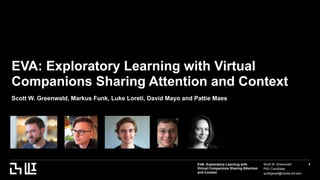
EVA: Exploratory Learning with Virtual
Companions Sharing Attention and Context
Scott W. Greenwald, Markus Funk, Luke Loreti, David Mayo and Pattie Maes
EVA: Exploratory Learning with
Virtual Companions Sharing Attention
and Context
Scott W. Greenwald
PhD Candidate
scottgwald@media.mit.edu
5
Outline
EVA: Exploratory Learning with
Virtual Companions Sharing Attention
and Context
Scott W. Greenwald
PhD Candidate
scottgwald@media.mit.edu
6
Outline
• Introduction and Background
• Related Work
• Approach: EVA
• Proof-of-Concept Systems: VR and AR
• Exploratory Trials
• Conclusion
• Acknowledgments
EVA: Exploratory Learning with
Virtual Companions Sharing Attention
and Context
Scott W. Greenwald
PhD Candidate
scottgwald@media.mit.edu
7
Introduction
EVA: Exploratory Learning with
Virtual Companions Sharing Attention
and Context
Scott W. Greenwald
PhD Candidate
scottgwald@media.mit.edu
8
Introduction
Investigate the Intersection of
• Exploratory Learning
• Telepresence
• Attention Awareness
EVA: Exploratory Learning with
Virtual Companions Sharing Attention
and Context
Scott W. Greenwald
PhD Candidate
scottgwald@media.mit.edu
9
Related Work
EVA: Exploratory Learning with
Virtual Companions Sharing Attention
and Context
Scott W. Greenwald
PhD Candidate
scottgwald@media.mit.edu
10
Related Work
• Learning in AR
• Collaboration with AR
• Learning in VR
• Remote Learning in AR/VR
EVA: Exploratory Learning with
Virtual Companions Sharing Attention
and Context
Scott W. Greenwald
PhD Candidate
scottgwald@media.mit.edu
11
Related Work: Learning in AR
• AR is viable for guiding students through building
molecular models
• (Chastine et al, 2007)
Asdf
EVA: Exploratory Learning with
Virtual Companions Sharing Attention
and Context
Scott W. Greenwald
PhD Candidate
scottgwald@media.mit.edu
12
Related Work: Collaboration in AR
• Need to direct attention of user to specific point
• Point may be outside current field of view
• Annotations can be stabilized when viewed on a
tablet
• Cheng & Robinson 1998, Gauglitz 2014
EVA: Exploratory Learning with
Virtual Companions Sharing Attention
and Context
Scott W. Greenwald
PhD Candidate
scottgwald@media.mit.edu
13
Telepresence
• Used for remote collaboration and performing tasks
remotely.
• Includes some way for remote person to engage with
the environment directly.
Asdf
EVA: Exploratory Learning with
Virtual Companions Sharing Attention
and Context
Scott W. Greenwald
PhD Candidate
scottgwald@media.mit.edu
14
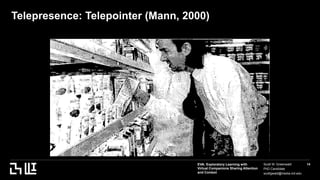
Telepresence: Telepointer (Mann, 2000)
EVA: Exploratory Learning with
Virtual Companions Sharing Attention
and Context
Scott W. Greenwald
PhD Candidate
scottgwald@media.mit.edu
15
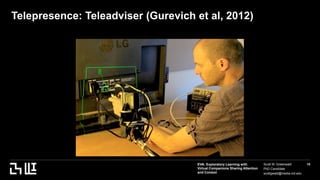
Telepresence: Teleadviser (Gurevich et al, 2012)
EVA: Exploratory Learning with
Virtual Companions Sharing Attention
and Context
Scott W. Greenwald
PhD Candidate
scottgwald@media.mit.edu
16
Exploratory Learning in VR
• Exploratory learning is a model for engaging with
learning materials and activities in immersive
environments.

• It is compatible with a variety of learning models,
including formal and informal ones.
• Greater autonomy and personalization leads to better
motivation and outcomes.
• de Freitas and Neumann, 2009
asda
Asdf
EVA: Exploratory Learning with
Virtual Companions Sharing Attention
and Context
Scott W. Greenwald
PhD Candidate
scottgwald@media.mit.edu
20
Remote Learning in AR
asda
Asdf
EVA: Exploratory Learning with
Virtual Companions Sharing Attention
and Context
Scott W. Greenwald
PhD Candidate
scottgwald@media.mit.edu
21
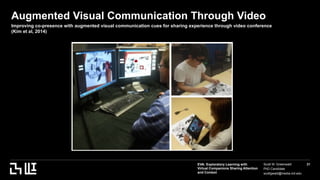
Augmented Visual Communication Through Video
Improving co-presence with augmented visual communication cues for sharing experience through video conference
(Kim et al, 2014)
EVA: Exploratory Learning with
Virtual Companions Sharing Attention
and Context
Scott W. Greenwald
PhD Candidate
scottgwald@media.mit.edu
22
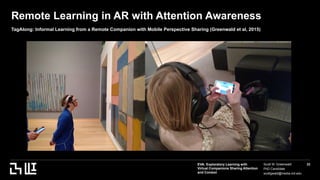
Remote Learning in AR with Attention Awareness
TagAlong: Informal Learning from a Remote Companion with Mobile Perspective Sharing (Greenwald et al, 2015)
EVA: Exploratory Learning with
Virtual Companions Sharing Attention
and Context
Scott W. Greenwald
PhD Candidate
scottgwald@media.mit.edu
23
Approach: EVA
EVA: Exploratory Learning with
Virtual Companions Sharing Attention
and Context
Scott W. Greenwald
PhD Candidate
scottgwald@media.mit.edu
24
EVA: Exploratory Learning with Virtual Companions
Sharing Attention and Context
How can giving the remote companion access to the
external context and attentional state of the learner
improve the learning interaction?
EVA: Exploratory Learning with
Virtual Companions Sharing Attention
and Context
Scott W. Greenwald
PhD Candidate
scottgwald@media.mit.edu
25
EVA: Exploratory Learning with Virtual Companions
Sharing Attention and Context
• Class of Learning Systems in VR And AR
• The learner explores an environment, shifts attention
through his own volition.
• The teacher or virtual companion provides relevant
information
• May making use of a pointing mechanism to make
direct reference to elements of the environment.
EVA: Exploratory Learning with
Virtual Companions Sharing Attention
and Context
Scott W. Greenwald
PhD Candidate
scottgwald@media.mit.edu
26
EVA: Exploratory Learning with Virtual Companions
Sharing Attention and Context
• The companion has access to the external context
and attentional state of the learner, and she uses this
to judge what input to provide, and at what point in
time.
EVA: Exploratory Learning with
Virtual Companions Sharing Attention
and Context
Scott W. Greenwald
PhD Candidate
scottgwald@media.mit.edu
27
EVA: Exploratory Learning with Virtual Companions
Sharing Attention and Context
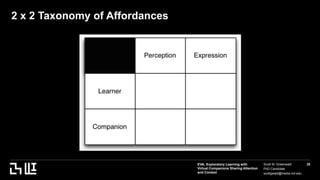
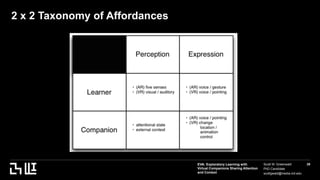
• 2 x 2 Taxonomy of Affordances
• Design dimensions
EVA: Exploratory Learning with
Virtual Companions Sharing Attention
and Context
Scott W. Greenwald
PhD Candidate
scottgwald@media.mit.edu
28
2 x 2 Taxonomy of Affordances
EVA: Exploratory Learning with
Virtual Companions Sharing Attention
and Context
Scott W. Greenwald
PhD Candidate
scottgwald@media.mit.edu
29
2 x 2 Taxonomy of Affordances
EVA: Exploratory Learning with
Virtual Companions Sharing Attention
and Context
Scott W. Greenwald
PhD Candidate
scottgwald@media.mit.edu
30
Design Dimensions for EVA Systems
• Augmented-Virtual Spectrum
• Synchronous-Asynchronous Spectrum
• Active-Passive Learning Spectrum
• Level of Personalization
EVA: Exploratory Learning with
Virtual Companions Sharing Attention
and Context
Scott W. Greenwald
PhD Candidate
scottgwald@media.mit.edu
31
Proof of Concept Systems: AR and VR
EVA: Exploratory Learning with
Virtual Companions Sharing Attention
and Context
Scott W. Greenwald
PhD Candidate
scottgwald@media.mit.edu
32
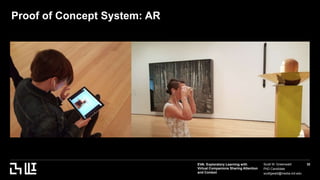
Proof of Concept System: AR
EVA: Exploratory Learning with
Virtual Companions Sharing Attention
and Context
Scott W. Greenwald
PhD Candidate
scottgwald@media.mit.edu
33
EVA: Exploratory Learning with
Virtual Companions Sharing Attention
and Context
Scott W. Greenwald
PhD Candidate
scottgwald@media.mit.edu
34
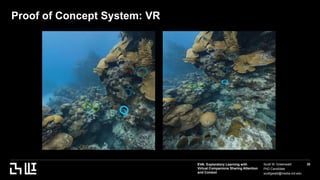
Proof of Concept System: VR
EVA: Exploratory Learning with
Virtual Companions Sharing Attention
and Context
Scott W. Greenwald
PhD Candidate
scottgwald@media.mit.edu
35
Proof of Concept System: VR
EVA: Exploratory Learning with
Virtual Companions Sharing Attention
and Context
Scott W. Greenwald
PhD Candidate
scottgwald@media.mit.edu
36
EVA: Exploratory Learning with
Virtual Companions Sharing Attention
and Context
Scott W. Greenwald
PhD Candidate
scottgwald@media.mit.edu
37
Exploratory Trials
EVA: Exploratory Learning with
Virtual Companions Sharing Attention
and Context
Scott W. Greenwald
PhD Candidate
scottgwald@media.mit.edu
38
Hypotheses
• Overall experience in both cases will be effective and
engaging.
• Companion will be able to proactively give relevant
information.
• Persistence of markers in VR condition will be
advantageous.
• AR condition will effectively leverage the ability to
walk around for viewing sculpture.
EVA: Exploratory Learning with
Virtual Companions Sharing Attention
and Context
Scott W. Greenwald
PhD Candidate
scottgwald@media.mit.edu
39
Exploratory Trials
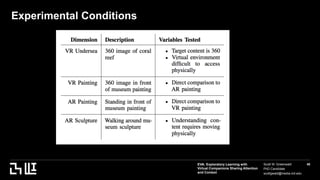
We conducted exploratory trials at an art museum,
inviting learner participants (3 male, 4 female, ages 22
to 30), and two expert companion participants (2
female, ages 31 to 34).
EVA: Exploratory Learning with
Virtual Companions Sharing Attention
and Context
Scott W. Greenwald
PhD Candidate
scottgwald@media.mit.edu
40
Experimental Conditions
EVA: Exploratory Learning with
Virtual Companions Sharing Attention
and Context
Scott W. Greenwald
PhD Candidate
scottgwald@media.mit.edu
41
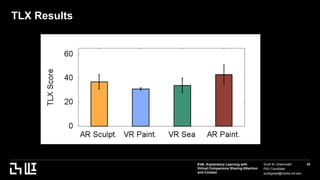
Evaluation
• NASA TLX
• Questionnaire
• Interviews
EVA: Exploratory Learning with
Virtual Companions Sharing Attention
and Context
Scott W. Greenwald
PhD Candidate
scottgwald@media.mit.edu
42
TLX Results
EVA: Exploratory Learning with
Virtual Companions Sharing Attention
and Context
Scott W. Greenwald
PhD Candidate
scottgwald@media.mit.edu
43
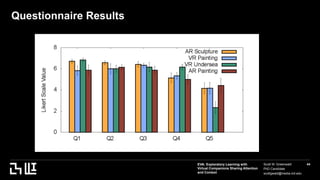
Questionnaire questions
• Q1: It was easy for me to make reference to objects being
discussed during the conversation.
• Q2: It was easy to figure out what objects the expert was
referring to during the conversation.
• Q3: I felt interested and engaged for the duration of the trial.
• Q4: The technology platform contributed positively to the
quality of the interaction.
• Q5: The technology distracted me from viewing the art piece.
EVA: Exploratory Learning with
Virtual Companions Sharing Attention
and Context
Scott W. Greenwald
PhD Candidate
scottgwald@media.mit.edu
44
Questionnaire Results
EVA: Exploratory Learning with
Virtual Companions Sharing Attention
and Context
Scott W. Greenwald
PhD Candidate
scottgwald@media.mit.edu
45
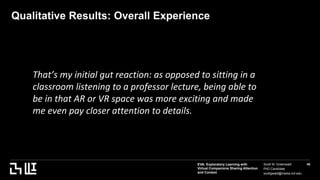
Qualitative Results: Overall Experience
That’s my initial gut reaction: as opposed to sitting in a
classroom listening to a professor lecture, being able to
be in that AR or VR space was more exciting and made
me even pay closer attention to details.
EVA: Exploratory Learning with
Virtual Companions Sharing Attention
and Context
Scott W. Greenwald
PhD Candidate
scottgwald@media.mit.edu
46
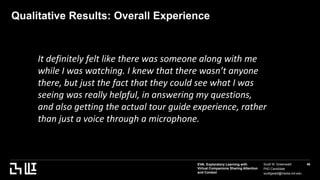
Qualitative Results: Overall Experience
It definitely felt like there was someone along with me
while I was watching. I knew that there wasn’t anyone
there, but just the fact that they could see what I was
seeing was really helpful, in answering my questions,
and also getting the actual tour guide experience, rather
than just a voice through a microphone.
EVA: Exploratory Learning with
Virtual Companions Sharing Attention
and Context
Scott W. Greenwald
PhD Candidate
scottgwald@media.mit.edu
47
Qualitative Results: Contrasting AR and VR
• Contrary to expectations, marker persistence was not
advantageous. In fact it was reported to be
bothersome.
• The ability to point outside the field of view was useful
but no much so that participants noticed this
difference between the systems.
EVA: Exploratory Learning with
Virtual Companions Sharing Attention
and Context
Scott W. Greenwald
PhD Candidate
scottgwald@media.mit.edu
48
Acknowledgements
• This work was supported by gifts from Google and
Pearson.
• Thanks to Chris Schmandt and Albrecht Schmidt for
their valuable feedback.
EVA: Exploratory Learning with
Virtual Companions Sharing Attention
and Context
Scott W. Greenwald
PhD Candidate
scottgwald@media.mit.edu
49
EVA: Exploratory Learning with Virtual
Companions Sharing Attention and Context
Scott W. Greenwald, Markus Funk, Luke Loreti, David Mayo and Pattie Maes

EVA: Exploratory Learning with Virtual Companions Sharing Attention and Context

  • 1.
    EVA: Exploratory Learningwith Virtual Companions Sharing Attention and Context Scott W. Greenwald PhD Candidate scottgwald@media.mit.edu 2
  • 2.
    EVA: Exploratory Learningwith Virtual Companions Sharing Attention and Context Scott W. Greenwald PhD Candidate scottgwald@media.mit.edu 3 EVA: Exploratory Learning with Virtual Companions Sharing Attention and Context Scott W. Greenwald, Markus Funk, Luke Loreti, David Mayo and Pattie Maes
  • 3.
    EVA: Exploratory Learningwith Virtual Companions Sharing Attention and Context Scott W. Greenwald PhD Candidate scottgwald@media.mit.edu 5 Outline
  • 4.
    EVA: Exploratory Learningwith Virtual Companions Sharing Attention and Context Scott W. Greenwald PhD Candidate scottgwald@media.mit.edu 6 Outline • Introduction and Background • Related Work • Approach: EVA • Proof-of-Concept Systems: VR and AR • Exploratory Trials • Conclusion • Acknowledgments
  • 5.
    EVA: Exploratory Learningwith Virtual Companions Sharing Attention and Context Scott W. Greenwald PhD Candidate scottgwald@media.mit.edu 7 Introduction
  • 6.
    EVA: Exploratory Learningwith Virtual Companions Sharing Attention and Context Scott W. Greenwald PhD Candidate scottgwald@media.mit.edu 8 Introduction Investigate the Intersection of • Exploratory Learning • Telepresence • Attention Awareness
  • 7.
    EVA: Exploratory Learningwith Virtual Companions Sharing Attention and Context Scott W. Greenwald PhD Candidate scottgwald@media.mit.edu 9 Related Work
  • 8.
    EVA: Exploratory Learningwith Virtual Companions Sharing Attention and Context Scott W. Greenwald PhD Candidate scottgwald@media.mit.edu 10 Related Work • Learning in AR • Collaboration with AR • Learning in VR • Remote Learning in AR/VR
  • 9.
    EVA: Exploratory Learningwith Virtual Companions Sharing Attention and Context Scott W. Greenwald PhD Candidate scottgwald@media.mit.edu 11 Related Work: Learning in AR • AR is viable for guiding students through building molecular models • (Chastine et al, 2007) Asdf
  • 10.
    EVA: Exploratory Learningwith Virtual Companions Sharing Attention and Context Scott W. Greenwald PhD Candidate scottgwald@media.mit.edu 12 Related Work: Collaboration in AR • Need to direct attention of user to specific point • Point may be outside current field of view • Annotations can be stabilized when viewed on a tablet • Cheng & Robinson 1998, Gauglitz 2014
  • 11.
    EVA: Exploratory Learningwith Virtual Companions Sharing Attention and Context Scott W. Greenwald PhD Candidate scottgwald@media.mit.edu 13 Telepresence • Used for remote collaboration and performing tasks remotely. • Includes some way for remote person to engage with the environment directly. Asdf
  • 12.
    EVA: Exploratory Learningwith Virtual Companions Sharing Attention and Context Scott W. Greenwald PhD Candidate scottgwald@media.mit.edu 14 Telepresence: Telepointer (Mann, 2000)
  • 13.
    EVA: Exploratory Learningwith Virtual Companions Sharing Attention and Context Scott W. Greenwald PhD Candidate scottgwald@media.mit.edu 15 Telepresence: Teleadviser (Gurevich et al, 2012)
  • 14.
    EVA: Exploratory Learningwith Virtual Companions Sharing Attention and Context Scott W. Greenwald PhD Candidate scottgwald@media.mit.edu 16 Exploratory Learning in VR • Exploratory learning is a model for engaging with learning materials and activities in immersive environments. • It is compatible with a variety of learning models, including formal and informal ones. • Greater autonomy and personalization leads to better motivation and outcomes. • de Freitas and Neumann, 2009 asda Asdf
  • 15.
    EVA: Exploratory Learningwith Virtual Companions Sharing Attention and Context Scott W. Greenwald PhD Candidate scottgwald@media.mit.edu 20 Remote Learning in AR asda Asdf
  • 16.
    EVA: Exploratory Learningwith Virtual Companions Sharing Attention and Context Scott W. Greenwald PhD Candidate scottgwald@media.mit.edu 21 Augmented Visual Communication Through Video Improving co-presence with augmented visual communication cues for sharing experience through video conference (Kim et al, 2014)
  • 17.
    EVA: Exploratory Learningwith Virtual Companions Sharing Attention and Context Scott W. Greenwald PhD Candidate scottgwald@media.mit.edu 22 Remote Learning in AR with Attention Awareness TagAlong: Informal Learning from a Remote Companion with Mobile Perspective Sharing (Greenwald et al, 2015)
  • 18.
    EVA: Exploratory Learningwith Virtual Companions Sharing Attention and Context Scott W. Greenwald PhD Candidate scottgwald@media.mit.edu 23 Approach: EVA
  • 19.
    EVA: Exploratory Learningwith Virtual Companions Sharing Attention and Context Scott W. Greenwald PhD Candidate scottgwald@media.mit.edu 24 EVA: Exploratory Learning with Virtual Companions Sharing Attention and Context How can giving the remote companion access to the external context and attentional state of the learner improve the learning interaction?
  • 20.
    EVA: Exploratory Learningwith Virtual Companions Sharing Attention and Context Scott W. Greenwald PhD Candidate scottgwald@media.mit.edu 25 EVA: Exploratory Learning with Virtual Companions Sharing Attention and Context • Class of Learning Systems in VR And AR • The learner explores an environment, shifts attention through his own volition. • The teacher or virtual companion provides relevant information • May making use of a pointing mechanism to make direct reference to elements of the environment.
  • 21.
    EVA: Exploratory Learningwith Virtual Companions Sharing Attention and Context Scott W. Greenwald PhD Candidate scottgwald@media.mit.edu 26 EVA: Exploratory Learning with Virtual Companions Sharing Attention and Context • The companion has access to the external context and attentional state of the learner, and she uses this to judge what input to provide, and at what point in time.
  • 22.
    EVA: Exploratory Learningwith Virtual Companions Sharing Attention and Context Scott W. Greenwald PhD Candidate scottgwald@media.mit.edu 27 EVA: Exploratory Learning with Virtual Companions Sharing Attention and Context • 2 x 2 Taxonomy of Affordances • Design dimensions
  • 23.
    EVA: Exploratory Learningwith Virtual Companions Sharing Attention and Context Scott W. Greenwald PhD Candidate scottgwald@media.mit.edu 28 2 x 2 Taxonomy of Affordances
  • 24.
    EVA: Exploratory Learningwith Virtual Companions Sharing Attention and Context Scott W. Greenwald PhD Candidate scottgwald@media.mit.edu 29 2 x 2 Taxonomy of Affordances
  • 25.
    EVA: Exploratory Learningwith Virtual Companions Sharing Attention and Context Scott W. Greenwald PhD Candidate scottgwald@media.mit.edu 30 Design Dimensions for EVA Systems • Augmented-Virtual Spectrum • Synchronous-Asynchronous Spectrum • Active-Passive Learning Spectrum • Level of Personalization
  • 26.
    EVA: Exploratory Learningwith Virtual Companions Sharing Attention and Context Scott W. Greenwald PhD Candidate scottgwald@media.mit.edu 31 Proof of Concept Systems: AR and VR
  • 27.
    EVA: Exploratory Learningwith Virtual Companions Sharing Attention and Context Scott W. Greenwald PhD Candidate scottgwald@media.mit.edu 32 Proof of Concept System: AR
  • 28.
    EVA: Exploratory Learningwith Virtual Companions Sharing Attention and Context Scott W. Greenwald PhD Candidate scottgwald@media.mit.edu 33
  • 29.
    EVA: Exploratory Learningwith Virtual Companions Sharing Attention and Context Scott W. Greenwald PhD Candidate scottgwald@media.mit.edu 34 Proof of Concept System: VR
  • 30.
    EVA: Exploratory Learningwith Virtual Companions Sharing Attention and Context Scott W. Greenwald PhD Candidate scottgwald@media.mit.edu 35 Proof of Concept System: VR
  • 31.
    EVA: Exploratory Learningwith Virtual Companions Sharing Attention and Context Scott W. Greenwald PhD Candidate scottgwald@media.mit.edu 36
  • 32.
    EVA: Exploratory Learningwith Virtual Companions Sharing Attention and Context Scott W. Greenwald PhD Candidate scottgwald@media.mit.edu 37 Exploratory Trials
  • 33.
    EVA: Exploratory Learningwith Virtual Companions Sharing Attention and Context Scott W. Greenwald PhD Candidate scottgwald@media.mit.edu 38 Hypotheses • Overall experience in both cases will be effective and engaging. • Companion will be able to proactively give relevant information. • Persistence of markers in VR condition will be advantageous. • AR condition will effectively leverage the ability to walk around for viewing sculpture.
  • 34.
    EVA: Exploratory Learningwith Virtual Companions Sharing Attention and Context Scott W. Greenwald PhD Candidate scottgwald@media.mit.edu 39 Exploratory Trials We conducted exploratory trials at an art museum, inviting learner participants (3 male, 4 female, ages 22 to 30), and two expert companion participants (2 female, ages 31 to 34).
  • 35.
    EVA: Exploratory Learningwith Virtual Companions Sharing Attention and Context Scott W. Greenwald PhD Candidate scottgwald@media.mit.edu 40 Experimental Conditions
  • 36.
    EVA: Exploratory Learningwith Virtual Companions Sharing Attention and Context Scott W. Greenwald PhD Candidate scottgwald@media.mit.edu 41 Evaluation • NASA TLX • Questionnaire • Interviews
  • 37.
    EVA: Exploratory Learningwith Virtual Companions Sharing Attention and Context Scott W. Greenwald PhD Candidate scottgwald@media.mit.edu 42 TLX Results
  • 38.
    EVA: Exploratory Learningwith Virtual Companions Sharing Attention and Context Scott W. Greenwald PhD Candidate scottgwald@media.mit.edu 43 Questionnaire questions • Q1: It was easy for me to make reference to objects being discussed during the conversation. • Q2: It was easy to figure out what objects the expert was referring to during the conversation. • Q3: I felt interested and engaged for the duration of the trial. • Q4: The technology platform contributed positively to the quality of the interaction. • Q5: The technology distracted me from viewing the art piece.
  • 39.
    EVA: Exploratory Learningwith Virtual Companions Sharing Attention and Context Scott W. Greenwald PhD Candidate scottgwald@media.mit.edu 44 Questionnaire Results
  • 40.
    EVA: Exploratory Learningwith Virtual Companions Sharing Attention and Context Scott W. Greenwald PhD Candidate scottgwald@media.mit.edu 45 Qualitative Results: Overall Experience That’s my initial gut reaction: as opposed to sitting in a classroom listening to a professor lecture, being able to be in that AR or VR space was more exciting and made me even pay closer attention to details.
  • 41.
    EVA: Exploratory Learningwith Virtual Companions Sharing Attention and Context Scott W. Greenwald PhD Candidate scottgwald@media.mit.edu 46 Qualitative Results: Overall Experience It definitely felt like there was someone along with me while I was watching. I knew that there wasn’t anyone there, but just the fact that they could see what I was seeing was really helpful, in answering my questions, and also getting the actual tour guide experience, rather than just a voice through a microphone.
  • 42.
    EVA: Exploratory Learningwith Virtual Companions Sharing Attention and Context Scott W. Greenwald PhD Candidate scottgwald@media.mit.edu 47 Qualitative Results: Contrasting AR and VR • Contrary to expectations, marker persistence was not advantageous. In fact it was reported to be bothersome. • The ability to point outside the field of view was useful but no much so that participants noticed this difference between the systems.
  • 43.
    EVA: Exploratory Learningwith Virtual Companions Sharing Attention and Context Scott W. Greenwald PhD Candidate scottgwald@media.mit.edu 48 Acknowledgements • This work was supported by gifts from Google and Pearson. • Thanks to Chris Schmandt and Albrecht Schmidt for their valuable feedback.
  • 44.
    EVA: Exploratory Learningwith Virtual Companions Sharing Attention and Context Scott W. Greenwald PhD Candidate scottgwald@media.mit.edu 49 EVA: Exploratory Learning with Virtual Companions Sharing Attention and Context Scott W. Greenwald, Markus Funk, Luke Loreti, David Mayo and Pattie Maes

Editor's Notes

  • #6 Introduction Related Work Approach Proof-of-Concept Systems: VR and AR Exploratory Trials Conclusion Acknowledgments
  • #10 Introduction Related Work Approach Proof-of-Concept Systems: VR and AR Exploratory Trials Conclusion Acknowledgments
  • #39 Add that we did 50/50 question-asking / lesson-based
  • #40 Add that we did 50/50 question-asking / lesson-based