Moderator – Dr. Sumit jain onco.surgeon
Presenter Dr. Inderpreet Singh PG resident
MOBILE NO.9876736845
DMC & H (PUNJAB)
ENDOSCOPIC ULTRASOUND:
DIAGNOSTIC &THERAPEUTIC
ROLE
 Endoscopic ultrasound (EUS) has revolutionized the
field of both diagnostic and therapeutic
gastroentrology.
 It is a combination of an endoscope with an
ultrasound probe to examine wall of GI tract and
beyond.
 EUS has transformed itself from a research tool to
tool of utmost clinical importance due to its ability
to visualize layers of GIT and structures and organs
which lies in close proximity to gut wall.
 EUS is very useful modality for locoregional
staging of esophagus, pancreatic and biliary
tract cancers.
 It is most sensitive method for detection of
benign vs malignant tumors of pancreas and
has an important role in assessing
resectibility of tumors by assessing vascular
invasion.
 Depending upon the design of ulttrasonic probe at the tip of
endoscopic probe there are two major designs
 1) Radial echo endoscope
 2) Linear echo endoscope
Other echo endoscopes are:
a) Slim blind radial probe for esophageal cancer staging
b) Mini probe for superficial and intraluminal
pancreaticobiliary ducts
c) Forward viewing echo endoscope for therapeutic
indications
 Radial echo endoscopes produce image that
is perpendicular to the axis of insertion tube
and image (360 degree).
 Because of inability to view acessory and
target organ simultaneously in real time,
radial EUS can only be used as diagnostic
purpose.
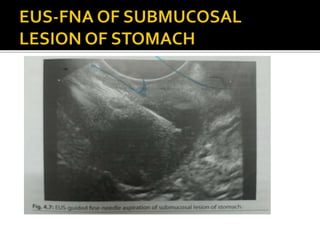
 Linear EUS produces an image that is parallel
to axis of insertion of scope, this orientation
facilitates real time US guidance intervention
such as FNA as endosonologist can
simultaneously visualize the needle as weel
as tissue/ target organ.
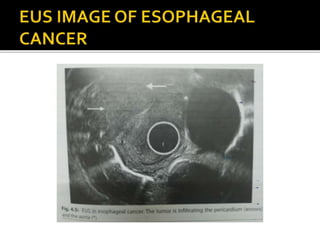
 Esophagus: conventional EUS probe visualize
esophageal wall in five layers but now a days high
frequency probe provide high resolution images; it
images esophageal wall in 9 layers.
 So it provides better T staging of early cancer
(distinguishing more clearly between mucosal and
submucosal lesion lesions).
 It plays very important role in better planning of
surgical treatment.
 EUS FNA has also been shown to better than CT in
detecting nodal mets in CA esophagus.
 Limitations : presence of stenotic lesions
limits the extent to which lesion can be
examined by conventional EUS.
 But in these situations catheter probe EUS
can be used for delineating theT stage of ca
esophagus.
 EUS combined with manometry gives better
deliniation of high pressure zones in motility
disorders.
 In achlasia cardia, EUS has been used to define
the thickness of the muscularis propria at the
level of LES.
 EUS also help in diagnosing other benign
esophageal conditions like esopahageal
duplication cyst, extrinsic compression by
lesions (Lymph node).
 EUS also helps in finding out etiology for
mechanical dysphageal secondary to
extramural compression.
 It is also helpful in establishing diagnoses by
sampling of mediastinal nodes (TB).
 EUS helps in predicting response to
endoscopic dilatation in case of benign
esophageal strictures.
 UNEXPLAINED BILIARY DUCTAL
DILATATION
 Dilatation of CBD is very common finding in
current era .
 Sometimes inspite of various investigations
including MRCP , it is not unusual to find no
cause for dilatation of CBD .
 This is an important issue especially in pts .
With normal LFTs and without JAUNDICE .
 EUS plays a crucial role in such patients with
unexplained CBD dilatation …… cause for the
same is as follows:
1. Small CBD stone missed by other modalities
2. CBD mass in very early stage
3. Benign biliary stricture , mostly secondary to
chronic pancreatitis .
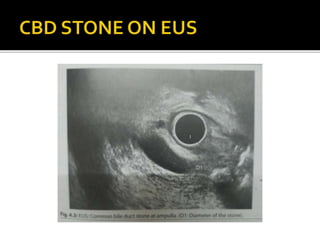
 ERCP is the GOLD standard for diagnosing
CBD stones . But because of risk of various
complications in current era, EUS also holds
crucial role in diagnosing CBD STONE under
special circumstances .
 Using a scoring system comprising AGE, LFT
AND FINDINGS OF USG ABDOMEN . One
can classify pts. Into having LOW ,
INTERMEDIATE or HIGH PROBABILITY of
CBD stones .
 ERCP is prefered modality in high probability
pts.
 EUS & MRCP are better for intermediates
 Whereas for low probability pts , EUS has a
specificity of 90-98% for ruling out CBD
stones.
 Moreover in a recent cochrane review on EUS
vs MRCP for detection of CBD stone , both
have shown equal diagnostic accuracy .
 Despite extensive investigations including
cross sectional imaging, ERCP &
CHOLALNGIOSCOPY ….. BILIARY
STRICTURE REMAINS A DIAGNOSTIC
DILEMMA.
 Endosonography ,EUS guided FNA and IDUS
(intraductal ultrasonogram ) are important
diagnostic modalities for diagnosing
INDTERMINATE STRICTURES .
 Endosonograprhy is well suited for extrahepatic
biliary tree especially DISTAL CBD
 Conventional EUS can easily diagnose benign
strictures related to portal biliopathy and
chronic pancreatitis
 IDUS helps to diagnose malignant etiology of
biliary strictures includes presence of mass in
bile duct , bile duct wall thickness of greater than
3 mm, presence of mass in head of pancreas ,
irregular outer bile duct wall .
 In NUTSHELL ,
 IDUS is better in determining resectibility and
T staging especially for proximal and mid
CBD strictures .
 IDUS seems promising to define the exact
longitudinal intraductal extent of
CHOLANGIOCARCINOMA.
 EUS helps in finding out etiology for acute
pancreatitis when routine investigations fails to
do so (USG, CT, MRCP failed).
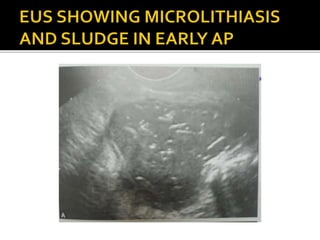
 The role of microlithiasis and sludge as etiology
for AP remains doubtful but EUS caries high
senstivity and specificity for diagnoses of
microlithiasis.
 EUS also helps in diagnosing other uncommon
etiologies for AP such as biliary and pancreatic
ascariasis and hyperparathyroidism.
 Presence and early detection of pancreatic
necrosis in AP has always been a challenge but
EUS may predict the presence of same on very
1st day of admission.
 It also helps in quantifying amount of solid
debris in necrotic pancreatic collections as it has
a role in definite management of these
collections.
 Patient with less than 10% solid debris needs
only 1 session of drainage.
 Collection with 10-40 % of debris require
more than 1 endoscopic sessions for
drainage.
 Collection with more than 40% debris require
surgical necrosectomy.
 Diagnosis of CP relies upon demonstration of
parenchymal and functional changes.
 EUS can detect subtal alterations in parenchyma
and can help in diagnosng CP when other modalities
fails to do so.
 EUS ELASTOGRAPHY has emerged as a promising
technique in detecting parenchymal changes at very
EARLY STAGE.
 It is based on tissue hardness.
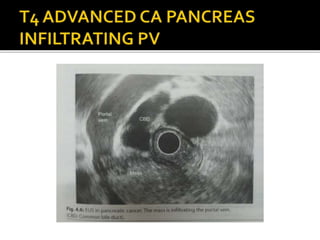
 EUS may define the transverse spread of
malignant lesion with accuracy, it also defines
extra luminal involvement by tumor.
 Determining the depth of lesion and presence of
lymph node mets.
 Senstivity of EUS for diagnosing pancreatic
cancer ranges from 90% to 100%.
 On EUS carcinomas are usually
HYPOENHANCING as compared to
inflammatory pseudotumors and
neuroendocrine tumors which are
hyperenhancing.
 EUS provides fine detail of ampullary region.
 In high risk individuals for pancreatic cancer EUS is as
good as MRI for screening.
 It also helps to differentiate pancreatic benign cystic
lesions from malignant ones on the basis of features:
 Mural nodule
 Thickened cyst wall
 Increase in cyst size
Along with CEA & cystic fluid amylase, a trio of
three shown to have highest sensitivity and
specificity for differentiating mucinous vs non
mucinous
 PSEUDOCYST DRAINAGE
 BILIARY DRAINAGE
 DRAINAGE OF PERILUMINALABCESSESS
 PANCREATIC DUCT DRAINAGE
 EUS GUIDED CELIAC PLEXUS BLOCK
 EUS guided NOTES
 EUS HAS REVOLUTIONIZED endoscopic
transmural drainage of pancreatic collections safely.
 It acccurately characterizes amount of solid necrotic
debris.
 It has advantage over conventional endoscopic
drainage in NON BULGING collections as well as
collections with COLLATERALS and at atypical
locations.
 Retrograde access to biliary tree through ERCP can
be difficult in patients with stenotic papillae,
presence of large periampullary diverticulae or
malignancy or altered anatomy due to Billroth
reconstruction or roux-en-y GJ.
 With the advent of EUS guided biliary access can be
achieved via transgastric or transduodenal route.
 CBD as well as both right and left biliary radicals can
be accessed although its technically very
demanding.
 It is a/k/a celiac plexus neurolysis, is a
chemical ablation of the plexus.
 Using linear EUS temporary blockade of
neurotransmission is inhibited.
 Agents used in CPB are bupivacaine with long
acting steroid.
 In a meta-analysis of EUS guided CPB 80% of
patient got pain relief in advanced CA
pancreas.
 EUS guided brachytherapy
 Ethanol ablation
 EUS guided delivery of antitumor agents
Brachytherapy has been used especially in
pancreatic cancers.
Ethanol ablation used in treatment of NET,
Gastric GIST and hepatic METS.
 In past few years recent advances have changed the
field of EUS AND HAS INCREASED ITS DIAGNOSTIC
ANDTHERAPEUTIC UTILITY.
 When combined with other techniques like CEUS and
EUS elastography the diagnostic utility is far better in
comparison to EUS alone.
 On the other hand IDUS has been emerged as
important diagnostic tool for undetermined
biliary strictures, cholangio CA and ampullary
tumors.
 EUS has important therapeutic role in management
of PFCs, biliary and pancreatic duct drainage,
CPN/CPB, drainage of mediastinal and
intraabdominal abcess and also in achieving
hemostasis in non variceal bleed along with
targeted cancer chemotherapy.
THANK YOU for sparing valuable
time

eus-200527113847.pdf

  • 1.
    Moderator – Dr.Sumit jain onco.surgeon Presenter Dr. Inderpreet Singh PG resident MOBILE NO.9876736845 DMC & H (PUNJAB)
  • 2.
  • 3.
     Endoscopic ultrasound(EUS) has revolutionized the field of both diagnostic and therapeutic gastroentrology.  It is a combination of an endoscope with an ultrasound probe to examine wall of GI tract and beyond.  EUS has transformed itself from a research tool to tool of utmost clinical importance due to its ability to visualize layers of GIT and structures and organs which lies in close proximity to gut wall.
  • 4.
     EUS isvery useful modality for locoregional staging of esophagus, pancreatic and biliary tract cancers.  It is most sensitive method for detection of benign vs malignant tumors of pancreas and has an important role in assessing resectibility of tumors by assessing vascular invasion.
  • 5.
     Depending uponthe design of ulttrasonic probe at the tip of endoscopic probe there are two major designs  1) Radial echo endoscope  2) Linear echo endoscope Other echo endoscopes are: a) Slim blind radial probe for esophageal cancer staging b) Mini probe for superficial and intraluminal pancreaticobiliary ducts c) Forward viewing echo endoscope for therapeutic indications
  • 6.
     Radial echoendoscopes produce image that is perpendicular to the axis of insertion tube and image (360 degree).  Because of inability to view acessory and target organ simultaneously in real time, radial EUS can only be used as diagnostic purpose.
  • 7.
     Linear EUSproduces an image that is parallel to axis of insertion of scope, this orientation facilitates real time US guidance intervention such as FNA as endosonologist can simultaneously visualize the needle as weel as tissue/ target organ.
  • 10.
     Esophagus: conventionalEUS probe visualize esophageal wall in five layers but now a days high frequency probe provide high resolution images; it images esophageal wall in 9 layers.  So it provides better T staging of early cancer (distinguishing more clearly between mucosal and submucosal lesion lesions).  It plays very important role in better planning of surgical treatment.  EUS FNA has also been shown to better than CT in detecting nodal mets in CA esophagus.
  • 12.
     Limitations :presence of stenotic lesions limits the extent to which lesion can be examined by conventional EUS.  But in these situations catheter probe EUS can be used for delineating theT stage of ca esophagus.
  • 14.
     EUS combinedwith manometry gives better deliniation of high pressure zones in motility disorders.  In achlasia cardia, EUS has been used to define the thickness of the muscularis propria at the level of LES.  EUS also help in diagnosing other benign esophageal conditions like esopahageal duplication cyst, extrinsic compression by lesions (Lymph node).
  • 15.
     EUS alsohelps in finding out etiology for mechanical dysphageal secondary to extramural compression.  It is also helpful in establishing diagnoses by sampling of mediastinal nodes (TB).  EUS helps in predicting response to endoscopic dilatation in case of benign esophageal strictures.
  • 16.
     UNEXPLAINED BILIARYDUCTAL DILATATION  Dilatation of CBD is very common finding in current era .  Sometimes inspite of various investigations including MRCP , it is not unusual to find no cause for dilatation of CBD .  This is an important issue especially in pts . With normal LFTs and without JAUNDICE .
  • 17.
     EUS playsa crucial role in such patients with unexplained CBD dilatation …… cause for the same is as follows: 1. Small CBD stone missed by other modalities 2. CBD mass in very early stage 3. Benign biliary stricture , mostly secondary to chronic pancreatitis .
  • 18.
     ERCP isthe GOLD standard for diagnosing CBD stones . But because of risk of various complications in current era, EUS also holds crucial role in diagnosing CBD STONE under special circumstances .  Using a scoring system comprising AGE, LFT AND FINDINGS OF USG ABDOMEN . One can classify pts. Into having LOW , INTERMEDIATE or HIGH PROBABILITY of CBD stones .
  • 19.
     ERCP isprefered modality in high probability pts.  EUS & MRCP are better for intermediates  Whereas for low probability pts , EUS has a specificity of 90-98% for ruling out CBD stones.  Moreover in a recent cochrane review on EUS vs MRCP for detection of CBD stone , both have shown equal diagnostic accuracy .
  • 21.
     Despite extensiveinvestigations including cross sectional imaging, ERCP & CHOLALNGIOSCOPY ….. BILIARY STRICTURE REMAINS A DIAGNOSTIC DILEMMA.  Endosonography ,EUS guided FNA and IDUS (intraductal ultrasonogram ) are important diagnostic modalities for diagnosing INDTERMINATE STRICTURES .
  • 22.
     Endosonograprhy iswell suited for extrahepatic biliary tree especially DISTAL CBD  Conventional EUS can easily diagnose benign strictures related to portal biliopathy and chronic pancreatitis  IDUS helps to diagnose malignant etiology of biliary strictures includes presence of mass in bile duct , bile duct wall thickness of greater than 3 mm, presence of mass in head of pancreas , irregular outer bile duct wall .
  • 23.
     In NUTSHELL,  IDUS is better in determining resectibility and T staging especially for proximal and mid CBD strictures .  IDUS seems promising to define the exact longitudinal intraductal extent of CHOLANGIOCARCINOMA.
  • 24.
     EUS helpsin finding out etiology for acute pancreatitis when routine investigations fails to do so (USG, CT, MRCP failed).  The role of microlithiasis and sludge as etiology for AP remains doubtful but EUS caries high senstivity and specificity for diagnoses of microlithiasis.  EUS also helps in diagnosing other uncommon etiologies for AP such as biliary and pancreatic ascariasis and hyperparathyroidism.
  • 26.
     Presence andearly detection of pancreatic necrosis in AP has always been a challenge but EUS may predict the presence of same on very 1st day of admission.  It also helps in quantifying amount of solid debris in necrotic pancreatic collections as it has a role in definite management of these collections.  Patient with less than 10% solid debris needs only 1 session of drainage.
  • 27.
     Collection with10-40 % of debris require more than 1 endoscopic sessions for drainage.  Collection with more than 40% debris require surgical necrosectomy.
  • 28.
     Diagnosis ofCP relies upon demonstration of parenchymal and functional changes.  EUS can detect subtal alterations in parenchyma and can help in diagnosng CP when other modalities fails to do so.  EUS ELASTOGRAPHY has emerged as a promising technique in detecting parenchymal changes at very EARLY STAGE.  It is based on tissue hardness.
  • 29.
     EUS maydefine the transverse spread of malignant lesion with accuracy, it also defines extra luminal involvement by tumor.  Determining the depth of lesion and presence of lymph node mets.  Senstivity of EUS for diagnosing pancreatic cancer ranges from 90% to 100%.  On EUS carcinomas are usually HYPOENHANCING as compared to inflammatory pseudotumors and neuroendocrine tumors which are hyperenhancing.
  • 30.
     EUS providesfine detail of ampullary region.  In high risk individuals for pancreatic cancer EUS is as good as MRI for screening.  It also helps to differentiate pancreatic benign cystic lesions from malignant ones on the basis of features:  Mural nodule  Thickened cyst wall  Increase in cyst size Along with CEA & cystic fluid amylase, a trio of three shown to have highest sensitivity and specificity for differentiating mucinous vs non mucinous
  • 32.
     PSEUDOCYST DRAINAGE BILIARY DRAINAGE  DRAINAGE OF PERILUMINALABCESSESS  PANCREATIC DUCT DRAINAGE  EUS GUIDED CELIAC PLEXUS BLOCK  EUS guided NOTES
  • 33.
     EUS HASREVOLUTIONIZED endoscopic transmural drainage of pancreatic collections safely.  It acccurately characterizes amount of solid necrotic debris.  It has advantage over conventional endoscopic drainage in NON BULGING collections as well as collections with COLLATERALS and at atypical locations.
  • 34.
     Retrograde accessto biliary tree through ERCP can be difficult in patients with stenotic papillae, presence of large periampullary diverticulae or malignancy or altered anatomy due to Billroth reconstruction or roux-en-y GJ.  With the advent of EUS guided biliary access can be achieved via transgastric or transduodenal route.  CBD as well as both right and left biliary radicals can be accessed although its technically very demanding.
  • 35.
     It isa/k/a celiac plexus neurolysis, is a chemical ablation of the plexus.  Using linear EUS temporary blockade of neurotransmission is inhibited.  Agents used in CPB are bupivacaine with long acting steroid.  In a meta-analysis of EUS guided CPB 80% of patient got pain relief in advanced CA pancreas.
  • 36.
     EUS guidedbrachytherapy  Ethanol ablation  EUS guided delivery of antitumor agents Brachytherapy has been used especially in pancreatic cancers. Ethanol ablation used in treatment of NET, Gastric GIST and hepatic METS.
  • 37.
     In pastfew years recent advances have changed the field of EUS AND HAS INCREASED ITS DIAGNOSTIC ANDTHERAPEUTIC UTILITY.  When combined with other techniques like CEUS and EUS elastography the diagnostic utility is far better in comparison to EUS alone.  On the other hand IDUS has been emerged as important diagnostic tool for undetermined biliary strictures, cholangio CA and ampullary tumors.
  • 38.
     EUS hasimportant therapeutic role in management of PFCs, biliary and pancreatic duct drainage, CPN/CPB, drainage of mediastinal and intraabdominal abcess and also in achieving hemostasis in non variceal bleed along with targeted cancer chemotherapy.
  • 39.
    THANK YOU forsparing valuable time