Europeana Status Quo
Vilnius Aggregator meeting 07/10/2013
Joris Pekel
@jpekel
Thursday 10 October 2013(w)
About
Thursday 10 October 2013(w)
Content
à Where do we come from?
à Where are we at?
à Where are we going?
Thursday 10 October 2013(w)
Where do we come from?
Thursday 10 October 2013(w)
History of Europeana
à April 2005: Jacques Chirac wrote to European Commission President
José Manuel Barroso, recommending the creation of a virtual
European library
à EC’s Information Society and Media Directorate had been supporting
European digital information exchange projects for 15 years
à September 2005: publication of EC’s i2010 strategy on digital libraries
à 2007: European Digital Library Network – EDLnet – began building
Europeana, funded under i2010
à November 2008: Europeana prototype launched
à Summer 2010: prototype became an operational service funded under
the EC’s CIP ICT-PSP (Competitiveness and Innovation Framework
Programme)
à January 2011: New Renaissance Report published - endorses
Europeana as ‘the reference point for European culture online’
à September 2012: Europeana metadata released under CC0 waiver,
making it freely available for re-use
Thursday 10 October 2013(w)
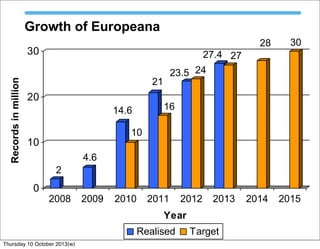
Growth of Europeana
2
4.6
14.6
10
21
16
23.5 24
27.4 27
28 30
0
10
20
30
Recordsinmillion
2008 2009 2010 2011 2012 2013 2014 2015
Year
Realised Target
Thursday 10 October 2013(w)
Where do we come from?
à Very low barriers for joining
à ‘Ploughing’ the European cultural heritage sector
à Extreme rapid growth
à Great in making change, not so great in providing great value
Thursday 10 October 2013(w)
Where are we now?
Thursday 10 October 2013(w)
Where are we now?
à Nearly hit the 30M metadata records
à Rights labeling campaign
à Metadata quality
à Change in funding
à Europeana strategy plan 2015-2020
à Great in quantity, not so great in quality
Thursday 10 October 2013(w)
Where are we going?
Thursday 10 October 2013(w)
Where are we going
à Europeana has to become a trustworthy source for
accessing cultural content
à Platform driven vs. portal driven
à Continue to set standards on a legal and technical level
à Europeana Cloud
à Providing access to content
à Provide tangible value to our data providers
Thursday 10 October 2013(w)
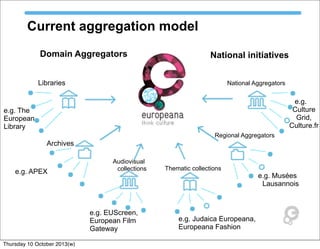
Current aggregation model
Domain Aggregators National initiatives
Audiovisual
collections
National Aggregators
Regional Aggregators
Archives
Thematic collections
Libraries
e.g. Musées
Lausannois
e.g.
Culture
Grid,
Culture.fr
e.g. The
European
Library
e.g. APEX
e.g. EUScreen,
European Film
Gateway
e.g. Judaica Europeana,
Europeana Fashion
Thursday 10 October 2013(w)
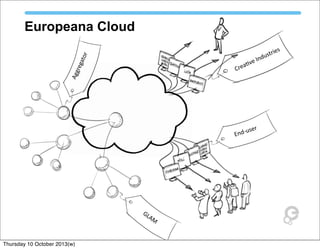
Europeana Cloud
GLAM
%
End)user%
Crea0ve%Industries%
Aggregator%
Thursday 10 October 2013(w)
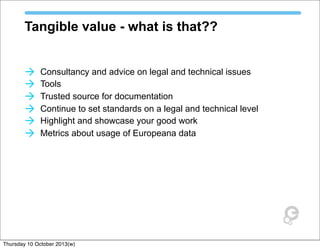
Tangible value - what is that??
à Consultancy and advice on legal and technical issues
à Tools
à Trusted source for documentation
à Continue to set standards on a legal and technical level
à Highlight and showcase your good work
à Metrics about usage of Europeana data
Thursday 10 October 2013(w)
Conclusion
Thursday 10 October 2013(w)
Conclusion
à High quality data is key for success
à Europeana as partner to move your institution forward in the
digital age
à Making content available for re-use
Thursday 10 October 2013(w)
Thank you
Joris Pekel
joris.pekel@kb.nl
@jpekel
Thursday 10 October 2013(w)

Europeana status quo

  • 1.
    Europeana Status Quo VilniusAggregator meeting 07/10/2013 Joris Pekel @jpekel Thursday 10 October 2013(w)
  • 2.
  • 3.
    Content à Where dowe come from? à Where are we at? à Where are we going? Thursday 10 October 2013(w)
  • 4.
    Where do wecome from? Thursday 10 October 2013(w)
  • 5.
    History of Europeana àApril 2005: Jacques Chirac wrote to European Commission President José Manuel Barroso, recommending the creation of a virtual European library à EC’s Information Society and Media Directorate had been supporting European digital information exchange projects for 15 years à September 2005: publication of EC’s i2010 strategy on digital libraries à 2007: European Digital Library Network – EDLnet – began building Europeana, funded under i2010 à November 2008: Europeana prototype launched à Summer 2010: prototype became an operational service funded under the EC’s CIP ICT-PSP (Competitiveness and Innovation Framework Programme) à January 2011: New Renaissance Report published - endorses Europeana as ‘the reference point for European culture online’ à September 2012: Europeana metadata released under CC0 waiver, making it freely available for re-use Thursday 10 October 2013(w)
  • 6.
    Growth of Europeana 2 4.6 14.6 10 21 16 23.524 27.4 27 28 30 0 10 20 30 Recordsinmillion 2008 2009 2010 2011 2012 2013 2014 2015 Year Realised Target Thursday 10 October 2013(w)
  • 7.
    Where do wecome from? à Very low barriers for joining à ‘Ploughing’ the European cultural heritage sector à Extreme rapid growth à Great in making change, not so great in providing great value Thursday 10 October 2013(w)
  • 8.
    Where are wenow? Thursday 10 October 2013(w)
  • 9.
    Where are wenow? à Nearly hit the 30M metadata records à Rights labeling campaign à Metadata quality à Change in funding à Europeana strategy plan 2015-2020 à Great in quantity, not so great in quality Thursday 10 October 2013(w)
  • 10.
    Where are wegoing? Thursday 10 October 2013(w)
  • 11.
    Where are wegoing à Europeana has to become a trustworthy source for accessing cultural content à Platform driven vs. portal driven à Continue to set standards on a legal and technical level à Europeana Cloud à Providing access to content à Provide tangible value to our data providers Thursday 10 October 2013(w)
  • 12.
    Current aggregation model DomainAggregators National initiatives Audiovisual collections National Aggregators Regional Aggregators Archives Thematic collections Libraries e.g. Musées Lausannois e.g. Culture Grid, Culture.fr e.g. The European Library e.g. APEX e.g. EUScreen, European Film Gateway e.g. Judaica Europeana, Europeana Fashion Thursday 10 October 2013(w)
  • 13.
  • 14.
    Tangible value -what is that?? à Consultancy and advice on legal and technical issues à Tools à Trusted source for documentation à Continue to set standards on a legal and technical level à Highlight and showcase your good work à Metrics about usage of Europeana data Thursday 10 October 2013(w)
  • 15.
  • 16.
    Conclusion à High qualitydata is key for success à Europeana as partner to move your institution forward in the digital age à Making content available for re-use Thursday 10 October 2013(w)
  • 17.