E-TWINNING WORK A  Students  DREAM!
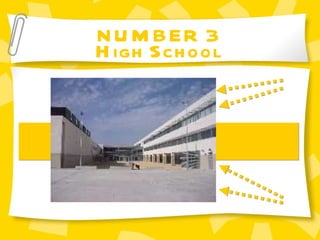
NUMBER 3   H IGH   S CHOOL
H ISTORY Y ear of foundation:  2007 ACADEMICAL DATA 67 professors 754 students The High School offers: 4 levels of Secondary  Education 2 levels of Bachelor
LOCATION outskirts of the city It is located on the
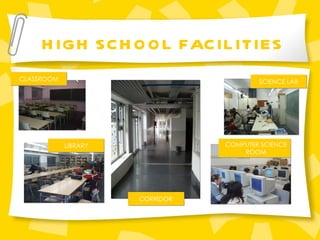
HIGH SCHOOL FACILITIES CLASSROOM LIBRARY CORRIDOR COMPUTER SCIENCE ROOM SCIENCE LAB
HIGH SCHOOL FACILITIES Playground Gym Music room Lunch room Art room Professors common room
O UR  C OMUNNITY O ur region is divided into three provinces:  ALACANT VALENCIA CASTELL Ó T wo official languages are spoken in our  area: Castillian Spanish and Valencian T he yelow part is where we live. T his is the map of our region.
ALICANTE
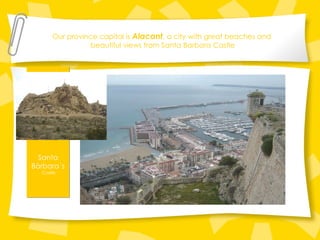
Our province capital is  Alacant , a city with great beaches and  beautiful views from Santa Barbara Castle Santa Bàrbara ´s  Castle
The  “explanada”  in Alacant  is a perfect place to go for a walk!! The best-known beach is called  “ Postiguet”
PLACES TO VISIT TABARCA ´S ISLAND “ SERRA de MARIOLA”
The Capital of the Valencian Region is Valencia, where you will find everything! For example, the marvellous masterpiece of the architect Santiago Calatrava: the Arts and Sciences Museum, together with the Oceanografic and the Auditorium. VAL È NCIA City of ARTS and SCIENCES
MONUMENTS “ Quart” towers Central Market The  “MICALET” “ Marqu és de dos Aguas” Palace
FESTIVITIES The “ M A S C L E T À ” The “fallers” give flower  presents to their Patron Saint.
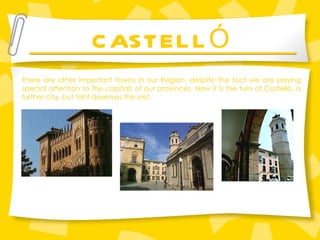
CASTELL Ó There are other important towns in our Region, despite the fact we are paying special attention to the capitals of our provinces. Now it is the turn of Castell ó, a further city, but taht deserves the visit.
C astell ó  is a modern town with a fascinating history P LACES TO  V ISIT The most representative symbol is “El Fadr í” bell tower O pposite is the town market. Moreover, Santa Maria´s cathedral is a stunning 14th century building. In this area there are many samples of Academicist architecture: The  Orphanage , the  “C áñamo” market , the  Grammar School , the  Bishop´s Palace  and  “casa de los caracoles”.
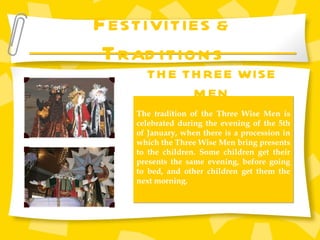
F ESTIVITIES &  T RADITIONS THE THREE WISE MEN The tradition of the Three Wise Men is celebrated during the evening of the 5th of January, when there is a procession in which the Three Wise Men bring presents to the children. Some children get their presents the same evening, before going to bed, and other children get them the next morning.
T HE  H OLY  W EEK The Holy Week in Villena, with an antiquity of more than 150 years, is organized by the “Association of Brotherhoods”.   The so-called “Procesión del Encuentro” where the Virgin of Soledad meets Jesus, accompanied by a devotional song,is extremely emotional.
T HE   E LCHE   M YSTERY   P LAY The Elche Mystery Play, a lyrical drama dating from the Middle Ages, is the city’s most deeply-rooted cultural symbol. In 2001, UNESCO declared it a Masterpiece of World Oral and Intangible Heritage.  The play is performed in the basilica of Santa Maria every 14th and 15th August. It was banned By the Council of Trent, but Elche obtained a Bull From Pope Urban VIII to keep the play alive.
S AN   A NTHONY   F ESTIVITY It is celebrated on 17th January in a village close to Villena, called Biar. A comic figure of a king has the main role in this feast. It embodies the fight among classes and the religions clash between Muslims and Christians in the XVI century. The main typical activities are:  1.-Food collection 2.-Lighting of bonfires in the main streets 3.-Blessing of animals 4.-In Villena the sale of traditional cakes is  typical in this feast.
T he  “ O rej ón” of   v illena The “Orejon” of Villena is one of the most important representations of this town, because, in the past, the “orejón” was placed in an important clock tower and it used to show his head to announce the time point.
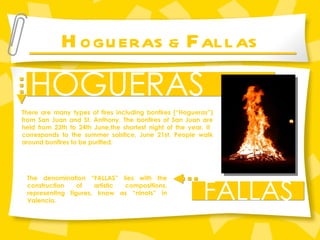
H OGUERAS &  F ALLAS HOGUERAS FALLAS There are many types of fires including bonfires (“Hogueras”) from San Juan and St. Anthony. The bonfires of San Juan are held from 23th to 24th June,the shortest night of the year. It  corresponds to the summer solstice, June 21st. People walk around bonfires to be purified. The denomination “FALLAS” lies with the construction of artistic compositions, representing figures, know as “ninots” in Valencia.
M OORS &  CH RISTIANS In Villena, the Festival of Moors and Christians are held from 4 to 9 September in honor of the Virgin of Virtudes. Its origin is found in 1474, when this Virgin was proclaimed as Patron of the City and counsel against Plague. Her image was placed in a shrine built in 1490, 5 kms from town. Villena citizens go on pilgrimage twice a year, first in March and another on September 8.
GASTRONOMY
T HE  M EDITERRANEAN  D IET Spain and Italy share the so-called Mediterranean diet. Bread, oil and wine have always been present in our diet. Apart from that, we also eat a lot of rice, pasta, fruit, vegetables and all kinds of fish.
T HE  C ULTURE OF  “TAPEO” “ Tapas" (snacks) form a part of the gastronomic Spanish culture. “ Ir de tapas" means going out with friends, to enjoy small snacks.
T HE  P OTATO  O MELETTE It is possibly our best-known dish. Here you have the recipe.   We hope that you like it!
POTATO OMELETTE I ngredients: 1.- 4 eggs, 1/2 kilo of potatoes, oil (a glass, 1/4 of liter), salt. 2.- Wash and cut the potatoes in thin sheets. Fry the potatoes with oil. Add salt.  When they are golden, take them apart to a  plate with absorbent paper. 3.- Beat the eggs with salt. Add the potatoes, mixing everything well. 4.- Add some oil to the frying pan again and put the mixture of the egg and the potatoes. The omelette will be ready when it is golden on both sides.  Take care when you turn it around!! P rocess:
MAP OF SPAIN
GALICIA Seafood Galician octopus.
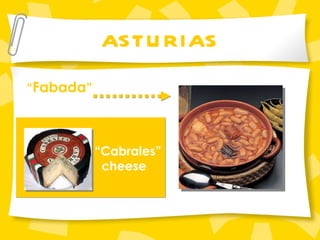
ASTURIAS “ Fabada ” “ Cabrales”  cheese
CANTABRIA “ Sobaos pasiegos” “ Quesada pasiega”
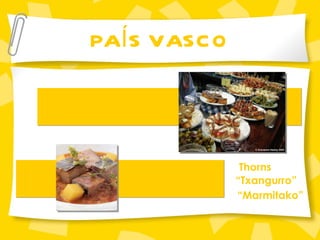
PA ÍS VASCO Thorns “ Txangurro” “ Marmitako”
LA RIOJA & “ Riojan” potatoes Wines Wines Wines
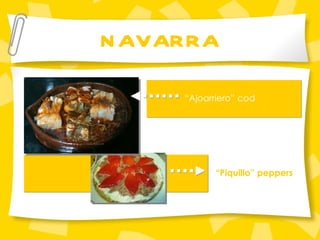
NAVARRA “ Ajoarriero” cod  “ Piquillo” peppers
ARAG ÓN Partridge
CATALUÑA Stuffed Bread with tomato and ham. (“Pa amb tomaca”) Garlic and oil mayonnaise  (“All i oli”)
CASTILLA Y LE ÓN Suckling pig from Segovia “ Chuletón” from Avila
MADRID Stew (“Cocido”) from Madrid Castilla la mancha Cheese of  La Mancha “ Gazpacho”
EXTREMADURA HAM
ANDALUCIA FRIED FISH “ Gazpacho” from  Andaluc ía
CANARIAS BALEARES & “ Papas arrug ás ”with “ Mojo Pic ón” sauce “ Sobrasada” “  Ensaimada”
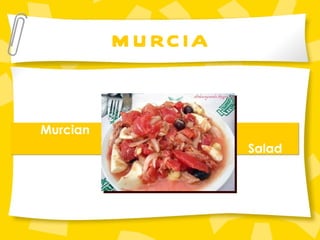
MURCIA Murcian Salad
T he  V alencian C ommunity The Valencian gastronomy is very varied The Valencian weather favours the culture of citrus fruits and vegetables. The orange is one of the typical fruits of the Valencian agriculture .
Our rice: our more international dishes! The most famous is the “paella” In addition, we have great rices,  such as “arroz a banda”  (with fish sauce),  “ black rice” (with squid ink),  rice with egg crust...
T he  V alencian C ommunity The majority of sweets date  from the Moorish conquest. Jijona is the best-know producer of "turrón” very consumed in Spain at Christmas. In Xátiva, the " Arnadí “ is prepared with gourd. In  Villena , there are many typical dishes,  such as “ gachamiga ” (an omelette made of flour)

Etwinning project

  • 1.
    E-TWINNING WORK A Students DREAM!
  • 2.
    NUMBER 3 H IGH S CHOOL
  • 3.
    H ISTORY Year of foundation: 2007 ACADEMICAL DATA 67 professors 754 students The High School offers: 4 levels of Secondary Education 2 levels of Bachelor
  • 4.
    LOCATION outskirts ofthe city It is located on the
  • 5.
    HIGH SCHOOL FACILITIESCLASSROOM LIBRARY CORRIDOR COMPUTER SCIENCE ROOM SCIENCE LAB
  • 6.
    HIGH SCHOOL FACILITIESPlayground Gym Music room Lunch room Art room Professors common room
  • 7.
    O UR C OMUNNITY O ur region is divided into three provinces: ALACANT VALENCIA CASTELL Ó T wo official languages are spoken in our area: Castillian Spanish and Valencian T he yelow part is where we live. T his is the map of our region.
  • 8.
  • 9.
    Our province capitalis Alacant , a city with great beaches and beautiful views from Santa Barbara Castle Santa Bàrbara ´s Castle
  • 10.
    The “explanada” in Alacant is a perfect place to go for a walk!! The best-known beach is called “ Postiguet”
  • 11.
    PLACES TO VISITTABARCA ´S ISLAND “ SERRA de MARIOLA”
  • 12.
    The Capital ofthe Valencian Region is Valencia, where you will find everything! For example, the marvellous masterpiece of the architect Santiago Calatrava: the Arts and Sciences Museum, together with the Oceanografic and the Auditorium. VAL È NCIA City of ARTS and SCIENCES
  • 13.
    MONUMENTS “ Quart”towers Central Market The “MICALET” “ Marqu és de dos Aguas” Palace
  • 14.
    FESTIVITIES The “M A S C L E T À ” The “fallers” give flower presents to their Patron Saint.
  • 15.
    CASTELL Ó Thereare other important towns in our Region, despite the fact we are paying special attention to the capitals of our provinces. Now it is the turn of Castell ó, a further city, but taht deserves the visit.
  • 16.
    C astell ó is a modern town with a fascinating history P LACES TO V ISIT The most representative symbol is “El Fadr í” bell tower O pposite is the town market. Moreover, Santa Maria´s cathedral is a stunning 14th century building. In this area there are many samples of Academicist architecture: The Orphanage , the “C áñamo” market , the Grammar School , the Bishop´s Palace and “casa de los caracoles”.
  • 17.
    F ESTIVITIES & T RADITIONS THE THREE WISE MEN The tradition of the Three Wise Men is celebrated during the evening of the 5th of January, when there is a procession in which the Three Wise Men bring presents to the children. Some children get their presents the same evening, before going to bed, and other children get them the next morning.
  • 18.
    T HE H OLY W EEK The Holy Week in Villena, with an antiquity of more than 150 years, is organized by the “Association of Brotherhoods”. The so-called “Procesión del Encuentro” where the Virgin of Soledad meets Jesus, accompanied by a devotional song,is extremely emotional.
  • 19.
    T HE E LCHE M YSTERY P LAY The Elche Mystery Play, a lyrical drama dating from the Middle Ages, is the city’s most deeply-rooted cultural symbol. In 2001, UNESCO declared it a Masterpiece of World Oral and Intangible Heritage. The play is performed in the basilica of Santa Maria every 14th and 15th August. It was banned By the Council of Trent, but Elche obtained a Bull From Pope Urban VIII to keep the play alive.
  • 20.
    S AN A NTHONY F ESTIVITY It is celebrated on 17th January in a village close to Villena, called Biar. A comic figure of a king has the main role in this feast. It embodies the fight among classes and the religions clash between Muslims and Christians in the XVI century. The main typical activities are: 1.-Food collection 2.-Lighting of bonfires in the main streets 3.-Blessing of animals 4.-In Villena the sale of traditional cakes is typical in this feast.
  • 21.
    T he “ O rej ón” of v illena The “Orejon” of Villena is one of the most important representations of this town, because, in the past, the “orejón” was placed in an important clock tower and it used to show his head to announce the time point.
  • 22.
    H OGUERAS & F ALLAS HOGUERAS FALLAS There are many types of fires including bonfires (“Hogueras”) from San Juan and St. Anthony. The bonfires of San Juan are held from 23th to 24th June,the shortest night of the year. It corresponds to the summer solstice, June 21st. People walk around bonfires to be purified. The denomination “FALLAS” lies with the construction of artistic compositions, representing figures, know as “ninots” in Valencia.
  • 23.
    M OORS & CH RISTIANS In Villena, the Festival of Moors and Christians are held from 4 to 9 September in honor of the Virgin of Virtudes. Its origin is found in 1474, when this Virgin was proclaimed as Patron of the City and counsel against Plague. Her image was placed in a shrine built in 1490, 5 kms from town. Villena citizens go on pilgrimage twice a year, first in March and another on September 8.
  • 24.
  • 25.
    T HE M EDITERRANEAN D IET Spain and Italy share the so-called Mediterranean diet. Bread, oil and wine have always been present in our diet. Apart from that, we also eat a lot of rice, pasta, fruit, vegetables and all kinds of fish.
  • 26.
    T HE C ULTURE OF “TAPEO” “ Tapas" (snacks) form a part of the gastronomic Spanish culture. “ Ir de tapas" means going out with friends, to enjoy small snacks.
  • 27.
    T HE P OTATO O MELETTE It is possibly our best-known dish. Here you have the recipe. We hope that you like it!
  • 28.
    POTATO OMELETTE Ingredients: 1.- 4 eggs, 1/2 kilo of potatoes, oil (a glass, 1/4 of liter), salt. 2.- Wash and cut the potatoes in thin sheets. Fry the potatoes with oil. Add salt. When they are golden, take them apart to a plate with absorbent paper. 3.- Beat the eggs with salt. Add the potatoes, mixing everything well. 4.- Add some oil to the frying pan again and put the mixture of the egg and the potatoes. The omelette will be ready when it is golden on both sides. Take care when you turn it around!! P rocess:
  • 29.
  • 30.
  • 31.
    ASTURIAS “ Fabada” “ Cabrales” cheese
  • 32.
    CANTABRIA “ Sobaospasiegos” “ Quesada pasiega”
  • 33.
    PA ÍS VASCOThorns “ Txangurro” “ Marmitako”
  • 34.
    LA RIOJA &“ Riojan” potatoes Wines Wines Wines
  • 35.
    NAVARRA “ Ajoarriero”cod “ Piquillo” peppers
  • 36.
  • 37.
    CATALUÑA Stuffed Breadwith tomato and ham. (“Pa amb tomaca”) Garlic and oil mayonnaise (“All i oli”)
  • 38.
    CASTILLA Y LEÓN Suckling pig from Segovia “ Chuletón” from Avila
  • 39.
    MADRID Stew (“Cocido”)from Madrid Castilla la mancha Cheese of La Mancha “ Gazpacho”
  • 40.
  • 41.
    ANDALUCIA FRIED FISH“ Gazpacho” from Andaluc ía
  • 42.
    CANARIAS BALEARES &“ Papas arrug ás ”with “ Mojo Pic ón” sauce “ Sobrasada” “ Ensaimada”
  • 43.
  • 44.
    T he V alencian C ommunity The Valencian gastronomy is very varied The Valencian weather favours the culture of citrus fruits and vegetables. The orange is one of the typical fruits of the Valencian agriculture .
  • 45.
    Our rice: ourmore international dishes! The most famous is the “paella” In addition, we have great rices, such as “arroz a banda” (with fish sauce), “ black rice” (with squid ink), rice with egg crust...
  • 46.
    T he V alencian C ommunity The majority of sweets date from the Moorish conquest. Jijona is the best-know producer of "turrón” very consumed in Spain at Christmas. In Xátiva, the " Arnadí “ is prepared with gourd. In Villena , there are many typical dishes, such as “ gachamiga ” (an omelette made of flour)