Ethnography: A Theoretically Oriented Practice 1st ed. Edition Vincenzo Matera
Ethnography: A Theoretically Oriented Practice 1st ed. Edition Vincenzo Matera
Ethnography: A Theoretically Oriented Practice 1st ed. Edition Vincenzo Matera
Ethnography: A Theoretically Oriented Practice 1st ed. Edition Vincenzo Matera
Ethnography: A Theoretically Oriented Practice 1st ed. Edition Vincenzo Matera
1.
Download the fullversion and explore a variety of ebooks
or textbooks at https://ebookmass.com
Ethnography: A Theoretically Oriented Practice 1st
ed. Edition Vincenzo Matera
_____ Follow the link below to get your download now _____
https://ebookmass.com/product/ethnography-a-theoretically-
oriented-practice-1st-ed-edition-vincenzo-matera/
Access ebookmass.com now to download high-quality
ebooks or textbooks
2.
We have selectedsome products that you may be interested in
Click the link to download now or visit ebookmass.com
for more options!.
Ethnography: A Theoretically Oriented Practice 1st ed.
Edition Vincenzo Matera
https://ebookmass.com/product/ethnography-a-theoretically-oriented-
practice-1st-ed-edition-vincenzo-matera/
The Social Organization of Best Practice: An Institutional
Ethnography of Physicians’ Work 1st ed. Edition Fiona
Webster
https://ebookmass.com/product/the-social-organization-of-best-
practice-an-institutional-ethnography-of-physicians-work-1st-ed-
edition-fiona-webster/
Writing Friendship: A Reciprocal Ethnography 1st ed. 2020
Edition Paloma Gay Y Blasco
https://ebookmass.com/product/writing-friendship-a-reciprocal-
ethnography-1st-ed-2020-edition-paloma-gay-y-blasco/
C++ Programming: An Object-Oriented Approach, 1e ISE 1st
Edition Behrouz A. Forouzan
https://ebookmass.com/product/c-programming-an-object-oriented-
approach-1e-ise-1st-edition-behrouz-a-forouzan/
3.
The Palgrave Handbookof Urban Ethnography 1st Edition
Italo Pardo
https://ebookmass.com/product/the-palgrave-handbook-of-urban-
ethnography-1st-edition-italo-pardo/
Russia's Public Diplomacy: Evolution and Practice 1st ed.
2020 Edition Anna A. Velikaya
https://ebookmass.com/product/russias-public-diplomacy-evolution-and-
practice-1st-ed-2020-edition-anna-a-velikaya/
Environmentally Oriented Modernization of Power Boilers
1st Edition Marek Pronobis
https://ebookmass.com/product/environmentally-oriented-modernization-
of-power-boilers-1st-edition-marek-pronobis/
Higher Education in Market-Oriented Socialist Vietnam: New
Players, Discourses, and Practices 1st ed. Edition Phan Le
Ha
https://ebookmass.com/product/higher-education-in-market-oriented-
socialist-vietnam-new-players-discourses-and-practices-1st-ed-edition-
phan-le-ha/
Adaptation Considered as a Collaborative Art: Process and
Practice 1st ed. Edition Bernadette Cronin
https://ebookmass.com/product/adaptation-considered-as-a-
collaborative-art-process-and-practice-1st-ed-edition-bernadette-
cronin/
Contents
1 Ethnography: ATheoretically Oriented Practice
Introduction 1
Vincenzo Matera and Angela Biscaldi
Part I Grounds for Sociocultural Anthropology: USA,
UK, FR, IT
2 Ethnography Before Ethnography: Genesis
and Developments of Fieldwork in North America 21
Enzo Vinicio Alliegro
3 Before and After Science: Radcliffe-Brown, British
Social Anthropology, and the Relationship Between
Field Research, Ethnography, and Theory 51
Alessandro Mancuso
4 “Ethnography in France”: Ethnographic Practices
and Theories in Marcel Griaule Between the Empirical
and Rhetorical 81
Angela Biscaldi and Vincenzo Matera
v
10.
vi CONTENTS
5 TheStructural Formula of the Team: Reflections
on Ernesto de Martino’s Ethnographic Method 103
Giovanni Pizza
Part II Anthropology (Theory) vs Ethnography
(Fieldwork)
6 Illusion of Immediate Knowledge or Spiritual
Exercise? The Dialogic Exchange and Pierre
Bourdieu’s Ethnography 129
Ferdinando Fava
7 The Bridge and the Dance: Situational Analysis
in Anthropology 159
Marco Gardini and Luca Rimoldi
8 Politics Within Anthropology 181
Vincenzo Matera
9 Stumbling Blocks: The Irruption of the Interpretive
Approach in Twentieth-Century Anthropology 207
Patrizia Resta
Part III Visual, Dialogical, Sensorial, Multi-sited
Ethnography
10 The Anthropologist’s Eye: Ethnography, Visual
Practices, Images 231
Francesco Faeta
11 Dennis and Barbara Tedlock: The Dialogic Turn
in Anthropology 263
Angela Biscaldi
11.
CONTENTS vii
12 Ethnographyand Embodiment 277
Ivo Quaranta
13 Exploring Mobility Through Mobility: Some
of the Methodological Challenges of Multi-sited
Ethnography in the Study of Migration 293
Bruno Riccio
Part IV Deconstructions
14 Participant Observation: The Personal Commitment
in Native Life—A Problematic Methodological Topos 313
Gabriella D’Agostino
15 The Weberian Line of Anthropology: George Marcus
from Writing Culture to Design 341
Alessandro Simonicca
16 Making the Invisible Ethnography Visible: The
Peculiar Relationship Between Italian Anthropology
and Feminism 371
Michela Fusaschi
17 Beyond the Field: Ethnography, Theory, and Writing
in Anthropology 395
Fabio Dei
Author Index 417
Subject Index 423
12.
Notes on Contributors
EnzoVinicio Alliegro (Ph.D.) is Associate Professor of anthropological
disciplines at the University of Naples Federico II. His study interests are
focused on the history of anthropology—both Italian and North Amer-
ican—historical and symbolic anthropology, anthropology of the terri-
tory and the environment in crisis. He is author of the book Terraferma.
Un’altra Basilicata tra stereotipi, identità e [sotto]sviluppo (2019).
Angela Biscaldi (Ph.D.) is Associate Professor at the Department of
Social and Political Sciences, University of Milano. Her research focuses
on ethnography of communication, with particular emphasis on perfor-
mativity, agentivity and indexicality in everyday educational practices. She
is coauthor, with Vincenzo Matera, of the book Antropologia dei social
media (2019).
Gabriella D’Agostino (Ph.D.) is Full Professor of Cultural Anthro-
pology at Palermo University, Dipartimento Culture e Società. She is
author of the book Sous le traces. Anthropologie et contemporanéité (2018),
and Editor of the journal of Human Sciences “Archivio Antropologico
Mediterraneo” https://journals.openedition.org/aam/. http://www.arc
hivioantropologicomediterraneo.it/.
Fabio Dei is Associate Professor of Cultural Anthropology in the Univer-
sity of Pisa. He is Editor of the new Journal Rivista di antropologia
contemporanea. He is author of the book Cultura popolare in Italia. Da
Gramsci all’Unesco (2018).
ix
13.
x NOTES ONCONTRIBUTORS
Francesco Faeta is Full Professor of Cultural Anthropology. He has
taught at the University of Calabria and the University of Messina and
now teaches, as an external teacher, at the School of Specialization for the
DEA Cultural Heritage of the University “La Sapienza” of Rome. He is
author of the book La passione secondo Cerveno (2019).
Ferdinando Fava (Ph.D.) is Associate Professor of Cultural and Urban
Anthropology, at the Department of Scienze Storiche, Geografiche e
dell’Antichità of the University of Padova, and “Chercheur Membre
Statutaire” CNRS-UMR 7218 LAVUE (Laboratoire Architecture Ville
Urbanisme Environnement) Équipe LAA. He is author of the book Qui
suis-je pour mes interlocuteurs ? Préface de Marc Augé. Avant-propos de
Monique Selim (2015).
Michela Fusaschi (Ph.D.) is Associate Professor in the Department of
Political Sciences of the University of Roma Tre (Italy). She is one of the
main authors in the anthropology of the FGM/C practices, proposing
an interpretative approach based on the concepts of bio-politics and
moral economy. She is author of the book Corpo non si nasce, si diventa.
Antropologiche di genere nella globalizzazione (2018).
Marco Gardini is enlisted as Researcher at the Department of Political
and Social Sciences at the University of Pavia. He is author of the book
La Terra Contesa. Conflitti fondiari e lavoro agricolo in Togo (2017).
Alessandro Mancuso (Ph.D.) is Assistant Professor at the University of
Palermo (Italy). He did a long fieldwork among the Wayuu people of
Colombian Guajira. He is author of the book Altre persone. Antropologia,
visioni del mondo e ontologie indigene (2018).
Vincenzo Matera is Full Professor of Cultural and Social anthropology
at the University of Bologna, Department of Cultural Heritage (Ravenna
Campus). He also teaches Social history of culture at USI (Università della
Svizzera Italiana), Faculty of Communication, Culture and Society. He is
author of the book Antropologia contemporanea (2017) and editor of the
special issue De-constructing the Field, Archivio Antropologico Mediter-
raneo online, XVI (2013), 15 (2)—http://www.archivioantropologico
mediterraneo.it/.
Giovanni Pizza (Ph.D.) is Associate Professor in Cultural and Medical
Anthropology at the Department of Filosofia, Scienze Sociali, Umane e
della Formazione of the University of Perugia (Italy). He is author of the
14.
NOTES ON CONTRIBUTORSxi
book Il tarantismo oggi. Antropologia, politica, cultura (2015), and Editor
of AM. Rivista della società di antropologia medica—https://www.antrop
ologiamedica.it/am-rivista-della-sicieta-italiana-di-antropologia-medica/.
Ivo Quaranta is Associate Professor in Cultural Anthropology and
Ethnology at the Department of History and Cultures of the University
of Bologna (Italy) and Director of the Research Center in International
and Intercultural Health (CSI) (University of Bologna). He is editor of
the book Assemblages, Transformations and Politics of Care (2019).
Patrizia Resta is Full Professor of Cultural Anthropology at the Depart-
ment of Humanities Studies, Cultural Heritage, Education Science of
the University of Foggia (Italy). Her scientific interests deal with specific
thematic fields such as Legal Anthropology, blood feud and conflict reso-
lution. She is author of the book Pensare il sangue (2002) and Editor
of the book Di terra e di mare. Pratiche di appartenenza a Manfredonia
(2009).
Bruno Riccio (Ph.D.) is Full Professor of Cultural Anthropology and
the director of the research center on Mobility Diversity and social Inclu-
sion (MODI) at the Department of Education of the University of
Bologna (Italy). He is Editor of the book From Internal to Transnational
Mobility (2016), cofounder of the Italian Society for Applied Anthro-
pology and codirector of the journal Antropologia Pubblica https://riv
iste-clueb.online/index.php/anpub.
Luca Rimoldi (Ph.D.) is researcher in Cultural Anthropology at the
Department of Political and Social Science of the University of Catania
(Italy). He conducts ethnographic research in Italy and Senegal, focussing
on memory, work and forms of social exclusion. He is author of the book
Lavorare alla Pirelli-Bicocca. Antropologia delle memorie operaie (2017).
Alessandro Simonicca is Associate Professor of Cultural Anthropology
at Sapienza University of Rome and, currently, Director of the Ethnolog-
ical Mission of the Ministry for Foreign Affairs for South America. He is
author of the book Sull’estetico etnografico (2019).
2 V. MATERAAND A. BISCALDI
With this volume we offer both a historical overview and a critical
reflection on ethnography—how it originated, and how it was concep-
tualized, represented, and discussed by anthropologists.
It is intended as a tool for deepening the conditions that have seen
the emergence of the research practice, the branches it has taken in rela-
tion to particular theoretical needs, the role it played in the construction
of anthropological knowledge and the limits that sometimes affected its
effectiveness.
It is also a “dense” support that is rich in indications and suggestions
for anyone interested in practicing ethnography, studying it, becoming an
anthropologist, or, more in general, doing social research.
Furthermore, it aims to emphasize the particular and innovative char-
acter of the Italian anthropological tradition with reference to an anthro-
pological gaze full of political sensitivity, long unexpectedly overlooked;
it aims to account for the great liveliness that Italian anthropology has
taken on, especially in recent decades, in the critical confrontation with
the international guidelines of the discipline.
The aspect that characterizes the volume is the central idea that
animates it: repositioning ethnography at the core of the anthropolog-
ical tradition and showing the extent to which ethnography is strongly
connected to a sophisticated theoretical reflection and deeply embedded
in cultural and social anthropology. Outside this intellectual endeavor,
ethnography itself has little value, and nor does the knowledge one
may hope to obtain through the naive use of a so-called “ethnographic
method.”
This does not mean to deny that ethnography also exists outside
anthropology, for example in research based on Max Weber’s theory
of social action, in the symbolic interactionism of the Chicago School
or in ethnomethodology, but anthropology is certainly the discipline in
which ethnography originated and which has cultivated it deeper and for
longer. It is the discipline that maintains the most intimate and exclusive
relationship with ethnography.
As a consequence, ethnography can no longer be viewed as the simple
empirical side of anthropology, or as a “practical” mode of research, a kind
of technique; it requires a recognition of its high theoretical value since
the real core of ethnography (and anthropological knowledge) lies in the
way in which it formulates research problems and conceptually defines its
objects.
17.
1 ETHNOGRAPHY: ATHEORETICALLY ORIENTED … 3
“Being there” in itself has no value; otherwise, the best ethnographers
would be the missionaries—and there are those who have said this—or
they would be the “natives” themselves—and there are those who have
said this, as well.
So, the common thread of the essays contained in this volume, beyond
the particular perspectives of the individual authors, therefore lies in the
belief that ethnography is a theoretical elaboration tool and, because of
this, it becomes an indispensable part in any production of knowledge on
social and cultural facts.
We think that outside this frame, ethnography is nothing, just as little
knowledge is believed to be able to derive by a “simple use” of the
ethnographic method (that without reference theory does not exist).
In the chapters of the volume, in fact, there are many ethnographic
approaches, aimed at grasping worlds, networks, or flows of meanings,
which both sprang from and are projections of theoretical concepts and
intellectual sensibilities, but there is no “method.”
To confirm what we say, we quote the sentence of a famous British
social anthropologist, suspiciously very critical of the practice he had prac-
ticed for a long time, with intensity and with remarkable results during
his career:
Anyone who is not a complete idiot can do fieldwork, […]. It has been
my woeful experience that many a student comes home from the field to
write just another book about just another people, hardly knowing what
to do with the grain he has been at such pains to garner. (Evans-Pritchard
1973, p. 3)
This statement should not be understood as an absolute criticism of field-
work. Rather, it is an implicit call to those solid foundations of theory
that allow the anthropologist to win the decisive battle, that is not fought
in the field but in the study afterward, Evans-Pritchard said. In fact, theo-
retically oriented ethnography is necessary in order to go beyond the
surface of everyday projects, actions and words, toward those invisible
bonds that bind individuals together and give body to the community
(or communities) to which they belong.
Today (the last couple of decades), communities have opened up and
become porous; the protagonists of primordial myths have been replaced
(or joined) by movie stars or football champions, political leaders, and
rock stars; the “dense” description is being replaced (or flanked) by the
18.
4 V. MATERAAND A. BISCALDI
anthropology of global processes (Comaroff and Comaroff 1992; Fabietti
et al. 2020).
Anyway, ethnography is not a simple “global interview.” There is
always something more, there is always another “level” that is not
directly perceptible and that escapes the immediate conceptualization of
the “here”—on the spot—and the “now”—in the present—of empirical
research, of fieldwork.
This “something” is certainly ambiguous, indeterminate, incoherent,
asymmetrical, open to intertwining sometimes inextricable, but never
completely meaningless; moreover, it is always attributable to constraints
(for example, “material conditions of existence”) and to power relation-
ships (for example, “dominant and dominated”); in other words, it is
identifiable.
This means that subjective, personal, and individual action is always
rooted in society, history, and culture (Wright Mills 1961; Ginzburg
1986; Comaroff and Comaroff 1992; Appadurai 1996, 2004). The ways
of this rooting are opaque, and we have the task of trying to make
them as transparent as possible (cfr. Hannerz 2010). Without this projec-
tion in wider frames, toward the wider world of power and meaning,
ethnography loses its potential.
So ethnography emerges in this volume as a fragment—a multiplicity
of fragments—which aims to be reunited with a (partial) totality (Fillitz
2013). How? There is no univocal answer to this crucial theoretical and
methodological question, even if we consider the current enlargement of
the classic ethnographic “field” (Matera 2013).
Instead, there are many. Some of these are outlined in this volume. In
fact, the volume presents both a historical overview of ethnography and a
thematic discussion of its major trends, which have oriented research prac-
tice in the field in different periods. It also presents more marginal—in the
sense that they are undervalued in history of anthropology or introduc-
tory textbooks—modes of ethnographic research (for example feminist
and phenomenological approaches), those that had less impact and reso-
nance inside the academic community, but that nonetheless had a solid
theoretical frame and a range of insights with regard to their effectiveness
as paths to gaining anthropological knowledge.
The volume is divided into four parts.
Part I, Grounds for sociocultural anthropology: USA, UK, FR,
IT, lays the foundations for our discussion. Enzo Vinicio Alliegro,
in Ethnography before ethnography argues that, although anthropologists
19.
1 ETHNOGRAPHY: ATHEORETICALLY ORIENTED … 5
are used deconstructing mythological narratives to unveil their under-
lying logic of power and functioning, they themselves contribute and are
victim to them. This is the case in the history of ethnography, which is
often simplistically traced back to the works of Malinowski and Radcliffe-
Brown in the early twentieth century. Through a thorough comparison
with the specialist literature and relying on a large mass of documen-
tary sources, the article deals with the origins of ethnography, focusing
on the pioneering research activities conducted in the United States of
America. In the second half of the nineteenth century, the sensitive and
bloody question of the natives made the study of the so-called “red-
skins” urgent, and led to a methodology based on a long stay in the
field. Even though an ill-concealed guilt has clouded this research period
for a long time, after over a hundred years, it is now possible to go back
to the contribution and brilliant intuitions of such students as Franz H.
Cushing and James Mooney, who, along with colleagues of the Bureau of
American Ethnology, laid the foundations of conscious scientific ethno-
logical methodology, acknowledged as such first by M. Mauss and then by
Claude Lévi-Strauss. Particularly worthy in this sense is the “transforma-
tive spiral” triggered during his fieldwork experience, by which Cushing
changed from an “extraneous unidentified object” into a trustworthy
“subject” according to a dynamic that recalls the anecdote that Clifford
Geertz tells at the beginning of his perhaps most famous essay:
My wife and I were still very much in the gust-of wind stage, a most
frustrating, and even, as you soon begin to doubt whether you are really
real after all, unnerving one, when, ten days or so after our arrival, a large
cockfight was held in the public square to raise money for a new school…
(1973, p. 413)
In the ethnographic cases presented in Alliegro’s essay, the radical impor-
tance of the experience marks the researchers in the body, as well as in
the mind, and it stands out and qualifies their research as ethnographic.
Why then, is the birth of ethnography linked to Malinowski?
Alessandro Mancuso, in Radcliffe-Brown, Evans-Pritchard and the
Issue of the Relationships between Fieldwork Methods, Ethnography and
Theory in British Social Anthropology, analyzes another crucial context for
ethnography, the British one, and focuses on the figure of A. R. Radcliffe-
Brown, who has contributed to the consolidation of the procedures for
the construction of anthropological knowledge.
20.
6 V. MATERAAND A. BISCALDI
Mancuso underlines how Radcliffe-Brown’s theoretical social anthro-
pology program as a “natural science of society” empirically founded
on the “comparative method” for generalization purposes on social
phenomena has been seen as a fundamental research tool useful not only
to guarantee reliability scientific work to collect and record ethnographic
documentation, but also to empirically test theoretical hypotheses.
In the first part of the paper, Mancuso exposes some points of debate
inside British Social Anthropology before 1960 on how to organize
fieldwork research and ethnographic monographs by trying to concil-
iate the stress that Radcliffe-Brown puts on the search for the normative
and structural aspects of social life with the Malinowskian imperative of
presenting thorough documentary evidence of every detail of “natives’”
views, beliefs, discourses, and behavior, also taking in account individual
variation. In the second part, he focuses on the new twist to which
these epistemological dilemmas about the aims of fieldwork research and
ethnography were submitted after Evans-Pritchard’s turn to a view of
social anthropology as a discipline which rather deals with the study of
“moral systems” and it is closer to history and humanities than to the
models of natural sciences.
Angela Biscaldi and Vincenzo Matera, in Ethnography in France.
Ethnographic practices and theories in Marcel Griaule explore how
ethnography in France—a relatively neglected scholarly practice till the
late twenties—developed and was actually practiced and conceptualized
during the two world wars up to the late fifties, when Marcel Griaule
published his now classic Méthode de l’Ethnographie (1957), the first
ethnographic handbook available in French. The chapter highlights how
the idea of ethnography of Marcel Griaule was really variable and contin-
gent, going from a documentary ethnography, to a semi dialogical and
exegetical ethnography—as it emerges from the famous Conversation
with Ogotemmeli—, to a new redefinition of ethnography as judiciary
inquiry, as it was strongly expressed in Méthode. On the background of
Griaule’s ethnographic in progress idea, there was the project of the Insti-
tute of Ethnology established by a physical anthropologist (Paul Rivet),
a sociologist of Durheimian obedience (Marcel Mauss), and a socialist,
politically influential academic philosopher (Lucien Lévy-Bruhl) at the
University of Paris in 1925. During the twenties and thirties, the Insti-
tute of Ethnology promoted several “ethnographic expeditions” (among
which the renowned Dakar-Djibouti mission, conducted in 1931–1933
by a research collective led indeed by the young Marcel Griaule), which
21.
1 ETHNOGRAPHY: ATHEORETICALLY ORIENTED … 7
contributed to codify ethnography as a specific set of practices which ulti-
mately merged into the general scientific framework offered in Griaule’s
handbook. From this standpoint, Conversations with Ogotemmeli appears
as an exception, even if this exception probably become in the work
of Marcel Griaule’s daughter, Genevieve, the bridge between this first
ethnographic practice in France and the dialogical anthropology of the
80s in the United States. The chapter asks what kind of characteristics
may help to describe a “French ethnographic tradition,” and according
to which kind of features it might be considered specific in comparison
to other relevant anthropological/ethnographic national traditions of the
same time period (USA, UK, Italy). It finally asks to what extent a French
ethnographic tradition contributed to developing a certain anthropolog-
ical style (understood as a set of ethnographic practices and theories
together).
Giovanni Pizza, “The structural formula of the équipe [team].” Reflec-
tions on the historical-ethnographic method of Ernesto de Martino is the last
chapter in Part I. The author proposes some reflections on the ethno-
graphic methodology of Ernesto de Martino (Naples 1908–Rome 1965),
in particular as regards what he himself called “la formula strutturale
dell’équipe.” What is an “ethnographic équipe [team]”? It is the main
question that the essay tries to answer. As he has been considered the
“father” of a specific vein in Italian anthropology, de Martino is really an
original thinker and an anthropologist whose theoretical lines as well as
methodologies are really unique and original. In the chapter, after revis-
iting some of the main ethnographic research carried out by de Martino
and his team in Southern Italy (above all the one in Apulia on taran-
tism), the author goes deep inside what has been considered as an “Italian
style” in ethnography, stressing the advantages and limits of this pecu-
liar scientific practice in the history of global cultural anthropology. The
reinterpretation presented in Pizza’s text becomes the premise to resume
the “Italian ethnographic style” with a somewhat ironic register. Pizza
proposes a rereading of the ethnographer de Martino articulated in three
main points: the role of fieldwork in the production of anthropolog-
ical knowledge; the effects in terms of Italian mimesis of Demartinian
ethnography; the “cognitive blindness” recently observed in the results
of its production, after the southern Italy trilogy. Today, we wonder why
de Martino did not take into consideration the entry of the Italian State
on the southern scene, despite it seeming to be an anachronistic oper-
ation (a bit like criticizing Tristi Tropici for the lack of “ethnographic
22.
8 V. MATERAAND A. BISCALDI
acumen”), because it is an important way to trace the foundations (and
also the entanglements) of Italian anthropology from the postwar period
up to now.
Part II, Anthropology (Theory) vs Ethnography (Fieldwork),
opens with the essay by Ferdinando Fava, Illusion of immediate knowledge
(immediacy) or spiritual exercise? The dialogic exchange and Pierre Bour-
dieu’s ethnography. This contribution attempts to locate the ethnographic
practice of Pierre Bourdieu by articulating two perspectives that are
distinct but not separate. First of all, it illustrates the function that ethnog-
raphy assumed in the construction of the central concepts of his “theory
of practice” (habitus, field, temporality, symbolic capital) in his scientific
and biographical trajectory. It then identifies the characteristics of Bour-
dieu contemporary reception and appropriation in socio-anthropological
research contexts.
How to read Bourdieu? This is the question that Fava asks at the begin-
ning of the text to point out the complexity of reading the author’s work
in a nontemporally offset way, so to speak, with respect to the author
himself. Rather, it is a question of bringing out the logic of his research
practice without reducing it to pure methodology.
It follows very similar reasoning to the idea that the basis of an intel-
lectual product is always a process of research, reflection, study, and
thought.
Ethnography is a product that is accessible to any reader. However,
without the elements that can help to reconstruct the process that under-
lies it, it is de-historicized and reified by the writing. There is always a
distance between theoretical statements and empirical practices; in the
case of ethnography, this distance has appeared to be constant since the
time of Malinowski. How is it possible to look closely without losing sight
of the structures that produce what you look at.
Fava tries to answer this question in detail and with strict reference to
Bourdieu’s texts. Accounting for the “total meaning of the experience” is
what he proposes, an outcome that can only be achieved through the
gradual and progressive convergence of different research practices on
the same subject. This is a modus operandi to be continuously reviewed
to escape the “illusion of immediacy”: social relations are not reduced
to interactions between subjectivities animated by intentions and motiva-
tions; rather, they are always stuck in social and economic positions. Here
there is a distrust of an ethnography completely focused on action. A
French and an Algerian, a conversation between a “white” and a “black”
23.
1 ETHNOGRAPHY: ATHEORETICALLY ORIENTED … 9
activate a communication between dominant and dominated, imbued
with relationships of strength, colonial history, and politics.
In the final part, Fava’s chapter presents the inversion that characterizes
the way Gerard Althabe takes Bourdieu’s perspective: for Althabe, unlike
Bourdieu, it is the world of the dominant that takes on meaning in the
world of the dominated.
Luca Rimoldi and Marco Gardini present an essay entitled An
Anthropologist on the Bridge. Max Gluckman and his Analysis of Social
Situations. It explores the ethnographic method of the Manchester
school: a method based on the detailed descriptions of particular social
situations, the analysis of different strategies and positioning of the
actors involved, which aims to present the materials that anthropologists
collected in the field, but which uses them not as illustrative examples of
given structural principles, but rather as points of entry for understanding
the dynamism and variability of the contexts under investigation.
Specifically, the chapter explores the methodological contribution of
Max Gluckman in his Analysis of a Social Situation in Modern Zulu-
land (1940–1942; 1958). By analyzing the literature on this essay, it
takes into consideration the communities and innovations that this text
has produced over time.
Although influenced by the structural-functionalist frame, the analysis
that Gluckman carries out in describing the events of January 7, 1938,
builds a bridge to a contemporary public anthropology. The three parts
in which the essay is divided show the complexities of Gluckman’s idea of
ethnography, expressed in the extended case study. Moreover, the ethno-
graphic method proposed by Gluckman and practiced by the researchers
of his Seven-Years-Research-Plan at the Rhodes-Livingston Institute and,
later, by his students at the Manchester School, enriched the context of
ethnographic analysis by bringing in new figures (colonial administrators
and officials, missionaries, mine owners, and trade unionists), new sources
(documents of colonial administrators, censuses, written and oral histor-
ical sources), new roles that groups and individuals play in producing,
reproducing or questioning norms and values.
The chapter highlights the interconnections between ethnographic
practice and a sophisticated theoretical reflection.
Vincenzo Matera, Politics within Cultural and Social Anthropology,
aims to underline the theoretical depth of ethnography, retracing some
significant steps of anthropology in the second half of the twentieth
century. The goal is to trace and highlight the effects of the discovery of
24.
10 V. MATERAAND A. BISCALDI
history and consequently of politics (and ethics) within the production of
anthropological knowledge, also, though not only, through ethnography.
In particular, the essay runs through Antonio Gramsci’s intuitions
regarding the political potential of popular culture, and connects them
to the developments of the Italian line of reflection, which are not always
linear and sometimes ambivalent.
It reveals the impossibility of a “neutral” anthropology and the power
of a political sensitivity in the approach, ethnographic or otherwise, to
social and cultural phenomena.
The text also highlights that the Gramscian conceptualization of
popular culture, which had and continues to have a lot of influence on
cultural analysis, inside and outside anthropology, all over the world, has
been elaborated in the enclosure of a cell.
The chapter also focuses on one of the most famous books written
by an Italian anthropologist and translated outside Italy: Vittorio
Lanternari’s, The Religions of the Oppressed. A Study of Modern Messianic
Cults. When Lanternari’s book was published in the American edition
(1963), a great deal of criticism was directed at it. Some of this criticism
was made by specialists in particular areas on the risks of large gener-
alizations. In his reading of this debate, which is significant of the link
between cultural anthropology and ethnography that was prevalent in the
immediate postwar period, Matera would like to point out that omissions
of ethnographic details and misunderstandings of the cultural significance
of a specific element do not always undermine the theoretical, analytical,
and heuristic relevance of the reading of such a large phenomenon as the
one at the center of Lanternari’s analysis. And vice versa, we should also
consider how much even maniacal ethnographic precision, achieved after
years of specific in-depth study in the same “field,” does not ultimately
prove itself to be devoid of any theoretical significance; in short, it is “mis-
sionary knowledge” of very little use for the purposes of anthropological
theory.
The last chapter of Part II is Patrizia Resta Stumbling blocks. The
irruption of the interpretive approach in twentieth century anthropology.
Geertz’s interpretive anthropology has guided the anthropological debate
of the mid-twentieth century, laying the deconstructionist approach foun-
dation privileged by the anthropological discipline at the end of the same
century. In a broader perspective, without attempting to exhaust the
topic, this chapter proposes to relaunch some questions: first, that of
ethnographic practice. Did Geertz’s reflections undermine the authority
25.
1 ETHNOGRAPHY: ATHEORETICALLY ORIENTED … 11
of the ethnographic paradigm in its connection with the field as it
had hitherto been known and practiced? Or is it possible to find the
original features that distinguish the epistemological dimension of the
ethnographic paradigm in its theoretical methodological proposal? In
his collected works, do the “parochial facts” allow the emergence of
the “broad principles” in which the possibility of understanding them is
embedded? Or has reflexivity oriented his research to such an extent that
no posthumous diary can allow a different interpretation? Very briefly,
reevaluated at a distance, can we say that the interpretive paradigm has
been truly revolutionary, innovative, alternative or that it must be repo-
sitioned in the discipline’s historical trajectory oriented toward assuming
diversity within the framework of cultural creativity? The author empha-
sizes the critical issues of the interpretative and ethnographic perspectives
that emerged in the twentieth century, in particular research contexts,
such as those in which corruption and organized crime are articulated.
Patrizia Resta highlights the great contradiction present in an ethnog-
raphy that places itself, in the light of a long and settled empirical practice
and theoretical reflection, as an effective tool for understanding the other
with respect to which, however, it turns out to be condemned to the
inscrutable opacity that the other opposes him.
Despite the enormous influence it has exercised on the anthropolog-
ical debate throughout the last century, the interpretative approach and
anthropological writing show all their limitations and they stop in the face
of contexts of unquestionable relevance in the contemporary world that
oppose an unsurpassed impermeability.
Part III, Visual, Dialogical, Sensorial, Multi-sited ethnography,
counts four chapters on specific research approaches in ethnography.
The first is by Francesco Faeta, Seeing means knowing (Zu sehen
bedeutet zu wissen). On visual paradigm in ethnography. Taking as a
matter of fact a specific and complex consideration of ethnography
(authoritatively supported by other writings present in the book), Faeta’s
chapter focuses on the issues of the gaze connected with fieldwork. He
dwells on the critical exiguity of anthropological reflection on the topic,
and on the need to define in theoretical terms, even with the help of
conceptual frameworks tangent the disciplinary field (see, i.e., Maurice
Merleau-Ponty and Pierre Bourdieu), the nature of the ethnographic
gaze, in the perspective of the visual construction of the subject and of the
access of this subject to the awareness of the ethnographic relationship.
26.
12 V. MATERAAND A. BISCALDI
In this perspective, Faeta emphasizes the body-gaze and body-world
relationships, on the background of the consideration that visual processes
have had in the construction of knowledge in the contemporary West.
Finally, he tries to focus on the link between ethnography and photog-
raphy (identified as a valuable tool for a critique of the gaze), with atten-
tion to some possibilities of experimental and “conceptual” declination of
this connection.
Faeta points out that it is not important what we look at, but how
we look and he points out that the critical and self-critical effort of each
ethnographer must be based on a systematic analysis of his own, as well
as others’, way of seeing.
Visual ethnography can act as the foundation of the most extensive
research practices as a tool for a critique of the gaze.
Only this perception of reality can lead to the construction of an
ethnography that restores the consistency of the data in front of us in
a non-naive or superficial way.
The second chapter in this section is by Angela Biscaldi. The chapter,
entitled Dennis and Barbara Tedlock: Dialogical Anthropology, discusses
three main aspects of Barbara Tedlock’s and Dennis Tedlock’s fieldwork
and anthropological reflection; poetics, participation, and translation.
According to Barbara and Dennis Tedlock, every act of speech, writing,
or doing has a poetic dimension. They discuss how the categories of a
poetics based in Western literacy tradition require extensive revaluation in
order to improve our comprehension of native arts and our concept of
performance too.
Barbara and Dennis Tedlock were also interested in the personal
encounter of the anthropologist and the informant and in examining
how this encounter serves as the origin of the ethnographic material.
They reflect on and critically engage with their own participation within
the ethnographic frame and on the consequences of thinking and doing
anthropology as dialogue, not only during fieldwork, but in publication
as well. Barbara Tedlock created the concept of “Observation of partic-
ipation.” During participant observation ethnographers attempt to be
both emotionally engaged participants and coolly dispassionate observers.
In the observation of participation, ethnographers both experience and
observe their own and others’ coparticipation within the ethnographic
encounter. The shift from one methodology to the other entails an impor-
tant representational transformation. Finally, translation is the main topic
of Barbara and Dennis Tedlock’s reflection. They proposed the concept
27.
1 ETHNOGRAPHY: ATHEORETICALLY ORIENTED … 13
of “dialogical anthropology”—an important epistemological paradigm
turn. Analogical anthropology involves the replacement of one discourse
(the native one) with another (the anthropological one). Analogical
Anthropology is “Talking above,” “talking beyond,” or “talking later”; it
produces a result. Dialogical anthropology is “talking across” or “talking
alternately”; it illustrates processes and changes. Theoretical and method-
ological implications of this shift are relevant, and they are analyzed in the
chapter.
Ivo Quaranta Sensory and Embodied Ethnography presents in a critical
way the paradigm of embodiment that helped to redefine the very way
cultural processes are conceptualized and investigated in social sciences.
By placing the analysis at the level of lived experience, embodiment has
emerged as a powerful way to relate perceptions and sensations to broader
socio-historical dynamics. Such a shift, though, did not focus merely on
the issues of the cultural construction of the body and the senses, it rather
allowed analyses to account for the very process of actors’ engagement in
the production of meaning, i.e., in the practical embodied production of
culture.
If culture is rooted in, and emerges from, social practices and these are
inevitably incorporated, then corporeality is not an accessory segment, a
specialized theme, to rise to a constitutive and unavoidable dimension of
anthropological reflection.
Working through the incorporation paradigm does not require specific
research objects or special data; it means adopting a posture aimed at
grasping the relationship that research themes maintain with corporeality.
The body of the ethnographer therefore should not be understood as a
natural and unmediated tool for data collection, but as a tool for meeting,
negotiating, and cultural production.
Within this broader theoretical scenario, ethnography has been
profoundly reframed as an embodied practice as well. The contribution
aims at reconstructing such a theoretical debate arguing how sensory
ethnography has allowed scholarship to de-intellectualize the interpreta-
tions of social reality, placing intercorporeality as the very lived ground
of that mutual understanding that we represent through ethnographic
writing.
Bruno Riccio, Exploring Mobility through Mobility. The Challenges of
Multi-sited Ethnography from Marcus and Hannerz to nowadays, closes
this Part. With the aim of grasping “glocal” nexuses as much as different
28.
14 V. MATERAAND A. BISCALDI
human experiences of movement (migration, tourism, aid, and develop-
ment) within contemporary societies, mobile approaches as multi-sited
research developed, where the field was shaped by following people,
kin, and other social networks, economic and social remittances, political
projects, etc. Drawing on ethnographic examples, Riccio shows how this
methodological perspective is well suited to the analysis of displacement
through space: considering migrants and their families in both the place
of origin and contexts of arrival considerably facilitates the understanding
of a complex and multidimensional process such as migration.
By following migrants’ relationships and practices, Riccio connected
up the different locations and methodological experiences (participant
observation, interviews, archive research, and life stories) by continuously
comparing their life and professional stories (similarities and differences)
while also engaging spatially with the continuous references and compar-
isons between actions and thoughts that surfaced in the different field
research sites.
Simultaneously Riccio considers and discusses critical challenges to
such an extension of the ethnographic field. More than on Space, he
focuses on Time as a crucial variable to be managed in the attempt
to compensate the “centrifugal” dispersion of multi-sited explorations.
In fact, the multi-sited character of migration ethnography may be
appreciated not only in terms of space, but also from a temporal perspec-
tive: ethnography is not only multi-sited but also multi-temporal, thus
addressing the need to adopt a longitudinal perspective and periodically
revisit the field as the years pass.
The last Part is Part IV. Visual, Dialogical, Sensorial, Practical,
Multi-sited ethnography. This Part opens with Gabriella D’Agostino
Participant observation. A problematic methodological topos.
The chapter begins with Malinowski, an author who could not be left
out of a book dedicated to ethnography. While it is well known that the
attribution of the ethnographic primacy to the Polish anthropologist is
a matter of disciplinary tradition rather than of history [cf. Alliegro], the
importance of the Argonauts, and also of the Diaries, remains unquestion-
able for the foundation of the ethnographic practice and for the scientific
status of the knowledge acquired by its means.
Gabriella D’Agostino reads in depth the most significant passages
in this sense of the famous Introduction to the Argonauts, explains and
problematizes the foundational value of a specifically ethnographic epis-
temology. She also reads Malinowski’s Diaries, not as a stone of a scandal
29.
1 ETHNOGRAPHY: ATHEORETICALLY ORIENTED … 15
but as a counterpart to a practice that is in itself reflective, ambivalent, and
finally procedural, as the ethnographic one will later reveal in unsuspected
years.
This essay has several purposes: highlighting some issues related to
Malinowski’s theory and practice of research, which are full of impli-
cations not always grasped in their theoretical and methodological
complexity; recalling some criticisms that have been put forward in
the anthropological debate toward the notion of reflexive observation;
discussing some uses and abuses of ethnographic practice in disciplinary
domains other than anthropology.
We leave the reader with the difficult task of determining whether
the pioneering role that disciplinary history attributes to Malinowski is
founded or not.
The second chapter of this part is by Alessandro Simonicca, Marcus
and Clifford, between deconstruction and agency in anthropological field
work. The essay aims to retrace some fundamental phases of the interpre-
tive anthropological currents of the late twentieth century, focusing on
the relationship between the “end of the subject” in philosophical decon-
struction (first French, then American) and “text” as an ethnographic
organization of anthropological discourse.
Referring to authors such as George Marcus and James Clifford, it has
the intention of demonstrating both the usefulness of the notion of text
and the overcoming of the classical antinomies of the relationship between
power/structure and action in ethnography.
The concept of design is introduced here. Design is an analytical repre-
sentation of reality: the researcher connects and groups certain aspects of
reality by providing a category capable of understanding realities without
clear boundaries. Both for logical structure and for theoretical refer-
ences, it is connected to the ideal type of Wax Weber, in the sense of
a conceptual framework that functions as a scheme for a case of the
world. Anthropology, for Marcus, is topological research that focuses on
the practice of connectivity. With it the anthropologist tries to under-
take an ontological, conceptual, and moral commitment with the world;
and this practice places “design” at the center, as an arrangement that
gives access to an understanding of reality. The notion of “design” has
been central in recent decades and continually appeals to how Marcus—
referring to design disciplines such as architecture or art—defines his two
souls: “design practice” and “design studio,” a model for doing and a
30.
16 V. MATERAAND A. BISCALDI
model for understanding. The common matrix is the idea of a non-
theory driven practice, but a series of regulatory skills whose structure
is the collaborative cognitive enterprise, which is carried out by means of
invention, learning, and analysis processes.
Michela Fusaschi The theory and practice of gender ethnography: a text-
book case of invisibility. The gender ethnography such as feminist anthro-
pology has a long history, but they are a textbook case of invisibility,
at least in Italy. The contemporary anthropology analysis has focused on
denaturalizations and deconstruction to unveil the mechanisms of power
and the dynamics of social hierarchy. In this sense, cultural anthropology
would have had to acquire the commitment and reflexivity of gender and
feminist ethnography without hiding them or relegating them into “ded-
icated texts.” Why are anthropologists such as Denise Paulme, Germaine
Tillion, Michelle S. Rosaldo, Louise Lamphere, Nicole-Claude Mathieu,
Gayle Rubin, Marilyn Strathern, Henrietta Moore, and Lila Abu-Lughod
less famous than Bronislaw Malinowki, Edward Evan Evans-Pritchard,
Marcel Griaule, Claude Lévi-Strauss, and Clifford Geertz? The author
of this chapter proposes the reconstruction of some of these exemplary
ethnographies to bring them to the heart of the history of anthropology.
The goal is to show how theory, practice, and posture of feminist ethnog-
raphy produce analytical-descriptive elaboration on gender and generation
of how they are multi-located, sexed, and historicized even in the form of
critique politics for the recognition of subjects and subjectivity.
Fabio Dei “Beyond the field: research experience and theoretical elab-
oration in anthropological traditions” closes Part IV. The centrality of
field research, so strong in mainstream English-speaking anthropology,
sometimes turns unduly into a sort of “mystique of fieldwork,” according
to which anthropological knowledge stems directly from the researcher’s
subjective experience.
If Geertz and the Writing Culture movement insisted on rhetorical-
literary devices filtering field experience, its relationship with the theoret-
ical dimension of anthropological writing is less clear. This aspect can be
explored in two directions: (a) the analysis of anthropological traditions
including forms of empirical research other than fieldwork; (b) the anal-
ysis of “mainstream” authors in which the research/theory relationship is
configured in a less classical way, e.g., with a conspicuous theoretical elab-
oration based on the use of empirical data not directly produced through
fieldwork.
31.
1 ETHNOGRAPHY: ATHEORETICALLY ORIENTED … 17
If the attention to the anthropology-literature link has diminished over
time, Fabio Dei underlines how that intellectual season contributed to
accentuate the myth of a fieldwork as a subjective experience, testimony
of participation, of political denunciation, or of anti-hegemonic prac-
tice. It is a conception of research that perhaps still covers part of the
real ethnographic work. But it does not account for a more widespread
reality of empirical research, which does not take place in “other” worlds
but also in “ours” and is no longer divided between a clearly separated
Being there and Being here. It is research that uses multiple methods of
dialogue, documentation, data “collection,” but also of engagement and
involvement of the researcher in the context studied.
In conclusion, the author calls for a different way of character-
izing anthropological research, which arises from a broader comparison
between the different histories and traditions. However, it takes into
account the essential core of ethnography: an endeavor to cautiously and
patiently punctuate the fine grain of social relations, that which gener-
ally escapes grand models and the surface of official and institutional
self-representations.
Finally, a retrospection. In 1997, a book entitled Ethnography. Writings
and representations of anthropology was published in Italy written by Ugo
Fabietti, and one of the two editors of this volume, Vincenzo Matera.
The theoretical core of that volume is the writing, understood as
the engine of any research project aimed at producing knowledge on
social and cultural phenomena. The book emphasized that the strength
of anthropology lies in its ability to construct wide-ranging discourses
on cultural diversity and that this ability is played out in the field of
writing and representation. The anthropologist creates a discursive field,
a way of considering problems, events, conflicts, and values. Whether he
uses fieldwork or other sources to do this, what matters is the power
to engage with the representation he has built. In other words, the speci-
ficity of anthropological knowledge lies in the way it sets problems, thinks
about them, and represents them, not in what, without theoretical open-
ness, is reduced to a mere “technique” of research, nor (even less) in the
“courage” of the intrepid explorer/ethnographer. Today, that position
leads both editors of this volume to reaffirm that “ethnography without
anthropology is nothingness” (Ingold 2007) to express a critique of the
ethnographic “fashion” that has dominated and still dominates the recent
field: a retreat into angles of the world from which few then succeed in
32.
18 V. MATERAAND A. BISCALDI
coming out in a convincing way. The ability to persuade is played on a
complexity that has many faces, as emerges in the following chapters.
References
Appadurai, A. (1996). Modernity at Large. Cultural Dimensions of Globalization.
Minneapolis: University of Minnesota Press.
Appadurai, A. (2004). The Capacity to Aspire. In R. Vijayendra & M. Walton
(Eds.), Culture and Public Action. Stanford: Stanford University Press.
Comaroff, J., & Comaroff, J. L. (1992). Ethnography and Historical Imagina-
tion. Boulder, CO: Westview Press.
Evans-Pritchard, E. E. (1973). Some Reminiscences and Reflections on Field-
work. Journal of the Anthropological Society of Oxford, 4(1), 1–12.
Fabietti, U., & Matera, V. (Eds.). (1997). Etnografia. Scritture e rappresentazioni
dell’antropologia. Roma: Carocci.
Fabietti, U., Malighetti, R., & Matera, V. (2020). Dal tribale al globale. Milano:
Pearson.
Fillitz, T. (2013). Spatialising the Field: Conceptualising Fields and Interconnec-
tions in the Context of Contemporary Art of Africa. In V. Matera (Ed.),
De-constructing the Field (Archivio Antropologico Mediterraneo [on line],
XVI, 15(2), 19–28).
Geertz, C. (1973). Deep Play: Notes on the Balinese Cockfight. In C. Geertz
(Ed.), The Interpretation of Cultures (pp. 412–454). Boston: Basic Book.
Ginzburg, C. (1986). Miti, emblemi, spie. Torino: Einaudi.
Hannerz, U. (2010). Anthropology’s World. Life in a Twenty-First Century
Discipline. London: Pluto Press.
Ingold, T. (2007). Anthropology Is Not Ethnography. Radcliffe-Brown Lecture to
the British Academy.
Lanternari, V. (1963). The Religions of the Oppressed. A Study of Modern Messianic
Cults. New York and London: McGibbon & Kee.
Matera, V. (2013). Deconstructing the Field. Archivio Antropologico Mediter-
raneo, XVI, 15(2).
Matera, V. (2019). La memoria dell’antropologo. Retrospezioni o interpretazioni
ex-post. Antropologia, 6(1), 49–61.
Wright Mills, C. (1961). The Sociological Imagination. New York: Grove Press.
22 E. V.ALLIEGRO
lesson in the method and style of the processes of production of anthro-
pological knowledge (Harris 1968; Mercier 1972; Firth 1981; Silverman
1981; Kuper 1996; Rivière 1998; Fabietti 2001; Barnard 2000; Kuklick
2008; Pavanello 2009; Barth et al. 2010; Signorelli 2011).
It is thanks to the eminent George W. Stocking that we have a clear
and determinate distancing from this premise, which depends upon guilty
historiographic omissions that overlooked a series of prior activities. In
the well-known essay, The ethnographer’s: fieldwork in British anthropology
from Tylor to Malinowski (Stocking 1983), Stocking conducted an accu-
rate act of historical revision, demonstrating the presence of an interesting
and well-established ethnographic tradition that preceded Malinowsky.
Through a varied and dense body of documents, the historian highlighted
the degree to which the narration that obscured the nineteenth-century
roots of ethnography is ascribable, on one hand, to Malinowski himself,
who was the architect of an insidious self-celebratory policy sustained
by specific rhetorical strategies of self-representation that made their
way into the noted 1922 monograph (Malinowski 1922) and, on the
other hand, to the posthumous appraisals put forth by James Frazer,
Alfred C. Haddon and Max Gluckman (Stocking 1983, pp. 110–112),
which authoritatively sealed this self-investiture by supporting it with
peremptory judgments.
In the spirit of Stocking’s exemplary essay, and within the framework
of a historiographic field which was never extinguished and which would
warrant being appropriately revitalized, the present work aims to examine
some of the ethnographic experiences of the nineteenth century that took
place in North America, in particular in the United States, taking advan-
tage of the remarkable heuristic value of documentary sources. That is to
say, it makes use of field-notes—diaries, epistolary exchanges, and notes—
that make possible the recovery of a very particular analytic perspective
and the adumbration of the less evident secrets of the experience of field-
work, exactly as occurred with Malinowski’s posthumous publications
(Malinowski 1967).
Preparing to write a history of ethnography before ethnography, that is
to say, a prehistory or an archaeology of ethnography, not only entails the
possibility of reflecting on the sociopolitical, historical, and cultural factors
that facilitate—or impede—the genesis and the development of a kind of
knowledge, but it also makes it possible to highlight the significance of
a research trajectory aimed at delineating an anthropology of disciplinary
memory, or, an ethnography of those retrospective writings which, in
36.
2 ETHNOGRAPHY BEFOREETHNOGRAPHY: GENESIS … 23
presenting themselves as impartial actions of representation of the past,
actually end up exceeding this by assuming the honor of presenting a kind
of group icon. In fact, employing peremptory judgments framed around
specific genealogical directions, retrospective reconstructions push, in any
case, toward the definition of “traditions” and “scientific schools,” config-
uring “legacies” and intellectual “loans” from the evident symbolic and
identitarian functions. More generally, therefore, dealing with some of
the mechanisms that underlie the reconstruction of the past entails exam-
ining the operations of stabilization and capitalization of memory, which
are always conceivable in terms of the construction of identity (Alliegro
2011), that is, a strategy of research of the traits deemed foundational to,
and constitutive of, the definition of any sort of cultural identity—in this
case, a “disciplinary identity.”
Beginnings
A specific conjuncture of political, social, and cultural variables acted as a
particularly fertile soil for the development of ethnography in the United
States. Within diligently controlled territorial boundaries, beginning with
the scrupulous geographic mapping required for military control of the
terrain, thousands of men from different continents found themselves
compelled to share a close and problematic coexistence. The history of the
“New World,” spanning multiple centuries beginning with the landing
of the first European vessels, made the “Promised Land” a space that
was strongly characterized in multi-ethnic terms and, thus, a fertile soil
for the birth of anthropological studies. Nonetheless, those who evoked
such ethnographic interest were neither western immigrants nor enslaved
African peoples, but rather the native peoples of the North American
continent who, by virtue of their singular and surprising “being-there,”
constituted an obstacle to the politics of expansion—a material and
moral impediment standing in the way of the “conquest of the West”
(Bergamini 2002).
The initial occasional observation of the native peoples and their subse-
quent closer investigation took place in a historico-political context in
which the understanding of cultural difference was not only a matter of
conscience, that is, an expiatory tool in the face of the evident ethnocide
and genocide which was taking place, but also a matter of state—a patri-
otic enterprise serving the pressing demands of “state building”—as well
as a matter of science—a cognitive opportunity to confront the questions
37.
24 E. V.ALLIEGRO
with which the “civilisational” processes were invested and in relation to
which the “autochthonous race” represented both an enormous ques-
tion and an insidious solicitation. Between the eighteenth and nineteenth
centuries, then, men who often shared a political and ideological orienta-
tion while having diverse and often controversial motivations and varying
degrees of preparation, initiated investigative journeys in which the atten-
tion toward the indigenous peoples increasingly adopted the traits of a
spatiotemporal dislocation which permitted—across borders and “en plein
air”—the encounter, the interaction, and, occasionally, the confrontation
with, alterity (Gruber 1959; Hinsley 1981; Bieder 1986).
If the clergy sought to reach the “savages” in order to redeem them
from “sin” (van del Geest 1990; Abler 1992; Steckley 1992), as in the
case of the Jesuit Latifau who wrote, in 1724, the renowned Moeurs des
sauvages amériquains, comparées aux moeurs des premiers temps, it was
economic motives which motivated explorers and agents of commercial
companies, while romantic and nostalgic expectations were at the root
of the bold striding forward of artists and intellectuals (Eisen 1977;
Gidley 1998; Ronda 2002). Alongside the documentary production of
specialists of the “westernisation of the frontier,” a modality of knowing
that emerged between the eighteenth and nineteenth centuries that was
less proximate to the canons of the “fortune-seeking professionals” and
aimed to free itself from voyeuristic and frequently radically ethnocentric
observations.
Within the framework of the experiences that had emerged in the
western nations, by the middle of the eighteenth century, the United
States witnessed the emergence of scientific fellowships where the rigid
separation between the different branches of human knowledge had not
yet consolidated. It is within the perimeter of these broad political and
cultural receptacles that the investigative trends which would fall within
the boundaries set by the future anthropology increasingly took shape.
Such is the case of the American Philosophical Society (A.P.S.), founded
in Philadelphia in 1743 and directed by prominent figures in the United
States history (Wissler 1942). The A.P.S. focused a portion of its interest
on indigenous populations, specifying in its charter that its mission should
be the study of “antiquity, changes and present state of the country”
(Wissler 1942, p. 189). It is precisely within the scope of the A.P.S that
Peter S. Du Ponceau acted, writing a text on grammatical systems in
1838, together with John Pickering who, following the examples of the
38.
2 ETHNOGRAPHY BEFOREETHNOGRAPHY: GENESIS … 25
brothers Wilhelm and Alexander von Humboldt (Bunzl 1996), gave rise
to a series of investigations in Indian territories.
It is within this primordial atmosphere of the discovery and study of
native populations—in which there was no shortage of in-depth histor-
ical and archaeological analyses like those of Ephraim George Squier
(Barnhart 2005), who, in 1848, opened the publication of Smithsonian
Institution (Hinsley 1981) with the volume Ancient monuments of the
Mississippi Valley, as well as physical-anatomic studies, specifically in cran-
iometry and anthropometry, tied to the 1839 work, Crania Americana,
by Samuel G. Merton (Bieder 1986)—that the need to establish a relevant
ethnological society took shape, giving birth to the “American Ethnolog-
ical Society” (A.E.S.). Founded in 1842, the A.E.S. was directed by Albert
Gallatin, a prominent figure in the political and cultural circles of the time,
who distinguished himself by holding delicate diplomatic missions as well
as by holding the position of Treasury Secretary during the presidency
of Thomas Jefferson. As a collaborator of the Bureau of Indian Affairs,
the office expressly created within the Ministry of War, Gallatin had the
chance to begin an intense cognitive campaign, from which emerged one
of the first classifications of the thousands of native tribes (Bieder 1986).
Despite its good intentions, the A.E.S did not actually manage to stim-
ulate ethnographic research, which instead found an essential fulcrum in
the government agents, who were those who lived in close contact with
the native peoples in the reserves. Among the figures who stood out in
the context of this “proto-ethnographic paradigm” (Oswalt 1972) we
must surely include Henry R. Schoolcraft (Bremer 1987), who produced,
beginning in 1822, a series of publications based on first-hand knowledge
of native culture, partly thanks to his marriage to an Ojibwa woman.
Lewis Henry Morgan
Ethnographic observation, carried out as an accidental and fleeting digres-
sion from exploratory military, geological or naturalistic missions, or
practiced instrumentally as an apparatus in service of aims that were
not entirely scientific, within the context of political assignments, reli-
gious missions, or artistic adventures, gave birth to a research model
which one can appropriately designate as prehensile, that is to say, a
“predatory paradigm.” In such cases, the interaction with the other was
mainly limited to the gathering of whatever was concretely removable and
collectible, superficially perceptible and observable, as much outside of
39.
26 E. V.ALLIEGRO
any precise schema of research as of any definite methodology and scien-
tific inquiry. In most cases, it was a matter of extemporaneous incursions
aimed at intentionally modifying the sociocultural and political structures
of the native peoples.
Around the middle of the nineteenth century, when there were as yet
no institutions officially in charge of anthropological training and profes-
sionalization, Lewis Henry Morgan, an American lawyer and member
of the American parliament, marked a considerable turning point in the
field (Resek 1960; Moses 2009; Alliegro 2015a, b; 2017a, b). Born on
November 21, 1818 in Aurora (Rochester 1881), New York, into an
influential Presbyterian and masonic family of landowners, politicians, and
army officials, Morgan had the opportunity to come into contact with
native peoples. First as a young secondary school student, and subse-
quently through his work as a lawyer. It was in this context of close
relations within the Indian reservations of Tonawanda and Onondaga—
engaged at the time in a struggle to oppose the land occupation carried
out by the Ogden Land Company—that Morgan, supported by Ely S.
Parker (a young Seneca), gained the trust of the local community (Tooker
1994), which he demonstrated through specific in-depth studies on its
material culture (Morgan 1850) as well as in a publication dedicated to
the Iroquois league (Morgan 1851), considered to be one of the first
monographs to appear within the field of anthropology (Comba 1998).
In Morgan’s vast and diverse pioneering work, the analysis of the
terminological system of kinship assumed a particular relevance. Having
understood that various populations, including the Iroquois and the
Objiva, adopted a system defined as classificatory, Morgan had the distinc-
tion of clearly and coherently defining a specific cognitive problem for his
fieldwork, formalized through the following question: “May this code of
descendancy be employed in an attempt to solve the great problem of the
origin of our Indian race” (Morgan 1858, pp. 139–140).
To confront this question, Morgan set out an articulate and organic
program of investigation that was immensely innovative and complex for
its time (Fortes 1969; Remotti 1986; Trautman 1987). On the one hand,
he activated a network of collaborators to fill in specific questionnaires at a
distance while, on the other, planning to position himself to work directly
with native peoples. Consequently, it was with Lewis Henry Morgan that
fieldwork assumed the value of a “dedicated modality” for the collection
and construction of data strictly connected to a specific anthropological
inquiry (Eggan 1965, p. 272; Fortes 1969, p. 9). Following a clearly
40.
2 ETHNOGRAPHY BEFOREETHNOGRAPHY: GENESIS … 27
analytical plan premised on clarifying anthropological goals to be estab-
lished well in advance of the outset of any journey, an interlocutory
paradigm to replace the earlier predatory one took shape with Morgan—a
“dialogical paradigm” which demonstrated the degree to which ethnog-
raphy could constitute a patient disclosing of “latent logics” within the
framework of interrelational channels opportunely arrayed in the field,
rather than a coercive excision.
Morgan left Rochester on May 17, 1859 (White 1959; Alliegro
2017a), reaching Nebraska and Arkansas after a difficult journey which
lasted about a month, during which he also traveled on foot. Having
realized the enormous heuristic potentialities implicit in the up-close
knowledge of the tribes of the Southern states, he revisited the tribes
during three different journeys, in 1860, 1861, and 1862. Unlike the first
two (in Arkansas and Nebraska in 1860, and in Wisconsin, Minnesota,
and the Dakotas in 1861), which were brief (the first began on May 25,
1860 and ended on 18th June of the same year, the second began on
July 4, 1861 and ended on approximately August 10, 1861), the inquiry
of 1862, which took place in Iowa, South Dakota, North Dakota, and
Montana, lasted nearly seventy days.
What were the salient aspects of his venture among the so-called “red-
skins”? How was the research actually carried out? In order to answer
these questions, it is more useful to look into the travel diaries than
the official reports, which intimate the many difficulties faced along with
some of the resolutive strategies adopted and methodological realizations
derived.
As would later become clear, the field is not a closed system within
which the researcher need only cast his or her nets, standing aside and
waiting silently to catch the “prey.” The field of research is open and
opaque, insidious, and problematic. Within its boundaries, artificially
defined as such, the researcher experiments with critical issues of a rela-
tional, linguistic, and political nature, which he or she may unconsciously
determine, forming a complex process of negotiation, which may, in
some cases, itself alter the state of things. Morgan was fully conscious
of the difficulty associated with the ethnographic encounter, as is demon-
strated by some of his reflections concerning the need to identify the
most patient and trustworthy informants as well as to submit the data
to a review process, proceeding by way of repeated feedback and compar-
isons. Despite operating from within a positivist optic, according to which
the document indubitably preexists the researcher, he demonstrated an
41.
28 E. V.ALLIEGRO
awareness of a series of obstacles standing in the way of unveiling, as
well as of the urgency of modeling relational contexts based on trust and
reciprocity. Having begun the study while sharing some of the dominant
positions circulating in the political contexts of the time, which placed
profound faith in the inherent goodness of the (forced) assimilation of the
indigenous peoples, Morgan was compelled to revise some of his points
of view, to the point of reaching conclusions that were, in some ways,
revolutionary and expressing the idea that only a genetic commingling,
through intermarriage, could lead to the desired “Americanisation.” From
a mere aseptic site of removal as it had been reductively conceived in many
preceding experiences, the field of study came to assume the outlines
of a multifaceted ambit, an occasion not just to verify preset formulas,
but one for reflexive considerations on the nature of the research itself
which, in the final pages of the travel diary, is described in clearly posi-
tive terms, precisely with respect to the achievement of the goals of the
inquiry established upon Morgan’s departure:
I have eleven schedules in my pockets in eleven different languages and
have settled the existence of the same system in at least eight or ten others,
beyond any question. I shall return quite satisfied with the general results
of my inquiries, only regretting that I could stay so short a time in each
place. (in White 1959, p. 69)
Bureau of American Ethnology
Starting with an integrated methodological approach expressly devised to
deal with problems and themes of great theoretical value, Morgan wrote
two important monographs during the 1870s. These two books, Systems
of Consanguinity and Affinity of the Human Family (Morgan 1871) and
The Ancient Society (Morgan 1877), were adopted by evolutionist theory
as a manifesto. In light of Morgan’s acquired notoriety, the presidency
of the Annual Congress of the National Association for the Progress
of Science was assigned to him in 1879. This constituted an important
acknowledgment for the process of public affirmation of anthropolog-
ical knowledge, which occurred in the same year as the establishment, in
Washington, of a research center exclusively dedicated to native studies,
the Bureau of American Ethnology (B.A.E.)1 (Wallace 1954; Judd 1967;
Woodbury and Woodbury 1999; Alliegro 2014b), whose direction was
entrusted to John Wesley Powell (Aton 2010).
42.
2 ETHNOGRAPHY BEFOREETHNOGRAPHY: GENESIS … 29
Born in Mount Morris, New York, on March 24, 1834 (
Brooklyn 1902), before taking on the office at the Bureau, Powell was
known for his delicate military activities and for his scientific explorations,
including of the “Little Grand Canyon,” on the Mississippi River. These
expeditions were followed by publications (Powell 1875, 1877) which
did not lack accomplished ethnographic openings. It is precisely the biog-
raphy of Major Powell, a loyal statesman and a devout proponent of the
westernization of the native peoples, that makes the orientation given to
the B.A.E. clear, where analytic research conducted outside the frontier
acquired an increasingly important role. In 1880, only one year after its
inception, the B.A.E. employed around twenty agents on a permanent
basis. By the beginning of the twentieth century it would become the
most important and qualified anthropological research center in the world
(Haddon 1902), where, in addition to philologists, stenographers, and
artists assigned to the work of cataloguing and filing, and to photog-
raphers, many researchers figured who were officially engaged with it
as “ethnographers.” The most important results achieved by the group
directed by Powell were published in the B.A.E.’s “Annual Report.”
These were enormous, elegant volumes often exceeding one thousand
pages, furnished with rich iconographic contributions, which made them
an imposing step forward in the development of visual anthropology.
From 1879 to 1902, the “Annual Reports” made space not only for
analytic treatises about single ethnic groups and comparative analyses
between multiple ones, but also to methodological insights, as shown by
the first volumes, in which essays appeared such as On limitation to the use
of some anthropological data (Powell 1881) and Illustration of the method
of recording Indian Languages (Dorsey et al. 1881).
During the period of time considered here, despite Powell’s imposi-
tion of an outline which was in some respects authoritarian, within the
framework of rigidly evolutionist interpretative schemas, no official, exclu-
sive, or dominant model of research affirmed itself in the B.A.E. Rather,
there was a genuine “methodological pluralism” that never overflowed
into “anarchism.” Among the many authors militating for and collabo-
rating with the B.A.E., giving birth to monographs of unquestionable
value going beyond the documentary,2 it is certainly important to linger
a moment on Frank Hamilton Cushing and James Mooney.
43.
30 E. V.ALLIEGRO
Frank Hamilton Cushing:
“They Love Me, and I Learn”
A modality of investigation that flourished under Powell, who furnished it
with both a full theoretical legitimation and adequate financial resources,
was one focused on a deep study of well-defined and localized ethnic
groups. The research had to be carried out according to at least three
methodological imperatives defined by the B.A.E.: (1) Long permanence
in the field; (2) Acquisition of the language; (3) Sharing of daily life and
ritual practices. Along this line of intervention, the work of the young
autodidact Frank Hamilton Cushing emerged.
Born in a village in Erie County, Pennsylvania, on July 22, 1857 ( ´
Washington 1900), Cushing joined the anthropological milieu with a
background in Morgan’s works, and after having curated (since 1876) the
ethnographic collections of the Smithsonian Institution (Curtis 1981).
His name (Fontana 1963; Green 1990; Alliegro 2014a, 2016b) is indis-
solubly linked to that of the Zuñi “pueblos” of New Mexico (Tiberini
1999; Mcfeely 2001), where he carried out profound research that lasted
almost five years, from September 19, 1879 to April 1884.3
Cushing’s experience among the Zuñi developed as an individual
research project which unfolded in a public, collective, and institutional
framework—that is, individual research project made public, since its
outcomes were published even before it was complete, in numerous arti-
cles appearing in certain renowned newspapers (Cushing 1882a, b, c).
This individual research soon took on the traits of collective research
(though not carried out by a team), as it unfolded in direct contact with
colleagues at the B.A.E. Ultimately, it was institutional, and partly “reg-
ulated,” research that paid particular attention not to slip into “method-
ological idiosyncrasy,” as Cushing constantly received methodological
instructions from his director.
Besides recognizing the high rate of scientific productivity associ-
ated with ethnographic research in this instance, as attested by the
large number of publications that Cushing’s long permanence allowed
(Cushing 1883, 1886, 1892a, b, 1894, 1895, 1896), the investigation
among the Zuñi turns out to be extremely useful in highlighting an effect
induced by experience in the field. Cushing, in fact, underwent a transfor-
mative spiral, during which he changed from an “extraneous unidentified
object” into a trustworthy “subject” in the eyes of the Zuñi. Whereas the
young man had been viewed with suspicion during the first months of
44.
2 ETHNOGRAPHY BEFOREETHNOGRAPHY: GENESIS … 31
his stay, by the end he had even gained access to their secret societies,
assuming relevant political assignments (Patterson 2006) that eventually
resulted in the destabilization of the community, causing the eruption of
bloody micro-conflictual phenomena (Pandey 1972).
With this “young white man” who made himself an “Indian,” too,
it is the letters and the diaries (Green 1990; Alliegro 2016a) which
offer us access to otherwise undisclosed aspects of the fieldwork, and the
possibility of grasping, for example, the relevance assumed by a series
of reflexive dimensions. These reflections began, with methodological
questions, to interrogate the penetrability of “other worlds,” but transi-
tioned to dealing with epistemological questions concerning the problem
of these worlds’ intelligibility. In December 1880 Cushing wrote:
For many months my suffering and loneliness were dreadful. I neither
understood the Spanish language universally spoken by the whites here,
nor the native Indian. My means were scant, my position – as a prayer into
secret and forbidden rites – precarious. The Indians were all my master, and
with the kindest intentions – those of making me a member of their tribe
– they proved tyrannical. I was forced to adopt their mode of dress and
manner of living, to live with them, and to share their food in common.
By policy and patience, I won, in long months, their confidence (…). (in
Green 1990, p. 137)
In a previous letter, dated October 29, 1879, after having demonstrated
how the Zuñi would modify their rites in the presence of strangers, and
how decisive it was, according to the canons of “urgent anthropology,”
to document customs and traditions in anticipation of their disappear-
ance, the researcher depicted his own peculiar ethnographic method,
synthesisable in the formula “they love me, and I learn.”
The literature on these people, with the exception of one or two recent
brief articles, is utterly worthless; and if again I turn my face to the field, I
shall hardly be faint hearted because an authority tells me he can do more
with books than I can with ears and eyes, and a filibuster says that the tribe
scientifically is “bed ridden”.
I do not count myself a man of as much ability as those possessed who
have preceded me; but my method must succeed. I live among the Indians,
I eat their food, and sleep in their houses. Because I will unhesitatingly
plunge my hand in common with their dusty ones and dirtier children’s
into a great kind of hot, miscellaneous food; will sit close to having neither
45.
32 E. V.ALLIEGRO
vermin nor disease, will fondle and talk sweet Indian to their bright eyed
little babies; will wear the blanket and tie the pania around my long hair;
will look with unfeigned reverence on their beautiful and ancient cere-
monies, never laughing at any absurd observance, they love me, and I
learn. (Green 1990, p. 60)
The research that unfolded according to a model that can be character-
ized as an “experiential and empathic paradigm,” where the “doing” is
oriented by “thinking” a precise scientific problematic, did not provide at
all for a separation between ethnographic and archival research. Rather,
such a model constituted a worthwhile multidisciplinary approach, in the
framework of a continuous comparison of sources and documents.
The work carried out in the field, oscillating between depression
and the feeling of satisfaction, of which Cushing’s diaries retain traces
(Alliegro 2016a), persuaded the young ethnologist to consider the
connection between the different dimensions of social action as funda-
mental to the comprehension of Zuñi life. Their “beliefs,” for example,
were understandable only if read in light of an integrated system,
considering behavioral codes as much expressive ones.
In his study on ceramics (Cushing 1886), this particular way of
proceeding, merging interpretation with a consistent documentary repos-
itory, was further confirmed. Participating for many years in Zuñi daily
life, Cushing discovered that the decorations possessed a symbolic value
tied to their general value system. This emerged from a careful analysis of
objects and myths that demonstrated, for example, that in some artifacts
used for cooking, the decorative lines were left open so that “something”
animating the ceramic, once placed in contact with the flames, could leave
the object, and be safe from the fire.
It is, however, with the text Outlines of Zuñi Creation Myths (Cushing
1896) that Cushing’s knowledge would express its heuristic value to the
highest level of abstraction. Through a patient labor of stitching together
fragments of knowledge assumed in different moments of fieldwork, we
see the anthropologist passing from a single aspect to more general
modeling, pushing finally toward the reconstruction of a complex system
in which the astral, earthly, and social dimensions, reciprocally inter-
twined, reverberate in the belief systems and in ritual practices, proceeding
from specific classificatory patterns.
The ethnographic research, beset with obstacles and rife with
psychophysical uneasiness, results in the young researcher’s narration,
46.
2 ETHNOGRAPHY BEFOREETHNOGRAPHY: GENESIS … 33
punctuated nonetheless with scientific gratifications capable of providing
relief and compensation for every kind of effort. Where the body suffers,
the intellect rejoices, as Cushing underlines on July 18, 1880, referring
to the ethnographic parenthesis as an indelible human experience, a sort
of master key, destined to leave its signs in the mental, civil, and ethical
arsenal of the man and the scholar:
I can sum up in one sentence what my life here has been – physically, so
far as the appetites are concerned, paralysis; socially, exile; ethically [and]
theoretically, a feast, a peace of mind unapproached in all my previous
experience. And as to results – probably impaired health during life; a
strengthening and development of moral character in every respect, and
aside from a more practical and cosmopolitan view of humanity and its
institutions, I hope and pray (though sometimes dubiously) that it will
make a worker of me. (in Green 1990, p. 117)
What the researcher does in the field is, in Cushing’s case, the product of
a clear programmatic plan. The following program for work demonstrates
this in an unequivocal manner:
First, then, among the objects of extended residence with the Zunis would
be the acquisition of the language, as essential to all the following;
Second, the recording, in the original language and with faithful
translation, of the industrial and art formulae;
Third, [the recording] of the “Ancient Talks” (i-no-ti pe-i.e.-we) or
religious instructions for ceremonies, dances, etc. and of the prayers and
songs;
Fourth, the collecting of a vast amount of material (costumes, altars,
masks, wands, etc. etc.) illustrative of this study;
Fifth, study of the plume sticks with collecting of a series:
Sixth, [study] of the astronomic monuments, structures, etc., with
photographs, plans, etc., illustrative;
Seventh, [study] of the Zuni culture as compared to and illustrative of
the other indigenous civilizations of America;
Eight, [study] of the survivals of gesture language in use among the
Zuni as an accompaniment to an oral speech;
Ninth, [study] of the Zuni system of consanguinity and affinity a.
present, b. primitive, c. geographic origin of the groups (“division”) of
the gens, including the special histories of these groups, etc.
47.
34 E. V.ALLIEGRO
Tenth, [study] of the I-no-te as related to ancient ruins, including the
exploration, planography and photography of and collections from the
scene;
Eleventh, [study] of the primitive condition of the Shy-wi, its culture,
etc., as compared to the present;
Twelfth, [study] of the important origin of certain mythological usages
now in vogue but only [partial] understood… (Green 1990, p. 104)
James Mooney
Thoroughly different from Cushing’s approach is that assumed by James
Mooney (Moses 1984; Alliegro 2019). Between 1890 and 1893, Mooney
conducted demanding and extensive research, focusing on the study of
prophetic movements linked to the “spirit dance,” revitalized before and
after the massacre of Wounded Knee (Bergamini 2002).
Mooney was born in Richmond, Indiana, on February 10, 1861 (
Washington 1921) into a catholic family of modest Irish immigrants.
Attracted, since childhood, to the world of the native peoples, to which
he devoted many years of intense readings centered on Morgan’s and
Schoolcraft’s publications, Mooney initially dedicated himself to jour-
nalism. After applying as a self-taught ethnologist to the B.A.E. for the
first time in 1883, and then again in 1884, he succeeded in his aim of
going directly to Washington in 1885. There, Powell, then director of
the B.A.E., diverted Mooney’s attention from a research trip to Central
America in order to entrust him with various assignments that the young
man carried out in the capacity of a volunteer, to be finally officially
employed in the summer of 1886. Within a few years, Mooney estab-
lished himself as a first-level expert on Western and Great Plains tribes
(Tiberini 1999), introducing photographic devices and gramophones to
ethnographic research as early as the 1890s (Jacknis 1990). In light of
the close relationship that he was able to establish with many different
ethnic groups, among them the Sioux, the Arapaho, and, above all,
the Cheyenne, to which he dedicated many studies (Mooney 1889a, b,
1890a, b, 1891, 1892), the B.A.E. entrusted him with a particularly deli-
cate assignment: to shed light on a “revolt” movement that had erupted
in the reserves, the so-called Ghost Dance (GD).
Mooney began his investigation on December 22, 1890, and ended
it after three years, giving rise to a research plan which was structured,
on one hand, around a phase of accurate consultation of the available
48.
2 ETHNOGRAPHY BEFOREETHNOGRAPHY: GENESIS … 35
historical and archival documentation and of a systematic examination of
government and press sources and, on the other hand, around a phase
consisting of direct exploration in the field, focused on the recording of
narrations as much as on ethnographic observation.
In the final research report, The Ghost Dance Religion and the Sioux
Outbreak of 1890 (GDR), prepared in 1893 but published only in 1896
by the B.A.E. (Mooney 1896a), Mooney, with a pinch of ostentatious
self-satisfaction, doesn’t fail to note that he remained with the Indians for
twelve months altogether, during which he covered over 32,000 miles by
every means possible, directly reaching no less than twenty tribes. Further-
more, unlike journalists and government agents who had already worked
on the GD, in the GDR volume, Mooney highlighted that he alone
had been able to reach, photograph and interview the prophet Wovoka,
founder of the GD, among the Paiute, in the Mason Valley reserve in
Nevada. In the GDR text there are many expressions such as “I could
see with my own eyes,” “I could hear,” “I took part,” “I was informed,”
modeled on a persuasive narrative style aimed at instilling a prominent
sense of realism by deploying the “ethnographic present” (Matera 2015).
In the text, Mooney lingers over his encounter, in 1892, with Wovoka,
from whom he learned the origins and salient features of the messianic
movement.
If this accurate investigation effectively permitted Mooney to deviate
from some of the conclusions disseminated by the military and journal-
istic apparatuses, demonstrating the validity of a cognitive perspective
based on the close encounter with the “Other,” the emphasis posed on
quantitative data related to the journey highlights the establishment and
the diffusion, in the scientific community, of specific “criteria of validity”
according to which the ethnographic work must be conducted, and the
anthropological work of interpretative synthesis should be evaluated.
During his lengthy survey, Mooney traveled to the western part of
Oklahoma where, in the summer of 1891 in a Kiowa camp, a ritual prac-
tice which was different from the GC, based on the ingestion of a cactus
originating from the Rio Grande valleys of New Mexico, attracted his
attention.
From this accidental encounter, therefore, but also by virtue of an
evident intellectual receptivity that placed him in the position of grasping
what life in the field revealed, emerged the research on Peyote Religion
(Mooney 1896b, 1897). In this context, the ethnologist became the
49.
36 E. V.ALLIEGRO
protagonist of many experiences that allow us to highlight some unex-
pected and unplanned effects associated with the public dimension of the
work.
In the early years of the nineteenth century, the Peyote Religion became
the object of prohibitionist political actions. In this repressive plan, hard
accusations were directed against Mooney who, as an anthropologist
devoted to the documentation of “archaic and savage” rites, was consid-
ered responsible for their conservation and diffusion (Alliegro 2019). As
a scholar of the native culture, therefore, and because of his intimate
knowledge of the ritual practices and of their related symbolic universes,
Mooney participated in the work of the parliamentary commission. There,
he defended with conviction not only freedom of worship, but also the
role of anthropological knowledge. This was based entirely on a non-
mediated knowledge of native culture, and on a very specific cognitive
and moral-ethical intentionality, in the framework of an ethnography that
became “applied ethnography.”
Franz Boas
In the 1888 edition of the B.A.E.’s “Annual Report,” a dense work on the
Inuit of Baffin Island appeared, with the title The Central Eskimo (Boas
1888). It was characterized by a notable attention to material culture,
with broader relevant ethnographic annotations. The work was written
by Franz Boas (Stocking 1974; Darnell 1998, 2001), a young German
student who drew Powell’s attention, precisely on account of his intense
fieldwork in the polar regions.
Born in Minden on July 9, 1858 ( ´
New York 1942), Boas began
his studies in geography, and acquired a doctorate in physics (Cole
1999). In June 1883, he left his hometown to join the “Germany,” the
ship that would take him to the Arctic (Alliegro 2014c). Once among
the Inuits, Boas spent a year conducting geographical and ethnological
research, while keeping a series of epistolary diaries (Alliegro 2014d).
What emerged from his private writings was not just the difficulty of
adaptation—especially concerning climate and food—determined by an
environment that was not particularly conducive to scientific research, but
also, and importantly, the difficulty of intersubjective relations. In fact,
Boas reached villages where no Westerner had yet set foot. Concomi-
tantly with his arrival, the local population was affected by the death of
many children, which was ascribed to the “intruder.”
their feet thefertile plains of France presented themselves,—above,
ranges of magnificent heights towered in majestic grandeur to the
skies, and stretched into distance beyond the range of sight.
241
Although no military movements were made, this inactive
interval of a vigorous campaign was usefully employed by the allied
commander, in organizing anew the regiments that had suffered
most, concentrating the divisions, replacing exhausted stores, and
perfecting the whole matériel of the army. Those of the British near
the coast, compared with the corps that were blockading Pamplona,
lived comfortably in their mountain bivouacs; indeed, the task of
covering a blockade is the most disagreeable that falls to the
soldier’s lot. Exposed to cold and rain, continually on the alert, and
yet engaged in a duty devoid of enterprise and interest, nothing
could be more wearying to the troops employed; and desertions,
which during active service were infrequent, now became numerous,
and especially among the Spaniards and Irish.
The siege of San Sebastian was renewed. Guns, formerly
employed, were re-landed,—the trenches occupied again,—and a
large supply of heavy ordnance and mortars, received opportunely
from England, were placed in battery. Lord Wellington was reinforced
by a company of sappers and miners—and the navy, under Sir
George Collier, assisted him with both men and guns.
242
The
batteries were consequently enlarged—and a furious sortie by the
garrison on the night of the 24th producing little effect, on the 26th
a crushing fire opened from fifty-seven pieces of siege artillery.
On the same night the island of Santa Clara, situated at the
entrance of the harbour, and partially enfilading the defences of the
castle, was surprised and stormed by a mixed party of sailors and
soldiers, and its garrison made prisoners. On the 27th, a second
sortie on the whole front of the isthmus failed entirely, and the
assailants were instantly driven back. The siege and working
artillery
243
had been now augmented to eighty pieces—and on the
30th the breaches were so extensively battered down, that Lord
52.
Wellington issued ordersthat they should be assaulted, and the next
morning was named for the attempt.
244
In the annals of modern warfare, perhaps there is no conflict
recorded which was so sanguinary and so desperate as the storming
of that well-defended breach. During the blockade, every resource of
military ingenuity was tried by the French governor—and the failure
of the first assault, with the subsequent raising of the siege,
emboldened the garrison, and rendered them the more confident of
holding out until Soult could advance and succour them. The time
from which the battering guns had been withdrawn, until they had
been again placed in battery, was assiduously employed in
constructing new defences and strengthening the old ones. But
though the place when reinvested was more formidable than before,
the besiegers appeared only the more determined to reduce it.
245
Morning broke gloomily—an intense mist obscured every object,
and the work of slaughter was for a time delayed. At nine the sea-
breeze cleared away the fog; the sun shone gloriously out—and in
two hours the forlorn hope issued from the trenches. The columns
succeeded,
246
—and every gun from the fortress that could bear,
opened on them with shot and shells. The appearance of the breach
was perfectly delusive; nothing living could reach the summit—no
courage, however desperate, could overcome the difficulties, for
they were alike unexpected and insurmountable. In vain the officers
rushed forward, and devotedly were they followed by their men.
From intrenched houses behind the breach, the traverses, and the
ramparts of the curtain, a withering discharge of musketry was
poured on the assailants, while the Mirador and Prince batteries
swept the approaches with their guns. To survive this concentrated
fire was impossible; the forlorn hope were cut off to a man, and the
heads of the columns annihilated. At last the debouches were
choked with the dead and wounded, and a further passage to the
breach rendered impracticable from the heap of corpses that were
piled upon each other.
247
53.
Then, in thatdesperate moment, when hope might have been
supposed to be over, an expedient unparalleled in the records of war
was resorted to. The British batteries opened on the curtain—and
the storming parties heard with surprise the roar of cannon in the
rear, while, but a few feet above their heads, their iron shower
hissed horribly, and swept away the enemy and their defences.
This was the moment for a fresh effort. Another brigade was
moved forward—and favoured by an accidental explosion upon the
curtain, which confused the enemy while it encouraged the
assailants, the terre-plain was mounted, and the French driven from
the works. A long and obstinate resistance was continued in the
streets, which were in many places barricaded—but by five in the
evening opposition had ceased, and the town was in the possession
of the British. Seven hundred of the garrison were prisoners—and
the remainder were either disabled in the assault or shut up in the
castle.
The unfortunate town seemed alike devoted by friends and
enemies to destruction. The conquerors were roaming through the
streets—the castle firing on the houses beneath its guns—in many
places fires had broken out—and a storm of thunder, rain, and
lightning, added to the confusion of a scene which even in warfare
finds no parallel.
248
The assault of San Sebastian cost a large expense of life, there
being seven hundred and sixty-one killed, one thousand six hundred
and ninety-seven wounded, and forty-five missing, and in that
number many valuable officers were included. The head of the
engineer department, Sir Richard Fletcher, was killed—and Generals
Leith,
249
Oswald, and Robinson were returned in the list of wounded.
The Spanish corps of Friere formed a part of the covering army,
and occupied the heights of San Marcial. Their front and left flank
were covered by the Bidassao, and their right appuied upon the
Sierra de Haya. On these heights Longa’s guerillas were posted, and
the first division in rear of Irun. The reserve was behind the left.
54.
The French shewedthemselves at Yera on the 30th, and in
consequence, Generals Inglis and Ross were moved, the former to
the bridge of Lezeca, and the latter to a position on the Haya
mountain, while a Portuguese brigade secured it from being turned
on the right.
Two of the enemy’s divisions forded the river on the morning of
the 31st, and, in the front of the Spanish left wing, mounted the
heights with determined gallantry. On this occasion the Spaniards
behaved with courage worthy of their once chivalric name. Coolly
waiting until the French divisions had topped the heights, they
rushed forward with the bayonet, and bore them down the hill. So
completely were they broken by this sudden and unexpected charge,
that driven into the river by the impetuosity of their assailants, many
missed the fords and perished.
Undismayed by the repulse, a pontoon bridge was thrown across
the Bidassao—and passing fourteen thousand men, the French
advanced again with renewed confidence against the Spanish lines.
Wellington, in person, was present on the hill—his appearance was
enthusiastically hailed—and deeds afterwards attested how powerful
the influence of that presence proved. Before the French could gain
the summit, the Spanish battalions boldly advanced to meet them—a
bayonet rush was made—the enemy recoiled—the allies pressed
them closely—a panic resulted—some rushed into the deeps of the
Bidassao, and were drowned; others succeeded in finding the fords
and escaped. A multitude hurried towards the bridge, but it was
soon choked with fugitives—the pressure became too heavy for the
pontoons to support—it sank suddenly—and of those upon it at the
moment, few gained the other bank.
A renewed discomfiture, attended with such fatal consequences,
and achieved by troops they had hitherto despised, astonished and
chagrined the French officers; while the allied leader, surprised by
this brilliant display of unwonted heroism, bestowed his highest
commendation on the Spanish troops.
55.
A simultaneous attackwas made on the road leading to San
Sebastian by the right of the Haya mountain, which runs past the
village of Oyarzum. As the position was defective, the Portuguese
brigade, which with Inglis’s corps had been intrusted with its
defence, fell back on the bold and rocky ridge on which stands the
convent of San Antonio. Here, too, the French efforts were
unavailing, and the enemy retired in despair. In the mean time heavy
rains had caused a mountain flood—the river became impassable,
the fords could not be crossed, and the bridge of Vera offered the
only point by which they could retreat. That passage could not be
effected with rapidity—and before one half of the French column had
defiled, the light divisions were on the banks, and had opened a
severe and constant fire. This, with other losses, made the effort to
relieve San Sebastian a most infelicitous attempt. Two generals and
fifteen hundred men were lost on these occasions—and that, too, by
a signal repulse from a force invariably mentioned by the French
marshals as contemptible.
Vigorous measures were in preparation for the reduction of the
castle of San Sebastian. From the height of its escarp, and the
solidity of the masonry, La Mota could not be assaulted with any
certainty of success—and a regular investment was requisite to
obtain the place.
On the 1st of September the mortar-batteries commenced
throwing shells;
250
and as the castle was indifferently provided with
bomb-proof casemates, a considerable loss induced the governor
251
to offer a capitulation, but the terms were not such as could be
granted. Batteries with heavy ordnance were erected on the works
of the town, and on the 8th opened with such terrible effect, that in
two hours the place was unconditionally surrendered.
252
The
garrison amounted to eighteen hundred men, of whom nearly a third
were disabled.
253
San Sebastian was held to the last with excellent judgment and
dauntless gallantry. Indeed, the loss of the besiegers bore
56.
melancholy confirmation ofthe fact,—for the reduction of that
fortress cost the allies nearly four thousand men.
* * * * *
Before we record the triumphant entrance into the French
territory by the allied troops, it may be necessary to casually notice
the proceedings of the Anglo-Sicilian army in the east of Spain.
Lord Wellington had arranged, as a part of the military
operations of the brilliant campaign of 1813, the liberation of
Valencia, by forcing Suchet from that province, and obliging him to
abandon afterwards the line of the Lower Ebro. This was perfectly
practicable. The Spanish commanders were in force in Catalonia,—
Del Parque in Murcia and Grenada,—the coast was open to the
English shipping—and Sir John Murray could embark at Alicant, and
land his army on any part of Catalonia that he pleased.
In pursuance of this plan, Sir John Murray appeared before
Tarragona on the 2nd of June, landed next morning, and invested
the place. His opening operations were successful. Fort Balaguer,
after a day’s bombardment, surrendered; and the French were
confined to the possession of the inner defences of the town.
The siege was proceeding with every promise of a successful
result, when Murray, learning that Suchet was advancing from
Valencia, and Mathieu from Barcelona, raised it with such
unnecessary precipitation, that nineteen battering guns were
abandoned in the trenches, and the infantry and cavalry reimbarked
with an ill-judged haste, that at the time not only produced
considerable dissatisfaction among the troops, but afterwards
subjected Sir John Murray to a court-martial. That it was a most
uncalled for proceeding on the part of the English general was
subsequently ascertained,—for, and at the same moment, Murray,
Suchet, and Mathieu were actually retiring from each other.
254
Murray suspected that he should be exposed to a combined attack—
Mathieu dared not venture singly on the English—and Suchet, having
57.
left his artilleryat Tortosa, feared to attack while unprovided with
that most essential arm.
Lord William Bentinck’s subsequent attempt on Tarragona, when
Suchet retreated from the Ebro into Catalonia, was equally
unsuccessful. Having moved from Villa Franca and advanced across
to Ordal, on the night of the 12th of September, he was furiously
attacked, and driven back on the main body, with a loss of four
guns, and a thousand men hors de combat. The British retreated,
pursued by Suchet and Decaen; and, after an affair between the
Brunswick hussars and a French cuirassier regiment, highly
creditable to the former, the English returned to Tarragona, and the
French to their cantonments on the Llobregat. Lord William resigned
the command to General Clinton, and resumed that which he had
previously held in Sicily.
58.
PASSAGE OF THEBIDASSAO.
Passage of the Bidassao.—Fall of Pamplona.
The capture of San Sebastian permitted the allied leader to
prepare for a decisive movement so soon as the reduction of
Pamplona should warrant his advance across the frontier. The enemy
were strongly posted on the right bank of the Bidassao,
255
in front of
Vera—and preparatory to assuming the offensive, Wellington
determined to force that position and occupy it himself.
Every arrangement was made with his habitual secrecy. The
fords were sounded and marked by fishermen, who created no
suspicion, as, to all appearance, they were following their customary
avocation, and hence their proceedings were unnoticed by the
French videts. All was prepared for the attempt—and at midnight, on
the 6th of October, the British divisions got silently under arms. A
storm was raging furiously—thunder was pealing round them—
lightning, in quick and vivid flashes, flared across the murky sky—the
elemental uproar was reverberated among the alpine heights above
—and a wilder night was never chosen for a military operation.
Gradually the tempest exhausted its fury—the wind fell—the rain
ceased—an overwhelming heat succeeded—and when the morning
broke, the leading brigades, at seven different points, plunged into
the Bidassao; while a rocket rose from the ancient steeple of
Fontarabia, and the signal was answered from the heights by a
combined movement of all the divisions there drawn up in order of
battle.
59.
Perfect success crownedthis daring essay. The leading columns
were nearly across the river before the French fire opened. Ground,
difficult and broken in itself, had been carefully strengthened with
numerous field-works; but all gave way before the desperate valour
of the assailants. The light division, with the Spaniards under
Longa,
256
carried the intrenched position of Puerto-de-Vera. Redoubt
and abbatis were stoutly defended; but from all, in quick succession,
the enemy was driven at the point of the bayonet. Night fell—the
attack had everywhere succeeded—and the victors bivouacked on
the field they won; and, for the first time, the allied forces slept
upon French ground.
Here the British commander established himself, and awaited the
fall of Pamplona, which Soult’s repeated defeats rendered inevitable.
The garrison still obstinately held out: and when their provisions
were nearly exhausted, it was rumoured that they intended, rather
than surrender, to blow up the works, and take their chance of
escaping.
257
But an assurance from the Spanish commander, Don
Carlos, that, should the place be destroyed, he would hang the
governor and officers, and decimate the men, prevented the
attempt; and, on the 30th of October, the garrison yielded
themselves prisoners of war, and the place surrendered.
Winter had now set in, and a season of unusual severity
commenced. The allies were sadly exposed to the weather, and an
increasing difficulty was felt every day in procuring necessary
supplies. Forage became so scarce, that part of the cavalry had
nothing for their horses but grass; while the cattle for the soldiers’
rations, driven sometimes from the interior of Spain, perished in
immense numbers by the way, or reached the camp so wretchedly
reduced in condition as to be little better than carrion. Resources
from the sea could not be trusted to; for in blowing weather the
coast was scarcely approachable, and even in the sheltered harbour
of Passages, the transports could with difficulty ride to their
moorings, in consequence of the heavy swell that tumbled in from
the Atlantic. The cold became intense,—sentries were frozen at their
60.
posts,—and a picketat Roncesvalles, regularly snowed up, was
saved with great difficulty. All this plainly shewed that the present
position of the allies was not tenable much longer, and that a
forward movement into France was unavoidable.
258
But great difficulties in advancing presented themselves; and, all
things considered, success was a matter of uncertainty. Soult’s army
had been powerfully reinforced by the last conscription; and for
three months the French marshal had been indefatigable in fortifying
the whole line of his position, and strengthening his defences,
wherever the ground would admit an enemy to approach. The field-
works extended from the sea to the river, as the right rested on St.
Jean-de-Luz, and the left on the Nivelle. The centre was at Mont La
Rhune and the heights of Sarré. The whole position passed in a half-
circle through Irogne, Ascain, Sarré, Ainhoue, and Espelette. Though
the centre was commanded by a higher ridge, a narrow valley
interposed between them. The entire front was covered with works,
and the sierras defended by a chain of redoubts. The centre was
particularly strong—in fact, it was a work regularly ditched and
palisaded.
To turn the position, by advancing Hill’s corps through St. Jean
Pied-de-Port, was first determined on; but, on consideration, this
plan of operations was abandoned,—and, strong as the centre was,
the allied leader resolved that on it his attack should be directed,
while the heights of Ainhoue, which formed its support, should, if
possible, be simultaneously carried.
A commander less nerved than Lord Wellington, would have
lacked resolution for this bold and masterly operation. Everything
was against him, and every chance favoured the enemy. The
weather was dreadful—the rain fell in torrents,—and while no army
could move, the French had the advantage of the delay to complete
the defences of a position which was already deemed perfect as art
and nature could render it. Nor did their powerful works produce in
the enemy a false security. Aware of the man and the troops which
threatened them—they were always ready for an attack—and their
61.
outpost duty wasrigidly attended to. Before day their corps were
under arms—and the whole line of defences continued fully
garrisoned until night permitted the troops to be withdrawn.
At last the weather moderated. On the 7th, Ainhoue was
reconnoitred by Wellington in person, and the plan of the attack
arranged. No operation could be more plain or straightforward. The
centre was to be carried by columns of divisions, and the right
centre turned. To all the corps their respective points of attack were
assigned,—while to the light division and Longa’s Spaniards the
storming of La Petite Rhune was confided. The latter were to be
supported by Alten’s cavalry, three brigades of British artillery, and
three mountain guns.
259
The 8th had been named for the attack—but the roads were so
dreadfully cut up, that neither the artillery nor Hill’s brigade could
get into position, and it was postponed for two days longer—when
the 10th dawned, a clear and moonlight morning. Long before day,
Lord Wellington, and several of the generals of division and brigade
with their respective staffs, had assembled in a small wood, five
hundred yards from the redoubt above the village of Sarré, waiting
for sufficient light to commence the arranged attack.
Nothing could exceed the courage and rapidity with which the
troops rushed on, and overcame every artificial and natural obstacle.
The 3rd and 7th advanced in front of the village—Downie’s Spanish
brigade attacked the right—while the left was turned by Cole’s, and
the whole of the first line of defences remained in possession of the
allies.
On this glorious occasion, the light division was preeminently
distinguished. By moonlight it moved from the greater La Rhune,
and formed in a ravine which separates the bolder from the lesser
height. This latter was occupied in force by the enemy, and covered
on every assailable point with intrenchments. As morning broke, the
British light troops rushed from the hollow which had concealed
them. To withstand their assault was impossible—work after work
was stormed; forward they went with irresistible bravery, and on the
62.
summit of thehill united themselves with Cole’s division, and then
pushed on against the intrenched heights behind, which formed the
strongest part of the position. Here, a momentary check arrested
their progress—the supporting force (Spanish) were too slow, and
the ground too rugged for the horse artillery to get over it at speed.
The rifles were attacked in turn, and for a moment driven back by a
mass of the enemy. But the reserve came up; and again the light
troops rushed forward—the French gave way—and the whole of the
lower ridge was left in possession of the assailants.
For four hours the combat had raged, and on every point the
British were victorious. A more formidable position still remained
behind—and Wellington combined his efforts for a vigorous and
general attack.
This mountain position extended from Mondarin to Ascain—and
a long valley, through which the Nivelle flows, traversed it; where
the surface was unequal, the higher points were crowned with
redoubts, and the spaces of leveller surface occupied by the French
in line or column, as the nature of the ground best admitted. Men
inclined to fight never had a field that offered so many advantages;
and there were none, save the British leader and the splendid army
he commanded, who would have ventured to assault equal numbers
posted as the enemy were.
The dispositions were soon complete—the word was given—and
in six columns, with a chain of skirmishers in front, the allies
advanced to the attack.
To carry a strong work, or assail a body of infantry in close
column, placed on the crest of an acclivity that requires the
attacking force to halt frequently for breathing-time, requires a
desperate and enduring valour which few armies can boast—but
such bravery on that occasion characterised the allied divisions.
Masses posted on a steep height were forced from it by the bayonet,
though hand and foot were often required to enable the assaulting
party to reach them. Redoubts were carried at a run, or so rapidly
turned by the different brigades, that the defenders had scarcely
63.
time to escapeby the rear. Nothing could resist the dash and
intrepidity of the British; and over the whole extent of that
formidable position, on no point did the attack fail.
The French were driven from their works, and forced in great
confusion on the bridge of the Nivelle. One redoubt, from its
superior strength, had been obstinately maintained—but the
regiment that occupied it was completely cut off from retreating, and
the whole were made prisoners.
In every other point the British attack succeeded. Hill’s division
carried the heights of Ainhoue, the whole of the redoubts falling to
the British and Portuguese under Hamilton; while Stewart drove the
enemy from a parallel ridge in the rear—and the divisions, by an
united attack, forcing the enemy from their works at Espelette,
obliged them to retire towards Cambo,—thus gaining the rear of the
position originally occupied, and forcing Soult’s centre on his right.
The French marshal formed in great force on the high grounds
over Ascain and St. Pe, and Lord Wellington made instant
dispositions to attack him. Three divisions, the third, sixth, and
seventh, advanced against the heights—two by the left of the
Nivelle, and one, the sixth, by the right bank. As the position was
exceedingly strong, the enemy determined to hold it to the last, and
maintained a furious cannonade, supported by a heavy fire of
musketry. But the steady and imposing advance of the allies could
not be repelled—and the French retired hastily. The right of the
position was thus entirely cut through—and though for months the
Duke of Dalmatia had been arming every vulnerable point, and his
engineers had used their utmost skill in perfecting its defences, the
British commander’s dispositions were so admirably made and so
gallantly carried out, that his numerous and most difficult attacks
were crowned with brilliant success, unalloyed by a single failure.
Night ended the battle,—the firing ceased—Soult retreated and,
covered by the darkness, withdrew a beaten army, that had
numbered fully seventy thousand men. His killed and wounded
exceeded three thousand, besides a loss of fifty guns, and twelve
64.
hundred prisoners. Theallies reckoned their casualties at two
thousand four hundred killed and wounded; which, the nature of the
ground, the strength of its defences, and the corps d’armée that
held it, considered, was indeed a loss comparatively light.
65.
PASSAGE OF THEADOUR.
French and English positions.—Wellington advances.—The
left wing of the allies attacked.—Soult defeated.—The
French marshal attacks the right, and is severely
repulsed by General Hill.—Sir Rowland drives the French
from their position, and Soult retires within his lines.—
Defection of German regiments, who come over to the
allies.
Soult halted his different corps in the intrenched camp of
Bayonne, and Wellington cantoned his troops two miles in front of
his opponent, in lines extending from the sea to the Nivelle, his right
stretching to Cambo and his left resting on the coast. This change in
his cantonments was productive of serious advantages. His wearied
soldiery obtained rest and many comforts which in their mountain
bivouacs were unattainable; and though the enemy possessed
unlimited command of a well-supplied district for their foraging
parties, and the surface over which Lord Wellington might obtain
supplies was necessarily circumscribed, his direct communication
with the sea, and a month’s rest in tolerable quarters, recruited his
exhausted army and produced the best results.
260
But Wellington merely waited to mature his preparations—and,
to extend his line of supply, he determined to seize the strong
ground between the Nive and the Adour, and confine Soult to the
immediate vicinity of his own camp. Accordingly on the 9th of
December, the left wing of the allies, advancing by the road of St.
Jean de Luz, gained the heights domineering the intrenchments of
the French. The right forded the Nive above Cambo—while, by a
66.
bridge of boats,Clinton crossed at Nostariz, and obliged the enemy,
to avoid being cut off, to fall back on Bayonne. At night, the French
having retired to their posts within the fortified position they had
occupied, Hope, with the left of the allies, recrossed the river to his
former cantonments, having a direct communication open with Sir
Rowland Hill, who had taken a position with his division, his right on
the Adour, his centre in the village of St. Pierre, and his left appuied
on the heights of Ville Franque. Morillo’s division was in observation
at Urcuray, and a cavalry corps at Hasparren.
The relative positions of the rival armies were greatly different.
Soult possessed immense advantages; his corps d’armée were
compactly bivouacked, with easy communications, every facility for
rapid concentration, and the citadel of Bayonne to protect him if he
found it necessary to fall back. The allies extended over an irregular
line intersected by the Nive, with bad roads, that rendered any rapid
reinforcement of a threatened point altogether impracticable. Hence,
Wellington was everywhere open to attack—and Soult could fall on
him with overwhelming numbers and force an unequal combat,
while but a part of the allies should be opposed to the combined
efforts of the enemy. The French marshal was aware of this—and it
was not long before he endeavoured to profit by his advantage.
The left of the allies, under Sir John Hope, had the fifth division
(Hay’s) posted on the heights of Barouillet, with Campbell’s
Portuguese brigade on a narrow ridge immediately in their front. At
Arrangues, the light division was formed on a strong height, at a
distance of two miles from the fifth.
The positions were separated by the low grounds between the
hills, and the corps were consequently unconnected. Although both
were strongly posted, still, in case of an attack, each must trust
entirely to his own resources, and repulse the enemy without
counting on support from the other.
Early on the 10th of December, Soult appeared on the road of
St. Jean de Luz, and in great force marched directly against the
allied left. The light and fifth divisions were simultaneously assailed
67.
—the former drivenback into its intrenchments, and Campbell’s
brigade forced back upon Hay’s at Barouillet. The intermediate
ground between the allied positions was now in the possession of
the enemy, and thus Soult was enabled to attack the right of the
fifth with vigour. Although assailed in front and flank, the allied
division gallantly withstood the assault; and when the position was
completely penetrated, and the orchard on the right forced and
occupied by the French with overwhelming numbers, still the British
and Portuguese held the heights, and, while whole sections fell, not
an inch of ground was yielded.
Another and a more determined effort was now made by the
French marshal, and made in vain—for by a bold and well-timed
movement of the 9th British and a Portuguese battalion, wheeling
round suddenly and charging the French rear, the enemy were
driven back with the loss of a number of prisoners. Fresh troops
were fast arriving—the guards came into action—and Lord
Wellington reached the battle-ground from the right. But the French
had been repulsed in their last attempt so decisively that they did
not venture to repeat it—evening closed—the firing gradually died
away—and the allied divisions held the same positions from which
Soult, with an immense numerical superiority in men and guns, had
vainly striven to force them.
The slaughter was great on both sides—and, wearied by long
sustained exertion, and weakened by its heavy loss, the fifth division
was relieved by the first, who occupied the post their comrades had
maintained so gloriously. The fourth and seventh were placed in
reserve, and enabled, in case of attack, to assist on either point,
should Soult, on the following morning, as was expected, again
attempt to make himself master of Barouillet.
Nothing could surpass the reckless gallantry displayed by the
British officers throughout this long and sanguinary struggle. Sir
John Hope, with his staff, was always seen where the contest was
most furious; and the only wonder was that in a combat so close
and murderous, one remarkable alike in personal appearance and
68.
“daring deed,” shouldhave outlived that desperate day. His escapes
indeed were many. He was wounded in the leg—contused in the
shoulder—four musket-bullets passed through his hat, and he lost
two horses. General Robinson, in command of the second brigade,
was badly wounded—and Wellington himself was constantly exposed
to fire. Unable to determine where the grand effort of his adversary
would be directed, he passed repeatedly from one point of the
position to the other—and that life, so valuable to all beside, seemed
“of light estimation” to himself alone.
The next sun rose to witness a renewal of the contest. In their
attack upon the light division at Arrangues, the French, driven from
the defended posts the château and churchyard afforded, retired to
the plateau of Bassusarry, and there established themselves for the
night. During the forenoon some slight affairs between the pickets
occurred; but at noon, the fusilade having ceased, the allies
collected wood, lighted fires, and cooked their dinners. At two, a
considerable stir was visible in the enemy’s line, and their pioneers
were seen cutting down the fence for the passage of artillery. Soult’s
first demonstration of attack was made against Arrangues; but that
was only to mask his real object. Presently his tirailleurs swarmed
out in front of Barouillet, attacked the British outposts, drove the
pickets back, and moving in strong columns by the Bayonne road,
furiously assailed the heights of the position. The wood-cutters,
surprised by the sudden onset of the French, hurried back to resume
their arms and join their regiments; while the enemy, mistaking the
cause of this rush to their alarm posts, supposed a panic had seized
the troops, and pressed forward with increased impetuosity. But the
same results attended their attempt upon the first as on the fifth
division; and the French were driven back with heavy loss. In the
contests of two days not an inch of ground was yielded—and the left
wing of the allies remained firm in its position, when night brought
the combat to a close.
During the 12th, Soult still continued in front of the heights of
Barouillet, and preserved throughout the day a threatening attitude.
No serious attack, however, was made; some sharp skirmishing
69.
occurred between thepickets, and darkness ended these occasional
affairs.
The grand object of the French marshal in his sustained attacks
upon the allied left, was to force the position and penetrate to St.
Jean de Luz. Although so severely handled in his attempts upon the
10th and 11th, the bustle visible along his line, and the activity of
the officers of his staff during the morning of the 12th, shewed that
he still meditated a fresh effort. The imposing appearance of the
allied troops on the heights of Barouillet induced him to change his
intention; and he made arrangements to throw his whole disposable
force suddenly upon the right wing of the British, and attack Sir
Rowland Hill with overwhelming numbers.
This probable attack had been foreseen by Lord Wellington—
and, with his accustomed caution, means had been adopted to
render it unsuccessful. In the event of assistance being required, the
sixth division was placed at Hill’s disposal; and early on the morning
of the 13th, the third and fourth divisions moved towards the right
of the allied lines, and were held in readiness to pass the river
should circumstances demand it. As Lord Wellington had anticipated,
Soult marched his main body through Bayonne during the night of
the 12th, and at daylight, pushing forward thirty thousand men in
columns of great strength, attacked furiously the right wing of the
allies.
Hill had only fourteen thousand British and Portuguese to repel
the French marshal’s assault, but the ground he occupied was
capable of being vigorously defended. On the right, General Byng’s
brigade was formed in front of the Vieux Monguerre—occupying a
ridge, with the Adour upon the right, and the left flanked by several
mill-dams. General Pringle held the ridge of Ville Franque with his
brigade; the Nive ran in front of his left, and his right also appuied
on several mill-dams. The brigades of Generals Barnes and Ashworth
were posted on a range of heights opposite the village of St. Pierre—
while two Portuguese brigades were formed in reserve immediately
behind Ville Franque. The general form of the line nearly described a
70.
crescent—and against itsconcave side, the efforts of the French
marshal were principally directed. The position extended from the
Adour to the Nive, occupying a space, from right to left, of four
miles.
The outposts stationed on the road from Bayonne to St. Jean
Pied de Port were driven back by the enemy’s tirailleurs, followed by
the main body of the French, who mounted the sloping ground in
front of the British position
261
—and supported by another division,
which moved by a hollow way between the left centre and Pringle’s
brigade, they came forward in massive columns. Sir Rowland Hill at
once perceived that Soult’s design was to force his centre, and carry
the heights of St. Pierre. To strengthen that part of the position, the
brigade of General Byng was promptly moved to the right of the
centre, leaving the third (Buffs) regiment and some light companies
at Vieux Monguerre—while a Portuguese brigade was marched from
behind Ville Franque to support the left. The sixth division was
apprised of the threatened attack, and an aide-de-camp was
despatched to order its immediate march upon the centre.
The French came on with all the confidence of superior strength,
and a full determination to break through the British position, and
thus achieve upon the right that object which they had essayed
upon the left, and twice in vain. Exposed to a tremendous fire of
grape from the British guns, and a withering fusilade from the light
infantry, they pressed steadily on, and, by strength of numbers,
succeeded in gaining ground in front of the heights. But further they
never could attain, as the supporting brigades joined on either flank,
and every continued essay to force the centre was repulsed. A long
and bloody combat, when renewed, produced no happier result, for
the allies obstinately held their position. The Buffs and light
companies, who had been forced by an overwhelming superiority to
retire for a time from Vieux Monguerre, re-formed, charged into the
village, and won it back at the point of the bayonet—when, after
exhausting his whole strength in hopeless efforts to break the British
71.
line, Soult abandonedthe attack, and reluctantly gave the order to
fall back.
Not satisfied with repelling the enemy’s attack, Hill in turn
became the assailant, and boldly pursued the broken columns as
they retired from the front of the position. On a high ground in
advance of his intrenched lines, Soult drew up in force, and
determined to fall back no further. The hill was instantly assaulted by
Byng’s brigade, led on by the general in person. Unchecked by a
storm of grape and a heavy fire of musketry, the British, reinforced
by a Portuguese brigade, carried the height, and the French were
beaten from a strong position with a serious loss in men, and the
capture of two pieces of cannon.
The third and sixth divisions came up as quickly as distance and
difficult roads would permit—but the contest was ended; and Hill,
262
unassisted by any supporting troops, had, with his own corps,
achieved a complete and glorious victory. Every effort, continued
with unabated vigour for five hours, and with decided advantages on
his side, had signally failed—and the Duke of Dalmatia was forced
again to retire within his fortified lines between the Nive and the
Adour, while the allies pushed their advanced posts to the verge of
the valley immediately in front of St. Pierre.
In these continued actions the loss on both sides was immense.
In the casualties of the 9th, 10th, 11th, 12th, and 13th of December,
the total, including four generals, amounted to five thousand and
sixty-one hors de combat.
The French loss was infinitely greater—it is but a moderate
estimate to place it at six thousand men. Indeed, no contests,
sanguinary as most of them had been during the Peninsular
campaigns, were attended with greater loss of life—and those well
accustomed to view a battle-field expressed astonishment at the
slaughter the limited spaces on which the repeated struggles had
occurred exhibited at the close of every succeeding engagement.
72.
Soult, defeated inthe presence of thousands of his countrymen,
and with every advantage locality could confer, had no apology to
offer for the failure of his attacks—and if any additional mortification
were necessary, the defection of the regiments of Nassau-Usingen
and Frankfort would have completed it. After the first attempt upon
the allied left, these regiments abandoned the service of Napoleon;
and, on an assurance of their being sent home, they came over in a
body to the fourth division.
263
The winter had now set in with severity, and ended all military
movements for a season.
264
The roads were impassable from
constant rain, and the low grounds heavily flooded. The French took
up cantonments on the right bank of the Adour; while the allies
occupied the country between the left of that river and the sea.
Every means were employed to render the troops comfortable in
their winter quarters—and to guard against surprise, telegraphs
were erected in communication with every post, which, by a simple
combination of flags, transmitted intelligence along the line of the
cantonments, and apprised the detached officers of the earliest
movement of the enemy. Abundant supplies, and the advantage of
an open communication with England, enabled the army to recruit
its strength
265
—and, with occasional interruptions of its quiet, the
year 1813 passed away—and another, “big with the fate of empires,”
was ushered in.
73.
BATTLE OF ORTHEZ.
Weatherchanges.—Operations recommence.—Harispe
driven from his position by Wellington. Preparations for
passing the Adour.—Guards and Rifles cross over—are
attacked, but maintain their ground until reinforced.—
Soult takes a position at Orthez.
The intrenchments into which Soult, on the failure of his
attempts upon the allied positions, had withdrawn his troops,
covered the approach to Bayonne on the side opposite to Anglet,
retaining, however, the village and the range of heights from the
Biarits to the Nive. This strong camp rested its left flank on the river,
below the Château de Marrac and its walled gardens—the whole
position forming the segment of a circle, of which the cathedral of
Bayonne might have been considered a centre, the extension being
from the Nive to the Adour, opposite the Château de St. Bernard.
Soult prolonged his line to the confluence of the Bidouse below
Guiche, and established his head-quarters at Peyrehorade, at the
junction of the Gave de Pau with the Gave d’Oleron. The right of the
French army was commanded by Count Reille, the left by Clausel,
the centre by D’Erlon, and a division at St. Jean Pied de Port by
Harispe.
Six weeks passed on. The weather was too inclement to allow
movements to be made on either side—and the French marshal was
occupied in defending his extensive lines, and the allied general in
preparing secretly for passing the Adour.
266
74.
In February theweather changed—the cross roads became
practicable—and Lord Wellington with his characteristic promptness,
commenced preparatory movements for the execution of his grand
conception.
To distract the attention of Soult from the defence of the Adour,
Wellington threatened the French left on the Bidouse, and directed
Hill’s corps against that of Harispe. The latter, leaving St. Jean Pied
de Port garrisoned, fell back on Hellete; retiring subsequently on the
heights of La Montagne, and next day uniting with another corps.
Thus strengthened, Harispe formed in order of battle on a very
strong position to the right of Garris.
The road, however, communicating with the bridge of St. Palais
was uncovered—and though evening had come on, and the second
division, with a Spanish corps under Morillo, were alone in hand,
Lord Wellington determined to force the position. The Spaniards
were desired to march rapidly on St. Palais, while, with Stewart’s
division, the heights should be carried. The attack was gallantly
made, the enemy offered a brave resistance,—but the position was
stormed in fine style, and held against every effort the French could
make for its recovery. The contest continued until darkness had
shrouded distant objects, while the battalions still fought with such
furious obstinacy, that volleys were interchanged within pistol range,
and the bayonet frequently resorted to. Finding it impossible to force
those enduring troops from the ground they seemed determined
upon keeping, Harispe, before Morillo could seize the bridge,
succeeded in retiring his beaten corps. Falling back upon the Gave
de Mauleon, he destroyed the bridge of Navarette; but the river was
forded by the British, Harispe’s position forced, and his division
driven behind Gave d’Oleron.
Soult instantly destroyed the communications, and rendered the
bridges over the Adour impassable. The centre of the allies being
now in force on the Bidouse, and concentrating on Sauveterre, the
French marshal retired from Bayonne, leaving a powerful garrison
behind him for the protection of that important city.
75.
All necessary preparationsfor the passage of the Adour had
been completed, and from the co-operation of the British navy much
assistance was expected. That hope was fully realized; and the noble
exertions of the English sailors on the eastern coast of Spain, at St.
Sebastian, and at Passages, were crowned by the intrepidity with
which the bar of the Adour was crossed. Undaunted by the failure of
the leading vessels, which perished in the surf—with death before
their eyes, and their comrades swamping in the waters—on came
the succeeding chasse-marées.
267
At last the true channel was
discovered. Vessel succeeded vessel,—and before night a perfect
bridge was established over the Adour, able from its solidity to resist
a river current, and protected from any effort of the enemy by a line
of booms and spars, which stretched across the river as a security
against fire ships, or any other means which the French might
employ for its destruction
268
Before the flotilla had entered the Adour, or the pontoons had
arrived from Bedart, the guards attempted a passage of the river by
means of the small boats and a temporary raft formed of a few
pontoons, and worked as a flying bridge, by means of a hawser
extended from the opposite bank. As the strength of the tide
interrupted this precarious mode of passage, when only six
companies, with two of the 60th rifles, and a party of the rocket
corps, had crossed, the position of this small body, isolated as it was,
and open to the attack of overwhelming numbers, was dangerous in
the extreme.
269
Colonel Stopford, however, made the best
dispositions in his power for defence, and formed with one flank
upon the river, and the other appuied upon a morass, while the
heavy guns that had been placed in battery on the other shore,
swept the ground in front of the position with their fire. As had been
truly apprehended, an attack was made. The French advanced with
fifteen hundred men, and the guards and rifles received them
steadily—the rocket corps, on either flank, opening with this novel
and destructive projectile.
270
A few discharges completely arrested
the enemy’s advance, and they hastily retired from the attack; while
76.
Welcome to ourwebsite – the perfect destination for book lovers and
knowledge seekers. We believe that every book holds a new world,
offering opportunities for learning, discovery, and personal growth.
That’s why we are dedicated to bringing you a diverse collection of
books, ranging from classic literature and specialized publications to
self-development guides and children's books.
More than just a book-buying platform, we strive to be a bridge
connecting you with timeless cultural and intellectual values. With an
elegant, user-friendly interface and a smart search system, you can
quickly find the books that best suit your interests. Additionally,
our special promotions and home delivery services help you save time
and fully enjoy the joy of reading.
Join us on a journey of knowledge exploration, passion nurturing, and
personal growth every day!
ebookmasss.com





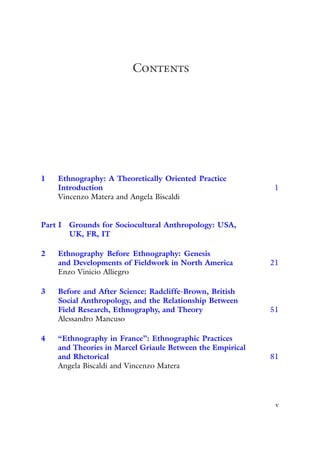
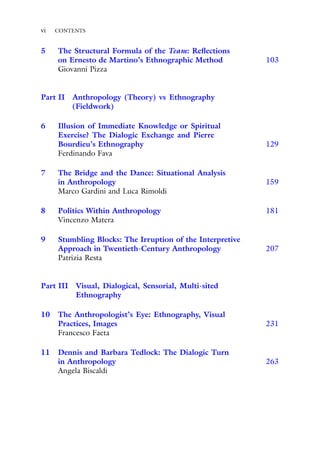
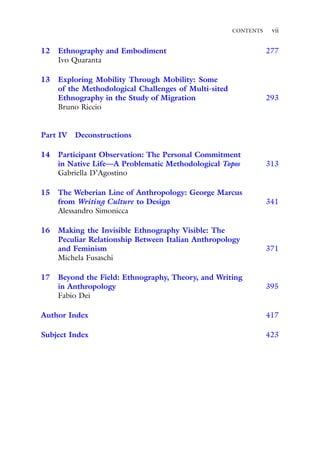
![Notes on Contributors
Enzo Vinicio Alliegro (Ph.D.) is Associate Professor of anthropological
disciplines at the University of Naples Federico II. His study interests are
focused on the history of anthropology—both Italian and North Amer-
ican—historical and symbolic anthropology, anthropology of the terri-
tory and the environment in crisis. He is author of the book Terraferma.
Un’altra Basilicata tra stereotipi, identità e [sotto]sviluppo (2019).
Angela Biscaldi (Ph.D.) is Associate Professor at the Department of
Social and Political Sciences, University of Milano. Her research focuses
on ethnography of communication, with particular emphasis on perfor-
mativity, agentivity and indexicality in everyday educational practices. She
is coauthor, with Vincenzo Matera, of the book Antropologia dei social
media (2019).
Gabriella D’Agostino (Ph.D.) is Full Professor of Cultural Anthro-
pology at Palermo University, Dipartimento Culture e Società. She is
author of the book Sous le traces. Anthropologie et contemporanéité (2018),
and Editor of the journal of Human Sciences “Archivio Antropologico
Mediterraneo” https://journals.openedition.org/aam/. http://www.arc
hivioantropologicomediterraneo.it/.
Fabio Dei is Associate Professor of Cultural Anthropology in the Univer-
sity of Pisa. He is Editor of the new Journal Rivista di antropologia
contemporanea. He is author of the book Cultura popolare in Italia. Da
Gramsci all’Unesco (2018).
ix](https://image.slidesharecdn.com/65173-250415053557-8f5a13de/85/Ethnography-A-Theoretically-Oriented-Practice-1st-ed-Edition-Vincenzo-Matera-12-320.jpg)
![1 ETHNOGRAPHY: A THEORETICALLY ORIENTED … 3
“Being there” in itself has no value; otherwise, the best ethnographers
would be the missionaries—and there are those who have said this—or
they would be the “natives” themselves—and there are those who have
said this, as well.
So, the common thread of the essays contained in this volume, beyond
the particular perspectives of the individual authors, therefore lies in the
belief that ethnography is a theoretical elaboration tool and, because of
this, it becomes an indispensable part in any production of knowledge on
social and cultural facts.
We think that outside this frame, ethnography is nothing, just as little
knowledge is believed to be able to derive by a “simple use” of the
ethnographic method (that without reference theory does not exist).
In the chapters of the volume, in fact, there are many ethnographic
approaches, aimed at grasping worlds, networks, or flows of meanings,
which both sprang from and are projections of theoretical concepts and
intellectual sensibilities, but there is no “method.”
To confirm what we say, we quote the sentence of a famous British
social anthropologist, suspiciously very critical of the practice he had prac-
ticed for a long time, with intensity and with remarkable results during
his career:
Anyone who is not a complete idiot can do fieldwork, […]. It has been
my woeful experience that many a student comes home from the field to
write just another book about just another people, hardly knowing what
to do with the grain he has been at such pains to garner. (Evans-Pritchard
1973, p. 3)
This statement should not be understood as an absolute criticism of field-
work. Rather, it is an implicit call to those solid foundations of theory
that allow the anthropologist to win the decisive battle, that is not fought
in the field but in the study afterward, Evans-Pritchard said. In fact, theo-
retically oriented ethnography is necessary in order to go beyond the
surface of everyday projects, actions and words, toward those invisible
bonds that bind individuals together and give body to the community
(or communities) to which they belong.
Today (the last couple of decades), communities have opened up and
become porous; the protagonists of primordial myths have been replaced
(or joined) by movie stars or football champions, political leaders, and
rock stars; the “dense” description is being replaced (or flanked) by the](https://image.slidesharecdn.com/65173-250415053557-8f5a13de/85/Ethnography-A-Theoretically-Oriented-Practice-1st-ed-Edition-Vincenzo-Matera-17-320.jpg)
![1 ETHNOGRAPHY: A THEORETICALLY ORIENTED … 7
contributed to codify ethnography as a specific set of practices which ulti-
mately merged into the general scientific framework offered in Griaule’s
handbook. From this standpoint, Conversations with Ogotemmeli appears
as an exception, even if this exception probably become in the work
of Marcel Griaule’s daughter, Genevieve, the bridge between this first
ethnographic practice in France and the dialogical anthropology of the
80s in the United States. The chapter asks what kind of characteristics
may help to describe a “French ethnographic tradition,” and according
to which kind of features it might be considered specific in comparison
to other relevant anthropological/ethnographic national traditions of the
same time period (USA, UK, Italy). It finally asks to what extent a French
ethnographic tradition contributed to developing a certain anthropolog-
ical style (understood as a set of ethnographic practices and theories
together).
Giovanni Pizza, “The structural formula of the équipe [team].” Reflec-
tions on the historical-ethnographic method of Ernesto de Martino is the last
chapter in Part I. The author proposes some reflections on the ethno-
graphic methodology of Ernesto de Martino (Naples 1908–Rome 1965),
in particular as regards what he himself called “la formula strutturale
dell’équipe.” What is an “ethnographic équipe [team]”? It is the main
question that the essay tries to answer. As he has been considered the
“father” of a specific vein in Italian anthropology, de Martino is really an
original thinker and an anthropologist whose theoretical lines as well as
methodologies are really unique and original. In the chapter, after revis-
iting some of the main ethnographic research carried out by de Martino
and his team in Southern Italy (above all the one in Apulia on taran-
tism), the author goes deep inside what has been considered as an “Italian
style” in ethnography, stressing the advantages and limits of this pecu-
liar scientific practice in the history of global cultural anthropology. The
reinterpretation presented in Pizza’s text becomes the premise to resume
the “Italian ethnographic style” with a somewhat ironic register. Pizza
proposes a rereading of the ethnographer de Martino articulated in three
main points: the role of fieldwork in the production of anthropolog-
ical knowledge; the effects in terms of Italian mimesis of Demartinian
ethnography; the “cognitive blindness” recently observed in the results
of its production, after the southern Italy trilogy. Today, we wonder why
de Martino did not take into consideration the entry of the Italian State
on the southern scene, despite it seeming to be an anachronistic oper-
ation (a bit like criticizing Tristi Tropici for the lack of “ethnographic](https://image.slidesharecdn.com/65173-250415053557-8f5a13de/85/Ethnography-A-Theoretically-Oriented-Practice-1st-ed-Edition-Vincenzo-Matera-21-320.jpg)
![14 V. MATERA AND A. BISCALDI
human experiences of movement (migration, tourism, aid, and develop-
ment) within contemporary societies, mobile approaches as multi-sited
research developed, where the field was shaped by following people,
kin, and other social networks, economic and social remittances, political
projects, etc. Drawing on ethnographic examples, Riccio shows how this
methodological perspective is well suited to the analysis of displacement
through space: considering migrants and their families in both the place
of origin and contexts of arrival considerably facilitates the understanding
of a complex and multidimensional process such as migration.
By following migrants’ relationships and practices, Riccio connected
up the different locations and methodological experiences (participant
observation, interviews, archive research, and life stories) by continuously
comparing their life and professional stories (similarities and differences)
while also engaging spatially with the continuous references and compar-
isons between actions and thoughts that surfaced in the different field
research sites.
Simultaneously Riccio considers and discusses critical challenges to
such an extension of the ethnographic field. More than on Space, he
focuses on Time as a crucial variable to be managed in the attempt
to compensate the “centrifugal” dispersion of multi-sited explorations.
In fact, the multi-sited character of migration ethnography may be
appreciated not only in terms of space, but also from a temporal perspec-
tive: ethnography is not only multi-sited but also multi-temporal, thus
addressing the need to adopt a longitudinal perspective and periodically
revisit the field as the years pass.
The last Part is Part IV. Visual, Dialogical, Sensorial, Practical,
Multi-sited ethnography. This Part opens with Gabriella D’Agostino
Participant observation. A problematic methodological topos.
The chapter begins with Malinowski, an author who could not be left
out of a book dedicated to ethnography. While it is well known that the
attribution of the ethnographic primacy to the Polish anthropologist is
a matter of disciplinary tradition rather than of history [cf. Alliegro], the
importance of the Argonauts, and also of the Diaries, remains unquestion-
able for the foundation of the ethnographic practice and for the scientific
status of the knowledge acquired by its means.
Gabriella D’Agostino reads in depth the most significant passages
in this sense of the famous Introduction to the Argonauts, explains and
problematizes the foundational value of a specifically ethnographic epis-
temology. She also reads Malinowski’s Diaries, not as a stone of a scandal](https://image.slidesharecdn.com/65173-250415053557-8f5a13de/85/Ethnography-A-Theoretically-Oriented-Practice-1st-ed-Edition-Vincenzo-Matera-28-320.jpg)
![18 V. MATERA AND A. BISCALDI
coming out in a convincing way. The ability to persuade is played on a
complexity that has many faces, as emerges in the following chapters.
References
Appadurai, A. (1996). Modernity at Large. Cultural Dimensions of Globalization.
Minneapolis: University of Minnesota Press.
Appadurai, A. (2004). The Capacity to Aspire. In R. Vijayendra & M. Walton
(Eds.), Culture and Public Action. Stanford: Stanford University Press.
Comaroff, J., & Comaroff, J. L. (1992). Ethnography and Historical Imagina-
tion. Boulder, CO: Westview Press.
Evans-Pritchard, E. E. (1973). Some Reminiscences and Reflections on Field-
work. Journal of the Anthropological Society of Oxford, 4(1), 1–12.
Fabietti, U., & Matera, V. (Eds.). (1997). Etnografia. Scritture e rappresentazioni
dell’antropologia. Roma: Carocci.
Fabietti, U., Malighetti, R., & Matera, V. (2020). Dal tribale al globale. Milano:
Pearson.
Fillitz, T. (2013). Spatialising the Field: Conceptualising Fields and Interconnec-
tions in the Context of Contemporary Art of Africa. In V. Matera (Ed.),
De-constructing the Field (Archivio Antropologico Mediterraneo [on line],
XVI, 15(2), 19–28).
Geertz, C. (1973). Deep Play: Notes on the Balinese Cockfight. In C. Geertz
(Ed.), The Interpretation of Cultures (pp. 412–454). Boston: Basic Book.
Ginzburg, C. (1986). Miti, emblemi, spie. Torino: Einaudi.
Hannerz, U. (2010). Anthropology’s World. Life in a Twenty-First Century
Discipline. London: Pluto Press.
Ingold, T. (2007). Anthropology Is Not Ethnography. Radcliffe-Brown Lecture to
the British Academy.
Lanternari, V. (1963). The Religions of the Oppressed. A Study of Modern Messianic
Cults. New York and London: McGibbon & Kee.
Matera, V. (2013). Deconstructing the Field. Archivio Antropologico Mediter-
raneo, XVI, 15(2).
Matera, V. (2019). La memoria dell’antropologo. Retrospezioni o interpretazioni
ex-post. Antropologia, 6(1), 49–61.
Wright Mills, C. (1961). The Sociological Imagination. New York: Grove Press.](https://image.slidesharecdn.com/65173-250415053557-8f5a13de/85/Ethnography-A-Theoretically-Oriented-Practice-1st-ed-Edition-Vincenzo-Matera-32-320.jpg)
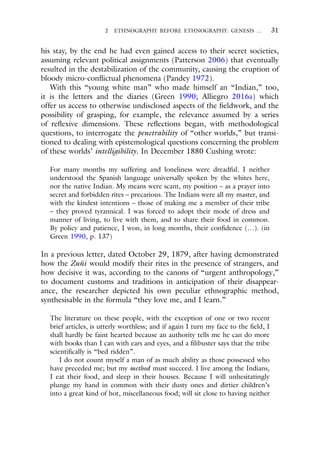
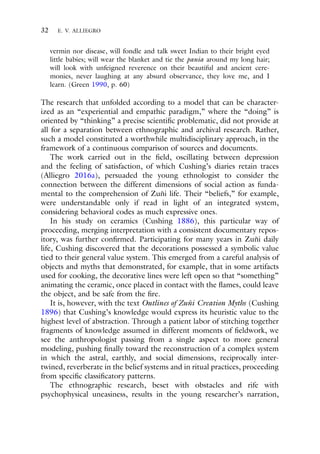
![2 ETHNOGRAPHY BEFORE ETHNOGRAPHY: GENESIS … 33
punctuated nonetheless with scientific gratifications capable of providing
relief and compensation for every kind of effort. Where the body suffers,
the intellect rejoices, as Cushing underlines on July 18, 1880, referring
to the ethnographic parenthesis as an indelible human experience, a sort
of master key, destined to leave its signs in the mental, civil, and ethical
arsenal of the man and the scholar:
I can sum up in one sentence what my life here has been – physically, so
far as the appetites are concerned, paralysis; socially, exile; ethically [and]
theoretically, a feast, a peace of mind unapproached in all my previous
experience. And as to results – probably impaired health during life; a
strengthening and development of moral character in every respect, and
aside from a more practical and cosmopolitan view of humanity and its
institutions, I hope and pray (though sometimes dubiously) that it will
make a worker of me. (in Green 1990, p. 117)
What the researcher does in the field is, in Cushing’s case, the product of
a clear programmatic plan. The following program for work demonstrates
this in an unequivocal manner:
First, then, among the objects of extended residence with the Zunis would
be the acquisition of the language, as essential to all the following;
Second, the recording, in the original language and with faithful
translation, of the industrial and art formulae;
Third, [the recording] of the “Ancient Talks” (i-no-ti pe-i.e.-we) or
religious instructions for ceremonies, dances, etc. and of the prayers and
songs;
Fourth, the collecting of a vast amount of material (costumes, altars,
masks, wands, etc. etc.) illustrative of this study;
Fifth, study of the plume sticks with collecting of a series:
Sixth, [study] of the astronomic monuments, structures, etc., with
photographs, plans, etc., illustrative;
Seventh, [study] of the Zuni culture as compared to and illustrative of
the other indigenous civilizations of America;
Eight, [study] of the survivals of gesture language in use among the
Zuni as an accompaniment to an oral speech;
Ninth, [study] of the Zuni system of consanguinity and affinity a.
present, b. primitive, c. geographic origin of the groups (“division”) of
the gens, including the special histories of these groups, etc.](https://image.slidesharecdn.com/65173-250415053557-8f5a13de/85/Ethnography-A-Theoretically-Oriented-Practice-1st-ed-Edition-Vincenzo-Matera-46-320.jpg)
![34 E. V. ALLIEGRO
Tenth, [study] of the I-no-te as related to ancient ruins, including the
exploration, planography and photography of and collections from the
scene;
Eleventh, [study] of the primitive condition of the Shy-wi, its culture,
etc., as compared to the present;
Twelfth, [study] of the important origin of certain mythological usages
now in vogue but only [partial] understood… (Green 1990, p. 104)
James Mooney
Thoroughly different from Cushing’s approach is that assumed by James
Mooney (Moses 1984; Alliegro 2019). Between 1890 and 1893, Mooney
conducted demanding and extensive research, focusing on the study of
prophetic movements linked to the “spirit dance,” revitalized before and
after the massacre of Wounded Knee (Bergamini 2002).
Mooney was born in Richmond, Indiana, on February 10, 1861 (
Washington 1921) into a catholic family of modest Irish immigrants.
Attracted, since childhood, to the world of the native peoples, to which
he devoted many years of intense readings centered on Morgan’s and
Schoolcraft’s publications, Mooney initially dedicated himself to jour-
nalism. After applying as a self-taught ethnologist to the B.A.E. for the
first time in 1883, and then again in 1884, he succeeded in his aim of
going directly to Washington in 1885. There, Powell, then director of
the B.A.E., diverted Mooney’s attention from a research trip to Central
America in order to entrust him with various assignments that the young
man carried out in the capacity of a volunteer, to be finally officially
employed in the summer of 1886. Within a few years, Mooney estab-
lished himself as a first-level expert on Western and Great Plains tribes
(Tiberini 1999), introducing photographic devices and gramophones to
ethnographic research as early as the 1890s (Jacknis 1990). In light of
the close relationship that he was able to establish with many different
ethnic groups, among them the Sioux, the Arapaho, and, above all,
the Cheyenne, to which he dedicated many studies (Mooney 1889a, b,
1890a, b, 1891, 1892), the B.A.E. entrusted him with a particularly deli-
cate assignment: to shed light on a “revolt” movement that had erupted
in the reserves, the so-called Ghost Dance (GD).
Mooney began his investigation on December 22, 1890, and ended
it after three years, giving rise to a research plan which was structured,
on one hand, around a phase of accurate consultation of the available](https://image.slidesharecdn.com/65173-250415053557-8f5a13de/85/Ethnography-A-Theoretically-Oriented-Practice-1st-ed-Edition-Vincenzo-Matera-47-320.jpg)