
Law and
PracticeETHIOPIAN PRESS
By Fasil Girma
2014
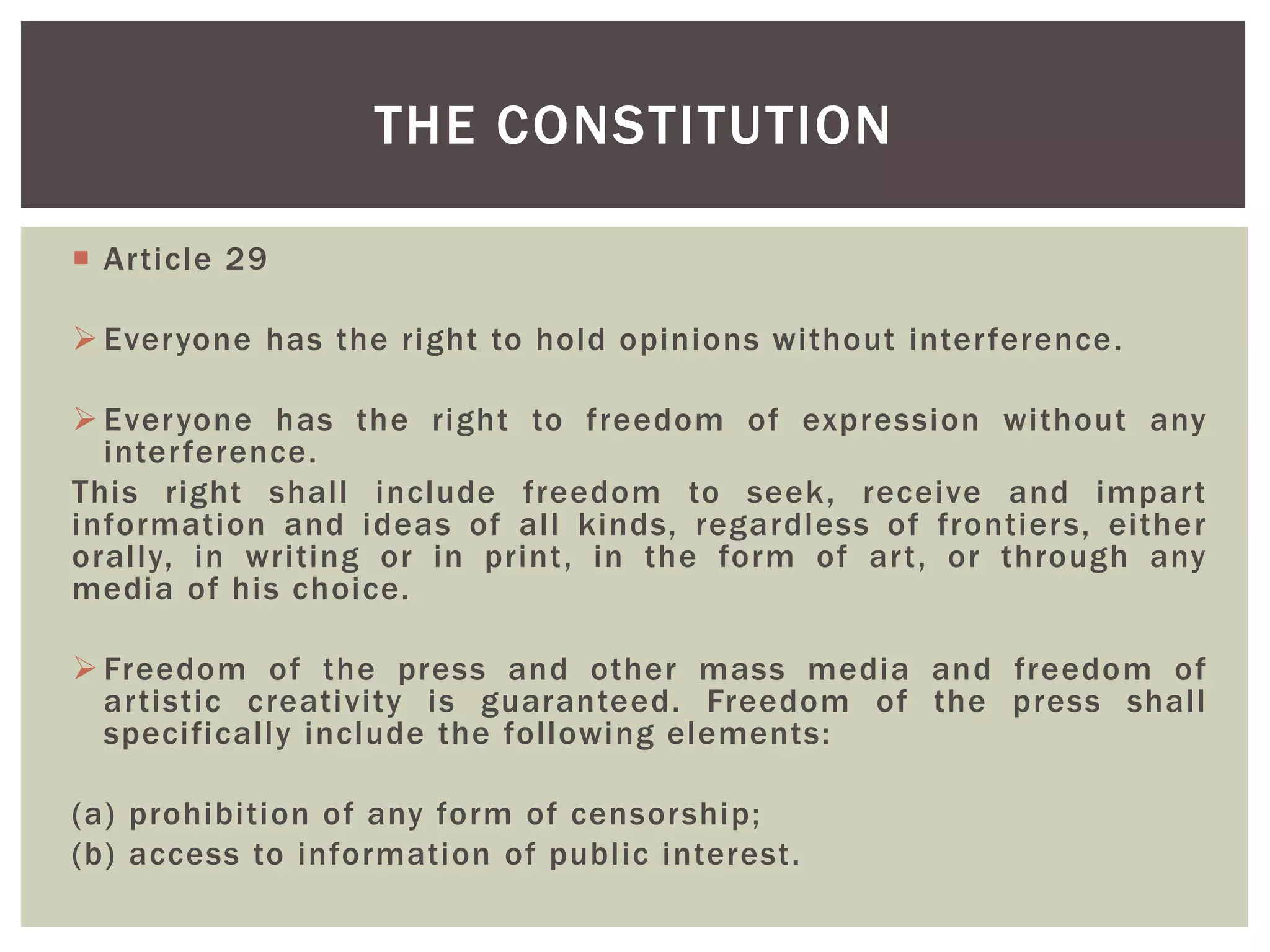
 Article 29
 Everyone has the right to hold opinions without interference.
 Everyone has the right to freedom of expression without any
interference.
This right shall include freedom to seek, receive and impart
information and ideas of all kinds, regardless of frontiers, either
orally, in writing or in print, in the form of art, or through any
media of his choice.
 Freedom of the press and other mass media and freedom of
artistic creativity is guaranteed. Freedom of the press shall
specifically include the following elements:
(a) prohibition of any form of censorship;
(b) access to information of public interest.
THE CONSTITUTION
 Article 29
In the interest of the free flow of information, ideas and
opinions which are essential to the functioning of a
democratic order, the press shall, as an institution, enjoy
legal protection to ensure its operational independence and
its capacity to entertain diverse opinions.
THE CONS…
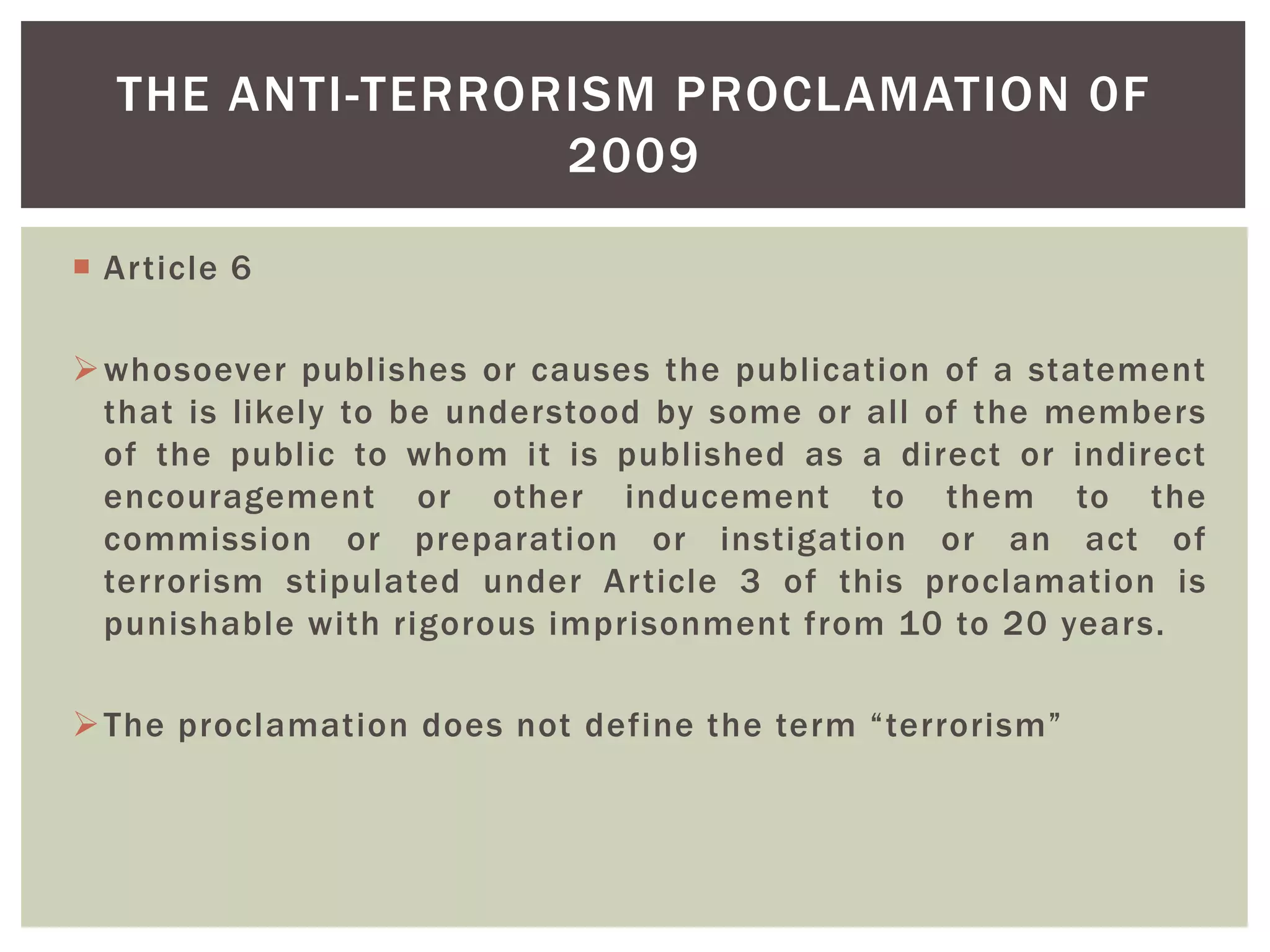
 Article 6
whosoever publishes or causes the publication of a statement
that is likely to be understood by some or all of the members
of the public to whom it is published as a direct or indirect
encouragement or other inducement to them to the
commission or preparation or instigation or an act of
terrorism stipulated under Article 3 of this proclamation is
punishable with rigorous imprisonment from 10 to 20 years.
The proclamation does not define the term “terrorism”
THE ANTI-TERRORISM PROCLAMATION 0F
2009
 Article 613
 Criminal defamation
Hearsay and anonymous reports from security officers are
accepted as evidence.
Where the defamation is against a public official, this will be
taken as an aggravating circumstance and entail a penalty of up to
one year imprisonment.
The burden of proving malice lies with the plaintiff in the case of
civil proceedings, in criminal proceedings it is the defendant who
has to show such proof.
THE REVISED CRIMINAL CODE OF 2004
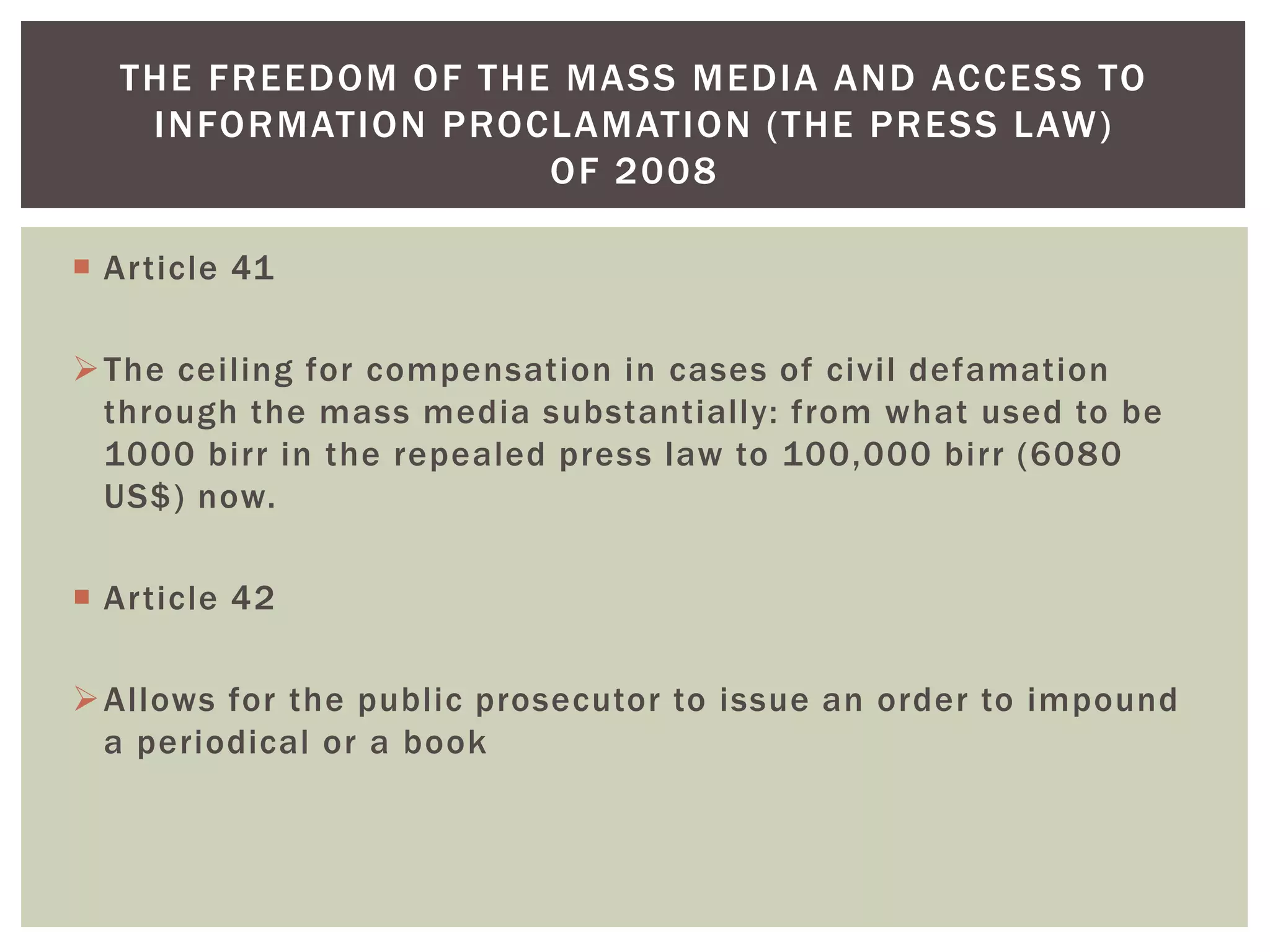
 Article 41
The ceiling for compensation in cases of civil defamation
through the mass media substantially: from what used to be
1000 birr in the repealed press law to 100,000 birr (6080
US$) now.
 Article 42
Allows for the public prosecutor to issue an order to impound
a periodical or a book
THE FREEDOM OF THE MASS MEDIA AND ACCESS TO
INFORMATION PROCLAMATION (THE PRESS LAW)
OF 2008
 The International Covenant on Civil and Political Rights. Article 19
 Everyone shall have the right to hold opinions without interference.
 Everyone shall have the right to freedom of expression; this right shall
include freedom to seek, receive and impart information and ideas of
all kinds, regardless of frontiers, either orally, in writing or in print, in
the form of art, or through any other media of his choice.
 The exercise of the rights provided for in paragraph 2 of this article
carries with it special duties and responsibilities. It may therefore be
subject to certain restrictions, but these shall only be such as are
provided by law and are necessary:
a) For respect of the rights or reputations of others;
b) b) For the protection of national security or of public order, or of
public health or morals.
INTERNATIONAL LAWS
 The Universal Declaration of Human Rights. Article 19
Everyone has the right to freedom of opinion and expression;
this right includes freedom to hold opinions without
interference and to seek, receive and impart information and
ideas through any media and regardless of frontiers.
 The African Charter on Human and Peoples’ Rights. Article 9
Every individual shall have the right to receive information.
Every individual shall have the right to express and
disseminate his opinions within the law.
INTERNATIONAL…
 News Papers (Private)
 17 news papers are on the market
 5 of them are sport papers
 8 of the papers report on general issues that includes politics,
economy and social
 2 of them are business news papers
 The rest are special papers
 2 of them are biweekly, while the rest are weekly
 Total publication is less than 60,000 of copies per week for a 90
million population
PRACTICE
 Magazines
20 magazines are on the market
All of them report on general issues that includes politics,
economy and social
Most of them are weekly while there rest are monthly
Total publications reaches up to 80, copies.
2 of them are English papers while the rest are Amharic
PRACTICE
 Radio
 Five Private radio broadcasters
 Three of them are purely pro governmental
Fana Broadcasting Corporate, Zami FM, and Voice of Woyane Tigray
 Four of them are FM radio broadcasters
 Fana has also national coverage
 Four of them only covers the capital Addis Ababa and its
surrounding.
PRACTICE
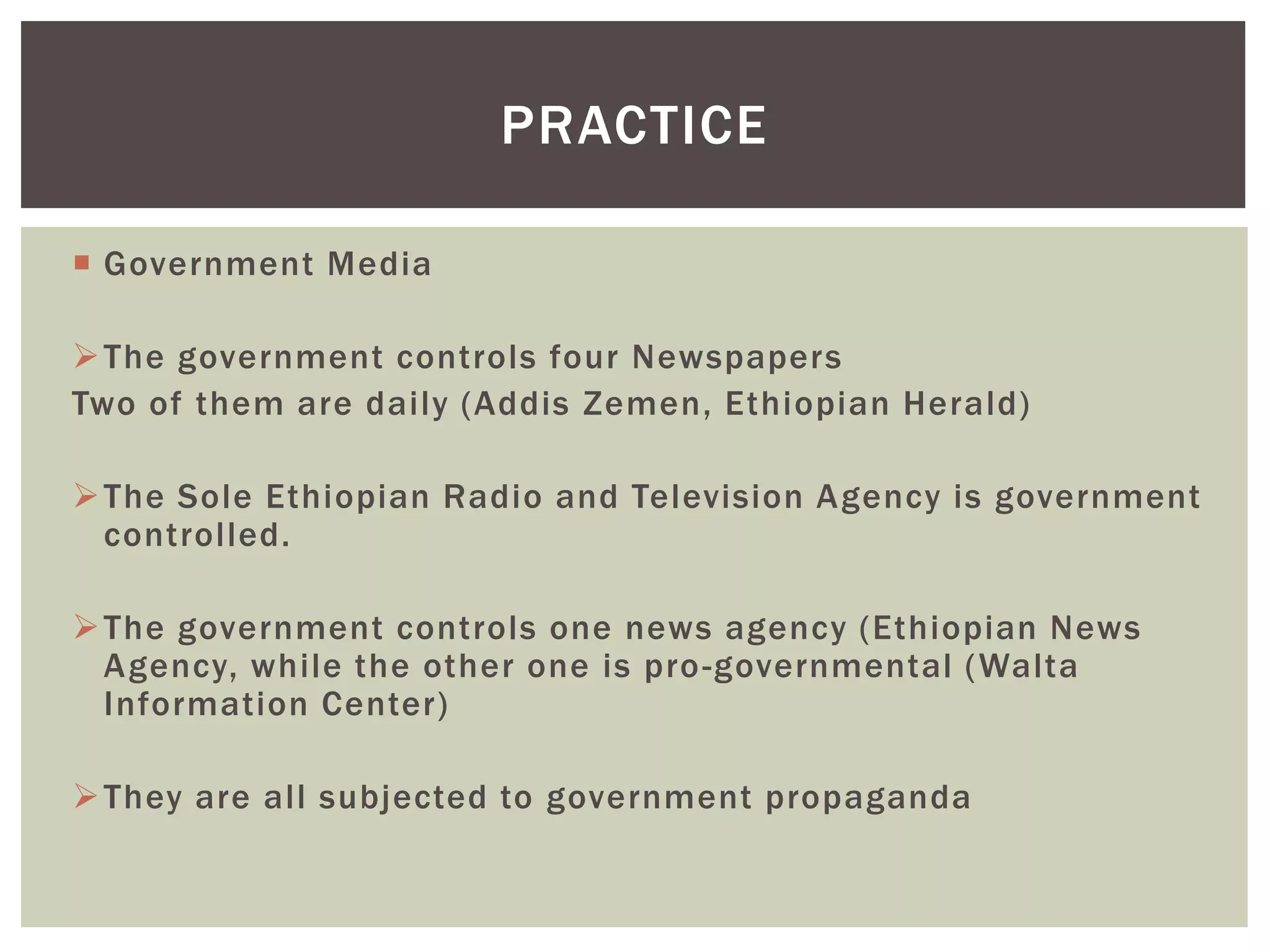
 Government Media
The government controls four Newspapers
Two of them are daily (Addis Zemen, Ethiopian Herald)
The Sole Ethiopian Radio and Television Agency is government
controlled.
The government controls one news agency (Ethiopian News
Agency, while the other one is pro-governmental (Walta
Information Center)
They are all subjected to government propaganda
PRACTICE
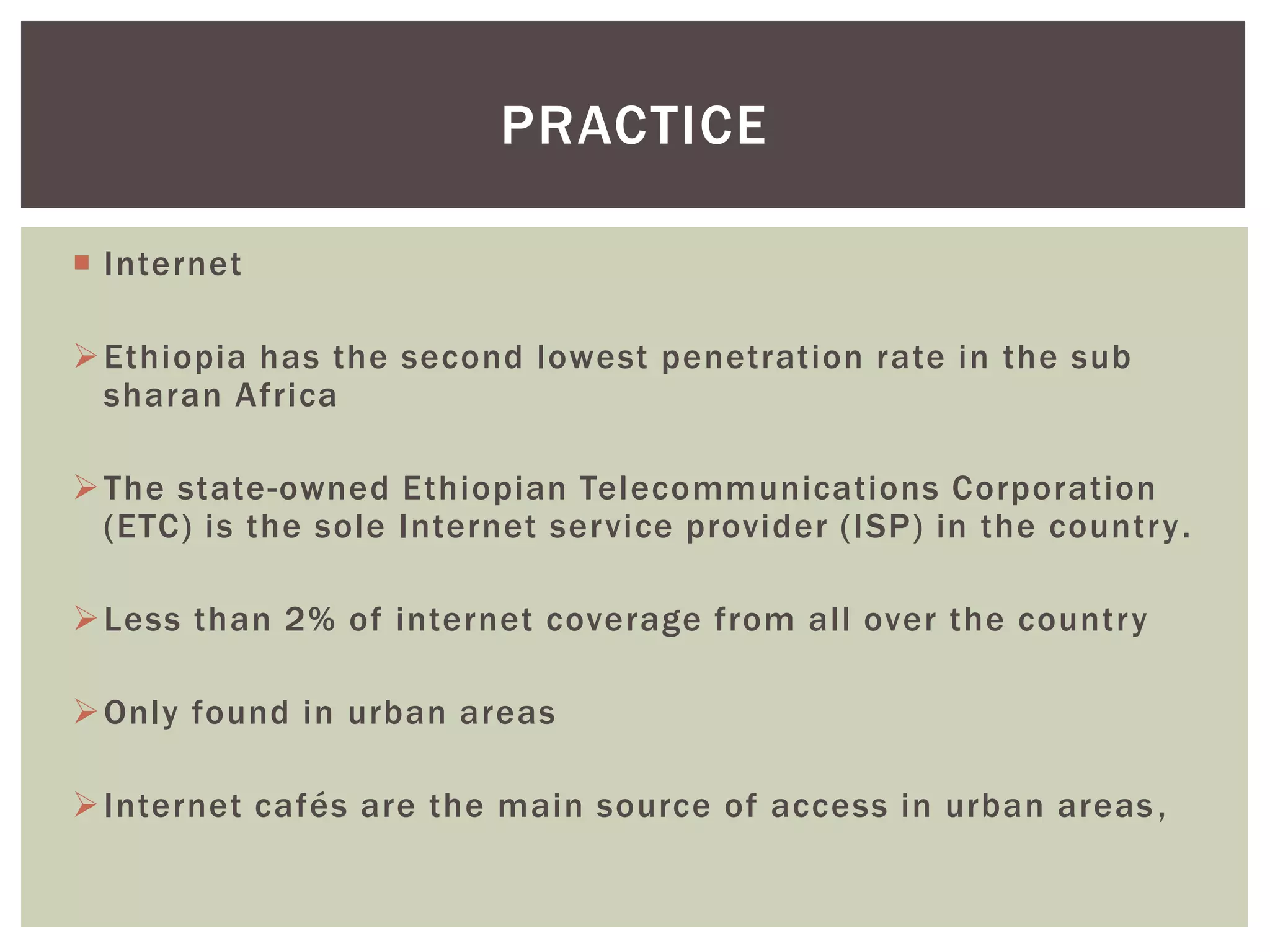
 Internet
Ethiopia has the second lowest penetration rate in the sub
sharan Africa
The state-owned Ethiopian Telecommunications Corporation
(ETC) is the sole Internet service provider (ISP) in the country.
Less than 2% of internet coverage from all over the country
Only found in urban areas
Internet cafés are the main source of access in urban areas,
PRACTICE
 Most of press freedom activist organizations such as;
Committee to Protect Journalists, Article 19, Reporters
Without Borders, Pen International and so forth, described
Ethiopia as the country with lowest press freedom.
 6 journalists imprisoned because the Anti-Terrorism Law.
 3 journalists and 6 bloggers are currently detained
 More than 50 journalists live in exile out of Ethiopia since
2007
REPORTS
 There is high degree of professionalism and quality problem
 Most of printing press institutions are governmental, while the
rest have no full capacity to publish large amount of copies of
Newspapers and magazines
 High tax on papers and printing press machines
 There is no private Television broadcaster
REPORTS
Thank you
THANK YOU

Ethiopian press

  • 1.
  • 2.
     Article 29 Everyone has the right to hold opinions without interference.  Everyone has the right to freedom of expression without any interference. This right shall include freedom to seek, receive and impart information and ideas of all kinds, regardless of frontiers, either orally, in writing or in print, in the form of art, or through any media of his choice.  Freedom of the press and other mass media and freedom of artistic creativity is guaranteed. Freedom of the press shall specifically include the following elements: (a) prohibition of any form of censorship; (b) access to information of public interest. THE CONSTITUTION
  • 3.
     Article 29 Inthe interest of the free flow of information, ideas and opinions which are essential to the functioning of a democratic order, the press shall, as an institution, enjoy legal protection to ensure its operational independence and its capacity to entertain diverse opinions. THE CONS…
  • 4.
     Article 6 whosoeverpublishes or causes the publication of a statement that is likely to be understood by some or all of the members of the public to whom it is published as a direct or indirect encouragement or other inducement to them to the commission or preparation or instigation or an act of terrorism stipulated under Article 3 of this proclamation is punishable with rigorous imprisonment from 10 to 20 years. The proclamation does not define the term “terrorism” THE ANTI-TERRORISM PROCLAMATION 0F 2009
  • 5.
     Article 613 Criminal defamation Hearsay and anonymous reports from security officers are accepted as evidence. Where the defamation is against a public official, this will be taken as an aggravating circumstance and entail a penalty of up to one year imprisonment. The burden of proving malice lies with the plaintiff in the case of civil proceedings, in criminal proceedings it is the defendant who has to show such proof. THE REVISED CRIMINAL CODE OF 2004
  • 6.
     Article 41 Theceiling for compensation in cases of civil defamation through the mass media substantially: from what used to be 1000 birr in the repealed press law to 100,000 birr (6080 US$) now.  Article 42 Allows for the public prosecutor to issue an order to impound a periodical or a book THE FREEDOM OF THE MASS MEDIA AND ACCESS TO INFORMATION PROCLAMATION (THE PRESS LAW) OF 2008
  • 7.
     The InternationalCovenant on Civil and Political Rights. Article 19  Everyone shall have the right to hold opinions without interference.  Everyone shall have the right to freedom of expression; this right shall include freedom to seek, receive and impart information and ideas of all kinds, regardless of frontiers, either orally, in writing or in print, in the form of art, or through any other media of his choice.  The exercise of the rights provided for in paragraph 2 of this article carries with it special duties and responsibilities. It may therefore be subject to certain restrictions, but these shall only be such as are provided by law and are necessary: a) For respect of the rights or reputations of others; b) b) For the protection of national security or of public order, or of public health or morals. INTERNATIONAL LAWS
  • 8.
     The UniversalDeclaration of Human Rights. Article 19 Everyone has the right to freedom of opinion and expression; this right includes freedom to hold opinions without interference and to seek, receive and impart information and ideas through any media and regardless of frontiers.  The African Charter on Human and Peoples’ Rights. Article 9 Every individual shall have the right to receive information. Every individual shall have the right to express and disseminate his opinions within the law. INTERNATIONAL…
  • 9.
     News Papers(Private)  17 news papers are on the market  5 of them are sport papers  8 of the papers report on general issues that includes politics, economy and social  2 of them are business news papers  The rest are special papers  2 of them are biweekly, while the rest are weekly  Total publication is less than 60,000 of copies per week for a 90 million population PRACTICE
  • 10.
     Magazines 20 magazinesare on the market All of them report on general issues that includes politics, economy and social Most of them are weekly while there rest are monthly Total publications reaches up to 80, copies. 2 of them are English papers while the rest are Amharic PRACTICE
  • 11.
     Radio  FivePrivate radio broadcasters  Three of them are purely pro governmental Fana Broadcasting Corporate, Zami FM, and Voice of Woyane Tigray  Four of them are FM radio broadcasters  Fana has also national coverage  Four of them only covers the capital Addis Ababa and its surrounding. PRACTICE
  • 12.
     Government Media Thegovernment controls four Newspapers Two of them are daily (Addis Zemen, Ethiopian Herald) The Sole Ethiopian Radio and Television Agency is government controlled. The government controls one news agency (Ethiopian News Agency, while the other one is pro-governmental (Walta Information Center) They are all subjected to government propaganda PRACTICE
  • 13.
     Internet Ethiopia hasthe second lowest penetration rate in the sub sharan Africa The state-owned Ethiopian Telecommunications Corporation (ETC) is the sole Internet service provider (ISP) in the country. Less than 2% of internet coverage from all over the country Only found in urban areas Internet cafés are the main source of access in urban areas, PRACTICE
  • 14.
     Most ofpress freedom activist organizations such as; Committee to Protect Journalists, Article 19, Reporters Without Borders, Pen International and so forth, described Ethiopia as the country with lowest press freedom.  6 journalists imprisoned because the Anti-Terrorism Law.  3 journalists and 6 bloggers are currently detained  More than 50 journalists live in exile out of Ethiopia since 2007 REPORTS
  • 15.
     There ishigh degree of professionalism and quality problem  Most of printing press institutions are governmental, while the rest have no full capacity to publish large amount of copies of Newspapers and magazines  High tax on papers and printing press machines  There is no private Television broadcaster REPORTS
  • 16.