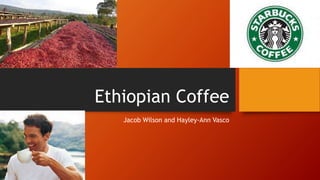
Ethiopian Coffee
Jacob Wilson and Hayley-Ann Vasco
Background
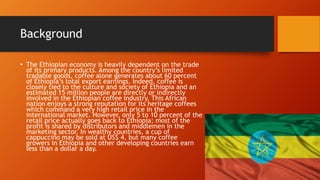
• The Ethiopian economy is heavily dependent on the trade
of its primary products. Among the country’s limited
tradable goods, coffee alone generates about 60 percent
of Ethiopia’s total export earnings. Indeed, coffee is
closely tied to the culture and society of Ethiopia and an
estimated 15 million people are directly or indirectly
involved in the Ethiopian coffee industry. This African
nation enjoys a strong reputation for its heritage coffees
which command a very high retail price in the
international market. However, only 5 to 10 percent of the
retail price actually goes back to Ethiopia; most of the
profit is shared by distributors and middlemen in the
marketing sector. In wealthy countries, a cup of
cappuccino may be sold at US$ 4, but many coffee
growers in Ethiopia and other developing countries earn
less than a dollar a day.
Yirga Chefe
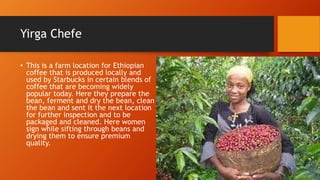
• This is a farm location for Ethiopian
coffee that is produced locally and
used by Starbucks in certain blends of
coffee that are becoming widely
popular today. Here they prepare the
bean, ferment and dry the bean, clean
the bean and sent it the next location
for further inspection and to be
packaged and cleaned. Here women
sign while sifting through beans and
drying them to ensure premium
quality.
Addis Ababa
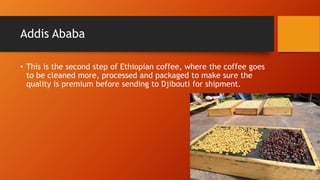
• This is the second step of Ethiopian coffee, where the coffee goes
to be cleaned more, processed and packaged to make sure the
quality is premium before sending to Djibouti for shipment.
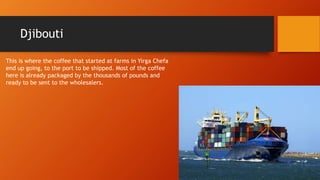
Djibouti
This is where the coffee that started at farms in Yirga Chefa
end up going, to the port to be shipped. Most of the coffee
here is already packaged by the thousands of pounds and
ready to be sent to the wholesalers.
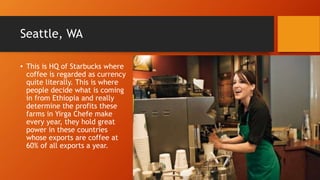
Seattle, WA
• This is HQ of Starbucks where
coffee is regarded as currency
quite literally. This is where
people decide what is coming
in from Ethiopia and really
determine the profits these
farms in Yirga Chefe make
every year, they hold great
power in these countries
whose exports are coffee at
60% of all exports a year.
Lexington, KY
• Finally where our great University resides and we have the
privilege to walk out of our door every day and decide we want a
warm cup of Ethiopian coffee. The door at Starbucks might not be
a direct connection to the Yirga Chefe farms but we are a lot
closer than you'd ever think we are culturally and economically.
How is Ethiopia coffee doing today?
• “These changes have had marked positive results in terms of increased income
and improved living standards of the coffee producers. Prior to the IP protection
initiative, Ethiopia was receiving a scanty 6 percent of the final retail price for
its coffees. Against the average final retail price ranging from US$ 20 to 28 per
kilogram, the farmers were receiving as little as US$ 1 per kilogram. The
trademarking and licensing scheme immensely helped improve the situation:
Yirgacheffe farmers’ income doubled in 2007 in comparison with their income in
2006, with estimation that over the years the producers could secure their
income at around US $6-8 per kilogram. Overall, Ethiopia’s total coffee exports
are expected to reach the level of US $1.2-1.6 billion as opposed to a meager
US $400 million prior to the
Initiative.”(http://www.wipo.int/ipadvantage/en/details.jsp?id=2621) accordng
to many sources and media out there today I was able to find out that many
companies and even nations were taking advantage of these coffee farmers and
the whole country to buy them cheaper than what they were worth and causing
the nation and farmers to suffer losses and very low income but many pleaces
are trying to fix this problem and are succesfully changing the income these
farmers such as the ones in Yirga Chefe receive.
Who buys this product
• Most of the world enjoys coffee and this has been an amazing time
breaking product that has always been popular and has seen
skyrocketing popularity with companies such as Starbucks and
Dunkin Doughnuts making moves in the international markets and
making this a very easily accessible product.

Ethiopian coffee

  • 1.
    Ethiopian Coffee Jacob Wilsonand Hayley-Ann Vasco
  • 2.
    Background • The Ethiopianeconomy is heavily dependent on the trade of its primary products. Among the country’s limited tradable goods, coffee alone generates about 60 percent of Ethiopia’s total export earnings. Indeed, coffee is closely tied to the culture and society of Ethiopia and an estimated 15 million people are directly or indirectly involved in the Ethiopian coffee industry. This African nation enjoys a strong reputation for its heritage coffees which command a very high retail price in the international market. However, only 5 to 10 percent of the retail price actually goes back to Ethiopia; most of the profit is shared by distributors and middlemen in the marketing sector. In wealthy countries, a cup of cappuccino may be sold at US$ 4, but many coffee growers in Ethiopia and other developing countries earn less than a dollar a day.
  • 3.
    Yirga Chefe • Thisis a farm location for Ethiopian coffee that is produced locally and used by Starbucks in certain blends of coffee that are becoming widely popular today. Here they prepare the bean, ferment and dry the bean, clean the bean and sent it the next location for further inspection and to be packaged and cleaned. Here women sign while sifting through beans and drying them to ensure premium quality.
  • 4.
    Addis Ababa • Thisis the second step of Ethiopian coffee, where the coffee goes to be cleaned more, processed and packaged to make sure the quality is premium before sending to Djibouti for shipment.
  • 5.
    Djibouti This is wherethe coffee that started at farms in Yirga Chefa end up going, to the port to be shipped. Most of the coffee here is already packaged by the thousands of pounds and ready to be sent to the wholesalers.
  • 6.
    Seattle, WA • Thisis HQ of Starbucks where coffee is regarded as currency quite literally. This is where people decide what is coming in from Ethiopia and really determine the profits these farms in Yirga Chefe make every year, they hold great power in these countries whose exports are coffee at 60% of all exports a year.
  • 7.
    Lexington, KY • Finallywhere our great University resides and we have the privilege to walk out of our door every day and decide we want a warm cup of Ethiopian coffee. The door at Starbucks might not be a direct connection to the Yirga Chefe farms but we are a lot closer than you'd ever think we are culturally and economically.
  • 8.
    How is Ethiopiacoffee doing today? • “These changes have had marked positive results in terms of increased income and improved living standards of the coffee producers. Prior to the IP protection initiative, Ethiopia was receiving a scanty 6 percent of the final retail price for its coffees. Against the average final retail price ranging from US$ 20 to 28 per kilogram, the farmers were receiving as little as US$ 1 per kilogram. The trademarking and licensing scheme immensely helped improve the situation: Yirgacheffe farmers’ income doubled in 2007 in comparison with their income in 2006, with estimation that over the years the producers could secure their income at around US $6-8 per kilogram. Overall, Ethiopia’s total coffee exports are expected to reach the level of US $1.2-1.6 billion as opposed to a meager US $400 million prior to the Initiative.”(http://www.wipo.int/ipadvantage/en/details.jsp?id=2621) accordng to many sources and media out there today I was able to find out that many companies and even nations were taking advantage of these coffee farmers and the whole country to buy them cheaper than what they were worth and causing the nation and farmers to suffer losses and very low income but many pleaces are trying to fix this problem and are succesfully changing the income these farmers such as the ones in Yirga Chefe receive.
  • 9.
    Who buys thisproduct • Most of the world enjoys coffee and this has been an amazing time breaking product that has always been popular and has seen skyrocketing popularity with companies such as Starbucks and Dunkin Doughnuts making moves in the international markets and making this a very easily accessible product.