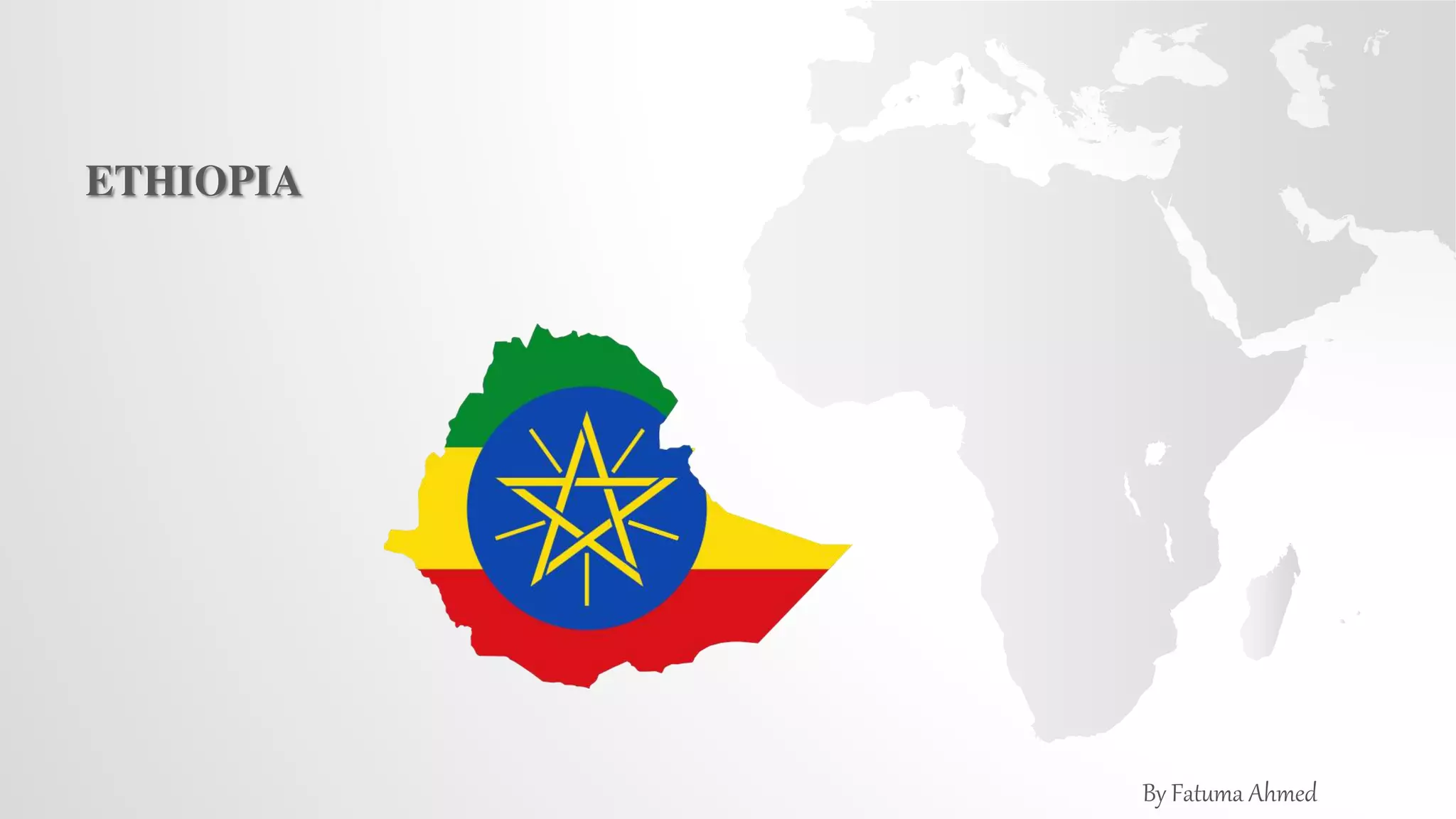

ETHIOPIA
By Fatuma Ahmed
ETHIOPIA
Ethiopia is Africa's oldest independent country and it’s
second largest in terms of population. From a five-year
occupation by Italy, it has never been colonised.
• The population of Ethiopia is estimated at 96 million as of July 1
2014.
• Ethiopia's population is equivalent to 1.3% of the total world
population
• Ethiopia ranks number 13 in the list of Countries by population
• The population density in Ethiopia is 87 people per Km2.
• 18% of the population is urban (17 million people in 2014).
• The median age in Ethiopia is 18.4 years.
ETHIOPIAN ECONOMY
• Ethiopia’s economic freedom score is 51.5, making its economy the
149th freest in the 2015 Index. Its overall score is 1.5 points higher than
last year, reflecting considerable improvements in monetary freedom,
freedom from corruption, and labour freedom.
• Ethiopia is ranked 37th out of 46 countries in the Sub-Saharan Africa
region, and its overall score continues to be below the regional average.
• With a large domestic market and promising economic prospects,
Ethiopia has the potential to become a regional economic powerhouse.
• economic freedom in Ethiopia is still weak. A nominally independent
judiciary continues to follow government policy advice, and corruption
remains endemic.
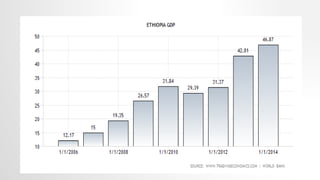
ETHIOPIAN GDP
• The GDP in Ethiopia was worth 46.87 billion US dollars
in 2014.
• The GDP value of Ethiopia represents 0.08 percent of
the world economy.
• GDP in Ethiopia averaged 14.35 USD Billion from 1981
until 2013, reaching an all-time high of 46.87 USD
Billion in 2014 and a record low of 7.27 USD Billion in
1981.
• The method used to calculate GDP is production method
• The economy of Ethiopia is based on agriculture , which
accounts for 46.3% of (GDP), 60% of exports, and 80%
of total employment
• Coffee is critical to the Ethiopian economy
with it providing exports of some $350 million in
2006.
ECONOMIC SECTOR OF ETHIOPIA
INFLATION
• The inflation rate in Ethiopia was recorded at 9.30
percent in April of 2015.
• Inflation Rate in Ethiopia averaged 18.41 percent from
2006 until 2015, reaching an all-time high of 64.20
percent in July of 2008 and a record low of -4.10
percent in September of 2009.
• Inflation Rate in Ethiopia is reported by the Central
Statistical Agency of Ethiopia.
SOURCE OF INCOME
• Total government income in Ethiopia comes from the following sources:
• Direct taxes, which include personal income taxes (including income from the sale
of forest products) and land use fees;
• Indirect taxes, which include duties on trade and sales taxes on goods and services
sold in the domestic market
• Non-tax revenue
• External loans and credits and
• External grants.
• The total income of the Federal Government (including external support) was over
7 billion Birr in 1994 and increased to over 10 billion Birr in 1999. A large
proportion of this revenue comes from indirect taxes on international trade.
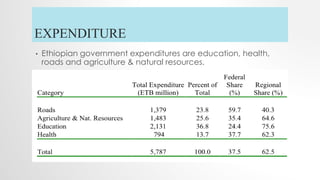
EXPENDITURE
• Ethiopian government expenditures are education, health,
roads and agriculture & natural resources.
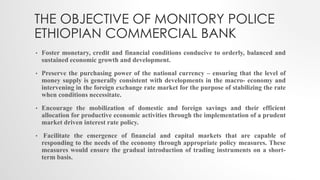
THE OBJECTIVE OF MONITORY POLICE
ETHIOPIAN COMMERCIAL BANK
• Foster monetary, credit and financial conditions conducive to orderly, balanced and
sustained economic growth and development.
• Preserve the purchasing power of the national currency – ensuring that the level of
money supply is generally consistent with developments in the macro- economy and
intervening in the foreign exchange rate market for the purpose of stabilizing the rate
when conditions necessitate.
• Encourage the mobilization of domestic and foreign savings and their efficient
allocation for productive economic activities through the implementation of a prudent
market driven interest rate policy.
• Facilitate the emergence of financial and capital markets that are capable of
responding to the needs of the economy through appropriate policy measures. These
measures would ensure the gradual introduction of trading instruments on a short-
term basis.
Ethiopian GDP

Ethiopian GDP

  • 1.
  • 2.
    ETHIOPIA Ethiopia is Africa'soldest independent country and it’s second largest in terms of population. From a five-year occupation by Italy, it has never been colonised. • The population of Ethiopia is estimated at 96 million as of July 1 2014. • Ethiopia's population is equivalent to 1.3% of the total world population • Ethiopia ranks number 13 in the list of Countries by population • The population density in Ethiopia is 87 people per Km2. • 18% of the population is urban (17 million people in 2014). • The median age in Ethiopia is 18.4 years.
  • 3.
    ETHIOPIAN ECONOMY • Ethiopia’seconomic freedom score is 51.5, making its economy the 149th freest in the 2015 Index. Its overall score is 1.5 points higher than last year, reflecting considerable improvements in monetary freedom, freedom from corruption, and labour freedom. • Ethiopia is ranked 37th out of 46 countries in the Sub-Saharan Africa region, and its overall score continues to be below the regional average. • With a large domestic market and promising economic prospects, Ethiopia has the potential to become a regional economic powerhouse. • economic freedom in Ethiopia is still weak. A nominally independent judiciary continues to follow government policy advice, and corruption remains endemic.
  • 4.
    ETHIOPIAN GDP • TheGDP in Ethiopia was worth 46.87 billion US dollars in 2014. • The GDP value of Ethiopia represents 0.08 percent of the world economy. • GDP in Ethiopia averaged 14.35 USD Billion from 1981 until 2013, reaching an all-time high of 46.87 USD Billion in 2014 and a record low of 7.27 USD Billion in 1981. • The method used to calculate GDP is production method
  • 6.
    • The economyof Ethiopia is based on agriculture , which accounts for 46.3% of (GDP), 60% of exports, and 80% of total employment • Coffee is critical to the Ethiopian economy with it providing exports of some $350 million in 2006. ECONOMIC SECTOR OF ETHIOPIA
  • 7.
    INFLATION • The inflationrate in Ethiopia was recorded at 9.30 percent in April of 2015. • Inflation Rate in Ethiopia averaged 18.41 percent from 2006 until 2015, reaching an all-time high of 64.20 percent in July of 2008 and a record low of -4.10 percent in September of 2009. • Inflation Rate in Ethiopia is reported by the Central Statistical Agency of Ethiopia.
  • 8.
    SOURCE OF INCOME •Total government income in Ethiopia comes from the following sources: • Direct taxes, which include personal income taxes (including income from the sale of forest products) and land use fees; • Indirect taxes, which include duties on trade and sales taxes on goods and services sold in the domestic market • Non-tax revenue • External loans and credits and • External grants. • The total income of the Federal Government (including external support) was over 7 billion Birr in 1994 and increased to over 10 billion Birr in 1999. A large proportion of this revenue comes from indirect taxes on international trade.
  • 9.
    EXPENDITURE • Ethiopian governmentexpenditures are education, health, roads and agriculture & natural resources.
  • 10.
    THE OBJECTIVE OFMONITORY POLICE ETHIOPIAN COMMERCIAL BANK • Foster monetary, credit and financial conditions conducive to orderly, balanced and sustained economic growth and development. • Preserve the purchasing power of the national currency – ensuring that the level of money supply is generally consistent with developments in the macro- economy and intervening in the foreign exchange rate market for the purpose of stabilizing the rate when conditions necessitate. • Encourage the mobilization of domestic and foreign savings and their efficient allocation for productive economic activities through the implementation of a prudent market driven interest rate policy. • Facilitate the emergence of financial and capital markets that are capable of responding to the needs of the economy through appropriate policy measures. These measures would ensure the gradual introduction of trading instruments on a short- term basis.