1. Muhammad Abiyyu Farras 64909
2. Sagita Cahyani Mawaddah 64910
3. Thi Hao Nguyen 64812
4.Muhammad Iniditiya Gegar Laras 64892
5. Wahyu Purwandi 64903
6. Emmanuel Niyibizi 64904
EMISSION: THE
VOLKSWAGEN CASE
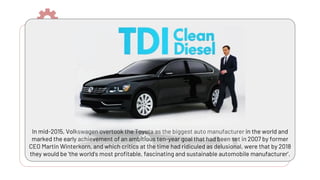
In mid-2015, Volkswagen overtook the Toyota as the biggest auto manufacturer in the world and
marked the early achievement of an ambitious ten-year goal that had been set in 2007 by former
CEO Martin Winterkorn, and which critics at the time had ridiculed as delusional, were that by 2018
they would be ‘the world’s most profitable, fascinating and sustainable automobile manufacturer’.
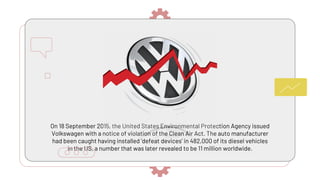
On 18 September 2015, the United States Environmental Protection Agency issued
Volkswagen with a notice of violation of the Clean Air Act. The auto manufacturer
had been caught having installed ‘defeat devices’ in 482,000 of its diesel vehicles
in the US, a number that was later revealed to be 11 million worldwide.
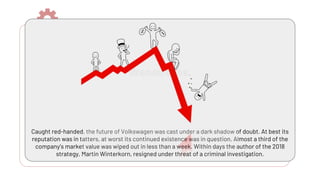
Caught red-handed, the future of Volkswagen was cast under a dark shadow of doubt. At best its
reputation was in tatters, at worst its continued existence was in question. Almost a third of the
company’s market value was wiped out in less than a week. Within days the author of the 2018
strategy, Martin Winterkorn, resigned under threat of a criminal investigation.
TABLE OF
CONTENTS
Introduction
01
Before The Scandal Breaks
02
The Scandal Breaks
03
The Aftermath
04
Ethical Insight
05
Ethical Perspective
06
$
INTRODUCTION
$
01
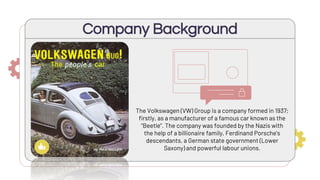
The Volkswagen (VW) Group is a company formed in 1937;
firstly, as a manufacturer of a famous car known as the
“Beetle”. The company was founded by the Nazis with
the help of a billionaire family, Ferdinand Porsche's
descendants, a German state government (Lower
Saxony) and powerful labour unions.
Company Background
Acknowledgement
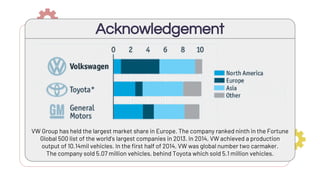
VW Group has held the largest market share in Europe. The company ranked ninth in the Fortune
Global 500 list of the world’s largest companies in 2013. In 2014, VW achieved a production
output of 10.14mil vehicles. In the first half of 2014, VW was global number two carmaker.
The company sold 5.07 million vehicles, behind Toyota which sold 5.1 million vehicles.
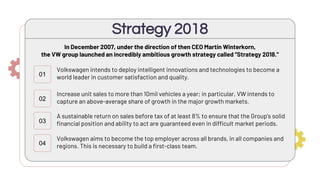
In December 2007, under the direction of then CEO Martin Winterkorn,
the VW group launched an incredibly ambitious growth strategy called “Strategy 2018.”
Strategy 2018
01
02
03
04
Volkswagen intends to deploy intelligent innovations and technologies to become a
world leader in customer satisfaction and quality.
Increase unit sales to more than 10mil vehicles a year; in particular, VW intends to
capture an above-average share of growth in the major growth markets.
A sustainable return on sales before tax of at least 8% to ensure that the Group’s solid
financial position and ability to act are guaranteed even in difficult market periods.
Volkswagen aims to become the top employer across all brands, in all companies and
regions. This is necessary to build a first-class team.
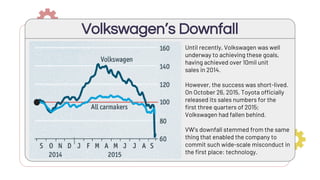
Volkswagen’s Downfall
Until recently, Volkswagen was well
underway to achieving these goals,
having achieved over 10mil unit
sales in 2014.
However, the success was short-lived.
On October 26, 2015, Toyota officially
released its sales numbers for the
first three quarters of 2015;
Volkswagen had fallen behind.
VW’s downfall stemmed from the same
thing that enabled the company to
commit such wide-scale misconduct in
the first place: technology.
Scandal Break
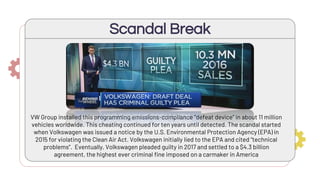
VW Group installed this programming emissions-compliance “defeat device” in about 11 million
vehicles worldwide. This cheating continued for ten years until detected. The scandal started
when Volkswagen was issued a notice by the U.S. Environmental Protection Agency (EPA) in
2015 for violating the Clean Air Act. Volkswagen initially lied to the EPA and cited “technical
problems”. Eventually, Volkswagen pleaded guilty in 2017 and settled to a $4.3 billion
agreement, the highest ever criminal fine imposed on a carmaker in America
Initial Response & Impact
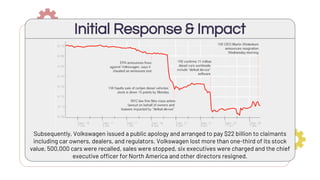
Subsequently, Volkswagen issued a public apology and arranged to pay $22 billion to claimants
including car owners, dealers, and regulators. Volkswagen lost more than one-third of its stock
value, 500,000 cars were recalled, sales were stopped, six executives were charged and the chief
executive officer for North America and other directors resigned.
BEFORE THE
SCANDAL BREAKS
02
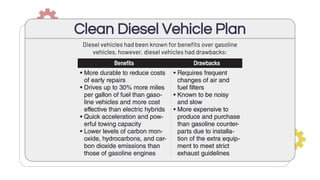
Clean Diesel Vehicle Plan
Diesel vehicles had been known for benefits over gasoline
vehicles, however, diesel vehicles had drawbacks:
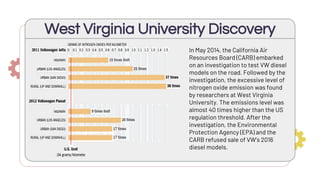
West Virginia University Discovery
In May 2014, the California Air
Resources Board (CARB) embarked
on an investigation to test VW diesel
models on the road. Followed by the
investigation, the excessive level of
nitrogen oxide emission was found
by researchers at West Virginia
University. The emissions level was
almost 40 times higher than the US
regulation threshold. After the
investigation, the Environmental
Protection Agency (EPA) and the
CARB refused sale of VW’s 2016
diesel models.
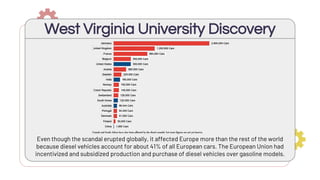
West Virginia University Discovery
Even though the scandal erupted globally, it affected Europe more than the rest of the world
because diesel vehicles account for about 41% of all European cars. The European Union had
incentivized and subsidized production and purchase of diesel vehicles over gasoline models.
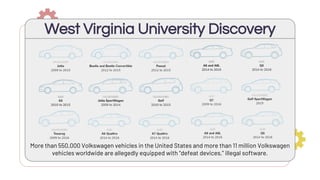
West Virginia University Discovery
More than 550,000 Volkswagen vehicles in the United States and more than 11 million Volkswagen
vehicles worldwide are allegedly equipped with “defeat devices,” illegal software.
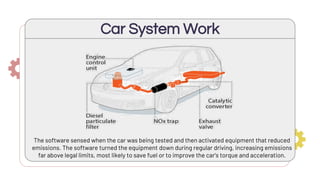
Car System Work
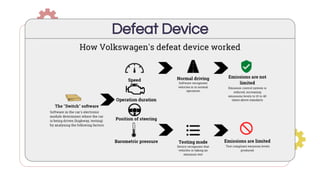
The software sensed when the car was being tested and then activated equipment that reduced
emissions. The software turned the equipment down during regular driving, increasing emissions
far above legal limits, most likely to save fuel or to improve the car’s torque and acceleration.
Defeat Device
THE
SCANDAL
BREAKS
03
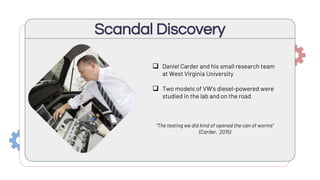
Scandal Discovery
 Daniel Carder and his small research team
at West Virginia University
 Two models of VW’s diesel-powered were
studied in the lab and on the road
“The testing we did kind of opened the can of worms”
(Carder, 2015)
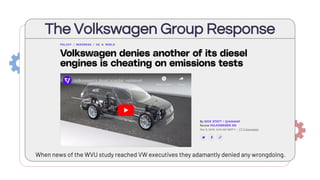
The Volkswagen Group Response
When news of the WVU study reached VW executives they adamantly denied any wrongdoing.
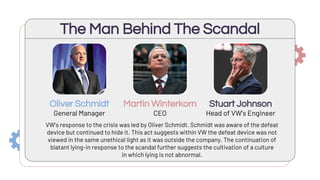
The Man Behind The Scandal
VW’s response to the crisis was led by Oliver Schmidt. Schmidt was aware of the defeat
device but continued to hide it. This act suggests within VW the defeat device was not
viewed in the same unethical light as it was outside the company. The continuation of
blatant lying-in response to the scandal further suggests the cultivation of a culture
in which lying is not abnormal.
General Manager
Oliver Schmidt
CEO
Martin Winterkorn
Head of VW’s Engineer
Stuart Johnson
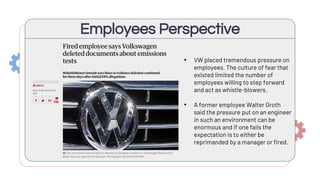
Employees Perspective
• VW placed tremendous pressure on
employees. The culture of fear that
existed limited the number of
employees willing to step forward
and act as whistle-blowers.
• A former employee Walter Groth
said the pressure put on an engineer
in such an environment can be
enormous and if one fails the
expectation is to either be
reprimanded by a manager or fired.
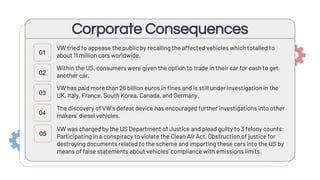
Corporate Consequences
01
02
03
04
VW tried to appease the public by recalling the affected vehicles which totalled to
about 11 million cars worldwide.
Within the US, consumers were given the option to trade in their car for cash to get
another car.
VW has paid more than 26 billion euros in fines and is still under investigation in the
UK, Italy, France, South Korea, Canada, and Germany.
The discovery of VW's defeat device has encouraged further investigations into other
makers' diesel vehicles.
05
VW was charged by the US Department of Justice and plead guilty to 3 felony counts:
Participating in a conspiracy to violate the Clean Air Act, Obstruction of justice for
destroying documents related to the scheme and importing these cars into the US by
means of false statements about vehicles’ compliance with emissions limits.
THE
AFTERMATH
04
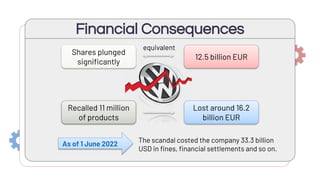
Financial Consequences
Shares plunged
significantly
12.5 billion EUR
equivalent
Recalled 11 million
of products
Lost around 16.2
billion EUR
The scandal costed the company 33.3 billion
USD in fines, financial settlements and so on.
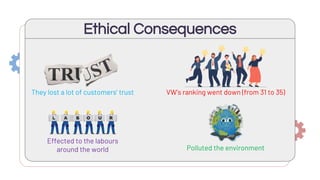
Ethical Consequences
They lost a lot of customers’ trust VW’s ranking went down (from 31 to 35)
Effected to the labours
around the world Polluted the environment
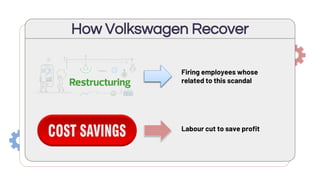
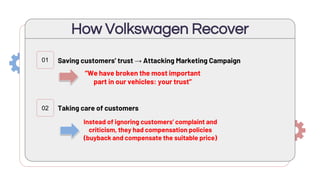
How Volkswagen Recover
Firing employees whose
related to this scandal
Labour cut to save profit
How Volkswagen Recover
Saving customers’ trust → Attacking Marketing Campaign
“We have broken the most important
part in our vehicles: your trust”
Taking care of customers
Instead of ignoring customers’ complaint and
criticism, they had compensation policies
(buyback and compensate the suitable price)
01
02
Ethical Insight &
Future Recc.
05
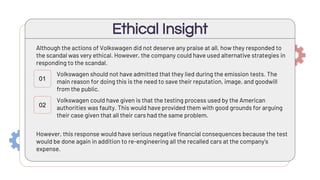
Although the actions of Volkswagen did not deserve any praise at all, how they responded to
the scandal was very ethical. However, the company could have used alternative strategies in
responding to the scandal.
Ethical Insight
01
02
Volkswagen should not have admitted that they lied during the emission tests. The
main reason for doing this is the need to save their reputation, image, and goodwill
from the public.
Volkswagen could have given is that the testing process used by the American
authorities was faulty. This would have provided them with good grounds for arguing
their case given that all their cars had the same problem.
However, this response would have serious negative financial consequences because the test
would be done again in addition to re-engineering all the recalled cars at the company’s
expense.
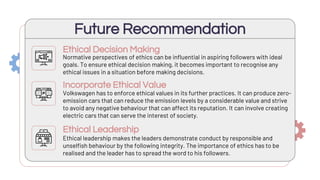
Future Recommendation
Normative perspectives of ethics can be influential in aspiring followers with ideal
goals. To ensure ethical decision making, it becomes important to recognise any
ethical issues in a situation before making decisions.
Ethical Decision Making
Volkswagen has to enforce ethical values in its further practices. It can produce zero-
emission cars that can reduce the emission levels by a considerable value and strive
to avoid any negative behaviour that can affect its reputation. It can involve creating
electric cars that can serve the interest of society.
Incorporate Ethical Value
Ethical leadership makes the leaders demonstrate conduct by responsible and
unselfish behaviour by the following integrity. The importance of ethics has to be
realised and the leader has to spread the word to his followers.
Ethical Leadership
Ethical
Perspectives
06
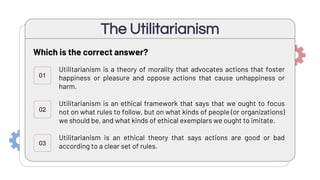
Utilitarianism is a theory of morality that advocates actions that foster
happiness or pleasure and oppose actions that cause unhappiness or
harm.
Utilitarianism is an ethical framework that says that we ought to focus
not on what rules to follow, but on what kinds of people (or organizations)
we should be, and what kinds of ethical exemplars we ought to imitate.
Utilitarianism is an ethical theory that says actions are good or bad
according to a clear set of rules.
The Utilitarianism
01
02
Which is the correct answer?
03
Utilitarianism is a theory of morality that advocates actions that foster
happiness or pleasure and oppose actions that cause unhappiness or
harm.
Utilitarianism is an ethical framework that says that we ought to focus
not on what rules to follow, but on what kinds of people (or organizations)
we should be, and what kinds of ethical exemplars we ought to imitate.
Utilitarianism is an ethical theory that says actions are good or bad
according to a clear set of rules.
The Utilitarianism
01
02
Which is the correct answer?
03
The utilitarianism was founded by Jeremy Bentham (1748-1832) and later developed
by John Stuart Mill (1806-1873), as a teleological conception on morality: "the moral
value of the conduct of a person can be determined only by the consequences of his
behavior, respectively the benefits and the satisfactions for the soul that he can
obtain“. Based on microeconomic theory, the utility is defined through the
perception of an individual/corporation regarding the net benefits they derive from
an action, good/service, compared to the costs to be committed for their
realization.
The ultimate goal of utilitarianism is to ensure "maximum of good for maximum of
people". Proponents of utilitarianism recommend the use of simple rules in
business: "always tell the truth", "never break a contract", "respect your business
partners" etc., rules that could generate the most significant benefits, in the
majority of cases.
The Utilitarianism
01
02
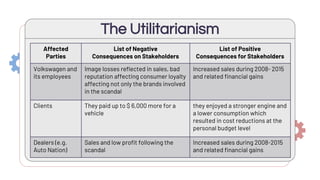
The Utilitarianism
Affected
Parties
List of Negative
Consequences on Stakeholders
List of Positive
Consequences for Stakeholders
Volkswagen and
its employees
Image losses reflected in sales, bad
reputation affecting consumer loyalty
affecting not only the brands involved
in the scandal
Increased sales during 2008- 2015
and related financial gains
Clients They paid up to $ 6,000 more for a
vehicle
they enjoyed a stronger engine and
a lower consumption which
resulted in cost reductions at the
personal budget level
Dealers (e.g.
Auto Nation)
Sales and low profit following the
scandal
Increased sales during 2008-2015
and related financial gains
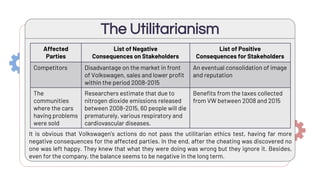
The Utilitarianism
Affected
Parties
List of Negative
Consequences on Stakeholders
List of Positive
Consequences for Stakeholders
Competitors Disadvantage on the market in front
of Volkswagen, sales and lower profit
within the period 2008-2015
An eventual consolidation of image
and reputation
The
communities
where the cars
having problems
were sold
Researchers estimate that due to
nitrogen dioxide emissions released
between 2008-2015, 60 people will die
prematurely, various respiratory and
cardiovascular diseases.
Benefits from the taxes collected
from VW between 2008 and 2015
It is obvious that Volkswagen's actions do not pass the utilitarian ethics test, having far more
negative consequences for the affected parties. In the end, after the cheating was discovered no
one was left happy. They knew that what they were doing was wrong but they ignore it. Besides,
even for the company, the balance seems to be negative in the long term.
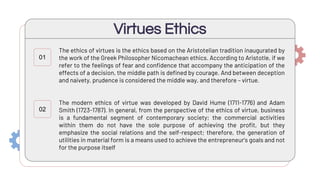
The ethics of virtues is the ethics based on the Aristotelian tradition inaugurated by
the work of the Greek Philosopher Nicomachean ethics. According to Aristotle, if we
refer to the feelings of fear and confidence that accompany the anticipation of the
effects of a decision, the middle path is defined by courage. And between deception
and naivety, prudence is considered the middle way, and therefore – virtue.
The modern ethics of virtue was developed by David Hume (1711-1776) and Adam
Smith (1723-1787). In general, from the perspective of the ethics of virtue, business
is a fundamental segment of contemporary society; the commercial activities
within them do not have the sole purpose of achieving the profit, but they
emphasize the social relations and the self-respect; therefore, the generation of
utilities in material form is a means used to achieve the entrepreneur's goals and not
for the purpose itself
Virtues Ethics
01
02
Virtues Ethics
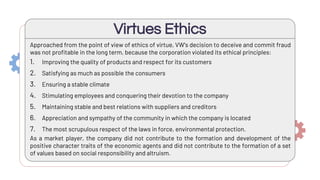
Approached from the point of view of ethics of virtue, VW's decision to deceive and commit fraud
was not profitable in the long term, because the corporation violated its ethical principles:
1. Improving the quality of products and respect for its customers
2. Satisfying as much as possible the consumers
3. Ensuring a stable climate
4. Stimulating employees and conquering their devotion to the company
5. Maintaining stable and best relations with suppliers and creditors
6. Appreciation and sympathy of the community in which the company is located
7. The most scrupulous respect of the laws in force, environmental protection.
As a market player, the company did not contribute to the formation and development of the
positive character traits of the economic agents and did not contribute to the formation of a set
of values based on social responsibility and altruism.
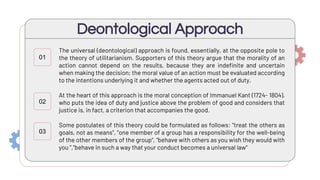
The universal (deontological) approach is found, essentially, at the opposite pole to
the theory of utilitarianism. Supporters of this theory argue that the morality of an
action cannot depend on the results, because they are indefinite and uncertain
when making the decision; the moral value of an action must be evaluated according
to the intentions underlying it and whether the agents acted out of duty.
At the heart of this approach is the moral conception of Immanuel Kant (1724- 1804),
who puts the idea of duty and justice above the problem of good and considers that
justice is, in fact, a criterion that accompanies the good.
Some postulates of this theory could be formulated as follows: "treat the others as
goals, not as means", "one member of a group has a responsibility for the well-being
of the other members of the group”, “behave with others as you wish they would with
you ”,“behave in such a way that your conduct becomes a universal law”
Deontological Approach
01
02
03
Deontological Approach
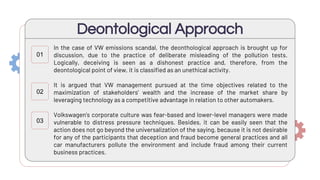
In the case of VW emissions scandal, the deonthological approach is brought up for
discussion, due to the practice of deliberate misleading of the pollution tests.
Logically, deceiving is seen as a dishonest practice and, therefore, from the
deontological point of view, it is classified as an unethical activity.
It is argued that VW management pursued at the time objectives related to the
maximization of stakeholders’ wealth and the increase of the market share by
leveraging technology as a competitive advantage in relation to other automakers.
Volkswagen’s corporate culture was fear-based and lower-level managers were made
vulnerable to distress pressure techniques. Besides, it can be easily seen that the
action does not go beyond the universalization of the saying, because it is not desirable
for any of the participants that deception and fraud become general practices and all
car manufacturers pollute the environment and include fraud among their current
business practices.
01
02
03
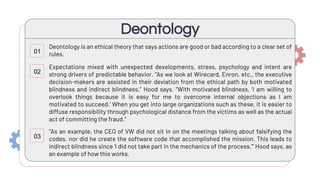
Deontology is an ethical theory that says actions are good or bad according to a clear set of
rules.
Expectations mixed with unexpected developments, stress, psychology and intent are
strong drivers of predictable behavior. “As we look at Wirecard, Enron, etc., the executive
decision-makers are assisted in their deviation from the ethical path by both motivated
blindness and indirect blindness,” Hood says. “With motivated blindness, ‘I am willing to
overlook things because it is easy for me to overcome internal objections as I am
motivated to succeed.’ When you get into large organizations such as these, it is easier to
diffuse responsibility through psychological distance from the victims as well as the actual
act of committing the fraud.”
“As an example, the CEO of VW did not sit in on the meetings talking about falsifying the
codes, nor did he create the software code that accomplished the mission. This leads to
indirect blindness since ‘I did not take part in the mechanics of the process,’” Hood says, as
an example of how this works.
Deontology
01
02
03
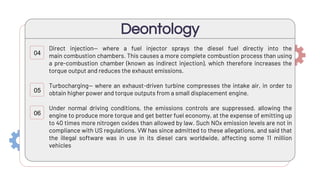
Direct injection— where a fuel injector sprays the diesel fuel directly into the
main combustion chambers. This causes a more complete combustion process than using
a pre-combustion chamber (known as indirect injection), which therefore increases the
torque output and reduces the exhaust emissions.
Turbocharging— where an exhaust-driven turbine compresses the intake air, in order to
obtain higher power and torque outputs from a small displacement engine.
Under normal driving conditions, the emissions controls are suppressed, allowing the
engine to produce more torque and get better fuel economy, at the expense of emitting up
to 40 times more nitrogen oxides than allowed by law. Such NOx emission levels are not in
compliance with US regulations. VW has since admitted to these allegations, and said that
the illegal software was in use in its diesel cars worldwide, affecting some 11 million
vehicles
Deontology
04
05
06
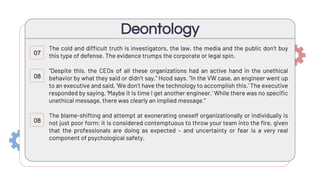
The cold and difficult truth is investigators, the law, the media and the public don’t buy
this type of defense. The evidence trumps the corporate or legal spin.
“Despite this, the CEOs of all these organizations had an active hand in the unethical
behavior by what they said or didn’t say,” Hood says. “In the VW case, an engineer went up
to an executive and said, ‘We don’t have the technology to accomplish this.’ The executive
responded by saying, ‘Maybe it is time I get another engineer.’ While there was no specific
unethical message, there was clearly an implied message.”
The blame-shifting and attempt at exonerating oneself organizationally or individually is
not just poor form; it is considered contemptuous to throw your team into the fire, given
that the professionals are doing as expected – and uncertainty or fear is a very real
component of psychological safety.
Deontology
07
08
08
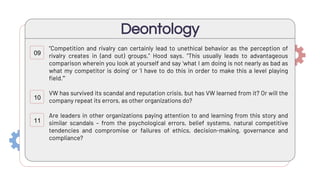
“Competition and rivalry can certainly lead to unethical behavior as the perception of
rivalry creates in (and out) groups,” Hood says. “This usually leads to advantageous
comparison wherein you look at yourself and say ‘what I am doing is not nearly as bad as
what my competitor is doing’ or ‘I have to do this in order to make this a level playing
field.’”
VW has survived its scandal and reputation crisis, but has VW learned from it? Or will the
company repeat its errors, as other organizations do?
Are leaders in other organizations paying attention to and learning from this story and
similar scandals – from the psychological errors, belief systems, natural competitive
tendencies and compromise or failures of ethics, decision-making, governance and
compliance?
Deontology
09
10
11
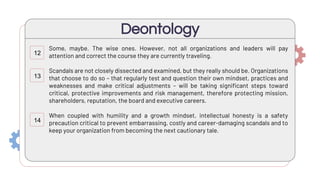
Some, maybe. The wise ones. However, not all organizations and leaders will pay
attention and correct the course they are currently traveling.
Scandals are not closely dissected and examined, but they really should be. Organizations
that choose to do so – that regularly test and question their own mindset, practices and
weaknesses and make critical adjustments – will be taking significant steps toward
critical, protective improvements and risk management, therefore protecting mission,
shareholders, reputation, the board and executive careers.
When coupled with humility and a growth mindset, intellectual honesty is a safety
precaution critical to prevent embarrassing, costly and career-damaging scandals and to
keep your organization from becoming the next cautionary tale.
Deontology
12
13
14
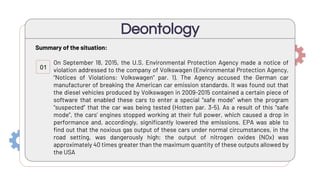
Summary of the situation:
On September 18, 2015, the U.S. Environmental Protection Agency made a notice of
violation addressed to the company of Volkswagen (Environmental Protection Agency,
“Notices of Violations: Volkswagen” par. 1). The Agency accused the German car
manufacturer of breaking the American car emission standards. It was found out that
the diesel vehicles produced by Volkswagen in 2009-2015 contained a certain piece of
software that enabled these cars to enter a special “safe mode” when the program
“suspected” that the car was being tested (Hotten par. 3-5). As a result of this “safe
mode”, the cars’ engines stopped working at their full power, which caused a drop in
performance and, accordingly, significantly lowered the emissions. EPA was able to
find out that the noxious gas output of these cars under normal circumstances, in the
road setting, was dangerously high; the output of nitrogen oxides (NOx) was
approximately 40 times greater than the maximum quantity of these outputs allowed by
the USA
Deontology
01
Summary of the situation:
After the EPA’s actions, the “Volkswagen Group” leading officials admitted that the
company indeed had devised a sophisticated piece of software and had been using it in
order to cheat the emissions tests. The business was forced to recall nearly 500,000
cars in the United States only, which cost approximately €6.5 billion. It is also pointed
out that the EPA is legally able to fine the car manufacturer additional $37,500 for every
car that violates the emissions standards, notably, these are the consequences that
occurred only in the US. Worldwide, the company’s vehicles are also being planned to be
tested, and not only Volkswagen’s cars but also the vehicles made by other
manufacturers
Deontology
02
CONCLUSION
An ethical dilemma implies at least two solutions, both of them being moral; at the same
time, the moral temptation does refer to any moral alternative. Apparently, in deciding
upon the cheating of emission test results, the Volkswagen representatives did not
receive a “false impression” that they faced a right versus right dilemma. It was more than
evident at that time that the choices they had were right versus wrong.
Economic reasons such as increasing company’s benefit and performances are
arguments that fade when balanced with the profoundly negative impact of unethical
actions undertaken by Volkswagen management: increasing the incidence of premature
deaths due to excess of NOx in the atmosphere; the appearance of acid rain.
The fact that Volkswagen was burden by huge costs in the form of fines, penalties,
expenses incurred in repairing vehicles that had installed the software for handling
pollution tests; payment of compensation to cover the huge losses recorded by the
dealers in their own distribution network; erosion of the company's long-term image and
loss of customer loyalty etc.
01
02
03
Thank You
$

Ethics - VW Emission Case (Final Version).pdf

  • 1.
    1. Muhammad AbiyyuFarras 64909 2. Sagita Cahyani Mawaddah 64910 3. Thi Hao Nguyen 64812 4.Muhammad Iniditiya Gegar Laras 64892 5. Wahyu Purwandi 64903 6. Emmanuel Niyibizi 64904 EMISSION: THE VOLKSWAGEN CASE
  • 2.
    In mid-2015, Volkswagenovertook the Toyota as the biggest auto manufacturer in the world and marked the early achievement of an ambitious ten-year goal that had been set in 2007 by former CEO Martin Winterkorn, and which critics at the time had ridiculed as delusional, were that by 2018 they would be ‘the world’s most profitable, fascinating and sustainable automobile manufacturer’.
  • 3.
    On 18 September2015, the United States Environmental Protection Agency issued Volkswagen with a notice of violation of the Clean Air Act. The auto manufacturer had been caught having installed ‘defeat devices’ in 482,000 of its diesel vehicles in the US, a number that was later revealed to be 11 million worldwide.
  • 4.
    Caught red-handed, thefuture of Volkswagen was cast under a dark shadow of doubt. At best its reputation was in tatters, at worst its continued existence was in question. Almost a third of the company’s market value was wiped out in less than a week. Within days the author of the 2018 strategy, Martin Winterkorn, resigned under threat of a criminal investigation.
  • 5.
    TABLE OF CONTENTS Introduction 01 Before TheScandal Breaks 02 The Scandal Breaks 03 The Aftermath 04 Ethical Insight 05 Ethical Perspective 06 $
  • 6.
  • 7.
    The Volkswagen (VW)Group is a company formed in 1937; firstly, as a manufacturer of a famous car known as the “Beetle”. The company was founded by the Nazis with the help of a billionaire family, Ferdinand Porsche's descendants, a German state government (Lower Saxony) and powerful labour unions. Company Background
  • 8.
    Acknowledgement VW Group hasheld the largest market share in Europe. The company ranked ninth in the Fortune Global 500 list of the world’s largest companies in 2013. In 2014, VW achieved a production output of 10.14mil vehicles. In the first half of 2014, VW was global number two carmaker. The company sold 5.07 million vehicles, behind Toyota which sold 5.1 million vehicles.
  • 9.
    In December 2007,under the direction of then CEO Martin Winterkorn, the VW group launched an incredibly ambitious growth strategy called “Strategy 2018.” Strategy 2018 01 02 03 04 Volkswagen intends to deploy intelligent innovations and technologies to become a world leader in customer satisfaction and quality. Increase unit sales to more than 10mil vehicles a year; in particular, VW intends to capture an above-average share of growth in the major growth markets. A sustainable return on sales before tax of at least 8% to ensure that the Group’s solid financial position and ability to act are guaranteed even in difficult market periods. Volkswagen aims to become the top employer across all brands, in all companies and regions. This is necessary to build a first-class team.
  • 10.
    Volkswagen’s Downfall Until recently,Volkswagen was well underway to achieving these goals, having achieved over 10mil unit sales in 2014. However, the success was short-lived. On October 26, 2015, Toyota officially released its sales numbers for the first three quarters of 2015; Volkswagen had fallen behind. VW’s downfall stemmed from the same thing that enabled the company to commit such wide-scale misconduct in the first place: technology.
  • 11.
    Scandal Break VW Groupinstalled this programming emissions-compliance “defeat device” in about 11 million vehicles worldwide. This cheating continued for ten years until detected. The scandal started when Volkswagen was issued a notice by the U.S. Environmental Protection Agency (EPA) in 2015 for violating the Clean Air Act. Volkswagen initially lied to the EPA and cited “technical problems”. Eventually, Volkswagen pleaded guilty in 2017 and settled to a $4.3 billion agreement, the highest ever criminal fine imposed on a carmaker in America
  • 12.
    Initial Response &Impact Subsequently, Volkswagen issued a public apology and arranged to pay $22 billion to claimants including car owners, dealers, and regulators. Volkswagen lost more than one-third of its stock value, 500,000 cars were recalled, sales were stopped, six executives were charged and the chief executive officer for North America and other directors resigned.
  • 13.
  • 14.
    Clean Diesel VehiclePlan Diesel vehicles had been known for benefits over gasoline vehicles, however, diesel vehicles had drawbacks:
  • 15.
    West Virginia UniversityDiscovery In May 2014, the California Air Resources Board (CARB) embarked on an investigation to test VW diesel models on the road. Followed by the investigation, the excessive level of nitrogen oxide emission was found by researchers at West Virginia University. The emissions level was almost 40 times higher than the US regulation threshold. After the investigation, the Environmental Protection Agency (EPA) and the CARB refused sale of VW’s 2016 diesel models.
  • 16.
    West Virginia UniversityDiscovery Even though the scandal erupted globally, it affected Europe more than the rest of the world because diesel vehicles account for about 41% of all European cars. The European Union had incentivized and subsidized production and purchase of diesel vehicles over gasoline models.
  • 17.
    West Virginia UniversityDiscovery More than 550,000 Volkswagen vehicles in the United States and more than 11 million Volkswagen vehicles worldwide are allegedly equipped with “defeat devices,” illegal software.
  • 18.
    Car System Work Thesoftware sensed when the car was being tested and then activated equipment that reduced emissions. The software turned the equipment down during regular driving, increasing emissions far above legal limits, most likely to save fuel or to improve the car’s torque and acceleration.
  • 19.
  • 20.
  • 21.
    Scandal Discovery  DanielCarder and his small research team at West Virginia University  Two models of VW’s diesel-powered were studied in the lab and on the road “The testing we did kind of opened the can of worms” (Carder, 2015)
  • 22.
    The Volkswagen GroupResponse When news of the WVU study reached VW executives they adamantly denied any wrongdoing.
  • 23.
    The Man BehindThe Scandal VW’s response to the crisis was led by Oliver Schmidt. Schmidt was aware of the defeat device but continued to hide it. This act suggests within VW the defeat device was not viewed in the same unethical light as it was outside the company. The continuation of blatant lying-in response to the scandal further suggests the cultivation of a culture in which lying is not abnormal. General Manager Oliver Schmidt CEO Martin Winterkorn Head of VW’s Engineer Stuart Johnson
  • 24.
    Employees Perspective • VWplaced tremendous pressure on employees. The culture of fear that existed limited the number of employees willing to step forward and act as whistle-blowers. • A former employee Walter Groth said the pressure put on an engineer in such an environment can be enormous and if one fails the expectation is to either be reprimanded by a manager or fired.
  • 25.
    Corporate Consequences 01 02 03 04 VW triedto appease the public by recalling the affected vehicles which totalled to about 11 million cars worldwide. Within the US, consumers were given the option to trade in their car for cash to get another car. VW has paid more than 26 billion euros in fines and is still under investigation in the UK, Italy, France, South Korea, Canada, and Germany. The discovery of VW's defeat device has encouraged further investigations into other makers' diesel vehicles. 05 VW was charged by the US Department of Justice and plead guilty to 3 felony counts: Participating in a conspiracy to violate the Clean Air Act, Obstruction of justice for destroying documents related to the scheme and importing these cars into the US by means of false statements about vehicles’ compliance with emissions limits.
  • 26.
  • 27.
    Financial Consequences Shares plunged significantly 12.5billion EUR equivalent Recalled 11 million of products Lost around 16.2 billion EUR The scandal costed the company 33.3 billion USD in fines, financial settlements and so on.
  • 28.
    Ethical Consequences They losta lot of customers’ trust VW’s ranking went down (from 31 to 35) Effected to the labours around the world Polluted the environment
  • 29.
    How Volkswagen Recover Firingemployees whose related to this scandal Labour cut to save profit
  • 30.
    How Volkswagen Recover Savingcustomers’ trust → Attacking Marketing Campaign “We have broken the most important part in our vehicles: your trust” Taking care of customers Instead of ignoring customers’ complaint and criticism, they had compensation policies (buyback and compensate the suitable price) 01 02
  • 31.
  • 32.
    Although the actionsof Volkswagen did not deserve any praise at all, how they responded to the scandal was very ethical. However, the company could have used alternative strategies in responding to the scandal. Ethical Insight 01 02 Volkswagen should not have admitted that they lied during the emission tests. The main reason for doing this is the need to save their reputation, image, and goodwill from the public. Volkswagen could have given is that the testing process used by the American authorities was faulty. This would have provided them with good grounds for arguing their case given that all their cars had the same problem. However, this response would have serious negative financial consequences because the test would be done again in addition to re-engineering all the recalled cars at the company’s expense.
  • 33.
    Future Recommendation Normative perspectivesof ethics can be influential in aspiring followers with ideal goals. To ensure ethical decision making, it becomes important to recognise any ethical issues in a situation before making decisions. Ethical Decision Making Volkswagen has to enforce ethical values in its further practices. It can produce zero- emission cars that can reduce the emission levels by a considerable value and strive to avoid any negative behaviour that can affect its reputation. It can involve creating electric cars that can serve the interest of society. Incorporate Ethical Value Ethical leadership makes the leaders demonstrate conduct by responsible and unselfish behaviour by the following integrity. The importance of ethics has to be realised and the leader has to spread the word to his followers. Ethical Leadership
  • 34.
  • 35.
    Utilitarianism is atheory of morality that advocates actions that foster happiness or pleasure and oppose actions that cause unhappiness or harm. Utilitarianism is an ethical framework that says that we ought to focus not on what rules to follow, but on what kinds of people (or organizations) we should be, and what kinds of ethical exemplars we ought to imitate. Utilitarianism is an ethical theory that says actions are good or bad according to a clear set of rules. The Utilitarianism 01 02 Which is the correct answer? 03
  • 36.
    Utilitarianism is atheory of morality that advocates actions that foster happiness or pleasure and oppose actions that cause unhappiness or harm. Utilitarianism is an ethical framework that says that we ought to focus not on what rules to follow, but on what kinds of people (or organizations) we should be, and what kinds of ethical exemplars we ought to imitate. Utilitarianism is an ethical theory that says actions are good or bad according to a clear set of rules. The Utilitarianism 01 02 Which is the correct answer? 03
  • 37.
    The utilitarianism wasfounded by Jeremy Bentham (1748-1832) and later developed by John Stuart Mill (1806-1873), as a teleological conception on morality: "the moral value of the conduct of a person can be determined only by the consequences of his behavior, respectively the benefits and the satisfactions for the soul that he can obtain“. Based on microeconomic theory, the utility is defined through the perception of an individual/corporation regarding the net benefits they derive from an action, good/service, compared to the costs to be committed for their realization. The ultimate goal of utilitarianism is to ensure "maximum of good for maximum of people". Proponents of utilitarianism recommend the use of simple rules in business: "always tell the truth", "never break a contract", "respect your business partners" etc., rules that could generate the most significant benefits, in the majority of cases. The Utilitarianism 01 02
  • 38.
    The Utilitarianism Affected Parties List ofNegative Consequences on Stakeholders List of Positive Consequences for Stakeholders Volkswagen and its employees Image losses reflected in sales, bad reputation affecting consumer loyalty affecting not only the brands involved in the scandal Increased sales during 2008- 2015 and related financial gains Clients They paid up to $ 6,000 more for a vehicle they enjoyed a stronger engine and a lower consumption which resulted in cost reductions at the personal budget level Dealers (e.g. Auto Nation) Sales and low profit following the scandal Increased sales during 2008-2015 and related financial gains
  • 39.
    The Utilitarianism Affected Parties List ofNegative Consequences on Stakeholders List of Positive Consequences for Stakeholders Competitors Disadvantage on the market in front of Volkswagen, sales and lower profit within the period 2008-2015 An eventual consolidation of image and reputation The communities where the cars having problems were sold Researchers estimate that due to nitrogen dioxide emissions released between 2008-2015, 60 people will die prematurely, various respiratory and cardiovascular diseases. Benefits from the taxes collected from VW between 2008 and 2015 It is obvious that Volkswagen's actions do not pass the utilitarian ethics test, having far more negative consequences for the affected parties. In the end, after the cheating was discovered no one was left happy. They knew that what they were doing was wrong but they ignore it. Besides, even for the company, the balance seems to be negative in the long term.
  • 40.
    The ethics ofvirtues is the ethics based on the Aristotelian tradition inaugurated by the work of the Greek Philosopher Nicomachean ethics. According to Aristotle, if we refer to the feelings of fear and confidence that accompany the anticipation of the effects of a decision, the middle path is defined by courage. And between deception and naivety, prudence is considered the middle way, and therefore – virtue. The modern ethics of virtue was developed by David Hume (1711-1776) and Adam Smith (1723-1787). In general, from the perspective of the ethics of virtue, business is a fundamental segment of contemporary society; the commercial activities within them do not have the sole purpose of achieving the profit, but they emphasize the social relations and the self-respect; therefore, the generation of utilities in material form is a means used to achieve the entrepreneur's goals and not for the purpose itself Virtues Ethics 01 02
  • 41.
    Virtues Ethics Approached fromthe point of view of ethics of virtue, VW's decision to deceive and commit fraud was not profitable in the long term, because the corporation violated its ethical principles: 1. Improving the quality of products and respect for its customers 2. Satisfying as much as possible the consumers 3. Ensuring a stable climate 4. Stimulating employees and conquering their devotion to the company 5. Maintaining stable and best relations with suppliers and creditors 6. Appreciation and sympathy of the community in which the company is located 7. The most scrupulous respect of the laws in force, environmental protection. As a market player, the company did not contribute to the formation and development of the positive character traits of the economic agents and did not contribute to the formation of a set of values based on social responsibility and altruism.
  • 42.
    The universal (deontological)approach is found, essentially, at the opposite pole to the theory of utilitarianism. Supporters of this theory argue that the morality of an action cannot depend on the results, because they are indefinite and uncertain when making the decision; the moral value of an action must be evaluated according to the intentions underlying it and whether the agents acted out of duty. At the heart of this approach is the moral conception of Immanuel Kant (1724- 1804), who puts the idea of duty and justice above the problem of good and considers that justice is, in fact, a criterion that accompanies the good. Some postulates of this theory could be formulated as follows: "treat the others as goals, not as means", "one member of a group has a responsibility for the well-being of the other members of the group”, “behave with others as you wish they would with you ”,“behave in such a way that your conduct becomes a universal law” Deontological Approach 01 02 03
  • 43.
    Deontological Approach In thecase of VW emissions scandal, the deonthological approach is brought up for discussion, due to the practice of deliberate misleading of the pollution tests. Logically, deceiving is seen as a dishonest practice and, therefore, from the deontological point of view, it is classified as an unethical activity. It is argued that VW management pursued at the time objectives related to the maximization of stakeholders’ wealth and the increase of the market share by leveraging technology as a competitive advantage in relation to other automakers. Volkswagen’s corporate culture was fear-based and lower-level managers were made vulnerable to distress pressure techniques. Besides, it can be easily seen that the action does not go beyond the universalization of the saying, because it is not desirable for any of the participants that deception and fraud become general practices and all car manufacturers pollute the environment and include fraud among their current business practices. 01 02 03
  • 44.
    Deontology is anethical theory that says actions are good or bad according to a clear set of rules. Expectations mixed with unexpected developments, stress, psychology and intent are strong drivers of predictable behavior. “As we look at Wirecard, Enron, etc., the executive decision-makers are assisted in their deviation from the ethical path by both motivated blindness and indirect blindness,” Hood says. “With motivated blindness, ‘I am willing to overlook things because it is easy for me to overcome internal objections as I am motivated to succeed.’ When you get into large organizations such as these, it is easier to diffuse responsibility through psychological distance from the victims as well as the actual act of committing the fraud.” “As an example, the CEO of VW did not sit in on the meetings talking about falsifying the codes, nor did he create the software code that accomplished the mission. This leads to indirect blindness since ‘I did not take part in the mechanics of the process,’” Hood says, as an example of how this works. Deontology 01 02 03
  • 45.
    Direct injection— wherea fuel injector sprays the diesel fuel directly into the main combustion chambers. This causes a more complete combustion process than using a pre-combustion chamber (known as indirect injection), which therefore increases the torque output and reduces the exhaust emissions. Turbocharging— where an exhaust-driven turbine compresses the intake air, in order to obtain higher power and torque outputs from a small displacement engine. Under normal driving conditions, the emissions controls are suppressed, allowing the engine to produce more torque and get better fuel economy, at the expense of emitting up to 40 times more nitrogen oxides than allowed by law. Such NOx emission levels are not in compliance with US regulations. VW has since admitted to these allegations, and said that the illegal software was in use in its diesel cars worldwide, affecting some 11 million vehicles Deontology 04 05 06
  • 46.
    The cold anddifficult truth is investigators, the law, the media and the public don’t buy this type of defense. The evidence trumps the corporate or legal spin. “Despite this, the CEOs of all these organizations had an active hand in the unethical behavior by what they said or didn’t say,” Hood says. “In the VW case, an engineer went up to an executive and said, ‘We don’t have the technology to accomplish this.’ The executive responded by saying, ‘Maybe it is time I get another engineer.’ While there was no specific unethical message, there was clearly an implied message.” The blame-shifting and attempt at exonerating oneself organizationally or individually is not just poor form; it is considered contemptuous to throw your team into the fire, given that the professionals are doing as expected – and uncertainty or fear is a very real component of psychological safety. Deontology 07 08 08
  • 47.
    “Competition and rivalrycan certainly lead to unethical behavior as the perception of rivalry creates in (and out) groups,” Hood says. “This usually leads to advantageous comparison wherein you look at yourself and say ‘what I am doing is not nearly as bad as what my competitor is doing’ or ‘I have to do this in order to make this a level playing field.’” VW has survived its scandal and reputation crisis, but has VW learned from it? Or will the company repeat its errors, as other organizations do? Are leaders in other organizations paying attention to and learning from this story and similar scandals – from the psychological errors, belief systems, natural competitive tendencies and compromise or failures of ethics, decision-making, governance and compliance? Deontology 09 10 11
  • 48.
    Some, maybe. Thewise ones. However, not all organizations and leaders will pay attention and correct the course they are currently traveling. Scandals are not closely dissected and examined, but they really should be. Organizations that choose to do so – that regularly test and question their own mindset, practices and weaknesses and make critical adjustments – will be taking significant steps toward critical, protective improvements and risk management, therefore protecting mission, shareholders, reputation, the board and executive careers. When coupled with humility and a growth mindset, intellectual honesty is a safety precaution critical to prevent embarrassing, costly and career-damaging scandals and to keep your organization from becoming the next cautionary tale. Deontology 12 13 14
  • 49.
    Summary of thesituation: On September 18, 2015, the U.S. Environmental Protection Agency made a notice of violation addressed to the company of Volkswagen (Environmental Protection Agency, “Notices of Violations: Volkswagen” par. 1). The Agency accused the German car manufacturer of breaking the American car emission standards. It was found out that the diesel vehicles produced by Volkswagen in 2009-2015 contained a certain piece of software that enabled these cars to enter a special “safe mode” when the program “suspected” that the car was being tested (Hotten par. 3-5). As a result of this “safe mode”, the cars’ engines stopped working at their full power, which caused a drop in performance and, accordingly, significantly lowered the emissions. EPA was able to find out that the noxious gas output of these cars under normal circumstances, in the road setting, was dangerously high; the output of nitrogen oxides (NOx) was approximately 40 times greater than the maximum quantity of these outputs allowed by the USA Deontology 01
  • 50.
    Summary of thesituation: After the EPA’s actions, the “Volkswagen Group” leading officials admitted that the company indeed had devised a sophisticated piece of software and had been using it in order to cheat the emissions tests. The business was forced to recall nearly 500,000 cars in the United States only, which cost approximately €6.5 billion. It is also pointed out that the EPA is legally able to fine the car manufacturer additional $37,500 for every car that violates the emissions standards, notably, these are the consequences that occurred only in the US. Worldwide, the company’s vehicles are also being planned to be tested, and not only Volkswagen’s cars but also the vehicles made by other manufacturers Deontology 02
  • 51.
  • 52.
    An ethical dilemmaimplies at least two solutions, both of them being moral; at the same time, the moral temptation does refer to any moral alternative. Apparently, in deciding upon the cheating of emission test results, the Volkswagen representatives did not receive a “false impression” that they faced a right versus right dilemma. It was more than evident at that time that the choices they had were right versus wrong. Economic reasons such as increasing company’s benefit and performances are arguments that fade when balanced with the profoundly negative impact of unethical actions undertaken by Volkswagen management: increasing the incidence of premature deaths due to excess of NOx in the atmosphere; the appearance of acid rain. The fact that Volkswagen was burden by huge costs in the form of fines, penalties, expenses incurred in repairing vehicles that had installed the software for handling pollution tests; payment of compensation to cover the huge losses recorded by the dealers in their own distribution network; erosion of the company's long-term image and loss of customer loyalty etc. 01 02 03
  • 53.