ETHICAL VOTING
U M E S H S I N H A
DY E L E C T I O N C O M M I S S I O N E R
R A J E S H L A K H A N I
C E O T N
ETHICAL VOTING - DEFINITION
Nothing is more integral to democracy than voting. Most
people believe that every citizen has the civic duty or moral
obligation to vote, that any sincere vote is morally acceptable,
and that buying, selling, or trading votes is inherently wrong.
ETHICAL PRINCIPLES OF ELECTION
ADMINISTRATION
• Demonstrate respect for Law
• Must be non partisan and neutral
• Must be transparent
• Must be accurate and designed to serve the voters
THREE DIMENSIONS OF ELECTORAL PARTICIPATION
Informed Inclusive
Ethical
VICIOUS CYCLE
Candidate/ Political Party
Voter
Distribution of money
Demands more money
VIRTUOUS CYCLE
Voter
Political party/ Candidate
Pledge NO NOTE
No Incentive
ETHICAL AND INFORMED VOTING
• Buying, selling, or trading votes is inherently wrong.
• Don’t be induced into voting for money
• Don’t be induced into voting on caste and religious lines
• Vote for right candidate
• Vote without fear
• Giving as well as taking bribe for voting is an electoral offence and punishable
under law with one year imprisonment
Indian Penal Code 1860
Sec.171 B –
Bribery
Sec.171 E –
Provision of
punishment
Sec. 171 C –
Undue
influence at
election
Sec. 171 F -
Provision of
punishment
Sec.171 H -
Illegal
payments
and
punishment
LEGAL PROVISIONS AT A GLANCE
Representation of People Act, 1951
Sec. 8, 8A
Disqualification
on conviction
for certain
offences
(promoting
enmity on
ground of
religion, race,
language, etc),
on ground of
corrupt
practices
Sec. 9, 9A, 10
Disqualification
for corruption or
disloyalty, for
Government
contracts, etc.
office under
Government
company, for
failure to lodge
account of
election expenses.
Sec.11A.
Disqualification
arising out of
conviction and
corrupt
practices
LEGAL PROVISIONS AT A GLANCE
MODEL CODE OF CONDUCT
• The Model Code of Conduct for guidance of political parties and candidates is a set of norms
which has been evolved with the consensus of political parties who have consented to abide by
the principles embodied in the said code and also binds them to respect and observe it in its
letter and spirit.
• The salient features of the Model Code of Conduct lay down how political parties, contesting
candidates and party(s) in power should conduct themselves during the process of elections i.e.
on their general conduct during electioneering, holding meetings and processions, poll day
activities and functioning of the party in power etc.
• MCC comes into operation from the day ECI announces the program for election in a
constituency.
• Developed for maintaining a healthy and peaceful atmosphere conducive to the conduct of
smooth elections
• Also, provides level playing field for all parties.
SVEEP (SYSTEMATIC VOTER’ EDUCATION AND ELECTORAL PARTICIPATION)
• Started by Election Commission of India during 2009
• Multi Intervention programme
• Reaches out through different modes and media
• To educate citizens electors and voters about the electoral process in order to
increase their awareness and participation
• Is designed according to the socio – economic, cultural and demographic
profile of the State as well as history of electoral participation in previous
rounds of elections and learning thereof
CASE STUDY
ETHICAL VOTING – THE CAMPAIGN
• Create awareness among the voters by educating them to cast their votes
without any inducement
• Spreading awareness messages such as
“Vote with consciousness”
 “Vote without Note”
 “NoVote for Note”
ETHICAL VOTING – THE CAMPAIGN
• The provision for imprisonment for receiving bribe for vote – was
published widely by posters, media etc.,
• Ethical voting pledge was taken by candidates during nomination and the
same was widely disseminated in all media.
• Mass Ethical voting pledge was taken throughout the state by all stake
holders
CELEBRITY ENDORSEMENT
VIRAT KOHLI- CRICKETER
No Note for
Vote
NO NOTE FOR VOTE
CELEBRITY VIDEO MESSAGES
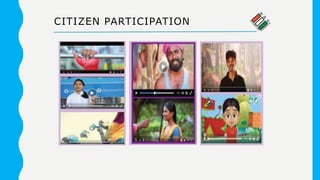
CITIZEN PARTICIPATION
CELEBRITY VIDEO
TN 100 PERCENT
SVEEP Buses
REACHING OUT TO PARENTS
THROUGH THEIR WARDS
ETHICAL VOTING – PLEDGE BY CANDIDATES
• For the first time in Indian
elections, the contesting
candidates were requested to
take a pledge on ethical voting
while filing their nomination to
ensure a free and fair election
without any inducement
Candidates taking ethical voting pledge
ETHICAL VOTING – PLEDGE BY CANDIDATE
ETHICAL VOTING - PLEDGE BY VOTERS
Hospitals Villages
CEO’S PORTAL – RECENT EVENTS IN PLEDGE
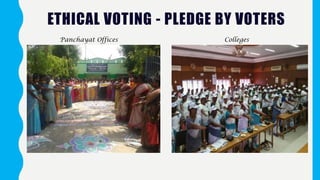
ETHICAL VOTING - PLEDGE BY VOTERS
Panchayat Offices Colleges
CEO’S PORTAL – RECENT EVENTS IN PLEDGE
Recent election related events were made available to public in the CEO’s portal.
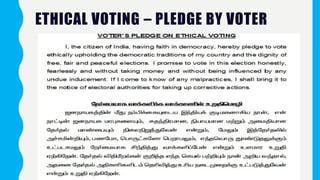
ETHICAL VOTING – PLEDGE BY VOTER
For improvingVoter turnout and ensuring
EthicalVoting practice
 Mass Ethical voting pledge was taken
throughout the state by all stake holders on
10-05-2016 and a record 160,95,163
persons took the pledge.
 107,517 pics uploaded on website
ETHICAL VOTING – THE CAMPAIGN
THANK YOU

Ethical voting

  • 1.
    ETHICAL VOTING U ME S H S I N H A DY E L E C T I O N C O M M I S S I O N E R R A J E S H L A K H A N I C E O T N
  • 2.
    ETHICAL VOTING -DEFINITION Nothing is more integral to democracy than voting. Most people believe that every citizen has the civic duty or moral obligation to vote, that any sincere vote is morally acceptable, and that buying, selling, or trading votes is inherently wrong.
  • 3.
    ETHICAL PRINCIPLES OFELECTION ADMINISTRATION • Demonstrate respect for Law • Must be non partisan and neutral • Must be transparent • Must be accurate and designed to serve the voters
  • 4.
    THREE DIMENSIONS OFELECTORAL PARTICIPATION Informed Inclusive Ethical
  • 5.
    VICIOUS CYCLE Candidate/ PoliticalParty Voter Distribution of money Demands more money
  • 6.
    VIRTUOUS CYCLE Voter Political party/Candidate Pledge NO NOTE No Incentive
  • 7.
    ETHICAL AND INFORMEDVOTING • Buying, selling, or trading votes is inherently wrong. • Don’t be induced into voting for money • Don’t be induced into voting on caste and religious lines • Vote for right candidate • Vote without fear • Giving as well as taking bribe for voting is an electoral offence and punishable under law with one year imprisonment
  • 8.
    Indian Penal Code1860 Sec.171 B – Bribery Sec.171 E – Provision of punishment Sec. 171 C – Undue influence at election Sec. 171 F - Provision of punishment Sec.171 H - Illegal payments and punishment LEGAL PROVISIONS AT A GLANCE
  • 9.
    Representation of PeopleAct, 1951 Sec. 8, 8A Disqualification on conviction for certain offences (promoting enmity on ground of religion, race, language, etc), on ground of corrupt practices Sec. 9, 9A, 10 Disqualification for corruption or disloyalty, for Government contracts, etc. office under Government company, for failure to lodge account of election expenses. Sec.11A. Disqualification arising out of conviction and corrupt practices LEGAL PROVISIONS AT A GLANCE
  • 10.
    MODEL CODE OFCONDUCT • The Model Code of Conduct for guidance of political parties and candidates is a set of norms which has been evolved with the consensus of political parties who have consented to abide by the principles embodied in the said code and also binds them to respect and observe it in its letter and spirit. • The salient features of the Model Code of Conduct lay down how political parties, contesting candidates and party(s) in power should conduct themselves during the process of elections i.e. on their general conduct during electioneering, holding meetings and processions, poll day activities and functioning of the party in power etc. • MCC comes into operation from the day ECI announces the program for election in a constituency. • Developed for maintaining a healthy and peaceful atmosphere conducive to the conduct of smooth elections • Also, provides level playing field for all parties.
  • 11.
    SVEEP (SYSTEMATIC VOTER’EDUCATION AND ELECTORAL PARTICIPATION) • Started by Election Commission of India during 2009 • Multi Intervention programme • Reaches out through different modes and media • To educate citizens electors and voters about the electoral process in order to increase their awareness and participation • Is designed according to the socio – economic, cultural and demographic profile of the State as well as history of electoral participation in previous rounds of elections and learning thereof
  • 13.
  • 14.
    ETHICAL VOTING –THE CAMPAIGN • Create awareness among the voters by educating them to cast their votes without any inducement • Spreading awareness messages such as “Vote with consciousness”  “Vote without Note”  “NoVote for Note”
  • 15.
    ETHICAL VOTING –THE CAMPAIGN • The provision for imprisonment for receiving bribe for vote – was published widely by posters, media etc., • Ethical voting pledge was taken by candidates during nomination and the same was widely disseminated in all media. • Mass Ethical voting pledge was taken throughout the state by all stake holders
  • 16.
  • 17.
  • 25.
  • 26.
  • 27.
  • 28.
  • 29.
  • 31.
  • 32.
  • 33.
    REACHING OUT TOPARENTS THROUGH THEIR WARDS
  • 35.
    ETHICAL VOTING –PLEDGE BY CANDIDATES • For the first time in Indian elections, the contesting candidates were requested to take a pledge on ethical voting while filing their nomination to ensure a free and fair election without any inducement Candidates taking ethical voting pledge
  • 36.
    ETHICAL VOTING –PLEDGE BY CANDIDATE
  • 37.
    ETHICAL VOTING -PLEDGE BY VOTERS Hospitals Villages
  • 38.
    CEO’S PORTAL –RECENT EVENTS IN PLEDGE
  • 39.
    ETHICAL VOTING -PLEDGE BY VOTERS Panchayat Offices Colleges
  • 40.
    CEO’S PORTAL –RECENT EVENTS IN PLEDGE Recent election related events were made available to public in the CEO’s portal.
  • 41.
    ETHICAL VOTING –PLEDGE BY VOTER
  • 42.
    For improvingVoter turnoutand ensuring EthicalVoting practice  Mass Ethical voting pledge was taken throughout the state by all stake holders on 10-05-2016 and a record 160,95,163 persons took the pledge.  107,517 pics uploaded on website ETHICAL VOTING – THE CAMPAIGN
  • 43.