Grade 12 Global Issues:
Citizenship and Sustainability

          SAGE: MSSTA
        October 19th, 2012
Who we are
• Vision: Manitobans — Working Together as Global Citizens.

• Mission: The Manitoba Council for International
  Cooperation (MCIC) is a coalition of organizations involved
  in international development who are committed to:
   – Respect, empowerment and self-determination for all peoples
   – Development that protects the world’s environment
   – Global understanding, cooperation and social justice.
   MCIC’s mission as a coordinating structure is to promote public
     awareness of international issues, to foster member interaction,
     and to administer funds for international development.
What we Do
• Administer MGMGP for our members
  • Development
  • Relief and Rehabilitation
• Public Engagement
  • Schools
  • Community
• Communication
• Capacity Building
• Fair Trade Manitoba is a program of MCIC that
  seeks to increase awareness of fair trade & the
  number of products available in Manitoba
• Consumer guide on
  www.fairtrademanitoba.com can help you find
  fair trade products in your region!
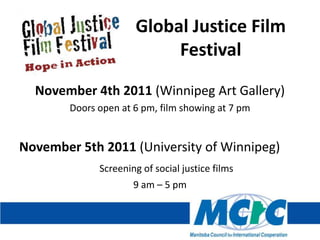
Global Justice Film
                           Festival

  November 4th 2011 (Winnipeg Art Gallery)
        Doors open at 6 pm, film showing at 7 pm


November 5th 2011 (University of Winnipeg)
              Screening of social justice films
                      9 am – 5 pm
Global Citizenship Award
The Global Citizenship Award recognizes graduating
Grade 12 students.
New this year will be the Global Citizenship Educator
Award for middle school teachers; high school
teachers; or administrators who have helped create a
more just and sustainable world through engaging in
meaningful global citizenship activities.

The deadline for the 2010/11 year is March 23, 2012.
Community
                          Solidarity Fund

The Community Solidarity Fund provides
funding to Manitoba not-for-profit, community
based groups involved in development projects
overseas.
Funds of up to $5,000 available.
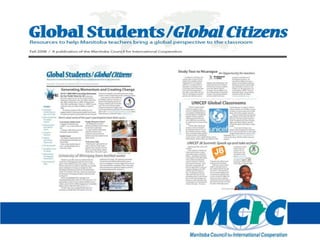
Global Students/Global Citizens is a quarterly
e-newsletter distributed to hundreds of
teachers throughout Manitoba. The
newsletter is a way for MCIC and its members
to inform teachers about educational
opportunities available to them and their
students.
Customized Programs
         MCIC staff are available to do
         programs on global issues to
         your school. We currently have
         workshops on:
         •   Water
         •   Fair Trade / Child Labour
         •   Ethical Consumption
         •   Play Fair: Fair Trade and Sports
         •   Gender & Education
         •   Global Food Security
         •   Sustainable Development Grant Assistance

Contact us to ask about your needs!
Exploring the Impacts of Take Action
           Projects: Thinking Critically
What are the impacts of our actions at these levels:
• Individual
• Classroom
• School
• Community
• City
• Provincial
• Country
• Global
A student hears of a major disaster
and decides to raise money for relief
in the country. They use images
taken during the disaster in their
fundraising. When students donate,
they receive a button to wear that
says, I helped to save [name of
country]
A student decides to collect second-
hand clothing to send to a poor
community in another country. They
plan to send the clothing to a school
in the community, where the
clothing will be distributed for free
to the students.
Ethical Images

Adapted from Ethical Images: The
South Through the Northern Eye
A severely malnourished displaced Somali child is admitted at southern
   Mogadishu's Banadir hospital for treatment on August 2, 2011. Warnings
  grow that famine could spread across all southern Somalia, but the urgent
action needed to avert that is being hampered as conflict escalates and rebels
 maintain a stranglehold on aid. Famine was declared in two Somali regions
   last month, but UN humanitarian relief chief Valerie Amos has warned it
                could extend across the majority of the south
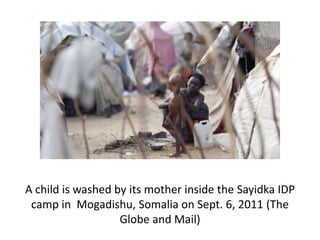
A child is washed by its mother inside the Sayidka IDP
 camp in Mogadishu, Somalia on Sept. 6, 2011 (The
                   Globe and Mail)
When asked “When I say to you
         ‘developing’ or ‘third world’
        what comes to mind?”
   80% responded with words such as
           ‘war’, ‘famine’, ‘disaster’,
        ‘starvation’, and ‘corruption’.
-VSO Study, “The Live Aid Legacy: The Developing World through British Eyes”
Canadian Perceptions of International Development:
• No aid can make a difference
• Problems are unsolvable
• “Us” vs. “them” – focus on separateness, no
  recognition of interconnectedness
• Superiority of the North as experts
• The South as a charity case
• Poverty as hopeless
• People in developing countries as victims, rather
  than agents of their own empowerment /
  development
                                     - Nathanson, 2005
Pictures of famine victims are often
   presented without context and
  without the subjects’ names. You
    have to think, “would I like my
 picture, or my child’s picture, taken
              like this?”
                        -Pete Davis, Oxfam
Disaster images rarely portray local
      people helping each other.
90% of the people saved are saved by
 their neighbours and family, 10% by
  people who rush in from round and
about, and about 0.01% by people who
  come in from the other side of the
                world.
   - Tony Vaux, Author of the Selfish Altruist
Critical Thinking
When looking at a photograph, ask yourself:
• Who took the photograph? What is their position /
  job / role?
• Why did this person take the photograph?
  (commercial, personal reasons)
• How is the photograph being used? Who benefits
  from the use of the photograph (short-term and
  long-term)?
• What message is the photograph meant to convey?
• What message does it convey?
We can avoid images that:
• oversimplify / hide diversity
• fuel prejudice
• give an idea of Northern superiority
• show people as hopeless objects for our
  pity, instead of equal partners in action
               -Adapted from CCIC’s Code of Ethics
Visit our website at
   www.mcic.ca

   (204) 987-6420
   youth@mcic.ca

Ethical images

  • 1.
    Grade 12 GlobalIssues: Citizenship and Sustainability SAGE: MSSTA October 19th, 2012
  • 2.
    Who we are •Vision: Manitobans — Working Together as Global Citizens. • Mission: The Manitoba Council for International Cooperation (MCIC) is a coalition of organizations involved in international development who are committed to: – Respect, empowerment and self-determination for all peoples – Development that protects the world’s environment – Global understanding, cooperation and social justice. MCIC’s mission as a coordinating structure is to promote public awareness of international issues, to foster member interaction, and to administer funds for international development.
  • 3.
    What we Do •Administer MGMGP for our members • Development • Relief and Rehabilitation • Public Engagement • Schools • Community • Communication • Capacity Building
  • 4.
    • Fair TradeManitoba is a program of MCIC that seeks to increase awareness of fair trade & the number of products available in Manitoba • Consumer guide on www.fairtrademanitoba.com can help you find fair trade products in your region!
  • 5.
    Global Justice Film Festival November 4th 2011 (Winnipeg Art Gallery) Doors open at 6 pm, film showing at 7 pm November 5th 2011 (University of Winnipeg) Screening of social justice films 9 am – 5 pm
  • 6.
    Global Citizenship Award TheGlobal Citizenship Award recognizes graduating Grade 12 students. New this year will be the Global Citizenship Educator Award for middle school teachers; high school teachers; or administrators who have helped create a more just and sustainable world through engaging in meaningful global citizenship activities. The deadline for the 2010/11 year is March 23, 2012.
  • 7.
    Community Solidarity Fund The Community Solidarity Fund provides funding to Manitoba not-for-profit, community based groups involved in development projects overseas. Funds of up to $5,000 available.
  • 8.
    Global Students/Global Citizensis a quarterly e-newsletter distributed to hundreds of teachers throughout Manitoba. The newsletter is a way for MCIC and its members to inform teachers about educational opportunities available to them and their students.
  • 10.
    Customized Programs MCIC staff are available to do programs on global issues to your school. We currently have workshops on: • Water • Fair Trade / Child Labour • Ethical Consumption • Play Fair: Fair Trade and Sports • Gender & Education • Global Food Security • Sustainable Development Grant Assistance Contact us to ask about your needs!
  • 11.
    Exploring the Impactsof Take Action Projects: Thinking Critically What are the impacts of our actions at these levels: • Individual • Classroom • School • Community • City • Provincial • Country • Global
  • 12.
    A student hearsof a major disaster and decides to raise money for relief in the country. They use images taken during the disaster in their fundraising. When students donate, they receive a button to wear that says, I helped to save [name of country]
  • 13.
    A student decidesto collect second- hand clothing to send to a poor community in another country. They plan to send the clothing to a school in the community, where the clothing will be distributed for free to the students.
  • 14.
    Ethical Images Adapted fromEthical Images: The South Through the Northern Eye
  • 15.
    A severely malnourisheddisplaced Somali child is admitted at southern Mogadishu's Banadir hospital for treatment on August 2, 2011. Warnings grow that famine could spread across all southern Somalia, but the urgent action needed to avert that is being hampered as conflict escalates and rebels maintain a stranglehold on aid. Famine was declared in two Somali regions last month, but UN humanitarian relief chief Valerie Amos has warned it could extend across the majority of the south
  • 16.
    A child iswashed by its mother inside the Sayidka IDP camp in Mogadishu, Somalia on Sept. 6, 2011 (The Globe and Mail)
  • 17.
    When asked “WhenI say to you ‘developing’ or ‘third world’ what comes to mind?” 80% responded with words such as ‘war’, ‘famine’, ‘disaster’, ‘starvation’, and ‘corruption’. -VSO Study, “The Live Aid Legacy: The Developing World through British Eyes”
  • 18.
    Canadian Perceptions ofInternational Development: • No aid can make a difference • Problems are unsolvable • “Us” vs. “them” – focus on separateness, no recognition of interconnectedness • Superiority of the North as experts • The South as a charity case • Poverty as hopeless • People in developing countries as victims, rather than agents of their own empowerment / development - Nathanson, 2005
  • 19.
    Pictures of faminevictims are often presented without context and without the subjects’ names. You have to think, “would I like my picture, or my child’s picture, taken like this?” -Pete Davis, Oxfam
  • 20.
    Disaster images rarelyportray local people helping each other. 90% of the people saved are saved by their neighbours and family, 10% by people who rush in from round and about, and about 0.01% by people who come in from the other side of the world. - Tony Vaux, Author of the Selfish Altruist
  • 21.
    Critical Thinking When lookingat a photograph, ask yourself: • Who took the photograph? What is their position / job / role? • Why did this person take the photograph? (commercial, personal reasons) • How is the photograph being used? Who benefits from the use of the photograph (short-term and long-term)? • What message is the photograph meant to convey? • What message does it convey?
  • 22.
    We can avoidimages that: • oversimplify / hide diversity • fuel prejudice • give an idea of Northern superiority • show people as hopeless objects for our pity, instead of equal partners in action -Adapted from CCIC’s Code of Ethics
  • 23.
    Visit our websiteat www.mcic.ca (204) 987-6420 youth@mcic.ca

Editor's Notes

  • #3 Member based organization, with over 40 members
  • #16 This photo was used with a Globe and Mail article “Shocking Images aren’t enough” by Marilyn McHarg from Doctors without Borders
  • #19 In what ways do the photos we have just seen reinforce or challenge these perceptions?