03/03/2017 FTAdviser
https://www.ftadviser.com/investments/2017/03/02/etf-developments-in-2017-and-beyond/?page=2 1/6
ETFs ­ Spring 2017 yesterday
ETF developments in 2017 and beyond
Sponsored by
Investors have a plethora of potentially market-shaking events coming up this year –
from the triggering of Brexit in the UK, to elections across Europe and the actions and
reactions of loose cannon Donald Trump in the White House.
FTAdviser asked the experts what to expect specifically in the ETF market, as investors
seek to ride out these choppy waters.
Bryon Lake, head of Invesco PowerShares EMEA, reckons there will be continued
adoption of ETFs in the year ahead, particularly smart beta ETFs.
“Usage is already pronounced, but momentum continues to build over time with average
smart beta portfolio allocations expected to rise to 25 per cent in the UK within the next
three years,” he said.
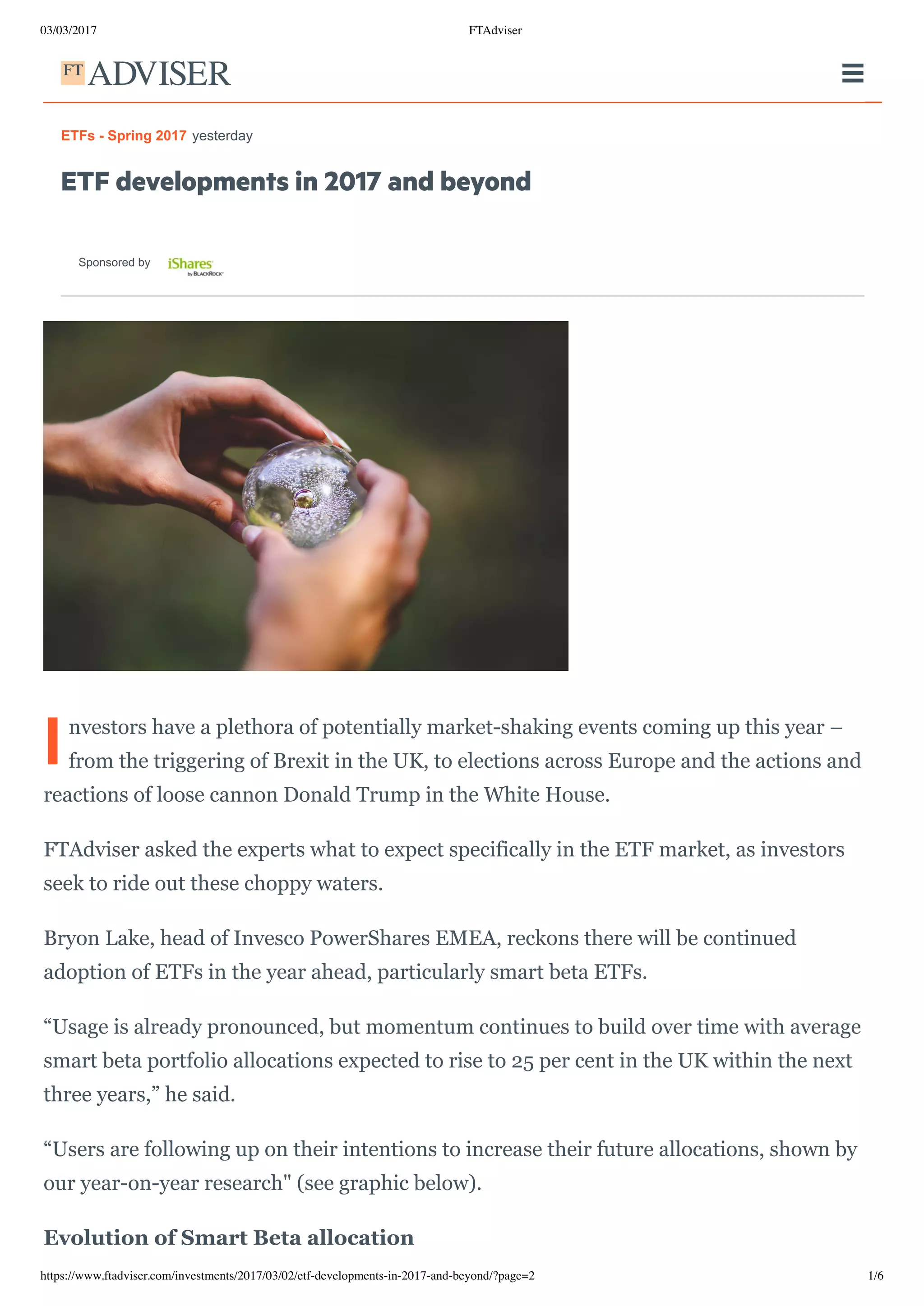
“Users are following up on their intentions to increase their future allocations, shown by
our year-on-year research" (see graphic below).
Evolution of Smart Beta allocation
Subscribe
03/03/2017 FTAdviser
https://www.ftadviser.com/investments/2017/03/02/etf-developments-in-2017-and-beyond/?page=2 2/6
Mr Lake says a large proportion of smart beta users are currently investing in developed
market equities through smart beta in their efforts to meet the challenges they face. 
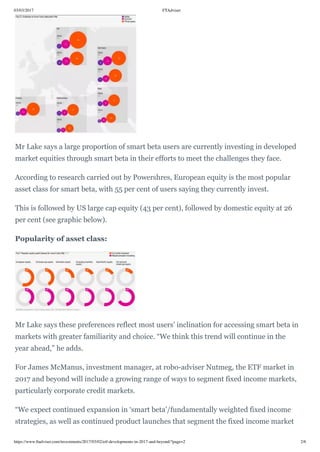
According to research carried out by Powershres, European equity is the most popular
asset class for smart beta, with 55 per cent of users saying they currently invest. 
This is followed by US large cap equity (43 per cent), followed by domestic equity at 26
per cent (see graphic below).
Popularity of asset class:
Mr Lake says these preferences reflect most users’ inclination for accessing smart beta in
markets with greater familiarity and choice. “We think this trend will continue in the
year ahead,” he adds.
For James McManus, investment manager, at robo-adviser Nutmeg, the ETF market in
2017 and beyond will include a growing range of ways to segment fixed income markets,
particularly corporate credit markets. 
“We expect continued expansion in ‘smart beta’/fundamentally weighted fixed income
strategies, as well as continued product launches that segment the fixed income market
03/03/2017 FTAdviser
https://www.ftadviser.com/investments/2017/03/02/etf-developments-in-2017-and-beyond/?page=2 3/6
by credit quality, duration etc, weighted on a market cap basis, as well as more currency-
hedged share classes,” he says.
Mr McManus also forecasts growth in the number of players in the ETF market, with
more traditional asset managers expected to launch ETF businesses. 
“Many of the larger active market leaders are already looking at ETFs as a solution they
need to be able to offer investors,” he says.
“Whether they will be able to find their niche and compete with the existing ETF market
leaders is another question.”
Costs
The most unifying forecast from the experts is good news for investors - ETF costs are
set to fall.
Daniel Greenhough, investment manager at St Albans-based Lumin Wealth, points to
recent cost cutting by passive giant Vanguard to undercut the market leader iShares in
the fixed income asset classes of ETFs.
He expects prices will plateau somewhere between 0.07 per cent and 0.15 on index
linked gilts ETFs, for example.
Mr McManus of Nutmeg expects increased liquidity and volume in Europe should mean
lower trading costs in the ETF secondary market (tighter bid-ask spreads).
Chief executive and co-founder of ETFmatic, Luis Rivera, thinks the cost of physical and
synthetic replication will continue to come under pressure.
He says more and more providers will compete at lower and lower prices. 
“In many ways ETF issuers face commoditisation, which is why some are venturing into
the robo-adviser space,” he says.
Mark Fitzgerald, product manager for Vanguard, echoes the view ETF investors will
benefit from lower prices in 2017 – he says through increased product and cost
competition, cost transparency and product suitability.
However he adds that while cost transparency and fee sensitivity will continue to drive
investment in ETFs in 2017, this “will force consolidation into products with
03/03/2017 FTAdviser
https://www.ftadviser.com/investments/2017/03/02/etf-developments-in-2017-and-beyond/?page=2 4/6
unsustainable asset levels.” 
Mr McManus sounds his own note of caution, foreseeing problems in advances in ‘active
ETFs’ over the next 12 months.
“For us, active ETFs raise the prospect of decreased transparency for investors and
potentially introduce a product that is structurally different to those in the existing
market, under the same ETF banner.”
But Joe Parkin, head of UK wealth and retail sales at iShares, is more open to ETFs
being used as part of active strategies. 
>The approach combines the most effective characteristics of index and active
investment, and offers more flexibility and lower costs than more conventional
approaches.---Joe Parkin
In 2017 and beyond he sees investors increasingly use core and satellite strategies when
developing portfolios with ETFs where, with what he says is the extensive range of
market exposures that they can offer, ETFs can be used as ‘core’ investments, or as more
flexible ‘satellites’.
“The approach combines the most effective characteristics of index and active
investment, and offers more flexibility and lower costs than more conventional
approaches,” he says.
“The flexible and liquid attributes of ETFs makes them ideally suited to build portfolios
with.  They enable investors to get exposure to markets quickly, and cost effectively.”
For Mr Greenhough, 2016 suited passive investing, particularly in UK equities, pointing
to a good 2017 for the investments.
“The best performing funds in one year are generally the best-selling funds the next – so
it should be positive for ETF flows. 
“I expect we will continue to see model portfolio services providers creating passive only
model portfolio for advisers to use with clients.”
laura.miller@ft.com
Also in this guide
03/03/2017 FTAdviser
https://www.ftadviser.com/investments/2017/03/02/etf-developments-in-2017-and-beyond/?page=2 5/6
Sponsored by
Bank CPDFinished reading all (4) articles in this guide?
Guide to exchange-traded funds
How the ETF market has grown1
ETFs vs index funds and the rise of smart beta2
How to use ETFs in portfolio construction3
ETF developments in 2017 and beyond4
CPD 60min
ETFs ­ Spring 2017 yesterday
03/03/2017 FTAdviser
https://www.ftadviser.com/investments/2017/03/02/etf-developments-in-2017-and-beyond/?page=2 6/6

ETF developments in 2017 and beyond ft adviser

  • 1.
    03/03/2017 FTAdviser https://www.ftadviser.com/investments/2017/03/02/etf-developments-in-2017-and-beyond/?page=2 1/6 ETFs ­ Spring 2017 yesterday ETF developments in 2017 and beyond Sponsored by Investorshave a plethora of potentially market-shaking events coming up this year – from the triggering of Brexit in the UK, to elections across Europe and the actions and reactions of loose cannon Donald Trump in the White House. FTAdviser asked the experts what to expect specifically in the ETF market, as investors seek to ride out these choppy waters. Bryon Lake, head of Invesco PowerShares EMEA, reckons there will be continued adoption of ETFs in the year ahead, particularly smart beta ETFs. “Usage is already pronounced, but momentum continues to build over time with average smart beta portfolio allocations expected to rise to 25 per cent in the UK within the next three years,” he said. “Users are following up on their intentions to increase their future allocations, shown by our year-on-year research" (see graphic below). Evolution of Smart Beta allocation Subscribe
  • 2.
    03/03/2017 FTAdviser https://www.ftadviser.com/investments/2017/03/02/etf-developments-in-2017-and-beyond/?page=2 2/6 MrLake says a large proportion of smart beta users are currently investing in developed market equities through smart beta in their efforts to meet the challenges they face.  According to research carried out by Powershres, European equity is the most popular asset class for smart beta, with 55 per cent of users saying they currently invest.  This is followed by US large cap equity (43 per cent), followed by domestic equity at 26 per cent (see graphic below). Popularity of asset class: Mr Lake says these preferences reflect most users’ inclination for accessing smart beta in markets with greater familiarity and choice. “We think this trend will continue in the year ahead,” he adds. For James McManus, investment manager, at robo-adviser Nutmeg, the ETF market in 2017 and beyond will include a growing range of ways to segment fixed income markets, particularly corporate credit markets.  “We expect continued expansion in ‘smart beta’/fundamentally weighted fixed income strategies, as well as continued product launches that segment the fixed income market
  • 3.
    03/03/2017 FTAdviser https://www.ftadviser.com/investments/2017/03/02/etf-developments-in-2017-and-beyond/?page=2 3/6 bycredit quality, duration etc, weighted on a market cap basis, as well as more currency- hedged share classes,” he says. Mr McManus also forecasts growth in the number of players in the ETF market, with more traditional asset managers expected to launch ETF businesses.  “Many of the larger active market leaders are already looking at ETFs as a solution they need to be able to offer investors,” he says. “Whether they will be able to find their niche and compete with the existing ETF market leaders is another question.” Costs The most unifying forecast from the experts is good news for investors - ETF costs are set to fall. Daniel Greenhough, investment manager at St Albans-based Lumin Wealth, points to recent cost cutting by passive giant Vanguard to undercut the market leader iShares in the fixed income asset classes of ETFs. He expects prices will plateau somewhere between 0.07 per cent and 0.15 on index linked gilts ETFs, for example. Mr McManus of Nutmeg expects increased liquidity and volume in Europe should mean lower trading costs in the ETF secondary market (tighter bid-ask spreads). Chief executive and co-founder of ETFmatic, Luis Rivera, thinks the cost of physical and synthetic replication will continue to come under pressure. He says more and more providers will compete at lower and lower prices.  “In many ways ETF issuers face commoditisation, which is why some are venturing into the robo-adviser space,” he says. Mark Fitzgerald, product manager for Vanguard, echoes the view ETF investors will benefit from lower prices in 2017 – he says through increased product and cost competition, cost transparency and product suitability. However he adds that while cost transparency and fee sensitivity will continue to drive investment in ETFs in 2017, this “will force consolidation into products with
  • 4.
    03/03/2017 FTAdviser https://www.ftadviser.com/investments/2017/03/02/etf-developments-in-2017-and-beyond/?page=2 4/6 unsustainableasset levels.”  Mr McManus sounds his own note of caution, foreseeing problems in advances in ‘active ETFs’ over the next 12 months. “For us, active ETFs raise the prospect of decreased transparency for investors and potentially introduce a product that is structurally different to those in the existing market, under the same ETF banner.” But Joe Parkin, head of UK wealth and retail sales at iShares, is more open to ETFs being used as part of active strategies.  >The approach combines the most effective characteristics of index and active investment, and offers more flexibility and lower costs than more conventional approaches.---Joe Parkin In 2017 and beyond he sees investors increasingly use core and satellite strategies when developing portfolios with ETFs where, with what he says is the extensive range of market exposures that they can offer, ETFs can be used as ‘core’ investments, or as more flexible ‘satellites’. “The approach combines the most effective characteristics of index and active investment, and offers more flexibility and lower costs than more conventional approaches,” he says. “The flexible and liquid attributes of ETFs makes them ideally suited to build portfolios with.  They enable investors to get exposure to markets quickly, and cost effectively.” For Mr Greenhough, 2016 suited passive investing, particularly in UK equities, pointing to a good 2017 for the investments. “The best performing funds in one year are generally the best-selling funds the next – so it should be positive for ETF flows.  “I expect we will continue to see model portfolio services providers creating passive only model portfolio for advisers to use with clients.” laura.miller@ft.com Also in this guide
  • 5.
  • 6.