Top 10 Frameworks for Mobile App Development to
Look in 2025
Top 10 Frameworks for Mobile App Development to Look in 2025
The mobile app development landscape continues to evolve, with frameworks playing a critical
role in defining how apps are built and delivered. As businesses strive to create engaging, high-
performing apps, selecting the right framework becomes a vital decision. With 2025 on the
horizon, it’s essential to identify the top frameworks that will shape mobile app development in
the coming year. This blog highlights ten frameworks that stand out for their features,
performance, and ability to cater to diverse project needs.
Mobile App Development Framework
Mobile application development frameworks are tools that provide a structured environment
for building applications. They simplify the development process by offering pre-built
components, libraries, and tools. These frameworks enable developers to write code efficiently
and create apps for Android, iOS, or both, often using a single codebase.
Frameworks are critical for improving development speed, ensuring compatibility, and
integrating advanced features. By choosing the right framework, businesses can save time and
resources while delivering apps that meet user expectations.
Types of Mobile App Development Frameworks
Understanding the types of mobile app development frameworks is crucial for selecting the
best tool for your project. These frameworks can be classified into the following categories:
1. Native Frameworks
○ Designed for building apps specific to a single platform, such as Android or iOS.
○ Examples: Android SDK for Android apps, and Swift for iOS apps.
○ Offers the highest performance and direct access to native device features.
2. Hybrid Frameworks
○ Enables developers to write a single codebase for apps compatible with
multiple platforms.
○ Examples: React Native, Flutter, Ionic.
○ Cost-effective and faster to develop compared to native frameworks.
3. Web-Based Frameworks
○ Focused on creating web apps that run in a browser and can function across
platforms.
○ Examples: JQuery Mobile, Sencha Touch.
○ Suitable for apps with lightweight functionality and broad compatibility needs.
Each type serves distinct purposes, and the choice depends on the project’s requirements,
budget, and scalability goals.
Best Mobile App Development Frameworks
Choosing the right framework is pivotal for the success of any mobile app. The framework
determines the app's performance, scalability, and user experience. Factors like compatibility
with existing tools, ease of learning, and community support should influence your decision.
Selecting a framework tailored to your project goals ensures smoother development and long-
term success.
1. React Native
React Native, developed by Facebook, remains a top choice for mobile app developers due to
its flexibility and robust community support. It allows developers to create cross-platform apps
using JavaScript, delivering a native-like experience.
Key Features:
● A rich library of reusable components.
● Real-time updates with hot reloading.
● Strong performance for apps requiring high responsiveness.
React Native is ideal for businesses seeking efficient development with a single codebase.
2. Flutter
Flutter, Google’s open-source framework, is known for its ability to create visually stunning
applications. It uses the Dart programming language, which simplifies coding and debugging.
Key Features:
● A wide range of customizable widgets for user interface design.
● Single codebase for Android, iOS, and web apps.
● Smooth integration with Google services.
Flutter stands out as a powerful tool for developers focusing on design-rich and performance-
driven apps.
Also read: Top 10 Use Cases of Flutter as a Framework for App Development
3. Ionic
Ionic leverages web technologies like HTML, CSS, and JavaScript to build cross-platform apps. It
works seamlessly with popular frameworks such as Angular, React, and Vue.
Key Features:
● Pre-built UI components for faster development.
● Tools for adding offline capabilities and push notifications.
● Compatibility with Android, iOS, and progressive web apps.
Ionic is suitable for developers aiming to build apps quickly without compromising functionality.
4. Xamarin
Backed by Microsoft, Xamarin bridges the gap between native and hybrid app development. It
allows developers to write apps in C#, ensuring near-native performance.
Key Features:
● Reusable code across multiple platforms.
● Access to native APIs for enhanced app functionality.
● Integration with Visual Studio for streamlined development.
Xamarin works best for businesses prioritizing scalability and high-quality performance.
5. Mobile Angular UI
Mobile Angular UI combines AngularJS with Bootstrap, making it a robust framework for
creating responsive mobile applications. It’s particularly useful for developers familiar with
AngularJS.
Key Features:
● Simplifies the development of hybrid apps with a responsive design.
● Offers built-in UI components like switches, overlays, and sidebars.
● Easy integration with existing AngularJS projects.
This framework is ideal for developers who prioritize simplicity and responsiveness.
6. Adobe PhoneGap
Adobe PhoneGap, based on Apache Cordova, simplifies mobile app development by using web
development skills. It allows developers to build cross-platform apps without extensive
knowledge of native programming.
Key Features:
● Wide range of plugins to access device-specific features.
● Simple development process with HTML, CSS, and JavaScript.
● Compatibility with various platforms, including Android and iOS.
PhoneGap is a practical choice for lightweight apps that require core functionalities.
7. Appcelerator Titanium
Appcelerator Titanium provides developers with a single JavaScript codebase to build cross-
platform apps. It emphasizes performance and native-like functionality.
Key Features:
● Access to native UI components for high responsiveness.
● Built-in analytics for monitoring app performance.
● Tools for prototyping with a drag-and-drop interface designer.
Titanium is a reliable framework for projects that demand speed and scalability.
8. Framework7
Framework7 delivers a native-like experience for iOS and Android apps. It focuses on user
interface design, offering pre-built components that streamline development.
Key Features:
● Tools for building hybrid and progressive web apps.
● Integration with React and Vue.js for added flexibility.
● Consistent user interface components for polished designs.
Framework7 is perfect for apps prioritizing design and usability.
9. JQuery Mobile
JQuery Mobile simplifies app development by offering a lightweight framework for creating
responsive web and mobile applications. It’s highly compatible with older devices and platforms.
Key Features:
● Cross-platform compatibility, even on older devices.
● Simple theming options for customization.
● Support for HTML5-based applications.
JQuery Mobile is a good fit for developers targeting a wide range of devices and user bases.
10. NativeScript
NativeScript is a framework designed for building apps that feel and function like native
applications. It supports JavaScript, TypeScript, and Angular for development flexibility.
Key Features:
● Direct access to native APIs for high performance.
● Support for popular libraries and tools.
● Customization options for creating unique app experiences.
NativeScript is an excellent choice for developers seeking full control over app functionality and
design.
How to Choose the Right Mobile App Development Framework for
Your Project
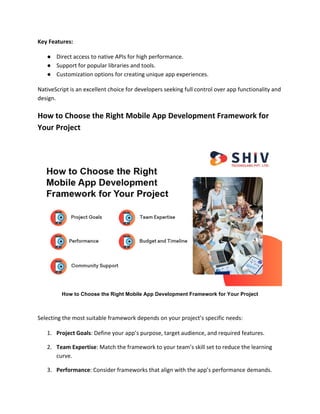
How to Choose the Right Mobile App Development Framework for Your Project
Selecting the most suitable framework depends on your project’s specific needs:
1. Project Goals: Define your app’s purpose, target audience, and required features.
2. Team Expertise: Match the framework to your team’s skill set to reduce the learning
curve.
3. Performance: Consider frameworks that align with the app’s performance demands.
4. Budget and Timeline: Choose frameworks that fit your development budget and
schedule.
5. Community Support: Opt for frameworks with active developer communities and
extensive resources.
By analyzing these factors, you can make an informed decision that ensures your app’s success.
Also read: How Much Does it Cost to Integrate AI into an Mobile App?
Conclusion
The top frameworks for mobile app development in 2025 showcase the diversity and
innovation in the industry. From React Native’s adaptability to NativeScript’s customization
capabilities, these tools provide developers with the resources to build exceptional apps.
At Shiv Technolabs, we specialize in helping businesses choose the right framework and
delivering mobile apps that exceed expectations. Whether you're creating your first app or
scaling an existing one, our expertise ensures success at every stage of development. Contact
us to start your mobile app journey today!

Essential Mobile App Development Frameworks for 2025

  • 1.
    Top 10 Frameworksfor Mobile App Development to Look in 2025 Top 10 Frameworks for Mobile App Development to Look in 2025 The mobile app development landscape continues to evolve, with frameworks playing a critical role in defining how apps are built and delivered. As businesses strive to create engaging, high- performing apps, selecting the right framework becomes a vital decision. With 2025 on the horizon, it’s essential to identify the top frameworks that will shape mobile app development in the coming year. This blog highlights ten frameworks that stand out for their features, performance, and ability to cater to diverse project needs.
  • 2.
    Mobile App DevelopmentFramework Mobile App Development Framework Mobile application development frameworks are tools that provide a structured environment for building applications. They simplify the development process by offering pre-built components, libraries, and tools. These frameworks enable developers to write code efficiently and create apps for Android, iOS, or both, often using a single codebase. Frameworks are critical for improving development speed, ensuring compatibility, and integrating advanced features. By choosing the right framework, businesses can save time and resources while delivering apps that meet user expectations. Types of Mobile App Development Frameworks Understanding the types of mobile app development frameworks is crucial for selecting the best tool for your project. These frameworks can be classified into the following categories: 1. Native Frameworks
  • 3.
    ○ Designed forbuilding apps specific to a single platform, such as Android or iOS. ○ Examples: Android SDK for Android apps, and Swift for iOS apps. ○ Offers the highest performance and direct access to native device features. 2. Hybrid Frameworks ○ Enables developers to write a single codebase for apps compatible with multiple platforms. ○ Examples: React Native, Flutter, Ionic. ○ Cost-effective and faster to develop compared to native frameworks. 3. Web-Based Frameworks ○ Focused on creating web apps that run in a browser and can function across platforms. ○ Examples: JQuery Mobile, Sencha Touch. ○ Suitable for apps with lightweight functionality and broad compatibility needs. Each type serves distinct purposes, and the choice depends on the project’s requirements, budget, and scalability goals. Best Mobile App Development Frameworks Choosing the right framework is pivotal for the success of any mobile app. The framework determines the app's performance, scalability, and user experience. Factors like compatibility with existing tools, ease of learning, and community support should influence your decision. Selecting a framework tailored to your project goals ensures smoother development and long- term success. 1. React Native React Native, developed by Facebook, remains a top choice for mobile app developers due to its flexibility and robust community support. It allows developers to create cross-platform apps using JavaScript, delivering a native-like experience.
  • 4.
    Key Features: ● Arich library of reusable components. ● Real-time updates with hot reloading. ● Strong performance for apps requiring high responsiveness. React Native is ideal for businesses seeking efficient development with a single codebase. 2. Flutter Flutter, Google’s open-source framework, is known for its ability to create visually stunning applications. It uses the Dart programming language, which simplifies coding and debugging. Key Features: ● A wide range of customizable widgets for user interface design. ● Single codebase for Android, iOS, and web apps. ● Smooth integration with Google services. Flutter stands out as a powerful tool for developers focusing on design-rich and performance- driven apps. Also read: Top 10 Use Cases of Flutter as a Framework for App Development 3. Ionic Ionic leverages web technologies like HTML, CSS, and JavaScript to build cross-platform apps. It works seamlessly with popular frameworks such as Angular, React, and Vue. Key Features: ● Pre-built UI components for faster development. ● Tools for adding offline capabilities and push notifications. ● Compatibility with Android, iOS, and progressive web apps. Ionic is suitable for developers aiming to build apps quickly without compromising functionality. 4. Xamarin Backed by Microsoft, Xamarin bridges the gap between native and hybrid app development. It allows developers to write apps in C#, ensuring near-native performance.
  • 5.
    Key Features: ● Reusablecode across multiple platforms. ● Access to native APIs for enhanced app functionality. ● Integration with Visual Studio for streamlined development. Xamarin works best for businesses prioritizing scalability and high-quality performance. 5. Mobile Angular UI Mobile Angular UI combines AngularJS with Bootstrap, making it a robust framework for creating responsive mobile applications. It’s particularly useful for developers familiar with AngularJS. Key Features: ● Simplifies the development of hybrid apps with a responsive design. ● Offers built-in UI components like switches, overlays, and sidebars. ● Easy integration with existing AngularJS projects. This framework is ideal for developers who prioritize simplicity and responsiveness. 6. Adobe PhoneGap Adobe PhoneGap, based on Apache Cordova, simplifies mobile app development by using web development skills. It allows developers to build cross-platform apps without extensive knowledge of native programming. Key Features: ● Wide range of plugins to access device-specific features. ● Simple development process with HTML, CSS, and JavaScript. ● Compatibility with various platforms, including Android and iOS. PhoneGap is a practical choice for lightweight apps that require core functionalities. 7. Appcelerator Titanium Appcelerator Titanium provides developers with a single JavaScript codebase to build cross- platform apps. It emphasizes performance and native-like functionality.
  • 6.
    Key Features: ● Accessto native UI components for high responsiveness. ● Built-in analytics for monitoring app performance. ● Tools for prototyping with a drag-and-drop interface designer. Titanium is a reliable framework for projects that demand speed and scalability. 8. Framework7 Framework7 delivers a native-like experience for iOS and Android apps. It focuses on user interface design, offering pre-built components that streamline development. Key Features: ● Tools for building hybrid and progressive web apps. ● Integration with React and Vue.js for added flexibility. ● Consistent user interface components for polished designs. Framework7 is perfect for apps prioritizing design and usability. 9. JQuery Mobile JQuery Mobile simplifies app development by offering a lightweight framework for creating responsive web and mobile applications. It’s highly compatible with older devices and platforms. Key Features: ● Cross-platform compatibility, even on older devices. ● Simple theming options for customization. ● Support for HTML5-based applications. JQuery Mobile is a good fit for developers targeting a wide range of devices and user bases. 10. NativeScript NativeScript is a framework designed for building apps that feel and function like native applications. It supports JavaScript, TypeScript, and Angular for development flexibility.
  • 7.
    Key Features: ● Directaccess to native APIs for high performance. ● Support for popular libraries and tools. ● Customization options for creating unique app experiences. NativeScript is an excellent choice for developers seeking full control over app functionality and design. How to Choose the Right Mobile App Development Framework for Your Project How to Choose the Right Mobile App Development Framework for Your Project Selecting the most suitable framework depends on your project’s specific needs: 1. Project Goals: Define your app’s purpose, target audience, and required features. 2. Team Expertise: Match the framework to your team’s skill set to reduce the learning curve. 3. Performance: Consider frameworks that align with the app’s performance demands.
  • 8.
    4. Budget andTimeline: Choose frameworks that fit your development budget and schedule. 5. Community Support: Opt for frameworks with active developer communities and extensive resources. By analyzing these factors, you can make an informed decision that ensures your app’s success. Also read: How Much Does it Cost to Integrate AI into an Mobile App? Conclusion The top frameworks for mobile app development in 2025 showcase the diversity and innovation in the industry. From React Native’s adaptability to NativeScript’s customization capabilities, these tools provide developers with the resources to build exceptional apps. At Shiv Technolabs, we specialize in helping businesses choose the right framework and delivering mobile apps that exceed expectations. Whether you're creating your first app or scaling an existing one, our expertise ensures success at every stage of development. Contact us to start your mobile app journey today!