Home / Blog /
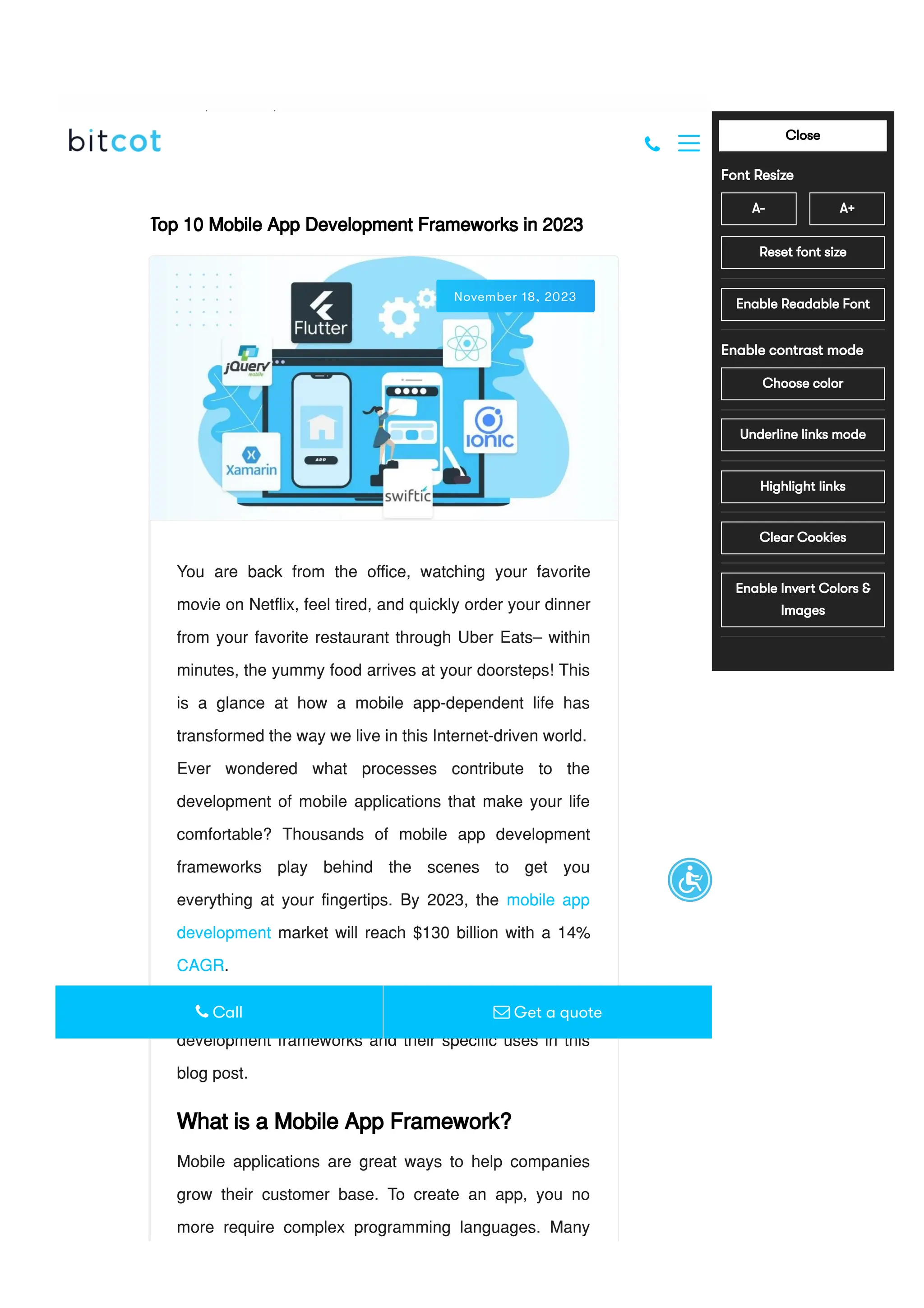
Top 10 Mobile App Development Frameworks in 2023
November 18, 2023
You are back from the office, watching your favorite
movie on Netflix, feel tired, and quickly order your dinner
from your favorite restaurant through Uber Eats– within
minutes, the yummy food arrives at your doorsteps! This
is a glance at how a mobile app-dependent life has
transformed the way we live in this Internet-driven world.
Ever wondered what processes contribute to the
development of mobile applications that make your life
comfortable? Thousands of mobile app development
frameworks play behind the scenes to get you
everything at your fingertips. By 2023, the mobile app
development market will reach $130 billion with a 14%
CAGR.
Let’s take a deep dive into the best mobile app
development frameworks and their specific uses in this
blog post.
What is a Mobile App Framework?
Mobile applications are great ways to help companies
grow their customer base. To create an app, you no
more require complex programming languages. Many

 Call  Get a quote
A- A+
Close
Font Resize
Reset font size
Enable Readable Font
Enable contrast mode
Choose color
Underline links mode
Highlight links
Clear Cookies
Enable Invert Colors &
Images
Accessibility by WAH
app development frameworks for Android and iOS exist
to make the app development process quick.
A mobile app framework is a platform that comprises
software, compilers, programming interfaces, and
debugging tools to build applications. A developer uses
a framework to aid the development of applications for
specific devices and ecosystems.
Mobile app Frameworks fall into three core categories:
Native frameworks that focus on platform-specific app
development, mobile web app frameworks, as well as
hybrid apps that combine the properties of the two
frameworks.
Types of Mobile Application Frameworks
1. Native Apps
Native app development creates applications exclusively
for specific mobile operating systems (iOS or Android)
using platform-native languages like Flutter, React
Native, Ionic, or Kotlin. Known for high performance and
seamless user experiences, native apps fully utilize
device capabilities. However, they require separate
development for each platform, increasing time and cost.
2. Web Apps
Web apps are mobile-optimized websites accessed
through a browser, eliminating the need for downloads
or installations. Built with standard web technologies
(HTML, CSS, JavaScript), they offer cross-platform
compatibility but may have performance and feature
limitations compared to native apps.
3. Hybrid Apps
Hybrid apps blend native and web elements, utilizing
web technologies (HTML, CSS, JavaScript) within a
native container for installation. Offering cost-
effectiveness and streamlined cross-platform
deployment, hybrid apps aim to balance web
development advantages with native app performance.
However, they may not match the performance level of
fully native apps.
Each type of mobile app development framework has its
advantages and considerations. The choice of
framework depends on factors such as project
requirements, target audience, budget, development
timeline, and desired app performance. It’s important to
carefully evaluate these factors to select the most
suitable framework for your mobile app development
project.
Why should you use a framework?
The framework gives you confidence in developing an
app that adheres to the business specifications—
structured, upgradable, and maintainable.
The developer doesn’t have to worry about how to
create a mobile app or work for days on the
development of generic components. With the time
saved, more specific components can be looked into, to
build a quality-centric and sustainable code.
The framework works around the longevity of the
applications you use. It gives the developer the
capability to make an application and maintain and
upgrade it neatly.
Mobile app frameworks contribute to your business with
the following advantages:
Developers can use a piece-by-piece allocation of
work with the framework componentization.
Design reusability that triggers the quality of code
and ensures reduced app development costs.
Customization to implement the needs of the
business.
Things to check before choosing a mobile app
development framework
One usual question that revolves around the minds of
businesses would be ‘Which is the best framework for
mobile app development?’ To choose the best mobile
app development framework, you should consider the
following elements:
Design and User Interface
Before you choose a mobile app development
framework, you need to think about the user interface.
With a framework, the developers can easily consider
the business needs and choose the ideal UI parameters.
Mobile app development partner
Many vendors offer framework and assistance to key
you to build the applications. However, it is safe when
you fetch the most reliable and top mobile app
development company that can bring a desirable impact
to your business.
Open/closed Ecosystem
Various platforms exist from which you can choose to
use while developing the mobile app. You might need a
platform that is convenient and flexible in terms of
performance and ease of use. Based on the business
functionalities you can opt for an open or closed
ecosystem.
Team of experts
An app development process is complete only with an
expert staff and skilled personnel. It is crucial to go for a
framework that the existing team can handle without any
Encapsulation process that offers security and helps
the access of control components.
Rapid app development with predefined interactions
among various classes to form templates.
risks. Mobile app developers also should be able to find
the best ways to make the monetization of mobile apps
possible.
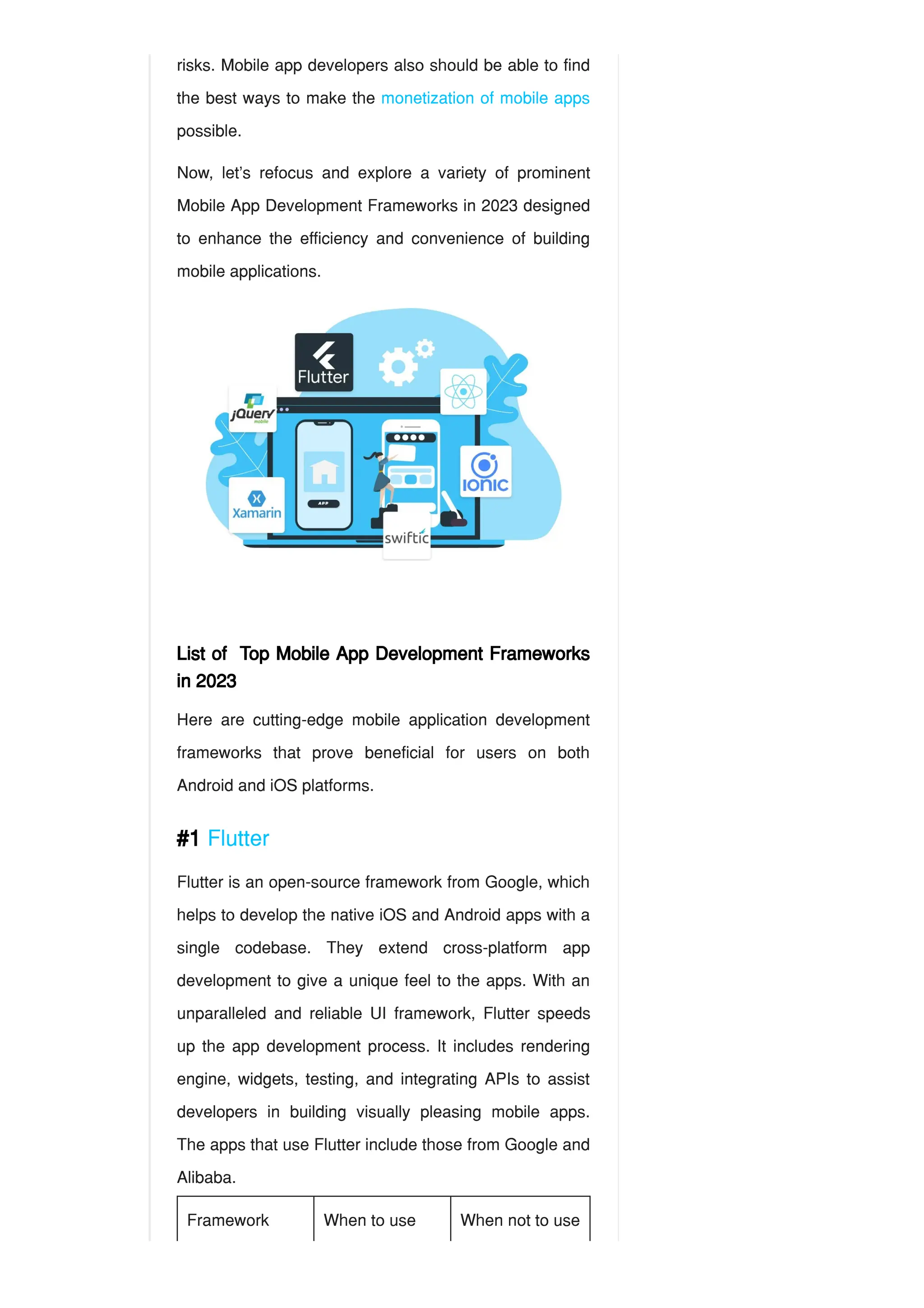
Now, let’s refocus and explore a variety of prominent
Mobile App Development Frameworks in 2023 designed
to enhance the efficiency and convenience of building
mobile applications.
List of Top Mobile App Development Frameworks
in 2023
Here are cutting-edge mobile application development
frameworks that prove beneficial for users on both
Android and iOS platforms.
#1 Flutter
Flutter is an open-source framework from Google, which
helps to develop the native iOS and Android apps with a
single codebase. They extend cross-platform app
development to give a unique feel to the apps. With an
unparalleled and reliable UI framework, Flutter speeds
up the app development process. It includes rendering
engine, widgets, testing, and integrating APIs to assist
developers in building visually pleasing mobile apps.
The apps that use Flutter include those from Google and
Alibaba.
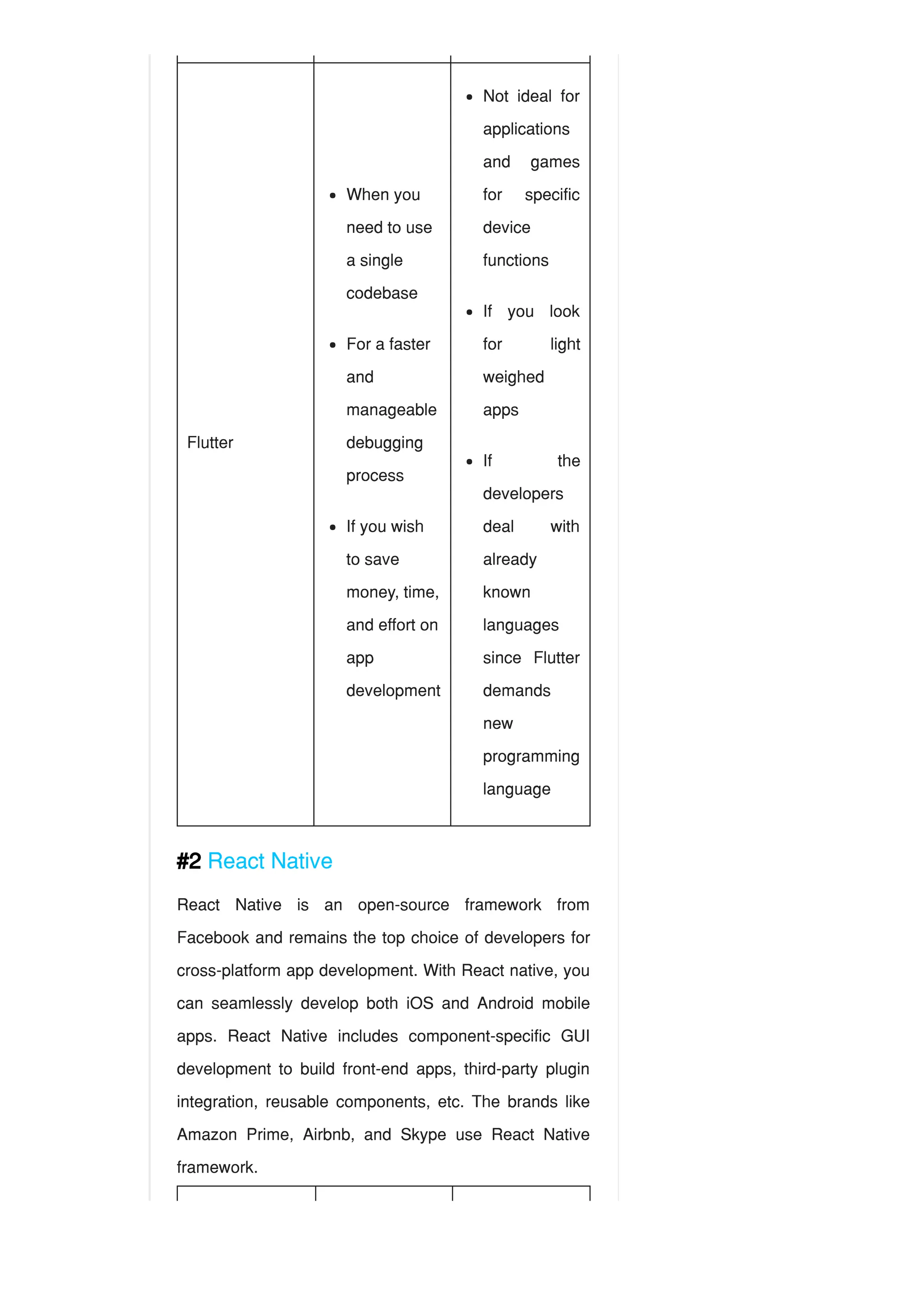
Framework When to use When not to use
Flutter
#2 React Native
React Native is an open-source framework from
Facebook and remains the top choice of developers for
cross-platform app development. With React native, you
can seamlessly develop both iOS and Android mobile
apps. React Native includes component-specific GUI
development to build front-end apps, third-party plugin
integration, reusable components, etc. The brands like
Amazon Prime, Airbnb, and Skype use React Native
framework.
When you
need to use
a single
codebase
For a faster
and
manageable
debugging
process
If you wish
to save
money, time,
and effort on
app
development
Not ideal for
applications
and games
for specific
device
functions
If you look
for light
weighed
apps
If the
developers
deal with
already
known
languages
since Flutter
demands
new
programming
language
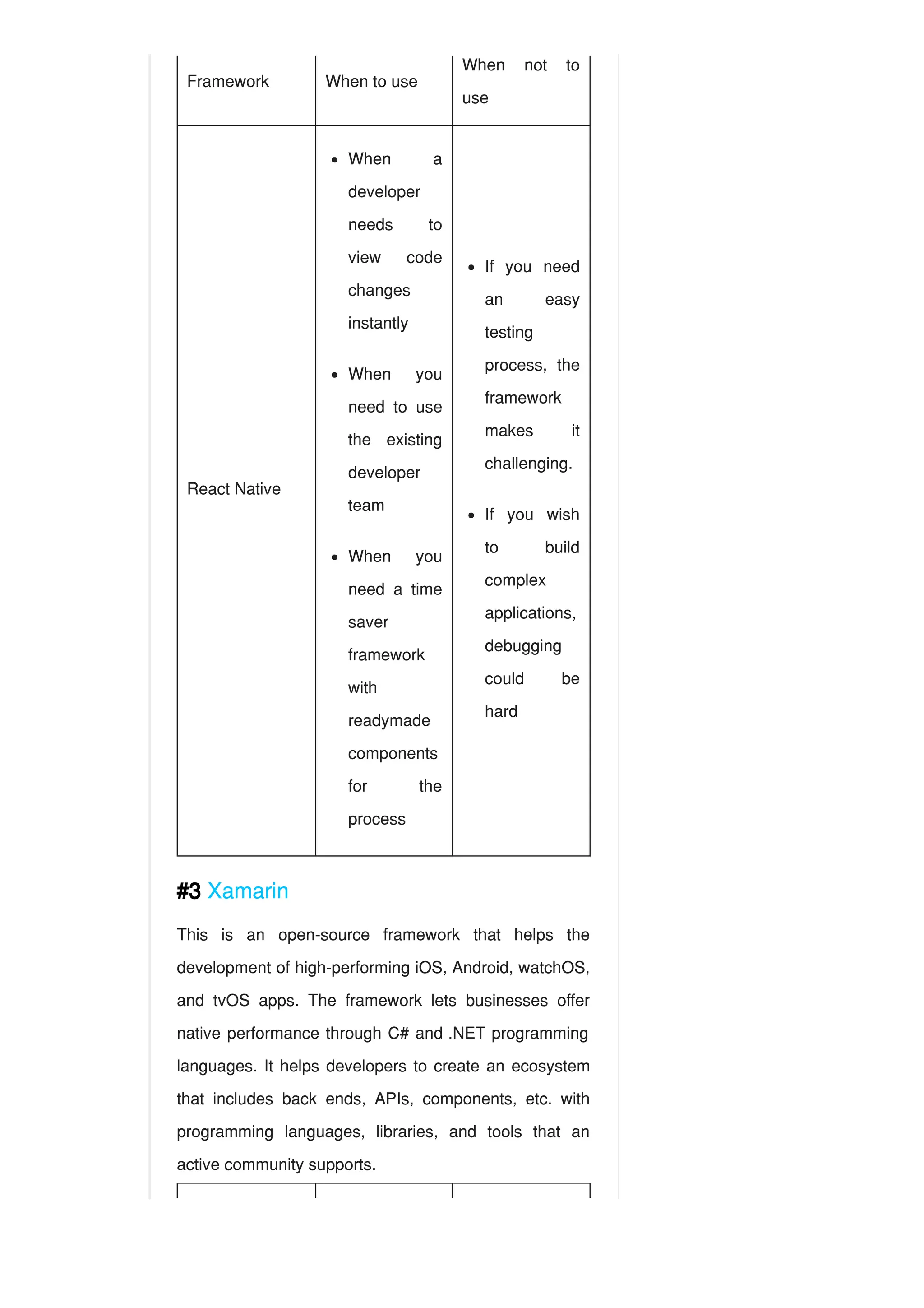
Framework When to use
When not to
use
React Native
#3 Xamarin
This is an open-source framework that helps the
development of high-performing iOS, Android, watchOS,
and tvOS apps. The framework lets businesses offer
native performance through C# and .NET programming
languages. It helps developers to create an ecosystem
that includes back ends, APIs, components, etc. with
programming languages, libraries, and tools that an
active community supports.
When a
developer
needs to
view code
changes
instantly
When you
need to use
the existing
developer
team
When you
need a time
saver
framework
with
readymade
components
for the
process
If you need
an easy
testing
process, the
framework
makes it
challenging.
If you wish
to build
complex
applications,
debugging
could be
hard
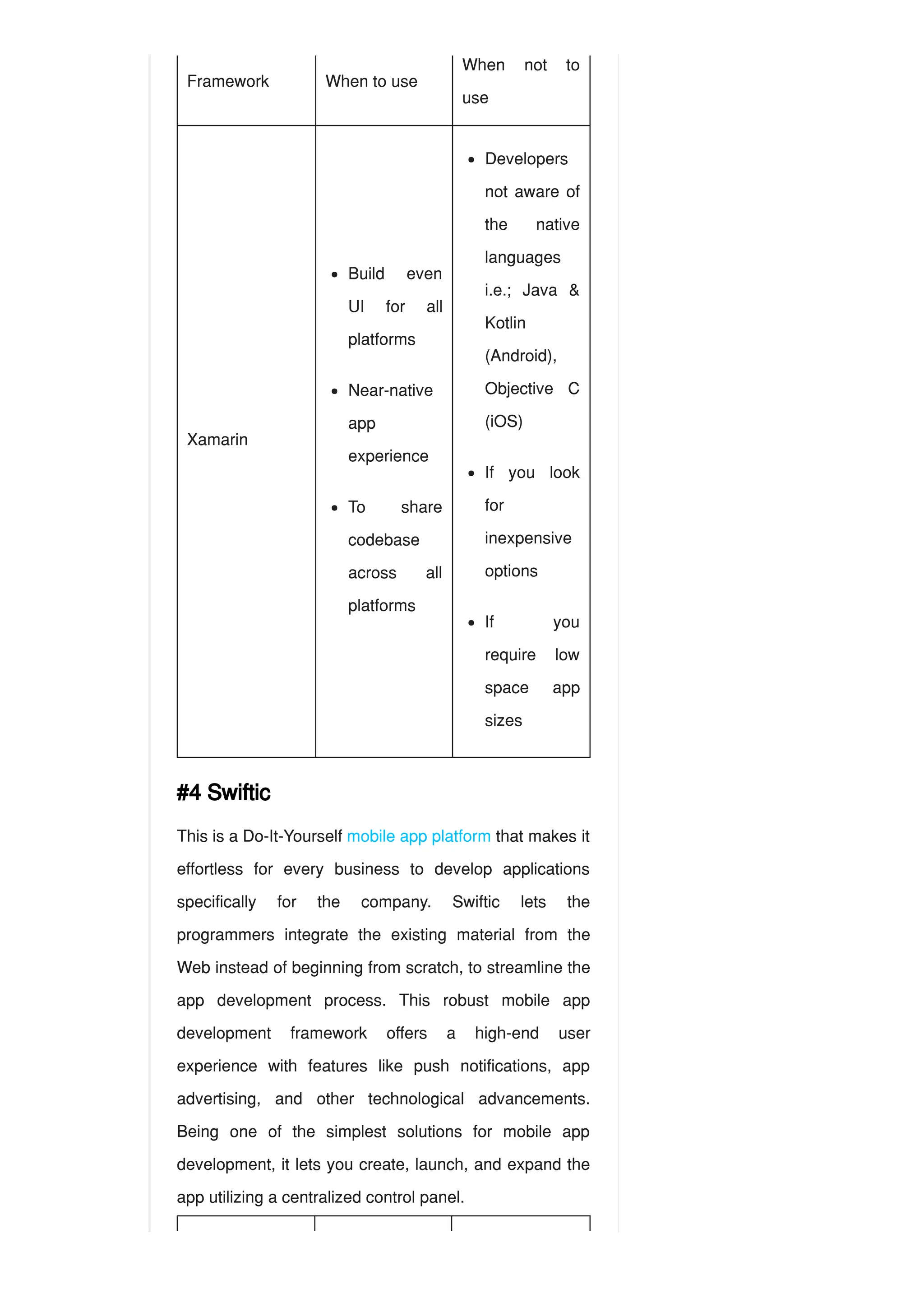
Framework When to use
When not to
use
Xamarin
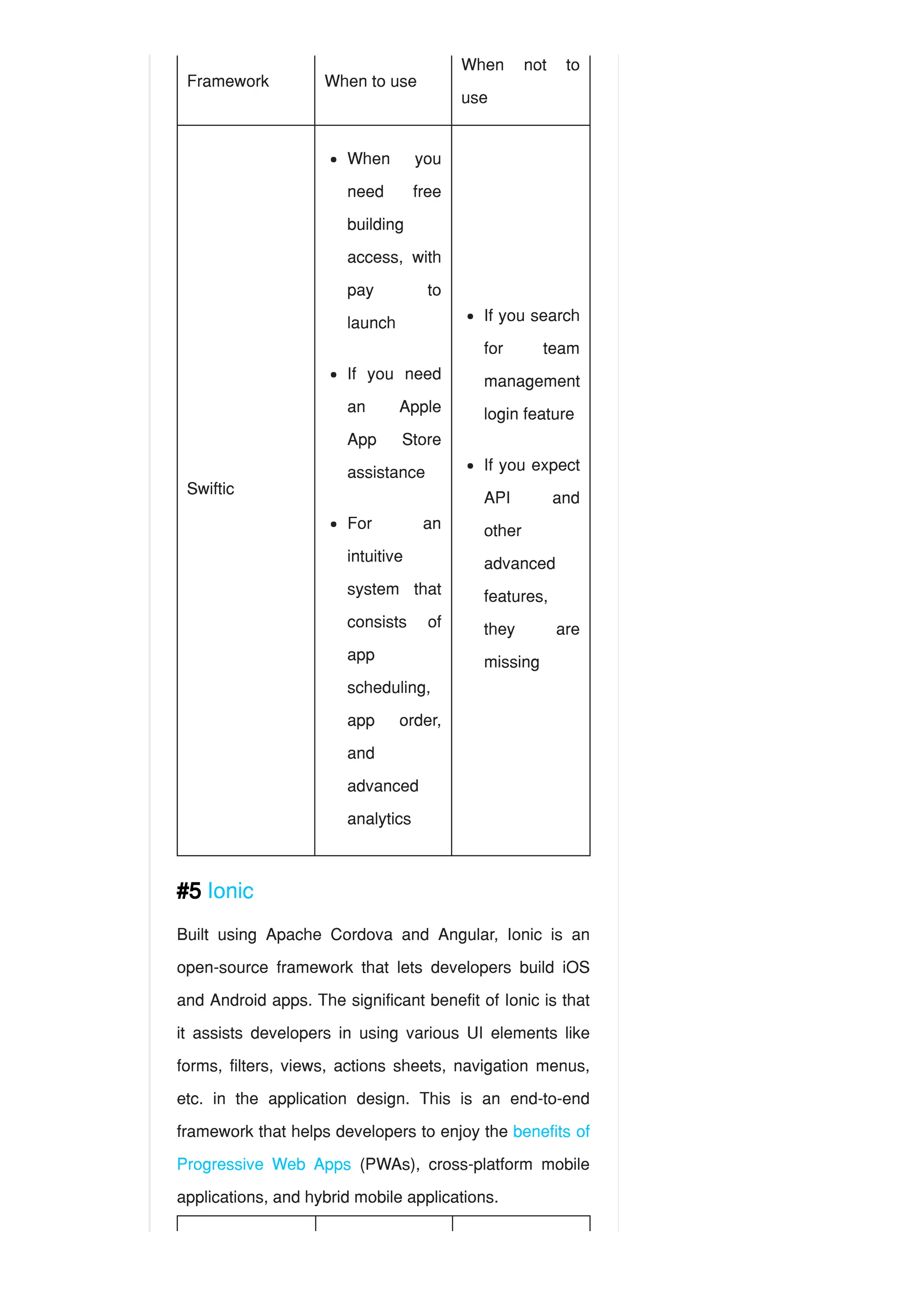
#4 Swiftic
This is a Do-It-Yourself mobile app platform that makes it
effortless for every business to develop applications
specifically for the company. Swiftic lets the
programmers integrate the existing material from the
Web instead of beginning from scratch, to streamline the
app development process. This robust mobile app
development framework offers a high-end user
experience with features like push notifications, app
advertising, and other technological advancements.
Being one of the simplest solutions for mobile app
development, it lets you create, launch, and expand the
app utilizing a centralized control panel.
Build even
UI for all
platforms
Near-native
app
experience
To share
codebase
across all
platforms
Developers
not aware of
the native
languages
i.e.; Java &
Kotlin
(Android),
Objective C
(iOS)
If you look
for
inexpensive
options
If you
require low
space app
sizes
Framework When to use
When not to
use
Swiftic
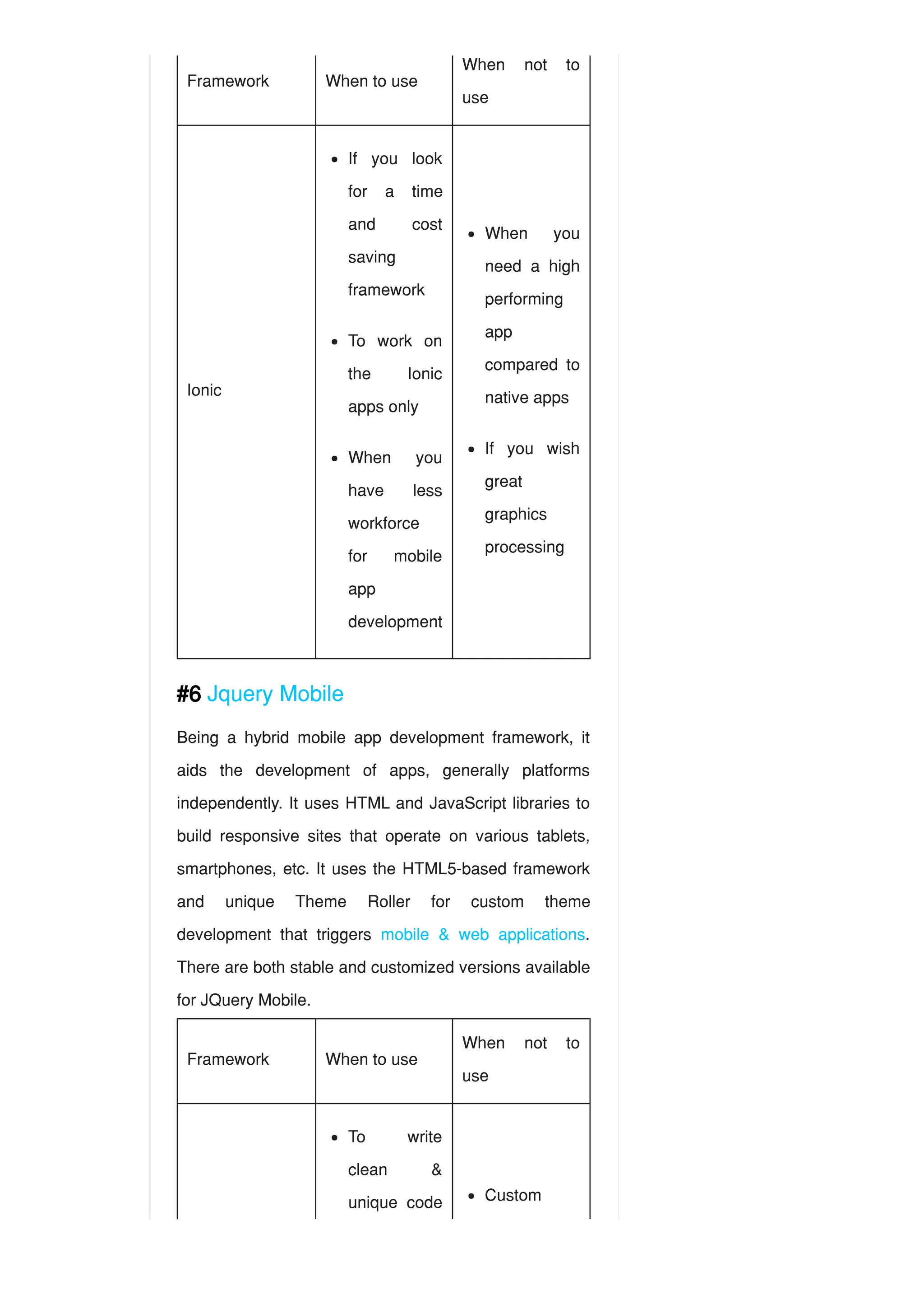
#5 Ionic
Built using Apache Cordova and Angular, Ionic is an
open-source framework that lets developers build iOS
and Android apps. The significant benefit of Ionic is that
it assists developers in using various UI elements like
forms, filters, views, actions sheets, navigation menus,
etc. in the application design. This is an end-to-end
framework that helps developers to enjoy the benefits of
Progressive Web Apps (PWAs), cross-platform mobile
applications, and hybrid mobile applications.
When you
need free
building
access, with
pay to
launch
If you need
an Apple
App Store
assistance
For an
intuitive
system that
consists of
app
scheduling,
app order,
and
advanced
analytics
If you search
for team
management
login feature
If you expect
API and
other
advanced
features,
they are
missing
Framework When to use
When not to
use
Ionic
#6 Jquery Mobile
Being a hybrid mobile app development framework, it
aids the development of apps, generally platforms
independently. It uses HTML and JavaScript libraries to
build responsive sites that operate on various tablets,
smartphones, etc. It uses the HTML5-based framework
and unique Theme Roller for custom theme
development that triggers mobile & web applications.
There are both stable and customized versions available
for JQuery Mobile.
Framework When to use
When not to
use
If you look
for a time
and cost
saving
framework
To work on
the Ionic
apps only
When you
have less
workforce
for mobile
app
development
When you
need a high
performing
app
compared to
native apps
If you wish
great
graphics
processing
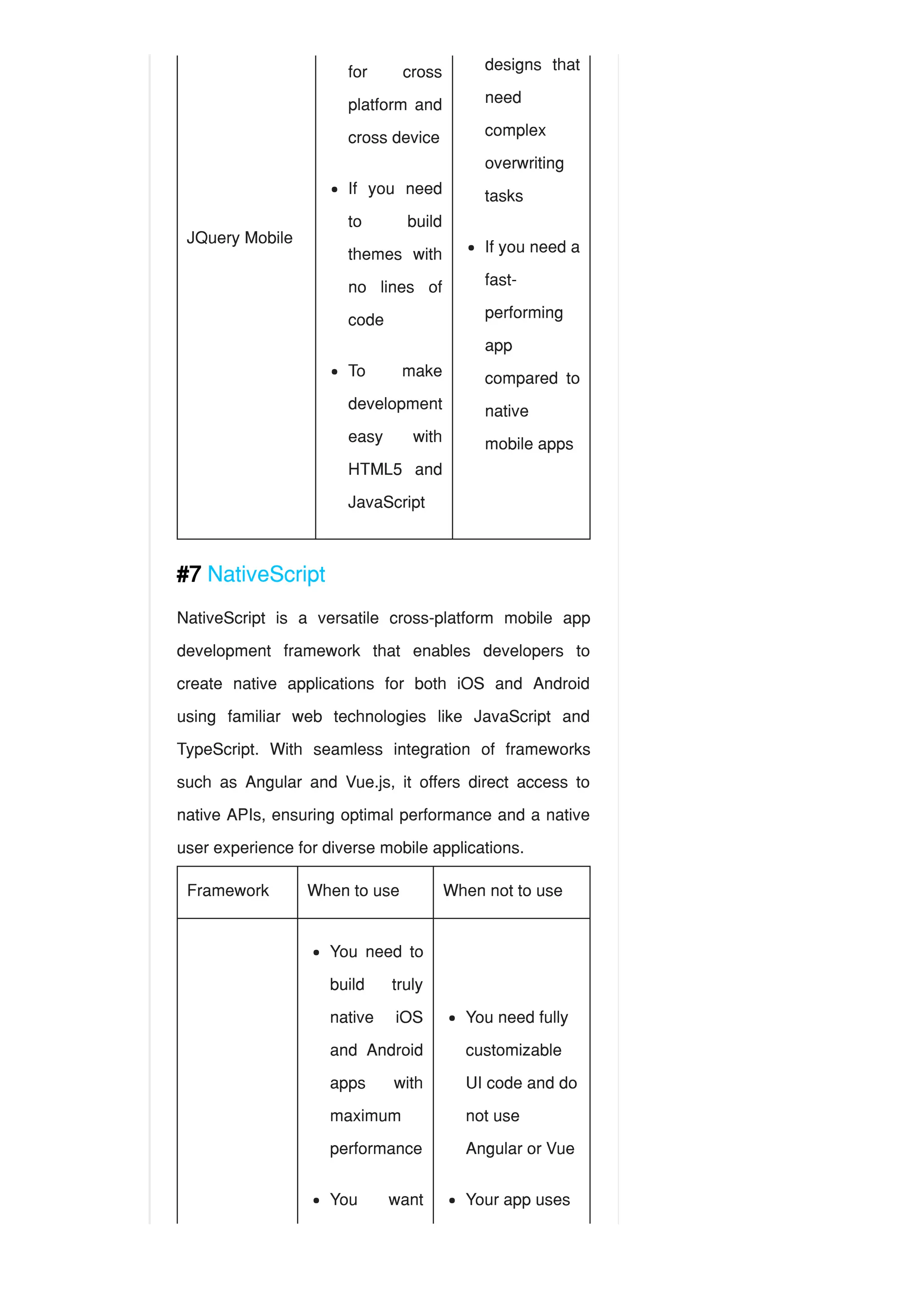
To write
clean &
unique code Custom
JQuery Mobile
#7 NativeScript
NativeScript is a versatile cross-platform mobile app
development framework that enables developers to
create native applications for both iOS and Android
using familiar web technologies like JavaScript and
TypeScript. With seamless integration of frameworks
such as Angular and Vue.js, it offers direct access to
native APIs, ensuring optimal performance and a native
user experience for diverse mobile applications.
Framework When to use When not to use
for cross
platform and
cross device
If you need
to build
themes with
no lines of
code
To make
development
easy with
HTML5 and
JavaScript
designs that
need
complex
overwriting
tasks
If you need a
fast-
performing
app
compared to
native
mobile apps
You need to
build truly
native iOS
and Android
apps with
maximum
performance
You want
You need fully
customizable
UI code and do
not use
Angular or Vue
Your app uses
NativeScript
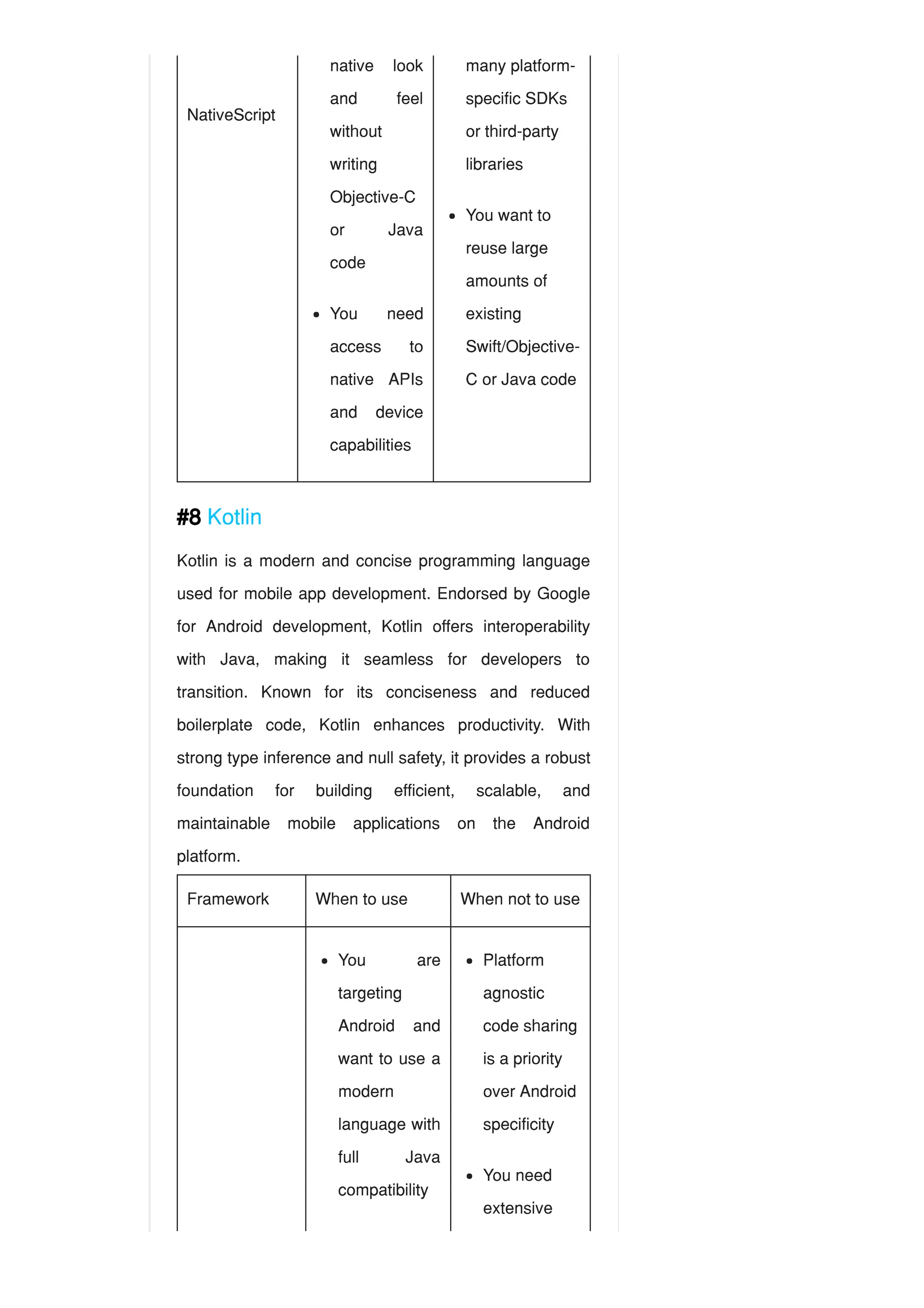
#8 Kotlin
Kotlin is a modern and concise programming language
used for mobile app development. Endorsed by Google
for Android development, Kotlin offers interoperability
with Java, making it seamless for developers to
transition. Known for its conciseness and reduced
boilerplate code, Kotlin enhances productivity. With
strong type inference and null safety, it provides a robust
foundation for building efficient, scalable, and
maintainable mobile applications on the Android
platform.
Framework When to use When not to use
native look
and feel
without
writing
Objective-C
or Java
code
You need
access to
native APIs
and device
capabilities
many platform-
specific SDKs
or third-party
libraries
You want to
reuse large
amounts of
existing
Swift/Objective-
C or Java code
You are
targeting
Android and
want to use a
modern
language with
full Java
compatibility
Platform
agnostic
code sharing
is a priority
over Android
specificity
You need
extensive
Kotlin
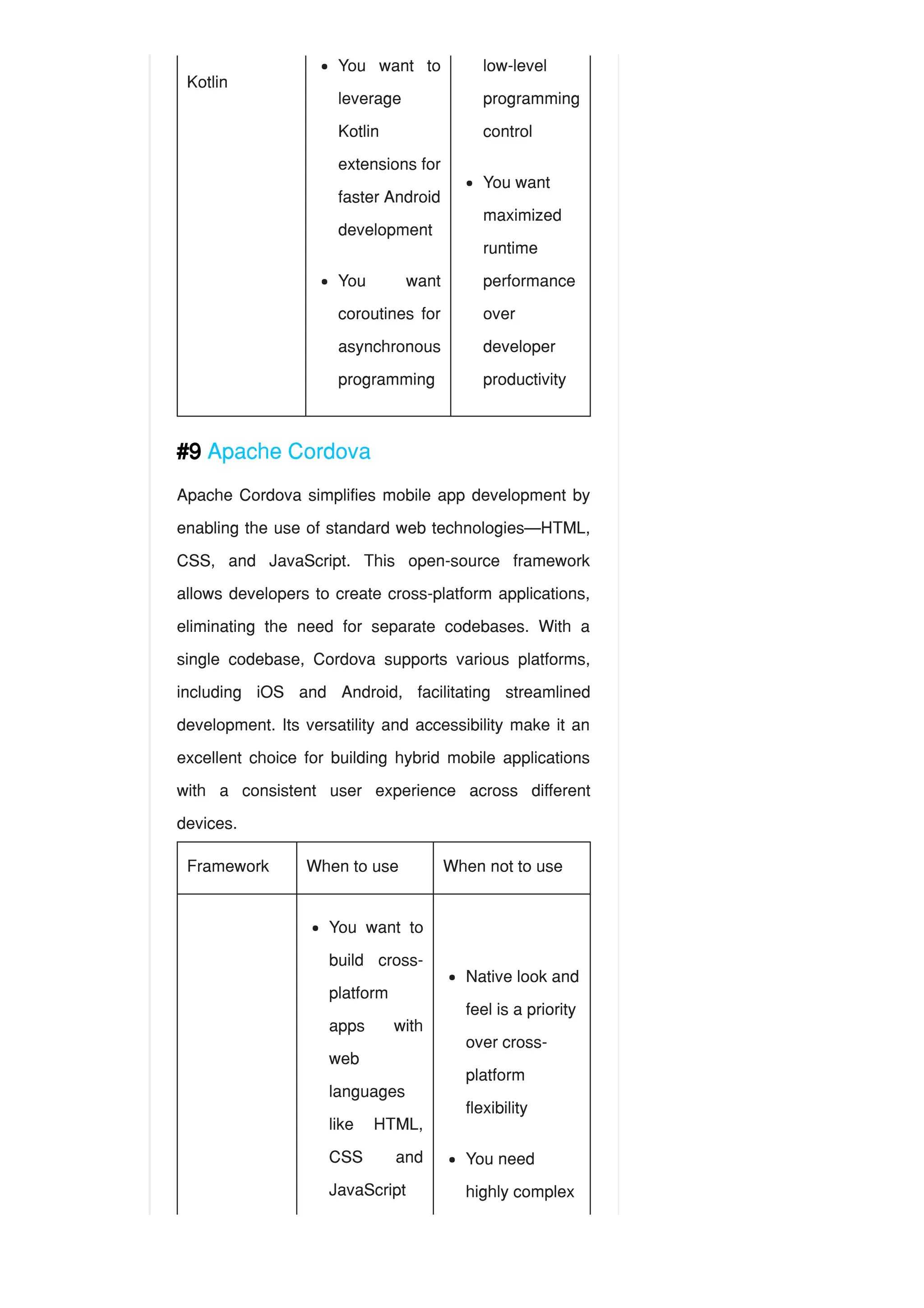
#9 Apache Cordova
Apache Cordova simplifies mobile app development by
enabling the use of standard web technologies—HTML,
CSS, and JavaScript. This open-source framework
allows developers to create cross-platform applications,
eliminating the need for separate codebases. With a
single codebase, Cordova supports various platforms,
including iOS and Android, facilitating streamlined
development. Its versatility and accessibility make it an
excellent choice for building hybrid mobile applications
with a consistent user experience across different
devices.
Framework When to use When not to use
You want to
leverage
Kotlin
extensions for
faster Android
development
You want
coroutines for
asynchronous
programming
low-level
programming
control
You want
maximized
runtime
performance
over
developer
productivity
You want to
build cross-
platform
apps with
web
languages
like HTML,
CSS and
JavaScript
Native look and
feel is a priority
over cross-
platform
flexibility
You need
highly complex
Apache
Cordova
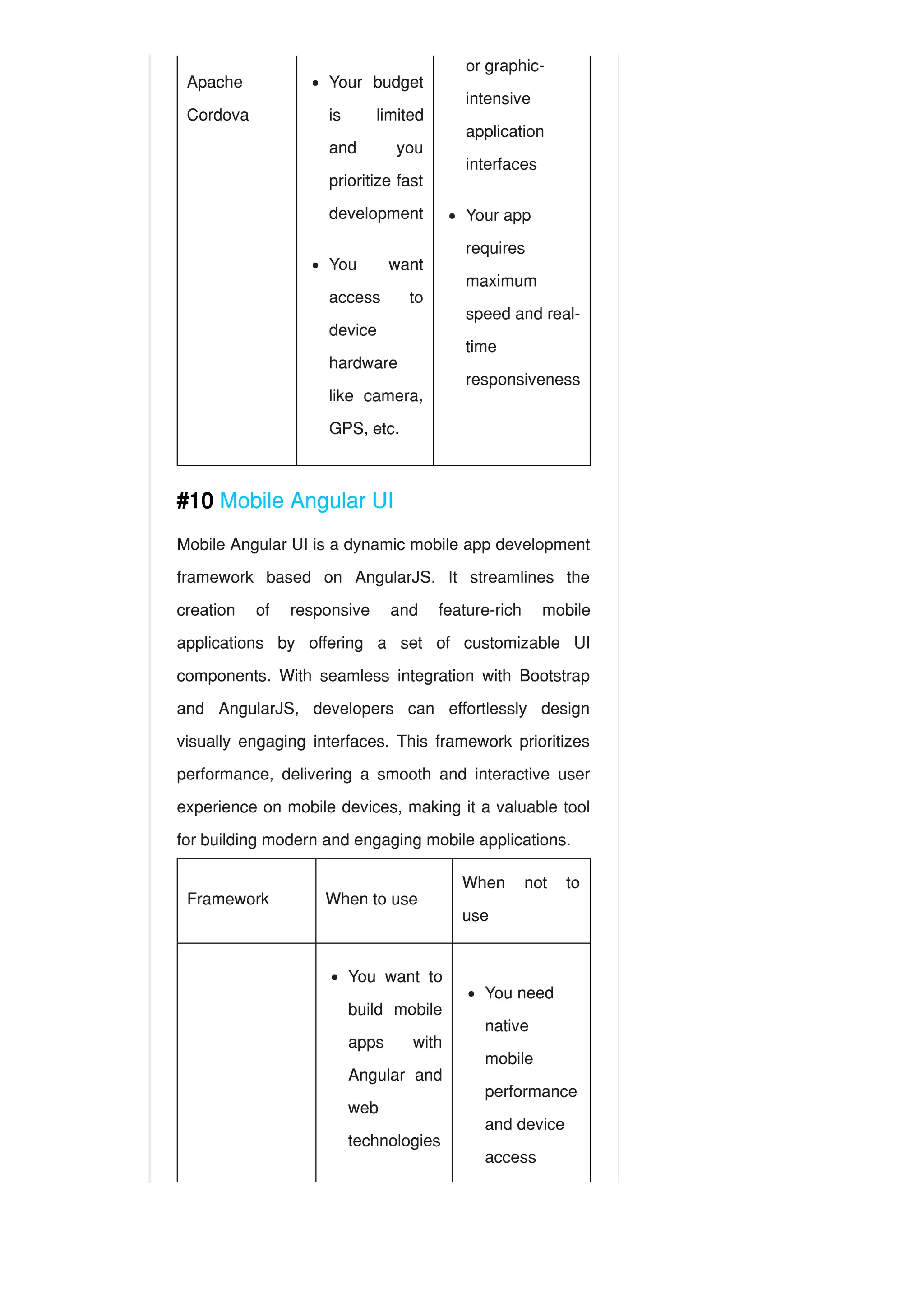
#10 Mobile Angular UI
Mobile Angular UI is a dynamic mobile app development
framework based on AngularJS. It streamlines the
creation of responsive and feature-rich mobile
applications by offering a set of customizable UI
components. With seamless integration with Bootstrap
and AngularJS, developers can effortlessly design
visually engaging interfaces. This framework prioritizes
performance, delivering a smooth and interactive user
experience on mobile devices, making it a valuable tool
for building modern and engaging mobile applications.
Framework When to use
When not to
use
Your budget
is limited
and you
prioritize fast
development
You want
access to
device
hardware
like camera,
GPS, etc.
or graphic-
intensive
application
interfaces
Your app
requires
maximum
speed and real-
time
responsiveness
You want to
build mobile
apps with
Angular and
web
technologies
You need
native
mobile
performance
and device
access
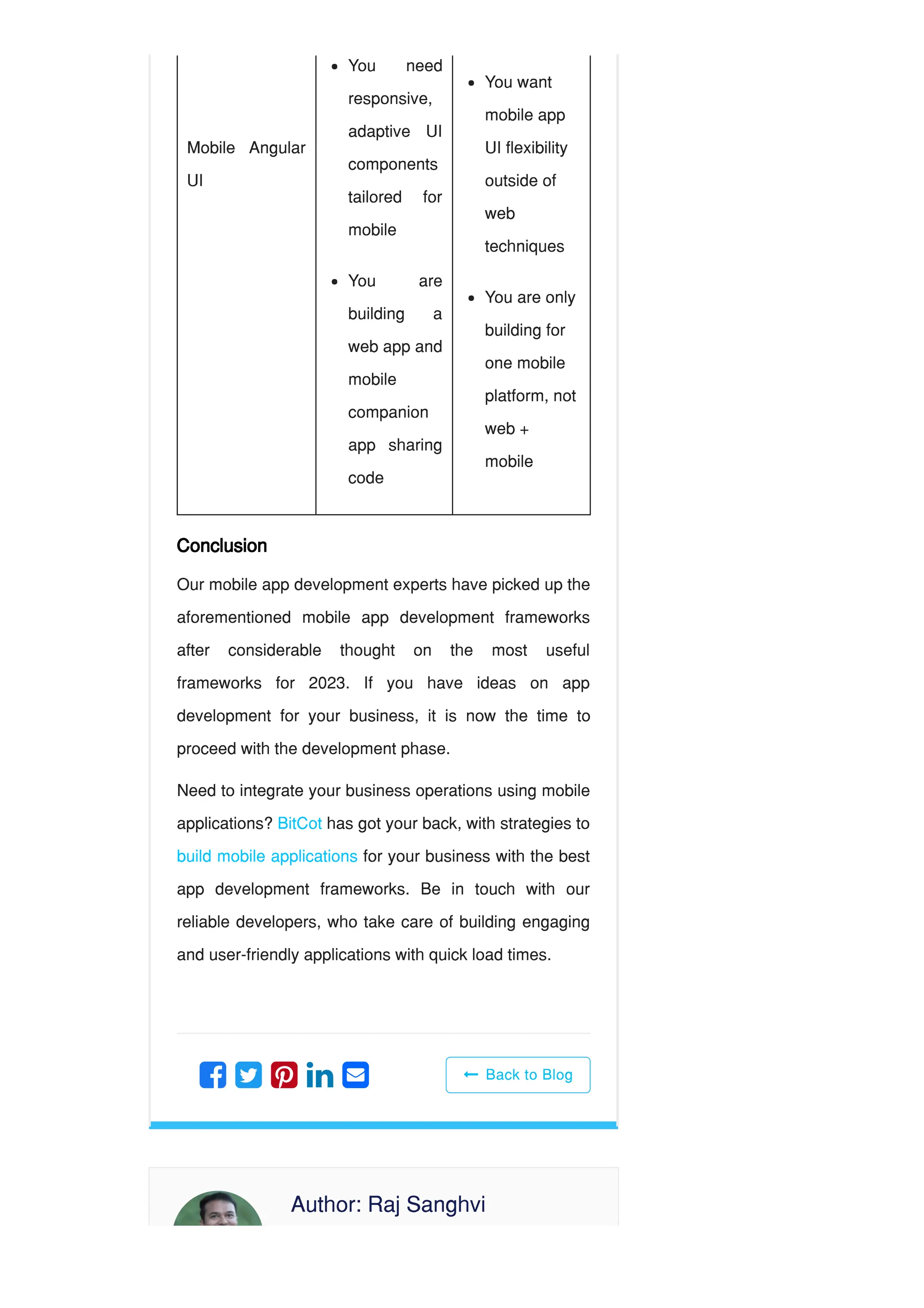
Mobile Angular
UI
Conclusion
Our mobile app development experts have picked up the
aforementioned mobile app development frameworks
after considerable thought on the most useful
frameworks for 2023. If you have ideas on app
development for your business, it is now the time to
proceed with the development phase.
Need to integrate your business operations using mobile
applications? BitCot has got your back, with strategies to
build mobile applications for your business with the best
app development frameworks. Be in touch with our
reliable developers, who take care of building engaging
and user-friendly applications with quick load times.
 Back to Blog
You need
responsive,
adaptive UI
components
tailored for
mobile
You are
building a
web app and
mobile
companion
app sharing
code
You want
mobile app
UI flexibility
outside of
web
techniques
You are only
building for
one mobile
platform, not
web +
mobile
    
Author: Raj Sanghvi
 Previous Post Next Post 
Read More Blogs
Raj Sanghvi is a technologist and founder of
BitCot, a full-service award-winning software
development company. With over 15 years of
innovative coding experience creating
complex technology solutions for businesses
like IBM, Sony, Nissan, Micron, Dicks Sporting
Goods, HDSupply, Bombardier and more,
Sanghvi helps build for both major brands and
entrepreneurs to launch their own
technologies platforms.
Visit Raj Sanghvi on LinkedIn and follow him on
Twitter. View Full Bio
Web Applications
How to Build a Scalable Web Application for Your Project
If you’ve ever had to deal with a poorly constructed web
application or been unlucky enough to be saddled with…
Raj Sanghvi November 29, 2023
Web Applications, Web Development
What is the Difference Between Web Application and
Website?
Deciding between a website or web application depends
significantly on your specific goals and target features.…
Raj Sanghvi November 28, 2023
Web Applications
15 Best Web Application Design Examples for Inspiration
Web app design is a critical aspect of creating engaging
and intuitive user experiences. In today’s…
Raj Sanghvi November 23, 2023
Web Development
Full Stack Development
AngularJS Development
NodeJS Development
PHP Development
ReactJS Development
WooCommerce Development
Shopify Development
SaaS Development
App Development
Mobile App Development
iOS App Development
Android App Development
Hybrid App Development
Ruby on Rails Development
Apple tvOS App Development
React Native App Development
Flutter App Development
Ofce(s)
San Diego HQ:
16870 W Bernardo,
Dr #400, San Diego,
CA 92127, United States
Follow Us
  
See map 
 support@bitcot.com
 +1 858-683-3692
Š 2023 BITCOT INC.
About Us Testimonials Areas We Serve Blog Careers
News Room Contact Privacy Sitemap

Top 10 Mobile App Development Frameworks in 2023

  • 1.
    Home / Blog/ Top 10 Mobile App Development Frameworks in 2023 Top 10 Mobile App Development Frameworks in 2023 November 18, 2023 You are back from the office, watching your favorite movie on Netflix, feel tired, and quickly order your dinner from your favorite restaurant through Uber Eats– within minutes, the yummy food arrives at your doorsteps! This is a glance at how a mobile app-dependent life has transformed the way we live in this Internet-driven world. Ever wondered what processes contribute to the development of mobile applications that make your life comfortable? Thousands of mobile app development frameworks play behind the scenes to get you everything at your fingertips. By 2023, the mobile app development market will reach $130 billion with a 14% CAGR. Let’s take a deep dive into the best mobile app development frameworks and their specific uses in this blog post. What is a Mobile App Framework? Mobile applications are great ways to help companies grow their customer base. To create an app, you no more require complex programming languages. Many   Call  Get a quote A- A+ Close Font Resize Reset font size Enable Readable Font Enable contrast mode Choose color Underline links mode Highlight links Clear Cookies Enable Invert Colors & Images Accessibility by WAH
  • 2.
    app development frameworksfor Android and iOS exist to make the app development process quick. A mobile app framework is a platform that comprises software, compilers, programming interfaces, and debugging tools to build applications. A developer uses a framework to aid the development of applications for specific devices and ecosystems. Mobile app Frameworks fall into three core categories: Native frameworks that focus on platform-specific app development, mobile web app frameworks, as well as hybrid apps that combine the properties of the two frameworks. Types of Mobile Application Frameworks 1. Native Apps Native app development creates applications exclusively for specific mobile operating systems (iOS or Android) using platform-native languages like Flutter, React Native, Ionic, or Kotlin. Known for high performance and seamless user experiences, native apps fully utilize device capabilities. However, they require separate development for each platform, increasing time and cost. 2. Web Apps Web apps are mobile-optimized websites accessed through a browser, eliminating the need for downloads or installations. Built with standard web technologies (HTML, CSS, JavaScript), they offer cross-platform compatibility but may have performance and feature limitations compared to native apps. 3. Hybrid Apps Hybrid apps blend native and web elements, utilizing web technologies (HTML, CSS, JavaScript) within a native container for installation. Offering cost- effectiveness and streamlined cross-platform
  • 3.
    deployment, hybrid appsaim to balance web development advantages with native app performance. However, they may not match the performance level of fully native apps. Each type of mobile app development framework has its advantages and considerations. The choice of framework depends on factors such as project requirements, target audience, budget, development timeline, and desired app performance. It’s important to carefully evaluate these factors to select the most suitable framework for your mobile app development project. Why should you use a framework? The framework gives you confidence in developing an app that adheres to the business specifications— structured, upgradable, and maintainable. The developer doesn’t have to worry about how to create a mobile app or work for days on the development of generic components. With the time saved, more specific components can be looked into, to build a quality-centric and sustainable code. The framework works around the longevity of the applications you use. It gives the developer the capability to make an application and maintain and upgrade it neatly. Mobile app frameworks contribute to your business with the following advantages: Developers can use a piece-by-piece allocation of work with the framework componentization. Design reusability that triggers the quality of code and ensures reduced app development costs. Customization to implement the needs of the business.
  • 4.
    Things to checkbefore choosing a mobile app development framework One usual question that revolves around the minds of businesses would be ‘Which is the best framework for mobile app development?’ To choose the best mobile app development framework, you should consider the following elements: Design and User Interface Before you choose a mobile app development framework, you need to think about the user interface. With a framework, the developers can easily consider the business needs and choose the ideal UI parameters. Mobile app development partner Many vendors offer framework and assistance to key you to build the applications. However, it is safe when you fetch the most reliable and top mobile app development company that can bring a desirable impact to your business. Open/closed Ecosystem Various platforms exist from which you can choose to use while developing the mobile app. You might need a platform that is convenient and flexible in terms of performance and ease of use. Based on the business functionalities you can opt for an open or closed ecosystem. Team of experts An app development process is complete only with an expert staff and skilled personnel. It is crucial to go for a framework that the existing team can handle without any Encapsulation process that offers security and helps the access of control components. Rapid app development with predefined interactions among various classes to form templates.
  • 5.
    risks. Mobile appdevelopers also should be able to find the best ways to make the monetization of mobile apps possible. Now, let’s refocus and explore a variety of prominent Mobile App Development Frameworks in 2023 designed to enhance the efficiency and convenience of building mobile applications. List of Top Mobile App Development Frameworks in 2023 Here are cutting-edge mobile application development frameworks that prove beneficial for users on both Android and iOS platforms. #1 Flutter Flutter is an open-source framework from Google, which helps to develop the native iOS and Android apps with a single codebase. They extend cross-platform app development to give a unique feel to the apps. With an unparalleled and reliable UI framework, Flutter speeds up the app development process. It includes rendering engine, widgets, testing, and integrating APIs to assist developers in building visually pleasing mobile apps. The apps that use Flutter include those from Google and Alibaba. Framework When to use When not to use
  • 6.
    Flutter #2 React Native ReactNative is an open-source framework from Facebook and remains the top choice of developers for cross-platform app development. With React native, you can seamlessly develop both iOS and Android mobile apps. React Native includes component-specific GUI development to build front-end apps, third-party plugin integration, reusable components, etc. The brands like Amazon Prime, Airbnb, and Skype use React Native framework. When you need to use a single codebase For a faster and manageable debugging process If you wish to save money, time, and effort on app development Not ideal for applications and games for specific device functions If you look for light weighed apps If the developers deal with already known languages since Flutter demands new programming language
  • 7.
    Framework When touse When not to use React Native #3 Xamarin This is an open-source framework that helps the development of high-performing iOS, Android, watchOS, and tvOS apps. The framework lets businesses offer native performance through C# and .NET programming languages. It helps developers to create an ecosystem that includes back ends, APIs, components, etc. with programming languages, libraries, and tools that an active community supports. When a developer needs to view code changes instantly When you need to use the existing developer team When you need a time saver framework with readymade components for the process If you need an easy testing process, the framework makes it challenging. If you wish to build complex applications, debugging could be hard
  • 8.
    Framework When touse When not to use Xamarin #4 Swiftic This is a Do-It-Yourself mobile app platform that makes it effortless for every business to develop applications specifically for the company. Swiftic lets the programmers integrate the existing material from the Web instead of beginning from scratch, to streamline the app development process. This robust mobile app development framework offers a high-end user experience with features like push notifications, app advertising, and other technological advancements. Being one of the simplest solutions for mobile app development, it lets you create, launch, and expand the app utilizing a centralized control panel. Build even UI for all platforms Near-native app experience To share codebase across all platforms Developers not aware of the native languages i.e.; Java & Kotlin (Android), Objective C (iOS) If you look for inexpensive options If you require low space app sizes
  • 9.
    Framework When touse When not to use Swiftic #5 Ionic Built using Apache Cordova and Angular, Ionic is an open-source framework that lets developers build iOS and Android apps. The significant benefit of Ionic is that it assists developers in using various UI elements like forms, filters, views, actions sheets, navigation menus, etc. in the application design. This is an end-to-end framework that helps developers to enjoy the benefits of Progressive Web Apps (PWAs), cross-platform mobile applications, and hybrid mobile applications. When you need free building access, with pay to launch If you need an Apple App Store assistance For an intuitive system that consists of app scheduling, app order, and advanced analytics If you search for team management login feature If you expect API and other advanced features, they are missing
  • 10.
    Framework When touse When not to use Ionic #6 Jquery Mobile Being a hybrid mobile app development framework, it aids the development of apps, generally platforms independently. It uses HTML and JavaScript libraries to build responsive sites that operate on various tablets, smartphones, etc. It uses the HTML5-based framework and unique Theme Roller for custom theme development that triggers mobile & web applications. There are both stable and customized versions available for JQuery Mobile. Framework When to use When not to use If you look for a time and cost saving framework To work on the Ionic apps only When you have less workforce for mobile app development When you need a high performing app compared to native apps If you wish great graphics processing To write clean & unique code Custom
  • 11.
    JQuery Mobile #7 NativeScript NativeScriptis a versatile cross-platform mobile app development framework that enables developers to create native applications for both iOS and Android using familiar web technologies like JavaScript and TypeScript. With seamless integration of frameworks such as Angular and Vue.js, it offers direct access to native APIs, ensuring optimal performance and a native user experience for diverse mobile applications. Framework When to use When not to use for cross platform and cross device If you need to build themes with no lines of code To make development easy with HTML5 and JavaScript designs that need complex overwriting tasks If you need a fast- performing app compared to native mobile apps You need to build truly native iOS and Android apps with maximum performance You want You need fully customizable UI code and do not use Angular or Vue Your app uses
  • 12.
    NativeScript #8 Kotlin Kotlin isa modern and concise programming language used for mobile app development. Endorsed by Google for Android development, Kotlin offers interoperability with Java, making it seamless for developers to transition. Known for its conciseness and reduced boilerplate code, Kotlin enhances productivity. With strong type inference and null safety, it provides a robust foundation for building efficient, scalable, and maintainable mobile applications on the Android platform. Framework When to use When not to use native look and feel without writing Objective-C or Java code You need access to native APIs and device capabilities many platform- specific SDKs or third-party libraries You want to reuse large amounts of existing Swift/Objective- C or Java code You are targeting Android and want to use a modern language with full Java compatibility Platform agnostic code sharing is a priority over Android specificity You need extensive
  • 13.
    Kotlin #9 Apache Cordova ApacheCordova simplifies mobile app development by enabling the use of standard web technologies—HTML, CSS, and JavaScript. This open-source framework allows developers to create cross-platform applications, eliminating the need for separate codebases. With a single codebase, Cordova supports various platforms, including iOS and Android, facilitating streamlined development. Its versatility and accessibility make it an excellent choice for building hybrid mobile applications with a consistent user experience across different devices. Framework When to use When not to use You want to leverage Kotlin extensions for faster Android development You want coroutines for asynchronous programming low-level programming control You want maximized runtime performance over developer productivity You want to build cross- platform apps with web languages like HTML, CSS and JavaScript Native look and feel is a priority over cross- platform flexibility You need highly complex
  • 14.
    Apache Cordova #10 Mobile AngularUI Mobile Angular UI is a dynamic mobile app development framework based on AngularJS. It streamlines the creation of responsive and feature-rich mobile applications by offering a set of customizable UI components. With seamless integration with Bootstrap and AngularJS, developers can effortlessly design visually engaging interfaces. This framework prioritizes performance, delivering a smooth and interactive user experience on mobile devices, making it a valuable tool for building modern and engaging mobile applications. Framework When to use When not to use Your budget is limited and you prioritize fast development You want access to device hardware like camera, GPS, etc. or graphic- intensive application interfaces Your app requires maximum speed and real- time responsiveness You want to build mobile apps with Angular and web technologies You need native mobile performance and device access
  • 15.
    Mobile Angular UI Conclusion Our mobileapp development experts have picked up the aforementioned mobile app development frameworks after considerable thought on the most useful frameworks for 2023. If you have ideas on app development for your business, it is now the time to proceed with the development phase. Need to integrate your business operations using mobile applications? BitCot has got your back, with strategies to build mobile applications for your business with the best app development frameworks. Be in touch with our reliable developers, who take care of building engaging and user-friendly applications with quick load times.  Back to Blog You need responsive, adaptive UI components tailored for mobile You are building a web app and mobile companion app sharing code You want mobile app UI flexibility outside of web techniques You are only building for one mobile platform, not web + mobile      Author: Raj Sanghvi
  • 16.
     Previous PostNext Post  Read More Blogs Raj Sanghvi is a technologist and founder of BitCot, a full-service award-winning software development company. With over 15 years of innovative coding experience creating complex technology solutions for businesses like IBM, Sony, Nissan, Micron, Dicks Sporting Goods, HDSupply, Bombardier and more, Sanghvi helps build for both major brands and entrepreneurs to launch their own technologies platforms. Visit Raj Sanghvi on LinkedIn and follow him on Twitter. View Full Bio Web Applications How to Build a Scalable Web Application for Your Project If you’ve ever had to deal with a poorly constructed web application or been unlucky enough to be saddled with… Raj Sanghvi November 29, 2023 Web Applications, Web Development What is the Difference Between Web Application and
  • 17.
    Website? Deciding between awebsite or web application depends significantly on your specific goals and target features.… Raj Sanghvi November 28, 2023 Web Applications 15 Best Web Application Design Examples for Inspiration Web app design is a critical aspect of creating engaging and intuitive user experiences. In today’s… Raj Sanghvi November 23, 2023 Web Development Full Stack Development AngularJS Development NodeJS Development PHP Development ReactJS Development WooCommerce Development Shopify Development SaaS Development App Development Mobile App Development iOS App Development Android App Development Hybrid App Development Ruby on Rails Development Apple tvOS App Development React Native App Development Flutter App Development
  • 18.
    Office(s) San Diego HQ: 16870W Bernardo, Dr #400, San Diego, CA 92127, United States Follow Us    See map   support@bitcot.com  +1 858-683-3692 © 2023 BITCOT INC. About Us Testimonials Areas We Serve Blog Careers News Room Contact Privacy Sitemap