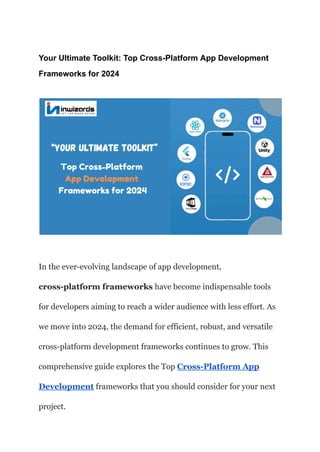
Your Ultimate Toolkit: Top Cross-Platform App Development
Frameworks for 2024
In the ever-evolving landscape of app development,
cross-platform frameworks have become indispensable tools
for developers aiming to reach a wider audience with less effort. As
we move into 2024, the demand for efficient, robust, and versatile
cross-platform development frameworks continues to grow. This
comprehensive guide explores the Top Cross-Platform App
Development frameworks that you should consider for your next
project.
Introduction to Cross-Platform App Development
Cross-platform app development refers to the practice of creating
applications that can run on multiple operating systems, such as
iOS, Android, and Windows, using a single codebase. This approach
offers several benefits, including reduced development time and
cost, as well as a consistent user experience across different devices.
Why Choose Cross-Platform Development?
Choosing cross-platform development over native development can
save time and resources while still delivering high-quality
applications. Some key benefits include:
● Cost Efficiency: Develop once, deploy everywhere.
● Faster Time to Market: Simultaneous deployment
across multiple platforms.
● Uniform User Experience: Consistent look and feel
across all devices.
● Easier Maintenance: Single codebase means easier
updates and bug fixes.
Key Features to Look for in a Framework
When selecting a cross-platform development framework, consider
the following features:
● Performance: Should offer near-native performance.
● Flexibility: Support for various third-party libraries and
plugins.
● Community Support: Active community for
troubleshooting and updates.
● Ease of Use: Developer-friendly with comprehensive
documentation.
1. Flutter
Flutter, developed by Google, has gained immense popularity due
to its fast development cycles and expressive UI components. It uses
the Dart programming language and offers a rich set of
pre-designed widgets.
Key Features:
● Hot Reload: Instantly view changes without restarting
the app.
● Rich Widgets: Extensive library of customizable widgets.
● Performance: Near-native performance with a single
codebase.
2. React Native
React Native, created by Facebook, allows developers to build
mobile applications using JavaScript and React. It’s known for its
strong community support and reusable components.
Key Features:
● Reusable Components: Write once, use everywhere.
● Third-Party Plugins: Wide range of plugins for
enhanced functionality.
● Hot Reloading: Quick testing and debugging.
3. Xamarin
Xamarin, owned by Microsoft, enables developers to build
Android and iOS apps using C#. It integrates well with the .NET
ecosystem and offers a high degree of code reuse.
Key Features:
● Native Performance: Access to native APIs and
performance.
● Shared Codebase: Up to 90% code reuse across
platforms.
● Strong Support: Backed by Microsoft with extensive
documentation.
4. Ionic
Ionic is a popular choice for developing hybrid mobile apps using
web technologies like HTML, CSS, and JavaScript. It provides a
library of mobile-optimized UI components.
Key Features:
● Web Standards: Built on open web technologies.
● Cross-Platform: Supports Android, iOS, and PWAs.
● Comprehensive Documentation: Extensive resources
and community support.
5. PhoneGap
PhoneGap, now known as Apache Cordova, allows developers to
use HTML5, CSS3, and JavaScript to create mobile apps. It’s
well-suited for simple apps that require basic functionality.
Key Features:
● Open Source: Completely free and open-source.
● Plugins: Large library of plugins for additional features.
● Ease of Use: Simple setup and development process.
6. NativeScript
NativeScript is an open-source framework that allows developers
to build native iOS and Android apps using JavaScript, TypeScript,
or Angular.
Key Features:
● Native Performance: Access to native APIs and
components.
● Flexibility: Use Angular, Vue.js, or plain JavaScript.
● Extensibility: Easily extend functionality with plugins.
7. Qt
Qt is a robust framework for building cross-platform applications
with C++. It’s known for its performance and support for a wide
range of platforms.
Key Features:
● High Performance: Optimized for speed and efficiency.
● Cross-Platform: Supports desktop, mobile, and
embedded systems.
● Rich Libraries: Extensive set of libraries and tools.
8. Unity
Unity is a leading game development engine that also supports the
creation of non-gaming apps. It uses C# and offers a rich
development environment.
Key Features:
● Versatility: Ideal for both games and non-gaming apps.
● Graphics: Advanced graphics capabilities.
● Community: Large and active developer community.
9. Corona SDK
Corona SDK is a cross-platform framework specializing in 2D
game development but also suitable for app development. It uses
the Lua scripting language.
Key Features:
● Ease of Use: Simple syntax and easy learning curve.
● Performance: High-performance graphics engine.
● Plugins: Wide range of plugins for additional
functionality.
10. Appcelerator Titanium
Appcelerator Titanium allows developers to create native apps
using JavaScript. It offers a comprehensive set of APIs and supports
real-time analytics.
Key Features:
● Native Code: Compiles JavaScript to native code.
● APIs: Extensive API support for native functionality.
● Analytics: Real-time analytics for app performance
tracking.
11. Codename One
Codename One is designed to provide a native user experience
while using a single Java codebase. It supports a wide range of
platforms including iOS, Android, Windows, and more.
Key Features:
● Java-Based: Develop in Java and deploy across
platforms.
● Speed: Fast development cycles.
● Extensive Tools: Comprehensive set of development
tools.
Looking for leading Software Development Company to
develop software? Consult Inwizards Technology.
Conclusion
In 2024, cross-platform app development frameworks are more
powerful and versatile than ever before. Whether you are a
seasoned developer or just starting, choosing the right framework
can significantly impact your project’s success. From Flutter’s rich
widgets to React Native’s reusable components, and Xamarin’s
seamless integration with .NET, each framework offers unique
advantages. Consider your project’s specific needs, the preferred
programming language, and the required features to select the best
framework for your development journey.
Contact Inwizards today for a free consultation and let’s discuss
how we can help you build your next game-changing cross-platform
app.

Your Ultimate Toolkit: Top Cross-Platform App Development Frameworks for 2024

  • 1.
    Your Ultimate Toolkit:Top Cross-Platform App Development Frameworks for 2024 In the ever-evolving landscape of app development, cross-platform frameworks have become indispensable tools for developers aiming to reach a wider audience with less effort. As we move into 2024, the demand for efficient, robust, and versatile cross-platform development frameworks continues to grow. This comprehensive guide explores the Top Cross-Platform App Development frameworks that you should consider for your next project.
  • 2.
    Introduction to Cross-PlatformApp Development Cross-platform app development refers to the practice of creating applications that can run on multiple operating systems, such as iOS, Android, and Windows, using a single codebase. This approach offers several benefits, including reduced development time and cost, as well as a consistent user experience across different devices. Why Choose Cross-Platform Development? Choosing cross-platform development over native development can save time and resources while still delivering high-quality applications. Some key benefits include: ● Cost Efficiency: Develop once, deploy everywhere. ● Faster Time to Market: Simultaneous deployment across multiple platforms. ● Uniform User Experience: Consistent look and feel across all devices. ● Easier Maintenance: Single codebase means easier updates and bug fixes.
  • 3.
    Key Features toLook for in a Framework When selecting a cross-platform development framework, consider the following features: ● Performance: Should offer near-native performance. ● Flexibility: Support for various third-party libraries and plugins. ● Community Support: Active community for troubleshooting and updates. ● Ease of Use: Developer-friendly with comprehensive documentation. 1. Flutter Flutter, developed by Google, has gained immense popularity due to its fast development cycles and expressive UI components. It uses the Dart programming language and offers a rich set of pre-designed widgets.
  • 4.
    Key Features: ● HotReload: Instantly view changes without restarting the app. ● Rich Widgets: Extensive library of customizable widgets. ● Performance: Near-native performance with a single codebase. 2. React Native React Native, created by Facebook, allows developers to build mobile applications using JavaScript and React. It’s known for its strong community support and reusable components. Key Features: ● Reusable Components: Write once, use everywhere. ● Third-Party Plugins: Wide range of plugins for enhanced functionality. ● Hot Reloading: Quick testing and debugging.
  • 5.
    3. Xamarin Xamarin, ownedby Microsoft, enables developers to build Android and iOS apps using C#. It integrates well with the .NET ecosystem and offers a high degree of code reuse. Key Features: ● Native Performance: Access to native APIs and performance. ● Shared Codebase: Up to 90% code reuse across platforms. ● Strong Support: Backed by Microsoft with extensive documentation. 4. Ionic Ionic is a popular choice for developing hybrid mobile apps using web technologies like HTML, CSS, and JavaScript. It provides a library of mobile-optimized UI components.
  • 6.
    Key Features: ● WebStandards: Built on open web technologies. ● Cross-Platform: Supports Android, iOS, and PWAs. ● Comprehensive Documentation: Extensive resources and community support. 5. PhoneGap PhoneGap, now known as Apache Cordova, allows developers to use HTML5, CSS3, and JavaScript to create mobile apps. It’s well-suited for simple apps that require basic functionality. Key Features: ● Open Source: Completely free and open-source. ● Plugins: Large library of plugins for additional features. ● Ease of Use: Simple setup and development process.
  • 7.
    6. NativeScript NativeScript isan open-source framework that allows developers to build native iOS and Android apps using JavaScript, TypeScript, or Angular. Key Features: ● Native Performance: Access to native APIs and components. ● Flexibility: Use Angular, Vue.js, or plain JavaScript. ● Extensibility: Easily extend functionality with plugins. 7. Qt Qt is a robust framework for building cross-platform applications with C++. It’s known for its performance and support for a wide range of platforms. Key Features: ● High Performance: Optimized for speed and efficiency.
  • 8.
    ● Cross-Platform: Supportsdesktop, mobile, and embedded systems. ● Rich Libraries: Extensive set of libraries and tools. 8. Unity Unity is a leading game development engine that also supports the creation of non-gaming apps. It uses C# and offers a rich development environment. Key Features: ● Versatility: Ideal for both games and non-gaming apps. ● Graphics: Advanced graphics capabilities. ● Community: Large and active developer community. 9. Corona SDK Corona SDK is a cross-platform framework specializing in 2D game development but also suitable for app development. It uses the Lua scripting language.
  • 9.
    Key Features: ● Easeof Use: Simple syntax and easy learning curve. ● Performance: High-performance graphics engine. ● Plugins: Wide range of plugins for additional functionality. 10. Appcelerator Titanium Appcelerator Titanium allows developers to create native apps using JavaScript. It offers a comprehensive set of APIs and supports real-time analytics. Key Features: ● Native Code: Compiles JavaScript to native code. ● APIs: Extensive API support for native functionality. ● Analytics: Real-time analytics for app performance tracking.
  • 10.
    11. Codename One CodenameOne is designed to provide a native user experience while using a single Java codebase. It supports a wide range of platforms including iOS, Android, Windows, and more. Key Features: ● Java-Based: Develop in Java and deploy across platforms. ● Speed: Fast development cycles. ● Extensive Tools: Comprehensive set of development tools. Looking for leading Software Development Company to develop software? Consult Inwizards Technology. Conclusion In 2024, cross-platform app development frameworks are more powerful and versatile than ever before. Whether you are a seasoned developer or just starting, choosing the right framework
  • 11.
    can significantly impactyour project’s success. From Flutter’s rich widgets to React Native’s reusable components, and Xamarin’s seamless integration with .NET, each framework offers unique advantages. Consider your project’s specific needs, the preferred programming language, and the required features to select the best framework for your development journey. Contact Inwizards today for a free consultation and let’s discuss how we can help you build your next game-changing cross-platform app.